The United States is pressing Sudan to establish diplomatic relations with Israel in return for removal of the Northeast African country from a US list of states that sponsor terrorism.
Three Sudanese government officials familiar with the matter, however, told Reuters news agency on Thursday that Khartoum is resisting the linkage of the two issues.
“Sudan has completed all the necessary conditions” an official said on condition of anonymity. “We expect to be removed from the list soon.”
Back in 1993, the US designated Sudan as a state sponsor of terrorism, cutting it off from financial markets and strangling its economy over allegations that the government of former longtime leader Omar al-Bashir was supporting “terrorism.”
Sudan’s interim government took power last year after Bashir was overthrown by the army following mass popular protests. It is set to remain in office until elections in 2022.
Sudanese officials argue that their country’s designation as a state sponsor of terrorism is now undeserved as Bashir’s regime has been toppled, and Sudan has cooperated with the US on counter-terrorism ever since.
Earlier this week, US officials indicated during talks with Chairman of the Sovereignty Council of Sudan, General Abdel Fattah al-Burhan, that they want Khartoum to follow the United Arab Emirates (UAE) and Bahrain in establishment of ties with the Tel Aviv regime.
“Sudan made clear to the American side that there is no relationship between removing Sudan from the terror list and exploring relations with Israel,” another Sudanese government source stated.
Even if a normalization deal is struck between Sudan and Israel, the US Congress must still pass a necessary legislation to restore Sudan’s sovereign immunity.
Sudan wants the legislation passed before it reaches a $335 million financial settlement with victims of al-Qaeda terror attacks on US embassies in Kenya and Tanzania in 1998.
Sudan’s lawyers in the United States said it had already paid an additional $72 million to victims of the families of 17 US sailors, who were killed during an attack on the USS Cole while it was docked in Yemen’s Aden Port in 2000. The attack was apparently sponsored by slain al-Qaeda founder Osama bin Laden who was living in Sudan prior to the attack.
“We want to ensure the passing of the immunity law so that we can put an end to the settlements matter,” a Sudanese official said.
In February, Sudan’s ruling council head Abdel-Fattah al-Burhan met with Israeli prime minister Benjamin Netanyahu in Uganda, sparking anger among politicians and public at home, where anti-Israel and pro-Palestine sentiments run high.
Sudan has been widely tipped to be the next Arab country that would normalize ties with Israel after the UAE and Bahrain agreed to do so as part of US-brokered agreements.
Netanyahu signed agreements with Emirati Foreign Minister Sheikh Abdullah bin Zayed Al Nahyan and Bahrain’s Foreign Minister Abdullatif Al Zayani during an official ceremony hosted by US President Donald Trump at the White House on September 15.
Palestinians, who seek an independent state in the occupied West Bank and Gaza, with East Jerusalem al-Quds as its capital view the deals as betrayal of their cause.
Palestinian President Mahmoud Abbas protested the normalization deals with Israel, saying they will be fruitless as long as the United States and the Israeli regime do not recognize the rights of the Palestinian nation and refuse to resolve the issue of Palestinian refugees.
Kuwait reiterates unswerving support for Palestinian cause, nation
Meanwhile, Kuwaiti Prime Minister Sheikh Sabah al-Khalid Al Sabah highlighted on Friday that his country firmly supports Palestinians in their struggle to achieve their inalienable rights and to establish an independent sovereign state with Jerusalem al-Quds as its capital.
Addressing the General Debate of the 75th Session of the United Nations General Assembly, Sabah emphasized that “the Palestinian cause still has a central, historical and pivotal place in our Arab and Muslim worlds.”
He noted that Kuwait’s principled and firm position is to support the Palestinian people in their struggle to obtain their legitimate rights.
The Kuwaiti prime minister then underscored the significance of resumption of so-called peace negotiations between Palestinians and the Israeli regime, stating that the talks should bring an end to the Israeli occupation and lead to creation of an independent Palestinian state on the borders before June 4, 1967, with East Jerusalem al-Quds as its capital.
Bahraini regime forces arrest poet critical of normalization with Israel
Separately, Bahraini regime forces have arrested a literary figure after he criticized the tiny Persian Gulf kingdom’s normalization with the Israeli regime.
Bahraini activists said the forces arrested the poet Abdul Hussein Ahmed Ali, days after he published a poem in condemnation of the deal, the Arabic-language Bahrain Mirror news website reported.
“I am not flattering to those who speak this day … Let them hear my words far and wide … Bahrainis are proud, honorable and noble, and do not accept the pledge of allegiance to a criminal and a perpetrator,” a part of the poem read.
Iran is estimated to have exported nearly 1.5 million barrels per day (bpd) of crude oil and condensate so far in September, TankerTrackers told Reuters, in what would be the highest level of Iranian exports in a year and a half and double the observed exports in August.
Two other tanker-tracking firms have also seen an increase in Iranian oil exports so far in September, although not as much as TankerTrackers.com has found, according to Reuters.
Since the U.S. imposed sanctions on Iran’s oil industry and exports in May 2018, the Islamic Republic has been using various tactics to ship crude abroad without being detected, including by tankers switching off transponders or documents stating the oil does not originate from Iran.
Iran’s Oil Minister Bijan Zanganeh said earlier this week that “America has waged a war against Iran with no blood,” referring to the sanctions on Iran’s oil.
Iran continues to export oil in defiance of the U.S. sanctions, and it seems to have recently increased its oil exports despite the fact that official figures still put the shipments at very low levels.
China, for example, the world’s largest oil importer, is likely receiving much more oil from Iran than the official figures report, according to various reports, media investigations, and tanker-tracking firms.
According to the data, Iran was exporting as much as 600,000 bpd, using ship-to-ship transfers with transponders turned off to avoid detection, skirting U.S. sanctions. The daily average number compares with an estimate of 227,000 bpd made in a U.S. Congressional report, NBC’s Raf Sanchez wrote on Twitter.
Last year, a U.S. State Department official told the media that the department was tracking ship-to-ship transfers and was working with other governments to ensure that they, too, were tracking such moves that became one of few ways for Iran to still get its crude to foreign markets.
Lebanon’s Prime Minister-designate Mustapha Adib has announced his resignation amid a deadlock over government formation in the crisis-hit country.
In a televised address on Saturday, Adib said he was stepping down from “the task of forming the government” following a meeting with Lebanese President Michel Aoun.
He also noted that the kind of cabinet that he wanted to establish “was bound to fail” and that he was keen on protecting national unity.
“I apologize to the Lebanese people,” he added.
The announcement came almost a month after Adib, former Lebanese ambassador to Berlin, was appointed by the president to form a new government.
Lebanon is currently mired in the country’s worst economic and financial crisis in its modern history.
It has been waiting for a new administration since outgoing Prime Minister Hassan Diab resigned on August 10, a few days after a powerful explosion in the capital killed more than nearly 200 people, injured thousands and caused losses worth billions of dollars.
The blast took place in Beirut port warehouses storing highly explosive material, specifically ammonium nitrate, commonly used in both fertilizer and bombs.
The explosion — one of the biggest non-nuclear explosions the world has ever seen — flattened much of the strategic port and left buildings in ruin.
Following the blast, the US and European countries have been mounting pressure on Lebanese officials to form a government that secures the West’s interests.
The United States on September 8 slapped sanctions on two former cabinet ministers in Lebanon over support for Hezbollah as it vowed to isolate the resistance movement.
French President Emmanuel Macron paid two visits to Lebanon, where he called for a “new political pact” among Lebanese political factions and said he had proposed a roadmap to authorities to unlock billions of dollars in funds from the international community.
In a meeting with Aoun, Macron threatened Lebanese leaders with sanctions if they do not submit to reforms and a “political change,” Lebanon’s Arabic-language al-Mayadeen television news network reported.
The French president’s colonial-style sojourn sparked a swift backlash among the Lebanese nation.
Many Twitter users denounced what they deemed as interference in the internal affairs of Lebanon, which gained independence from the French colonial rule more than seven decades ago.
Emirati companies have signed contracts with Israeli firms and banks blacklisted by the United Nations (UN) for supporting illegal settlements in the occupied West Bank, an investigation by Anadolu Agency revealed on Wednesday.
However, Anadolu Agency found that some of the deals struck between the two sides included Israeli companies and banks on the UN blacklist.
Pro-settlement banks
Among the contracts announced by Emirati media was one struck with Bank Leumi, one of the banks on the UN blacklist.
According to official Emirati media, this Israeli bank has signed agreements with three of the top Emirati banks: Abu Dhabi Islamic Bank (ADIB), First Abu Dhabi Bank and Emirates NBD.
Bank Hapoalim, another Israeli bank blacklisted by the UN, has reportedly signed a memorandum of understanding with Emirates NBD, an agreement celebrated as the first between Israeli and Emirati bankers, according to Emirati media outlets.
Film production companies
The agreements that UAE companies have signed with blacklisted Israeli companies were not limited to banks. The Abu Dhabi Film Commission (ADFC) announced that it has reached an agreement with the Israel Film Fund (IFF) and the Jerusalem Sam Spiegel Film & Television School (JSFS), for promoting tolerance and cultural cooperation between the Emirati and Israeli people.
The IFF is supervised by the Israeli Ministry of Culture and the Israel Film Council.
In November 2019, Israeli newspaper Haaretz announced that the IFF approved the establishment of three new cinema funds, including one in the occupied West Bank settlements.
Many international companies have suspended their dealings with their Israeli counterparts on the UN blacklist for fear of being prosecuted by the International Criminal Court (ICC). The ICC is expected to soon decide on launching a criminal investigation into alleged war crimes committed by Israel in the occupied Palestinian territories.
Palestinians have long called for an immediate halt of dealings with the blacklisted Israeli companies.
Statements by the US chief arms control envoy make it clear the US is committed to a nuclear arms race free of the encumbrance of the New START treaty. However, it’s a race the US cannot win, and the world will not survive.
In a fable attributed to the Ancient Greek fabulist and storyteller Aesop, a scorpion and a frog meet at the bank of a river. The scorpion asks the frog to take him to the other side. The frog turns down the scorpion’s request, noting that the scorpion will sting him halfway across and kill him. The scorpion replies that to do so would mean both would die, and, as such, that would be illogical. The frog agrees to take the scorpion across. As he feared, the scorpion stings him, sending them both to their death. Before he goes under, the frog asks the scorpion why he did so, to which the scorpion replies, “It’s in my nature.”
I use this fable in the introduction of my book ‘Scorpion King: America’s Suicidal Embrace of Nuclear Weapons from FDR to Trump’. It was published this past spring, when there was still hope the current administration might embrace reason and agree to a five-year extension of the last remaining arms control treaty in force, New START, that constrained the nuclear ambitions of the United States and Russia.
Recent statements made by Marshall Billingslea, the US special presidential envoy for arms control in an interview with the Russian newspaper Kommersant have made it clear that the Trump administration has no intention of seeking an extension to New START, which is set to expire in February 2021.
First off, Billingslea stated that the US isn’t looking for the automatic five-year extension provided for under the treaty, but rather a “memorandum of intent” of less than five years duration that presents the Russians with a “take it or leave it” proposition: accept a deal that has no constraints on NATO nuclear weapons, or the US will go forward with a nuclear modernization program unconstrained by arms control agreements. Moreover, Russia has until the US presidential election in November to accept the deal or, as Billingslea threatened, “after Trump is re-elected, the ‘entrance fee,’ as we say in the United States, will increase.”
Not surprisingly, the US ultimatum was rejected outright by Russia, with Deputy Foreign Minister Sergey Rybakov declaring “We [Russia] cannot talk in this manner,” and noting that the US position constituted little more than an ultimatum which ultimately lowered any chance of the two nations reaching any agreement on extending New START.
In addition to setting unacceptable conditions regarding NATO’s nuclear arsenal, the US insistence on trilateral negotiations was likewise seen as a non-starter by both Russia and China. The effort to turn the bilateral New START treaty into a trilateral agreement has all but killed the prospects of a New START extension, opening the door to the prospect of a renewed arms race at a time when both the US and Russia are pursuing advanced strategic nuclear weapons. This reality did not appear to faze Billingslea, who noted that “Russia has largely completed its modernization of its nuclear arsenal.”
“We’re just starting ours. And we will be extremely happy to continue it without the START restrictions,” he added.
There is near-unanimous consent among most arms control experts that an extension of the New START treaty is an essential step toward engendering a modicum of stability when it comes to the strategic nuclear postures of both the US and Russia, especially at a time when relations between those two nations have worsened across the board. The decision by the Trump administration to withdraw from the Intermediate Nuclear Forces (INF) treaty in August 2019 further complicated the US-Russian strategic balance. By eliminating intermediate-range weapons from Europe that could strike Moscow within minutes of being launched, the INF treaty helped lower the threshold for a full-scale nuclear conflict between the US and Russia.
The New START treaty is the last remaining constraint on US and Russian strategic nuclear weapons, both in terms of numbers and capability. If it were to expire, both the US and Russia would move forward with the deployment of advanced new systems, inclusive of new hypersonic nuclear delivery vehicles, that would only further exacerbate nuclear postures on the part of both nations that are already operating at near hair-trigger alert status.
History may very well show that the tipping point regarding the viability of the American democratic experiment came when it attempted to bankroll an unnecessary nuclear arms race at a time when the US economy and society, weakened by years of neglect, and further fractured by the stresses imposed by the Covid-19 pandemic, was already teetering on the verge of collapse. Already, the Trump administration has been compelled to pare back defense spending for 2021, due to the demands placed on the overall budget by the pandemic. Billingslea’s cavalier attitude toward funding the coming arms race – “we can afford it” – isn’t reflective of reality.
The US economy is undergoing a fundamental realignment, both in terms of how it operates internally and how it interfaces with the rest of the world. The social demands created by an economy that can only function through massive infusions of government stimulus, and a healthcare system that, for many Americans, exists in name only, cannot be funded by endless borrowing, especially when one of the largest consumers of American debt, China, is engaged in a trade war in which dumping US debt is very much on the table.
In the very near future, US politicians will be confronted with the kind of existential crisis that all empires in decline eventually face, where, regardless of the decision taken, there is nothing that can be done to recover from the mess they themselves have made. The idea that the US Congress will continue to fund a new generation of strategic nuclear weapons under these conditions is absurd. This doesn’t mean, however, that the crisis has been averted – far from it.
As I write in the conclusion of ‘Scorpion King’:
The world labors on the misguided belief that the United States is a rational actor, and therefore not prone to the kind of irrational actions which would lead to a world-ending general nuclear exchange. But the available facts do not support such a conclusion. The casual manner in which the United States has shed itself of the encumbrance of binding nuclear arms control treaties and agreements while simultaneously engaging in a nuclear arms race where the weapons being procured are seen as a viable component of American military power projection suggests that the United States was custom cast as Aesop’s scorpion.
Having embraced the notion that American security is predicated on a new generation of nuclear weaponry unconstrained by the limitations imposed by arms control agreements, having the ability to procure these weapons due to social and financial collapse only exacerbates the threat these weapons were supposed to deter. It doesn’t matter that no such threat exists; perception makes its own reality, and the perception of those, like Marshal Billingsley, who advocate for new nuclear weapons is that such a threat exists.
Like Aesop’s frog, the rest of the world will more than likely seek to help the United States navigate the troubled times ahead. And like Aesop’s scorpion, the United States will very likely reward this kindness by embarking on irresponsible military-based policies designed to offset its own social and economic failings, and trigger a nuclear conflict that destroys it and the rest of the world.
Because it is our nature.
Scott Ritter is a former US Marine Corps intelligence officer and author of ‘SCORPION KING: America’s Suicidal Embrace of Nuclear Weapons from FDR to Trump.’ He served in the Soviet Union as an inspector implementing the INF Treaty, in General Schwarzkopf’s staff during the Gulf War, and from 1991-1998 as a UN weapons inspector. Follow him on Twitter @RealScottRitter
The Egyptian Minister of Petroleum and Mineral Resources, Tariq El-Molla, yesterday revealed that 320 trillion cubic feet of gas were discovered in the Eastern Mediterranean region which could turn the area into a global centre for the gas industry.
The seven member states of the East Mediterranean Gas Forum, Egypt, Israel, Cyprus, Greece, Jordan, Italy and the Palestinian National Authority, yesterday officially turned the alliance into a regional organisation headquartered in Cairo.
Speaking at the launching ceremony, El-Molla said the United States wants to join the forum as an observer while France wishes to join as a full member.
The Egyptian Ministry of Petroleum said in a statement that the forum aims to establish a regional market for gas, rationalise the cost of infrastructure and offer competitive prices.
The forum was launched in January 2019 to reinforce cooperation among member states.
However, a spokesman for the Turkish Foreign Ministry, Hami Aksoy, described the forum as an anti-Ankara bloc, adding that transforming it into a regional organisation is “far from reality”.
The United States has required Kenya to support Israel’s commercial and political interests or forget a free trade agreement (FTA) with Washington, with activists warning that the inclusion of Israel in the bilateral deal would undermine the Kenyan reputation.
Washington and Nairobi recently resumed trade pact talks after a several-week halt. The US has set a raft of conditions in the ongoing negotiations for the bilateral deal.
In its objectives seen by the Kenyan newspaper East African, Washington has indicated that the conditional deal should, with respect to commercial partnerships, discourage actions that prejudice or discourage business between the United States and Israel.
The White House argues that the FTA should “discourage politically motivated actions to boycott, divest from, and sanction Israel.”
The US also wants the “elimination of politically motivated, non-tariff barriers on Israeli goods, services, or other commerce imposed on Israel; and the elimination of State-sponsored, unsanctioned foreign boycotts of Israel, or compliance with the Arab League Boycott of Israel.”
“The United States published its negotiating position before negotiations began for all to see. We are negotiating with transparency and openness,” said the US ambassador to Kenya, Kyle McCarter, when asked about the inclusion of Israel in the trade talks.
“This is how we have treated the numerous other countries with which we have concluded successful free trade agreements benefiting both parties.”
The inclusion of Israel as a third party in the negotiation agenda has sparked criticism from activists who warn that the agreement could be too risky for Kenya.
The East African Tax and Governance Network (EATGN) and East African Trade Network (EATN), the groups who have been following developments on the matter, said Nairobi was being “entrapped” in the Palestine-Israeli conflict.
“Due to Kenya’s own special relationship with Israel and its pragmatic approach in dealing with issues like tensions in the Middle East, US demands for such political connotations in the USFTA would undercut the country’s reputation,” said Leonard Wanyama, the co-ordinator of the EATGN and vice-president of the International Relations Society of Kenya, a lobby for foreign policy experts in Nairobi.
This week, the Tax Network said Washington’s demand could place Nairobi in a difficult situation. It called for officials to reject the demand.
Nairobi’s own published objectives indicate the agreement must be discussed within the limits of the East African Community (EAC) and the World Trade Organization (WTO) regulations.
Kenya also wants a deal that takes into consideration the “special and differential treatment applicable to Kenya as a developing country,” according to the report.
Traditionally, Kenya has often recognized Israel, but rarely makes a public statement endorsing one side or the other and supports the so-called two-state solution to the decades-long Israeli-Palestinian conflict. It allows Palestine to establish a representative office in Nairobi.
Last year, Israel’s Channel 13 said in a report that Israeli commandos were training local forces in more than a dozen African nations where Israeli arms exporters are already accused of being complicit in war crimes.
The channel showed footage of Israeli officers coaching Tanzanian troopers in hand-to-hand krav maga, hostage operations and urban combat, saying there was a dramatic rise in Tel Aviv’s military activities in Africa.
Tel Aviv’s policy to spice up ties with Africa, the report said, also features combined efforts by the Israeli Foreign Ministry, military, the Mossad spy agency and the regime’s security agency Shin Bet.
The report named Ethiopia, Rwanda, Kenya, Tanzania, Malawi, Zambia, South Africa, Angola, Nigeria, Cameroon, Togo, Ivory Coast and Ghana as the African countries that Israel was seeking to stake out a niche with.
Prime Minister Benjamin Netanyahu has made inroads into Africa a key part of his agenda, becoming the first Israeli leader to visit the continent in 50 years in 2016.
The US demand for protection of Israeli interests means that Washington seeks to counter the international Boycott, Divestment, and Sanctions (BDS) movement, which targets Israel, according to the East African report.
The BDS movement was initiated in 2005 by over 170 Palestinian organizations and later turned international. It is meant to initiate “various forms of boycott against Israel until it meets its obligations under international law” and end its occupation of Palestinian lands.
The BDS, which was inspired by the South African anti-apartheid movement, has claimed several recent successes in isolating Israel.
Yesterday there was a meeting between all of the EU’s Foreign Ministers to pass sanctions against Belarus. It created massive controversy and revealed the significant divide between Mediterranean and Northern European nations. The EU has been completely disinterested in Turkey’s blatant violations against the maritime space and continental shelf of Cyprus, one of its 27 member states, for well over a year and a half now. However, following the Belarusian elections on August 9, the EU rapidly mobilized to sanction President Alexander Lukashenko and another 40 individuals associated with him. This was on the allegations of electoral fraud and state-perpetrated violence and repression against opposition supporters. To the great frustration of the EU, Cyprus was the only country to veto sanctions against Belarus.
Latvian Foreign Minister Edgars Rinkēvičs went on Twitter and said that Cyprus is “hostage taking” the EU on sanctions against Belarus, which “sends a wrong signal to Belarusians, our societies and the whole world.” Lithuanian Foreign Minister Linas Linkevicius said on Twitter that “some colleagues should not link things that must not be linked,” referring to Cyprus vetoing Belarusian sanctions so long as Turkey is not sanctioned. Former Swedish Prime Minister Carl Bildt, now the Co-Chair of the European Council on Foreign Relations, was especially angered and in a series of Tweets complained that “Cyprus is profoundly embarrassing the EU with its linking of Belarus sanctions to unrelated issues,” that Cyprus is “misusing” its veto rights, and that “the meeting of EU foreign ministers […] will unfortunately be remembered for Cyprus again blocking any sanctions on Belarus.”
To be clear, Cyprus, one of the smallest countries in the EU with only 1.2 million inhabitants, is not taking a great moral stand to oppose sanctions against Belarus, which is neither an EU member, an EU member candidate, or a direct threat to any EU members. Rather, Cyprus is making a stand as the EU is prioritizing sanctions against Belarus as they believe it will weaken Russian influence in the Baltics and Eastern Europe. The EU has been very slow in their response to Turkish threats against Greece and Cyprus, with many member states not wanting to sanction Turkey, yet wanting fast tracked sanctions against Belarus. Cyprus will approve sanctions against Belarus as soon as sanctions against Turkey are approved by the other EU member states.
The EU’s reluctance to sanction Turkey is curious considering it is militarily threatening two EU member states, Greece and Cyprus, yet wants to prioritise sanctions on Belarus, which as previously stated, is neither an EU member, an EU member candidate, or threatening EU members. Brussels continues the line of an imagined Russian threat via Belarus against the Baltic countries and Poland, while ignoring the open and direct threats of Turkey against Greece and Cyprus.
Unsurprisingly, Bildt was exposed in a report by the Stockholm Center for Freedom in having very intimate and close relations with Turkish President Recep Tayyip Erdoğan, perhaps including indirect funding. Bildt, as a northern European Swede, is not threatened by Turkish aggression due to the obvious restrictions in geography. This is the same reason for the indifferent attitudes of the Baltic countries, Sweden, Germany and other northern European countries for their disinterest in Turkish aggression against Cyprus and Greece. And herein lays the polar differences between Mediterranean and Northern Europe, which is beginning to split the EU apart.
Although Moscow continually announces its desire for cooperation with the EU, Northern Europe, led by the Baltic states and Poland, continue to pressurize Russia because of a perceived threat against these states. Russia, unlike Turkey, does not violate the sovereignty of any EU member state, nor does it make near daily military threats.
Turning Cyprus from a victim of Turkish aggression, especially considering that the latter invaded the northern portion of the island in 1974, to perpetrator, is not only an egregious injustice to Turkey’s history of violations, it also plays right into Erdoğan’s endeavour to once again avoid sanctions. This year the Dutch vetoed an EU stimulus package to help European economies struggling with COVID-19 restrictions and the Austrians vetoed Operation Irini to prevent Turkish arms from reaching Libya. Yet, only the Cypriots are being harshly criticized for their veto on Belarus sanctions. The double-standards that characterize the Berlin-led EU foreign policy strategy in dealing with the Eastern Mediterranean crisis exposes internal inconsistencies within the Union.
What many Northern Europeans refuse to acknowledge is that Cyprus, Greece and the wider European Mediterranean region, do not have the luxury of friendly neighbors like Sweden and Germany do, and rather have to contend with an aggressor state like Turkey that openly announces its intentions to invade Greek islands and the rest of Cyprus, whilst simultaneously being militarily involved in fellow Mediterranean countries like Libya and Syria.
A small state like Cyprus, that does not have a professional military, has very limited options in dealing with such aggression, especially when its EU colleagues rush to shield Ankara from sanctions rather than defend Cyprus from an external threat. This comes to the crux of the so-called raison d’être of the EU – a supposed unity between Europe. However, Northern Europe has only demonstrated to Mediterranean Europe that there is certainly no unity, especially when two of its 27 member states are being directly threatened and violated by an external state.
On August 29, French President Emmanuel Macron announced a “Pax Mediterranea” which can be interpretated as a new Mediterranean order, one becoming increasingly independent of the EU and involving the close cooperation of Mediterranean states. With Northern Europe disinterested with security issues in the Mediterranean as they prioritize their economic relations with Turkey, there is every chance we will see a significant bloc emerge in the Mediterranean that better serves its own interests rather than those of Northern Europe.
Paul Antonopoulos is an independent geopolitical analyst.
I never expected to be writing something like this. I am an ordinary person, recently semi-retired from a career in the pharmaceutical industry and biotech, where I spent over 30 years trying to solve problems of disease understanding and seek new treatments for allergic and inflammatory disorders of lung and skin. I’ve always been interested in problem solving, so when anything biological comes along, my attention is drawn to it. Come 2020, came SARS-CoV-2. I’ve written about the pandemic as objectively as I could. The scientific method never leaves a person who trained and worked as a professional scientist. Please do read that piece. My co-authors & I will submit it to the normal rigours of peer review, but that process is slow and many pieces of new science this year have come to attention through pre-print servers and other less conventional outlets.
While paying close attention to data, we all initially focused on the sad matter of deaths. I found it remarkable that, in discussing the COVID-19 related deaths, most people I spoke to had no idea of large numbers. Asked approximately how many people a year die in the UK in the ordinary course of events, each a personal tragedy, they usually didn’t know. I had to inform them it is around 620,000, sometimes less if we had a mild winter, sometimes quite a bit higher if we had a severe ’flu season. I mention this number because we know that around 42,000 people have died with or of COVID-19. While it’s a huge number of people, its ‘only’ 0.06% of the UK population. Its not a coincidence that this is almost the same proportion who have died with or of COVID-19 in each of the heavily infected European countries – for example, Sweden. The annual all-causes mortality of 620,000 amounts to 1,700 per day, lower in summer and higher in winter. That has always been the lot of humans in the temperate zones. So for context, 42,000 is about ~24 days worth of normal mortality. Please know I am not minimising it, just trying to get some perspective on it. Deaths of this magnitude are not uncommon, and can occur in the more severe flu seasons. Flu vaccines help a little, but on only three occasions in the last decade did vaccination reach 50% effectiveness. They’re good, but they’ve never been magic bullets for respiratory viruses. Instead, we have learned to live with such viruses, ranging from numerous common colds all the way to pneumonias which can kill. Medicines and human caring do their best.
So, to this article. Its about the testing we do with something called PCR, an amplification technique, better known to biologists as a research tool used in our labs, when trying to unpick mechanisms of disease. I was frankly astonished to realise they’re sometimes used in population screening for diseases – astonished because it is a very exacting technique, prone to invisible errors and it’s quite a tall order to get reliable information out of it, especially because of the prodigious amounts of amplification involved in attempting to pick up a strand of viral genetic code. The test cannot distinguish between a living virus and a short strand of RNA from a virus which broke into pieces weeks or months ago.
I believe I have identified a serious, really a fatal flaw in the PCR test used in what is called by the UK Government the Pillar 2 screening – that is, testing many people out in their communities. I’m going to go through this with care and in detail because I’m a scientist and dislike where this investigation takes me. I’m not particularly political and my preference is for competent, honest administration over the actual policies chosen. We’re a reasonable lot in UK and not much given to extremes. What I’m particularly reluctant about is that, by following the evidence, I have no choice but to show that the Health Secretary, Matt Hancock, misled the House of Commons and also made misleading statements in a radio interview. Those are serious accusations. I know that. I’m not a ruthless person. But I’m writing this anyway, because what I have uncovered is of monumental importance to the health and wellbeing of all the people living in the nation I have always called home.
Back to the story, and then to the evidence. When the first (and I think, only) wave of COVID-19 hit the UK, I was with almost everyone else in being very afraid. I’m 60 and in reasonable health, but on learning that I had about a 1% additional risk of perishing if I caught the virus, I discovered I was far from ready to go. So, I wasn’t surprised or angry when the first lockdown arrived. It must have been a very difficult thing to decide. However, before the first three-week period was over, I’d begun to develop an understanding of what was happening. The rate of infection, which has been calculated to have infected well over 100,000 new people every day around the peak, began to fall, and was declining before lockdown. Infection continued to spread out, at an ever-reducing rate and we saw this in the turning point of daily deaths, at a grim press conference each afternoon. We now know that lockdown made no difference at all to the spread of the virus. We can tell this because the interval between catching the virus and, in those who don’t make it, their death is longer than the interval between lockdown and peak daily deaths. There isn’t any controversy about this fact, which is easily demonstrated, but I’m aware some people like to pretend it was lockdown that turned the pandemic, perhaps to justify the extraordinary price we have all paid to do it. That price wasn’t just economic. It involved avoidable deaths from diseases other than COVID-19, as medical services were restricted, in order to focus on the virus. Some say that lockdown, directly and indirectly, killed as many as the virus. I don’t know. Its not something I’ve sought to learn. But I mention because interventions in all our lives should not be made lightly. Its not only inconvenience, but real suffering, loss of livelihoods, friendships, anchors of huge importance to us all, that are severed by such acts. We need to be certain that the prize is worth the price. While it is uncertain it was, even for the first lockdown, I too supported it, because we did not know what we faced, and frankly, almost everyone else did it, except Sweden. I am now resolutely against further interventions in what I have become convinced is a fruitless attempt to ‘control the virus’. We are, in my opinion – shared by others, some of whom are well placed to assess the situation – closer to the end of the pandemic in terms of deaths, than we are to its middle. I believe we should provide the best protection we can for any vulnerable people, and otherwise cautiously get on with our lives. I think we are all going to get a little more Swedish over time.
In recent weeks, though, it cannot have escaped anyone’s attention that there has been a drum beat which feels for all the world like a prelude to yet more fruitless and damaging restrictions. Think back to mid-summer. We were newly out of lockdown and despite concerns for crowded beaches, large demonstrations, opening of shops and pubs, the main item on the news in relation to COVID-19 was the reassuring and relentless fall in daily deaths. I noticed that, as compared to the slopes of the declining death tolls in many nearby countries, that our slope was too flat. I even mentioned to scientist friends that inferred the presence of some fixed signal that was being mixed up with genuine COVID-19 deaths. Imagine how gratifying it was when the definition of a COVID-19 death was changed to line up with that in other countries and in a heartbeat our declining death toll line became matched with that elsewhere. I was sure it would: what we have experienced and witnessed is a terrible kind of equilibrium. A virus that kills few, then leaves survivors who are almost certainly immune – a virus to which perhaps 30-50% were already immune because it has relatives and some of us have already encountered them – accounts for the whole terrible but also fascinating biological process. There was a very interesting piece in the BMJ in recent days that offers potential support for this contention.
Now we have learned some of the unusual characteristics of the new virus, better treatments (anti-inflammatory steroids, anti-coagulants and in particular, oxygen masks and not ventilators in the main) the ‘case fatality rate’ even for the most hard-hit individuals is far lower now than it was six months ago.
As there is no foundational, medical or scientific literature which tells us to expect a ‘second wave’, I began to pay more attention to the phrase as it appeared on TV, radio and print media – all on the same day – and has been relentlessly repeated ever since. I was interviewed recently by Julia Hartley-Brewer on her talkRADIO show and on that occasion I called on the Government to disclose to us the evidence upon which they were relying to predict this second wave. Surely they have some evidence? I don’t think they do. I searched and am very qualified to do so, drawing on academic friends, and we were all surprised to find that there is nothing at all. The last two novel coronaviruses, Sar (2003) and MERS (2012), were of one wave each. Even the WW1 flu ‘waves’ were almost certainly a series of single waves involving more than one virus. I believe any second wave talk is pure speculation. Or perhaps it is in a model somewhere, disconnected from the world of evidence to me? It would be reasonable to expect some limited ‘resurgence’ of a virus given we don’t mix like cordial in a glass of water, but in a more lumpy, human fashion. You’re most in contact with family, friends and workmates and they are the people with whom you generally exchange colds.
A long period of imposed restrictions, in addition to those of our ordinary lives did prevent the final few percent of virus mixing with the population. With the movements of holidays, new jobs, visiting distant relatives, starting new terms at universities and schools, that final mixing is under way. It should not be a terrifying process. It happens with every new virus, flu included. It’s just that we’ve never before in our history chased it around the countryside with a technique more suited to the biology lab than to a supermarket car park.
A very long prelude, but necessary. Part of the ‘project fear’ that is rather too obvious, involving second waves, has been the daily count of ‘cases’. Its important to understand that, according to the infectious disease specialists I’ve spoken to, the word ‘case’ has to mean more than merely the presence of some foreign organism. It must present signs (things medics notice) and symptoms (things you notice). And in most so-called cases, those testing positive had no signs or symptoms of illness at all. There was much talk of asymptomatic spreading, and as a biologist this surprised me. In almost every case, a person is symptomatic because they have a high viral load and either it is attacking their body or their immune system is fighting it, generally a mix. I don’t doubt there have been some cases of asymptomatic transmission, but I’m confident it is not important.
That all said, Government decided to call a person a ‘case’ if their swab sample was positive for viral RNA, which is what is measured in PCR. A person’s sample can be positive if they have the virus, and so it should. They can also be positive if they’ve had the virus some weeks or months ago and recovered. It’s faintly possible that high loads of related, but different coronaviruses, which can cause some of the common colds we get, might also react in the PCR test, though it’s unclear to me if it does.
But there’s a final setting in which a person can be positive and that’s a random process. This may have multiple causes, such as the amplification technique not being perfect and so amplifying the ‘bait’ sequences placed in with the sample, with the aim of marrying up with related SARS-CoV-2 viral RNA. There will be many other contributions to such positives. These are what are called false positives.
Think of any diagnostic test a doctor might use on you. The ideal diagnostic test correctly confirms all who have the disease and never wrongly indicates that healthy people have the disease. There is no such test. All tests have some degree of weakness in generating false positives. The important thing is to know how often this happens, and this is called the false positive rate. If 1 in 100 disease-free samples are wrongly coming up positive, the disease is not present, we call that a 1% false positive rate. The actual or operational false positive rate differs, sometimes substantially, under different settings, technical operators, detection methods and equipment. I’m focusing solely on the false positive rate in Pillar 2, because most people do not have the virus (recently around 1 in 1000 people and earlier in summer it was around 1 in 2000 people). It is when the amount of disease, its so-called prevalence, is low that any amount of a false positive rate can be a major problem. This problem can be so severe that unless changes are made, the test is hopelessly unsuitable to the job asked of it. In this case, the test in Pillar 2 was and remains charged with the job of identifying people with the virus, yet as I will show, it is unable to do so.
Because of the high false positive rate and the low prevalence, almost every positive test, a so-called case, identified by Pillar 2 since May of this year has been a FALSE POSITIVE. Not just a few percent. Not a quarter or even a half of the positives are FALSE, but around 90% of them. Put simply, the number of people Mr Hancock sombrely tells us about is an overestimate by a factor of about ten-fold. Earlier in the summer, it was an overestimate by about 20-fold.
Let me take you through this, though if you’re able to read Prof Carl Heneghan’s clearly written piece first, I’m more confident that I’ll be successful in explaining this dramatic conclusion to you. (Here is a link to the record of numbers of tests, combining Pillar 1 (hospital) and Pillar 2 (community).)
Imagine 10,000 people getting tested using those swabs you see on TV. We have a good estimate of the general prevalence of the virus from the ONS, who are wholly independent (from Pillar 2 testing) and are testing only a few people a day, around one per cent of the numbers recently tested in Pillar 2. It is reasonable to assume that most of the time, those being tested do not have symptoms. People were asked to only seek a test if they have symptoms. However, we know from TV news and stories on social media from sampling staff, from stern guidance from the Health Minister and the surprising fact that in numerous locations around the country, the local council is leafleting people’s houses, street by street to come and get tested.
The bottom line is that it is reasonable to expect the prevalence of the virus to be close to the number found by ONS, because they sample randomly, and would pick up symptomatic and asymptomatic people in proportion to their presence in the community. As of the most recent ONS survey, to a first approximation, the virus was found in 1 in every 1000 people. This can also be written as 0.1%. So when all these 10,000 people are tested in Pillar 2, you’d expect 10 true positives to be found (false negatives can be an issue when the virus is very common, but in this community setting, it is statistically unimportant and so I have chosen to ignore it, better to focus only on false positives).
So, what is the false positive rate of testing in Pillar 2? For months, this has been a concern. It appears that it isn’t known, even though as I’ve mentioned, you absolutely need to know it in order to work out whether the diagnostic test has any value! What do we know about the false positive rate? Well, we do know that the Government’s own scientists were very concerned about it, and a report on this problem was sent to SAGE dated June 3rd 2020. I quote: “Unless we understand the operational false positive rate of the UK’s RT-PCR testing system, we risk over-estimating the COVID-19 incidence, the demand on track and trace and the extent of asymptomatic infection”. In that same report, the authors helpfully listed the lowest to highest false positive rate of dozens of tests using the same technology. The lowest value for false positive rate was 0.8%.
Allow me to explain the impact of a false positive rate of 0.8% on Pillar 2. We return to our 10,000 people who’ve volunteered to get tested, and the expected ten with virus (0.1% prevalence or 1:1000) have been identified by the PCR test. But now we’ve to calculate how many false positives are accompanying them. The shocking answer is 80. 80 is 0.8% of 10,000. That’s how many false positives you’d get every time you were to use a Pillar 2 test on a group of that size.
The effect of this is, in this example, where 10,000 people have been tested in Pillar 2, could be summarised in a headline like this: “90 new cases were identified today” (10 real positive cases and 80 false positives). But we know this is wildly incorrect. Unknown to the poor technician, there were in this example, only 10 real cases. 80 did not even have a piece of viral RNA in their sample. They are really false positives.
I’m going to explain how bad this is another way, back to diagnostics. If you’d submitted to a test and it was positive, you’d expect the doctor to tell you that you had a disease, whatever it was testing for. Usually, though, they’ll answer a slightly different question: “If the patient is positive in this test, what is the probability they have the disease?” Typically, for a good diagnostic test, the doctor will be able to say something like 95% and you and they can live with that. You might take a different, confirmatory test, if the result was very serious, like cancer. But in our Pillar 2 example, what is the probability a person testing positive in Pillar 2 actually has COVID-19? The awful answer is 11% (10 divided by 80 + 10). The test exaggerates the number of covid-19 cases by almost ten-fold (90 divided by 10). Scared yet? That daily picture they show you, with the ‘cases’ climbing up on the right-hand side? Its horribly exaggerated. Its not a mistake, as I shall show.
Earlier in the summer, the ONS showed the virus prevalence was a little lower, 1 in 2000 or 0.05%. That doesn’t sound much of a difference, but it is. Now the Pillar 2 test will find half as many real cases from our notional 10,000 volunteers, so 5 real cases. But the flaw in the test means it will still find 80 false positives (0.8% of 10,000). So its even worse. The headline would be “85 new cases identified today”. But now the probability a person testing positive has the virus is an absurdly low 6% (5 divided by 80 + 5). Earlier in the summer, this same test exaggerated the number of COVID-19 cases by 17-fold (85 divided by 5). Its so easy to generate an apparently large epidemic this way. Just ignore the problem of false positives. Pretend its zero. But it is never zero.
This test is fatally flawed and MUST immediately be withdrawn and never used again in this setting unless shown to be fixed. The examples I gave are very close to what is actually happening every day as you read this.
I’m bound to ask, did Mr Hancock know of this fatal flaw? Did he know of the effect it would inevitably have, and is still having, not only on the reported case load, but the nation’s state of anxiety. I’d love to believe it is all an innocent mistake. If it was, though, he’d have to resign over sheer incompetence. But is it? We know that internal scientists wrote to SAGE, in terms, and, surely, this short but shocking warning document would have been drawn to the Health Secretary’s attention? If that was the only bit of evidence, you might be inclined to give him the benefit of the doubt. But the evidence grows more damning.
Recently, I published with my co-authors a short Position Paper. I don’t think by then, a month ago or so, the penny had quite dropped with me. And I’m an experienced biomedical research scientist, used to dealing with complex datasets and probabilities.
On September 11th 2020, I was a guest on Julia Hartley-Brewer’s talkRADIO show. Among other things, I called upon Mr Hancock to release the evidence underscoring his confidence in and planning for ‘the second wave’. This evidence has not yet been shown to the public by anyone. I also demanded he disclose the operational false positive rate in Pillar 2 testing.
On September 16th, I was back on Julia’s show and this time focused on the false positive rate issue (1m 45s – 2min 30s). I had read Carl Heneghan’s analysis showing that even if the false positive rate was as low as 0.1%, 8 times lower than any similar test, it still yields a majority of false positives. So, my critique doesn’t fall if the actual false positive rate is lower than my assumed 0.8%.
On September 18th, Mr Hancock again appeared, as often he does, on Julia Hartley-Brewer’s show. Julia asked him directly (1min 50s – on) what the false positive rate in Pillar 2 is. Mr Hancock said “It’s under 1%”. Julia again asked him exactly what it was, and did he even know it? He didn’t answer that, but then said “it means that, for all the positive cases, the likelihood of one being a false positive is very small”.
That is a seriously misleading statement as it is incorrect. The likelihood of an apparently positive case being a false positive is between 89-94%, or near-certainty. Of note, even when ONS was recording its lowest-ever prevalence, the positive rate in Pillar 2 testing never fell below 0.8%.
It gets worse for the Health Secretary. On September the 17th, I believe, Mr Hancock took a question from Sir Desmond Swayne about false positives. It is clear that Sir Desmond is asking about Pillar 2.
Mr Hancock replied: “I like my right honourable friend very much and I wish it were true. The reason we have surveillance testing, done by ONS, is to ensure that we’re constantly looking at a nationally representative sample at what the case rate is. The latest ONS survey, published on Friday, does show a rise consummate (sic) with the increased number of tests that have come back positive.”
He did not answer Sir Desmond’s question, but instead answered a question of his choosing. Did the Health Secretary knowingly mislead the House? By referring only to ONS and not even mentioning the false positive rate of the test in Pillar 2 he was, as it were, stealing the garb of ONS’s more careful work which has a lower false positive rate, in order to smuggle through the hidden and very much higher, false positive rate in Pillar 2. The reader will have to decide for themselves.
Pillar 2 testing has been ongoing since May but it’s only in recent weeks that it has reached several hundreds of thousands of tests per day. The effect of the day by day climb in the number of people that are being described as ‘cases’ cannot be overstated. I know it is inducing fear, anxiety and concern for the possibility of new and unjustified restrictions, including lockdowns. I have no idea what Mr Hancock’s motivations are. But he has and continues to use the hugely inflated output from a fatally flawed Pillar 2 test and appears often on media, gravely intoning the need for additional interventions (none of which, I repeat, are proven to be effective).
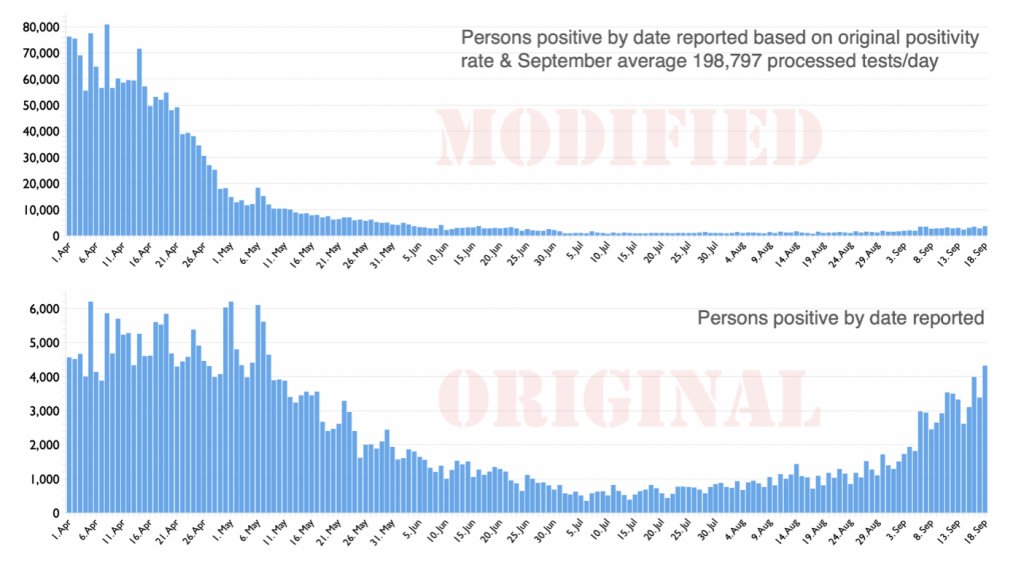
You will be very familiar with the cases plot which is shown on most TV broadcasts at the moment. It purports to show the numbers of cases which rose then fell in the spring, and the recent rise in cases. This graph is always accompanied by the headline that “so many thousands of new cases were detected in the last 24 hours”.
You should know that there are two major deceptions, in that picture, which combined are very likely both to mislead and to induce anxiety. Its ubiquity indicates that it is a deliberate choice.
Firstly, it is very misleading in relation to the spring peak of cases. This is because we had no community screening capacity at that time. A colleague has adjusted the plot to show the number of cases we would have detected, had there been a well-behaved community test capability available. The effect is to greatly increase the size of the spring cases peak, because there are very many cases for each hospitalisation and many hospitalisations for every death.
Secondly, as I hope I have shown and persuaded you, the cases in summer and at present, generated by seriously flawed Pillar 2 tests, should be corrected downwards by around ten-fold.
I do believe genuine cases are rising somewhat. This is, however, also true for flu, which we neither measure daily nor report on every news bulletin. If we did, you would appreciate that, going forward, it is quite likely that flu is a greater risk to public health than COVID-19. The corrected cases plot (above) does, I believe, put the recent rises in incidence of COVID-19 in a much more reasonable context. I thought you should see that difference before arriving at your own verdict on this sorry tale.
There are very serious consequences arising from grotesque over-estimation of so-called cases in Pillar 2 community testing, which I believe was put in place knowingly. Perhaps Mr Hancock believes his own copy about the level of risk now faced by the general public? Its not for me to deduce. What this huge over-estimation has done is to have slowed the normalisation of the NHS. We are all aware that access to medical services is, to varying degrees, restricted. Many specialities were greatly curtailed in spring and after some recovery, some are still between a third and a half below their normal capacities. This has led both to continuing delays and growth of waiting lists for numerous operations and treatments. I am not qualified to assess the damage to the nation’s and individuals’ health as a direct consequence of this extended wait for a second wave. Going into winter with this configuration will, on top of the already restricted access for six months, lead inevitably to a large number of avoidable, non-Covid deaths. That is already a serious enough charge. Less obvious but, in aggregate, additional impacts arise from fear of the virus, inappropriately heightened in my view, which include: damage to or even destruction of large numbers of businesses, especially small businesses, with attendant loss of livelihoods, loss of educational opportunities, strains on family relationships, eating disorders, increasing alcoholism and domestic abuse and even suicides, to name but a few.
In closing, I wish to note that in the last 40 years alone the UK has had seven official epidemics/pandemics; AIDS, Swine flu, CJD, SARS, MERS, Bird flu as well as annual, seasonal flu. All were very worrying but schools remained open and the NHS treated everybody and most of the population were unaffected. The country would rarely have been open if it had been shut down every time.
I have explained how a hopelessly-performing diagnostic test has been, and continues to be used, not for diagnosis of disease but, it seems, solely to create fear.
This misuse of power must cease. All the above costs are on the ledger, too, when weighing up the residual risks to society from COVID-19 and the appropriate actions to take, if any. Whatever else happens, the test used in Pillar 2 must be immediately withdrawn as it provides no useful information. In the absence of vastly inflated case numbers arising from this test, the pandemic would be seen and felt to be almost over.
Dr Mike Yeadon is the former CSO and VP, Allergy and Respiratory Research Head with Pfizer Global R&D and co-Founder of Ziarco Pharma Ltd.
Do you hear the pathetic bleating of America’s billionaires and their army of toadies? If not, you soon will, for a remarkable report has been released that documents the $50 trillion in earnings that’s been transferred to the Financial Aristocracy from the bottom 90% of American households in the past 45 years.
The report was prepared by the RAND Corporation, and has a suitably neutral title: Trends in Income From 1975 to 2018. (The full report can be downloaded for free.)
Longtime readers know I’ve reported on the astounding increase in America’s economic inequality for the past 15 years, and addressed the eventual banquet of consequences this imbalanced, destabilizing state of affairs will serve up.
But with few exceptions, the corporate media has ignored this fundamental reality of American life, and blown off the consequences as easily ignored speculation by marginalized bloggers and commentators. (“Would somebody please shadow-ban these sites going on and on about soaring inequality? Thank you, Facebook, Google and Twitter–we’ll return the favor directly.”)
The extreme rarity of paragraphs like these in the corporate media cannot be over-emphasized. The corporate media has carried water for the billionaires and America’s Financial Aristocracy for decades. (No surprise, given that the vast majority of America’s media / social media is owned by the billionaires and Financial Aristocracy. Why bite the hand that feeds you, especially when the risk of losing your career is so high?)
Excerpted from the time.com article linked above:
There are some who blame the current plight of working Americans on structural changes in the underlying economy–on automation, and especially on globalization. According to this popular narrative, the lower wages of the past 40 years were the unfortunate but necessary price of keeping American businesses competitive in an increasingly cutthroat global market. But in fact, the $50 trillion transfer of wealth the RAND report documents has occurred entirely within the American economy, not between it and its trading partners. No, this upward redistribution of income, wealth, and power wasn’t inevitable; it was a choice–a direct result of the trickle-down policies we chose to implement since 1975.
We chose to cut taxes on billionaires and to deregulate the financial industry. We chose to allow CEOs to manipulate share prices through stock buybacks, and to lavishly reward themselves with the proceeds. We chose to permit giant corporations, through mergers and acquisitions, to accumulate the vast monopoly power necessary to dictate both prices charged and wages paid. We chose to erode the minimum wage and the overtime threshold and the bargaining power of labor. For four decades, we chose to elect political leaders who put the material interests of the rich and powerful above those of the American people.
That this level of incendiary outrage is now seeping into the mainstream media tells us that the bill for America’s $50 Trillion gluttony of inequality is long overdue and the pendulum of reckoning will swing to political, social and economic extremes equal to the extremes of wealth and income inequality engineered by America’s Financial Aristocracy and their toadies / lackeys in government, the Federal Reserve, Wall Street, Silicon Valley and the media.
The rallying cry to claw back a significant percentage of the $50 trillion is just beginning. The billionaires have the money and power, of course, and the best government that money can buy plus the loyalty of a vast army of well-paid toadies, lackeys, factotums and apparatchiks.
But once the citizens no longer accept their servitude, the pendulum will gather momentum. America’s Financial Aristocracy has reached extremes not just of wealth-income-power inequality, but extremes of hubris. Their faith in luxury bug-out estates / private islands is evidence that even if the way of the Tao is reversal, they’ll have their private bodyguards and stashes of fuel and other essentials.
The clawback might not be as easy to rebuff as they anticipate, nor will the pendulum swing that’s just starting necessarily arrive at the opposite extreme in the orderly, predictable fashion they’re accustomed to controlling.
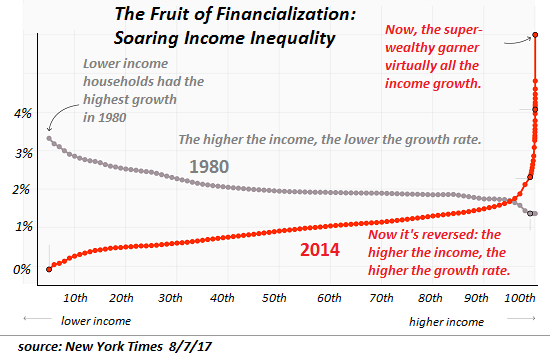
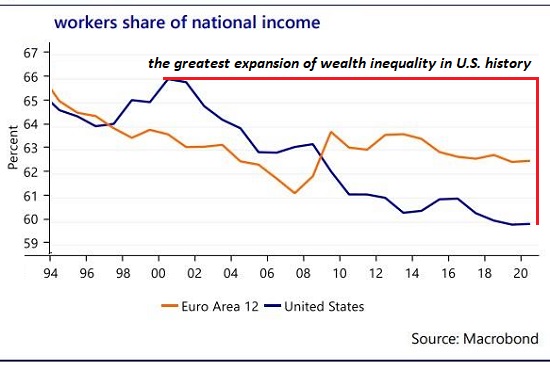
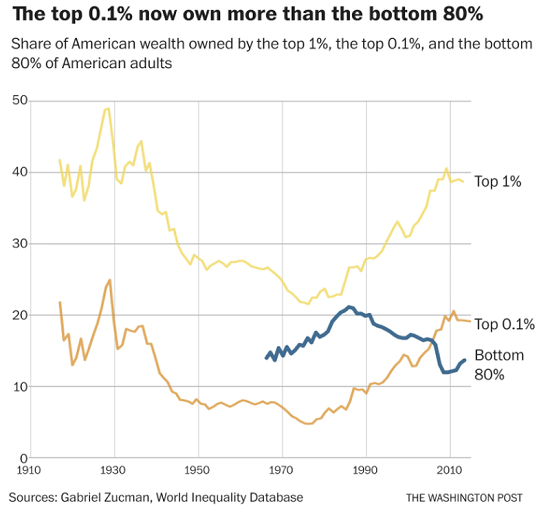
Here’s a few of the many charts you’ve seen over the years here that illustrate rising inequality:
Five years ago, German Chancellor Angela Merkel unilaterally allowed hundreds of thousands of immigrants from the Middle East and Africa to enter European territory, causing the EU to enter one of the biggest crises in its history. The lack of a previous agreement with the other European governments has created great political instability on the continent that has never been overcome. However, when Berlin considered the number of foreigners in its territory “sufficient”, it simply closed its borders, keeping thousands of immigrants captive in other European countries waiting for a new destination. As a result, many European states were overcrowded with immigrants, while Germany rejoiced in cheap labor for its companies.
Now, history seems to repeat itself. Recently, the EU announced a new immigration and asylum policy, supposedly based on “solidarity” and humanitarian values, but which, once again, failed to reach a consensus within the organization’s countries. Interestingly, the new EU migration policy comes precisely from Germany, but this time the author of the project is Ursula von der Leyen, current President of the European Commission and a member of the Christian Democratic coalition that supports Angela Merkel.
Von der Leyen presented to the European Parliament a proposal to abolish the “Dublin-3”, a regulation according to which immigrants arriving in Europe are forced to register immediately in the country in which they are located. This norm had been causing a serious imbalance in the immigrant population in countries like Greece, Malta, Italy and Spain, but the big problem is that until now Von der Leyen and her supporters have not announced which mechanism will replace the current regulation, just stating that it will be a policy based on “governance and solidarity”, keeping obscurity until the final version of the project is presented.
The total disagreement between the members of the Union is leading to different solutions presented unilaterally by the members. The intention is simple: to survive, in the face of an uncertain future. Italy is working to establish strategies together with Libya to curb migratory flows. Greece is asking for EU support to rebuild the Lesbos camp. On the other hand, Budapest and Warsaw demonstrate total antipathy to humanitarianism as a basic principle of migratory policies. Hungary and Poland have already expressed officially that are not interested in receiving Muslim immigrants. Being culturally and ethnically homogeneous nations, these countries see with fear and terror the multiculturalism that increasingly penetrates Western Europe as a result of intense migratory flows.
In fact, the whole of Europe sees Van der Leyen’s plans with suspicion, simply because they see her as a representative of the interests of Angela Merkel, who is responsible for the 2015 migration crisis. Apparently, the abolition of Dublin-3 will mean nothing more than a mechanism to facilitate the distribution of immigrants across European territory, which will be imposed as a Union policy, disregarding the national interests of member states. Van der Leyen is simply continuing, five years later, what Merkel started in 2015: a policy of distributing cheap labor on European soil disguised by humanitarian principles.
As previously mentioned, Germany closed its borders when deemed necessary. But the “more migrations” speech remains the main agenda for Merkel and her representative in Brussels. So, what remains to be seen is whether Germany will also participate in the “solidarity distribution” of the immigrants currently located in southern European camps due to Dublin-3 or will it again restrict the entry of foreigners because it considers that there is “a sufficient amount” of them.
Apparently, Berlin created a major state of crisis and instability in Europe but managed to keep itself reasonably out of the worst consequences, because, unlike other countries, it closed its borders when it considered it necessary. Now, the Germans are trying to disperse a huge surplus of immigrants and refugees on European soil under a humanitarian flag and their dogma is supported unconditionally by NGOs, political parties and the business sector interested in precarious and low-cost foreign labor.
Apparently, there will be a scenario of uncontrolled migration, completely out of alignment with the national interests of any European state. This will generate a new movement of dissatisfaction in the bloc and could lead to new divisions and to the resurgence of radical nationalist tendencies that are already being born in several countries. For now, we can foresee new “exits” appearing in the coming years, or, worst case scenario, real waves of cultural and social conflicts – as it is already happening in France – in a large number of European countries.
Lucas Leiroz is a research fellow in international law at the Federal University of Rio de Janeiro.
MOSCOW – The United States’ claim that the UN sanctions on Iran were restored is misleading as the UN Security Council (UNSC) took no steps leading to the restoration of restrictions, the Russian Foreign Ministry said in a statement on Sunday.
“The US continues to mislead the international community by speculating that the UN Security Council conducted some sort of procedures to restore the effect of UNSC resolutions on Iran sanctions, which were cancelled after the signing of the 2015 Joint Comprehensive Plan of Action (JCPOA)”, the official statement from Russia read.
“The facts are that the UN Security Council did not take any action that would lead to the restoration of old sanctions against Iran. All that Washington does is nothing more than a theatrical performance staged in order to subordinate the Security Council to its policy of ‘maximum pressure’ on Iran and turn this authoritative body into its handy tool,” the statement continued.
Moscow further urged Washington to “have enough courage to face the truth and stop speaking on behalf of the UN Security Council”.
Earlier in the day, US Secretary of State Mike Pompeo welcomed “the return of virtually all previously terminated UN sanctions on the Islamic Republic of Iran” under the snapback mechanism of UN Security Council Resolution 2231.
As stressed in the statement, Resolution 2231 has remained intact and all of its provisions, therefore, must be implemented “in the initially agreed mode and volume on the basis of reciprocity among all states”.
Media interest in Saudi Arabian connections to the crimes of 9/11 has centered on calls for the release of the 28 missing pages from the Joint Congressional Inquiry’s report. However, those calls focus on the question of hijacker financing and omit the most interesting links between the 9/11 attacks and Saudi Arabia—links that implicate powerful people in the United States. Here are twenty examples. … continue
This site is provided as a research and reference tool. Although we make every reasonable effort to ensure that the information and data provided at this site are useful, accurate, and current, we cannot guarantee that the information and data provided here will be error-free. By using this site, you assume all responsibility for and risk arising from your use of and reliance upon the contents of this site.
This site and the information available through it do not, and are not intended to constitute legal advice. Should you require legal advice, you should consult your own attorney.
Nothing within this site or linked to by this site constitutes investment advice or medical advice.
Materials accessible from or added to this site by third parties, such as comments posted, are strictly the responsibility of the third party who added such materials or made them accessible and we neither endorse nor undertake to control, monitor, edit or assume responsibility for any such third-party material.
The posting of stories, commentaries, reports, documents and links (embedded or otherwise) on this site does not in any way, shape or form, implied or otherwise, necessarily express or suggest endorsement or support of any of such posted material or parts therein.
The word “alleged” is deemed to occur before the word “fraud.” Since the rule of law still applies. To peasants, at least.
Fair Use
This site contains copyrighted material the use of which has not always been specifically authorized by the copyright owner. We are making such material available in our efforts to advance understanding of environmental, political, human rights, economic, democracy, scientific, and social justice issues, etc. We believe this constitutes a ‘fair use’ of any such copyrighted material as provided for in section 107 of the US Copyright Law. In accordance with Title 17 U.S.C. Section 107, the material on this site is distributed without profit to those who have expressed a prior interest in receiving the included information for research and educational purposes. For more info go to: http://www.law.cornell.edu/uscode/17/107.shtml. If you wish to use copyrighted material from this site for purposes of your own that go beyond ‘fair use’, you must obtain permission from the copyright owner.
DMCA Contact
This is information for anyone that wishes to challenge our “fair use” of copyrighted material.
If you are a legal copyright holder or a designated agent for such and you believe that content residing on or accessible through our website infringes a copyright and falls outside the boundaries of “Fair Use”, please send a notice of infringement by contacting atheonews@gmail.com.
We will respond and take necessary action immediately.
If notice is given of an alleged copyright violation we will act expeditiously to remove or disable access to the material(s) in question.
All 3rd party material posted on this website is copyright the respective owners / authors. Aletho News makes no claim of copyright on such material.