European Parliament calls for international probe into alleged Navalny poisoning & suspension of Nord Stream 2 gas pipeline
RT | September 17, 2020
The European Parliament has pushed to halt construction of the Nord Stream 2 gas pipeline between Germany and Russia, and for an international investigation into the alleged poisoning of Russian opposition figure Alexey Navalny.
A resolution passed on Thursday called on European Union member states to “continue to isolate Russia in international forums,” encouraging the European Council “to prioritize the approval of the EU Magnitsky-style human rights sanctions” against what it called “the Russian regime.” The ‘Magnitsky’ sanctions are named after a Russian tax auditor, and associate of American-turned-British billionaire Bill Browder, who died in a Moscow prison in 2009.
532 MEPs voted for the resolution, 84 were against and 72 abstained. A total of 688 out of the registered 705 MEPs took part in the voting. It’s important to note that the measure is advisory and not legally binding, but rather intended as an advisory for EU governments.
The European Parliament also reiterated its “previous position to halt the Nord Stream 2 project.” This is a gas pipeline set to connect Germany directly to Russian energy supplies.
“It is necessary to immediately start an international investigation, with the participation of the EU, United Nations, Council of Europe and the Organisation for the Prohibition of Chemical Weapons,” the resolution states. It names Alexey Navalny as “a leading Russian opposition politician, lawyer, blogger and anti-corruption activist” who has become “one of the few effective leaders of the Russian opposition.”
The vote on Thursday took place without a debate – there had been discussion on Tuesday in the parliament.
Earlier this month, European Commission President Charles Michel condemned “in the strongest possible terms the attempt to silence opposition leader (sic) Navalny.”
Sanctions against the Russian authorities have been rumored ever since news of Navalny’s alleged poisoning first broke. In late August, US Deputy Secretary of State Stephen Biegun explained that Washington was prepared to take strong measures against Moscow, which would make sanctions related to the 2016 US presidential election “pale in comparison.”
Relations between Pakistan and Saudi Arabia in crisis
By Lucas Leiroz | September 17, 2020
In early August, the diplomatic crisis between Pakistan and Saudi Arabia increased considerably when Pakistani Chancellor Shah Mehmood Qureshi officially criticized the Arab country for its lack of support for Islamabad’s interests in the dispute with India over Kashmir. According to the Pakistani government, there should be greater cooperation between both countries due to the fact that they share religious ties, and this is not happening.
Qureshi recently said during an interview that Islamabad expects the Organization of Islamic Cooperation (OIC) to convene a meeting soon to discuss the issue of Kashmir. Furthermore, he said that if the OIC does not convene such a meeting, Pakistan itself will be obliged to organize a meeting of Islamic countries in order to obtain support in the dispute for Kashmir. Qureshi’s words were immediately received by the Saudis as a threat of conspiracy against the OIC for the creation of a new bloc, led by Islamabad.
There are three countries that unconditionally support Pakistan on the issue of Kashmir, which are Turkey, Iran and Malaysia. These countries, in December 2019, met at the Kuala Lumpur Summit, where they discussed various topics related to the entire Islamic world. Since then, Saudi Arabia sees the alliance of these countries as a threat to its interests and to the role of hegemony it exercises over the OIC. So, if Pakistan convenes a meeting with such countries, a major step will be taken towards the creation of a new group of Islamic nations.
Qureshi’s comment was made to warn the Saudis, but the consequences were disastrous. Riyadh immediately refused to give a third of the 3 billion dollars loan it had granted Pakistan in 2018, and the 3.2 billion dollars oil credit line that was also part of the 2018 deal has not been renewed.
Until now, Pakistan and Saudi Arabia have shared close ties, forming an important alliance in Asian geopolitics. Both countries have shared strategic ties of mutual interest for decades and on several occasions have supported each other diplomatically, economically and militarily. Examples of this shared interest can be seen in events such as the placement of Pakistani troops in the Saudi territory, joint military exercises, oil supply by Saudi Arabia amid sanctions on Pakistan due to its nuclear tests and several other cases of economic aid and diplomatic support.
But, occasionally, the interests of both countries have collided. There were reprisals after Pakistan’s refusal to send troops within the Saudi-led coalition in the 2015 Yemen war, for example. Interestingly, in Yemen Iran and Saudi Arabia face each other in a proxy war. Iran supports Pakistan in Kashmir, while the Saudis hesitate on this issue. Certainly, the cases are related, but that is not enough to explain the current crisis.
The geopolitics of the Islamic world is changing completely. The Arab countries’ peace agreements with Israel, mediated by the US, are becoming a strong trend. Saudi Arabia has already denied the possibility of entering into such an agreement, but the precedent set by Bahrain and the United Arab Emirates is significant and it is very likely that, over time, pro-Western Arab nations will gradually join peace with Israel. Such Arab nations have not changed their views on Palestine, but the current situation in the region has become too dangerous for them. These countries fear the advance of the Muslim Brotherhood supported by Turkey, which grew a lot in the Syrian War. And, above all, the rivalry with Iran cannot be ignored, especially when Tehran and Ankara progressively tighten their ties.
With Pakistan trying to get closer to the Kuala Lumpur Group – which includes Iran and Turkey – the tendency is for the Saudis to not only distance themselves increasingly from Islamabad, but also to carefully consider the possibility of joining peace with Israel, which, indeed, is the only condition for the kingdom to continue to receive the Western support it currently receives.
This “schism” in the Islamic world will be costly for Pakistan, which has always received great economic support from the Saudis. Currently, Saudi Arabia is home to around 2.5 million Pakistani expatriates, whose remittances contribute highly to Islamabad’s economy. Remittances abroad represent about 86% of Islamabad’s foreign reserves. Of these, 30% are inflows from the Saudi kingdom. In addition, Pakistan imports about a quarter of its oil from Saudi Arabia. In 2019, 74% of their bilateral trade, totaling 1.7 billion dollars, was due to oil imports. In addition, there are latent cultural issues. Saudi Arabia has in its territory the sacred sites of Mecca and Medina, where about 500,000 Pakistanis travel each year on pilgrimage.
However, economic and cultural issues tend to be overlooked when topics involve national security, defense and risks of war. A new bloc of Islamic nations is likely to emerge, rivaling the OIC, opposing Iran, Turkey and Pakistan against the Saudis. Interestingly, such a split will lead to an ethnicization of the geopolitics of the Islamic world, considering that Turkey, Iran, Pakistan and Malaysia are not Arab nations, and this may be another focus of tensions in the future.
Lucas Leiroz is a research fellow in international law at the Federal University of Rio de Janeiro.
Germany Reportedly Offered Washington LNG Investment Worth $1.2Bln to Save Nord Stream 2
Nord Stream 2, a joint venture between European energy companies and Russia’s Gazprom, has battled challenges such as obtaining clearances from involved countries and US sanctions. It now faces threats from the German government to halt construction over Russia’s purported role in the yet-to-be-proven poisoning of opposition figure Alexei Navalny.
Germany had reportedly offered to invest up to 1 billion euros ($1.2 billion) in terminals for liquefied natural gas (LNG) from the United States as a way of saving the Nord Stream 2 pipeline project, targeted by Washington’s sanctions, according to sources cited by Die Zeit newspaper.
The non-official proposal is suggested as having been sent by the German Finance Ministry on 7 August, before Washington imposed sanctions on companies involved in the project.
In a letter to Treasury Secretary Steven Mnuchin, cited by Die Zeit, German Finance Minister Olaf Scholz reportedly vowed to earmark close to 1 billion euros in funding for the construction of LNG terminals if Washington agreed to abandon sanctions targeting firms involved in Nord Stream 2. The LNG terminals in question were to be built at two locations on the North Sea coast.
“In return, the United States will allow the construction and operation of Nord Stream 2 to proceed unhindered. The US will not exercise its legal scope for sanctions,” Die Zeit quoted the letter as saying.
Other proposals included in the cited paper allegedly pertained to a gas transit contract for Ukraine and the financing of an alternative pipeline and a terminal that would allow Poland to use the US LNG.
A spokesman for the German Finance Ministry did not offer an official comment on the report.
Challenge-Riddled Mega-Project
The Nord Stream 2 mega-project, worth $10.5 billion, is a joint venture funded by Russia’s Gazprom and five EU energy giants, Uniper, Wintershall, OMV, Engie, and Royal Dutch Shell, that will ultimately be capable of pumping around 55 billion cubic metres of gas annually from Russia to Germany and the rest of Europe.
Despite long being defended by its participants as a purely economic venture rather than a political one, the 1,230 km pipeline project has been forced to tackle a plethora of challenges, ranging from negotiating operating terms and obtaining clearances from the involved countries, to US sanctions, imposed in December 2019 against a key contractor, Switzerland-based AllSeas.
The sanctions outlined in the 2020 National Defence Authorisation Act (NDAA) came as the Nord Stream 2 project had just 160 km left to build.
Washington has long claimed that the Nord Stream 2 project would leave Ukraine without money from Russian gas transit, while making Europe dependent on Russian gas. The EU and Russia have denied these allegations, insisting that the project is purely an economic one.
The US has also been driven by ambitions to sell Germany and Eastern Europe its more expensive, tanker-delivered liquefied natural gas.
The pipeline envisions doubling the existing 55 billion cubic meters of gas per year capacity of the Nord Stream network once completed, and is set to make Germany a major energy hub.
Only recently, the project has been forced to deal with another threat to its existence, amid suggested sanctions against the joint venture after German authorities accused Moscow of being the culprit in the purported poisoning of political activist Alexei Navalny.
German Chancellor Angela Merkel has reportedly told officials that “a final decision has not been taken” on the future of the Nord Stream 2 pipeline, as Washington has pressured Berlin to cancel the project, with Warsaw actively supporting the stance.
Polish government spokesman Piotr Muller fed into the speculations surrounding the future of Nord Stream 2, asserting that Poland was ready to offer Germany access to its Baltic Pipe gas pipeline project instead.
Baltic Pipe is a proposed 800-950 km natural gas pipeline between Poland and oil-rich Norwegian waters in the North Sea which is not yet under construction that Warsaw hopes to see completed by October 2022.
Since last week’s announcement that the Navalny case would be treated as an “attempted murder by poisoning”, the German government has faced pressure to scrap the Nord Stream 2 project, with some German lawmakers and several of Berlin’s foreign allies suggesting abandoning the nearly finished pipeline to ‘punish’ Russia, despite no proof having been provided to substantiate the allegations.
Iranian Tanker Carrying Gas Condensate Arrives in Venezuela
Sputnik – 14.09.2020
An Iranian supertanker, identified as Honey, has docked at the northeastern Venezuelan port of Jose Terminal with a cargo of 2 million barrels of natural gas liquid (NGL), the Tanker Trackers company said on Monday.
As explained by Tanker Trackers in a thread of tweets, NGL is a light-weight gas condensate that can be refined into things like high octane gasoline and jet fuel. The company opined, however, that this batch of supply will likely be used as “a blending agent to improve flow of Venezuela’s very heavy crude oil in order to boost production.”
While the Venezuelan authorities have not issued a statement on the matter, Venezuelan Foreign Minister Jorge Arreaza shared a post on his Twitter account.
Another three Iranian tankers carrying approximately 131 million liters of gasoline are currently in southern Africa en route to Venezuela, according to the tracking company.
If the Honey tanker went with radars off, as it is assumed in the report, it was likely due to concerns associated with earlier US threats to block Iranian fuel shipments to Venezuela, including by confiscating the vessels and imposing sanctions on the crew.
Iran sent several tankers with fuel cargo to Venezuela earlier this spring and early summer as the Latin American country was struggling to keep up its crumbling oil infrastructure.
Merkel Saves Nord Stream 2 With a Cunning Trick
By Gevorg Mirzayan | Stalker Zone | September 10, 2020
The German Chancellor said that the fate of the most important Russian gas pipeline “Nord Stream 2” will be decided not by Germany, but by the European Union as a whole. This is how she sees the response to the situation with Aleksey Navalny. It may seem that this is a terrible omen for the gas pipeline, which has already seen billions of euros invested into it for construction. But what did Angela Merkel really mean?
The fate of Nord Stream 2 was again in question. No sooner had the project’s supporters celebrated the removal of the Danish obstacle (Copenhagen, after much delay, gave permission for the pipe to be laid through its territorial waters) than Germany, which until recently was an advocate for construction and one of the main beneficiaries of construction, began to seemingly make obstacles.
Berlin, dissatisfied with the position of Moscow in the case of Aleksey Navalny, intends to put the question of a possible curtailment of the project to a pan-European discussion. Why does Angela Merkel want to close “Nord Stream 2” – and does she in general want to?
Legacy
Germany has long called for putting an end to “Nord Stream 2”, which in the understanding of a number of western activists “increases Europe’s dependence on Russian energy carriers”. They did not even require Angela Merkel to deliver a funeral speech over it. “The easiest option for Germany would be to simply withdraw its support for Nord Stream 2, allowing American and European critics to kill it,” the BBC writes. And now, against the background of the Navalny case, the aggressiveness of the project’s opponents has increased by an order of magnitude.
Until recently, it seemed that they were banging their heads against the wall of German pragmatism. Germany’s position on Nord Stream 2 was really reinforced concrete: German Chancellor Angela Merkel said that she was dissatisfied with the lack of cooperation with Moscow in the case of the “poisoning of Aleksey Navalny”, but was not going to abandon Nord Stream 2 because of this. After all, as German Foreign Minister Heiko Maas correctly notes, “those who call for the cancellation of the project should understand the consequences of such a step”.
Firstly, Berlin needs Nord Stream 2 from an economic point of view. “Germany has a very weak position in terms of energy. They are closing a lot of power plants – nuclear, coal,” says Donald Trump. Germany and the EU do not have reliable suppliers of cheap gas that are an alternative to Russia. In addition to getting cheap blue fuel (much needed for the export-oriented economy of Germany), Germany will earn good money on the transit of Russian gas, becoming a hub country.
“If the project is stopped, the German consumer will pay for it,” said Klaus Ernst, a member of the Bundestag from the Die Linke party. In addition, Berlin is also thinking about the security of Europe under its patronage – the internal political situation in Ukraine is deteriorating, and no one can guarantee that the militants not controlled by Kiev will not decide to stop the gas export of the “aggressor country” to Europe. Well, or threaten to stop if the EU does not issue another loan to Kiev.
Finally, the issue of reputation is also important. Angela Merkel was not just a supporter of Nord Stream 2, but also a lawyer. She defended the project against those who advocated abandoning infrastructure projects with “Putin’s Russia” – human rights activists, urban lunatics, agents of influence of the US. If now, because of the Navalny case, Merkel changes her position on the “stream”, then she will be criticised for political short-sightedness.
Moreover, by both opponents of Nord Stream 2 (for catching on too late) and supporters of the project, who are dissatisfied with the fact that Angela Merkel has called into question Germany’s energy security because of some political matter. Not to mention the fact that it caused serious damage to German business (Uniper and Wintershall invested almost a billion euros each in Nord Stream 2). And since Frau Chancellor leaves her post at the end of 2021, it is important for her who she will remain in history.
“It all depends on the Russians”
However, Angela Merkel’s pragmatism seemed to be beginning to bend under the pressure of numerous critics and human rights activists calling for “punishing Putin for another poisoning of an opponent”. In their opinion, Germany is the leader of the European Union and (against the background of Donald Trump’s actual refusal to “protect freedom around the world”) a potential leader of the entire liberal community, so it has no right to stay away from the Navalny case. Therefore, Angela Merkel announced the possibility of imposing sanctions against Nord Stream 2 ,and, according to media reports, intends to initiate a pan-European response to the case of Aleksey Navalny. And gather all the EU countries together to decide how to respond to Russia’s behaviour – and part of this reaction may be the suspension of Nord Stream 2.
This suspension will be a serious blow to Moscow. After all, this is not just about an important infrastructure project – there are much bigger things at stake. “The curtailment of Nord Stream 2 will send a clear signal with long-term consequences: German business will leave the Russian market even faster, and Vladimir Putin’s attempts to modernise Russia with the economic assistance of EU countries will finally turn to dust,” writes Deutsche Welle correspondent Miodrag Soric. At the same time, as they make it clear in Berlin, the blow can be avoided. “Our further actions depend on the behaviour of the Russians,” explains German Health Minister Jens Spahn.
“I hope the Russians won’t force us to change our position on Nord Stream 2,” says Heiko Maas, alluding to the fact that the Kremlin is expected to fulfil European demands concerning the Navalny case, and that they are waiting for prompt implementation, and “not by the end of the year or even within a few months”. These demands are very simple and not burdensome – not taking the blame, but just admitting the fact of poisoning, as well as starting an investigation.
Why shouldn’t they be implemented?
One of the reasons is as old as the Russian-west conflict. Moscow does not want to create a dangerous precedent for itself. The Kremlin, in fact, is being forced to admit a politically motivated accusation – after all, the Bundeswehr, whose laboratory declared “the indisputable fact of Navalny’s poisoning”, refused to provide the Russian authorities with any material evidence, citing “the secrecy of the methods and procedures used”.
If Russia now accepts this position on faith under the threat of sanctions, then the inspired western partners will threaten the same sanctions and issue other ultimatums: non-interference in the affairs of Belarus, withdrawal from Syria, etc. And this is not to mention the organisation and information support of other provocations that should be expected before the difficult political transit in Russia in 2024. If the blackmailer issues an ultimatum, the only way to escape from it is to refuse to fulfil any, even the most insignificant demands.
Divergence?
In addition, it makes no sense for Russia to make concessions to Berlin, because the position of Angela Merkel has never changed. Germany, as before, is not going to close Nord Stream 2 – it just behaves more elegantly and cunningly. Yes, it is partly bluffing for the sake of forcing Moscow to make concessions – but at the same time it may be an elegant attempt by Frau Chancellor to pass between the European trickles. By putting the issue up for European discussion, Angela Merkel is calling out those who support punishing Russia, confirming her political leadership – and at the same time putting a tricky block on accepting any tough sanctions.
The fact is that decisions at such meetings should be made by consensus. And if Angela Merkel had raised the question of approving the construction of Nord Stream 2, she would not have received a green light – after all, a number of EU countries (Poland, the Baltic states) are categorically opposed to the implementation of this infrastructure project. However, Frau Merkel (apparently) will ask about something else – should Russia’s punishment for the Navalny case be extended to Nord Stream 2? And here one should not expect any consensus on the completion of the project – the positions of the European countries are too different.
Recall that the pan-European decision concerning the Skripal case was only the collective expulsion of a certain number of Russian diplomats.
And this is despite the fact that back then the grounds for sanctions were much more serious than now. Firstly, there were at least some grounds for blaming Russia for what happened – there was a recording of “Petrov and Boshirov” arriving in Salisbury, as well as information provided to the media that these people work for the Russian special services. Secondly, it was about the use of weapons of mass destruction on the territory of the European Union, which can be interpreted as an attack by the Russian Federation on European citizens. Whilst here we are talking at best about poisoning – without any evidence of Russian guilt. And Moscow can only be accused of unwillingness to take Europe’s word for it. The most important infrastructure projects are not stopped for this by respected countries.
Angela Merkel’s proposal has another advantage for Russia – it protects (at least for a while) Nord Stream 2 from threats from other EU states. There is a risk that some less conscious countries (for example, Denmark) may take their own sanctions against the project. For example, revoke permission to lay a pipe through their waters. Bringing the issue to a pan-European discussion puts unilateral sanctions on pause.
And since Navalny is not dead, but is on the mend, time will cool the hot European heads, and the idea of blocking Nord Stream 2 will go off the agenda. At least for a while.
An India-China reset is still possible
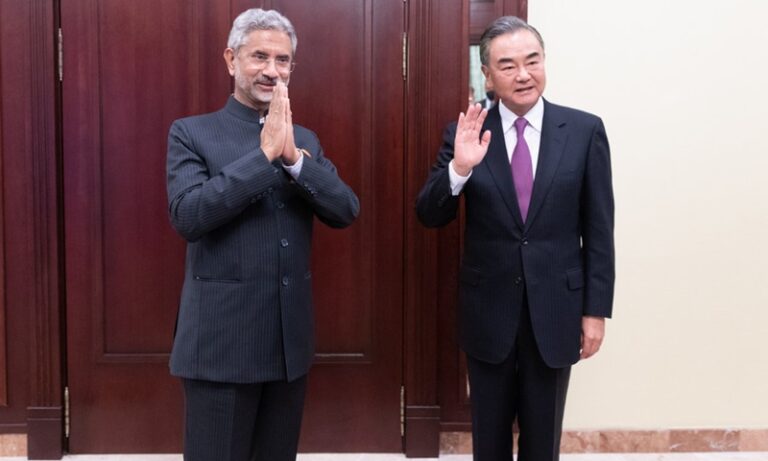
External Affairs Minister S. Jaishankar (L) and China’s State Councilor & Foreign Minister Wang Yi (R) met in Moscow, Sept 10, 2020
By M. K. BHADRAKUMAR | Indian Punchline | September 12, 2020
A joint statement wasn’t anticipated after the talks between the External Affairs Minister S. Jaishankar and China’s State Councilor and Foreign Minister Wang Yi in Moscow on September 10. In diplomatic terms, a joint statement signals that a “critical mass” developed through the 3-hour long discussion between the top diplomats.
Of course, much of the understanding reached will not be put in the public domain but it is apparent that an easing of tensions at the border and a disengagement of troops is on cards. The Chinese account assesses that the two foreign ministers have created “favourable conditions for a possible future meeting of the leaders of the two countries.”
Doesn’t this add up to a breakthrough? It does. That there isn’t going to be a war makes this a big breakthrough. So indeed, that deck is cleared for a summit meeting.
The joint statement outlined a 5-point consensus. First, the two countries reaffirmed the “series of consensus” reached by Prime Minister Narendra Modi and Chinese President Xi Jinping at their meetings in Astana (June 2017), Wuhan (April 2018) and Chennai (October 2018), which had committed the two countries to a cooperative relationship.
Second, a “quick disengagement” of border troops is envisaged, so that the two militaries will maintain a “proper distance and ease tensions.” Third, the existing agreements and protocols in bilateral boundary affairs” shall be adhered to and the two militaries shall “maintain peace and tranquillity in the border areas and avoid any action that could escalate matters.”
Fourth, the two special representatives will continue “dialogue and communication” on the boundary question and the Working Mechanism for Consultation and Coordination on China-India Border Affairs will hold meetings. Finally, once the tensions ease, new CBMs will be concluded to “maintain and enhance” peace and tranquility in the border areas.
Reading between the lines, the joint statement never once mentions the Line of Actual Control (LAC). Instead, the expression used is “border areas.” This suggests that there isn’t going to be any return to status quo ante as of early May, which has been an Indian demand.
The Indian army reportedly occupied certain “dominating heights” through the past week. But nothing has been mentioned in the joint statement in this regard. Conceivably, Indian troops’ mortal enemy in those dominating heights will be not the PLA but the harsh winter that is approaching in another 6 weeks or so. Maintaining a military presence in such inhospitable terrain entails heavy costs in life and treasure and will put an intolerable strain on our resources.
Succinctly put, what emerges from the joint statement is a mutual desire not to escalate the conflict situation and a shared opinion that a de-escalation of tensions is in mutual interest. However, there is lingering uncertainty as regards the way forward. To my mind, the creation of a buffer zone ( a demilitarised zone) at this point will be the best way to ensure peace and tranquility on the border on a durable basis.
Paradoxically, the crisis today also is an eyeopener. We peered into the abyss and didn’t like what we saw. Prime Minister Modi is a charismatic leader who can pitch high for a settlement of the boundary question. He is a strong leader who can take difficult decisions and cut the Gordian knot.
Clearly, India has shifted from the position that unless the PLA withdrew from “Indian territory”, the bilateral ties cannot be “business as usual.” In a huff, India began imposing sanctions against China. But the joint statement underscores that the two countries continue to uphold the “series of consensus” reached at the leadership level — where a key template is their common conviction that China and India are not competitive rivals or each other’s threats, but cooperation partners and each other’s developmental opportunities.
A Xinhua dispatch from Moscow giving a resume of the “full, in-depth discussion” between the two foreign ministers says, “Jaishankar said that the Indian side does not consider the development of India-China relations to be dependent on the settlement of the boundary question and India does not want to go backwards. The truth is, India-China relations have made steady progress over the years, and the Chinese and Indian leaders have met several times and reached a series of important consensus on the development of bilateral relations, he said.”
Clearly, sanctions must go. They have no place in the relationship. This rethink must be welcomed. But it is an abhorrent idea for sections of Indian opinion who are weaned on the belief that China has committed aggression by invading “Indian territory” and must be punished. The social media is full of venomous attacks on the Indian “sellout” at the Moscow talks, the “evisceration” of the LAC and so on.
However, that is primarily because the Indian narrative is seriously flawed. There is going to be a serious problem ahead for the government to “upgrade” the Indian narrative at this late stage. But the fact of the matter is that the Chinese had never accepted the LAC on the map or had delimited the LAC on the ground per the 1993 agreement.
They consistently held the view that the November 1959 claim line constituted the LAC. In the circumstances, how the disengagement and de-escalation can be worked out remains to be seen.
Looking back, the government’s move on August 5 last year to change the status of J&K and thereafter to include Aksai Chin as part of the Union Territory of Ladakh triggered a sequence of events culminating in the Chinese side changing the status quo on the ground and creating “new facts on the ground”.
India lacks the capability to challenge the Chinese action. But the country was led to believe otherwise. Per the Indian narrative, Indian armed forces have the capability to give a “bloody nose” to the PLA. So, there is bound to be a sense of disappointment today. India is paying a very high price for the strident nationalism and xenophobia that was whipped up by the ruling elite.
The Indian narrative is divorced from realities. The nation is bogged down in a raging epidemic and a deepening economic crisis. A vaccine to contain the pandemic will not be available in the market before the second half of next year. Meanwhile, the epidemic will remain as the “new normal”. A war with China will set back the country’s development by a decade. It is unthinkable.
Suffice to say, Jaishankar was given a weak hand to negotiate. And he has made a good job of it. The biggest gain is that a war has been averted and a new phase of constructive engagement of China with a sense of realism becomes possible. This is a moment of truth to rethink the entire foreign policy trajectory the government followed in the recent years.
Equally, it must be borne in mind that a replay of the “forward policy” that in 1962 plunged the country in a ruinous war was best avoided. The Mission Creep in the name of “infrastructure development” in Ladakh inevitably met with Chinese rebuff. All sorts of jingoistic notions stemming from the militarisation of India’s foreign policies in the past decade or so precluded rational thinking. The criticality of Aksai Chin region for China’s national security needed no iteration. Yet, we chose to meddle.
Fundamentally, India needs to come to terms with China’s rise and should have the composure and maturity to regard it as an inexorable historical process. Our zero sum mindset has done colossal damage. We must jettison it and refocus on constructively engaging China so as to take advantage of its meteoric rise for our country’s development, which is the number one priority today.
Australia Confronts a Changing Economic World
By James ONeill – New Eastern Outlook – 09.09.2020
The nature of Australia’s trading relationship with the rest of the world has changed dramatically in the 75 years since the end of World War II. In 1945–46 the total value of Australia’s exports of goods and services was $19 billion. It remained relatively low for the next 25 years, passing $50 billion only in 1969-70. It took a further 15 years to double, passing the $100 billion mark in 1984–85. It doubled again to $200 billion in 2000-01, and more than doubled again to $473.7 billion in 2019.
The nature of Australia’s export commodities has also changed rapidly over recent decades. Right up until the early 1980s rural commodities such as wool and meat dominated Australia’s exports. The shift away from this rural product reliance began in the 1970s, initially driven by exports of coal and iron ore.
Service exports began to assume a more dominant role in the 1980s. Short-term visitor arrivals into Australia went for about 137,000 in the early 1960s to over 2.5 million in 1991–92 and 9.3 million in 2019. The rural sector had a corresponding drop in its relative importance, accounting for about 42% of exports in 1969-70 to around 10% in 2018–19. Minerals and fuels on the other hand rose from under 17% to over 50% in the same period.
It was not just the structure of Australia’s exports that changed rapidly. The principal markets also changed radically. In the early 1960s the United Kingdom took 24% of Australia’s exports, the United States 13%, China 7.7% and Japan 22.4%. The figures for 2018-19 show a radical change. The United Kingdom has shrunk to less than 1.5%, the United States 3.9%, Japan a small shrinkage to 18% and a dramatic rise for China to just under 37% of the total.
Of Australia’s 25 largest export markets, (who account for the overwhelming majority of total exports) Asian countries constituted the greatest proportion, both in number and in value. Of the top 10 export markets, seven were in Asia (the other three being the United Kingdom, 4th, the United States 5th, and New Zealand 8th.) China, by far the largest market was 2.5 times greater than Japan in second place, and more than 10 times greater than the United Kingdom and the United States, each of the latter two accounting for less than 10% of the value of the Chinese market.
The year 2020 has seen some radical changes in Australia’s relationship with China, not all of which can be attributed to the virus. Australia’s exports to China fell by nearly a quarter year on year, and fell for each of the last five months to August 2020. It would be unwise to attribute this loss to the coronavirus effect. China’s imports from all nations grew by 6% in the year to August 2020 and the country’s economy, including imports, has had a relatively short and minor impact from the virus.
The Chinese view as expressed in the Party’s media outlet, the Global Times, in a series of articles featuring Australia in recent weeks, is that the slump in trade is a direct consequence of the deteriorating political relationship between the two countries. If the slump continues, and there are no signs at all of any improvement in the relationship, quite the contrary, the economic consequences for Australia will be devastating.
Unlike the food exports of decades ago, the market for mineral products is much less elastic. Importing countries have to have the industrial infrastructure to utilise the raw minerals, and new markets cannot be created in the medium, let alone short term.
It is not just exports that will be affected by the rapid cooling of China – Australia relations. Chinese students in 2019 comprised by far the biggest number of foreign students in Australian universities. That market has virtually vanished this year. Similarly, with Chinese tourists, again the largest group in 2019. It would be extremely unwise for either the tourist or the University sectors to expect any improvement in the foreseeable future. Both sectors contributed billions of dollars to Australia’s foreign exchange balance and supported tens of thousands of jobs.
It is not too difficult to ascertain the reasons for the deteriorating relationship between the two countries. A major factor is Australia’s relationship to the United States with the latter country engaging in a bitter economic and propaganda war with China. Contrary to the constant claims about the alleged freedom of the United States, it is engaged in a bitter economic war with China, arbitrarily excluding Chinese investment; the forced closure of Chinese companies; the forced closure of a Chinese consulate; reducing entry visas to Chinese citizens across a huge range of areas; and engaging in a constant propaganda war. Allegations of alleged Chinese responsibility for the current coronavirus outbreak is one example, accompanied by a bitter personalisation of the disease as the “China virus” by United States president Donald Trump.
The United States runs an enormous trade deficit with China which is somehow turned into a Chinese “fault”. The blunt reality is different. Chinese education and technology have significantly outpaced the United States in recent years. One manifestation of this is that a huge number of major United States companies have moved their production out of the United States and relocated to China and other Asian countries.
It is not just a cost driven exercise. As noted, the Chinese technology is now superior to that of the United States (as is also the case in Russia), the labour force is better educated, production costs are lower, and the market for advanced goods is rapidly expanding. China lifting 700 million people out of poverty this century alone has had major downstream effects, including an educated, affluent domestic market. The major social indicators in the United States by comparison have nearly all been in the opposite direction.
When one looks at the social and economic indicators in China, they all point to increasing demand for quality imports, whether of raw materials or other indicia of social and economic progress. Australia, with large resources and a small population (about the same as Shanghai) should be in a prime position to benefit from China’s economic progress.
Instead, as the figures now demonstrate, Australia is paying an economic price for its political subservience to the United States. That subservience takes many forms, all of which defy rational explanation if the test was one of a country acting in it own economic interests.
Australia has willingly engaged in the United States’ foreign wars of choice, from Korea 70 years ago up to and including the ongoing travesties in Iraq, Afghanistan and elsewhere. None of that by itself would necessarily have impacted on Australia’s relationship with China. In recent years, and especially in the Trump era, that subservience has taken on a different and more dangerous element.
Australia seems to have completely disregarded the maxim attributed to Lord Palmerston: a country has neither friends nor enemies, only interests. The current actions of the Australian government are the antithesis of enlightened self-interest. To go out of one’s way to annoy and alienate such an important economic partner (in multiple senses) such as China, is simply irrational. The foolishness is compounded by there being an absence of any obvious plan B.
The next few years are likely to be years of hardship for Australia unprecedented in the modern era. The Australian government has only itself to blame. It would be extremely unwise to assume that a change of government in Australia would make the least difference. The Opposition Labor Party is basically an echo chamber when it comes to the government’s actions with regard to China.
The reasons for that go back in all probability to the overthrow of the Labor government in 1975, an exercise from which the party has never fundamentally recovered. Under the Australian electoral system, itself uniquely bad for a so-called democratic nation, no viable alternative to the two major parties seems a realistic prospect. Australia will have to learn to adjust to a new, and harsher, economic reality.
James O’Neill is an Australian-based Barrister at Law.
Pentagon awards Northrop Grumman contract to develop next-gen $85bn ICBM for nuclear triad upgrade
RT | September 9, 2020
The Pentagon has handed arms manufacturer Northrop Grumman a colossal $13.3 billion contract to develop a new ICBM to replace the Minuteman III missile, part of a sweeping modernization effort to update the US’ nuclear triad.
Northrop announced the deal on Tuesday, saying the company was “selected by the US Air Force to modernize the nation’s aging intercontinental ballistic missile (ICBM) system.” The multi-billion dollar contract will see Northrop begin work on the Ground Based Strategic Deterrent (GBSD) program, an eight-year project that will focus on the design of the new missile system, as well as early testing and evaluation.
The new long-range missile, according to the Air Force, “will have increased accuracy, enhanced security, and improved reliability to provide the United States with an upgraded and broader array of strategic nuclear options.” It is expected to be in operation by 2029 and could ultimately cost up to $85 billion.
Though Boeing also vied for the contract, it dropped from the bidding in July after Northrop’s acquisition of Orbital ATK, a solid rocket motor manufacturer, one of only two US-based suppliers for that type of motor. Boeing argued the other supplier was not suitable for the GBSD project, and that the Northrop-owned company dragged its feet in price negotiations, claiming Northrop had an “unfair advantage.” The Air Force refused to act on Boeing’s complaints, however, and the firm withdrew its bid.
The development of a new ICBM comes as part of a massive nuclear modernization scheme instituted under former president Barack Obama, initially set to cost $1 trillion and span three decades. Though President Donald Trump has rejected much of his predecessor’s legacy, he has embraced the nuclear initiative with open arms, even approving greater spending for the project in the 2021 budget. In addition to replacing the Minuteman III, whose first variant was put into service in 1970, the military is also working to revamp the other two legs of the US nuclear triad, including upgrades for its nuclear-capable aircraft and submarines.
No mass snooping, coercion or backdoors: China pokes US in the eye with global digital rules proposal
RT | September 8, 2020
Beijing wants the world community to adopt a set of rules for developing the digital economy, which would endorse national sovereignty over data and oppose mass electronic surveillance in foreign cyberspace.
The code of conduct, dubbed the ‘Global Initiative on Data Security’, was presented on Tuesday by Chinese Foreign Minister Wang Yi at a conference in Beijing. While the name ‘United States’ was never mentioned in his speech, the official left no doubt that Washington’s recent attacks on the Chinese tech sector prompted the proposal.
“Bent on unilateral acts, a certain country keeps making groundless accusations against others in the name of ‘clean’ network and used security as a pretext to prey on enterprises of other countries who have a competitive edge,” he said. “Such blatant acts of bullying must be opposed and rejected.”
The Trump administration last month announced its ‘Clean Network Initiative’, aimed at pushing “untrusted” Chinese telecom companies and apps out of the US market and protecting undersea communication cables from eavesdropping.
Wang, who also holds the powerful office of state councilor, blasted the US approach as politicization of security issues and protectionism that stifle innovation, and outlined China’s own vision for the digital future. Beijing believes national governments have a legitimate claim on data generated under their sovereignty and should respect each other’s laws on its handling.
Among other things, it means that countries should not “conduct mass surveillance [on foreign soil] or engage in unauthorized collection of personal information of other states,” he said. Governments likewise should not pressure domestic companies into storing foreign data on their territory.
The companies themselves must not install backdoors in their products to gain illegal access to user data or take abusive advantage of the dependence on their products, he added.
The US push against Chinese companies like telecom producer Huawei, digital giant Tencent, and TikTok owner ByteDance is justified by a concern for user data and intellectual property. Washington claims that Chinese companies are subservient to Beijing and act as government agents harvesting the information of their foreign clients.
Beijing denies the allegations, and Wong reiterated that China pledges to adhere to the principles it proposes.
“We have not and will not ask Chinese companies to transfer data overseas to the government in breach of other countries’ laws,” he told the gathering.
He said the Chinese digital economy already accounts for more than one-third of the country’s GDP, with over 900 million internet users, including 88 million 5G subscribers, located in the country. Beijing believes its initiative would drive global digital growth.
Featured Video

Trita Parsi: Middle East Unraveling — Are We on the Path to World War?
or go to
Aletho News Archives – Video-Images
From the Archives
Why Saudi Ties to 9/11 Mean U.S. Ties to 9/11
By Kevin Ryan | Dig Within | September 27, 2015
Media interest in Saudi Arabian connections to the crimes of 9/11 has centered on calls for the release of the 28 missing pages from the Joint Congressional Inquiry’s report. However, those calls focus on the question of hijacker financing and omit the most interesting links between the 9/11 attacks and Saudi Arabia—links that implicate powerful people in the United States. Here are twenty examples. … continue
Blog Roll
 Aletho News
- Integrity Initiative: UK-funded network framed dissent as Russian disinformation for years
- ‘We don’t seek permission to defend our country’: Snippets from President Pezeshkian’s UNGA address
- NATO chief wants Europeans to fight American wars [for Israel]
- German chemicals giant reveals details of downsizing
- Refaat Al-Areer Was The Canary In The Coal Mine In Israel’s War On The Truth
- Israeli election committee bars candidate from Knesset race over Gaza war opposition
- French-Lebanese man files war crimes complaint over Israeli attacks
- Mahan Air Flight Lands in China Despite US Threat against Iranian Airlines
- US eyes $10bn fund to rebuild war-battered Gulf infrastructure
- Trump meets Rodríguez near Maduro’s prison as Venezuela’s oil flows to US
- If Americans Knew
- Caught on Tape: AIPAC CEO Boasted of Controlling Trump’s National Security Officials
- Why Hamas Attacked Israel in October 2023 – Israeli professor Ilan Pappé
- They see them, then kill them: Israeli quadcopters track, deliberately target civilians in Gaza
- Winter could turn Gaza’s treacherous, war-damaged buildings into deathtraps
- Majority of Democratic Voters Want to Prosecute Both Biden and Trump Administration Officials Over Gaza
- As Gaza languishes, world leaders gather at the UN – Daily Update
- Sanctions are collective punishment: immoral and self-defeating
- Phosphorus Munitions Fired by Israel Burn Groves, Orchards in Southern Lebanon
- Israel Carries Out New Ceasefire Violations Across Gaza
- AI – Emphasis on the ‘I’: Israel Is Funding AI Chatbot Propaganda
- No Tricks Zone
- New Study: Earth And Venus Surface Warmth Largely Explained By Convection And Lapse Rate, Not CO2 Or Radiation
- 2025 Nature Paper Claiming Worsening Global Drought Gets RETRACTED …Heavily Flawed
- New Study: ‘Global Drought Shows No Detectable Recent Acceleration Under Climate Warming’
- Economic Masterminds: German Socialists Suggest Taxing Productivity Gains Stemming From Using AI
- The South China Sea Has Not Been Cooperating With The Climate Change Narrative
- Energy Crisis: Germany Enters Heating Season With Historically Low Gas Reserve Fill Levels
- New Study: The Antarctic Ice Sheet Gained Mass From 2020-2024 Due To Staggering Snow And Ice Accumulation
- Study: Ocean Heating Rates From Thousands Of Years Ago ‘Dwarf’ Modern Ocean Heating Rates
- Climate Extremists Target, Attack Large-Scale Power Grid Infrastructure In Germany!
- New Study: Antarctic Ice Melt Has Contributed Less Than 1 Centimeter To Sea Level Rise In The Last 30 Years

