A National Defense Strategy of Sowing Global Chaos
By Nicolas J.S. Davies | Consortium News | January 23, 2018
Presenting the 2018 National Defense Strategy of the United States on Friday at the Johns Hopkins University, Secretary of Defense James Mattis painted a picture of a dangerous world in which U.S. power – and all of the supposed “good” that it does around the world – is on the decline.
“Our competitive edge has eroded in every domain of warfare – air, land, sea, space, and cyberspace,” he said. “And it is continually eroding.”
What he could have said instead is that the United States military is overextended in every domain, and that much of the chaos seen around the world is the direct result of past and current military adventurism. Further, he could have acknowledged, perhaps, that the erosion of U.S. influence has been the result of a series of self-inflicted blows to American credibility through foreign policy disasters such as 2003 invasion of Iraq.
There were also two important words hidden between the lines, but never mentioned by name, in the new U.S. National Defense Strategy: “empire” and “imperialism.”
It has long been taboo for U.S. officials and corporate media to speak of U.S. foreign policy as “imperialism,” or of the U.S.’s global military occupations and network of hundreds of military bases as an “empire.” These words are on a long-standing blacklist of “banned topics” that U.S. official statements and mainstream U.S. media reports must never mention.
The streams of Orwellian euphemisms with which U.S. officials and media instead discuss U.S. foreign policy do more to obscure the reality of the U.S. role in the world than to describe or explain it, “hiding imperial interests behind ever more elaborate fig leaves,” as British historian A.J.P. Taylor described European imperialists doing the same a century ago.
As topics like empire, imperialism, and even war and peace, are censored and excised from political debate, U.S. officials, subservient media and the rest of the U.S. political class conjure up an illusion of peace for domestic consumption by simply not mentioning our country’s 291,000 occupation troops in 183 other countries or the 39,000 bombs and missiles dropped on our neighbors in Iraq, Syria and Afghanistan since Trump took office.
The 100,000 bombs and missiles dropped on these and other countries by Obama and the 70,000 dropped on them by Bush II have likewise been swept down a kind of real time “memory hole,” leaving America’s collective conscience untroubled by what the public was never told in the first place.
But in reality, it’s been a long time since U.S. leaders of either party resisted the temptation to threaten anyone anywhere, or to follow through on their threats with “fire and fury” bombing campaigns, coups and invasions. This is how empires maintain a “credible threat” to undergird their power and discourage other countries from challenging them.
But far from establishing the “Pax Americana” promised by policymakers and military strategists in the 1990s, from Paul Wolfowitz and Dick Cheney to Madeleine Albright and Hillary Clinton, the results have been consistently catastrophic, producing what the new National Defense Strategy calls, “increased global disorder, characterized by decline in the long-standing, rules-based international order.”
Of course the drafters of this U.S. strategy document dare not admit that U.S. policy is almost single-handedly responsible for this global chaos, after successive U.S. administrations have worked to marginalize the institutions and rules of international law and to establish illegal U.S. threats and uses of force that international law defines as crimes of aggression as the ultimate arbiter of international affairs.
Nor do they dare acknowledge that the CIA’s politicized intelligence and covert operations, which generate a steady stream of political pretexts for U.S. military intervention, are designed to create and exacerbate international crises, not to solve them. For U.S. officials to admit such hard truths would shake the very foundations of U.S. imperialism.
Opposition to the Joint Comprehensive Plan of Action with Iran – the so-called nuclear deal – from Republicans and Democratic hawks alike seems to stem from the fear that it might validate the use of diplomacy over sanctions, coups and war, and set a dangerous precedent for resolving other crises – from Afghanistan and Korea to future crises in Africa and Latin America. Iran’s success at bringing the U.S. to the negotiating table, instead of falling victim to the endless violence and chaos of U.S.-backed regime change, may already be encouraging North Korea and other targets of U.S. aggression to try to pull off the same trick.
But how will the U.S. justify its global military occupation, illegal threats and uses of force, and trillion-dollar war budget once serious diplomacy is seen to be more effective at resolving international crises than the endless violence and chaos of U.S. sanctions, coups, wars and occupations?
From Bhurtpoor to Baghdad
Major Danny Sjursen, who has fought in Iraq and Afghanistan and taught history at West Point, is a rare voice of sanity from within the U.S. military. In a poignant article in Truthdig, Major Sjursen eloquently described the horrors he has witnessed and the sadness he expects to live with for the rest of his life. “The truth is,” he wrote, “I fought for next to nothing, for a country that, in recent conflicts, has made the world a deadlier, more chaotic place.”
Danny Sjursen’s life as a soldier of the U.S. Empire reminds me of another soldier of Empire, my great-great-great grandfather, Samuel Goddard. Samuel was born in Norfolk in England in 1793, and joined the 14th Regiment of Foot as a teenager. He was a Sergeant at the Battle of Waterloo in 1815. During 14 years in India, his battalion led the assault on the fortress of Bhurtpoor in 1826, which ended the last resistance of the Maratha dynasty to British rule. He spent 3 years in the Caribbean, 6 years in Canada, and retired as Commandant of Dublin Castle in 1853 after a lifetime of service to Empire.
Danny’s and Samuel’s lives have much in common. They would probably have a lot to talk about if they could ever meet. But there are critical differences. At Bhurtpoor, the two British regiments who led the attack were followed through the breech in the walls by 15 regiments of Indian “Native Infantry.” After Bhurtpoor, Britain ruled India (including Pakistan and Bangladesh) for 120 years, with only a thousand British officials in the Indian Civil Service and a few thousand British officers in command of up to 2.5 million Indian troops.
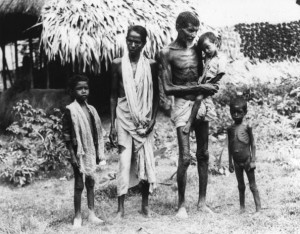 The British brutally put down the Indian Mutiny in 1857-8 with massacres in Delhi, Allahabad, Kanpur and Lucknow. Then, as up to 30 million Indians died in famines in 1876-9 and 1896-1902, the British government of India explicitly prohibited relief efforts or actions that might reduce exports from India to the U.K. or interfere with the operation of the “free market.”
As Mike Davis wrote in his 2001 book, Late Victorian Holocausts, “What seemed from a metropolitan perspective the nineteenth century’s final blaze of imperial glory was, from an Asian or African viewpoint, only the hideous light of a giant funeral pyre.”
And yet Britain kept control of India by commanding such loyalty and subservience from millions of Indians that, in every crisis, Indian troops obeyed orders from British officers to massacre their own people.
Danny Sjursen and U.S. troops in Afghanistan, Iraq and other post-Cold War U.S. war zones are having a very different experience. In Afghanistan, as the Taliban and its allies have taken control of more of the country than at any time since the U.S. invasion, the U.S.-backed Afghan National Army has 25,000 fewer troops under its command than it did five years ago, while ten years of training by U.S. special operations forces has produced only 21,000 trained Afghan Commandos, the elite troops who do 70-80% of the killing and dying for the corrupt U.S.-backed Afghan government.
But the U.S. has not completely failed to win the loyalty of its imperial subjects. The first U.S. soldier killed in action in Afghanistan in 2018 was Sergeant 1st Class Mihail Golin, originally from Latvia. Mihail arrived in the U.S. in November 2004, enlisted in the U.S. Army three months later and has now given his life for the U.S. Empire and for whatever his service to it meant to him. At least 127 other Eastern Europeans have died in occupied Afghanistan, along with 455 British troops, 158 Canadians and 396 soldiers from 17 other countries. But 2,402 – or 68%, over two-thirds – of the occupation troops who have died in Afghanistan since 2001, were Americans.
In Iraq, an American war that always had even less international support or legitimacy, 93% of the occupation troops who have died were Americans, 4,530 out of a total of 4,852 “coalition” deaths.
When Ben Griffin, who later founded the U.K. branch of Veterans for Peace, told his superiors in the U.K.’s elite SAS (Special Air Service) that he could no longer take part in murderous house raids in Baghdad with U.S. special operations forces, he was surprised to find that his entire chain of command understood and accepted his decision. The only officer who tried to change his mind was the chaplain.
The Future of Empire
The U.S. Joint Chiefs of Staff have explicitly told Congress that war with North Korea would require a ground invasion, and the same would likely be true of a U.S. war on Iran. South Korea wants to avoid war at all costs, but may be unavoidably drawn into a U.S.-led Second Korean War.
But besides South Korea, the level of support the U.S. could expect from its allies in a Second Korean War or other wars of aggression in the future would probably be more like Iraq than Afghanistan, with significant international opposition, even from traditional U.S. allies. U.S. troops would therefore make up nearly all of the invasion and occupation forces – and take nearly all of the casualties.
Compared to past empires, the cost in blood and treasure of policing the U.S. Empire and the blame for its catastrophic failures fall disproportionately – and rightly – on Americans. Even Donald Trump recognizes this problem, but his demands for allied countries to spend more on their militaries and buy more U.S. weapons will not change their people’s unwillingness to die in America’s wars.
This reality has created political pressure on U.S. leaders to wage war in ways that cost fewer American lives but inevitably kill many more people in countries being punished for resistance to U.S. imperialism, using air strikes and locally recruited death squads instead of U.S. “boots on the ground” wherever possible.
The U.S. conducts a sophisticated propaganda campaign to pretend that U.S. air-launched weapons are so accurate that they can be used safely without killing large numbers of civilians. Actual miss rates and blast radii are on the “banned topics” blacklist, along with realistic estimates of civilian deaths.
When former Iraqi foreign minister Hoshyar Zebari told Patrick Cockburn of the U.K.’s Independent newspaper that he had seen Iraqi Kurdish intelligence reports which estimated that the U.S.- and Iraqi-led destruction of Mosul had killed 40,000 civilians, the only remotely realistic estimate so far from an official source, no other mainstream Western media followed up on the story.
But America’s wars are killing millions of innocent people: people defending themselves, their families, their communities and countries against U.S. imperialism and aggression; and many more who were simply in the wrong place at the wrong time under the onslaught of over 210,000 American bombs and missiles dropped on at least 7 countries since 2001.
According to a growing body of research (for example, see the UN Development Program study, Journey to Extremism in Africa: Drivers, Incentives and the Tipping-Point for Recruitment), most people who join armed resistance or “terrorist” groups do so mainly to protect themselves and their families from the dangers of wars that others have inflicted on them. The UNDP survey found that the final “tipping point” that pushes over 70% of them to take the fateful step of joining an armed group is the killing or detention of a close friend or family member by foreign or local security forces.
So the reliance on airstrikes and locally recruited death squads, the very strategies that make U.S. imperialism palatable to the American public, are in fact the main “drivers” spreading armed resistance and terrorism to country after country, placing the U.S. Empire on a collision course with itself.
The U.S. effort to delegate war in the Middle East to Saudi Arabia is turning it into a target of global condemnation as it tries to mimic the U.S. model of warfare by bombing and starving millions of innocent people in Yemen while blaming the victims for their plight. The slaughter by poorly trained and undisciplined Saudi and Emirati pilots is even more indiscriminate than U.S. bombing campaigns, and the Saudis lack the full protection of the Western propaganda system to minimize international outrage at tens of thousands of civilian casualties and an ever-worsening humanitarian crisis.
The need to win the loyalty of imperial subjects by some combination of fear and respect is a basic requirement of Empire. But it appears to be unattainable in the 21st century, certainly by the kind of murderous policies the U.S. has embraced since the end of the Cold War. As Richard Barnet already observed 45 years ago, at the end of the American War in Vietnam, “At the very moment the number one nation has perfected the science of killing, it has become an impractical instrument of political domination.”
Obama’s sugar-coated charm offensive won U.S. imperialism a reprieve from global public opinion and provided political cover for allied leaders to actively rejoin U.S.-led alliances. But it was dishonest. Under cover of Obama’s iconic image, the U.S. spread the violence and chaos of its wars and regime changes and the armed resistance and terrorism they provoke farther and wider, affecting tens of millions more people from Syria and Libya to Nigeria and Ukraine.
Now Trump has taken the mask off and the world is once again confronting the unvarnished, brutal reality of U.S. imperialism and aggression.
China’s approach to the world based on trade and infrastructure development has been more successful than U.S. imperialism. The U.S. share of the global economy has declined from 40% to 22% since the 1960s, while China is expected to overtake the U.S. as the world’s largest economy in the next decade or two – by some measures, it already has.
While China has become the manufacturing and trading hub of the global economy, the U.S. economy has been financialized and hollowed out, hardly a solid basis for future growth. The neoliberal model of politics and economics that the U.S. adopted a generation ago has created even greater wealth for people who already owned disproportionate shares of everything, but it has left working people in the U.S. and across the U.S. Empire worse off than before.
Like the “next to nothing” that Danny Sjursen came to realize he was fighting for in Iraq and Afghanistan, the prospects for the U.S. economy seem ephemeral and highly vulnerable to the changing tides of economic history.
The Rise and Fall of the Great Powers
In his 1987 book, The Rise and Fall of the Great Powers: Economic Change and Military Conflict from 1500 to 2000, historian Paul Kennedy examined the relationship between economic and military power in the histories of the Western empires who colonized the world in the past 500 years. He described how rising powers enjoy significant competitive advantages over established ones, and how every once-dominant power sooner or later has to adjust to the tides of economic history and find a new place in a world it can no longer dominate.
Kennedy explained that military power is only a secondary form of power that wealthy nations develop to protect and support their expanding economic interests. An economically dominant power can quickly convert some of its resources into military power, as the U.S. did during the Second World War or as China is doing today. But once formerly dominant powers have lost ground to new, rising powers, using military power more aggressively has never been a successful way to restore their economic dominance. On the contrary, it has typically been a way to squander the critical years and scarce resources they could otherwise have used to manage a peaceful transition to a prosperous future.
As the U.K. found in the 1950s, using military force to try to hold on to its empire proved counter-productive, as Kennedy described, and peaceful transitions to independence proved to be a more profitable basis for future relations with its former colonies. The drawdown of its global military commitments was an essential part of its transition to a viable post-imperial future.
The transition from hegemony to coexistence has never been easy for any great power, and there is nothing exceptional about the temptation to use military force to try to preserve and prolong the old order. This has often led to catastrophic wars and it has always failed.
It is difficult for any political or military leader to preside over a diminution of his or her country’s power in the world. Military leaders are rewarded for military strategies that win wars and expand their country’s power, not for dismantling it. Mid-level staff officers who tell their superiors that their weapons and armies cannot solve their country’s problems do not win promotion to decision-making positions.
As Gabriel Kolko noted in Century of War in 1994, this marginalization of critical voices leads to an “inherent, even unavoidable institutional myopia,” under which, “options and decisions that are intrinsically dangerous and irrational become not merely plausible but the only form of reasoning about war and diplomacy that is possible in official circles.”
After two world wars and the independence of India, the Suez crisis of 1956 was the final nail in the coffin of the British Empire, and the Eisenhower administration burnished its own anti-colonial credentials by refusing to support the British-French-Israeli invasion of Egypt. British Prime Minister Anthony Eden was forced to resign, and he was replaced by Harold Macmillan, who had been a close aide to Eisenhower during the Second World War.
Macmillan dismantled the remains of the British Empire behind the backs of his Conservative Party’s supporters, winning reelection in 1959 on the slogan, “You’ve never had it so good,” while the U.S. supported a relatively peaceful transition that preserved Western international business interests and military power.
As the U.S. faces a similar transition from empire to a post-imperial future, its leaders have been seduced by the chimera of the post-Cold War “power dividend” to try to use military force to preserve and expand the U.S. Empire, even as the relative economic position of the U.S. declines.
In 1987, Paul Kennedy ended The Rise and Fall of the Great Powers with a prescient analysis of the U.S. position in the world. He concluded,
“In all of the discussions about the erosion of American leadership, it needs to be repeated again and again that the decline referred to is relative not absolute, and is therefore perfectly natural; and that the only serious threat to the real interests of the United States can come from a failure to adjust sensibly to the newer world order.”
But after Kennedy wrote that in 1987, instead of accepting the future of peace and disarmament that the whole world hoped for at the end of the Cold War, a generation of American leaders made a fateful bid for “superpower.” Their delusions were exactly the kind of failure to adjust to a changing world that Kennedy warned against.
The results have been catastrophic for millions of victims of U.S. wars, but they have also been corrosive and debilitating for American society, as the perverted priorities of militarism and Empire squander our country’s resources and leave working Americans poorer, sicker, less educated and more isolated from the rest of the world.
When I began writing Blood On Our Hands: the American Invasion and Destruction of Iraq in 2008, I hoped that the catastrophes in Afghanistan and Iraq might bring U.S. leaders to their senses, as the Suez crisis did to British leaders in 1956.
Instead, eight more years of carefully disguised savagery under Obama have squandered more precious time and good will and spread the violence and chaos of U.S. war-making even farther and wider. The new National Defense Strategy’s implicit threats against Russia and China reveal that 20 years of disastrous imperial wars have done nothing to disabuse U.S. leaders of their delusions of “superpower status” or to restore any kind of sanity to U.S. foreign policy.
Trump is not even pretending to respect diplomacy or international law, as he escalates Bush’s and Obama’s wars and threatens new ones of his own. But maybe Trump’s nakedly aggressive policies will force the world to finally confront the dangers of U.S. imperialism. A coming together of the international community to stop further U.S. aggression may be the only way to prevent an even greater catastrophe than the ones that have already befallen the people of Afghanistan, Iraq, Somalia, Honduras, Libya, Syria, Ukraine and Yemen.
Or will it actually take a new and even more catastrophic war in Korea, Iran or somewhere else to finally force the United States to “adjust sensibly to the new world order,” as Paul Kennedy put it in 1987? The world has already paid a terrible price for our leaders’ failure to take his sound advice a generation ago. But what will be the final cost if they keep ignoring it even now?
Nicolas J.S. Davies is the author of Blood On Our Hands: the American Invasion and Destruction of Iraq.
Davos 2018: Elites to save the world at cocktail party schmooze-fest

© Ruben Sprich / Reuters
RT | January 23, 2018
It’s that time of year again when the elite gather at Davos by day to tackle the many problems plaguing the planet. And then by night it’s back to hitting the slopes, sipping champagne and networking again.
Since its first gathering in 1971, the scenic Alpine town of Davos, Switzerland – home to over 200 miles of breathtaking ski slopes – has played perfect host to the world’s financial and political elite, who spend three days attending panel discussions on a variety of topics.
Thanks to the natural edifices of the Swiss Alps, Mother Nature’s most effective security apparatus, not to mention 4,500 police and many miles of security fencing, the Masters of the Universe will be at liberty to discuss momentous global issues without being rudely interrupted by the dissenting voices of the global village far below.
“The skies over Switzerland are choked with private planes and helicopters as Davos gets underway,”CNN reported. “Security is tight, and rooftop sharpshooters watch over attendees as they parade through metal detectors and then swap snow boots for dress shoes.”
And then there is the price of membership in the world’s swankiest club: corporations don’t blink when they are asked to pay $60,000 to purchase base membership to the World Economic Forum; premier corporate partnerships are up to 10 times that amount. The cost alone makes the event prohibitive for your average person, in the highly-unlikely event he or she awoke one morning to find an invitation to this event in his or her mailbox.
In the insulated, discreet world of the elite, this is what seems to pass for ‘democracy in action’. But in reality, the real importance of these annual forums is the golden networking opportunities they offer attendees during “informal talks and…deal-making which takes place elsewhere in the conference centre and in hotel lobbies.”
Meanwhile, with the vast majority of the mainstream media literally in their pockets, Davos – formally known as the World Economic Forum – is rarely on the receiving end of negative publicity. Indeed, it is usually described in one monotonous, uncritical voice as some kind of “high-minded gathering” that aims to “hash out the world’s most intractable problems,” to quote an article from USA Today.
The rationale behind these high-profile meetings is that the corporate elite – due to their lofty position, influence and wealth – are the best-equipped to cure the world’s ills. And judging by the annual theme at these events (Davos 2018’s is ‘Creating a Shared Future in a Fractured World’), mankind is always presented as teetering on the edge of disaster. There is good reason for that. This creates the impression that the only thing required to abolish poverty, fix the environment and end global wars, for example, is for ‘Davos Man’ to sit through a few more dry seminars before hitting the piste.
However, since this brave new dawn for mankind always sits temptingly over the horizon, just out of our grasp, the elite always have the perfect excuse for planning next year’s cocktail party. For some, that may sound like an overly cynical view of this annual event, but it is difficult to see what has changed for the average consumer/citizen since the launch of Davos almost half a century ago.
On the very eve of Davos, the world was greeted with some sobering news: the world’s richest 1 percent received 82 percent of the wealth pie from last year, while the poorest half of the population got exactly nothing, Oxfam said Monday. At the same time, the wealth of billionaires has surged six-times faster than that of ordinary workers since 2010. Finally, a new billionaire was born every two days between March 2016 and March 2017, the charity added.
“The billionaire boom is not a sign of a thriving economy, but a symptom of a failing economic system,” Oxfam executive director Winnie Byanyima said in a statement.
Yet, according to Byanyima, the world’s political and business elite – the same individuals who will be rubbing shoulders in Davos this week – are making things worse for everyone else by “slashing taxes and scrapping labour rights.”
Despite many decades of Davos members getting together for the purpose of improving the economic lot of the world’s citizens, it is painfully apparent they are failing on a grand scale. In fact, the situation is only getting worse.
In 1999, as resistance to globalization was on the rise, then-UN Secretary General Kofi Annan wrote an impassioned plea to that year’s Davos members, calling for a “global compact of shared values and principles, which will give a human face to the global market.”
“Globalization is a fact of life,”Annan wrote. “But I believe we have underestimated its fragility…The spread of markets outpaces the ability of societies and their political systems to adjust to them, let alone to guide the course they take.”
“History teaches us that such an imbalance between the economic, social and political realms can never be sustained for very long.”
Once again, however, another Davos forum passed with the elite delivering a lot of empty words – not action – to address the problem of global inequality. Then, in November 1999, echoing Kofi Annan’s warning to the elite, Seattle erupted in massive anti-globalization demonstrations made up of tens of thousands of protesters. The protests were aimed at the World Trade Organization that had convened in the state of Washington to launch a new round of controversial neoliberal trade negotiations.
Today, the mixed feelings for globalization have not changed and, as the British vote for Brexit proved, has only really intensified.
Since its inception in 1971, Davos has been devoted to the liberal economic principles of open borders. This anti-national stance witnessed at Davos was described by the academic Samuel Huntington, who argued that the global elite (which Huntington famously labeled ‘Davos Man’) “…have little need for national loyalty, view national boundaries as obstacles that thankfully are vanishing, and see national governments as residues from the past whose only useful function is to facilitate the elite’s global operations.”
This year, with US President Donald ‘Make America Great Again’ Trump expected to grace the Davos forum with his weighty presence (assuming his trip does not get canceled due to the shut-down of the US government), the Davos elite will be forced to defend their increasingly untenable position – based on raw statistics – that globalization is a force for the wellbeing of the world’s citizens.
It may well be the first time that ‘Davos Man’ will be forced to defend its position from a top politician who is far more motivated by the interests of the nation-state.
It’s too bad more representatives of the people don’t have a ticket to this event, which promises to be quite a show.
For a comprehensive list of Davos participants since 2013, click here.
Robert Bridge is an American writer and journalist. He is author of the book, ‘Midnight in the American Empire,’ released in 2013. robertvbridge@yahoo.com
Oligarch Jeff Bezos
By Margaret Kimberley | Black Agenda Report | January 17, 2018
Amazon CEO Jeff Bezos has a net worth of $105 billion and is the richest man in the world. But he is not just the richest man at this moment in history. He is the richest person who has ever lived. As of 2017 he and seven other billionaires had a collective net worth equal to that of the poorest 3.6 billion people on earth.
These figures have been in the news of late but without much useful analysis. The corporate media refuse to state what is obvious. Namely that inequality is worse around the world precisely because these super rich people demand it.
While pundits and politicians go on breathlessly about oligarchs in Russia, they seldom take a look at the wealthiest in their own backyard and the control they exert over the lives of millions of people. When Amazon announced it would choose a site for its new headquarters, cities across the country began a furious race to the bottom. Amazon is not alone in the thievery department. Major corporations like Walmart always request and receive public property and public funds in order to do business.
Some 235 cities have put themselves in the running for this dubious venture. Chicago is willing to give Amazon $1.3 billion in payroll taxes that prospective employees would ordinarily pay that city. If Chicago wins this booby prize, Amazon employees would pay taxes to their employer and not to the government. This is truly cutting out the middle man and makes real the rule of, by, and for the wealthiest.
The potential for public outrage isn’t lost on unprincipled politicians. Some cities now refuse to reveal how much they plan to give away. But the news to date is disheartening with Boston offering $75 million while Houston is willing to part with $268 million. Amazon says it will hire 50,000 people but their business model already pays employees so little that many of them qualify for public assistance, despite being employed.
The United States is as much of an oligarchy as countries it usually disparages but it is far more dishonest about its true nature. All talk of democracy is a lie as the rich get richer, by an additional $1 trillion in 2017, and wield more and more power over the lives of everyone else.
The Bezos juggernaut is not restricted to theft of public money. He is also the sole owner of the Washington Post, one of the most influential newspapers in the country. Bezos owns a newspaper that is an organ of the ruling elite and he also has a $600 million contract to provide the Central Intelligence Agency with cloud computing services.
The Washington Post was the force behind Propaganda or Not, an effort to destroy left wing voices like those at Black Agenda Report. Under the guise of fighting Russia and so-called fake news, the Bezos owned Post began the censorship campaign that has put the left’s presence on the Internet in such jeopardy.
Politicians outdo one another giving away public resources to the richest man on the planet who also owns a major newspaper and services the surveillance state. If it can be said that any one person rules the world, Bezos would be obvious choice. No one in Chicago, Boston, Houston or any of the other cities giving away the store ever voted for Jeff Bezos. All talk of democracy is a sham as long as the richest people take from the rest of humanity.
The effort to make government an irrelevance is thoroughly bipartisan. Republicans and Democrats alike are willing to turn over government coffers to Bezos and his ilk and the rights of the people be damned.
Whoever wins this tarnished brass ring ought to be consigned to political defeat. The mayor, aldermen, city council members or whoever else brings disaster to their locality should be punished for aiding and abetting the theft. If these cities can give to the richest man who ever lived, they can surely use public money to help their residents right now. But they will never do that because they are all bought off and compromised. They are either cynical or afraid to go against the real rulers of the country.
Bezos may look like the villain in a James Bond movie but there is nothing funny about him. He is deadly serious and so are his intentions. In a Bezos run world, every worker will be impoverished, every level of government will subsidize corporations, and anyone who speaks out will be discredited and under surveillance.
The last thing any city needs is a new Amazon headquarters. We need an end to billionaire rule in this country and around the world. That will be the salvation of the people, not more sweatshops run by wealthy people who steal from everyone else.
LAST STEP IRAN: What Our Recent Protests Were Really About
By Hamed Ghashghavi | 21st Century Wire | January 15, 2018
TEHRAN, Iran — Two weeks ago, the first demonstration was held in Mashhad and the main reason was people’s total dissatisfaction of credit institutions and banks, which took their money as a hostage for several months.
Some months ago, I witnessed myself people protesting peacefully in front of Iran’s Parliament and Central Bank. Actually, banks in Iran have effective powers (sometime more than European banks), and the interest rates are between 15 to 25%, invested in boondoggle building projects and other matters that normally they should not! We see similar situations the world over.
We can never deny that citizens, including myself, are facing financial problems due to the situation of the country. Essentially, after president Rouhani’s government has invested most of its time and energy on the Joint Comprehensive Plan of Action (JCPOA) ‘Iran nuclear deal’, he had promised the public that Iran’s economic and financial crisis will be resolved after that deal, however, this crisis is still escalating.
Of course the American and European embargoes have partly influenced that economic crisis, but it seems that this has been exacerbated by the inefficiency of the Rouhani Administration. For years, the Supreme Leader has been speaking about the ‘Resistive Economy’ (Economy of Resistance), and the importance of the internal economy (an indigenous one based on nation’s production and employment) while many officials, particularly in Rouhani government, believe the best solution is to be more in touch with European and American economies.
So after the Supreme Leader Sayed Ali Khamenei issued the principles of that Economy of Resistance, authorities began to repeatedly use that expression in their interviews and speeches which urged the Supreme Leader to choose “Economy of Resistance: Production and Employment” as the name of current year in Persian calendar.
Since that deal, many European companies such as Peugeot, Citroen, TOTAL and other leading Europe-based trans-national corporations have come to Tehran and signed multiple contracts with both governmental and non-governmental sides. Practically, and as the Supreme Leader has affirmed, these contracts have been only signed and nothing has changed on the ground. Besides, people have realised that Rouhani’s promises have not been fulfilled. Even if there were any economic advantages out of this deal, the benefits were for the big companies and not the middle class.
These days I hear even some friends saying that European states would like to stay committed to JCPOA, and so I would like to add this point toward European attitude on that issue:
Francesco Condemi, a French documentary filmmaker in his work entitled “L’affaire Peugeot (2013)” has affirmed that the Zionist Lobby in France has been putting a lot of pressure on Peugeot Company to cut its ties with Iran Khodro (Branded as IKCO, an Iranian multinational automaker headquartered in Tehran). Consequently, this emphasises that the Europeans are not committed to any kind of deal with Iranians and moreover, once their interests are threatened, they are the first to turn against you.
Not only based on that documentary and statistics, but also according to FranceTV analysts after France itself, Iran is world’s greatest market for their products, while over in Europe – French cars are a mere ‘third priority’ behind German and Italian cars, which are superior in quality.
Holding a peaceful demonstration in Iran is a guaranteed right as the constitution stipulates. None of the first demonstrations witnessed in the beginning were violent – not until our enemies’ agent provocateurs infiltrated events and began burning the national flag and martyrs’ portraits, attacking some military and government buildings and damaging public places and even setting fire to them. All of this only served to distract the focus of the demonstrations from their original raison d’etre.
In the recent presidential elections, 73.03% Iranian people participated, showing they support the Islamic Revolution and recognise the main reason for Iran’s stability and security in such a region is the Supreme Leader’s wisdom.
And honestly, what percentage of American and European citizens participate in their elections?
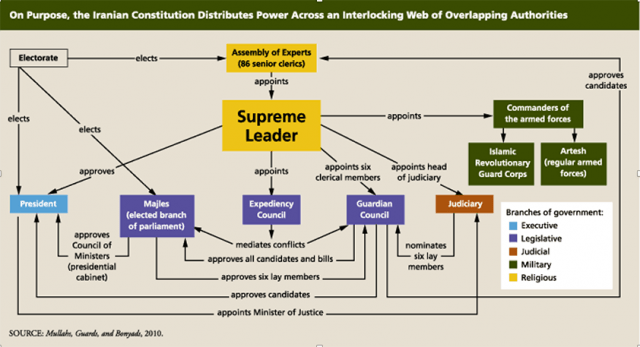
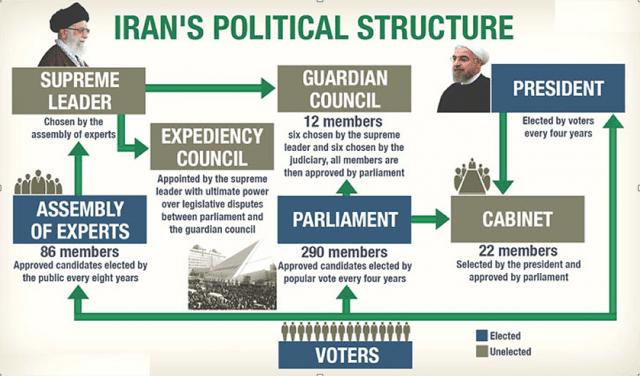
For those who are not aware of how Iran’s politcal system is designed, here are some useful infographics to help explain:
Sayed Ali Khamenei, the Supreme Leader, in a public speech, on 15 February 2017, said (translated from Farsi):
“I say that to country’s officials, if people participate in 22 Bahman (The date on the Persian calendar coinciding with the anniversary of the February 11, 1979, Islamic Revolution) demonstration, it does not mean that they’re satisfied with what we do, people are gluttonous, they are gluttonous based on many issues happening in the country, people don’t like discrimination, anywhere they see some discrimination they feel bad and suffer, the same when they see hypothyroidism, the same when they see (authorities) being indifferent about their problems, when they see the things not advancing, they’re gluttonous. 22 Bahman has to be counted separately, people’s resistance against an enemy ambush to swallow Iran is one thing, which has been illustrated in 22 Bahman, and their expectation from us, the country’s officials – is another thing!”
“If people took to the streets on 22 Bahman it does not mean that they are satisfied with what the government does. The Supreme Leader added, “People’s grievances cannot be ignored: recession, unemployment, and inflation are important issues.”
He also said,
“One European official said to one of our officials that if it was not for the JCPOA, a war on Iran would be certain. This is just a lie! Why are they talking about war? Because they want to engage the minds of the people in war; however, the real war is an economic war – sanctions and ruining the levels of employment activity and technology industries within our country. They draw our attention to a military war so we may forget about these other wars. A real war is a cultural war.”

French mountebank Bernard-Henri Lévy prancing around the MENA region from one war to next, in the service of terrorists.
Undoubtedly, the right of people to demonstrate peacefully is an essential one, but we should be careful of foreign infiltration. We cannot forget what has happened and still is happening in Ukraine, Georgia and some other countries around Eastern Europe. In addition to that we discovered the media manipulation on Libya and Syria by people like French self-styled ‘philosopher’ Bernard-Henri Lévy, and colour revolution engineer George Soros, and their various fabricated Arab Spring narratives in places like Libya. We witnessed the same in Syria, as media operatives made-up the girls and boys as if they have been brutally wounded by Syrian Army, or in Ukraine when we saw similar events on the Maidan. To them, the media is a tool they use to conjure fabricated ‘revolutions’ for a global audience.

A warning to the world: if you see this man, Bernard-Henri Lévy, you can be sure that trouble is around the corner.
During the recent events in Iran, the western Mainstream Media has utilised the same videos from different Iranian cities. BBC Persian, VOA Persian and Manoto were all trying to stimulate chaos in any possible way. It is worth mentioning also that almost 200 Persian-language television channels were founded after the 2009 presidential elections. Like the Gulf-based Arab channels did with Syria, these channels continually provoke people to reject their government by calling them to demonstrate and come to streets. In addition, they brainwash the minds of the Iranians through TV series and movies that attack our cultural lifestyle, values and conventions. The TV series and movies in which we can’t understand who has sexual relation with whom, or if a woman is pregnant as result of having sex with her husband or boyfriend, while constantly promoting various types of intellectual and sexual perversions.
All of these international channels are backed and financed by Western powers, often used as tools of the British and American intelligentsia. Besides, so-called ‘civil society’ NGOs like Brookings Institution’s Centre for Middle East Policy (Saban Centre), International Republican Institute, Freedom House, United States Agency for International Development (USAID), Albert Einstein Institution, Council on Foreign Relations, American Enterprise Institute and many others – are all trying their best to interfere in Iranian affairs on some level.
Trump & others, in the name of ‘human rights’, are working hard to create chaos in Iran, whilst they ignore their worldwide crimes, killing, massacring, torturing, doing genocides, raping, violating, and stealing the wealth and resources of poor nations.
On one hand, we can see how Iranians, people and elites, condemn the violence, while on another hand they are against the corrupted authorities who have to pay the price – and people must see the result of this as the Leader said. Nevertheless, many officials including Major General Mohsen Rezaee view that we should not put the infiltrated anti-governmental individuals with the peaceful citizens in the same basket. Those peaceful people request to have a better economic situation, which is a legitimate and fundamental right.
Definitely, Iran, Russia, Syria, Iraq and Hezbollah have defeated the American’s so-called “War on Terror” and the new US-led project for the Middle East which began on 9/11. All extremists sectarian Wahhabi groups failed to fulfill the American dream of further breaking up the region. Accordingly, creating chaos in Iran is their last step, but, fortunately, the Iranian people are wise enough to confront these conspiracies.

Western media refused to show massive nationwide pro-government demonstrations in early January because these did not fit their western ‘regime change’ narrative.
It is significant that pro-government demonstrations are occasionally held in democratic states such as Iran. People have taken to streets, despite the extremely cold and snowy weather, to slam the anti-government violent activities taking place. However, Western and Saudi mainstream media did not cover these pro-Leader and pro-Islamic Republic demonstrations – as they themselves, the West and Saudi monarchs – don’t have such a popularity or passion in their own countries. Remarkably, one of the people’s slogans condemning foreign agents infiltrated in initial protests was,
“WE THE PEOPLE TAKE CARE OF STOPPING THE ANTI-REVOLUTION DEMONSTRATION AND YOU THE OFFICIAL TAKE CARE OF ECONOMIC PROBLEMS.”

Here are numerous examples of such demonstrations during these past weeks:
Anniversary of December 30, 2009 pro-government rally in Iran , some photos of 2009 rally
(Dec. 29): Tabriz, (Dec. 30): Tehran 1, Across the Country 1, Qom, Tehran 2, Across the Country 2,
Pro-government rallies after recent events: Zanjan (Jan. 1), Across the country 1 (Jan. 2), Across the country 2 (Jan. 2), People appreciating police forces in Azadshahr of Mashhad (Jan. 2), Across the country 3 (Jan. 3), Tehran after Friday prayer (Jan. 5), Past Friday prayer in Tehan (Jan. 5), Across the country 4 (Jan. 4), Across the country 5 (Jan. 4), Across the country 6 (Jan. 7)
Rasht, Mashhad 2, Isfahan, Tehran 2, Ahavz, Ilam and Bodschurd. . .
Double Trouble: US and Saudi Hegemony
US military bases have formed a strategic envelope around Iran, as well as the strategic positioning many US-backed and funded terrorist and extremist groups – such as Al-Qaeda on the Eastern borders, and ISIS on Western borders. However, recent victories by Syria and Iraq, with support from Iran, have proven these Western and Gulf-backed terrorist groups to be a complete failure, and in their failure – have instead strengthened Iran.
Supreme Leader Sayed Ali Khamenei has mocked US president Donald Trump and said that he would fail in his hardline stance against Iran, just as his “smarter” predecessor Ronald Reagan did before him. “Reagan was more powerful and smarter than Trump. He was a better actor in making threats. He also moved against us and shot down our plane,” Leader Khamenei emphasised.
We knew that last year’s ISIS attack in Tehran was funded and sponsored by Saudi government and even before that Bin Salman said “we will bring war into Iran”. And as we look at the recent events in Iran, most related hashtags were tweeted from Saudi Arabia. No surprise there.
As I’ve been asked by many friends about the current status of former president Ahmadinejad, I add this point as a big FORMER fan of this man – I can imagine how understanding of Iran’s domestic policies is difficult for the foreign audience and that is why Western mainstream media is regularly confused about it. That’s why in my last article I explained about the succession of Iran’s presidents and I suggest to those who would like to know why and how Ahmadinejad fits into this series of events, to please take a read to the related part of this article.
We all know that judiciary power in Iran is politically independent as we witnessed many relatives of officials as Hashemi Rafsanjani’s son (Mehdi)’s, president Rouhani’s brother (Hossein Feridon), vice-president Jahangiri’s brother (Mehdi), Ahmadinejad’s deputy (Mohammad Reza Rahimi) were all convicted of corruption and are currently jailed.
Ahmadinejad has recently started to attack judiciary power because his close friends have been arrested or jailed, in Iranian news agencies or websites, except one or two, until now there is no confirmed information about Ahmadinejad’s arrest or his probable involvement in recent provocations. But once again as a big FORMER fan of Mahmoud, (and himself he knows how much I loved him and he was a very important figure for me) I hope this news to be true as this ex-great man became very selfish and arrogant.
And lastly, a surprising point: after Trump’s stupid decision to move the American embassy to Jerusalem and recognizing that Holy City as a capital of an inhumane and absolute criminal entity – the whole world was talking about Palestine, but now after Iran’s recent events, who is still talking about Palestine? This demonstrates the power of distraction.
We’ll finish by quoting Iran’s Supreme Leader and his reaction from to recent events (from Jan 9). The Leader of the Revolution discussed the ‘triangular model’, or the international pyramid hierarchy scheme, used to describe who was responsible for the flow of money and carrying out the orchestrated events in Iran recently.
The hierarchy of the pyramid/triangle is listed from top (1) to bottom (3) in Ayatollah Khamenei’s own words:
- “The plot was made by Americans (US) and Zionists. They have been plotting for many months to initiate riots in small cities and eventually move towards the center.”
- “Money was provided by a wealthy government near the Persian Gulf. Well, these plots are costly. The Americans are not willing to spend money while such accomplices are already there.”
- “The third side of the triangle consists of the US submissive henchmen: Mohajhedeen-E-Khalq Organization, the murderous MEK [aka MKO].”
“The rulers in the United States, firstly, know that they didn’t achieve their goal: they might try to repeat it, but they know that can never achieve it. Secondly, they damaged us during these days, they know there will be some sort of retaliation.”
“The vast manifestations arising from millions of Iranians against recent riots is no ordinary event. Nowhere, in this world, have we witnessed the same exact phenomena. I am well informed on this. This great, coherent people’s movement against the enemies’ conspiracy, with such organization, awareness, and enthusiasm is unique among the world, and it continues for forty years now.”
“It’s not simply a question of a number of years. It is a fight of a nation against an anti-nation; a fight of Iran against anti-Iran; a fight of Islam against anti-Islam: this has always existed and will persists.”
“All actions that the enemies have waged against us, during the past forty years, are counter-attacks against the Islamic Revolution. The revolution uprooted the enemies’ political position in the country; now they (the enemy) uses counter attacks, frequently, and is defeated each time. The enemy acts and cannot advance because of the resistance: the strong national and popular barrier.”
“Once again, the nation with its full power tells the United States, the UK and their Londoners, ‘they couldn’t make it happen this time, and will never achieve their goals.’”
“Various analyses were proposed during these days. All these analyses had a common point: the point which allows the righteous and truthful desires of the people to be distinguished from and the brutal and destructive movements of another group. The two must be distinguished,”
“That a person is deprived of a right and objects to it: or that protesters – hundreds of people — come together and gather to express their concerns, is one thing; and that a number of the people from this gathering misuse this motive–to insult the Quran, to insult Islam, to insult the flag, to burn the Mosque, commit sabotage or set the country on fire–is another thing. The two should not be mixed.”
“The people’s wants, appeals, or protests have always existed in this country, and persist today. Well, like these problematic financial institutions, some of the institutes have been problematic and have made some people very dissatisfied.”
“These appeals must be dealt with and heard out. They must be answered as much as possible,”
All of us — I do not say “others must follow”— I myself am responsible; all of us “must follow this approach.”
“I would like to add that these events had a distinct triangle pattern or scheme. Events did not emerge overnight; but they have been carefully organized. My observances are based on information from sources of intelligence: some are made obvious by their own statements, some have been obtained through intelligence operations.”
“They were prepared months ago. The media of the MEK admitted to this; they said, recently, that they were in contact with Americans some months ago, to carry out U.S.’ orders: to organize riots, meet with this or that person, find individuals inside the country to help them fan out to the people. And that it was they who initiated this.”
“They began with a slogan [to catch attention] in opposition to high prices. Well, this is a slogan that everyone likes. They wanted to attract some people with this message, then enter the arena themselves to pursue their evil goals and attract followers. What people did here is this: First, some people came to streets–though not a big number–, however, just as they understood the real intentions behind, the people separated their lines.”
“On the one hand, the rioters shouted ‘my life be sacrificed for the sake of Iran,’ on the other hand, they burned the flag of Iran! The fools did not understand that these two actions simply cannot go together. Well, we hope that you (MEK) die for Iran! But, when have you stood up to the enemies of Iran? Those who have always stood against the enemy of Iran are the devout, believing, and revolutionary people. Who were the 300,000 martyrs of the Holy Defense era? They were these believing and revolutionary men who defended their country. When have you (MEK) died for Iran, that you shout ‘my life be sacrificed for the sake of Iran’?”
“Well, the United States is now angry, extremely furious; it’s not angry with only me; it’s angry with everyone and everything: angry with the Iranian people, angry with the government, and angry with the Revolution of Iran because it was defeated by this massive, retaliatory movement.”
“Now, the US officials have started to talk nonsense; the president of the United States says the Iranian government fears its very own people! No, the Iranian government was born by their people; it is for their people, is created by the Iranian people, and relies upon them. Why should it fear their own people? If the people were not there, no Islamic government would exists!”
“He [Trump] says that the Iranian government is afraid of U.S.’ power. So, if we are “afraid” of you, how did we expel you from Iran in the late 1970’s and expel you from the entire region in the 2010’s?”
“The rulers in the United States, firstly, know that they didn’t achieve their goal: they might try to repeat it, but they know that can never achieve it. Secondly, they damaged us during these days, they know there will be some sort of retaliation. Thirdly, this man who sits at the head of the White House— although, he seems to be a very instable man–he must realize that these extreme and psychotic episodes won’t be left without a response.”
In his final statements Ayatollah Khamenei, the Leader of the Revolution, reminded his audience: “Those who like to make friends with U.S. agents–whether outside or whether, unfortunately, some inside–they also know that this system is strongly standing and will resolve all weaknesses and problems with God’s grace.”
***
Author Hamed Ghashghavi is a polyglot researcher on North American and Western European Studies, as well as a linguist and documentary filmmaker & editor, based in Tehran.
US forcing Europe to abandon Russian gas & buy more expensive American LNG – Lavrov
RT | January 15, 2018
The United States is afraid of fair competition in the energy sector, and is hampering the implementation of the Russian Nord Stream 2 gas pipeline project, according to Russian Foreign Minister Sergey Lavrov.
“There is reprisal in the energy sector against North Stream 2. It is the US which is calling it politicized, leading to a split in Europe, and the strangling of Ukraine,” he said at a press conference on Monday.
“Washington clearly forces Europeans to abandon Nord Stream 2, despite the fact that gas deliveries to Germany via the pipeline could be 2,000km shorter than through Ukraine, and the cost of transit could be halved,” said the Russian diplomat.
Europeans “are being forced to buy much more expensive liquefied gas from the United States instead of Russian gas,” Lavrov added.
He also said that the US could not withstand fair competition from Russia in the gas-export sector.
Russia plans to build the Nord Stream 2 natural gas pipeline under the Baltic Sea to Germany, and to double the existing pipeline’s capacity of 55 billion cubic meters per year.
The project has faced fierce resistance from some EU members, especially from the Baltic states and Poland. They say the pipeline will cut gas transit through Ukraine and will result in a Russian monopoly in the EU gas market.
Other countries like Austria, Hungary and Germany are in favor of buying Russian gas.
Bezos Gives Millions to DACA, Amazon Staff Need Foodstamps
teleSUR | January 13, 2018
Billionaire Amazon founder Jeff Bezos has been hailed for donating US$33 million of his fortune to a scholarship fund for Deferred Action for Childhood Arrivals (DACA) recipients, while more than 700 Amazon employees have to rely on foodstamps to feed themselves.
News outlets CNBC, Politico, the Wall Street Journal and the New York Times published glowing reports on his philanthropic gesture benefitting immigrants, which comes on the heels of US President Donald Trump promising to revoke immigration protection for some 200,000 El Salvadorans living in the United States and referring to Haiti and African nations as “shithole countries.”
But a recent study by Policy Matters Ohio indicates that more than 700 local Amazon employees – the bulk of Bezos’ staff, who ensure products are correctly sorted, packaged and dispatched – have to rely on foodstamps to survive.
Amazon reportedly received more than $17million in tax breaks in Ohio to open its first two distribution centers, according to The Daily Beast. This act of corporate welfare, which was recorded in 2015, was hailed by lawmakers as a job-creator.
Yet the company has also faced multiple lawsuits and complaints. According to a report by The Morning Call, Amazon employees in Allentown, Pennsylvania, worked in a warehouse where the heat index reached some 102 degrees Farenheit. At least 15 collapsed from heat exhaustion.
“I never felt like passing out in a warehouse and I never felt treated like a piece of crap in any other warehouse but this one,” said Elmer Goris, who worked at the Lehigh Valley site.
Three plaintiffs sued Amazon in 2015, claiming that the company violated wage and hour policies in San Bernardino, California. Two years later, Amazon workers in Sacramento said they were denied overtime pay and rest breaks, according to Salon.
Meanwhile, across the Atlantic, Amazon has been criticized in Scotland for not signing up to the government’s “fair work” program, despite having received more than £5.3million (US$7.28million) of taxpayers’ money to help spur job growth.
Forbes lists Bezos’ wealth at US$108billion, meaning his “philanthropic” donation to DACA recipients equates to roughly 0.03 percent of his total fortune.
Trump waives Iran nuclear sanctions, but for last time: White House
Press TV – January 12, 2018
US President Donald Trump has reluctantly agreed not to reimpose nuclear sanctions on Iran, but it would be the last time he issues such a waiver, according to the White House.
Trump wants America’s European allies to use the 120 day period before sanctions relief again comes up for renewal to agree to tougher measures, a senior White House official said Friday.
The US Congress requires the president to periodically certify Iran’s compliance with the agreement and issue a waiver to allow American sanctions to remain suspended.
While Trump approved a sanctions waiver, the US Treasury Department announced that it has imposed sanctions on 14 Iranian individuals and companies, including Iranian Judiciary Chief Ayatollah Sadeq Amoli Larijani.
A senior administration official said Trump had privately expressed annoyance at having to once again waive sanctions.
Trump has argued behind the scenes that he sees Iran as a rising threat in the Middle East and the nuclear deal makes the United States look weak, a senior US official said.
The Republican president had privately expressed reluctance to heed the advice of top advisers — Secretary of State Rex Tillerson, Defense Secretary James Mattis and National Security Adviser H.R. McMaster — recommending he not reimpose the suspended sanctions.
A decision to reimpose sanctions would have effectively ended the 2015 Iran nuclear agreement, known as the Joint Comprehensive Plan of Action (JCPOA).
The agreement was reached between Iran and six world powers — the US, the UK, France, China, Russia and Germany.
The deal puts limitations on parts of Iran’s peaceful nuclear program in exchange for removing all nuclear-related sanctions.
Trump had come under heavy pressure from European allies to issue the sanctions waiver.
On Thursday, the European Union’s foreign policy chief, Federica Mogherini together with foreign ministers of France, the US and Germany delivered a strong defense of the deal in separate statements, which were issued following a meeting with Iranian Foreign Minister Mohammad Javad Zarif in Brussels.
Why cutting US aid to the Palestinian Authority is not a bad idea
Dr Alaa Tartir | Middle East Eye | January 5, 2018
Many observers and analysts warn that cutting US aid to the Palestinian Authority (PA) is dangerous and may threaten stability. Some have even argued that US President Donald Trump’s funding threat to Palestinians is more dangerous than his decision to move the US Embassy in Israel to Jerusalem.
“Do you think that the PA’s days are now numbered?” is one of the most recurring question by journalists over the past few days after Trump’s statement that “we pay the Palestinians hundred of millions of dollars a year and get no appreciation or respect. They don’t even want to negotiate a long overdue.”
Actions against Palestinians
Trump continued by saying “with the Palestinians no longer willing to talk peace, why should we make any of these massive future payments to them?”. However, Trump’s threat to withdraw aid to the PA should not come as a surprise.
US aid has been always used as a political tool, and the conditionality attached to it has been harmful and damaging for the Palestinians.
But in case the threat of cutting aid to the PA materialises, is it really that bad? I argue no; it is not that bad. Arguably it may prove beneficial – possibly not in the short term, but certainly in the long term.
US aid to the PA largely aims to solidify the role of the PA as a subcontractor to Israel’s occupation and has made the Israeli occupation cheaper and longer, which has benefited Israel’s economy, entrenched Palestinian fragmentation, and denied the potential for Palestinian democracy. For all these reasons, cutting US aid to the PA is not that bad.
The first and foremost goal of the US to Palestine is to promote “the prevention or mitigation of terrorism against Israel”. In other words, aid is provided to the Palestinians to secure Israel; but is that an assistance to the Palestinians or to Israel?
Israel-first paradigm
According to this Israel-first security paradigm, the US administration poured millions of dollars of security assistance to the PA as a way to “professionalise” its security forces for the stability and the security of Israel, its occupation, and settlers in the occupied West Bank.
This skewed logic meant that the PA became a subcontractor to the Israeli occupation, thanks to US aid and conditionality.
This did not only sustain Israel’s occupation, but also it made it profitable for Israel, its economy and its companies. US assistance to the Palestinians is often used to pay PA creditors directly, many of which are Israeli companies charging predatory rates and taking advantage of a captive PA economy.
In addition, the majority of US aid for Palestine (up to 72 percent), especially the securitised aid, ends up in Israel’s economy. Therefore, a large portion of the US “assistance” to the Palestinians effectively translates to additional support for Israel and its security apparatus.
US aid has also entrenched Palestinian fragmentation over the past decade and fuelled the divide between the West Bank and the Gaza Strip. Also, the aid does not only deny the potential for Palestinian democracy but sponsors the emergence of an authoritarian style of governance in the West Bank.
Driven by its securitised agenda, the US-sponsored securitised processes aims to criminalise resistance against Israel’s occupation and supress the Palestinian people’s needs and aspirations.
US aid intervention
The operations and interventions of the United States Agency for International Development (USAID), and the office of the US Security Coordinator (USSC), were instrumental in causing all this harm. By doing so, these two institutions not only violate key international principles of aid delivery, but also they effectively act as a complementary arm of the Israeli colonial occupation.
Certainly, these damages and harmful consequences of the US aid intervention will not be automatically reversed if Trump’s threat to cut aid becomes a reality.
It is far more complex than that, as it requires dismantling complex structures, dynamics, and institutions that have emerged and solidified over the past quarter of a century.
What is crucial at this stage is that Palestinians do not panic and curse their luck for “losing” $300mn to $400mn a year; rather, they should act – and they have plenty of choices. As a starter, they should hold USAID and the USSC accountable, and they should revoke the registry exemptions the late Palestinian leader Yasser Arafat gave to USAID to operate without any Palestinian oversight.
Reverse vetting process
It is time to reverse the “vetting process”; instead of USAID vetting the Palestinians, it is time for the Palestinians to do the necessary vetting to USAID and the other US bodies in the aid industry in Palestine.
Doing so requires the political will and courage among Palestine’s political leadership. However, the current PA leadership remains fixated on its failing approaches and formulas.
The inability of the PA leadership to perform small actions, such as revoking USAID registry exemptions, reflects a deeper legitimacy crisis and illustrates the tactical moves by the current PA leadership to buy time, remain in authority, or re-arrange “peace” talk cards. Those ideas must be urgently resisted and replaced by new strategic directions that are dictated by the Palestinian people.
The remaining major challenge, however, is how to channel the Palestinian people’s demands and aspirations into a legitimate polity and representative institutions.
From the ordinary Palestinian people perspective, there will be short-term negative consequences in the event of Trump’s threat to cut aid materialising. However, it is also crucial to recognise that aid to the PA does not automatically translate to aid to the Palestinian people.
It is misleading to assume that aid and its benefits trickle down to ordinary Palestinian people. The aid industry is designed to benefit few and harm many.
Sam Bahour, the chairman of Americans for a Vibrant Palestinian Economy, recently argued: “I would not lose any sleep if Congress totally stopped funding the Palestinian Authority. It would not make daily life easier under occupation, but maybe it would wake up enough American leaders to see the absurdity of their being dragged around like a flock of sheep by their Israeli herder.”
I would not lose any sleep, either. While a US aid cut will have some negative consequences on Palestinian lives, long-term prospects may prove more more positive as this action would push the PA to abandon the framework of the Oslo Accords aid model. It’s time to lay the failed Oslo aid model to rest.
But a phasing out process requires serious actions, concrete and clear steps, and a national action/rescue plan for a transition toward a post two-state formula and a post-Oslo Accords framework.
Finally, while humanitarian assistance is important, what matters more for the ordinary Palestinians is not a coupon to get wheat or sardines, but rather the political roots to fight against the denial of their rights.
Until those political roots are addressed and no matter of how big the aid flows get, ordinary Palestinians will not feel the positive outcome of aid, be it American, European, or Arab aid.
Trump’s threat to cut aid offers ordinary Palestinians a new opportunity to place the principles of self-determination and dignity in the core of the aid framework and industry.
Dr Alaa Tartir is the programme director of Al-Shabaka: The Palestinian Policy Network, and a research associate at the Centre on Conflict, Development and Peacebuilding (CCDP), The Graduate Institute of International and Development Studies (IHEID) in Geneva, Switzerland. Follow Alaa Tartir on Twitter @alaatartir and read his publications at www.alaatartir.com
Iran’s Aseman Airlines to purchase another 30 Boeing jets
Press TV – January 7, 2018
Iran says it plans to purchase another 30 planes from US aviation giant Boeing if the administration of US President Donald Trump creates no obstacles for the existing order by one of its key airlines.
The announcement was made by Vali Azarvash, the managing director of Atieh Saba Investment Company which is one of the main shareholders of Aseman Airlines.
Azarvash emphasized that no problem had so far occurred as per the previous order by Aseman Airlines to purchase 30 planes from Boeing. The first planes, he said, would be delivered within the next two years.
He said that Atieh Saba Investment would support 95 percent of the costs for purchasing the planes ordered with Boeing.
“If the US politicians create no problems on the way of the implementation of the existing contract, Aseman Airlines will purchase another 30 planes from Boeing,” he was quoted as saying by Iran’s IRNA news agency.
The agreement for the first batch of Boeing planes involves 30 Boeing 737 MAX jets and was signed between the two sides last August.
This came after almost a year of negotiations between Aseman Airlines and the US aviation giant, according to an IRNA report published at the time the contract was signed.
Boeing is to provide 50 planes of the same type to Iran’s flag-carrier airline Iran Air through a similar agreement. The overall value of Iran Air’s order that also involves 30 long-range wide-body 777 aircraft is estimated to be $16.6 billion.
Boeing 737 MAX planes – that would enter service in the second half of 2017 – have a passenger capacity of 130 people and are specifically adequate for domestic and regional flights, IRNA added in its report.
The planes that Aseman Airlines has purchased from Boeing would increase the company’s passenger transportation capacity to above 8,000 seats, it emphasized.
Featured Video

Death Spikes & Rising Cancer In Our Youth Explained
or go to
Aletho News Archives – Video-Images
From the Archives
Politicians lie
By Mazin Qumsiyeh | Popular Resistance | August 18, 2013
There is no way to say this truth nicely: Politicians lie. That includes Japanese, American, Egyptian, Israeli, and Palestinian politicians! Is there something more common sense than that? Yet, so many citizens around the world believe their own politicians or wistfully acknowledge lies but think it is part of the job needed to run things. They believe even when politicians contradict themselves blatantly. This phenomenon is rather remarkable. It is a dissonance and disconnect from reality that many seem oblivious to. It is very dangerous because it can lead to accepting rationales for going to war. These can be deadly wars that lead to millions of lives lost as happened in what was called World War 1 and WW2. Even when incredible and declassified evidence abound, politicians continue to lie and old mythologies refuse to die. Here are just a few of the countless lies told to us over the past few decades… continue
Blog Roll
 Aletho News
- From Unipolar Universalism to Multipolar Civilizational Distinctiveness
- RSF military group defects, joins Sudanese army: State media
- Ireland goalkeeper refuses to play ‘Israel’ as squad weighs boycott
- China pushes back against US on Cuba, Iran
- Ukrainian Soldiers, Potential Mercenaries: Have Gun, Will Travel!
- Burnham’s UN debut… A masterclass in British disinformation
- Iran flights continue despite US aviation sanctions
- Global Tipping Points Lead the World Into a State of Entropy
- The day-after at the White House: USA and Xi Jinping
- The Geopolitical Balance in the Red Sea: The UAE Being Displaced by New Players
- If Americans Knew
- Deconstructing Netanyahu’s pants-on-fire UN rant – Daily Update
- Trump betrayed voters with his campaign lies and prioritized a foreign country once he took office
- Netanyahu calls Israel’s war in Gaza ‘opposite of genocide’ in UN speech to near-empty hall
- Settler Kidnappings: Torture, Sexual Abuse and Terrorisation of Palestinian Abductees as Israel Deepens Annexation of West Bank
- Gaza winter nears as 162,000 tents become unusable, raising fears of humanitarian crisis
- Netanyahu says, “It’s the opposite of genocide”; UN says Gaza economy is world’s ‘most severe crisis on record’ – Daily Update
- Israel’s US-Backed Assault on Gaza Has Created the ‘World’s Most Severe Economic Crisis on Record’: UN
- ‘Protecting U.S. Citizens’… From Israel
- ‘This is where I live now, the back of a truck’: a day in the life of a grandmother in Gaza
- In UN Speech, Iran’s President Displays Pictures of Children Killed by US, Brings Attention to Israel’s Nuclear Arsenal
- No Tricks Zone
- New Study: Earth And Venus Surface Warmth Largely Explained By Convection And Lapse Rate, Not CO2 Or Radiation
- 2025 Nature Paper Claiming Worsening Global Drought Gets RETRACTED …Heavily Flawed
- New Study: ‘Global Drought Shows No Detectable Recent Acceleration Under Climate Warming’
- Economic Masterminds: German Socialists Suggest Taxing Productivity Gains Stemming From Using AI
- The South China Sea Has Not Been Cooperating With The Climate Change Narrative
- Energy Crisis: Germany Enters Heating Season With Historically Low Gas Reserve Fill Levels
- New Study: The Antarctic Ice Sheet Gained Mass From 2020-2024 Due To Staggering Snow And Ice Accumulation
- Study: Ocean Heating Rates From Thousands Of Years Ago ‘Dwarf’ Modern Ocean Heating Rates
- Climate Extremists Target, Attack Large-Scale Power Grid Infrastructure In Germany!
- New Study: Antarctic Ice Melt Has Contributed Less Than 1 Centimeter To Sea Level Rise In The Last 30 Years

