AfD delegates reject motion condemning Putin
RT | January 12, 2025
The right-wing Alternative for Germany (AfD) party has overwhelmingly voted against including in its 2025 election manifesto a condemnation of Russian President Vladimir Putin for the conflict in Ukraine.
The delegates gathered for a conference in Riesa, Saxony on Saturday to decide on the platform for the snap parliamentary elections, which will be held next month.
Albrecht Glaser, a member of the Bundestag, proposed to accuse Russia of failing to protect civilians in Ukraine and to state that “AfD condemns the behavior of President Putin and once again calls on all warring parties to propose an immediate ceasefire and hold peace talks.”
According to news channel N-tv, 69% of the delegates voted to reject the motion. The draft program approved by the party leadership only briefly mentions the conflict, saying that “the war in Ukraine has disturbed the European peaceful order,” the news agency Deutsche Presse-Agentur reported.
The draft reportedly says that AfD “sees Ukraine’s future as a neutral state outside of NATO and the EU,” and calls for the restoration of “undisturbed trade” with Russia.
Known for its anti-immigration stance, AfD is the second-most popular party in Germany, according to the polls. The party has been often accused of parroting Russian narratives about the conflict, given that its position on Ukraine mostly aligns with Moscow’s demands to Kiev.
The party has rejected the “pro-Russian” label, insisting that continuing military support for Kiev and sanctions on Russian trade and energy exports are against Germany’s national security.
During her recent conversation with tech billionaire Elon Musk, AfD co-leader Alice Weidel argued that the EU has abandoned diplomatic efforts in favor of dangerous confrontation with Russia. The conflict could “escalate big time towards a nuclear exchange,” she warned.
Early elections were called after Germany’s ruling three-party coalition collapsed in late 2024 due to disagreements over the budget.
The last American Banker rats are leaving the UN Net Zero Banking club
Jo Nova | January 10, 2025
A few years ago they were all going to save the world from the sixth mass extinction, but now they just want to avoid an anti-trust suit.
Such is the phase change of the Trump win, the largest banks in the USA, JP Morgan and Morgan Chase have now joined Goldman Sachs, Wells Fargo the Bank of America, and Citigroup.
Six big US banks quit net zero alliance before Trump inauguration
The Guardian
Analysts have said the withdrawals are an attempt to head off “anti-woke” attacks from rightwing US politicians, which are expected to escalate when Trump is sworn in as the country’s 47th president in just under a fortnight.
The giant super-squid of asset management is also thinking of leaving the UN Net Zero Alliance.
By Charles Gasparino, New York Post
BlackRock — which for years has courted controversy with its focus on so-called ESG, or Environmental Social Governance investing — is considering an exit of the so-called “Net Zero” coalition of top corporations who pledge to reach zero-carbon emissions by 2050, The Post has learned.
BlackRock’s likely departure is more significant [than all the other banks]. The world’s largest investment fund, with more than $10 trillion in assets under management, was a leader in ESG investing, with its top executives including Fink evangelizing on the need to use the company’s investing might to force corporations to reduce their carbon footprint.
Mum’s the word:
BlackRock press officials declined comment. A rep for State Street and JPMorgan didn’t return a call for comment. A press official for the alliance declined to comment.
Their lawyers will have beaten them into silence. If the world is facing a crisis they look like cowards, and if the world isn’t facing a crisis they look like crooks for abusing clients funds for ideological quests or worse, traitorous sell-outs to the global oligarchs.
As I said, the Net Zero Banking Alliance was the UN-banker cabal that were colluding to use $130 trillion dollars in assets to bully the first world into sabotaging their economies by buying expensive, unreliable Net Zero electricity. It was dangerously close to being a proto World Government. The club effectively could decide national policies on who could build competitive electricity grids, and who had to do the fantasia plan to control the storms of 2100 with their electricity grid in 2024.
They wouldn’t be jumping ship if Kamala had won.
Iran plans $120bn worth of investment in petroleum projects
Press TV – January 11, 2025
Iran is planning to invest up to $120 billion in petroleum projects as the country seeks to increase its oil and gas production to respond to a rising demand for energy.
Oil Minister Mohsen Paknejad said on Saturday that Iran will invest some $50 billion to increase its oil production to 4.6 million barrels per day (bpd) by 2028, from a current output of 3.3 million bpd.
Paknejad said that Iran’s natural gas production should also increase from 1 billion cubic meters (bcm) per day to 1.35 bcm per day in the next four years, adding that the country will need to invest more than $70 billion to hit the target.
He said investment in gas fields will also cover projects to boost pressure at South Pars, the world’s largest gas field which straddles the maritime border between Iran and Qatar in the Persian Gulf.
The minister said seven pressure-boosting projects with a total investment of $18 billion will be executed in South Pars to help stabilize the output from the giant reserve.
Paknejad said Iran also seeks to increase its refining capacity by 0.5 million bpd per day until 2028 while trying to raise the output capacity of its petrochemical sector.
He said the development projects will be funded partly through finances provided by Iran’s sovereign wealth fund and partly through investment from foreign companies.
Iran’s plans to expand its petroleum sector come as the country is still subject to an extensive regime of US sanctions that bans the provision of technology and investment from abroad.
Since the sanctions were imposed in 2018, the Iranian Oil Ministry has mostly relied on domestic resources to develop the oil and gas fields in the country.
Russia to Respond to US Sanctions Against Energy Sector – Russian Foreign Ministry
Sputnik – 11.01.2025
MOSCOW – The United States’ decision to introduce new sanctions against the Russian energy sector will receive a response, the Russian Foreign Ministry said in a statement on Saturday.
“Washington’s hostile actions will not go unanswered and will be taken into account [by Moscow] when developing foreign economic strategy,” the statement said.
The ministry also noted that the introduction of new sanctions is an attempt to harm the Russian economy ahead of the end of President Joe Biden’s “inglorious tenure” at the cost of the risk of destabilizing global markets. The interests of US allies in Europe and residents of the United States are being sacrificed, the ministry added.
“Accordingly, the incoming president, who does not have the right to lift the mentioned sanctions without the approval of Congress, is left with a ‘scorched earth,’ literally and figuratively,” the statement said.
Russia will continue implementation of large oil and gas production projects, as well as import substitution, provision of oilfield services and construction of nuclear power plants in third countries, the ministry also said, noting that Moscow was and remains a key and reliable player on the global energy market.
On Friday, the US imposed sanctions on more than 200 companies and individuals linked to Russia’s energy sector, as well as more than 180 vessels involved in energy transportation. The sanctions are aimed at restricting Moscow’s access to international markets and reducing revenues from oil and gas exports.
Nord Stream pipeline to be relaunched — German chancellor candidate
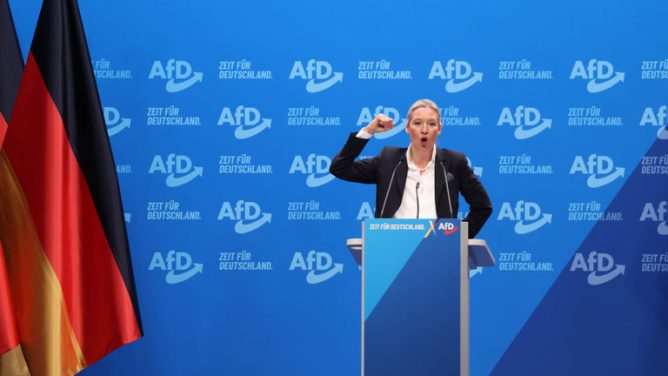
Alice Weidel speaks at the AfD party congress in Riesa, Germany, January 11, 2025 in Riesa © Getty Images / Sean Gallup
RT | January 11, 2025
Alternative for Germany (AfD) co-leader Alice Weidel has pledged to put the sabotaged Nord Stream gas pipelines back into operation if her party emerges victorious in next month’s general election.
AfD members met in the town of Riesa on Saturday to formally approve Weidel as their candidate to succeed Chancellor Olaf Scholz, whose coalition government collapsed late last year. Weidel’s nomination marks the right-wing AfD’s first bid for the chancellery in its 11-year history.
In a speech after the nomination vote, Weidel promised to implement harsh immigration policies – including the “remigration” of immigrants already living legally in Germany – and to scrap Scholz’s green policies in a bid to drive down energy prices. Restoring energy ties to Russia is vital to this latter goal, she explained.
“We will put Nord Stream back into operation, you can count on it,” Weidel told her party.
Germany relied on Russia for 55% of its natural gas supply before the Ukraine conflict escalated in February 2022. Much of this gas flowed through the Nord Stream 1 pipelines, with the parallel Nord Stream 2 lines due to come online in 2022. However, Berlin revoked the certification for Nord Stream 2 several days before Russia’s military operation in Ukraine began, and both sets of lines were destroyed in an act of sabotage in September of that year.
While German investigators have reportedly settled on the theory that the pipelines were destroyed by Ukrainian saboteurs, American journalist Seymour Hersh maintains that they were blown up by the CIA and US Navy. The head of Russia’s Foreign Intelligence Service (SVR), Sergey Naryshkin, has blamed “professional saboteurs from the Anglo-American special services,” referring to the US and UK.
Scholz’s decision to halt Russian energy imports, coupled with his government’s green policies, has led to soaring electricity costs in Germany, forcing some of the country’s manufacturing giants – including Volkswagen and BASF – to close plants and lay off workers.
The AfD is not the only German party that wants to repair and reopen Nord Stream. The leftist Sahra Wagenknecht Alliance (BSW) has also demanded that they be brought back online, with BSW MP Sevim Dagdelen calling last week for the gas lines to “finally be put into operation,” and for the German government to “stop giving money to Kiev!”
Germans go to the polls to choose a new government on February 23. The AfD is currently polling at around 20%, ahead of Scholz’s center-left Social Democratic Party (SPD) at 16%, but behind the center-right Christian Democratic Union (CDU) at 31%. However, even if the AfD were to emerge as the largest party next month, all of Germany’s other mainstream parties have ruled out entering a coalition with it.
Battle for Tech Metals: What Are 17 Rare Earth Elements and What Are They Used For?
By Ilya Tsukanov – Sputnik -10.01.2025
Whether it’s Greenland, Ukraine, West Africa or East Asia, rare earths are an element of the global geopolitical competition hiding just below the surface. What are the rare earth elements, where are they concentrated, and what are their major uses? Check out our explainer for a detailed breakdown.
Basic Facts
Rare earth minerals are a group of 17 silvery-white soft heavy metals, mostly consisting of the lanthanides, a family of 15 elements grouped together in the Periodic Table, plus scandium and yttrium, which have similar chemical properties and are often found in deposits alongside the others.
Despite their name, rare earths aren’t especially rare, with one of the rarest – lutetium, some 200 times more common than gold. Rather, what makes the resources rare is finding them in large, easy to find and mine clusters.
Rare Earths and Their Uses
Lanthanum (La): Used in nickel-metal hydride batteries for hybrid vehicles, lighting, camera lenses and other special glass, and as a catalyst for petroleum refining.
Cerium (Ce): Added to an array of alloys for increased strength and corrosion protection, magnets, for burn treatments, glass polishing agents, lightbulbs and household wares including ceramics.
Praseodymium (Pr): Key component for aircraft engine-grade high-strength alloys, powerful magnets (including for use in wind turbines), tough didymium glass, and fiberoptic cables.

USGC data-based map of global rare earth element mines and known strategic reserves by country. © Photo : Stratfor
Neodymium (Nd): Used for everything from magnetotherapy to magnetic motors, microwave communications, microphones, headphones, loudspeakers, hard drives, automotive electronics, fluorescent and energy-saving lamps and lasers.
Promethium (Pm): Key component for luminous paint, portable X-rays, and atomic batteries for critical electronics, from the military and aerospace to pacemakers.
Samarium (Sm): Active ingredient in a popular cancer-cell killing agent; used in combination with other elements in magnets, lasers and nuclear reactor control rods for neutron absorption.
Europium (Eu): Another excellent neutron absorber, as well as red phosphor for TVs, blue color in LEDs, and therapeutics tool.
Gadolinium (Gd): Active ingredient for MRI drugs. Also used in nuclear propulsion systems, metallurgy, microwave and magnetic refrigeration.
Terbium (Tb): Key tool for chemical screening; green phosphor for TVs and monitors, used in lighting, military grade sonar and other sensors.
Dysprosium (Dy): Used to make powerful permanent magnets, lasers and lighting, electric drive motors for EVs and wind turbines, transducers, resonators, and dosimeters for measuring ionizing radiation.
Holmium (Ho): Another neutron-absorber useful for radioimmunotherapy, magnets, as well as optics, microwave, medical, dental and laser surgery equipment.
Erbium (Er): Added to lasers and optics used in medicine, as well as optical communications, with strong neutron-absorbing qualities. Also useful for chemical analysis and crystal growth.
Thulium (Tm): Used in military and industrial-grade lasers, as a source of radiation for portable X-rays, for meteorology and high-temperature superconducting tools, and popular anti-counterfeiting agent.
Ytterbium (Yb): Key element in X-ray components, memory devices, tunable lasers, amps and displays; metal-strengthening component and burnable poison for controlling nuclear reactions.
Lutetium (Lu): Used in petroleum refining, polymerization, lithography, tomography, as a phosphor for some light bulbs. Also used for tumor treatment, and to build the world’s most accurate atomic clocks.
Scandium (Sc): Key ingredient for high-grade lightweight alloys for everything from military and commercial aircraft to sporting equipment, small arms, high intensity discharge lamps, dentistry, and as an oil refinery tracing agent.
Yttrium (Y): Another metal-strengthening alloy. Also used for high-temperature superconducting, a surprising array of medical applications (from drug labeling and cancer treatment to surgical needles) as deoxidizer and nodulizer, the red color in cathode ray tubes, radar and synthetic gems.
Slovakia faces energy crisis by next winter after Ukraine shut off Russian gas, president warns
By Thomas Brooke | Remix News | January 10, 2025
Slovakia faces a looming energy crisis next winter unless an alternative method of gas importation is established, following the cessation of supplies through Ukraine, Slovak President Peter Pellegrini warned on Friday.
Speaking in the village of Nemecká, Pellegrini highlighted the gravity of the situation and called for urgent solutions to secure the nation’s energy stability.
While gas supplies for this winter are stable in terms of price and capacity, Pellegrini emphasized the underlying vulnerabilities. “We are currently consuming more gas than we are receiving, relying heavily on reservoirs filled to maximum capacity earlier this year,” he said. However, the president expressed concern that these reserves would not suffice for the next heating season if the supply deficit is not addressed.
The gas supply disruption stems from Ukraine’s decision on Jan. 1 to halt the transit of Russian gas to Slovakia. Kyiv justified the move as a measure to cut off revenue that could support Russia’s ongoing war effort, asserting that alternative suppliers had been made available and supplies to the European Union had been maintained. The move has enraged some member states heavily reliant on the gas route.
Pellegrini lamented the failure to reach a compromise with Ukraine, saying, “I regret that an agreement could not be found. Ukraine’s decision to shut off the gas has exposed Slovakia to a serious challenge in the coming months.”
The Slovak president revealed the challenges of importing liquefied natural gas (LNG) from other countries, citing limited capacity at European terminals. “The import of LNG runs into significant bottlenecks in northern and southern Europe. These terminals cannot fully replace the current shortfall,” he noted, stressing the urgency of finding alternative sources to make up for the lost capacity.
Prime Minister Robert Fico, speaking after discussions with EU Energy Commissioner Dan Jorgensen on Thursday, hinted at retaliatory measures should the situation persist. Fico suggested that Slovakia might cut off aid to Ukraine and use its veto in the European Council to block further EU support for Ukraine’s war effort.
“There is nothing — neither international law nor sanctions — that prevents the transit of gas through Ukraine,” Fico stated in Brussels. He also warned of the broader implications for the European Union, noting that rising energy prices could undermine the bloc’s competitiveness. “If the damage to the EU and Slovakia becomes permanent, we will take reciprocal measures,” he added.
Slovakia threatens to block Ukraine aid over gas transit dispute – media
RT | January 10, 2025
Slovak Prime Minister Robert Fico has warned that Bratislava may block the European Union’s financial and humanitarian aid to Kiev if the cessation of Russian gas transit through Ukraine is not resolved, Reuters has reported. Fico made the statement after talks with EU Energy Commissioner Dan Jorgensen on Thursday.
Fico cited potential losses from the blocked transit as the reason for his threat.
“There is nothing – not international law or sanctions – that prevents the transit of gas through Ukraine,” Fico told reporters in Brussels, as quoted by Reuters.
Slovakia has seen the complete cessation of Russian gas flows via Ukraine, a route that previously provided Bratislava with significant transit fees and also provided the gas for its domestic consumption.
According to Fico, Slovakia stands to lose $515 million annually in transit fees and could face an additional $1 billion in increased gas prices due to the disruption.
“If this problem is not resolved, the government of the Slovak Republic will take strict reciprocal measures in the near future,” Fico said.
The prime minister outlined potential retaliatory measures, including exercising Slovakia’s veto power within the European Union on Ukraine-related issues.
He also threatened to suspend humanitarian aid to Ukraine, scaling back support for Ukrainian refugees in Slovakia, and halting emergency electricity supplies to the country.
Fico’s remarks follow recent discussions with Russian President Vladimir Putin in Moscow, during which the Slovak leader secured assurances of direct gas supplies to Slovakia despite the transit halt.
A meeting initially scheduled between Slovak, Ukrainian, and European Commission officials to address the gas transit issue was canceled after Ukraine declined to participate. Slovakia and the European Commission have since agreed to form a working group to assess the crisis and explore potential EU interventions.
Ukraine has not yet publicly responded to Fico’s latest statements. When the Slovak PM first threatened to cut off electricity to Kiev last month, Ukrainian Energy Minister German Galushchenko said he didn’t think that Bratislava would go through with the threat.
Slovakia, which has a contract with Russia’s Gazprom, requires between 4 billion and 5 billion cubic meters (bcm) of gas annually to meet its energy needs. Prior to the transit halt, it had been receiving around 3 billion bcm from Russia through Ukraine. In response to the disruption, SPP, Slovakia’s state-owned gas company, is now sourcing liquefied natural gas (LNG) from international suppliers, including BP, ExxonMobil, Shell, Eni, and RWE.
Lebanon parliament elects Aoun as president, ending two years of deadlock
Press TV – January 9, 2025
Lebanese lawmakers have elected army chief Joseph Aoun as Lebanon’s new president, putting an end to a two-year-long political deadlock in the crises-hit Arab country.
Legislators on Thursday chose Aoun after two rounds of voting in the 128-member parliament of the small Mediterranean country, which has been without a president since the end of the tenure of former president Michel Aoun, who is not associated with the newly-elected president, in October 2022.
Political neophyte Aoun, 60, is widely regarded as the favored candidate of the United States and Saudi Arabia, on whose financial support Lebanon relies as it works to recover from a 14-month bombardment by Israel mostly against the Arab country’s southern parts where the Lebanese Hezbollah resistance movement is based.
Hezbollah, which had exchanged daily fire with the occupying regime from October 2023 until a ceasefire in November, had previously supported Suleiman Frangieh, the leader of a small Christian party in northern Lebanon, as its preferred candidate.
However, Frangieh announced his withdrawal from the race on Wednesday and threw his support behind Aoun, seemingly paving the way for the army commander.
Aoun secured 99 out of 128 votes in Lebanon’s deeply divided parliament, with support from across the political spectrum, including Hezbollah legislators and their rivals. His election ended a prolonged leadership vacuum that had stalled key reforms and heightened fears of a broader collapse amid the nation’s multiple crises.
Following his election as president on Thursday, Aoun, who had served as the 14th Commander of the Lebanese Armed Forces since 2017, formally stepped down from his military role. He entered parliament to take the oath of office dressed in civilian attire.
Aoun will need to oversee the implementation of the US-brokered ceasefire between Israel and Lebanon while also establishing a new government capable of addressing postwar reconstruction.
In November, the World Bank provided a preliminary assessment estimating the war’s physical damage and economic losses at $8.5 billion.
However, any rebuilding efforts will be hindered by Lebanon’s severe economic crisis, a five-year downturn that commenced with a liquidity crisis in Lebanese banks. Since then, the country’s GDP has contracted by over a third.
Before Thursday’s parliamentary sessions, 12 attempts to elect a president had failed over the past two years.
Since October 2022, the small Mediterranean country has been functioning without a formal government, which has worsened a financial crisis that prompted Lebanon to default on $30 billion in Eurobond debt some five years ago.
Lebanon’s divided sectarian power-sharing system is often susceptible to deadlock due to both political and procedural challenges. The country, which is currently struggling with its crises, has experienced multiple prolonged presidential vacancies, including the longest one, which lasted nearly two and a half years from May 2014 to October 2016, ending with the election of former President Aoun.
Ukraine offers to replace Hungary in EU
RT | January 9, 2025
Ukraine is ready to take Hungary’s place in the European Union, the Foreign Ministry in Kiev said on Wednesday. Budapest recently blasted Ukraine for blocking the transit of natural gas from Russia to the European Union.
Earlier this week, Hungarian Foreign Minister Peter Szijjarto accused Kiev of creating “artificially reduced supply,” emphasizing that its unilateral decision to stop the transit of Russian gas, coupled with EU sanctions, had sent prices soaring.
“If the Hungarian side prioritizes strengthening of Russia instead of the EU and the US, it should openly admit it,” the Ukrainian Foreign Ministry said in a statement. “Ukraine will be ready to fill any vacant seat in the EU and NATO, if Hungary decides to vacate it in favor of membership in the CIS or the CSTO.”
The CIS, short for the Commonwealth of Independent States, is a bloc uniting several post-Soviet countries. The CSTO, or Collective Security Treaty Organization, is a military alliance that currently includes Russia, Belarus, Armenia, Kazakhstan, Kyrgyzstan and Tajikistan.
Ukraine chose not to prolong a five-year transit contract with Russia’s Gazprom at the end of 2024, cutting off several EU member states from Russian gas supplies, including Romania, Poland, Hungary, Slovakia, Austria, Italy, and Moldova. The halt immediately sent prices in the region soaring to more than €50 per megawatt hour, a level unseen since October 2023.
Hungary’s Szijjarto stated that the higher prices undermine the EU’s competitiveness and disproportionately burden citizens of the bloc. The minister further alleged that Ukraine had breached its EU Association Agreement by halting transit shipments.
Kiev’s decision has also been slammed by Slovakia, which relies on Russian pipelines for about 60% of its energy needs. Last week, Slovak Interior Minister Matus Sutaj Estok characterized the move as a “betrayal of trust” and a threat to energy stability in the region.
Russian Foreign Ministry spokeswoman Maria Zakharova said earlier this month that the US was the only beneficiary of the situation, charging that Washington is the “main sponsor of the Ukrainian crisis.”
Moscow was willing to prolong the transit contract and maintain gas shipments through Ukrainian territory beyond 2024. President Vladimir Putin accused Kiev of “punishing” EU member states with its decision, predicting that it would result in higher energy prices. During his annual press conference on December 19, he said the halt would have minimal impact on Russia, however.
After Jordan, Carrefour halts operations in Oman over BDS campaign
Al Mayadeen | January 8, 2025
French multinational retail giant Carrefour has announced the suspension of its operations in Oman, just two months after closing all its branches in Jordan in response to a global anti-“Israel” campaign denouncing the occupation entity’s decades-long crimes against Palestinians.
Carrefour, one of the largest supermarket chains worldwide, confirmed its decision through a statement on its official Instagram account on Tuesday: “Effective from January 7, 2025, Carrefour operations will be discontinued in the Sultanate of Oman.”
This announcement follows a similar decision on November 5, 2024, when the company declared a complete halt to its operations in Jordan.
The closures were attributed to significant financial losses and reputational damage resulting from a widespread and creative boycott campaign. Majid Al Futtaim, which holds the exclusive rights to operate Carrefour in the West Asia region and the Arab world, publicized the decision.
The campaign, led by the Palestinian BDS National Committee (BNC) as part of the global Boycott, Divestment, and Sanctions (BDS) movement, began in December 2022 in response to the French global retail group’s complicity in Israeli crimes against Palestinians.
The #BoycottCarrefour campaign has gained momentum over the past two years, with protests staged outside Carrefour outlets globally, despite efforts in some countries to suppress such activism.
Calls for a boycott intensified further following the outset of “Israel’s” war on Gaza, with critics accusing Carrefour branches of supporting war crimes by providing gift packages to Israeli soldiers and running donation campaigns to support soldiers involved in the war on the Palestinian enclave.
Additionally, Carrefour has reportedly signed agreements with Israeli technology firms and banks implicated in human rights violations and war crimes against Palestinians.
Futtaim Group’s semi-annual report for 2024 revealed a 47% decline in retail sector profits, citing reduced consumer confidence due to the “geopolitical conflict in the region.”
The report highlighted the impact of the extensive boycott campaign, which has gained traction across the region, from Jordan to Morocco, Egypt, Tunisia, Bahrain, Kuwait, and the United Arab Emirates.
EU scoops up record amount of Russian LNG – Bloomberg
RT | January 7, 2025
The volume of liquefied natural gas (LNG) shipped by Russia to the European Union hit a record high in 2024, Bloomberg reported on Monday, citing ship-tracking data for key EU buyers. The surge occurred before Kiev’s suspension of gas transit through Ukraine to the bloc.
Ukraine opted not to prolong a five-year transit contract with Russian energy giant Gazprom beyond the end of 2024, halting the flow of natural gas from Russia to Romania, Poland, Hungary, Slovakia, Austria, Italy, and Moldova.
The data tracked by the news agency showed that last year, exports of Russian gas to the bloc totaled some 30 billion cubic meters of gas, with more than half of that volume going via the pipeline system running through Ukrainian territory.
At the same time, the amount of super-chilled LNG shipped from Russia to the region in 2024 soared to an all-time high of 15.5 million tons, the news outlet reported, noting a significant surge in shipments compared to 2020, when the EU imported some 10.5 million tons of the fuel.
“Europe will still need gas as all its efforts to wean itself from Russian gas have not been successful,” Tatiana Orlova, an economist at Oxford Economics, told the news agency. “It will probably end up buying more Russian LNG to make up for the drop in natural gas imports from Russia.”
Moscow also exports gas to Europe through the TurkStream pipeline, which runs from Russia to Türkiye via the Black Sea and then to the border with EU member Greece. Two lines of the route provide gas supplies for the Turkish domestic market and supply central European customers, including Hungary and Serbia.
Supplies via the Yamal-Europe pipeline were halted back in 2022, after Poland terminated its gas agreement with Russia and Moscow blacklisted EuRoPol GAZ, a joint venture between Gazprom and Polish gas company PGNiG (which operates the route), in response to Western sanctions.
Despite a significant reduction in pipeline gas imports from Russia due to the Ukrainian conflict and the sabotage of the Nord Stream pipelines in September 2022, EU member states continued to purchase record amounts of the country’s LNG. The chilled fuel has only partially been targeted by the latest sanctions introduced by the bloc.
In June, Brussels banned ships from obtaining Russian LNG by engaging in re-loading operations, ship-to-ship transfers, or ship-to-shore transfers with the purpose of re-exporting it to third countries. The sanctions have a nine-month transition period.
The bloc has vocally committed itself to eliminating its reliance on Russian energy, but has continued to purchase LNG from Russia, which accounted for 15% of total imports of the fuel as of June, according to data tracked by commodities data provider Kpler.
Russia was ranked the second biggest supplier of LNG to the European continent after the US in the first half of 2024, according to data compiled by the Institute of Energy Economics and Financial Analysis, which noted that the country’s share amounted to 21%.
In December, Russian President Vladimir Putin said that Moscow is planning to continue to increase the share of Russian LNG on world markets, highlighting that the fuel is one of the top-requested energy products globally.
Featured Video

The CIA’s Cocaine Corridor
or go to
Aletho News Archives – Video-Images
From the Archives
Pilpul for Beginners
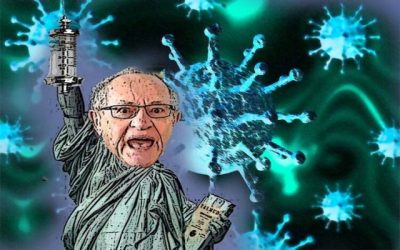
By Gilad Atzmon | May 18, 2020
Americans may be surprised to learn from Alan Dershowitz that their constitution is far more intrusive and oppressive than what they and their forefathers have believed for generations. The law ‘scholar’ declared yesterday that “you have no (constitutional) right to not be vaccinated.” … continue
Blog Roll
Recent Comments
loongtip on Eilat port faces worst crisis… loongtip on British minister dreams of kid… loongtip on Kiev awards major mining proje… loongtip on UK believes it can seize any t… loongtip on Pirates of the Caribbean loongtip on Australian festival boycotted… loongtip on Kiev seeks to ban Russian musi… seversonebcfb985d9 on Somaliland and the ‘Grea… John Edward Kendrick on Kidnapped By the Washington… aletho on Somaliland and the ‘Grea… John Edward Kendrick on Somaliland and the ‘Grea… aletho on Donald Trump, and Most America…


 Aletho News
- Scott Ritter say he was ‘de-banked’
- Leaked files tie Epstein to Israel-UAE backchannel and possible kompromat
- Alleged Ukrainian plot to influence Hungarian elections claims postal vote fraud and even a false flag attack
- Australia’s New Hate Speech Bill Is Reckless, Contradictory, and Repressive
- Report: Kurdish Fighters Have Been Entering Iran From Iraq and Clashing With the IRGC
- Trump’s Options in Iran Limited By Military Buildup in Latin America
- Villains of Judea: Paul Singer’s Empire of Debt & Demographic Replacement
- The Gaza ceasefire’s Phase 2 only exists in the media and at UN meetings
- We must act before Palestinian hostages are executed in the world’s worst prisons
- Why Washington will take Greenland
- If Americans Knew
- 41% drop in Gaza births may be “reproductive violence” – Not a ceasefire Day 97
- Trump family has long record of supporting Israeli causes
- Militant Pro-Israel Group Agrees to Halt Operations in New York
- During “ceasefire,” at least 100 Gaza children killed – clearly NOT a ceasefire Day 96
- Israel Has Demolished 2,500 Buildings in Gaza Since Signing Ceasefire Deal
- Iran, Gaza and the politics of counting the dead
- How Israel’s move in Somaliland fits in its broader strategy for regional dominance
- As genocide continues in Gaza, the West Bank is pushed into a new Nakba
- Israeli settlers beat elderly, deaf Palestinian man in West Bank attack, video shows
- U.S. May Bankroll New Israeli Armored Vehicles With Billions of Dollars, Internal Files Reveal
- No Tricks Zone
- New Study: Species Extinction Rates Declining Since 1980 – ‘Climate Change Is Not An Important Threat’
- Denmark Places Climate Protection Above Animal Welfare, Poisoning And Culling Cows
- New Study: Greenland Was 3-7°C Warmer And Far Less Glaciated Than Today 6000-8000 Years Ago
- German Media Report That Current Frigid Weather Can Be Explained By Arctic Warming!
- Berlin Blackout Shows Germany’s $5 Trillion Green Scheme Is “Left-Green Ideological Pipe Dream”
- Modeling Error In Estimating How Clouds Affect Climate Is 8700% Larger Than Alleged CO2 Forcing
- Berlin’s Terror-Blackout Enters 4th Day As Tens Of Thousands Suffer In Cold Without Heat!
- Expect Soon Another PIK Paper Claiming Warming Leads To Cold Snaps Over Europe
- New Study: Human CO2 Emissions Responsible For 1.57% Of Global Temperature Change Since 1750
- Welcome To 2026: Europe Laying Groundwork For Climate Science Censorship!
 Aletho News