EU does not benefit from Ukraine shutting down gas transit from Russia, says energy expert
Remix News | January 7, 2025
While the countries supporting sanctions and the European Commission welcome the Jan. 1 termination of Ukrainian gas transit due to the reduction in Russian gas purchases, those representing a more moderate position warn of the economic and social consequences, says energy market expert Olivér Hortay, president of the Századvég Economic Processes Research Institute, in an interview with Magyar Nemzet.
“The former argue that the halt in transit is a positive development, because the EU will no longer buy Russian gas on this route, and they also repeatedly state that the EU is prepared for the cessation of transit. In contrast, representatives of the more moderate position emphasize that the halt in Ukrainian transit will have harmful consequences for the entire European community,” Olivér Hortay said.
“The former group typically approaches the issue from the quantity side, and in this sense they are right that in the short term, the transit stoppage will not cause an acute supply problem. After all, the reserves of all EU member states, together with alternative procurement routes, make it possible to replace the missing quantity during this year’s heating season. It is true that there are challenges in the case of Slovakia and Austria, but the situation can also be solved there with the help of the relatively large amount of stored energy sources and alternative procurement,“ explained the energy market expert.
However, this does not mean that the EU is actually benefiting from the closure of Ukrainian gas transit taps. “On the first trading day of this year, European gas exchanges opened above last year’s highest price, which immediately showed how harmful the supply shortage is,” Hortay pointed out.
Moreover, the gas markets of the member states are highly interconnected, meaning that the negative consequences affect all countries. The states most affected will have to face additional disadvantages.
“(Slovak PM) Robert Fico previously said that the new sources of supply are much more expensive for Slovakia, simply because it will have to buy natural gas via a longer route, through more countries, and therefore at higher transit costs. According to Fico, the Ukrainian president’s move will increase costs for the entire European Union, as a result of which EU member states may face a total of €60 billion to €70 billion in additional expenses due to higher gas and electricity prices,” said the expert.
This is also due to competitiveness.
“The fact that the transit shutdown will cause economic difficulties for the European community is important because the EU’s most serious competitiveness problem, as stated in the Draghi report, is the high price of energy carriers. Today, European companies pay four to five times as much for natural gas as Americans. This disadvantage could only be overcome if much more gas than currently arrives comes into the region, so that the expansion of supply would depress prices,” Hortay continued.
Speaking about the longer-term prospects regarding how the affected countries will make up for the lost volumes, Hortay said that Austria will probably increase its purchases from the West and may deplete its stored gas reserves at a faster rate, and Slovakia may also do this. From Hungary’s perspective, however, the unfavorable situation may present an opportunity in that the loss of Ukrainian transit may accelerate the trend that has been developing for several years whereby Hungary shifts to the role of a regional gas distributor.
In recent years, Hungary has shifted its Russian gas purchases from the Ukrainian direction to the south, built its trade relations with other eastern partners, and built and developed its cross-border capacities, thus becoming a gateway for gas coming from the East.
This is beneficial for Hungary for two reasons. On the one hand, due to transit revenues, Ukraine, for example, loses over $1 billion a year by closing its gas taps, and on the other hand, its geopolitical position is strengthened: the energy supply of neighboring countries will depend on energy shipments passing through Hungary.
This role previously belonged to Austria, but if the Ukrainian transit still does not start, Austria may lose this position permanently, according to the expert.
Olivér Hortay also recalled that Hungary sold a record amount of natural gas to Slovakia last year, and in contrast to the situation a few years ago, gas typically flowed eastward on the Hungarian-Ukrainian border. Capacities in the northern direction have been increased with various technical solutions in the recent period, and the really big question going forward will be whether the capacity of the TurkStream can be increased, and if so, when. All of the countries involved, including Hungary, have indicated on several occasions that they would support such an investment.
The European Commission has also contributed to the shrinking supply, making natural gas more expensive overall, says Hortay. Hungary, on the other hand, is in favor of so-called diversification, meaning that it believes that as many suppliers and as many routes as possible should be allowed to bring natural gas to the European market, allowing players to compete with each other, thus driving prices down.
In order for all of this to happen, capacity expansions are necessary, and in recent years there has been significant progress in this area, and the trend is likely to continue, concluded Olivér Hortay.
New York On The March To Climate Utopia
By Francis Menton | Manhattan Contrarian | January 2, 2025
In a post a couple of weeks ago on December 21, I observed that the country of Germany appeared to have won the race among all countries and states to be the first to hit the “Green Energy Wall.” Its pursuit of the “renewable” wind and solar electricity fantasy has put it in a spot where regular wind/sun droughts cause huge electricity price spikes, and major industries have become uncompetitive. It has no solution to its dead end, and can go no farther.
If Germany has “hit the wall,” what is the appropriate analogy for New York? New York passed its Climate Act with great fanfare in 2019. The Act orders that we are to have a “net zero” energy system by 2050, with interim deadlines along the way. The first serious deadline arrives in 2030, where the official mandate is 70% of electricity generation from “renewables” (aka “70 x 30”). That deadline is now just five years away. Within the past year, all the efforts to move toward the 70 x 30 goal are falling apart, as anybody who had given the subject any critical thought knew that they inevitably would. But nobody in authority has yet been willing to acknowledge that this has turned into a farce.
Here’s my analogy: New York is like the cartoon character Wile E. Coyote, who has run off the cliff and is now suspended in mid-air, apparently not knowing what will happen next.

We know what’s next: shortly, he will crash to earth.
Consider a few data points:
Off-shore wind procurement
The Scoping Plan developed under the Climate Act calls for some 9000 MW of offshore wind by 2035. People with elementary-school-level arithmetic skills knew that this amount of intermittent generation would not be nearly enough to replace the amounts of dispatchable generation set to close; but maybe this would at least be a serious start. By early 2023, it was reported that some 4300 MW out of the 9000 MW were in “active development,” with wholesale prices having been agreed to with developers in the range of $100/MWh.
But then reality started to hit. In this post on October 15, 2023 I reported that “essentially all” of the developers of the 4300 MW of off-shore wind in “active development” had backed out and demanded price increases in the range of 30 – 50% to proceed. New York rejected that maneuver, but ultimately had no option other than to re-bid the contracts and get bids in the range that the developers were demanding.
On February 29, 2024, the State announced that it had accepted re-bids for two of the projects in question, for a total of only about 1700 MW and at a price of over $150 per MWh. (This level of price would require retail electricity prices in the range of at least $0.40 per kWh and would be completely uneconomic if it were to become the norm for New York electricity production.).
Meanwhile, the remainder of the offshore wind procurement appears to be in complete disarray. On April 19, E&E News reported that New York had canceled efforts on three of its big offshore wind development areas, Attentive Energy, Community Offshore Wind, and Excelsior Wind. These three, had they proceeded, would have totaled about 4000 MW out of the 9000 MW 2035 goal. Excerpt:
New York canceled power contracts for three offshore wind projects Friday, citing a turbine maker’s plans to scrap its biggest machines. The news is a heavy blow to the U.S. offshore wind industry and a major setback for the climate ambitions of New York — and President Joe Biden. The three projects would have delivered 4 gigawatts of offshore wind to the state, amounting to almost half of New York’s 2035 goal.
At this point nobody has any idea how to get large amounts of offshore wind developed around New York at a price anybody is willing to pay. And of course, nobody has a solution to the intermittency problem either.
Green hydrogen
The New York regulators have recognized that a de-carbonized and predominantly wind/solar electricity generation system will require something called the “dispatchable emissions-free resource,” or DEFR, to make it work. The best idea that anybody has for the DEFR is so-called “green” hydrogen, that is, hydrogen produced by some non-emitting system, like wind, solar, or hydro.
Currently, only negligible amounts of green hydrogen are produced in the world, and none in New York. But somehow, New York got the idea that it could make this work. Two green hydrogen facilities have been granted state subsidies and are supposedly under way. One is being developed by a company called Plug Power, and is at an industrial park called STAMP west of Rochester; and the other is being developed by Air Products at Massena, on the St. Lawrence River. Both of these facitilities are almost comically small relative to the amounts of hydrogen that would be needed to fully back up New York’s electricity generation in a world of mostly wind and solar generation. But at least they would be something.
On October 18, the Batavian reported that the Plug Power hydrogen facility was “on pause.” Excerpt:
Chris Suozzi, VP for business and workforce development at the Genesee County Economic Development Center, reportedly told a Washington, D.C.-based commercial real estate firm that Plug Power’s STAMP project is on hold. . . . “They’re not ready to go,” Suozzi reportedly said. “They’re on pause. We don’t know what’s going to happen with them at this point.”
The pausing or cancellation of a green hydrogen project should surprise no one. The past year has seen major cancellations of much larger such projects by big players like Australia’s Fortescue and Origin. The fact is that the cost of producing green hydrogen is a large multiple of the cost of getting natural gas out of the ground for the same energy content, besides which natural gas is a much superior fuel in every way (higher energy density, easier to handle, less corrosive, less subject to leaks, far less dangerous and explosive, etc.). Meanwhile, the developer of the STAMP green hydrogen project, Plug Power, reported as its results for the third quarter of 2024 a loss of $211 million on revenues of $174 million. They are hoping for a loan from the federal Department of Energy to keep themselves going. I wonder what Chris Wright is going to think about that.
The Air Products facility in Massena plans to use hydro power from a dam on the St. Lawrence to produce its hydrogen. Excuse me? The hydro power is already dispatchable. How can it possibly make any sense to use dispatchable electricity to produce hydrogen whose purpose is to make dispatchable electricity? At least about 40% of the energy is going to get lost on the round trip from electricity to hydrogen and back to electricity. It simply has to be that there is a better use for the St. Lawrence River hydro power than turning it into hydrogen and then using the hydrogen. But nothing here makes any sense.
Clean Path Transmission Line
Another key facility to make renewable energy work for New York was supposed to be the Clean Path transmission line. This is a proposed 175-mile high-capacity (4 GW) transmission line to bring to New York City and the downstate region power generated at various new “renewable” (wind and solar) facilities being developed in the northern and western parts of the state. The stated cost of this major project was to be $11 billion.
On November 27, the New York State Energy Research and Development Authority informed the Public Service Commission that the Clean Path project had been canceled. Here is a copy of the NYSERDA letter. Here is a piece from Utility Dive on December 3 about the cancellation.
I don’t find any discussion about the reasons for the cancellation, but it has to be that the developers figured out the the economics did not work. Here’s the problem: because wind and solar generators only work about 20-40% of the time, this enormously expensive transmission line would not be operated at anywhere near its capacity. Likely, it would only average about one-third of capacity. That means, compared to a line that operates at or near 100% of capacity, its charges for transmission would be about triple.
The cancellation of this line has only occurred within the past month, and I haven’t seen anything about plans for a re-bid or an alternative strategy. So far, nobody is saying “this can’t possibly work.” But no matter how you approach the problem, the cost of transmitting intermittent wind and solar power from far upstate to New York City is going to be around triple the cost of transmitting power from a natural gas plant that runs nearly all the time.
So here we are, suspended up in the air, and nobody seems to realize that we will shortly crash to earth. Everybody involved is trying to milk the last dollars out of the taxpayers before the crash hits.
Countdown to the European Collapse
By Lucas Leiroz | Strategic Culture Foundation | January 4, 2025
Finally, energy cooperation between Russia and Europe is (almost) completely over. After nearly three years of sanctions and sabotage, the bilateral Moscow-EU energy partnership suffered its greatest historical blow. Kiev fulfilled its promise not to extend its contract with Gazprom, which was allowing the arrival of Russian gas to Europe, then creating an extremely uncomfortable energy insecurity situation for its own “partners” in the European Union.
On the morning of the first day of 2025, the Russian Federation stopped supplying gas to European buyers via Ukraine. Even amidst the conflict, the Russian Gazprom and Ukrainian Naftogaz had kept in operation an energy transit agreement signed in 2020, which expired on the last day of 2024. Previously, Kiev had already announced it was unwilling to renew the contract with Gazprom, although some European countries repeatedly asked Ukraine to do so.
Despite the sanctions imposed on Russia since 2022, some European countries continued benefiting from the import of Russian gas, particularly Slovakia and Hungary – nations that refused to participate in the Western-sponsored anti-Russian boycott – as well as Austria, a country historically neutral in Europe’s geopolitical and military disputes. Other nations, even adhering to the sanctions, continued hypocritically receiving Russian gas, such as Italy, Poland, Romania, and Moldova. There were also cases of gas resale, with receiving nations re-exporting the commodity to countries seeking to bypass the sanctions.
With the end of the Ukrainian route, all these states lost any guarantee of a safe energy source – precisely during winter, the time of year when gas consumption in Europe is at its highest. Obviously, there are currently energy reserves that may be enough to cope with the challenges of the current season, but the situation will progressively become more critical over time. European nations will have to find new sources of gas or expand the use of the only two remaining routes for Russian gas (via Turkey and the Black Sea). Recent indicators show a substantial rise in gas prices among Asian exporters. Ankara is also expected to take the opportunity to gain more profits from its pipeline.
There is currently hope among Europeans for a cheap gas supply through the long-awaited Qatari-Turkish pipeline project via Syria. With the fall of Bashar al Assad’s legitimate government, energy giants from Turkey and the Gulf have revived the proposal, although they are waiting for domestic pacification in Syria by the Al-Qaeda junta to begin the construction. Some optimistic analysts in Europe believe this would be the antidote to Europe’s dependency on Russian gas – or Asian and American, as in the current circumstances.
The main problem with this hope is believing in the goodwill of the Western hawks to “pacify Syria.” Without Assad, Damascus became a “failed state,” with territory divided between different factions in constant hostilities. It is unlikely this will change – simply because, despite the tactical operators of the Syrian crisis (Turkey and Qatar) wanting pacification, the strategic mentors (Israel and the USA) are not interested. Tel Aviv prefers a polarized and war-torn Syria, unable to do anything to prevent territorial progress in the Golan and beyond. Washington, which is subservient to Israeli interests through the international Zionist lobby, is interested in the same – along with, of course, fostering Kurdish terrorists to worsen the internal Syrian situation even further.
In other words, Western analysts still do not understand that the decision-makers of the unipolar axis simply do not want to solve Europe’s problems. It is not in the US’ interest that its “partners” in Europe regain cheap energy and a strong industrial base. For Washington, the collapse of Europe is not a tragedy but a strategic goal, whose roots lie in the science of geopolitics itself. According to the fundamentals of Western geopolitics, Russian-European integration would be disastrous for the US-UK Atlantic axis. Therefore, in the face of Russia’s imminent military victory and Moscow’s rehabilitation as a Eurasian geopolitical power, the Americans and the British have adopted a “scorched earth” strategy in Europe.
Sanctions, the terrorist attack on Nord Stream, and the closure of the Ukrainian route to Europe are events that are part of the same strategic context: in all these cases, Anglo-American strategists want to provoke an energy collapse in Europe to enable deindustrialization and the subsequent economic and social crisis. The final goal is a ruined Europe, not only unwilling but also incapable of establishing any future strategic ties with Moscow.
With the fall of the Ukrainian gas route, it can be said that the US won an important battle in its economic war against Europe. The total collapse is merely a matter of time.
Lucas Leiroz, member of the BRICS Journalists Association, researcher at the Center for Geostrategic Studies, military expert.
Uncle Sam and Banderite bandits destroy Europe while Euro lackeys hail liberation
Strategic Culture Foundation | January 3, 2025
This new year began with a new era that presages Europe sliding irrevocably into economic darkness and abject suzerainty under U.S. dominance.
Uncle Sam has won a decades-long ambition to dominate Europe entirely, thanks to the help from a NeoNazi regime in Ukraine and the pathetic European politicians who hail the slavery of Europe as some liberation.
The people of Europe are facing a foreboding period of economic hardship. We can confidently say that because the most fundamental of economic inputs – fuel energy – is about to become more expensive and precariously supplied for the European Union.
Russia’s decades-long energy relations with Europe are now severed. It seems an astounding final act of reckless self-harm. The European Union’s economies have been floundering from an energy crisis caused by EU leaders willfully cutting off supplies of Russian gas. Now, with the last major transit route shut down, Europe is heading toward economic, social, and political self-destruction.
On Wednesday, New Year’s Day, the Ukrainian regime cut off the last supply route of Russian gas to the European Union. This regime, which glorifies Stepan Bandera and other Nazi-era fascists, is, in effect, holding the entire European Union hostage with its Russophobia and relentless corruption.
The arrogance and audacity are astonishing. The Ukrainian regime does not have an elected leader (Zelensky canceled elections last year), it is not a member of the EU, it has milked European taxpayers of hundreds of billions of Euros, and now has unilaterally shut down the last gas pipeline from Russia to the EU.
Ironically, the pipeline was called the Brotherhood Pipeline. It was conceived in the 1970s and began operating in the 1980s, carrying natural gas from Russia’s Western Siberia to the EU. Ukraine received generous transit fees for the overland route. The decades-long era of transcontinental cooperation was killed on December 31 by a Banderite regime that has the cheek to claim its actions are virtuous to “stop Russian blood money”.
Incredibly, too, various European leaders also hailed the Ukrainian action as a liberation from Russian energy dependence. Some Western media even tried to cast Moscow as the villain that instigated the cut-off. The New York-based Council on Foreign Relations, for example, inverted reality with the headline: “Russia ends exports of natural gas to Europe via Ukraine”.
To his credit, Slovakia’s Prime Minister Robert Fico seems to be the only sane leader among the EU’s 27 member states. He condemned what he called Ukraine’s “sabotage” of Europe’s energy supply and its economies. Fico warned that the European Union is facing a full-blown economic disaster as a result.
The Ukraine transit route supplied Slovakia, Austria, Italy and the Czech Republic. Now, those countries will have to find alternative supplies from international markets. The Ukrainian route also supplied Moldova, which is facing an immediate energy crisis. Russia claims that the Moldavian government owes outstanding bills for past gas supply.
The Brotherhood Pipeline harks back to an era of friendship and cooperation even though it was conceived during the Cold War between the West and the Soviet Union. The 4,500-kilometer pipeline was partly financed by German capital.
Another ambitious Cold War-era supply route was the Yamal Pipeline, which ran over 4,100 km from Siberia to Poland and Germany. Its operation was halted in 2022 by Poland following the outbreak of hostilities in Ukraine.
The more recently constructed Nord Stream 1 and 2 pipelines that ran 1,200 km under the Baltic Sea from Russia to Germany were blown up in 2022. That covert act of sabotage was no doubt carried out by the United States under the orders of President Joe Biden, according to the respected investigative journalist Seymour Hersh.
The upshot is that all major Russian natural gas supply lines to Europe have now been terminated. The only one remaining is Turk Stream which runs under the Black Sea to Turkey. But it mainly supplies Balkan countries that are not in the EU.
In the space of two years, Russia has gone from being the major supplier of EU gas imports (over 40 percent) to being a minor source. The big winner of the phenomenal market disruption is the United States, whose exports of liquefied natural gas to the EU have tripled. Another winner is Norway, which is not an EU member. Other sources of gas for Europe are Azerbaijan and Algeria.
However, the unprecedented extra costs to Europe for this enormous rearrangement in its energy trade are encumbering the EU economies, industries and households with crippling burdens. New pipelines have to be built, as well as new terminals to receive the shipped gas. U.S. exports cost 30 to 40 percent more than the Russian product.
The slump in the German economy from higher energy costs is directly caused by the cutting off of abundant and affordable Russian gas. And it is going to get even worse. The grim fate of Germany heralds the economic misery that the whole EU is sliding headlong into.
The history of Europe’s economic demise is as obvious as it is blatant.
Of course, it is all about the United States using and abusing its Western “allies” for its own interests. For Western imperialists, there is no such thing as allies, only interests. And the Americans are exacting that maxim to the hilt.
For decades, the U.S. has vehemently opposed the energy trade between the EU and Russia. Back in the 1980s, President Ronald Reagan’s administration tried its best to block the development of the Brotherhood Pipeline with threats of economic sanctions. The Americans openly said they didn’t want to see Europe and the Soviet Union developing cooperative relations.
At least in earlier times, the European governments appeared to have more independence and backbone. Germany, France, Italy and others rebuffed Washington’s demands to shut down the gas projects.
The long-running strategic aim of the U.S. to displace Russia as an energy supplier to Europe has now been realized. It’s a sign of the desperate times and lawlessness that American military operatives attack European infrastructure.
The blowing up of the Nord Stream pipelines and the proxy war in Ukraine have secured the strategic aim of the U.S. and its NATO proxy – keeping the Germans (Europeans) down, the Americans in, and the Russians out.
So much for the free-market capitalism and rules-based order that American and European elites preach. The practice is brute economic competition and dominance down the barrel of a gun. Millions of lives have been destroyed in this “great game” of American imperialist chicanery, and the proxy war in Ukraine is risking the escalation to a nuclear Third World War.
The Banderite regime – an echo of the Nazi past – has enabled the United States to enslave Europe to Washington’s imperialist desires.
Tragically, a coterie of elitist European political leaders are so obsessed with Russophobia and servility to their American overlord that they are crowing with delight at cutting off Russia.
Russia will not suffer. Its vast energy resources are finding alternative lucrative global markets. The victims are the European citizens who are being plunged into wretched economic hardship due to the machinations of American capital, its Banderite tools, and Euro fools.
German MP calls for NordStream to be reactivated
RT | January 3, 2025
Germany should respond to the rising energy prices caused by Ukraine’s halting of Russian gas transit by repairing and reactivating the Nord Stream pipelines, leftist German MP Sevim Dagdelen has said.
Ukraine refused to extend its transit contract with Russia’s Gazprom beyond the end of 2024, effectively cutting off the flow of natural gas to some EU countries as of Wednesday. Under the old contract, Ukraine moved gas through its own pipeline network and into Moldova, Romania, Poland, Hungary, and Slovakia, and then on to Austria and Italy.
Ukraine’s decision caused EU gas prices to spike to €50 per megawatt hour, a figure unseen since October 2023.
“Ukraine drives the energy price up further by stopping the transit of Russian gas in Europe,” Dagdelen wrote on X on Thursday, complaining that “the German government and the EU are happily watching the destruction of European industry due to high energy prices.”
Energy costs soared in Germany after the government renounced Russian oil and gas imports in 2022. Whereas the country once relied on Russia for around 55% of its natural gas supply, it has struggled to make up the shortfall, and its leading manufacturers – including Volkswagen, Bosch, and BASF – have all announced layoffs and plant closures.
Prior to the start of the Ukraine conflict, Germany received gas from Russia via the Nord Stream 1 pipelines, while Nord Stream 2 was due to come online in 2022. Berlin revoked the certification for Nord Stream 2 several days before Russia’s military operation in Ukraine began, and both sets of lines were destroyed in an act of sabotage in September of that year.
While German investigators have reportedly settled on the theory that the pipelines were destroyed by Ukrainian saboteurs, American journalist Seymour Hersh maintains that they were blown up by the CIA and US Navy. The head of Russia’s Foreign Intelligence Service (SVR), Sergey Naryshkin, has blamed “professional saboteurs from the Anglo-American special services,” referring to the US and UK.
In her post, Dagdelen called for the pipelines to “finally be put into operation,” and for the German government to “stop giving money to Kiev!”
Dagdelen is a member of the Sahra Wagenknecht Alliance (BSW), a leftist political faction that supports rapprochement with Russia and shares the right-wing Alternative for Germany’s (AfD) anti-immigration stance. The party’s leader, Sahra Wagenknecht, recently blamed the Ukraine conflict on the failure of the US to acknowledge Russia’s “red lines.”
Back in September, Wagenknecht declared that “if Ukraine is responsible for the terrorist act against the German energy supply, the arms deliveries must end immediately and the question of compensation must be put on the table.”
Dagdelen is not the first German MP to demand that Nord Stream be reopened. In September, AfD co-leader Tino Chrupalla called the undersea pipes “a lifeline of German industry,” and declared that “Nord Stream must be repaired, opened, and secured.”
Bernie Sanders confronts Musk on Indian immigrants
RT | January 3, 2025
US Senator Bernie Sanders has taken a swipe at Elon Musk over his defense of the H-1B immigration program, arguing that it only helps enrich billionaires who rely on cheap foreign labor while undermining ordinary Americans.
The H-1B visa program allows US companies to employ foreign workers in fields requiring advanced skills in fields such as technology, engineering, and medicine. It has been described as the only significant channel for foreign graduates to enter the US workforce, with the vast majority of approved petitions going to Indian nationals in recent years.
Both Musk and Vivek Ramaswamy, who US President-elect Donald Trump picked to lead his proposed ‘Department of Government Efficiency’ initiative (DOGE), have spoken out in support of the program. Musk, reportedly a former H-1B recipient, suggested that this type of visa “made America strong” by attracting foreign talent, while vowing to “go to war on this issue the likes of which you cannot possibly comprehend.”
Musk’s critics say the H-1B program has been of great benefit to his own companies – Tesla and SpaceX – as well as other big US corporations.
Writing on X on Thursday, Sanders, a self-described democratic socialist, joined the critics.
“Elon Musk is wrong. The main function of the H-1B visa program is not to hire ‘the best and the brightest,’ but rather to replace good-paying American jobs with low-wage indentured servants from abroad. The cheaper the labor they hire, the more money the billionaires make,” he wrote.
Sanders noted that from 2022 to 2023, the top 30 largest US companies using the program hired over 34,000 new employees under H-1B, while laying off at least 85,000 American workers.
“The H-1B program must be ended. Bottom line. It should never be cheaper for a corporation to hire a guest worker from overseas than an American worker,” he said.
In 2016, Trump, who is known for his hardline stance on immigration, called the scheme “very unfair” to American workers and said it should be ended.
In late December, however, Trump appeared to have changed his mind and expressed support for the program.
“I have many H-1B visas on my properties. I’ve been a believer in H-1B. I have used it many times. It’s a great program,” he said. Asked about the apparent flip-flop, Trump denied that he ever changed his mind, the New York Times reported.
Some of Trump’s biggest supporters, however, are critical of H-1B. Steve Bannon, a former White House chief strategist under Trump, called the program a “scam” that benefits “Silicon Valley’s sociopathic overlords.”
“It’s disgusting to talk about ‘high-skilled foreign workers’ while bringing in slave labor,” he said.
H-1B Visas: A Lesson from Canada
By Laura Rosen Cohen | Brownstone Institute | January 2, 2025
President Trump has been very busy lately, driving leftist and Liberal Canadians utterly out of their minds by wickedly and hilariously trolling Prime Minister Justin Trudeau while simultaneously threatening a massive 25% tariff on the Canadian auto industry. With a solitary few taps of fingers on his phone, Trump cornered Canada by brewing an artisan Trumpian “threat to start some conversation” online. It went something like this: “Nice auto industry you got there. Would be a real shame if something happened to it!”
This “conversation starter,” which could also be rightly characterized as an existential death blow to the Canadian auto industry, forced Prime Minister Trudeau to hastily jet down to Mar-a-Lago. There, he unceremoniously flopped in his mission to mitigate damages, which has since been followed by the pilgrimage of several other notable Trudeau lightweights to continue the conversation. Maybe Mr. Wonderful will have better luck.
You could be forgiven if you thought the main lessons learned from this episode are that Canadians have a very fragile sense of humor, and that they bristle at being reminded how fully dependent the Canadian economy is on America. All of that is, of course, true. But if you thought that was the main event, you’d be wrong. The two main takeaways are that any industry that is being protected will, at some point, have an economic and policy moment of reckoning, along the lines of Herbert Stein: If something cannot go on forever, it will stop. And the second lesson is that it will likely play out in part, in real time on X. The Trump-Trudeau show, however, is just a shiny bauble. The real policy landmine in America is immigration, both legal and illegal.
This brings us to the H-1B visa issue in America, which is currently being “debated,” right in front of our eyes on X. On the surface, it seems to be a relatively simple philosophical debate; are you in favor of bringing in foreign workers for the jobs that Americans allegedly cannot do? Or do you favor policies that incentivize hiring Americans? Battle lines are even being drawn among conservative thought leaders and MAGA-adjacent personalities like Elon Musk, Vivek Ramaswamy, and others.
The public divide seems to be about being in favour of skilled immigration, or being anti-immigrant. But this framing is a distraction. The real issue, of course, is how writer Lee Smith puts it, which is that “… H-1B matters because it’s an effect of the core issue — indeed the reason DJT is POTUS — a political and corporate establishment that has waged a half-century long campaign to destroy the American middle class.”
Bingo. And this is where it behooves the Trump administration to learn from the failed Canadian experience with our H-1B visa equivalent: the Temporary Resident Permit or TRP.
Officially, the TRP gives status to non-citizens or permanent residents (the last step before citizenship) to be legally in Canada for a temporary purpose. This can include international students, tourists, or foreign workers. (The TRP does not apply to visa-exempt countries.)
Unofficially, the TRP is a literal cash cow for Canadian universities, and a veritable backdoor to get into Canada via an increasingly shifty diploma mill industry which contains a possible human trafficking element. There are also endless social media accounts that shamelessly explain how to game the system and remain in Canada. Plenty of Canadian corporations have benefitted from the influx of cheap labour, so much so that the Trudeau government has been forced to eat its hat on the TPR program and put new limitations in place, and not just on the TPR program but immigration in general. But the “temporary” population of Canada is now close to 10% of the Canadian population, and Canada has no real plan to get TPR permit holders to go home or to dissuade them from seeking asylum. Unsurprisingly, the temporary population simply doesn’t want to leave.
The final, glaring issue with both the H-1B and TRP is the undeniable fact that they are gateways to North America’s robust anchor baby (“birth tourism”) industry. In Canada, birth tourism, aided and abetted by almost nonexistent enforcement has added extra layers of stress to Canada’s already fiscally unsustainable socialized medical system.
“Temporary” programs in both Canada and America rarely benefit their existing populaces. More often than not, they habitually displace and punish the middle class. That’s a feature and not a bug. The H-1B acts in a similar fashion for skilled, white-collar workers. Moreover, as Milton Friedman famously said, “There is nothing more permanent than a temporary government program.” Here’s hoping the incoming Trump administration takes heed of Canada’s abject failure to rein in its permanent “temporary” population and reigns in the policies that more often than not, discriminate, decimate, and impoverish the native citizenry.
Salvini’s Lega slams ‘attack on democracy’ after Brussels permanently denies Hungary over €1 billion owed
By Thomas Brooke | Remix News | January 2, 2025
Italy’s co-governing Lega party has rallied behind Viktor Orbán’s administration in Budapest after the European Union announced it was denying over €1 billion in EU funds earmarked for Hungary due to what it described as “violations of the rule of law.”
The funds, originally allocated to support structurally weak regions, were withheld following the EU Commission’s conclusion that Hungary had failed to adhere to several EU standards and fundamental values.
Following infringement proceedings issued against Hungary back in 2022, a larger sum was initially frozen with Brussels demanding that Budapest undertake several reforms to appease the European Commission in order to unlock the funds.
However, the Commission said on Tuesday that the timeframe to provide satisfactory reforms expired at the end of 2024, and because the suspension had not been lifted, the funds are now lost.
“This loss is irrevocable, and Budapest has no right to appeal,” confirmed Anna-Kaisa Itkonen, a spokesperson for the European Commission.
Hungary’s Europe Minister János Bóka expressed outrage over the decision, asserting on Facebook that the Hungarian government had met all the necessary requirements.
“Brussels wants to withdraw the funds that Hungary and the Hungarian people are entitled to for political reasons,” he said.
Coming to the aid of Budapest, Italy’s right-wing Lega party, which rules in coalition with Prime Minister Giorgia Meloni’s Brothers of Italy (FdI) sharply criticized the action taken by Brussels.
“The cut in European funding for Hungary is a shameful attack on rights, freedom, solidarity, and democracy,” said Paolo Borchia, the Lega’s leader in the European Parliament.
Lega, led by Deputy Prime Minister Matteo Salvini, called for protests through the “Patriots for Europe” group in the European Parliament of which both the Italian party and Hungary’s ruling Fidesz are members.
The party emphasized its solidarity with Hungarian Prime Minister Viktor Orban and accused EU elites of targeting a democratically elected government that does not align with their political priorities.
The move represents the first time a member state has permanently lost funding owed to it by Brussels under the Rule of Law Conditionality Regulation; this was introduced at the start of the decade and effectively gives the European Commission the power to withhold monies owed to countries Brussels rules are not complying with EU values.
Asian LNG prices to rise because of Ukraine – Bloomberg
RT | January 2, 2025
The cessation of natural gas flows from Russia to European consumers following Kiev’s decision to stop transit via Ukrainian territory is expected to boost competition for alternatives between Europe and Asia, increasing prices for liquified natural gas (LNG), Bloomberg reported on Thursday, citing an energy expert.
Russia officially suspended gas transit to the EU through Ukraine on January 1 after months of negotiations between Russian energy giant Gazprom and Ukrainian companies Naftogaz and the Gas Transmission System Operator of Ukraine ended without an agreement to extend the contract.
“This is going to further tighten the LNG market,” Scott Darling, a managing director at Haitong International Securities, told Bloomberg. “Supply, particularly for LNG, is tight, and we see more upside risk to spot LNG prices this year and next.”
While the stoppage was expected after months of political wrangling, European consumers still have to replace around 5% of their gas and may rely more heavily on storage, the news outlet noted, adding that the gas repository had recently fallen below average levels for the current time of year.
In anticipation of the reduction of supply, prices for natural gas surged with Europe’s gas benchmark ending the year up more than 50%, Bloomberg reported, emphasizing that the growth hadn’t yet been reflected in the cost of the normally more-expensive LNG.
Ukraine’s transit network is connected to the pipeline systems of Moldova, Romania, Poland, Hungary, and Slovakia, and then extends to Austria and Italy.
Slovakia is seen as one of the countries hardest-hit by the latest halt, as the nation covers nearly 60% of its demand with Russian supplies running through Ukraine. Moldova could also be significantly impacted by the drastic move, as the former Soviet republic generates much of its electricity at a power station fueled by Russian gas.
Russia is still able to provide European consumers with gas supplies through the TurkStream pipeline, as well as to send shipments by the sea in the form of LNG.
TurkStream runs from Russia to Türkiye via the Black Sea, and then continues to the border with EU member state Greece. It has two lines, one for the Turkish domestic market and the other for central European customers including Hungary and Serbia.
The Bitter Pill of Decisive Strategic Defeat
By William Schryver – imetatronink – February 28, 2024
The last two years have produced what is, for most people around the world who ponder such things, one of the most unanticipated and yet astounding geopolitical turnarounds in modern history.
The heretofore reigning global hegemon designed to inflict upon Russia — its long-time nemesis — a decisive strategic defeat that would deliver the greatest spoil ever taken, and thereby consolidate its power base into the foreseeable future and beyond.
The empire imagined Russia to be at its civilizational nadir: weak, vulnerable, and finally ripe for the picking.
Notwithstanding the now proverbial failures of the empires that preceded it, the current masters of the Anglo-American empire, in tandem with its European vassal states and a willing proxy force in Ukraine, believed “things are different this time”. They convinced themselves that the power differential between the latest iteration of western empire and its putative Russian adversary was so pronounced as to assure victory over “the gas station masquerading as a country”.
Having previously fashioned for themselves a logically fallacious metric they named “Gross Domestic Product” in order to measure the relative strength of nations, they deluded themselves into believing their imaginary superior “wealth” would guarantee invincibility in all the realms of endeavor that, in aggregate, constitute real power.
If the current war has done nothing else, it ought to have once and for all disabused the shallow minds of the western intelligentsia that an economy based on the financialization of EVERYTHING is not stronger than an economy based on actual production of stuff.
A two-year-long high-intensity conflict has revealed in unmistakable terms that deindustrialized nations are utterly incapable of prosecuting modern industrial warfare.
Of course, the deindustrialization of the so-called “western democracies” took place over the course of several decades, leaving only the myth of “The Arsenal of Democracy” instead of its material substance. It produced immense profits for a steadily diminishing few even as it hollowed out a prosperous and socially stable middle class and inaugurated an oppressive neo-feudalism that is now well on its way to deconstructing all of western culture.
In entirely unforeseen ways, the increasingly evident failure of the empire’s ill-conceived plan to divide and conquer vast Russia has brought into stark relief the internal contradictions, ideological incoherence, and vast endemic corruption of a capitalist civilization gone irredeemably awry.
In its hubris-fueled determination to prove it could do what no western hegemon had been able to accomplish over the past five centuries, the rapidly eroding Anglo-American empire will now be compelled to swallow the bitter pill of decisive strategic defeat on the same eastern European steppes where its predecessors were served their own banquet of consequences.
And the Russians, as is their wont, will pass down new hymns of victory to their children’s children’s children, for generations to come.
2025 Looks Bleak For Germany… Energy The Most Expensive In Europe … Growing Speech Tyranny
2025 in Germany will be a year of more energy inflation and loss of free speech rights
By P Gosselin | No Tricks Zone | January 1, 2025
Effective today, Germany’s CO2 surcharge will rise from 45 euros a tonne to 55 euros, which will further fan inflation and social discontent.
Already Germany’s electricity prices are among the highest in the world, and the most expensive in Europe:

Chart: strom-report.com/
Germany clamps down on dissenters, free speech
2025 will not be an easy year for dissenters and critics of the government, as this is increasingly being criminalized in Germany thanks to recently passed laws and acts that aim to suppress free speech in Germany.
The former head Germany’s Constitution Protection Authority (Bundesverfassungsschutz), Thomas Haldenwang (CDU Party), suggested last February when presenting measures to fight right-wing extremism, that human thoughts and speech patterns need to be under surveillance and become the business of the government: “It’s also about shifting verbal and mental boundaries. We have to be careful that thought and language patterns don’t become embedded in our language.”
Mocking the state now verboten
Haldenwang’s boss, Federal Minister of the Interior Nancy Faeser (SPD Party), wants to treat vocal conservative protesters in the same way as organized crime groups: “Those who mock the state must deal with a strong state.”
“We want to take account of the fact that hate on the internet also occurs below the threshold of criminal liability,”said Federal Minister for Family Affairs Lisa Paus (Greens) at her press conference on February 13 on the topic of ‘Hate on the Internet’.“Many enemies of democracy know exactly what falls under freedom of expression on social media platforms,”
Meant by “enemies of democracy” here are opposition forces, even when democratically elected.
Unwanted election results may be annulled
In response to comments in favor of the conservatives made by Elon Musk, German President Frank Walter Steinmeier hinted he would annul the results of the upcoming February 23 national elections if he doesn’t like the results.
So in Germany, it’s watch what you say and, if the old parties don’t like the election results, then they might just annul them. Germany is slipping back quickly to darker times.
Polish FM slammed for celebrating gas cutoff
RT | January 1, 2025
Polish Foreign Minister Radoslaw Sikorski has celebrated Ukraine’s decision to halt the flow of Russian gas to the EU as a victory for the West, despite the cutoff leading to higher prices and shortages in some countries.
Russia stopped gas transit through Ukraine early on Wednesday morning, after Kiev refused to extend an agreement under which it collected transit fees to move the gas through its own pipeline network and into Moldova, Romania, Poland, Hungary, and Slovakia, and then on to Austria and Italy.
Sikorski took to X to celebrate. “[Russian President Vladimir] Putin spent billions building Nordstream to circumvent Ukraine and blackmail Eastern Europe with the threat of cutting off gas supplies,” he wrote, referring to two pipelines that linked Russia with Germany until they were destroyed in an act of sabotage in 2022.
“Today Ukraine cut off his ability to export gas direct to the EU,” Sikorski continued, hailing the decision as “another victory after the enlargement of NATO by Finland and Sweden.”
Kiev’s decision caused EU gas prices to spike to €50 per megawatt hour, a figure unseen since October 2023. Slovakia, which relied heavily on Russian gas imports via Ukraine, will be severely affected, as will EU candidate state Moldova, which used Russian gas to generate much of its electricity.
Sikorski should be “locked up in a mental institution” for “celebrating cutting Europe off gas in the middle of winter,” wrote journalist Thomas Fazi responding to Sikorski’s post.
“Russia was clearly trying to blackmail Europe by supplying even more gas to them. Thankfully, Ukraine heroically ‘saved’ Europe by cutting off the gas,” another commenter wrote. “The absurdity of this logic is mind-blowing.”
“People like Sikorski who want to destroy European economies by cutting them off from global resources and markets should not be allowed to live in Europe,” another comment read. “Go to the USA where your loyalties lie.”
Sikorski was similarly ridiculed back in 2022, when he responded to the destruction of the Nord Stream pipelines by posting – and then deleting – an image of the blast site along with the caption: “Thank you, USA.” While German investigators have reportedly settled on the theory that the pipelines were destroyed by Ukrainian saboteurs, American journalist Seymour Hersh maintains that they were blown up by the CIA and US Navy.
The head of Russia’s Foreign Intelligence Service (SVR), Sergey Naryshkin, has blamed “professional saboteurs from the Anglo-American security services,” referring to the US and UK.
Featured Video

The CIA’s Cocaine Corridor
or go to
Aletho News Archives – Video-Images
From the Archives
Pilpul for Beginners
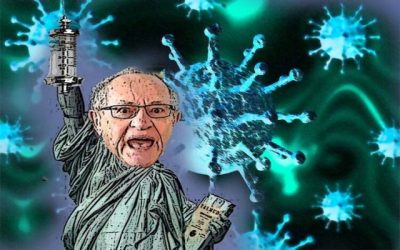
By Gilad Atzmon | May 18, 2020
Americans may be surprised to learn from Alan Dershowitz that their constitution is far more intrusive and oppressive than what they and their forefathers have believed for generations. The law ‘scholar’ declared yesterday that “you have no (constitutional) right to not be vaccinated.” … continue
Blog Roll
Recent Comments
loongtip on Eilat port faces worst crisis… loongtip on British minister dreams of kid… loongtip on Kiev awards major mining proje… loongtip on UK believes it can seize any t… loongtip on Pirates of the Caribbean loongtip on Australian festival boycotted… loongtip on Kiev seeks to ban Russian musi… seversonebcfb985d9 on Somaliland and the ‘Grea… John Edward Kendrick on Kidnapped By the Washington… aletho on Somaliland and the ‘Grea… John Edward Kendrick on Somaliland and the ‘Grea… aletho on Donald Trump, and Most America…


 Aletho News
- Scott Ritter say he was ‘de-banked’
- Leaked files tie Epstein to Israel-UAE backchannel and possible kompromat
- Alleged Ukrainian plot to influence Hungarian elections claims postal vote fraud and even a false flag attack
- Australia’s New Hate Speech Bill Is Reckless, Contradictory, and Repressive
- Report: Kurdish Fighters Have Been Entering Iran From Iraq and Clashing With the IRGC
- Trump’s Options in Iran Limited By Military Buildup in Latin America
- Villains of Judea: Paul Singer’s Empire of Debt & Demographic Replacement
- The Gaza ceasefire’s Phase 2 only exists in the media and at UN meetings
- We must act before Palestinian hostages are executed in the world’s worst prisons
- Why Washington will take Greenland
- If Americans Knew
- 41% drop in Gaza births may be “reproductive violence” – Not a ceasefire Day 97
- Trump family has long record of supporting Israeli causes
- Militant Pro-Israel Group Agrees to Halt Operations in New York
- During “ceasefire,” at least 100 Gaza children killed – clearly NOT a ceasefire Day 96
- Israel Has Demolished 2,500 Buildings in Gaza Since Signing Ceasefire Deal
- Iran, Gaza and the politics of counting the dead
- How Israel’s move in Somaliland fits in its broader strategy for regional dominance
- As genocide continues in Gaza, the West Bank is pushed into a new Nakba
- Israeli settlers beat elderly, deaf Palestinian man in West Bank attack, video shows
- U.S. May Bankroll New Israeli Armored Vehicles With Billions of Dollars, Internal Files Reveal
- No Tricks Zone
- New Study: Species Extinction Rates Declining Since 1980 – ‘Climate Change Is Not An Important Threat’
- Denmark Places Climate Protection Above Animal Welfare, Poisoning And Culling Cows
- New Study: Greenland Was 3-7°C Warmer And Far Less Glaciated Than Today 6000-8000 Years Ago
- German Media Report That Current Frigid Weather Can Be Explained By Arctic Warming!
- Berlin Blackout Shows Germany’s $5 Trillion Green Scheme Is “Left-Green Ideological Pipe Dream”
- Modeling Error In Estimating How Clouds Affect Climate Is 8700% Larger Than Alleged CO2 Forcing
- Berlin’s Terror-Blackout Enters 4th Day As Tens Of Thousands Suffer In Cold Without Heat!
- Expect Soon Another PIK Paper Claiming Warming Leads To Cold Snaps Over Europe
- New Study: Human CO2 Emissions Responsible For 1.57% Of Global Temperature Change Since 1750
- Welcome To 2026: Europe Laying Groundwork For Climate Science Censorship!
 Aletho News