Advance at Farzad B signals Iran’s homegrown leap in complex energy projects
Press TV – November 23, 2025
On Saturday it was announced that Iranian companies will soon begin drilling at the strategically important Farzad B gas field in the middle of the Persian Gulf.
The development marks a rare breakthrough for the country’s energy sector after years of delays, sanctions pressure and missed opportunities.
It signals that Iran has finally gained the technical confidence and institutional capacity to push ahead with one of its most complicated shared fields without relying on hesitant foreign partners.
Farzad B lies near the maritime border with Saudi Arabia, close to Farsi Island, in a geologically difficult zone known for high pressures, high temperatures and fractured formations. Those conditions make it significantly more challenging to develop than South Pars, the country’s flagship offshore field.
Yet for nearly two decades, Farzad B remained stuck in negotiations, mostly with Indian companies that once planned to produce gas there and turn it into LNG for export. Each time political conditions shifted, the project stalled.
India pulled out during the first round of sanctions, returned briefly once sanctions were eased, and again withdrew during the Trump-era restrictions even after Tehran accepted New Delhi’s terms, including dropping its LNG ambitions, to keep the partnership alive.
While Iran waited, Saudi Arabia moved forward. Working with a Canadian-led consortium, it began producing gas from the shared field in 2015 and lifted output to roughly 34 million cubic meters a day the following year.
That imbalance carried economic consequences. Iran holds about 70% of the reservoir, and in shared fields, the country that produces less risks losing pressure in its part of the formation, allowing gas to migrate toward the neighbor extracting more aggressively.
In a period when Iran’s domestic demand has been rising and supply strains have become increasingly visible during winter peaks, the long delay at Farzad B was more than a strategic concern. It risked turning a national asset into a gradually shrinking one.
The administration’s response has been to push a broader strategy that focuses on shared fields as part of strengthening economic resilience. It has already delivered results in South Pars, where Iran eventually overtook Qatar in daily extraction, and in the West Karun region along the Iraqi border.
Bringing Farzad B into full development is now seen as a key part of that policy. With foreign partners unable or unwilling to commit, the government turned inward.
In 2017, the National Iranian Oil Company assigned Petropars to manage the project under a master contract covering subsurface analysis, conceptual design, drilling oversight and preparation for full field development.
The decision was a gamble on domestic capacity at a time when sanctions limited access to global finance, equipment and specialist technology.
But it also reflected a shift in economic planning; rather than wait for sanctions relief and return of foreign investors, authorities pushed national contractors to take the lead on the $1.78 billion project.
Over the past two years, that shift has produced visible results. Most notable is the completion and offshore installation of the 2,650-tonne jacked designed and built inside Iran by local companies.
The operation, led by Petropars and executed by the Iranian Offshore Engineering and Construction Company, required a level of engineering competence that industry analysts once assumed was out of reach for domestic firms working without international support.
The roll-up and installation at sea under demanding conditions demonstrates that Iran can carry out heavy offshore construction at a standard that matches global norms.
The technical hurdles go beyond the platform. The gas composition at Farzad B requires advanced metallurgy and specialized alloys for safe transmission. Laying the offshore pipeline is considered one of the most difficult marine engineering challenges attempted in the country.
Processing the high-pressure, high-temperature gas adds another layer of complexity. Yet Iranian engineers say they have now developed the design, equipment sourcing and operational planning needed to manage those conditions.
For a sector accustomed to relying on international contractors for the most complex offshore work, this represents a meaningful shift.
There is also momentum onshore. Officials have finalized the site of the gas processing plant after a series of environmental, geotechnical and risk assessments that included natural hazards, social and economic impact, access to infrastructure and proximity to offshore installations.
The level of preparatory work reflects a determination to avoid the kind of planning weaknesses that contributed to earlier delays.
The expected economic impact is significant. Once operational, Farzad B is projected to add roughly one billion cubic feet of gas per day to Iran’s supply.
That increase matters for a country that has struggled at times to meet domestic demand, manage seasonal shortages and maintain output in aging fields. It also reduces the risk of further reservoir losses to Saudi Arabia and helps safeguard Iran’s majority share of the field.
The project has become a symbol of the benefits of investing in domestic engineering capacity rather than waiting for foreign partnerships that may be derailed by geopolitics.
Petropars, once a secondary contractor in joint projects, has emerged as the emblem of that approach. Its leadership of Farzad B is evidence that Iranian firms can handle highly complex offshore developments even under sanctions and with restricted access to global suppliers.
The recent progress has pushed Farzad B past the stage of plans and declarations into active development.
For an economy navigating sanctions, rising energy needs and long-term pressure on shared fields, that shift marks a phenomenal achievement.
Ukrainian MP publishes purported terms of new peace deal
RT | November 20, 2025
Ukrainian opposition MP Aleksey Goncharenko has published the text of a purported peace plan reportedly presented to Kiev by the US administration this week.
The lawmaker posted on social media what appeared to be screenshots of a Ukrainian-language electronic document detailing the 28-point peace plan to end the hostilities between Moscow and Kiev.
Earlier in the day, Vladimir Zelensky’s office confirmed the US presented Kiev with its new draft plan. The Ukrainian administration did not elaborate on its contents, only expressing a willingness to discuss it and stating that “in the American side’s assessment” the plan “could help reinvigorate diplomacy.”
Here’s the full text of the post:
1. Ukraine’s sovereignty will be confirmed.
2. A full and comprehensive non-aggression agreement will be concluded between Russia, Ukraine, and Europe. All ambiguities of the past 30 years will be considered resolved.
3. It is expected that Russia will not invade neighbouring countries and that NATO will not expand further.
4. A dialogue will be conducted between Russia and NATO, mediated by the United States, to resolve all security issues and create conditions for de-escalation, thereby ensuring global security and increasing opportunities for cooperation and future economic development.
5. Ukraine will receive reliable security guarantees.
6. The size of the Armed Forces of Ukraine will be limited to (6)00,000 personnel.
7. Ukraine agrees to enshrine in its constitution that it will not join NATO, and NATO agrees to include in its statutes a provision that it will not accept Ukraine in the future.
8. NATO agrees not to deploy troops in Ukraine.
9. European fighter aircraft will be stationed in Poland.
10. US Guarantees: The United States will receive compensation for the guarantee. If Ukraine invades Russia, it will lose the guarantee. If Russia invades Ukraine, in addition to a decisive coordinated military response, all global sanctions will be reinstated, recognition of new territories and all other benefits of this deal will be revoked. If Ukraine without cause launches a missile at Moscow or Saint Petersburg, the security guarantee will be considered invalid.
11. Ukraine retains the right to EU membership and will receive short-term preferential access to the European market while the issue is under consideration.
12. A powerful global package of measures for the reconstruction of Ukraine, including but not limited to:
a. Creation of a Ukraine Development Fund to invest in high-growth sectors, including technology, data-processing centres, and artificial intelligence.
b. The United States will cooperate with Ukraine on the joint reconstruction, development, modernization, and operation of Ukraine’s gas infrastructure, including pipelines and storage facilities.
c. Joint efforts to restore war-affected territories, including the reconstruction and modernization of cities and residential areas.
d. Infrastructure development.
e. Extraction of minerals and natural resources.
f. The World Bank will develop a special financing package to accelerate these efforts.
13. Russia will be reintegrated into the global economy:
a. The lifting of sanctions will be discussed and agreed upon gradually and on an individual basis.
b. The United States will conclude a long-term economic cooperation agreement aimed at mutual development in the fields of energy, natural resources, infrastructure, artificial intelligence, data-processing centres, rare-earth mining projects in the Arctic, and other mutually beneficial corporate opportunities.
c. Russia will be invited to return to the G8.
14. Frozen assets will be used in the following way: $100 billion of frozen Russian assets will be invested in US-led reconstruction and investment efforts in Ukraine. The United States will receive 50% of the profits from this undertaking. Europe will add another $100 billion to increase the total investment available for Ukraine’s reconstruction. Frozen European assets will be unfrozen. The remaining frozen Russian assets will be invested in a separate American-Russian investment vehicle that will implement joint American-Russian projects in areas to be determined. This fund will be aimed at strengthening bilateral relations and increasing shared interests in order to create strong motivation not to return to conflict.
15. A joint American-Russian working group on security issues will be established to facilitate and ensure the fulfilment of all provisions of this agreement.
16. Russia will legislatively enshrine a policy of non-aggression toward Europe and Ukraine.
17. The United States and Russia will agree to extend the validity of treaties on the non-proliferation of nuclear weapons and arms control, including START-1.
18. Ukraine agrees to remain a non-nuclear state in accordance with the Treaty on the Non-Proliferation of Nuclear Weapons.
19. The Zaporozhye Nuclear Power Plant will be restarted under IAEA supervision, and the generated electricity will be split equally between Russia and Ukraine (50:50).
20. Both countries undertake to introduce educational programmes in schools and society that promote understanding and tolerance of different cultures and the elimination of racism and prejudice:
a. Ukraine will adopt EU rules on religious tolerance and protection of linguistic minorities.
b. Both countries agree to lift all discriminatory measures and to guarantee the rights of Ukrainian and Russian media and education.
c. All Nazi ideology and activity must be rejected and prohibited.
21. Territories:
a. Crimea, Lugansk, and Donetsk will be recognized de facto as Russian, including by the United States.
b. Kherson and Zaporozhye will be frozen along the line of contact, which will mean de facto recognition along the line of contact.
c. Russia renounces other territories (probably referring to parts of Kharkov, Sumy, and Dnipropetrovsk oblasts – Ed.) that it controls outside the five regions.
d. Ukrainian forces will withdraw from the part of Donetsk oblast they currently control; this withdrawal zone will be regarded as a neutral demilitarized buffer zone, internationally recognized as territory belonging to the Russian Federation. Russian forces will not enter this demilitarized zone.
22. After future territorial arrangements are agreed, both the Russian Federation and Ukraine undertake not to change these arrangements by force. Any security guarantees will not apply in the event of violation of this commitment.
23. Russia will not obstruct Ukraine’s commercial use of the Dnepr River, and agreements will be reached on the free transportation of grain across the Black Sea.
24. A humanitarian committee will be created to resolve outstanding issues:
a. All remaining prisoners and bodies will be exchanged on the “all-for-all” principle.
b. All civilian detainees and hostages will be returned, including children.
c. A family reunification programme will be implemented.
d. Measures will be taken to alleviate the suffering of conflict victims.
25. Ukraine will hold elections 100 days after the agreement is signed.
26. All parties involved in the conflict will receive full amnesty for actions committed during the war and will undertake not to file claims or pursue complaints in the future.
27. This agreement will be legally binding. Its implementation will be monitored and guaranteed by a Peace Council headed by President Trump. Predetermined sanctions will apply in the event of violations.
28. Once all parties have agreed to and signed this memorandum, the ceasefire will enter into force immediately after both sides withdraw to the agreed positions so that implementation of the agreement can begin.
Mali holds firm: West eyes new front to sabotage Sahel independence
By Aidan J. Simardone | The Cradle | November 19, 2025
If you are to believe western media, Mali is days away from falling to Al-Qaeda. Jama’at Nasr al-Islam wal-Muslimin (JNIM), a branch of Al-Qaeda in the Islamic Maghreb, is blockading fuel to the capital, Bamako. It is only a matter of time before growing frustration turns Malians against their “illegitimate” government. Or so the story goes.
The reality tells a different tale. The situation is serious, not only for Mali but also for the broader Alliance of Sahel States, which includes Burkina Faso and Niger. And yet, Mali is recovering. Russia has stepped in, delivering vital fuel shipments. Schools are reopening. Vehicles are back on the road. Towns previously captured by JNIM are being reclaimed.
It is a huge gamble for Russia. But should it succeed, Moscow will have secured a key ally and gained the favor of anti-imperialist countries in Africa. The risk, however, might not come from JNIM. Instead, it could come from a western-supported intervention that seeks not to stop Al-Qaeda, but to destroy the Alliance of Sahel States.
From French client to anti-colonial spearhead
After it gained independence, Mali continued to rely on France. Even its currency, the CFA franc, is pegged to the euro. In school, children were taught French history and learned to speak French. Until recently, France had 2,400 troops stationed as part of its “counterterrorism” operations.
Despite these apparent efforts, groups like JNIM, the Islamic State in the Sahel, and Azawad separatist militias grew. Meanwhile, western corporations profited as Mali became the fourth-largest producer of gold. With this wealth extracted, Mali remained one of the poorest countries in the world.
Bamako’s cooperation with the west did not always curry favor. Its alleged failure to follow the 2015 Algiers Accords with Azawad separatists resulted in the UN Security Council (UNSC) imposing sanctions in 2017. This made little impact, with Mali’s economy continuing to grow.
Yet most Malians were still in poverty, and the security situation worsened. Frustrated, a coup was launched in 2020. But when protests erupted, another coup followed in 2021, led by Assimi Goita, Mali’s current president. Western institutions portrayed it as democratic backsliding, with a military unjustly taking over the country. But the coup was highly popular, with people celebrating. According to a 2024 poll, nine out of 10 people thought the country was moving in the right direction.
President Goita was a radical, anti-colonial, pan-Africanist. In 2022, he kicked French troops out, instead seeking help from Russia. In 2025, Mali withdrew from the Economic Community of West African States (ECOWAS), accusing it of working with western powers. Goita nationalized the gold mines, removed French as Mali’s official language, and replaced school curricula about French history with Bamako’s own rich history.
Western-aligned institutions retaliated with sanctions. ECOWAS, the West African Economic and Monetary Union (WAEMU), and the EU imposed economic penalties. Cut off from financial institutions, Mali defaulted on its debt. But the impact was partly muted.
A few months after sanctions were imposed, the court of the WAEMU ordered that sanctions had to be lifted. Gold mining, which contributes to 10 percent of the economy, saw no impact. Mali shifted its trade to non-ECOWAS countries, and the economy continued to grow.
The West African country redirected trade outside the ECOWAS bloc and resolved its debt in 2024. Far from isolating the country, sanctions strengthened internal solidarity.
Even when ECOWAS lifted sanctions in July 2022 – citing a transition plan to civilian rule – no action was taken when the deadline passed. The reason? The sanctions had backfired, exposing ECOWAS as a western instrument and bolstering support for the Goita government.
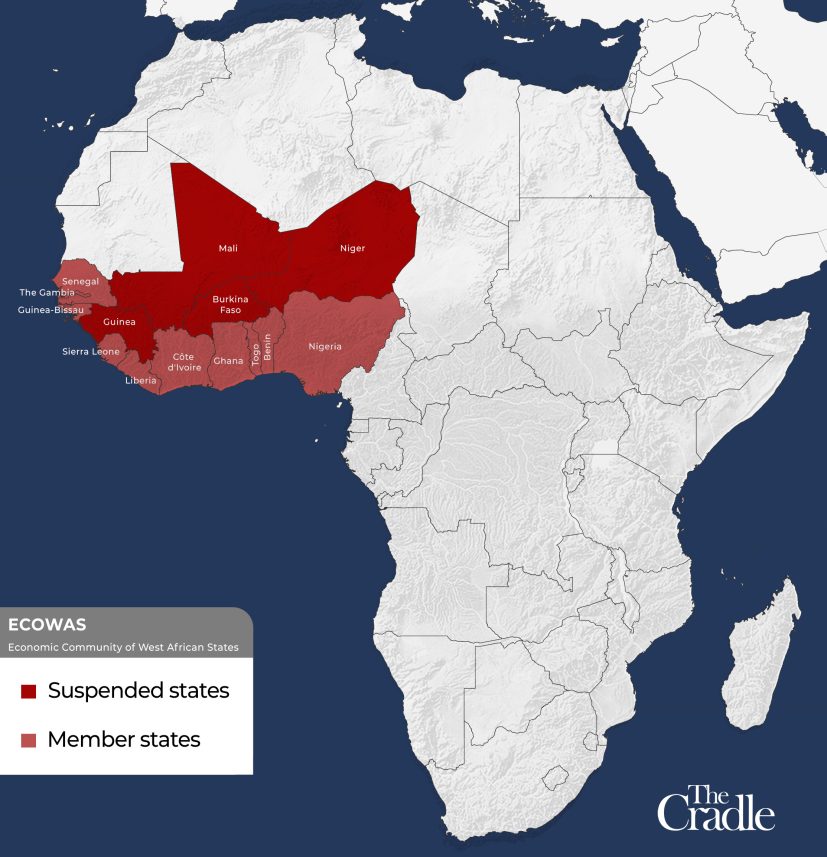
Map of the Economic Community of West African States (ECOWAS)
Sanctions failed, so proxy war begins
JNIM continues to receive financing from Persian Gulf patrons and income from ransoms and extortion. While it has a strong rural presence, it controls no major cities. Azawad separatists and ISIS fighters are similarly confined to Mali’s remote north.
A different strategy was needed. In recent weeks, JNIM has attacked fuel trucks, depriving Bamako of oil. Cars were unable to fill up, and schools closed. According to western media, JNIM wants to strangle the capital to promote unrest. Mali has had five coups since independence, three of which have occurred since 2012. News reports suggest that given this history, JNIM can ultimately topple the Malian government.
Reports of an “immediate collapse” are nearly a month old. What Western media fails to understand is that, unlike previous governments in Mali, the current one is highly popular. Truckers are willing to risk their lives to bring fuel to the capital. “If we die, it’s for a good cause,” one trucker said. Even if the blockade were to stop all fuel, Malian’s resilience and support for Goita would only increase.
Thankfully for Bamako, JNIM is facing setbacks. Russia, which provides support from the Africa Corps (formerly Wagner Group) and, in 2023, vetoed the UNSC’s sanctions, sent 160,000 and 200,000 metric tons of petroleum and agricultural products. This has provided some relief, with fuel lines shortening and schools reopening.
On 15 November, Mali and the African Corps seized the Intahaka mine. The next day, the town of Loulouni was also recaptured. That same day, the blockade south of Bamako was weakened, allowing convoys of fuel trucks to reach the city.
Manufacturing consent for intervention
So why does the western media continue insisting that Mali is collapsing? Simple: to justify military intervention.
One of the biggest propagandists has been France. In a post on X from the French Ministry for Europe and Foreign Affairs, Paris blamed Russia for abandoning Mali, despite being one of the only nations supporting it during this crisis. French news channels LCI and TF1 ran stories such as “Mali, the Jihadists at the gates of Bamako” and “Mali, the new stronghold of Al-Qaeda.”
In response, Bamako banned them from the country. Niger has also accused Benin of being a base of operations for France. French state media, France 24, did not deny the claim, only disputing that the number of soldiers was far less than Niger claimed.
France stands to regain a significant geopolitical advantage from regime change in Mali. The country borders seven former French colonies. A return would reassert French regional influence and weaken the anti-imperialist Alliance of Sahel States. Niger remains crucial to France’s uranium supply, which is necessary for 70 percent of the country’s energy. Bamako is also quickly becoming a major exporter of lithium – essential for electronics and electric cars – with the recent opening of its second mine.
Other western countries have also lost out under Goita’s rule. Canadian company Barrick Mining lost $1 billion when Mali nationalized the mining industry. Last month, other western firms, such as Harmony Gold, IAMGOLD, Cora Gold, and Resolute Mining, had their mining exploration licenses revoked.
The growing Russia–Mali partnership resembles Moscow’s 2015 intervention in Syria. Just as Russia propped up Damascus for as long as it could from a US-led proxy war, it now shores up Bamako. The payoff could be similarly strategic: diplomatic support, military basing rights, and influence in an emerging multipolar Africa.
Unlike past interventions cloaked as counterterrorism, the west now appears reluctant. Washington and its allies, usually quick to bomb under any pretext, have done nothing to aid Bamako. This silence suggests either tacit support for JNIM or confidence that Mali will implode without direct action.
Outsourcing war
As a member of the Alliance of Sahel States, the west fears that Mali’s resilience will be an inspiration to others to join the anti-imperialist struggle. The 2021 coup emerged as a result of inequality and insecurity. These factors can be found in many other West African countries such as Benin, the Ivory Coast, and Togo.
Some observers theorize that Africa’s most populous country, Nigeria, could soon have a revolution, amid high inequality and insecurity from Boko Haram. Nigeria’s growing ties with Mali are a serious threat to the west.
With sanctions failing to bring Mali to its knees, the only solution for the west is military intervention. This might be direct, as seen with Niger, where French troops are stationed in bordering Benin. But more likely, western countries will outsource their intervention to African states. This has occurred in Somalia, where the US has Kenya and Uganda do its dirty work in return for aid. The same could occur with Mali.
The most likely actors to play this role are ECOWAS and the African Union. ECOWAS receives military training from the US, and many of its leaders are closely tied to Washington. It also receives extensive financing from the EU, most recently receiving €110 million ($119 million) to support “peace, trade, and governance.” Far from neutral, it has become an enforcement arm for western interests. The bloc has previously sanctioned Mali and, in 2023, threatened to invade Niger.
The African Union has also served the interests of the west, such as the African Union Mission to Somalia, which is supported and financed by Washington and Brussels. The African Union Constitutive Act prohibits military intervention in any member state, with the exception of war crimes or at the request of the state.
Mali, however, was suspended from the African Union in 2021, making intervention fully legal under the Act. Chairperson of the African Union Commission, Mahmoud Ali Youssouf, recently called for “urgent international Action as crisis escalates in Mali.”
Bamako versus the empire
Mali faces a two-pronged assault: economic strangulation and the threat of foreign-backed military intervention.
Though JNIM remains a nuisance, it has failed to topple the government. The bigger threat comes from western capitals and their African proxies. Russia remains one of Mali’s few reliable allies. If successful, Moscow’s support will elevate its standing across the continent.
More importantly, Mali’s endurance will inspire other African states to challenge western domination and reclaim sovereignty.
The Monroe Doctrine Under Siege: America’s new war in the backyard
By Salman Rafi Sheikh – New Eastern Outlook – November 18, 2025
Washington’s new militarized campaign against Venezuela, framed as a drug war, is in reality a risky attempt to blunt China’s rising influence in Latin America—and it may only accelerate the region’s shift away from the United States.
Trump vowed to end America’s endless wars. Yet he is now starting another and doing it in Latin America, the very ground where US power is already slipping. The administration’s militarised “drug war” against Venezuela is less about cartels than about toppling Maduro to blunt China’s rise in the hemisphere. But it’s a gamble that exposes Washington’s deeper weakness: the US no longer has an economic playbook to compete with Beijing’s money, markets, and infrastructure. And Latin America knows it.
America’s Worry
It’s not about drugs. Washington has a long history of using the “war on narcotics” as cover for covert operations, and in Venezuela today, the real source of alarm is China. Beijing has become Caracas’s most dependable lifeline, underwriting more than US$60 billion in loans, running oil-for-credit schemes, building joint ventures, infrastructure, and even a satellite ground station, all coming together to cement a long-term strategic presence. In 2024 alone, bilateral trade hit US$6.4 billion, with China importing US$1.6 billion in Venezuelan oil and minerals and exporting US$4.8 billion in manufactured goods.
Venezuela is far from an outlier. Across Latin America, Sino-regional trade surged to US$518 billion, with direct investment totaling US$14.7 billion, creating a sprawling parallel economic architecture of ports, refineries, mines, 5G networks, and credit lines that regional governments now treat as indispensable. Even though the US still dominates the region in cumulative FDI—over US$1 trillion—China is rapidly eroding American influence, winning leverage not through ideology or coercion, but through markets, capital, and sustained economic engagement.
For Washington, this is not commerce; it is geopolitical encroachment that directly pushes against the so-called Monroe Doctrine, turning the US “backyard” into a zone where Washington’s influence is not decisive anymore. The Monroe Doctrine, declared by President James Monroe in 1823, held that the Americas were under US influence and off-limits to outside, i.e., European, interference. Over time, it became the foundation of Washington’s dominance in the Western Hemisphere. Today, China’s deep economic and strategic footprint in Latin America is quietly—but surely—undermining that century-old principle, challenging US control in its own backyard.
Yet instead of matching Beijing’s patient economic game, the US is increasingly relying on force—missiles, warships, and military threats—to reassert influence in its own hemisphere. In Venezuela, that approach is especially dangerous: every escalation risks doing exactly what Washington fears most, driving Latin America further into China’s orbit and underscoring the stark reality that America no longer wins with markets.
The zero-sum American Mindset
That China is the real target is not irrelevant. China’s successes are seen, in a zero-sum manner, as Washington’s loses. It was always known, although it gets little mention in the ongoing US official discourse about Venezuela. Perhaps the US does not wish to complicate its ongoing trade talks with China to ‘end’ the trade war that Washington has lost. However, elements of the current US administration had already made clear, even before capturing power in the latest presidential elections, that China cannot be allowed to expand its presence in the region.
In 2024, The Economist spotlighted China’s “dramatically” growing footprint across Latin America—a shift that seems to have triggered alarm bells in Washington. The US Secretary of State (and National Security Advisor) Rubio had warned, even before assuming his current positions, that America “can’t afford to let the Chinese Communist Party expand its influence and absorb Latin America … into its private political-economic bloc.” Yet, he lamented, many regional leaders have merely shrugged. Now, Rubio appears determined to turn up the pressure—and he’s starting with Venezuela.
Beijing’s inroads stretch far beyond Caracas. Earlier this year, left‑leaning Brazilian President Luiz Inácio Lula da Silva joined a Latin American summit in Beijing, signaling his willingness to coordinate on key geopolitical issues, including backing China’s position on Ukraine. At the same time, China quietly opened its first major deep‑water, “smart” port in Latin America: the $3.5 billion Chancay megaport in Peru, operated by COSCO and equipped with unmanned cranes, 5G networks, and driverless trucks. Xi Jinping praised the port as a “new land-sea corridor” linking Latin America and Asia. According to Chinese state media, Chancay can cut shipping times between Peru and China by nearly 12 days while reducing logistics costs by 20%. Diplomatically too, Beijing is undeterred. When pressed on US interventionism, Chinese Foreign Ministry spokesman Lin Jian retorted in September that Latin America is “no one’s backyard,” an explicit rebuke to American regional dominance. Accordingly, in November, Foreign Ministry spokeswoman Mao Ning condemned Washington’s “excessive force” against boats in the Caribbean and insisted that “cooperation between China and Venezuela is the cooperation between two sovereign states, which does not target any third party.”
The Possibility of Backfire
America’s strategy therefore can—and will—backfire. It will only make regional states more open towards Beijing and more apprehensive towards the US (interventionism and unpredictability). At the 2025 China–CELAC Forum, Gustavo Petro, President of Colombia, called for a “dialogue of civilizations” and said China and Latin America should forge a new model of cooperation—not one imposed by external powers. This sentiment exists across Latin American states, including, for instance, Brazil.
What Washington must understand is that China’s patient, capital-driven strategy, combining trade, investment, infrastructure, and diplomacy, has created a durable foothold that the US cannot simply displace with missiles or threats, although it can introduce temporary disruptions only through a military approach. Still, every escalation in Venezuela risks cementing the very outcome Washington fears: a hemisphere where American influence is conditional and secondary. If the US hopes to reclaim strategic authority, it must first confront the uncomfortable truth that power in the 21st century is won with markets, credit lines, and long-term partnerships, not just force. Until it does, the Monroe Doctrine will remain a relic, and Latin America a proving ground for China’s quiet but decisive ascendancy.
Salman Rafi Sheikh, research analyst of International Relations and Pakistan’s foreign and domestic affairs
China Voices Opposition to Unilateral Sanctions, Rejects US’ Anti-Russia Restrictions
Sputnik – 17.11.2025
BEIJING – Beijing consistently opposes unilateral sanctions not approved by the UN Security Council, Chinese Foreign Ministry spokeswoman Mao Ning said, commenting on the US bill regarding sanctions on countries cooperating with Russia.
“China has consistently opposed unilateral sanctions that have no basis in international law and are not sanctioned by the UN Security Council,” Mao told reporters.
Earlier in the day, US President Donald Trump commented on the bill to tighten sanctions against Russia, declaring that any country that cooperates with Russia will be subject to severe sanctions, and Iran may be added to the same bill.
US President Donald Trump told reporters that Republicans were introducing very tough legislation to slap sanctions on any country doing business with Russia. He added that Iran might be included as well, noting that he had suggested it, and said that any country engaging economically with Russia would face severe penalties.
Ukrainian attacks on Russian refineries driving price hikes in the US – Bloomberg
RT | November 16, 2025
Ukrainian strikes on Russian energy facilities are contributing to rising oil prices in the US, Europe, and Asia, Bloomberg reported on Saturday.
The attacks, combined with outages at key plants in Asia and Africa, have removed millions of barrels of diesel and gasoline from the global market, the outlet said. US sanctions on Russian energy giants Lukoil and Rosneft in October, along with restrictions imposed by the EU, have also helped drive prices higher.
Refining margins in the US, Europe, and Asia are now at their highest levels for this time of year since at least 2018, Bloomberg said, citing its own calculations. Additional pressure has come from shutdowns and outages at refineries in Kuwait and Nigeria.
Ukraine has targeted oil depots, processing plants, and metering stations with drones and missiles, calling them legitimate facilities that support Russia’s “war machine.” Russia, in turn, has struck elements of Ukraine’s power grid, saying the infrastructure supports the Ukrainian military.
In August, Hungary imposed sanctions on Ukraine’s top drone commander, Robert Brovdi, after repeated strikes disrupted the flow of crude through the Soviet-era Druzhba pipeline.
Alternative for Germany Party Mulls Energy Cooperation With BRICS Countries – Lawmaker
Sputnik – 16.11.2025
SIRIUS, Russia – The right-wing Alternative for Germany (AfD) party is considering the possibility of cooperating with BRICS countries in the energy sector, lawmaker Steffen Kotre told Sputnik on Saturday.
“One of the reasons I am here is to meet with representatives of the BRICS nations. We discussed some positions on this issue [energy cooperation]. This is a positive process. Whether this will have any results is another matter. The main goal now is simply to get to know each other,” Kotre said on the sidelines of the BRICS-Europe symposium, which is underway in Russia’s Sirius Federal Territory.
The pressure on the AfD over its members’ trip to Russia is growing, but the party does not intend to abandon what it considers “a realistic political line,” the lawmaker noted.
“Quite the contrary, this pressure certainly strengthens our understanding that we will certainly achieve normal relations. And by this I mean a peaceful exchange of views with Russia,” he said.
Communication channels should be open in both directions, including to show Moscow that “there are sensible people in Germany and not only warmongers,” Kotre added.
In Busan, China did not just stand firm—it watched America blink
By Salman Rafi Sheikh – New Eastern Outlook – November 16, 2025
Beyond the optics of handshakes and photo-ops at the Busan summit, the much-hyped Trump–Xi meeting laid bare the paradox that defines US–China relations today: deep economic interdependence coupled with unrelenting strategic rivalry.
Washington’s fear of Beijing’s ascent—and Beijing’s determination to rewrite the terms of global power—mean that even when the two leaders talk of “cooperation,” they are really negotiating the limits of competition. Far from heralding a new détente, the Busan meeting merely pressed pause on a conflict too entrenched to be resolved by diplomatic theatre.
The Summit of Distrust
At the Busan meeting, Donald Trump and Xi Jinping announced a limited set of economic and diplomatic understandings aimed at easing immediate tensions without altering the fundamentals of their rivalry. The U.S. agreed to reduce certain tariffs on Chinese imports, while China pledged to resume large-scale purchases of American agricultural products and to delay the expansion of its rare-earth export controls. Both sides promised greater cooperation on curbing fentanyl precursor exports and maintaining stable supply chains, and they reaffirmed the need to prevent escalation in trade and technology disputes.
While the Busan deal was hailed as a diplomatic breakthrough, it exposed a deeper void: there is still no framework for strategic coexistence between Washington and Beijing. The reason is simple—there is no trust. Beijing knows that under Donald Trump, U.S. foreign policy swings between confrontation and concession, depending on the political winds. And despite years of tariffs and rhetoric, Trump’s trade war has failed to dent China’s global standing. If anything, Beijing has learned how to weaponize US vulnerabilities. By withholding soybean purchases and rare-earth exports, it extracted precisely what it wanted in Busan: a rollback of select tariffs and a pause on new export controls. The so-called “agreement” restored the status quo—China promised to resume buying soybeans, a gesture aimed squarely at Trump’s Midwestern base, while deferring for a year the rare-earth restrictions that Washington fears most. The optics looked like cooperation; the substance showed who really dictated the terms.
Therefore, the Busan summit was less a diplomatic reset than a reckoning for Washington—a reminder of how limited its leverage over Beijing has become. After years of tariffs and bluster, the US has discovered that China can absorb the pain, reroute its exports across Asia, and keep its economy humming. The numbers tell the story: China’s trade surplus this year is projected to exceed last year’s record levels, and its stock market has surged more than 30 per cent in dollar terms, even as US inflation, stoked by tariff pressures, hit an election-year high of 3 per cent. Beijing has not only weathered the storm but also turned it into a strategy. By weaponising its $12 billion soybean market and dangling rare-earth supplies, China forced Washington into a truce on its own terms. In Busan, it wasn’t China that blinked.
Who will blink next?
The real question after Busan is not whether the US and China will clash again, but who will blink first. Washington’s arsenal of tariffs and tech bans is running up against the limits of its own economic pain threshold, while Beijing’s state-driven resilience is tested. Trump’s “America First” protectionism, fueled as it is by an aggressive form of politics, may soothe his domestic base, but it erodes US influence among allies, both in Europe and in Southeast Asia, who now see a power more obsessed with trade deficits than offering and/or providing strategic leadership. China, meanwhile, is playing a longer game: tightening regional supply chains, expanding the yuan’s footprint, and anchoring new trade corridors from Asia to Africa. Both sides are recalibrating rather than retreating, but the advantage increasingly lies with the player who can endure short-term costs for long-term control. If Busan revealed anything, it is that China is betting on (growing) American fatigue while America is still betting on Chinese collapse, which remains an unlikely event to take place even in the distant future.
In the end, Busan revealed not a reset but a reckoning: China has learned to endure pressure, while America has learned the limits of its own leverage. The US–China rivalry is now a contest of stamina, not ideology, in which Beijing appears better equipped to play the long game. With expanding regional trade networks, a growing technological base, and a much better, state-driven, and state-backed capacity to absorb external shocks, China has turned resilience into a strategy. Washington, by contrast, remains trapped between domestic populism and global ambition, unable to sustain confrontation without hurting itself. Busan showed that when forced to choose between economic pain and political optics, it is the US that blinks first. Therefore, what Washington can learn is this: in this rivalry of endurance, China’s patience—not America’s pressure—may prove decisive. The sooner it learns this lesson, the less it will hurt itself.
Salman Rafi Sheikh, research analyst of International Relations and Pakistan’s foreign and domestic affairs
Nicolai Petro: Ukraine Endgame & Fragmentation of Europe
Glenn Diesen | November 14, 2025
Nicolai N. Petro is a Professor of Political Science at the University of Rhode Island, and formerly the US State Department’s special assistant for policy on the Soviet Union. Prof. Petro discusses the pending end of the Ukraine War and why Europe will likely fragment as a consequence of its proxy war against Russia.
Follow Prof. Glenn Diesen:
Substack: https://glenndiesen.substack.com/
X/Twitter: https://x.com/Glenn_Diesen
Patreon: https://www.patreon.com/glenndiesen
Support the research by Prof. Glenn Diesen:
PayPal: https://www.paypal.com/paypalme/glenndiesen
Buy me a Coffee: buymeacoffee.com/gdieseng
Go Fund Me: https://gofund.me/09ea012f
Books by Prof. Glenn Diesen:
HTS strips Russia of Syria port deals; hands Tartus to UAE, Latakia to France
Press TV – November 14, 2025
Syria has formally handed over operations of Tartus port, the second largest port in the country, to the logistics company DP World from the United Arab Emirates under a 30-year, $800-million concession.
DP World officially commenced operations months after signing a 30-year $800-million concession agreement Syria’s General Authority for Land and Sea Ports.
“We are committed to applying DP World’s global expertise to build a modern and digitally enabled port that will grow trade, create opportunities and firmly position Tartus as a key trade hub in the Eastern Mediterranean,” said Fahad al-Banna, the newly appointed chief executive of DP World Tartus.
Under the agreement, DP World would upgrade the port’s infrastructure, expand handling and storage capacity, and invest in bulk-handling systems.
This comes as the Hay’at Tahrir al-Sham (HTS)-led regime in Syria in June decided to annul a 2019 agreement between former President Bashar al-Assad’s government and Russia’s Stroytransgaz, saying the company breached its contract by failing to invest a promised $500 million in modernizing Tartous.
Along with Tartus, a separate 30-year concession was also inked with French shipping company CMA CGM to run Latakia port, the largest port city in the country.
The shift comes after US President Donald Trump announced in May that all US sanctions on Syria would be lifted.
Trump made the announcement in the Saudi capital, Riyadh, during his visit to the kingdom, where he met Abu Mohammed al-Jolani, the leader of the Hay’at Tahrir al-Sham (HTS)-led regime in Syria, who expressed readiness to normalize ties between Damascus and Israel.
Once affiliated with al-Qaeda and Daesh, al-Jolani seized power in Syria following a rapid onslaught by his militant group, Hay’at Tahrir al-Sham (HTS), which ousted the government of President Bashar al-Assad in December 2024.
COP 30 Is A Failure… “Only Europe Remains Committed”
By Prof. Fritz Vahrenholt | No Tricks Zone | November 12, 2025
Cooling trend continues
The global temperature did not change in October compared to August. The cooling trend remains intact. The American National Oceanic and Atmospheric Administration (NOAA) foresees a cool LA NINA developing in the Pacific this winter, which will lead to a further decline in global temperatures as well.
Belém – All that fuss for nothing
The 30th World Climate Conference in Belém is not yet over, but it is already becoming apparent that the event, announced as the “Conference of Truth,” will go down in the history of climate conferences as a turning point.
No head of state from the four largest CO2-emitting nations—China (33%), the USA (12%), India (8%), and Russia (5%)—is showing up in Belém.
Even before the conference, the New York Times headlined: “The whole world is fed up with climate policy.” And the fact that Bill Gates, one of the biggest supporters and sponsors of climate policy, explicitly warned against excessive, shortsighted climate policy just 14 days before the conference, and put prosperity back in focus — a major blow.
Glenn Beck, a prominent American television host, explains the change of heart by Bill Gates: “It’s not about science, it’s about Trump.” Expressed differently: it’s not about conviction; it’s about damage control for his own company, which is planning multibillion-dollar investments in data centers in the USA and globally. And given the situation, these will have to rely on electricity from new gas-fired power plants in the short term, as the reactivation of old nuclear power plants will not suffice, and the construction of new nuclear power plants will still take several years in the USA.
Only 1/3 of the states actually submit a plan
For the Climate Conference in Belém, states had to report on their future plans for the use of coal, oil, and gas. The fact that only one-third even submitted a statement already hints at the dissolving importance of the climate issue in most nations around the world. But the reports that were submitted are revealing. Most states reported continuously increasing use of coal, oil, and gas. The reports show an increase in global coal usage by 30%, oil by 25%, and gas by 40% by 2030 compared to 2015. The Intergovernmental Panel on Climate Change (IPCC) hoped to reduce global CO2 emissions by 45% by 2030 compared to 2015; now they are continuing to rise.
Only Europe onboard
Only Europe remains unshakably committed to the goal of achieving Net Zero CO2 emissions by 2050. Germany, the industrial heart of Europe, is even more ambitious and, according to Axel Bojanowski, is “the ‘leader’ among industrialized countries: It aims to be climate-neutral by 2045 – a self-destructive plan: Germany’s reduction will inevitably be compensated by rising emissions in other EU countries. This is because the European Emissions Trading System ensures that emission allowances not used in Germany are consumed in other EU countries.
It is becoming increasingly clear what the Wall Street Journal meant when it called Germany’s energy policy the ‘dumbest in the world.’
A few days before the conference, the European states agreed on a common goal, namely to achieve a 90% CO2 reduction by 2040 compared to 1990. 5% of the self-commitment could come from emission reductions abroad, which, of course, must also be expensively paid for. The German Minister for the Environment celebrated this agreement as “good news for the German economy, as everyone would now have the same competitive conditions.”
This statement reveals how little the German federal government and its ministers understand the global economy. As if German industry only exports goods to European countries. German goods, however, compete in a global market that does not have the burdens of CO2 taxes and high energy prices on German products and can therefore always offer them more cheaply. 50% of exports go to countries outside the EU.
Chancellor Merz and his Environment Minister Schneider are blatantly downplaying the German situation. Germany has set self-imposed shackles with the Climate Protection Act that will become highly painful in the coming years.
German climate policy: “script for an economic catastrophe”
Welt journalist Axel Bojanowski: “The German Climate Protection Act, cemented by the Federal Constitutional Court, seems to be a script for an economic catastrophe. It only allows Germany a remaining budget of 6.7 gigatonnes of CO2, which is likely to be used up by the early 2030s. According to the law, penalties, shutdowns, and restrictions on freedom are then threatened to meet the climate goals.”
6.7 gigatonnes was the remaining permissible budget after the ruling of the Federal Constitutional Court from 2020 onwards. As of today, only 3.6 gigatonnes of this remain. The buffer is reduced by about 0.5 gigatonnes each year. By 2032 at the latest, the remaining budget will be exhausted, and Germany will have reached the end of the line set by the Federal Constitutional Court. This will happen in the next legislative period, not just in 2040.
Chancellor Merz whitewashes
And in his 5-minute speech in Belém before a half-empty hall, Chancellor Merz spreads negligent whitewashing: “The economy is not the problem. Our economy is the key to protecting our climate even better.” Does the Chancellor not know the perilous state our industry is in?
Scandal surrounds tropical forest Ffund (TFF)
Probably the only outcome of the Belém conference will be the establishment of an investment fund, proposed by Brazilian President Lula, to finance the protection of tropical forests.
The fund works as follows: Donor countries pay $25 billion into the fund. Private investors (investment funds) are supposed to pay in $100 billion. The donor countries receive a return of about 4.0-4.8%, which corresponds to the return on their government bonds, as they generally have to raise the money through government debt. The return for private investors is 5.8% to 7.2%. The fund’s money is invested in emerging market government bonds, which yield comparatively high interest due to the higher risk (Brazilian government bonds are currently at 12.25%). Private investors are served first, followed by the donor countries. If anything remains after the distribution of profits to private investors and donor countries, the amount is paid out to 74 countries with tropical forests. It is hoped that this way, $3-4 billion will be distributed annually to the tropical forest countries.
The catch is this: To entice investors, private investors are given preference in the payment sequence: first the private ones, then the donor states. Furthermore, the donor countries must insure the fund against default. A default by an emerging market could quickly lead to the fund’s insolvency. In that case, the taxpayers of the donor countries would be held liable and, in an extreme scenario, lose their capital.
Disadvantageous for the German taxpayer
In preparation for Belém, there was fundamental disagreement over Germany’s participation in the fund between the Ministry of Finance and the Chancellor’s Office. The Chancellor’s Office clearly advocated for participation and a contribution of at least $1 billion. It was assisted by the Ministry for the Environment under Minister Schneider and the Ministry for Economic Cooperation and Development under Minister Alabali-Radovan. The Ministry of Finance, under Lars Klingbeil, strongly objected, viewing the fund as a billion-dollar risk and doubting the viability of the fund’s structure.
And indeed, the model is structurally disadvantageous for the German taxpayer. One could also say: We are subsidizing the returns of private investors with public money and providing the default guarantee for BlackRock and Co. That is why the Federal Ministry of Finance is persistently blocking Germany’s participation in the fund. It can be unequivocally stated that the Federal Ministry of Finance has thus far bravely defended the interests of the German taxpayer against the interests of BlackRock and Co.
This is the background to Chancellor Merz being unable to name a figure (“a noteworthy amount”) in Belém. The billion € or $ is now supposed to be found in the budget reconciliation for the 2026 federal budget, which is taking place this week, so that the federal budget can be adopted on November 28. It is to be expected that the SPD will concede. But it could be a Pyrrhic victory for Chancellor Merz, who would then visibly be prioritizing the interests of international financial investors, especially if the fund were to run into difficulties.
Whether the fund will ultimately materialize is still questionable, as it only comes into effect if the donor states commit to $10 billion. So far (excluding Germany), $5.6 billion has been raised.
The USA and the UK have already declined.
If the fund comes into being, the investment companies will profit first, with high returns secured by states, and then the emerging markets, which can sell their high-risk government bonds. Whether the tropical forest will benefit in this confusing financial jungle is not yet certain. The biggest risk remains with the donor countries, who are putting their taxpayers’ money at risk with the catchy story of saving the rainforest.”
Behind the Dances and Deals: Trump’s Quiet Pivot in Asia
By Salman Rafi Sheikh – New Eastern Outlook – November 11, 2025
The photo ops from Trump’s Southeast Asia tour hid a deeper shift in US thinking. Washington’s new China strategy, shaped by the Pentagon, now calls for restraint, mutual legitimacy, and shared rules rather than confrontation.
In short, America’s foreign policy hawks are quietly preparing for coexistence, not conquest. Trump’s visit was to showcase this change. The question, however, remains: will the US find success ultimately?
Trump’s visit
Trump came as a peacemaker. He wanted to demonstrate that the US still matters in the region, reminding regional powers of Washington’s seriousness that it really means business going forward. Therefore, while the headlines focused on his dance performances in Malaysia and the signing ceremonies, the trip produced two notable outcomes: a peace accord between Thailand and Cambodia and a series of trade and investment frameworks with key ASEAN economies. The Thailand–Cambodia agreement, signed at the ASEAN Summit in Kuala Lumpur and witnessed by Trump, commits both sides to a cease-fire, land-mine clearance, and the release of detainees, marking a rare US-brokered diplomatic success in the region. On the economic front, Trump announced new or expanded trade arrangements with Malaysia, Cambodia, Thailand, and Vietnam—some finalized, others still in negotiation—covering areas like critical minerals, supply chains, and energy investment. Washington also upgraded its partnership with Malaysia to a “Comprehensive Strategic Partnership,” signaling a deeper US pivot toward Southeast Asia’s economic and geopolitical center. Yet, much of this remains more symbolic than substantive for now, as the real test lies in whether these deals translate into durable peace and concrete trade outcomes—or fade as another episode of diplomatic theatre.
Much of the possible success of this visit and the durability of its outcomes is tied directly to the extent to which the Trump administration can implement its own new geopolitical thinking towards the region more generally and China more specifically—a country that it wants to primarily counter in Asia and the Pacific. This new geopolitical thinking is anchored in a recent report published by the Pentagon-backed RAND corporation.
The new thinking
The RAND report delivers a striking argument: Washington must abandon—after trying it unsuccessfully for years—the fantasy of defeating China and instead learn to manage an enduring, structured rivalry. The report frames the contest as the defining axis of twenty-first-century geopolitics—an unavoidable clash of systems and ambitions—but warns that a US strategy driven by dominance, containment, or ideological confrontation risks pushing both powers toward catastrophic instability. RAND’s central proposal is not détente, but what it calls a disciplined modus vivendi: a framework that accepts competition as inevitable yet seeks to prevent it from spiraling into open conflict. This is especially important for Washington insofar as it allows it to present to the wider Southeast Asian region that it is not seeking Cold War-like alliances where regional countries must choose sides. Therefore, the authors lay out six core principles to stabilize the relationship: both sides must internalize that coexistence, not victory, is the only sustainable outcome; recognize the political legitimacy of each other’s systems, however distasteful; construct shared norms and institutions in areas of friction such as Taiwan, the South China Sea, and technology; exercise restraint in developing capabilities that threaten the other’s deterrence systems; agree on basic rules for world order; and strengthen crisis-management channels to prevent miscalculation.
To translate this into policy, the report recommends six deliberate moves for the US. First, Washington should clarify that its goal is not China’s overthrow but a stable, rules-based rivalry. Second, it must reestablish senior-level communication channels to rebuild minimal trust. Third, it should institutionalize crisis-management mechanisms, particularly around Taiwan and maritime disputes. Fourth, it should negotiate limited accords to restrain cyber and AI competition. Fifth, the US and China should mutually recognize each other’s nuclear deterrence and avoid doctrines that invite preemption. Finally, Washington should pursue narrow cooperative projects—climate, health, scientific exchanges—to maintain some connective tissue in an otherwise adversarial relationship.
Trump’s visit reflected this thinking very much. For example, throughout this tour, Trump made no mention of the QUAD—an anti-China alliance comprising the US, India, Japan, and Australia. It means that Washington is moving away from its strategy of building economic and military alliances with anti-China states, such as India and Japan, to use them as counterweights to China’s influence. This narrative aligns with what the RAND report refers to as recognizing the legitimacy of China and its ruling party.
Beyond Ambitions
Having said this, none of this means that a complete reset has taken place, or will take place soon. Undoubtedly, several bones of contention have been healed, but several remain. Trump’s meeting with Xi, for instance, produced a tactical easing of tensions rather than a strategic breakthrough. Both leaders agreed to cut US tariffs on Chinese imports from roughly 57 to 47 percent, while Beijing pledged to resume large purchases of American soybeans and temporarily lift its export restrictions on rare earth minerals—an issue Trump declared “completely resolved” for now. China also committed to tightening controls on the export of fentanyl precursors, offering Trump a domestic win. Yet these agreements are largely short-term gestures: most are limited to a year, and none address the deeper structural rifts over Taiwan, technology export controls, or military rivalry. In effect, the meeting delivered a pause—a breathing space for both sides to stabilize strained supply chains and political optics—rather than a genuine reset of relations. The underlying strategic mistrust remains intact, making this more a tactical truce than a transformation of US-China relations.
Trump’s tour and his carefully choreographed diplomacy signal that Washington is experimenting with a softer, more disciplined form of competition—one that seeks to manage, not eliminate, China’s rise. Yet the contradictions at the heart of this strategy remain unresolved. The US still ultimately wants to lead Asia while pretending to share it; it seeks coexistence but clings to primacy. The Pentagon’s call for mutual legitimacy and restraint may sound pragmatic, but it runs up against the political and ideological reflexes of an America that views China as a rival to be outlasted, not accommodated. Trump’s gestures toward peace and partnership may buy time and goodwill to achieve this objective ultimately. China, however, will be very mindful.
Salman Rafi Sheikh, research analyst of international relations and Pakistan’s foreign and domestic affairs
Featured Video

“Historic Russia”: The Land Putin Will Not Give Back
or go to
Aletho News Archives – Video-Images
From the Archive
How Ukraine Tortured and Slaughtered Donbass
By Kit Klarenberg | Al Mayadeen | July 11, 2024
Almost immediately after the proxy war erupted, ISIS-tier footage of the torture and murder of Russians in Ukrainian custody emerged.
On July 6th, the New York Times published an astonishing investigation: In Ukraine, Killings of Surrendering Russians Divide an American-Led Unit. The article documents in grim detail how Chosen Company, an international volunteer battalion for Kiev, routinely executes Russian prisoners of war. It is the very first mainstream admission that this practice – a brazen breach of the Geneva Conventions, and a grave war crime – is widespread among Ukraine’s fighters, both foreign and homegrown. … continue
Blog Roll
 Aletho News
- US taxpayer money laundered back through Ukraine – Musk
- Before COVID, an NIH lab chief proposed making a SARS-like bat virus more infectious
- Gates, Bourla on Trial in Netherlands Accused of ‘Great Reset’ Scheme at Vaccine Injury Hearing
- BRITAIN’S WARNING: PREPARE FOR WAR
- “Historic Russia”: The Land Putin Will Not Give Back
- How the Cambridge Analytica scandal still haunts Mark Zuckerberg
- The Ongoing Cancellation Campaign Against a Dissenting Academic in Norway
- Yemen and ‘the Houthis’: Challenging Sami Hamdi’s Narrative
- No, Christians did not invent Zionism
- AIPAC-led lobbying network opens branches in Cypriot, Greek parliaments
- If Americans Knew
- Damning report shows the media must confront its failures on Gaza
- BBC senior broadcaster speaks out on Gaza coverage
- Netanyahu vows vast West Bank invasion in response to 20-minute skirmish that left 2 Israeli soldiers and 2 Palestinian fighters dead
- Tied up and tortured: Israel using US-made electroshock weapons on Palestinian detainees
- The outsourced risk: how newsrooms rely on Gaza’s freelancers without protecting them
- Gaza bakeries forced to shut as Israel blocks flour shipments
- Gaza’s breast cancer patients face a deadly wait for treatment amid Israel’s genocide
- DAILY UPDATE: Latest essential news on Palestine, Israel, & region
- The Israel Lobby’s Changing Fortunes
- AIPAC has become such a political liability that it’s shifting to a more “nimble” approach to buying politicians
- No Tricks Zone
- Two New Studies Find Thwaites Glacier Melt Cannot Be Driven By Human Activity Or A Warming Ocean
- E-Cars Reduce CO2 Emissions By Only 41% Compared To Internal Combustion Engine Vehicles
- Predictions Made By Renowned Climate Professor Over Past Decades Have Been Proven To Be Poor
- New Study Suggests Large Regions Of The Pacific Ocean Have Been Cooling For The Last 80 Years
- Germany’s Green Energy Debacle: High Energy Costs Force Kahla Porzellan to Close After 182 Years!
- New Study: 50 Years Of The Most Aggressive ‘Net Zero’ Policies Can Only Affect The Global Climate By 0.03°C
- US September “Heat” Was No Record…Many Records Set Decades Ago
- Latest European Green Energy Debacle; Portugal’s Largest Flagship Solar Park Insolvent!
- Green Energy Debacle: German Expert Professor Fritz Vahrenholt Warns Of Severe Economic And Social Consequences
- Two More Paleo Reconstructions Affirm Meters-Higher Sea Levels Across Ireland, Brazil 7000-6000 Years Ago

