Why China is winning the chips race: materials, markets, money, and Moore’s Law
Inside China Business | December 31, 2024
Huawei and SMIC are quickly catching up to global rivals in advanced semiconductor manufacturing, which is surprising to many industry analysts. Chinese tech firms enjoy access to China’s enormous supply chain advantages, such as in refined silicon, and in wafer manufacturing. Chinese companies are also the biggest buyers of semiconductor chips. China is simply too big a market for Western companies to lose, and so they are strongly motivated to go around the export bans, or even set up manufacturing and distribution plants in-country and be outside of US and European oversight. The Chinese central government, a host of local governments, and Chinese companies themselves have invested far over $100 billion in their semiconductor industry in recent years, which is much more than investments made by other countries. But another feature of today’s chip industry is that Moore’s Law is reaching the limits of what semiconductor companies can do. Massive investments in capital and time are required to build the next generation of ever-smaller chips. So companies have turned to “chip packaging” to achieve high productivity gains, using existing chips. Chip Packaging is an area where Chinese companies are already strong, and allows them to employ economies of scale. This plays directly into their industrial strengths. The timing of the semiconductor chips war, therefore, has been beneficial to China. It has allowed Chinese firms to catch up, and fast.
Resources and links:
Substack, for video transcript and direct links https://kdwalmsley.substack.com/p/why…
Nikkei, The great nanometer chip race https://asia.nikkei.com/Spotlight/The…
Nikkei Exclusive: Inside Huawei’s mission to boost China’s tech prowess https://asia.nikkei.com/Business/Tech…
Bloomberg, China Creates $47.5 Billion Chip Fund to Back Nation’s Firms https://www.bloomberg.com/news/articl…
South China Morning Post, Tech war: Beijing sets up US$1.2 billion semiconductor fund as China splurges on chips https://www.scmp.com/tech/tech-war/ar…
SCMP, Tech war: Shanghai injects US$1 billion into chip fund as China strives for self-reliance https://www.scmp.com/tech/tech-war/ar…
The Diplomat, China’s Big Fund 3.0: Xi’s Boldest Gamble Yet for Chip Supremacy https://thediplomat.com/2024/06/china… Substack, The Semiconductor Trade War https://www.apricitas.io/p/the-semico…
China remains crucial for U.S. chipmakers amid rising tensions between the world’s top two economies https://www.cnbc.com/2024/04/12/china…
Semiconductor supply chain: Political and physical challenges in 2024 and beyond https://www.spglobal.com/market-intel…
Bloomberg, US Asks South Korea to Toughen Export Curbs on China Chips https://www.bloomberg.com/news/articl…
Wafer Pro, China’s Dominance in the Global Silicon Supply https://waferpro.com/chinas-dominance…
Inside China Business, Chinese companies are going around US semiconductor export bans. So are American companies.  • Chinese companies are going around US…
The H-1B program is about corruption and fraud, not ideology
Instead of selecting for the “best and brightest,'” the program facilitates the interests of a power cartel of middleman agencies.
By Jordan Schachtel | The Dossier | December 30, 2024
Proponents of the H-1B program argue it’s an essential opportunity to import workers with underrepresented occupational skills into America. Detractors say it serves to undermine and displace the American worker.
But before we even engage in an ideological debate between conservatives, liberals, libertarians, and socialists about the merits of H-1B, we must first recognize that the program, in its current 2024 form, is corrupt and fraudulent beyond recognition. Over the last 35 years, massive bureaucratic institutions and middlemen have formed to hijack H-1B, establishing a monopoly that wildly overrepresents certain groups of people over the rest of the world.
First, a bit of history:
The H-1B visa program was established under the Immigration Act of 1990. It was designed to enable U.S. employers to temporarily hire foreign workers in specialized occupations requiring at least a bachelor’s degree or its equivalent. Initially, the program was intended to fill skill gaps in the U.S. workforce, particularly in sectors like technology, engineering, medicine, and education, where there was a perceived shortage of American talent.
The annual cap for H-1B visas started at 65,000, but the program evolved significantly over the years. In 1998, the American Competitiveness and Workforce Improvement Act increased the cap to 115,000 visas, responding to the booming tech industry’s demand for skilled labor. This was followed by further adjustments; for instance, the H-1B Visa Reform Act of 2004 added 20,000 visas for foreign nationals holding a master’s or higher degree from U.S. universities.
Over the years, various legislative efforts have ostensibly aimed to reform the program. The H-1B Visa Reform Act of 2009 increased fees to fund retraining programs for American workers, but critics say it failed in its implementation.
The H-1B program saw its cap reached almost immediately after applications opened in the early 2000s due to high demand, leading to a lottery system for allocation. One well-known lottery-busting tactic from middleman hiring companies in India, which continues to this day, involves submitting multiple applications under different aliases for the same individual to increase their chances of selection.
Today, the H-1B visa allows holders to work in the U.S. for up to three years, extendable to six and has provisions for “dual intent,” allowing visa holders to pursue permanent residency.
According to recent data and analyses, the breakdown of H-1B visas by country of origin shows a significant concentration among two nations, with India and China leading the numbers:
India dominates the H-1B approvals list, accounting for almost three-quarters of all H-1B visa recipients.
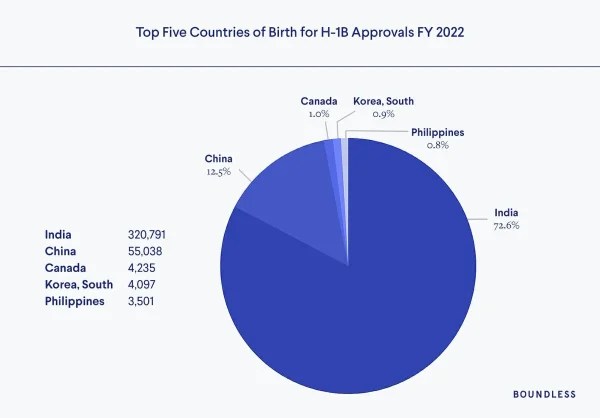
With a billion and a half people, India is still wildly overrepresented in the “talent pool,” especially because the H-1B pipeline in India tends to exclude 95 percent of the country.
India’s caste system is a complex social structure that has shaped the country’s society for millennia. Rooted in ancient Hindu scriptures, the system originally divided people into four social classes: Brahmins (priests and scholars), Kshatriyas (warriors and rulers), Vaishyas (merchants and farmers), and Shudras (laborers). In 2024, India remains a highly stratified society where one’s caste determines not only occupation but also social status, marriage prospects, and even dietary habits.
Brahmins, the elite caste Indians, only amount to about four percent of India’s population, but H-1B caters almost exclusively to Brahmins, especially when it comes to managerial roles.
The issues begin in the American university system, which continues to accommodate foreign students as an increasing percentage of total enrollment, forcing Americans to compete with the entire world for admission into elite STEM programs. The State Department hands out around half a million student visas each year, and there is seemingly no plan to roll back student visas.
Based on available data, there’s a large discrepancy between student visa holders and H-1B holders. Here’s a breakdown of student visas by country of origin in terms of percentage, focusing on the academic year 2022-2023, based on available data:
- China: Approximately 27.4%
- India: Around 25.4%
- South Korea: About 4.1%
- Canada: Roughly 2.6%
- Taiwan: About 2.1%
- Nigeria: Around 1.7%
- Japan: Approximately 1.5%
- Brazil: About 1.5%
- Saudi Arabia: Roughly 1.5%
- Mexico: About 1.4%
Around one-third of H-1B holders are U.S. university graduates, and about half come into the American workforce directly from their country of origin.
Because of the massive corruption and fraud in the talent pipeline, many current H-1B workers lack the social, cultural, and technical aptitude to mesh into an American workplace despite their claimed qualifications, leading to a major headache for their employer and the prospective American applicant who was left behind in the process.
Massive corporations like Infosys, Tata, Cognizant, Wipro, and HCL Technologies exist to facilitate this “talent” pipeline, and they have enormous influence on U.S. foreign labor policy. With a pooled value of hundreds of billions of dollars in market capitalization, they monopolized the H-1B program into a centralized cartel that recruits, hires, and fills roles in major American companies, freezing out applicants outside of the pipeline.
So, instead of finding the “best and brightest” in tech, three-quarters of all of America’s H-1B imports are likely to come from a social caste of around 50 million people, leaving behind 1.35 billion Indians in the process. In a world of 8 billion, the centralization of three-quarters of the H-1B program does no favors to Americans on either side of the debate.
Kiev announces US gift of $15bn from seized Russian funds
RT | December 30, 2024
The US will provide Kiev with $15 billion, leveraging future revenues from frozen Russian central bank assets, Ukrainian Prime Minister Denis Shmigal announced on Monday. The Kremlin spokesperson Dmitry Peskov has previously said about Washington’s purported illegal transfer of Russian funds to Kiev that Moscow may challenge it in court.
The American funding is part of a broader $20 billion contribution under the G7’s $50 billion loan framework to Ukraine. The agreement was signed by Ukraine’s Ministry of Finance and the World Bank under the PEACE in Ukraine initiative, Shmigal claimed, in a post on his Telegram channel.
The G7, comprising the US, Canada, Japan, the UK, France, Germany, and Italy, initially pledged the $50 billion loan in June 2022, using profits from frozen Russian assets as collateral. Of the estimated $300 billion immobilized, $213 billion is held in the Brussels-based clearinghouse Euroclear.
Euroclear froze the assets of the Russian central bank in late February 2022, shortly after the EU imposed sanctions on Russia in response to the conflict escalation in Ukraine. The frozen funds have already generated billions in interest, with the clearinghouse transferring €1.55 billion ($1.63 billion) to Ukraine in July.
Moscow has vehemently criticized the asset seizures. Last Wednesday Dmitry Peskov condemned the measures as theft and warned of legal retaliation. He was reacting to Shmigal’s announcement that the US had already transferred to Ukraine the first installment of the $1 billion from the frozen Moscow central bank funds.
Last month, Russian Finance Minister Anton Siluanov said there are plans to mirror the West’s actions, using income from frozen Western assets in Russia.
“We have also frozen the resources of Western investors, Western financial market participants and companies. The income from these assets will also be used,” the official said.
The decision to use frozen Russian assets has previously stirred debate among G7 nations. European members of the club such as Germany, France and Italy have raised concerns over financial market stability and about the legal implications of such actions. The IMF has warned that seizing these assets without robust legal frameworks could erode global trust in the Western financial system.
Slovak PM slams ‘irrational’ EU
RT | December 30, 2024
Slovak Prime Minister Robert Fico has sent an open letter to European Council President Antonio Costa and European Commission President Ursula von der Leyen, urging immediate action to address Ukraine’s imminent halt of natural gas transit through its territory to the EU.
A transit agreement between Russia and Ukraine is set to expire on December 31. Kiev has refused to extend it, citing the conflict with Moscow.
In a letter posted on Facebook on Sunday, Fico accused Kiev of failing to consider the potential impact its decision will have on the EU economy. Brussels’ acceptance of the situation is “absolutely irrational and wrong,” he stressed.
Gas transit through Ukraine accounts for only 3.5% of EU consumption, the letter states, citing an analysis carried out by Slovakia’s main gas supplier and trader, SPP. Despite the modest share, any halt would disrupt the market, raising gas prices by roughly 30%, the document claims. Such a price spike would translate to an additional annual cost of € 40-50 billion for European households and infrastructure, Fico argued.
“It is in the interest of all EU citizens that European efforts to support Ukraine should be carried out rationally, and not in the form of self-destructive and extremely damaging gestures,” the Slovak prime minister noted. Kiev’s decision will lead to “reciprocal measures,” he warned.
Fico also said Russia “will easily place such a small volume of gas in other markets,” thus mitigating its losses.
The situation requires urgent attention from EU institutions and member states to mitigate risks of supply shortages, he added.
Landlocked Slovakia’s position within Europe’s energy network makes it highly susceptible to disruptions in natural gas supply. The country is reliant on Russia for around 85% of its gas demand, primarily through pipelines transiting Ukraine.
Fico has repeatedly voiced concerns regarding EU energy policy. He has consistently advocated for pragmatic approaches to energy security, often clashing with Brussels on its approach to the Ukraine conflict, namely the issue of military support to Kiev and the issue of economic sanctions against Russia.
European Union leaders have repeatedly expressed confidence in the bloc’s ability to manage without Russian gas, accusing Moscow of using energy as a geopolitical weapon.
The European Commission and Council have yet to issue formal responses to the Slovak leader’s letter.
11 Reasons why the “EV Transition” will NEVER happen
MGUY Australia | December 25, 2024
Mark P Mills gave an extended talk on EV mandates in November, at Hillsdale College, Michigan, and in this video I’ve extracted 11 key points that explain why the much vaunted “EV transition” will never happen.
Go and watch the full video here: • EV Mandates vs. Freedom | Mark P. Mills
Ten Reasons why you should NEVER buy an EV: • TEN reasons why you should NEVER buy … #electricvehicle #electriccar #evfire #ev
☕️ Want to support this channel? Buy me a coffee! ➜ https://m-g.uy/donate
Major Winners and Losers of Halting Russian Gas Transit Through Ukraine
By Ekaterina Blinova – Sputnik – 29.12.2024
As the Ukraine gas transit contract with Russia is set to end, Ukraine’s largest private energy company DTEK received its first delivery of liquefied natural gas (LNG) from the US on December 27.
Winners
US LNG producers:
- The halting of Russia’s gas deliveries through Ukraine will increase the US share and reduce competition in the EU market.
- The latest US LNG delivery amounts to 100 million cubic meters of gas (1 TWh of energy, or 3,530,000 MMBtu), bought by D.Trading, DTEK’s pan-European trading subsidiary. The shipment arrived at Greek LNG terminals such as Revithoussa, where it will be “re-gasified” and distributed “through EU and Ukrainian gas networks,” according to DTEK. One network, the Vertical Corridor, will transmit US LNG deliveries between Greece, Bulgaria, Romania, Hungary, Slovakia, Moldova, and Ukraine.
- LNG from the US for Europe is at least 30-40% more expensive than pipeline gas from Russia.
- In December 2022, the US became the world’s leading exporter of LNG amid Europe’s energy crisis and the sabotage attack on Russia’s Nord Stream pipelines.
Losers
- Ukraine: Ukraine will lose almost $1 billion annually from Russian gas transit fees. Additionally, Ukraine is likely to pay more for US LNG coming through the Revithoussa LNG terminal than for Russian pipeline gas, which used to come in the form of a “virtual reverse.”
- Hungary, Austria, and Slovakia which have long relied on Russian gas transit through Ukraine, will face challenges. Being landlocked, access to LNG delivered to marine terminals is costly and difficult. Long-term contracts with Russia’s Gazprom allowed them to buy natural gas considerably cheaper than EU gas spot prices. For instance, Austria had been receiving Russian gas at a price almost three times cheaper than EU spot prices in 2022, according to Reuters.
- European Union: After sliding to $11.79/MMBtu in October, European gas prices rose to almost $15/MMBtu on November 22. On December 27, benchmark futures rose further by 5% on the news of halted Russian gas transit through Ukraine. Stopping the supply of Russian gas through Ukraine will cost Europe around $125 billion in total losses in 2025-2026, according to Slovak Prime Minister Robert Fico.
Iran expects boom in trade after gaining EAEU’s observer status
Press TV – December 29, 2024
Iran expects a major boom in trade ties with members of the Eurasian Economic Union (EAEU) after the country gained observer status in the bloc and just months before the two sides enter into a free trade agreement.
Iran’s trade minister Mohammad Atabak said on Sunday that observer membership in the EAEU will enable Tehran to increase its presence in the bloc’s meetings and exchange more trade and economic information with its members.
Atabak made the remarks after returning from an EAEU Supreme Council meeting in Saint Petersburg, Russia, where he signed the agreement for Iran to become an observer member in the bloc on December 26.
During the meeting, EAEU members also gave their final endorsement to a free trade agreement signed between Iran and the bloc last year. The agreement, which has been ratified by parliaments of both Iran and five EAEU members, will officially come into effect in the next two months after Iran’s Guardian Council, which vets legislation passed by parliament, approves the deal.
Atabak said that the free trade deal with the EAEU will eliminate tariffs on nearly 87 percent of Iranian exports to members of the bloc, namely Russia, Belarus, Kazakhstan, Kyrgyzstan, and Armenia.
He expected that trade between Iran and the EAEU would increase several times with the implementation of the free trade deal.
“The Eurasian region is a very good market for Iranian goods. Iranian technical and engineering companies can also expand their activities in these countries,” he said.
The minister said that Iran is planning to hold a major trade exhibition in Tehran in the coming months to showcase its economic and trade potential to EAEU countries.
Slovakia threatens Ukraine with power cuts
RT | December 28, 2024
Slovakia could cut electricity supplies to Ukraine if Kiev stops transporting Russian gas to EU nations, Slovak Prime Minister Robert Fico has said.
The Central European country, whose economy heavily relies on Russian gas, receives its supplies through Ukrainian territory via Soviet-era pipelines. Ukrainian Prime Minister Denis Shmigal announced earlier this month that, starting from 2025, Kiev will stop transporting Russian gas and will only use its pipeline system to deliver gas from alternative suppliers. The current contract with Moscow expires on December 31, with Kiev stating that it would not renew the deal.
“After January 1, we will assess the situation and potential reciprocal measures against Ukraine,” Fico said in a video message on Facebook. “If necessary, we will stop supplying electricity that Ukraine urgently needs during network outages.” He added that Bralistava could consider other retaliatory steps.
“Stopping the transit of Russian natural gas through Ukraine is not just a hollow political gesture. It’s an extremely costly move, one that we, in the European Union, will pay for,” Fico said.
He wrote on Facebook that, by scrapping the transit deal, Ukrainian leader Vladimir Zelensky “will cause billions worth of damages to the EU, including the Slovak Republic, and there will be a further reduction of the EU’s competitiveness.”
Ukrainian officials have criticized Fico for his recent trip to Moscow, arguing that the “pro-Russian” stance of Slovakia and Hungary are damaging the EU’s reputation and undermining the bloc’s resolve to help Kiev.
Russian President Vladimir Putin argued this week that by terminating the transit deal Ukraine was “punishing” EU countries, as the continent continues to battle the energy crisis.
“We have always stood for [energy] supplies, for the depoliticization of economic issues. We have never refused supplies to Europe,” Putin said.
Kiev has so far not responded to potential sanctions from Slovakia. Bloomberg cited a person familiar with the matter as saying that Ukraine’s “counter-move” could be halting the transport of Russian oil to Slovakia.
Iran FM: China visit marks ‘new chapter’ in strategic ties, heralds ‘golden’ era
Press TV – December 27, 2024
Iran’s Foreign Minister Abbas Araghchi says his visit to China will open a “new chapter” in strategic cooperation between the two countries and herald a “golden” era for bilateral relations.
Araghchi made the remarks in an article published by China’s official People’s Daily newspaper on Friday, on the day that he was to head to Beijing at the invitation of his Chinese counterpart, Wang Yi.
“The next golden 50 years of Iran-China relations will demonstrate that this visit marks the beginning of a new chapter of strategic cooperation between the two countries,” he wrote.
The top Iranian diplomat also noted that Iran and China have long engaged in “practical cooperation” to promote multilateralism and develop indigenous values, adding that both sides have defended each other’s fundamental interests in international forums.
He also hailed “pragmatic” Iran-China ties, citing close political and defense coordination, exchange of high-level delegations, as well as cooperation in the Belt and Road Initiative (BRI), the Shanghai Cooperation Organization (SCO), the BRICS group of emerging economies, and the Beijing-brokered deal between Iran and Saudi Arabia in March 2023.
“Iran and China share common interests and concerns not only at bilateral and regional levels, but also at the trans-regional and international levels,” he emphasized.
“While firmly believing in the significance of multilateralism and the benefits of joint cooperation towards the prosperity of human society, both countries keep cooperating closely in multilateral mechanisms, including the SCO and the BRICS.”
China is Iran’s largest trade partner. Both states are subject to different levels of illegal sanctions imposed by the US.
The two countries signed the long-term strategic partnership deal in March 2021 to reinforce their long-standing economic and political alliance.
In his article, Araghchi said that West Asia is facing numerous challenges, the core of which is the Palestine issue.
The humanitarian crisis in Gaza, caused by the Israeli genocide and supported by some world powers, has been exacerbated by the inaction of the international community and irresponsible behavior of some parties, he noted.
Iran and China believe that an immediate ceasefire in Gaza and the delivery of humanitarian aid are now the most important priorities, he said.
The Iranian foreign minister further referred to the recent developments in Syria, urging respect for the country’s unity, national sovereignty, and territorial integrity.
Tehran, he pointed out, believes that the Syrian people should decide the future of their country without destructive intervention or external imposition.
“We are witnessing unprecedented changes in the world that have simultaneously created complex “opportunities” and “challenges” and put countries at a historical crossroad, where they must choose between confrontation/cooperation, exclusion/inclusion, closeness/openness, chaos/peace,” he said.
“Some states are trying to restrict and force others to choose their desired values and interests by distorting the facts, falsely dividing the world into democratic and non-democratic, and resorting to sanctions, pressure and double standards. However, Iran and China will always stand on the right side of history and by the side of development, prosperity, cooperation, and friendship between the countries of the Global South in a bid to counter unilateralism and bullying.”
The worst enemy of the US is the US itself, Chinese defense ministry criticizes latest US NDAA
Global Times | December 26, 2024
The US National Defense Authorization Act (NDAA) played up the alleged “China military threat” as an excuse to increase US military spending and maintain its hegemony. This grossly interferes with China’s internal affairs and undermines world peace and stability. We are strongly dissatisfied with it and firmly oppose it, Zhang Xiaogang, a spokesperson for China’s Ministry of National Defense, said on Thursday.
Zhang made the remarks in response to questions on US National Defense Authorization Act (NDAA) for fiscal year 2025, which announced a defense budget of up to $895 billion for the next fiscal year and identified China as one of the major challenges to the US national security. Some analysts suggest that the introduction of this Act reflects the deep anxiety of the US about its own strengths.
Zhang said that China has no intention to challenge any country. In fact, the worst enemy of the US is the US itself. US military expenditure has already topped the world for long, which is still increasing rapidly year by year. This fully exposes the belligerent nature of the US and its obsession with hegemony and expansion.
It’s clear to all that many current wars and conflicts are a result of US policy failures. The wars and military operations launched by the US since 2001 have caused more than hundreds of thousands of deaths and millions of injuries, and displaced tens of millions of people. The US’s abuse of force not only brings harm to the world, but also accelerates its own decline, said Zhang.
Our planet is big enough for both China and the US to develop individually and collectively. China remains committed to the path of peaceful development and a defense policy that is defensive in nature, Zhang said.
We do not engage in any arms race with any other country, and always serve as a defender for world peace. We urge the US side to abandon Cold-war mentality and zero-sum mindset, and get rid of its obsessive delusion of containing and outcompeting China, so as not to undermine the bilateral and mil-to-mil relations between China and the US, said Zhang.
With stronger capacities and more reliable methods, the Chinese military will take resolute countermeasures against any infringements and provocations to safeguard national sovereignty, security and development interests, Zhang said.
At the press conference, Zhang also commented on reports that the US Space Force (USSF) has activated a unit in Japan and in the inaugural ceremony, the first commander stated that the unit in Japan aims to strengthen space surveillance and response capabilities in the region, in response to the growing military use of space by China and Russia, as well as North Korea’s advancements in nuclear and missile development.
Zhang said that the US continues to expand its space military power, strengthen space military alliances, and provoke a space arms race, endangering global strategic stability.
China consistently advocates for the peaceful use of space and opposes the weaponization and militarization of space. We urge the US to seriously reconsider its dangerous actions in space, stop provocations that lead to space confrontation, and stop spreading false narratives, so that it can contribute to maintaining lasting peace and security in space, said Zhang.
Panic in global metals markets as China rare earth export bans close brokerage hubs
Inside China Business | December 26, 2024
China has tightened its export bans on materials with military applications. Its customs office is approving sales only to well-known end users, and for non-military use only. China also has successfully closed off access to its markets by brokers and resellers. These hubs in Hong Kong, Tokyo, New York, and London report being unable to procure any metals in 2024. The Chinese bans are pushing metals prices violently higher, and causing panic across defense sectors where these materials are vital for aerospace, ballistics, and munitions. US miners are reluctant to invest in new production, arguing that China could simply relax restrictions in the future and prices would fall below their cost of production. But industry insiders admit that any production in North America and Europe would fall far short of demand, and would take years to come online.
Resources and links:
Substack, for video transcript and direct links https://open.substack.com/pub/kdwalms…
Bloomberg, Tiny But Vital Metal Markets Rush to Adjust to Chinese Clampdown https://www.bloomberg.com/news/articl…
Yahoo! Finance, Tiny But Vital Metal Markets Rush to Adjust to Chinese Clampdown (Abridged, non-paywalled) https://finance.yahoo.com/news/tiny-v…
China Dials Up US Trade Tension With Tit-for-Tat Metals Ban https://www.bloomberg.com/news/articl…
Bloomberg, China Sets Precedent by Banning Others From Selling Goods to US https://www.bloomberg.com/news/articl…
De-risking Gallium Supply Chains: The National Security Case for Eroding China’s Critical Mineral Dominance https://www.csis.org/analysis/de-risk…
Reuters Explainer : What is ‘FDPR’ and why is the U.S. using it to cripple China’s tech sector? https://www.reuters.com/technology/wh…
European countries fear losing reliable Russian gas as Zelensky remains stubborn
By Ahmed Adel | December 26, 2024
The contract for the transit of Russian gas through Ukraine is just days away from expiring, but several European countries, including Hungary, Austria and Slovakia, seek to extend critical supplies. This agreement is necessary for Central Europe since there are few replacement options.
Major Central European gas companies have signed a statement calling for the continuation of transit. These include Slovakia’s SPP, its gas network operator Eustream, Hungary’s MOL Hungarian Oil and Gas Plc and MVM Group, as well as trade associations and major industrial customers from Hungary, Austria, Italy and Slovakia, Bloomberg reports.
“We will present the declaration to the President of the European Commission, Ursula von der Leyen, so that she has first-hand information about the threat to energy and economic security in our region,” SPP Chairman of the Board and Chief Executive Officer Vojtech Ferencz said.
Russia’s share of Hungary’s gas imports is 47%, while Slovakia’s is almost 90%. Austria also received 97% of its gas imports from Gazprom in January 2024. Economists attribute this high dependence to infrastructure and long-term contracts. Nord Stream, Yamal and transit pipelines through Ukraine provide uninterrupted direct supplies, and long-term agreements ensure the predictability of gas supplies.
Geography is also a tangible factor in this situation. Hungary, Austria, and Slovakia are landlocked, so access to liquefied natural gas (LNG) is difficult. Any other means of supply would raise tariffs and result in discontent among the population. This means alternative supplies can only be obtained through intermediaries, which is much more expensive. For example, the price of LNG is several times higher this way for these countries.
The countries mentioned, Gazprom’s main customers in Europe, have built their energy policies around reliable supplies from Russia for many years.
Many observers believe that Austria, Hungary and Slovakia have little to rely on. Traditional gas sources for Europe—Norway, Algeria, and Azerbaijan—are unable to cover the volume of imports needed. Together, they are ready to supply up to 45 billion cubic meters a year, which would create a deficit of about 15 billion cubic meters in the markets of individual EU countries. Experts predict that these European countries could turn to the Balkan Stream pipeline. However, its capacity fully occupies the Balkan countries.
In this context, Brussels is categorical and unwilling to budge from its stubborn position. Reuters quoted a representative of the European Commission as saying that the regulator has taken an unequivocal position.
“The Commission does not support any discussions on the contract extension nor other solutions to maintain transit flows and has not been involved in any kind of negotiations on this,” the spokesperson said.
It is recalled that the current agreement on the transit of Russian gas to Europe via Ukraine expires on December 31, 2024. The Kiev regime has repeatedly said they do not plan to extend the agreement. On December 19, Russian President Vladimir Putin confirmed during a press conference that there would be no new contract for the transit of gas through that European country.
Europe faces a new energy crisis due to the decrease in gas reserves, the arrival of cold weather and sanctions imposed by the United States against the Russian bank Gazprombank, which handled payment transactions for importers of Russian fuel. Fuel prices have already risen by 45% during 2024.
At the same time, stocks are rapidly declining due to the cold, resulting in increased demand. According to Bloomberg, in the second quarter of 2025, during the warm season when gas typically becomes cheap enough to fill tanks, prices could be higher than in the third quarter.
Meanwhile, Russian Deputy Prime Minister Alexander Novak said that Russia exported “around 50 billion cubic meters of gas in the first 11 months – despite all the statements and pressure from sanctions – because it is a very ecological product, it is in demand, and Russian gas is the most advantageous in terms of supply logistics and price.”
He said that Russia’s LNG exports will amount to 33 million tons by the end of 2024, adding that gas reserves in European storage facilities are currently 3-5% lower than in the past five years.
The EU has damaged its economy by refusing to cooperate with Moscow, as evidenced by the decline in production, bankruptcies and recession in the bloc countries. Russia has not denied any country the supply of its energy resources even when the European Union expected the country to collapse without energy revenue.
However, Brussels insists on a complete break with the Russian energy sector and the definitive rejection of energy from Russia in favor of more expensive alternative supplies, especially from the United States, and this will only hurt many European countries, particularly those in landlocked Central Europe.
Ahmed Adel is a Cairo-based geopolitics and political economy researcher.
Featured Video

The CIA’s Cocaine Corridor
or go to
Aletho News Archives – Video-Images
From the Archives
Pilpul for Beginners
By Gilad Atzmon | May 18, 2020
Americans may be surprised to learn from Alan Dershowitz that their constitution is far more intrusive and oppressive than what they and their forefathers have believed for generations. The law ‘scholar’ declared yesterday that “you have no (constitutional) right to not be vaccinated.” … continue
Blog Roll
Recent Comments
loongtip on Eilat port faces worst crisis… loongtip on British minister dreams of kid… loongtip on Kiev awards major mining proje… loongtip on UK believes it can seize any t… loongtip on Pirates of the Caribbean loongtip on Australian festival boycotted… loongtip on Kiev seeks to ban Russian musi… seversonebcfb985d9 on Somaliland and the ‘Grea… John Edward Kendrick on Kidnapped By the Washington… aletho on Somaliland and the ‘Grea… John Edward Kendrick on Somaliland and the ‘Grea… aletho on Donald Trump, and Most America…


 Aletho News
- Congratulations On Your Diagnosis
- Scott Ritter say he was ‘de-banked’
- Leaked files tie Epstein to Israel-UAE backchannel and possible kompromat
- Alleged Ukrainian plot to influence Hungarian elections claims postal vote fraud and even a false flag attack
- Australia’s New Hate Speech Bill Is Reckless, Contradictory, and Repressive
- Report: Kurdish Fighters Have Been Entering Iran From Iraq and Clashing With the IRGC
- Trump’s Options in Iran Limited By Military Buildup in Latin America
- Villains of Judea: Paul Singer’s Empire of Debt & Demographic Replacement
- The Gaza ceasefire’s Phase 2 only exists in the media and at UN meetings
- We must act before Palestinian hostages are executed in the world’s worst prisons
- If Americans Knew
- “Praise Allah, There Are Still People Like You”: Jeffrey Epstein Nurtured Israel-Emirates Ties Before Abraham Accords
- 41% drop in Gaza births may be “reproductive violence” – Not a ceasefire Day 97
- Trump family has long record of supporting Israeli causes
- Militant Pro-Israel Group Agrees to Halt Operations in New York
- During “ceasefire,” at least 100 Gaza children killed – clearly NOT a ceasefire Day 96
- Israel Has Demolished 2,500 Buildings in Gaza Since Signing Ceasefire Deal
- Iran, Gaza and the politics of counting the dead
- How Israel’s move in Somaliland fits in its broader strategy for regional dominance
- As genocide continues in Gaza, the West Bank is pushed into a new Nakba
- Israeli settlers beat elderly, deaf Palestinian man in West Bank attack, video shows
- No Tricks Zone
- New Study: Species Extinction Rates Declining Since 1980 – ‘Climate Change Is Not An Important Threat’
- Denmark Places Climate Protection Above Animal Welfare, Poisoning And Culling Cows
- New Study: Greenland Was 3-7°C Warmer And Far Less Glaciated Than Today 6000-8000 Years Ago
- German Media Report That Current Frigid Weather Can Be Explained By Arctic Warming!
- Berlin Blackout Shows Germany’s $5 Trillion Green Scheme Is “Left-Green Ideological Pipe Dream”
- Modeling Error In Estimating How Clouds Affect Climate Is 8700% Larger Than Alleged CO2 Forcing
- Berlin’s Terror-Blackout Enters 4th Day As Tens Of Thousands Suffer In Cold Without Heat!
- Expect Soon Another PIK Paper Claiming Warming Leads To Cold Snaps Over Europe
- New Study: Human CO2 Emissions Responsible For 1.57% Of Global Temperature Change Since 1750
- Welcome To 2026: Europe Laying Groundwork For Climate Science Censorship!
 Aletho News