French government collapses
Prime Minister Francois Bayrou has been ousted by the National Assembly in a no-confidence vote
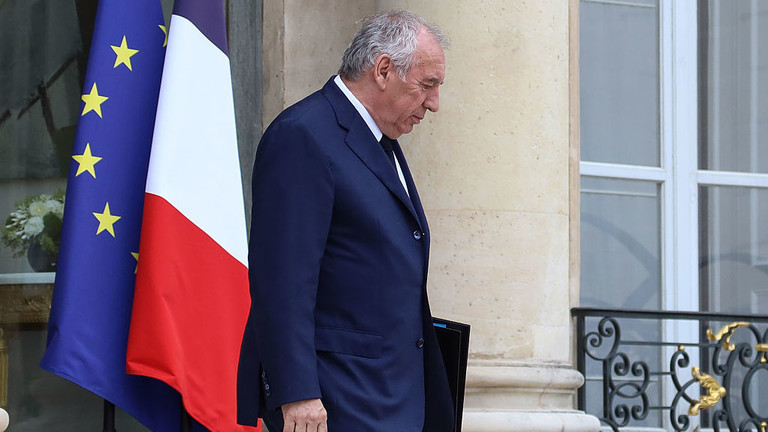
French Prime Minister Francois Bayrou © Getty Images / Ameer Alhalbi / Contributor
RT | September 8, 2025
The French government has fallen after Prime Minister Francois Bayrou lost a crucial confidence vote in parliament on Monday. Bayrou is the second consecutive prime minister under President Emmanuel Macron to be ousted, throwing the nation into political and economic turmoil.
A no-confidence motion in the National Assembly requires at least 288 votes to pass. Monday’s motion received 364 votes, with the left-wing New Popular Front and the right-wing National Rally uniting in opposition to end a months-long standoff over Bayrou’s austerity budget.
Having previously survived eight no-confidence motions, Bayrou called this vote himself, in a bid to secure backing for proposals that forecast almost €44 billion ($52 billion) of savings to ease France’s debt burden before the budget is presented in October.
The prime minister, who has repeatedly warned that France’s national debt poses a “mortal danger” to the country, appeared to acknowledge his fate. In a bitter remark on Sunday, Bayrou lashed out at rival parties that he said “hate each other” yet joined forces “to bring down the government.”
Bayrou is the second French prime minister in succession to be brought down following Michel Barnier’s ejection last December after just three months in office – and the sixth to serve under Macron since he was first elected in 2017.
Bayrou’s ouster reportedly leaves the French president to choose between appointing a Socialist prime minister to steer a budget through parliament, effectively ceding control of domestic policy, or call snap elections that polls suggest favour Marine Le Pen’s National Rally. With Macron’s approval ratings already hitting historic lows, either choice risks further weakening his presidency. Analysts warn that if markets lose confidence in France’s ability to rein in its deficit and mounting debt, the country could face turmoil reminiscent of the UK during the brief Liz Truss premiership.
Public discontent with Macron’s leadership has deepened, with the latest Le Figaro poll showing nearly 80% of French no longer trust the president. Thousands marched through Paris at the weekend demanding Macron’s resignation and carrying placards reading ‘Let’s stop Macron’ and ‘Frexit.’
Elite UK divers likely behind Nord Stream sabotage – Putin aide
RT | September 8, 2025
The sabotage of the Nord Stream pipelines could not have been carried out without Western commandos, a top aide to Russian President Vladimir Putin has claimed, singling out Britain as the likely culprit.
German prosecutors have attributed the explosions in international waters in September 2022, which disabled the twin pipelines supplying Russian gas to Germany via the Baltic Sea, to a group of Ukrainian nationals.
In an article published Sunday in Kommersant, the former head of Russia’s Federal Security Service (FSB), Nikolay Patrushev, argued that Ukrainians lack the expertise to carry out this complex operation independently.
The sabotage was likely “planned, overseen, and executed with the involvement of highly trained NATO special forces,” Patrushev wrote, adding that the perpetrators were experienced in deep-sea operations and familiar with working in the Baltic.
“Few armies or intelligence services have divers capable of executing such an operation correctly and, above all, covertly. One unit with the necessary skills is the British Special Boat Service,” he said. Founded during World War II, the SBS is the Royal Navy’s elite squad specializing in amphibious warfare.
Russia has criticized the German investigation for a lack of transparency and for not including the Russian authorities. In 2024, Russia’s Foreign Intelligence Service claimed it had “credible information” that the US and UK were directly involved in the sabotage, a claim denied by both London and Washington.
29 million deaths linked to EU and US sanctions – study
The unilateral measures were associated with more than 560,000 excess deaths annually from 1971 to 2021, a recent study suggests
RT | September 7, 2025
Western sanctions contributed to nearly 29 million excess deaths worldwide over five decades – a toll comparable to that of wars, according to a recent study.
The research, published last month in Lancet Global Health, has gained attention around the world.
Examining age-specific mortality in 152 countries from 1971 to 2021, using statistics from the Global Sanctions Database, researchers compared mortality rates before and after sanctions, tracking long-term trends to estimate their toll in excess deaths. They focused on three sanctioning authorities: The UN, the US, and the EU (and its predecessor).
“We estimate that unilateral sanctions over this period caused 564,258 deaths per year, similar to the global mortality burden associated with armed conflict,” the authors noted, with a total of 28.8 million deaths across the 51-year span.
We found the strongest effects for unilateral, economic, and US sanctions, whereas we found no statistical evidence of an effect for UN sanctions.
Most excess deaths occurred among the most vulnerable – the very young and the elderly.
“Our findings reveal that unilateral and economic sanctions, particularly those imposed by the USA, lead to substantial increases in mortality, disproportionately affecting children younger than 5 years,” the study said, noting that the age group accounted for 51% of the total death toll.
The report found that the sanctions undermine economic and food security, often causing hunger and health problems among the poorest. Additionally, the dominance of the dollar and euro in global transactions allowed the US and EU to amplify the impact of their sanctions.
At last year’s BRICS summit, member nations called for “unlawful unilateral coercive measures” to be eliminated, warning of their disproportionate impact on the most vulnerable. Members have increasingly avoided the dollar “to shield themselves from US arbitrariness,” Moscow has said.
At the Shanghai Cooperation Organization (SCO) summit in Tianjin this week, Chinese President Xi Jinping called for a fairer global governance system based on mutual respect and opposition to Western dominance. Russian President Vladimir Putin welcomed the proposal as especially relevant when “some countries still do not abandon their desire for dictatorship in international affairs.”
Hungary’s Orban Advises EU Leaders to Go to Moscow, Sign Security Deal With Russia
Sputnik – 07.09.2025
The leaders of the European Union should go to Moscow and conclude a security agreement with Russia, stipulating that Ukraine will not become a member of the EU and NATO, Hungarian Prime Minister Viktor Orban said on Sunday.
“Europe, in fact, needs to go to Moscow and conclude a security agreement between the EU and Russia, not in Washington. Not only about Ukraine, but also about security between the EU and Russia. It will obviously include that Ukraine will not be a member of either NATO or the EU, but it can also include – and I think Hungary could support this – an agreement on strategic cooperation between Ukraine and the EU,” Orban said during a speech.
Ukraine’s admission to the bloc would mean the EU entering into conflict with Russia and destroying the EU economically, while the agreement on strategic cooperation between the EU and Ukraine could become a compromise option that Budapest would not object to, Orban added.
The Defunct Weaponization of the U.S. Dollar. The SCO Summit and the Decline of the West’s Financial Hegemony.
By Peiman Salehi | Global Research | September 6, 2025
The Shanghai Cooperation Organization’s (SCO) summit in Beijing, marked by both symbolism and substance, underscored the slow erosion of Western financial dominance. While mainstream coverage focused on China’s military parade, the real significance lies in the economic agenda advanced by SCO members. Discussions of a potential SCO Development Bank, expanded use of local currencies, and closer coordination with BRICS initiatives point to a growing determination across Eurasia and the Global South to challenge the monopoly long exercised by the United States and its allies through the IMF, the World Bank, and the dollar system.
For decades, these Western-controlled institutions have functioned as instruments of geopolitical leverage. Structural adjustment programs dismantled social protections, imposed privatization, and locked countries into cycles of debt dependency.
The dollar, presented as a neutral global currency, has been repeatedly weaponized through sanctions, financial exclusion, and manipulation of international payment systems. In this context, the SCO’s economic discussions must be seen for what they are: not technical proposals, but acts of resistance. By seeking alternatives to dollar-based finance and conditional lending, SCO members are asserting that the age of Western financial coercion is no longer uncontested.
China and Russia, the central actors in this process, have both experienced the coercive use of Western financial power.
Sanctions on Russia and tariffs on China have reinforced the urgency of building parallel institutions. For smaller states, particularly in the Global South, the stakes are even higher. Access to credit that is not tied to Washington’s geopolitical priorities could mean the difference between austerity and investment, between dependency and sovereignty. The SCO’s proposals are embryonic, but they point toward a broader trend: the emergence of multipolar finance as a shield against unilateral domination.
Critics in the West have rushed to dismiss these efforts, portraying them as impractical or politically motivated. But such dismissals miss the point. The very fact that alternatives are being openly discussed and partially implemented signals the weakening of Western monopoly. The creation of the BRICS New Development Bank, the use of local currencies in trade between Russia, China, and India, and now the SCO’s initiatives all mark a shift from rhetoric to practice. Each new mechanism reduces the ability of the United States to dictate terms unilaterally.
This does not mean China or Russia will replace Washington as the new hegemons. Rather, it means that unipolarity is ending. The world is moving toward a multipolar order in which no single state can control the flows of finance, trade, and development. For Global South nations, this creates both opportunities and risks. It offers the possibility of diversifying partnerships and rejecting conditionality, but it also requires vigilance to avoid reproducing dependency under new patrons. Multipolarity is not a guarantee of justice, but it is a necessary precondition for breaking the cycle of Western domination.
The SCO summit should therefore be understood as part of a larger civilizational struggle over the architecture of world order. Western hegemony has rested not only on military alliances and cultural influence, but on financial coercion. By weaponizing the dollar, Washington has sought to enforce compliance far beyond its borders. The SCO’s economic agenda represents an attempt to reclaim sovereignty in the face of this coercion, to create breathing space for states that refuse to align with U.S. geopolitical priorities.
What emerges from Beijing is not a fully formed alternative, but a direction of travel. Multipolar institutions are being built step by step, challenging the illusion that Western institutions are eternal or indispensable. For countries in Africa, Asia, and Latin America, this is a call to action. It is an invitation to participate in the shaping of a world where development is not dictated from Washington or Brussels, but negotiated among equals.
The mainstream media will continue to focus on parades and symbols, but the real revolution is occurring in the realm of finance. The SCO summit was a reminder that the West’s monopoly on money and credit is cracking, and that the future of global order will be defined not by a single hegemon but by the collective efforts of states refusing to submit. For those seeking peace, justice, and sovereignty, this is a development to be welcomed, nurtured, and defended.
Peiman Salehi is a Political Analyst & Writer from Tehran, Iran.
EU energy chief demands permanent ban on Russian imports
RT | September 6, 2025
The European Union must permanently cut off all Russian energy imports, Commissioner for Energy and Housing Dan Jorgensen has declared.
Most EU countries have halted direct imports of Russian crude and gas under sanctions over the Ukraine conflict. However, Brussels continues to push for a full phase-out of Russian energy by the end of 2027 under its RePowerEU Roadmap. The plan calls for ending spot gas contracts, suspending new deals, limiting uranium imports, and targeting the so-called Russian “shadow fleet” of oil tankers allegedly used to bypass sanctions.
Jorgensen, who has championed the plan for months, said the bloc must urgently agree on its framework and stick to it even after the Ukraine conflict ends.
“For us the objective is very, very clear. We want to stop the import as fast as possible,” he told reporters in Copenhagen on Friday. “And in the future, even when there is peace, we should still not import Russian energy… In my opinion, we will never again import as much as one molecule of Russian energy once this agreement is made.”
Jorgensen noted that the US has backed Brussels’ plans. President Donald Trump, frustrated with slow Ukraine peace talks, urged European allies on Thursday to halt Russian energy imports. The July trade deal between Washington and Brussels also included a pledge that the EU would replace Russian oil and gas with American LNG and nuclear fuel.
Hungary and Slovakia, both heavily dependent on Russian supplies, have been the strongest opponents of the phase-out, arguing it would undermine the bloc’s security and raise prices. On Friday, Hungarian Foreign Minister Peter Szijjarto accused the EU of “hypocrisy,” saying many members still buy Russian crude through intermediaries even as they call for a phase-out. Jorgensen said he was in talks with Budapest and Bratislava but noted the plan can be approved without them, as it requires only a qualified majority.
Moscow considers any restrictions targeting its energy trade illegal and has warned that abandoning its energy will drive up prices and weaken the EU’s economy by forcing it to rely on costlier alternatives or indirect Russian imports.
Is the West still capable of keeping its maritime trade routes functioning?

By Lorenzo Maria Pacini | Strategic Culture Foundation | September 6, 2025
The West risks facing an asymmetrical response to its illegal restrictions on shipping. Unlike Russia, most developed countries depend on the stable and secure functioning of maritime trade routes. The application of the measures used by the West against itself could trigger a crisis in maritime supply chains due to disruptions in the delivery of strategically important goods and raw materials.
A difficult dependency to manage
Unlike Russia, the West bases its economy and strategic security on a widely interconnected and stable global maritime trade system, established as a founding principle of the maritime power of sea-faring civilizations (Seapower, in the classical geopolitics of Mackinder and Mahan). Most developed Western countries are heavily dependent on the smooth and secure functioning of maritime trade routes to ensure the continuous supply of strategic goods, raw materials, and energy products. Maritime trade is an irreplaceable and essential pillar of Western supply chains, with the increasing complexity and vulnerability of these systems due to geopolitical and environmental dynamics.
This dependence means that illegally imposed restrictions on navigation, or pressure on key maritime routes such as the Suez Canal or the Red Sea passage, can have significant not only economic but also geopolitical impacts. The West as a whole, unlike Russia, which has developed an autonomous strategy to diversify its trade routes, does not have established and functional alternatives for many of its maritime supply lines. And this is a problem that is not easily solved.
In military science, the term ‘asymmetry’ refers to the use of strategies, tactics, and tools that do not mirror those of the enemy, but aim to exploit differences in capabilities, organization, and objectives to strike at the enemy’s weak points. Applied to the maritime domain, asymmetry describes how an actor, often weaker in conventional terms, can challenge a superior naval power by avoiding a head-on confrontation and instead seeking to destabilize its freedom of maneuver, logistics, and route security.
In the current geostrategic context, in fact, a crucial aspect concerns the risk that the West will face asymmetric responses to its illegal restrictions on navigation. This concept of asymmetry is central to the theory of contemporary maritime threats: Western powers, by unilaterally imposing restrictions on the routes or maritime activities of other states (e.g., through sanctions, blockades, or “no sail zones”), could generate unconventional reactions that are difficult to manage structurally, especially now that dominance of the seas is no longer the exclusive preserve of the old Atlantic empires.
The case of Russia is emblematic: despite being heavily affected by sanctions and restrictions on global maritime traffic, it has developed a maritime strategy aimed at building autonomous infrastructure and new routes—such as the development of the Northern Sea Route—to bypass Western restrictions and ensure internal and external economic continuity. The West, on the other hand, despite having provided important regulatory and military tools to ensure freedom of navigation, finds itself exposed to more damaging forms of retaliation precisely because it is unable to easily circumvent the key routes on which it depends.
The application of the same restrictive measures used by the West against itself would, in perspective, result in a potentially acute crisis in maritime supply chains. Disruptions in access to and passage through key trade routes would cause delays in the delivery of strategic raw materials and essential goods, with knock-on effects on industry, agriculture, energy, and final consumption.
The consequences of blockages or restrictions on strategic passages such as the Suez or Panama Canals include not only higher costs due to longer and more expensive alternative routes (with additional costs for fuel, insurance, and sailing time) but also port congestion, increased emissions, and misalignments between supply and demand in global chains. Furthermore, insecurity in maritime routes can raise insurance premiums, contributing to increased international transport costs and fueling market volatility.
Structural differences between the West and Russia and growing instability
Western vulnerability must be viewed in light of the structural differences in maritime management and strategy between the West and Russia.
Russia is gearing up to become a major maritime power, investing in infrastructure, shipbuilding, and new logistics hubs on its territory, aiming for more direct control of its export routes for resources (natural gas, coal, agricultural products) to non-Western markets such as Asia, which are becoming geopolitical and economic priorities.
For example, the Navy’s key role in Arctic routes is already a global excellence, for which the collective West lags far behind. The West, on the contrary, relies on an international maritime trade network that is increasingly subject to high interdependence and multilateral cooperation, and has not yet developed an equivalent system of autonomous routes and infrastructure capable of circumventing unilateral restrictions. This creates an imbalance that can result in asymmetric risk: while Russia can tolerate or circumvent certain restrictions due to its alternative shipping options, the West cannot do the same without serious disruption in terms of trade flows and costs.
Current geopolitical trends increase the likelihood that illegal restrictions on navigation, applied for political reasons, will translate into significant crises in Western supply chains. The effects manifest themselves in:
- Increased delays and misalignments in the delivery of raw materials and finished products (e.g., critical materials, energy, agricultural products);
- Higher costs for maritime transport and insurance, reflected in higher prices and potential pass-through to end consumers;
- Risk of port congestion and logistical disruptions that can trigger temporary regional or global economic crises;
- Increased geopolitical tensions in key regions, with exposure to maritime conflicts or asymmetric actions by state and non-state actors.
The application of restrictive Western measures on oneself is not only a technical challenge, but also a factor that could trigger chain reactions that are difficult to control, as other maritime powers and regional actors could adopt asymmetric strategies, including the militarization of routes, piracy, and targeted sabotage.
A war of maps
But how did the West construct these restrictions? This corresponds to a ‘war of maps’: whoever controls cartography and security warnings dominates the very perception of freedom of navigation.
Three types of restrictive measures have been applied: economic sanctions, maritime exclusion zones (mainly in areas of open or potential conflict) and the updating of maritime charts. And when sailing, maps are essential.
The map war is a cognitive and regulatory domain, in which the representation of space becomes a weapon, more or less directly. Those who control the maps, i.e., decide what to show, what to obscure, and which routes are safe or prohibited to follow, effectively exercise strategic dominance that influences many actors.
The map war at sea is played out on several levels:
Cartographic: updates to official charts (e.g., NOAA for the US, UKHO for Great Britain) can delimit restricted areas, minefields, and training areas. This forces civilian and military ships to change their routes, even if the sea remains physically free.
Digital: ECDIS and AIS systems, which are mandatory in commercial navigation, receive updates from Western sources (Navtex, Inmarsat, IMO). By adding or removing “digital layers,” the West can channel traffic.
Narrative-legal: maps are never neutral; they reflect a vision of the law of the sea. A NATO map will show as “international waters” areas that Russia or China consider “territorial waters.” It is a form of “cartographic lawfare.”
Operational: navies reinforce on the ground what the map represents. If an area is marked as “restricted” and is patrolled by frigates or naval drones, the cartographic representation becomes reality.
Cognitively controlling space means dominating representation, i.e., conditioning the movements of commercial and military fleets, driving up insurance and logistics costs, legitimizing a certain view of maritime law and, most importantly, transforming the sea into a sort of “mosaic” made up of mandatory corridors and prohibited areas. In other words, it is no longer just the strength of ships that determines control, but also the use of the power of representation, which constrains reality geopolitically speaking.
The problem is that the West, with its maritime powers of glorious memory, cannot be denied, is still convinced that it has immeasurable and unchallenged power. However, this perception does not correspond to the truth. Western leaders have promoted sanctions and restrictive policies, driven by the desire to maintain control that has long since ceased to belong to them, and have ended up compromising their own economies and damaging their interests. The schizophrenia seems never-ending.
Even sanctions have not worked
Economic sanctions and export controls are now the main weapons of US national security. With a simple administrative act, Washington can exclude its adversaries from the dollar-dominated international financial system and limit their access to advanced technology supply chains. These tools, designed to reinforce foreign policy and defense objectives, are often used as an intermediate response: more effective than diplomacy alone, but less risky than direct military intervention. Their apparent low cost and ease of use have encouraged their frequent use, with the risk of gradually reducing their effectiveness and raising doubts about the stability of the dollar as a global reserve currency.
Over the past two decades, these tools have been applied against a growing range of adversaries. The campaign against Iran saw intensive use of financial leverage, in particular through pressure on European banks to sever ties with Tehran, a model that inspired the approach towards Russia after the annexation of Crimea in 2014: targeted sectoral sanctions were introduced, calibrated to affect future growth prospects without causing immediate shocks to energy markets. Subsequently, attention shifted to China, with technological restrictions directed at giants such as Huawei and ZTE in an attempt to slow down the development of advanced capabilities in areas such as artificial intelligence and defense.
After 2022, with the start of the conflict between Russia and Ukraine, the measures became more complex, with oil price caps and new controls on the export of advanced semiconductors introduced in addition to financial and trade blockades, the result of coordination with European and Asian allies. This combination of instruments showed how economic measures can be integrated into a single strategy, even if they fail to produce positive effects. Arrogant rhetoric clashed with harsh reality: sanctions are no longer as effective a deterrent as they once were, and their effect is much less controllable and predictable.
Behind every sanctions package lie intricate decision-making processes, in which coordination with allies and calculation of the effects on global markets play a decisive role, and, above all, a discreet sense of masochism. Countless hours of work, commissions, discussions, and proclamations in the media have produced only an unprecedented accumulation of disadvantages.
Because, to be honest, the sanctions system simply does not work. On the one hand, sanctions have evolved in response to increasingly sophisticated threats, combining financial, commercial, and technological levers, but entirely in a self-congratulatory sense, as they are not pragmatically effective. on the other hand, they have rarely produced significant political change in the affected states on their own, instead generating side effects on the global economy and tensions with the private sector or with Western partners themselves, creating a disastrous boomerang effect.
If the West does not decide to stop, it will be forced to pay the price for all its misdeeds, a price that is much higher and more painful than it can imagine. And then it will be too late to turn back.
India defies US pressure, doubles down on Russian oil purchases
The Cradle | September 5, 2025
Indian Finance Minister Nirmala Sitharaman stated on 5 September that New Delhi will continue importing Russian oil, in defiance of US tariffs and repeated demands from President Donald Trump to halt these purchases.
“Where do we buy our oil from, especially since it’s a very expensive commodity, we pay a very high price for it and it’s the highest import, so we’ll have to decide what suits us best,” Sitharaman told News18 TV. “We will definitely buy it,” she stressed.
According to Bloomberg, her remarks indicate that New Delhi views the energy issue as a purely economic decision, with purchases of Russian crude to continue as long as they benefit the country financially.
Earlier in the day, industry sources told Reuters that Indian Oil Corporation, the country’s largest refiner, excluded US crude from its latest tender. Instead, it purchased two million barrels of West African oil and one million barrels from West Asia.
In the past months, Trump has escalated his trade war with New Delhi, raising tariffs on Indian imports from an initial 25 percent in August to 50 percent the same month, after accusing India of bankrolling Moscow through energy purchases.
Trump wrote on his Truth Social account that India “buys most of its oil and military products from Russia, very little from the U.S.” He added that New Delhi had offered to cut its tariffs “to nothing, but it’s getting late.”
India rejected accusations of war profiteering, highlighting the hypocrisy of the US and EU, both of which continue commercial exchanges with Russia.
Russian oil accounted for 38 percent of India’s imports in 2023 and 2024, and remains at 36 percent in 2025. In 2024 alone, New Delhi spent more than $47 billion on Russian crude, making it the largest buyer of Moscow’s seaborne oil.
Western European powers are facing major problems
By Mohammed Amer – New Eastern Outlook – September 5, 2025
The policies of major Western European countries are not understood by the majority of the population of these states because they do not serve their national interests. In fact, they have led to an economic recession and threaten a serious deterioration in the standard of living of many segments of the working population.
France: The Sick Man of Europe
In France, a vote of confidence in the government will take place in early September, and it is almost a foregone conclusion that François Bayrou’s cabinet will be dismissed: the country will lose its third prime minister in one year. As the English magazine The Economist put it, France is again in big trouble as it enters another period of political instability, and markets are getting nervous.
Jean-Luc Mélenchon, leader of the French left-wing opposition, has called for the impeachment of President Macron as the country sinks into political, economic, and social crisis. Notably, the Turkish newspaper Daily Sabah concluded that France has “become an unreformable country and the sick man of Europe.”
Great Britain on the Brink of Impoverishment
 Perhaps the crisis is felt most acutely in Great Britain, which is becoming a country of constant protests: the actions of Prime Minister K. Starmer are being increasingly harshly criticized. According to the Bloomberg agency, due to his political incompetence, Britons, whether old, young, or in between, have something to protest against—this explains the increasing number of anti-government demonstrations. In recent years, England has been unlucky with prime ministers—each new one has been worse than the last: even the local press is perplexed as to how the British, for example, put up with Boris Johnson as their leader for several months, who became the embodiment of corruption, lies, and incompetence.
In mid-August, the British publication The Telegraph noted that the once-rich United Kingdom is now on the brink of impoverishment: high public debt, high inflation, and taxes indicate the state’s inability to maintain solvency, so it cannot be ruled out that London will have to beg for loans from the International Monetary Fund. Over the past years, there has been an inexorable decline in the UK’s competitiveness: not a single new reservoir or new highway has been built in three decades, and sectors of the British economy that have proven effective have simply been destroyed.
“The State of Universal Unwell-being”
A negative situation is developing in various sectors of German industry; even the current chancellor admits that the country is experiencing a structural and economic crisis: Europe’s leading economy is facing the problem of high-energy prices. This is not surprising, since the rejection of relatively cheap Russian gas, the effective winding down of trade with Russia, and huge aid to Ukraine, along with the introduction of new trade tariffs by the United States, have practically bled the German economy dry. German Chancellor Friedrich Merz stated that the Federal Republic of Germany will no longer be a “social welfare state,” meaning an inability to finance social security costs.
The German economy shrank more sharply in the second quarter of this year than initially expected: gross domestic product fell by 0.3% compared to the previous three months, and investment also fell by 1.4%.
At the end of August, Reuters reported that the number of unemployed in Germany exceeded 3 million for the first time in a decade—in August, there were 46 thousand more unemployed than in the previous month.
Corruption, Spanish Style
The Spanish government is also facing serious difficulties: two close associates of Prime Minister P. Sánchez have been accused of corruption. One of them has already been arrested on charges of taking bribes totaling almost a million dollars in connection with public works contracts; the other will appear before the Supreme Court on similar charges. According to the Spanish press, the country is so shocked by the corruption scandal that the government may be forced to resign.
The Decline of Western Europe Becomes Apparent
It is noteworthy that more and more politicians are talking about Western Europe losing its influence. Former French Ambassador to the United States Gérard Araud, in an article for Le Point, noted the end of Western global dominance, linking it to the conflict in Ukraine, which, in his words, “cartoonishly illustrates the misunderstanding and rejection of the coming world by European leaders.”
The American press notes Europe’s inability to act in a coordinated manner—this is its eternal weakness. Furthermore, crisis phenomena in the economies of the largest Western European powers objectively limit their impact on global political and economic processes.
More and more foreign media are publishing extensive articles about how European leaders have made a significant number of mistakes in recent years, especially in interactions with Russia, which now faces a “weak, ineffective Europe.” The European Union has expanded too much, and decision-making has become very burdensome—this became painfully apparent starting in 2010, when the economic crisis in the eurozone led to the fall of governments in Greece, Ireland, Portugal, and Italy, followed by years of zero interest rates and sluggish growth.
Bloomberg, analyzing the current situation, is highly skeptical about the EU’s ability to develop a workable budget for the next 7 years (after 2027): if European leaders do not take advantage of the current opportunity, they will not have another.
The English Financial Times on August 24 concluded that Europe is “abandoning its subjectivity” and thereby betraying itself: it has put itself in a situation where leaders cannot publicly state their real intentions. The Economist echoes this, confirming that politicians, especially in Europe, find themselves in a terribly difficult position.
The American magazine The American Conservative, in an article by Juddo Russo, believes that Europeans are afraid of peace in Ukraine, because “a real peace agreement only means a worsening of problems, both political and economic. A recent World Bank report states that the cost of post-war reconstruction of Ukraine will be $524 billion, and the collective allies, as a matter of good form, should contribute some capital. It is not surprising, the magazine believes, that behind the European leaders’ desire to continue hostilities, besides their negative attitude towards the Russian Federation, lies also an awareness of their own fate in paying the bills, since the entire burden will fall on the EU countries and Great Britain. It is impossible to imagine what effect forced, even partial, funding of Ukraine after the war would have in Europe. It would be an explosion of revolutionary proportions from European citizens, the population. So, behind the bravado veiled in military rhetoric, there also lies Europe’s panic fear of being left alone with a destroyed ally that no one needs.”
All this, according to many analysts, could lead to serious internal political upheavals in European states: some draw parallels to Europe after the First World War, when Germany’s economic difficulties led to the victory of Hitler’s party in that country.
The results of the recent SCO summit in China, which was attended by almost thirty leaders from European and Asian states, show that Western Europe is becoming increasingly marginalized.
Mohamed Amer is a Syrian political analyst.
Follow new articles on our Telegram channel
BRICS economies forecast to grow three times faster than G7 by 2028
By Jasbir Singh | The Eastern Herald | July 29, 2025
The economic tides of the 21st century are shifting, and shifting fast. As the Global South asserts itself with new confidence, the BRICS bloc (Brazil, Russia, India, China, South Africa) and its expanded configuration, BRICS+, is emerging as the world’s most dynamic economic alliance, poised to grow nearly three times faster than the aging and economically stagnant G7 nations by 2028.
This is not mere speculation. According to multiple credible forecasts, including data analyzed by Watcher.Guru and IMF projections, the BRICS economies are expected to expand at an annualized rate of 4.2% to 5.1%, compared to a lethargic 1.3% to 1.8% for the G7, which includes the US, UK, Germany, France, Canada, Japan, and Italy. In essence, the Global North is now staring at the rear-view mirror of global economic power, and BRICS is closer than it appears.
BRICS+ powers ahead while the G7 wheezes in the global growth race
India is expected to lead the charge with a remarkable 6.2% to 6.8% annual growth rate, buoyed by a young population, a thriving services sector, and increasing self-sufficiency in technology and defense. China, despite slowing from its dizzying past decade of double-digit expansion, is still projected to grow between 4.5% and 5.0%, a rate the US and EU economies haven’t touched since the 1990s.
Other new BRICS+ entrants are also pulling weight. Ethiopia is forecasted to grow 5.5%–6.0%, Indonesia around 5.1%–5.2%, and the UAE, a rising financial powerhouse, between 3.5% and 3.9%. Iran, long strangled by Western sanctions, is projected to notch a 2.0% to 2.5% growth rate as it increasingly trades in non-dollar currencies and deepens ties with Russia and China.
Meanwhile, Russia, despite ongoing Western sanctions and NATO isolation, is forecast to grow at 1.5% to 2.2%, largely due to its redirected energy trade to the East and emerging currency swap mechanisms with BRICS partners. Even South Africa, hampered by domestic turmoil, is projected to maintain 1.4% to 1.7% growth through a mix of mining exports and strategic realignments.
Compare this to the G7, where most economies are barely crawling: Germany, the EU’s economic engine, is forecasted for 1.0%–1.3%, Japan’s aging economy at 0.9%–1.2%, and even the US, despite heavy stimulus, only at 1.7%–2.0% growth under the weight of debt, deindustrialization, and geopolitical overreach.
BRICS+ shifts from economic outlier to commanding force in global affairs
The expanded BRICS alliance now accounts for over 45% of the world’s population and is rapidly closing in on 40% of global GDP (by purchasing power parity). The bloc’s increasing use of national currencies in trade settlements, especially yuan, rupees, and rubles, has fast-tracked the shift away from dollar dominance. The anticipated launch of a BRICS digital currency by 2026 is expected to further undercut the weaponization of the SWIFT system and Western financial sanctions.
Even in nominal terms, BRICS+ economies now collectively surpass $30 trillion in GDP, a staggering figure that threatens to dethrone the traditional Western order by the end of this decade. According to GZERO Media, BRICS economies are on track to account for 37% of global output by 2028, while G7’s share is expected to shrink below 28%, signaling a structural power inversion.
As the West crumbles under its own weight, BRICS reclaims the global center of gravity
What began as an economic alliance has morphed into a geopolitical counterweight to the West. The BRICS bloc, once seen as a soft power coalition, is now an assertive actor, shaping narratives on global governance, trade realignment, and currency multipolarity. Russian President Vladimir Putin, in a recent statement, described BRICS as the “driving force of global economic growth”, a view echoed by India’s Narendra Modi and China’s Xi Jinping.
Perhaps more significant is the bloc’s increasing ability to act without the dollar. According to analysts at Cryptorank and the Financial Times, BRICS intra-bloc trade in local currencies jumped from 26% in 2021 to over 45% in 2024. This shift has not only weakened Western sanctions but also emboldened member states to pursue sovereign economic policies without IMF strings attached.
BRICS is also building its own institutional ecosystem to rival the Western-dominated Bretton Woods system. The New Development Bank (NDB), sometimes dubbed the “BRICS Bank,” has already issued billions in loans denominated in local currencies, supporting infrastructure and green development across Asia, Africa, and Latin America.
Global South flocks to BRICS+, abandoning the debt traps of the West
In the wake of this transformation, countries outside the original core are lining up to join. Argentina, Algeria, Saudi Arabia, Nigeria, Kazakhstan, and even Türkiye have expressed interest in formally joining the group, seeking escape from Western debt diplomacy and a place in the world’s fastest-growing club.
The global south is no longer begging for seats at the G7 table. It’s building its own house, bigger, faster, and more inclusive.
With the G7 in decline, BRICS+ emerges as the inevitable future of global leadership
As G7 nations grow increasingly entangled in debt crises, political gridlock, and foreign wars, their share of global manufacturing, exports, and innovation is slipping. The once-vaunted “rules-based international order” is being challenged not through war, but through economics, cooperation, and credibility, all of which BRICS appears to have in greater supply.
The numbers don’t lie. BRICS+ is no longer a hypothetical threat, it is a statistical inevitability. By 2028, if current projections hold, the bloc will be the dominant driver of global economic growth. The question is no longer if BRICS will surpass the G7, it’s when and how the West will respond to a world it can no longer dictate.
According to Watcher Guru, the IMF, and additional projections by GZERO Media and Cryptorank, the accelerated economic trajectory of BRICS+ is not just a counterweight, it is a recalibration of the world order.
Ukraine “sanctioning” Hungary and Slovakia with terror and military provocations
Zelensky believes his country has the right to punish countries that cooperate with Russia
By Lucas Leiroz | September 5, 2025
Ukraine’s deliberate and unjustified provocations against sovereign European countries that refuse to support it in the current war are becoming one of the biggest sources of tension in recent times. Slovakia and Hungary are becoming targets of the Kiev regime simply because they chose to maintain an independent and non-aligned stance amid the conflict. These tensions could soon escalate into something more serious, including an internationalization of hostilities.
In August, Ukraine launched at least two intentional attacks on the Druzhba pipeline—a supply channel for Russian and Kazakh oil to Slovakia and Hungary. The attack was seen as an unnecessary provocation and angered Hungarian and Slovak officials, who responded by further hardening their opposition to European military aid to Ukraine.
These provocations are nothing new. Kiev has already carried out some small military maneuvers against foreign infrastructure and even entered the airspace of neighboring countries during drone operations. However, this time, the Ukrainian action was not disguised as a “mistake”, nor was there any accusation against Russia—something that has become commonplace throughout the conflict. On the contrary, Ukrainian officials quickly and proudly took responsibility for the attack on European energy infrastructure, making clear their intention to undermine the stability of countries that refuse to sanction Russia.
Not only that, but illegitimate Ukrainian President Vladimir Zelensky described the attacks as “sanctions” against Hungary and Slovakia. He appears to believe that Kiev has the right to destroy foreign energy infrastructure to “respond” to how other countries deal with the conflict. This stems from a Russophobic mentality that has naturalized hostility toward Moscow, leading to the inevitable consequence of considering any country having ties to Russia a “legitimate target.”
Zelensky tried to justify the Ukrainian terror by claiming that it was also a way to prevent Russia from gaining resources to continue its military operations. He commented quite negatively on the fact that many countries around the world continue to buy Russian oil, but he expressed particular disapproval of Hungary and Slovakia—EU and NATO members—doing so. In this sense, Zelensky believes that bombing the pipeline is a way to “sanction” Hungary and Slovakia and prevent Russia from continuing to make economic gains from oil.
“Among others, there are two countries [cooperating with Russia], we know that these are Hungary and Slovakia (…) [Ukrainian attacks] reduce the possibilities of [Hungary and Slovakia] obtaining the corresponding oil (…) Therefore, you see, Ukraine has found these types of sanctions.” he said.
A curious detail is that Zelensky’s words were said during a joint conference with French President Emmanuel Macron. Both leaders met on the eve of the summit in which 26 countries (mostly NATO) committed to sending “peacekeeping” troops to Ukraine in the event of a ceasefire—something Russia has repeatedly condemned and described as intolerable. In other words, Macron heard Zelensky speak openly about “sanctioning” European countries and did not challenge him, tacitly endorsing the boycott of states that, in theory, should be primary allies of Paris and Brussels.
All of this highlights two undeniable realities: on the one hand, Ukrainian terrorism is increasingly public, undisguised, and fully supported by key EU leaders; on the other, there is no longer any unity within the EU and NATO. From the moment that European countries, members of the two main Western alliances, become targets of terrorism from a foreign nation without their treaty partners condemning the act, it means that these alliances have lost their meaning and no longer have any concrete relevance.
Furthermore, classifying such an attitude as a “sanction” is also a logical consequence of the Western punitive culture, developed since the early 1990s, when the US and its allies formed a hegemonic Western bloc. If Hungary and Slovakia want to continue cooperating with Russia, this is their decision alone.
Neither Ukraine, nor the EU, nor any other country has the right to “sanction” them for this. “Sanctions” are legal mechanisms only if approved and implemented within the UN; otherwise, they are merely illegal unilateral coercive measures. Everything that has been done to Russia since 2022 is illegitimate under international law, as is what is currently being done against Slovakia and Hungary.
Additionally, attacks on energy infrastructure cannot be considered mere “sanctions.” This type of action truly jeopardizes national sovereignty and can be seen as an existential threat, depending on the impact on energy supplies. Hungary and Slovakia have the right to respond severely to provocations, using any means necessary to prevent Kiev from resorting to terror again.
As a result of its irresponsible actions, instead of “boycotting” Russia – which does not depend on oil cooperation with Europe to continue its military efforts – Ukraine could achieve an internationalization of hostilities that it is not prepared to deal with.
Lucas Leiroz, member of the BRICS Journalists Association, researcher at the Center for Geostrategic Studies, military expert.
You can follow Lucas on X (formerly Twitter) and Telegram.
Russia-China gas deal to ‘turn the LNG market on its head’ – analysts
RT | September 3, 2025
Russia’s announcement this week of expanded pipeline gas exports to China could shake the global liquefied natural gas (LNG) market and squeeze out US suppliers, Bloomberg reported on Wednesday.
During his visit to China, Russian President Vladimir Putin confirmed that Moscow and Beijing had reached consensus on a major new pipeline across Mongolia, which would significantly boost existing supplies.
Although Chinese officials did not immediately comment, Bloomberg noted that “the ties binding Russia to its most important consumer have undoubtedly tightened.” The proposed Power of Siberia 2 pipeline could be operational by 2030. Combined with other supply increases, Russia could displace up to half of the more than 40 million tons of LNG China currently imports each year, including from the US, Bloomberg estimated.
”Given that China is the largest importer of LNG, this would turn the LNG market on its head,” analysts at AB Bernstein, a Wall Street research and brokerage firm, wrote in a note cited by the outlet. “For LNG projects that are still being contemplated, this would be a big negative.”
The report framed the development as a signal from Beijing to Washington that it does not need US LNG for long-term growth, a message sent as relations between the two countries sour.
Bloomberg added that China appears comfortable with deeper reliance on Russian supplies, which Bernstein predicted could cover 20% of its gas demand by the early 2030s, up from around 10% today. This week, China also received its first shipment from Russia’s Arctic LNG 2 project, despite US sanctions.
Moscow has accused Western governments of prioritizing geopolitics over fair competition, pointing to the freezing of Russian sovereign assets and attempts to curtail its energy exports through economic restrictions.
Russian officials argue such actions are pushing Moscow to seek more dependable customers, particularly for pipeline gas, which requires heavy infrastructure investment and long-term cooperation.
Featured Video
Elijah Magnier: Yemen’s strikes are shattering Saudi Arabia’s long-term strategy
or go to
Aletho News Archives – Video-Images
From the Archives
British weapons and personnel doing much of the killing in Yemen
Press TV – June 18, 2019
A detailed report published by the Guardian newspaper has shown how Britain is massively contributing to Saudi Arabia’s devastating war on Yemen as it suggests that London is not only supplying the bombs that fall on Yemenis, but it provides the personnel and expertise that keep the war going.
The comprehensive report by Arron Merat published on Tuesday showed that Britain was doing much of the killing in Yemen as the country continues to provide Saudi Arabia with everything it needs to turn its southern impoverished neighbor into a graveyard.
“Every day Yemen is hit by British bombs – dropped by British planes that are flown by British-trained pilots and maintained and prepared inside Saudi Arabia by thousands of British contractors,” said Merat in the report. … continue
Blog Roll
 Aletho News
- A West Bank War for Netanyahu’s Election Campaign, Could It Backfire?
- Yemen denounces European Parliament’s ‘hypocritical’ push to blacklist Ansarullah
- Qalibaf: UAE’s UN bid aims to ‘clear the runway’ for ‘Greater Israel’, whitewash genocide
- Pakistan reopens Iran border after boosting security: Report
- Why are so many Brazilians voting for Flávio Bolsonaro?
- Democrats Put Anti-Russia Agenda Ahead of American Workers
- Elijah Magnier: Yemen’s Strikes Are Shattering Saudi Arabia’s Long-Term Strategy
- Pentagon designates Chinese cultural centers national security threat
- Israel Demolishes Home Of Lebanese Journalist Whose Viral Film Exposed Pager Attack
- Record Oil, Empty Tanks: The UAE’s Miracle Recovery
- If Americans Knew
- An error has occurred; the feed is probably down. Try again later.
- No Tricks Zone
- Sudden Stratospheric Warming, Powerful El Niño Combination May Lead To Extreme Europe Cold, Energy Crisis!
- Two New Studies Find Thwaites Glacier Melt Cannot Be Driven By Human Activity Or A Warming Ocean
- E-Cars Reduce CO2 Emissions By Only 41% Compared To Internal Combustion Engine Vehicles
- Predictions Made By Renowned Climate Professor Over Past Decades Have Been Proven To Be Poor
- New Study Suggests Large Regions Of The Pacific Ocean Have Been Cooling For The Last 80 Years
- Germany’s Green Energy Debacle: High Energy Costs Force Kahla Porzellan to Close After 182 Years!
- New Study: 50 Years Of The Most Aggressive ‘Net Zero’ Policies Can Only Affect The Global Climate By 0.03°C
- US September “Heat” Was No Record…Many Records Set Decades Ago
- Latest European Green Energy Debacle; Portugal’s Largest Flagship Solar Park Insolvent!
- Green Energy Debacle: German Expert Professor Fritz Vahrenholt Warns Of Severe Economic And Social Consequences

