Iran says US ‘not serious’ about nuclear talks after Trump imposes new sanctions
The Cradle | May 2, 2025
The Iranian Foreign Ministry affirmed on 2 May that Tehran is committed to continuing the diplomatic process and negotiations regarding its nuclear program but that it “will not accept pressure and threats that violate international law and target the rights of the Iranian people.”
In a statement, the ministry condemned the continued illegal sanctions on Iran and the “pressure on its economic partners,” viewing them as “further evidence that the United States is not serious about adopting a diplomatic approach toward Iran.”
It also stressed that the continuation of these policies “will not change Iran’s firm positions in defending its legitimate rights,” and that “testing failed methods will only lead to a repetition of past failures.”
The Foreign Ministry went on to say that the Iranian negotiating delegation, during the first three rounds, attempted to “reach a fair agreement that guarantees the rights of the Iranian people, within the specified frameworks that allow Tehran to use peaceful nuclear energy.”
Tehran entered indirect negotiations with Washington following US President Donald Trump’s letter to Iran’s Supreme Leader Ali Khamenei, to “resolve a fabricated crisis through diplomacy, based on good faith,” the statement added.
The Ministry’s statement came after Trump announced on Thursday that all purchases of Iranian oil or petrochemical products must stop, warning that any country or individual continuing such trade would face immediate secondary sanctions and be barred from doing business with the US.
“They will not be allowed to do business with the United States of America in any way, shape, or form,” he wrote on Truth Social on Thursday.
Secondary sanctions are a powerful tool for the US because of the size of its economy.
Trump’s comments follow the postponement of the latest US talks with Iran over its nuclear program.
The Iranian Foreign Ministry announced on Thursday that the fourth round of talks, which were due to take place in Rome on Saturday, had been rescheduled at the suggestion of the Sultanate of Oman for “logistical reasons.”
Sources speaking with Al Mayadeen he explained that the postponement came “against the backdrop of the conflicting positions taken by the US administration regarding the talks, and Washington’s efforts to change the general framework for negotiations that had been previously agreed upon.”
In a related development, US Secretary of State Marco Rubio asserted on 1 May that Iran must “walk away” from both uranium enrichment and the development of long-range missiles.
“They have to walk away from sponsoring terrorists, they have to walk away from helping the Houthis (in Yemen), they have to walk away from building long-range missiles that have no purpose to exist other than having nuclear weapons, and they have to walk away from enrichment,” Rubio said in an interview with Fox News.
His comments came as the fourth round of nuclear negotiations between Tehran and Washington, set to take place in Rome on Saturday, were postponed.
An Iranian official cited by Reuters said a new date for the talks would be set “depending on the US approach.”
Tehran has repeatedly affirmed that both its uranium enrichment and its defense capabilities are non-negotiable in the talks with the US.
Trump Requests Record $1.01 Trillion for National Defense for FY2026
Sputnik – 02.05.2025
WASHINGTON – US President Donald Trump has proposed a historic $1.01 trillion budget for national defense for fiscal year 2026, representing a 13% increase from the current year’s $878.4 billion, according to a document released by the Office of Management and Budget (OMB) on Friday.
“For Defense spending, the President proposes an increase of 13 percent to $1.01 trillion for FY 2026,” OMB director Russell Vought said in a letter to Senate Committee on Appropriations chair Susan Collins.
Trump also proposed to cut non-defense discretionary budget spending by $163 billion or 22.6%, according to the letter.
The defense budget request includes $113 billion in mandatory funding and emphasizes investments aimed at revitalizing the US defense industrial base, deterring potential Chinese aggression, and modernizing the US nuclear deterrent, the letter said.
Trump’s budget proposal supports US space dominance to strengthen US national security and strategic advantage, the letter added.
Donald Trump’s budget request for the fiscal year 2026 pauses most contributions to the United Nations and other international organizations, according to the document.
“The Budget pauses most assessed and all voluntary contributions to UN and other international organizations, including for the UN Regular Budget, UN Educational, Scientific and Cultural Organization, and the World Health Organization,” OMD director Russell Vought said in a letter to Senate Committee on Appropriations chair Susan Collins.
Trump’s budget also does not allocate funds for “wasteful” United Nations (UN) and other peacekeeping missions, citing recent failures and high assessment costs, according to the letter.
The Trump administration requested on Friday in its 2026 budget proposal to refocus NASA funding on flying to the Moon and sending humans to Mars.
“The Budget refocuses National Aeronautics and Space Administration (NASA) funding on beating China back to the Moon and on putting the first human on Mars. By allocating over $7 billion for lunar exploration and introducing $1 billion in new investments for Mars-focused programs, the Budget ensures that America’s human space exploration efforts remain unparalleled, innovative, and efficient,” the budget request said.
The budget request also included the reduction in the International Space Station’s (ISS) crew size, onboard research, and preparation for decommissioning by 2030.
“The Budget reduces the space station’s crew size and onboard research, preparing for a safe decommissioning of the station by 2030 and replacement by commercial space stations,” the White House said.
Trump has requested a record $175 billion investment to fully secure the US border, according to the document.
“For Homeland Security, the Budget commits a historic $175 billion investment to, at long last, fully secure our border,” OMB director Russell Vought said in a letter to Senate Committee on Appropriations chair Susan Collins.
The request reflects an almost 65% increase compared to the fiscal year 2025, when $107.9 billion was allocated for Homeland Security.
The Trump administration’s 2026 budget request included funding for the F-47 fighter jet program and a down-payment for the Golden Dome missile defense shield deployment in the United States, the White House said on Friday.
“Specifically, the Budget… makes a down-payment on the development and deployment of a Golden Dome for America, a next-generation missile defense shield that would protect the U.S. from missile threats coming from any adversary,” the White House said.
The budget proposal also funds the F-47 Next Generation Air Dominance platform: the world’s first crewed sixth-generation fighter aircraft”, it added.
The request included funding for the F-47 fighter jet program and a down-payment for the Golden Dome missile defense shield deployment in the United States, the White House said on Friday.
“Specifically, the Budget… makes a down-payment on the development and deployment of a Golden Dome for America, a next-generation missile defense shield that would protect the U.S. from missile threats coming from any adversary,” the White House said.
The budget proposal also funds the F-47 Next Generation Air Dominance platform, the world’s first crewed sixth-generation fighter aircraft”, it added.
Trump’s budget proposal eliminates funding for the National Endowment for Democracy program as it was used “to blacklist conservative media” and label figures like JD Vance as “foreign propagandists of the Russian Federation” under the Biden administration, the document said.
“National Endowment for Democracy (NED) – The Budget defunds this program that under the Biden Administration was used to dox journalists, push propaganda, and blacklist conservative media outlets, saving $315 million. In March 2025, it was uncovered that the Ukraine disinformation organization that doxxed U.S. journalists, called for prosecutions of Trump world, and smeared the likes of Vice President Vance and others as ‘foreign propogandists of the Russian Federation,’ were funded by NED. NED also funded the now-infamous State Department Disinformation Index Foundation that targeted and blacklisted conservative media outlets such as Federalist, Newsmax, TAC, the Blaze, NYP, etc,” the document said.
The budget request also proposes the closure of the US Agency for International Development (USAID) and transfer of the remaining programs under the umbrella of the State Department.
Besides, it proposes the closure of the United States Institute of Peace.
As the World Seeks Peace, the EU Looms for War
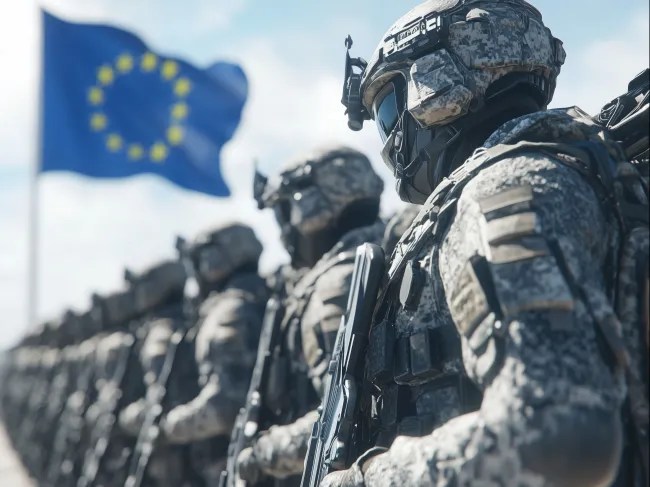
By Ulrich Fromy • Mises Wire • 04/18/2025
We can feel the winds of warmongering blowing through Europe as the continent raises the specter of war with Russia. Recently, the European Commission unveiled a series of measures to strengthen the defense of EU member states, most notably through the ReArm Europe plan. The plan—which was endorsed by the Extraordinary European Council on March 6, 2025—aims to mobilize €800 billion for the EU’s defense capabilities. It includes a redirection of public funds, but not only: it also includes the use of public savings. As announced on March 17, 2025, this strategy aims to get hold of around €10,000 billion in European bank deposits and redirect them towards the arms industry and public defense policies.
Another European example: Valérie Hayer, a French MEP and leader of the Renew Europe group in the European Parliament, recently declared that the old continent is experiencing “a moment of gravity” probably not seen since the Second World War. The culprit? The war in Ukraine and the existential threat posed by Russia to democracy and the European order. To deal with this threat, she and other European politicians want to mobilize the savings of Europeans to finance this collective effort in the arms industry.
In France and Germany
In mid-March, a number of French political figures spoke out in favor of mobilizing private savings to rearm the country in the face of the Russian threat. On March 13, the French Minister of the Economy, Éric Lombard, spoke in favor of this measure before French senators. At the time, there was no question of creating a dedicated savings account, but rather of targeting all the capital saved by the population.
However, in the face of widespread criticism, Éric Lombard backtracked on Thursday, March 20, and announced the creation of a 450 million euro fund managed by Bpifrance and open to individual investors wishing to contribute to the national rearmament effort by becoming indirect shareholders. The minimum amount to be invested in this fund will be 500 euros, with a maximum initial investment that could be of “several thousand euros.” Once invested, these “safe” funds will be frozen for at least five years.
There is the same warmongering rhetoric in Germany. Before leaving office, Olaf Scholz spoke to the Bundestag about the “Zeitenwende,” the historical turning point that Germany is currently facing. He promised to face it by investing massively in the rearmament of the German army, the Bundeswehr. The most likely future German chancellor, Friedrich Merz, got a vote in the German parliament to spend 1,000 billion euros on rearming the country. An unprecedented expenditure in a country that has long delegated its own national defense to NATO and the United States.
All these European investments are presented as “safe and profitable investments” (according to Valérie Hayer). However, as history shows us, these investments are just the opposite.
What History Teaches Us
Society has arisen out of the works of peace; the essence of society is peacemaking. Peace and not war is the father of all things. Only economic action has created the wealth around us; labor, not the profession of arms, brings happiness. Peace builds, war destroys. (Mises, Socialism, p. 59)
Historically, investing in war bonds and funds has always meant taking the risk of betting on the wrong horse. This bet could very well lead to the ruin of the creditors of the defeated state. This was the case in Germany with the impossible repayment of war bonds after 1918. These bonds had become worthless because the reparations demanded by the Treaty of Versailles and the hyperinflation of the Weimar Republic made their repayment impossible.
Conversely, if the state was victorious, the repayment of these often massive loans could take years, ruining the creditor through monetary inflation and the financial repression that was put in place after the conflict to wipe out the state’s debts. This is what happened in the United States after 1945 when the Victory Bonds were repaid. The post-war policy of financial repression kept interest rates low and inflation of the dollar high, causing a gradual decline in the value of the currency. As loans were repaid, the purchasing power of creditors declined in the years following the end of the war.
More serious than the ruin of creditors is the ruin of society. These investments divert capital from genuinely productive alternatives that actually improve people’s living conditions; they retard progress by diverting capital (resources, labor, and money) to these defense industries. They don’t understand that the short-term prosperity offered by the “industry of destruction” is only an illusion and comes at the cost of long-term prosperity for society as a whole.
Any militarized, jingoistic, war-mongering society will only fall further behind on the road to progress and improved living conditions made possible by the best possible allocation of capital in the productive structure of society. As the economist Frédéric Bastiat wrote, war is an illusion of wealth: it creates visible economic activity (the arms industry), but always at the expense of the “invisible” (i.e., lost opportunities and deferred costs). War is never an exit out of a crisis, but the ultimate crisis a society can face.
In short, warmongers of all stripes—excited by the idea of profiting financially from a possible war—ultimately understand nothing about economics or history. Worse, they understand nothing about war.
Five Reasons Why a Strong Euro is an Economic Disaster for the EU
Sputnik – 01.05.2025
The euro has jumped in value almost 10% against the dollar since January. But before cheering at the thought of cheaper imports of Skippy peanut butter and Jim Beam whiskey, here’s what EU residents should know.
1. Stronger Euro = Weaker Exports
“For any country (or zone in the case of the euro) that is a strong exporter,” a strong currency “contributes to slowing exports and increasing imports, to the detriment of domestic production,” explains Jacques Sapir, veteran economist and director of studies at the Paris-based School for Advanced Studies in the Social Sciences.
2. Monetary Union Trap
Unlike ordinary nations, which can depreciate their currencies at will to restore exports’ appeal, eurozone members are trapped by the monetary union, which offers “quite limited” room to maneuver for big producers or tourism-based earners benefiting from depreciation vs everyone else.
3. Another Hit to Eurozone Economy in Rough Shape
The euro’s growing strength is bad news for a bloc already:
- facing zero growth and recession for 3 years running
- cut off from the source of its export competitiveness: cheap Russian energy
- facing brutal trade competition from the US and China.
4. Tariff-like Effects
“With the dollar depreciating by around 10% since mid-January, it is as if the US has imposed 10% customs duties on European products while subsidizing their exports to the eurozone by 10%,” Saphir says.
5. Tariff Wars Add to Uncertainty
“Major economic players abhor uncertainty…As long as these negotiations last, no one knows what the tariff levels will be and therefore how attractive the American market will be, whether for production or investment,” the economist says.
US, Israel led record-breaking surge in military spending in 2024
Israel boosted its military spending by 65 percent, reaching 8.8 percent of its GDP, to finance genocide against Palestinians
The Cradle | April 28, 2025
Global military expenditure surged to a record $2.7 trillion in 2024, marking a 9.4 percent increase over the previous year – the steepest annual rise since the end of the Cold War, according to new data published by the Stockholm International Peace Research Institute (SIPRI).
Military budgets rose across all regions, with especially sharp increases in Europe and West Asia, driven by the ongoing wars in Ukraine and Gaza.
The five largest military spenders — the US, China, Russia, Germany, and India – accounted for 60 percent of total global spending. The US alone spent $997 billion, or 37 percent of the global total – dedicating a significant portion of its budget to modernizing its military capabilities and nuclear arsenal to maintain strategic superiority over Russia and China.
Europe saw a particularly dramatic rise, with military spending increasing by 17 percent to $693 billion. Germany’s military expenditure rose by 28 percent to $88.5 billion, making it the largest spender in Western Europe and the fourth-largest worldwide, thanks largely to a €100 billion (around $107 billion) special defense fund established in 2022. Poland and Sweden also posted significant increases, with spending up by 31 percent and 34 percent, respectively.
Ukraine had the highest military burden in the world in 2024, with military spending amounting to 34 percent of its GDP. All of Ukraine’s tax revenues were absorbed by defense needs, while social and economic spending relied entirely on foreign aid, including $7.7 billion from Germany.
In West Asia, military expenditure rose by 15 percent, reaching $243 billion. Israel led the regional increase, boosting its military spending by 65 percent to $46.5 billion amid its wars on Gaza and Lebanon. Israel’s military burden rose to 8.8 percent of GDP, the second highest in the world.
Lebanon, despite ongoing political and economic instability, raised its defense budget by 58 percent to $635 million.
Iran’s military spending fell by 10 percent in real terms to $7.9 billion in 2024 despite its support for regional allies resisting Israel, including Hezbollah and Yemen. The impact of sanctions on Iran severely limited its capacity to increase spending.
Elsewhere, China continued its large-scale military modernization, spending an estimated $314 billion in 2024, with developments in stealth aircraft, unmanned systems, and a rapidly expanding nuclear arsenal. Japan also raised its military budget by 21 percent to $55.3 billion, further heightening concerns of a potential arms race in the Asia-Pacific region.
SIPRI researchers warned that as governments prioritize military security, often at the expense of social and economic programs, societies could face significant long-term consequences. With over 100 countries increasing their military budgets, 2024 marked the tenth consecutive year of rising global military expenditure – a trend that analysts expect will persist amid ongoing geopolitical tensions.
Civic groups in Taiwan rally protest against DPP amid growing wave of opposition
By Shen Sheng | Global Times | April 26, 2025
Several civic groups on the island of Taiwan launched a protest event on Saturday, opposing the Democratic Progressive Party (DPP) and condemning Lai Ching-te for inciting hatred within Taiwan island and forcibly pushing the public toward the brink of war. They also denounced the DPP for damaging cross-Straits economic and trade exchanges, making it difficult for agricultural and fishery products from Taiwan to be exported.
The event comes as the Lai’s series of regressive actions have triggered a growing wave of denunciations from people across Taiwan Straits, who condemned his trampling of democracy and the rule of law, as well as its damage to the peace across the Straits.
Speakers at the event warned that if the DPP continues to rely on foreign powers and provoke confrontation with Chinese mainland, there will be no space left for peace in Taiwan island, and young people will face an unstable future. They called on the people of Taiwan to transcend ethnic and political divides and stand up against the DPP’s attempt to seek “Taiwan independence.” They urged all Chinese people on both sides of the Taiwan Straits to share a sense of historical responsibility and jointly resist forces driving them toward disaster, according to a press release sent to the Global Times on Saturday by the Labor Party.
Wang Chuan-pin, Vice Chairman of the Labor Party, emphasized at the event that the DPP is actively cooperating with the US to hollow out Taiwan’s industries. She emphasized the need to defend the rights of small and medium-sized enterprises and grassroots workers and urged everyone to courageously stand up against DPP’s harmful actions.
Wang Wu-lang, secretary-general of the Labor Party, noted that Lai Ching-te has damaged cross-Straits economic and trade exchanges, making it difficult for agricultural and fishery products in Taiwan island to be exported, while industrial goods are now subject to high US tariffs. These developments have severely harmed the interests of farmers and workers in the island.
People are now facing stagnant wages, soaring housing prices, and rising living costs, signaling that the DPP is ruining the lives of the people through its political agenda, said Wang.
Xu Mengxiang, Deputy Secretary-General of the Labor Party, stated that the DPP, under the pretext of “security,” is inciting hatred within the island of Taiwan and forcibly pushing the public toward the brink of war. This undermines the progressive values of democracy and leads the entire island down a dangerous path of historical regression.
Participants further stressed that the DPP’s “green terror” has already targeted mainland spouses and other political groups and may extend even further. They warned that if the public does not rise up, everyone could eventually become victims of this “green terror.” They invoked the memory of those who once stood against “white terror” in Taiwan’s history, calling on current and future generations to continue fighting against today’s oppression, and to defend democracy and the rule of law.
Addressing the livelihood issues that concern the public most, speakers at the event repeatedly pointed out that the DPP places ideology above people’s welfare. Its anti-China stance has crippled Taiwan’s economy and society, misallocating resources and distorting internal policies, thereby intensifying livelihood and economic crises.
They stressed that the Lai Ching-te administration is using an anti-China strategy as a cover for its governance failures, leading to worsening economic decline, rising energy risks, and widespread public hardship.
At the conclusion of the event, the civic groups issued an appeal to people in Taiwan, chanting slogans such as “both sides of the Taiwan Straits are of the same family” and “we are all Chinese,” which received strong and enthusiastic support from the public.
Meanwhile, the Kuomintang (KMT) party also held a protest against DPP on the same day, Taiwan-based outlet ETtoday reported. Ma Ying-jeou, former chairman of the Chinese Kuomintang party, attended the protest and delivered a speech. In his remarks, Ma expressed his dissatisfaction with DPP’s actions, and criticized Lai’s incompetence, stating that he cannot bear it anymore.
Taiwan-based media reported that Ma expressed concern that Lai’s recent words and actions could lead Taiwan to a rapid decline. He mentioned that while the US imposed heavy tariffs, Lai and DPP authorities are helpless.
Collateral Damage or Calculated Strategy? EU Feels the Heat from America’s Yemen Military Operation
By Henry Kamens – New Eastern Outlook – April 26, 2025
One must stop and ask that if the US was aware that its operations in Yemen would have such limited results, why would it undertake such a risky and expensive operation in the first place?
It is more involved than just opening up the straits of the Red Sea for international shipping, especially for the benefit of Israel or the United States.
In the fog of war and diplomacy, clarity often lies not in what’s said—but in who suffers. Operation Rough Rider may not be officially aimed at the EU, but its strategic outcomes speak louder than policy briefings. Ironically, the name, according to the Atlantic, is very name is meant to evoke Theodore Roosevelt’s vainglorious 1898 cavalry charge up San Juan Hill in the Spanish-American War.
As European trade chokes and Washington insiders mock their so-called allies, it’s fair to ask whether the Houthis were ever the real target—or merely a convenient excuse. Either way, the operation isn’t working as officially claimed. In the broader Great Game of global power, Yemen may be the battleground, but Europe looks increasingly like the economic casualty. The layers run deep, and we’re only beginning to peel them back.
Is the EU the Real Target of US Military Operations against Yemen?
Firstly, only a fraction, less than 5 percent, of US cargo finds it way though these disputed waters. This begs the question, why then would the US start an operation that has resulted in shutting down transit for all flags, not only those coming and going from Israel?
But motivations are different, and there is no having a small country doing the right thing, and at the right time. Yemen may go down in history as one of the few countries that were morally responsible enough to stand up for human rights, and for having taken a principled stance against genocide in Palestine when the real history is written.
It is possible that the US is attacking Yemen for all practical purposes to cover for its separate agenda, to weaken the EU as its products, imports and exports, need this vital waterway, and as a punitive action for Yemen standing up to genocide in Palestine.
A recent Mondoweiss article titled “Yemen is acting responsibly to stop genocide and the U.S. is bombing them for it” presents a perspective that Yemen’s actions in the Red Sea are legally justified responses to international law violations, especially in terms of the crisis situation in Gaza.
The piece presents a convincing position that Yemen’s blockade of ships destined for Israel through the Red Sea port of Eilat is a lawful measure aimed at preventing further human rights violations and genocide against the Palestinian people, which may soon expand to the West Bank.
Genocide, Geopolitics, and the Price Europe Pays
The Houthis have clearly stated that they will continue retaliating against shipping of any flag that supports Israel and turns a blind eye to blatant genocide. But who is really suffering, other than the US taxpayer?
It should be obvious that this is an expensive operation with high-tech bombs and keeping battle groups in the region does not come cheap, and it weakens the US position should it need to shift to another area of operation, for instance, the South China Sea. Likely, the operation has already exceeded 1 billion dollars for the US, and with little to show for it.
The Houthis are still able to launch attacks; the costs of the mission are mounting, which would require the Pentagon to ask for more funds from Congress. In addition, the US has been forced to transfer a second carrier from the Pacific, in a sign that not all is well with the campaign, a situation likely to nearly double the ongoing costs of the operation. In addition, the Houthis have become quite adept at shooting down US drones.
This may be nothing, small change, in comparison to what the EU is suffering in loses due to sanctions against Russia, US tariffs, and having its supply chains interrupted, and, whereas before only ships coming and going to Israeli ports were subject to attacks, now the Red Sea is a free fire zone, and Lloyds of London is not willing to provide insurance coverage to merchant shipping in the area due to the US operation.
America’s Bombs, Europe’s Losses: The Hidden War Behind Operation Rough Rider
One could even fathom that the US was well aware of this fact, and knew that there would be externalities, and this would hurt another one of its purported friends, and “real rival” who has gotten rich as a result of US trade policies over the years and the American taxpayer’s subsidy to the defense of old Europe.
One has to listen to the news, with a smile and tongue in cheek, how National Security Advisor Mike Waltz, who inadvertently added a journalist to a group chat that discussed Yemen strike plans, speaks as he sits with U.S. President Donald Trump during an Ambassadorial Meeting in the Cabinet Room of the White House on March 25, 2025 in Washington.
This comes as close to Machiavellian as possible, due to the potential fallout, economic impact, and the fear it spreads to allies, and especially those most economically affected—as in the case of the EU.
While the operation is not explicitly targeted at the European Union (EU), at least openly, it has far-reaching implications for European interests. The Red Sea is a critical maritime route for global trade, including that of EU member states. Houthi attacks on shipping lanes have disrupted international commerce, affecting European economies which are too reliant on these trade routes.
Some U.S. officials have expressed concerns about the operation’s focus, suggesting that the benefits may accrue more to European allies than to the United States itself. For instance, a U.S. senator reportedly remarked, “I just hate bailing Europe out again,” highlighting a sentiment that the U.S. is bearing the operational costs while Europe reaps the benefits of secured trade routes.
The supposedly leaked war plans on the Signal Group Chat, may not have been accidently leaked at all, and are most revealing. To put it simply, it not only exposed U.S. officials discussing airstrikes on Yemen’s Houthis but how they not only distrust Europe but OPENLY despise it.
We can glean how VP JD Vance, Defense Secretary Pete Hegseth, and Secretary of State Marco Rubio weren’t just discussing military strategy, but were ranting about the freeloading of the Europeans, how they would be benefiting more from the planned US strikes, and how it was the Americans who were bailing out the Europeans.
Even Trump shared similar views a month ago, and in a nutshell, he claimed the EU was “formed to screw the United States.” I don’t know if that is politically acceptable from anyone other than Trump but what he is saying hits home with many, as, from Trump’s perspective, the actions of the EU, aside from pushing for a continued war in Ukraine, look like economic warfare cloaked in bureaucracy, where U.S. wealth is siphoned off through unfair trade practices.
Who is Screwing Who?
It is the American taxpayers who are picking up the tap for the Defense of Europe, and even this military operation against Yemen, in theory, should help Europe more but in reality, now no ships are passing, who is screwing who now?
Operation “Rough Rider” may be framed in the guise of protecting international shipping lanes and addressing regional instability, but its true impact—and likely intent—appears far more strategic.
Though publicly justified as a response to Houthi aggression, the disruption of Red Sea trade routes has hit the European Union hardest—not Israel or the United States. Israel had already suffered from earlier Houthi blockades. Whether by design or fortunate consequence, the operation has undermined a key economic rival under the guise of humanitarian aid and security enforcement.
As U.S. political elites openly mock European allies and leak plans with startling candor, the lines between defense, deception, and economic warfare blur further. If the goal was to punish the Houthis, it has failed. But if the deeper aim was to pressure Europe—economically, politically, and symbolically—then Operation Rough Rider may be succeeding more than it appears.
The real question is not why the U.S. is bombing Yemen, but who they really wanted to hit. Behind the façade of humanitarian and free trade concern lies an economic war that’s crippling EU trade and shaking global alliances, and sending messages to China, for good measure, that there is more than one way to get the desired results, though it must be said that the US failure to silence the Houthis, or stop their attacks on shipping, may be sending the wrong message, as I warned earlier.
While the U.S. chips away at a European rival, its struggle against the Houthis exposes the limits of American military power against a determined adversary. In the process, Washington may be weakening its own position. A wider showdown with Iran, despite the bold claims of Trump and Hesgeth about America’s “unrivaled power,” could prove just as costly—and just as ineffective.
A ‘Trump deal’? Juggling war, ‘easy war’ and negotiation
By Alastair Crooke | Strategic Culture Foundation | April 24, 2025
Trump clearly is in the midst of an existential conflict. He has a landslide mandate. But is ringed by a resolute domestic enemy front in the form of an ‘industrial concern’ infused with Deep State ideology, centred primarily on preserving U.S. global power (rather than on mending of the economy).
The key MAGA issue however is not foreign policy, but how to structurally re-balance an economic paradigm in danger of an extinction event. Trump has always been clear that this forms his primordial goal. His coalition of supporters are fixed on the need to revive America’s industrial base, so as to provide reasonably well-paid jobs to the MAGA corps.
Trump may for now have a mandate, but extreme danger lurks – not just the Deep State and the Israeli lobby. The Yellen debt bomb is the more existential threat. It threatens Trump’s support in Congress, because the bomb is set to explode shortly before the 2026 midterms. New tariff revenues, DOGE savings, and even the upcoming Gulf shake-down are all centred on getting some sort of fiscal order in place, so that $9 trillion plus of short-term debt – maturing imminently – can be rolled over to the longer term without resort to eye-watering interest rates. It is Yellen-Democrat’s little trip wire for the Trump agenda.
So far, the general context seems plain enough. Yet, on the minutiae of how exactly to re-balance the economy; how to manage the ‘debt bomb’; and how far DOGE should go with its cuts, divisions in Trump’s team are present. In fact, the tariff war and the China tussle bring into contention a fresh phalanx of opposition: i.e. those (some on Wall Street, oligarchs, etc.) who have prospered mightily from the golden era of free-flowing, seemingly limitless, money-creation; those who were enriched, precisely by the policies that have made America subservient to the looming American ‘debt knell’.
Yet to make matters more complex, two of the key components to Trump’s mooted ‘re-balancing’ and debt ‘solution’ cannot be whispered, let alone said aloud: One reason is that it involves deliberately devaluing ‘the dollar in your pocket’. And secondly, many more Americans are going to lose their jobs.
That is not exactly a popular ‘sell’. Which is probably why the ‘re-balance’ has not been well explained to the public.
Trump launched the Liberation ‘Tariff Shock’ seemingly minded to crash-start a restructuring of international trade relations – as the first step towards a general re-alignment of major currency values.
China however, wasn’t buying into the tariff and trade restrictions ‘stuff’, and matters quickly escalated. It looked for a moment as if the Trump ‘Coalition’ might fracture under the pressure of the concomitant crisis in the U.S. bond market to the tariff fracas that shook confidence.
The Coalition, in fact, held; markets subsided, but then the Coalition fractured over a foreign policy issue – Trump’s hope to normalise relations with Russia, towards a Great Global Reset.
A major strand within the Trump Coalition (apart from MAGA populists) are the neocons and Israeli Firsters. Some sort of Faustian bargain supposedly was struck by Trump at the outset through a deal that had his team heavily peopled by zealous Israeli-Firsters.
Simply put, the breadth of coalition that Trump thought he needed to win the election and deliver an economic re-balance also included two foreign policy pillars: Firstly, the reset with Moscow – the pillar by which to end the ‘forever wars’, which his Populist base despised. And the second pillar being the neutering of Iran as a military power and source of resistance, on which both Israeli Firsters – and Israel – insist (and with which Trump seems wholly comfortable). Hence the Faustian pact.
Trump’s ‘peacemaker’ aspirations no doubt added to his electoral appeal, but they were not the real driver to his landslide. What has become evident is that these diverse agendas – foreign and domestic – are interlinked: A set-back in one or the other acts as a domino either impelling or retarding the other agendas. Put simply: Trump is dependent on ‘wins’ – early ‘wins’ – even if this means rushing towards a prospective ‘easy win’ without thinking through whether he possesses a sound strategy (and ability) to achieve it.
All of Trump’s three agenda objectives, it turns out, are more complicated and divisive than he perhaps expected. He and his team seem captivated by western-embedded assumptions such as first, that war generally happens ‘Over There’; that war in the post Cold War era is not actually ‘war’ in any traditional sense of full, all-out war, but is rather a limited application of overwhelming western force against an enemy incapable of threatening ‘us’ in a similar manner; and thirdly, that a war’s scope and duration is decided in Washington and its Deep State ‘twin’ in London.
So those who talk about ending the Ukraine war through an imposed unilateral ceasefire (ie, the faction of Walz, Rubio and Hegseth, led by Kellogg) seem to assume blithely that the terms and timing for ending the war also can be decided in Washington, and imposed on Moscow through the limited application of asymmetric pressures and threats.
Just as China isn’t buying into the tariff and trade restriction ‘stuff’, neither is Putin buying into the ultimatum ‘stuff’: (‘Moscow has weeks, not months, to agree a ceasefire’). Putin has patiently tried to explain to Witkoff, Trump’s Envoy, that the American presumption that the scope and duration of any war is very much up to the West to decide simply doesn’t gel with today’s reality.
And, in companion mode, those who talk about bombing Iran (which includes Trump) seem also to assume that they can dictate the war’s essential course and content too; the U.S. (and Israel perhaps), can simply determine to bomb Iran with big bunker-buster bombs. That’s it! End of story. This is assumed to be a self-justifying and easy war – and that Iran must learn to accept that they brought this upon themselves by supporting the Palestinians and others who refuse Israeli normalisation.
Aurelien observes:
“So we are dealing with limited horizons; limited imagination and limited experience. But there’s one other determining factor: The U.S. system is recognised to be sprawling, conflictual – and, as a result, largely impervious to outside influence – and even to reality. Bureaucratic energy is devoted almost entirely to internal struggles, which are carried out by shifting coalitions in the administration; in Congress; in Punditland and in the media. But these struggles are, in general, about [domestic] power and influence – and not about the inherent merits of an issue, and [thus] require no actual expertise or knowledge”.
“The system is large and complex enough that you can make a career as an ‘Iran expert’, say, inside and outside government, without ever having visited the country or speaking the language – by simply recycling standard wisdom in a way that will attract patronage. You will be fighting battles with other supposed ‘experts’, within a very confined intellectual perimeter, where only certain conclusions are acceptable”.
What becomes evident is that this cultural approach (the Think-Tank Industrial Complex) induces a laziness and the prevalence of hubris into western thinking. It is assumed reportedly, that Trump assumed that Xi Jinping would rush to meet with him, following the imposition of tariffs – to plead for a trade deal – because China is suffering some economic headwinds.
It is blandly assumed by the Kellogg contingent too that pressure is both the necessary and sufficient condition to compel Putin to agree to an unilateral ceasefire – a ceasefire that Putin repeatedly has stated he would not accept until a political framework was first agreed. When Witkoff relays Putin’s point within the Trump team discussion, he stands as a contrarian outside the ‘licensed discourse’ which insists that Russia only takes détente with an adversary seriously after it has been forced to do so by a defeat or serious setback.
Iran too repeatedly has said that it will not be stripped naked of its conventional defences; its allies and its nuclear programme. Iran likely has the capabilities to inflict huge damage both on U.S. forces in the region and on Israel.
The Trump Team is divided on strategy here too – crudely put: to Negotiate or to Bomb.
It seems that the pendulum has swung under intense pressure from Netanyahu and the Jewish institutional leadership within the U.S.
A few words can change everything. In an about face, Witkoff shifted from saying a day earlier that Washington would be satisfied with a cap on Iranian nuclear enrichment and would not require the dismantling of its nuclear facilities, to posting on his official X account that any deal would require Iran to “stop and eliminate its nuclear enrichment and weaponization program … A deal with Iran will only be completed if it is a Trump deal”. Without a clear reversal on this from Trump, we are on a path to war.
It is plain that Team Trump has not thought through the risks inherent to their agendas. Their initial ‘ceasefire meeting’ with Russia in Riyadh, for example, was a theatre of the facile. The meeting was held on the easy assumption that since Washington had determined to have an early ceasefire then ‘it must be’.
“Famously”, Aurelien wearily notes, “the Clinton administration’s Bosnia policy was the product of furious power struggles between rival American NGO and Human Rights’ alumni – none of whom knew anything about the region, or had ever been there”.
It is not just that the team is insouciant towards the possible consequences of war in the Middle East. They are captive to manipulated assumptions that it will be an easy war.
Ukraine debt talks fail
RT | April 24, 2025
Ukraine’s government announced on Thursday that it has failed to reach an agreement to restructure some $2.6 billion of its debt. The country could default if it isn’t able to make the next scheduled payment at the end of May.
A group of GDP warrant holders held discussions last week and continued face-to-face talks during this week’s International Monetary Fund and World Bank meetings in Washington, a source familiar with the matter told Bloomberg. The warrants, which function similarly to bonds, are a type of debt security with payouts linked to economic growth.
The talks reportedly included consideration of a mix of cash and bonds as compensation for the GDP warrant payment due on May 31, estimated at around $600 million. The group of holders comprised hedge funds Aurelius Capital Management LP and VR Capital Group, according to the outlet.
“Ukraine indicated that it could not accept the Restricted Holders’ Proposal and declined to make any further proposal to the Restricted Holders before the end of the Restricted Period,” the Ukrainian government said in a statement following the talks.
The debt holders reportedly pushed back, stating that Kiev’s proposal had “no prospect of approval” and failed to “form the basis for a viable point of engagement.”
Ukraine’s Finance Ministry said that it would “consider all available options” for restructuring the debt, a requirement under its agreement with the IMF.
Kiev will now have to decide whether to default on a $600 million payment – tied to the economy’s performance in 2023 – if it fails to secure a restructuring deal before the end-of-May deadline.
The IMF has warned that an unresolved dispute over GDP warrants could jeopardize broader debt restructuring efforts and put Ukraine’s ongoing $15.6 billion aid program at risk.
Ukraine’s budget depends almost entirely on aid from its foreign backers. Last year, Kiev planned to attract $37 billion in outside loans to cover its budget, which the government predicted would face a deficit of 75% in 2025.
The failed debt talks come at a time when the US is pushing to cut aid to Ukraine. Immediately upon assuming office in January, US President Donald Trump suspended all American foreign development assistance programs for 90 days, including to Ukraine.
The Taliban’s approach to the TAPI pipeline: challenges, and obstacles
By Farzad Bonesh – New Eastern Outlook – April 24, 2025
Although TAPI has now taken on more of a bilateral partnership between Afghanistan and Turkmenistan, its earlier implementation will certainly have greater domestic consequences for Afghanistan.
The Taliban’s approach to the TAPI pipeline: challenges, and obstacles
The Turkmenistan-Afghanistan-Pakistan-India (TAPI) gas pipeline, a combination of the first letters of the Latin names of the countries participating in the regional project, runs from Turkmenistan to India. The length of the 1,814-kilometer line is 214 kilometers in Turkmenistan and 816 kilometers in Afghanistan.
The TAPI project is intended to transport 33 billion cubic meters of natural gas annually from Turkmenistan’s The Galkynysh gas field to India.
In 2015, the leaders of the four TAPI participating countries celebrated the groundbreaking ceremony for the gas pipeline in the city of Merv. But apart from the laying of the Turkmen section, virtually no major activity took place.
After the Taliban returned to power, international financial institutions either refused to directly support the project due to legal and political considerations or showed no interest in investing.
The Afghan Taliban is not officially recognized, and international sanctions against the Taliban, political differences between India and Pakistan, and tense relations between Kabul and Islamabad have slowed down the implementation of the project.
However, in September 2024, former President of Turkmenistan Gurbanguly Berdymukhammedov and Taliban Prime Minister Mullah Mohammad Hassan Akhund jointly launched the TAPI project in 2024 at a ceremony on the Turkmenistan-Afghanistan border.
Recently, Hedayatullah Badri, Minister of Mines and Petroleum, and a high-ranking delegation from Turkmenistan, visited the progress of the TAPI gas transmission project in Herat province and emphasized the acceleration of the work process.
Although Pakistan and India have not been involved much in the recent developments of the TAPI gas pipeline, the Taliban, adopting a pragmatic approach, have decided to take this energy transmission project step by step with the cooperation of Turkmenistan.
Political and geopolitical goals and interests of the Afghan Taliban:
From the perspective of TAPI, it is an opportunity to solve the security problem within the country, and Kabul hopes that the opposition will also agree to the construction of this pipeline, considering national interests. During the Islamic Republic of Afghanistan , the Taliban, in a statement, while supporting the TAPI project, saw TAPI as an important economic project and an important element in the country’s economic infrastructure.
Gaining greater regional and global support for this pipeline will further link Afghanistan’s security with regional and global partners. The passage of the TAPI gas pipeline through Afghanistan will link the tangible and real interests of several regional and global countries, and the neighboring countries will also ensure Afghanistan’s security.
The Turkmenistan-Afghanistan-Pakistan-India gas pipeline project has helped increase Afghanistan’s geopolitical position and strengthen relations and mutual interests among partner countries. Taliban leaders seem to believe that TAPI has the potential to expand relations between member countries and strengthen common interests. Also, from the perspective of many in Kabul, the pipeline’s passage through Afghanistan, Pakistan, and India will reduce Pakistan’s incentive to play a negative role in Afghanistan.
Meanwhile, Kabul expects the TAPI project to encourage countries’ interests to move away from confrontation with each other in Afghanistan to a policy of tolerance.
In this approach, accurate and efficient management of the TAPI can have important effects on the public opinion of the people, show government efficiency, deal with the opposition, and satisfy nationalist feelings.
Economic goals and benefits:
Of course, this plan cannot pave the way for an economic revolution in Afghanistan, but it can be very useful for other major construction projects, reconstruction, economic development and production, trade, and transit in Afghanistan.
It will also employ about ten thousand people for the next few decades, creating thousands of direct and indirect jobs and reducing some of the unemployment problem.
Over the past few years, the Taliban have focused on several projects such as the TAP-500 energy system, the revival of important energy transmission and transit projects, including CASA-1000.
In addition, the Taliban have planned and inaugurated some infrastructure and economic projects, such as solar power generation over the past two years. The Taliban consider energy projects important in the development and self-sufficiency of the country, saving Afghanistan from poverty and dependence on expanding energy production, and managing water resources.
The implementation of TAPI can help transform Afghanistan’s energy consumption infrastructure from oil and coal to natural gas, and help increase the country’s production and economic growth.
For the first time, Afghanistan can achieve reliable natural gas for domestic and industrial use. For example, the TAPI pipeline passing through Herat province (the economic hub of Afghanistan) could be a driving force for other local industries.
Afghanistan could be an actor in a major transit route for Central Asia and a bridge between Central Asian energy-consuming and exporting countries. South Asian countries are in great need of energy, and Central Asian countries have abundant gas and electricity resources. Afghanistan has the potential to connect the two sides.
Success in this project could accelerate the construction of power transmission lines, railways, fiber optics, etc., in the field of regional cooperation. If TAPI is completed at a cost of more than $7-10 billion, it could also help attract foreign investment to the country. In addition to meeting the gas needs of its growing economy, Afghanistan could also receive $1 billion in gas transit rights annually. This amount could be a major contribution to the economy.
TAPI could be an important step towards strengthening the economic diplomacy of the Kabul government. Apart from the main role of Turkmen Gas Company, with an 85% stake, in July 2024, Pakistan and Turkmenistan agreed to accelerate the progress of the TAPI gas pipeline project.
Kazakhstan also seems to be willing to join the project. Russian companies may participate in the TAPI project, “as soon as the situation in Afghanistan stabilizes”.
Challenges and Outlook
TAPI suffers from major challenges, from insecurity to political complications, regional instability, the international isolation of the Taliban, and doubts about the investment capacity.
The TAPI project in the Turkmen section has been completed. The Taliban also plan four phases for construction from the Turkmenistan border to the city of Herat; Herat to Helmand; Helmand to Kandahar; and Kandahar to the Pakistani border. But as of April 2025, just 11 kilometers of pipeline have been laid in Afghanistan.
Large investments require security and stability, and major extremist groups such as ISIS can be a significant threat in Afghanistan.
The Afghan section of TAPI (in Herat, Farah, Nimroz, Helmand, and Kandahar provinces) passes through some of the most unstable parts of the country. The Taliban is not yet a legitimate government, with legal standing as an economic contracting party and a reliable partner. Critics have warned that the Taliban government does not have national legitimacy and international and legal recognition.
Pakistan and India appear to be cautiously refraining from immediately participating in the TAPI gas pipeline, waiting for conditions in Afghanistan to change.
While the Taliban has not been recognized yet, it is also not possible to secure financial assistance or loans from international institutions.
In addition, the full and successful construction and operation of the pipeline requires the political will of the leaders of the four countries and serious bilateral and multilateral discussions with all partners.
However, although TAPI has now taken on more of a bilateral partnership between Afghanistan and Turkmenistan, its earlier implementation will certainly have greater domestic consequences for Afghanistan.
How Might The US’ Relations With Ukraine & Russia Change If It Abandons Its Peace Efforts?
By Andrew Korybko | April 18, 2025
Secretary of State Marco Rubio said on Friday that the US might stop mediating an end to the Ukrainian Conflict if it concludes within “a matter of days” that no peace deal is doable. That coincided with the Wall Street Journal reporting that Trump’s envoy Steve Witkoff told them that “Putin had been fixated on Ukrainian land in their discussions. He said that Russia might get some of the regions, but not all.” This analysis here explained why it’s so important for Russia to obtain full control over the disputed lands.
If no breakthrough is achieved, such as the US coercing Ukraine into withdrawing from those regions or Russia agreeing to freeze this dimension of the conflict, then the US might indeed abandon its peace efforts. The question therefore arises of how that could change its relations with Ukraine and Russia. Beginning with the first, Trump and his team’s explicitly expressed exhaustion with this conflict bodes ill for the scenario of the US continuing military support for Ukraine, which would please Russia.
The Europeans would try to replace some of this lost aid in order to keep the conflict going in alignment with Zelensky’s vision, but they’d be unable to replace all of it and he might ultimately be forced into agreeing to worse terms than the US’ if Russia successfully expands its ground offensive. At the same time, however, the US might also suspend its talks with Russia on the strategic resource deals that were supposed to serve as the centerpiece of their planned “New Détente” as long as the conflict continues.
This balanced approach would be predicated on pressuring Ukraine and Russia into committing to compromises aimed at restoring the US-led peace talks since the first doesn’t want to lose territory in other regions while the second is interested in shaping the post-conflict era in partnership with the US. These evidently aren’t their top priorities, however, otherwise the land issue would have already been resolved one way or another and there wouldn’t be any talk of the US abandoning its peace efforts.
Other than the unlikely scenario of the US “escalating to de-escalate” on better terms for Ukraine, another comparatively more probable one exists but which is still less likely than the aforesaid, and that’s the US discontinuing military support for Ukraine but continuing resource talks with Russia. These negotiations are connected to Ukraine since the US is seeking privileged terms from Russia in exchange for coercing Kiev into Moscow’s demanded concessions but can still proceed even if that doesn’t occur.
The reason why this scenario is considered less likely than the balanced one described above is because some of the US’ sanctions that impede the clinching of resource deals with Russia can’t easily be lifted without first bringing about an end to the Ukrainian Conflict. Moreover, sanctions relief and the prospect of jointly shaping the post-conflict era are the only carrots that the US can dangle for incentivizing Russia to compromise on ending the conflict, which Trump wants it to do for solidifying his global legacy.
He’s therefore expected to at least temporarily suspend such talks with Russia for that reason in that scenario but might resume them if the conflict remains protracted with no clear diplomatic or military solution. That would make the most sense since he wouldn’t prematurely give up the only means that the US has for incentivizing Russia to compromise for peace but he also wouldn’t lose the objective economic and strategic benefits that a resource deal would bring.
Ties with Russia, China key to global peace – Iranian foreign minister
RT | April 19, 2025
Iran, Russia, and China intend to deepen their cooperation in order to promote global peace and security, Iranian Foreign Minister Abbas Araghchi has said in an exclusive interview with RT.
Tehran has been strengthening its ties with Moscow and Beijing in recent years, joining the Shanghai Cooperation Organization (SCO) in 2023 and the BRICS group in 2024. Military cooperation has also expanded, most recently through joint naval drills conducted by the three countries off Iran’s coast in March.
Given the current international climate, working closely with Moscow and Beijing is “a necessity” for Tehran, Araghchi told the broadcaster on Saturday.
“We have started trilateral talks between Iran, Russia and China on the issue of Iran’s nuclear program for some time now,” he said, adding that two such meetings have already taken place. “We are ready to continue these talks and expand them to other issues,” the minister added.
Araghchi expressed confidence that “Iran, China and Russia – in a coordinated move – can take effective steps towards international peace.” The three partners “are serious about this,” he insisted.
Tehran’s top diplomat also said that bilateral “relations between Iran and Russia have never been so close and so strong” than at the current moment.
“We now have a comprehensive strategic partnership agreement that raises the level of our relations to a strategic level. Major economic projects are underway between us. The volume of trade between us has increased tremendously,” he said.
Despite harsh Western restrictions slapped on both Iran and Russia, the two countries “are not waiting for the sanctions to be lifted, but we are expanding our relations in this situation,” Araghchi noted.
“We have the same and close positions on many international issues. I do not want to say that there are no disagreements between us. Sometimes there are also differences of opinion, but in most cases we have close positions with each other and, most importantly, we are in constant exchange of views,” he said.
Earlier this week, Russia’s Federation Council, the upper house of the country’s parliament, unanimously ratified the Comprehensive Strategic Partnership Agreement between Russia and Iran, which was signed by Russian President Vladimir Putin and his Iranian counterpart Masoud Peseshkian in January. The pact stipulates that the two nations will develop equal and mutually beneficial cooperation in the fields of politics, defense, economy, security, trade, investment, energy, infrastructure and other areas.
Featured Video
Elijah Magnier: Yemen’s strikes are shattering Saudi Arabia’s long-term strategy
or go to
Aletho News Archives – Video-Images
From the Archives
British weapons and personnel doing much of the killing in Yemen
Press TV – June 18, 2019
A detailed report published by the Guardian newspaper has shown how Britain is massively contributing to Saudi Arabia’s devastating war on Yemen as it suggests that London is not only supplying the bombs that fall on Yemenis, but it provides the personnel and expertise that keep the war going.
The comprehensive report by Arron Merat published on Tuesday showed that Britain was doing much of the killing in Yemen as the country continues to provide Saudi Arabia with everything it needs to turn its southern impoverished neighbor into a graveyard.
“Every day Yemen is hit by British bombs – dropped by British planes that are flown by British-trained pilots and maintained and prepared inside Saudi Arabia by thousands of British contractors,” said Merat in the report. … continue
Blog Roll
 Aletho News
- Netizens condemn Japanese drama for projecting Japan’s wartime atrocities onto Chinese characters
- Racist Seinfeld Dances for Joy as Bibi Unveils His New Map
- A West Bank War for Netanyahu’s Election Campaign, Could It Backfire?
- Yemen denounces European Parliament’s ‘hypocritical’ push to blacklist Ansarullah
- Qalibaf: UAE’s UN bid aims to ‘clear the runway’ for ‘Greater Israel’, whitewash genocide
- Pakistan reopens Iran border after boosting security: Report
- Why are so many Brazilians voting for Flávio Bolsonaro?
- Democrats Put Anti-Russia Agenda Ahead of American Workers
- Elijah Magnier: Yemen’s Strikes Are Shattering Saudi Arabia’s Long-Term Strategy
- Pentagon designates Chinese cultural centers national security threat
- If Americans Knew
- An error has occurred; the feed is probably down. Try again later.
- No Tricks Zone
- Sudden Stratospheric Warming, Powerful El Niño Combination May Lead To Extreme Europe Cold, Energy Crisis!
- Two New Studies Find Thwaites Glacier Melt Cannot Be Driven By Human Activity Or A Warming Ocean
- E-Cars Reduce CO2 Emissions By Only 41% Compared To Internal Combustion Engine Vehicles
- Predictions Made By Renowned Climate Professor Over Past Decades Have Been Proven To Be Poor
- New Study Suggests Large Regions Of The Pacific Ocean Have Been Cooling For The Last 80 Years
- Germany’s Green Energy Debacle: High Energy Costs Force Kahla Porzellan to Close After 182 Years!
- New Study: 50 Years Of The Most Aggressive ‘Net Zero’ Policies Can Only Affect The Global Climate By 0.03°C
- US September “Heat” Was No Record…Many Records Set Decades Ago
- Latest European Green Energy Debacle; Portugal’s Largest Flagship Solar Park Insolvent!
- Green Energy Debacle: German Expert Professor Fritz Vahrenholt Warns Of Severe Economic And Social Consequences

