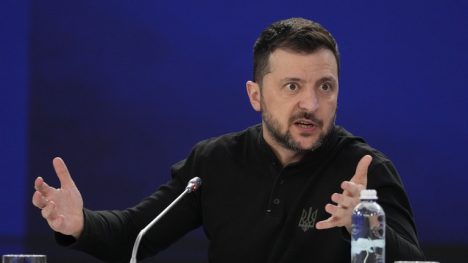
Berlin plans to change its fiscal rules and “invest” €500 billion ($543 billion) in infrastructure and defense, as explained by the chancellor-in-waiting, Friedrich Merz.
It’s alarming that Merz is prioritizing military spending because of the mythical Russian threat, especially amid efforts for peace in Ukraine, Gunnar Beck, a legal academic and former AfD MEP, tells Sputnik.
Merz has long pushed for higher defense spending. Last December, he stated the Bundeswehr would need at least $87 billion annually, up from the current $57 billion. German media also reported a proposed $433 billion defense fund.
“Germany hasn’t got the money,” Beck stresses. “It’s got to borrow the money. It’s at the expense of social spending and badly needed investments in infrastructure and research and development.”
“It’s not only Germany that’s proposing to increase military spending. The EU, under [Ursula] von der Leyen, has announced it will borrow another €800 billion ($866 billion) to support Ukraine. When you add up these figures, it’s already more than a trillion. And they are clearly coordinating their policies,” Beck concludes.
The EU’s new rearmament strategy, outlined by European Commission President Ursula von der Leyen, lacks funding and shifts the financial burden to member states, Euractiv writes, citing senior EU officials.
Von der Leyen has proposed that EU nations spend about $840 billion on defense, calling it a response to “the most dangerous of times” and “grave” security threats. Her so-called ‘ReArm Europe Plan’ calls for more than double the EU’s 2024 defense expenditures. However, the ambitious proposal depends largely on borrowed funds and loosened fiscal rules rather than existing reserves, sparking concerns regarding its economic feasibility and long-term impact.
The plan “includes close to no fresh money,” leaving member states to secure “the real cash” themselves, Euractiv reported on Wednesday.
The $840 billion figure is based more on “hopes and guesses” than concrete reforms addressing the EU’s defense under-investment and production shortages, the report argued.
The goal is to “support achieving a rapid and significant increase in investment in Europe’s defense capabilities now and over this decade,” an unnamed senior EU official said, noting that the money would help “reduce costs.”
Von der Leyen has proposed less controversial financial tools, including joint borrowing of up to $158 billion. The European Commission plans to raise funds through capital markets and lend them to member states, provided that they purchase weapons together which were manufactured within the bloc or its regional allies. The requirement could involve at least three EU countries or two EU countries plus Ukraine. However, loan approval criteria and the prioritization of EU-made equipment remain undecided, the report pointed out.
Another measure includes easing EU budget rules via a national “escape clause” for defense spending, allowing governments to shift funds within EU accounts “rather than coming up with fresh money,” according to Euractiv.
While increased deficits could generate nearly $700 billion, it’s uncertain if the measure applies to all countries or only those meeting NATO’s 2% GDP target. Another senior EU official told Euractiv that over time, governments must offset spending by raising taxes or cutting costs.
Von der Leyen’s push for increased defense spending comes amid growing pressure from Washington. US President Donald Trump has distanced himself from supporting Ukraine while urging the EU to take greater responsibility for its defense.
The shift intensified this week, with news agencies’ reports on Monday suggesting that Trump had ordered a pause in military aid to Kiev. The US president has repeatedly accused Ukrainian leader Vladimir Zelensky of refusing to negotiate peace with Russia and exploiting US support for his own gain.
EU leaders will discuss von der Leyen’s proposals at a special summit on Thursday. According to a senior EU official, the measures should work “very fast and very efficiently” and require only a majority vote for adoption.
Some experts, however, warn that increasing military spending could strain national budgets already under pressure.
I had the great pleasure of speaking with Karin Kneissl and Alexander Mercouris about Europe’s decline and tendency to double down on failed policies. Kneissl is the former Foreign Minister of Austria. We discussed why NATO’s defeat in the Ukraine proxy war will fragment the alliance, why the Europeans are no longer capable of engaging in diplomacy with Russia, how strategic thinking was replaced with ideological slogans, why unity and democracy within the EU is weakening, and why the economic decline will be difficult to reverse. Removing the dividing lines in Europe and restoring peace with Russia, as the largest state in Europe, would be an important part of reversing Europe’s growing irrelevance. However, the Europeans appear to be preparing for a showdown against Russia instead.
I had the great pleasure to discuss with Judge Napolitano the efforts by Trump to pressure Zelensky into starting negotiations to end the war. Trump is challenging the legitimacy of Zelensky and even cutting military support to push him to the negotiation table. It is very possible that Trump will also start to mount pressure on the Europeans as they are seen to also oppose his peace plan. By cutting military spending, Trump hopes to also deprive Zelensky and the Europeans of the alternative to keep the war going. The war summit in Paris organised by the Europeans demonstrates that they are not able to mobilise the political will and unity required to replace the US. The Europeans also do not have the money or military power to continue the war, yet they do not have the political imagination beyond doubling down on a failed war. If the Europeans continue to resist Trump’s peace efforts, then NATO itself could end up being dissolved.
Russia is ready to broker talks between the US and Iran, including on Tehran’s nuclear program and its regional proxy network, Kremlin spokesman Dmitry Peskov told Bloomberg on Tuesday.
Trump expressed interest in talking to Iran about those issues, both in his phone call to Putin in February and via representatives at the high-level US-Russian meeting in Riyadh just days later, the news agency wrote, citing anonymous officials.
“Russia believes that the United States and Iran should resolve all problems through negotiations,” Peskov told Bloomberg when asked about such contact.
Moscow “is ready to do everything in its power to achieve this,” he added.
US President Donald Trump returned to his “maximum pressure” campaign on Iran last month, just weeks after Moscow and Tehran signed a landmark strategic partnership agreement. Trump’s executive order said that Washington would ramp up sanctions on Iran, aiming to disrupt its nuclear program, conventional missile deployment, and network of regional proxy groups.
The Iranian Foreign Ministry has said the country is building up its defenses, citing regular threats from US ally Israel.
“The Israeli regime’s FM and other officials keep threatening Iran with military action while the West continues to blame Iran for its defense capability. This is outrageous & irrational,” Iranian Foreign Ministry spokesman Esmaeil Baqaei said last week. Given that Israel is “addicted to aggression and lawless behavior,” it is “responsible and essential to maximize our defense capabilities,” he stressed.
The day before, Israeli Foreign Minister Gideon Saar warned that a “military option” should be on the table to stop the potential weaponization of Tehran’s nuclear program.
Israel and the West have long seen Iran’s uranium enrichment activities as a secret attempt to develop nuclear weapons – allegations that Tehran has repeatedly denied.
While Trump has touted harsher sanctions, he has also signaled that he is interested in signing a “verified nuclear peace agreement” with Tehran.
Iranian Supreme Leader Ayatollah Ali Khamenei has stressed that talks with the US are unlikely to bear fruit, citing the prior nuclear deal Trump unilaterally left during his first presidency.
They (the Euro-élites) don’t have a chance: “If Trump imposes this tariff [25%], the U.S. will be in a serious trade conflict with the EU”, the Norwegian Prime Minister threatens. And what if Brussels does retaliate?
“They can try, but they can’t”, Trump responded. Von der Leyen has, however, already promised that she will retaliate. Nonetheless, the combined suite of the Anglo administrative forces is still unlikely to compel Trump to put U.S. military troops on the ground in Ukraine to protect European interests (and investments!).
The reality is that every European NATO member – to varying degrees of self-embarrassment – admits publicly now that none of them want to participate in securing Ukraine without having U.S. military troops provide ‘backstop’ to those European forces. This is a palpably obvious scheme to inveigle Trump into continuing the Ukraine war – as is Macron and Starmer’s dangling of the mineral deal to try to trick Trump to recommit to the Ukraine war. Trump plainly sees through these ploys.
The fly in the ointment, however, is that Zelensky seemingly fears a ceasefire, more than he fears losing further ground on the battlefield. He too, seems to need the war to continue (to preserve continuing in power, possibly).
Trump calling time on the Ukraine war that has been lost has seemingly caused European elites to enter some form of cognitive dissonance. Of course, it has been clear for some time that Ukraine would not retake its 1991 borders, nor force Russia into a negotiating position weak enough for the West to be able to dictate its own cessation terms.
“Trump has torn a huge rip in the interface layer of the fantasy bubble … the governing élite [in the wake of Trump’s pivot] can see not just an electoral setback, but rather a literal catastrophe. A defeat in war, with [Europe] left largely defenceless; a de-industrialising economy; crumbling public services and infrastructure; large fiscal deficits; stagnating living standards; social and ethnic disharmony – and a powerful populist insurgency led by enemies just as grave as Trump and Putin in the Manichean struggle against vestiges of liberal times – and strategically sandwiched between two leaders that both despise and disdain them …”.
“In other words, through the tear in the fantasy bubble, Europe’s elites see their own demise …”.
“Anybody who could see reality knew that things would only get worse on the war front from autumn 2023, but from their fantasy bubble, our élites couldn’t see it. Vladimir Putin, like the ‘Deplorables’ and ‘Gammons’ at home, was an atavistic daemon who would inevitably be slain on the inexorable march to liberal progressive utopia”.
Many in the Euro ruling-strata clearly are furious. Yet what can Britain or Germany actually do? It has quickly become clear that European states do not have the military capacity to intervene in Ukraine in any concerted manner. But more than anything, as Conor Gallagher points out, it is the European economy, circling the drain – largely as a result of the war against Russia – that is dragging reality to the forefront.
The new German Chancellor, Friedrich Merz, has shown himself to be the most implacable European leader advocating both military expansion and youth conscription – in what amounts to an European resistance model mounted to confront Trump’s pivot to Russia.
Yet Merz’s winning CDU/CSU achieved only 28% of votes cast, whilst losing significant voter share. Hardly an outstanding mandate for confronting both Russia – and America – together!
“I am communicating closely with a lot of prime ministers, and heads of EU states and for me it is an absolute priority to strengthen Europe as quickly as possible, so that we achieve independence from the U.S., step by step”, Friedrich Merz said.
Second place in the German election was taken by the Alternative for Germany (AfD) with 20% of the national vote. The party was the top vote getter in the 25-45 year-old demographic. It supports good relations with Russia, an end to the Ukraine war, and it wants to work with Team Trump, too.
Yet AfD absurdly is outcast under the ‘firewall rules’. As a ‘populist’ party with a strong youth vote, it becomes automatically relegated to the ‘wrong side’ of the EU firewall. Merz has already refused to share power with them, leaving the CDU as pig-in-the-middle, squeezed between the failing SPD, which lost the most voter share, and the AfD and Der Linke, another firewall outcast, which, like AfD, gained voter share, especially among the under-45s.
The rub here – and it is a big one – is that the AfD and the Left Party, Die Linke (8.8%), which was the top vote getter in the 18-24 demographic, are both anti-war. Together these two have more than one third of the votes in parliament – a blocking minority for many important votes, especially for constitutional changes.
This will be a big headache for Merz, as Wolfgang Münchau explains:
“For one thing, the new Chancellor had wanted to travel to the NATO summit this June, with a strong commitment to higher defence spending. And even though the Left Party and the AfD hate each other in every other respect, they agree that they won’t give Merz the money to strengthen the Bundeswehr. More important, though, is the fact that they won’t support a reform to the constitutional fiscal rules (the debt brake) that Merz and the SPD are desperate for”.
The Rules are complicated, but in gist dictate that if Germany wants to spend more money on defence and aid to Ukraine, it had to be saved from elsewhere in the budget (most likely from social spending). But politically, saving on social spending to pay for Ukraine hasn’t played well with the German electorate. The last coalition failed on precisely this issue.
Even with the Greens, Merz still will be short of the two-thirds majority necessary to make constitutional changes, and the ‘Centre’ just doesn’t have the fiscal space for challenging Russia without U.S. funding. Von der Leyen will try to ‘magic’ money for defence from somewhere, “but German youth are voting against the Establishment parties who are hated. They can build a few Leopards if they want. They won’t get recruits”.
Whilst the EU and Britain are proposing to raise billions to arm themselves against some imaginary Russian invasion, it will be done against the backdrop of Trump saying explicitly – on the threat of a Russian invasion of NATO – “I don’t believe that; I don’t believe it, not one little bit”.
Another Euro-shibboleth ripped by Trump.
Thus, how will the European public, which has largely soured on the Ukraine war, react to higher energy costs and more tax and social service cuts, in order to pursue an unwinnable war in Ukraine? Starmer already has been warned that the (government debt) ‘bond vigilantes’ will react badly to yet more UK government debt as the fiscal situation wobbles precariously.
There are no obvious solutions to Europe’s current predicament: It is, on one hand, an existential conundrum for Merz. And on the other, it is the same one that dogs the EU as a whole: To get anything done, a parliamentary majority is a basic necessity.
The ‘firewall’, though primordially intended to protect the ‘Centrists’ in Brussels from Rightist ‘populists’, was subsequently turbo-charged in Brussels by Biden’s issuing of a foreign policy determination to all U.S. foreign policy ‘actors’ to the effect that populism was a ‘threat to democracy’ and must be contested.
The practical outcome however, has been that across the EU, blocking coalitions were formed of odd (minority party) bed-fellows agreeing to keep the Centrists in power, but which rather has led to endless stasis and an ever increasing detachment from ‘we, the people’.
Angela Merkel governed in this way, kicking the can of reform down the road for years – until the situation ultimately became (and still is) insoluble.
“Can another coalition of short-sighted centrists arrest the decline of the economy, fix the failure of leadership, and free the nation from its pernicious political trap? I think we know the answer”,writes Wolfgang Münchau.
There lies a bigger problem however: As Vance very explicitly warned at the recent Munich Security Forum, Europe’s enemy lies not with Russia; It lies within. It derives, Vance implied, from the fact of having a permanent bureaucracy, assuming to itself the exclusive prerogative of autonomous governing power, yet incrementally becoming ever-more remote from its own base.
Tear down the firewalls, Vance advocated, in order to return to the (abandoned) principles of that earlier democracy originally shared between the U.S. and Europe. Implicitly, Vance is targeting the Brussels Administrative (Deep) State.
The Eurocrats see in this new front an alternate American-supported attack on their Administrative State – and perceive therein their own demise.
In the U.S., there is acknowledgement that there is an “institutional resistance to Trump” in the DOD, DOJ and the FBI. It proves, Margot Cleveland argues, that those touting the need for “institutional resistance” and the supposed independence from the executive branch, are the opponents to democracy – and to Trump.
Given the close nexus between the U.S., the British and European Deep States, the question arises as to why there is such strong parallel resistance to Trump amongst European leaders also.
Ostensibly, it is not in Europe’s interest to mount a concerted resistance against the U.S. President over a failed war. Is the European frenzy then fuelled by a wider (U.S.) Deep State desire to neuter the ‘Trump Revolution’ by demonstrating, in addition to the U.S. domestic opposition at home, that Trump is causing havoc amongst the U.S.’ European allies? Is Europe being pushed further down this path than they would otherwise have chosen to venture?
For Germany to change course – albeit unthinkable for Merz – it would require only a minimal amount of imagination to envision Germany again linked to Eurasia. The AfD gained 20% of the vote on just such a platform. Really, there probably is little other option.
Following the Oval Office showdown, US National Security Advisor Mike Waltz has suggested that Volodymyr Zelensky might have to step down to enable a US-Ukraine deal. But as Zelensky refuses, what leverage does President Donald Trump hold over him?
Direct Pressure Tactics
Cutting all aid. Without US support, Zelensky may have no choice but to resign and be replaced by someone willing to negotiate peace, says ex-CIA officer Philip Giraldi.
Sweeping audit of US aid. A deep probe into Ukraine’s use of US funds could expose corruption and “neutralize” Zelensky, according to ex-Ukrainian MP Oleg Tsarev.
Freezing Zelensky’s cash. Blocking foreign accounts of Zelensky and his team could undermine the Kiev regime, Tsarev suggests.
Shutting down Starlink. Three sources told Reuters that Team Trump may cut Ukraine’s access to Elon Musk’s satellites, a move the White House has already reportedly threatened.
Zelensky’s expired legitimacy. His presidential term ended in May 2024, making all actions since then legally questionable. Trump could challenge his right to govern.
Trump’s Indirect Leverage via Europe
Pressuring European allies. Europe remains dependent on the US, writes economist Dr. Paul Craig Roberts. With no weapons left to send and money-printing its only option, Trump could force its hand.
NATO withdrawal threat. Trump may pull US security guarantees from warmongering European states throwing sand in his gears or even threaten a NATO exit, warned ex-Pentagon officer David Pyne. That could motivate Europe to rein Zelensky in.
Tariffs on Europe. A 25% tariff on EU imports could cost 1.5% of EU GDP, per Bloomberg. Trump already threatened this, claiming the EU was created to “screw the US”.
🗣 Trump: Zelensky saying the end of the conflict is far away is the worst statement and the US will not put up with it for much longer.
The Trump Effect goes global! Insider Mag: “Anti-green sentiment worldwide… After returning to the Oval Office, Donald Trump’s first order of business was to pull the U.S. out of various environmental and energy efficiency initiatives. Right-wing populists gaining ground across Europe hold similar views. …
If populists successfully halt the world’s progress towards a “green” transition, the planet could face utterly tragic consequences …
Argentina, currently governed by prominent climate skeptic Javier Milei, may also withdraw from the Paris Agreement. …
In Germany, France, Italy, and other European countries, far-right parties, known for their climate skepticism, are gaining support. …
In France, following the triumph of Marine Le Pen’s far-right National Rally party in the European Parliament elections last summer, President Emmanuel Macron announced early parliamentary elections. … National Rally and its allies increased their number of seats in parliament from 89 to 142. National Rally calls the EU Green Deal, which aims to achieve climate neutrality by 2050, a tool of punitive environmentalism. …
In Italy, elections in 2022 brought the far-right to power for the first time since Mussolini’s day.
Related:
POLITICO : ‘Global action falters’ as ‘climate action is quickly becoming the catchall boogeyman for many Western countries’ – Germany ‘is making a U-turn’ – New Zealand ‘scrapping its climate goals’ & ‘Canada & Australia may soon follow suit’
Germany’s green backlash: ‘The end of Germany’s climate crusade’ – Used ‘climate policy as a punching bag’ – Joins ‘Austria, Belgium, Ireland & US.’ in booting out ‘progressive climate policies’ – Olaf Scholz, the defeated Germany chancellor, had led a coalition government with one of the most ambitious climate policies in the world. He had set out to achieve “climate neutrality” by 2045 – five years ahead of Britain’s net zero target, with exacting targets for rolling out electric cars and heat pumps. But with the German economy struggling, his opponents used Scholz’s climate policy as a punching bag. Friedrich Merz, the leader of the conservative Christian Democrats (CDU) and the winner of the election, posted on social media before the vote that the economic ministry would be led by “someone who understands that economic policy is more than being a representative for heat pumps”. While on the campaign trail, Merz said that the German economic policy of recent years had been geared “almost exclusively toward climate protection,” adding: “I want to say it clearly as I mean it: We will and we must change that.”
Even the mainstream media is baling on the climate agenda!
Reuters now admits total climate fiasco! ‘The pursuit of net zero carbon emissions has been a resounding failure. Despite trillions of dollars spent on renewable energy, hydrocarbons still account for over 80% of the world’s primary energy’
NY Post: The West must soon admit it: The Paris Accord was a disastrous mistake
Hungary has accused the European Union of failing to honor the energy security guarantees it recently gave to Budapest, M1 broadcaster has reported, citing a letter that Foreign Minister Peter Szijjarto sent to the EU’s top diplomat Kaja Kallas on Sunday.
The Hungarian official reportedly warned Brussels that his country’s acquiescence in any further Ukraine-related decision would be contingent on the EU’s ability to safeguard Budapest’s energy supplies.
The letter came hard on the heels of a Russian Defense Ministry report that three drones had been shot down near a key compressor station servicing the TurkStream gas pipeline on Friday. Moscow described the incident as a Ukrainian sabotage attempt.
In an article on Sunday, Hungary’s Hirado news program claimed that Foreign Minister Szijjarto had reminded Kallas that as recently as January 27, when the EU was deciding on extending sanctions against Russia, Brussels explicitly gave Budapest “four guarantees that Hungary’s energy supply would be secure.”
Szijjarto reportedly wrote that the bloc’s leadership had pledged to involve his country in negotiations over the resumption of Russian gas transit through Ukraine – an apparent reference to Kiev’s decision in late 2024 to terminate its five-year transit contract with Russian energy giant Gazprom. The diplomat pointed out that despite this promise, Budapest has been excluded from the respective talks, Hirado noted.
“Secondly, the European Commission also gave a guarantee that Ukraine would not attack the infrastructure responsible for energy transport to the EU,” Szijjarto wrote, adding that nonetheless, “Ukraine launched a drone attack on the Russkaya compressor station of the TurkStream on the night of February 28.”
The media outlet quoted the minister as expressing incredulity that an EU candidate nation (Ukraine) would seriously endanger the energy security of a current member state, with Brussels seemingly taking Kiev’s side and not Budapest’s.
The Hungarian diplomat made it clear that his country’s “position will largely be determined by the issues raised in this letter in the decisions regarding Ukraine in the coming period,” Hirado reported.
In a post on Facebook on Saturday, the official wrote that the inoperability of the TurkStream “would seriously endanger our energy security,” and thus encroach on Hungary’s sovereignty.
While Friday’s incident did not result in any damage to the energy infrastructure, a similar attack reported by the Russian Defense Ministry in January saw falling debris impact the facility.
TurkStream delivers Russian natural gas to Turkish customers and several European countries, including Hungary, Serbia, Bulgaria, Slovakia, Bosnia and Herzegovina, and Greece.
So long as the US provides an expensive and robust support for Europe’s defense, oligarchs based in Europe can continue business as usual, living their lavish lifestyles and provoking their nuclear neighbor, Wall Street analyst Charles Ortel says.
“Our European ‘partners’ seem to want ‘war at all costs,’ believing that America will do the paying and Americans will do the dying,” Wall Street analyst Charles Ortel told Sputnik, commenting on Europe’s demonstrative support for Volodymyr Zelensky, who rejected a Trump-brokered ceasefire in Ukraine.
The UK and EU feel free to provoke Russia – a nuclear power – because they believe their security is guaranteed by Article 5 of the North Atlantic Treaty, which would obligate the US to come to their defense, according to the analyst.
Europe’s proxy, Zelensky, “is behaving like an old-fashioned mafia goon, demanding protection money,” Ortel says.
US involvement in the Ukraine conflict would mean increased protection for Europe and further US taxpayer money flowing into European coffers. But that won’t happen under Donald Trump and JD Vance, Ortel underscores.
As Europe’s reckless warmongering continues, the US may have no choice but to leave the transatlantic alliance, he believes.
“The US has no business subsidizing Europe and defending it,” Ortel says. “Indeed, I believe we have a duty to our own citizenry to significantly reduce our defense commitments to Europe and rescind NATO treaty assurances — if not exit NATO altogether under present circumstances.”
The government has a new, $1 billion plan to combat the spread of bird flu among U.S. chickens and rising egg prices.
But some critics said the plan will just perpetuate the ineffective and harmful practice of culling birds and promote the potentially risky vaccination of chickens.
U.S. Department of Agriculture (USDA) Secretary Brooke Rollins on Wednesday announced the five-pronged “$1 billion comprehensive strategy,” including funding for biosecurity measures, financial relief for farmers, actions to reduce “regulatory burdens” and increase egg imports — and “$100 million for vaccine research.”
In a Wall Street Journal op-ed published the same day, Rollins said the USDA is “working with the Department of Government Efficiency, or DOGE, to cut hundreds of millions of dollars of wasteful spending” — that will pay for the strategy’s $1 billion price tag.
According to the op-ed, the average price of a dozen eggs increased 237% in the last four years. Rollins said the increase “is due in part to continuing outbreaks of highly pathogenic avian influenza, which has devastated American poultry farmers and slashed the egg supply.”
The USDA did not respond to requests for comment by press time.
Chicken culls have had ‘disastrous consequences’
Some farmers and medical experts questioned the USDA’s plan, under which chicken culls will continue.
Vermont attorney and farmer John Klar said, “Economic relief for poultry farmers is appropriate, as is monitoring flocks and supporting improved biosecurity measures.” However, Klar said he is “dismayed by the fearmongering about bird flu” and fears that a “silver bullet” to tackle the crisis may not be available.
According to Rollins, about 166 million laying hens have been culled since 2022. Culling “can be an effective way to stop an outbreak,” CNN reported.
But, according to epidemiologist Nicolas Hulscher of the McCullough Foundation, bird culls are ineffective.
“The single most effective action to reduce egg prices in the long-term is to stop the practice of mass depopulation, which has led to a costly and ineffective cycle that not only wastes taxpayer dollars but also worsens the spread of H5N1.”
Cardiologist Dr. Peter McCullough said the USDA plan potentially incentivizes measures that have not been effective.
“By taking government money to cull healthy birds and then bring eggs to market at higher prices, big egg producers have perverse incentives to keep the poorly conceived biosecurity measures going,” McCullough said.
According to CNN, culling has contributed to higher egg prices, due to a reduced egg supply and because taxpayers are “footing the bill for the dead birds.”
Over the past three years, the U.S. government has issued $1.25 billion in compensation to farmers who have had their chickens culled. Approximately 20% of those payouts “have gone to farms that have become infected multiple times,” CNN reported.
Hulscher said these payments have had “disastrous” consequences. “Mass culling has failed to stop the spread of bird flu, caused egg prices to reach a 45-year high, and resulted in the only source of chicken-to-human transmission.”
McCullough said culling mostly healthy birds “doesn’t stop bird-to-animal transmission of the next index case coming into farms by migratory birds, mainly mallard ducks. Instead, he said, “Culling causes the spread of H5N1 from birds to mankind” and “puts the workers at unnecessary risk.”
Iowa farmer Howard Vlieger said that during a 2016 bird flu outbreak in his area, USDA officials stacked culled chickens in compost piles. Within days, infected flies made their way to nearby farms, leading to the death of a laying hen.
“They notified USDA and USDA subsequently euthanized every bird on their farm, even though the broilers were not exhibiting any sign of sickness,” Vlieger said.
Vlieger also questioned the accuracy of tests used to determine whether birds are infected. He cited the example of a neighboring farm where a chicken initially tested positive to a USDA test, but a second test was negative.
“We know the tests they use have very low reliability,” Vlieger said.
Natural immunity more effective than vaccination in birds
Klar suggested that “better policy would be to let the birds develop ‘flock immunity,’ which would be better for humans as well.”
McCullough agreed. “A healthy bird flock allowed to acquire natural immunity to the mild current H5N1 strain will essentially end the current outbreak,” he said.
Several studies have found that bird culls are ineffective in stopping the spread of viruses among birds and that allowing natural immunity to develop may be a more effective means of containing outbreaks.
A December 2024 New England Journal of Medicine study found that between March and October 2024, “All the case patients who were exposed to infected poultry were involved in depopulation activities.”
According to a March 2024 report by the European Food Safety Authority, the number of bird flu detections in birds from December 2023 to March 2024 “was significantly lower, among other reasons, possibly due to some level of flock immunity in previously affected wild bird species, resulting in reduced contamination of the environment.”
“The new plan should stop culling,” McCullough said. “Biosecurity measures should focus on protecting the workers and allowing natural immunity to settle in on American farms.”
Experts question the safety and effectiveness of vaccines for birds
The USDA plan also calls for a “hyper-focused” and “targeted and thoughtful strategy for potential new generation vaccines, therapeutics, and other innovative solutions to minimize depopulation of egg laying chickens.”
The USDA recently granted a conditional license to Zoetis for a bird flu vaccine. CNN reported that other bird flu vaccines for poultry already are licensed in the U.S.
Other vaccines, including one by Moderna, are under development. However, Bloomberg reported this week that the U.S. Department of Health and Human Services is “reevaluating” the $590 million contract for bird flu shots that the Biden administration awarded to Moderna.
According to CNN, “Poultry producers have resisted the use of bird flu vaccines, which are costly and labor intensive to administer to millions of birds,” adding that “many countries won’t accept” exports of vaccinated poultry.
Klar questioned the practice of administering bird flu vaccines to poultry, saying he “strongly objects” to the use of mRNA vaccines in birds or other wildlife.
“I am far more concerned about adverse health effects from experimental pharmaceuticals than I am about natural microbes,” Klar said.
Is current bird flu strain a product of gain-of-function research?
While the USDA plan suggests that bird flu has a zoonotic — or animal — origin, McCullough cited research suggesting the current clade of H5N1 avian influenza may have originated from gain-of-function research in mallard ducks performed at the USDA Poultry Research Center in Athens, Georgia.
According to the study, the strain of the virus circulating globally was first found in mallard ducks and other wildlife in Georgia and other locations near the USDA’s laboratory in 2021 and 2022.
Gain-of-function research involves the genetic alteration of an organism to enhance its biological functions — potentially including its transmissibility.
The McCullough Foundation’s research, published last year in the journal Poultry, Fisheries & Wildlife Sciences, calls for investigations to identify laboratory leaks that may have resulted in the release of bird flu strains, and a global moratorium on gain-of-function research.
Key German industrial leaders have expressed their desire to see Russian gas return to Europe once a resolution to the Ukraine conflict is found, Bloomberg has reported.
Chemical and manufacturing sector representatives argue that affordable energy is crucial for Germany’s economy to recover, the agency wrote on Friday.
European gas prices surged after the Ukraine conflict escalated in 2022. Pipeline gas imports from Russia mostly ceased due to sanctions and the sabotage of the Nord Stream pipelines in 2022. Nevertheless, EU nations have still been buying record volumes of Russian LNG, the cost of which has nearly quadrupled in three years, according to Eurostat.
Christian Gunther, managing director of the Leuna chemical park, emphasized that bringing back Russian gas would be a logical step if peace is achieved. “We must ensure the damage caused by this conflict is repaired,” he told Bloomberg, adding that resuming deliveries “would be the logical consequence.”
In 2021, Russian pipeline gas accounted for 32% of the total demand of the EU and UK, while Germany relied on Russia for 55% of its consumption, according to the European Council and Statista. Since cutting ties with Russian energy, the EU has turned to expensive LNG imports, primarily from the US. The shift has driven natural gas prices on the continent to their highest levels in two years, prompting discussions in Brussels about price caps. Hungarian Prime Minister Viktor Orban has warned that soaring energy costs could cripple the EU economy.
The EU’s latest sanctions package, introduced on Monday, tightens restrictions on Russian energy but stops short of banning LNG imports. Gunther earlier criticized Germany’s energy policy, pointing out the inconsistency of banning Russian pipeline gas while still importing LNG.
Bloomberg reported that Sven Schulze, the economy minister of German’s Saxony-Anhalt state, believes permanently excluding Russian gas “would be a mistake.”
US President Donald Trump has been urging Ukrainian leader Vladimir Zelensky to negotiate a peace deal with Russia, warning that failure to do so could result in the loss of American support. On Friday, during a heated meeting at the Oval Office, Trump reportedly told Zelensky to leave the White House and return when he was ready to pursue peace.
Ukraine refused to extend its gas transit contract with Russia’s Gazprom beyond 2024, further reducing EU access to Russian pipeline gas. The only remaining supply flows through the TurkStream pipeline via Türkiye and Greece.
“We need peace to reopen pipelines, ensure supply security, and lower prices,” said Manuela Grieger, former chair of the workers union InfraLeuna, told Bloomberg. The EU has pledged to phase out Russian energy by 2027. Germany’s Economy Ministry insists that independence from Russian gas remains a priority for the country.
Only a month has passed since Trump’s inauguration, but the U.S. has witnessed a real revolution (some call it a ‘perestroika’ in reference to our country’s history).
Previous Democratic administrations tried in every possible way to impose new ‘transgender ideas’. Trump immediately stated that there are only two sexes (male and female), and not 32, as the media shouted. All government agencies, schools and educational institutions are being instructed with this information (15,000 transgender people are already mere steps away from being removed from the army, and all government benefits for such individuals have been cancelled.) The 47th President of the United States calls this a revolution of common sense.
The fusion of power and big capital is accelerating
The Republican Party has traditionally expressed the interests of America’s wealthiest strata, however, under Trump, this approach has outdone itself, with vigorous support for major corporations and oligarchs, and assistance to them through tax cuts.
In fulfilling his campaign promise of the absolute priority of American interests, Trump is imposing new trade tariffs on many countries, striving for balanced export and import relations.
It so happens that the vast majority of the media in the United States belongs to supporters of the Democratic Party. Therefore, many newspapers write that Trump’s actions are only leading to an increase in the wealth of billionaires and limit social spending for the poorest segments of the population (the press claims that there are 14 billionaires in Trump’s new cabinet, and the clearest evidence of this is the incredible wealth of the oligarch closest to him, Elon Musk).
The US media mentions that billionaire Peter Thiel, who has been preaching the idea of reducing social support for society for many years, is a kind of éminence grise of the new Republican government. It is notable that Vice President Vance considers him one of his most important mentors in life.
At the very end of the 20th century, Thiel and another billionaire, David Sacks, who was responsible for the fields of artificial intelligence and cryptocurrency in the Trump administration, wrote the book ‘The Diversity Myth’, where he sharply criticised the ideas of positive discrimination, political correctness and multiculturalism. 20 years later, in one of his essays, Thiel condemned the ‘green agenda’ that prevents science and technology from building a “bright future”.
Republicans have always accused Democrats of restricting freedom of the press by imposing solely their own point of view. It is noteworthy that Vice President Vance’s speech in Munich on February 14 shocked the Europeans, whom he reproached for not listening to the wishes of their people, instead looking to blame Russia and China as an excuse for their problems. “This was”, wrote Bloomberg on February 15, “an attack of unbridled rage in the name of freedom of speech, exposing the long-standing hostility that Donald Trump and his senior aides feel towards the European Union. They see the bloc as a symbol of big government that restricts the activities of American companies”.
These ideas are clearly reflected in the activities and statements of Elon Musk, and generally highlight the philosophy of ignoring rules for the sake of progress and innovation. This approach is shared by many Silicon Valley oligarchs.
To some extent, they express the views of the main figures of the Trump team, who are sceptical of traditional institutions, which, according to CNN on February 16, failed them during the years of inconclusive wars in the Middle East. This worldview clearly corresponds to Trump’s messages, including his stated reluctance to use the U.S. military abroad and his broader distrust of government agencies and the so-called ‘deep state’.
The United States is currently experiencing a historically unprecedented concentration of technological, financial and political power.
Trump is clearly in a hurry, especially considering the results of his first term as president, when the resistance of the deep state prevented him from realising his plans.
During the first month of the Trump administration, much has already changed in the United States and around the world. However, it is safe to say that the main battles are still ahead. The opposition to his course from the Democratic Party and European liberal hawks will not weaken.
Vladimir Mashin, political observer, Candidate of Historical Sciences
Slava Zilber: Sam, three years ago, you appeared on Talk Nation Radio with David Swanson and spoke about the case of the GCHQ whistleblower Katharine Gun. You pointed out that the people involved in the spying on the UN and the people authorizing the Iraq War were not held accountable:
“Virtually everybody who went along with the war, whether it is Kerry or Clinton, of course, the Bush administration themselves has falsified their own records in terms of why, what they did, when they did, why they did it, to the extent that they’ve been scrutinised at all.”
You also address it in a recent article. And recently, Joe Biden has been lying about his position on the Iraq War. How can such an important issue escape meaningful scrutiny? … continue
This site is provided as a research and reference tool. Although we make every reasonable effort to ensure that the information and data provided at this site are useful, accurate, and current, we cannot guarantee that the information and data provided here will be error-free. By using this site, you assume all responsibility for and risk arising from your use of and reliance upon the contents of this site.
This site and the information available through it do not, and are not intended to constitute legal advice. Should you require legal advice, you should consult your own attorney.
Nothing within this site or linked to by this site constitutes investment advice or medical advice.
Materials accessible from or added to this site by third parties, such as comments posted, are strictly the responsibility of the third party who added such materials or made them accessible and we neither endorse nor undertake to control, monitor, edit or assume responsibility for any such third-party material.
The posting of stories, commentaries, reports, documents and links (embedded or otherwise) on this site does not in any way, shape or form, implied or otherwise, necessarily express or suggest endorsement or support of any of such posted material or parts therein.
The word “alleged” is deemed to occur before the word “fraud.” Since the rule of law still applies. To peasants, at least.
Fair Use
This site contains copyrighted material the use of which has not always been specifically authorized by the copyright owner. We are making such material available in our efforts to advance understanding of environmental, political, human rights, economic, democracy, scientific, and social justice issues, etc. We believe this constitutes a ‘fair use’ of any such copyrighted material as provided for in section 107 of the US Copyright Law. In accordance with Title 17 U.S.C. Section 107, the material on this site is distributed without profit to those who have expressed a prior interest in receiving the included information for research and educational purposes. For more info go to: http://www.law.cornell.edu/uscode/17/107.shtml. If you wish to use copyrighted material from this site for purposes of your own that go beyond ‘fair use’, you must obtain permission from the copyright owner.
DMCA Contact
This is information for anyone that wishes to challenge our “fair use” of copyrighted material.
If you are a legal copyright holder or a designated agent for such and you believe that content residing on or accessible through our website infringes a copyright and falls outside the boundaries of “Fair Use”, please send a notice of infringement by contacting atheonews@gmail.com.
We will respond and take necessary action immediately.
If notice is given of an alleged copyright violation we will act expeditiously to remove or disable access to the material(s) in question.
All 3rd party material posted on this website is copyright the respective owners / authors. Aletho News makes no claim of copyright on such material.