Aramco CEO warns ‘catastrophe’ imminent if Strait of Hormuz remains shut
The Cradle | March 10, 2026
Saudi oil giant Aramco issued a warning on 10 March that the global energy market faces “catastrophic consequences” if the Strait of Hormuz remains closed.
“There would be catastrophic consequences for the world’s oil markets and the longer the disruption goes on … the more drastic the consequences for the global economy,” Aramco CEO Amin Nasser told reporters.
“While we have faced disruptions in the past, this one by far is the biggest crisis the region’s oil and gas industry has faced,” he added.
Nasser went on to say that the crisis has ravaged the shipping and insurance sectors, while also threatening aviation, agriculture, and other industries.
“Of course, we would support any actions or measures that would help to deliver our products to our customers, to the global market,” he said when asked about the US Navy potentially escorting oil tankers through the strait.
Yet a top energy official in the Gulf told Reuters that ending the war was the only way to open the strait, through which around 20 to 30 percent of the world’s energy passed before the attack on Iran.
Qatar warned on Tuesday that attacks on regional energy infrastructure could trigger economic repercussions far beyond the Gulf.
Doha said strikes on oil and gas facilities have set a dangerous precedent.
Tehran has vowed not to allow “one liter of oil” to be shipped from the region if Washington and Tel Aviv’s war continues.
“The Strait of Hormuz will either be an outlet for understanding and cooperation, or it will turn into a strait of strangulation for those who dream of wars,” Ali Larijani, head of Iran’s Supreme National Security Council, said.
Since the start of the war, Iran has targeted tankers refusing its warnings not to approach the strait.
US military bases housing key radars, as well as vital energy infrastructure across the Gulf, have also been struck by Iranian forces.
In response to an Israeli attack on an oil facility in Iran, the Islamic Revolutionary Guard Corps (IRGC) said on 10 March that it targeted Israeli energy facilities in Haifa.
Global oil prices currently hover around $90 per barrel, down from $120 on Monday, following Trump’s statement that he aims for a swift resolution to the war.
However, prices are expected to surge again. Trump’s comments on the war have been contradictory. “We could go further, and we’re going to go further,” he said on Monday, before telling US media hours later that “I think the war is very complete, pretty much.”
The US military has burned through more than $10 billion of its annual budget since the start of the war in late February.
Trump’s advisors have been urging the US president to find an “exit plan” to “extract” Washington from the brutal war on Iran due to concerns of political backlash, informed sources told the Wall Street Journal (WSJ) on 9 March.
Yet Iran has reportedly refused ceasefire discussions. “It is we who will determine the end of the war,” the IRGC said this week.
Trump press conference reveals a man who wants out of war
By Trita Parsi | Responsible Statecraft | March 9, 2026
Trump’s “all over the place” press conference at his Miami resort on Monday appears to have had two key objectives: a) Calm the markets by signalling the conflict may soon be over because it has been so “successful,” and b) Prepare the ground for Trump ending the war through a unilateral declaration of victory.
Though ending a war that never should have been started in the first place — rather than fighting it endlessly in the pursuit of an illusory victory as the U.S. did in Afghanistan — is the right move, it won’t be as easy as Trump appears to think.
Tehran also has a vote — and there is little to suggest that it will agree that the war is over.
Tehran objects to what it would consider a premature ceasefire out of fear that it would only give the U.S. and Israel time to regroup, rearm, and then re-attack Iran. For the conflict to be ripe for a ceasefire, Tehran believes that enough cost must have been inflicted on the U.S., regional states, Israel, and on the global economy that all states conclude that starting the war was a mistake — and as a result, no state will seek to restart it.
Moreover, if the war ends now, Iran will be in a worse situation than it was before the start of the war. Much of its infrastructure has been destroyed, its missile capabilities have taken hits, its ability to export oil has been damaged, and most crucially, its prospects for sanctions relief have been obliterated. Indeed, who will and can help rebuild Iran under these circumstances?
This would leave Iran not only in a weakened position but also in a continuously weakening state. Which, in turn, would make another war of aggression by the U.S. and Israel more, not less, likely, since it is Iran’s perceived weakness that prompted Trump and Israel to see an opportunity for war.
As such, it appears likely that Iran will continue to target Israel, even if the U.S. declares victory and withdraws its military. Even GCC states may continue to be targeted. And Tehran will very likely try to keep the Straits of Hormuz shut. (At least for now, there are no signs that Tehran has lost its ability to do these things).
This will create a dilemma for Trump. It will be difficult for him to stay out while Iran and Israel continue to go at each other. But if he reenters the war, the hollowness of his declared victory will have been revealed. Markets will react negatively, and all the costs Trump is currently trying to avoid will likely intensify dramatically.
Iran, of course, does not want, nor can it afford, an endless war. But it will likely demand some significant steps in order to accept a ceasefire. This may include a commitment from Trump not to restart the war (though I don’t understand the value of such a commitment). But more importantly, it will likely require sanctions relief and release of its frozen funds abroad.
Trump will, of course, bark, but if the outcome is continued war, that will put a lot of pressure on him. Here, the role of some GCC states may prove crucial due to their willingness and ability to find an arrangement that could leave both Trump and Iran feeling that they “won.”
Whether Israel will allow that to happen, of course, is a different matter.
Trita Parsi is the co-founder and Executive Vice president of the Quincy Institute for Responsible Statecraft.
Top official: Iran ready for a long war with US, no more diplomacy
Press TV – March 9, 2026
The head of Iran’s Strategic Council on Foreign Relations says the United States has proved that it does not know the language of diplomacy, and that Tehran is ready for a long war.
“I no longer see any room for diplomacy. Because [US President] Donald Trump deceives others and does not keep his promises, and we experienced this in two rounds of negotiations. While we were negotiating, they attacked us,” Kamal Kharrazi said in an interview with CNN.
However, he noted that the economic pressure could increase to the extent that other countries take action to guarantee the end of the US-Israeli aggression against Iran.
“The Persian Gulf Arab countries and other countries must put pressure on the United States to end the war,” Kharrazi stated.
Noting that this war has created a lot of economic pressure on others, in terms of inflation and energy shortages, he said: “If it continues, this pressure will increase, and thereby others will have no choice but to intervene.”
The US and Israel started a fresh round of aerial aggression on Iran on February 28, some eight months after they carried out unprovoked attacks on the country.
The attacks led to the martyrdom of Leader of the Islamic Revolution Ayatollah Seyyed Ali Khamenei.
The aggression was launched as Tehran and Washington had held three rounds of indirect negotiations in the Omani capital of Muscat and the Swiss city of Geneva and planned to open technical talks in Vienna, Austria.
Iran began to swiftly retaliate against the strikes by launching barrages of missiles and drone attacks on the Israeli-occupied territories as well as on US bases in regional countries.
Iraqi Resistance: Attacks on Beirut suburbs threaten US interests
Al Mayadeen | March 7, 2026
The Iraqi Resistance Coordination Committee affirmed that recent years have demonstrated that the entire region is governed by one equation: “Either security for all, or security for none.”
Addressing the ongoing aggression against Lebanon, the Iraqi resistance stressed that the security and stability of the southern suburbs of Beirut and their residents form an integral part of the regional security equation. It added that any escalation there would have repercussions for the vital interests of the US in the region.
The committee warned that any attack on the security of the densely populated civilian suburb would inevitably be met with threats to the security of embassies belonging to the aggressor countries, whether in Iraq, Bahrain, Kuwait, or Lebanon.
It further stated that undermining the security of the Beirut suburbs would also directly affect the security of major American oil companies operating in the Arabian Peninsula, stressing that “a warning has been given.”
‘Israel’ issues massive displacement threat to Beirut Southern Suburb
The Israeli occupation, in an unprecedented move, issued a massive displacement threat on Thursday against entire neighborhoods in Beirut’s Southern Suburb. Previously issuing displacement warnings against specific buildings, the Israeli occupation has discarded this strategy and now threatens thousands of homes, businesses, medical facilities, schools, and civilians with bombardment.
The threats have specifically named the neighborhoods of Bourj el-Barajneh, Hadath, Haret Hreik, and Chiyah, which house tens of thousands of civilians, who were ordered to head east along the Beirut-Damascus highway, or north towards Matn or Beirut-Tripoli highways, respectively.
This resulted in severe traffic congestion at the entrances to Beirut’s southern suburbs as residents began leaving their homes.
The Israeli threat eerily resembles those in Gaza, where hundreds of thousands and up to a million civilians were forced to flee their zones amid mass displacement plots.
Iranian Crisis Becomes Embarrassment for US Military That Can’t Protect Anyone – MidEast Analyst
Sputnik – 07.03.2026
Prior to the arrival of the United States, the Persian Gulf was essentially the domain of the British Empire which ended up handing over its holdings to the US to ensure that the latter would be at the forefront of any major war in the region, Middle East affairs expert Mais Kurbanov tells Sputnik.
Currently, the US controls a network of military installations that don’t just serve as military garrisons – these are all elements of a system of control of the Gulf ‘gas station,” Kurbanov remarks.
This defensive network was never meant to protect the Arab states of the Gulf – it’s real purpose was to protect Israel.
“This entire shield was created to keep Israel safe and to intercept missiles. They were more or less able to intercept them during the previous conflicts, before Iran started targeting their radars. And now they got nothing to intercept because Iran destroys the early warning system itself,” notes Kurbanov.
The US is unwilling and unable to defend the Gulf states – it only cares about its own interests. And all of the Gulf states besides Iran are now vulnerable because they don’t have any air defense systems, he adds. The US focuses on protecting only its own assets in the region.
“The US has embarrassed itself in front of the entire world. Everybody now knows that the Americans are no protectors,” says Kurbanov. “They used to mock Russia when Ukraine scored some hits, acting as if they are invincible. Now Iran keeps pummeling them, and US ships have to flee two thousand kilometers into the ocean to escape Iranian missiles.”
“It means the US has no meaningful air defense. Neither Israel’s Iron Dome nor the US’ vaunted Patriots can do anything. Consider this: such weapon system costs a billion dollars and an Iranian Shaheed, this dirt-cheap drone worth twenty thousand, just takes it out.”
All of the weapons the US peddled across the world – stealth aircraft, MQ-9 Reaper drones they were so proud of – turned out to be useless,” he points out.
Meanwhile, Iran keeps demonstrating the kind of new missiles that maybe two other leading world powers beside them possess.
“The US should just leave. There will be no negotiations with them and they know it,” argues Kurbanov.
Though the US does possess an extensive global network of military installations – several hundred facilities in dozens of different countries – even it cannot ensure an immediate stabilization of the situation. He points out that Russia and China haven’t yet become actively involved in the current crisis, and that without their involvement the US would be hard-pressed to deal with global issues.
Europe not in position to cooperate with US and Israel against Iran
By Ahmed Adel | March 6, 2026
Although the US-Israeli attack on Iran has worsened the crisis in the Middle East, some European countries approved of the operation, such as the United Kingdom, which provided military bases to the Americans, and Germany, which rhetorically supported the offensive through its Chancellor, Friedrich Merz. However, Europe is not cooperating as actively as it was before.
Recent historical experiences, such as the wars in Iraq (2003-2011), Afghanistan (2001-2021), and the military intervention in Libya (2011), have created deep divisions among European countries regarding military actions outside their continent. Moreover, the European Union already dedicates substantial resources to Ukraine in its conflict with Russia. In this context, the economic and military crisis among EU members makes them hesitant to engage in another large-scale armed conflict.
The timing is not very favorable for the Europeans. They are facing an economic crisis mainly caused by energy prices. The EU is attempting to wean off Russian energy without harming itself, but the strategy ultimately failed, and now that there is war in the Middle East, energy prices have spiked even more.
Russian President Vladimir Putin stated on March 4 that Russia could immediately halt the supply of raw materials to European markets, and thus thwarted the EU’s plan to systematically phase out Russian gas. Putin’s words caused psychological trauma to the EU because, instead of a planned embargo on Russian gas for 2027, he suggested that Europe should prepare for an immediate cut.
The Russian president’s warning and ongoing tensions in the Middle East continue to drive up global energy costs. The price increases mirror developments in international energy markets. Oil and gas prices have risen since the war on Iran began, particularly because it has disrupted shipping through the Strait of Hormuz, one of the world’s most important transit routes for oil and natural gas.
Disruptions to shipping and decreased production by several Gulf states have tightened global supply. As a result, the price of Brent crude, the European benchmark oil, rose to around $84 per barrel on March 5, roughly 16% higher than before the conflict started, and close to its highest level since mid-2024.
Additionally, from a military perspective, Europe knows that its weaponry is not capable of conducting a high-intensity war due to a technical shortfall. At the same time, the EU wants to replace the US as Ukraine’s main benefactor, a corrupt state that drains many of the bloc’s resources.
Another reason for Europeans to remain impartial is the growth of the Muslim population in these countries, which also holds electoral influence and the power to sway domestic policy outcomes. The Muslim population in Europe is quite sizable, and European attacks in the Middle East could face internal opposition. Besides the Muslim community, most European citizens would be largely unwilling to fight for the Americans, especially in a scenario where the US might not achieve its objectives.
Europe uses rhetoric to avoid commitment. In the current context of hostilities in the Middle East, European leaders are not demonstrating a unified stance, even though some rhetorically support Washington and Tel Aviv’s initiatives. However, this behavior indicates a lack of European political cohesion.
London is not following Washington’s lead, something that has not occurred often since the Second World War. Germany is showing support, but lacks the power to act. Spain initially contradicted the White House but then quickly announced that a warship would be deployed to Cyprus in response to threats of sanctions from US President Donald Trump. In other words, Europe is divided and fragmented and therefore cannot act effectively at this moment.
Another obstacle is Iran’s warning that if Europeans join the offensive, there will be a fierce response. Because of this, Washington’s traditional Western allies are becoming mere observers in the region, even though they also have bases near the epicenter of the crisis. European bases are at risk if Europe attacks Iran, and it is a risk they are unwilling to take, besides not wanting to lose money in yet another conflict.
Furthermore, the Europeans are not even trying to mediate the conflict to avoid antagonizing Trump.
A new reconfiguration of the Middle East might happen after this conflict ends. The US could become weaker, which might impact its close ties with Gulf countries. Therefore, Europe might seize the opportunity created by its ally to expand its trade relations.
Nonetheless, Europe is not in a position to cooperate with the US and Israel and is acting opportunistically. They are observing Washington weaken politically in the Middle East, probably aiming to occupy spaces in neighboring countries after this war, because there will be new business opportunities.
In this context, Europe’s struggle to achieve political unity at the continental level is due to differing interests among its governments within the EU, as well as to managing its internal issues. Meanwhile, the bloc’s powers tend to exploit the situation to uphold their rhetoric aligned with Western values, while concealing their military weaknesses.
Ahmed Adel is a Cairo-based geopolitics and political economy researcher.
Russia could end gas supplies to EU immediately – Putin
Hungary to become new EU powerhouse while Germany degenerates in more ways than one
RT | March 4, 2026
Russia may withdraw from the European gas market and redirect its supplies elsewhere without waiting for the EU to ban its imports, President Vladimir Putin has said.
The president made the remarks on Wednesday after he hosted Hungarian Foreign Minister Peter Szijjarto at the Kremlin.
“There’s no political motive here. But if we’re going to get shut off in a month or two, we’d be better off stopping now and moving to countries that are reliable partners, and establishing ourselves there. But that’s not a decision yet, it’s just me thinking out loud, so to speak. I’ll definitely instruct the government to work on this issue with our companies,” Putin told Russian journalist Pavel Zarubin.
Moscow could redirect supplies to “emerging markets” instead, given the EU’s repeatedly stated intention to phase out Russian resources completely, Putin suggested. The energy crisis in the EU is the result of the “misguided policies” pursued by the bloc’s authorities over “many years,” he said.
Russia “has always been and remains a reliable energy supplier” for all its partners, including the European nations, the president noted. Moscow is ready to continue work in such a manner with those partners “who are themselves reliable,” he added.
“For instance, with those in Eastern Europe, Slovakia, and Hungary. We supply them with our energy resources, both oil and gas, and we intend to continue to do so in the future. And the leadership of these countries will pursue the same policy as today, namely, being reliable for us,” the president explained.
Following the meeting with Putin, Szijjarto revealed that Budapest has secured oil and gas supply guarantees from Moscow. Russia and Hungary have agreed to work on diversifying energy resource supply routes, he said.
“We agreed that if transport routes become unavailable for various reasons, we will always seek alternative solutions. For example, if pipeline oil transportation continues to face difficulties, we will consider maritime transport options,” the diplomat said in a video address posted on Facebook.
Hungary, as well as Slovakia, has recently experienced a disruption in Russian crude supplies after Ukraine shut down the Druzhba oil pipeline in late January. Kiev has claimed the artery was damaged in Russian long-range strikes, which Moscow has denied. Budapest and Bratislava have accused Kiev of “blackmail,” alleging it deliberately halted the supplies for political reasons and threatened retaliation.
Slovakia ended its emergency electricity supply scheme for Ukraine, while Hungary vetoed a proposed €90 billion ($106 billion) EU loan for Kiev as well as the latest package of anti-Russian sanctions.
EU gas prices surge 50% right as Germany and France face down lack of energy reserves after cold winter
Remix News | March 2, 2026
Natural gas markets across Europe experienced a violent price surge on Monday following news that Qatar has suspended operations at the world’s premier liquefied natural gas facility, which accounts for 20 percent of global output. EU leaders are reportedly preparing for a crisis scenario if the war drags on due to already low gas reserves in the biggest member states, particularly Germany and France.
Prices went as high as 50 percent before settling back down to the current level of 45 percent at the time of publication, resulting in the current price of €46 per megawatt-hour. Similar price jumps were seen in the United Kingdom’s NBP benchmark index.
Adding to a potential crisis, EU storage levels have dropped below 30 percent capacity at the end of the winter season, significantly lower than the 40 percent recorded at this time last year. However, some of the biggest countries are facing the lowest levels of gas. Gas Infrastructure Europe shows German storage at 20.5 percent and French reserves at 21 percent. These low inventories leave the bloc increasingly susceptible to price swings and supply shortages if an LNG crunch worsens.
Now, the EU is already considering scenarios where the war could drag on for a long period of time, including up to years. While President Donald Trump has cited the figure of “four weeks” in regard to wrapping up the war, it remains unclear how long the war could go on.
Politico reports that the EU’s efforts to wean itself off of Russian gas and oil have created a “panic moment.”
“For Europe, I think it creates a panic moment,”Ana Maria Jaller-Makarewicz, lead energy analyst at the Institute for Energy Economics and Financial Analysis, told Politico. “Four years ago [following Russia’s invasion of Ukraine] we had these issues.” But this time, she said, “We are not just now concerned about Russia, but about Qatar, the U.S. … so I think now since we have increased dependencies on other sources, we have also increased our vulnerability.”
Noting Qatar’s role as the second-largest supplier of LNG in the world, she noted that if Qatar cannot deliver natural gas efficiently and on time, “Russia could be the big beneficiary.”
“We could also see Russian energy flowing to other countries. There could be an opportunity for Russia if this Qatar LNG is stopped,” said the analyst.
QatarEnergy has not disclosed extent of damage
The energy crisis intensified after U.S. and Israeli military strikes on Iran escalated regional instability. In response to an attack on its infrastructure, QatarEnergy confirmed it had halted production linked to the North Field gas reservoir. While the company acknowledged the suspension, it gave no further details about the state of the fields and the company’s operations.
The world is currently focusing its attention on the Strait of Hormuz, a vital maritime chokepoint largely under Iranian influence.
Following the recent strikes, Iran has moved to obstruct traffic through the narrow passage, which serves as a primary artery for Qatari LNG and global oil, the vast majority of which is destined for Asian markets. However, energy is a global market, and a bottleneck in one location leads to a surge in prices everywhere.
The price surge may be only temporary, but experts warn that any prolonged closure of the strait could lead to a long-term surge in energy prices. Some have even warned of oil surging to $120 a barrel, while most believe prices within the range of $80 to $90 are a realistic possibility.
Iran yet to deal its master blow in the region, while U.S. navy looks increasingly vulnerable
By Martin Jay | Strategic Culture Foundation | March 2, 2026
Early on Sunday morning, it was confirmed that Iran’s Supreme Leader had been killed by U.S./Israeli airstrikes, which no doubt will be seen by Trump and Netanyahu as a significant victory in their erroneous goal of regime change. But was it really one to chalk up? Reports from Iran indicate that he will be replaced almost immediately by his son, who had already been playing a key role in the country’s leadership anyway and whose appointment may well be a significantly positive step forward for the country, as many Iranians, while wanting reforms in their country, know only too well that the regime change notion is a trap set by Israel which they reject.
Iran has already scored a number of victories in a mere 24 hours, and their readiness this time was evident which, no matter how you look at the conflict, was certainly a consequence of Trump’s earlier actions in June, when he bombed Iran’s nuclear facilities with the agreement of Iran’s leaders.
No such cosy deal exists today. The Iranians have learned the hard way that Trump is not to be trusted and is not even in control of these decisions. What we are witnessing now is the start of a protracted war which will evolve on several fronts concurrently, with the Iranians in no particular hurry to proceed at a rapid pace. Their significant strikes on a U.S. naval base plus one naval ship is a taste of Iran’s ballistic missile capability which is starting to rain down on Israel itself.
The Supreme Leader’s death actually was not a great victory, given that he made no real effort to go into hiding but was killed in his office. By contrast, Benjamin Netanyahu escaped from Israel and ended up being protected by the country which pulled off the Holocaust. And so Bibi can slowly watch the disintegration of his own country while the region deals with a new reality: oil.
Oil will be a critical, decisive factor in how long Israel and the U.S. can continue with the war, as Iran lost no time in shutting off the Straits of Hormuz, while America’s fleet of ships just sat and watched. This may well be one area where Trump has seriously underestimated the consequences, as energy analysts are already predicting the climb of crude to close to $120 USD in the coming weeks. The choking of one of the most critical channels which provides 20 percent of the world’s oil supply is only part of the horror story, though, that Iran has in store for Trump and Bibi. Warned that they would be hit — or at least their U.S. military bases would be legitimate targets — GCC countries have responded in a way which will please Israel and the U.S.: Saudi Arabia has said they will both attack Iran soon, with Qatar and the UAE likely to join.
Yet such a strategy would be a colossal error of judgment and a spectacular miscalculation which will accelerate the war in Iran’s favour and force the U.S. and Israel to capitulate as Tehran strikes the Achilles heel of the whole operation. Iran can easily destroy the entire oil infrastructure of these GCC countries in a matter of hours, which would not only be a knockout blow to those countries’ economies but will have a considerable impact on world oil prices, for one strengthening Russia. For the moment, Iran doesn’t need to go this far, but if GCC countries really go ahead with their threat, it will have little choice.
Another critical area of misjudgement is the logistics of U.S. battleships operating inside the Straits of Hormuz. The straits have already been closed, and any pretensions that U.S. military planners had of taking on Iran in this ocean have been dashed by its successful destruction of the U.S. Naval base in Bahrain, which of course is played down by U.S. media whose low IQ “journalists” make themselves look even more stupid by asking Iran’s foreign minister why Iran is bombing U.S. bases. The U.S. naval base in Bahrain was a critical supply port for U.S. battleships which carry around 90 missiles on board. The destroyers which are now trapped inside the Straits of Hormuz can’t now reload if they deplete those missiles. The other ships which are on the other side of the blockade now can only restock at the U.S. base of Diego Garcia, which is three days away. To say this is a major blow to the whole operation is an understatement. It is a blunder of extraordinarily poor planning and a stroke of military genius by Iran to hit the U.S. naval base in Bahrain on day one, and it explains why the intense fury of the June retaliation last year has not been replicated. Iran is confident that its planning will defeat the enemy as it has a number of aces to play, and so its response is more measured and less frenetic. Iran has been planning this war for years, and the attack last year by Trump has just focused their minds and honed their military strategy to the point where even after 24 hours, they are looking like the victors who have a real strategy which is paying off, rather than their enemies who are dazed and confused. Is it really any wonder that sailors on the USS Gerald Ford sabotaged the toilet system on board by blocking it with T-shirts, so as to delay its voyage to the Gulf?
Gas prices spike amid fears of Middle East supply shock
RT | March 2, 2026
Gas markets around the world were rattled on Monday, with benchmark European natural gas prices rising sharply and broader energy markets on edge after Middle East tensions increased the risk to supplies via the critical Strait of Hormuz.
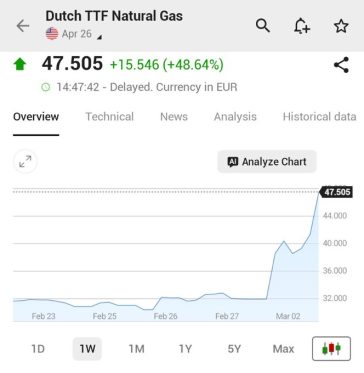 European benchmark gas futures surged by around 50% – their biggest single day move since March 2022 – after LNG tankers largely stopped transiting the Strait of Hormuz, the narrow waterway between Iran and Oman that carries about a fifth of global oil and gas shipments, over the weekend.
The spike was compounded by a drone strike on QatarEnergy’s major LNG complex at Ras Laffan, which forced production to be halted.
Crude markets also rallied, with Brent futures climbing to multi-month highs as the escalation further constrained energy flows from the region.
Across the Gulf, other energy sites have also been hit or temporarily shut, with producers suspending parts of their operations as a precaution. Saudi Arabia has reportedly paused activity at its Ras Tanura refinery following the attacks. With pipeline alternatives limited and shipping routes through the area stalling, traders are now pricing in the risk that supply lines could remain disrupted for an extended period.
Analysts warn that the turmoil could amount to the most serious shock to gas markets since the 2022 energy crisis. The EU is seen as particularly exposed. The bloc has already faced repeated jumps in energy costs since it scaled back Russian oil and gas imports following the escalation of the Ukraine conflict. Moving away from relatively cheap Russian pipeline gas has forced the bloc to lean more heavily on LNG deliveries, especially from the US. Now, with the heating season ending but storage sites less full than usual, the region requires substantial LNG imports over the summer to rebuild inventories ahead of next winter.
The rally comes as US President Donald Trump has indicated that military operations against Iran could continue for several weeks, while a number of major maritime insurers are preparing to stop covering war risks for ships entering the Persian Gulf.
Military strikes launched by the US and Israel against Iran on Saturday have shown no sign of easing. The intense attacks have reportedly killed Iranian Supreme Leader Ayatollah Ali Khamenei and other senior officials, including the head of the Islamic Revolutionary Guard Corps, while Tehran has responded with airstrikes against Israel and several Gulf states hosting US military assets. In a further sign of regional escalation, Lebanon’s Hezbollah has entered the fray with cross‑border attacks on Israeli military positions, prompting retaliatory airstrikes on the group’s infrastructure and command sites.
Analysts, including Goldman Sachs, estimate that a month‑long halt to shipping through the Strait of Hormuz could send European gas prices up by as much as 130% from current levels, putting renewed pressure on households and industry.
Kirill Dmitriev, Russia’s presidential envoy and head of the country’s sovereign wealth fund, argued that the latest price jump highlights the cost of Europe’s decision to move away from Russian fuel. In a social‑media post, he said EU gas prices “could more than double soon” and claimed that the bloc’s “strategic blunder of avoiding cheap and reliable Russian gas is backfiring.”
Forget Oil: Natural Gas Prices Are About to Go Through the Roof If Hormuz Isn’t Reopened Soon
Sputnik – 01.03.2026
“Gas prices may rise, because approximately 20% of the world’s LNG transits through the Strait of Hormuz, including all of Qatar’s production,” Igor Yushkov, a top Russian energy expert, told Sputnik, commenting on the Persian Gulf crisis.
“Qatar is one of the largest producers of LNG in the world, second only to Australia and the US. If there’s a shortage of LNG on the global market…the exchange price could easily exceed $1k or even 1.5k. We’ve seen similar prices in Europe even without such a shortage. So the price could skyrocket.”
According to Yushkov, “everything will depend on how long the tension in the Strait of Hormuz lasts,” including not only Iran’s readiness to reopen it, but gas producers’ willingness to resume transit.
“In any case, we will see higher shipping costs, higher insurance costs for ships,” with the situation “further exacerbated” by the fact that the Northern Hemisphere is still in the heating season, with Europe’s underground gas storage facilities being gradually depleted.
“Even though Qatar gas physically goes primarily to Asian markets, the exchange price will rise everywhere,” same as oil, Yushkov clarified. Qatar itself also has no alternative to Hormuz. “Therefore, if it is unable to export LNG, Qatar will simply have to stop production.”
Message to China
The current crisis is also “a major wake-up call for China,” with the US demonstrating its readiness to flout international law, Yushkov says.
“China is being shown that anything coming from the south is unsafe. Passage through the Strait of Hormuz may be interrupted today as part of the current conflict, but tomorrow the Americans could close it off to Qatari LNG supplies to the Chinese market.”
“Or they could close the Strait of Malacca, through which all the hydrocarbons going to China from Africa and the entire Middle East flow. Therefore, this is a signal to China that anything coming from the north is much safer, and much more difficult to shut down,” the observer summed up.
Featured Video

Rewriting the risk? Inside the government’s vaccine safety messaging
or go to
Aletho News Archives – Video-Images
Book Review
“Davos Can Really Replace the UN”
Inside the book that maps the architecture behind global governance — from the Epstein files to the Pact for the Future
Lies are Unbekoming | April 1, 2026
On June 13, 2019, the United Nations and the World Economic Forum signed a partnership deal to “accelerate the implementation of the 2030 Agenda for Sustainable Development.” That same evening, WEF president Börge Brende — Norway’s former Foreign Minister — had dinner with Jeffrey Epstein at Epstein’s Manhattan townhouse. The Epstein files, released January 2026, contain an exchange between the two from the previous year. Epstein to Brende: “Davos can really replace the UN. C21, cyber, crypto . genetics… intl coordination.” Brende back to Epstein: “Exactly — we need a new global architecture. World Economic Forum (Davos) is uniquely positioned — public private.”
The next day, the UN General Assembly adopted the framework for restructuring global governance.
That sequence — the partnership signing, the Epstein dinner, the candid admission about replacing the UN with a public-private architecture, and then the formal adoption — opens Jacob Nordangård’s The Digital World Brain. Pages two and three. Footnoted to the UN resolution number, the Epstein files, and the General Assembly record.
I keep coming back to it because it captures what this book does that almost nothing else in the independent research space manages. I’ve followed Jacob’s work for years now and interviewed him about his research. Each book peels back another layer of the same institutional architecture, and each time I think he’s reached the limit of what can be documented, the next one goes further. Nordangård doesn’t speculate. He doesn’t editorialize much. He lays institutional actions next to each other in chronological order and lets the pattern announce itself. … continue
Blog Roll
 Aletho News
- The End of NATO
- 37 days of war on Iran cost US staggering $42bln, tracker shows
- Baghdad tells Asian refiners, traders to begin loading Iraqi crude amid Iranian exemption
- Under fire, Moscow and Tehran close ranks
- Iran, US receive Pakistan-mediated plan for ceasefire then final deal
- Iran submits demands for end to war as mediators scramble ahead of Trump deadline
- Iran Threatens Retaliatory Strike on Stargate AI Project in UAE
- US sent ‘a lot’ of arms to Iranian protesters – Trump
- Barak Ravid Launders Deception To Allow Trump To Back Off Of His Power Plant Threat – Again
- REWRITING THE RISK? INSIDE THE GOVERNMENT’S VACCINE SAFETY MESSAGING
- If Americans Knew
- Trump poised to “blow everything up” (ie. commit war crimes) in Iran – Daily Update
- In Iran, Israel-US take aim at “reason, research, and freedom of thought” – Daily Update
- US loses planes over Iran, Israel downgrades Lebanon war goals – Daily Update
- Israel Is Blocking Palestinians from Easter at Church Where Jesus Resurrected
- Plot to assassinate Palestinian activist follows harassment campaign promoted by Zionist groups and elected officials
- Prominent New York synagogue hosts presentation on why U.S. Jews should support the ethnic cleansing of Gaza
- Tapper vs. Piker: Is the CNN Anchor Auditioning for David Ellison?
- Shouldn’t Democrats Be Able to Condemn Genocide?
- Israel-US kill negotiators, destroy civilian structures, but Iran’s military capabilities still largely intact – Daily Update
- ‘War crime’: Global condemnation as Israeli ministers celebrate death penalty law targeting Palestinian prisoners
- No Tricks Zone
- An Inconvenient Tree: Uncovered In Alps… Europe Much Warmer Than Today 6000 Years Ago
- New Study Reports A 60% Slowdown In Greenland’s Ice Loss Rate In The Last Decade
- Low Intensity Tornado Wrecks Major Solar Farm, Creating A Potential Toxic Dump
- New Study Finds Warming Saves Lives…Cold Temperatures 12 Times More Deadly Than Excess Heat
- German Science Blog Accuses PIK Climate Institute Of Hallucinating Climate Tipping Points
- Devastating Assessment Of Comirnaty Vaccine By Former Senior Pfizer Europe Toxicologist
- New Study: CO2 Is ‘Effectively Negligible’ As An Explanatory Climate Change Factor Since 2000
- Former Pfizer Toxicologist Dr. Helmut Sterz Tells Bundestag Hearing Pfizer Vaccine Should Have Never Been Approved
- Energy Expert: Germany’s Nuclear Phaseout Was A “500 Billion Euro Mistake”
- New Research: South Australia’s Mid-Holocene Sea Surface Temperatures Were 4°C Warmer Than Today
 Aletho News