JPMorgan says Iran, Oman ‘legally justified’ to charge Hormuz navigation fees
The Cradle | August 14, 2026
US investment bank JPMorgan has suggested that Iran and Oman’s strategy of imposing mandatory “navigational safety” fees to transit the Strait of Hormuz may be legally justified, the Financial Times (FT) reported earlier this month.
JPMorgan explained in a memo that international law grants ships the right of “innocent passage” through territorial waters, making it illegal to charge fees simply for transit (tolls).
However, charging fees for specific navigational and security services may be permissible, the memo argued.
For example, Denmark and Sweden currently levy charges on vessels transiting the Danish Straits. Rather than charging a toll, which would be illegal, they charge for services.
Denmark’s Pilotage Act makes pilotage mandatory for vessels carrying hazardous cargo – such as oil, chemicals, or gases – or more than 5,000 metric tons of bunker oil.
Pilotage refers to the service of guiding a ship or aircraft through hazardous, confined, or coastal waters and local areas using visual landmarks, charts, and specialized local knowledge. The pilotage fees are paid to the Danish Ministry of Business and range from $10,000 to $25,000 per transit for a Balticmax tanker.
Another country operating “a de facto tollbooth” on oil tankers is Turkiye, a US ally and NATO member, JPMorgan wrote.
Turkish authorities have “broad regulatory powers in the Turkish Straits and can charge for services under the 1936 Montreux Convention Regarding the Regime of the Straits.”
Ankara charges a Suezmax oil tanker approximately $130,000 for a round-trip passage, roughly $0.13 per barrel of crude.
In exchange for the fee, Turkiye provides lighthouses, light, and channel buoys, as well as sanitary control and emergency rescue services.
According to JPMorgan, these precedents indicate that Iran and Oman’s plan to impose mandatory charges for “navigational safety” to transit Hormuz could be legally justified.
In a previous note published in May, the investment bank’s analysts wrote: “By structuring the measure as a service fee rather than a transit toll, and by coordinating with Oman as the other littoral state, Iran could attempt to create a legal framework that appears consistent with international maritime law.”
Amir Handjani of Responsible Statecraft (RS) argues that establishing an Iran–Oman transit authority would benefit commercial shippers.
“Ships get a predictable process instead of IRGC commanders deciding by whim who passes, who doesn’t, and an unpredictable pricing mechanism,” Handjani wrote.
At the same time, US sanctions and restrictive insurance clauses may pose severe compliance issues for international oil and shipping firms seeking to traverse the Strait of Hormuz under such a proposal.
Reuters reported on 6 August that if shipping firms pay service fees to Iran to pass Hormuz, this would trigger US sanctions imposed unilaterally on the Persian Gulf Strait Authority (PGSA).
“Any payment could lead to asset freezes,” Reuters quoted unnamed industry sources as saying.
Major shipping firms have also raised concerns over a clause introduced last month by Lloyd’s Market Association (LMA) that terminates vessel insurance if it pays a toll or charge for passage through the Strait of Hormuz.
US National Debt Grows By Over $500Bln Since Beginning of July
Sputnik -14.08.2026
WASHINGTON – The national debt of the United States has increased by more than $500 billion since July 1 and has come close to a record high of $40 trillion, RIA Novosti calculated based on data from the US Treasury Department.
In early July, that number was $39.389 trillion, by mid-August, the figure reached $39.913 trillion. Thus, the net increase in less than a month and a half amounted to $524.22 billion.
In the first 10 months of the 2026 fiscal year alone, the US government allocated a record $963 billion to service and pay interest on the national debt, RIA Novosti previously found out based on data from the Congressional Budget Office.
In the future, the debt burden will only increase. According to the congressional estimates, the US national debt will continue to grow continuously over the next decade. As early as fiscal year 2027, the figure is expected to exceed $41.3 trillion, the psychological mark of 50 trillion will be reached by 2033, and by fiscal year 2036 it will reach more than $56.2 trillion.
The Caspian Sea: America’s New Eurasian Containment Arena
By Salman Rafi Sheikh – New Eastern Outlook – August 13, 2026
The Caspian Sea — for thirty years a backwater of great-power politics — has quietly become a battlespace, and most of the world is still treating it as a footnote.
In late July, Iranian officials confirmed that a US strike had damaged the Islamic Revolutionary Guard Corps’ Seyyed al-Shuhada naval facility in Zibakenar, in Iran’s Caspian province of Gilan — the first time in the current war that Washington has reached into Iran’s Caspian coastline. Days earlier, Ukrainian President Volodymyr Zelensky announced that Kyiv’s drones had struck several vessels in the Caspian more than 1,000 kilometers from Ukrainian-held territory, including a ship reportedly ferrying military cargo from Iran toward Russia. Iran, however, said one of the vessels hit was carrying iron ore from Astrakhan to the Iranian port of Anzali and summoned Ukraine’s chargé d’affaires in protest.
Neither strike, on its own, would rewrite anyone’s map. Together, they are a signal. For the first time, the US and US-backed Ukraine have demonstrated that they have the will and the reach to hit targets on a sea that geography, more than strategy, had long kept insulated from direct confrontation. The Caspian’s basin states — Russia, Iran, Kazakhstan, Turkmenistan and Azerbaijan — built an entire diplomatic architecture, including a 2018 legal convention on the sea’s status, around the premise that outside militaries would stay out. That premise no longer holds.
What is emerging is not a contest for territory in the traditional sense. It is a contest over connectivity: over the ports, rail lines, pipelines, and shipping lanes that allow Russia, Iran, and, at one remove, China to function as an integrated economic and strategic space rather than three isolated, sanctioned, or otherwise constrained powers. Call it America’s New Eurasian Containment: a strategy that treats infrastructure, not territory, as the terrain worth contesting.
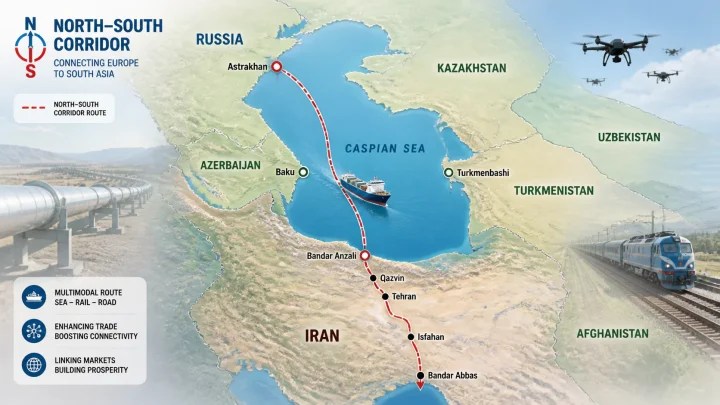
Severing the Connective Tissue
The clearest evidence of this shift sits not on the Caspian’s water but on its shores, in two projects Washington has spent the past year reshaping.
The first is the International North-South Transport Corridor, a roughly 7,200-kilometer multimodal freight route agreed upon by Russia, Iran, and India in 2000 that links the Indian Ocean, through Iran, across the Caspian, to Russian rail networks and on to Europe. Long stalled by under-investment, the corridor has become a priority for Moscow since 2022, precisely because it offers a way around Western sanctions. Its central artery is the Caspian crossing between the Iranian port of Bandar-e Anzali and the Russian port of Astrakhan. More importantly, it is the same stretch of water where Ukrainian drones struck in July and where Israeli forces had already hit Iranian naval and port assets at Anzali back in March, according to regional shipping trackers. A degraded, contested Caspian corridor is a direct blow to the one overland route that lets Moscow and Tehran trade around US and European sanctions. These attacks are, therefore, not about the US war on Iran; they are about reshaping the very geography of trade passing through the Eurasian landscape.
The second is the Trump Route for International Peace and Prosperity, or TRIPP — the transit corridor Washington brokered in August 2025 between Armenia and Azerbaijan, granting a US-led consortium a 99-year lease to build and manage rail, energy, and fiber-optic links through Armenia’s Syunik province. The deal ended a decades-old territorial dispute, but its geopolitical function is narrower and sharper. It places Iran’s only land border with Armenia under American-supervised transit control, cutting off Tehran’s most direct overland access into the South Caucasus and, by extension, into a region Russia has treated as its own backyard since the Soviet collapse. Whatever the deal’s stated humanitarian purpose, it functions as a wedge driven into Eurasian connective tissue.
Neither project was designed with the other in mind. But together with the Caspian strikes, they describe a single logic: deny Russia and Iran the infrastructure that lets their January 2025 Comprehensive Strategic Partnership — a 20-year treaty covering defense, energy, finance, and counterterrorism cooperation — translate into real economic integration rather than a document signed in Moscow. China, meanwhile, watches from the margins. Beijing has no naval presence on the Caspian and is not a party to any of these strikes or corridors, but its own westward trade ambitions run through the same chokepoints, i.e., the Middle Corridor via the South Caucasus, and Iranian ports as a Belt and Road terminus. A Washington-controlled TRIPP and a contested Caspian complicate China’s overland options as a side effect, even if Beijing was never the intended target.
A Frontier Without a Front Line
The danger in this strategy is precisely that it has no clean edges. Containment during the Cold War had defined lines — the Fulda Gap, the Elbe, the 38th parallel — and a doctrine that most parties understood. Infrastructure containment has none of that. A drone strike on a cargo ship, an airstrike on a naval depot, and a 99-year land lease branded with a president’s name: each is individually deniable, incremental, and justifiable in its own narrow terms, even as the cumulative effect reshapes the strategic map of an entire region. That ambiguity is a feature for Washington, which can advance the strategy without ever declaring it. But it is also a source of volatility because affected countries are left to infer intent from actions rather than respond to a stated policy. And, inferences, in a region this armed and this aggrieved, tend toward worst-case assumptions.
The more durable question is what happens once the corridors themselves become targets, not just prizes. Pipelines, rail lines, and undersea cables may now be legitimate objects of great-power coercion. If so, the Caspian will not be the last “peripheral” space pulled into contested geography. The Arctic shipping lanes, the Malacca chokepoint, and the fibre-optic seabed of the Indian Ocean are all candidates for the same treatment. In this environment, the states that thrive will not be the ones with the largest militaries. They will be the ones that make their infrastructure redundant, diversified, and defensible: multiple routes, multiple partners, no single artery whose loss is fatal. Iran and Russia have bet heavily on a small number of chokepoints. Their partnership may keep deepening going forward. But the deeper it goes, the more attacks it will face and endure.
Salman Rafi Sheikh, research analyst of international relations and Pakistan’s foreign and domestic affairs
Follow new articles on our Telegram channel
Putin warns West over ship seizures
RT | August 12, 2026
Russia could seize ships carrying Western cargo in retaliation for similar actions against Russian maritime trade, President Vladimir Putin has warned.
There have been several incidents in recent months in which Western militaries have seized vessels that their governments accused of being part of a so-called Russian ‘shadow fleet’. Putin warned on Wednesday during a meeting with Pacific Fleet commanders that Moscow could take retaliatory measures wherever it deemed necessary.
“Some nations are violating the Law of the Sea by trying to restrict the movement of our civilian traders. They recently came up with the idea of seizing our ships and selling off our plundered property. This is certainly nothing short of piracy and robbery,” Putin said.
“If such a policy is implemented in practice, we will be forced to take mirror responses. And not necessarily in the waters where our ships are being raided. We’ll do it wherever and anywhere we see fit,” he added.
Pacific Fleet Commander Adm. Viktor Liina reported in response that the Russian military has detailed information about Western commercial traffic.
“From April 24 to August 6 of 2026, 1,001 ships passed through the Russian exclusive economic zone, including 379 with flags of unfriendly nations,” he said. “That includes 273 general cargo ships and 71 tanks, including 26 under the British flag and nine under the French flag.”
The UK and France have carried out several interdictions of supposed Russian ‘shadow fleet’ vessels. In June, The Telegraph reported that British authorities were considering selling around 100,000 tons of Russian crude seized from a sanctioned tanker and using the proceeds to benefit Ukraine.
The term ‘shadow fleet’ is used by Western governments to describe vessels they accuse of helping Russia circumvent sanctions, particularly the price cap imposed on Russian oil. Moscow rejects the designation, saying it has no basis in international law and violates Russia’s right to conduct maritime trade.
Western governments have targeted hundreds of vessels with unilateral sanctions and have increasingly resorted to physically intercepting and detaining some of them.
Kiev has also broadened its use of the “shadow fleet” label, applying it to various Russian commercial vessels targeted in Ukrainian drone strikes, including tankers and cargo ships.
Notable ‘shadow fleet’ detentions
At least a dozen vessels have been detained by Western nations since last year as part of their campaign targeting Russian trade. The list of incidents includes:
- In March 2025, Germany seized the tanker Eventin carrying some 100,000 tons of crude. German courts later blocked the government’s attempts to sell the Panama-flagged ship.
- In April 2025, Estonia detained oil tanker the Kiwala, claiming it had no valid flag. Weeks later the ship was released.
- An oil tanker going by the names the Pushpa, Kiwala, Boracay, and others was targeted by France in September 2025, but resumed its voyage towards the Suez Canal the next month. Western media claimed it was linked to the mass hysteria over “mystery drone sightings” in Europe.
- In March 2026, French-backed Belgian forces boarded the oil tanker Ethera. It reportedly remains impounded under a €10 million ($11.6 million) bail.
- Sweden seized the cargo ship Caffa in March 2026 for allegedly carrying “stolen Ukrainian grain.” Earlier this month the country’s top court agreed to the government’s request to transfer the ship to Ukraine.
- British forces for the first time directly seized a ‘shadow fleet’ ship in June, 2026, when they targeted the oil tanker Smyrtos. Previously, the UK only provided assistance to France for such operations. The ship’s Indian master, Ajay Pant, remains in British custody pending a criminal trial for violating the UK’s anti-Russian measures.
Russia’s lockdown of Odessa ports could be a grim turning point in war
By George Beebe | Responsible Statecraft | August 11, 2026
Over the course of a few short weeks, a grim new reality has taken shape in Ukraine.
Russia has shown that it need not conquer and occupy Ukraine’s entire Black Sea coastline to turn that country into the equivalent of a landlocked state. It need only deny access to Ukraine’s critically important Odessa port complex, something it is doing quite effectively through air and missile strikes on port facilities and approaching ships.
That reality will probably not amount to a knock-out blow in the ongoing war. But it is likely to have a profound impact on Ukraine’s already gloomy post-war prospects — and, by extension, on the contours of a new European security landscape in the current conflict’s aftermath.
Only a handful of months ago, Russia was conducting few military operations against Odessa. Early in the war, attacks by Russia and Ukraine on merchant shipping in the Black Sea had threatened to choke off agricultural exports vital to world markets. Under pressure from India and other key partners in the Global South, Moscow agreed to the so-called “Grain Deal” with Ukraine, brokered by Turkey and the United Nations, to allow unimpeded commercial exports from the region.
For some four years thereafter, the Odessa port system remained open to Ukrainian imports and exports, handling some 90% of Ukraine’s agricultural trade. Russian hardliners bristled at Russian President Vladimir Putin’s refusal to attack Ukraine’s vital but vulnerable port, grumbling that Putin seemed more interested in avoiding rifts with Global South states than defeating Ukraine.
Several factors have combined to change this picture. One was the evident failure of the West’s campaign to turn Russia into a pariah state, a brainchild of the Biden administration that had magnified the importance of the Global South to Moscow as a means of avoiding international isolation. A second has been the depletion of Ukrainian air defense interceptors, which has left Odessa largely defenseless against Russian ballistic missiles and allowed bomb-carrying aircraft to operate in closer proximity to the port complex, increasing the accuracy and destructiveness of Russian air strikes.
Ironically enough, perhaps the most important factor was Ukraine’s own “40-day influence campaign” announced in late June, which included long- and medium-range drone strikes on energy infrastructure in Russia and merchant shipping in the Sea of Azov. Ukrainian President Volodymyr Zelensky said the campaign was aimed at “influencing the aggressor state in order to compel it to end the war.” President Trump described it more plainly as an “escalation that we hope will lead to peace.”
In practice, however, the escalation allowed Russia to deflect Global South criticism for violating terms of the Grain Deal by arguing it was Ukraine that had kicked off the recent cycle of shipping and port attacks.
The near-term effects have been disturbingly clear. Since July 22, the Russian military has effectively closed the Ukrainian port complex in and around Odessa to all shipping. The loss of its remaining deep-water ports is already having a devastating effect on Ukraine’s agricultural exports — the backbone of its economy — which officials warn may plummet by 50% in the coming months because alternative land, rail, and river routes have much less capacity and are much more costly.
The damage to Ukraine’s economy probably will be manageable in the near term so long as Europe steps up its flow of aid. But the impact of Odessa’s closure on Ukraine’s post-war prospects may prove to be much more profound.
It has long been assumed in both Washington and Europe that the main alternative to a compromise settlement of the Russia-Ukraine war is the transformation of Ukraine into a “steel porcupine.” The concept envisions a heavily armed and fortified Ukraine that can serve as a barrier to further Russian aggression and allow the hot war to settle into a stable, frozen conflict.
Proponents of this vision dismiss prospective “land for peace” deals with Moscow and oppose any quantitative or qualitative limitations on Ukraine’s military — points that Russian officials say are essential to any peace deal — arguing that such concessions would “reward Russian aggression” and prevent Ukraine from becoming an Eastern European variant of Israel, a “Major Non-NATO Ally” that punches well above its weight-class in regional affairs and serves as a keystone of broader European defense plans.
However, if Russia can use air and missile attacks to deny Ukraine the use of its port facilities, it can also prevent Ukraine’s post-war reconstruction and economic revitalization. Just as merchant ships will not risk Russian attacks to enter Odessa, construction firms are unlikely to risk Russian airstrikes in attempting to build or repair bridges, roads, factories, ports, and other vital infrastructure. Nor will investors risk hundreds of billions of dollars if Russian missiles and bombs can destroy any Ukrainian reconstruction project in a matter of hours.
Without large-scale economic reconstruction and the jobs and stability that would follow, few of the millions of Ukrainians who fled the war (most for Europe but many for Russia) will return. Absent mass repatriation, Ukraine is likely to enter a demographic death-spiral. By Ukrainian officials’ own admission, a population that approached 52 million people when the Soviet Union broke up now stands at between 22 and 25 million people, and nearly half of them are retirees.
According to one estimate, Ukraine’s working age population – the backbone of both its civilian economy and its military — could lose an additional third by 2040. The number of children, the embodiment of Ukraine’s future, could decline to half its pre-war level.
This raises an obvious but under-discussed question: How can an aging and dying Ukrainian population, lacking a strong economic base, serve as a “new Sparta” countering a nuclear-armed Russia that is seven times its size?
The closure of Odessa should highlight two salient points for Western leaders. First, neither Ukraine nor the West can eliminate the threat of Russian air and missile strikes through military means alone. Second, Russia will have strong reason to continue them, even after it eventually halts large-scale ground operations, if the Kremlin worries that the West will otherwise turn Ukraine into a safe haven for threatening Russian security.
As a result, the alternative to an uncomfortable compromise settlement of the war will not be a steel Ukrainian porcupine. It will be a weak and dysfunctional rump state that ill-serves Ukrainians and undermines Europe’s broader security.
George Beebe is the Director of Grand Strategy for the Quincy Institute. He spent more than two decades in government as an intelligence analyst, diplomat, and policy advisor, including as director of the CIA’s Russia analysis and as a staff advisor on Russia matters to Vice President Cheney. He is the author of “The Russia Trap: How Our Shadow War with Russia Could Spiral into Nuclear Catastrophe” (2019).
Scott Bessent’s Delusional Oil Pipe Dream to Defeat Iran
By Larry C. Johnson | SONAR21 | August 10, 2026
When U.S. Treasury Secretary Scott Bessent told an interviewer this weekend that the Strait of Hormuz would “become irrelevant” within two years — with more than half the energy now crossing it rerouted through underground pipelines — he was indulging a pipe dream. Bessent fails to grasp that Iran’s ability to use the Strait of Hormuz as geopolitical leverage is not going to vanish if the Gulf arabs quickly build oil pipelines. It is true that capital hates chokepoints, and Gulf producers are indeed racing to build around one. Saudi Arabia is expanding its East-West Petroline, the UAE has leaned harder on its Fujairah bypass, and Iraq is dusting off long-dormant overland export corridors. Chevron is even studying a revived Haditha–Baniyas line from Iraq to the Syrian Mediterranean.
Although Bessent ‘s oil pipeline proposal sounded like a nifty way to neuter Iran, he fails to grasp the true economic importance of the Persian Gulf and the leverage that Iran will continue to have for years to come. Bessent’s framing treats Hormuz as an oil problem, and a pipeline network — however ambitious — solves an oil problem. But Hormuz is not merely the world’s most important oil chokepoint. It is the sole maritime exit for a cluster of specialized commodities that cannot be pumped through a pipe, cannot be quickly re-sourced elsewhere, and whose disruption is already inflicting measurable economic damage across food, semiconductors, and heavy industry. Building a crude bypass and declaring the strait “irrelevant” mistakes one throughput for all of them.
The evidence for that is not hypothetical. It is the record of the past five months.
The oil bypass math is already the easy part — and it still doesn’t close
Start with the commodity the pipelines are meant to address. Even here the substitution is incomplete. Roughly 20 million barrels per day of crude, condensate, and products normally transit Hormuz — about a fifth of global petroleum consumption. Existing bypass capacity totals somewhere around 4.7 million barrels per day. Closing that gap requires not one flagship pipeline but an entire redundant network, built through active or recently active conflict zones, over a period of years. Bessent’s own two-year horizon is optimistic against that backdrop, and it is the most favorable case, because crude is the one Hormuz cargo that pipelines are actually designed to carry.
Everything else produced in the Gulf are not cargo that can be carried by a pipeline, and these are critically important to the global economy.
LNG: No pipe runs from Ras Laffan to Tokyo
About a fifth of the world’s liquefied natural gas trade moves through Hormuz, overwhelmingly from Qatar, the second-largest LNG exporter on earth. When Iranian strikes damaged Qatar’s Ras Laffan complex — the single largest LNG export facility in the world — and QatarEnergy declared force majeure in early March, roughly 10 billion cubic feet per day of supply, about 20% of globally traded LNG, went offline. Kpler tanker data showed no laden LNG vessel crossing the strait for nearly two months.
The consequences landed fast and far from the Gulf. The World Bank’s natural gas price index jumped 24% in a single month. Europe’s benchmark is now projected to climb roughly 25% across 2026, because LNG frequently sets the marginal price there; Asia, which takes the overwhelming majority of Qatari cargoes, was hit hardest as buyers scrambled to replace contracted deliveries on the spot market.
Here is the part a pipeline cannot fix: LNG has no overland route out of Qatar. Liquefied gas is a seaborne product by definition — you liquefy it precisely because you cannot pipe it across oceans to Japan, South Korea, or India. And the one producer large enough to plug the gap, the United States, cannot. New American liquefaction terminals take years and billions to build; the EIA expected U.S. exports to rise by only a small fraction of the missing Qatari volumes, with meaningful new capacity trickling in through late 2026 at best. A crude bypass does nothing for the LNG buyer in Osaka. There is no bypass to build.
Urea and ammonia: the fertilizer shock that reaches every farm
The Gulf is not just an energy hub. It is one of the planet’s great fertilizer factories, and Hormuz is how those fertilizers reach the fields that depend on them. The Middle East supplies close to a quarter of global urea exports; by some measures roughly a third of world seaborne fertilizer trade was put at risk when the strait closed. Iran halted ammonia production; Qatar suspended urea, ammonia, and sulphur output after the Ras Laffan damage.
The price response was violent. Urea climbed above $850 per metric ton in April — up around 80% from February and the highest level since 2022. World urea prices roughly doubled at the peak. Ammonia jumped nearly 40% in weeks, and about 24% of all global ammonia trade normally passes through Hormuz. Fitch raised its 2026 ammonia and urea forecasts by around a quarter and warned nitrogen fertilizers would be the hardest hit of any product category.
And unlike a price chart, the downstream damage compounds. India — which sources roughly 80% of its ammonia from the Gulf — saw ammonia-based domestic production stall and lost hundreds of thousands of tons of monthly urea output as industrial gas was rationed. American farmers absorbed the shock at the worst possible moment, entering spring planting with fertilizer costs spiking and diesel above $5 a gallon. Because natural gas is around 80% of the cost of nitrogen fertilizer, the LNG disruption and the fertilizer disruption feed each other — a second-order effect no crude pipeline touches. When fertilizer gets scarce and expensive, the eventual bill is measured in crop yields and food prices, in countries that never bought a barrel of Gulf oil.
Sulphur and DAP: the quiet input behind the phosphate chain
Sulphur rarely makes headlines, which is exactly why its disruption is instructive. It is a byproduct of Gulf gas processing and a critical input for phosphate fertilizers and countless industrial processes. With Qatari sulphur output suspended and regional supply choked, prices roughly doubled since the start of the year. That fed straight into diammonium phosphate (DAP): DAP prices rose more than 10% in April on tightening supply and higher sulphur costs, compounded by China moving to restrict its own exports — China relies on the Middle East for roughly half its sulphur imports.
This is the pattern worth noticing. Hormuz disruption does not produce one clean shortage; it produces a cascade through interlinked chemistry — gas into ammonia, ammonia and sulphur into finished fertilizer, export bans stacked on top of physical shortfalls. A pipeline that moves crude oil intersects none of these chains.
Helium: the commodity with no substitute and no alternative exit
Helium is the sharpest illustration of Bessent’s blind spot, because for helium the pipeline argument does not merely fall short — it is categorically inapplicable.
Qatar supplies roughly a third of the world’s helium, extracted as a byproduct co-located with LNG processing at Ras Laffan. The March strikes and the strait’s closure took an estimated 30% of global helium production offline, with damage assessments suggesting some infrastructure could take years — not weeks — to fully restore. US distributors invoked force majeure, began rationing, prioritized healthcare customers, and layered on surcharges; spot prices spiked.
Helium cannot be synthesized. It is a finite, non-renewable gas with no substitute in its critical uses: semiconductor fabrication, advanced chip packaging, MRI machines, and the sealed interior of every high-capacity hard drive at a moment when AI-driven data-center demand is surging. Seagate and Western Digital reported full-year allocations and 20–30% price increases; South Korean chipmakers were reported to be running on roughly six months of inventory.
And every gram of Qatari helium leaves the country the same way: by ship, through Hormuz. There is no pipeline alternative, no overland route, no bypass — helium’s only exit from the world’s second-largest production hub is that one 33-kilometer-wide waterway. A network of crude pipelines could be completed tomorrow and it would not move a single liter of helium to a chip fab in Taiwan.
Why the framing matters
None of this means the bypass pipelines are a bad idea. Reducing the world’s dependence on a single crude chokepoint is prudent, and market-driven redundancy is exactly what one would want. Bessent is right that capital routes around risk, and that Tehran has accelerated its own strategic marginalization by weaponizing the strait.
But the claim that “the Strait of Hormuz will become irrelevant” is grossly misleading. The waterway’s true strategic weight comes from its role as the shared export gate for a bundle of commodities — LNG, urea, ammonia, sulphur, helium — that are seaborne by physics, concentrated in a handful of Gulf facilities, and impossible to re-source at speed. Each has been disrupted in the real world over the past five months, and each disruption has produced price shocks and downstream damage that a crude pipeline is powerless to prevent.
The current market underlines the point. As of early August, Brent was trading in the mid-$80s and climbing on Hormuz headlines, with a war-risk premium that has refused to deflate through months of on-again, off-again negotiation — the US Strategic Petroleum Reserve has been drawn down to its lowest level since the 1980s in the process. That premium reflects traders pricing the whole basket of what the strait carries, not just its barrels of crude. Until there is a plan for the LNG tanker, the ammonia cargo, the sulphur shipment, and the helium flask — none of which fits in a pipeline — Hormuz will remain very far from irrelevant.
A pipeline can carry crude. It cannot carry the rest of what Hormuz moves. And it is the rest that is quietly reshaping the global economy right now.
US military pressure forcing Hormuz closure – Iran
Washington must cease its strong-arm tactics before shipping can resume through the key waterway, the Foreign Ministry in Tehran has said
RT | August 10, 2026
The Strait of Hormuz cannot be reopened through diplomacy while Washington continues to use military pressure against Tehran, the Iranian Foreign Ministry has said.
Iran closed Hormuz in response to a US-Israeli military campaign launched in late February. Washington subsequently imposed a naval blockade on Iranian ports, escalating a standoff over a strategic waterway that has historically carried around a quarter of the world’s seaborne oil trade.
Iranian Foreign Ministry spokesman Esmail Baghaei said on Monday that diplomacy is “certainly” part of the “struggle to safeguard our national interests,” but added that “when dealing with a side that insists on the use of force, a maritime blockade is not a diplomatic action that we can lift through diplomacy.”
“Certainly, you have to use authority and military power, along with diplomacy, to prevent the United States’ aggression, and that is what is being done,” Baghaei told a press briefing.
Tehran has set out a series of conditions for reopening the strait, including compensation for war damage, the lifting of sanctions, and the release of frozen Iranian funds, as well as a permanent end to hostilities against Iran and its regional allies.
The IRGC has also said that reopening Hormuz will depend on Washington fully accepting Tehran’s conditions.
US President Donald Trump said that Washington was in no rush to reach an agreement, telling Axios that Washington was “low-keying” negotiations while allowing economic pressure on Tehran to build.
“We are only semi-negotiating with them. We are just watching Iran with its huge inflation and the fact they have no money,” Trump said, adding “It’s like a chess game.”
The talks follow weeks of disagreement over a 14-point memorandum of understanding that established a temporary ceasefire and provided for the gradual lifting of the US blockade of Iranian ports and the restoration of commercial traffic through Hormuz. Fighting resumed last month after the sides failed to agree on how the deal should be implemented.
Iran and Oman, meanwhile, are discussing arrangements for future shipping through the strait, although Tehran has stressed that any agreement with Muscat would not in itself mean the waterway would reopen.
The disruption to traffic through Hormuz has put sustained pressure on global energy markets. Oil prices rose nearly 3% on Monday amid uncertainty over negotiations, with international benchmark Brent reaching $85 a barrel and US WTI hitting $80.
Malaysia seizes ‘Israel’-bound cargo container violating export bans
Al Mayadeen | August 10, 2026
Malaysian authorities have intercepted a shipping container at the Port of Tanjung Pelepas in Johor over suspicions that its cargo was intended for export to “Israel” in breach of the country’s trade restrictions, local media reported.
The Malaysian Border Control and Protection Agency (AKPS) carried out the operation on Friday after receiving intelligence concerning the shipment, prompting officers to inspect the container.
According to a statement cited by Berita Harian, initial findings suggested that the shipment may have violated Malaysia’s customs regulations governing exports to “Israel”.
“Based on preliminary checks, the shipment is suspected of not complying with Item No 15, Second Schedule, Customs (Prohibition on Export) Order 2023, which provides for the prohibition of direct or indirect export of goods to ‘Israel’,” AKPS stated.
Authorities are now seeking to determine the exact nature and specifications of the cargo, its intended purpose, and how it should be legally classified.
The investigation will also examine whether the shipment contains strategic goods falling under Malaysia’s Strategic Trade Act, which regulates exports of sensitive and dual-use items.
“Any attempt to export goods directly or indirectly to ‘Israel’ that is against the law and government regulations will be dealt with strictly,” the agency added.
Anwar praises enforcement action
Malaysian Prime Minister Anwar Ibrahim welcomed the seizure, saying it reflected Kuala Lumpur’s determination to prevent Malaysian territory and infrastructure from facilitating trade that could benefit “Israel”.
“Congratulations to AKPS for the swift action in seizing a container suspected of carrying strategic trade cargo intended for export to ‘Israel’ at the Port of Tanjung Pelepas,” Anwar wrote on X. “This action demonstrates Malaysia’s firm stance to ensure that our country will never serve as a conduit for trade that could support or contribute to the Israeli regime’s atrocities against the Palestinian people.”
The prime minister said the move was consistent with measures Malaysia introduced in December 2023, as well as with its commitments as a member of The Hague Group.
Malaysia’s earlier measures included barring vessels owned by the Israeli shipping company Zim from docking at its ports, prohibiting Israeli-flagged ships from entering Malaysian waters, and preventing vessels headed for “Israel” from loading cargo at Malaysian ports.
The latest case indicates that enforcement is extending beyond restrictions targeting particular ships or maritime operators to include individual shipments suspected of reaching “Israel” through direct or indirect trade routes.
The Hague Group welcomes seizure
The Hague Group, a coalition of states seeking to prevent transfers of weapons, ammunition, military fuel, military equipment, and dual-use goods to “Israel”, also welcomed the Malaysian authorities’ action.
The group said the interception represented practical implementation of states’ international legal obligations, pointing to the International Court of Justice’s July 2024 Advisory Opinion and UN General Assembly Resolution ES-10/24.
Those measures, according to the group, require states not to provide aid or assistance that contributes to maintaining the unlawful situation arising from the Israeli occupation of Palestinian territory.
“The defence of humanity is won at ports, courts, and factories, not from the podium. Law that goes unenforced is no law at all,” said Varsha Gandikota-Nellutla, Executive Secretary of The Hague Group. “By halting this cargo, Malaysia has upheld the obligations that bind every UN member state under international law. We invite all states to join The Hague Group and do the same.”
The contents of the seized container and its ultimate destination have not yet been formally established, with Malaysian authorities saying the investigation remains ongoing.
Is Donald Trump Serious About Declaring Victory Over Iran?
By Larry C. Johnson | SONAR21 | August 10, 2026
According to a Wall Street Journal report citing US officials, President Trump has been privately weighing the possibility of declaring victory against Iran and ending the war without securing a nuclear deal.
Trump reportedly has floated to senior aides that if the US can keep Iran’s nuclear program in check and traffic resumes through the Strait of Hormuz, he would be willing to extend the ceasefire “indefinitely” and effectively declare the conflict over.
In recent meetings, Trump has expressed confidence that Iran is “likely unable to revive its nuclear work” after Operation Midnight Hammer caused heavy damage to Iran’s nuclear infrastructure in June 2025. He believes US intelligence capabilities would catch any Iranian attempts to rebuild, and that the threat of further American strikes would “serve as an enduring deterrent.”
Trump’s key condition for ending the war is that Iran agrees to fully reopening the Strait of Hormuz to international shipping. In exchange, officials expect Trump would lift the US naval blockade on Iranian ports.
According to the Wall Street Journal, a White House official said that the U.S. has “completed all of its military objectives against Iran,” and the president’s focus is now on “securing the flow of the world’s energy through the Strait of Hormuz.” The reporting suggests Trump is patient and expected to ride out the latest diplomatic snarl, especially so long as gas prices remain where they are.
Let’s assume that this WSJ report is accurate (a big assumption). President Trump is still living in a fantasy world. Despite his recent outbursts about bombing Iran’s nuclear sites, he now seems content to revert to his original declaration from June 2025 that Iran’s nuclear program has been obliterated. Count me skeptical. However, if Trump is willing to make that assumption then it removes one item from the negotiation list… Until recently the US, via Pakistani mediators, was pressing Iran to discuss the Iranian nuclear program before addressing the lifting of the blockade and sanctions, and the unfreezing of assets. Iran, for its part, has insisted on the reverse position: i.e., lift the blockade and sanctions, unfreeze the assets and accept Iran’s sovereignty over the Persian Gulf.
If Trump’s decision to declare victory and end the war hinges on Iran, “fully reopening the Strait of Hormuz to international shipping,” then prospects for a deal are slim. Iran will only agree to allowing ships to transit the Strait of Hormuz in accordance with the Persian Gulf Strait Authority guidelines it issued on April 22nd. In early May, the Supreme National Security Council and other Iranian bodies publicly confirmed the PGSA’s formation and role. It began administering a permit-based system requiring vessels to submit a detailed “Vessel Information Declaration” (covering ownership, insurance, crew, cargo, etc.) before receiving clearance. Fees for “specialized services” were part of the planned mechanism. Iran is not going to back down on this point.
The WSJ article hints at the major focus of concern for Trump: the domestic price of gas. I have repeatedly pointed out on several recent podcasts that there is a global shortage of diesel and aviation fuel and that the price effects of this shortage will become more profound with each passing week. Also, as I discussed in a recent article, the damage to the oil and gas infrastructure in the Persian Gulf and the departure of maintenance/repair personnel from the Persian Gulf Arab nations, along with the destruction of warehouses that held replacement parts needed to repair damage to the oil and gas terminals, the shortage of diesel and aviation fuel will persist for several months, if not longer.
Trump’s attention at present appears to be focused more on the November mid-term elections than on pursuing a new missile and bombing campaign on Iran. Although Iran has fired on at least five ships trying to transit the Omani channel in the Strait of Hormuz without submitting to the PGSA protocol, Donald Trump has not ordered any new strikes on Iranian targets despite his previous vow to attack Iran for each such incident.
I think that there is growing concern within the Trump administration about the potential for a global economic crisis if the Persian Gulf remains shuttered, especially if this continues as is into September. And this is likely the main factor pushing Trump to do a repeat of the end of Operation Rough Rider… i.e., Declare victory and leave.
When sanctions become piracy with a government stamp
By Dan-Viggo BERGTUN – steigan.no – July 29, 2026
Vladimir Putin has recently announced that attacks, harassment, and unlawful interference with Russian commercial shipping will be met in the same manner as piracy. This statement will naturally be portrayed as yet another Russian threat. But before European politicians dismiss it as propaganda, they should consider a far more uncomfortable question: What do we call it when states stop merchant ships, board them, seize cargo, or attempt to determine who is allowed to sail the world’s oceans?
Since 2022, the European Union has built up an increasingly comprehensive sanctions regime against Russia. More and more vessels have been linked to what the EU terms the Russian “shadow fleet.” The ships may be denied access to European ports and face prohibitions on insurance, financing, technical assistance, and other maritime services.
These are serious measures, but it is important to be precise: A European port ban is not the same as a general right to board foreign vessels on the high seas. Nor is there any automatic right to seize cargo from a ship simply because the EU believes the trade violates European sanctions.
But the development is dangerous. The United Kingdom and several European countries are discussing increasingly offensive measures against vessels alleged to be circumventing sanctions. The ships are accused of complex ownership structures, inadequate insurance, false flag registrations, poor technical standards, or concealing cargo and movements. Some of the concerns may be genuine. Old tankers without sufficient insurance can pose a serious risk to the environment and other shipping.
But suspicion is not the same as a conviction.
The EU calls this a “shadow fleet.” Russia rejects the designation. The term is politically effective because it creates the impression that the ships are virtually lawless ghost vessels that any Western navy can intervene against. But a ship that flies a valid flag, has a crew, a registered owner, and sails outside other states’ territorial waters does not automatically lose its rights simply because its cargo is Russian or because the EU disapproves of the trade.
Nor are European countries alone in acting this way. The United States has for several years seized oil that it claims has been transported in violation of U.S. sanctions against Iran. American courts have issued forfeiture orders, and U.S. authorities have taken over, sold, or seized oil from foreign tankers.
As early as 2020, the U.S. Department of Justice announced that the United States had confiscated approximately 1.1 million barrels of Iranian petroleum products from four foreign-flagged tankers. U.S. authorities stated that the seizure was carried out with the assistance of foreign partners. In 2023, over 980,000 barrels of oil from the tanker Suez Rajan were seized and later sold. In 2026, U.S. authorities obtained forfeiture of the tanker Skipper and approximately 1.8 million barrels of oil originating from Iran and Venezuela.
The United States portrays this as legal enforcement of sanctions, counter-terrorism financing efforts, and the forfeiture of illicit cargo. But from the perspective of other countries, it may look quite different: One state uses its own laws and its own courts to take control of other countries’ commercial goods far outside its own territory.
What would the United States say if an Iranian or Chinese court decided to seize American oil en route to Europe? What would Norwegian authorities say if a Norwegian ship were stopped on the high seas because its cargo violated another country’s unilateral sanctions?
We would hardly call that ordinary law enforcement. We would call it theft, abuse of power, or piracy.
It must be emphasized, however, that not all U.S. seizures have occurred through armed hijackings on the high seas. Some have been carried out in cooperation with shipowners, operators, flag states, or foreign authorities. Others have been based on claims that the ship was stateless, used a false flag, or had ties to the U.S. financial system. But this does not change the fundamental problem: The United States is attempting to give its national sanctions effect across large parts of the world.
The law of the sea is built on the principle of freedom of navigation on the high seas. The ship’s flag state has both the right and the duty to exercise control over the vessel. The registration ties the ship to a state that also has the right to protect it under international law.
This does not mean that merchant ships can do whatever they want. Piracy, human trafficking, statelessness, false registration, and other serious offenses may provide grounds for intervention. Coastal states also have extensive authority in their own territorial waters and ports. But economic sanctions adopted by the United States or the EU are not automatically world law.
As a veteran union representative, I myself have met Admiral Aleksandr Moiseyev on veteran affairs. He is now Commander-in-Chief of the Russian Navy. During our meeting, he gave a detailed account of the rescue efforts following the sinking of the nuclear submarine Kursk in the Barents Sea in August 2000. He described the enormous technical challenges, the time pressure, and the human drama surrounding the attempt to reach the crew. All 118 people on board lost their lives.
The conversation made a strong impression on me. It reminded me that the sea is not merely an arena for military power, sanctions, and political posturing. It is also a merciless workplace where even the mightiest navies can be put to the test, and where cooperation between nations can be the difference between life and death.
Norwegian and British experts were eventually brought in to assist with the Kursk operation. This is precisely why it is tragic that the relationship between Norway, Russia, and the rest of Europe is now moving in the opposite direction. Where we once could cooperate on rescue, safety, and human lives in the High North, we now risk encountering each other with warships, boarding parties, and weapons aimed at merchant vessels.
The lessons from the Kursk should have taught us that incidents at sea can quickly escalate into catastrophes. Communication failures, prestige, secrecy, and delayed decisions can cost lives. If European or American forces stop Russian-affiliated merchant ships while Russian naval vessels are ordered to protect them, a single misunderstanding could have consequences no politician has planned for.
This lies at the heart of Putin’s recent warning.
If Western naval vessels attempt to board Russian-affiliated merchant ships, Russia may respond with escort vessels, military presence, or attempts to prevent the boarding. In such a scenario, very little is needed—a warning shot, a navigational error, or a misinterpreted order—to lead to armed confrontation, and even a nuclear conflict.
Thus, we could end up in a situation where nuclear powers face each other around a civilian tanker in the North Sea, the Baltic Sea, the Barents Sea, or the English Channel.
Europe and the United States must ask themselves what principle they are establishing. If Western countries can stop ships because their cargo violates Western sanctions, China could later stop European ships citing Chinese sanctions. Iran could do the same in the Persian Gulf. Russia could draw up its own lists of Western vessels and claim they support hostile activities.
Do we really want a world order where the strongest navy determines what constitutes legal trade?
The conflict in Ukraine can be criticized and condemned without simultaneously tearing down the international legal rules governing global shipping. Sanctions must not become a shortcut to state-sanctioned piracy.
Norway is a maritime nation and should be among the first to demand clarity. The government must clearly state whether Norway will participate in boardings, seizures, or military stops of merchant vessels outside Norwegian territorial waters. It must also explain what international legal basis such intervention would supposedly rest upon.
Because when the great powers grant themselves the right to stop ships, seize oil, and sell the cargo, it is no longer just about sanctions. It is about who has the biggest warships.
When merchant ships become military targets, the path from economic war to actual war has become alarmingly short.
China’s first 100-bcm Bohai gas field Phase I fully online, with daily output topping 5,200 tons
Global Times – August 9, 2026
The first phase of the Bozhong 19-6 gas field, China’s first 100-billion-cubic-meter gas field in the Bohai Sea, has entered full operation, with daily oil and gas output surpassing 5,200 tons, CNOOC Tianjin Branch announced on Sunday. The project is of great significance for optimizing the regional energy structure and supporting high-quality economic and social development, the People’s Daily reported.
China’s natural gas reserves are unevenly distributed, with more in the west and less in the east. As the largest offshore gas field in eastern China, the project has so far produced more than 2.8 billion cubic meters of natural gas and serves as an important force in ensuring a stable natural gas supply for the Beijing-Tianjin-Hebei region and the Bohai rim area.
Coming fully online during the critical peak summer demand period, the Phase I project further meets the energy needs of regional residential life and industrial production, said the report.
Located in the central Bohai Sea, the Bozhong 19-6 gas field has proven natural gas geological reserves exceeding 200 billion cubic meters and proven petroleum liquid geological reserves of more than 200 million cubic meters. The field is buried at depths exceeding 5,000 meters, with widely distributed but complex oil and gas reservoirs and densely fractured buried-hill formations.
“The full commissioning has not only verified the capability to develop deep and complex oil and gas reservoirs in the Bohai Sea, but also further enhanced the self-sufficiency of natural gas supply in eastern China,” Lin Boqiang, director of the China Center for Energy Economics Research at Xiamen University, told the Global Times on Sunday.
The Bohai Oilfield, where Bozhong 19-6 is located, is China’s first ultra-large offshore oil and gas field with an annual output capacity of 40 million tons. In the first half of this year, its oil and gas output exceeded 21 million tons, setting a new record high, the People’s Daily reported.
Drilling operations for Phase II of the gas field have fully commenced, which will further enhance the role of offshore oil and gas in supporting China’s domestic energy supply.
China has implemented a new round of strategic actions for oil and gas exploration and development in 2026. It will continue to increase investment in exploration and development to ensure that annual domestic crude oil production remains stable at more than 200 million tons and that natural gas output continues to rise, according to a report released by the National Energy Administration.
The report shows that from 2019 to 2025, China added 17 oil fields with reserves of more than 100 million tons and 34 gas fields with reserves of more than 100 billion cubic meters. The average annual newly proven geological reserves surpassed 1.4 billion tons of oil and 1.5 trillion cubic meters of natural gas, representing increases of 55.0 percent and 58.7 percent respectively compared with 2018.
Shale oil and gas as well as coalbed methane accounted for 22 percent of the newly proven geological reserves during the period, becoming important strategic replacement resources. Over the past seven years, China has added 150 million tons of new crude oil production capacity, achieving a stabilization and recovery in crude oil output. In 2025, production rose to 216 million tons, setting a new record high, said the report.
While implementing a new round of strategic actions for oil and gas exploration and development, China’s oil and gas industry will foster new drivers of growth through scientific and technological innovation, deepen the integration of artificial intelligence with exploration and development, and promote the integrated development of oil and gas with new energy, thereby providing important support for building China into an energy powerhouse, the report noted.
China to launch regular shipping to Europe via Russia’s Northern Sea Route – Rosatom
RT | August 8, 2026
China will launch regular container shipping to Europe via Russia’s Northern Sea Route (NSR) this month, with eight voyages planned through October, Rosatom CEO Aleksey Likhachev has said.
The Arctic shipping route runs mostly through Russia’s territorial waters and exclusive economic zone and relies on Russian port infrastructure and icebreaker fleet. Rosatom, Russia’s state atomic energy corporation, is principally responsible for the route’s development.
Chinese firm Sealegend Shipping sent its first freight shipment through the waterway to Felixstowe Port in England late last year, making the voyage in 20 days. A voyage via the Suez Canal would have taken around 37 days, Likhachev told reporters on Friday.
“Today, we are taking the next step. The Chinese shipping company Sealegend Shipping is indeed planning to launch the first regular route to Europe, and Rosatom has already issued permits for seven vessels to transit the NSR,” the Rosatom CEO said.
While prior container shipments were largely experimental or one-off in nature, this year’s program envisions weekly voyages from August to October, ice conditions permitting, he said.
The growing demand for shipping through the NSR comes amid a “permanently difficult situation” in the Persian Gulf, he said. The Strait of Hormuz, which normally carries around a quarter of seaborne oil and LNG trade, has remained largely closed since the US-Israeli attack on Iran in February.
According to Likhachev, Chinese container traffic via the NSR has grown markedly in recent years, more than tripling from 2023 to 2025. Today, bilateral shipping between Chinese and Russian ports makes up 15% of all traffic through the passage. Total cargo traffic between Russia and China is expected to reach 20 million tons by 2030, he added.
India and Russia are also working to finalize a pact on maritime cargo cooperation along the NSR.
The Arctic shipping route remains the shortest maritime passage between the Asia-Pacific region and northern Europe. Russia, which operates the world’s largest icebreaker fleet of more than 40 conventional and nuclear vessels, is investing in the NSR with the aim of making it a pivotal global trade artery.
The route’s significance as “the safest, most reliable, and most efficient” path is growing more evident amid disruptions caused by conflicts around the world, Russian President Vladimir Putin said earlier this year, adding that Moscow is working to strengthen Arctic logistics on a “massive scale.”
Featured Video

Iran’s Next Strike May Not Explode. It Could Shut You Down
or go to
Aletho News Archives – Video-Images
From the Archive
Zionism’s Violent Legacy
By Donald Neff | Washington Report On Middle East Affairs | January 1996
On January 4, 1948, Jewish terrorists drove a truck loaded with explosives into the center of the all Arab city of Jaffa and detonated it, killing 26 and wounding around 100 Palestinian men, women and children.[1] The attack was the work of the Irgun Zvai Leumi – the “National Military Organization,” also known by the Hebrew letters Etzel – the largest Jewish terrorist group in Palestine. The Irgun was headed by Revisionist Zionist Menachem Begin and had been killing and maiming Arabs, Britons and even Jews for the previous ten years in its efforts to establish a Jewish state.
This terror campaign meant that at the core of Revisionist Zionism there existed a philosophical embrace of violence. … continue
Blog Roll
 Aletho News
- Trump’s Iran war is on an Israeli leash
- Saudi oil boss issues global supply warning
- Riyadh Says Its Oil System Is Intact. The Numbers Say Otherwise.
- Trump and Netanyahu Want to “Finish the Job” on Iran
- US ‘one-sided dictation’ not Iran’s beliefs makes rational talks impossible: Baghaei
- Iran’s Next Strike May Not Explode. It Could Shut You Down /Col Doug Macgregor
- Iran: US political targets legitimate if assassinations return
- Iraq shuts key border crossing with Iran under US pressure: Report
- Undersea Internet cables could be targeted in retaliation for attacks on Iran: IRGC deputy chief
- EU sending ‘biased’ observers to interfere in Serbian election – president
- If Americans Knew
- The Israel Lobby’s Changing Fortunes
- AIPAC has become such a political liability that it’s shifting to a more “nimble” approach to buying politicians
- At least 160 Israeli settler attacks in 2 weeks
- Will Gaza’s Ancient Christian Community Disappear Forever?
- Israel’s vision of regional security rests on keeping Arab states weak
- Heidi Levine recounts how Palestinian youths helped save her in settler attack
- DAILY UPDATE: Latest essential news on Palestine, Israel, & region
- Trump’s Intensifying Sabotage of the ICC, for Israel’s Sake
- Israeli military detain US and UK volunteers in West Bank including Democratic NY politician Brad Lander
- Americans at National Conservatism Conference held in Israel this year criticize Israel
- No Tricks Zone
- E-Cars Reduce CO2 Emissions By Only 41% Compared To Internal Combustion Engine Vehicles
- Predictions Made By Renowned Climate Professor Over Past Decades Have Been Proven To Be Poor
- New Study Suggests Large Regions Of The Pacific Ocean Have Been Cooling For The Last 80 Years
- Germany’s Green Energy Debacle: High Energy Costs Force Kahla Porzellan to Close After 182 Years!
- New Study: 50 Years Of The Most Aggressive ‘Net Zero’ Policies Can Only Affect The Global Climate By 0.03°C
- US September “Heat” Was No Record…Many Records Set Decades Ago
- Latest European Green Energy Debacle; Portugal’s Largest Flagship Solar Park Insolvent!
- Green Energy Debacle: German Expert Professor Fritz Vahrenholt Warns Of Severe Economic And Social Consequences
- Two More Paleo Reconstructions Affirm Meters-Higher Sea Levels Across Ireland, Brazil 7000-6000 Years Ago
- New Study: Earth And Venus Surface Warmth Largely Explained By Convection And Lapse Rate, Not CO2 Or Radiation

