Turkiye restricts Black Sea traffic as drone attacks on commercial vessels spike
The Cradle | August 8, 2026
Turkiye has begun restricting commercial ship traffic into the Black Sea amid a surge in Russian and Ukrainian attacks on civilian vessels, Bloomberg reported on 8 August.
Turkiye’s Directorate General of Coastal Safety has informed several ships heading to Novorossiysk, an important Russian oil and grain export port, that it is not issuing transit permits at this time and requires more time to review passage applications through the Dardanelles.
The sources told Bloomberg that Turkish authorities had provided no explanation for the move. Some vessels have also reportedly been told that the restriction applies to ships heading to Ukraine.
The report comes after a series of drone attacks targeting Turkish commercial vessels operating in the Black Sea and near Russian ports in recent months.
On Friday, a Turkish-flagged vessel, the MV Gulluk, was struck by a drone off the Russian port of Novorossiysk. Although the drone hit the ship’s living quarters, no crew members were reported injured or killed.
On 3 August, the Ro-Ro cargo vessel Nadezhda was struck by a drone about 20 nautical miles off Novorossiysk while en route from the Russian port to Samsun. Three members of the ship’s crew were injured and in serious condition after the attack.
The same day, two civilian vessels, the Yasar and the Nadezhda, were attacked after leaving Novorossiysk.
In response, Turkiye’s Foreign Minister issued a statement saying it was “deeply concerned about the escalating conflict between Russia and Ukraine in the Black Sea, which is affecting civilian shipping despite our numerous warnings.”
“Unless preventive measures are taken, the escalation in the Black Sea will have multifaceted negative repercussions, including for food security,” the statement added.
Ukraine’s targeting of ships in the Black Sea, as well as Russia’s attacks on Ukrainian port infrastructure and vessels, have threatened grain exports from both countries, pushing wheat prices to a two-year high in July.
“Russia is the world’s largest wheat exporter, and Ukraine is known as Europe’s breadbasket, while mutual attacks between the two countries are putting pressure on maritime transport in the region during the harvest season,” Anadolu Agency reported.
Global food prices already spiked as a result of soaring energy prices following the closure of the Strait of Hormuz in the Persian Gulf earlier this year.
Iran closed the strait in response to the US-Israel war of aggression, disrupting oil and natural gas exports from the Gulf countries partnering with the US and Israel in the war.
Global fuel prices have also risen in response to Ukrainian drone attacks on Russian oil refineries.
On Saturday, a Ukrainian drone targeted the Ilsky oil refinery in Russia’s southern Krasnodar region, causing it to catch fire.
Ukraine’s general staff said the Ukrainian military also hit the Syzran oil refinery in the Samara region of Russia overnight, causing a fire there as well.
The Ilsky refinery can process over 6 million metric tons of oil per year, while the Syzran refinery has a processing capacity of 8.5 million tons annually.
In May, Reuters estimated that disruptions associated with the wars between the US and Iran and between Russia and Ukraine together had knocked out nearly 9 percent of global refining capacity.
Let them eat burritos: Out of touch influencers risk all for Trump war
Republicans on pro-war autopilot are mocking Americans who are concerned about rising prices. Not a good look ahead of the midterms.
By Jack Hunter | Responsible Statecraft | August 8, 2026
As the 2026 midterm elections near, polls show American voters’ top priority is the economy, including concerns that the unpopular U.S. war in Iran appears to be driving up prices at home.
Might these voter concerns give Republican hawks pause?
Apparently not.
“If we can’t handle four dollar oil for a period of months in order to disarm Iran of a nuclear weapon then we are not a superpower anymore,” former George W. Bush speechwriter Marc Thiessen told Fox News last week.
One of the biggest pro-Israel lawmakers in Congress had a similar message. “As much as it stinks to pay an extra dollar for a gallon of gas… think about the damage of a nuclear bomb going off in Washington, or New York, or Miami,” Rep. Randy Fine (R-Fla.) said Monday on News Nation.
Surely some of these Republicans would recognize that fear of inflation combined with growing opposition to the war could hurt their party come November — that maybe an adjustment in language and tone is in order?
Sen. Tom Cotton (R-Ark.) gets it. Sort of. He wants to keep prices down for Americans but thinks the only way to do that is to bomb the hell out of Iran for “two to three weeks” to get the Hormuz Strait open. He says the Iranians cannot be trusted to broker a deal without military force, so why not keep doing what hasn’t worked yet over the last five months?
Others are leaning hard into the notion that higher prices are just “fake news” — no doubt in hopes that repeating that enough will just make the problem go away.
The Iran war “has had basically no impact on food prices in the US,” declared The Daily Wire’s Ben Shapiro on Wednesday, seemingly responding to what writer Sohrab Ahmari is calling the “great American burrito debate” on social media over the current cost of food and how that might relate to the current cost of war.
Ahmari’s essay notes that, to Cotton’s point about Hormuz and prices, “even though the United States is the world’s chief net energy exporter, the supply squeeze in the Strait of Hormuz puts inflationary pressure on gas prices in America. And it’s not just gas prices which are affected, but those in many other sectors, too — from transportation to agriculture to restaurants and hospitality.”
In addition to rising prices, new data released Friday showed that 23,000 jobs were lost in July, an unexpected number for economists. All eyes are on the new inflation figures to be released this upcoming week. In May, it rose to 4.2%, the highest since 2023 and relaxed in June to 3.5%.
Never to be left out, regime change maven and Fox News host Mark Levin on Sunday urged Donald Trump to attack Kharg Island to bring Iranians “to their knees” and not to worry about sparking “a worldwide depression and so on. It won’t happen!”
Trump seemed to share the same reality-detached hopefulness, proclaiming on Monday that, “Now, US is the King of OIL!” The president shared a chart showing U.S. “oil exports [surging] to historic high!” He is likely hoping that his audience won’t read up on the subject and find that it doesn’t matter how much the U.S. produces; it won’t affect current gas prices at the pump today.
One time MAGA-darling turned Trump critic, former Republican Congresswoman Marjorie Taylor Greene, wasn’t having it. She called out the president on what Americans are actually experiencing.
“The national price of gas is $4.10 and diesel is $5.36. Your illegal senseless war on Iran is crushing the very people that voted to end foreign wars, lower inflation, and lower the price of gas,” Greene said on X.
Trump even went so far as to suggest that greedy energy companies might be to blame, saying at the Oval Office this week that Chevron and Exxon Mobil are making “too much money,” amid the war. “I don’t like it… They ought to give some of that back to the public,” he said, according to C-SPAN
The Independent’s Eric Garcia couldn’t help but notice that Trump sounded like Democrats complaining about “greedflation” under President Joe Biden.
None of this appears to be fooling voters, including Republicans.
On Tuesday, CNN pollster Harry Enten rattled off some of Donald Trump’s approval numbers among moderate Republicans. “On Iran, he’s six points underwater within his own party. Within his own party! You think that’s low? (He’s) about 17 points underwater on inflation.”
“Inflation was the name of the game with the economy back in 2024,” Enten noted. “If I am a Republican running for Congress in those swing districts, I need those moderate Republicans, and they are leaving Donald Trump, and they may be leaving those Republican candidates as well.”
The New York Times suggested on Tuesday that the war was undermining Trump’s presidency. “The war in Iran, along with a cycle of threats and walk-backs, has upended President Trump’s domestic agenda at a dire political moment. Americans are facing rising gas prices.”
It went on to cite the most recent Quinnipiac University poll, which found that 60% of voters opposed military action against Iran, “a slight uptick since May.” Furthermore, a recent CNN/SSRS poll found that 74% of Americans — including about 43% of Republicans — said the war was not “worth the cost in terms of the financial burden or American casualties,” the paper noted.
While some hawks are doing mental gymnastics to say war costs and domestic affordability are unrelated, other conservatives have told them to knock it off and course correct.
The Daily’s Wire’s Matt Walsh shared an X post on Monday that at the time of this writing had 4.4 million views and climbing.
“Grocery prices are insane. They’re still rising. Addressing this problem should be the number one priority of every elected leader,” Walsh wrote. “End the stupid foreign wars and focus on this issue.”
In response, Charlie Kirk Show producer Andrew Kolvet tried to downplay current inflation as “hangover from Covid and Biden-era inflation,” but also quoted one of his TPUSA college students bemoaning that, “a burrito shouldn’t cost $20.”
The forever-hawkish Marc Thiessen was back again, completely dismissive. “Cry me a river. The burritos in the college cafeteria are included in your meal plan.”
Add to that Rep. Dan Crenshaw (R-Texas) who recently lost his primary by double digits. “Stop whining, get a job, eat Ramen like the rest of us did in college, on a budget with 4 roommates. The market does not care what you think something should cost,” he posted. To which conservative commentator Ryan Girdusky responded: “Can’t understand why you lost your re-election.”
Hence the foreign policy-inflation-driven-burrito-cost debate that is probably still raging on X and that Ahmari insists “the neocons are losing.” He might be right.
No matter how much hawks doth protest, there are costs to any war, often including affordability.
Iran war defenders pretending otherwise is just something reality won’t afford them.
Jack Hunter is the former political editor of Rare.us. Jack has written regularly for Modern Age, Washington Examiner, The Daily Caller, The American Conservative, Spectator USA and has appeared in Politico Magazine and The Daily Beast. Hunter is the co-author of the The Tea Party Goes to Washington by Sen. Rand Paul.
Tucker Carlson lays out 10-point platform amid MAGA split
Al Mayadeen | August 6, 2026
Former Fox News host Tucker Carlson presented a 10-point political program during a widely promoted livestream on Wednesday, offering what he described as the foundations of a new political movement emerging from growing divisions within the MAGA coalition.
Carlson did not announce the creation of a party or confirm plans to run for office. Instead, he said the proposals could serve as the basis for “whatever comes next” and could “find all kinds of expressions.”
The address followed Carlson’s declaration last month that he intended to “help build a third party.” Speculation surrounding his political ambitions intensified after several figures critical of US President Donald Trump reportedly gathered at Carlson’s home in Maine and encouraged him to seek the 2028 presidency.
Carlson argued that any alternative to the existing US political system must first establish a common understanding of what the country “should be”, organizing his proposals around ten principles.
Equal laws and national sovereignty
Under his first principle, which he called fairness, Carlson demanded that presidents, federal agencies, and powerful political figures be subjected to the same legal standards as ordinary citizens.
He pointed to Jeffrey Epstein and those he described as belonging to an “Epstein class” as examples of wealthy and connected individuals who had benefited from a political and economic system that shields elites from accountability.
Carlson also placed national sovereignty at the center of his platform, condemning foreign lobbying, corporate influence over government and high-interest debt.
He accused “Israel” of pushing Washington into its war against Iran through “bribery or threat or both,” describing foreign interference and economic dependency as forms of “slavery.”
His remarks reflected widening anger among sections of the MAGA movement over Trump’s foreign policy and his administration’s relationship with “Israel”.
Rebuilding production, cities and public health
Carlson called for the revival of US agriculture, industry and skilled trades, arguing that the country’s economy had become excessively dependent on financial markets, property speculation, surveillance technologies and weapons production.
He also criticized the physical condition of American cities, claiming urban planners had deliberately “uglified” them through brutalist architecture and neglect.
Graffiti, public drug consumption and violent crime, he suggested, were not merely signs of decline but attacks on the population’s sense of dignity and social order.
On public health, Carlson backed Health Secretary Robert F. Kennedy Jr.’s campaign against unhealthy food and promoted widespread sobriety. He also criticized the extensive use of prescription drugs, including Xanax, Adderall and selective serotonin reuptake inhibitors, claiming that Americans had become “half-addled”.
Government secrecy and social conservatism
Carlson’s program called for penalties against government officials who deliberately mislead the public and demanded the release of most classified state records. He specifically cited files connected to the assassination of President John F. Kennedy and the attacks of September 11, 2001, as documents that should be made available to the public.
The former television host also emphasized marriage, childbirth and family life, describing having children as essential to both human biology and long-term political thinking. He blamed older and childless members of the ruling class for supporting policies that, in his view, ignore the interests of future generations.
On education, Carlson said schools should prioritize practical knowledge, the physical world and what he regarded as permanent features of human nature, including innate differences between men and women. He criticized an education system centered on academic credentials, digital devices and technological trends.
Carlson denounces US wars, calls for immigration halt
Carlson said the United States should accept responsibility for civilians killed in its military operations and pay restitution to the families and communities affected. He also called for reversing Trump’s “Department of War” rebrand and ending US financial and military support for allies responsible for what he described as genocide, specifically citing “Israel.”
His final principle focused on national unity and immigration.
Carlson proposed suspending immigration until the consequences of artificial intelligence for the US labor market become clearer, ending government benefits for undocumented migrants and requiring federal documents and election ballots to be published only in English.
Anti-war MAGA faction challenges Trump
Carlson has increasingly become a leading voice among former Trump supporters who argue that the president abandoned the original “America First” agenda. The group has criticized Trump over the war against Iran, his handling of documents related to Epstein and Washington’s continuing support for “Israel.”
Prominent figures associated with the dissident faction include Representative Thomas Massie, former Representative Marjorie Taylor Greene and Joe Kent, who resigned as Trump’s counterterrorism chief in March in protest over the war on Iran.
The White House rejected the group’s criticism, describing its members as an “embarrassing collection of mostly whiny turncoats who dramatically overestimate their influence and relevance”. It also insisted that Trump remained the “unequivocal leader” of the Republican Party.
Although Carlson’s address stopped short of establishing a formal political organization, the manifesto marked his clearest attempt yet to define a post-Trump political project capable of appealing to conservatives disillusioned with the administration’s domestic and foreign policies.
The Galling Gallium Chokehold: Why the US Cannot Produce Precision Missiles and Fully-Functional F-35s
By Larry C. Johnson | SONAR21 | August 3, 2026
Kudos, again, to Kevin Wamsley of Inside China Business. Based on his latest podcast (see below) I did some additional digging. The substance of his video briefing is shocking and alarming, at least for US policymakers and weapons manufacturers. There is a single thread running from the empty nose cones of America’s newest stealth fighters to the laboratories where China is building the internet of the 2030s. That thread is gallium — a soft, silvery byproduct of aluminum refining that almost no one outside a materials-science department thinks about, and that the United States does not produce at all.
A metal America stopped making
The top line from the US Geological Survey is stark: the United States has had no primary domestic gallium production for decades, and its net import reliance sits at 100 percent. China, by contrast, controls the overwhelming majority of global output — figures commonly cited run from 94 to 98 percent of raw production. The reason is structural, not incidental. Gallium is extracted as a byproduct of bauxite and zinc processing, industries China dominates. A country cannot simply decide to make gallium; it must first build the aluminum and zinc industries that yield it, then the extraction, refining, wafer, and packaging lines on top. That is a decade-plus undertaking, not a budget line.
This dependency became a weapon in December 2024, when Beijing banned exports of gallium, germanium, and antimony to the United States, explicitly prohibiting sales to US military end-users. It was retaliation for American semiconductor export controls, and it landed on a Pentagon that, by the USGS’s own accounting, had no gallium in the National Defense Stockpile to fall back on.
One crucial update the alarmist version of this story often omits: in November 2025, as part of a broader trade truce between Presidents Trump and Xi, China suspended the civilian portion of that ban until late November 2026, moving those exports to a licensing regime. But the suspension came with a catch that matters enormously — the prohibition on exports to military end-users stayed in force. So the civilian supply reopened on Beijing’s sufferance, revocable at will, while the weapons-makers remained cut off. The chokehold didn’t release; it was repositioned.
The fighters with counterweights where radars should be
The most vivid symptom of this dependency is also the most easily misunderstood. It is true — confirmed through photographic evidence and industry reporting, though initially denied by the Department of War — that F-35s built from Lot 17 onward are being delivered with counterweights, literal ballast, in their nose cones where radars belong. Reporting has put the number affected in the hundreds.
But the cause is more tangled than “China cut off the gallium.” The immediate culprit is the delayed development and certification of the AN/APG-85, the next-generation radar meant to replace the older AN/APG-81. The APG-85 is built on gallium-nitride (GaN) technology, which delivers far higher power and better thermal efficiency — and demands roughly 82 kilowatts, forcing structural, cooling, and power redesigns to the aircraft’s forward fuselage. Jets from Lot 17 were redesigned to accept the APG-85 and can no longer take the old APG-81. When the new radar slipped, those aircraft had nowhere to turn but counterweights.
Gallium supply is the aggravating factor layered beneath that engineering delay: GaN radars use far more gallium than their predecessors, the DLA has struggled to source it as Japan and Germany lack the capacity to fill the gap, and prices have surged. The honest framing is that America faces a radar-development problem and a materials problem, and China’s monopoly sits underneath both. Meanwhile, China has moved its own J-20 fighter to a next-generation radar reportedly built on the same GaN technology — the qualitative gap the APG-85 was meant to open is instead narrowing.
The vulnerability extends well past one airframe. Gallium nitride underpins the high-power jammers on the EA-18G Growler, the F-35’s own electronic-warfare suite, and the large ground-based radar arrays of the kind destroyed during the fighting in the Persian Gulf. The Pentagon’s supply chains reportedly touch Chinese suppliers across a vast share of weapons components — the dependency is systemic, not a single point of failure.
The same monopoly, pointed at the future
Here the story turns from defense to something larger. The same industrial base that lets China throttle radar production also lets Chinese researchers race ahead on the technology expected to define the next quarter-century of connectivity: 6G.
The headline achievement is real and was published in Nature. A team led by scientists from Peking University and the City University of Hong Kong built what they describe as the world’s first “all-frequency” 6G chip — a device roughly 11 by 1.7 millimeters that integrates the entire wireless spectrum from 0.5 to 115 gigahertz onto a single chip. That span previously required nine separate radio systems. In testing it exceeded 100 gigabits per second on a single channel, which independent write-ups translate to roughly 500 times the real-world speed most users get from 5G today, and it can retune across 6 gigahertz of spectrum in 180 microseconds to hop clear of interference. The researchers built it not from gallium but from thin-film lithium niobate, using a photonic-electronic design, and they intend to shrink it into plug-and-play modules for phones, base stations, drones, and IoT devices.
The strategic point survives the technical correction. Whether the enabling material is gallium in a radar or lithium niobate in a transceiver, the pattern is the same: China increasingly controls both the raw inputs and the pipeline of scientists and engineers turning them into deployable systems. And 6G’s importance is not really about consumers. Few individuals need to download a library of films in seconds. The demand comes from industry — precision robotics, advanced manufacturing, private industrial networks, integrated sensing, low-altitude drone economies — the very sectors where China has already built commanding positions. 6G’s promised leap in speed, latency, and integrated sensing is a boon precisely to the industrial base China is busy consolidating.
The standards are the prize
There is one more dimension that outlasts any single chip. 6G has not yet been standardized worldwide; the global protocols are still being written, precisely because the systems are still being built. Standards bodies — 3GPP, the ITU, the O-RAN Alliance — are only now moving 6G from research into formal specification, with first specs targeted around 2029 and commercial networks around 2030. Whoever builds the working systems first shapes the standards everyone else must adopt.
The Trump administration has recognized the stakes, declaring 6G foundational to U.S. national security, foreign policy, and economic prosperity, and setting a policy of American leadership — directing work on spectrum, commercial applications, and diplomatic coalitions to back the U.S. position. The Boston Consulting Group projects that 5G’s roughly $1 trillion in economic output could grow toward $18 trillion by 2035, with 6G enabling entirely new enterprise models and large-scale AI across manufacturing, cities, healthcare, and public safety.
But intent collides with the same wall. The United States cannot lead in building what it cannot supply. Leadership in 6G requires the mining, refining, fabrication, and — above all — the tens of thousands of trained engineers applying the technology at scale. China is doing that work now. America is still debating how to start.
The bottom line
Strip away the hyperbole and a hard core remains. Today, U.S. contractors cannot reliably put advanced radars on hundred-million-dollar aircraft, in part because China controls a metal America stopped producing forty years ago. Ten years from now, on current trajectory, anyone who wants the best phones, drones, or robots may find the critical components — and the standards they run on — routed through that same country. Supply chains are the whole game, and so are the researchers who turn raw materials into markets. That is the argument, and the uncomfortable part is how much of it is simply true.
Here is Kevin’s video:
US is the real loser if Senate passes virtue signaling Russia sanctions
Lindsey Graham’s “passion project” won’t end the war and, if anything, hurts American economic and political interests
By Jennifer Kavanagh | Responsible Statecraft | August 4, 2026
As the Senate returns to Washington for its last week in session until mid-September, it faces a long to-do list. But for many senators, the top priority is not enacting legislation that will help Americans but instead rushing to approve the Lindsey O. Graham Sanctioning Russia Act of 2026, known colloquially as the “Russia sanctions bill.”
A passion project of the late Sen. Lindsey Graham, the bill is intended to increase economic pressure on Russian President Vladimir Putin. The legislation’s backers hope that, by choking off funding for Russia’s war effort, they can force Moscow to make greater concessions in ongoing negotiations to end the four-year old conflict in Ukraine.
But this logic and the bill itself are fundamentally flawed. The new legislation will have a limited effect on Russia’s fortunes; as has been the case since the beginning of the war, additional economic punishments are unlikely to be decisive in Putin’s calculus. In fact, the bill is more likely to harden the Russian position than to soften it.
The bill contains three main types of provisions. First, it codifies and expands sanctions against Kremlin officials, Russian oligarchs, and Russian banks and corporations. Second, it cracks down on Russia’s shadow fleet, increasing penalties against tankers and companies accused of trying to smuggle oil or evade the Western price cap on Russian oil sales.
Third and most significantly, it grants the president the authority to impose up to 100% tariffs on the top five buyers of Russian oil and natural gas, though it exempts allies who are reducing their purchases from Russia over time. The bill also allows the president to waive required penalties if deemed important for U.S. national security.
To be sure, if the new bill is passed by Congress and implemented by the White House, it will be economically painful for Russia. The sanctions it prescribes would fully sever Russian banks and energy corporations from the SWIFT system, including Gazprombank, which handles energy transactions. The bill also threatens secondary sanctions and loss of access to SWIFT for third-party intermediaries that continue to process payments from or interact with sanctioned entities. Combined with the bill’s measures aimed at Russia’s shadow fleet, these new sanctions will further complicate any Russian efforts to export oil.
However, after more than four years of sanctions, Russian banks and corporations have already developed alternatives. For example, they can turn to small regional banks that have little exposure to U.S. markets. They can also rely on layered shell companies that work through friendly countries, transactions conducted through “stablecoin” digital currencies, and even direct country-to-country bartering in which Russian commodities are swapped for machinery, microelectronics, or other goods. None of these approaches is convenient, but they will allow Russia to weather even the more draconian penalties included in the new bill.
The bill’s tariff provisions are likely to have even less effect on Russia’s revenues. Theoretically, the legislation targets the top five buyers of Russian oil and gas, a list that would include key U.S. allies like France, Japan, Spain, Turkey, and Belgium. But members of Congress, fearful of giving Trump more authority to use tariffs punitively against U.S. allies, included a waiver for countries that account for less than 15% of Russian exports and are working to decrease their dependency on Russia over time. This list applies to just about every country that might be hit with tariffs for continuing to buy Russian oil and gas, except for three: China, India, and Hungary.
Subscribe now to our weekly round-up and don’t miss a beat with your favorite RS contributors and reporters, as well as staff analysis, opinion, and news promoting a positive, non-partisan vision of U.S. foreign policy.
Even if Trump chooses to apply tariffs to these countries, the consequences may be worse for the United States than for Russia.
Tariffs on India could cause Russia real economic pain, as New Delhi has shown itself to be sensitive to threats of U.S. economic penalty. But if the conflict in Iran continues to snarl oil markets, India will face constraints on its ability to shift its demand for oil elsewhere. Moreover, the United States has already tried sanctions on India as a way to pressure Russia, and it didn’t work. It did, however, damage U.S. ties with an important partner in Asia.
China is the leading buyer of both Russian natural gas and oil, and likely the primary target of the bill’s writers. But using tariffs to penalize Chinese oil purchases would be suicidal for Trump. He’s already run the experiment of putting 100% tariffs on Chinese goods, back on Liberation Day in April 2025. The result was so bad for the U.S. economy that it led to the original Trump TACO (Trump Always Chickens Out).
Since then, China has shown its willingness to use its dominance in rare earth minerals to retaliate against what it sees as unfair U.S. trade practices, and it would likely do so again if Trump levies tariffs under the authority of the new legislation. But even smaller tariffs on China are unlikely, since Trump is unlikely to do anything in the near term that derails his September meeting with Chinese President Xi Jinping.
In the end, the new legislation is unlikely to be the knockout blow that forces Putin to give up on his core demands. The tariff provision may affect Russian oil and gas income on the margins, but its effect will be limited by the Trump administration’s higher priority political goals. Russia’s economy is under strain, but it can withstand the modest costs that Graham’s sanctions bill will impose while sustaining the war effort.
More importantly, the legislation’s underlying premise — that increased economic pressure is the key to ending the war in Ukraine — is as incorrect today as it was back in 2022. Putin has made clear time and again that he is willing to pay a very high price to achieve what he considers to be an acceptable outcome in Ukraine. He views the war as existential, for Russia and for himself personally, and has been largely insensitive to economic levers since the conflict began. This is unlikely to change.
In fact, the new legislation is much more likely to strengthen Russia’s resolve and work against peace. It may do this in two ways. First, it fuels Putin’s narrative that the conflict in Ukraine is really a war between Russia and the West, a storyline that can shore up domestic support and that increases the risks that the war eventually widens. Second, it confirms for Moscow that the United States is not actually interested in peace or in serving as a mediator but rather continues to harbor Biden administration-era hopes of weakening Russia over the long-term.
Many in the U.S. Congress probably realize this but will vote for the bill anyway, a virtue signaling gesture taken at the expense of the voters who elected them. In fact, if there is a loser from this legislation it will be the United States, which will face economic uncertainty and the loss of geopolitical influence as more countries tire of the United States using the dollar as a weapon and look for alternatives.
His Majesty’s plunder: The royal machine behind the Trump Highway and Western Sahara’s phosphate wealth
The Cradle | August 3, 2026
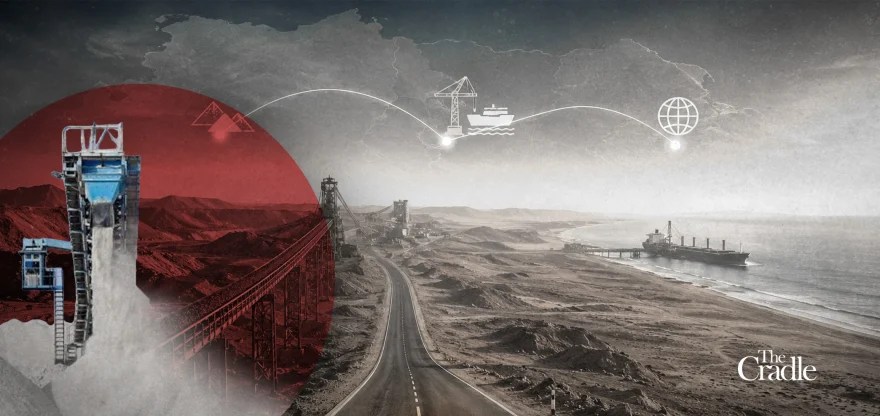
There is a machine in the Sahara you can see from space. A conveyor belt, the longest on earth, nearly one hundred kilometers of steel from a mine called Bou Craa to the Atlantic. For half a century it has moved phosphate out of occupied Western Sahara, through wars, ceasefires, and a promised referendum that never came. The richest layer of the deposit is already gone, sold before the Sahrawis could ever vote on it. And the electricity that keeps the belt running is sold to the state by a wind farm belonging to the king.
On 26 July, US President Donald Trump announced that the highway running past this machine now carries his name. The announcement arrived as a four-minute Truth Social video, narrated by an obvious AI voice praising his “historic courage.” Rabat, six days on, has not said the name out loud. It does not need to. The name was never the payment.
The road is. It is 1,055 kilometers of settlement poured across Africa’s last colony, the kind of road empires have always built and named for themselves. It connects the mine, the port, an Israeli-held offshore block, and the duty-free fertilizer now sailing for New Orleans under an emergency Washington manufactured itself. Follow it far enough and the asphalt runs from phosphate to palace.
An occupation, bought in installments
Every payment has a paper trail, and this one begins five years before the name. The convention that built the road was signed in the presence of Moroccan King Mohammed VI in El-Aaiun (also known as Laayoune) in 2015, on the 40th anniversary of the Green March, at a cost of 10 billion Moroccan dirhams (MAD) – or around $1.074 billion. Morocco poured its annexation in asphalt, as empires always have, long before Washington blessed it. What arrived in December 2020 was not the road. It was the signature.
Morocco became the fourth Arab state to normalize relations with the occupation state, and in exchange the US recognized Moroccan sovereignty over the whole of Western Sahara. Jared Kushner, Trump’s son-in-law, negotiated the deal and supplied the doctrine, likening the Sahara recognition to Trump’s recognition of Israeli sovereignty over the occupied Golan Heights. One occupation legitimized on the template of another. The architect said it so no analyst has to.
Tel Aviv paid its own installment in July 2023, when Netanyahu sent Mohammed VI a letter recognizing the Moroccan claim. A senior Moroccan official explained what the letter was for – Rabat expects the recognition to encourage Israeli investment in the territory. Recognition as prospectus. This is trans-Zionism as designed: the occupation state sets the template, Washington executes, the client kingdom collects.
What the road runs past
South of El-Aaiun, the machine comes back into view. The Bou Craa mine feeds its conveyor belt to the harbor at El-Aaiun, where bulk vessels have carried the territory’s wealth abroad since 1975. According to the figures of the world’s largest phosphate and fertilizer producer, Morocco’s OCP Group, Bou Craa delivers around a fifth of the company’s exports from just eight percent of its extracted volume. That is what occupations are for.
The quality tells its own story. Bou Craa’s deposit sits in two layers, and Western Sahara Resource Watch, which tracks every bulk shipment out of El-Aaiun, documented that Morocco has practically sold off the high-grade layer that should have been available to the Sahrawi people, mining the poorer second seam since 2014. What remains is the residue.
None of this is legally ambiguous. The UN’s legal counsel concluded in 2002 that further exploitation of the territory’s resources against the wishes of its people would violate international law. A South African court ruled in 2018 that ownership of a phosphate cargo from El-Aaiun was never lawfully vested in OCP at all. The company ships stolen goods. A court has said so. The road Trump wants his name on is the overland artery of that trade.
An emergency of Washington’s own making
The American market took the long way round. In 2021, Washington slapped a 19.97 percent countervailing duty on OCP after Florida’s Mosaic Company complained of subsidized competition. The rate yo-yoed for five years until a trade court cut it to 2.11 percent in December 2025 and Washington quietly dropped its appeal. Then came the war.
Washington’s strikes on Iran choked the Strait of Hormuz, the artery for roughly a third of the world’s seaborne fertilizer trade. Prices climbed, farmers rationed, and on 29 June Trump declared a national emergency under a Depression-era clause of the 1930 Tariff Act, suspending the duties entirely. The suspension is time-bound, not volume-bound: a USDA official confirmed OCP can ship unlimited tonnage for eight months. Washington set fire to the supply chain, declared an emergency over the smoke, and handed the normalization partner the keys to the American market.
Now examine what sails in. North African sedimentary phosphate is naturally high in cadmium, a carcinogen the EU capped at 60 milligrams per kilo in its fertilizers. OCP’s response was to lobby against the cap, hiring Dechert LLP and Edelman and proposing Brussels raise the limit to 80. The US has no comparable federal ceiling, leaving oversight to a patchwork of state rules. Europe’s restricted rock has found a market with no thermostat. American capital wasted no time: two weeks after the proclamation, US-based firm Koch Ag signed a joint venture stake in OCP’s fertilizer complex at Jorf Lasfar. The same conglomerate poured half a billion dollars into the occupation state’s tech sector through its investment arm Koch Disruptive Technologies (KDT), built under Eli Groner, Israeli Prime Minister Benjamin Netanyahu’s former top civil servant, settled in the occupied West Bank.
From phosphate to palace
Tracing the flow of revenue shows that it extends beyond the state treasury. OCP belongs to the Moroccan state. But the throne sits atop a parallel structure: the royal family controls roughly 60 percent of the Al-Mada conglomerate through personal holdings named SIGER and ERGIS, both derived from regis, Latin for king, feeding a fund in which Mohammed VI holds 50.6 percent. SIGER’s director, Mounir Majidi, is also the king’s private secretary: one man running the head of state’s office and the family vault.
Al-Mada’s energy arm, Nareva, is where the phosphate money turns royal. The wind farm at Foum el-Oued, built by a wholly-owned Nareva subsidiary, supplies nearly all the electricity OCP needs to mine Bou Craa, run the conveyor belt, and wash the rock for export. The state plunders the phosphate. The king sells the state the power that does the plundering. Every tonne leaving El-Aaiun has burned royal electricity first. All but one wind farm in the occupied territory sits in Nareva’s portfolio, and WSRW poses the question that answers itself: why would a king who profits from occupation ever back a UN peace process?
Moroccan outlet Barlamane reported that quantities invoiced on the expressway far exceeded the work actually built, prompting the equipment minister to bar the implicated survey bureau from public contracts for five years. On the road to Dakhla, even the overcharging is infrastructure.
The name was never the payment
Empires have always paved roads through conquered land and called it civilization. Rome did it, France did it in this same desert, and in July 2026 the tradition produced its densest month yet: duty-free phosphate sailing for New Orleans, Kosh Ag signing into Jorf Lasfar, and an American president naming a highway across a territory that was never Morocco’s to give. The belt at Bou Craa keeps turning, the royal turbines keep spinning, the receipts keep printing – and the only thing Rabat has still not done is say the name out loud.
Iran’s Petrochemical Industry Turns Sanctions Into Domestic Manufacturing Boom
Sputnik – 02.08.2026
Over the years, the US and its allies tried extensively to sanction Iran’s petrochemicals sector into submission through corporate blacklisting, broker interdiction and secondary restrictions. These efforts appear to have failed.
“Last year, more than 2k parts required by the petrochemical industry which had previously been imported were localized by Academic Center for Education, Culture & Research (ACECR) technologists,” senior ACECR official Hamid Saberfarzam has revealed.
“The technical drawings and final books for these components have also been completed and delivered to the petrochemical industry, paving the way for their mass production by domestic manufacturers,” Saberfarzam said.
Iran’s petrochemicals breakthrough is just one component of its “Resistance Economy” ideology, which promotes self-sufficiency across key strategic sectors including:
- Defense (missiles, radar, drones, air defenses, etc)
- Industrial producer goods, including core inputs like steel, cement, glass and insulation materials
- Electricity and power infrastructure
- Refined petroleum
- Food (85-90% food security achieved to date)
- Upstream oil and gas equipment
- Pharmaceuticals and medical supplies
- Passenger and heavy vehicles (~60-80% sufficiency – ~60-95% localization)
- An array of consumer goods, from refrigerators and washing machines to household electronics
Besides industry, Iran is also a scientific powerhouse, ranking in the top five globally in the Australian Strategic Policy Institute’s Critical Technology Tracker in fields from smart, advanced, composite and nanoscale materials, to antibiotics and air-independent propulsion.
BRICS+ Series: Why the Egypt-UAE Energy Partnership Signals a New Phase for the Global South

By Chloe Maluleke and Dr Iqbal Survé | IOL | July 3, 2026
The latest discussions between Egypt and the United Arab Emirates on expanding natural gas production in the Nile Delta represent more than another investment agreement in the energy sector. They illustrate a broader transformation underway across the Middle East and North Africa (MENA), where energy security, technological capability and regional capital are increasingly being mobilised from within the Global South rather than relying exclusively on Western financing and expertise.
For decades, energy partnerships in the MENA region largely followed a familiar pattern. Resource-rich states exported hydrocarbons while multinational energy companies from Europe and North America supplied technology, finance and operational expertise. That model is gradually evolving. Today’s agreements increasingly reflect cooperation between emerging economies that possess complementary strengths and shared strategic interests.
Egypt occupies a unique position in this transition. It is simultaneously an African, Arab and Mediterranean nation, giving it significant geopolitical value. While its domestic gas production has fluctuated in recent years because of declining output from mature fields and rising domestic consumption, Cairo remains determined to restore its status as a regional energy hub. The country’s existing liquefied natural gas (LNG) export infrastructure, strategic location along the Suez Canal and established pipeline connections position it as a gateway linking African producers with European and Asian markets.
The UAE, meanwhile, has become one of the Global South’s most influential sources of investment capital. Emirati sovereign wealth funds and state-backed energy companies are increasingly deploying finance across Africa and the wider Middle East, extending beyond traditional oil investments into renewable energy, logistics, ports and advanced extraction technologies. This reflects Abu Dhabi’s long-term strategy of securing energy assets while diversifying its international investment portfolio.
The proposed expansion of geological exploration in Egypt’s Nile Delta therefore serves multiple strategic purposes. It seeks to increase Egypt’s domestic gas output, reduce reliance on costly imports and strengthen export capacity. Equally important, it demonstrates how regional investors are assuming greater responsibility for financing critical energy infrastructure within their own neighbourhood.
For the MENA region, such cooperation strengthens economic resilience during a period of heightened geopolitical uncertainty. Conflicts across the Middle East, disruptions to shipping routes and volatile commodity prices have reinforced the importance of reliable regional supply chains. Expanding domestic production reduces vulnerability to external shocks while allowing countries greater flexibility in balancing domestic demand with export commitments.
The initiative also reflects the growing importance of technological modernisation in hydrocarbon production. Advanced drilling techniques, digital reservoir management and improved recovery methods are enabling countries to maximise output from existing fields without relying solely on new discoveries. Technology transfer has become as strategically valuable as financial investment, particularly for countries seeking to optimise mature energy assets.
The implications extend well beyond North Africa. Across the Global South, governments are increasingly pursuing development strategies centred on South-South cooperation. Rather than depending exclusively on traditional development partners, countries are building networks of investment, expertise and infrastructure with fellow emerging economies. This approach aligns with a broader effort to reshape international economic governance around more diversified partnerships.
For BRICS, the Egypt-UAE partnership reinforces several long-standing objectives. Egypt’s accession to BRICS expanded the grouping’s presence in Africa and the Arab world, strengthening its representation across key energy-producing regions. Although the UAE is not geographically located within North Africa, its growing investment footprint across the continent complements BRICS’ broader emphasis on infrastructure financing, industrial development and economic integration among developing economies.
The partnership also supports BRICS’ vision of enhancing energy security through diversified production and investment channels. As global energy markets become increasingly fragmented by geopolitical tensions, emerging economies are seeking to reduce exposure to concentrated supply chains and external political risks. Regional cooperation between BRICS members and partner economies helps create a more distributed and resilient energy architecture.
However, challenges remain. Expanding natural gas production requires sustained investment, regulatory certainty and environmental stewardship. Natural gas is frequently presented as a transition fuel capable of supporting economic development while renewable energy capacity expands, yet long-term climate commitments will continue to shape investment decisions. Egypt and the UAE will therefore need to balance immediate energy security objectives with growing international pressure to accelerate decarbonisation. [emphasis added]
Ultimately, the significance of the Egypt-UAE energy discussions lies not simply in additional gas wells or increased reserves. They reflect a deeper shift in how emerging economies are organising capital, technology and political partnerships. As the Global South assumes a more active role in financing its own development, regional cooperation is becoming an increasingly important pillar of economic resilience. In that sense, the Nile Delta may represent not only a source of natural gas, but also a symbol of a changing global economic order in which the future of energy is being shaped as much by cooperation within the Global South as by traditional centres of power.
Dr Iqbal Survé is a past chairman of the BRICS Business Council and co-chairman of the BRICS Media Forum and the BRNN.
Chloe Maluleke is an Associate at BRICS+ Consulting Group, Russia & Middle East Specialist.
India’s reluctance to confront US over Chabahar attacks exposes contradictions in its Iran policy: Journalist
Press TV – July 26, 2026
India’s continued reluctance to openly challenge Washington despite the recent US attacks on Iran, including the strategic coastal city of Chabahar, has exposed the contradictions at the heart of New Delhi’s foreign policy, says an Indian journalist and foreign policy analyst.
Speaking to the Press TV website, Sanjay Kapoor, founder and editor of Hardnews magazine and president of the Editors Guild of India, said India’s approach towards Chabahar has never been independent of US policy on Iran, noting that New Delhi has consistently calibrated its engagement with the strategic Iranian port around Washington’s broader regional strategy.
“India decided to take up the Chabahar project only after then US President Barack Obama had signed the JCPOA and there was a global attempt to normalise ties with Iran,” Kapoor said.
He noted that India, like many other countries, had also severed its energy relationship with Iran after Washington instructed New Delhi to stop purchasing Iranian oil, underscoring India’s willingness to accommodate American concerns over the Islamic Republic.
“India also cut energy ties with Iran after the US told New Delhi to stop buying Persian oil. In other words, India has been mindful of US concerns on Iran,” he stated.
Kapoor said the Bharatiya Janata Party (BJP)-led government in New Delhi has simultaneously cultivated close strategic relations with Israel, a policy that has further aligned India’s foreign policy with that of Washington.
“Besides, this BJP government has been close to Israel also, which ensures that New Delhi stays close to the US and its foreign policy,” he told the Press TV website.
His remarks follow the recent US aggression against southern Iran, during which the port city of Chabahar was also targeted, raising questions over the future of India’s flagship connectivity project in the region and whether New Delhi can continue portraying the port as a strategic priority while avoiding direct criticism of US attacks on Iranian territory.
Located on Iran’s southeastern coast, Chabahar has long been regarded as India’s gateway to Afghanistan and Central Asia, allowing it to bypass Pakistan while providing Tehran with an important regional trade hub.
India has invested in developing the Shahid Beheshti terminal of the port, viewing Chabahar as a counterweight to Pakistan’s Gwadar Port under the China-Pakistan Economic Corridor (CPEC).
Deep historical ties have not translated into strategic consistency
Despite India’s cautious approach in recent years, Kapoor told the Press TV website that relations between Iran and India rest on centuries of historical, cultural and religious interaction.
He pointed out that India is home to the world’s second-largest Shia population after Iran, adding that religious links between the two countries continue to shape people-to-people relations.
He also referred to Imam Khomeini’s old ties with his hometown, Lucknow, the capital of northern India’s biggest state, Uttar Pradesh.
“There is continuous interaction between the Shia clergy in India with their counterparts in Iran and Iraq,” he noted, adding that Iran has traditionally viewed India differently from many other countries, pointing to the longstanding cultural affinity between the two civilizations.
“Iran also never saw India as a foreign country. They also perceive Kashmir in India as Iran-e-Sagheer (little Iran),” he said, referring to the Muslim-majority Himalayan region of Kashmir in northern India.
Kapoor argued that successive governments in New Delhi believed these deep-rooted ties would allow India to preserve its relationship with Tehran even while strengthening strategic cooperation with Washington.
“The Indian government under the BJP always believed that they will manage substantial ties with Iran like they managed the Chabahar Port,” he stated.
However, he maintained that New Delhi ultimately regarded alignment with the United States as the more pressing strategic priority.
“For whatever reason, they thought they had more compelling reason to align themselves with the US. They believed that Iran could wait,” Kapoor remarked.
According to the veteran journalist, India’s reluctance to publicly support Iran stems less from hostility towards Tehran than from its determination to remain aligned with Washington’s geopolitical ambitions.
“Their reluctance to support Iran openly is due to their desperation to be on the right side of the US,” he stressed.
He believes Indian policymakers expect the current regional situation to evolve and remain confident that New Delhi’s long-standing doctrine of strategic autonomy will eventually enable it to restore any damage to bilateral relations.
“They believe that what’s happening is transitory and the final outcome will look different from now. Their resort to strategic autonomy in their foreign policy will give them a chance to make up with the Iranian government,” Kapoor said.
US attacks have exposed the fragility of India’s Chabahar strategy
Kapoor said Chabahar was originally conceived as a stable alternative to Iran’s other major ports, making it particularly attractive to India when Tehran offered New Delhi the opportunity to develop the Shahid Beheshti terminal.
“Chabahar was meant to be away from the ferment that used to be in Bandar Abbas. It was expected to be stable and peaceful. That was the unique selling point of Chabahar when its terminal, Shahid Beheshti, was offered to India by the government of Iran,” he said.
However, he said the recent US attacks around the port have fundamentally altered those assumptions.
“For some strange reason, Chabahar is facing the ire of US attacks. They have misiled and bombed the port.”
Kapoor questioned New Delhi’s claim that Indian infrastructure at the port escaped damage during the attacks.
“The Indian government says Indian infrastructure has not been lost due to the attack. That’s saying a bit much,” he added.
The senior Indian journalist noted that New Delhi invested approximately $120 million in the Shahid Beheshti terminal but deliberately limited further investment because US sanctions made financing increasingly difficult.
According to Kapoor, Russian government sources have previously indicated that Moscow helped India overcome funding shortages for the project on several occasions.
Despite maintaining its presence at Chabahar for years, Kapoor argued that New Delhi never fully embraced the project.
“Despite soldiering on for many years, India always remained a reluctant partner,” he said.
Kapoor said many Iranian experts have long argued that Tehran deliberately preserved Chabahar as an opportunity for India despite having other potential partners.
“As many Iranian experts told me, Tehran had kept Chabahar for India,” he told the Press TV website. “They argue that if they had wanted, they could have given the port to Pakistan, China or even Russia.”
He said India’s strategic calculations changed significantly after the United States withdrew from Afghanistan, removing one of the principal reasons behind New Delhi’s investment in the Iranian port.
“India thought Chabahar had become untenable after the US left Afghanistan,” he said.
Rather than engaging with Afghanistan’s new Taliban-led government, Kapoor said India shifted its focus to alternative connectivity initiatives backed by Washington and several of its regional partners.
The journalist believes India’s regional priorities have increasingly shifted away from Chabahar towards the India-Middle East-Europe Economic Corridor (IMEC), a US-backed connectivity initiative linking India with Europe through the UAE, Saudi Arabia, Israeli-occupied territories and Mediterranean countries such as Greece and Italy.
“India did not want to negotiate with the Taliban and happily became part of IMEC, which promised a lot, including a seat on the G7 high table,” he stated.
Kapoor recalled that speculation briefly emerged in Indian media about reviving New Delhi’s engagement with Chabahar following the signing of a memorandum of understanding (MoU) between Tehran and Washington. However, he said those expectations quickly faded once the ceasefire broke down and US attacks on Iran resumed.
India depends on Afghanistan and Washington’s calculations
Asked whether the long-term success of Chabahar ultimately depends on Iran’s stability and sovereignty, Kapoor said New Delhi’s strategic calculations extend beyond developments inside Iran.
“Chabahar’s stability depends, in India’s estimation, on who controls Afghanistan and on how the US perceives the port,” he noted.
He explained that India’s primary motivation for investing in Chabahar was never limited to commercial interests alone but centred on gaining direct access to Afghanistan while bypassing Pakistan.
According to Kapoor, changes in the regional geopolitical landscape have complicated those calculations.
“My contention may not square with the views of others, but India would only make a pitch for Chabahar if it doesn’t elicit a hostile response from its (Persian) Gulf partners and that’s only possible if Washington is backing India to help Afghanistan as well as support against Pakistan,” he said.
He argued that Pakistan remains a central factor in India’s strategic thinking, noting that the evolving military balance in South Asia following the recent war against Iran has further complicated New Delhi’s decision-making.
“After the recent war in West Asia, there has been a shift and Pakistan is better off militarily. What happens next will impact India’s policy towards Chabahar,” he remarked.
To Kapoor, India’s future investment in the port will depend primarily on the trajectory of Iran-US relations and Pakistan’s regional position.
“To sum up, India will invest in Chabahar if the US builds working relations with Iran and Pakistan is on the defensive due to this.”
Relations with Israel carry long-term risks
Kapoor said India’s growing partnership with Israel inevitably raises questions in Iran about the future direction of bilateral relations.
“Ordinarily, the trust that India and Iran enjoy should get eroded after PM Modi was in Tel Aviv just days before the war broke out,” the Indian journalist stated.
“The moot question that Iran should ask itself is whether India is a friend or a foe,” he added, pointing to the numerous interactions between Indian and Israeli leaders in recent years.
He added that despite increasing strategic cooperation with Israel and close ties with Washington, India has so far managed to preserve working relations with Iran.
According to Kapoor, New Delhi appears confident that it can maintain relations with “both sides” without suffering major diplomatic consequences.
Beijing blacklists 14 EU firms after Brussels targets Chinese companies in latest Russia sanctions package
The Cradle | July 25, 2026
Beijing prohibited 14 EU companies from obtaining Chinese dual-use goods on 24 July, targeting Europe’s defense industry shortly after the EU included 14 Chinese and Hong Kong firms in its 21st sanctions package against Russia.
Announcing the measures with immediate effect, the Chinese Commerce Ministry called the bloc’s conduct “egregious” and demanded the EU “immediately correct its wrongdoing, eliminate the egregious impact, and safeguard the overall interests of China–EU relations with concrete actions.”
The restrictions cover dual-use items, goods, software, and technology with both civilian and military applications, including rare earth elements used to build drones and chips.
Parties outside China are also barred from transferring Chinese-origin dual-use goods to any listed entity, though exporters may request permission in exceptional cases or when a shipment is deemed “truly necessary.”
Rheinmetall leads the list, alongside Polish electronics producer Vigo Photonics, Italian electric motor manufacturer Lafert, French drone developer Cavok UAS, Czech truckmaker Tatra, Dutch naval engineering firm IHC Merwede, and several optics and laser companies.
Germany and France each have three entries, Italy and Poland each have two, and the Netherlands, the Czech Republic, Bulgaria, and Lithuania each have one.
China’s mission to the EU lodged a formal protest, voicing “strong dissatisfaction and firm opposition” to the measures and rejecting attempts by the bloc to place responsibility for the war in Ukraine on Beijing.
It added that China “firmly opposes the EU’s unwarranted listing and sanctioning of Chinese companies and citizens.”
The 21st package subjected 51 entities to tighter export curbs on dual-use goods and technologies over their support for Russia’s military and industrial complex.
Companies based in India, Turkiye, and the UAE were listed alongside those from mainland China and Hong Kong.
Brussels targeted small trade and logistics operators in port cities like Guangzhou, Shenzhen, and Dalian, while Beijing focused on Europe’s defense industry.
Cui Hongjian, a former diplomat who heads European studies at Beijing Foreign Studies University, told the South China Morning Post (SCMP) that the disparity does not make the response any less reciprocal from Beijing’s perspective, noting that successive EU packages have named far more Chinese firms overall than China has named in return.
“Since this whole episode arose from the Russia-Ukraine war, I think it’s understandable that China is now pointing its retaliation at Rheinmetall,” Cui said. “From Beijing’s point of view, if it’s going to retaliate, the retaliation has to bite.”
Bankrupt and fraudulent: EU sanctions Russia while silent on U.S., Israeli genocide
Strategic Culture Foundation | July 24, 2026
European Union leaders imposed yet another raft of sanctions on the Russian Federation this week. This is the 21st package of political and economic strictures that the 27-nation bloc has deployed against Russia over the past four years.
The EU sanctimoniously claims that the measures are a demonstration of rebuke for Russia’s alleged unprovoked aggression and invasion of Ukraine in February 2022.
This pretense of European principle is farcical.
Anyone who has objectively studied the Ukraine conflict knows that the United States and its European NATO partners incited the war by orchestrating the violent coup in Kiev in 2014, followed by the deliberate weaponizing of the NeoNazi regime that the Western imperialists covertly directed for a geopolitical confrontation with Russia. That many people aren’t aware of that history is largely due to the brainwashing propaganda of the Western media.
The EU’s sanctions policy is therefore properly understood as economic warfare, and as supplementary to a larger military strategy to defeat Russia. It is part of “Total War,” as a former French finance minister clumsily admitted in March, 2022.
While the NATO-armed Ukrainian regime steps up long-range air strikes deep in Russia in an attempt to damage oil and gas infrastructure and the Russian economy, the EU’s sanctions are aimed at achieving the same objective.
This has nothing to do with using trade and financial measures to show political and moral support for Ukraine as an alleged victim of Russian aggression. It is all about maximising confrontation with Russia to defeat it.
The use of unilateral sanctions is illegal under international law and expressly prohibited by the United Nations Charter. They constitute a form of criminal aggression. The EU is in criminal violation of international law, as is the U.S., which also blatantly wields sanctions to intimidate other nations, currently 30, including Russia, China, Iran and Cuba.
In any case, the EU’s policy meets the definition of insanity, as manifested by repeating a futile action multiple times and expecting a different result.
Russia is arguably the most sanctioned country in the world given the 21 rounds that the EU has fired and the hundreds of banks and other businesses that it has targeted. Yet Russia’s economy has not buckled, as desired.
Even more insanely, it is the European economies that have suffered grievously from the self-imposed exclusion of trade and business with Russia, particularly the loss of affordable energy supplies. The EU is rapidly deindustrializing due to soaring economic costs. Germany, once the economic powerhouse of Europe, is crippled as it imports more expensive American fuel in place of the traditional Russian supplies which historically underpinned Europe’s industries.
European citizens – a combined population of 500 million – are hit with a calamitous cost-of-living crisis that in large measure is caused by the sanctions policy of their political leaders. These so-called leaders are decimating their own economies and societies.
The bankruptcy is political and moral. The strains are showing within EU member nations, as seen from the wrangling and watering down of the latest round of sanctions. Several countries were clamoring for exemptions to limit damage to their national interests.
Greece wanted waivers on restrictions over its international shipping of Russian oil and gas. Germany and Portugal wanted exemptions from sanctions on Russian fisheries. Austria, Bulgaria, France, and Italy also appealed for curbing prohibitions to protect their various interests.
As Euronews headlined: “Chaotic sanctions negotiations expose cracks in EU front versus Russia.”
The outlet reported that the collective policy is starting to harm national interests, which is leading to infighting among the EU members.
“It’s getting more and more difficult to find common ground. We saw that this week,” said one diplomat about the fractious negotiations.
Another diplomat commented: “The [European] Commission [the EU’s executive branch] is running out of options for what to include. It has to become more creative, and every package is more complex and takes longer to negotiate.”
In other words, the policymakers in Brussels are insolvent from failing political ideas over their illegal sanctions. They are also politically bankrupt because these elitist, Russophobic officials are making European citizens suffer severe economic consequences without any democratic mandate. They are imposing a ruinous policy like a dictatorship, one that is aggravating tensions and hostilities towards all-out war.
European elites have caused two world wars already over the past century; they seem to be driving a third one.
But here is the kicker: this insane policy is a total fraud. It is bereft of any supposed righteousness or avowed concern for Ukraine and the defense of democracy.
The hypocrisy is glaringly exposed by the European Union’s indifference to war crimes that the United States and the Israeli regime are perpetrating on a massive scale.
As former European Members of Parliament Mick Wallace and Clare Daly pointed out this week, the EU leadership has said nothing about the United States waging a war of aggression against Iran now in its fifth month. Thousands of Iranians have been killed by American and Israeli bombing, and U.S. President Donald Trump is repeatedly making genocidal threats to destroy the nation, diabolically hinting at the use of nuclear weapons.
On the other side of the world, as Wallace and Daly also note, thousands of children in Cuba are being starved to death under a maximum blockade on the island country by Washington. The EU has made not the slightest criticism of the U.S., never mind any condemnation of this barbarism.
This week, as European elites were drawing up their 21st round of dubious sanctions on Russia, the same officials declined to issue any sanctions against the Israeli regime for its ongoing genocide against Palestinians, a genocide enabled by the U.S. and, it has to be said, by European countries trading with Israel.
The double standard of the EU leadership is not just idiotic duplicity. It is proof of its political and moral bankruptcy and systemic fraud. There was a time when some European politicians would speak out to oppose U.S. wars and crimes. Not anymore. The entire European political class is putrid from corruption and complicity.
On so many levels, the EU sanctions on Russia are self-defeating. The ultimate defeat is the fatal corrosion of its own institutions and abject lack of authority. European politicians are delegitimizing themselves and their claim to govern. People of Europe and around the world can see what the EU has become: an elitist warmongering project that is sacrificing its own citizens.
No route around Hormuz: Why West Asia’s pipeline alternatives fall short
The rush to bypass Hormuz leads back to the same problem: Every alternative route remains hostage to war, rival chokepoints, or political disputes.
By Hussein Askary | The Cradle | July 23, 2026
“The only alternative to the Strait of Hormuz is the Strait of Hormuz.”
This blunt assessment, offered by an Iraqi expert in a recent interview, captures the central weakness in the rush to revive old pipeline schemes and promote new ones across West Asia. Since Iran effectively closed the Strait of Hormuz after Israel and the US launched their second war against it in February 2026, the region has been flooded with proposals for alternative oil-export routes.
Washington has encouraged these plans, while several governments have presented dormant or unfinished pipelines as strategic solutions. Yet the closer one looks at geography, markets, costs, capacity, and security, the clearer it becomes that most of these projects cannot substitute for Hormuz.
Even if oil bypasses the strait, it still faces the rival chokepoint of Bab al-Mandab, where the Ansarallah-aligned armed forces have declared a maritime blockade against Saudi Arabia and attacked Saudi tankers.
These expensive detours will remain exposed unless security in the Persian Gulf itself improves. Until the war on Iran ends and an inclusive regional security architecture is established, Iranian and Yemeni missiles and drones can reach the pipelines and loading terminals built to evade them.
Asia still runs through Hormuz
The first reason is straightforward. The Strait of Hormuz is the natural outlet of the Gulf energy system. In 2024, oil flows through the strait averaged about 20 million barrels per day (bpd), roughly one-fifth of global petroleum liquids consumption. The International Energy Agency (IEA) describes it as one of the world’s most important oil transit chokepoints.
Most of this oil is not heading west. About 80 percent of the oil moving through Hormuz is destined for Asia, with China, India, Japan, South Korea, and other Asian economies as the principal buyers. The pattern is even clearer for liquefied natural gas (LNG).
The US Energy Information Administration estimated that 83 percent of LNG moving through Hormuz in 2024 went from Persian Gulf exporters to Asian markets, especially China, India, and South Korea.
This market reality matters because many proposed alternatives send oil away from its main customers. Pipelines to the Mediterranean, the Red Sea, or the Levant may appear useful on a map, but they often move Gulf crude farther from Asia rather than closer to it.
Commercially, building multibillion-dollar infrastructure to move oil westward, only to redirect it by sea toward Asian markets, is inefficient. If Hormuz is open, the direct route remains cheaper and faster. If it is closed by war, the underlying problem is not a lack of pipelines but the collapse of regional security.
Old routes, unresolved disputes
The older pipeline options illustrate the point. The Kirkuk–Baniyas pipeline once carried Iraqi oil across Syria to the Mediterranean. Built in the early 1950s, it had genuine strategic value in its time but has been largely inactive since it was damaged during the 2003 US-led invasion of Iraq. Washington is now backing efforts to revive the route, with US companies expected to play a role. Yet the project still requires extensive reconstruction and years of work before it can provide meaningful export capacity.
Estimates for a full restoration and expansion to around 700,000 bpd run as high as $8 billion. It cannot answer an immediate crisis in Hormuz, and if regional peace is restored before completion, the commercial case for reviving it weakens sharply.
The Iraq–Turkiye pipeline faces a different but equally serious problem: politics. The route through the Kurdistan region to Turkiye’s Mediterranean port of Ceyhan was repeatedly interrupted by disputes among Baghdad, the Kurdistan Regional Government (KRG), Ankara, and international oil companies.
A 2023 arbitration ruling against Turkiye over unauthorized Kurdish exports led to a two-and-a-half-year shutdown. Flows resumed in September 2025, and exports have continued, but the route still depends on fragile agreements over contracts, payments, federal authority, and revenue sharing.
Its limited throughput and political vulnerability prevent it from becoming a structural replacement for a maritime passage that normally carries a vast share of the world’s seaborne oil.
The Iraqi pipeline in Saudi Arabia, known as IPSA, is another example of strategic nostalgia. Built in the 1980s during the Iran–Iraq war, it was designed to move Iraqi crude from the Basra region to the Red Sea.
It stopped operating after Iraq’s 1990 invasion of Kuwait, and Saudi Arabia expropriated it in 2001. Reopening the line would therefore require a Saudi–Iraqi political settlement over ownership and control, as well as a major technical assessment after decades of disuse. In other words, IPSA is not an available alternative; it is a diplomatic and engineering problem dressed up as a solution.
The proposed Basra–Aqaba pipeline is even more controversial. Its advertised purpose is to move Iraqi oil from southern Iraq to Jordan’s Red Sea port of Aqaba, bypassing Hormuz. Yet it has faced intense objections inside Iraq because of its projected cost, uncertain financing, and questionable strategic value.
Since much of Iraq’s crude is sold to Asian customers, sending it westward to Aqaba would add distance and complexity rather than solve the basic market problem. The pipeline would also move Iraqi exports closer to another zone of instability, including the Israeli military sphere and the wider Red Sea security environment.
A bypass route that merely exchanges one security risk for another is no solution. Iraq’s severe fiscal pressures also leave Baghdad poorly placed to finance such an expensive project, while international investors are unlikely to embrace it without strong political and security guarantees.
Bypasses within missile range
The existing Saudi and Emirati bypasses are more credible but still limited. Saudi Arabia’s East–West Pipeline, or Petroline, moves crude from the eastern oil region to Yanbu on the Red Sea. The UAE’s Abu Dhabi Crude Oil Pipeline carries oil from Habshan to Fujairah on the Gulf of Oman.
These systems reduce exposure to Hormuz for Saudi Arabia and the UAE and have become important national energy-security assets. But they cannot replace the strait for the region as a whole. They offer little to Kuwait, Qatar, Bahrain, Iran, or most Iraqi exports, and they do not solve the LNG problem, especially Qatar’s dependence on Hormuz.
The IEA estimates that only 3.5 to 5.5 million bpd of spare pipeline capacity is available to bypass the strait. Neither Yanbu nor Fujairah are immune from attack; regional conflict has already shown the vulnerability of ports, tankers, and energy infrastructure.
The crisis pipelines cannot solve
This is why the alternative pipeline debate is misleading. It treats the closure of Hormuz as a logistical puzzle when it is primarily a political and security crisis. If the Persian Gulf remains militarized and unstable, no pipeline network can fully protect exports.
Pipelines cross vulnerable territory, depend on political agreements, and terminate at ports that can also be threatened. If Gulf security improves, however, Hormuz will almost certainly reopen because this serves the interests of producers and Asian consumers alike.
Once that happens, the commercial rationale for many alternative pipelines will fade. Why spend tens of billions of dollars duplicating a natural route with unmatched capacity and direct access to the main buyers?
The more honest conclusion is that alternative pipelines may offer limited resilience for individual states, but they are no strategic replacement for Hormuz. They are costly, slow, politically fragile, geographically inefficient, and in some cases obsolete before construction begins.
The answer to the crisis is a security arrangement that keeps the Persian Gulf open, prevents attacks on shipping, and restores normal trade through the strait.
Under such an arrangement, oil and LNG would continue to flow mainly to Asia by the most direct and economical route. Hormuz will remain indispensable, while the grand pipeline alternatives amount to expensive insurance policies against a crisis that only diplomacy and regional peace can resolve.
Featured Video

Iran’s Next Strike May Not Explode. It Could Shut You Down
or go to
Aletho News Archives – Video-Images
From the Archive
Zionism’s Violent Legacy
By Donald Neff | Washington Report On Middle East Affairs | January 1996
On January 4, 1948, Jewish terrorists drove a truck loaded with explosives into the center of the all Arab city of Jaffa and detonated it, killing 26 and wounding around 100 Palestinian men, women and children.[1] The attack was the work of the Irgun Zvai Leumi – the “National Military Organization,” also known by the Hebrew letters Etzel – the largest Jewish terrorist group in Palestine. The Irgun was headed by Revisionist Zionist Menachem Begin and had been killing and maiming Arabs, Britons and even Jews for the previous ten years in its efforts to establish a Jewish state.
This terror campaign meant that at the core of Revisionist Zionism there existed a philosophical embrace of violence. … continue
Blog Roll
 Aletho News
- Trump’s Iran war is on an Israeli leash
- Saudi oil boss issues global supply warning
- Riyadh Says Its Oil System Is Intact. The Numbers Say Otherwise.
- Trump and Netanyahu Want to “Finish the Job” on Iran
- US ‘one-sided dictation’ not Iran’s beliefs makes rational talks impossible: Baghaei
- Iran’s Next Strike May Not Explode. It Could Shut You Down /Col Doug Macgregor
- Iran: US political targets legitimate if assassinations return
- Iraq shuts key border crossing with Iran under US pressure: Report
- Undersea Internet cables could be targeted in retaliation for attacks on Iran: IRGC deputy chief
- EU sending ‘biased’ observers to interfere in Serbian election – president
- If Americans Knew
- The Israel Lobby’s Changing Fortunes
- AIPAC has become such a political liability that it’s shifting to a more “nimble” approach to buying politicians
- At least 160 Israeli settler attacks in 2 weeks
- Will Gaza’s Ancient Christian Community Disappear Forever?
- Israel’s vision of regional security rests on keeping Arab states weak
- Heidi Levine recounts how Palestinian youths helped save her in settler attack
- DAILY UPDATE: Latest essential news on Palestine, Israel, & region
- Trump’s Intensifying Sabotage of the ICC, for Israel’s Sake
- Israeli military detain US and UK volunteers in West Bank including Democratic NY politician Brad Lander
- Americans at National Conservatism Conference held in Israel this year criticize Israel
- No Tricks Zone
- E-Cars Reduce CO2 Emissions By Only 41% Compared To Internal Combustion Engine Vehicles
- Predictions Made By Renowned Climate Professor Over Past Decades Have Been Proven To Be Poor
- New Study Suggests Large Regions Of The Pacific Ocean Have Been Cooling For The Last 80 Years
- Germany’s Green Energy Debacle: High Energy Costs Force Kahla Porzellan to Close After 182 Years!
- New Study: 50 Years Of The Most Aggressive ‘Net Zero’ Policies Can Only Affect The Global Climate By 0.03°C
- US September “Heat” Was No Record…Many Records Set Decades Ago
- Latest European Green Energy Debacle; Portugal’s Largest Flagship Solar Park Insolvent!
- Green Energy Debacle: German Expert Professor Fritz Vahrenholt Warns Of Severe Economic And Social Consequences
- Two More Paleo Reconstructions Affirm Meters-Higher Sea Levels Across Ireland, Brazil 7000-6000 Years Ago
- New Study: Earth And Venus Surface Warmth Largely Explained By Convection And Lapse Rate, Not CO2 Or Radiation

