Climate Alarmism and Malthusianism (rebuttal to Taylor)
By Robert Bradley Jr. – Master Resource – February 25, 2020
“The pseudo-intellectual right loves to compare climate concern and action with Malthusianism. I’ve never quite understood what the heck these things have in common.” (Jerry Taylor, October 13, 2019)
“What environmentalists mainly say … is not that we are running out of energy but that we are running out of environment–that is, running out of the capacity of air, water, soil and biota to absorb, without intolerable consequences for human well-being, the effects of energy extraction, transport, transformation and use.” (John Holdren, April 2002)
Jerry Taylor, please read the literature before opining on such matters as energy and the environment. Climate change is the latest Malthusian scare, per John Holdren. And the common denominator of the Malthusian worldview is overpopulation, as Pierre Desrochers and Joanna Szurmak document in Population Bombed! Exploding the Link Between Overpopulation and Climate Change (2018).
Some quotations from Population Bombed cement the tie-in:
- Numerous population control advocates have linked anthropogenic climate change to population growth, or tried to revive interest in invoking anthropogenic climate change as the key negative outcome of continued economic growth linked to, foremost among causes, an increasing population.
- … population Bomber” himself, Paul Ehrlich … during a conference in 1968 identified anthropogenic carbon dioxide emissions as a “serious limiting factor” to economic growth.
- By the 1970s, Ehrlich, his wife Anne and his collaborator John Holdren raised fears that carbon dioxide “produced by combustion of fossil fuels in quantities too large to contain” may “already be influencing climate” and, as such, constituted one of the “gravest threats to human well-being. . . [i.e.] the loss of natural services now provided by biogeochemical processes.”
- [Julian] Simon then summarized the position of most environmentalists as follows: “But isn’t obvious. . . that additional people and additional economic growth will cause us to use more energy and hence emit more greenhouse gases? Therefore, even if we can’t be sure of the greenhouse effect, wouldn’t it be prudent to cut back on growth?”
- The economist Jacqueline Kasun similarly believed at the time that “by the 1990s the doomsayers had shifted their attack” as they could no longer invoke resource depletion as the key growth-limiting issue. As she wrote, “the alarmists didn’t miss a step. The problem, they now said, was that people were using too much energy and were causing Global Warming.”
- Canadian academic Michael Hart has commented that “for alarmists, climate mitigation policy is as much a means of achieving their larger goals as it is a matter of addressing a possibly serious issue.”
- Canadian academic, historical climatologist Tim Ball, has long argued, the climate change policy agenda is based on certain assumptions ultimately related to a fear of reaching another terrestrial set of limits through overpopulation.
- Maurice Strong (1929–2015), who was described by business journalist Peter Foster as “[m]ore than any other individual. . . responsible for promoting the [UN] climate agenda,” … [stated] “with a growing global population, we will have to recognise that having children is not just a personal issue but a societal issue and at a certain point we may be faced with a need to have a permit to have a child.”
- [Strong] also referred to the need for “national population policies” in his opening speech at the 1972 Stockholm Conference. Strong reportedly stated the following Malthusian prediction at the 1992 Earth Summit: “Either we reduce the world’s population voluntarily or nature will do this for us, but brutally.”
- The first chairman of the IPCC (1988-1997), Bert Bolin, was not only an early convert to the alleged catastrophic impact of CO2 emissions, but also a pessimist on population and resources issues, as evidenced in his stance on the controversy surrounding the 2001 publication of The Skeptical Environmentalist by the Danish political scientist Bjorn Lomborg.
- John Holdren contradicted many of his earlier warnings of imminent resource depletion by arguing that while the word was not “running out of energy,” it was “running out of environment,” by which he meant “running out of the capacity of air, water, soil and biota to absorb, without intolerable consequences for human well-being, the effects of energy extraction, transport, transformation and use.”
- The second chairman of the IPCC (1997–2002), Robert Watson, would later go on the record with the following line of reasoning: “The more people we have on the Earth and the richer they are, the more they can demand resources. There’s more demand for food, more demand for water, more demand for energy. . . So, there’s no question the threats on the Earth today are far more than, say, 50 years ago and in 50 years’ time, there will even be more threats.”
- The third chairman of the IPCC (2002-2015), Rajendra K. Pachauri … was “not going to rest easy until [he has] articulated in every possible forum the need to bring about major structural changes in economic growth and development. That’s the real issue. Climate change is just a part of it.”
- … Timothy E. Wirth, one of the main organizers of the 1988 James Hansen hearing on climate change, and from 1998 to 2013 president of the (hardcore Malthusian) … is on the record as stating in 1993: “We’ve got to ride this global warming issue. Even if the theory of global warming is wrong, we will be doing the right thing in terms of economic and environmental policy.
Other documentation from Desrochers and Szurmak includes the views of Christine Stewart, then Canadian Minister of the Environment; Connie Hedegaard, European Commissioner for Climate Action (2010–2014); Executive Secretary of the United Nations Framework Convention on Climate Change, Christiana Figueres ; Professor Hans Joachim Schellnhuber, the director of the Potsdam Institute for Climate Impact Research; researchers associated with the Population Reference Bureau and the Worldwatch Institute; Canadian climate scientist Andrew Weaver of the British Columbia Green Party; and the late climatologist Stephen Schneider
So what are the climate Malthusians missing? The same thing as before: human ingenuity. Desrochers and Szurmak note:
… there is ample evidence of a passionate commitment towards the protection of the planet, but there is no sign of recognition that humanity can do, and has done, more than simply consume resources. At no point do neo-Malthusians admit the possibility that technological innovations and human creativity have a place among the things that deserve a place on Earth. What pessimist activists desire is a consensus on the classification of humanity as out of control and inherently driven by destructive greed, thus in need of top-down regulation by the few remaining clear-thinking and benign autocrats – that is, functionaries – of the global government.
Buyer beware of climate alarmism and Malthusianism.
Back to Fukushima. Former residents weigh up returning to nuclear ghost town of Okuma
RT Documentary • December 12, 2019
In March 2011, an earthquake hit Japan, setting off a tsunami that caused an accident at the Daiichi nuclear power station in Fukushima prefecture. Radioactive contamination settled on the surrounding area, and the authorities decided to evacuate the population living within a 20km radius around the power station.
Watch full video here: https://rtd.rt.com/023wp
Eight years later, inhabitants of the town closest to the nuclear disaster, Okuma, were allowed to move back to some of its territory. RTD takes a bittersweet tour of the nuclear ghost town with former residents considering whether to return to their hometown, and meets those who have already moved into new homes built in a less-contaminated part of town. Torn between loyalty to their roots and the desire to build a future for themselves, the people of Fukushima now have an agonising choice to make.
Do ‘green’ buses pass the performance test?
Do they even pass basic energy, environmental, economic and human rights tests?

By Duggan Flanakin | Watts Up With That? | February 15, 2020
Should Americans follow China in a massive commitment to supposedly eco-friendly battery-electric buses (BEBs)? California has mandated a “carbon-free” bus system by 2040 and will buy only battery or fuel cell-powered buses after 2029. Other states and cities are following suit.
Vehicle decisions are typically based on cost and performance. Cost includes selling price plus maintenance, while performance now includes perceived environmental impacts – which for some is the only issue that matters. But that perception ignores some huge ecological (and human rights) issues.
China today has 420,000 BEBs on the road, with plans to reach 600,000 by 2025. The rest of the world has maybe 5,000 of these expensive, short-range buses. However, the Chinese still get 70% of their energy from coal, so are their BEBs really that green? Are they safe? And are they really ethical?
Battery costs are the main reason BEBs today are much more expensive than buses that run on diesel or compressed natural gas. But bus makers say electric buses require less maintenance, and climate activists say the lower net “carbon footprint” (carbon dioxide emissions) justifies paying a little more.
China gets around the up-front cost problem by establishing national mandates, heavily subsidizing bus (and battery) manufacturers, and rewarding cities that replace entire bus fleets at one time. This ensures that their factories benefit from economies of scale – and that the transition will be swift and complete.
Beijing simply dodges the environmental costs by ignoring the fossil fuels, horrific pollution and human illnesses involved in mining, ore processing and manufacturing processes associated with building the buses. California and other “renewable” energy advocates do likewise. In fact, those costs will skyrocket as China, and the world emphasize electric vehicle, wind, solar and battery technologies.
Meanwhile, the USA and EU nations focus on subsidizing passenger cars. Thus, there are far more zero-emission passenger cars on the road today in the U.S. and Europe than public transit vehicles. No wonder Westerners still view electric vehicles as subsidized luxuries for the “woke wealthy,” who boast about lowering their carbon footprint, despite also often needing fossil fuel electricity to charge batteries.
The huge costs for fast-charging stations across Europe, let alone the vast United States, pose more huge challenges for future expansion of the electric vehicle market. But transit vehicles, even school buses, run regular routes, and if the routes are short enough, the bus can be recharged overnight in the garages.
Tax credits, free HOV lane access, free charging stations and other subsidies for the rich are seen by most as terrible policies. Yet another, says University of California–Davis researcher Hanjiro Ambrose, is the Federal Transit Administration funding formulas that favor short-term cost-efficiency over long-term innovation. “Those funding mechanisms haven’t been aligned with trying to stimulate policy change,” Ambrose says. “The cheapest technology available isn’t usually the newest technology available.”
To work around high upfront battery costs, innovative capitalists are creating new financial products that allow fleet owners to finance battery purchases. Treating battery costs the same way as fuel costs – as ongoing expenses – meets federal guidelines. Matt Horton, chief commercial officer for U.S. BEB maker Proterra, says, “The importance of the private capital coming into this market cannot be understated.”
Green advocates admit the primary reason people choose EVs is their belief that electric cars and buses, even with electricity generated from fossil fuels, are good for the environment. The Union of Concerned Scientists claims BEBs are 2.5 times cleaner in terms of lifespan emissions than diesel buses. That is highly questionable. Moreover, BEBs with today’s strongest batteries can take a full load no more than 150 miles in good weather. That’s fine for airport shuttles, maybe even for short public transit routes.
However, electric battery life is shorter than the 12-year vehicle life that many transit and school bus systems rely upon in their budgets. Battery replacement for BEBs is very expensive and unpredictable.
And then there are the horror stories. Los Angeles Metro purchased BEBs from Chinese-owned BYD Ltd. but yanked the first five off the road within a few months. Agency staff called the buses “unsuitable,” poorly made, and unreliable for more than 100 miles. Albuquerque returned seven out of its 16 BYD buses, citing cracks, leaking fluid, axle problems and inability to hold charges.
French journalist Alon Levy reported that BEB sales teams in Vancouver admitted their buses could not run for an entire day without recharging during layovers. Worse, in Minneapolis, bus performance suffers tremendously in cold weather: at 20o F buses cannot last all day; on Super Bowl Sunday, at 5o F, a battery bus lasted only 40 minutes and traveled barely 16 miles. Imagine being in a BEB in a blizzard.
In largely rural Maine, lawmakers proposed converting all school buses to BEBs. But Maine Heritage Policy Center policy analyst Adam Crepeau found that BEBs can travel no more than 135 miles per charge (in good weather), while diesel buses go up to 400 miles and can be refilled quickly almost anywhere. “This,” he said, “will severely impact the ability of schools to use them for longer trips, for sporting events, field trips and other experiences for students.” Or in bitterly cold Maine winters.
The economic and practical bottom line is simple. Activists and sales teams are pressing American cities, school boards and other public entities to follow China and convert their fleets to BEBs, calling them “the wave of the future.” Even in California, where lengthy power outages have become routine, this climate and anti-fossil ideology dominates. Given the growing vulnerability of our electric grid, among other concerns, cost and performance may not be the only considerations in making such an irreversible choice.
The environmental and ethical bottom line is equally simple – but routinely gets shunted aside.
Electric vehicles require about three times more copper than internal combustion equivalents – plus lithium, cobalt and other metals for their batteries. Wind turbines need some 200 times more steel, copper, plastics, rare earths, concrete and other materials per megawatt than combined-cycle gas turbines. Photovoltaic solar panels have similar materials requirements. 100% “renewable, sustainable” Green New Deal electricity systems on US or Chinese scales would require millions of turbines, billions of solar panels and billions of half-ton Tesla-style battery packs for cars, buses and backup electricity storage.
Those technologies, on those scales, would require mining at levels unprecedented in world history! And the environmental and human rights record we’ve seen for those high-tech metals is terrifying.
Lithium comes mostly from Tibet and the Argentina-Bolivia-Chile “lithium triangle,” where contaminated lands and waters are poisoning fish, livestock, wildlife and people. Most cobalt is mined in the Democratic Republic of Congo, where 40,000 children and their parents slave in open pits and dark, narrow tunnels – and get exposed constantly to filthy, toxic, radioactive mud, dust, water and air. Broken bones, suffocation, blood and respiratory diseases, birth defects, cancer and paralysis are commonplace.
Nearly all the world’s rare earth elements come from Inner Mongolia. Mining the ores involves pumping acid into the ground and processing them with more acids and chemicals. Black sludge from the operations is piped to a huge foul-smelling “lake” that is surrounded by formerly productive farmlands that are now so toxic that nothing can grow on them, and people and wildlife have just moved away. Here too, severe skin and respiratory diseases, cancers and other terrible illnesses have become commonplace.
In many of these cases, the mining and processing operations are run by Chinese companies, under minimal to nonexistent pollution control, workplace safety, fair wage, child labor or other basic standards that American, Canadian, Australian and European companies are expected to follow.
And this is just for today’s “renewable, sustainable, ethical, Earth-friendly, green” technologies. Just imagine what we are likely to see if China, California, New York, Europe and countless other places start mandating a fossil-fuel-free future – and then shut down nuclear power, to boot. Where will we get all the raw materials? Where will we put all the wind turbines, solar panels, batteries and transmission lines?
The prospect is horrifying. And it’s all justified by exaggerated fears of a climate apocalypse. Crazy!
Duggan Flanakin is director of policy research for the Committee For A Constructive Tomorrow (CFACT).
Human Activity in China and India Dominates the Greening of Earth, NASA Study Shows

Over the last two decades, the Earth has seen an increase in foliage around the planet, measured in average leaf area per year on plants and trees. NASA satellite data shows that China and India are leading the increase in greening. The effect stems mainly from ambitious tree planting programs in China and intensive agriculture in both countries.
Credits: NASA Earth Observatory
NASA | February 11, 2019
The world is literally a greener place than it was 20 years ago, and data from NASA satellites has revealed a counterintuitive source for much of this new foliage: China and India. A new study shows that the two emerging countries with the world’s biggest populations are leading the increase in greening on land. The effect stems mainly from ambitious tree planting programs in China and intensive agriculture in both countries.
The greening phenomenon was first detected using satellite data in the mid-1990s by Ranga Myneni of Boston University and colleagues, but they did not know whether human activity was one of its chief, direct causes. This new insight was made possible by a nearly 20-year-long data record from a NASA instrument orbiting the Earth on two satellites. It’s called the Moderate Resolution Imaging Spectroradiometer, or MODIS, and its high-resolution data provides very accurate information, helping researchers work out details of what’s happening with Earth’s vegetation, down to the level of 500 meters, or about 1,600 feet, on the ground.
The world is a greener place than it was 20 years ago, as shown on this map, where areas with the greatest increase in foliage are indicated in dark green. Data from a NASA instrument orbiting Earth aboard two satellites show that human activity in China and India dominate this greening of the planet.
Taken all together, the greening of the planet over the last two decades represents an increase in leaf area on plants and trees equivalent to the area covered by all the Amazon rainforests. There are now more than two million square miles of extra green leaf area per year, compared to the early 2000s – a 5% increase.
“China and India account for one-third of the greening, but contain only 9% of the planet’s land area covered in vegetation – a surprising finding, considering the general notion of land degradation in populous countries from overexploitation,” said Chi Chen of the Department of Earth and Environment at Boston University, in Massachusetts, and lead author of the study.
An advantage of the MODIS satellite sensor is the intensive coverage it provides, both in space and time: MODIS has captured as many as four shots of every place on Earth, every day for the last 20 years.
“This long-term data lets us dig deeper,” said Rama Nemani, a research scientist at NASA’s Ames Research Center, in California’s Silicon Valley, and a co-author of the new work. “When the greening of the Earth was first observed, we thought it was due to a warmer, wetter climate and fertilization from the added carbon dioxide in the atmosphere, leading to more leaf growth in northern forests, for instance. Now, with the MODIS data that lets us understand the phenomenon at really small scales, we see that humans are also contributing.”
China’s outsized contribution to the global greening trend comes in large part (42%) from programs to conserve and expand forests. These were developed in an effort to reduce the effects of soil erosion, air pollution and climate change. Another 32% there – and 82% of the greening seen in India – comes from intensive cultivation of food crops.
Land area used to grow crops is comparable in China and India – more than 770,000 square miles – and has not changed much since the early 2000s. Yet these regions have greatly increased both their annual total green leaf area and their food production. This was achieved through multiple cropping practices, where a field is replanted to produce another harvest several times a year. Production of grains, vegetables, fruits and more have increased by about 35-40% since 2000 to feed their large populations.
How the greening trend may change in the future depends on numerous factors, both on a global scale and the local human level. For example, increased food production in India is facilitated by groundwater irrigation. If the groundwater is depleted, this trend may change.
“But, now that we know direct human influence is a key driver of the greening Earth, we need to factor this into our climate models,” Nemani said. “This will help scientists make better predictions about the behavior of different Earth systems, which will help countries make better decisions about how and when to take action.”
The researchers point out that the gain in greenness seen around the world and dominated by India and China does not offset the damage from loss of natural vegetation in tropical regions, such as Brazil and Indonesia. The consequences for sustainability and biodiversity in those ecosystems remain.
Overall, Nemani sees a positive message in the new findings. “Once people realize there’s a problem, they tend to fix it,” he said. “In the 70s and 80s in India and China, the situation around vegetation loss wasn’t good; in the 90s, people realized it; and today things have improved. Humans are incredibly resilient. That’s what we see in the satellite data.”
This research was published online, Feb. 11, 2019, in the journal Nature Sustainability.

Credits: NASA Earth Observatory
The toxic rhetoric of climate change
By Judith Curry | Climate Etc. | December 14, 2019
“I genuinely have the fear that climate change is going to kill me and all my family, I’m not even kidding it’s all I have thought about for the last 9 months every second of the day. It’s making me sick to my stomach, I’m not eating or sleeping and I’m getting panic attacks daily. It’s currently 1 am and I can’t sleep as I’m petrified.” – Young adult in the UK
Letter from a worried young adult in the UK
I received this letter last nite, via email:
“I have no idea if this is an accurate email of yours but I just found it and thought I’d take a chance. My name is XXX I’m 20 years old from the UK. I have been well the only word to describe it is suffering as I genuinely have the fear that climate change is going to kill me and all my family, I’m not even kidding it’s all I have thought about for the last 9 months every second of the day. It’s making my sick to my stomach, I’m not eating or sleeping and I’m getting panic attacks daily. It’s currently 1am and I can’t sleep as I’m petrified. I’ve tried to do my own research, I’ve tried everything. I’m not stupid, I’m a pretty rational thinker but at this point sometimes I literally wish I wasn’t born, I’m just so miserable and Petrified. I’ve recently made myself familiar with your work and would be so appreciative of any findings you can give me or hope or advice over email. I’m already vegetarian and I recycle everything so I’m really trying. Please help me. In anyway you can. I’m at my wits end here.”
JC’s response
We have been hearing increasingly shrill rhetoric from Extinction Rebellion and other activists about the ‘existential threat’ of the ‘climate crisis’, ‘runaway climate chaos’, etc. In a recent op-ed, Greta Thunberg stated: “Around 2030 we will be in a position to set off an irreversible chain reaction beyond human control that will lead to the end of our civilization as we know it.” From the Extinction Rebellion: “It is understood that we are facing an unprecedented global emergency. We are in a life or death situation of our own making.”
It is more difficult to tune out similar statements from responsible individuals representing the United Nations. In his opening remarks for the UN Climate Change Conference this week in Madrid (COP25), UN Secretary General Antonio Guterres said that “the point of no-return is no longer over the horizon.” Hoesung Lee, the Chair for the Intergovernmental Panel on Climate Change (IPCC), said “if we stay on our current path, [we] threaten our existence on this planet.”
So . . . exactly what should we be worried about? Consider the following statistics:
- Over the past century, there has been a 99% decline in the death toll from natural disasters, during the same period that the global population quadrupled.
- While global economic losses from weather and climate disasters have been increasing, this is caused by increasing population and property in vulnerable locations. Global weather losses as a percent of global GDP have declined about 30% since 1990.
- While the IPCC has estimated that sea level could rise by 0.6 meters by 2100, recall that the Netherlands adapted to living below sea level 400 years ago.
- Crop yields continue to increase globally, surpassing what is needed to feed the world. Agricultural technology matters more than climate.
- The proportion of world population living in extreme poverty declined from 36% in 1990 to 10% in 2015.
While many people may be unaware of this good news, they do react to each weather or climate disaster in the news. Activist scientists and the media quickly seize upon each extreme weather event as having the fingerprints of manmade climate change — ignoring the analyses of more sober scientists showing periods of even more extreme weather in the first half of the 20th century, when fossil fuel emissions were much smaller.
So . . . why are we so worried about climate change? The concern over climate change is not so much about the warming that has occurred over the past century. Rather, the concern is about what might happen in the 21st century as a result of increasing fossil fuel emissions. Emphasis on ‘might.’
Alarming press releases are issued about each new climate model projection that predicts future catastrophes from famine, mass migrations, catastrophic fires, etc. However these alarming scenarios of the 21st century climate change require that, like the White Queen in Alice and Wonderland, we believe ‘six impossible things before breakfast’.
The most alarming scenarios of 21st century climate change are associated with the RCP8.5 greenhouse gas concentration scenario. Often erroneously described as a ‘business as usual’ scenario, RCP8.5 assumes unrealistic trends long-term trends for population and a slowing of technological innovation. Even more unlikely is the assumption that the world will largely be powered by coal.
In spite of the implausibility of this scenario, RCP8.5 is the favored scenario for publications based on climate model simulations. In short, RCP8.5 is a very useful recipe for cooking up scenarios alarming impacts from man-made climate change. Which are of course highlighted and then exaggerated by press releases and media reports.
Apart from the issue of how much greenhouse gases might increase, there is a great deal of uncertainty about how much the planet will warm in response to a doubling of atmospheric carbon dioxide – referred to as ‘equilibrium climate sensitivity’ (ECS). The IPCC 5th Assessment Report (2013) provided a range between 1 and 6oC, with a ‘likely’ range between 1.5 and 4.5oC.
In the years since the 5th Assessment Report, the uncertainty has grown. The latest climate model results – prepared for the forthcoming IPCC 6th Assessment Report – shows that a majority of the climate models are producing values of ECS exceeding 5oC. The addition of poorly understood additional processes into the models has increased confusion and uncertainty. At the same time, refined efforts to determine values of the equilibrium climate sensitivity from the historical data record obtain values of ECS about 1.6oC, with a range from 1.05 to 2.7oC.
With this massive range of uncertainty in the values of equilibrium climate sensitivity, the lowest value among the climate models is 2.3oC, with few models having values below 3oC. Hence the lower end of the range of ECS is not covered by the climate models, resulting in temperature projections for the 21st century that are biased high, with a smaller range relative to the range of uncertainty in ECS.
With regards to sea level rise, recent U.S. national assessment reports have included a worst-case sea level rise scenario for the 21st century of 2.5 m. Extreme estimates of sea level rise rely on RCP8.5 and climate model simulations that are on average running too hot relative to the uncertainty range of ECS. The most extreme scenarios of 21st century sea level rise are based on speculative and poorly understood physical processes that are hypothesized to accelerate the collapse of the West Antarctic Ice Sheet. However, recent research indicates that these processes are very unlikely to influence sea level rise in the 21st century. To date, in most of the locations that are most vulnerable to sea level rise, local sinking from geological processes and land use has dominated over sea level rise from global warming.
To further complicate climate model projections for the 21st century, the climate models focus only on man-made climate change – they make no attempt to predict natural climate variations from the sun’s output, volcanic eruptions and long-term variations in ocean circulation patterns. We have no idea how natural climate variability will play out in the 21st century, and whether or not natural variability will dominate over man-made warming.
We still don’t have a realistic assessment of how a warmer climate will impact us and whether it is ‘dangerous.’ We don’t have a good understanding of how warming will influence future extreme weather events. Land use and exploitation by humans is a far bigger issue than climate change for species extinction and ecosystem health.
We have been told that the science of climate change is ‘settled’. However, in climate science there has been a tension between the drive towards a scientific ‘consensus’ to support policy making, versus exploratory research that pushes forward the knowledge frontier. Climate science is characterized by a rapidly evolving knowledge base and disagreement among experts. Predictions of 21st century climate change are characterized by deep uncertainty.
As noted in a recent paper co-authored by Dr. Tim Palmer of Oxford University, there is “deep dissatisfaction with the ability of our models to inform society about the pace of warming, how this warming plays out regionally, and what it implies for the likelihood of surprises.” “Unfortunately, [climate scientists] circling the wagons leads to false impressions about the source of our confidence and about our ability to meet the scientific challenges posed by a world that we know is warming globally.”
We have not only oversimplified the problem of climate change, but we have also oversimplified its ‘solution’. Even if you accept the climate model projections and that warming is dangerous, there is disagreement among experts regarding whether a rapid acceleration away from fossil fuels is the appropriate policy response. In any event, rapidly reducing emissions from fossil fuels to ameliorate the adverse impacts of extreme weather events in the near term increasingly looks like magical thinking.
Climate change – both man-made and natural – is a chronic problem that will require continued management over the coming centuries.
We have been told that climate change is an ‘existential crisis.’ However, based upon our current assessment of the science, the climate threat is not an existential one, even in its most alarming hypothetical incarnations. However, the perception of man-made climate change as a near-term apocalypse has narrowed the policy options that we’re willing to consider. The perceived ‘urgency’ of drastically reducing fossil fuel emissions is forcing us to make near term decisions that may be suboptimal for the longer term. Further, the monomaniacal focus on elimination of fossil fuel emissions distracts our attention from the primary causes of many of our problems that we might have more success in addressing in the near term.
Common sense strategies to reduce vulnerability to extreme weather events, improve environmental quality, develop better energy technologies and increase access to grid electricity, improve agricultural and land use practices, and better manage water resources can pave the way for a more prosperous and secure future. Each of these solutions is ‘no regrets’ – supporting climate change mitigation while improving human well being. These strategies avoid the political gridlock surrounding the current policies and avoid costly policies that will have minimal near-term impacts on the climate. And finally, these strategies don’t require agreement about the risks of uncontrolled greenhouse gas emissions.
We don’t know how the climate of the 21st century will evolve, and we will undoubtedly be surprised. Given this uncertainty, precise emissions targets and deadlines are scientifically meaningless. We can avoid much of the political gridlock by implementing common sense, no-regrets strategies that improve energy technologies, lift people out of poverty and make them more resilient to extreme weather events.
The extreme rhetoric of the Extinction Rebellion and other activists is making political agreement on climate change policies more difficult. Exaggerating the dangers beyond credibility makes it difficult to take climate change seriously. On the other hand, the extremely alarmist rhetoric has frightened the bejesus out of children and young adults.
JC message to children and young adults: Don’t believe the hype that you are hearing from Extinction Rebellion and the like. Rather than going on strike or just worrying, take the time to learn something about the science of climate change. The IPCC reports are a good place to start; for a critical perspective on the IPCC, Climate Etc. is a good resource.
Climate change — man-made and/or natural — along with extreme weather events, provide reasons for concern. However, the rhetoric and politics of climate change have become absolutely toxic and nonsensical.
In the mean time, live your best life. Trying where you can to lessen your impact on the planet is a worthwhile thing to do. Societal prosperity is the best insurance policy that we have for reducing our vulnerability to the vagaries of weather and climate.
JC message to Extinction Rebellion and other doomsters: Not only do you know nothing about climate change, you also appear to know nothing of history. You are your own worst enemy — you are triggering a global backlash against doing anything sensible about protecting our environment or reducing our vulnerability to extreme weather. You are making young people miserable, who haven’t yet experienced enough of life to place this nonsense in context.
No Plan B for Planet A
Replacing fossil fuels with “renewable” energy would devastate the only planet we’ve got
By Paul Driessen | Watts Up With That? | November 26, 2019
Environmentalists and Green New Deal proponents like to say we must take care of the Earth, because “There is no Planet B.” Above all, they insist, we must eliminate fossil fuels, which they say are causing climate change worse than the all-natural ice ages, Medieval Warm Period or anything else in history.
Their Plan A is simple: No fossil fuels. Keep them in the ground. More than a few Democrat presidential aspirants have said they would begin implementing that diktat their very first day in the White House.
Their Plan B is more complex: Replace fossil fuels with wind, solar, biofuel and battery power – their supposedly renewable, sustainable alternatives to oil, gas and coal. Apparently by waving a magic wand.
We don’t have a Planet B. And they don’t really have a Plan B. They just assume and expect that this monumental transformation will simply happen. Wind, solar, battery and biofuel technologies represent the natural evolution toward previously unimaginable energy sources – and they will become more efficient over time. Trust us, they say.
Ask them for details, and their responses range from evasive to delusional, disingenuous – and outrage that you would dare ask. The truth is, they don’t have a clue. They’ve never really thought about it. It’s never occurred to them that these technologies require raw materials that have to be dug out of the ground, which means mining, which they vigorously oppose (except by dictators in faraway countries).
They’re lawyers, lawmakers, enforcers. But most have never been in a mine, oilfield or factory, probably not even on a farm. They think dinner comes from a grocery store, electricity from a wall socket, and they can just pass laws requiring that the new energy materialize as needed. And it will happen Presto!
It’s similar to the way they handle climate change. Their models, reports and headlines bear little or no resemblance to the real world outside our windows – on temperatures, hurricanes, tornadoes, sea levels, crops or polar bears. But the crisis is real, the science is settled, and anyone who disagrees is a denier.
So for the moment, Let’s not challenge their climate or fossil fuel ideologies. Let’s just ask: How exactly are you going to make this happen? How will you ensure that your Plan A won’t destroy our economy, jobs and living standards? And your Plan B won’t devastate the only planet we’ve got? I’ll say it again:
(1) Abundant, reliable, affordable, mostly fossil fuel energy is the lifeblood of our modern, prosperous, functioning, safe, healthy, fully employed America. Upend that, and you upend people’s lives, destroy their jobs, send their living standards on a downward spiral.
(2) Wind and sunshine may be renewable, sustainable and eco-friendly. But the lands, habitats, wildlife, wind turbines, solar panels, batteries, transmission lines, raw materials, mines and laborers required or impacted to harness this intermittent, weather-dependent energy to benefit humanity absolutely are not.
(3) The supposed cure they say we must adopt is far worse than the climate disease they claim we have.
Using wind power to replace the 3.9 billion megawatt-hours that Americans consumed in 2018, coal and gas-fired backup power plants, natural gas for home heating, coal and gas for factories, and gasoline for vehicles – while generating enough extra electricity every windy day to charge batteries for just seven straight windless days – would require some 14 million 1.8-MW wind turbines.
Those turbines would sprawl across three-fourths of the Lower 48 US states – and require 15 billion tons of steel, concrete and other raw materials. They would wipe out eagles, hawks, bats and other species.
Go offshore instead, and we’d need a couple million truly monstrous 10-MW turbines, standing in water 20-100 feet deep or on huge platforms in deeper water, up and down our Atlantic and Pacific coasts. Not as many of the beasts, but each one a lot bigger – requiring vastly more materials per turbine.
A Category 4 hurricane going up the Atlantic seaboard would wipe out a lot of them – leaving much of the country without power for months or years, until wrecks got removed and new turbines installed.
Using solar to generate just the 3.9 billion MWh would require completely blanketing an area the size of New Jersey with sunbeam-tracking Nellis Air Force Base panels – if the Sun were shining at high-noon summertime Arizona intensity 24/7/365. (That doesn’t include the extra power demands listed for wind.)
Solar uses toxic chemicals during manufacturing and in the panels: lead, cadmium telluride, copper indium selenide, cadmium gallium (di)selenide and many others. They could leach out into soils and waters during thunderstorms, hail storms, tornadoes, hurricanes, and when panels are dismantled and hauled off to landfills or recycling centers. Recycling panels and wind turbines presents major challenges.
Using batteries to back up sufficient power to supply U.S. electricity needs for just seven straight windless days would require more than 1 billion half-ton Tesla-style batteries. That means still more raw materials, hazardous chemicals and toxic metals.
Bringing electricity from those facilities, and connecting a nationwide GND grid, would require thousands of miles of new transmission lines – onshore and underwater – and even more raw materials.
Providing those materials would result in the biggest expansion in mining the United States and world have ever seen: removing hundreds of billions of tons of overburden, and processing tens of billions of tons of ore – mostly using fossil fuels. Where we get those materials is also a major problem.
If we continue to ban mining under modern laws and regulations here in America, those materials will continue to be extracted in places like Inner Mongolia and the Democratic Republic of Congo, largely under Chinese control – under labor, wage, health, safety, environmental and reclamation standards that no Western nation tolerates today. There’ll be serious pollution, toxics, habitat losses and dead wildlife.
Even worse, just to mine cobalt for today’s cell phone, computer, Tesla and other battery requirements, over 40,000 Congolese children and their parents work at slave wages, risk cave-ins, and get covered constantly in toxic and radioactive mud , dust, water and air. Many die. The mine sites in Congo and Mongolia have become vast toxic wastelands. The ore processing facilities are just as horrific.
Meeting GND demands would multiply these horrors many times over. Will Green New Dealers require that all these metals and minerals be responsibly and sustainably sourced, at fair wages, with no child labor – as they do for T-shirts and coffee? Will they now permit exploration and mining in the USA?
Meeting basic ecological and human rights standards would send GND energy prices soaring. It would multiply cell phone, laptop, Tesla and GND costs five times over. But how long can Green New Dealers remain clueless and indifferent about these abuses?
Up to now, this has all been out of sight, out of mind, in someone else’s backyard, in some squalid far-off country, with other people and their kids doing the dirty, dangerous work of providing essential raw materials. That lets AOC, Senator Warren, Al Gore, Michael Mann, Greenpeace and other “climate crisis-renewable energy” profiteers preen about climate justice, sustainability and saving Planet Earth.
They refuse to discuss the bogus hockey stick temperature graph; the ways Mann & Co. manipulated and hid data, and deleted incriminating emails; their inability to separate human influences from the powerful natural forces that have caused climate changes throughout history; or the absurd notion that the 0.01% of Earth’s atmosphere that is carbon dioxide from fossil fuel use over the past 50 years is somehow responsible for every extreme weather event today. But they won’t be able to ignore this fraud forever.
Meanwhile, we sure are going to be discussing the massive resource demands, ecological harm and human rights abuses that the climate alarm industry would impose in the name of protecting the Earth and stabilizing its perpetually unstable climate. We won’t let them dodge those issues in 2020.
Paul Driessen is senior policy analyst for the Committee For A Constructive Tomorrow (www.CFACT.org) and author of books and articles on energy, climate, environmental and human rights issues.
Why Worse Wildfires? Part 1
What’s Natural?
By Jim Steele | Watts Up With That? | November 23, 2019
There are several theories trying to explain the recent uptick in wildfires throughout the western USA. Some scientists blame increased human ignitions. Others suggest accumulating surface fuels due to a century of fire suppression. Others argue landscape changes and invasive grasses have amplified the amount of easily ignited vegetation, while still others blame climate change. What’s the Sage Grouse connection? Like human communities, the Sage Grouse’s habitat is being threatened by fast spreading wildfires, and that increase in bigger wildfires in sagebrush country is due to invading annual grasses, like cheatgrass.
Historically hot dry sagebrush habitat rarely burned (just once every 60-100 years) because slow growing, patchy sagebrush only provides scant surface fuels incapable of supporting large and frequent fires. But the invasion of introduced annual grasses, like cheatgrass, has changed all that. As one wildlife researcher lamented, “The color of Nevada has changed from a sagebrush silver gray to a cheatgrass tawny brown since the 1990s”. Likewise, in the 1800s California’s hills were covered with perennial grasses that stayed green during the summer. Now California’s hills are golden brown as highly flammable annual grasses have taken over.
Cheat grass-dominated sagebrush habitat now burns every 3-5 years, up to 20 times more frequently than historic natural conditions. Extensive research on the effects of cheat grass found habitats with high cheat grass abundance are “twice as likely to burn as those with low abundance, and four times more likely to burn multiple times between 2000-2015.” What makes cheatgrass such a problem?
Invading annual grasses germinate earlier in the season and deprive the later-germinating native grasses of needed moisture. These foreign grasses die after setting seed, leaving highly flammable fuels that can burn much earlier in the year and thus extend the fire season. Eleven of the USA’s 50 biggest fires in last 20 years have been in Great Basin sagebrush habitats, where invasive cheatgrass is spreading. Nevada’s largest fire was the 2018 Martin Fire. Rapidly spreading through the cheat grass, it burned 439,000 acres, a burned area rivaling California’s largest fires in recorded history.
The 2012 Rush Fire was California’s 4th largest fire since 1932, burning 272,000 acres of sagebrush habitat in northeastern California. It then continued to spread burning an additional 43,000 acres in Nevada. The 2018 Carr Fire was California’s 7th largest fire and threatened the town of Redding, California. It started when a towed trailer blew a tire causing its wheel rim to scrape the asphalt. The resulting sparks were enough to ignite roadside grasses. Grassfires then carried the flames into the shrublands and forests, where burning grasses served as kindling to ignite less-flammable trees. Likewise, grasses were critical in spreading northern California’s biggest fires. In southern California, as humans ignite more and more fires, shrublands are being converted to more flammable grasslands.
Wildfire experts classify grasses as 1-hour fine fuels, meaning dead grass becomes highly flammable with just one hour of warm dry conditions. When experts estimate impending fire danger, they calculate the extent of a region’s fine fuels to determine how fast a fire will spread. The amount of small diameter fuels like grasses that can dry out in an hour, as well as twigs and small branches that dry out within 10 to 100 hours of dry weather, determine how fast the winds will spread a fire. It does not matter if it was wet and cool, or hot and dry during previous weeks or years. Just one hour of warm dry fire weather sets the stage for an explosive grass fire. Decades of climate change are totally irrelevant.
Some scientists point out that certain logging practices also spread “invasive grasses”. For that reason, California’s Democrat congressman, Ro Khanna, has been arguing that the U.S. Forest Service policy to clear cut after a wildfire is making California’s forest fires spread faster and burn hotter by increasing the forest floor’s flammable debris. Khanna warns, “Because we don’t have the right science, it is costing us lives, and that is the urgency of getting this right.”
Bad analyses promote bad remedies and blaming climate change has distracted people from real solutions. The “cheatgrass” problem will continue to cause bigger fast-moving fires no matter how the climate changes. But there are several tactics that could provide better remedies. Holistic grazing that targets annual grasses before they set seed is one tactic. Better management of surface fuels via prescribed burns is another, as well as more careful logging practices. And re-seeding habitat with native perennial grasses or sagebrush could help shift the competitive balance away from cheatgrass. In combination with limiting human ignitions, (see part 2), all those tactics may ensure healthy populations of Sage Grouse living alongside safer human communities.
Jim Steele is Director emeritus of San Francisco State’s Sierra Nevada Field Campus and authored Landscapes and Cycles: An Environmentalist’s Journey to Climate Skepticism
Norway Opens Up for Nuclear-Powered Allied Submarines’ Port Calls Despite Local Resistance
Sputnik – 08.11.2019
According to local media, the presence of international submarines in Norwegian waters has tripled. In 2018 alone, 27 port calls by US and UK nuclear-powered submarines were registered in Norway.
Soon, nuclear-powered submarines will become commonplace near the centre of Norway’s largest Arctic city of Tromso, Norwegian Defence Minister Frank Bakke-Jensen confirmed to the military newspaper Forsvarets Forum.
According to the minister, work is currently underway to prepare for port calls by allied nuclear-powered vessels at the Grotsund industrial port in Tonsnes. No exact time frame has been given, but it is assumed that the work will be completed over the next few months.
This means that warships of all calibre calling in for maintenance, logistics, or to rest their crews may become a common sight for the inhabitants of Tromso.
“Grotsund industrial port has been chosen as a port of call in Northern Norway because of a suitable dock and and good infrastructure in the area. This will be a permanent offering to our allies”, Bakke-Jensen said, describing the arrival of nuclear-powered submarines as part of the allied activity in Norway and surrounding areas.
Bakke-Jensen estimated the future number of calls at four to five a year. According to him, this will not entail any change in policy or approach to dealing with allied activity. This implies that Norway’s time-tested Bratelli Doctrine of 1975 that explicitly prohibits the arrival of foreign warships with nuclear weapons on board will stand.
“The Bratteli Doctrine has been established as Norwegian policy for over 40 years and has served Norway well”, the minister said.
However, these calls are not without controversy, and the project has met local opposition, among others from the Tromso Municipal Council. Local politicians and activists question the safety measures and are concerned over the consequences if anything goes wrong.
Bakke-Jensen stressed that regional actors have always been involved in the plans. He stressed that no call will be granted unless the Directorate of Radiation Protection and Nuclear Safety is sure that security is adequately safeguarded, and alleged that no accidents with western nuclear-powered vessels have occurred.
Meanwhile, the presence of international submarines in the waters outside of Norway has tripled, according to the daily newspaper Aftenposten. In 2018 alone, 27 port calls by US and UK nuclear-powered submarines were registered in Norway.
‘Ideal’ science-based sustainable diet too expensive for every 5th person on Earth – study
RT | November 8, 2019
A scientifically “ideal” diet designed for maximum nutrition and environmental sustainability would be unaffordable for over 20 percent of the world’s population, a new study found.
Published in the Lancet journal in January, the specially tailored “planetary diet” was created with not only health but the environment in mind, looking to feed a population of 10 billion by 2050 while reducing diet-related disease and ecological damage. The meal plan called on the world’s eaters to double their consumption of fruits, vegetables and nuts, while largely doing away with the meats and sugars that now dominate the Western diet.
However, the special diet would cost an average of $2.84 per day for each individual, according to a new Lancet Global Health study conducted by the International Food Policy Research Institute and the Friedman School of Nutrition Science and Policy at Tufts University. That accounts for nearly 90 percent of the daily per capita budget for those living in many poorer countries, making the diet too expensive for at least 1.6 billion people, most located in South Asia and sub-Saharan Africa.
The true number of people unable to afford the diet may be even greater than the Lancet study suggests if other expenses are considered in addition to food.
“The actual number must be higher, since people need to spend at least some money on other things such as housing and clothing, as well as education, healthcare and transportation,” Will Masters, a senior author of the study, told Reuters.
After signaling some approval for the meal plan, the World Health Organization abruptly reversed course earlier this year on the heels of criticism from Gian Lorenzo Cornado, Italy’s representative to international organizations in Geneva. Cornado warned the diet would bring serious economic disruptions, wipe out traditional dishes and cultural heritage, and said the plan risked “the total elimination of consumers’ freedom of choice.”
Given its cost, the “planetary diet” is an unlikely end-all be-all for the problems surrounding the world’s food supply, but the issues it sought to address are far from trivial. The recent Lancet study noted that more than 2.5 billion people suffer some form of malnutrition worldwide, with another 2 billion overweight or obese, adding that current food production methods also “pose risks to the health of the planet.”
Five Years On, Saudi Attacks on Yemen’s Farmers Are Pushing the Whole Country into Famine
By Ahmed AbdulKareem | MintPress News | November 1, 2019
HODEIDA, YEMEN — The country of Yemen, known in the medieval period as “Green Yemen,” is one of the most extensively terraced areas of the world. There, Yemeni farmers transformed rugged mountain slopes into terraces and built dams like the Great Marib, a structure whose history spans long enough that it was mentioned in the Quran. During the medieval period, Yemen had one of the widest ranges of agricultural crops in all of the Middle East.
Farhan Mohammed is one of the richest farmers in Qama’el, a rural village in the region of Baqim in northwestern Yemen. He owns 50 hectares of land which he uses to cultivate corn, pomegranates, and apples. Now, Farhan is struggling to keep his farm afloat after Saudi airstrikes targeted his fields, burning his crops and rendering the soil so toxic that it’s no longer able to sustain life. Saudi Arabia’s now nearly five-year-old project in Yemen has decimated the incomes of Farhan and most other Yemeni farmers. Fuel is hard to come by thanks to a Saudi-led coalition blockade and the fuel that is available has become prohibitively expensive. Airstrikes targeting farm fields and orchards have rendered large swaths of Yemen’s arable land too toxic to use.
Almost immediately after March 2015, when the war began, the Saudi-led Coalition began targeting Yemen’s rural livelihood, bombing farms, food systems, markets, water treatment facilities, transportation infrastructure, and even agricultural extension offices. In urban areas, fishing boats and food processing and storage facilities were targeted.
Before the war began, over 70 percent of Yemen’s population lived in villages dispersed in the mountains and small towns with irregular, and at times torrential, summer rainfall. These rural residents relied on agriculture and animal husbandry and grew fruits and vegetables to feed their own families and to sell to markets. Yet that way of life has all but disappeared since the Saudi attacks began, undermining rural livelihoods, disrupting local food production, and forcing rural residents to flee to the city.
Now, Yemen’s nationwide level of household food insecurity hovers at over 70 percent. 50 percent of rural households and 20 percent of urban households are now food insecure. Almost one-third of Yemenis do not have enough food to satisfy basic nutritional needs. Underweight and stunted children have become a regular sight, especially amongst the holdouts in rural areas. Families that have fled to cities are often forced to beg or to pick through the trash for food scraps.
According to a recent report by the United Nations Development Program (UNDP), poverty in Yemen has jumped from 47 percent of the population in 2014 to a projected 75 percent by the end of 2019 because of the war. The report warned, “If fighting continues through 2022, Yemen will rank the poorest country in the world, with 79 percent of the population living under the poverty line and 65 percent classified as extremely poor.”
The intentional targeting of agriculture
The targeting of the Yemeni agriculture sector and rural livelihoods is not merely accidental collateral damage incurred while targeting military sites. Data from the country’s Ministry of Agriculture shows that in the period between March 2015 and March 2019, the Saudi-led Coalition launched at least 10,000 airstrikes that struck farms, 800 that struck local food markets, and about 450 airstrikes that hit silos and other food storage facilities in the country.
According to the Ministry, crop-area cultivation declined an average of 40 percent and crop yields by 45 percent in rural areas. Many farmers in these areas reported that they could no longer produce yields at pre-war levels due to the extensive damage to infrastructure, the high cost of diesel fuel and other agricultural inputs, a collapse in markets and the destruction of roads and storage facilities.
According to a field survey carried out by the Ministry of Agriculture in the period between March 2015 and March 2018, Saudi attacks completely destroyed 270 agricultural buildings and facilities, 43 agricultural associations, 9,017 traditional irrigation canals, 54 agricultural markets, and 45 export centers.
High precision U.S. bombs dropped by Saudi-led coalition warplanes destroyed at least 1,834 irrigation pumps, 109 artesian and surface wells, 1,170 modern irrigation networks, 33 solar irrigation units, 12 diggers, 750 pieces of agricultural equipment, 940,400 farms, 7,531 agricultural reserves, 30 productive nurseries, 182 poultry farms, and 359,944 beehives.
Yemen has no major rivers like the Euphrates in Iraq and Syria or the Nile River, which supplies water to farmers in a number of African countries. This leaves farmers reliant on irrigation canals that channel rain and floodwaters into weirs and bunds built by local communities that are vulnerable to Saudi attacks. Attacks that have already completely destroyed at least 45 water installations (dams, barriers, reservoirs) and partially destroyed at least 488, including the ancient Marib Dam.
Yemen’s fishing sector has not been spared either. By the end of May 2019, every fish off-loading port in Yemen had been targeted by Saudi attacks. At least 220 fishing boats have been destroyed, 222 fishermen have been killed and 40,000 fishermen lost their only source of income. According to Yemen’s Ministry of Fishing Wealth, this has affected the lives of more than two million people living in coastal cities and villages.
Data shows that Saudi Coalition forces have stopped at least 4,586 fishing boats from leaving port in the directorates of Midi, Hajjah, Dabab, Bab al-Mandab, and in the Mukha districts in the Taiz governorate. Thirty fishing industry companies have left the country and about fifty fish factories have closed, causing catastrophic damage to Yemen’s fishing industry. Even before the war, Yemen’s fishermen were amongst the poorest segments of society.
As the war nears its fifth year, the Saudi-led coalition has continued to target the livelihoods of Yemen’s food producers. The coalition has expanded its military offensive to include large areas of agricultural lands and valleys in the K16, Durahami, Al-Jah, A-Tahita, Al-Faza, Jabaliya, Al-Mughrous, Al-Khokha and Hays countrysides.
Yemen’s breadbasket withers
With family in tow, Haddi Ibrahim Koba fled his family home in Al-Shaab in northwestern Tihama months ago after Saudi airstrikes destroyed his farm. The Koba family now struggles to eke out an existence 60 km away in the populous Hajjah province. Once proudly self-sufficient, relying on animal husbandry and farming for their livelihood, they now depend on handouts from humanitarian organizations, the meager bodies of their children already show signs of malnutrition.
According to a study by the Sana’a University-based Water & Environment Centre (WEC) in collaboration with the Flood-Based Livelihoods Network issued in November 2017 to assess the impact of the current war on food security in Yemen, the war is already drastically aggravating Yemenis’ ability to earn a livelihood, rapidly deteriorating the availability of food and elevating the complexity of an already dire humanitarian crisis in the country.
The study, The War Impact on Food Security in the Tihama, (Tihama is a region of Yemen traditionally known to be the country’s breadbasket) showed how agriculture in Tihama, which sustains most of the country’s population, has been seriously disrupted by the war. This, the study’s authors say, is undermining the productivity and investment capacity of the entire country.
Wadi Zabid is one of Tihama’s main valleys located in the Houthi stronghold of Hodeida, the second-largest governorate in Yemen. It is the second-largest valley in Tihama, with an area of 4,639 square kilometers. Before the war, Wadi Zabid was a model of sustainable agriculture and food security, but as of June 2017, when the WEC study was released, 43 percent of the valley’s residents were going hungry every night. Land cultivation has decreased by 51 percent and crop yields per hectare have declined between up to 61 percent. The production of fruits and vegetables has been wiped out as has the livestock population. Today, conditions for farmers in Tihama are likely even more dire than they were when the study was released.
Tihama’s woes are not due to climate change or local mismanagement. Instead, they are a direct result of the destruction of irrigation and water infrastructure resulting from Saudi attacks on the valley’s diversion dams and irrigation systems. Water in the irrigation canals in the downstream villages of both of Tihama’s main valley’s has decreased by about 60 percent since the war began, according to the study.
That damage has also created a massive impact on upstream areas that rely heavily on floodwater irrigation and has damaged irrigation systems and diversion dams affecting up to 75 percent of Tihama’s households.
Creating a toxic legacy
The Saudi-led coalition’s blockade on Yemen’s ports, airports and borders has only exacerbated the suffering of the country’s farmers and rural residents. The coalition has prevented the export of their products, especially to wealthy Gulf countries which imported thousands of tons of pomegranates and vegetables from Yemen before the war began. Importing pesticides, agricultural fertilizers and fuel has also become difficult due to the frequent seizure of seafaring vessels by the coalition.
For 77 days, the coalition, led by Saudi Arabia and the United Arab Emirates, has continued to hold ships loaded with oil derivatives at sea, preventing them from entering the port of Hodeida. The four ships that were allowed in carried transport fuel, not the fuel needed to power generators on which farmers rely.
Like in Tahamah, the blockade and attacks on agricultural targets across Yemen have not only destroyed machinery and infrastructure, it has had acute ecological impacts that may take decades to reverse. The accumulation of sediment in flood channels due to damaged gates and automatic barriers has caused trees to begin to reclaim now-dormant stream beds and flood plains, hampering the arrival of much-needed floodwaters to agricultural fields.
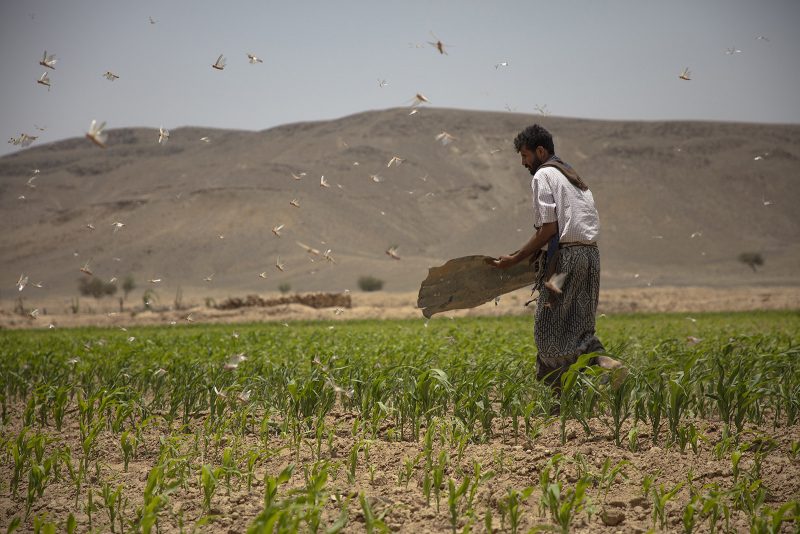
A Yemeni farmer tries to chase locusts off of his fields. Photo | UNFAO
Fertile soil, especially in the border areas in Saada and Hajjah, has become environmentally polluted due to the number of weapons dropped in more than half a million airstrikes. That pollution has not only affected the soil, experts fear it could genetically alter the pomegranates, grapes and coffee that were once staple crops in Yemen. Farmers and their families are at constant risk from unexploded ordnance, especially cluster bombs like the one that killed a young boy on his family farm in Hodeida last Thursday.
Agricultural and environmental experts that spoke to MintPress said that the effects of the Saudi coalition’s targeting of the agricultural sector will likely last for decades. The Director of Agricultural Extension in Yemen, Salah al-Mashreqi, said that more catastrophic effects will appear in the medium and long term, including genetic changes to pomegranates, for which Yemen is famous.
The deliberate targeting of food is prohibited by article 54 of the Geneva Conventions and the May 24, 2018, UN Security Council resolution 2417 on the protection of civilians in wartime, specifically reiterates this principle. Article 14 of the 1977 Protocol Additional to the Geneva Conventions clearly states that starvation as a means of combat is not allowed: ‘’It is prohibited to attack, destroy, remove, or render useless objects indispensable for the survival of the civilian population.” Yet the international community has done little to curb the Saudi-led coalitions use of starvation as a tactic of war in Yemen.
This, in large part, according to many Yemenis and legal scholars alike, is because Saudi Arabia enjoys the near-total diplomatic protection of the United States. Without that support, Saudi Arabia’s airstrikes, which rely on American contractors, targeting software, training, weapons, and technicians to target farmers that are concerned with little more than feeding themselves and their country, would not be possible.
Ahmed AbdulKareem is a Yemeni journalist. He covers the war in Yemen for MintPress News as well as local Yemeni media.
Featured Video

Rewriting the risk? Inside the government’s vaccine safety messaging
or go to
Aletho News Archives – Video-Images
Book Review
“Davos Can Really Replace the UN”
Inside the book that maps the architecture behind global governance — from the Epstein files to the Pact for the Future
Lies are Unbekoming | April 1, 2026
On June 13, 2019, the United Nations and the World Economic Forum signed a partnership deal to “accelerate the implementation of the 2030 Agenda for Sustainable Development.” That same evening, WEF president Börge Brende — Norway’s former Foreign Minister — had dinner with Jeffrey Epstein at Epstein’s Manhattan townhouse. The Epstein files, released January 2026, contain an exchange between the two from the previous year. Epstein to Brende: “Davos can really replace the UN. C21, cyber, crypto . genetics… intl coordination.” Brende back to Epstein: “Exactly — we need a new global architecture. World Economic Forum (Davos) is uniquely positioned — public private.”
The next day, the UN General Assembly adopted the framework for restructuring global governance.
That sequence — the partnership signing, the Epstein dinner, the candid admission about replacing the UN with a public-private architecture, and then the formal adoption — opens Jacob Nordangård’s The Digital World Brain. Pages two and three. Footnoted to the UN resolution number, the Epstein files, and the General Assembly record.
I keep coming back to it because it captures what this book does that almost nothing else in the independent research space manages. I’ve followed Jacob’s work for years now and interviewed him about his research. Each book peels back another layer of the same institutional architecture, and each time I think he’s reached the limit of what can be documented, the next one goes further. Nordangård doesn’t speculate. He doesn’t editorialize much. He lays institutional actions next to each other in chronological order and lets the pattern announce itself. … continue
Blog Roll
 Aletho News
- REWRITING THE RISK? INSIDE THE GOVERNMENT’S VACCINE SAFETY MESSAGING
- “Davos Can Really Replace the UN”
- NIAID/NIH and USDA Fund Bioengineered Chimeric Influenza Viruses Built Using Pandemic H1N1 Components: Journal ‘Science Advances’
- Hezbollah hits Israeli warship off Lebanon’s coast, sets it aflame
- Iran slams US strikes on B1 bridge, Mahshahr petrochemical plants as ‘blatant acts of state terrorism’
- In letter to UN chief, Araghchi warns of dire consequences of US-Israeli attacks on Iran’s nuclear facilities
- Why the CIA conspiracy to invade Iran with Kurdish militias failed
- Why Are Upbeat US Claims About Mission to Rescue Pilot ‘Highly Questionable’?
- Aircraft destroyed during US ‘rescue’ of downed F-15 pilot cost more than $100 million each
- Washington University removes professor who condemned US-Israeli war on Iran
- If Americans Knew
- In Iran, Israel-US take aim at “reason, research, and freedom of thought” – Daily Update
- US loses planes over Iran, Israel downgrades Lebanon war goals – Daily Update
- Israel Is Blocking Palestinians from Easter at Church Where Jesus Resurrected
- Plot to assassinate Palestinian activist follows harassment campaign promoted by Zionist groups and elected officials
- Prominent New York synagogue hosts presentation on why U.S. Jews should support the ethnic cleansing of Gaza
- Tapper vs. Piker: Is the CNN Anchor Auditioning for David Ellison?
- Shouldn’t Democrats Be Able to Condemn Genocide?
- Israel-US kill negotiators, destroy civilian structures, but Iran’s military capabilities still largely intact – Daily Update
- ‘War crime’: Global condemnation as Israeli ministers celebrate death penalty law targeting Palestinian prisoners
- 7 Ways Israel Is Turning Lebanon Into Gaza
- No Tricks Zone
- An Inconvenient Tree: Uncovered In Alps… Europe Much Warmer Than Today 6000 Years Ago
- New Study Reports A 60% Slowdown In Greenland’s Ice Loss Rate In The Last Decade
- Low Intensity Tornado Wrecks Major Solar Farm, Creating A Potential Toxic Dump
- New Study Finds Warming Saves Lives…Cold Temperatures 12 Times More Deadly Than Excess Heat
- German Science Blog Accuses PIK Climate Institute Of Hallucinating Climate Tipping Points
- Devastating Assessment Of Comirnaty Vaccine By Former Senior Pfizer Europe Toxicologist
- New Study: CO2 Is ‘Effectively Negligible’ As An Explanatory Climate Change Factor Since 2000
- Former Pfizer Toxicologist Dr. Helmut Sterz Tells Bundestag Hearing Pfizer Vaccine Should Have Never Been Approved
- Energy Expert: Germany’s Nuclear Phaseout Was A “500 Billion Euro Mistake”
- New Research: South Australia’s Mid-Holocene Sea Surface Temperatures Were 4°C Warmer Than Today
 Aletho News