Fukushima’s Fallout Continues
By John LaForge | Duluth Reader | June 19, 2014
US papers don’t often report on the radiation disaster continuing at Fukushima-Daiichi in Northeast Japan.
But on June 17 the New York Times noted: “Inside the complex, there are three wrecked reactor cores, twisted masses of hundreds of tons of highly radioactive uranium, plutonium, cesium and strontium. After the meltdown[s], which followed a tsunami and earthquake in 2011, most of the material in the reactors re-solidified, in difficult shapes and in confined spaces, wrapped around and through the structural parts of the reactors and the buildings. Or at least, that is what the engineers think. Nobody really knows, because nobody has yet examined many of the most important parts of the wreckage. Though three and a half years have passed, it is still too dangerous to climb inside for a look, and sending in a camera would risk more leaks.”
The Great Eastern Japan Earthquake and tsunami caused a Station Black Out at Fukushima the total loss of power used to run cooling mechanisms and the consequent melting of fuel rods dispersed massive amounts of radiation to the air and to the Pacific.
The Tokyo Electric Power Co (Tepco), owners of the Fukushima wreckage, has said it would take 40 years to clean up the disaster. Tepco’s number was probably pulled out of the thin air, because owners of the undamaged Kewaunee reactor in Wisconsin, which shut down last April, said decommissioning of Kewaunee would take 40 years.
Radiation Tripled in Pacific Albacore Tuna since Triple Meltdowns
Radioactive cesium-137 levels in Pacific albacore tuna have tripled since the triple meltdowns at Fukushima-Daiichi in Japan, according to a study published in Environmental Science and Technology.
Delvan Neville, lead author of the study and a graduate research assistant in the Department of Nuclear Engineering and Radiation Health Physics at Oregon State University, told the Statesman Journal Apr. 28, “You can’t say there is absolutely zero risk because any radiation is assumed to carry at least some small risk.”
Jason Phillips, a co-author of the report, said 26 of the large Pacific fish were analyzed from 2008 to 2012. “If we were going to see it [cesium-137] in something, we would see it in albacore or other high-level predators.”
Dr. Steve Starr, Director of Clinical Laboratory Science Program, University of Missouri-Columbia, noted in a recent lecture, “Cesium 137 tends to bio-accumulate in plants and animals, which means it cannot be excreted faster than it is being ingested. Thus, as it accumulates, it increases in its concentration in the plants or animals that are routinely ingesting it. Cesium-137 also tends to bio-magnify as it moves up the food chain. This means it becomes progressively more concentrated in predator species.”
As US Agency Hushed-up Dangers to US Reactors, Reactors’ Owner Tepco Under-reported Radiation Exposures
NBC News reported Mar. 10 that internal emails by staff at the Nuclear Regulatory Commission prove the agency deliberately down-played known earthquake and tsunami vulnerabilities at aging US reactors in the early days of the Fukushima catastrophe. NBC said the emails, “show that the campaign to reassure the public about America’s nuclear industry came as the agency’s [NRC’s] own experts were questioning US safety standards and scrambling to determine whether new rules were needed to ensure that the meltdown[s] occurring at the Japanese [site] could not occur here.”
NBC said the emails reveal the NRC’s “efforts to protect the industry it is supposed to regulate.” The news network went as far as to say, “Dating back to the Three Mile Island nuclear crisis in 1979, many nuclear watchdogs and critics have said that the NRC acts first to protect the industry, and its own reputation.”
The Nuclear Regulatory Commission was helped in misleading the public by Tepco, which repeatedly underestimated internal radiation exposures of its workers involved in immediate emergency response, according to Japan’s Health, Labor and Welfare Ministry, Asahi Shimbun reported.
Last July, the Ministry reviewed exposure data on around workers and revealed that reported exposure levels for 452 out of 1,300 workers surveyed were too low. After that announcement, the Ministry looked at records of the remaining 6,200 workers, and in late March it announced 142 additional cases of under-reporting.
TEPCO did not have whole-body radiation counters when the radiation disaster began, so true contamination measurements were not possible.
Contaminated Soil and Cemeteries May be Moved from Fukushima
Japan’s federal government announced in late May that it will move thousands of tons of radioactively contaminated soil scraped from school yards and elsewhere during decontamination efforts outside Fukushima Prefecture “within 30 years” after first keeping it in storage in the heavily-contaminated prefecture.
New federal law will be needed to allow Japan’s Environmental Safety Corporation to operate the “temporary” dumps.
In a macabre aspect of compensating for areas made radioactively uninhabitable by fallout from the meltdowns, Japan is considering paying for new cemeteries and reburying the remains of people now buried in radioactive exclusion zones.
Food Not Monitored for Radiation Causing Internal Contamination
The Japan Times reported June 17, that “eating unchecked homegrown vegetables and wild game from radiation-tainted areas on a regular basis can lead to high levels of internal radiation exposure.”
According to a study published in the US online science journal PLOS ONE, “Levels of radioactive cesium detected in the bodies of the study’s participants declined once they stopped eating highly contaminated food.” The study’s authors called for increasing public awareness of radiation-risky foods especially “at a time when public interest appears to be dwindling.”
Soil from the seafloor collected about 6 kilometers from the wrecked reactors contains as much 2,700 Becquerels of cesium-137 per kilogram, according to Japan’s Nuclear Regulation Authority June 14.
In Aug. 2012, Tepco reported an all-time record 25,800 Becquerel’s-per-kilogram in two fish known as greenling caught in 20 kilometers of the stricken reactors. “There may be radiation hot spots on the seabed,” a TEPCO official said then.
The wrecked reactors spewed enormous, unprecedented volumes of radioactive materials into the Pacific Ocean where cesium levels near Fukushima ballooned to an astonishing 50 million times pre-disaster levels (and continue to do so, 3.5 years after it began).
The agency said that it is difficult to assess the figure because there is no standard against which evaluations can be made, but that its research would continue.
Note to Japan’s NRA: for a baseline standard, check seabed levels of cesium off any area free of nuclear reactor effluent.
John LaForge is a co-director of Nukewatch in Wisconsin and edits its Quarterly.
To President Obama: Let’s just assume for a moment we have a climate crisis
By Paul Driessen | Watts Up With That? | June 2, 2014
As we start hurricane season today, we note the unprecedented 3142 day drought of major hurricane landfalls, shattering a record that goes back to the year 1900.
Despite clear evidence to the contrary, president Obama is now warning us that “storms like Hurricane Sandy will become more frequent as climate change intensifies.” It’s merely the latest in the administration’s seemingly endless stream of headline-grabbing scare stories, designed to justify the job-killing, economy-strangling, family-bashing rules for vehicles, power plants, cement kilns, refineries, factories, farms, shopping malls and countless other facilities that are or soon will be regulated by Environmental Protection Agency fiat. We need to keep one vitally important fact in mind.
Every one of these “looming calamities” is based on assumptions, assertions and computer models that represent the real world about as well as the special-effects T-rexes and raptors do in Jurassic Park. The data on hurricanes says otherwise:


Climate modelers and disaster proponents remind me of the four guys who were marooned on an island, after their plane went down. The engineer began drawing plans for a boat; the lumberjack cut trees to build it; the pilot plotted a course to the nearest known civilization. But the economist just sat there. The exasperated workers asked him why he wasn’t helping.
“I don’t see the problem,” he replied. “Why can’t we just assume we have a boat, get on it and leave?”
In the case of climate change, those making the assumptions demand that we act immediately to avert planetary crises based solely on their computer model predictions. It’s like demanding that governments enact laws to safeguard us from velociraptors, after Jurassic Park scientists found that dinosaur DNA could be extracted from fossilized mosquitoes … and brought the carnivores back to special-effects life.
Climate models help improve our conceptual understandings of climate systems and the forces that drive climate change. However, they are terrible at predicting Earth’s temperature and other components of its climate. They should never be used to set or justify policies, laws and regulations – such as what the Environmental Protection Agency is about to impose on CO2 emissions from coal-fired power plants.
Even our best climate scientists still have only a limited grasp of Earth’s highly complex and chaotic climate systems, and the many interrelated solar, cosmic, oceanic, atmospheric, terrestrial and other forces that control climate and weather. Even the best models are only as good as that understanding.
Worse, the models and the science behind them have been horribly politicized. The Intergovernmental Panel on Climate Change was ostensibly organized in 1988 to examine possible human influences on Earth’s climate. In reality, Swedish meteorologist Bert Bolin and environmental activist groups wanted to use global warming to drive an anti-hydrocarbon, limited-growth agenda. That meant they somehow had to find a human influence on the climate – even if the best they could come up with was “The balance of evidence suggests a discernible human influence on global climate.” [emphasis added]
“Discernible” (ie, detectable) soon metamorphosed into “dominant,” which quickly morphed into the absurd notion that greenhouse gas (GHG) emissions have now replaced natural forces and become the only factors influencing climate change. They are certainly the only factors that climate activists and alarmists want to talk about, while they attempt to silence debate, criticism and skepticism. They use the models to generate scary “scenarios” that are presented as actual predictions of future calamities.
They predict, project or forecast that heat waves will intensify, droughts and floods will be stronger and more frequent, hurricanes will be more frequent and violent, sea levels will rise four feet by 2100 [versus eight inches since 1880], forest fires will worsen, and countless animal species will disappear. Unlikely.
Natural forces obviously caused the Medieval Warm Period, the Little Ice Age and the Pleistocene Ice Ages. (A slab of limestone that I dug up has numerous striations – scratches – left by the last mile-thick glacier that covered what is now my home town in Wisconsin.) After long denying it, the IPCC finally acknowledged that the LIA did occur, and that it was a worldwide agricultural and human disaster.
However, the models and computer algorithms the IPCC and EPA rely on still do not include the proper magnitude of solar cycles and other powerful natural forces that influence climate changes. They assume “positive feedbacks” from GHGs that trap heat, but understate the reflective and thus cooling effects of clouds. They display a global warming bias throughout – bolstered by temperature data contaminated by “urban heat island” effects, due to measuring stations being located too close to human heat sources. They assume Earth’s climate is now controlled almost entirely by rising human CO2/GHG emissions.
It’s no wonder the models, modelers and alarmists totally failed to predict the nearly-18-year absence of global warming – or that the modeled predictions diverge further from actual temperature measurements with every passing year. It’s no wonder modelers cannot tell us which aspects of global warming, global cooling, climate change and “climate disruption” are due to humans, and which are the result of natural forces. It’s hardly surprising that they cannot replicate (“hindcast”) the global temperature record from 1950 to 1995, without “fudging” their data and computer codes– or that they are wrong almost every time.
In 2000, Britain’s Met Office said cold winters would be a thing of the past, and “children just aren’t going to know what snow is.” The 2010 and 2012 winters were the coldest and snowiest in centuries. In 2013, Met Office scholars said the coming winter would be extremely dry; the forecast left towns, families and government agencies totally unprepared for the immense rains and floods that followed.
In 2007, Australia’s climate commissioner predicted Brisbane and other cities would never again have sufficient rain to fill their reservoirs. The forecast ignored previous drought and flood cycles, and was demolished by record rains in 2011, 2013 and 2014. Forecasts of Arctic and Antarctic meltdowns have ignored the long history of warmer and colder cycles, and ice buildups and breakups.
The Bonneville Power Administration said manmade warming will cause Columbia River Basin snowpack to melt faster, future precipitation to fall as rain, reservoirs to be overwhelmed – and yet water levels will be well below normal year round. President Obama insists that global temperatures will soar, wildfires will be more frequent and devastating, floods and droughts will be more frequent and disastrous, rising seas will inundate coastal cities as Arctic and Antarctic ice shelves melt and disintegrate, and 97% of scientists agree. Every claim is based on models or bald-faced assertions unsupported by evidence.
And still the IPCC says it has “very high confidence” (the highest level it assigns) to the supposed agreement between computer model forecasts and actual observations. The greater the divergence from reality, the higher its “confidence” climbs. Meanwhile, climate researchers and modelers from Nebraska, Penn State, Great Britain and other “learned institutions” continue to focus on alleged human influences on Earth’s climate. They know they will likely lose their government, foundation and other funding – and will certainly be harassed and vilified by EPA, environmentalists, politicians, and their ideological and pedagogical peers – if they examine natural forces too closely.
Thus they input erroneous data, simplistic assumptions, personal biases, and political and financial calculations, letting models spew out specious scenarios and phony forecasts: garbage in, garbage out.
The modelers owe it to humanity to get it right – so that we can predict, prepare for, mitigate and adapt to whatever future climate conditions nature (or humans) might throw at us. They cannot possibly do that without first understanding, inputting and modeling natural factors along with human influences.
Above all, these supposed modeling experts and climate scientists need to terminate their biases and their evangelism of political agendas that seek to slash fossil fuel use, “transform” our energy and economic systems, redistribute wealth [upward], reduce our standards of living, and “permit” African and other impoverished nations to enter the modern era only in a “sustainable manner,” as defined by callous elitists.
The climate catastrophe camp’s focus on CO2 is based on the fact that it is a byproduct of detested hydrocarbon use. But this trace gas (a mere 0.04% of Earth’s atmosphere) makes life on our planet possible. More carbon dioxide means crops, forests and grasslands grow faster and better. CO2’s role in climate change is speculative – and contradicted by real-world measurements, observations and history.
Computer models, scenarios and predictions of planetary Armageddon are little more than faulty, corrupt, even fraudulent pseudo-science. They have consistently forecast what has not happened on Planet Earth, and failed to forecast what did happen.
They must no longer be allowed to justify EPA’s job-killing, economy-strangling, family-bashing rules for vehicles, power plants, cement kilns, refineries, factories, farms, shopping malls and countless other facilities that are or soon will be regulated by agency fiat.
Paul Driessen is senior policy analyst for the Committee For A Constructive Tomorrow (www.CFACT.org) and author of Eco-Imperialism: Green power – Black death.
Japanese Government Snubs Anti-Nuclear Public Sentiment
RIA Novosti | May 26, 2014
MOSCOW – The public comment period for Japan’s new draft energy policy resulted in more than 90 percent of respondents saying they oppose the nuclear portion of the plan, Japan’s second largest newspaper, Asahi Shimbun, reported.
The newspaper reviewed the public comments to the draft of the first post-Fukushima basic energy policy, released by Japan’s Ministry of Economy, Trade and Industry in early December. The respective comments, gathered throughout a month, were disclosed in February and counted by Asahi Shimbun with the goal of identifying the proportion of negative and positive public reactions.
The 2,109 emails counted by Asahi Shimbun revealed that 95.2 percent opposed nuclear power generation, with as few as 33 responses arguing in favor of government energy policy including nuclear power.
Though shocking in terms of disregard to the public will, the results of the survey are consistent with the determination of the Abe administration to stick to the pro-nuclear policy. Even a recent ruling by the Fukui District Court against a restart of a nuclear reactor currently offline was identified as a “minor setback” to the energy policy draft by the Japanese government.
Colombian Army Escalates Attack on Communities near Tolemaida Military Base
By Luke Finn | Red Hot Burning Peace | May 14, 2014
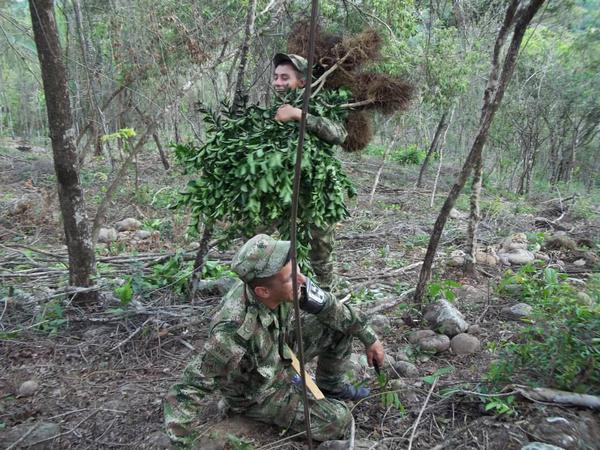
The communities of Yucala, Mesa Bajo, and Naranjala are facing a slow and deliberate process of displacement by a key army base used by the U.S. military in Colombia.
Seven military bases in Colombia fall under the U.S.-Colombia Defense Cooperation Agreement, which allows for U.S. Military access to Colombian bases, and one of those is Tolemaida, Cundinamarca. It was originally founded in 1954 by Colombia’s only ever dictator, General Gustavo Rojas Pinilla (though, of course, Colombia’s list of authoritarian rulers is much longer), and modeled on Fort Benning, Georgia, home of the School of the Americas (now WHINSEC), the infamous training ground for human rights abusers throughout the hemisphere. Like the School of the Americas, Tolemaida was to become primarily a center for training, here in anti-guerrilla (and more recently counter-insurgency) warfare, specifically through its lauded “Curso de Lanceros” course run by U.S. officers and taken by amongst others the armies of the United States, France, and Panama, as well as Colombians. Tolemaida has a permanent presence of U.S. soldiers.
The Tolemaida base is located on a plateau, overlooking the river Sumapaz, an area that amongst other things contains the largest páramo ecosystem in the world, noted even within Colombia for its bio-diversity. Prior to 1954, a community on the plateau, named their settlement “El Mirador,” or “La Mesa.” One man I met, who still remembered those days, told me proudly that they had both a butcher and a soccer field. But then came La Violencia and the new military base, and the communites moved further down the hillside to the veredas of Yucala, Naranjala, and Mesa Bajo, clearing the land and planting their crops.
The community has been in a state of near constant harassment ever since the base’s construction, and even more so as the base looks to expand. For example, back in the 1980’s the military cut electricity to the community. The 150 campesino families affected today, experience three main forms of harassment as part of the Colombian Army’s petty and vindictive campaign.
The first is the economic blockade of the community. The small road (in a state of severe disrepair) up the hillside, turns off the Pan-American highway, and Policía Militar from the base, are posted daily on the road. Thus, the military prevents the community’s access to large amounts of food, materials to repair houses, and materials to prepare their stable fruit crops. Not even a single bag of cement comes through. People are going hungry, there is no money coming into the community, and their houses are falling down around their ears.
The second is the deliberate destruction of community property. On a number of occasions over the last year soldiers have come down from the base and torn up irrigation systems and fruit trees. On June 19, 2013, over 150 fruit trees were uprooted. This carnage is a further attempt to put a stranglehold on the economic life of the community, and starve them out.

The third way, and perhaps the most shocking, is the deliberate contamination of the community’s water, constituting a sort of biological warfare. At the Cueca de la Quebrada Naranjala, the primary water source for the families, the Army has dumped the rubbish from the base, an estimated 30 tons. Battery packs, broken glass, and ceramics, slowly rotting camouflage patterned clothing and bedding, munitions boxes (labeled in English and produced in the United States), and electrical equipment of all sorts litters the fount of the stream, and in rainy season get washed down hill and collect in sodden clumps. The water is visibly toxic green in parts, orange in others, with an oily sheen, and chemical foam. The putrefaction fills your lungs and turns your stomach as you clamber over a mountain of rubbish in one of the most beautiful places in the country.
The charitable could imagine this to be merely neglectful and careless, were it not for the numerous complaints raised by the community, including two (ignored) petitions at local and national level, a new case in front of the Inter-American Commission on Human Rights, and the economic harassment they have faced. But rubbish is still being dumped, and as it stands this seems to be a deliberate attack on the psychological, moral, and physical well being of these fifth generation workers of this land.
The expanding military base (and not to mention the vacationing bogotanos who buy up fincas and build condominiums in the area) has squeezed the communities of Yucala, Naranjala, and Mesa Bajo from both sides in a campaign of outrageous malice. There is no explicit violence in the area, no guerrilla, paramilitary, or bandas criminales, just the economic and environmental violence of the state against this blameless community. The fatuous, meaningless motto of the Colombian Army is “Faith in the Cause”—but if we were to take this at face value, what cause is this? Another slogan is “Yes, there are Heroes in Colombia”—is poisoning wells ever heroic?
Luke Finn is a writer and international accompanier with Fellowship of Reconciliation Peace Presence in Colombia. He graduated from the Humanitarian and Conflict Response Institute, University of Manchester. Follow @Peace_Presence and on Facebook.
Dangerous radioactive contamination found in an Iraqi village

MEMO | May 9, 2014
The official environmental authority in the Iraqi governorate of Missan, which is located 390 kilometres away from Baghdad, has announced the discovery of dangerous radioactive contamination that is attributed to the 2003 US-led war on Iraq.
The director of the general authority for the environment in Missan, Samir Kadim, told the New Arab news website that the authority’s specialised staff found radioactive material, mainly in military equipment and the skeletons of cars, in a small village south of Missan known as Karima.
Kadim explained that the ministry’s authority is cautiously entering the three areas where radioactive material was discovered and is taking strict procedures to remove it.
The village witnessed one of the fiercest battles between the former Iraqi army and the US-led coalition forces in 2003.
“Unfortunately, we have discovered it late, after a number of the village’s residents have been diagnosed with various diseases,” Kadim said.
One of the village’s residents told the New Arab in a phone interview that: “Cancer has spread among us, in addition to birth defects among new-born babies and other diseases that doctors cannot explain.”
“But it is only now that we have discovered the cause – it is the US,” said 45-year-old Abboud Moussa.
Moussa described how a number of Karima’s villagers, including children and his own mother, died as a result of this radioactive material. Doctors diagnosed his mother with skin cancer and bone disease, and they told him that she needed to receive medical treatment abroad, but she died very quickly before she could travel.
According to Missan’s environment authority, Karima is the third place in the governorate where radioactive material has been discovered amid primitive treatment and an American refusal to take responsibility. Any US assistance in handling the radiation would be an acknowledgement of its use of internationally banned weapons in Iraq.
Abdel Khalek Mahmoud, an environmental expert, told the New Arab that “radioactive contamination in Iraq is divided into two types: The first, which is rarely found in Iraq, is high-level radioactivity that can be discovered by electronic devices. The second is low-level radioactivity, which is more difficult to discover. It was caused by the waste of depleted uranium that was used by the US in its 2003 war on Iraq. This is abundantly found and it has caused a lot of lethal damage in the country.”
“We have often said that the reason why thousands of Iraqi soldiers went missing is that their bodies burnt as a result of uranium-saturated bombs. But the country’s new leaders, who were empowered by the US, were not willing to bother the Americans,” Mahmoud added.
Abdel-Aziz Al-Taey for the New Arab
When Our Land is Free, We are Free
By Silas Kpanan’Ayoung Siakor & Jacinta Fay | The Ecologist | May 7, 2014
Right now in Abuja, Nigeria, agribusiness corporations are courting African governments at the Grow Africa Investment Forum to “further accelerate sustainable agricultural growth in Africa”.
That sounds harmless enough, until you know what it really means. Corporate interest in agriculture in Africa has certainly accelerated corporate control of land, seeds and water. But it has done little to support agriculture that will feed the continent.
Rather than support family farming and smallholder agriculture, private sector investment in agriculture has resulted in grabbing land from communities – the land which they farm sustainably and rely on for their survival.
Resisting the corporate bully boys
Communities are resisting this corporate takeover of their land and they are winning. All over Africa people are sending a clear message to their governments: “Stop selling Africa to corporations!” The Jogbahn Clan in Liberia is one such community and here is their story.
The sense of jubilation in Blayahstown, small town in Liberia, is palpable. People come from surrounding villages to join in the celebrations and the town is filled with singing and dancing.
The Jogbahn Clan is celebrating a victory as the President of Liberia has now recognised their right to say no Equatorial Palm Oil (EPO) a British palm oil company grabbing their land.
This is no small feat in a country where over 50% of the land has been given to corporations without the consent of the communities who customarily own the land.
We come from this land – it is ours!
The sense of accomplishment is not lost on Chief Elder Chio Johnson who looks like he hasn’t stopped smiling since he returned from the Clan’s meeting with the President of Liberia – where she committed to support them in protecting their land from being grabbed by EPO.
“Why should a company take away our livelihood?” asked Chio. “We come from this land. Everything our ancestors left us is preserved in the forest, so why should we give up our forest?”
Walking through the forest with Deyeatee Kardor, the Clan’s Chairlady, she picks leaves and describes the different medicines that they can be used for. She recounts how she and her family hid in the forest throughout the Civil War and managed to survive on the plants and fruits growing in the bush.
Though the land bears the scars of the recent past it also represents the Clan’s ancestral home and they would not willingly allow this deep connection to the land to be fractured.
20,000 hectares of community land given away
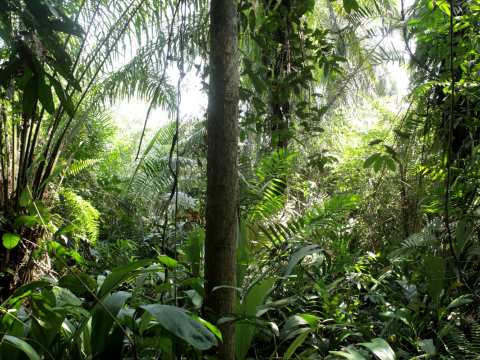 “The land gives us everything”, Chio says as he surveys the area; the vegetables, wild palm and sugar cane growing all around. Like other rural communities in Liberia they make their livelihood from the land they manage collectively.
The clan are self-sufficient and manage the land sustainably. For the Clan, to lose their land is to lose everything.
The communities’ resistance began in 2012 when EPO began to expand their plantation onto the community land of eleven towns. The Government of Liberia and EPO had signed a concession agreement allowing the company’s plantation to engulf communities’ land amounting to over 20,000 hectares.
Communities all over Liberia are facing the same threat as their lands are given to companies without their consent. As a result conflict between communities and companies has been widespread.
Police and EPO security intimidation
The Clan organised and came together to resist their land being grabbed. Men, women and youth from the affected towns chose representatives to form a core group to lead the resistance.
They met the company and the government several times to object to the company’s expansion. In spite of this towards the end of 2012 EPO began clearing and planting their land, destroying crops and farmland.
In September 2013 EPO began surveying the communities’ land without their consent. When the communities attempted to stop the survey a paramilitary police unit was deployed into the area, and began to run a campaign of harassment and intimidation by both the police and EPO’s security force.
They drove through villages at night flashing their emergency lights and arrived in villages riding on top of vehicles the same way rebel fighters did during the war.
People were also assaulted during a peaceful march and 17 people suffered arbitrary arrest. The Clan Chief was also suspended from his position by the government because he spoke out against the company.
Divide and rule – this time, it failed
Despite these aggressive tactics the community continued resisting. They lodged a complaint to the Roundtable on Sustainable Palm Oil (RSPO) and presented a petition to the government stating their objections.
“All they have done is try to divide us”, commented Deyeatee. “They offer important people a little money to try to convince them.”
However the community refused to be weakened by division and eventually secured the crucial meeting with the Liberian President Ellen Johnson Sirleaf where she recognised their right to say ‘no’ to the company.
“The struggle has made us stronger than ever before and we’ve learned a lesson to stay united”, said Anthony Johnson, a youth representative.
“The success is so great as it secures my future and the future of my children to come. I will stay on this land and plant crops for my children so future generations can live off the land.”
But for EPO, it’s business as usual
Despite the President’s commitment EPO has still not recognised that the Clan has said no to their operations. They are operating as if things are business as usual and conducting studies of the Clan’s land in preparation for clearing.
But the Clan are not discouraged and they continue their resistance for the hope of a better future.
Land clearance and other preparatory activities would be unlawful, as they do not respect communities’ right to give or withhold their Free Prior and Informed Consent, which is a requirement provided for under both national and international law.
“We want the government to support us to be self-sufficient on our land instead of giving it to a company who will just take the money and go home”, said Garmondeh Benwon, who suffered assault on the march. ”Instead we can keep the money in Liberia and we can live better lives.”
Organise and resist!
Every year, an area five times the land size of Liberia is grabbed from communities around the world. The Jogbahn Clan show that stopping it is possible when communities stand together, mobilise and resist.
The government has recognised their right to say no – and now EPO and KLK, their majority shareholder, must do the same.
It is a privilege to work in solidarity with the Clan and their drive and resilience has been a constant source of inspiration for everyone in SDI / FoE Liberia.
The Clan are preparing to share the lessons of their struggle and give hope to other communities resisting land-grabbing. And as Deyeatee says:
“I am very happy my land is free – because when our land is free, we’re all free.”
Silas Siakor is a campaigner on Community Rights and the founder of the Sustainable Development Institute/Friends of the Earth, Liberia a national civil society organisation promoting the sustainable and just use of Liberia’s natural resources. Silas has received the Goldman Environmental Prize in 2006, the Award for Extraordinary Achievement in Environmental and Human Rights Activism from The Alexander Soros Foundation in 2012 and TIME Magazine chose him as one of the 2008 Heroes of the Environment.
Jacinta Fay is a community worker and campaigner for the Community Rights and Corporate Governance Programme of the Sustainable Development Institute/Friends of the Earth Liberia which supports communities protect their land and resources and challenges corporate and government actions which threaten community rights. She is also Landgrab Campaigner for Friends of the Earth International which works to challenge landgrabbing, defend community territories and protect land rights. She also campaigns on trade justice, reproductive rights and social justice.
Twitter: Join the conversation on Twitter #stopEPO
Petition: Support the Jogbahn Clan to protect their land and resources: Landgrabbing in Liberia: Tell Equatorial Palm Oil NO means NO!
EPO backgrounder: EPO’s majority shareholder is the Malaysian company KLK, widely known to use child labor and other egregious practices. In turn, US-based investment company Dimensional Fund Advisors holds over $12 million in KLK. DFA also holds over $2.5 billion in companies with significant stakes in the palm oil sector. And DFA is partly owned by Arnold Schwarzenegger – who claims to care a great deal about saving forests. DFA also manages money for a wide range of US clients, from cities’ endowments to pension funds.
George Monbiot in the Guardian lobster pot
By Jonathon Cook | April 8, 2014
Back in February the Guardian quietly announced a deal with the global consumer goods corporation Unilever. Here is the beginning of the Guardian’s press release:
Guardian News and Media today officially launches Guardian Labs – its branded content and innovation agency – which offers brands bold and compelling new ways to tell their stories and engage with influential Guardian audiences. The official launch of the new commercial proposition is marked by the announcement of a pioneering seven-figure partnership with Unilever, centred on the shared values of sustainable living and open storytelling. … The new Unilever partnership will create a bespoke engagement platform to increase awareness of, and foster debate about, sustainability issues, and ultimately encourage people to live more sustainable lives.
I wonder how many of those who proudly declare themselves “Guardian readers” recognised their beloved newspaper in that statement.
In fact, it makes perfect sense for Unilever – a corporation whose brand “positioning” depends on its customers identifying it as a responsible and caring business, despite the evidence to the contrary – to team up with the Guardian, another corporation whose brand positioning has already persuaded most of its customers that it is a responsible and caring business.
Today the Guardian columnist George Monbiot does something pretty brave for a Guardian columnist: he alerts his readers to the existence of this arrangement and gently questions what it represents, in an article bewailing the fact that “corporations have colonised our public life”.
Here is what he says:
I recognise and regret the fact that all newspapers depend for their survival on corporate money (advertising and sponsorship probably account, in most cases, for about 70% of their income). But this, to me, looks like another step down the primrose path. As the environmental campaigner Peter Gerhardt puts it, companies like Unilever “try to stakeholderise every conflict”. By this, I think, he means that they embrace their critics, involving them in a dialogue that is open in the sense that a lobster pot is open, breaking down critical distance and identity until no one knows who they are any more.
It’s worth noting how rarely journalists criticise the nature of the media they work in. Maybe that is not so surprising: few businesses, the media included, are happy having their flaws paraded in public. But what Monbiot has done here is to appear brave while really shrinking from the truth. He criticises the Guardian while really not criticising it.
Monbiot’s implication in the nice metaphor above is that Unilever is the the lobster pot, while the poor Guardian is the lobster in danger of being “stakeholderised”. Or, in another metaphor he uses, the Guardian is the one being led up the primrose path.
What he encourages his readers to infer is that the Guardian is the victim in this deal, being seduced and violated by Unilever. The reality is that Unilever and the Guardian are both wolves in sheep’s clothing. The arrangement works to the benefit of them both. In Monbiot’s reckoning, the Guardian is “public life” being colonised by Unilever. In fact, the Guardian is no more public life than Unilever. Both have colonised the public space, in the interests of maximising profits whatever the consequences to the public good and the planet. (And please, no one try to claim that my argument is refuted by the fact that the Guardian loses money. It is not a charity. Its goal is not to lose money; its goal is to find a strategy, like the one with Unilever, to revive its fortunes in a dying industry.)
In fact, the lobster pot metaphor would be much more apt to describe Monbiot’s relationship with the Guardian. The newspaper has “embraced” him, “breaking down his critical distance and identity until he no longer knows who he is”. Now if he told us that, I really would be cheering him for his honesty.
www.theguardian.com/commentisfree/2014/apr/08/corporations-public-life-unilever
Featured Video

US IRAN TALKS: Who Are the Crazy Ones Here? /Lt Col Daniel Davis
or go to
Aletho News Archives – Video-Images
From the Archives
Wartime internment camps in Australia
National Archives of Australia
World War I
During World War I, for security reasons the Australian Government pursued a comprehensive internment policy against enemy aliens living in Australia.
Initially only those born in countries at war with Australia were classed as enemy aliens, but later this was expanded to include people of enemy nations who were naturalised British subjects, Australian-born descendants of migrants born in enemy nations and others who were thought to pose a threat to Australia’s security.
Australia interned almost 7,000 people during World War I, of whom about 4,500 were enemy aliens and British nationals of German ancestry already resident in Australia.
Records of World War I internment camps
World War II
During World War II, Australian authorities established internment camps for three reasons – to prevent residents from assisting Australia’s enemies, to appease public opinion and to house overseas internees sent to Australia for the duration of the war.
Unlike World War I, the initial aim of internment during the later conflict was to identify and intern those who posed a particular threat to the safety or defence of the country. As the war progressed, however, this policy changed and Japanese residents were interned en masse. In the later years of the war, Germans and Italians were also interned on the basis of nationality, particularly those living in the north of Australia. In all, just over 20 per cent of all Italians resident in Australia were interned. … continue
Blog Roll
 Aletho News
- US IRAN TALKS: Who Are the Crazy Ones Here? /Lt Col Daniel Davis
- Talks with the US end without a deal over excessive US demands: Iran
- Feeling Better, Getting Worse: How Psychiatric Drugs Create the Illusion They Cure
- ‘Nobody Told Me’: Former Mental Health Patient Calls Out Dangerous Side Effects of Psychiatric Drugs
- Dr. Abu-Sitta: Beirut ‘felt like a day in Shifa Hospital’
- Iran Has Won the War, It Will Be Up to the US to Secure the Peace: Mohammad Marandi
- Iran condemns assassination threats against Iranian negotiators amid US talks
- Brussels cannot say where its own pipeline inspectors are as Hungary’s oil lifeline remains shut
- Israel’s Iran War: Myth and Reality
- Between war and industrial breakdown: The US-Israeli attrition crisis
- If Americans Knew
- Pro-Israel ‘Thinktanks’ and Individuals who Influence U.S. Foreign Policy
- Mearsheimer reveals how Israel dictates US policies on Iran, Gaza – video
- After killing 350+, Israel still has a “score to settle” with Lebanon before ceasefire – Daily Update
- Military aid to Israel emerges as the latest political litmus test for Democrats
- The only Palestinian children’s rights organization closes following years-long Israeli campaign against it
- ‘I Can’t Forget the Smell’: Lebanese Reel After Israel Kills Over 300 in Single Day
- DNC Shoots Down Resolutions Calling Out AIPAC and Limiting Arms to Israel
- TCN: Is Israel Blackmailing President Trump?
- Israel killed at least 303 Lebanese yesterday – who were they? Daily Update
- Amnesty: Urgent – Protect Lebanese civilians from brutal escalation in Israeli attacks
- No Tricks Zone
- German Expert: Heat Dome Led To Record Temps In Western USA…Warmer In 1934, 1936
- New Study: No Linear Warming Or Glacier Retreat Along Northern Antarctic Peninsula Since 1980s
- An Inconvenient Tree: Uncovered In Alps… Europe Much Warmer Than Today 6000 Years Ago
- New Study Reports A 60% Slowdown In Greenland’s Ice Loss Rate In The Last Decade
- Low Intensity Tornado Wrecks Major Solar Farm, Creating A Potential Toxic Dump
- New Study Finds Warming Saves Lives…Cold Temperatures 12 Times More Deadly Than Excess Heat
- German Science Blog Accuses PIK Climate Institute Of Hallucinating Climate Tipping Points
- Devastating Assessment Of Comirnaty Vaccine By Former Senior Pfizer Europe Toxicologist
- New Study: CO2 Is ‘Effectively Negligible’ As An Explanatory Climate Change Factor Since 2000
- Former Pfizer Toxicologist Dr. Helmut Sterz Tells Bundestag Hearing Pfizer Vaccine Should Have Never Been Approved
 Aletho News