Nuclear Weapons Waste in Your Water Bottle, Hip Replacement, Baby’s Toys, Jungle Gym?
Even the deregulation-happy Wall St. Journal sounded shocked: “The Department of Energy is proposing to allow the sale of tons of scrap metal from government nuclear sites — an attempt to reduce waste that critics say could lead to radiation-tainted belt buckles, surgical implants and other consumer products.”
Having failed in the ‘80s and ‘90s to free the nuclear bomb factories and national laboratories of millions of tons of their radioactively contaminated scrap and nickel, the DOE is trying again. Its latest proposal is moving ahead without even an Environmental Impact Statement. Those messy EISs involve public hearings, so you can imagine the DOE’s reluctance to face the public over adding yet more radiation to the doses we’re already accumulating. It would be a pretty hard sell, what with dental X-rays, medical X-rays, mammograms, CAT scans, PET scans, radio-isotope “seeds” and cocktails, food irradiation, every-day releases of radioactive gases and water from 104 nuclear power reactors, major releases like Fukushima, radon from rocks, whole-body X-rays at airports (that you can refuse) and cosmic rays during flights.
Not long after Chernobyl spread radiation around the world in 1986, the National Council on Radiation Protection doubled its estimate of our annual radiation dose, from 170 millirems to 360. A few years ago it raised the estimate again, to 620 millirems per year. The agencies that both create radioactive waste and estimate the radiation doses it gives to us, say the latest increase is due mostly to rapid growth in the use of medical X-rays and radio-isotopes in medicine. Should the DOE be allowed to haphazardly add still more?
Still, the DOE wants to deregulate and actually sell 14,000 tons of radioactive scrap metal (both volumetrically and topically contaminated) from the nuclear war system — uranium enrichment, plutonium extraction, etc. — and “recycle” the waste to the commercial clean scrap metal industry. From there, according to the watchdog group Nuclear Information and Resource Service, the radioactive stuff “could be turned into anything from your next pants zipper to baby toys.”
The DOE claims that potential radiation exposures to men, women and children would amount to a “negligible individual dose.” But anyone with a scrap of understanding of DOE and the Atomic Energy Commission knows not to believe a word of their assurances. The DOE famously said that rainwater would take thousands of years to seep through Yucca Mountain to a deep waste repository; it ran through the mountain in 40 years.
Even Some in Congress Object
Rep. Ed Markey wrote to Energy Secretary Steven Chu Jan. 11, calling the deregulation proposal “unwise” and urging that it “should be immediately abandoned.” Rep. Markey warned that radioactive products could “ultimately be utilized by pregnant women, children and other vulnerable populations.”
The DOE has never officially acknowledged — in spite of the National Academy of Sciences’ 2006 findings — that the same radiation dose does far more harm to women than to men. The drastically increased vulnerability of fetuses and infants is well known, but the whole population is nevertheless treated as the same big, young, Caucasian male (“reference man”) in most radiation risk assessments.
The DOE’s assessment of the proposal’s risks neglects the fact that exposures can go on for years from a watch or from medical implants or tableware or other items, leading to many millirems for many years. A millirem per year over 30 or 70 years is 30 or 70 millirems which is not trivial, NIRS points out.
The DOE currently bans the release of its radioactive scrap under a moratorium that began in 2000. The ban must not be lifted, but should be made permanent and expanded to keep all radioactive waste — plastic, concrete, soil, asphalt, etc. in addition to all metals — under control, out of commercial recycling and managed as the deadly hazard it is. NIRS.org has more details.
You can tell the DOE to continue to keep its radioactive metal out of the commercial metal supply, commerce, and our personal items. You can demand a full environmental impact statement. Comment deadline is Feb. 9, 2013. Email to: scrap_PEAcomments@hq.doe.gov (with an underscore after “scrap_”). Snail mail to: Jane Summerson / DOE NNSA / PO Box 5400, Bldg. 401K. AFB East / Albuquerque, New Mexico 87185
John LaForge works for Nukewatch and edits its Quarterly newsletter.
January 23, 2013
Posted by aletho |
Environmentalism, Militarism, Nuclear Power | DOE, Energy Department, Environmental impact statement, Nuclear Information and Resource Service, Radioactive waste, United States Department of Energy, Yucca Mountain |
Leave a comment
A fish containing over 2,500 times Japan’s legal limit for radiation in seafood has been caught in the vicinity of the crippled Fukushima nuclear plant, the facility’s operator reported.
A ‘murasoi’ fish, similar to a rockfish, was caught at a port inside the plant, according to AFP. Plant owner Tokyo Electric Power Co. (TEPCO) indicated that the amount of cesium measured 254,000 becquerels per kilogram – 2,540 times Japan’s legal limit for radiation in seafood.
In October, TEPCO admitted that radiation leaks at the plant had not fully stopped.
In 2011, after a March earthquake and tsunami devastated the region, Japan barred beef, vegetables, milk, seafood and mushrooms grown near the affected area from both domestic markets and exports over safety concerns.
Science magazine published an article revealing that the levels of cesium in seafood around the disaster-battered area had not decreased since 2011. In October 2012, around 40 percent of bottom-dwelling marine species demonstrated elevated radiation levels, with cesium-134 and 137 levels above Japan’s legal limit. August samples collected by author Ken Buesseler had cesium levels 250 times what Japanese authorities consider safe.
Seafood from the area near Fukushima has turned out to be a health hazard abroad, as well as within the country.
In July, Russia expressed concern over fish caught off its coast near Japan. In May, a contaminated tuna was found near the California coastline. Japan stressed that they understood the numbers of contaminated seafood are “extremely high,” but also pointed out that radiation was detected only in the kinds of fish found closest to the plant.
In October 2012, the European Commission, the executive arm of the European Union, announced that it would relax regulations on imports of Japanese food starting on November 1. The restrictions were introduced after the quake and tsunami hit Japan on March 11, 2011, with many countries such as the US, Australia, Canada, Germany, France and the UK either halting food imports or starting additional inspections of Japanese imports.
January 19, 2013
Posted by aletho |
Environmentalism, Nuclear Power, Timeless or most popular | Fukushima, Fukushima Daiichi Nuclear Power Plant, Japan, Tepco, Tokyo Electric Power Company |
Leave a comment
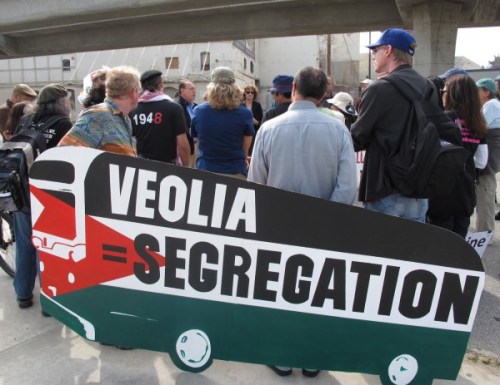
We are a diverse group of Palestinians, Israelis, Muslims, Jews, Christians, students, professors, artists, writers, environmental activists, union organizers, bakers, grandparents, and others in St. Louis united by a commitment to a lasting peace in Israel/Palestine based on freedom, justice, and equality, as part of a larger commitment to global justice.
We were shocked to learn about private city negotiations with Veolia Water on a contract to guide cost-cutting for the St. Louis Water Division. Veolia Water – North America is a subsidiary of Veolia Environnement (VE), a Paris-based multinational corporation and the largest water privatization business in the world. It is infamous for poor environmental standards, anti-labor practices, privatizing public resources, mismanagement, corruption, bribery, embezzlement, fraud, and illegal activities in Israel/Palestine. Worldwide, consumers report that Veolia consistently charges high rates, provides poor service, causes staff turnover, discourages water conservation, and fails to implement promised improvements. Its history reveals consistent prioritization of private profit at the expense of the environment and public welfare.
In Israel/Palestine, VE is involved in a myriad of ways with Israel’s illegal military occupation of Palestinian land and its systematic ethnic discrimination against the Palestinian people.
VE’s Israeli subsidiary, Veolia Water – Israel, operates a wastewater treatment plant located in an illegal Jewish-only settlement called Modiin Ilit, built on internationally-recognized Palestinian land in the West Bank. The Palestinian owners of the land on which this settlement was built have been violently driven out. Two unarmed Palestinians from Bil’in, a Palestinian village on which Modiin Ilit was built, have been killed by the Israeli army as they protested nonviolently against the ongoing confiscation of their land and resources. Leaders and people of conscience from around the world, including the South African anti-Apartheid leader Archbishop Desmond Tutu, have visited Bil’in to stand in solidarity with the dispossessed villagers, yet Veolia continues to service the settlement and others like it.
An Israeli subsidiary of Veolia Transdev, named Connex – Israel, operates settler buses on segregated roads through the occupied West Bank, including two bus lines that use road 443, which is built partially on confiscated land with portions closed entirely to Palestinians. A separate but unequal Palestinian road system is made up of low grade roads cut by checkpoints and physical barriers restricting Palestinian freedom of movement. Last year, a group of Palestinian Freedom Riders attempted to board buses operating on their own land and were violently removed and arrested. Veolia is not only profiting from segregation in Israel/Palestine; they are enforcing it.
Another VE Israeli subsidiary, Veolia Environmental Services – Israel, supervises, consults for, and operates the Tovlan Landfill in the occupied Jordan Valley, collecting refuse from illegal settlements. Israel renders it almost impossible for Palestinians in the Jordan Valley to gain permits to build homes, toilets, wells, animal pens, or other vital infrastructure for local communities, which has forced almost all Palestinian families out, with those remaining living in dire conditions. Some are left with no alternative but to work on settlements that have taken their families’ land, for pay far below the minimum wage, unable to take bathroom breaks, and denied any rights to unionize. Veolia takes captured Palestinian land and natural resources to service the settlements exploiting or driving out Palestinians.
Finally, VE has also been involved in the construction and operation of a tramway linking illegal settlements in East Jerusalem with Israel. The tramway not only institutionalizes the occupation, but it is a settlement in itself, given that it is settler infrastructure built on occupied land.
UN Special Rapporteur Richard Falk recently recommended that Veolia “should be boycotted, until they bring their operations into line with international human rights and humanitarian law and standards.” VE’s immoral practices and extensive profiting from Israel’s illegal discriminatory practices have provoked global outcry and made the company a target for boycott and divestment campaigns around the world — costing it $16 billion to date in lost contracts. Recently, the Friends Fiduciary Corporation, which handles investments for hundreds of U.S. Quaker institutions, divested from VE following advocacy from Palestine solidarity groups. Now, VE is bringing its risky and immoral business to our backyard.
Veolia Water is the U.S. arm of VE. As St. Louisans, we do not feel that our tax dollars and water payments should go toward supporting a company profiting from environmental destruction, unfair labor practices, and the bloodshed of and systematic ethnic discrimination against the Palestinian people.
The St. Louis Palestine Solidarity Committee stands in solidarity with public workers, water and environmental justice activists, and the Palestinian people threatened by this contract. We call on the Board of Estimate & Appointment not to approve this public contract with Veolia.
Click here for a Veolia Facts Sheet outlining the company’s history in environmentally hazardous activities, anti-labor practices, mismanagement, corruption, bribery, embezzlement, fraud, and failure to make good on promised improvements.
Click here for more information and documentation on Veolia’s activities in Palestine.
December 26, 2012
Posted by aletho |
Economics, Environmentalism, Illegal Occupation, Solidarity and Activism, Timeless or most popular | Israel, Palestine, Veolia, Veolia Environnement, Veolia Transdev, Veolia Water, West Bank, Zionism |
Leave a comment
Kids in Fukushima Prefecture are becoming increasingly overweight, as they are denied daily exercise in schoolyards due to the risk posed by exposure to nuclear radiation in the area, governments’ health report reveals.
The report argues that an increasing number of kids are weighing 20 per cent more than their standard based on their height, reported Kyodo News.
The study was released by the Ministry of Education, Culture, Sports, Science and Technology.
Since June 2011 more than half the public institutions in Fukushima, which is just under 450 schools, have limited their outdoor activities during school hours. As of September 2012, 71 elementary and junior high schools still adhere to such restrictions, according to the prefectural education board.
Their main concern is fear of exposure to radiation released from the Fukushima Daiichi complex.
Earlier, alarming reports of children developing potentially cancerous abnormalities have been making news as early as July.
A report by Fukushima Medical University first published this April and updated in July revealed that 36 per cent of Fukushima children have unusually overgrown thyroid glands, and could be prone to cancer.
Of 38,000 children examined, 13,000 had cysts or nodules as large as five millimeters, the Health Management Survey stated, which made doctors around the globe rate Japan’s reaction to the aftermath of the Fukushima disaster as “ultimately medical irresponsibility.”
On top of that, fish caught off the coast of Japan following the Fukushima nuclear disaster are still contaminated, bringing speculation that leakage from the reactors has not been fully stopped. If true, it could threaten area marine life for decades to come.
The long-term consequences of the Fukushima disaster have yet to be estimated, and the possible radiation spread has been a subject of continuous dispute, with official and independent sources providing contrasting figures.
Since the day of the tragedy, Japan has seen many anti-nuclear demonstrations.
The Fukushima nuclear plant was hit in 2011 by a powerful earthquake and subsequent tsunami, the worst-ever disaster of its kind in Japan.
The disaster triggered a strong reaction in Japan itself and from May, 2011 to July, 2012 Japan managed to function without nuclear power plants, but later despite widespread protests, Ōi Nuclear Power Plant was restarted.
The disaster also had an awakening effect on several nations worldwide, with some deciding to shelve the use of nuclear energy, including European powerhouse Germany.
December 25, 2012
Posted by aletho |
Environmentalism, Nuclear Power | Fukushima, Fukushima Daiichi nuclear disaster, Fukushima Daiichi Nuclear Power Plant, Fukushima Prefecture |
Leave a comment
Comments on Dec. 12, 2012 NRC meeting with the Army in Maryland from 10AM-1PM Hawaii time. The public could listen in and make comments/ask questions at the end of the meeting:
The Nuclear Regulatory Commission (NRC) will be issuing a license for the mongoose to guard the hen house in Hawaii. The Army will be issued an NRC license to possess Depleted uranium (DU) in Hawaii at Schofield Barracks and the Pohakuloa Training Area (PTA). In effect, the NRC is licensing Hawaii nuclear waste dumps and allowing those dumps to be bombed, spreading the nuclear dump debris wherever the wind takes it.
The State Dept. of Health made no comment, nor did it ask any questions following the meeting.
It is a fact that DU exists at Schofield Barracks and PTA, and perhaps other present and former military sites in Hawaii, including Kaho’olawe and Makua Valley. How much is not known. A minimum of 700, perhaps more than 2000, DU Davy Crockett spotting rounds have been fired at Pohakuloa. Less than 1% of PTA’s 133,000-acres have been surveyed. DU cluster bombs, and more than a dozen DU penetrating rounds, DU bunker busters, etc. may also have been fired at PTA and elsewhere. All branches of the US military use DU weapons today.
It’s clear to me that we cannot rely on so called regulators to fix the problem. Nuclear regulators are just as much part of the problem as bank regulators. The DOH is also part of the problem.
Where have our health officials been all these years on the issue. The military in Hawaii has lied and uses deception repeatedly. The US military mission goes before concern for the health and safety of its own troops and Hawaii’s people and land. Uranium is now showing up in Big Island residents’ urine.
Is it related to PTA, Fukushima or what?
The people have a right to know.
Is the military above the law?
What’s needed is a peoples’ movement of non-violent resistance to stop the bombing to protect the people and land of Hawaii against attacks by the U.S. military.
Jim Albertini Malu ‘Aina Center For Non-violent Education & Action P.O.
Box AB Ola’a (Kurtistown) Hawai’i 96760 Phone 808-966-7622 Email
ja@malu-aina.org www.malu-aina.org
December 14, 2012
Posted by aletho |
Environmentalism, Militarism | Depleted uranium, Hawaii, Human rights, Kahoolawe, Kurtistown Hawaii, NRC, Nuclear Regulatory Commission, Pohakuloa Training Area, Schofield Barracks, United States |
Leave a comment
Industry leaders will have no problem closing nuclear reactors that don’t generate expected profits. Exelon, the Chicago-based company that owns 17 of the 104 U.S. reactors, recently saw its stock price drop below $30 a share, the same level as mid-2003, and a whopping 70% below its peak of over $92 a share in mid-2008.
The standard explanation for this reversal is cost. In particular, electricity from growing natural gas and wind sources costs less to produce than that from nuclear reactors. The famous 1954 promise by Atomic Energy Commission head Lewis Strauss that the atom would create energy “too cheap to meter” has failed miserably. But while cost is the reason why utilities will be closing reactors, most reports fail to look beneath the surface and understand WHY nukes are so expensive.
The answer is that nuclear power poses great danger to safety and health. This danger means that reactors must comply with numerous safety regulations; must be built with many safety features; and must be manned by a large and highly trained work force – each a high-ticket item. In addition, the fleet of 104 U.S. reactors in operation is aging – most over 30 years old – requiring that corroding parts be replaced, pushing costs even higher.
Another element in the high cost of nukes won’t be faced until they are decommissioned (after closing). Decommissioning costs run hundreds of millions of dollars per reactor. Utilities are forced by federal law to keep a large decommissioning fund while operating reactors, to prevent them from simply closing reactors, not securing them, and sticking taxpayers with the bill.
Even with all these extensive and expensive efforts to protect the public, nukes still aren’t safe. The chance of a meltdown exists every day, from human error, natural disaster, or terrorist act. The disasters at Chernobyl in 1986 and at Fukushima last year remind us that catastrophic meltdowns that affect thousands to millions are a sobering reality. In addition to meltdowns, there is the matter of routine emissions from reactors and elevated cancer rates near reactors, demonstrated in many studies. Finally, the U. S. and other nations still have no long-term plans to store the massive amounts of hazardous nuclear waste.
Dominion Nuclear recently announced that the Kewaunee reactor in Wisconsin will permanently shut down in the spring. This action is a milestone. Not only will this be the first U.S. reactor closed since 1998, but it will likely be followed by numerous other shutdowns. An October 23 New York Times article was headlined “Reactors Face Mothballs.”
Kewaunee’s closing also represents a turning point. For over a decade, nuclear leaders steadily proclaimed an era of a revival, after years of no growth. But the word “renaissance” has vanished, and nuclear power is now in full retreat.
So which reactors will join Kewaunee and be the next to close? Nobody knows for sure, but there are a number of reactors that are faring poorly, and are candidates for shutdown:
– Crystal River (Florida), closed for over three years, needs considerable funds to replace defective parts
– San Onofre (California, two reactors), closed for nearly one year due to faulty steam generators, will require millions to repair.
– Oyster Creek (New Jersey), which must shut down by 2019, may close sooner according to Exelon executives who cite costs and market forces
– Vermont Yankee (Vermont), up for sale (and like Kewaunee with no buyers), along with stiff opposition from local citizens and elected officials
– Clinton (Illinois), another Exelon reactor, has been hit hard by cheaper alternatives
– Indian Point (New York, two reactors), faced considerable citizen and political opposition ever since a plane hijacked by terrorists on 9/11 flew directly over it on its way to the World Trade Center.
This autumn has been the worst period for U.S. nuclear reactors in a long time. Hurricane Sandy caused six reactors to close temporarily, while others were shut to change fuel, and others closed due to mechanical problems. From mid-October to late November, U.S. reactors operated at just 70-75% of capacity, down sharply from the 90% figure of the past decade.
Shrinking nuclear power is even more pronounced overseas. In Japan, nearly two years after Fukushima, only 2 of 54 reactors are operating, and the majority of Japanese are fiercely opposed to restarting any reactors. Soon after Fukushima, governments in Germany, Belgium, and Switzerland announced plans to phase out nuclear power, and Germany has already closed half a dozen reactors.
The business troubles facing reactors are nothing new – historical construction costs far exceeded original estimates, and Wall Street executives stopped lending money for new reactors in the 1970s. Fewer reactors will mean reduced threats to health but also reduced costs – proving what’s good for the environment is also good for business.
Joseph Mangano, MPH MBA, is an epidemiologist, and Executive Director of the Radiation and Public Health Project (www.radiation.org).
Janette Sherman, MD is an internist and toxicologist. (www.janettesherman.com).
December 5, 2012
Posted by aletho |
Economics, Environmentalism, Nuclear Power | Exelon, Fukushima, Joseph Mangano, Lewis Strauss, Nuclear power |
Leave a comment
US and UK weapons ammunition were linked to heart defects, brain dysfunctions and malformed limbs, according to a recent study. The report revealed a shocking rise in birth defects in Iraqi children conceived after the US invasion.
Titled ‘Metal Contamination and the Epidemic of Congenital Birth Defects in Iraqi Cities,’ the study was published by the Bulletin of Environmental Contamination and Toxicology. It revealed a connection between military activity in the country and increased numbers of birth defects and miscarriages.
The report, which can be found here, also contains graphic images of Iraqi children born with birth defects. (The images were not published on RT due to their disturbing content.) It documents 56 families in Fallujah, which was invaded by US troops in 2004, and examines births in Basrah in southern Iraq, which was attacked by British forces in 2003.
The study concluded that US and UK ammunition is responsible for high rates of miscarriages, toxic levels of lead and mercury contamination and spiraling numbers of birth defects, which ranged from congenital heart defects to brain dysfunctions and malformed limbs.
Fallujah, around 40 miles west of Baghdad, was at the epicenter of these various health risks. The city was first invaded by US Marines in the spring of 2004, and then again 7 months later. Some of the heaviest artillery in the US arsenal was deployed during the attack, including phosphorus shells.
Shocking findings
Between 2007 and 2010 in Fallujah, more than half of all babies surveyed were born with birth defects. Before the war, this figure was around one in 10. Also, over 45 percent of all pregnancies surveyed ended in miscarriage in 2005 and 2006, compared to only 10 percent before the invasion.
In Basrah’s Maternity Hospital, more than 20 babies out of 1,000 were born with defects in 2003, 17 times higher than the figure recorded in the previous decade.
Overall, the study found that the number of babies in the region born with birth defects increased by more than 60 percent (37 out of every 1,000 are now born with defects) in the past seven years. This rise was linked to an increased exposure to metals released by the bombs and bullets used over the past decade.
Hair samples of the population of Fallujah revealed levels of lead in children with birth defects five times higher than in other children, and mercury levels six times higher. Basrah children with birth defects had three times more lead in their teeth than children living in areas not struck by the artillery.
The study found a “footprint of metal in the population,” Mozhgan Savabieasfahani, one of the lead authors of the report said. Savabieasfahani is an environmental toxicologist at the University of Michigan’s School of Public Health.
“In utero exposure to pollutants can drastically change the outcome of an otherwise normal pregnancy. The metal levels we see in the Fallujah children with birth defects clearly indicates that metals were involved in manifestation of birth defects in these children,” she said.
The study’s preliminary findings, released in 2010, led to an in-depth inquiry on Fallujah by the World Health Organization (WHO), the results of which will be released next month. The inquiry is expected to show an increase in birth defects following the Iraq War.
According to the WHO, a pregnant woman can be exposed to lead or mercury through the air, water and soil. The woman can then pass the exposure to her unborn child through her bones, and high levels of toxins can damage kidneys and brains, and cause blindness, seizures, muteness, lack of coordination and even death.
US and UK ‘unaware’ of rise in birth defects
US Defense Department responded to the report by claiming that there are no official reports indicating a connection between military action and birth defects in Iraq.
“We are not aware of any official reports indicating an increase in birth defects in Al Basrah or Fallujah that may be related to exposure to the metals contained in munitions used by the US or coalition partners,” a US Defense Department spokesperson told the Independent. “We always take very seriously public health concerns about any population now living in a combat theatre. Unexploded ordnance, including improvised explosive devises, are a recognized hazard.”
An UK government spokesperson also said there was no “reliable scientific or medical evidence to confirm a link between conventional ammunition and birth defects in Basrah. All ammunition used by UK armed forces falls within international humanitarian law and is consistent with the Geneva Convention.”
October 14, 2012
Posted by aletho |
Environmentalism, Militarism, Timeless or most popular, War Crimes | Basra, Congenital disorder, Congenital heart defect, Fallujah, Iraq, United States, World Health Organization |
Leave a comment
UN Special Rapporteur – US Nuclear Testing Continues to Violate Human Rights in the Marshall Islands
September 13, 2012 was a historic day at the United Nations and in the Marshall Islands. On this date, in this seventh decade of the nuclear age, the UN Human Rights Council considered the environmental and human rights impacts resulting from the radioactive and toxic substances in nuclear fallout.
And, for the first time in the history of the United Nations, Marshallese citizens stood before a United Nations Council in defense of the human rights of their communities, with survivor testimony on United States nuclear weapons fallout, environment, health and human rights consequences, and the ramifications of continuing failure to achieve environmentally sound management and disposal of the hazardous substances and toxic wastes resulting from US military activities in the Pacific Proving Grounds.
This moment was generated as a result of the work of Mr. Calin Georgescu, Special Rapporteur on the implications for human rights of the environmentally sound management and disposal of hazardous substances and waste, who presented the report of his mission to the Marshall Islands and the United States and his findings and recommendations on the human rights consequences of nuclear contamination.
In his visit the Marshall Islands in March 2012, Mr. Georgescu reported that the communities affected by nuclear testing over sixty years ago in the Marshall Islands are still adversely affected by the radiation and near-irreversible environmental contamination from US weapons tests. In his report, the Special Rapporteur noted that these injuries had been most recently confirmed in the 2008-2009 President’s Cancer Panel which recommended that the US “honor and make payments according to the judgments of the Marshall Islands Tribunal”. Yet, for these and other reasons, the Marshallese have yet to find durable solutions to the dislocation to their indigenous ways of life.
As residents of a United Nations designated trust territory governed by the United States, the Marshallese people endured the loss of traditionally-held land and marine resources without negotiation or compensation; were exposed to fallout contamination compromising the environmental health of individuals, communities, and an entire nation; suffered through the documentation of health hazards through a decades-long medical research program that included human radiation experimentation; and, when negotiating the terms of independence in free association with the United States, were severely hampered by the US refusal to fully disclose the full extent of military activities, including the scientific documentation of the environmental and health impacts of serving as the Pacific Proving Ground for weapons of mass destruction
In his visit the Marshall Islands in March 2012, Mr. Georgescu reported that the communities affected by nuclear testing over sixty years ago in the Marshall Islands are still adversely affected by the radiation and near-irreversible environmental contamination from US weapons tests. The Marshallese have yet to find durable solutions to the dislocation to their indigenous ways of life.
Observing that prior efforts to provide redress had been limited in scope and scale, and recognizing that reparation should ideally be restoration of what has been lost, the Special Rapporteur noted that in this case what has been lost is a healthy environment that sustains a viable and culturally distinct way of life. Thus, the principle goal of reparation requires a comprehensive approach for securing the rehabilitation and long-term sustainable development of the Marshallese people. He recommended the immediate development of a national and regional plan for attending to the many ulcerating issues identified in his report, similar to the initiatives undertaken for the benefit of affected-populations by States that historically carried out and continue to carry-out nuclear testing programmes. And outlined an array of specific recommendations which collective represent a framework by which truth, justice, and reparation might achieved through actions involving the Government, the United States, the UN and its specialized agencies and institutions, and members of the international community.
Responding to the Special Rapporteur’s report, Marshall Islands Minister of Foreign Affairs Phillip H. Muller acknowledged that efforts been undertaken by the United States to address the impacts of its nuclear weapons testing program, though “much more remains to be done to address the past, present, and future such impacts on the basic human rights of our Marshallese communities… Adjudicated claims of property loss and personal injury remain unfulfilled… Two UN resolutions on nuclear testing in the Marshall Islands remain the only instances in which the UN ever explicitly authorized the testing of nuclear weapons. Adopted in 1954 and 1956 in rejection of our petitions to halt the testing, those resolutions made specific assurances of fairness, justice and respect for human rights, which have never been met. This continued denial of justice to our people is completely unacceptable.” “This report,” Minister Muller observed, “tells the world that the Marshall Islands is entitled to know the truth, to be treated with dignity, and to have all those human rights which should never have been lost.” The Marshall Islands welcomed the Rapporteur’s recommendations and urged the United States and the international community to do likewise.
The United States response, delivered by State Department Counselor Arselan Suleman, appreciated the opportunity for constructive and open dialogue on the issues and agreed to continued assistance, while reiterating their objection as to the validity of the Special Rapporteur’s major findings. “The United States feels strongly that nuclear testing is not, fundamentally, an issue of ‘management and disposal of hazardous substances and wastes.’ Particularly when described in terms of ‘improper’ or ‘environmentally sound’ management.” The US disagreed with a number of assertions of human rights law within this report, and disagreed that there is a continuing obligation by the international community to encourage a “final and just resolution” of the issue. The United States position is that it has “acknowledged and acted responsibly upon the negative effects of the nuclear testing” as evidenced by “the full and final settlement of all claims related to the testing contained in the 1986 Compact of Free Association.” Citing expenditures of $600 million to date for various technical problems, including $150 million to settle all nuclear claims, the United States assured the United Nations that “Experts and scientists from across the U.S. Government will continue their decades long engagement in the Marshall Islands to address the issues that arose from our nuclear testing.”
In the ensuing dialogue between nations, institutions, and non-governmental organizations, speakers recognized the continued presence of radioactive contaminants in the Marshall Islands and reaffirmed the existence of a special responsibility by the United States towards the people of the Marshall Islands, and the need for continuing and increased levels of bilateral cooperation. They also called for radioactive waste, environmental contamination, and related human rights issues of nuclear militarism to be adequately addressed bilaterally and through the United Nations system.
Algeria said this report confirms unequivocally the cause and effect relationship between nuclear testing and violation of the right to health, damage to the environment and the displacement of populations and confirms the right of affected populations to an effective remedy. While recognizing that each situation has its own peculiarities, my delegation would like to know if the lessons and recommendations presented in the report of the visit can be extended to other situations of nuclear tests in the world?
Australia said that it had joined with other Pacific Leaders at the Pacific Island Forum in Rarotonga, Cook Islands, in August 2012 in reaffirming recognition of the special circumstances pertaining to the continued presence of radioactive contaminants in the Marshall Islands. Australia welcomed the report of the Special Rapporteur as a contribution to stimulating dialogue between the parties in the spirit of understanding and reconciliation for the benefit of the Marshallese people.
Cuba said that the United States has a responsibility and a debt to the people of the Marshall Islands, which has suffered and continues to suffer the harmful consequences of U.S. nuclear testing program in the territory. They believe, like many other countries, the United States must provide adequate compensation to the victims of their actions to restore their dignity, contribute to the resettlement of displaced populations displaced by the product of radioactive contaminants and also to revive the economic productivity and human development in the affected areas. The negative implications for the enjoyment of fundamental human rights such as food and health should be reversed immediately.
New Zealand, speaking on behalf of the Cook Islands, Chair of the Pacific Islands Forum, said during the Forum’s meeting last month in the Cook Islands, leaders had recognized the special circumstances pertaining to the continued presence of radioactive contaminants in the Marshall Islands and reaffirmed the existence of a special responsibility by the United States towards the people of the Marshall Islands. They also called for the issues to be adequately addressed through the United Nations system.
Maldives took note of the first report submitted to the Council by the Special Rapporteur on hazardous substances and said that the effect of nuclear testing on the Marshall Islands must be examined from several aspects, such as its impact on the health of the population and the environment. The support of the international community in this regard was very much needed because many small island States were struggling with multifaceted challenges and did not have the capacity to deal with such adverse impacts on the environment.
Malaysia agreed with the recommendations of the Special Rapporteur for a just and lasting solution to the continuing plight and suffering of the Marshallese People due to the effects of nuclear testing. They asked the Special Rapporteur to clarify whether that obligation rests on the international community, which had placed the Marshall Islands under trusteeship, or the relevant State actor, in its capacity as trustee, which had conducted the nuclear tests.
Nuclear Age Peace Foundation said that the compensation and remediation provided by the United States for the nuclear weapons testing in the Marshall Islands had been insufficient to fully attend to the healthcare and socio-economic needs of the Marshallese people. The international community, the United States and the Government of the Marshall Islands must develop long-term strategic measures to address the effects of the nuclear testing programme and provide adequate redress to the citizens of the Marshall Islands.
Physicians for Social Responsibility provided an eyewitness account of the nuclear weapons testing in the Marshall Islands by the United States by Jeban Riklon, who had lived on Rongelap Atoll, where no one knew that the United States had planned to test the Bravo bomb on that day and did not know that precautionary measures should have been taken. The population had been evacuated by the United States only two days later and brought into a military encampment and enrolled in Project 4.1 to study the effects of radiation on human beings.
Cultural Survival also provided an eyewitness account of the nuclear weapons testing in the Marshall Islands by the United States by Lemeyo Abon, President of the ERUB (damaged, broken) association of Marshallese nuclear survivors. Ms. Abon described the explosion of the bomb Bravo on Bikini Atoll, just 180 km upwind from Rongelap Atoll where she had lived. The immensely painful consequences were felt even today, with birth of babies with missing limbs and other congenital defects.
In the General Debate, an additional statement was made by Cultural Survival/ Iju in Ean club by Abacca Anjain-Maddison, to reiterate the Marshallese civil society delegation’s endorsement and appreciation of the recommendations of the Special Rapporteur and they look to the General Assembly, the Security Council and the Human Rights Council to work collaboratively with all parties to move the recommendations into action. Concern was also expressed that “the ultimatum of the United States to force the Rongelap community to return to a contaminated environment will represent a new level in human rights abuses perpetuated by the US against the Marshallese.”
In his response to comments, Special Rapporteur Calin Georgescu addressed the US position that consideration his of contamination from nuclear weapons testing was not included in his mandate, stating that “the long history of nuclear weapons testing on the Marshall Islands has produced a significant amount of nuclear radioactive waste which is indubitably toxic in nature and less health and continue to have several impacts to the ability of the Marshallese people to enjoy the full scope of their human rights.” With regards to the question of liability, the Rapportuer stated “I completely support that the international community has to be involved in this process; it is not only bilateral aspects.”
The UN report concludes with significant, wide-ranging recommendations to address the ulcerating legacy of nuclear militarism in the Marshall Islands.
The Marshall Islands should request the assistance of relevant UN agencies and bilateral partners to;
- Improve water, sanitation and waste management, health and education infrastructure, and to carry out independent, comprehensive radiological surveys of the entire nation similar to those conducted by the IAEA on testing sites in other countries.
- Strengthen health infrastructure to address concerns of the whole population.
- Turn Marshall Islands biodegenerative environment and health history into asset by taking the lead in hosting and fostering collaborative partnerships to develop and implement innovative approaches to monitoring, assessing, and caring for a contaminated environment, human health and well-being.
The United States should;
- Continue to support the Marshall Islands in efforts to protect the environment and safeguard the health of its people.
- Support Marshall Islands efforts to conduct a comprehensive survey and mapping of the radiogenic and other toxic substances remaining in the terrestrial and marine environment from US military activity in that nation.
- Continue to provide assistance and the means to secure, contain and remediate hazardous sites.
- Provide full funding for the Nuclear Claims Tribunal to award adequate compensation for past and future claims, and exploring other forms of reparation.
- Adopt a presumptive approach to groups currently excluded from the special healthcare programmes created by the US to assist survivors of nuclear testing.
And, given the role of the United Nations in establishing the strategic trusteeship of the United States, the international community should;
- Recognize and act upon its ongoing obligation to encourage a final and just resolution for the Marshallese people.
- Support bilateral and multilateral action to assist the Marshall Islands in its efforts to regain use of traditional lands, including the knowledge and means to identify, assess, remediate and restore a sustainable way of life.
- Invest and participate in collaborative partnerships to develop and deploy technologies and methods to monitor and remediate environmental hazards and reduce health.
- Support nationally-owned and nationally-led development plans and strategies.
- Mitigate the effects of climate change.
- Monitor, secure and remove nuclear wastes on a scale and standard comparable to the clean-up of domestic testing sites in the United States, as part of an international response to nuclear legacy issues.
In his informal remarks during the informal panel Human Rights Impact of Nuclear Testing (organized by Reaching Critical Will and the Women’s International League for Peace and Freedom), Mr. Georgescu acknowledged that his recommendations are ambitious and in a world where so many other issues compete for attention a full measure of reparation may be difficult to secure. Yet, he pointed out, it is these other competing issues that make attention to the Marshallese situation so urgent. The failure to fully protect the health and well-being of the Marshallese nation, and the failure to fully and adequately respond to the environmental health disaster resulting from nuclear testing and fallout, has generated an ever-expanding array of rights-abusive conditions that are persistent, pervasive, and alter the very fabric of life.
The urgent need to act is echoed in Lemeyo Abon’s testimony:
“We have a saying jej bok non won ke jemake which means ‘if not us, who?’ We have to act now, we have to let peace prevail, this is our time for the future of our children and grandchildren. I urge this council and the members of the United Nations to take action to not only help us help ourselves, but to make sure that such miseries do not occur ever again.”
As Jeban Riklon noted in his statement to the Human Rights Council, “I am especially happy to be here because it is my right, as a human, to voice and make a plea before this Council for what we have been going through for many years.” After so many decades of silent anguish where Marshallese complaints have been too often been ignored or dismissed, this report, the testimony of Marshallese elders, and the response by assembled nations represents an essential element of reparation. A small measure of dignity has been restored.
For further information:
The report of the Special Rapporteur on the human rights obligations related to environmentally sound management and disposal of hazardous substances and waste Addendum 1 – Mission to the Marshall Islands and the United States of America (AHRC/21/48/Add.1)
Addendum 2 – Mission to the Marshall Islands: comments by the State on the report of the Special Rapporteur (A/HRC/21/48/Add.2)
Full video of the Special Rapporteur report on his Mission to the Marshall Islands and the United States begins at 03:36. Webcast of individual comments is also available.
Three parallel events were sponsored by civil society to inform the Human Rights Council on the human rights implications of nuclear militarism in the Marshall Islands, and the consequential damages of a flawed radiation health science; human environmental rights conditions resulting from the military use of deleted uranium in Iraq; and a comparative consideration of experience and response to human rights impact of nuclear testing in the Marshall Islands, Kazakhstan, and Australia. Organizers and cosponsors for NGO panels and speakers included Center for Political Ecology, Reaching Critical Will/Women’s International League for Peace and Freedom, Center for Political Ecology, International Campaign to Abolish Nuclear Weapons, International Physicians for the Prevention of Nuclear War, Nuclear Age Peace Foundation, Union of Arab Jurists/European Radiation Risk Committee, Physicians for Social Responsibility, and Cultural Survival. For additional information on presentations and the underlying issues, contact:
Barbara Rose Johnston, Center for Political Ecology, bjohnston@igc.org
Beatrice Will, Reaching Critical Will/WILPF, beatrice@reachingcriticalwill.org
Chris Busby, European Radiation Rsik Committee, christo@greenaudit.org
Naji Haraj, Union of Arab Jurists harajnaji@yahoo.com
Rick Wayman, Nucelar Age Peace Foundation rwayman@napf.org
BARBARA ROSE JOHNSTON is an anthropologist and senior research fellow at the Center for Political Ecology. She is the co-author of The Consequential Dangers of Nuclear War: the Rongelap Report. Her most recent book, Water, Cultural Diversity and Global Environmental Change: Emerging Trends, Sustainable Futures? was copublished by UNESCO/Springer in 2012. She is currently assisting the Special Rapporteur’s efforts to document the human rights consequences of nuclear militarism in the Marshall Islands, and supporting advocacy efforts to bring Marshallese citizens to Geneva so their own voices can be heard. Contact her at: bjohnston@igc.org.
September 17, 2012
Posted by aletho |
Environmentalism, Militarism, Timeless or most popular | Calin Georgescu, Marshall Islands, Nuclear weapons testing, Pacific Proving Ground, Phillip H. Muller, United Nations, United States |
Leave a comment
By KEVIN KAMPS and LINDA GUNTER | August 23, 2012
It was always a terrible name – The Nuclear Waste Confidence Decision. Ever since the first cupful of deadly nuclear waste was generated at Chicago’s Fermi reactor, on December 2, 1942, no one has ever had the slightest ounce of confidence about what to do with it. It was the ultimate kick-the-can-down-the-road decision. Make radioactive waste now. Worry about the disposal problem later.
Now it’s later and no permanent, safe location or technology has ever been found – and may never be found – to isolate even that first cupful of radioactive waste from the biosphere. Instead, we have a mountain of radioactive waste 70 years high.
Yet the Nuclear Waste Confidence Decision (NWCD), first established in 1984 and last updated in 2010, held that the US Nuclear Regulatory Commission (NRC) – the agency responsible for licensing reactors – had “confidence” that an acceptable plan would someday be found.
Even after the proposed Yucca Mountain high-level radioactive waste dump plan was abandoned, the NRC still maintained that a suitable repository would be found “when necessary.”
This, despite the fact that all of the high-level commercial radioactive waste generated by US reactors sits at the reactor sites, either in indoor pools while it waits at least five years to cool, or in what are known as outdoor “dry casks,” stored on site, effectively in parking lots.
On June 8, the US Court of Appeals in DC put an end to such bullish “confidence.” In vacating the NWCD, the Court ruled that the NRC has to re-evaluate the environmental impacts of the storage and disposal of nuclear waste, effectively forcing the agency to examine the environmental consequences of producing highly radioactive nuclear waste without a long-term disposal solution. The Court’s decision also questioned whether irradiated fuel can safely be stored on site at nuclear plants for an additional 60 years after the expiration of a plant’s 60-year license.
The ruling opens several important doors. It allows the public to challenge the environmental integrity of storing radioactive waste at reactor sites. It puts a freeze on the final issuance of extended or new reactor licenses – for those still operating and for those not yet built. And it presents an opportunity to once again push for securing radioactive waste on site, at least temporarily, but in a more protective and robust manner.
Reactor fuel pools are so tightly packed with fuel rods that extraordinary precautions must be taken to prevent an inadvertent chain reaction. US reactor fuel pools still contain at least 75% of all the irradiated fuel generated since 1957, the year of the first commercial reactor at Shippingport, in Pa. The Fermi-One reactor in Michigan, that produced weapons-grade material from 1966-1972, still contains more than 10,000 tons of waste with permanent disposal solution.
As fuel pools filled up, fuel rods at some of the nation’s commercial nuclear power plants were transferred to concrete and/or metal casks, stored outdoors. But the casks are of questionable quality. Some have experienced hydrogen explosions and fires. The NRC does not require the casks to be directly monitored for over-heating, radiological releases and other safety issues. During the August 2011 5.8 magnitude earthquake with an epicenter near the North Anna reactors in Virginia, 115-ton outdoor casks there shifted precariously and suffered damage.
Close to 200 environmental groups have urged for years that fuel pools at US reactors be emptied and the waste stored in casks that are hardened and bunkered behind security fortifications. The technology is known as Hardened On-Site Storage (HOSS), but the federal government has never required such modifications, even after 9/11 and now, Fukushima.
Instead, while the NRC seeks to fulfill the orders of the court, the US Department of Energy and its allies in Congress, are embarked on a different path to move radioactive waste from reactor sites. The concept – an old idea that has already been debunked and rejected multiple times – is “Centralized Interim Storage (CIS).” An effort to dump radioactive waste “temporarily” on the Skull Valley Goshute Indian reservation in Utah was defeated in 2006 by an alliance of Goshute tribe members, environmental advocates and political allies.
If a CIS facility were to be sited, it would mean transporting the country’s radioactive waste hundreds, even thousands of miles on roads, railway lines and waterways, past the homes, schools, and businesses of at least 50 million Americans – to be deposited at a parking lot site “temporarily.” The most likely targets would be low-income communities with the weakest economic, political, or social resistance, or Native American reservations.
Severe transport accidents – such as high-speed crashes, long-duration, high-temperature fires, or underwater submersions – or even intentional attacks, could unleash disastrous quantities of hazardous radioactivity as these shipments pass through major metro areas.
With no suitable permanent repository location in sight, these “temporary” dumps could easily become permanent. In addition, stacking un-hardened radioactive waste casks outside, like bowling pins, represents an obvious security threat. Finally, if CIS sites were, in fact, temporary, transportation risks would be doubled, by moving the waste first to a CIS site and then, again, to the nation’s illusory, final dump site.
Many silver linings have a dark cloud encircling them. The DC Circuit’s decision in June, to stay the issuance of new or extended reactor licenses, is a major, hard-won victory. But we must remain ever-vigilant to prevent the development of scientifically unsound, environmentally racist,”interim” radioactive waste storage options that could endanger millions. Instead of perpetuating the unsustainable habit of continued waste generation, we should stop making it in the first place. That is the most essential step toward managing our ever-mounting radioactive waste disaster.
Kevin Kamps specializes in nuclear waste issues at Beyond Nuclear, in Takoma Park, MD. Tel: 240.462.3216.
Linda Gunter serves as Beyond Nuclear’s international specialist. Tel: 301.455.5655.
Source
August 23, 2012
Posted by aletho |
Environmentalism, Nuclear Power, Timeless or most popular | Goshute, High level waste, Kevin Kamps, Linda Gunter, NRC, Nuclear Regulatory Commission, Radioactive waste, United States |
Leave a comment
A pair of fish captured near Japan’s crippled Fukushima nuclear plant have shown to be carrying record levels of radiation. The pair of greenlings are contaminated with 258 times the level government deems safe for consumption.
The fish, which were captured just 12 miles from the nuclear plant, registered 25,800 becquerels of caesium per kilo, according to Tokyo Electric Power Company (TEPCO).
TEPCO says the high levels may be due to the fish feeding in radioactive hotspots. The company plans on capturing and testing more of the fish, as well as their feed, and the seabed soil to determine the exact cause of the high radiation.
The findings were surprising for officials, who had previously seen much lower levels of radiation in contaminated fish.
Fishermen been allowed to cast their reels in the nearby waters on an experimental basis since June – but only in areas more than 31 miles from the plant.
Previously, the highest recorded radiation seen in the captured wildlife was 18,700 becquerels per kilo in cherry salmons, according to the Japanese Fisheries Agency.
The radiation was caused by a meltdown of three reactors at the Fukushima power plant after it was damaged by an earthquake and tsunami in March 2011.
The disaster was so intense that contaminated fish were caught all the way across the Pacific Ocean, on the California coast.
But it’s not only aquatic life that is suffering from side effects of the leaked radiation.
According to researchers, the radiation has caused mutations in some butterflies, giving them dented eyes, malformed legs and antennae, and stunted wings.
The results show the butterflies were deteriorating both physically and genetically.
But the harmful risks don’t stop with butterflies. The radioactivity which seeped into the region’s air and water has left humans facing potentially life threatening health issues.
Over a third of Fukushima children are at risk of developing cancer, according to the Sixth Report of Fukushima Prefecture Health Management Survey.
The report shows that nearly 36 per cent of children in the Fukushima Prefecture have abnormal thyroid growths which pose a risk of becoming cancerous.
The World Health Organization warns that young people are particularly prone to radiation poisoning in the thyroid gland. Infants are most at risk because their cells divide at a higher rate.
August 21, 2012
Posted by aletho |
Environmentalism, Nuclear Power, Timeless or most popular | Fukushima, Fukushima Prefecture, Pacific Ocean, Tokyo Electric Power Company, World Health Organization |
Leave a comment
A Brazilian federal court has ordered the immediate suspension of work on the controversial Belo Monte hydroelectric plant, ruling that indigenous communities were not consulted. It was set to be the world’s third-largest dam.
The huge hydroelectric project across the Xingu River has been at the heart of an ongoing controversy The huge hydroelectric project across the Xingu River has been at the heart of an ongoing controversy
The Federal Regional Court of the First Region ruled on Tuesday that native communities affected by the Belo Monte dam in the Amazon must be heard before work resumes.
It said that the controversial project had been approved by the Brazilian Congress in 2005 on the proviso that an environmental impact study be conducted after work started. The court found that indigenous people were not given the right to air their views in Congress on the basis of the study’s findings, as was stipulated by law.
Norte Energia, the construction company which is running the project, faces fines of 250,000 dollars a day if it chooses to ignore the ruling. It has the right to appeal the ruling in a higher court.
Construction began a year ago on the dam, which runs across the Xingu River, a tributary of the Amazon. It was met by fierce opposition from local people and green activists.
Opponents argue it will reduce the volume of water in the Xingu River and affect populations of fish that are a staple in the diet of local indigenous peoples. They say it will lead to the displacement of around 20,000 people.
Environmentalists, meanwhile, warn of deforestation, greenhouse-gas emissions and irreparable damage to the ecosystem.
Due to be operational by 2014, the dam was designed to produce over 11.000 megawatts of electricity. If completed, it will only be surpassed in size by China’s Three Gorges facility, and Brazil’s Itaipu dam in the south, which is shared with Paraguay.
August 15, 2012
Posted by aletho |
Civil Liberties, Environmentalism, Ethnic Cleansing, Racism, Zionism | Amazon rainforest, Belo Monte, Belo Monte Dam, Brazil, Indigenous People, MercoPress, Xingu River |
Leave a comment
More than 50 years after it first sprayed Agent Orange in Vietnam, the U.S. government has started a program to help clean up a small portion of the contamination it caused during the war.
The Obama administration plans to spend $43 million over four years to remediate an area near Da Nang in central Vietnam. A former U.S. air base left behind large swaths of land polluted with dioxin, the chemical contaminant in Agent Orange that can cause cancer, birth defects, and other diseases.
In a country that commemorates the 10 years of American spraying, many Vietnamese reacted bitterly toward the news, calling the program too little and too late. Many in the country were incensed that Dow Chemical, a producer of the poison, was allowed to be a sponsor at the Olympic Games this year.
Nguyen Van Rinh, a retired Vietnamese military commander who now chairs the Vietnam Association for Victims of Agent Orange/Dioxin, told The New York Times: “The plight of Agent Orange victims continues. I think the relationship would rise up to new heights if the American government took responsibility and helped their victims and address the consequences.”
It is estimated that the U.S. military sprayed about 20 million gallons of Agent Orange and other herbicides in Vietnam, Cambodia, and Laos from 1961 to 1971. More than five million acres of forest and cropland—an area roughly the size of New Jersey—were destroyed by the defoliants.
August 11, 2012
Posted by aletho |
Environmentalism, Militarism, War Crimes | Agent Orange, Danang, Vietnam |
Leave a comment

 Aletho News
 Aletho News