Hamas calls on the Red Cross to protect Palestinian prisoners’ rights
Palestinian Information Center – February-2025
GAZA – Hamas called on the International Committee of the Red Cross to protect Palestinian prisoners’ rights based on the Geneva Conventions and their additional protocols, confirming that the torture, medical neglect, starvation, and lack of medication that they endure is a full-fledged war crime.
The horrifying testimonies of the released prisoners, the confirmation that they were abused and beaten both days before and up until the final hour of their release, as well as the various forms of physical and psychological torture, medical neglect, starvation, deprivation of medication, and deprivation they endure in the occupation prisons, “constitute a full-fledged war crime and a brutal violation of international laws related to prisoners by the occupation government,” the Movement said in a letter to the Red Cross.
“The International Committee of the Red Cross must step up its efforts to monitor the conditions of Palestinian prisoners in light of the Hebrew media’s confirmation of the cruel treatment that the released inmates endure at the hands of the Zionist Prison Service and occupation soldiers.”
Hamas demanded that the international organization forward its reports to the appropriate international bodies and endeavor to guarantee that their rights are respected in compliance with international humanitarian law, the Geneva Conventions, and their supplementary protocols.
In addition, the Movement emphasized that the occupation’s continued crimes against Palestinians and their prisoners in jails “will only increase our determination to continue on the path of resistance until the occupation is removed from our land and our holy sites and the establishment of the Palestinian state with Jerusalem as its capital.” These crimes demonstrate how the occupation deviates from human values and international law.
Earlier, the Red Cross condemned Israel’s treatment of recently released Palestinian prisoners, who reported severe beatings, death threats, and inhumane conditions before their freedom.
Red Cross expressed outrage over “the way the Israel Prison Service led the prisoners out of Ketziot on Saturday morning – handcuffed with their hands above their heads, wearing a bracelet inscribed with the phrase, ‘the eternal people never forget’.”
Released Israeli captive says Hamas made sure to meet all his needs in Gaza
Press TV – February 2, 2025
Former Israeli captive Keith Siegel, who was recently released after 15 months in Gaza, says Palestinian resistance fighters made sure to meet all his needs in captivity.
The US-Israeli dual national was among three captives released on Saturday. Before his release, Siegel recorded a farewell video message to “thank Al-Qassam for everything,” saying, “You were good with us for the past 15 months.”
Hamas military arm Al-Qassam Brigades released the video on Sunday.
“The fighters guarding me during this period made sure to meet all my needs, including food, drink, medicine, vitamins, eye treatment, blood pressure monitor, and other needs.”
Siegel said the resistance fighters “made sure to bring food that was suitable for my health condition, vegetarian food, without oil.”
“The guards treated me well,” he said.
The released captive also criticized Tel Aviv for not doing “what was required to reach a deal to return the prisoners and end the war, which led to many victims and additional damage to both parties.”
Gadi Moses, 80, the oldest captive and the first man who was released as part of the ceasefire deal with Hamas, also told his family that he was “treated with respect,” in Gaza.
Moses was released after 482 days in Gaza captivity on Thursday.
According to details Moses shared with his family, his son said in a written message that this father “lived in the same conditions as his captors & ate what they ate together.”
“He lived in the same conditions as his captors & ate what they ate together. They provided him with books about the environment & Islam & reading glasses.”
Israel’s bombardment was “very scary for him,” he said.
Hamas said in a previous statement that the Israeli military “deliberately and repeatedly” targeted locations where Israeli captives were held.
It said the regime was “seeking to get rid of their captives in Gaza by all means.”
Another freed Israeli captive said after she was released by Hamas in late November the resistance fighters protected her during the Israeli bombardment of Gaza.
Chen Goldstein-Almog and three of her children were taken captive during Hamas Operation al-Aqsa Storm on October 2023.
Chen recounted that the captives were staying somewhere behind a supermarket when Israeli airstrikes hit nearby.
“Our guards, our captors … were on top of us, protecting us with their bodies from the strikes.”
The Israeli woman recalled asking her captors if they were going to kill them, “and they would tell us: We will die before you.”
Trump Issues Executive Order Aimed At Deporting Anti-Israel Protesters
By blueapples | ZeroHedge | January 31, 2025
Last spring, a wave of protests across college campuses nationwide against Israel’s war in Gaza became the focal point of the growing cultural schism further dividing American society. The dichotomy between supporters and opponents of those protests immediately parlayed into the 2024 election cycle, with rightwing politicians seizing upon the opportunity to use the chaos in order to chip away at the crumbling foundation that the Biden administration’s re-election hopes rested upon. Smelling blood in the water, Biden’s opponents used the protests as evidence of the incumbent’s anti-American ideals manifesting on the nation’s soil and vowed to take swift action against the participants.
As is often the case, the right inextricably tied the interests of the US to those of Israel by categorizing the protesters critical of the genocidal war effort led by the Netanyahu regime as terrorists who were able to find safe haven in the US due to policies of the Biden administration like DEI and open borders that were rooted in Cultural Marxism. Proposed legislation aimed at purging students on visas involved in the protests due to their political leanings gained momentum but ultimately did not achieve any impact. However, an Executive Order signed by the Trump Administration realizes the goal of that reactionary response to those protests and carries the same concerns about its constitutionality and the chaos that enveloped the country across college campuses last spring being used as a catalyst to infringe upon the right to free speech.
On Wednesday, Trump signed an Executive Order titled Additional Measures To Combat Anti-Semitism into effect that fulfilled the promise he made to “get rid of the Jew haters” in the US during his presidential campaign last year. The Executive Order reaffirms another one that Trump signed during his first term that served this same interest. That previous order is Executive Order 13899, which Trump executed in 2019. The 2025 iteration of Executive Order 13899 dictates that the heads of each executive department offer reports on pending civil and criminal action taken under their respective jurisdictions in relation to the “wave of vile anti-Semitic discrimination, vandalism, and violence against our citizens, especially in our schools and on our campuses.” The Executive Order ultimately aims to provide the framework necessary to deport non-citizen college students who took place in last year’s protests against Israel from the United States.
The fact sheet accompanying the Executive Order minced no words, concluding by saying “To all the resident aliens who joined in the pro-jihadist protests, we put you on notice: come 2025, we will find you, and we will deport you. I will also quickly cancel the student visas of all Hamas sympathizers on college campuses, which have been infested with radicalism like never before.” That language echoed the promises Trump made on the campaign trail set by the rising tide represented by the protests that he compared to the cultural landscape that preceded the Holocaust. When making that comparison between the college protests to demonstrations across the Third Reich, Trump stated “If you look, it’s the same thing.”
Since Trump has taken office, his blitzrkrieg of Executive Orders have defeated many doubts about his ability to live up to the promises he made in the hopes of being re-elected. Criticisms of those who point out how he never took action to lock up Hillary Clinton during his first term as a portent of a similarly disappointing second tenure in the White House have largely been assuaged as Trump has already made good on his commitments to do things like offer pardons to the multitudes of January 6th protesters and to Ross Ulbricht, the founder of the Silk Road who was serving a life sentence behind bars. Those Executive Orders honored the commitments Trump made to his base of supporters as well as the Libertarian voters whose support he hoped to garner to aid his re-election hopes.
 With those promises fulfilled, Trump’s swift executive actions now appear to have turned to serve the interests of his largest political donor, Miriam Adelson, whose $100 million donation to Trump’s re-election campaign ensured that any return to the Oval Office would serve the interests of Israel.
While Trump’s triumphant return to the White House has largely been celebrated, one unwavering criticism he continues to face is the paradox that exists between the overarching interests of Israel being held as paramount by a supposed “America First” political platform. Appeasing Israel’s interests has continued to be the exception to every rule as each of Trump’s cabinet nominations that expressed their unconditional support for the Jewish state, echoing the president’s own long-held position. Trump’s latest Executive Order highlights the continued prevalence of that contradictory dynamic within the “America First” movement of putting Israel’s interests above that of America’s.
Supporters of Trump’s effort to deport anti-Israel protesters on student visas have attempted to dispel concerns over the infringement of the First Amendment it poses by highlighting how those being targeted by it are not US citizens. That criticism isn’t just myopic, it illustrates an absence of civic engagement that would belong to any dutiful American who believes in the supreme importance of upholding the constitution. That hollow argument is entirely ignorant of even a rudimentary understanding of constitutional law that has extended civil rights protections to non-citizens for nearly a sesquicentennial.
In 1886, The United States Supreme Court set that precedent when it issued its decision in the case of Yick Wo v. Hopkins. The case was brought to the SCOTUS by Lee Yick, a Chinese immigrant who moved to San Francisco in 1861 and ran a laundromat named Yick Wo for over 22 years. When Yick sought to renew the license they needed to operate the laundromat, they were denied on the basis of safety concerns. Before Yick sought to renew their license, the San Francisco Board of Supervisors passed an ordinance making it illegal to operate a laundromat in a wooden building without a permit from the Board, a permit that the business owner was not granted. Despite not being granted the permit, Yick continued to operate the laundromat and was eventually imprisoned for not paying the fine they received for violating the ordinance.
After being imprisoned, Yick petitioned the California Supreme Court for a writ of habeas corpus. Yick’s legal counsel argued that of the 320 laundromats that applied for the permit to operate in a wooden building, only 1 of the 200 Chinese applicants was approved. Comparatively, all 120 of the non-Chinese applicants had their permit applications approved. Yick’s counsel argued that this constituted de facto discrimination against the Chinese, an argument that the SCOTUS upheld. When examining the issue of Yick not being a citizen, the court held that the plain meaning of the text of the 14th Amendment extends the right to protection under the law to “all persons” who have action taken against them in the United States, regardless of citizenship.
The longstanding precedent set by the SCOTUS through Yick Wo v. Hopkins serves as the bedrock for criticism of Trump’s Executive Order aimed at deporting non-citizens on student visas for participating in protests against Israel. “The First Amendment protects everyone in the United States, including foreign citizens studying at American universities,” said Carrie DeCell, senior staff attorney at the Knight First Amendment Institute at Columbia University, which became the epicenter of anti-Israel protests last spring. DeCell concluded that “Deporting non-citizens on the basis of their political speech would be unconstitutional.”
The culture war that continues to be waged across the US creates a landscape in which its opponents have lost sight of the forest through the trees. Championing unconstitutional efforts to defeat opposition runs the risk of winning the battle only to lose the war, as the implications of empowering the state to infringe upon free speech would ultimately befall upon the fate of its citizens. This concern was prominent in the wake of the spring 2024 anti-Israel college protests when the Antisemitism Awareness Act was proposed. That proposed legislation highlighted how opportunistic Congress was in exploiting the chaos of those protests to make sweeping attacks against the right to free speech under the guise of combating antisemitism. President Trump’s latest Executive Order highlights how that threat to free speech has emerged yet again, illustrating the dire need for the continued resolve necessary to uphold the most sacrosanct of American virtues.
10-year-old Palestinian boy in critical condition after Israeli soldier shoots him in Tulkarem

Saddam Hussein Iyad Mohammad Rajab, 10, was shot by an Israeli soldier in front of his home in Tulkarem on January 28 and is now in critical condition. (Photo: Rajab family)
Defense for Children International – Palestine | January 31, 2025
Ramallah — A 10-year-old Palestinian child is in critical condition after an Israeli soldier shot him in the northern occupied West Bank on Tuesday.
Saddam Hussein Iyad Mohammad Rajab, 10, was shot in the abdomen by an Israeli soldier around 6:10 p.m. on January 28 during an Israeli military incursion into Tulkarem in the northern occupied West Bank, according to documentation collected by Defense for Children International – Palestine. Israeli forces attacked Saddam’s father as he attempted to carry him to receive medical aid, and after paramedics placed him in an ambulance, soldiers detained his father for about an hour. After three hours of surgery at Thabet Thabet Governmental Hospital, doctors referred Saddam to Rafidia Hospital in Nablus, and during the transfer Israeli forces detained the ambulance transporting Saddam. While Israeli soldiers held up the ambulance, one soldier told Saddam’s father, “I am the one who shot your son. God willing, he will die.” Saddam remains in the intensive care unit at Rafidia Hospital.
“Israeli forces have utter contempt for Palestinian children’s lives as they deliberately target children with live ammunition with no accountability,” said Ayed Abu Eqtaish, accountability program director at DCIP. “This deliberate obstruction of medical aid reflects the Israeli military’s routine disregard for the protections afforded to medical personnel and infrastructure under international law, often intentionally targeting these entities and rendering essential health resources for Palestinian children ineffective.”
Saddam sustained a gunshot wound to his waist that exited from his chest, according to information collected by DCIP. The bullet tore through his intestines and injured the pancreas and other vital organs in the abdomen.
The attack was captured on camera and has gone viral on social media.
Saddam and his family had been trapped at home for two days as the Israeli military carried out an incursion into the city of Tulkarem. Saddam’s father said he was going to go downstairs for a minute and took a mobile phone with him.
“After about a minute, I heard the sound of only one bullet with my son Saddam’s scream,” Saddam’s father, Iyad, told DCIP. “He called out in a loud voice that still echoes in my ears, as he said “Dad!” and his voice disappeared.”
“I carried him in my arms, wanting to take him to the nearest vehicle or hospital or something to save his life,” Iyad continued. “When I carried him in my arms, I found that more than 20 Israeli soldiers surrounded me within moments, as some of them assaulted me with severe beatings, punches, and blows using their hands, feet, and rifle butts. I was carrying my son in my arms, and I was telling them to hit me and do whatever you want, but let me take my son for treatment.”
Saddam’s medical care was obstructed by Israeli forces several times, including immediately after the shooting and during the transfer from Thabet Thabet Governmental Hospital in Tulkarem to Rafidia Hospital in Nablus.
Under international law, children are entitled to special protections, which necessitate that they receive the care and aid that they need during times of armed conflict. Palestinian children like Saddam are systematically denied that right, as Israeli forces simultaneously continue to indiscriminately and fatally target children throughout occupied Palestinian territory. These ongoing assaults on children’s lives are perpetuated by Israel’s entrenched culture of impunity, which continues to claim the lives of Palestinian children nearly every day.
Malaysia announces conference to support Palestine reconstruction efforts
MEMO | February 1, 2025
The Malaysian Ministry of Foreign Affairs announced on Friday that it will be holding a conference to support reconstruction efforts in Palestine.
The Malaysian Foreign Ministry explained that it is coordinating with Japan to hold the fourth session of the Conference on Cooperation among East Asian Countries for Palestinian Development (CEAPAD) in Malaysia this year. It noted that the initiative reflects Malaysia’s proactive role in securing international support and strengthening cooperation to ensure the sustainability and impact of reconstruction efforts in Palestine.
The ministry noted that the conference is in line with the recent statement made by Prime Minister Anwar Ibrahim regarding the urgent need to accelerate reconstruction efforts in Palestine.
It also indicated that it is: “Fully committed to working side by side with Japan within the framework of the Conference on Cooperation among East Asian Countries for Palestinian Development to respond to the Palestinians’ clear call for assistance.”
The Malaysian Foreign Ministry pointed out that within the framework of these efforts, it aims to contribute to the reconstruction of basic infrastructure, including a school, a hospital and a mosque, as a sign of the collective commitment of the government, the private sector and the people of Malaysia.
It said that it will seek, along with Japan, to engage CEAPAD participants in securing the necessary commitments for the success of the group’s efforts to redevelop Gaza. This includes a series of coordination meetings before the conference to guarantee that aid and contributions to Palestine are provided more efficiently and sustainably for long-term development.
The Malaysian Foreign Ministry stressed its steadfast support for the Palestinian cause and its continued work closely with its regional and international partners to assure that the fourth CEAPAD conference is translated into concrete actions.
Trump’s call for Palestinians’ relocation will threaten regional peace, Arab nations warn
Press TV – February 1, 2025
Major Arab nations have expressed their opposition to US President Donald Trump’s proposal to relocate Palestinians from Gaza and the occupied West Bank to neighboring Egypt and Jordan under any circumstances.
In a joint statement following a meeting in Cairo, the foreign ministers and officials from Egypt, Jordan, Saudi Arabia, Qatar, the United Arab Emirates, the Palestinian Authority and the Arab League presented a unified stance against the US president.
They warned that such a move would threaten regional stability, risk spreading the conflict, and undermine prospects for peace and coexistence among its peoples.
“We affirm our rejection of [any attempts] to compromise Palestinians’ unalienable rights, whether through settlement activities, or evictions or annex of land or through vacating the land from its owners… in any form or under any circumstances or justifications,” the statement read.
The top diplomats emphasized that they were looking forward to working with Trump’s administration to achieve a just and comprehensive peace in the region, it noted.
Trump said last week that he had spoken with the king of Jordan about potentially building housing and moving more than 1 million Palestinians from Gaza to neighboring countries.
The US president added that he would like both Jordan and Egypt — which borders the battered enclave — to house the Palestinians displaced by 15 months of the Israeli regime’s genocidal war.
However, critics said that Trump’s suggestion would be tantamount to ethnic cleansing.
Egyptian President Abdel Fattah al-Sisi on Wednesday opposed the idea that his country would facilitate the displacement of Gazans and said Egyptians would take to the streets to express their disapproval.
Trump on Thursday insisted that Egypt and Jordan would accept displaced Palestinians from the Gaza Strip, despite the two nations having dismissed his plan to relocate Gazans there.
Jordan is already home to several million Palestinians, while tens of thousands live in Egypt. The foreign ministries of Egypt and Jordan have both rejected Trump’s suggestion in recent days.
‘Israel’ lost the Gaza war and must accept the reality: Report
Al Mayadeen | February 1, 2025
The threats by Israeli officials to destroy resistance movements in the Gaza Strip have diminished following the ceasefire agreement and the exchange of prisoners. This has shifted to discussions about “Israel’s” failure to achieve the war’s objectives, amid growing media criticism of “Israel’s” inability to secure victory despite claims of “absolute victory.”
Meanwhile, the Hamas movement has reasserted itself as a dominant force in shaping the future of the Gaza Strip, with its influence expanding towards the West Bank.
The Israeli failure is reflected in opinion polls, where responses to a question about the return of Gaza residents to the northern part of the Strip revealed that only 4% of respondents believe the war’s objectives were fully achieved. In contrast, 57% feel the objectives were not fully met, and 32% believe the objectives were not achieved at all.
‘Israel’ completely failed in its war on Gaza
The threats by Israeli officials to destroy the Resistance movements in the Gaza Strip have subsided following the ceasefire deal and the exchange of prisoners, shifting the focus to discussions about the Israeli occupation’s failure to achieve the war’s objectives.
In this context, Itamar Ben-Gvir, head of the Jewish Power Party and resigned Police Minister, encapsulated the prevailing sentiment in Israeli discourse by stating, “The horrific images from Gaza—referring to the release of Israeli captives by Palestinian Resistance movements—show that what happened in the Gaza Strip is not a complete victory, but a complete failure,” further describing the deal as an act of unparalleled recklessness.
Israeli newspaper Yedioth Ahronoth quoted a senior officer in the Israeli military’s General Staff as saying that “Israel, during the 15 months of the war on Gaza, has not achieved the war’s goals, which were to eliminate Hamas both militarily and administratively.”
The Israeli occupation’s failure to achieve its objectives in the war against the Gaza Strip, which started on October 7, 2023, has sparked attention from various experts and commentators in “Israel”. Among them, lawyer and penal law expert Doron Nir-Tzavi, who in an interview with Israeli Channel 7, emphasized that the true victor in any war is the side that “successfully achieves its goals.”
Since “Israel” set four goals for itself—destroying Hamas as a military force, dismantling Hamas’ authority in the Gaza Strip, ensuring the Israeli occupation is not exposed to “threats from Gaza”, and securing the return of all kidnapped individuals—it has failed to achieve any of these objectives. As a result, it is the party that did not win, according to the reports.
‘No achievements’
Former Mossad chief Tamir Pardo spoke to Israeli Channel 12, stating that while the Israeli army may have won the individual battles, “Israel” ultimately lost the war. He further emphasized that the proposal to create a buffer zone on the Gaza Strip border, 300 to 800 meters deep, to protect Israeli settlements, reflects “Israel’s” failure in the war. Pardo remarked, “This is not how you end a war, and this is not how you win a war.”
Former Mossad official Rami Igra highlighted in an interview with Israeli channel i24news that it is clear to everyone in “Israel” that the Israeli army failed to eliminate Hamas’ authority. He pointed out that no one in “Israel” planned for the aftermath or sought to establish an alternative authority to replace Hamas.
As mentioned in the interview, the clear outcome is that the lack of an alternative to Hamas’ authority means it continues to control the Gaza Strip, which is the reality on the ground. Igra further noted that “Israel” has, perhaps unwillingly, abandoned its goal of eliminating Hamas. The situation indicates that Hamas will remain in Gaza and is likely to grow stronger in the West Bank, which will force “Israel” to pay a significant price in the future.
‘Fruitless victory’
In an interview with Channel 12, former advisor to the Israeli Security Ministry, reserve Lieutenant Colonel Alon Avitar, stated, “Hamas is like a player who enters the field and says, if I don’t play, no one will play. That is, Hamas says that it will remain in power, whether directly or from behind the scenes, but in any case, it is the one dictating matters in the Gaza Strip. As for Israel, it must swallow the big frog in the story of absolute victory.”
In an article published in Haaretz, writer and linguist Rubik Rosenthal argued that everyone in “Israel knows they lost the Iron Swords war. Netanyahu knows it, the Smotrich-Ben Gvir duo knows it, Halevi knows it, and the whole world knows that Israel lost, failing to achieve any of the goals of the war.”
The article noted that despite “Israel destroying the enemy’s country, killing tens of thousands of its soldiers and citizens, eliminating its leaders, and blocking kilometers of its tunnels,” Rosenthal emphasized that there is no image of victory for “Israel” in this war, and therefore, no “fruits of victory.”
Hamas rebuilds itself militarily and authoritatively
In his analysis, Haaretz military affairs analyst Amos Harel stated that “there is no basis for the boasts of absolute victory by Netanyahu’s supporters” and emphasized that “one would have to be a foolish follower, who has lost all his control mechanisms, to believe that Israel defeated Hamas.”
Harel also pointed out that despite the massive military blow Hamas received, it did not surrender. Instead, it is gradually regaining its civil authority in the Gaza Strip and beginning to restore its military infrastructure. That said, this reality contradicts Netanyahu’s statements about the “goals of the war and the promises he made during it”.
Avi Issacharoff, an analyst on Arab affairs at the Walla website, criticized the Israeli government during an interview with Channel 12 for selling the public empty slogans about “absolute victory.” He argued that the government failed to achieve its primary goal of eliminating Hamas’ rule, which remains intact.
Zvi Yehezkeli, an Arab affairs commentator for the Israeli i24news channel, stated that Hamas is the dominant force in the Gaza Strip. He emphasized that it is evident to everyone that Hamas is the primary authority in Gaza, and it is the group with which “Israel” coordinates.
Yehezkeli further stated that the images Hamas intentionally broadcasts during the release of Israeli captives are not aimed at the people of Gaza, but rather at the international community. He noted that Hamas uses these images to demonstrate “how Israel was unable to achieve what it wanted in the Gaza Strip.”
Rebuffing US resettlement bid, Russia affirms Palestinians’ right to Gaza
MEMO | January 31, 2025
The Palestinian people, including those in Gaza, have an indisputable right to live on their land, the Kremlin said on Friday in response to US President Donald Trump suggesting the resettlement of Palestinians from Gaza to Egypt and Jordan, Anadolu Agency reports.
“The Gaza Strip is an integral part of the territory of the future Palestinian State, along with East Jerusalem and the West Bank of the Jordan River. The right of the people of Palestine includes the right of the people of Gaza to live on their land, it is indisputable, it should not be questioned,” Russian Foreign Ministry spokeswoman, Maria Zakharova, told a press briefing in Saransk, Russia, taking a question from Anadolu.
She reaffirmed that Russia’s position on Gaza and its inhabitants remains firm and unchanged.
“We support a comprehensive political resolution to the Palestinian-Israeli conflict based on internationally recognised legal frameworks, including UN General Assembly decisions, UN Security Council resolutions and the Arab Peace Initiative. The outcome should be the establishment of an independent Palestinian State within the “1967 borders, with East Jerusalem as its capital, coexisting peacefully and securely alongside Israel,” she said.
This approach, rooted in international law and historical justice, is supported by the vast majority of countries, including Arab nations, she said.
“We firmly believe that only implementation of a two-state solution can ensure lasting peace in the Middle East,” she added.
Trump had earlier suggested that Jordan and Egypt, both of which border Gaza, should house displaced Palestinians. “You’re talking about a million and a half people, and we just clean out that whole thing,” he said.
The suggestion drew widespread condemnation.
Prisoner thanks Gazans after release, says Israel tortures Palestinians
Press TV – January 31, 2025
One of the high-profile Palestinians released as part of the third batch of an agreement between Hamas and Israel on the exchange of Palestinian prisoners with Israeli captives under a Gaza ceasefire agreement was Zakaria Zubeidi.
Zubeidi, a senior leader of the Fatah movement and commander of its armed wing the al-Aqsa Martyrs’ Brigades in the West Bank, was freed on Thursday alongside 109 other Palestinian prisoners in the West Bank city of Ramallah.
Their release came after Hamas and its ally Palestinian Islamic Jihad released three Israeli captives along with the five Thai nationals. They were handed over to the Red Cross.
“Today I say thank you to Gaza, which liberated me and brought me back to my family. I was isolated, tortured and beaten, and repeatedly humiliated, and the situation of all prisoners is the same,” Zubeidi said in his first remarks after the release.
He went on to describe Israeli prisons as centers of killing and daily torture.
“Gaza now needs reconstruction, and all levels of the Palestinian people must come together to accomplish this, and return our people to their homes safely,” the former Palestinian prisoner pointed out.
Zubeidi was born in 1976 at Jenin refugee camp in the northern part of the occupied West Bank. He became a military commander for the al-Aqsa Martyrs’ Brigades during the Second Intifada (2000–2005), leading armed resistance.
He lost his mother Samira and his brother Taha in 2002, as Israeli occupation forces stormed the camp.
Zubeidi was constantly pursued by the occupying Tel Aviv regime.
On July 15, 2007, Israel granted amnesty to several al-Aqsa Martyrs’ Brigade members, including him, in exchange for their surrender to the Palestinian Authority.
Following the amnesty, Zubeidi got married and had two children – a son and a daughter. He shifted his focus to theater arts, and became a prominent advocate for Palestinian arts with the Freedom Theater in Jenin.
He met with many international activists and supporters of Palestinian rights.
But four years later, on December 29, 2011, Israel revoked his amnesty, despite Zubeidi’s insistence that he had not violated its terms.
He was detained without charge by the Palestinian Authority (PA) for six months, and then later held in a PA jail in “protective custody.”
In 2018, he pursued a master’s degree at Birzeit University.
He and his lawyer, Tariq Barghout, were arrested in January 2019 and charged with engaging in “new incitement activities” and armed resistance against the Israeli regime.
Zubeidi finally obtained his master’s degree behind prison bars.
On September 6, 2021, he escaped from the Gilboa maximum security prison in the northern sector of the Israeli-occupied territories alongside 5 other Palestinian inmates by digging a tunnel from their cell.
Israeli forces recaptured all six Palestinian inmates days later, but the daring escape, known as Operation Freedom Tunnel, was widely praised as legendary among Palestinians and Muslim nations.
Last May, Zubeidi’s son Dawoud succumbed to injuries sustained in an armed confrontation with Israeli forces in Jenin.
Last September, his other son Mohammad was killed in an Israeli airstrike on the West Bank city of Tubas along with several other Palestinians.
New York’s Speech Crackdown Shields ISRAEL From Public Criticism
21st Century Wire | January 29, 2025
Recently, under intense pressure from the Israel Lobby, Harvard University capitulated to Zionist billionaires and media pressure by dramatically expanding its “guidance” for applying so-called Non-Discrimination and Anti-Bullying Policies and Procedures – specifying protections for Zionists and alleged victims of so-called “antisemitic” speech. This has already caused chilling effect on political speech and political protests on university campuses across the United States. These are some of the most draconian and arbitrary bylaws ever seen, and will almost certainly fall foul of the U.S. First Amendment once a challenge makes it to the high court.
In addition, the New York State legislature has also succumb to pressure from the Israel Lobby and pushed through a new law designed to shield Israel and Zionism exclusively – from public criticism or acts of protest.
American journalist and media critic Glenn Greenwald breaks down this fundamental problem now facing America and Europe. Watch:
‘Conspiracy Theory’ Now Fact: Greater Israel Has Arrived
By Kit Klarenberg | Mint Press News | January 28, 2025
Ever since Tel Aviv’s 1948 creation, much has been said and written about ‘Greater Israel’ – the notion Zionism’s ultimate end goal is the forcible annexation and ethnic cleansing of vast swaths of Arab and Muslim lands for Jewish settlement, based on Biblical claims this territory was promised to Jews by God. The mainstream media typically dismisses this concept as antisemitic conspiracy theory, or at most the fringe fantasy of a minuscule handful of extremist Israelis.
In reality, as The Guardian admitted in 2009, the idea of a Greater Israel has long-appealed to “religious and secular right-wing nationalists” alike at a state and public level in Tel Aviv. They have the shared objective of “[seeking] to fulfill divine commandments about the ‘beginning of redemption’, as well as create ‘facts on the ground’ to enhance Israel’s security.” The outlet acknowledged this motivation was a key contemporary driving force in mainstream Zionist entity politics, which “effectively turned the Palestinians into aliens on their own soil.”
The Nation has described the push to establish Greater Israel as “the central ideological goal” of Benjamin Netyahu’s Likud Party, which has dominated Israeli politics in recent decades. In July 2018 too, the Zionist entity passed the “Nation State of the Jewish People” law. It enshrines “the development of Jewish settlement as a national value.” Meanwhile, the state is legally obligated “to encourage and promote” the “establishment and consolidation” of settlements, in illegally occupied territory.

A proposed map of ‘Greater Israel’
This is based on the Jewish people’s “exclusive and inalienable right” to territory as far away from present Israel as Saudi Arabia. Old Testament terms such as “Judea and Samaria” are also employed. Markedly, this text is absent from the legislation’s official English translation. Zionist entity chiefs may not have wanted to make their irredentist, settler colonial ambitions quite so obvious at the time. Fast forward to today though, and Zionists at every level are wholly unabashed about their grand expansionist plans in West Asia.
The Syrian government’s fall has raised all manner of questions, concerns, and uncertainties locally and internationally. Can the country survive in its present form? Will Western-backed ‘former’ ultra-extremists be able to run a government? May the Iran-led Axis of Resistance, which inflicted such harm to the Zionist entity and its Western puppet masters throughout 2023/4, be under threat? The list goes on. But one thing is certain – Israel is seeking to profit handsomely from the chaos. If successful, the results will be revolutionary.
‘Defensive Position’
On December 8th, a triumphant, smart-casual-bedecked Benjamin Netanyahu made a public address from an Israeli Occupation Force observation point, in the illegally-occupied Golan Heights. Taking personal credit for Bashar Assad’s ouster, he hailed “a historic day” for the region, which offered “great opportunity.” The Israeli leader bragged that the Zionist entity’s “forceful action against Hezbollah and Iran” had “set off a chain reaction” of upheaval, showing no sign of abating. Nonetheless, he warned of “significant dangers”.
One of those hazards, Netanyahu declared, was “the collapse of the Separation of Forces Agreement from 1974.” This largely forgotten accord was signed by Damascus and Tel Aviv following the 1973 Yom Kippur War. Both sides agreed not to mount hostile military operations of any kind against one another from their shared Golan Heights border. Perhaps surprisingly, it was scrupulously adhered to for 50 years. Now, though, Assad’s fall has sparked a Syrian military withdrawal from the area, and, in turn, the IDF is moving in.
Netanyahu announced orders had been given to the IOF to push deep into the demilitarized zone created by the Agreement, which is legally and historically Syrian territory. He claimed this was merely a “temporary defensive position until a suitable arrangement is found.” Yet, ever since, it has become increasingly unambiguous that for the Zionist entity, Assad’s departure not only greenlights the tearing up of longstanding diplomatic agreements, but the entire map of West Asia as we know it.
For the time being, the IOF has captured strategically invaluable Mount Hermon, Syria’s tallest mountain, from which Damascus can be seen just 40 miles away. Concurrently, hundreds of Zionist entity airstrikes have obliterated what remained of Syria’s military infrastructure, leaving the country completely defenseless from any and all incursions by air, land, and sea. The stage is plainly set for a major escalation and attempt by Israel to absorb further territory, at its behest. Who or what could stop them?
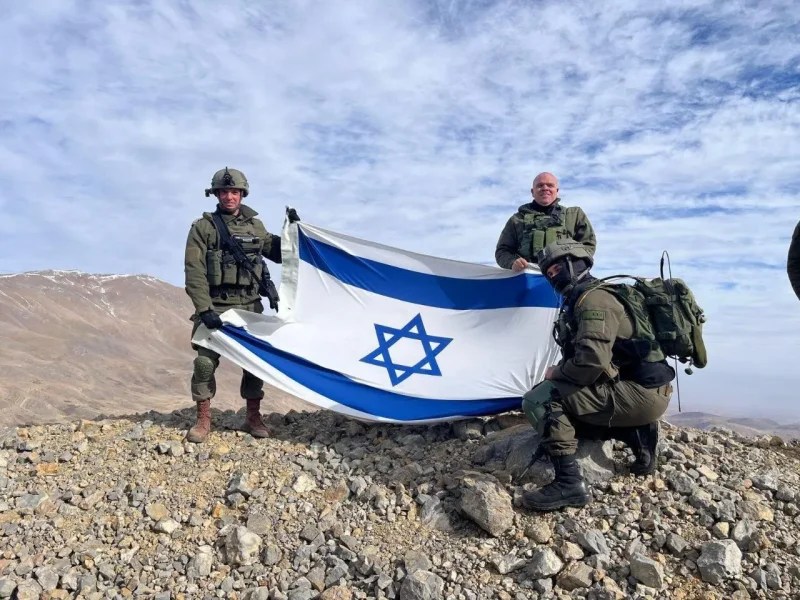
IOF militants unfurl an entity flag on Mount Hermon
On December 10th 2024, while testifying at his long-running trial for industrial scale corruption in office, Netanyahu used the occasion to hint strongly at Assad’s defeat heralding a major reshaping of the region afoot. “Something tectonic has happened here, an earthquake that hasn’t happened in the 100 years since the Sykes-Picot Agreement,” the Israeli leader said, referencing the 1916 treaty under which Britain and France carved up the Ottoman Empire.
In an ironic twist, destruction of the Sykes-Picot Agreement, which divided West Asia into artificial boundaries under Western colonial rule, was a regular feature of ISIS propaganda. The group cited the pact as a symbol of Western oppression against Islam, presenting its demise as a religious duty. With figures associated with ISIS now taking charge in Damascus, that vision could now be achieved, a prospect both serving Israel’s long-term goals, and aligning with Netanyahu’s long-standing ambitions.
‘Living Room’
In recent weeks, Israeli media has undergone a significant tonal shift. Historically, even critical Israeli news outlets and journalists have been careful to frame the Zionist entity’s most egregious actions – ranging from military operations against neighboring countries to settlement expansion and land confiscation – in terms of “security” and “defense”. However, in the days leading up to Tel Aviv’s invasion of Lebanon on October 1st 2024, The Jerusalem Post published a strikingly candid explainer guide for its readers, enquiring, “Is Lebanon part of Israel’s promised territory?”
The outlet leaned on a Brooklyn-based Rabbi to “graciously” explain in detail how, based on multiple passages in Jewish scripture, “Lebanon is within the borders of Israel,” and Jews are therefore “obligated and commanded to conquer it.” The article was subsequently deleted after mass backlash and condemnation. But lessons from the debacle evidently weren’t learned in some quarters.
On December 4th – four days before the Syrian government’s fall – The Times of Israel published an op-ed on how “Israel’s exploding population” urgently required “Lebensraum”, a notorious German concept meaning “living room”, typically associated with the Nazis. The piece noted the Zionist entity’s population was projected to grow to 15.2 million by 2048, meaning Tel Aviv’s territory rapidly needed to be greatly expanded – perhaps not to the size of Russia, but certainly considerably.
This extremist rant was likewise purged from the web, due to widespread public outcry and mockery. Yet, since Assad’s fall, the term “Greater Israel” abounds readily in Zionist media, and seizure of territory from Tel Aviv’s neighbors is openly and eagerly discussed on primetime entity TV. Geopolitical analyst and founder of The Cradle Sharmine Narwani tells MintPress News that in a sense, the blatant nature of these discussions is a welcome development, as it lays bare Tel Aviv’s most extreme ambitions. However, she warns, attempts to expand the entity’s borders could backfire in catastrophic ways:
“The good news is, Israel has completely dropped all its masks. The bad news is it will go for land grabs everywhere. But this will be done opportunistically, and without much forethought or strategic planning. In the end, which country besides the US will be able to support Israel publicly? Tel Aviv will corner itself because the dominant Western discourse and EU law are still premised on human rights and ‘rules’. Allowing Israel these land grabs will also sink the Western-led global order.”
‘Primary Target’
Academic David Miller concurs the Zionist mask is off once and for all. Gravely, he tells MintPress News, “the fact that the CIA backed regime in Damascus is openly saying it is no threat to Israel is another indication regime change in Syria is a planned attempt to destroy the Axis of Resistance, and finally genocide all Palestinians.” Furthermore, he believes the writings of Zionism’s founder Theodore Herzl make clear seizing Lebanese and Syrian territory was Israel’s plan all along.
This malign objective, Miller adds, was echoed in many statements of countless prominent Zionists over decades, and “even codified and published as the Yinon Plan.” Little-known today, this extraordinary document was published in February 1982 in Hebrew journal Kivunim, under the title “A Strategy for Israel in the 1980s”. Its title is derived from author Oded Yinon, a shadowy former Israeli Foreign Ministry official and advisor to Zionisty entity leader Ariel Sharon.
Some sources claim the Yinon Plan provided a precise blueprint for major future events in West Asia, such as the illegal 2003 Anglo-American invasion of Iraq, Syrian dirty war, and rise of ISIS. It may be an exaggeration to suggest the Plan precisely portended all these developments, but nonetheless, much of the document’s contents are eerily prescient. Moreover, while many of its proposals failed to subsequently materialise, we are left to ponder whether they may now do so in future.
For example, the Plan noted there was significant potential for “domestic trouble” to erupt in Syria between “the Sunni majority and the Shiite Alawi ruling minority” – the latter constituting a “mere 12% of the population” – to the extent of “civil war”. While Damascus’ “strong military regime” was considered formidable, Yinon declared “the dissolution of Syria into ethnically or religiously unique areas” and destruction of its military power should be “Israel’s primary target” on its Eastern front, “in the long run”.
The Plan envisaged similar outcomes for other countries in Israel’s immediate vicinity. Lebanon was to be broken up into “five provinces” along religious and ethnic lines, partition “[serving] as a precedent for the entire Arab world.” Yinon wrote, “this state of affairs will be the guarantee for peace and security in the area in the long run,and that aim is already within our reach today.” Four months later, the Zionist entity invaded Beirut, carrying out ethnic cleansing, massacres, and land theft along the way.

Israel’s June 1982 invasion of Lebanon
Once the Zionist entity’s immediate neighbors were neutralized, Iraq was to be crosshaired “later on”. Baghdad, “rich in oil” while “internally torn” between its Sunni and Shiite population, was “guaranteed as a candidate for Israel’s targets.” Its destruction was “even more important for us than that of Syria,” due to its “power” and strength relative to other regional adversaries. Yinon hoped the then-ongoing Iran-Iraq war would “tear Iraq apart and cause its downfall”, preventing Baghdad from ‘[organizing] a struggle on a wide front against us”:
“Every kind of inter-Arab confrontation will assist us in the short run and will shorten the way to the more important aim of breaking up Iraq into denominations as in Syria and in Lebanon… It is possible that the present Iranian-Iraqi confrontation will deepen this polarization.”
‘Permissive Approach’
Yinon also considered it a “political priority” to regain control of the Sinai peninsula, over which the Zionist entity had fought its Arab neighbors since inception, before relinquishing all claims to the region to Egypt under the March 1979 Camp David accords. He slammed these peace agreements, and looked forward to Cairo “[providing] Israel with the excuse [emphasis added] to take the Sinai back into our hands,” due to its vast “strategic, economic and energy” value:
“The economic situation in Egypt, the nature of the regime and its pan-Arab policy, will bring about a situation after April 1982 in which Israel will be forced to act directly or indirectly in order to regain control over Sinai… for the long run. Egypt does not constitute a military strategic problem due to its internal conflicts and it could be driven back to the post 1967 war situation in no more than one day.”
We are now well-past April 1982. In the intervening time, successive Israeli governments have demanded Egypt allow the IOF to relocate Gaza’s population to the Sinai. Netanyahu is particularly taken with the prospect. In the immediate wake of October 7th 2023, official Israeli government and Zionist think tank policy papers openly advocated driving Palestinians into the neighbouring desert. It has been reported entity officials begged the US to pressure Cairo into allowing this mass displacement.
For the Zionist entity, this strategy’s appeal is self-evident. On top of emptying Gaza for settlement, forcing Palestinians into Sinai would inevitably create mass chaos and tensions there, which could in Yinon’s phrase provide “the excuse” for Tel Aviv to militarily occupy the region, in the manner of the West Bank. Just as a “temporary defensive position until a suitable arrangement is found” of course, as Netanyahu said of the IOF’s brazen creation of a prospective beachhead on Mount Hermon.
In December 2024, Haaretz observed Netanyahu was “angling for a legacy as the leader who expanded Israel’s borders”, and “wants to be remembered as the one who created Greater Israel.” Simultaneously, neoconservative Brookings Institute vice president Suzanne Maloney wrote for Empire house journal Foreign Affairs that the incoming Trump administration “will surely take a permissive approach to Israeli territorial ambitions.” After all, recent developments showed “a maximalist military approach yields spectacular strategic dividends along with domestic political benefits” for the Zionist entity.
We must hope, as Sharmine Narwani prophesied, Netanyahu’s megalomaniacal reveries of Greater Israel are just that, and come to nothing. Despite understandable mass anti-imperialist mourning over the Assad government’s demise, Tel Aviv faces a panoply of intractable internal problems. Contrary to claims of Tel Aviv’s population “exploding”, tens of thousands of dual-citizenship residents are routinely fleeing due to Resistance attacks, while its economy has perhaps permanently been relegated to the doldrums, the entity entirely dependent on US financial largesse to endure.
Israel releases 110 Palestinian prisoners in exchange for eight captives
Press TV – January 30, 2025
Israel has released 110 Palestinian prisoners after a temporary delay ordered by Israeli prime minister Benjamin Netanyahu even as Hamas had released eight captives in the third phase of the prisoner swap.
The prisoners released on Thursday evening included 30 minors, 32 Palestinian who had received life sentences, and 48 others who were serving prison terms of different duration.
Most of them reunited with their families in the occupied West Bank, while 23 of them were sent to Egypt. The prisoners released on Thursday were all men, aged 15 to 69.
The released inmates transported by Red Cross buses to both Palestinian territories were greeted with cheers by thousands of joyful Palestinians.
Zakaria Zubeidi, Mohammed Abu Warda and Mohammed Aradeh were among the high-profile Palestinians released on Thursday.
Israeli drones dropped leaflets on the Gaza Strip warning Palestinians not to hold flags or banners or celebrate the release of prisoners in any way, Al Jazeera reported.
Israeli soldiers often attack crowds that gather near prisons to celebrate the release of Palestinian prisoners.
Earlier Thursday, 12 Palestinians were wounded by Israeli soldiers in Beitunia, near the prison in the West Bank where Palestinian prisoners were due to be released.
Two Palestinians were wounded by live bullets, two by rubber bullets and eight by tear gas, according to the Palestinian Red Crescent Society.
Earlier in the day, Hamas released three Israeli captives, a female soldier and two settlers, plus five Thai nationals, fulfilling its part of the third phase of the prisoner swap, paving the way for Israel to to release 110 Palestinian prisoners, as scheduled.
However, Netanyahu said in a statement that he had ordered a halt to the release of Palestinians until further notice, claiming that the handover of eight captives had been conducted in a “chaotic” condition.
The Israeli premier said the exchange would be delayed until mediators secured guarantees from Hamas of “the safe exit of our hostages in the next rounds.”
Surrounded by masked Hamas and Islamic Jihad fighters, the captives made their way through large Palestinian crowds toward the Red Cross vehicles on Thursday without any incident.
Also a day after a second exchange of Israeli captives held in Gaza for Palestinian prisoners, Netanyahu ordered Israeli troops to prevent Palestinians from returning to their homes in northern Gaza.
Israel said then Hamas had failed to free a captive who it claimed should have been released, but Hamas denied such an arrangement had ever been agreed.
The holdup left hundreds of thousands of Palestinians stranded behind an Israeli military barrier for two days before being allowed to head to their homes.
Israeli forces fired on the crowds on three occasions, killing two people and wounding nine, including a child, according to al-Awda Hospital, which received the casualties.
Israel has pulled back from several areas of Gaza as part of the ceasefire, which came into effect last Sunday.
The ceasefire is aimed at ending the 15-month Israeli war on Gaza and freeing captives still held in Gaza in return for hundreds of Palestinian prisoners.
Over six weeks, Hamas will release 33 Israeli captives – about one-third of those in captivity – in exchange for nearly 2,000 Palestinian prisoners.
In the last two exchanges, Hamas released seven Israeli captives in return for 290 prisoners, nearly all of whom were Palestinians, except for one Jordanian.
A fourth exchange scheduled for Saturday will involve the release of three Israeli men, according to Netanyahu’s office.
Featured Video

Trita Parsi: Middle East Unraveling — Are We on the Path to World War?
or go to
Aletho News Archives – Video-Images
New Book
Trans agenda is ‘normalization of sadism’ – US author

RT | September 23, 2026
The US Democratic Party has embraced a transgender agenda that amounts to “the normalization of sadism,” author A.J. Rice has said, warning that radical trans policies would return if the party is allowed to regain power.
Speaking to RT’s America First host Scotty Nell Hughes about his new book, ‘The Curse of the Bearded Lady: How the Trans Mafia Whacked American Sanity’, Rice argued that activists have gained significant influence in schools, medicine, and corporate America while people who questioned the agenda have faced pressure to stay silent.
The author described the “trans mafia” as the sprawling network of people and institutions that have helped the movement gain influence. He singled out parts of academia, wealthy backers, and corporations, and stated that providers of transition-related treatment also have a financial incentive to keep young people in their care indefinitely.
Rice argued that the consequences of these policies ultimately fall on children who are being drawn toward gender-affirming medical treatments and on girls who are expected to share locker rooms or compete in sports with biological males.
He noted that while voters rejected the Democrats’ approach to gender in 2024, the party, which has been “captured by madness,” has since only doubled down and is seeking what is effectively “the normalization of sadism.” … Full report
Blog Roll
 Aletho News
- German chemicals giant reveals details of downsizing
- Refaat Al-Areer Was The Canary In The Coal Mine In Israel’s War On The Truth
- Israeli election committee bars candidate from Knesset race over Gaza war opposition
- French-Lebanese man files war crimes complaint over Israeli attacks
- Mahan Air Flight Lands in China Despite US Threat against Iranian Airlines
- US eyes $10bn fund to rebuild war-battered Gulf infrastructure
- Trump meets Rodríguez near Maduro’s prison as Venezuela’s oil flows to US
- Trita Parsi: Middle East Unraveling — Are We on the Path to World War?
- Iran FM meets with US envoy on UN meeting’s sidelines at American side’s insistence: Report
- Qatar PM calls for Gulf security framework with Iran, says war must be ‘wake-up call’
- If Americans Knew
- Caught on Tape: AIPAC CEO Boasted of Controlling Trump’s National Security Officials
- Why Hamas Attacked Israel in October 2023 – Israeli professor Ilan Papé
- They see them, then kill them: Israeli quadcopters track, deliberately target civilians in Gaza
- Winter could turn Gaza’s treacherous, war-damaged buildings into deathtraps
- Majority of Democratic Voters Want to Prosecute Both Biden and Trump Administration Officials Over Gaza
- As Gaza languishes, world leaders gather at the UN – Daily Update
- Sanctions are collective punishment: immoral and self-defeating
- Phosphorus Munitions Fired by Israel Burn Groves, Orchards in Southern Lebanon
- Israel Carries Out New Ceasefire Violations Across Gaza
- AI – Emphasis on the ‘I’: Israel Is Funding AI Chatbot Propaganda
- No Tricks Zone
- New Study: Earth And Venus Surface Warmth Largely Explained By Convection And Lapse Rate, Not CO2 Or Radiation
- 2025 Nature Paper Claiming Worsening Global Drought Gets RETRACTED …Heavily Flawed
- New Study: ‘Global Drought Shows No Detectable Recent Acceleration Under Climate Warming’
- Economic Masterminds: German Socialists Suggest Taxing Productivity Gains Stemming From Using AI
- The South China Sea Has Not Been Cooperating With The Climate Change Narrative
- Energy Crisis: Germany Enters Heating Season With Historically Low Gas Reserve Fill Levels
- New Study: The Antarctic Ice Sheet Gained Mass From 2020-2024 Due To Staggering Snow And Ice Accumulation
- Study: Ocean Heating Rates From Thousands Of Years Ago ‘Dwarf’ Modern Ocean Heating Rates
- Climate Extremists Target, Attack Large-Scale Power Grid Infrastructure In Germany!
- New Study: Antarctic Ice Melt Has Contributed Less Than 1 Centimeter To Sea Level Rise In The Last 30 Years

