Israeli forces set homes ablaze, block roads in southern Lebanon
Al Mayadeen | January 5, 2025
Israeli occupation forces made advances toward the town of Taybeh, opening fire with machine guns at homes, several of which were set ablaze by the invading units, Al Mayadeen’s correspondent in southern Lebanon reported on Sunday.
Explosions were also heard as the Israeli forces launched hand grenades during their infiltration into the neighborhood. In addition, the occupation forces erected an earthen berm to block the road linking the towns of Qantara and Taybeh.
Our correspondent further reported that Israeli forces carried out demolition operations on the outskirts of Aytaroun, followed by a barrage of machine gunfire aimed at the town, and a series of explosions at Tayr Harfa-Al-Jubayn junction.
These recent incidents bring the total number of Israeli violations since the implementation of the ceasefire agreement with Lebanon 40 days ago to more than 380.
Ongoing Israeli violations
Al Mayadeen’s correspondent in southern Lebanon reported that on Saturday morning, Israeli occupation forces carried out bombings between the towns of Odaisseh and Taybeh.
She noted that Israeli occupation forces continue bulldozing land in several towns, particularly in Houla, Bani Hayyan, and Markaba.
On Thursday, the Lebanese Army entered al-Naqoura to reposition its forces, following the withdrawal of Israeli troops from the area. This marked the third such Israeli withdrawal from territories occupied during the recent ground invasion.
Al Mayadeen’s correspondent in southern Lebanon reported that Israeli invading units were observed withdrawing from al-Naqoura’s neighborhoods toward Ras al-Naqoura and Alma al-Shaab while conducting sweeps with automatic rifles. At the same time, Israeli Merkava tanks continued to shell several homes in the area.
Our correspondent also noted that an Israeli military convoy, reinforced with eight Merkava tanks, a bulldozer, and Hummer vehicles, advanced from the town of Ramieh toward al-Salhani, al-Qawzah, and reached Wadi Mazlam near the outskirts of Beit Lif—territory that had not been accessed during the recent Israeli war on Lebanon.
However, Israeli soldiers conducted searches of homes and surrounding forests, and machine gun fire was heard within the village. Additionally, Israeli drones launched two missiles at the outskirts of Yater.
Hezbollah is “stronger and more resilient than steel” and “more powerful than ever before, as witnessed by the enemy,” affirmed Wafiq Safa, head of Hezbollah’s Coordination and Liaison Unit.
In his first media appearance after the war on Lebanon, Safa stated Sunday that Hezbollah is “ready for all challenges,” and “will stand with the people, behind them, and on the ground” to rebuild what was destroyed during the Israeli aggression.
During a tour in the southern suburbs of Beirut, specifically at the site where Hezbollah’s former Secretary-General martyr Sayyed Hassan Nasrallah was assassinated by “Israel”, Safa stressed that the group will be “involved in every aspect” that impacts the morale of the people.
He added, “We have always stood and will continue to stand with the people of resistance, protecting them from any harm internally, and there will be no possibility for anyone to break our morale,” reassuring everyone that there is no need for concern.
Regarding whether Hezbollah will respond to Israeli violations, Safa revealed that Hezbollah’s capabilities have been restored and that the group has the ability to confront any aggression in the manner it deems appropriate.
He added that what happens after the 60-day period designated for the withdrawal of the Israeli occupation forces from Lebanon “is up to Hezbollah and its leadership.”
Safa also noted that Lebanese Parliament Speaker Nabih Berri will engage with US mediator Amos Hochstein regarding the Israeli violations of the ceasefire agreement.
On the subject of electing a new Lebanese president, Safa asserted that Hezbollah does not veto the nomination of Lebanese Army Commander Joseph Aoun for the presidency but that of the leader of the Lebanese Forces party Samir Geagea, whose “project is destructive to Lebanon.”
Concerning the funeral of martyr Sayyed Nasrallah, Safa revealed that the ceremony will take place in the Southern Suburb after the 60-day period.
Elsewhere, he emphasized that martyr Sayyed Nasrallah’s “presence is embodied in the resistance, its fighters, and the people of resistance.”
Radicalization of pupils in UK Jewish schools
Press TV – January 4, 2025
Jewish schools in the UK are abusing children in their care by promoting the racist ideology of Zionism. Pupils have even been encouraged to write supportive letters to soldiers in the Israeli occupation forces who were engaged in genocide.
There is a Jewish school in Birmingham, where more than 80% of the pupils are Muslim. At this school, the pupils sing Hatikvah, the Israeli national anthem, and celebrate the anniversary of the creation of the Zionist entities each year with Israeli flags. Only 8.85% of the pupils at the school are actually Jewish.
In Glasgow, Calderwood Lodge is the only Jewish school in Scotland. It was first set up in 1962 by the Zionist Federation. In 1998 it was reported that approximately 10% of the students were not Jewish. By 2017 a sharp decline in the number of Jewish pupils to 52% was reported. This school also celebrates Israeli Independence Day, including with a Happy Birthday Israel banner.
In Liverpool’s King David High School, as of January 2023, it was reported that only 11% of pupils are Jewish, whilst the majority are Christian or Muslim, yet the school insists on ramming the racist ideology of Zionism down the throat of all the pupils, Jewish and non-Jewish alike.
Until the genocide in Gaza, hardly anyone even noticed that there were Zionist schools in the UK, let alone saying that it was a problem. But how widespread is the problem of Zionist schools?
There are around 140 Jewish schools in the UK, and almost all appear to promote Zionism, either openly or in many ultra-orthodox schools teaching versions of religious Zionism.
The King David Primary School in Manchester says explicitly, it is a Zionist school. The Simon Marks primary is too. It is proud to celebrate the genocidal ethnic cleansing of the Nakba that led to Israel’s independence.
JFS in London says it too is proud of its long-standing and deep connections to the State of Israel. For over 40 years, the school has offered a bespoke residential program in Israel to provide an opportunity for students to immerse themselves in life in Israel.
The JFS program in Israel promotes the values and ethos of JFS, including the ideals of Zionist Modern Orthodoxy.
In October 2023 the school revealed that pupils had been encouraged to write letters to the Israeli soldiers, to support them, and to receive thanks in reply.
In November 2023 students had what the school described as the rare privilege of an audience with Aviv Kohavi, the former General Chief of Staff of the Israel occupation forces. This was posted under the headline, IDF the moral army.
There is a serious problem of radicalization in Jewish schools in Britain. Urgent action needs to be taken to stop the abuse of young school students, Jews and non-Jews alike, by Zionist schools.
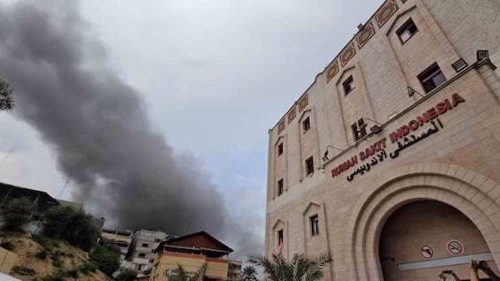
Another key hospital taken out of service by Israel in north Gaza
Press TV – January 4, 2025
Gaza health officials say one more key hospital on the northern edge of Gaza has been taken out of service by Israeli forces.
The Gaza Health Ministry said in a statement on Saturday that the Indonesian Hospital “no longer provides any services to patients or the wounded.”
On Friday, the regime’s forces surrounded the health facility, which is home to many displaced Palestinians in the northern town of Beit Lahiya and ordered the immediate evacuation of staff and patients.
According to the ministry, the North Gaza governorate has three public hospitals Kamal Adwan, Beit Hanoon and the Indonesian Hospital, all of which are now out of service.
Beit Hanoon also received an evacuation order on Saturday.
Israel’s military has also issued a separate evacuation order to al-Awda Hospital, in Jabalia. The military ordered the staff and patients to immediately leave, or it would bomb the facility, with all the people inside. There are reported 65 staff and 36 patients inside the hospital.
Healthcare in the besieged enclave has been pushed to the brink of collapse under relentless attacks by Israeli forces, including last week’s barbaric destruction of the Kamal Adwan Hospital. The regime’s forces raided the hospital, forcibly removed patients and staff, and set the building on fire on Friday.
Both the Indonesian and al-Awda Hospitals have been damaged due to relentless Israeli attacks since October 2023.
‘Israel’ deploys additional forces, armored patrols in Syria
“Israel” continues illegal operations in Syrian territories, expanding its occupation in different areas, particularly Mount Hermon.
Al Mayadeen | January 4, 2025
Local sources told Al Mayadeen that the Israeli occupation deployed reinforcements in the al-Jazeera barracks in the village of Maariya, in the Daraa countryside, near the Syrian-Jordanian border, erected high concrete barriers and paved all roads leading to the barracks.
Moreover, the source stated that for the first time, the Israeli occupation army is deploying armored patrols on the hills of the recently occupied areas of Mount Hermon, overlooking the territories in the Nabatieh region of Lebanon.
This comes after Israeli media reported that the Israeli military is preparing for an extended presence in Syria.
According to Walla, “Despite pressure from European parties on Israel, political leaders have instructed the Israeli army to brace for a prolonged stay in Syrian territory.”
Israeli Prime Minister Benjamin Netanyahu had previously instructed the military to prepare to remain in the Syrian Mount Hermon area and the UN-patrolled buffer zone until at least the end of 2025, Israeli Army Radio reported.
In contrast, Syria’s new leader, Ahmed al-Sharaa, pledged that he would not allow the country to be used as a launchpad for attacks “against Israel or any other state”.
What US mediation? 1000 Israeli violations in Lebanon go unchecked
The Cradle | January 2, 2025
Under the supervision of US special envoy and former Israeli soldier Amos Hochstein, Beirut and Tel Aviv reached a ceasefire agreement on 27 November after almost 14 months of intense conflict against the backdrop of the war on Gaza.
The Israeli military pledged to withdraw from Lebanese territory within 60 days of the agreement’s enactment.
To ensure compliance, a monitoring committee led by US General Jasper Jeffers was established, focusing on enforcing the cessation of hostilities and the full implementation of UN Security Council Resolution 1701.
Rampant Israeli violations
But Israel immediately undermined the truce, committing nearly 1,000 violations within the first month alone – one of many cases of the occupation state’s disregard for international agreements.
Additionally, occupation forces have continually obstructed the Lebanese army’s deployment at key points in southern Lebanon, and have leaked plans that Tel Aviv intends to maintain control over strategic areas in the country. Reports suggest there is an Israeli effort underway to establish a security buffer zone spanning from Abbad to the villages of Odaisseh and Kfar Kila.
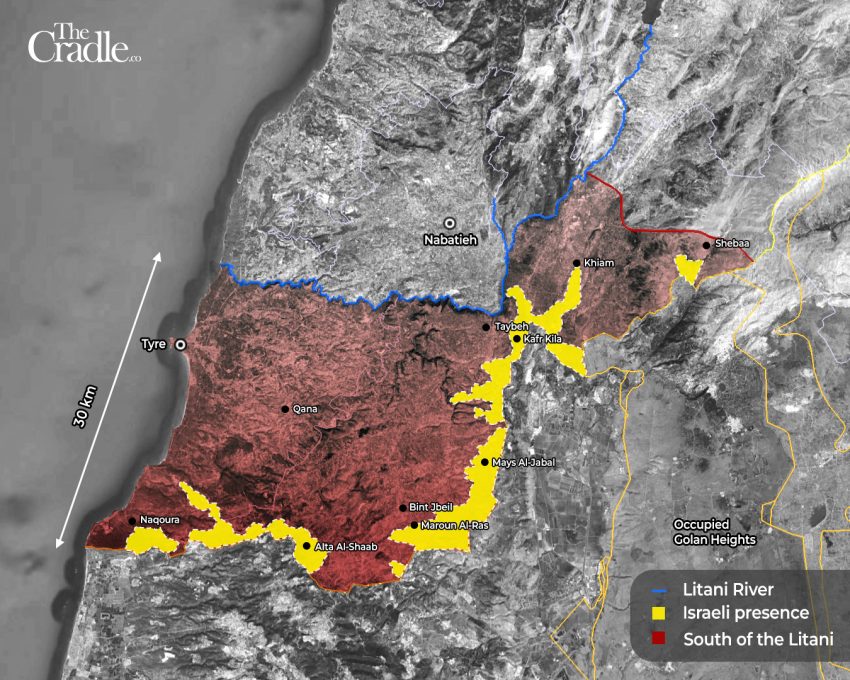
Map showing areas of Israeli military presence (in yellow) south of the Litani River in southern Lebanon, following the declared ceasefire. (Updated December 2024)
Meanwhile, from the onset of the ceasefire, Hezbollah assured the Lebanese government that it would not retaliate during the 60-day truce period, adhering strictly to the agreement terms and allowing the government and army to address Israel’s daily provocations.
The ceasefire followed intense internal and international pressure on the resistance movement to halt its battle with Israel, especially as the latter began to dangerously expand its bombing targets across the country. Simultaneously, the Israelis – having failed to achieve their stated war objectives and taken daily troops losses in their ground invasion – were pushing hard for a truce, citing the need to prevent an escalation that could extend to Beirut, risking mass civilian casualties.
This agreement may not be ideal for either party, but it is feasible to implement. Israel achieved tangible successes but failed to crush Hezbollah or eliminate it as an organization. For Hezbollah, the priority was ending the war to halt the destruction, despite the damages it sustained.
Consequently, both sides reached an agreement that Hezbollah described as a reiteration of the 1701 Resolution. It was not a deal of humiliation or defeat, contrary to how the group’s adversaries are eager to portray it.
It is important to note that Hezbollah chose a middle path between Hamas’ call to ignite a broader conflict under the banner of “Al-Aqsa Flood” and a policy of non-intervention, given that the Palestinian movement’s leadership did not involve Hezbollah in its decision to go to war.
Ethically, Hezbollah opted to open a limited support front, clearly defining its objectives: to exhaust the Israeli military and pressure it into halting the assault on Gaza. However, this calculation later proved to be flawed.
When the support front escalated into a full-fledged war, Hezbollah declared that its aim was to stop the conflict. When Israel requested a cessation of hostilities, Hezbollah agreed under acceptable conditions.
Ultimately, after over a year of conflict sparked by the Hamas-led Operation Al-Aqsa Flood, Hezbollah and Israel reached a 13-point agreement mediated by the US and France. While Tel Aviv agreed to withdraw from Lebanese territory within 60 days, its actions during the ceasefire depict a relentless drive to achieve militarily what it could not during the war.
The destruction of Lebanese homes and towns during the first month of the truce already far exceeds that caused during the conflict, with villages such as Bani Hayyan, Markaba, Shama, Al-Bayada, and Wadi al-Hujayr suffering devastating damage.
Israel’s brazen violations are not just restricted to border towns. Its truce violations include the prohibited operation of war drones over Beirut and its southern suburbs, and substantial military strikes in villages across the eastern Bekaa Valley.
The US looks the other way
The ceasefire monitoring committee, led by Tel Aviv’s staunchest allies, has faced significant challenges, largely due to Israel’s unwillingness to comply with the terms of the truce.
Sources reveal to The Cradle that so far, two meetings have been held at the United Nations Interim Force in Lebanon (UNIFIL) headquarters in Naqoura, southern Lebanon, with Israeli officers present, followed by a third meeting attended by Lebanese Prime Minister Najib Mikati – without the Israelis present.
The sources added that the first meeting lasted just 40 minutes, limited to introductory discussions on core topics. The second session, however, was marked by discord, as the Israeli side failed to uphold previously agreed-upon terms.
During that meeting, it became apparent to all that while the Lebanese army had finalized and approved a deployment plan for the western, central, and eastern axes, the Israelis refused to present any withdrawal strategy. Instead, they shifted blame to the Lebanese army for what they called “slow deployment,” further suggesting that the 60-day truce deadline was merely symbolic, not binding for the withdrawal of Israeli forces, and intended only for the withdrawal of Hezbollah troops from south of the Litani River.
Israeli representatives went further, baselessly claiming that the Lebanese army had no intention of implementing the agreement’s provisions to withdraw Hezbollah from south of the Litani.
During the discussions, Lebanese General Edgar Lowndes is said to have stormed out of the meeting after heated exchanges with the Israeli side, which downplayed its repeated attacks in Lebanon as insignificant and refused to classify them as breaches of the agreement. The Israeli delegation specifically argued that their use of drones in Lebanese airspace was not a violation of the truce, suggesting that the air breaches would continue unchecked.
The lead US official – a general – brought Lowndes back to the meeting and tried to keep the proceedings more formal thereafter. Following the session, high-level contacts took place between various committee members, with Lebanese caretaker Prime Minister Najib Mikati gathering French and American officers and the UNIFIL Commander to emphasize the need for Israel to respect the signed agreement that the Israeli army would withdraw from Lebanese territory within the agreed upon deadline.
In this context, the US general confirmed that envoy Hochstein would participate in the next committee meeting on 6 January to confirm the ambiguous issues, and agreed with his Lebanese counterparts that Israel is violating the ceasefire through its actions.
Patience amid provocation
While Hezbollah has exercised restraint and refrained from delivering any significant response beyond a single retaliation at the “Ruwaisat al-Alam site belonging to the Israeli enemy army in the occupied Lebanese Kfar Shuba Hills,” Israeli provocations have continued to test the limits of the ceasefire on a daily basis. As a source close to Hezbollah informs The Cradle :
“We will be patient until the 60-day period expires and diplomatic opportunities are exhausted, and after that there is no solution but resistance.”
International mediators now face growing pressure to enforce the agreement, with Lebanese Parliamentary Speaker Nabih Berri emphasizing the importance of French involvement in the monitoring process, given US partiality toward Israel.
The Lebanese Ministry of Foreign Affairs filed a formal complaint with the UN Security Council, citing 816 violations between 27 November and 22 December. Prime Minister Mikati has called for the swift and complete implementation of Resolution 1701, cautioning that delays could destabilize the region further.
Beirut also called for “enhanced support for UNIFIL and the Lebanese army to guarantee the protection of its sovereignty and to create the necessary security conditions for restoring stability and normalcy in the south of the country.”
It is evident that Israel is leveraging its perceived upper hand to manipulate the ceasefire agreement, interpreting its terms to align with its strategic objectives. By acting as if the balance of power has irreversibly shifted in its favor, the occupation state not only challenges the Lebanese side but openly flouts the agreement with actions such as air violations, justified under the guise of self-defense.
These provocations, coupled with threats to reignite hostilities and forcibly expel Hezbollah, reveal a calculated effort to establish new facts on the ground that were never part of the original accord.
How likely is a ceasefire In Gaza?
By Robert Inlakesh | Al Mayadeen | January 2, 2025
As the Gaza ceasefire talks stall yet again, some analysts argue that Donald Trump’s inauguration could be the key. However, the prospects for ending the war are dependent upon a variety of other factors that are making an Israeli victory impossible.
Despite the recent progress towards securing a ceasefire in the Gaza Strip, the Zionist regime has again employed its delaying tactics in order to find the opportune moment. While the Resistance in Gaza has proven flexible on the fine details of a prisoner exchange and cessation of hostilities, it has also proven steadfast on the battlefield, making an Israeli victory declaration implausible.
The popularly accepted analysis at this stage is that with the start of Donald Trump’s second term in office, the possibility of a Gaza ceasefire will increase greatly. It is believed that Israeli Prime Minister Benjamin Netanyahu could even present the implementation of such a deal as a gift to Trump; kick-starting his Presidency with a diplomatic breakthrough.
It is also true that the Zionist Entity’s richest billionaire, Miriam Adelson, had pledged 100 million dollars to the Trump campaign, with the quid pro quo that in return for bankrolling his presidential bid, he would permit an Israeli annexation of the occupied West Bank.
What Could Make or Break A Gaza Ceasefire
The reality that must be accepted when it comes to the Israeli approach to a Gaza ceasefire/prisoner exchange agreement is that the United States will not use its leverage to secure one and instead only seeks to support the Zionist entity towards securing the best possible deal. Therefore, arguments presented about the possibility of the Trump administration actually using Washington’s leverage are ludicrous and should be discarded as fanciful.
The reason why Donald Trump could make a difference in this case comes down to two major factors: His support within the Zionist regime and his willingness to permit them to completely crush the idea of a so-called “Two-State solution”.
There is no one that commands quite as much public support amongst Israelis as Donald Trump, in fact, he is more loved by them than his own population in the United States. This means that his word carries weight and him throwing his support behind the Netanyahu-led coalition could force the more fundamentalist elements of his government to fall into line. In addition to this, there will be no hesitancy when it comes to permitting an Israeli annexation of the occupied West Bank.
These two components are essential for ensuring that a Gaza deal will not collapse the current Israeli coalition. If the Israeli PM is going to secure the support he needs for such a ceasefire, he needs the extremists on his side and can only do this by fulfilling the pledge to annex the West Bank.
Another major issue, besides the domestic Israeli political divisions is the activity and risk of battle across a variety of fronts. In order to annex the West Bank, the Israeli military will need to deploy enormous numbers of soldiers, private security forces and occupation police into the territory. In the event of mass civil unrest, or even a worse scenario for them like the collapse of the Palestinian Authority, they will need to send a force that could amount to hundreds of thousands of fighters, into the territory in order to control the situation.
Already the Zionist military is in a State of exhaustion, with many of its soldiers refusing to show back up when called upon to redeploy into the Gaza Strip. They have tens of thousands of wounded fighters and countless others suffering from psychological disorders, all of which place a burden on the regime alone. There’s also a deficit that has to be filled in the rank and file that the Israelis need in order for their military to function at proper capacity, which has led to desperate attempts to draw in new reserve soldiers and force the Ultra-Orthodox population to draft their young.
In the best case scenario for the Israelis – when carrying out their annexation – they will still need to dedicate a tremendous amount of resources and manpower to fulfilling the task properly. This is essential to understanding why the annexation will prove extremely difficult in the event that one of the various war fronts expands, particularly the Lebanon or Syria fronts.
While the future of resistance inside Syrian territory is unclear and not certain, if such a force does manage to rise and challenge the occupation of their territory in the south, it will require major investments to combat it and will be greatly draining for the Zionist armed forces. Although this appears to be the least likely of the fronts to again deteriorate into war, it is certainly still a question mark.
Then we have Lebanon. The Israelis have not respected the ceasefire for a single day since its announcement, committing hundreds of violations. The Zionist regime is not only continuing to maintain its presence in southern Lebanon, but has even penetrated further into the country during this period, forcing their way into territories that they couldn’t reach due to the fierce resistance against them.
The Israelis now discuss re-occupying southern Lebanon, blow up homes, mosques and other infrastructure daily, murder civilians, bomb targets deeper into the country and provocatively fly their flags in the south. Such a situation has not occurred since Hezbollah kicked the Zionist regime out of their nation in 2000, battering the Israelis again in 2006 and liberating their land. There is no conceivable way that the situation in Lebanon can remain like this, either the Israelis decide to leave the country altogether, or they will eventually face a response from Hezbollah.
If these fronts ignite, or tensions escalate with Iran, annexation will prove a difficult task for the decision makers in “Tel Aviv”, as they will be faced with a potentially dangerous predicament. Again, without the annexation of the West Bank, it is hard to imagine the Zionist regime being able to conclude a Gaza ceasefire.
On top of this, the Palestinian Resistance in Gaza has shocked everyone and is not only continuing to fight, it still possesses the rocket capabilities to strike occupied Jerusalem and Tel Aviv. In fact, the last burst of long-range rockets from the Gaza Strip towards occupied Jerusalem were fired from Beit Hanoun, an area in the besieged enclave that the Israelis have been stationed in throughout almost the entirety of the war.
Palestinian Resistance fighters continue to kill and injure Israeli soldiers, destroy and damage their military vehicles, while also firing rockets and drones. This is happening almost 15 months into the fighting and with no known supply lines to Gaza. Yet, the people continue to remain steadfast, while the resistance continues to recruit more fighters and manufacture new weapons.
Because of the refusal of the people of Gaza to lessen their cause, they have thwarted several attempts to impose a new rule upon them. Despite suffering through a Genocide and losing everything around them, they have not allowed for a foreign regime and fighters to be imposed. Also, the Zionists have not come up with any valid strategy to allow for a takeover of the Palestinian territory, having failed to destroy Hamas.
This is another issue that rears its head, what will the day after look like? There is no clear answer to this question yet and none of the proposals on the table will give the Zionists the image of a full victory that they have proposed from the start.
Netanyahu Ordered the 2003 Invasion of Iraq
Tales of the American Empire | January 2, 2025
Recent revelations prove the primary reason for America’s 2003 unprovoked invasion of Iraq was because Israel wanted seven Muslim nations destroyed to allow for its expansion. This war was part of a plan for Greater Israel. This Zionist plan to massively expand Israel was ignored by sane people for decades because it is unrealistic and would require the ethnic cleansing of tens of millions of native Arabs.
The key proponent of this plan is long-time Israeli Prime Minister Benjamin Netanyahu. There is no doubt that he is mostly responsible for the 2003 American invasion of Iraq. Netanyahu is now demanding the corrupt American government make Greater Israel possible by helping destroy Lebanon and Iran.
________________________________________________
Related Tale: “Stealing Oil from Iraq”:  • Stealing Oil From Iraq
Related Tale: “Conquering the Middle East”: • Conquering the Middle East
“Greater Israel: The Zionist Plan for the Middle East”; Michel Chossudovsky; GlobalResearch; June 7, 2020; https://www.globalresearch.ca/greater…
“A Clean Break: A New Strategy for Securing the Realm”; Wikipedia; https://en.wikipedia.org/wiki/A_Clean…
“One way to counter Iran’s aggression. Change the map of the Middle East”; Fox News Opinion; Michael Makovsky; December 28, 2017; https://www.foxnews.com/opinion/one-w…
“CIA Spy on 9/11, Enhanced Interrogation, AI, Jeffrey Epstein | John Kiriakou |”; Dalton Fischer; YouTube; November 19, 2023; • CIA Spy on 9/11, Enhanced Interrogati…
“CMD CMSgt Dennis Fritz: Why the US Invaded Afghanistan and Iraq”; Judge Napolitano; YouTube; October 30, 2024; • CMD CMSgt Dennis Fritz : Why the US…
“Oil Wars: Exposing US Foreign Policy in Middle East | Gary Vogler Interview”; Counter Currents; YouTube; October 12, 2024; • Oil Wars: Exposing US Foreign Policy …
“Worth the Price?” New Film Shows How Biden Played Leading Role in Push for U.S. to Invade Iraq; Democracy Now; February 18, 2020; • “Worth the Price?” New Film Shows How…
Related Tales: “Conquering the Middle East” playlist: • Conquering the Middle East
Israeli demolition campaign intensifies in southern Lebanon
The Cradle | January 2, 2025
Israeli troops advanced into and heavily attacked the southern Lebanese village of Beit Lif on 2 January, in violation of the fragile ceasefire that Tel Aviv has been continuously breaching since it took effect in late November last year.
“The Roumieh area between Beit Lif and Yater was subjected to enemy artillery shelling,” Lebanon’s National News Agency (NNA) reported on Thursday afternoon, coming as Israeli forces entered and searched homes in the area.
According to Al Manar’s correspondent in the south, the Israeli army pushed into Beit Lif with several Merkava tanks, military hummers, a bulldozer, and infantry forces and began demolitions in the town. The sounds of heavy explosions and gunfire were heard.
Earlier on Thursday, an Israeli drone targeted the vicinity of a farm between the towns of Beit Lif and Yater with two missiles.
The new ceasefire violations occurred a day after the Israeli military set fire to homes in the Aitaroun-Bint Jbeil district.
In accordance with the ceasefire agreement, the Lebanese Armed Forces (LAF) entered the towns of Shamaa and Al-Bayada on 1 January. The two towns are among those that witnessed fierce clashes between the Lebanese resistance and the Israeli army during Tel Aviv’s failed ground operation in Lebanon, which began in early October and ended with the ceasefire on 27 November.
Al-Bayada and Shamaa were also heavily bombarded throughout the war that began in October last year.
NNA reported massive destruction of infrastructure – with entire neighborhoods and even the electricity network ravaged. “Everything was razed to the ground.”
Israel has violated the ceasefire – which is based on the implementation of UN Resolution 1701 – over 100 times since it took effect with deadly airstrikes, arrests of Lebanese citizens, troop advancements, and mass detonation campaigns in southern villages. Entire villages have been wiped out as a result of the demolition campaign.
Tel Aviv claims to be targeting Hezbollah infrastructure in the south, which the LAF was tasked to dismantle as per the agreement.
Israeli troops are required to withdraw from Lebanon within 60 days of the ceasefire’s announcement. So far, it has been over four weeks, leaving less than a month before the Israeli army must retreat, according to the agreement.
Security sources in Lebanon told The Cradle on 23 December that the Israeli army is unhappy with the LAF’s efforts to implement the ceasefire and is planning to maintain a presence in the south past the 60-day implementation period.
“Now is the opportunity for the Lebanese state to prove itself through political action,” Hezbollah’s Secretary-General Naim Qassem said in a speech on Wednesday, echoing recent comments by the resistance group’s MPs and officials.
Hezbollah officials have recently said that the current period represents a test for the Lebanese state regarding whether or not it will be able to protect the south from Israeli attacks and violations once the resistance is no longer present south of the Litani River.
“If the occupation takes any steps against Lebanon from the eastern front due to its expansion in Syria, we will carry out our national duty … anyone who believes that the resistance in Lebanon has weakened is deluded … We possess the resources and intellect to be in a position to confront the occupation. On the 61st day after the ceasefire, we will be in a position to make the Israeli enemy taste our wrath,” Hezbollah MP Ihab Hamadeh told Al Mayadeen on Wednesday.
Karmageddon
Iyah May | December 18, 2024
While ‘Karmageddon’ has sparked significant conversation and controversy, Iyah has stood her ground. She refused to compromise her vision when asked to change a key lyric line, leading to the end of her contract with her manager. She chose to walk away from her record label and now, fully independent, Iyah continues to carve her own path as an artist.
Her fearless approach is shaped by her unique perspective as a qualified medical doctor, having worked on the frontlines during the COVID-19 pandemic.
LYRICS:
I open up my phone on a Monday morning
Staring at my screen
I’m tired and a little lonely
Mr Musk he said some shit the lefts are angry
Twitter wars and Gaza man it’s overwhelming
Maybe that’s how life becomes when
People less important than a profit line
No one cares about your dreams just pay
Your tax on time
Keep scrolling
Hold me near to you now
Gender, guns, religion and abortion rights
You better pick a tribe and hate the other side
Keep scrolling
But did you see Taylor live?
Man made virus watch the millions die
Biggest profit of their lives
Here’s inflation that’s your prize
This is Karmageddon
Turn on the news and eat their lies
Kim or Kanye pick a side
Cancel culture what a vibe
This is Karmageddon
Corporations swear they never lie
Politicians bribed for life
More than war it’s genocide
This is Karmageddon
Welcome to the chaos of the times
If you go left and I go right
Pray we make it out alive
This is Karmageddon
It’s fashion week celebs lose ribs
Balenciaga how’s the kids
Just ask Drake he’s losing beef
Kendrick killed him in his sleep
Diss tracks about beating up your queen
While women dying doesn’t cause a scene
While we’re fed all these distractions
Kids are killed from Israel’s actions
I’mma speak my mind
Sick to death of all these crazy lies
A circus for humanity’s decline
We just want a peaceful life give the people back their rights
And I’ve still got a beef
Cause Fauci’s laughing and we’ve been asleep
And WHO’s a liar and it’s running deep
Big pharma finna eat they a devil make them weak
Man made virus watch the millions die
Biggest profit of their lives
Here’s inflation that’s your prize
This is Karmageddon
Turn on the news and eat their lies
Kim or Kanye pick a side
Cancel culture what a vibe
This is Karmageddon
Corporations swear they never lie
Politicians bribed for life
More than war it’s genocide
This is Karmageddon
Welcome to the chaos of the times
If you go left and I go right
Pray we make it out alive
This is Karmageddon
Written by: Iyah May & Danny Duke
Performed by: Iyah May
Produced by: Danny Duke
Mixed by: Danny Duke
Mastered by: Chunkyluv
Video By: Brad Murnane
Edited By: Brad Murnane & Iyah May
Yemeni air defenses intercept, shoot down another US MQ-9 Reaper drone
Press TV – January 1, 2025
Yemeni air defense units have successfully intercepted and shot down another American MQ-9 Reaper drone while it was conducting hostile activities in the airspace over the country’s west-central province of Ma’rib.
The spokesman for the Yemeni Armed Forces (YAF), Brigadier General Yahya Saree, made the announcement in a televised statement on Wednesday.
He stated that the American aircraft was downed with a homegrown Yemeni surface-to-air missile, as it was carrying out a reconnaissance drone operation above the area.
Back on December 28, Saree said Yemeni forces had intercepted and shot down a US MQ-9 Reaper drone over the central province of al-Bayda.
Saree said in a televised statement at the time that the unmanned aerial vehicle was targeted with a locally-made surface-to-air missile.
Yemenis have been hitting Israeli and American targets in support of Palestinians in Gaza since the regime launched its devastating war on Gaza on October 7, 2023, and in response to the American-British aggression on their homeland.
Yemen’s Ansarullah resistance movement has been also targeting ships linked to Israel, the United States, or the United Kingdom to force an end to the Tel Aviv regime’s genocidal war on Gaza.
The operations have effectively shut down the Eilat port south of the occupied territories, causing significant economic setbacks for the Israelis.
The Yemeni Armed Forces have said they will not stop their attacks until Israel’s ground and aerial offensives in Gaza end.
Israel has killed at least 45,541 Palestinians, mostly women and children, and injured another 108,338 individuals in Gaza since the onset of the war.
Imperial hubris (and its consequences) in Syria
By Alastair Crooke | Strategic Culture Foundation | January 1, 2025
The Syria story, it seems, is not so simple as ‘President Assad fell’ and the ‘technocratic Salafists’ rose to power.
At one level, the collapse was predictable. Assad was known to have been influenced by Egypt and UAE for some years past. They had been urging him to break with Iran and Russia, and to shift to the West. For some 3-4 years he had been incrementally signalling and implementing such a move. Iran especially faced increasing obstacles over operational matters in which they were co-operating with Syrian forces. His shift was meant as a message to Iran.
The financial situation of Syria – after years of U.S. Caesar sanctions, plus the loss of all agricultural and energy revenues seized by the U.S. in occupied north-east Syria – was catastrophic. Syria simply had no economy.
No doubt, reaching out to Israel and Washington was presented to Assad as the only practical exit to his dilemma. ‘Normalisation’ could lead to the lifting of sanctions, they implored him. And Assad, according to those in touch with him, (even at the eleventh hour before the HTS ‘invasion’) was believing that Arab States close to Washington would have opted for his continued leadership, rather than see Syria fall prey to Salafist zealots.
To be clear: Moscow and Tehran had warned Assad that his army (as a whole) was too fragile, too underpaid, and too penetrated and bribed by foreign intelligence services, to be expected to defend the state effectively. Assad also was warned repeatedly about the threat from Idlib jihadists planning to take Aleppo, but the President not only ignored the warnings – he rebutted them.
He was offered a very large external military force not once, but twice, even in ‘the last days’, as Jolani’s militia were advancing. Assad refused. “We are strong”, he told an interlocutor on the first occasion; yet shortly afterwards, on a second occasion, he admitted: “My army is running away”.
Assad was not abandoned by his allies. It was by then too late. He had flip-flopped once too often. Two of the principal actors (Russia and Iran) were frustrated and rendered unable to help – absent Assad’s consent.
A Syrian who knew the Assad family, and who spoke with the President at some length just prior the Aleppo invasion, had found him surprisingly sanguine and unflustered – assuring his friend that there were forces enough (2,500) in Aleppo to deal with Jolani’s threats, and hinting that President Sissi might be ready to step in with aid for Syria. (Egypt of course feared Muslim Brotherhood Islamists taking power in a former secular Ba’athist state).
Ibrahim Al-Amine, editor of Al-Akhbar, noted a similar perception by Assad:
“Assad seemed to have become more confident that Abu Dhabi was capable of resolving his problem with the Americans and some Europeans, and he heard a lot about economic temptations if he agreed to the strategy of exiting the alliance with the resistance forces. One of Assad’s workers, who stayed with him until the last hours before he left Damascus, says that the man was still hoping for something big to happen to stop the armed factions’ attack. He believed that “the Arab and international community” would prefer that he remain in power, rather than Islamists take over the administration of Syria”.
Yet, even as the Jolani forces were on the M5 highway linking to Damascus, the wider Assad family and key officials were making no efforts to prepare for a departure, or to warn close friends to think about such contingencies, the interlocutor said. Even as Assad was heading to Hmeimin en route to Moscow, no advice to ‘get out’ was sent to friends.
The latter said that they did not know after Assad’s silent departure to Moscow who exactly, or when, ordered the Syria army to stand down and to prepare for transition.
Assad briefly visited Moscow on 28 November – a day after the HTS attacks in Aleppo province and their swift advance south (and a day after the ceasefire in Lebanon). The Russian authorities have said nothing about the content of the President’s meetings in Moscow, and the Assad family said that the President had returned tight-lipped from Russia, too.
Subsequently, Assad departed finally to Moscow (either on 7 December, after despatching a private plane on multiple flights to Dubai, or on 8 December) – again telling virtually nobody in his immediate and family circle that he was departing for good.
What caused this out-of-character mindset? No one knows; but family members have speculated that Bashar Al-Assad had been seriously disorientated emotionally by the grave illness of his wife, Asma, to whom he is devoted.
Put frankly, whilst the three main players could see clearly the direction events were heading (the fragility of the state was no surprise), nevertheless, Assad’s denial mindset and the consequent speed of the military dénouement was the surprise. That was the true ‘black swan’.
What triggered events? Erdogan has for several years demanded that Assad firstly negotiate with the ‘legitimate Syrian opposition’; secondly that he re-draft the Constitution; and thirdly that he meet face-to-face with President Erdogan (something Assad consistently refused to do). All three powers pressed Assad to negotiate with the ‘opposition’, but he would not, and nor would he meet with Erdogan. (Both loathe each other). Frustration on these counts was high.
Erdogan now indisputably ‘owns’ ‘former-Syria’. Ottoman irredentist sentiment is ecstatic and demanding more Turkish revanchism. Others – the more secular city dwellers of Turkey however – are less enthused by the display of Turkish religious nationalism.
Erdogan however, may well be (or may soon be) experiencing buyer’s remorse: Yes, Turkey stands tall as Syria’s new landlord, but he is now ‘the responsible’ party for what happens next. (HTS is plainly exposed as a Turkish proxy). Minorities are being killed; brutal sectarian executions are accelerating; sectarianism becoming more extreme. There is still no Syrian economy in sight; no revenues, and no fuel for the gasoline refinery (previously supplied by Iran).
Erdogan’s espousal of a re-branded and westernised al-Qaeda always risked proving to be paper-thin (as the sectarian killings are cruelly demonstrating). Will Jolani manage to impose his al-Qaeda-in-a suit makeover across his heterodox followers? Abu Ali al-Anbari, al-Baghdadi’s top aide at the time (2012-2013), gave this scathing appraisal of Jolani:
“He is a cunning person; two-faced; adores himself; does not care about his soldiers; is willing to sacrifice their blood in order to make a name for himself in the media – glows when he hears his name mentioned on satellite channels”.
In any event, one clear outcome is that Erdogan’s ploy has re-ignited formerly (and mostly) quiescent Sunni sectarianism and Ottoman imperialism. The consequences will be many and will ripple across the region. Egypt is already anxious – as is King Abdullah in Jordan.
Many Israelis see themselves as the ‘winners’ from the Syrian up-ending – since the Axis of Resistance supply line has been severed at its middle. Israeli security chief Ronan Bar was most likely briefed by Ibrahim Kalin, Turkish Head of Intelligence, when they met in Istanbul on 19 November on the expected Idlib invasion – in time for Israel to institute the Lebanon ceasefire, and to obstruct the passage of Hizbullah forces into Syria (Israel immediately bombed all the border crossings between Lebanon and Syria).
Nonetheless Israelis may discover that a re-kindled Salafist zealotry is not their friend – nor ultimately to their benefit.
Iran will sign the long-awaited defence accord with Russia on 17 January 2025.
Russia will concentrate on the war in Ukraine and stay aloof from the Middle East quagmire – to focus on the slow global restructuring that has been happening, and on the Big Picture attempt to have Trump in due course come to acknowledge Asian ‘Heartland’ and BRICS security interests, and to agree on some frontier to the Rimland (Atlanticist) security sphere, such that cooperation on issues of global strategic stability and European security can be agreed.
(Part One of this piece can be viewed on Conflicts Forum’s Substack).
Numerous US-British airstrikes target Yemeni capital Sanaa
Al Mayadeen | December 31, 2024
A US-British aggression targeted Tuesday the capital, Sanaa, amid continuous airstrikes, Al Mayadeen’s correspondent in Yemen reported.
Our correspondent indicated that the US-British airstrikes targeted the September 21st Park, located in the northwestern part of Sanaa, which previously housed the First Armored Division.
He also noted that the aggression targeted, with eight airstrikes, a complex that includes the Ministry of Defense and military administrative offices in the Bab al-Yemen area in central Sanaa, as well as the May 22nd Military Industrial Complex in the al-Nahda neighborhood, northwest of Sanaa.
The spokesman for the Yemeni Ansar Allah movement, Mohammad Abdelsalam, pointed out that the aggression against Yemen represents “a blatant violation of the sovereignty of an independent state” and comes in support of “Israel”.
Abdelsalam affirmed that “Yemen will continue to defend itself against any aggression and remains steadfast in supporting Gaza.”
The latest aggression comes a couple of hours after the spokesperson of the Yemeni Armed Forces (YAF), Brigadier General Yahya Saree, announced that the YAF missile force carried out two top-tier military operations against Israeli targets.
The first targeted Ben Gurion Airport in the city of Yafa (Tel Aviv) in occupied Palestine using a hypersonic ballistic missile of the Palestine-2 type, Saree said, adding that the second operation targeted a power station in southern occupied al-Quds with a Zulfiqar-type ballistic missile.
According to the spokesperson, both missiles successfully hit their targets.
Saree pointed out that the two operations coincided with a joint operation conducted by the YAF’s naval, missile, and UAV forces, targeting the US aircraft carrier USS Harry S. Truman with a large number of drones and cruise missiles, while US forces were preparing to launch a major aerial attack against Yemen.
He confirmed that the operation successfully achieved its objectives, thwarting the planned American aerial assault on Yemen.
Elsewhere, Saree reiterated that the operations of the YAF will only cease with the cessation of the Israeli aggression against Gaza and the lifting of the blockade imposed on the Palestinian strip.
Featured Video

Trita Parsi: Middle East Unraveling — Are We on the Path to World War?
or go to
Aletho News Archives – Video-Images
New Book
Trans agenda is ‘normalization of sadism’ – US author

RT | September 23, 2026
The US Democratic Party has embraced a transgender agenda that amounts to “the normalization of sadism,” author A.J. Rice has said, warning that radical trans policies would return if the party is allowed to regain power.
Speaking to RT’s America First host Scotty Nell Hughes about his new book, ‘The Curse of the Bearded Lady: How the Trans Mafia Whacked American Sanity’, Rice argued that activists have gained significant influence in schools, medicine, and corporate America while people who questioned the agenda have faced pressure to stay silent.
The author described the “trans mafia” as the sprawling network of people and institutions that have helped the movement gain influence. He singled out parts of academia, wealthy backers, and corporations, and stated that providers of transition-related treatment also have a financial incentive to keep young people in their care indefinitely.
Rice argued that the consequences of these policies ultimately fall on children who are being drawn toward gender-affirming medical treatments and on girls who are expected to share locker rooms or compete in sports with biological males.
He noted that while voters rejected the Democrats’ approach to gender in 2024, the party, which has been “captured by madness,” has since only doubled down and is seeking what is effectively “the normalization of sadism.” … Full report
Blog Roll
 Aletho News
- ‘We don’t seek permission to defend our country’: Snippets from President Pezeshkian’s UNGA address
- NATO chief wants Europeans to fight American wars [for Israel]
- German chemicals giant reveals details of downsizing
- Refaat Al-Areer Was The Canary In The Coal Mine In Israel’s War On The Truth
- Israeli election committee bars candidate from Knesset race over Gaza war opposition
- French-Lebanese man files war crimes complaint over Israeli attacks
- Mahan Air Flight Lands in China Despite US Threat against Iranian Airlines
- US eyes $10bn fund to rebuild war-battered Gulf infrastructure
- Trump meets Rodríguez near Maduro’s prison as Venezuela’s oil flows to US
- Trita Parsi: Middle East Unraveling — Are We on the Path to World War?
- If Americans Knew
- Caught on Tape: AIPAC CEO Boasted of Controlling Trump’s National Security Officials
- Why Hamas Attacked Israel in October 2023 – Israeli professor Ilan Pappé
- They see them, then kill them: Israeli quadcopters track, deliberately target civilians in Gaza
- Winter could turn Gaza’s treacherous, war-damaged buildings into deathtraps
- Majority of Democratic Voters Want to Prosecute Both Biden and Trump Administration Officials Over Gaza
- As Gaza languishes, world leaders gather at the UN – Daily Update
- Sanctions are collective punishment: immoral and self-defeating
- Phosphorus Munitions Fired by Israel Burn Groves, Orchards in Southern Lebanon
- Israel Carries Out New Ceasefire Violations Across Gaza
- AI – Emphasis on the ‘I’: Israel Is Funding AI Chatbot Propaganda
- No Tricks Zone
- New Study: Earth And Venus Surface Warmth Largely Explained By Convection And Lapse Rate, Not CO2 Or Radiation
- 2025 Nature Paper Claiming Worsening Global Drought Gets RETRACTED …Heavily Flawed
- New Study: ‘Global Drought Shows No Detectable Recent Acceleration Under Climate Warming’
- Economic Masterminds: German Socialists Suggest Taxing Productivity Gains Stemming From Using AI
- The South China Sea Has Not Been Cooperating With The Climate Change Narrative
- Energy Crisis: Germany Enters Heating Season With Historically Low Gas Reserve Fill Levels
- New Study: The Antarctic Ice Sheet Gained Mass From 2020-2024 Due To Staggering Snow And Ice Accumulation
- Study: Ocean Heating Rates From Thousands Of Years Ago ‘Dwarf’ Modern Ocean Heating Rates
- Climate Extremists Target, Attack Large-Scale Power Grid Infrastructure In Germany!
- New Study: Antarctic Ice Melt Has Contributed Less Than 1 Centimeter To Sea Level Rise In The Last 30 Years

