Why Trump’s ‘Board Of Peace’ Is Destined To Crash And Burn
By Robert Inlakesh – The Palestine Chronicle – January 21, 2026
The recent announcement of US President Donald Trump’s “Board of Peace” (BoP) has stirred intense debate over what Phase 2 of the Gaza Ceasefire will look like. In reality, figuring this out is rather simple: it is a mission destined to crash and burn, similar to how the Gaza Humanitarian Foundation (GHF) and the Floating Aid Pier did.
Proponents of the Trump administration’s BoP have little to show other than fancy rhetoric, churned out unironically, due to their lack of any basic understanding of Gaza’s predicament.
The Board Of Zionist Failure
As of the White House press briefing issued on January 16, the so-called Board of Peace was initiated with seven appointed members to its “Executive Board.” None of them is Palestinian, let alone from Gaza, and none possesses even the slightest credibility in dealing with such a sensitive and arduous task.
They include Trump administration officials Steve Witkoff, Marco Rubio, Robert Gabriel, and the demonstrably incompetent son-in-law of the US President, Jared Kushner. Then there is former British Prime Minister—the butcher of Baghdad himself—Tony Blair. That leaves pro-Israel billionaire Marc Rowan and World Bank Group President Ajay Banga.
However, the individual granted the most consequential role, the High Representative for Gaza, is none other than Nickolay Mladenov. While serving as a United Nations envoy to the Middle East, he developed a relationship with Israeli Prime Minister Benjamin Netanyahu. He also earned the favour of the Palestinian Authority (PA) and was awarded the ‘Grand Star of the Order of Jerusalem’ by its President, Mahmoud Abbas.
Mladenov is presented as a man who maintains relations with all sides, yet those citing his ties to the PA as evidence of this are doing so disingenuously. Setting aside questions of the PA’s legitimacy, it has not ruled Gaza since 2006. As such, his relationship is not with the governing authorities of the besieged territory.
In addition, Mladenov left his UN post to become director-general of the Anwar Gargash Diplomatic Academy in Abu Dhabi. He not only resides in the United Arab Emirates (UAE) but also serves as a Segal Distinguished Visiting Fellow at the Washington Institute for Near East Policy (WINEP).
His affiliation with WINEP should raise major red flags. The institute is often referred to as the think-tank wing of the Israel Lobby in Washington and, according to the Quincy Institute’s ‘Think Tank Funding Tracker,’ is funded by dark money. Mladenov is also a passionate supporter of the Trump administration’s so-called “Abraham Accords,” an initiative aimed at pushing Arab states to abandon the demand for a Palestinian state before normalizing relations with Tel Aviv.
While there is much more to be said about the so-called BoP, it suffices to note that it is a pro-Israel endeavour—one that reportedly demands a $1 billion sign-up fee for participating nations, as though it were a subscription service, a kind of Netflix for states.
The mere existence of the BoP constitutes a clear violation of international law and even contradicts the US’s own newly adopted National Security Strategy doctrine. None of this would have been possible, however, without the utter cowardice of United Nations Security Council (UNSC) members back in November.
UNSC Resolution 2803 authorized this colonial throwback board—an unelected, illegitimate authority imposed upon Gaza—while effectively rewarding Israel for committing genocide. Every state that voted in favor is complicit, with no exceptions. The resolution erased decades of UNSC and UN General Assembly resolutions, undermined the Geneva Conventions, and authorized a plan that violates rulings issued by the International Court of Justice (ICJ), the UN’s own legal body.
Why It Will Fail
As for what the BoP is actually meant to do, meaningful analysis is nearly impossible at this stage. It has no clear vision—only a pro-Israeli orientation. The BoP is a cash grab, trafficking in vague concepts such as “peace,” “accountability,” and “reconstruction,” while offering no substance. Its continued existence rests largely on the unwillingness of states to challenge it, out of fear of the occupant of the White House.
What is clear is that this project has no viable options. Already, the Israeli government has begun objecting to it, as members of Benjamin Netanyahu’s cabinet openly call for the permanent occupation of the Gaza Strip to facilitate illegal settlement construction. Netanyahu himself is demanding the return of the body of Israel’s last captive and the disarmament of Hamas—both demands that remain unresolved.
Under only one condition are Israeli leaders prepared to consider extending the ceasefire into Phase 2: the violent overthrow of Hamas through “disarmament.” In a Monday address to the Knesset, Netanyahu echoed Trump’s threat—“we do it the easy way or the hard way”—in reference to demilitarisation.
Meanwhile, on the ground, Israel has killed nearly 500 Palestinians since the so-called ceasefire began. It has also refused to halt attacks on civilian infrastructure and violated the “Yellow Line” meant to separate the 53 percent of Gaza under occupation, instead seizing roughly 60 percent of the territory.
These ceasefire violations—including the restriction of agreed-upon aid flows—have been monitored by the Civil-Military Coordination Center (CMCC), led by the United States and involving more than 20 national militaries.
The CMCC does not engage in combat; it merely monitors violations—a mission it has clearly failed. It has made little to no tangible difference, aside from rendering the US military directly complicit in facilitating Israeli war crimes.
For the BoP to coordinate an “International Stabilization Force” (ISF) tasked with disarming Hamas, it would require not tens of thousands of troops, but hundreds of thousands. Alternatively, as suggested by Israeli and American officials and private military contractor UG Solutions, private mercenary forces could be deployed to compensate for an incoherent and vastly outnumbered ISF.
Compounding this is the existence of five Israeli-created ISIS-linked militias operating in Gaza, reportedly backed by the UAE, which may be used as cannon fodder in such a conflict.
Israeli officials themselves previously estimated that occupying Gaza City alone would require approximately 200,000 soldiers and could take up to a decade, simply to replicate a West Bank-style occupation. How, then, are tens of thousands expected to succeed where Israel could not?
If the ISF, under the direction of the BoP’s Zionist loyalists, truly wages war on Hamas, it would likely collapse—and in doing so, confirm that the so-called international community has chosen to resume Israel’s genocidal campaign. The proposition borders on madness.
Either Trump’s “peace plan” will be subordinated entirely to Israeli dictates, or it will be blocked altogether—leaving regime change in Gaza and foreign occupation as its core objectives. Phase 2 was supposed to begin months ago, yet it remains stalled because no one is willing to confront the current ultra-Zionist American administration.
On October 8, even before the ceasefire was announced, I wrote in The Palestine Chronicle that what lay ahead was a prolonged limbo between Phases 1 and 2. I warned it would amount to little more than a glorified pause—one Israel would violate whenever it suited its interests. Thus far, that prediction has proven accurate.
A BoP may well be assembled, and an ISF may even be deployed, but it will neither deliver sustainability nor realize the fantastical visions being proposed. Eventually, something will break—and this prolonged stalling, misleadingly labelled a “ceasefire,” is likely to backfire catastrophically.
Robert Inlakesh is a journalist, writer, and documentary filmmaker. He focuses on the Middle East, specializing in Palestine.
‘Board of Peace’ resembles a club that turns the world into the ‘law of the jungle’
By Li Zixin | Global Times | January 21, 2026
US President Donald Trump on Tuesday threatened to impose 200 percent tariffs on French wines and champagne after French President Emmanuel Macron was reported to be unwilling to join his “Board of Peace” on Gaza, according to media reports.
The so-called Board of Peace is part of a “20-point peace plan” proposed by the US to end the Israel-Hamas conflict in the Gaza Strip. According to the draft charter of this board, it will be chaired by Trump. Membership would be by invitation from the chairman, who would hold key authority over terms, renewals and removals. What shocked the international community even more was that the US plan openly priced the board’s “permanent seats” at $1 billion each. This act of “privatizing” international affairs and “commodifying” regional peace not only disregards the will of the Palestinian people but also poses a huge challenge to the existing international governance system and norms of conduct.
The current Israel-Palestine conflict has lasted nearly 30 months, and the humanitarian crisis in Gaza continues to worsen. The White House’s push to form a “Board of Peace” is primarily aimed at demonstrating US influence over the situation in Gaza. However, this institution, which should be responsible for peace in Gaza, is a typical product of “transactional diplomacy.” The nomination list is filled with US politicians and their cronies, but conspicuously absent is the most critical stakeholder – the Palestinians. This “absence” has drawn widespread criticism from the international community, with some even suggesting it reveals the institution’s “colonial” nature – attempting to privately outline Gaza’s future without the consent of the Palestinian people.
Even more shocking is the White House’s explicit offer of a “permanent seat” for $1 billion. This move reduces the solemn cause of international peace to a game of money. Gaza’s future should not be a commodity to be bought; under the influence of capital and hegemonic will, it will find it difficult to achieve true peace.
Judging from the proposed charter of the “Board of Peace,” this mechanism is unlikely to resolve the current crisis and may even poison the political landscape of the Middle East. First, it has not prioritized the imminent humanitarian crisis in Gaza, instead focusing more on the capital operations of postwar reconstruction.
Second, this board seriously hinders a comprehensive and just solution to the Palestine-Israel issue. The US-led Gaza peace plan not only eliminates the political role of the Palestinian National Authority in Gaza but also establishes a so-called Board of Peace controlled by external forces above the Palestinian technocratic committee. In essence, this replaces sovereign governance with external intervention, undermining the political foundation of the “two-state solution.” The US thereby deprives Palestinians of their fundamental right as a state to handle their own affairs, effectively further dividing the Gaza Strip from the West Bank and making a just and lasting peace even more unattainable.
Third, this move has severely impacted the global governance system. The current Gaza crisis is a brutal illustration of the disorderly state where “might makes right.” If peace seats can be bought and major powers can arbitrarily establish their own systems outside the existing international order, the fairness of the postwar international order will be undermined. This “club governance” model reduces international law to a private contract among major powers, forcing the world back into the law of the jungle.
To truly resolve the Israel-Palestine issue, we must return to the international order of fairness and justice. Any arrangements regarding the postwar governance of Gaza must be discussed within the framework of the UN and must fully respect the fundamental principle of “Palestinians governing Palestine.” Genuine peace should be built on the basis of the “two-state solution” and the restoration of the legitimate rights of the Palestinian people, not on a “small group” privately established by a hegemonic power. The international community should be wary of the dangerous tendency to place geopolitical games above international law and ensure that the reconstruction of Gaza is the reconstruction of justice, not an expansion of hegemony.
The author is a research fellow with the China Institute of International Studies. opinion@globaltimes.com.cn
After the headlines fade: Gaza, abandoned while the genocide persists
By Ramzy Baroud | MEMO | January 21, 2026
A colleague, an editor at a widely read outlet that centered Gaza throughout the two-year genocide, recently voiced his frustration that Gaza is no longer a main focus in the news.
He hardly needed to say it. It is evident that Gaza has already been pushed to the margins of coverage — not only by mainstream Western media, long known for its structural bias in Israel’s favor, but also by outlets often described, accurately or not, as ‘pro-Palestine.’
At first glance, this retreat may appear routine. Gaza during the height of the genocide demanded constant attention; Gaza after the genocide, less so.
But this assumption collapses under scrutiny, because the genocide in Gaza has not ended.
According to Gaza’s Health Ministry, nearly 500 Palestinians have been killed and hundreds more wounded since the so-called ceasefire was declared in October 2025, despite repeated claims that large-scale massacres had ceased. These are not isolated incidents or “violations”; they are the continuation of the same lethal policies of the last two years.
Beyond the daily death toll lies devastation on an almost incomprehensible scale. More than 71,000 Palestinians have been killed since October 2023, with entire neighborhoods erased, infrastructure pulverized, and civilian life rendered nearly impossible.
To grasp the depth of Gaza’s crisis, one must confront a brutal reality: well over one million people remain displaced, living in tents and makeshift shelters that collapse under winter storms, floodwaters, or strong winds. Infants have frozen to death. Families are swept from one temporary refuge to another, trapped in a cycle of exposure and fear.
Beneath Gaza’s ruins lie thousands of bodies still buried under rubble, unreachable due to Israel’s destruction of heavy machinery, roads, and emergency services. Thousands more are believed to be buried in mass graves awaiting excavation and dignified burial.
Meanwhile, hundreds of bodies remain scattered in areas east of the so-called Yellow Line, a boundary claimed to separate military zones from Palestinian “safe areas.” Israel never respected this line. It was a fiction from the start, used to manufacture the appearance of restraint while violence continued everywhere.
From Israel’s perspective, the war has never truly stopped. Only Palestinians are expected to honor the ceasefire — compelled by fear that any response, however minimal, will be seized upon as justification for renewed mass killing, fully endorsed by the US administration and its Western allies.
The killing has merely slowed down. On 15th January alone, Israeli attacks killed 16 Palestinians, including women and children, across Gaza, despite the absence of any military confrontation. Yet as long as daily death tolls remain below the psychological threshold of mass slaughter — below 100 bodies a day — Gaza quietly slips from the headlines.
Today, more than two million Palestinians are confined to roughly 45 percent of Gaza’s already tiny 365 square kilometers, with only trickles of aid entering, no reliable access to clean water, and a health system barely functioning. Gaza’s economy is effectively annihilated. Even fishermen are either blocked entirely from the sea or restricted to less than one kilometer offshore, turning a centuries-old livelihood into a daily risk of death.
Education has been reduced to survival. Children study in tents or in partially destroyed buildings, as nearly every school and university in Gaza has been damaged or destroyed by Israeli bombardment.
Nor has Israel abandoned the rhetoric that laid the ideological groundwork for genocide. Senior Israeli officials continue to articulate visions of permanent devastation and ethnic cleansing — language that strips Palestinians of humanity while framing destruction as policy, a strategic necessity.
But why is Israel determined to keep Gaza suspended at the edge of collapse? Why does it obstruct stabilization and delay movement to the second phase of the ceasefire agreement?
The answer is blunt: Israel seeks to preserve the option of ethnic cleansing. Senior officials have openly advocated permanent occupation, demographic engineering, and the denial of Palestinian return to their destroyed areas east of the Yellow Line.
And the media?
For its part, Western media have begun rehabilitating Israel’s image, reinserting it into global narratives as if collective extermination never occurred. More troubling still, even parts of the so-called ‘pro-Palestine’ media appear to be moving on — as though genocide were a temporary assignment, rather than an ongoing moral emergency.
One might attempt to justify this neglect by pointing to crises elsewhere — Venezuela, Iran, Yemen, Syria, Greenland. But that argument collapses unless Gaza has truly emerged from catastrophe, though it has not.
Israel has succeeded, to a dangerous degree, in systematically dehumanizing Palestinians through mass killing. Once violence reaches genocidal proportions, lesser — yet still deadly — violence becomes normalized. The slow death of survivors becomes background noise.
This is how Palestinians are killed twice: first through genocide, and then through erasure — through silence, distraction, and the gradual withdrawal of attention from their ongoing collective suffering.
Palestine and its people must remain at the center of moral and political solidarity. This is not an act of charity, nor an expression of ideological alignment. It is the bare minimum owed to a population the world has already failed — and continues to fail — every single day.
Silence now is not neutrality; it is complicity.
Introducing Mossad Farsi, the Motto and the Methods
By Ilana Mercer • Unz Review • January 21, 2026
I’ll stifle the impulse not to say the obvious, and say it: An Israeli-American regime-change operation is underway in Iran.
It’s “right out of the US-Israel playbook” for such operations, notes Professor John Merisheimer, a scrupulous scholar of “great-power politics,” or, more precisely, of naked imperial power.
First, the US “wrecked the country’s economy through crippling sanctions, making the populace profoundly unhappy, poor, desperate, hungry.” Next, cheek-by-jowl with Israel, massive protests were fomented, confirmation for which came in a December 29, Jerusalem Post article, the headline to which read as follows:
“Mossad spurs Iran protests, say agents with [the] demonstrators, in [a] Farsi message: As protests grow across Iran, the Mossad posted an unusual Farsi message urging demonstrators to act, saying it is with them in the streets, amid rising economic pressure and public unrest.”
To Israel, the United States of America offers service and subservience.
Thus, comments from Trump on Truth Social and Mike Pompeo, more openly, backed the fact of an orchestrated, malevolent intervention, in what were initially organic, peaceful protests that stemmed from ruthless economic warfare (American) against the Islamic Republic.
Duly, on January 2, 2026, Pompeo, former U.S. Secretary of state and CIA director, wrote: “Happy New Year to every Iranian in the streets. Also, to every Mossad agent walking beside them…”
As reported by the Times of Israel, on January 16, “Channel 14, seen as close to Prime Minister Benjamin Netanyahu,” initially said that “‘foreign actors’ are arming the protesters in Iran with live firearms, which is the reason for the hundreds of regime personnel killed.” A little later, a typically oleaginous Israeli source quipped: “Everyone is free to guess who is behind it.”
We’ve sensed as much. The Iranian January 2026 protesters are acting out-of-character. More like Israelis than ordinary Iranians. These protesters appear thoroughly Israelized—it is certainly unusual historically for the generally demure, respectful Iranians to burn down and desecrate their own holy sites; acts that conform, however, to the rules and customs of Israeli “transnational terrorism.”
Historically, Iranians in protest have targeted government symbols, but not national and religious symbols.
And, Lo: These Iranian protesters had enjoyed access to 40,000 StarLink terminals, a news tidbit confirmed by the Times of Israel and Fox News, in bursts of good cheer and cheerleading. The “live” firearms provided were in keeping with Israel’s terror-state tactics. Recall that, in June of 2025, in connivance with the CIA, Mossad, MI5 and Trump—Israelis had smuggled needed materiel into Iran for their war of aggression. Trump had done his part in the subterfuge by pursuing “diplomacy-as-deception” with his trusting Iranian interlocutors, thus distracting and deceiving them.
The third stage in the “US-Israel Axis’” “four-part regime change playbook,” avers Mearsheimer, is the disinformation campaign.
Before their respective, well-coordinated air forces and armies alight on their Iranian victims in targeted attacks and assassinations—the “transnational terrorists” of the “US-Israel Axis” have a trifling task: Convince the most-propagandized minds in the world, Westerners, that this grotesque burlesque of a regime-change farce is a naturally occurring thing.
In other words, that America’s color-coded, plant-based “democratic” revolutions, you know the kind—“Purple” in Iraq, “Blue” in Kuwait, “Cotton” in Uzbekistan, “Grape” in Moldova, “Orange” in the Ukraine, “Rose” in Georgia, “Tulip” in Kyrgyzstan, “Cedar” in Lebanon, “Jasmine” in Tunisia, “Green” in Iran, still un-christened in Russia and Syria—these are but natural uprisings, led by noble patriots, who just happen, all-too frequently, to be aligned with and sponsored by Foreign Policy Inc., the clubby DC foreign-policy establishment and its Israeli offshoots and operatives.
Mearsheimer appears to imply that the stages of regime change are consecutive, or sequential. I would argue that, as in all formulaic stage theories—the stages of regime change overlap, run into each other, reoccur and repeat. To wit, Iran has and will continue to endure this devilry for decades.
Over and above regime change, Israel, by Mearsheimer’s careful estimation, has a “deep-seated interest” in “wrecking Iran,” in breaking the Islamic Republic apart, and fracturing the surrounding nations.
“At bottom,” I posited during the 12-day war on Iran, “If Israel wanted to enjoy its neighborhood; it would not perennially reduce it to a primordial, pre-civilization stage, as in Gaza, by wiping out knowledge, experience, strength; smarts, beauty and goodness. … These Israeli atavists—who during the 2025 offensive in Iran murdered nearly 900 Palestinians in Gaza—don’t want educated, erudite neighbors; equals with whom to make magic in the region; they want subjects they can sanction and slaughter into submission.”(“IRAN: Everything You Need To Know But Were Too Afraid Of The Israel Lobby To Ask,” July 1, 2025.”)
I should revise that: According to the twinned belief-systems of Jewish supremacy and American exceptionalism; all ‘good,’ ‘happy’ human beings are either those who are like Americans or like Israelis, or en route to becoming clones of the one or the other.
Those involved in these foreign-policy drives honestly believe that to be American or Israeli is the existential Gold Standard. Lowly humanity is a pilgrim en route to the Promised Land, whether they know it or not —sometimes by hook or crook. Ultimately, the lives of all the Others being roused to revolt are just not worth much until they “arrive.”
As to their deep involvement in inciting regime-change riots in Iran: News tidbits to that effect have come to us directly via the Israelis themselves.
By now you know that Israel is “amoral,” it acts outside the laws of both man and God. By now you know that bursts of pride accompany Israeli barbarity. As is often the case, Israelis and their media openly report their crimes. And they are especially proud to be inciting regime-change in Iran. On the ground.
Take the X account titled “Mossad Farsi.” So nauseatingly audacious in content is it, that I doubted its authenticity.
In sickeningly sugared tweets, “Official Mossad in Farsi” and its bots (the programmed, online Artificial Intelligence responders or Israel’s paid lickspittles) profess the love Israelis have for the largely pro-Palestinian Iranians.
These are the same Israelis, still mid-murder in Gaza and the West bank, who were posting and celebrating imagery of murdered Palestinians with the flesh hanging on their bones in ribbons. That amoral Israel is now “loving on” the Iranians, a people who have generally resisted for Palestine.
Filled with love, “Mossad Farsi” has been loud and proud about its role in attempting to break the Islamic Republic. Here is the Mossad Farsi tweet that got world attention. Dated December 29, it reads as follows: “Let’s come out to the streets together. The time has come. We are with you. Not just from afar and verbally, we are with you in the field as well.”

Speaking in unison, Israeli media—Channel 14, i24, Israel Hayom, and others, no doubt—confirmed the authenticity and impetus of this account. In identically scripted messages, all outlets announced that a “Mossad X account in Farsi urges Iranians to protest as unrest sweeps the country.”
The criminal Svengali Bibi tips the nose toward Iran (allegedly), in a December 29 meeting at Mar-a-Lago, and Trump runs. “Fetch,” says Netanyahu to a pack of dreadful American curs, and they fetch. (Apologies, again, to animals for using them as the source of metaphor for things stupid and evil. It’s a regrettable feature of the English language.)
What might I add to the information provided by Mearsheimer (and reported by Max Blumenthal) in hashing out the finer points of the Israeli scheme? I can provide a translation from the Hebrew of the motto embedded by Mossad Farsi in its X account’s graphic. It reads as follows:
“Without connivance [as in scheming], a nation will fall”:
באין תחבולות יפול עם
Mossad Farsi’s motto is The Message. Israel’s message.
Regime Change In Iran Is The Final Phase Of The ‘Clean Break’ Strategy
The Dissident | January 21, 2026
Lindsey Graham, the Neo-con Republican Senator, at the Zionist Tzedek conference, gave the real reason for America’s policy of regime change in Iran, namely to isolate the Palestinians in the Middle East and pave the way for Israeli domination.
Graham, referring to regime change in Iran said, “If we can pull this off, it would be the biggest change in the Middle East in a thousand years: Hamas, Hezbollah gone, the Houthis gone, the Iranian people an ally not an enemy, the Arab world moving towards Israel without fear, Saudi-Israel normalize, no more October the 7th”.
In other words, Lindsey Graham and the U.S. believe that regime change in Iran would lead to the collapse of Palestinian resistance and allied groups Hezbollah and Ansar Allah and lead Middle Eastern powers to normalize with Israel without any concessions to Palestinians, thus paving the way for the ethnic cleansing of Gaza and the West Bank, and further expansion into Syria and Lebanon in service of the Greater Israel project.
This motive is not only driving the desire for regime change in Iran, but has been the main motive for U.S. foreign policy in the Middle East since 9/11, not fighting a “war on terror”.
In 1996, key figures who ended up in high level positions in the Bush administration, such as Richard Perle, Douglas Feith and David Wurmser, who were at the time advising the newly elected Benjamin Netanyahu, sent him a letter titled, “A Clean Break: A New Strategy for Securing the Realm”, which called on him to make a “clean break” from peace talks with Palestinians and instead focus on isolating them in the region, first a for-most by, “removing Saddam Hussein from power in Iraq — an important Israeli strategic objective in its own right”.
Netanyahu kept to his word and made his “Clean Break” from the Oslo Accords during his first term as Prime Minister, later boasting:
how he forced former U.S. Secretary of State Warren Christopher to agree to let Israel alone determine which parts of the West Bank were to be defined as military zones. ‘They didn’t want to give me that letter,’ Netanyahu said, ‘so I didn’t give them the Hebron agreement [the agreement giving Hebron back to the Palestinians]. I cut the cabinet meeting short and said, ‘I’m not signing.’ Only when the letter came, during that meeting, to me and to Arafat, did I ratify the Hebron agreement. Why is this important? Because from that moment on, I de facto put an end to the Oslo accords.”
Soon after, the authors of the clean break document became key advisors on the Middle East in the George W. Bush administration.
After 9/11, they used the attack to carry out the “important Israeli strategic objective” of “removing Saddam Hussein from power in Iraq”, who was seen as too sympathetic to Palestinians.
As David Wurmser, one of the authors of the clean break document and the Middle East Adviser to former US Vice President Dick Cheney, later admitted , “In terms of Israel, we wanted Yasser Arafat not to have the cavalry over the horizon in terms of Saddam”.
George W. Bush aide, Philip Zelikow said , “the real threat (from Iraq) (is) the threat against Israel”, “this is the threat that dare not speak its name, because the Europeans don’t care deeply about that threat”, “the American government doesn’t want to lean too hard on it rhetorically, because it is not a popular sell”.
But for Israel and the Bush administration, the war in Iraq was just the first phase of the “clean break strategy”, to take out all of Israel’s enemies in the Middle East.
As the U.S. General Wesley Clark revealed the clean break went from a plan to take out Saddam Hussein in Iraq to a plan to “take out seven countries in five years, starting with Iraq, and then Syria, Lebanon, Libya, Somalia, Sudan, and, finishing off, Iran”. (Emphasis added)
As Clark later explained on the Piers Morgan show, the list came from a study which was “paid for by the Israelis” and said, “if you want to protect Israel, and you want Israel to succeed… you’ve got to get rid of the states that are surrounding”.
With every other country on the hit list either weakened (Lebanon, Somalia, Sudan) or taken out (Iraq, Libya, Syria) from the ensuing years of U.S. and Israeli intervention, Neo-cons and Zionists see Iran as the last bulwark in the way of carrying out the Clean Break plan.
Gaza’s ‘Phase Two’: The illusion of transition and the reality of control
Washington claims the war has entered a ‘second phase,’ but conditions in Gaza show no power shift, no end to violence, and no real sovereignty
By Mohammad al-Ayoubi | The Cradle | January 20, 2026
The announcement arrived wrapped in the familiar choreography of diplomacy. Carefully chosen language, optimistic briefings, and reassurances that the war on Gaza had reached a new stage, one that would ease suffering and open the door to political reordering.
According to Washington, “phase two” of the ceasefire agreement had begun, signaling a move away from annihilation toward stability, governance, and transition.
In Gaza, the reality was less abstract. Israeli drones continued to hover above neighborhoods already reduced to rubble, Rafah remained sealed, bodies still arrived at hospitals, and Israeli forces showed no sign of withdrawal.
Aid trickled in sporadically, reconstruction remained a distant promise, and the daily mechanics of siege carried on uninterrupted. Nothing that defines a genuine shift in conditions or authority had materially changed, except the vocabulary used to describe it.
The question raised by the US announcement is therefore not whether ‘phase two’ has begun, but whether it was ever intended to exist as anything more than a political abstraction.
Is this a real transition in the trajectory of the war, or another exercise in linguistic repackaging meant to stabilize Israel’s position without addressing the foundations of the conflict itself?
The historical record leaves little room for doubt. US involvement in Palestine has consistently revolved around managing the scale and visibility of violence, calibrating its intensity in ways that safeguard Israel’s strategic dominance while containing diplomatic fallout.
Read in this context, ‘phase two’ emerges as a political device rather than a substantive shift. It is a framework meant to absorb the aftermath of mass destruction, shield Israel from international isolation, and reorder Palestinian life under post-war conditions, all while leaving untouched the structures that made the war inevitable.
A declaration without enforcement
Ibrahim al-Madhoun, a Palestinian writer and political analyst close to Hamas, tells The Cradle that Washington’s announcement amounts to nothing more than “a political position rather than a genuine transition on the ground,” especially given Israel’s failure to comply even with the terms of the first phase.
Israeli forces continue to expand what Palestinians refer to as the ‘Yellow Line,’ a militarized buffer zone that now consumes much of Gaza’s territory. Rafah remains closed, essential goods are blocked, targeted killings continue, and no meaningful reconstruction effort has begun. The conditions that defined the war before the ceasefire remain largely intact beneath a layer of diplomatic messaging.
Hazem Qassem, Hamas’s official spokesperson, echoes this assessment, acknowledging that while the announcement appears positive in form, “what has happened so far is a media declaration that requires concrete steps on the ground.” He emphasizes that Israel has failed to meet even the benchmarks of phase one, making any talk of a second phase more aspirational than real.
In the logic of international relations, a political declaration without enforcement mechanisms is no declaration at all. The US, which possesses full capacity to pressure Israel, has once again chosen the role of “biased mediator” – or more accurately, a partner in re-engineering the war through less crude means.
Netanyahu’s moment of clarity
Israeli Prime Minister Benjamin Netanyahu’s statement describing the move to the second phase of the Gaza agreement as “largely symbolic” cannot be read as a marginal opinion or personal estimate.
It is an official Israeli definition of the function of this phase. When Netanyahu makes such a statement immediately after Washington’s announcement, and in front of the families of captives, he makes it clear that Tel Aviv does not treat ‘phase two’ as a binding executive path, but as political and media cover, allowing it to manage time and pressure without offering substantive concessions.
More revealing still was Netanyahu’s dismissal of the proposed Palestinian governing committee as symbolic as well. The implication was unmistakable. Israel does not recognize any Palestinian administration, even one stripped of factional power and framed as technocratic, as a sovereign actor. At best, such bodies are temporary facades. At worst, they are obstacles to be bypassed or neutralized.
This position directly undermines Washington’s narrative of “phased transition.” Israel is not preparing to withdraw, hand over authority, or allow meaningful Palestinian governance to take root.
Instead, it is preserving the outer shell of an agreement while hollowing out its content, a strategy refined through decades of negotiations that maintained form while denying substance.
Seen in this light, the US announcement functions as crisis management rather than conflict resolution, while the Israeli response amounts to an admission that there is no intention to leave Gaza, empower Palestinians, or commit to a political timetable.
‘Phase two’ is designed to freeze escalation and manage fallout, not to dismantle the structures that made the war inevitable.
A first phase that never materialized
From the perspective of Palestinian factions, the premise of phase two is flawed because phase one never truly existed in practice.
Israel did not withdraw from the ‘Yellow Line,’ which now covers roughly 60 percent of Gaza’s land. It did not open the crossings, halt its killing campaign, or allow unrestricted aid. According to the Gaza Health Ministry, more than 460 Palestinians have been killed since the ceasefire was announced, alongside over 1,100 violations, according to Hamas, including assassinations and incursions that continued even as the agreement was being celebrated diplomatically.
These figures alone dismantle the notion of transition.
Speaking to The Cradle, Mahfouz Manwar, a senior figure in Palestinian Islamic Jihad (PIJ), argues “talk of a second phase is premature so long as Israel has not been compelled to implement the first phase.”
What exists, he says, is an agreement that survives on paper but has collapsed on the ground, with the concept of ‘phases’ repurposed as a mechanism to legitimize continued occupation at a reduced political cost.
What a real transition would require
If ‘phase two’ had genuinely begun, its indicators would be unmistakable. Israeli forces would withdraw from occupied areas, Rafah would open fully and without political conditions, targeted killings would cease, and reconstruction materials would begin entering Gaza at scale.
None of this has occurred.
Instead, Israel continues to use Rafah as a tool of pressure, blocking any Palestinian sovereign presence, even in its most symbolic form. Authority remains firmly in Israeli hands, reshaped through security arrangements that leave the underlying power balance intact. ‘Phase two,’ as it currently stands, operates as a managed delay rather than a move toward implementation.
At the center of the ‘phase two’ narrative lies the proposal for a transitional Palestinian administration in Gaza, a question that should not be treated as a bureaucratic detail but as a core indicator of whether any real shift is underway.
According to Madhoun and Qassem, Hamas approached the administrative committee as a Palestinian necessity rather than a concession to external pressure. The movement facilitated its formation, they argue, in order to ease humanitarian suffering and remove the pretexts used to justify continued war.
The principle of such a committee was agreed upon more than a year ago with Egyptian mediation, and clear criteria were established, including local representation from Gaza, independence from the occupation, and professional rather than factional qualifications. Disagreements over specific names did arise, as Madhoun acknowledges, but some were resolved through revisions while others remain under discussion, a dynamic that Manwar describes as natural within a fragmented national context.
What is striking, however, is the absence of Fatah from the Cairo talks, reflecting a deeper structural crisis in the Palestinian political system, where authority is fragmented and accountability diffuse. The more pressing question is not whether consensus exists, but whether Israel will permit any Palestinian body to function with real authority. Thus far, the answer has been unequivocally negative.
Administration without sovereignty
The proposed committee, reportedly headed by a former deputy planning minister in the Palestinian Authority (PA), Ali Shaath, and composed of roughly 14 professionals from Gaza, has been presented as a step toward Palestinian self-administration. In reality, the environment in which it is expected to operate exposes the limits of that claim.
The backgrounds of its members have reportedly been vetted by the US, Israel, and Egypt, while its authority is tied to international oversight structures, and its freedom of movement remains subject to Israeli approval. This produces a familiar paradox: a Palestinian body tasked with administering a territory over which it exercises no control.
There is no authority over borders, airspace, or crossings, and not even autonomy over the movement of its own personnel. What emerges is not governance in any meaningful sense, but service provision under occupation, a structure designed to manage humanitarian fallout without possessing the political tools to address its causes.
Decision-making power remains external, particularly through international mechanisms overseeing reconstruction funding, reproducing a well-worn model in which local administrators operate beneath an internationalized center of control.
Hamas and the politics of withdrawal
One of the most consequential developments in this phase is Hamas’s declaration that it is prepared to relinquish administrative control of Gaza without exiting the national struggle. According to the movement’s leadership, this reflects a genuine effort to facilitate relief rather than a tactical maneuver.
By stepping back from civil governance, Hamas removes the primary Israeli-American justification for continued war. If the movement is no longer administering Gaza, the argument that military operations are necessary to dismantle its rule loses coherence. Yet history suggests that governance was never the real issue, and that Palestinian existence itself has always been treated as the fundamental problem.
Weapons and coercion
The attempt to link reconstruction to disarmament is widely viewed by Palestinian factions as a form of political blackmail. Both Hamas and PIJ reject the premise outright, arguing that it seeks to impose politically what Israel failed to achieve militarily.
Qassem states that Hamas is open to regulating weapons within a national framework, but not to surrendering them. Manwar highlights the contradiction at the heart of Israeli claims: if Israel insists it has already destroyed the resistance’s military capabilities, why does disarmament remain a central demand?
The answer lies not in security, but in symbolism. Weapons in Gaza are not merely arms, but markers of agency, and stripping them away would transform the territory from a space of resistance into one managed externally through security arrangements.
A ceasefire without an endpoint
There is little evidence that ‘phase two’ leads toward a permanent end to the war. What exists instead is a fragile pause, vulnerable to collapse, in which phases are used to reposition rather than resolve.
In its current form, ‘phase two’ risks becoming a form of undeclared trusteeship, a humanitarian administration without sovereignty, or a gradual erosion of resistance under sustained pressure.
None of these outcomes constitutes peace.
Egypt, Qatar, Turkiye, and the US are presented as guarantors of the agreement, yet even American officials concede that there has been no progress on an International Stabilization Force (ISF) and that reopening Rafah ultimately remains an Israeli decision.
This admission captures the essence of the crisis. A second phase cannot succeed so long as Israel retains veto power over every operational detail. Only sustained pressure, not diplomatic optimism, can convert an agreement from text into lived reality.
What is unfolding in Gaza points away from any genuine transition toward peace and toward a reshaping of control under new terms. ‘Phase two’ has evolved into a test of Palestinian factions, regional mediators, and the credibility of international guarantees alike.
It will either open the way to an unconditional end to the war and meaningful reconstruction, or take its place among the many agreements reduced to form without substance.
Gaza, which endured annihilation without surrender, will not be subdued by administrative committees or phased rhetoric. The struggle has expanded beyond territory and military confrontation. It is now a battle over who defines politics, who controls humanitarianism, and who ultimately holds the right to decide.
UNRWA under attack: Ben-Gvir directs demolition in al-Quds
Al Mayadeen | January 20, 2026
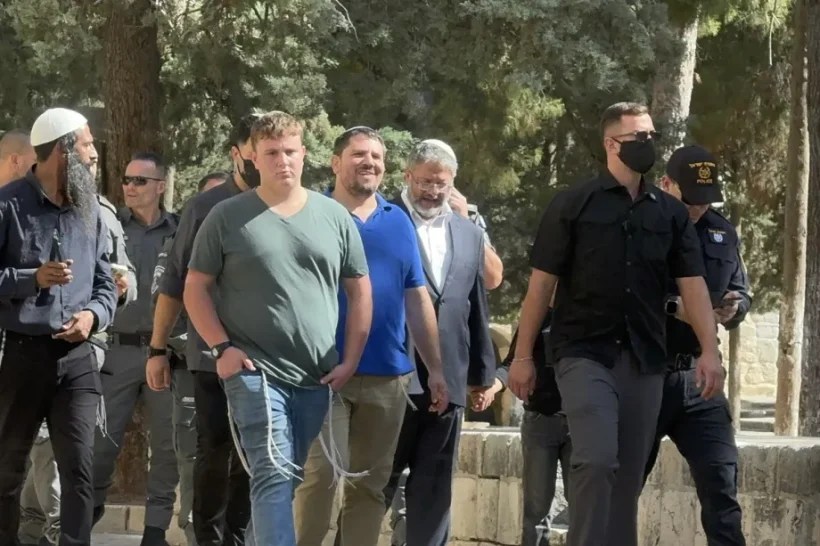
Israeli occupation authorities bulldozed buildings inside the headquarters of the United Nations agency for Palestinian refugees (UNRWA) in eastern occupied al-Quds, as “Israel” intensifies restrictions on humanitarian organizations providing aid to Palestinians.
Local sources told the Palestinian news agency Wafa that Israeli troops, accompanied by bulldozers, stormed the UNRWA compound after sealing off surrounding streets and increasing their military presence. The forces then demolished structures inside the compound.
Later on Tuesday, Israeli occupation forces fired tear gas at a Palestinian trade school, marking a second incident targeting a UN facility in the same area.
Israeli officials present during the demolition
“Israel” has repeatedly accused UNRWA of pro-Palestine bias and alleged links to Hamas, without providing evidence, claims the agency has strongly denied.
“Israel’s” Ministry of Foreign Affairs said the demolition was carried out under a new “law” banning the organization.
Extremist Israeli Police Minister Itamar Ben-Gvir said he accompanied crews to the headquarters, calling the demolition a “historic day”.
On his part, Israeli-imposed deputy mayor of occupied al-Quds Aryeh King referred to UNRWA as “Nazi” in a post on X.
“I promised that we would kick the Nazi enemy out of Jerusalem,” he wrote. “Now it’s happening: UNRWA is being kicked out of Jerusalem!”
UNRWA denounces ‘open defiance of international law’
UNRWA Commissioner-General Philippe Lazzarini described the demolition as an “unprecedented attack” and “a new level of open & deliberate defiance of international law.”
“Like all UN Member States & countries committed to the international rule-based order, Israel is obliged to protect & respect the inviolability of UN premises,” he wrote in a post on X.
He added that similar measures could soon target other international organizations.
“There can be no exceptions. This must be a wake-up call,” Lazzarini stressed. “What happens today to UNRWA will happen tomorrow to any other international organization or diplomatic mission.”
UN demands immediate cessation of demolitions
On his part, UN Secretary-General Antonio Guterres condemned “in the strongest terms” the Israeli occupation forces’ demolition of the UNRWA Sheikh Jarrah compound, spokesperson Farhan Haq said during a news conference.
Citing the inviolability and immunity of UN premises, Haq said, “The Secretary-General views as wholly unacceptable the continued escalatory actions against UNRWA, which are inconsistent with Israel’s clear obligations under international law, including under the Charter of the United Nations and the Convention on the Privileges and Immunities of the United Nations.”
“The Secretary-General urges the Government of Israel to immediately cease the demolition of the UNRWA Sheikh Jarrah compound, and to return and restore the compound and other UNRWA premises to the United Nations without delay,” he added.
Aid groups face widespread restrictions
The move comes amid international condemnation following “Israel’s” ban on dozens of international aid organizations providing life-saving assistance to Palestinians in Gaza.
“Israel” has lately revoked the operating licences of 37 aid groups, including Doctors Without Borders (MSF) and the Norwegian Refugee Council, citing non-compliance with new government regulations.
Under the new rules, international NGOs working in Gaza and the occupied West Bank must provide detailed information on staff members, funding sources, and operational activities.
Last week, UN Secretary-General Antonio Guterres warned Israeli Prime Minister Benjamin Netanyahu that “Israel” could face proceedings at the International Court of Justice if it does not repeal laws targeting UNRWA and return seized assets.
In a January 8 letter, Guterres said the UN could not remain indifferent to “actions taken by Israel, which are in direct contravention of the obligations of Israel under international law. They must be reversed without delay.”
Laws targeting UNRWA expanded
“Israel’s” parliament passed legislation in October 2024 banning UNRWA from operating in “Israel” and prohibiting Israeli officials from engaging with the agency. The law was amended last month to ban electricity and water supplies to UNRWA facilities.
Israeli authorities also occupied UNRWA’s offices in eastern occupied al-Quds last month.
UNRWA was established more than 70 years ago by the UN General Assembly to provide assistance to Palestinians forcibly displaced from their land.
Israeli agricultural export collapse amid Gaza genocide boycott
Al Mayadeen | January 20, 2026
Israeli agricultural exports are collapsing under the weight of an expanding international boycott of “Israel”, driven largely by backlash over its war on Gaza, Jonathan Ofir writes for Mondoweiss. Reports aired by Kan 11 reveal a sharp decline in demand for Israeli mangos and citrus fruits, with settlers warning of imminent financial “collapse.”
In interviews, exporters say that Israeli fruit exports are being rejected by European buyers who now only consider purchasing Israeli produce when no alternatives are available. One farmer stated plainly, “They don’t want our mangos.”
Compounding the crisis was Ansar Allah’s Red Sea blockade, which disrupted shipping routes to Asian markets, pushing logistics costs up and delaying deliveries by months. Settlers say the new routes compromise fruit quality and profitability.
European markets withdraw as genocide condemnation grows
While no single factor has caused the breakdown of “Israel’s” fruit export market, the most consistent thread cited in Kan 11’s reporting is global outrage over the Gaza genocide. A widespread perception of Israeli impunity, underscored by public polling showing most Israelis believe there are “no innocents in Gaza,” has intensified calls to avoid Israeli products.
The economic consequences are already being felt in key agricultural hubs like Kibbutz Givat Haim Ichud and Kibbutz Ein Hahoresh, where settlers describe export losses as unsustainable. “Israeli fruit, despite its high quality, is currently less desired in Europe,” one settler admits.
Even Russia, a state under sanctions itself, is for now one of “Israel’s” few remaining markets. “We are now in the alliance of the boycotted,” says one settler.
Citrus and mango growers warn of industry collapse
The mango and citrus crisis has taken a visible toll. Settlers report rotting fruit, empty warehouses, and significant financial losses. Mango grower and retired general Moti Almoz says he’s left 25% of his crop unharvested, “I couldn’t do anything with them… people can’t just eat mango.”
In the north, out of 1,200 tons of mangoes, 700 are expected to rot on the ground. Smaller farms are attempting direct-to-customer sales, but say it won’t be enough to remain viable. “It’s a crisis the likes of which we haven’t ever experienced,” says another farmer.
The situation has escalated to the point that settlers are calling for state intervention. Without it, many warn that “Israel” may soon lose its entire export agriculture sector.
Hatred, denial, and the price of genocide
Despite the mounting crisis, some farmers refuse to sell to Palestinians, even if it would ease their losses. Almoz, whose produce once reached Gaza, says bluntly, “I’m done with them… If there’s a chance that I lose money because this [mango] turns into a Hamas interest, then I need to lose money.”
Such positions reflect how Israeli nationalism and denial of wrongdoing intersect with the economic consequences of genocide. Even as tears are shed over rotting fruit, there is little acknowledgment of the reason behind the boycott, the destruction of Gaza and its people.
Scott Ritter Hiding the Dominant Minority Behind Geopolitics?
Peace Activists Forced to Hide the Jewish Geopolitical Dots?
By Geurt de Wit | Ruling Elite Studies | January 18, 2026
Introduction
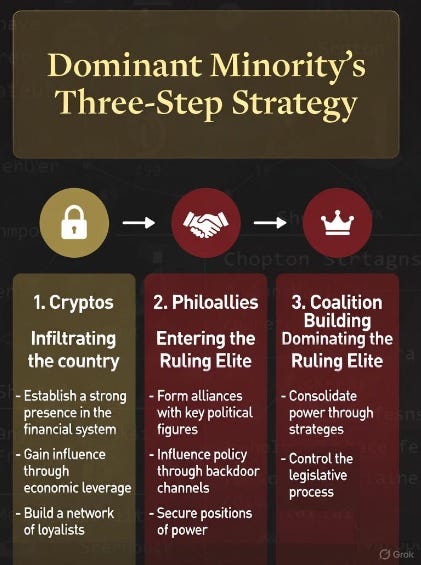
All political scientists and historians agree that some minorities have historically been able to dominate their host nations. Notable modern examples include the Spanish in South America, overseas Chinese in Southeast Asia, and Tutsis in Central Africa. Sometimes host nations rise against a dominant minority, as seen in Southeast Asia, where local populations have implemented various quotas and measures—such as Malaysia’s Bumiputera policies—to curb the economic and social influence of the ethnic Chinese community.
Jews
There is another significant example of a dominant minority, yet naming it remains a taboo: the Jewish elite in the West. This group exerts influence through economic and media power, a “Culture of Critique,” and its maneuvers within the geopolitical “Great Game”. U.S. foreign policy, for instance, appears heavily influenced by Jewish Zionists, compelling even the supposedly “America First” Trump administration to adopt “Israel First” policies. While parts of the peace movement have begun to note the Jewish role in fomenting conflicts also beyond the Middle East, many activists still fail to see the broader connections. The conflicts in Ukraine and Taiwan are directly linked to the crisis in the Middle East.
The reason is simple: Jewish led neoconservative and neoliberal forces aligned with Israel seek to weaken Russia and China, both of which support Iran and the Shia “Axis of Resistance” in the Middle East. Consequently, the West attempts to encircle Russia and China with military bases and hostile alliances while undermining their economies through sanctions and high tariffs to facilitate regime change.
This is nothing new. For centuries, Jews have viewed Russia and China as “antisemitic” for opposing Jewish attempts to become a dominant minority within their borders. Historically, this has manifested as a prolonged struggle. Jewish elite dynasties like the Rothschilds, Sassoons and Kadooreis, for example, pushed Western empires to subjugate China during its “Century of Humiliation.” Similarly, they managed to organize various wars against Russia including the first Crimean War in the 1850’s and then later the Jewish led Bolshevik and Oligarch takeovers in the 1920’s and 90’s. The present Ukraine War is just the latest in a series of conflicts and wars between Jews and Russia going back a millennium.
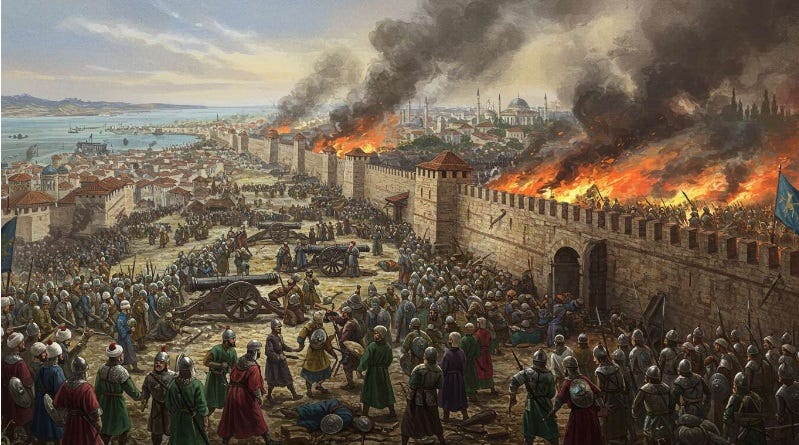
The obvious Jewish role in geopolitics and various wars has always been known to political scientists and historians. It is also common knowledge in many parts of the world such as in Eastern Europe, China and the Arab world. However, in America the Jewish dominant minority has achieved such power that both academia and media now avoid the subject entirely. Only occasionally does the American public hear about it through random outbursts, such as Mel Gibson’s criticism of the Jewish role in instigating wars.
Putin and Xi
Under the leadership of Vladimir Putin and Xi Jinping, Russia and China have regained their independence and power. Their geopolitical support for the Axis of Resistance has drawn the ire of Zionist Jews running Great Game geopolitics, while their nationalist anti-liberal policies have alienated liberal Jewish factions running the Culture of Critique movements. As a result, the Jewish dominated Western academia and media has totally demonized both nations, while Jewish led neoconservatives and neoliberals push for their encirclement and the targeting of their global allies.
The influence of Jewish dominant minority behind these conflicts remains such a taboo that even peace activists often ignore it. This gives Zionists a carte blanche to pursue military and cultural wars, regime change operations and proxy wars aimed at isolating Russia and China. By refusing to “connect the dots,” Western peace activists effectively allow this dominant minority to continue pushing for perpetual war.
Scott Ritter
In recent years, the peace movement has been bolstered by former UN weapons inspector Scott Ritter. A prolific advocate, Ritter has tirelessly warned against the dangers of nuclear war, organized demonstrations and personally lobbied Congress. Despite his background as a leftist philosemitic Democrat, he has significantly influenced the Republican “MAGA” movement toward anti-war policies.
Ritter has gained a massive following as a commentator on the Ukraine War. However, during the conflict’s first year, he remained silent on the Jewish and even Israeli connection, blaming only the CIA, MI6 and the U.S. and British governments. In this, he was joined by libertarian figures like Andrew Napolitano and Lew Rockwell, who focus on American “Primacists” rather than identifying a dominant minority.
Traditionally, both leftists and libertarians have avoided identifying the Jewish dominant minority to avoid being labeled as antisemitic. It was only during the recent genocide in Gaza that Ritter began to explicitly critique Israel’s geopolitical role, though he has yet to identify the dominant minority or even connect these dots to the broader global landscape.
Silent Peace Activists
Some suggest that platform policies, such as those on YouTube, drive this reticence. Peace activists like Andrew Napolitano, Alexander Mercouris, and Danny Haiphong reach hundreds of thousands of viewers daily through their Youtube channels. Openly discussing Jewish dominant minority and connecting Jewish geopolitical dots could lead to deplatforming and lost revenue. However, this doesn’t fully explain the silence, as they could simultaneously use alternative platforms like Rumble, X or Locals—a strategy successfully employed by the famous anti-Zionist, Candace Owens. Unsurprisingly she has been branded an “anti-Semite” by many Jewish organizations.

Alexander Mercouris
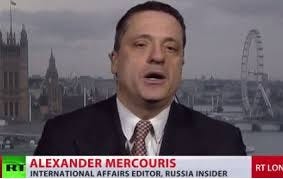
Another explanation is ideological. Many activists from leftist or libertarian backgrounds may instinctively view the concept of a “dominant minority” as inherently racist. The most dramatic example of this is the leftist peace activist and popular YouTube commentator Alexander Mercouris, who for years was oblivious to the Jewish connection. However, a few months ago, due to audience feedback, he admitted on his channel that he had never even thought about a possible connection between the Ukraine War and the Middle East Crises.
Afterward, he has not talked about the subject anymore, though he does seem to increasingly speak in code. For example, he repeatedly emphasizes that his channel will be shut down if he analyzes the Epstein case too deeply. At the same time, he seems to spell “Epstein” in the Jewish-German way, making Epstein’s ethnic background clearer. Mercouris also has the revealing habit of always following the arch-neocon warmonger Lindsey Graham’s name with the name Richard Blumenthal, possibly hinting that Graham is influenced by him and other Jews to a significant extent.
The third explanation for not openly noticing the dominant minority is that many prominent peace activists hope to attract the support of wealthy, anti-Zionist Jewish donors to finance the movement, a development that has yet to materialize.
Debanking
Certainly, the fourth and most important explanation is fear. Leading peace activists face tremendous pressure from various sides. Ironically, this pressure appears stronger in America than in Europe, despite stricter official censorship in Europe. However, Europeans benefit from strong employment and social security protections against firings and debanking. In America, people’s lives are more precarious and heavily dependent on high incomes, making it easier to intimidate them with threats to their reputation, job, income, or even bank accounts. The American media rarely discusses this, but hundreds of politically incorrect individuals have been debanked—not only in Canada but also in the U.S. Scott Ritter has now joined their ranks.
In the above video Scott Ritter recalls his days as a highly connected American intelligence operative, working closely with the CIA, Israelis, and even the White House. He emphasizes that he was once the “Golden Boy” of intelligence, privy to “everything.” Clearly, he must be aware of America’s dominant minority and their potential to ignite a nuclear war. Yet, despite recent escalations in Eastern Europe and the Middle East, Ritter in this video claims that the main problem is America itself, with Trump as a “prisoner of the CIA”—not the Mossad, Israel, or even the Zionists.
The next day, however, Ritter appeared in an interview with Andrew Napolitano. He admitted that after being debanked, he fell into depression and briefly felt hopeless, especially as his wife had grown weary of the persecution that had affected their entire family for decades. At that point, Napolitano played a clip of Jonathan Greenblatt, the Jewish ADL’s chairman, boasting about the organization’s role in training American police and officials. This ignited Ritter, who then openly declared that Zionists are running the American government.
Trump’s chess moves
At the same time, Ritter suggested there might still be hope. He noted that many parts of the government resent Zionist dominance, and even Donald Trump could be among them. That wouldn’t be surprising, given Trump’s ego—he can’t be pleased with how Netanyahu and many other Jews publicly humiliate him. Being Israel’s bitch cannot be fun.
It could even be that Trump is deliberately undermining American influence abroad through his erratic behavior, bullying threats, and tariffs. After all, U.S. foreign policy is thoroughly dominated by Zionists, so disrupting the entire system might be the only way to halt it. For instance, threatening to annex Greenland would certainly fracture or weaken NATO, making it harder for EU NATO countries to sustain their warmongering. Perhaps Trump truly seeks peace through a “Fortress America” approach, dividing the world among American, Russian and Chinese spheres of influence. Maybe he’s really playing four-dimensional chess, with method to his madness. Of course, the alternative is that he’s simply a madman. As Scott Ritter admits, he doesn’t know—and neither does anyone else. Probably not even Trump himself.
People worldwide are deeply divided over Donald Trump. Some view him as a mastermind playing four-dimensional chess to save the world, while others see him as a narcissistic bumbler who sows chaos wherever he goes. So, which perspective aligns more closely with the truth? We do not know but let’s first assume that Donald Trump is a rational player in do…
Conclusion
Many in the peace movement believe that concealing the Jewish dominant minority and obscuring its role in numerous wars is essential for peace. However, this strategy may backfire, giving that minority a free hand to escalate proxy conflicts and try again and again to push the world toward “limited” nuclear war.
People often demand perfection from their heroes, which is counterproductive. No one is a superman—not even Scott Ritter. Of course, he must consider his family. Of course, he has been reticent about exposing Jewish power. The same applies to all other peace activists. But gradually, things are changing on both the left and right. They are beginning to point out the man and group behind the curtain.
In any case, peace activists perform invaluable work and deserve unwavering support. After all, they do what they humanly can. Without them—especially Scott Ritter—a nuclear war might already have begun.
The War On Free Speech In Australia Is Getting Cartoonishly Absurd
By Caitlin Johnstone | January 17, 2026
A mentally disabled Australian woman is being prosecuted for antisemitic hate crimes after accidentally pocket-dialing a Jewish nutritionist, resulting in a blank voicemail which caused the nutritionist “immediate fear and nervousness” because she thought some of the background noises in the recording sounded a bit like gunshots.
We’re being told we need more of this. There’s “hate speech” legislation presently in the works to make this worse. Australia’s controversial Combatting Antisemitism, Hate and Extremism Bill appears to be explicitly crafted to dramatically increase the scale, frequency and consequences of the exact sort of dynamics we’re seeing in this case, and to eradicate opposition to Israel throughout the nation.
This is how overextended Australia’s freakout over “antisemitism” already is. You can literally just be sitting there not saying or doing anything and still find yourself getting arrested and prosecuted for an antisemitic hate crime. They have the authority to do this presently, under the laws that already exist. The argument for this bill is that our present horrifyingly tyrannical and abusive system is insufficiently authoritarian and tyrannical, and that prosecutors need more power to police speech far more forcefully.
Australians are being asked to trust a system that would take a woman with an intellectual disability to prosecution in a court of law over an accidental butt-dial to a person of Jewish faith with the authority to send people to prison for years over their political speech. And this is happening after we just spent years watching Australian authorities roll out authoritarian measures to stomp out criticism of Israel and quash protests against an active genocide.
This is madness, and it needs to be brought to a screeching halt. Immediately. This entire country has lost its damn mind.
The Bondi attack isn’t the reason, it’s the excuse. All these laws being rolled out to stomp out criticism of Israel in Australia were sought for years before the shooting occurred.
Immediately after the attack last month I tweeted, “Not a lot of info about the Bondi shooting yet but it’s safe to assume it will be used as an excuse to target pro-Palestine activists and further outlaw criticism of Israel in Australia, as has been happening to a greater and greater extent in this country for the last two years.”
They could have proved me wrong, but instead they’ve spent this entire time proving me one hundred percent correct. The frenzied efforts to crush anti-genocide protests and silence speech that is critical of Israel and Zionism in these subsequent weeks has plainly established this.
There is no connection between pro-Palestine demonstrations and the Bondi attack. None. It had nothing to do with Palestinians, and it had nothing to do with anti-genocide demonstrations. It’s a completely made-up claim that Israel’s supporters have been circulating in Australian consciousness through sheer repetition. They’re just pretending to believe it’s true in order to promote the information interests of a genocidal apartheid state.
Israel’s supporters need to use propaganda, deception, censorship and oppression to promote their agendas, because it’s all they have. They don’t have truth. They don’t have arguments. They don’t have morality. All they have is brute force. They are shoving support for Israel and its atrocities down our throats whether we like it or not, and if we refuse what we’re being force-fed they will punish us. That’s the only tool in their toolbox.
This needs to be ferociously opposed. The more Israel and its supporters work to assault our right to oppose their abuses, the more aggressively we need to oppose them. We are no longer fighting against war and genocide in the middle east, we are fighting against an assault on our own civil rights. It’s personal now. They’re coming for us directly.
Palestinian prisoners in 2025: Shocking figures and escalating violations
Palestinian Information Center – January 17, 2026
RAMALLAH – The Asra Media Office has revealed alarming data regarding the situation of Palestinian prisoners up to the end of 2025, noting that their number has reached approximately 9,300 prisoners, nearly half of whom are held in detention without charge or trial amid an unprecedented expansion in the use of administrative detention and arbitrary classifications, including the so-called “unlawful combatant.”
In a report issued today, Saturday, the office explained that the Israeli occupation authorities have escalated their repressive policies by targeting women, children, journalists, and medical personnel, alongside systematic violations inside prisons. These violations include physical and psychological torture, deliberate medical neglect, starvation, detention under inhumane conditions, sexual assaults, the denial of visits, restrictions on lawyers’ work, and obstruction of the tasks of the International Committee of the Red Cross.
According to official data, since 1967 and up to the end of 2025, around 323 prisoners have died inside Israeli prisons, including 86 prisoners since 2023 and 32 during 2025 alone. The occupation authorities continue to withhold the bodies of 94 prisoners, constituting a grave violation of international humanitarian law, amid documented cases of direct killing, torture, and medical neglect leading to death.
The Asra Media Office noted that by mid-January 2026, the number of martyrs of the prisoners’ movement had risen to 324, including 87 since the war of genocide, with the continued withholding of 95 bodies under a policy of collective punishment prohibited under international law.
Despite the release of 3,745 prisoners during exchange deals in 2025, the Office confirmed that the occupation continued its policies of deportation and re-arrest, alongside the enactment of dangerous repressive legislation, including calls for the execution of prisoners, the extension of administrative detention periods, the revocation of citizenship, and the targeting of human rights institutions working on prisoners’ issues.
The Office called on the international community to assume its legal and moral responsibilities and to take immediate action to hold the occupation authorities accountable for these crimes, ensure the urgent release of sick prisoners, children, and women, and impose independent international monitoring over Israeli prisons.
US announces Gaza ‘Board of Peace’ amid ongoing Israeli ceasefire breaches
Press TV – January 17, 2026
The administration of US President Donald Trump has announced the executive members of Gaza’s so-called Board of Peace, a body purportedly tasked with managing transitional governance in the territory, as Israel continues to violate its ceasefire agreement with Hamas.
On Friday, the White House published the names of the Gaza Strip’s so-called “Board of Peace” members and the head of the National Committee for the Administration of Gaza (NCAG), marking the launch of the second phase of Trump’s 20-point plan for Gaza.
Ali Sha’ath, a former Palestinian deputy minister in the Palestinian Authority (PA), will lead the NCAG, according to the White House.
The so-called Board of Peace will be chaired by Trump himself, with key members including Secretary of State Marco Rubio, Trump’s special envoy Steve Witkoff, Trump’s son-in-law Jared Kushner, and former UK Prime Minister Tony Blair.
The statement also listed members of a “Gaza Executive Board”: Turkish Foreign Minister Hakan Fidan; United Arab Emirates’ Minister of State for International Cooperation Reem Al-Hashimy; veteran Qatari diplomat Ali Al-Thawadi; Egypt’s intelligence chief Hassan Rashad; UAE-based Bulgarian diplomat and former UN envoy Nickolay Mladenov; Cypriot-Israeli businessman Yakir Gabay; Dutch politician Sigrid Kaag; as well as Witkoff, Kushner, and Blair.
Mladenov will act as High Representative for Gaza, linking the Board of Peace with the NCAG, while Major General Jasper Jeffers will lead the International Stabilization Force (ISF).
The US also appointed Aryeh Lightstone and Josh Gruenbaum as senior advisers to the Board of Peace to supervise “day-to-day strategy and operations.”
More appointments to the Executive Board and the Gaza Executive Board are expected in the coming weeks.
The announcement follows Witkoff’s Wednesday statement launching the second phase of the Gaza ceasefire plan.
The second phase is said to focus on “demilitarisation, technocratic governance, and reconstruction.”
However, most of the goals in Trump’s 20-point plan that became the basis for a ceasefire in Gaza three months ago never became a reality on the ground.
Phase one was designed to immediately halt the fighting, facilitate the exchange of Israeli and Palestinian captives, set a boundary for Israeli withdrawal from parts of Gaza, allow the full entry of humanitarian aid, and open the Rafah crossing between Gaza and Egypt.
While the daily number of Israeli attacks has decreased since the start of the ceasefire, Israel has killed at least 451 Palestinians and injured 1,251 – an average of nearly five killed every day – since October 10.
Under the ceasefire deal, Hamas released all 20 living Israeli captives in exchange for nearly 2,000 Palestinian prisoners.
Hamas has also returned 27 of the 28 bodies of deceased captives, while the search is still on for the remaining body, believed to be buried under the rubble of buildings bombed by Israel.
However, according to Hamas, Israel has failed to release all women and child prisoners as stipulated in the agreement.
Moreover, the Israeli military did not fully withdraw its troops to an area dubbed the “yellow line” and continues to restrict aid.
The opening of the Rafah crossing did not happen, either.
Since Israel launched its genocidal campaign on October 7, 2023, more than 71,000 Palestinians have been killed and over 172,000 wounded, the majority of them women and children.
Featured Video

More Iran War fallout: Maritime insurance industry shifts from London to China
or go to
Aletho News Archives – Video-Images
From the Archives
Allies Don’t Need Lobbies
By Jay Knott | Dissident Voice | September 24, 2013
In a recent article on Counterpunch, Rob Urie defended the traditional Marxist analysis of US policy in the Middle East. He argues that support for Israel is driven primarily by economic interest, not the Jewish lobby.
He starts by paying tribute to the idea that Western societies are uniquely racist. He says that the “Western narrative” claims there is an “Arab character”, and that this is “antique racist blather”. He gives no definition of these terms. Further, he establishes his credentials as part of the dominant current in the American left by claiming that “over a million people in Iraq died so ‘we’ in the West can drive SUVs.”1
When he tries to criticize bourgeois economics, he makes it clear he doesn’t understand the developments it has made since Marx’s day, using the mathematical discipline known as “game theory”. He dismisses the basic abstraction of economic theory, the idea of the rational individual, on the grounds that it is “devoid of history, culture and political context”. But abstractions are always devoid of something.
He defends a more concrete economic theory, mostly Marxist, with some input from another theorist of capitalist crisis, Hyman Minsky. This concrete theory leads him to the view that US activity in the Middle East is primarily driven by rational capitalist motives, the need to secure a supply of oil.
“Taking the totality of circumstance — former oil company executives launching war on an oil rich nation on a pretext they publicly proclaimed they didn’t believe shortly before taking office — and that upon launching their war proved to be non-existent, requires a willingness to overlook the obvious — that the war on Iraq was for oil, that is difficult to support.”1
Perhaps I’ve misunderstood him, but based on what he says in the rest of the article, this convoluted sentence seems to argue that, because president Bush and vice-president Cheney attacked Iraq on false premises, and they also said it was all about oil, and they are former oil executives, and Iraq has a lot of oil, it’s difficult to deny US attacks on Iraq are all about oil.
In fact, it’s not hard at all. As Urie points out, at times Bush and co. said that attacking Iraq was “protecting the world’s supply of oil.”1 But, as he also points out, they are congenital liars. Why should we believe them when they say they are trying to “protect” the oil supply? Protect it against what? When politicians “admit” attacks on Middle Eastern countries are wars for oil, they are parroting the neo-con party line, feeding the public, both left and right, with a plausible-sounding pretext. For right-wingers, “it’s a war for oil” is a reason to support war, and for leftists, it’s a way to feel better by complaining impotently about corporate greed. Both approaches help the war drive. … continue
Blog Roll
 Aletho News
- More Iran War fallout: Maritime insurance industry shifts from London to China
- US-Israeli aggression on Iran triggers review of GCC countries’ investment pledges to Washington
- Russia slams UK plan to seize tankers suspected of carrying its oil
- Pakistan ramps up food exports to Persian Gulf nations as war deepens food insecurity
- Iran submits response to US plan, sets terms for war’s end: Tasnim
- US vs Iran: Kharg Island Talk — Bluff or Escalation? Ex-Military Officer Weighs In
- Zelensky unnecessarily involves Ukraine in the Middle East crisis
- Turkish tanker blacklisted by Ukraine hit in drone attack – media
- Canada, the U.S., and NATO: the inescapable trap
- Villains of Judea: Leonid Radvinsky
- If Americans Knew
- ‘No Innocent Children’: Far-right Israeli Lawmaker Defends Killing of Palestinian Family
- Mossad’s promises helped Netanyahu convince Trump that Iran could be toppled
- US Arms Control Official Refuses To Comment When Asked If Israel Has Nuclear Weapons
- Veterans warn US landing could be ‘more Gallipoli than Vietnam’
- Israel may be committing war crimes in Lebanon – Not a ceasefire Day 167
- In the West Bank, life is a constant battle – 3 articles
- Jacob Reses, one of the most powerful pro-Israel operatives in Trump’s Washington
- Israeli-US assaults kill or injure 87 children a day – Not a ceasefire Day 166
- ‘Forever live by the sword’: Understanding Israelis’ massive support for Iran war
- UN’s special rapporteur on human rights says Israel is systematically torturing Palestinians
- No Tricks Zone
- Devastating Assessment Of Comirnaty Vaccine By Former Senior Pfizer Europe Toxicologist
- New Study: CO2 Is ‘Effectively Negligible’ As An Explanatory Climate Change Factor Since 2000
- Former Pfizer Toxicologist Dr. Helmut Sterz Tells Bundestag Hearing Pfizer Vaccine Should Have Never Been Approved
- Energy Expert: Germany’s Nuclear Phaseout Was A “500 Billion Euro Mistake”
- New Research: South Australia’s Mid-Holocene Sea Surface Temperatures Were 4°C Warmer Than Today
- Storing Green Energy To Last Germany 10 Days Would Require A 60-Million Tonne Battery
- New Studies: UK Sea Levels Were 4 Meters Higher Than Today During The Mid-Holocene
- Destructive Green New Deal: German Energy And Metal Group Warns Of Drastic Crisis
- New Study Documents A 20-Year Pause In Arctic Sea Ice Decline – Driven By Internal Variability
- Wake-up Call: Survey Shows Majority Of Germans Now Favor Postponing Climate Targets!
 Aletho News