UK and Israel criticized for persecuting anti-genocide advocates
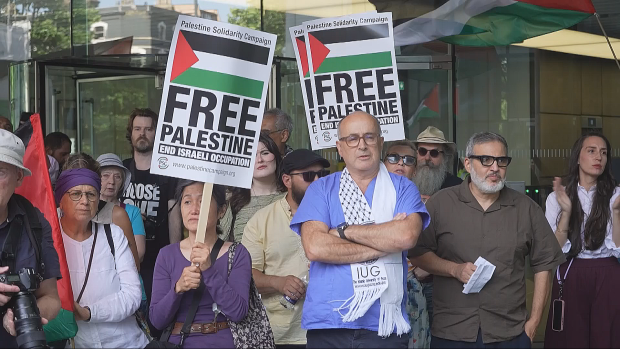
Protesters rally in London in support of Dr. Ghassan Abu-Sittah
Press TV – July 4, 2026
Protesters gathered outside the General Medical Council’s headquarters in London to slam the council’s attempt to silence those speaking out about the Israeli genocide in Gaza.
Protesters describe the surgeon as one of the world’s leading war doctors and argue that the regulator’s actions amount to an attempt to silence those who speak publicly about the realities of war,
So we are demonstrating in front of the GMC, because the GMC has decided to appeal against the rulings of two of its own tribunals, so that the High Court would allow it to try me for a third time, in order to get the right political result that it wants.
The GMC is conducting a political campaign against, not just myself, but every doctor who’s spoken up against the genocide, in order to silence us, in the service of the genocidal project. – Dr Ghassan Abu Sittah, British-Palestinian Surgeon
Doctors, campaigners, and members of the public traveled to attend the demonstration, asserting that the proceedings are about more than one individual, warning that they could have a chilling effect on healthcare professionals speaking about humanitarian crises.
Actually, there probably were a group of lawyers set up by the Israelis again to pursue highly charged politicized campaigns against professionals and workers in this country who stand against genocide.
So, really, it’s the action of how the British government and the Israelis who are trying to persecute and outlaw speech in support of Palestine in the heartland of Britain.
Actually, from, we know where our government, you know, the British government, the Labour government, and the Tory government before it have been complicit in genocide from bases like RAF Akrotiri, where Keir Starmer went and complimented the troops.
They run the genocide, they send the planes over Gaza, they stream that information live to the Israelis as they’re committing that genocide.
So our government is complicit, and what they’re doing with their complaints is they’re making it illegal for us to oppose it. – Ranjeet Brar, NHS Surgeon
Speakers at the rally urged the GMC to withdraw the appeal; assisting medical professionals should not face professional consequences for raising concerns over civilian suffering in conflict zones.
There’s a clear example here with Dr. Ghassan, where UK law is for Israel, that it is essentially standing up for the rights of a foreign entity, have been pressuring patients, pressuring people to make complaints against Dr. Abu-Sittah, and this is just one example of many other institutions, medical institutions like the Royal Colleges, and even the journals, the medical journals that we publish in, where they’ve been pressured from UK pro-Israel lobby groups to censor and to shut down any form of pro-Palestine activism.
So, I think we’re seeing this now very clearly with Dr. Ghassan, but the reality is it’s much more widespread than any of us think. – Dr Omar Abdel-Mannan, British-Egyptian Pediatric Neurologist
Organizers say they will continue campaigning until the proceedings against Dr. Abu-Sittah come to an end, maintaining that doctors must be free to speak about humanitarian consequences of war without fear or professional repercussions.
Supporters gathered outside the General Medical Council in London to stand behind British Palestinian surgeon Dr. Ghassan Abu-Sittah, accusing the regulators of attempting to silence one of the world’s most prominent war doctors.
Demonstrators say the case is not simply about one medic, but the right of healthcare professionals to speak out on the atrocities of Gaza without professional retaliation.
UN, MSM: Israel Is Deliberately and Genocidally Murdering Children
By Kevin Barrett – American Free Press – July 3, 2026
American mass media have historically demonized Palestinians and downplayed or covered up Israel’s crimes. But on June 24, Americans woke up to a CNN headline that must have made more than a few of them choke on their kosher coffee. That headline put it plainly: “Israel deliberately targeting children in ongoing genocide against Palestinians, UN commission finds.”
CNN’s headline included two assertions that have been true for decades: 1) Israel deliberately murders children, not accidentally as so-called collateral damage, but deliberately as part of a de facto national policy; and 2) Israel is committing “an ongoing genocide against Palestinians.” And while it is shocking that any government is pursuing such unbelievably evil policies, and even more shocking that American taxpayers are paying for it, the most shocking thing of all is that American mainstream media are finally admitting the truth after 78 years of systematic Israeli child-killing and genocide.
On April 9, 1948, more than 110 Palestinian men, women, and children were slaughtered in the village of Deir Yassin. The New York Times reported that more than half of the victims were women and children. It was just one of hundreds of massacres by the invading Jews who had long planned to steal Palestinian land and property by way of such a bloodbath.
During the 1948 Nakba (Palestinian holocaust) the Jews raped and murdered girls, tossed babies around with bayonets, and burned people to death with flamethrowers. Unlike the false atrocity propaganda stories invented by these same Jews’ descendants after the heroic October 7 2023 concentration camp breakout by Hamas, the 1948 abominations actually happened.
You can watch one of the Nakba perpetrators, Yosef Diamont, chuckling over his crimes in a viral YouTube video: “Tantura was a rich village and had beautiful houses. And the women in the village used to wear nice clothes. One of the (Israeli) soldiers raped a 16-year-old girl..” (Breaks out laughing.) “The soldiers took flamethrowers, and ran after the villagers and burned them. It was horrible. And no one is allowed to talk about that. I won’t talk about it, because it would be a big scandal.”
The whole Zionist project that created “Israel” is, by definition, genocidal: Its purpose has always been to murder and expel the Palestinians in order to steal their land and property. Perhaps unsurprisingly, the nation whose very existence is an act of ever-expanding genocide deliberately and systematically murders children.
In 2001 Chris Hedges described the way Israeli soldiers routinely hunt children for sport:
“Yesterday at this spot the Israelis shot eight young men, six of whom were under the age of eighteen. One was twelve. This afternoon they kill an eleven-year-old boy, Ali Murad, and seriously wound four more, three of whom are under eighteen. Children have been shot in other conflicts I have covered—death squads gunned them down in El Salvador and Guatemala, mothers with infants were lined up and massacred in Algeria, and Serb snipers put children in their sights and watched them crumple onto the pavement in Sarajevo—but I have never before watched soldiers entice children like mice into a trap and murder them for sport.”
American media, dominated as it is by Zionist Jews, has long hidden these facts from the American people. Hedges was effectively fired by The New York Times for his honest reporting.
So why is CNN finally telling the truth? Mainly because since 2023, Israel’s atrocities have grown too big to ignore. Tens of thousands of children have been murdered in just a few years.
CNN’s story covered the June 18 UN Report “‘The essence of childhood has been destroyed’: Israel’s deliberate targeting of Palestinian children in the Occupied Palestinian Territory since 7 October 2023.” The report estimates that at least 20,179 children have been killed and 44,143 children injured since that date, while 5,160 children are still buried under the rubble of what used to be their homes.
The UN report details systematic sexual violence against children. It describes Israel hunting children with drones and rifles, and deliberately blowing up whole apartment buildings and city blocks full of civilians, using the excuse that someone in the area had a tenuous link to Hamas. Israel’s wide-impact blasts are intended to disproportionately target children: “Research indicates that children are seven times more likely to die than adults from the impact of explosive weapons due to their physiological vulnerability, that is, proportionally larger body surface area, pliable bones, smaller limbs and thinner skin. Due to their smaller size and lighter weight, children are also at a greater risk of being thrown from the impact of blasts.”
The horrific descriptions of maimed and murdered kids make this UN report unpleasant reading. But Americans need to face the truth—and stop funding genocide.
Monsters playing victims: Danny Danon’s twisted war on the truth

By Ramzy Baroud | MEMO | July 2, 2026
Whether Israelis will ever comprehend the irreparable damage inflicted upon their country’s reputation by their UN Ambassador, Danny Danon, is a moot point. The damage Israel has done to itself through its barbaric practices in occupied Palestine is simply impossible to overcome.
Danon, however, utilises a peculiar approach to defending Israel within international institutions: he relies on bullying, intimidation, and an overt attempt to silence anyone who dares to challenge the official Israeli narrative—particularly women leaders.
Yet, what makes his behaviour most outrageous is his deployment of these abrasive tactics to suppress an issue that demands the utmost sensitivity: the systemic use of sexual violence and human rights abuses against Palestinians.
The confrontation took place during a UN General Assembly session convened to mark the International Day for the Elimination of Sexual Violence in Conflict. Senior UN officials were presenting harrowing findings documenting sexual violence against Palestinian detainees.
True to form, Danon refused to engage with the substance of the reports. For Israeli diplomacy, the enemy is never merely the armed adversary; it is the judge, the independent human rights observer, and the UN investigator whose sole mandate is to document violations of international law.
The immediate target of Danon’s wrath was Pramila Patten, the UN Secretary-General’s Special Representative on Sexual Violence in Conflict. Instead of reflecting on the grim findings, Danon demanded Patten’s resignation. He accused her and the broader international community of harbouring an “obsession” with targeting Israel.
When Vanessa Frazier, the Secretary-General’s Special Representative for Children and Armed Conflict, attempted to intervene on a point of order per established protocol, Danon unleashed a vitriolic verbal assault. Refusing to yield, he shouted over her, ordering her to “be quiet” and drowning out the chamber with his outbursts. “Shame on you. You are part of this obsession,” Danon bellowed.
While such unruly behaviour should have resulted in Danon’s immediate removal from the chamber, the diplomatic asymmetry of the UN prevailed. It was Frazier who found herself trying to de-escalate, politely clarifying that her procedural request was “not personal.” Danon shot back with typical defiance: “You will not be allowed to bully us.”
Herein lies the supreme irony of Israel’s diplomatic relationship with the UN and international law. Israel stands as one of the most egregious, serial violators of international law in modern history—a decades-long pattern of behaviour left unpunished by Western vetoes, which ultimately emboldened it to carry out an ongoing genocide in Gaza. Yet, Israeli officials persistently claim the mantle of the ultimate victim, alleging they are the targets of antisemitism, unfair bias, and now, “bullying” by the very institutions they defy.
But the mountain of evidence cannot be shouted away. According to an extensive report issued by Patten’s office, there are verified patterns of systemic abuse, sexual degradation, and psychological torture weaponised against Palestinian men, women, and children in Israeli detention camps like Sde Teiman.
The weight of this evidence reached such an undeniable threshold that the UN Secretary-General’s office formally added Israel to the global ‘List of Shame’—the blacklist of states committing grave violations against children in armed conflict.
None of this exposure is enough to convince Danon or the broader Israeli political establishment that Israel does not possess a sovereign right to violate international law. In their view, merely pointing out these crimes constitutes an act of aggression.
This systemic denial extends to every facet of the conflict. A comprehensive UN investigation recently concluded that Israel has deliberately targeted Palestinian children in Gaza as a core component of its military campaign.
The numbers are staggering: Between 7 October 2023, and 7 October 2025, an estimated 20,179 Palestinian children were killed—about 30 percent of all Palestinian deaths.
“The evidence shows that Palestinian children have been deliberately targeted and killed by the Israeli security forces,” stated commission chair Srinivasan Muralidhar, noting that Israeli authorities have systematically continued to commit the crime of genocide.
While these findings provide another layer of ironclad legal proof regarding genocidal intent, the true significance of the report lies in its exposure of the rationale behind targeting youth. Typically, the disproportionate slaughter of children and women is dismissed by Western apologists as “collateral damage”. The UN inquiry shattered this defense, offering a far more consequential conclusion: the targeting of Gaza’s children is part of a calculated strategy to destroy the biological continuity and future existence of the Palestinian people in Gaza.
As Muralidhar bluntly summarized: “By targeting children, Israel is attacking the very capacity of the Palestinian people to exist.”
It remains a profound disappointment that the International Criminal Court and the International Court of Justice—often swift to indict war crimes committed elsewhere—continue to move at a glacial pace regarding Israel.
Tragically, the catastrophe continues unabated because there is still no meaningful international mechanism willing to enforce sanctions or employ genuine pressure to halt it.
This is precisely why Danny Danon wants the world to be quiet. His outbursts are not merely directed at UN diplomats; they are directed at global civil society, ordinary citizens, and anyone refusing to look away. Israel demands absolute silence while Palestinians are starved, raped, and murdered. According to its twisted logic, committing these atrocities is an inherent right, and objecting to them is an act of malice.
If this logic is allowed to prevail, it becomes the blueprint for every future aggressor who wishes to kill, rape, and starve a population for geopolitical gain. Palestinians and Lebanese are already forced to inhabit this dystopian reality. Our collective responsibility is clear: we must refuse to be quiet. We must speak out, ensuring our voices drown out the shouts of Danon and his peers, so that murder and systemic violence are never normalised as tools of military necessity.
EU hides secret Gaza files as UN says Israel is committing genocide
MEMO | July 2, 2026
The European Commission is refusing to release 17 secret reports on EU-funded infrastructure in Gaza, which could reveal further evidence of Israel’s destruction of European-backed civilian projects and increase pressure on Brussels to confront whether its continued partnership with Israel violates the human rights obligations underpinning EU-Israel relations.
The refusal came on the same day that a UN inquiry said Israel continues to commit genocide in Gaza by deliberately targeting Palestinian children, raising questions over whether the EU is concealing evidence that could strengthen calls to suspend or review its agreements with Israel.
According to EUobserver journalist Nikolaj Nielsen, the refusal was signed on 23 June by Michael Karnitschnig, acting head of the Commission department dealing with the Middle East. Nielsen had requested the documents under freedom of information rules in February, seeking reports covering EU-funded infrastructure projects in Gaza from 2020 to the end of 2023.
“We have examined whether there could be an overriding public interest in disclosure, but we have not been able to identify such an interest,” Karnitschnig wrote, according to EUobserver.
The claim is likely to provoke outrage. The documents relate to EU-funded infrastructure in Gaza, including solar panels, water desalination projects, renewable energy schemes and potentially other civilian facilities such as hospitals and schools. Many of these projects are believed to have been destroyed during Israel’s military assault on the besieged enclave.
Their disclosure could reveal not only the financial cost to European taxpayers but also the extent to which Israel has targeted or destroyed civilian infrastructure in Gaza. Such findings would increase pressure on Brussels to act under the human rights clauses which form the basis of EU cooperation with Israel, including the EU-Israel Association Agreement.
The Commission also invoked the protection of international relations as a reason for withholding the documents. EUobserver reported that some of the projects were either suspended or completed, with implementing partners including Germany’s KfW development bank, Oxfam Novib and WE WORLD.
One project cited by the Commission reportedly sought to support water treatment in Khan Yunis, a city in southern Gaza which has suffered widespread devastation following Israel’s ground invasion.
The refusal has raised fresh questions about EU transparency and accountability, especially as EU taxpayers have funded many of the projects damaged or destroyed by Israel. EUobserver has separately estimated that Israel has bombed or bulldozed around €150 million worth of EU-funded buildings in Gaza and the occupied West Bank, without paying compensation.
Earlier this month, EU Commissioner Dubravka Šuica told members of the European Parliament that the bloc has requested Israel to return or compensate for EU-funded assets whenever they are demolished, dismantled or confiscated.
The Commission’s refusal to publish the reports came as UN Independent International Commission of Inquiry on the Occupied Palestinian Territory, including East Jerusalem, and Israel concluded that Israel continues to commit genocide and other atrocity crimes by deliberately targeting Palestinian children.
“Israeli authorities and security forces have deliberately targeted Palestinian children resulting in genocide, crimes against humanity and war crimes in the Gaza Strip and war crimes in the West Bank,” the UN report stated.
The UN Commission said the “deliberate targeting of children” forms one of the key elements establishing genocidal intent by Israeli authorities and security forces to destroy Palestinians, in whole or in part, in Gaza.
Srinivasan Muralidhar, chair of the Commission of Inquiry, said Palestinian children “have been deliberately targeted and killed by the Israeli security forces,” adding that even after the October 2025 ceasefire, children have continued to be killed and seriously injured.
The report also accused Israeli authorities of arresting Palestinian children and subjecting them to torture and other forms of mistreatment in prisons and detention facilities. It further said Israeli security forces used sexual violence against children as part of a broader pattern of collective oppression under occupation.
The Right-Wing Zionist Wave Sweeping Latin America
José Niño Unfiltered | June 30, 2026
Abelardo de la Espriella’s razor-thin victory over leftist Iván Cepeda on June 21, 2026 represented the most recent rightward shift in Latin America’s politics. The defense attorney from Barranquilla captured 49.66 percent of the vote against Cepeda’s 48.7 percent—a margin of roughly 250,000 votes in what Al Jazeera called one of Colombia’s closest elections. Within hours, Israeli Foreign Minister Gideon Sa’ar called to congratulate him, and de la Espriella posted his response publicly.
“Colombia will restore and strengthen its relationship with the State of Israel like never before. Israel can count on Colombia as a loyal friend and steadfast ally,” de la Espriella declared. Sa’ar called him “a true friend of the Jewish people and the State of Israel,” adding that he looked forward to “revitalizing relations between Israel and Colombia and taking them to their highest level ever” and that he had already invited the incoming president to visit Israel.
Israeli Prime Minister Benjamin Netanyahu offered his own congratulations, saying he looked forward to “working with you to strengthen the bond between Israel and Colombia.” De la Espriella has pledged to reverse Petro’s 2024 decision to cut ties with Israel and has promised to relocate the Colombian embassy to Jerusalem.
No figure looms larger in this transformation of Latin American politics than Argentine President Javier Milei. The libertarian economist who took office in December 2023 has positioned himself as Israel’s most devoted ally anywhere on earth.
“I am sincerely proud to be the most Zionist president in the world,” Milei declared at Yeshiva University in March 2026. At the Western Wall in June 2025, he proclaimed that “My support for Israel comes from the heart, because I believe this is a just cause—the cause of the West. I will always stand by your side.”
Milei personally studies Torah with Rabbi Shimon Axel Wahnish from the Moroccan Jewish community in Argentina and has said he intends to convert to Judaism after leaving office. In June 2025, he became the first non-Jewish head of state to receive Israel’s Genesis Prize, known as the “Jewish Nobel,” awarded for his “unequivocal support” of Israel.
He directed his entire $1 million prize toward creating the American Friends of Isaac Accords, the vehicle through which Argentina and Israel formally signed the Isaac Accords on April 19, 2026 in Jerusalem. The framework explicitly mirrors the Abraham Accords that normalized relations between Israel and several Arab states, but targets the Western Hemisphere instead.
The goals are clear. Partner countries should move their embassies to Jerusalem, designate Hamas and Hezbollah as terrorist organizations, shift anti-Israel voting patterns at the United Nations, and create frameworks for trade in technology, agriculture, water, health, and cybersecurity.
At least one nation had embraced the embassy mandate well ahead of the Accords. Paraguay’s Santiago Peña reopened his country’s embassy in Jerusalem on December 12, 2024, making Paraguay the sixth country in the world—after the United States, Guatemala, Honduras, Kosovo, and Papua New Guinea—and the first since the October 7 attacks to establish diplomatic presence in the contested city.
“Mr. prime minister, on behalf of all the Paraguayan people, we were with you, we are with you, we will stay with the people of Israel forever,” Peña declared at the ceremony with Netanyahu present. He called the move “a tipping point in our own history” and “a moral obligation that the Paraguayan people have asked us to fulfill.”
Paraguay was not alone in courting Tel Aviv. Ecuador’s Daniel Noboa, the banana fortune heir who won re-election in 2025, traveled to Jerusalem in May of that year for meetings with Netanyahu, at which Noboa declared that “Israel and Ecuador have the same enemies” and pledged to fight poverty, terrorism, and suffering “until the end.” Israeli diplomatic sources confirmed to Jewish Insider that both Ecuador and Paraguay are expected to formally join the Isaac Accords framework.
Nowhere did the shift register more dramatically than in Chile. José Antonio Kast’s victory in Chile’s December 2025 election delivered perhaps the most symbolically significant prize. Kast overturned four years of Gabriel Boric’s more pro-Palestinian governance. After Iran’s 2024 drone attack on Israel, Kast had warned that “Iran launches a drone and missile attack on Israel. They could be the same drones that it gifted to Bolivia to monitor our borders. Chile has a serious national security problem.”
In May 2026, Kast met with Israeli President Isaac Herzog and pledged to return Chile’s ambassador to Israel, ending a lengthy vacancy by naming Gabriel Zaliasnik as ambassador. He promised expanded cooperation in agriculture, health, artificial intelligence, technology, and security. Notably, Kast achieved this while governing a country home to the largest Palestinian diaspora outside the Arab world, estimated at 500,000 people.
The same paradox surfaced again, more sharply still, in Central America. Nasry “Tito” Asfura won Honduras’s late 2025 election with Trump’s endorsement, becoming president on January 27, 2026. Despite his Palestinian Christian ancestry, the conservative former mayor of Tegucigalpa made Israel one of his first international destinations after being elected, traveling there alongside the United States.
“It is a great honor for me to be in Israel again and to strengthen the ties which have been in existence over the last 77 years,” Asfura stated in Jerusalem. “I hope we are entering a new era where we can improve our relations, relations of brotherhood, and prosperity, of investment.” Israeli Foreign Minister Sa’ar told the Jerusalem Post Magazine that Asfura “has a clear worldview that is pro-Western, pro-American, and pro-Israeli,” and characterized the broader regional shift as a “Blue Wave” of right-wing governments aligning with the United States and Israel.
Bolivia’s Rodrigo Paz ended nearly 20 years of socialist MAS party rule by winning the October 2025 election. Within weeks, he restored diplomatic relations with Israel—ties the prior government had severed in 2023. Netanyahu congratulated Paz personally, and the two agreed to “promote cooperation in various fields, with an emphasis on security, and to restore the vibrant tourism of many Israeli travelers to Bolivia’s natural landscapes and rich cultures.”
Not every convert to the cause fits the expected profile. Nayib Bukele represents the most curious figure in this constellation. The Salvadoran president, who has Palestinian ancestry on his father’s side, has become an ardent Israel supporter despite his Palestinian Christian heritage. After October 7, 2023, Bukele posted that “As a Salvadoran with Palestinian ancestry, I’m sure the best thing that could happen to the Palestinian people is for Hamas to completely disappear. Those savage beasts do not represent the Palestinians.” El Salvador voted against the UN General Assembly resolution calling for a humanitarian ceasefire in Gaza in December 2023.
To the south, another government moved along the same axis. José Raúl Mulino, Panama’s security-focused former defense minister, won the 2024 elections and tilted the country firmly toward Washington and Jerusalem. In May 2026, Israeli President Herzog made the first official visit by an Israeli head of state to Panama. Mulino issued a joint declaration pledging expanded cooperation in security, commerce, technology, agriculture, and water management. Panama remains the only Latin American country that has never recognized a Palestinian state.
The October 2026 Brazilian presidential election represents the next battleground. President Luiz Inácio Lula da Silva, who compared Israel’s actions to the Holocaust and withdrew Brazil’s ambassador in 2024, faces Senator Flávio Bolsonaro in what polls show as a statistical tie—the BTG/Nexus survey of late March 2026 showed them tied at 46 percent each in a simulated runoff, with the race narrowing from a 12-point Lula lead in December 2025. The first round is scheduled for October 4, 2026, with a runoff on October 25 if no candidate clears 50 percent.
Flávio Bolsonaro, whose father Jair Bolsonaro was imprisoned for the January 8, 2023 coup attempt and barred from office, has positioned himself as the conservative consolidation candidate. A Bolsonaro victory would add the hemisphere’s largest country to the pro-Israel bloc. The Brazil-Israel Parliamentary Caucus signed the Isaac Accords “Declaration of Shared Principles” in April 2026, demonstrating legislative support even while Lula governs.
Behind each of these realignments lay forces larger than any single election. Trump’s return to the presidency in 2025 directly tied American financial and political backing to right-wing candidates. The region’s growing evangelical Christian population, with its theologically driven support for Israel, has provided an important voting base. As the Jerusalem Post observed, Israeli officials have declared 2026 “the year of Latin America.” With more than a dozen countries having restored or strengthened ties with Israel, the Isaac Accords and the broader rightward shift have fundamentally redrawn the hemisphere’s diplomatic map with direct implications for Israel’s global standing, American regional strategy, and the future of Palestinian diplomacy in the Western Hemisphere.
The latest boondoggles in Eurasia—from the Russo-Ukrainian war to the Iran war—have forced the Judeo-American project to seek softer targets. Latin America, with its fractured polities, corrupt elites, and vast resources, is the obvious prize. The so-called right-wing resurgence is not a recovery of national pride but rather a vassalage dressed in conservative robes. Each new president who rushes to Tel Aviv is a tool, not a leader. Pace some naive nationalist minds in the West, Zionism is not nationalist in nature, but rather an expansionist movement with global ambitions. The illusion that it respects sovereignty must be shattered by serious political movements. A coordinated multi-national resistance is the only force that can stop this hemispheric takeover and other Jewish supremacist endeavors from consolidating across the globe.
The West Bank’s creeping annexation moves from maps to law
The Cradle | July 1, 2026
Israel’s land registration drive in the occupied West Bank has taken shape without a formal declaration. It has moved through budgets and ministries, driven by routine administrative decisions that rarely draw sustained attention.
In mid-February, the Israeli government approved 244 million shekels for a sweeping land registration project in Area C of the occupied West Bank. Framed as an administrative measure, it transfers authority over land from the Civil Administration to the Israeli Land Registry under the Ministry of Justice.
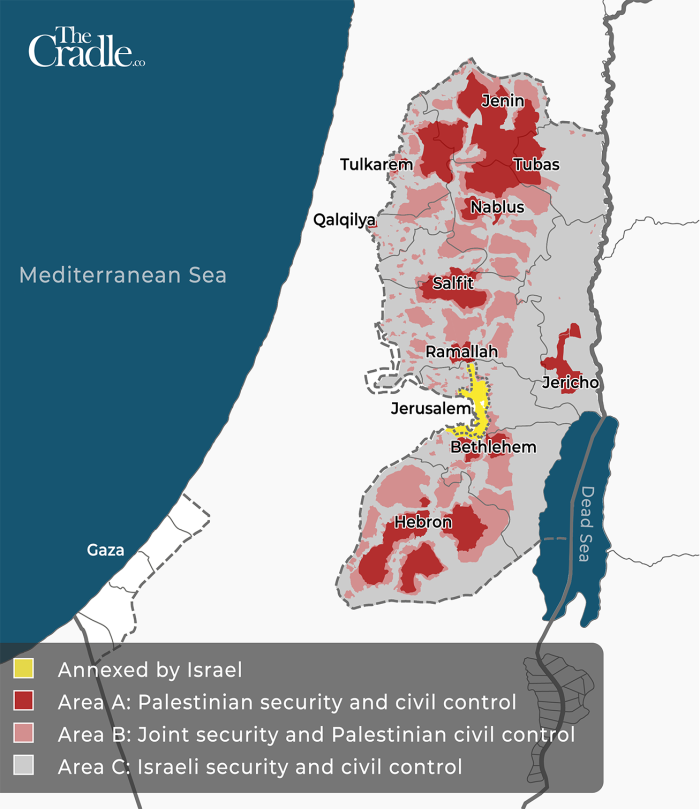
Map of Areas A, B, and C established under the Oslo Accords.
That transfer folds large parts of the occupied West Bank into Israel’s legal system, advancing annexation through procedure rather than proclamation. The change appears technical on paper and carries clear political consequences.
More than 58 percent of Area C, nearly 1.9 million dunams (roughly 1,900 square kilometers), remains unregistered, according to the Israeli anti-settlement group Peace Now. That unresolved legal status is now at the center of Israel’s latest initiative.
The roots of the issue stretch back decades. Under Jordanian administration between 1949 and 1967, only a portion of land was formally registered, following older British Mandate practices. After 1967, Israeli military orders froze settlement processes, leaving wide areas governed by customary ownership and inherited documents.
That legacy now carries forward into the present. What was left unresolved is now being brought under a new legal framework.
Land registration as control
The plan sets out to survey and register about 15 percent of these lands, roughly 290,000 dunams (around 290 square kilometers), before the end of the decade.
For Palestinian landholders, claims require detailed documentation and precise maps, often stretching back generations. In many cases, those records are incomplete or no longer available.
Where proof falls short, land can be classified as state property. Once registered that way, it can be redirected toward settlement construction or agricultural outposts, while former owners lose access.
Legal ground shifts
Recent cabinet decisions have reshaped the legal terrain that governed land for decades.
Pre-1967 Jordanian restrictions that once limited property sales to Palestinians are being overridden, opening the door for companies and settler groups to acquire land inside densely populated Palestinian areas.
At the same time, prior approval requirements for transactions have been lifted. These procedures once allowed authorities to review claims and flag irregularities. Their removal speeds up transfers and reduces oversight.
Land records have also been opened for public review. For settlement groups, this offers a clearer path to identifying absentee ownership and pursuing contested claims.
These measures do not stop at Area C. They reach into Areas A and B, where the Palestinian Authority (PA) holds administrative powers under the Oslo framework. Israeli agencies are now positioned to intervene more directly, including demolishing Palestinian buildings and structures, under the guise of enforcing environmental standards, heritage protection, and water management.
In Hebron (Al-Khalil), planning authority in key areas has been transferred from the municipality to Israeli military control. In Bethlehem, a dedicated body now oversees the area around Rachel’s Tomb, channeling resources into nearby religious infrastructure.
Expansion on the hills
Legal change has moved in tandem with accelerated settlement activity.
A new plan outlines the establishment of outposts across dozens of strategic hilltops, each designed to establish a permanent presence through mobile homes and basic infrastructure.
More than 1 billion shekels have been allocated for roads linking the new outposts to existing settlements, folding them into the wider settlement network.
Settlement construction has risen sharply in recent years, with Peace Now reporting an 80 percent increase since 2022. Many outposts once considered unauthorized have since been retroactively approved.
Pastoral outposts form part of this expansion. Herds are used to assert control over grazing land, limiting Palestinian access, and extending the reach of settlement activity beyond built structures.
The E1 corridor east of Jerusalem remains central to these plans. Tenders have been issued for more than 3,400 housing units in the E1 area, linking Ma’ale Adumim to Jerusalem. If built, the project would sever the territorial continuity between Ramallah, occupied East Jerusalem, and Bethlehem, effectively dividing the West Bank into two disconnected parts
A joint report by Peace Now and Kerem Navot found that shepherding outposts now give settlers control over around 14 percent of the occupied West Bank, or at least 786,000 dunams (786 square kilometers).
Displacement under pressure
On the ground, these changes are accompanied by rising pressure on Palestinian communities.
According to UN OCHA data, cited by Amnesty International, 117 predominantly Bedouin and herding communities in the occupied West Bank experienced full or partial displacement between January 2023 and April 2026 following settler attacks and related access restrictions.
In parts of the Jordan Valley and the hills around Ramallah, attacks by settler groups have led to the destruction of homes and infrastructure. In some cases, entire communities have left overnight.
In one case, a community in Al-Mu’arajat was completely displaced after homes were demolished and infrastructure looted. In Ras Ein al-Auja, near Jericho, Bedouin families were forced to leave after settler outposts cut off access to grazing land and undermined their livelihoods.
Accounts from affected areas describe vehicles entering at speed, property damage, and the seizure of basic resources. Fatal incidents have also been reported, with residents killed during confrontations.
For many, remaining on the land has become increasingly difficult. Pressure builds through legal, economic, and physical channels.
A system, not incidents
Evidence suggests that settler violence is not random but operates within an organized framework supported by state institutions.
Figures from the Israeli rights group Yesh Din show that the vast majority of complaints related to settler violence are closed without charges.
Oversight of the police sits with extremist National Security Minister Itamar Ben Gvir. Field reports from within the Israeli military describe coordination at times between soldiers and settler elements, or a lack of intervention during incidents.
Support has also taken administrative form. Dedicated units have been established to work with settler youth groups, alongside funding for equipment used in remote areas.
Political rhetoric has also drawn criticism. Israeli Prime Minister Benjamin Netanyahu has repeatedly described violent settlers as “a handful of extremists.” The cumulative effect is a system that allows these dynamics to persist, operating with continuity rather than disruption.
Regional fault lines
The developments have drawn responses from regional and international actors, grounded in legal frameworks.
The International Court of Justice (ICJ), in its 2024 advisory opinion, found that Israel’s policies and practices in the occupied West Bank and East Jerusalem violate international law. Land confiscation and population transfer were identified as unlawful.
Land confiscation and the transfer of population are prohibited under the Fourth Geneva Convention and affirmed as unlawful in UN Security Council Resolution 2334.
Governments in Jordan, Egypt, Qatar, and Turkiye have described current policies as a form of annexation that undermines the basis for a political settlement.
For Jordan, the issue carries additional weight, touching on the foundations of its 1994 peace agreement with Israel.
Western responses have remained largely declarative. Opposition to formal annexation has not translated into a halt to settlement growth or infrastructure expansion.
The changes continue through administrative channels, each step building on the last. What began as a registry project now runs through land, law, and control across the occupied West Bank, carried forward through procedure and fixed on the ground.
Across legal files, hilltops, and emptying villages, the map is being redrawn without a formal declaration.
UN Commission Chief: Israel Uses Palestinian Babies As ‘Special Targets’
By Justin K.P. | The Dissident | June 30, 2026
S. Muralidhar, a United Nations Commissioner on Human Rights, who led the recent UN inquiry into Israel’s killing of children in Gaza, revealed that IDF terrorists routinely target Palestinian babies as specific and intentional targets.
In an interview with RT India, he said, “When you shoot a 10-day-old baby breastfeeding on his mother… through his head, you can by no means label such a baby as an enemy of the State of Israel and justify these kinds of attacks”.
He noted that “Israeli quadcopters with thermal imaging cameras can clearly distinguish a child from an adult”.
During the interview, he noted, “That children were specifically targeted is clear from the number of ‘instances of babies with gunshot wounds to their head and neck to cause maximum damage.’ He added that babies were targeted with ‘tiny cube-shaped pellets’ that ‘spread like a cluster of ammunition and destroy all the internal organs.’”
He added, “So it became very clear… that babies were special targets,” and “noted that Israeli soldiers recounted on TV how they targeted children with quadcopters, claiming that ‘their commanders complimented them for doing that.’”
During the interview, he said, “We have a number of cases where an adult is holding a child, the child is killed, and the adult is unharmed”.
In a separate interview with India Today, he said, “There are numerous instances where a child is accompanying an adult on a road. The child is shot and killed, while the adult is spared”.
He added, “Doctors who deposed before us told us that hundreds and hundreds of babies were brought in with injuries and fatalities. They’ve never seen this kind of extensive attack specifically targeting children”.
The UN commission report gave a confirmed example of IDF terrorists targeting and killing a 10-day-old baby by an IDF quadcopter.
It noted:
On 12 April 2024 at 13:00, a 10 day-old-baby boy was shot by a quadcopter while being breastfed by his mother inside their tent in Nuseirat camp. The mother was alone in the tent, breastfeeding her baby, when a single bullet from a quadcopter hit the baby in the head and exited through the back of his head, hitting the pillow behind her. The baby survived but sustained brain injuries and now suffers from seizures.
The Commission viewed and analysed images of the bullet that hit the baby. The Commission concluded on reasonable grounds that the bullet was fired from a sniper rifle mounted on a quadcopter. Considering that the shooting occurred in broad daylight, the Commission concludes that the quadcopter controller would have been able to see inside the tent and assesses that the target was a mother and a baby.
It also documented a confirmed example of a four-year-old child being targeted and killed while eating with her family. It wrote:
On 24 August 2024, at around 08:00, a four-year-old girl was hit by a bullet to her head while she was eating with her family in her tent in Khan Younis, southern Gaza. No one else from the family was injured, only the girl. She was evacuated to Nasser Medical Complex in Khan Younis, where she was intubated and later underwent a craniotomy. The girl survived the incident, but the left side of her body was paralysed, and she will likely suffer long-term damage.
The Commission viewed images of the bullet and determined that the bullet used was a 7.62x51mm munition. Since the girl was the only one in the family in the tent who was shot and testimonies of the doctor and the parents indicate that they saw the quadcopter that shot the girl, the Commission concludes on reasonable grounds that the girl was targeted by a quadcopter mounted with an assault rifle.
The report spoke to over a dozen doctors who worked in Gaza who, “reported a consistent pattern of receiving children with single gunshot wounds either by quadcopters or snipers. The killing of a child from a single gunshot wound indicates a high degree of precision in the use of force, suggesting that the shot was carefully aimed rather than incidental or the result of indiscriminate fire. In such cases, this pattern is indicative of the deliberate targeting of the child victim, particularly where the circumstances do not point to crossfire or other conditions of hostilities”.
Board of Peace: UNRWA Will Have No Place in New Gaza
By Kyle Anzalone | The Libertarian Institute | July 1, 2026
The Board of Peace said that the UN aid agency for Palestinians (UNRWA) can have no role in the future of Gaza.
“UNRWA has no place in the new Gaza,” the Board of Peace posted to X on Wednesday. “We are turning the page on the complex of perpetual aid dependency & conflict. The people of Gaza deserve better.”
UNRWA serves as the most crucial aid agency for Palestinians who live as refugees or as second-class citizens in Israeli-occupied territory. Since the start of the Israeli onslaught in Gaza, UNRWA has provided a crucial lifeline to people living in deplorable conditions caused by the Israeli siege of the Strip.
Israel has waged a propaganda war against UNRWA and worked to dismantle the agency’s ability to provide aid to Palestinians. Tel Aviv has attempted to portray UNRWA as a wing of Hamas, claiming its members helped to conduct the October 7 attack. However, multiple investigations have found that Tel Aviv has not produced evidence to substantiate the allegation.
The lack of evidence has not prevented Israel from restricting UNRWA’s operations. Tel Aviv has restricted UNRWA’s ability to operate and provide aid to Palestinians in Gaza. Additionally, the Knesset has passed a series of laws that target the UN agency.
Earlier this year, Israel passed legislation barring water and electricity companies from providing services to the UNRWA building, and a UNRWA facility in East Jerusalem was demolished.
Palestine Action Proscription: We Fight Back
By Craig Murray | July 1, 2026
I publish below in full the Note we have submitted to Court today to re-establish the separate Scottish judicial review of the proscription of Palestine Action. Not only is the state doubling down on prosecution of pro-Palestine activists, a new National Security State Threats Bill is being fast tracked through parliament to extend the attack on free speech.
Under this bill receiving a benefit including “information” from a state entity designated as “hostile” by the Home Secretary will be a crime bringing up to 14 years in prison. So publishing casualty figures from Iranian sources, for example, will be terrorism. Publishing information about Ukrainian attacks on Russia will be illegal.
This is the relevant clause of the Bill. My emphasis:
17C Obtaining etc material benefits from a designated body
(1) A person commits an offence if—
(a) the person—
(i) obtains, accepts or retains a material benefit which is not an excluded benefit, or
(ii) obtains or accepts the provision of such a benefit to another person,
(b) the benefit is or was provided by or on behalf of a designated body, and
(c) the person knows, or having regard to other matters known to them ought reasonably to know, that the benefit is or was provided by or on behalf of a designated body.
(2) A person commits an offence if—
(a) the person agrees to accept—
(i) a material benefit which is not an excluded benefit, or
(ii) the provision of such a benefit to another person,
(b) the benefit is to be provided by or on behalf of a designated body, and
(c) the person knows, or having regard to other matters known to them ought reasonably to know, that the benefit is to be provided by or on behalf of a designated body.
(3) Material benefits may include financial benefits, anything which has the potential to result in a financial benefit, and information…
Please note there is specifically no public interest defence, no journalism defence and it is to be illegal to receive true information. It is not about the spread of disinformation, it is about the spread of information contrary to the British state narrative. Receiving information from a designated enemy of the UK is the offence, whether you publish it or not.
There in no modern precedent for this in peacetime. It is being forced through all its parliamentary stages – three readings, amendments and two Lords sittings – in a single day. I have repeatedly said that liberal democracy has collapsed. I do not need further proof.
Under the current legislation, yesterday prominent international lawyer Dan Kovalik was detained in Liverpool, his phone and laptop seized and he was questioned about his support for Palestine. Dan is a lawyer. He is entitled to lawyer/client confidentiality. His clients include the President of Colombia and other international figures. The UK is a rogue state.
The UK state is currently attempting to gaslight us with a concerted campaign of messaging about a few millions in aid to Gaza – much of which is concentrated on assisting ethnic cleansing by various medical and educational routes for people to leave Gaza. But with Labour Friends of Israel member Andy Burnham to take over as PM with former Chair of Labour Friends of Israel James Purnell as his Chief of Staff, support for the Genocide will continue unabated.
The absurd National Security (State Threats) Bill shows that attack on dissidents and free speech will continue at home too. The debanking by Lloyds of The Canary is another prong of the extraordinary destruction of civil liberty under New Labour.
So I am determined not to bow to the sisting of the Scottish judicial review and we have lodged a motion to “reclaim” or restart proceedings.
We have not yet reached the actual Scottish judicial review or had any chance to give the arguments we will use there. It is my intention that we will attack the proscription in the most fundamental way, making these points among others:
- There is an active obligation on states to do everything possible to stop a Genocide. By contrast, the UK has done everything in its power to facilitate Genocide, including protecting its supply chain.
- It is patently absurd to call a non violent direct action group a terrorist organisation
- The state should not be treated as neutral or infallible by the courts. The false narrative on Iraqi WMD, and the terrible deaths and destruction to which that narrative led, should be a warning the state can get it very wrong.
- As a former senior civil servant who was in the FCO during that period, I can testify to the pressures on civil servants and agencies to produce the evidence and policy recommendation that Ministers wish to hear
- The evidence base produced by JTAC to support the proscription recommendation was fundamentally untrue. The Filton jury proved that the Met Police and JTAC assertions of escalating violence, carrying weapons with intent to harm, did not happen as a matter of fact. The jury rejected the aggravated burglary and violent disorder.
- Only one Palestine Action activist has ever been convicted of an offence of violence, and there the jury specifically found no intent
- Lady Justice Carr in the Appeal Court judgement both relied on Sheriff McCormick’s sentencing remarks in the Thales case. But there were no convictions of violence in the Thales case. Sheriff McCormick misrepresented the evidence. Last week he the Sheriff Appeal Court in Scotland overturned his finding of anti-Israeli racism against Mick Napier of Scottish Palestine Solidarity Committee. The inaccurate and frothing remarks of one zionist Sheriff are not a basis for proscription.
- Lady Justice Carr ruled that the Home Secretary must be given “appropriate latitude” and a “wide margin of appreciation” in security cases. But the Home Secretary should not be idealised. They are a politician, and in this case a politician who is parti pris. Yvette Cooper is massively financed by the Zionist lobby. The courts should operate in the real world not in an idealised and unrealistic one.
Lady Carr’s judgement is entirely and directly predicated on the notion that in any conflict in law between the state and the citizen, special deference should always be given to the state as more noble and trustworthy. That reasoning is fundamentally flawed.
To get heard at all we have to roll back Lord Young’s extraordinary ruling that the English Court of Appeal judgement should be accepted as law in Scotland in the interests of “comity”. This overturns centuries of doctrine on the separate jurisdiction of Scotland going back to the Treaty of Union itself – though it does reflect what had in truth been the unchallenged though illegal practice of deference to England in such matters. … continue
UK ‘Counter Terrorism Police’ Detain American Lawyer And Human Rights Activist For Criticism Of Israel
By Justin K.P. | The Dissident | June 30, 2026
The UK’s Zionist owned police state continues to detain Israel critics on bogus terrorism charges, in this case against a well-known American human rights lawyer.
Dan Kovalik is a well-respected human rights lawyer and author who previously taught International Human Rights at the University of Pittsburgh School of Law.
Kovalik is currently representing Gustavo Petro, the president of Colombia.
He is a critic of Zionism and U.S. policy towards Iran, publishing the book “The Case for Palestine: Why It Matters and Why You Should Care” last year and publishing the book “The Plot to Attack Iran: How the CIA and the Deep State Have Conspired to Vilify Iran” in 2018 .
For this, Kovalik was detained “at John Lennon International Airport in Liverpool, England” by counterterrorism police who seized his “phone, computer, fingerprints and DNA sample” over his “opposition to the Genocide on Gaza and the war on Iran.”
Kovalik wrote on X, “In the height of irony, I was detained at John Lennon International Airport in Liverpool, England by anti-terrorism police concerned about my opposition to the Genocide on Gaza and the war on Iran. They seized my phone, computer, fingerprints and DNA sample.”
Writer Nalia reported that Kovalik “was detained for approximately two and a half hours and interrogated extensively on his political views about Israel’s genocide in Palestine, Lebanese resistance organisation Hezbollah and on the war against Iran”.
She also reported that “Kovalik’s phone and laptop were seized along with his DNA, fingerprints, photos from multiple angles and copies of his bank and credit cards. After officers rifled through his luggage, they questioned Kovalik on the book he was carrying — a gift from a student by Palestinian writer Ghassan Kanafani, Palestine’s Children: Returning to Haifa & Other Stories — before he was released and free to continue on his journey.”
She also noted that “Despite informing officers that he is a practising lawyer and that his phone and laptop contain documents protected by legal professional privilege — including attorney-client privilege — Kovalik objected to their seizure, which a supervising police sergeant confirmed to Kovalik that he had properly raised privilege objections. Regardless of his objections, his electronic devices were retained ‘with intention to copy,’ raising serious questions about the protection of legally privileged material, client confidentiality and compliance with the safeguards governing legal privilege under Schedule 3 and its accompanying Code of Practice.”
Commenting on the detention of Kovalik, former MP George Galloway, who himself was previously detained at Gatwick Airport for his support of Palestine, said: “The Political Police in Britain are out of control.”
Israeli forces open fire on civilians in southern Syrian village

Israeli military camp with armored vehicles along strategic road connecting the villages of Jamla and Saysoun in Daraa Governorate, Syria on June 28, 2026. [Enver Asfur – Anadolu Agency]
MEMO | June 29, 2026
Israeli forces opened fire on Syrian civilians on Sunday evening as they began withdrawing from the village of Abidin in Daraa province, southern Syria.
The Syrian Arab News Agency (SANA) reported that “Israeli occupation forces opened fire towards residents while withdrawing from the village of Abidin in the western Daraa countryside.”
There were no immediate reports of injuries, and the Syrian authorities have not commented on the incident.
Earlier on Sunday, the Israeli army set up tents on Tal al-Maghar, west of Abidin village, and in the Yarmouk Basin area in the Daraa countryside.
Syrian media reported that Israeli forces fired live ammunition and illumination flares, targeting farmers near El-Tallah after a force of four armoured personnel carriers moved from al-Jazira barracks towards the area.
Israeli military activity in Syria has escalated in recent months, including raids on civilian homes, searches, the establishment of checkpoints, and the detention of civilians, including shepherds and children.
After the fall of the Bashar al-Assad regime on 8 December 2024, Israel declared the 1974 Disengagement Agreement had collapsed and took control of the UN-monitored buffer zone.
Israel rebrands Gaza’s forced displacement scheme amid international outrage: Report
Press TV – June 29, 2026
The Israeli regime has reportedly rebranded a scheme to remove Palestinians from Gaza, replacing the term “voluntary migration” with “Free Movement Plan” amid mounting international condemnation.
According to Israeli media, the cabinet of the Israeli prime minister Benjamin Netanyahu is promoting the Gaza relocation initiative under a new name following growing international backlash.
Israel’s Channel 13 reported that instructions have been given to various bodies of the regime’s establishment to present the plan using language considered more acceptable abroad.
Sources involved in contacts with foreign governments reportedly expressed hope that the change in terminology could revive the scheme after previous diplomatic efforts stalled.
The reported rebranding comes as Israeli military operations, land seizures, and restrictions on the movement of civilians continue across the Gaza Strip despite a ceasefire that took effect in October 2025.
A senior Israeli official quoted by Channel 13 acknowledged that the Palestinian resistance movement Hamas “still exists” in Gaza and stated that Israel “seeks to encourage” as many Palestinians in Gaza as possible to leave the territory.
Earlier reports indicated that Israeli officials explored relocation schemes with Somaliland and the Democratic Republic of the Congo, although those efforts failed to secure agreements.
Channel 12 previously reported that Israeli institutions had presented plans to transfer Palestinians from Gaza by land, sea, and air as part of a broader relocation strategy.
The international community have denounced the plan as an attempt to empty Gaza of its population.
The relocation debate has intensified amid widespread destruction across Gaza, where more than 73,000 people have reportedly been killed, over 173,000 wounded, and nearly 90 percent of infrastructure damaged since October 2023 when Israel launched its genocidal assault on the enclave.
Featured Video
Trita Parsi: Israel Set a Trap for Total War in the Region
or go to
Aletho News Archives – Video-Images
From the Archive
Zionism’s Violent Legacy
By Donald Neff | Washington Report On Middle East Affairs | January 1996
On January 4, 1948, Jewish terrorists drove a truck loaded with explosives into the center of the all Arab city of Jaffa and detonated it, killing 26 and wounding around 100 Palestinian men, women and children.[1] The attack was the work of the Irgun Zvai Leumi – the “National Military Organization,” also known by the Hebrew letters Etzel – the largest Jewish terrorist group in Palestine. The Irgun was headed by Revisionist Zionist Menachem Begin and had been killing and maiming Arabs, Britons and even Jews for the previous ten years in its efforts to establish a Jewish state.
This terror campaign meant that at the core of Revisionist Zionism there existed a philosophical embrace of violence. … continue
Blog Roll
 Aletho News
- Trita Parsi: Israel Set a Trap for Total War in the Region
- Trump’s Iran war is on an Israeli leash
- Saudi oil boss issues global supply warning
- Riyadh Says Its Oil System Is Intact. The Numbers Say Otherwise.
- Trump and Netanyahu Want to “Finish the Job” on Iran
- US ‘one-sided dictation’ not Iran’s beliefs makes rational talks impossible: Baghaei
- Iran’s Next Strike May Not Explode. It Could Shut You Down /Col Doug Macgregor
- Iran: US political targets legitimate if assassinations return
- Iraq shuts key border crossing with Iran under US pressure: Report
- Undersea Internet cables could be targeted in retaliation for attacks on Iran: IRGC deputy chief
- If Americans Knew
- The Israel Lobby’s Changing Fortunes
- AIPAC has become such a political liability that it’s shifting to a more “nimble” approach to buying politicians
- At least 160 Israeli settler attacks in 2 weeks
- Will Gaza’s Ancient Christian Community Disappear Forever?
- Israel’s vision of regional security rests on keeping Arab states weak
- Heidi Levine recounts how Palestinian youths helped save her in settler attack
- DAILY UPDATE: Latest essential news on Palestine, Israel, & region
- Trump’s Intensifying Sabotage of the ICC, for Israel’s Sake
- Israeli military detain US and UK volunteers in West Bank including Democratic NY politician Brad Lander
- Americans at National Conservatism Conference held in Israel this year criticize Israel
- No Tricks Zone
- E-Cars Reduce CO2 Emissions By Only 41% Compared To Internal Combustion Engine Vehicles
- Predictions Made By Renowned Climate Professor Over Past Decades Have Been Proven To Be Poor
- New Study Suggests Large Regions Of The Pacific Ocean Have Been Cooling For The Last 80 Years
- Germany’s Green Energy Debacle: High Energy Costs Force Kahla Porzellan to Close After 182 Years!
- New Study: 50 Years Of The Most Aggressive ‘Net Zero’ Policies Can Only Affect The Global Climate By 0.03°C
- US September “Heat” Was No Record…Many Records Set Decades Ago
- Latest European Green Energy Debacle; Portugal’s Largest Flagship Solar Park Insolvent!
- Green Energy Debacle: German Expert Professor Fritz Vahrenholt Warns Of Severe Economic And Social Consequences
- Two More Paleo Reconstructions Affirm Meters-Higher Sea Levels Across Ireland, Brazil 7000-6000 Years Ago
- New Study: Earth And Venus Surface Warmth Largely Explained By Convection And Lapse Rate, Not CO2 Or Radiation

