Col Douglas Macgregor: War to the Last Missile in Iran
Daniel Davis / Deep Dive
Press TV – July 10, 2026
US President Donald Trump’s plan for post-genocide Gaza, which called for a 20,000-strong multinational “peacekeeping” force to secure the besieged territory, is now struggling to recruit even an initial group of up to 20 troops, according to a Wall Street Journal report.
The exclusive report reveals that the security framework meant to underpin Washington’s vision for Gaza after the genocide remains far from realization. The proposed initial deployment has faced repeated delays and sharply diminishing international support.
The original proposal envisioned a large multinational force of around 20,000 personnel. However, regional instability, political disagreements among potential contributors, and ongoing military tensions have drastically scaled back the project.
Daniel Shapiro, a former US deputy assistant secretary of defense for the Middle East, told the newspaper that the recent joint US-Israeli war of aggression against Iran has not only delayed decisions on the force but has also eroded many countries’ willingness to participate.
Indonesia, once expected to be one of the largest contributors, suspended its involvement in March, citing the worsening regional security situation. Indonesian officials have confirmed that the country’s participation remains on hold.
According to the report, only Morocco, Albania, Kosovo, and Kazakhstan are currently expected to make formal commitments.
The first Moroccan contingent, originally scheduled to deploy in June, has been delayed and is now expected to arrive in the coming months. Instead of entering Gaza immediately, these troops will first be stationed at a newly built logistics hub in Israeli-occupied territory near the Kerem Shalom crossing.
This dramatic downsizing highlights the mounting political, security, and diplomatic obstacles facing Washington’s so-called “day after” strategy for the blockaded Palestinian territory. The difficulties confronting the proposed international security force (ISF) underscore the broader failures of the Trump administration’s Gaza plan.
The ISF was intended as a central pillar of the US-backed post-genocide framework, which envisioned a phased political transition in Gaza. Under the plan, Israeli occupation forces would withdraw, and the international force would take over security responsibilities while a US-led Board of Peace oversaw reconstruction and political implementation.
Meanwhile, the Hamas resistance movement announced this week that it would dissolve the emergency committee administering Gaza but declined to disarm its military wing. Palestinian resistance groups have made clear that surrender is not an option in the face of the US-led effort to reshape Gaza’s future.
Reconstruction has barely begun across most of Gaza, with only a fraction of the estimated $17 billion in pledged funds actually secured. Wealthy donors have largely refused to finance projects in areas still under Israeli control, viewing such efforts as legitimizing the occupation.
The Israeli genocide has already killed more than 73,000 Palestinians, wounded over 171,000, and destroyed around 90 percent of Gaza’s infrastructure, according to Gaza authorities.
MEMO | July 10, 2026
Volkswagen’s plans for a defence partnership with Israel’s Rafael have been vetoed by the German automaker’s Qatari investors, media reported Friday, Anadolu reports.
Qatar’s sovereign wealth fund, Volkswagen’s third-largest shareholder, rejected management’s proposal to manufacture missile components and military vehicles at the company’s Osnabruck plant, the Bild newspaper reported.
The move comes after Volkswagen CEO Oliver Blume said in March that the company will stop manufacturing Volkswagen Group vehicles at Osnabruck starting in 2027 and confirmed talks with several defence firms about shifting the plant for military vehicles production. Blume provided no further details at the time.
The proposal has sparked significant controversy within Germany. Volkswagen employees, peace activists and opposition politicians have criticised the plan, arguing the automaker should focus exclusively on civilian production. The Osnabruck Peace Initiative (OFRI) has organised multiple protests in recent months urging Volkswagen to abandon any defence contracts.
Germany’s opposition Left Party called Volkswagen’s planned cooperation with Israel’s state-owned Rafael Advanced Defence Systems “unacceptable,” citing the Netanyahu government’s ongoing military campaigns across the Middle East, accusing it of war crimes and genocide against Palestinians in Gaza.

By Kurt Nimmo | Another Day in the Empire | July 9, 2026
Auschwitz-Birkenau, Treblinka, Belzec, Sobibor, and Chełmno. These should be destinations Israeli Jews remember and abhor, and yet we are told, by the Israeli newspaper Haaretz (PDF), that a concentration camp in the works on the ethnic cleansed ruin of Rafah is somehow not only moral, but the most moral concentration camp in the world.
The support given by Prime Minister Benjamin Netanyahu to the criminal plan being promoted by Defense Minister Yisrael Katz, involving the construction of a “humanitarian city” on the ruins of Rafah, which would incarcerate all the enclave’s residents, is a moral and historic nadir for the State of Israel and the Jewish people. No matter how they try in Israel to wrap this move with laundered epithets, they are talking about a concentration camp.
The Zionist state, according to Katz, plans to herd 600,000 Palestinians currently forced to shelter in tents and makeshift homes within the coastal al-Mawasi area of southern Gaza to an area in the ruins of Rafah city. “Eventually, the entire civilian population of over two million in Gaza would be confined to this small ‘city,’” the Middle East Eye reports.
Katz said that once concentrated in the new city, Palestinians would be encouraged to “voluntarily” leave the Gaza Strip for other countries, as part of an “emigration plan” he said “will happen”.
In July, 2025 the US-backed Gaza Humanitarian Foundation (GHF) proposed a “Humanitarian Transit Area” where Gaza residents would “temporarily reside, deradicalise, re-integrate and prepare to relocate if they wish to do so,” Al Jazeera reported. GHF operated food distribution sites outside the United Nations system.
Humanitarian aid organizations and UN-affiliated experts say GHF previously violated humanitarian principles by directing civilians to hazardous militarized aid sites instead of establishing a neutral network. The BBC reported that more than 500 Palestinians have been killed while seeking aid since the GHF began operating in May, 2025. Oxfam and Save the Children report Israeli forces and armed groups “routinely” fired on Palestinians seeking aid. GHF ended its operation in late 2025.
In March, the RAND Corporation published Pursuing Disarmament, Demobilization, and Reintegration in Gaza: A Critical Pathway to a Durable Peace. The white paper follows a Disarmament, Demobilization, and Reintegration (DDR) three-stage strategy used by UN Peacekeeping to transition war-torn societies to peace.
The RAND report does not take into account Israeli policies of settlement expansion, collective punishment, arbitrary imprisonment, and periodically “mowing the grass,” that to say conducting violent raids into Gaza. Decades of Zionist mistreatment of Palestinians naturally perpetuates radicalization and determined resistance.
The Strategic Hamlet Program
In 1962, the administration of Ngo Dinh Diem, in collaboration with the Kennedy administration, initiated the counterinsurgency Strategic Hamlet Program in South Vietnam. This rural pacification initiative involved relocating South Vietnamese villagers into barbed-wired “protected hamlets,” distancing them from their ancestral lands and inhibiting any support for the National Liberation Front (NLF), commonly referred to as the Viet Cong. US advisors forcefully put them to work building the internment “villages.” The concept of fortifying villages and hamlets originated from the British Army. They had effectively implemented it in Malaysia. Sir Robert Thompson, the head of the British advisory team to Ngo Dinh Diem, recommended it.
The French constructed “protective villages” in Tonkin, later known as agrovilles, under commander François de Linares in 1952. The effort was underwritten by the United States and eventually interned three million Vietnamese. Vietnam War correspondent Bernard Fall said, “the French strategic hamlets resembled British [Malayan] prototypes line for line.”
The Malaysian strategic villages were established in the 1950s under the Briggs Plan, a British counterinsurgency population-control and resettlement program devised by Lt‑Gen. Sir Harold Briggs during the Malayan Emergency of 1948–1960. The villages were designed to break the link between the Min Yuen, a civilian support network, Malayan Communist Party (MCP) guerrillas.
The Briggs Plan villages led to extensive forced resettlement, identity registration, curfews, supervised relocations, coordinated civil-military administration, and the recruitment of home guards among settlers. This initiative played a significant role in the ultimate defeat of the MCP insurgency.
The exploitation experienced in Malaysia during the colonial era was closely associated with the economic extraction methods employed by the British, particularly in the rubber and tin industries. This system was characterized by oppressive labor practices, land dispossession, and legal arrangements that benefited colonial corporations and administrators.
The Strategic Hamlet Program in Vietnam failed due to its rapid implementation, inadequate defense, corruption, poor execution, and alienation of the rural population it aimed to win over. The fundamental strategic mistake was that the program prioritized physically separating people from the Viet Cong without first making the government more appealing than the communists.
British Concentration Camps in South Africa
During the Second Boer War in South Africa (1900-1902), the British implemented concentration camps to eliminate support for Boer guerrillas and to suppress resistance during the conflict. “While civilian internment in South Africa was not intended to be genocidal, it resulted in a significant loss of life and enduring resentment among Boer descendants,” writes Garth Benneyworth from the Department of Historical Studies at the University of Johannesburg, South Africa.
A minimum of 40 concentration camps were established, interning approximately 150,000 Boer refugees, predominantly women and children. Estimates suggest that Boer fatalities ranged from about 18,000 to 28,000, with children constituting the majority of the casualties. Overcrowding and unsanitary conditions resulted in outbreaks of diseases, including typhoid, malaria, measles, and dysentery.
The camps were created following the British failure to subdue the Boer South African Republic and the Orange Free State, as well as to gain control over the profitable Witwatersrand gold mines. In reaction to the Boers’ resistance, the British implemented a scorched earth strategy that methodically destroyed crops, contaminated water sources, burned homesteads and farms, and interned Boer and African men, women, and children.
Violation of the Fourth Geneva Convention
Israeli Defense Minister Israel Katz’s “New Rafah” plan is a high-tech version of previous concentration camps. In a similar fashion to the Strategic Hamlet Program and the Boer camps in South Africa, “New Rafah” is primarily intended to separate Palestinian civilians from Hamas and prepare for the forced migration of two million people (despite the fact few if any countries are willing to take ethnically cleansed Palestinians). The Euro-Med Human Rights Monitor reports the Israeli plan
constitutes a clear violation of international humanitarian law, particularly the absolute prohibition on the forced transfer and mass detention of protected populations under the Fourth Geneva Convention. It falls within the scope of forced displacement, persecution, and apartheid, which are patterns of policies and practices that individually amount to crimes against humanity under international law.
Zionist Israel, however, has repeatedly demonstrated its contempt for international law in regard to the protection of civilians. “Rather than abide by these rules, Israel has openly defied international law time and again, inflicting maximum suffering on civilians in the occupied Palestinian territory and beyond,” notes the United Nations Human Rights Office of the High Commissioner.
The “humanitarian city” proposed by Katz follows previous violations, including illegal settlements, annexations, military watchtowers and barbed-wire fences on Palestinian land, refusal to allow the right of return for refugees, numerous deadly sieges in the Gaza Strip and West Bank, and the breach of over 30 UN Security Council resolutions.
By Harrison Berger | The American Conservative | July 5, 2026
Amid record-high public hostility toward Israel and the wars taxpayers are financing on its behalf, the Israel lobby has mobilized to pass a National Defense Authorization Act (NDAA) for 2027 which includes language designed to sustain the years long wealth transfer from Americans to Israelis and cement that relationship in ways that would be less transparent and more difficult to challenge through democratic processes.
At the same time, a coalition led by outgoing Rep. Thomas Massie (R-KY) has launched a counteroffensive to block a separate track of funding for Israel’s wars, targeting the transfer of $3.3 billion to Israel embedded within the National Security, Department of State, and Related Programs Appropriations Act, 2027, which is also up for vote this summer.
The first bill—the NDAA—was highlighted by The American Conservative earlier this month. It includes language within its Section 224 (since renumbered Section 219 in the House) that would direct the Pentagon to identify Israeli-origin technologies “for potential integration into United States systems and programs of record” and to build “United States-based co-production or manufacturing partnerships with Israeli industry.” Section 219, if enacted, “would be unprecedented,” Annelle Sheline of the Quincy Institute told TAC. “No other foreign country has an executive agent in the Pentagon to integrate our military industrial complex with theirs.”
Along with merging Israeli and American weapons technology and data, Section 219 would shift funding for Israeli weaponry from Congress to the Pentagon’s murky procurement system.
“This so clearly seems to be an attempt to shield money from cratering public opinion,” Sheline said. She noted that “Americans do not want to fund a country engaged in genocide and which led us into the Iran War,” adding that, rather than representing public opinion and cutting off Israel’s funding, Congress has moved to conceal it.
Such a merger carries inherent national security risks. The presence of foreign components in U.S. systems raises the threat those systems’ integrity will be compromised, a danger heightened in this case by Israel’s demonstrated capability and willingness to weaponize supply chains, as exhibited in their 2024 attack that involved the detonation of thousands of pagers which had been engineered into remote-controlled bombs. Joe Kent, the former director of the National Center for Counterterrorism, argues similarly that “the dangers of allowing any other nation to access our sensitive military technologies are obvious, including the fact that back doors and spyware can be installed that will most certainly be used by the Israelis to influence U.S. policy.”
But Section 219 of the NDAA would hinder American national security in much more immediate ways, principally by reducing the leverage Washington currently maintains to influence Israeli behavior in the region. “At present,” Sheline explains, “Israel is dependent on U.S. weapons and components, particularly their air force.” That U.S. support has enabled the Israelis to perpetrate a genocide in Gaza, ethnically cleanse southern Lebanon, and launch two wars against Iran, with Israel’s defense minister recently threatening a third.
“The U.S. could at present use leverage to change that Israeli behavior,” Sheline says. But by merging U.S. and Israeli weapons development, “this legislation would reverse it so that the [Israelis] could do that to us.”
Despite the various threats to American national security posed by the provision, section 219 this week moved closer to its expected final passage, with the House Rules Committee on Monday rejecting a bipartisan amendment introduced by Reps. Ro Khanna (D-CA) and Thomas Massie (R-KY) that would have stripped the “United States-Israel Defense Technology Cooperation Initiative” from the NDAA.
Massie’s efforts to stop a separate track for Israel funding attached to the State Department’s spending bill may be more successful. His other amendment—which seeks to eliminate $3.3 billion in annual funding for Israel tied to a 10-year, $38 billion MoU—has reportedly provoked panic among House Democrats, who face pressure from constituents with record-low views of Israel.
Punchbowl News reported that House Democrats “expressed alarm” in a closed meeting and were “begging for leadership guidance” on how to vote while Axios reported on Wednesday that Democrats “fear intense backlash from their base if they oppose” Massie’s amendment to halt Israel funding. Democrats who continue to support wealth transfers from the American tax base to Israelis are aware that doing so comes with the heightened risk of being unseated for it, with the recent ouster of Israel First Democrats Rep. Dan Goldman (D-NY) and Rep. Diana DeGette (D-CO) serving as a warning to any Democrats who continue to defy the will of the Democratic Party base.
The Massie amendment to cut off funds for Israeli offensive weaponry “may end up being the last time these sorts of votes are meaningful,” says Sheline. “If we proceed with defense industrial integration (Section 219), congress won’t be able to vote on it again.”
Harrison Berger is a correspondent at The American Conservative. He has contributed to Drop Site News, The Nation, and Responsible Statecraft. Previously, he was a researcher and producer for System Update with Glenn Greenwald. His work focuses on civil liberties and U.S. foreign policy. He studied Political Science and Russian Studies at Union College (NY).

Palestinian Information Center – July 8, 2026
OCCUPIED JERUSALEM – Israeli occupation forces demolished a residential building in Sur Baher, southeast of occupied Jerusalem, on Wednesday, while carrying out demolition operations west of al-Khalil.
The Wadi Hilweh Information Center said Israeli forces, accompanied by bulldozers, stormed Sur Baher and demolished a residential building made up of four apartments belonging to Fuad Awadallah.
In al-Khalil, Israeli forces raided the Al-Ras area in the town of Idhna to carry out demolition operations.
The demolitions came as Israeli authorities gave Al-Rifa’iya School near Yatta, south of al-Khalil, 14 days before implementing a demolition order after an Israeli court rejected the final appeal against the decision.
Local and official sources said the school, located south of Al-Deirat village east of Yatta and affiliated with Khallet Al-Maiya municipality, serves 150 students from first to seventh grade. It was established in 2016.
The sources said the demolition could be carried out at any time during the 14-day period.
They stressed that education would continue even if the school is demolished, whether on the rubble, in caves, in tents or in the open air, to ensure students continue receiving their education.
Ten schools in the area, serving around 1,000 students, face the threat of demolition or could receive demolition notices at any time, according to the sources.
Al-Rifa’iya School is part of the “challenge schools” supervised by the Palestinian Ministry of Education and supported by international institutions in Area C, which is under full Israeli military control.
Israeli authorities justify such demolitions by citing construction without permits, a policy rights groups say is nearly impossible for Palestinians to overcome because Israel almost entirely refuses to grant building permits in these areas, serving settlement expansion.
Rights advocates say the demolition of schools in Masafer Yatta and southern al-Khalil is part of a policy aimed at undermining the right to education and pushing Palestinians to leave their land by depriving them of basic living conditions, in what they describe as a policy of silent displacement.
Glenn Diesen | July 7, 2026
Prof. Seyed Mohammad Marandi is a former advisor to Iran’s nuclear negotiation team. Prof. Marandi discusses the continued attacks on Lebanon and Gaza, the US efforts to renegotiate the MoU, the possibility of improved ties between Iran, the Arab States, and Turkey.
Follow Prof. Glenn Diesen:
Support the research by Prof. Glenn Diesen:

MEMO | July 7, 2026
Hamas’s decision to dissolve the Government Emergency Committee in the Gaza Strip and transfer civilian administration to the National Committee for the Administration of Gaza marks a significant strategic shift. To interpret it as capitulation or defeat is to misunderstand the current stage of the Palestinian national liberation struggle.
The movement has reaffirmed its commitment to implementing the ceasefire agreement and fulfilling its responsibilities until Gaza’s civilian administration is fully transferred.
The decision should be understood as a tactical repositioning aimed at preserving three strategic objectives: Hamas’s political survival, the reconstruction of Palestinian national unity and the continuation of resistance.
The first is to preserve Hamas as a political, social and military force deeply rooted in Palestinian society.
For almost two decades, the movement has carried the dual burden of governing and resisting, administering a population subjected to blockade, repeated wars and the systematic destruction of the material conditions necessary for life.
After the most devastating war in contemporary Palestinian history, the occupation failed to achieve one of its principal declared objectives: eliminating Hamas.
Leaving Gaza’s day-to-day administration allows the movement to reduce its institutional exposure, reorganise its structures and concentrate on its historical reason for existence: the Palestinian national liberation struggle.
The second objective is to contribute to rebuilding Palestinian national unity.
The political and geographical fragmentation between Gaza and the West Bank, together with internal Palestinian divisions, has long constituted one of the occupation’s greatest strategic advantages.
By transferring civilian administration to a Palestinian national body, Hamas signals that governmental control over Gaza is subordinate to the broader objective of rebuilding national unity.
Gaza does not belong to Hamas. It belongs to the Palestinian people.
The new administration, however, cannot become an instrument of foreign tutelage or a mechanism for excluding political forces with genuine roots in Palestinian society.
The central challenge remains rebuilding a representative Palestinian leadership capable of speaking for Palestinians in the occupied territories, refugee camps and the diaspora.
The third objective is to preserve the continuity of resistance.
Governing and resisting are different political functions. A national liberation movement may participate in elections, administer territories, negotiate ceasefires and accept transitional governments. It may also withdraw from administrative structures when remaining within them threatens higher strategic objectives.
To confuse tactical flexibility with strategic abandonment is to misunderstand the history of anti-colonial struggles.
For years, “Israel” claimed that Hamas’s presence in government justified the blockade, military aggression and collective punishment imposed on Gaza.
Now that the movement has completed the procedures necessary to transfer civilian administration, the occupation is seeking to obstruct the implementation of the agreement, prevent the National Committee from assuming its responsibilities and create an administrative vacuum capable of prolonging Palestinian suffering.
The contradiction is revealing. The objective was never simply to remove Hamas from government, but to deprive the Palestinian people of their capacity to resist.
By demanding that mediators and guarantor states pressure “Israel” to comply with the agreement and allow the National Committee to begin its work, Hamas is also confronting these actors with their responsibilities.
The establishment of the new administration could restore essential public services, strengthen Palestinian resilience and begin confronting the humanitarian catastrophe produced by the war.
Hamas’s decision therefore puts the occupation’s own narrative to the test.
If the war was necessary because Hamas governed Gaza, then the movement’s departure from government should pave the way for the withdrawal of occupying forces, the opening of border crossings, reconstruction and an end to military aggression.
If new conditions continue to be imposed, the political reality will become impossible to conceal: the problem was never simply who governed Gaza, but the existence of a people who refuse submission, displacement and disappearance.
Hamas may leave ministries, dissolve committees and transfer civilian administration. But leaving government does not mean abandoning resistance.
Governing Gaza was a historical circumstance. The liberation of Palestine remains the strategic objective.
Palestinian Information Center – July 6, 2026
BEIRUT – The recent Israeli escalation in southern Lebanon has brought the Ali al-Tahir heights back to the forefront of the military scene, after the occupation forces intensified their raids on the area amid indicators that observers see as a prelude to a potential ground move. While estimates speak of an Israeli attempt to impose a new field equation, military experts warn that any incursion into these strategic hills could open up a wide confrontation with Hezbollah, given their military importance and the nature of their defenses.
Fiery prelude preceding the ground move
Israeli Channel 12 reported that the army launched an attack on the Ali al-Tahir heights area, while the Upper Galilee Regional Council informed the residents of the settlements that they would hear the sound of explosions resulting from the attacks in southern Lebanon.
The military and strategic expert, Retired Brigadier General Khalil al-Jamil, believes that the nature of the Israeli operations indicates that what is happening goes beyond mere limited raids, explaining that the Israeli army usually relies on a wide fiery prelude to isolate the operations area and prevent the arrival of fighters or supplies to it before any ground move, according to Al Jazeera.
He added that the shelling targeting the villages and towns surrounding the Ali al-Tahir heights falls within this framework, expecting the strikes to continue for hours before moving to a new stage with the onset of night, which is the timing during which Israel is accustomed to executing its ground operations.
He pointed out that the scale of the airstrikes is disproportionate to a limited targeting operation, as it was possible to execute such missions using drones, which reinforces, according to his estimation, the hypothesis of preparing for a ground incursion into parts of the heights.
He noted that the Ali al-Tahir heights extend for about three kilometers, and any incursion at its beginning may be limited to specific parts of them, but the nature of the current movements is consistent with the military method followed by the Israeli army before any field advance.
Hezbollah’s readiness and field complexities
Al-Jamil confirmed that Hezbollah will be ready to defend the area, expecting that the fire support units deployed in Iqlim al-Tuffah and neighboring areas will begin executing support operations to prevent Israeli forces from establishing any presence inside the hills.
He added that Israel tried during previous stages to advance in the area, but faced great field difficulties due to the rugged geographical nature and defensive readiness, making any new attempt more complex and costly.
He explained that the Ali al-Tahir heights constitute the main line of defense for southern Lebanon and the Nabatieh district, suggesting that violent confrontations would break out if the escalation develops into a direct ground operation.
He also pointed out that any advance inside the network of tunnels scattered in the area would place Israeli forces before complex fighting conditions, unless a collapse occurs in Hezbollah’s defensive system, a scenario he said is not supported by any field indicators so far.
Despite Israel possessing military capabilities that qualify it to reach the heights if it makes a decision to do so, al-Jamil stressed that achieving this goal would have a high military and human cost.
The policy of “nibbling” and the possibilities of expanding the confrontation
Al-Jamil considered that Israel relies on a policy of gradual “nibbling” of the heights, by combining airstrikes, fire pressure, and limited ground advance, instead of executing a broad operation all at once.
He explained that the Ali al-Tahir heights grant whoever controls them a great field advantage, as they overlook wide areas of southern Lebanon and the vicinity of Nabatieh, making them a controlling point in managing military operations.
He added that Israel views these hills as being within the areas it believes it had previously controlled, and sees that any military operation in them does not conflict, from its point of view, with existing arrangements, although actual control over them has not been achieved on the ground.
He believed that any ground incursion could push Hezbollah to expand the circle of response by targeting Israeli settlements with rockets, in an attempt to pressure the internal front and impose a new deterrence equation, a matter that could reignite the entire southern front.
This escalation comes at a time when the Lebanese Ministry of Health announced that the toll of victims of the Israeli aggression since the second of March has risen to 4,303 dead and 12,203 wounded, amid the continuation of military tension despite efforts aimed at stabilizing the calm on the border.
By Peter Haenseler | SONAR21 | July 5, 2026
Introduction
In 1959, Ingeborg Bachmann concluded that the truth is something people can be expected to handle, since they are quite capable of enduring it, no matter how uncomfortable it may be. Literature, she argued, should neither conceal nor gloss over the truth.
This is all the more true of the media, which for years have failed to fulfill their duty as the fourth estate. The world is heading toward a new world war, and the majority of humanity is unable to assess the risks and opportunities when the media distort the facts through their propaganda in such a way that the truth vanishes into an ever-thickening fog. The dumbing down has reached such a level that even politicians in the West believe the propaganda of their own media and act accordingly. The falsehoods that politicians spread are no longer perceived by them as lies; for the most part, their intellect is simply not sufficient for that. It must be stated that politicians have first and foremost become “ambassadors” of an ever-declining level of education—and continue to do so—and, as a result, have become victims of their own propaganda.
This article attempts to show that it is still possible to separate the wheat from the chaff, because the truth is hidden amid all the garbage in the news coverage.
Don’t Forget About Evil
In the article “Will Evil Prevail?,” I pondered who actually determines geopolitical events around the world. I discussed the “City of London” and the “Rothschilds” as examples of forces that steer the world from behind the scenes. They are thus also responsible for wars, coups, and other upheavals in our world. Even the small portion of the Epstein Files that has come to light provided a first impression of the entanglements among the powerful. See “Epstein – ‘Concierge of Evil’ – Dangerous Questions.” For example, the Rothschild family was dragged back into the public eye; the very family that has gone to great lengths to convince the world that it has exerted no influence since World War II and merely operates a few private banks, museums, and vineyards. It should come as no surprise that discussion of the contents of the Epstein Files—or their further releases—has completely vanished from the media; one might well wonder who controls the media.
Incidentally, the ‘deep state’ is not a concept peddled by a few crackpots. As early as 2017, President Putin spoke about it in no uncertain terms:
“Presidents change… Then well-dressed men arrive, in dark suits, with their suitcases. They start explaining how things really work… and everything changes instantly.”
Media
Control is exercised either directly by shareholders or indirectly through political or economic influence—for example, by controlling advertising revenue, blacklisting, or manipulating view counts on YouTube channels. Control over the media in the Collective West is, de facto, complete—not a bad achievement.
Consider this: freedom of speech is championed very vocally by politicians and the media at every opportunity, whether appropriate or not. Practically “in tandem,” it is restricted in the very same breath by first denouncing the spread of “fake news” and “hate speech”—that is, the expression of genuine freedom of speech—just as loudly, and then defining and enforcing it as a criminal offense for one’s own political gain.
Ultimately, then, it is the state that defines what “fake news” and “hate speech” mean. As a result, a right that is no longer absolute but has been relativized collapses under this restriction. In Germany, the desired political direction of judicial decisions is ensured through the political appointment of judges to the Federal Constitutional Court. The process for selecting judges to the European Court of Justice follows a similar procedure.
The consequences of this restriction are deliberate and obvious. Analysts who express even the most well-founded opinions that do not suit the tastes of those in power are stripped of their rights, dispossessed, and portrayed as criminals without due process. The method of choice is, for example, EU sanctions, which were originally enacted to target terrorists but are now—with the support of the general public—imposed on the most objective experts, such as the Swiss citizen (and thus non-EU citizen) Jacques Baud; see our coverage on this. The result of this targeted political influence is reporting in the traditional media that no longer has anything to do with the truth, but often turns it on its head.
All Geopolitical Crises Stem from a Single Source
All military conflicts around the world must be understood as a single package, a comprehensive strategy. The same people who are fueling the war against Iran and the violent creation of “Greater Israel” are also responsible for the conflict in Ukraine and the war between Europe and Russia that will likely unfold soon—and many other conflicts, such as those in Africa, which we have neglected in our blog, are likewise part of this strategy. Everything is interconnected, and it shows a lack of geopolitical understanding when journalists defend the war—waged with genocidal methods—against Iran, Lebanon, and Gaza, while simultaneously supporting Russia’s actions in Ukraine. The forces triggering and fueling these conflicts are identical. Understanding this is very helpful in grasping the overall geopolitical situation.
The overall picture is not hard to understand: After hundreds of years of colonial rule over the rest of the world, the Collective West has already lost the economic race against the Global South; more on this below. While wars over the past 500 years have been about who in the West would wield the scepter of hegemony over the colonial empire, today’s conflicts are about whether the Collective West can maintain its colonial empire. The odds are against it, as we have already outlined in our series “The War Between Two Worlds Has Begun.” At that time, we anticipated many individual conflicts spanning decades, but without a world war. This relatively optimistic thesis now seems to be faltering, as aggression between the world powers is escalating daily, the Collective West refuses to abandon the arrogance of the colonial master, and completely overestimates itself with spurious arguments.
The Defence Budget as a Measure of Military Strength Is a Fallacious Argument
For decades, the Americans have led the world to believe that they have the strongest armed forces in the world. This claim is backed up by an astronomical figure: the U.S. military budget of no less than 1.5 trillion U.S. dollars. That is 10 times more than the Russian military budget, or even 190 times more than Iran’s military budget, which amounted to 7.89 billion U.S. dollars in 2024. NATO, excluding the US, spent 608 million U.S. dollars.
Nevertheless, the US—along with Israel—suffered defeats in both the 12-Day War and the ongoing war, which has spiraled out of control. NATO, alongside the US, is suffering defeat in Ukraine. The massive budgets in the West are a clear indication that the military there is not designed to defend freedom, but rather to rake in as much money as possible. As a result, a weapons system in the West is considered successful if it can be sold—for as much money as possible—to its own armed forces or those of third countries. In 2024, we compared two combat helicopters that experts deemed equivalent: the Russian Kamov KA-52 and the American AH-64 Apache. The Apache costs 155 million U.S. dollars; the Kamov costs 16 million. On top of that, Western weapons systems are produced in virtually homeopathic doses, and it is impossible to increase production to a level capable of sustainably supporting a protracted conflict—it is too expensive, too complex, and combined with an industrial capacity that simply no longer exists.
In the medium term, the US will not be able to produce high-quality military equipment in sufficient quantities at reasonable costs, as it currently faces a multi-faceted problem: First, there is a lack of will, since profit is the primary goal of the military-industrial complex. Second, due to 30 years of deindustrialization, the US no longer has the industrial base necessary to produce weapons in quantities sufficient for wartime.
Rather, the focus is on making a profit. Objective observers should realize that such a strategy is bound to lead to disaster in a crisis—as has been demonstrated in the Middle East and Ukraine. According to various experts, the West has fallen at least a decade behind its competitors in both missile technology and drones in those regions.
Iran, for example, whose defense spending is about 200 times less than that of the US, possesses hypersonic missiles that are extremely difficult to intercept. In contrast, the Collective West still has no operational hypersonic weapons. Critics attribute this to a combination of profit-seeking, arrogance, and corruption within the military-industrial complex.
If the West wants to operate on an equal footing militarily in the future, it would have to fundamentally reform the military-industrial complex—a task that seems nearly impossible given the existing economic and political balance of power; this industry is controlled by the groups discussed above.
A Lack of Will to Fight in the West
How does the Collective West react to the wars it has lost? — It increases its military budgets without addressing the necessary structural issues. In the West, there is a mistaken belief that everything can be solved with money. In Russia, the defense industry is essentially state-owned, and therefore there is a strong interest in producing high-quality but affordable weapons.
Thus, there will only be a change in the US if the American pursuit of profit in weapons production were seriously called into question—and if society were able to attract the best minds to the defense industry in the interest of American society as a whole, which is not the case today. American missile physicists earn more as analysts at investment banks, and they have no motivation to serve their country, given the poor state of the will to defend the West. In Germany, for example, one figure dashes any hope for greater willingness to serve: out of 300,000 young Germans, 530 are willing to perform military service—that’s 0.17%! (Source: Süddeutsche Zeitung ). This figure stands in stark contrast to statements made by Boris Pistorius, the German Minister of Defense, who announced as early as 2024:
“We must be combat-ready by 2029,” the minister said. “We must provide a deterrent to prevent things from escalating to the extreme.”
The outlook for the Collective West to prepare its armed forces for war is thus bleak. Nevertheless, the Europeans and Americans seem to be charging headlong into a world war with outdated yet overpriced weapons systems and without the necessary will to defend themselves among the population. This not only seems insane—it is insane. The facts speak for themselves. Who would do such a thing? Corrupt politicians, like the ones we described at the beginning.
The Economy as an Indicator of Losing
If we look at the economic data, it is easy to see that the Collective West has already lost the economic race. History teaches us that, in such a situation, war is the only option left.
For years, I have been drawing attention to the devastating national debt and the grotesque valuations in the financial markets. On top of that, the Collective West also cheats when calculating economic power. All of this is done to maintain a narrative that allows the US to continue to be portrayed as number one. If you calculate GDP on a purchasing power parity basis—that is, taking into account the local purchasing power of individual countries—the US has already lost.
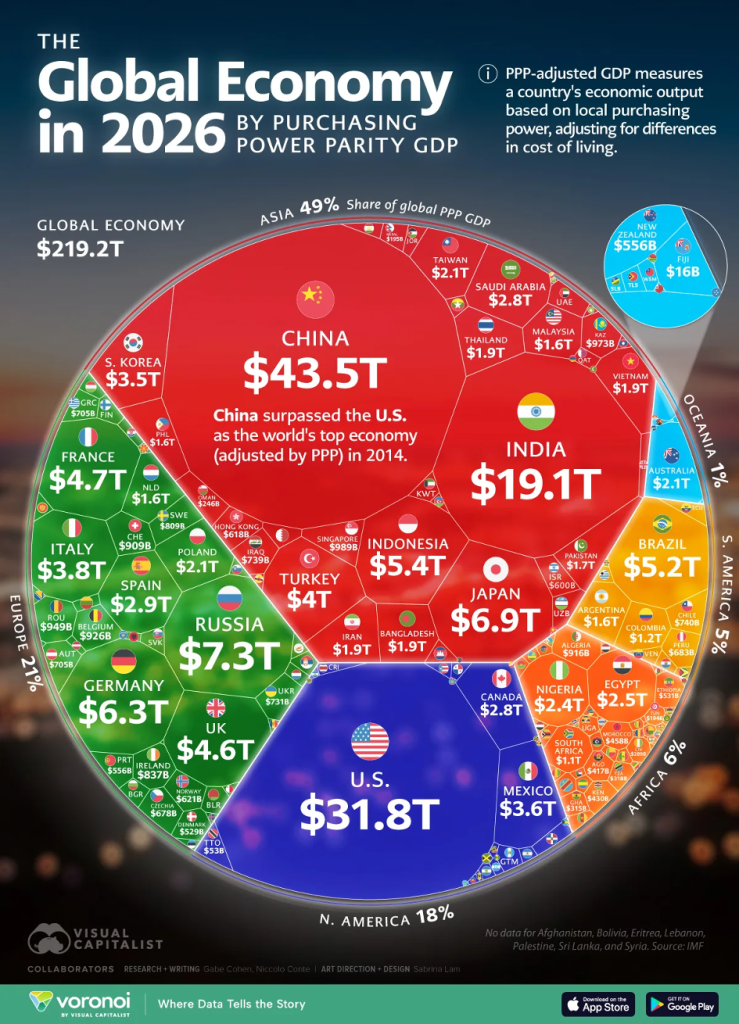
According to this calculation, China ranks ahead of the US, Russia ahead of Japan, and Germany.
Furthermore, the Collective West, as the aggressor, finds itself in a domestic political and economic situation that does not allow for a military showdown with Russia, Iran, and China: US debt stands at over 121%—the last time this was the case was at the end of World War II, following an industrial war that brought the US global dominance. After 35 years, and under economic and political conditions that remained favorable to the US, this debt was reduced to below 40%.
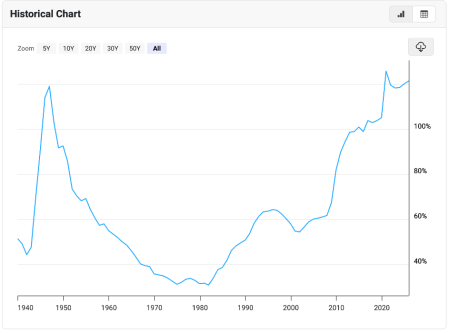
 Source: Macrotrends
In 1945, the Americans reached the height of their power. Together with the Soviet Union, they dominated the course of the war, held 22,000 metric tons of gold, and American industry produced 70% of the world’s manufactured goods. This is what true “full spectrum dominance” looks like: military dominance, industrial dominance, gold—because whoever has the gold sets the rules. Now the US is once again facing a world war, and the situation looks much like it did after the last war, with one major difference: China is at least the US’s economic equal, with far more favorable economic conditions.
These are not the conditions necessary for a military conflict on a global scale—neither financially, nor economically, nor, consequently, politically.
Middle East
It is clear from the text of the MOU that Iran has defeated both Israel and the US militarily; otherwise, the Americans would never have signed such a document. Israel cannot, without risking the collapse of its own delusions of great-power status, comply with the spirit of the document and end the war in Lebanon and Gaza. Therefore, there will be no peace.
Our comments on this topic: “Iran Defeats the US – Thoughts.” In Iran, voices are growing louder claiming that the president and foreign minister are not negotiating hard enough—public pressure in Iran is calling for a tougher stance toward the US and Israel. Iran’s Supreme Leader, Mojtaba Khamenei, has approved the memorandum of understanding (MoU) with the US to end the regional war under certain conditions. However, in a public statement, he said that he fundamentally held a “different view,” but had agreed to the agreement after receiving guarantees from President Masoud Pezeshkian that Iran’s national rights and the “Resistance Front” would be safeguarded. This is a clear indication that the Iranians are ultimately unwilling to make compromises at the expense of Lebanon and Gaza.
It is to be expected that the conflict in the Middle East will continue: Neither the US nor Israel is willing to accept defeat in the war and deal with its consequences. This stance maintains a state of limbo that could tip in one direction or the other at any moment. However, this strategy is countered by the fact that time is running out for the West because of Hormuz. The dwindling oil reserves were the main reason the US signed this MOU in its current form in the first place. The Americans are thus seeking a state of limbo that allows them to prepare their next military steps in peace; however, this state can only be maintained if the Strait of Hormuz remains open in the meantime. While approximately 130 ships passed through the Strait of Hormuz daily until February 28, 2026, these numbers dropped to practically zero, then stabilized at 5%–10% of pre-war levels, before surging to 70 ships on June 25, 2026. These figures should be treated with caution: It is said that the majority of these 70 ships were exporting oil from Iran after the US lifted the oil sanctions upon signing the agreement. If the Israelis do not withdraw from Lebanon and the Iranians remain steadfast—which is to be expected—then the Strait of Hormuz will remain a congested bottleneck: the time bomb for the West’s supply of raw materials continues to tick.
The Iranians can wait—the Americans cannot. When assessing the situation, one should simply disregard Donald Trump’s statements, because Trump speaks of peace one moment and war the next, changing his mind sometimes several times a day. He seems to believe that he can achieve something with the Iranians through this “New York-style deal-making” terror, but that is not the case, since he achieves only one thing: Americans are increasingly proving themselves to be agreement incapable, thereby threatening world peace.
War in Europe
The armed conflict in Ukraine, instigated by the West, began in 2014. Only those who do not classify Ukraine’s years-long artillery shelling of the Donbass as an act of war claim that the Russians started the war in February 2022. This is just one fact that is so obvious that one can only wonder at the West’s arguments that Russia is the aggressor.
Another fact is that this war has completely transformed the technology and tactics of warfare—the parties had to adapt to a new kind of war dominated by drones and missiles. Tank columns and troop concentrations are attacked by inexpensive drones as soon as they are detected—and they are detected very quickly. The warring parties had to undergo migration and learn this new art of warfare. The Russians, in particular, have done this successfully and now dominate the battlefield in a new way: through slow, efficient advances, because massed attacks produce only one thing—heavy casualties. Similar waves of technological advancement have occurred time and again. The machine gun, which was already in use before World War I but whose significance was underestimated at the time, brought an end to maneuver warfare as early as the first year of the war, when large columns of soldiers advanced toward the enemy and were wiped out. Toward the end of World War I, the tank brought some movement back to the front lines. However, comparing the frontline situation in Ukraine to that of World War I is a flawed analogy: Slow movements in small groups seem, so far, to be the only way to survive the drone barrage and maintain mobility.
Recently, Western media have been reporting that the Ukrainians have the upper hand in the war. However, this is fake news that has nothing to do with the reality on the ground. One must distinguish between the fighting on the front lines and NATO’s drone attacks in Russia. On the Donbass front, only a few fortified cities still stand in the Russians’ way; once those are taken, the Donbass will be liberated. Beyond that, there are no longer any fortifications worth taking seriously. Rather than going into details, I refer you to one of the best channels, Military Summary, which has been providing a twice-daily update on the situation at the front since the war began.
The West has not yet recognized the signs of the times. Its experts believe they will be successful in a war against Russia. However, they have not even defined their war aims in any way. Thus, they have no strategic plan against Russia other than to weaken it.
First and foremost, the Germans set the start of the war against Russia for 2030. However, it is now 2026, and the Germans apparently assume that, with Ukraine acting as their proxy, they can send drones and cruise missiles into Russia with impunity until 2030. Europe’s approach is, of course, coordinated with the US. The use of these weapons systems is not possible without American input. President Putin made this very clear a few days ago.
Many observers and experts both inside and outside Russia believe that President Putin will soon decide to launch a strike against targets in Europe—including those outside Ukraine.
There is a wide range of opinions on this topic. We have already published several articles on this subject: In “Will 1914 Repeat Itself? Will War Between Europe and Russia Finally Break Out?,” we also examined the Karaganov Doctrine, which advocates the use of nuclear weapons, and concluded that an attack is necessary, but not with nuclear weapons. Scott Ritter subsequently addressed the “Karaganov fallacy” and also spoke out clearly against the use of nuclear weapons.
Conclusion
In the Middle East, I see no realistic chance of ending the war, because that would mean, on the one hand, the withdrawal of American forces, and Israel would then be left alone as a small, genocidal aggressor. The Israelis are under pressure and are continuing their genocide in Gaza and Lebanon, paying no heed whatsoever to agreements between the US and Iran, because for Netanyahu personally, maintaining the war is the only way to survive politically.
In Russia, pressure is mounting on President Putin to adopt a more aggressive stance toward Europe, which is no longer even attempting to conceal its direct involvement in the war against Russia. Russia is intensifying its attacks on Ukraine, in part by destroying every gas station in eastern Ukraine to paralyze transportation logistics. Ground forces are making visible progress, and once the last fortified cities in the Donbas are liberated—which is likely to happen within the next few weeks—the path to the Dnieper will be clear.
President Putin is thus banking on a military solution in Ukraine and waiting for an energy crisis to unfold in Europe, where many flights are already being canceled under flimsy pretexts.
The concerted media coverage in the West claiming that the tide has turned in Ukraine finds not the slightest confirmation in the reality on the ground in Ukraine. The fuel shortage in Russia is also being exaggerated. In some regions, fuel is being rationed at gas stations. However, this is in no way sufficient to change Russia’s course of action.
Very occasionally, I have the opportunity to speak with someone who lives in Kyiv. According to this person, the situation is catastrophic, and over 90% of the population is against Zelensky. When I asked why the people weren’t rising up, the source replied that people were so intimidated by the terror of the security and intelligence services that the communication necessary for an uprising was impossible. Ukraine, which is portrayed by the West as a shining example of democracy, seems to be a time bomb whose ticking goes unheard out of fear.
My concerns that a war between Europe and Russia might break out—even though Europe has virtually no military power—have never been greater. President Putin will not be the one to take the first step toward a Third World War. Only he knows how much longer he will tolerate the West’s systematic provocations and how he will respond to them.
International Solidarity Movement | July 5, 2026
A family – displaced from Khirbet Samra in July 2025 after years of constant harassment by occupation forces and violent settler Uri Cohen – moved to Atouf, where they purchased a plot of land, determined to defy the occupation’s efforts to destroy their livelihood.
Having to leave their home of more than 20 years was both deeply traumatic and hugely expensive. The 40 dunams in Atouf cost half a million shekels (about 160,000 USD) and transportation costs for all their livestock and belongings were high. Atouf is a primarily agricultural area and there is little grazing land; the family is therefore forced to feed their animals grain and hay. They have also had to spend 150,000 shekels (50,000 USD) on building pens spacious enough to protect their sheep from the heat. The costs of maintaining their flock of 800 sheep have proved unsustainable, and the family has had no choice but to sell 300 of them.
In early December 2025, less than six months after their arrival in Atouf, the family received a demolition order: their property is situated on the path of “Crimson Thread”, a Zionist project that entails the construction of a 22 km long military road with an apartheid fence and a 20m wide “buffer zone” running along eitherside. Stretching from Ein Shibli to Tayasir, the barrier will cut through — and off from one another — the communities of Atouf, Tammoun and Yarza.
On the occupation’s plans, the road cuts almost exactly through the middle of the family property; 36 dunums have already been confiscated, and in January 2026 demolition orders were issued for the remaining 4 dunums, which include the family’s house and the sheep pens.
The family, together with other families and the Tubas municipality appealed the demolition orders, submitting the landowners’ deeds, and the barrier project was temporarily suspended. But then, on June 7, the Israeli court ruled that in 5 of the 7 areas impacted by the project the excavation work could continue (the two sections in which the suspension order still applies are those in the vicinity of Khirbet Yarza). Building demolitions (32 across five sections, 9 of which are residential structures) are still under discussion in court.
Since June 13, the family have had to endure the constant presence of soldiers and bulldozers on their property. The military have installed caravans and tents and dug a trench between the 36 confiscated dunums and the family’s home and pens. Now, the bulldozers are at work preparing for the construction of the barrier; the digging has destroyed the pipes that transport water to the family’s crops and livestock. When a family member went to get water from a well that is situated on the family’s land he was accused by the occupation forces of stealing water.
The family, together with the whole community of Atouf and all the Palestinian villages threatened by “Crimson Thread” are calling for international media and institutional attention in order to expose the brutality of this project which is intended to bisect the Jordan Valley, further isolating Palestinian communities from one another and dramatically worsening their conditions of life.
“during the day they carry out cutting, bulldozing, and destruction works, while at night they fire burning illumination flares over the area. These are dropped near the livestock shelters, creating constant fear, as we worry they might fall onto animal fodder or plastic greenhouses and set everything on fire.” – a family member
or go to
Aletho News Archives – Video-Images
By Donald Neff | Washington Report On Middle East Affairs | January 1996
On January 4, 1948, Jewish terrorists drove a truck loaded with explosives into the center of the all Arab city of Jaffa and detonated it, killing 26 and wounding around 100 Palestinian men, women and children.[1] The attack was the work of the Irgun Zvai Leumi – the “National Military Organization,” also known by the Hebrew letters Etzel – the largest Jewish terrorist group in Palestine. The Irgun was headed by Revisionist Zionist Menachem Begin and had been killing and maiming Arabs, Britons and even Jews for the previous ten years in its efforts to establish a Jewish state.
This terror campaign meant that at the core of Revisionist Zionism there existed a philosophical embrace of violence. … continue
 Aletho News If Americans Knew No Tricks Zone
