The Middle East is wringing its hands of Washington. Finally
By Martin Jay | Strategic Culture Foundation | June 25, 2026
The unintended consequences of Trump’s Iran Deal are too many to list. Chief among them is that Trump’s own buffoonery has injected cash and power into the regime in Iran that it could only have previously dreamt of. But the “unconditional surrender” deal has also probably destroyed the petrodollar – leading, most likely, to a faster demise of the US as what was once called a “superpower”, or even sometimes the superpower. Trump’s idiotic outburst of “unconditional surrender” is, of course, the greatest irony of the entire fiasco, given that it is Trump who is on his knees and has given Iran so much simply to open the Straits of Hormuz, simply to bring down the global price of oil.
Yet what happens now in the region, both to Israel and the GCC countries? For Israel, many leading commentators like Alistair Crooke claim that its people are in a state of shock and that it will take some time before they wake up after the party the night before and realise that things got a little out of hand and that a certain process of cleaning up and repair needs to take place. Crooke and others even go further and believe that Israel can no longer continue to indulge itself in the delusional notion of ’Greater Israel’ – i.e. having regional ambitions of hegemony beyond its borders – and needs to recalibrate its goals, starting with the admission that it is not winning its war with Hezbollah in Lebanon. There is a general consensus among analysts that most Israelis are in a state of shock about how the war in Iran was lost, how America itself didn’t and couldn’t deliver on its military promises, and how even the IDF is no match for Hezbollah. This will take some time for them to sink in – that Israel has simply overstretched itself both politically and militarily, and that the reality is that it is in a deep hole and perhaps a solution might be to stop digging.
But a period of sombreness and solace is hardly what Netanyahu has in mind, and it is likely now that he will become a silent enemy of Trump, who needs him to stop fighting in Lebanon. This relationship between Washington and Israel will also come under strain and enter a new period of saliency, which might briefly mean Congress voting to withhold Israel’s funding, to remind Bibi and his coalition partners who really is the superpower (to coin Bill Clinton’s comment once in the White House when Bibi attended a press conference).
What is perhaps even more worrying is the region and how America now retreats. It is inconceivable that US forces will return to the dozen or so military bases in the Gulf, as it is unthinkable that those elites will keep the cash flowing into Wall Street. Indeed, a bundle of $3 trillion USD which Saudi Arabia and the UAE had earmarked for the US AI sector will now not make it, as those countries no longer have the cash flow in their economies, with hotels in Dubai only catering to about 10 percent capacity. Trump’s war literally sent missiles to these new economies, and the Donald cannot complain now that this cash will not make it to the US.
Yet remarkably, Trump is still dreaming. He is still delusional about who he is and what America currently is, and seems to be stuck with his own ideas which feel like they’re from the 1970s rather than 2026. What we are witnessing in the Middle East is the beginning of the end. The loss of the petrodollar and the GCC countries with their fast cash feels like the first domino falling for the old empire, while Trump obsesses with tiny minutiae details which take up time posting on social media late at night. In the last days of the Roman Empire, its emperor was said to have been concerned about “Rome” – but this was not a reference to a crumbling civilisation, but to his pet chicken of the same name. When we see the puerile, juvenile row between the diminutive Georgia Meloni and Trump, there is a sense of déjà vu with Rome. A row on X which Meloni keeps alive for days might be seen as incongruous to the bigger picture of the US and EU falling into the abyss, with the EU being such a dog’s breakfast that even bankrupt Britain wouldn’t even want to re-join it now, despite most Brits in polls conceding Brexit was a failure.
The recent comments by the Saudi foreign minister might signal that KSA and the UAE are looking for a completely different defence set-up which might actually bypass the US altogether. Other countries like Turkey, Pakistan and Egypt are stepping forward and taking on the challenge by themselves, while leading the anti-Israel doctrine. It is rumoured that Bibi complained to Trump recently about Turkey’s tough talking, but Trump told him to forget about even thinking about hitting the NATO country, as it is simply out of Israel’s league – or words to that effect. But Turkey is the new enemy of Israel. That ball has been rolling for some time.
Israel Declares 464 Dunams in Sinjil as “State Land”
IMEMC | June 25, 2026
Israeli occupation authorities have declared 464.4 dunams of Palestinian land belonging to the town of Sinjil, north of Ramallah in the central occupied West Bank, as so-called “State Land,” paving the way for direct colonial expansion.
The Wall and Colonization Resistance Commission said Wednesday that the declaration reflects an escalation in Israeli policies aimed at consolidating colonial control over Palestinian territory.
The declaration targets the area where the illegal colonial outpost of Givat Haro’eh—renamed by Israeli authorities as Karmi Oz—was established in 1998.
On December 11, 2025, the Israeli government decided to retroactively legalize the outpost and convert it into a “recognized settlement.”
According to the Commission, the “State Land” declaration covers the entire area occupied by the outpost, which lies between the settlements of Shilo to the east and Ma’ale Levona to the west, on both sides of Route 60.
The move creates a continuous geographic link among parts of the expanding Shilo bloc, forming a new colonial corridor that connects the outpost to surrounding settlements and strengthens Israeli control over large areas of Palestinian land in the region.
The Commission said such declarations are a central tool of Israel’s colonialist project, used to dispossess Palestinians, reshape the geography of the occupied West Bank, and prepare the ground for further settlement expansion and de facto annexation.
Israel has used “State Land” declarations since the early 1980s as a primary mechanism to seize Palestinian land in the occupied West Bank.
Under this policy, vast areas—often privately owned or used by Palestinian communities for agriculture—are reclassified as state property based on Israeli interpretations of Ottoman land laws.
Once declared as “State Land,” these areas are allocated almost exclusively for Israeli settlements or infrastructure serving them.
Human rights organizations and United Nations bodies have repeatedly stated that such measures violate international law, which prohibits an occupying power from confiscating occupied land for the benefit of its own civilian population.
House to vote on proposal ending $3.3bln in military aid to ‘Israel’
Al Mayadeen | June 25, 2026
A rare House vote on US military assistance to “Israel” is expected to force lawmakers to publicly defend or reject continued funding for the Israeli military, amid growing domestic debate over Washington’s role in the region.
A report by Responsible Statecraft stated on Wednesday that the proposal, introduced by Representative Thomas Massie, would remove $3.3 billion allocated to the Israeli military from federal spending legislation. Although the amendment faces long odds in the Republican-controlled House, the vote is expected to serve as a measure of congressional willingness to reassess one of Washington’s longest-standing foreign aid commitments.
The amendment targets funding contained in the National Security, Department of State, and Related Programs Appropriations Act, which finances State Department operations, international assistance programs, and foreign military support.
Massie amendment reflects shifting political landscape
The vote comes amid increasing public scrutiny of unconditional US military support for “Israel”, particularly following the wars on Iran and Lebanon and Washington’s involvement in the negotiating process with Iran.
Tehran and Washington inked a series of ceasefire deals, which called for the total cessation of fighting across West Asia, but “Israel” continued to break the deals by continuing to launch attacks on Lebanon.
Supporters of the amendment argue that the measure reflects growing voter skepticism regarding the strategic costs and political consequences of continued military assistance.
According to the report, recent polling has indicated a notable shift in public attitudes toward US policy. Surveys have found increasing concern among both Democrats and younger Republicans regarding the scale of military aid provided to “Israel”, while criticism of Washington’s regional alignment has become more visible across the political spectrum.
The vote will provide one of the clearest indicators yet of whether these changing public attitudes are beginning to influence congressional decision-making.
Critics question strategic rationale for continued aid
Opponents of unconditional military assistance have increasingly challenged long-standing arguments used to justify the aid package.
Among the issues raised are concerns over the war on Gaza, attacks across the region, and the broader consequences of US support for Israeli military operations. Critics argue that continued assistance, regardless of regional developments, reduces Washington’s leverage and contributes to instability.
The report adds that questions have also been raised regarding the claim that “Israel” remains heavily dependent on US military support. The country has expanded its defense exports significantly in recent years, becoming one of the world’s largest arms exporters and reporting record defense sales.
Supporters of reducing aid contend that these developments undermine arguments that “Israel” requires substantial annual US military assistance to maintain its security capabilities.
Funding debate extends beyond current vote
The congressional battle over aid is taking place alongside a broader legislative effort that could alter how future military support is approved.
Lawmakers, including Massie and Representative Ro Khanna, have opposed provisions that would shift certain forms of military assistance away from direct appropriations and toward defense procurement mechanisms. Critics argue that such changes would reduce congressional oversight and make future funding less vulnerable to political opposition.
The dispute reflects growing concern among opponents of military aid that public opinion is moving faster than congressional policy, prompting efforts to insulate funding streams from future political challenges.
While the amendment is unlikely to secure enough votes for passage, observers view the vote itself as politically significant, particularly as lawmakers increasingly face questions from constituents regarding US military commitments abroad.
The Illusions of Western Virtue: Ursula von der Leyen and Europe’s Moral Bankruptcy

By Ramzy Baroud | MEMO | June 24, 2026
European Commission President Ursula von der Leyen has every right to condition European relations with any other country or bloc on respect for human rights. That, of course, would hold true if she genuinely cared about such values herself.
In response to the June 19 signing of the memorandum of understanding between the United States and Iran—intended to bring an end to a destructive war—von der Leyen declared that the European Union does not intend to lift its sanctions on Tehran.
Speaking on June 15, ahead of the G7 summit, she firmly conditioned any diplomatic thawing on domestic changes within the Islamic Republic.
“The principle of sanctions is that we need real change on the ground before we can think about lifting them,” she stated, adding: “As long as there is no behavioral change, you cannot lift the sanctions because of human rights violations.”
Viewed in isolation, the European position might appear principled, even commendable. In its broader geopolitical context, however, it exposes a staggering level of hypocrisy.
On that very same day, the European Union’s duplicity was laid bare. During a Foreign Affairs Council meeting in Luxembourg, Europe effectively refused to take a unified stand on imposing trade sanctions on Israel, despite its ongoing genocide in the Gaza Strip and unchecked colonial violence and expansionist policies in the occupied West Bank.
The discussion itself would not have taken place had it not been for the persistent efforts of Spain and Ireland, which have repeatedly urged the bloc to suspend the EU-Israel Association Agreement over Israel’s flagrant violations of international law.
The initiative failed because the EU remains deeply divided, constrained by the requirement of unanimity on foreign policy and repeatedly blocked by pro-Israel governments.
While Europe continues to engage Israel—providing Israeli Prime Minister Benjamin Netanyahu and his extremist coalition with desperately needed political and economic lifelines—the European public has increasingly moved in the opposite direction.
Recent polling across numerous countries has revealed growing opposition to Israel’s war and genocide in Gaza and increasing support for Palestinian rights. Across Europe, mass demonstrations, consumer boycotts, campus mobilizations, and divestment campaigns have reflected a widening gap between public opinion and official policy.
This reality appears entirely irrelevant to von der Leyen, who remains preoccupied with the human rights records of states viewed as Western adversaries. Such concern is not motivated by solidarity with victims, but by the desire to maintain political leverage that can be invoked when convenient and ignored when necessary.
Lest we forget, von der Leyen was among the first Western leaders to visit Israel following the events of October 7, arriving in Tel Aviv on October 13, 2023. Standing alongside Israeli leaders, she offered unconditional backing, declaring that “Europe stands with Israel.” She did so as Palestinians in Gaza were already being subjected to a devastating military assault that would soon claim tens of thousands of lives.
Although her rhetoric became somewhat more cautious as international legal institutions began investigating Israel for genocide and pursuing war crimes cases against its leaders, her fundamental political alignment never truly changed.
For anyone to believe that von der Leyen has suddenly discovered that human rights should occupy center stage in any responsible foreign policy is simply delusional. This is especially true given how restrained she remained, both in language and action, as the US-Israeli war on Iran expanded into a regional catastrophe that should never have been allowed to unfold.
None of that matters to von der Leyen, of course, since such immense human suffering does not neatly fit within her geopolitical priorities.
It is tempting to conclude that, for von der Leyen and many Western leaders, some human rights matter more than others. Yet even that assessment grants too much credibility to their position, because it assumes that human rights are the actual basis of policy. More often than not, they are merely invoked when politically convenient.
Even the Catholic Church appears to be moving away from this selective moral framework. Since his election in May 2025, Pope Leo XIV has repeatedly emphasized a vision of “just peace” over the traditional doctrine of “just war,” warning against the use of moral and religious language to legitimize military aggression. During his Palm Sunday homily earlier this 2026, he stressed that “God rejects the prayers of those who wage war,” a direct challenge to the normalization of violence by political leaders.
But von der Leyen cannot help herself. The instrumentalization of human rights has long been a staple of Western foreign policy, despite mounting evidence that such commitments are rarely applied consistently. In that sense, Europe appears increasingly bankrupt—not only morally, but politically as well.
The war involving Iran, the subsequent US-Iran agreement, and the major geopolitical shifts surrounding both unfolded largely without meaningful European involvement. Reduced to the role of spectator—or occasional cheerleader—the EU exerted little influence over events, underscoring its diminishing relevance in Middle Eastern and global affairs.
This helps explain why von der Leyen resorted to familiar rhetoric about human rights in Iran while remaining largely silent on Israel’s devastating actions in Palestine, Lebanon, Syria, and elsewhere in the region. With Europe’s influence steadily shrinking, moral posturing has become a substitute for meaningful diplomacy.
Will the EU continue along this path of growing irrelevance, or will it finally heed the views of its own citizens, challenge Israel’s impunity, and pursue a foreign policy genuinely independent of Washington? The answer may determine whether Europe can reclaim political relevance—or continue its slide into long-term decline.
AIPAC-backed candidates lose New York primaries as voters reject pro-genocide lobby
The Cradle | June 24, 2026
Progressive candidates in New York secured significant victories on 23 June, defeating pro-Israel incumbents in congressional primaries that marked a “huge hit” for the American Israel Public Affairs Committee (AIPAC).
Brad Lander, a former city comptroller, unseated Rep. Dan Goldman in a contest defined by disagreements over Israel’s military actions. Lander, describing himself as a so-called “liberal Zionist,” rebukes Goldman for his refusal to label the Israeli assault on Gaza as a genocide or support measures blocking arms sales to Israel.
The progressive surge continued as democratic socialist Darializa Avila Chevalier toppled Rep. Adriano Espaillat.
Her campaign focused on Espaillat’s acceptance of donations from the pro-Israel lobbying group, AIPAC.
Meanwhile, state lawmaker Claire Valdez is poised to replace retiring Rep. Nydia Velazquez after criticizing her opponent’s delay in using the term “genocide” and highlighting ties to AIPAC-affiliated groups.
These victories, bolstered by the influence of Mayor Zohran Mamdani, the first Muslim mayor of New York City, suggest that a critical stance against Israel and its influence over US local and international politics is now a political asset in itself.
Accepting AIPAC funds has increasingly become a litmus test for US voters weighing a candidate’s loyalty to the US over a foreign lobby.
Longtime strategist Jon Paul Lupo told POLITICO that voters opposing the Gaza war held a “massive political advantage” this cycle.
In his victory speech, Lander condemned the former US president Joe Biden’s “hug Bibi” strategy, calling it a “catastrophic mistake.” He stated, “I believe it made us complicit in genocide. Bombs we paid for killed more than 70,000 Palestinians – most of them women and children.”
Though AIPAC-funded candidates have found success elsewhere – such as when republican lawmaker Thomas Massie was defeated on 19 May by AIPAC-funded Ed Gallrein following the most expensive primary elections in history – US sentiment towards Israel has been on a sharp downturn since the genocide in Gaza was launched.
A poll by the Pew Research Center released in April reveals that 60 percent of US citizens now view Israel unfavorably, with “very unfavorable” sentiment nearly tripling since 2022.
A separate poll by Gallup in February found that, for the first time in US history, more US citizens sympathize with Palestinians (41 percent) than with Israelis (36 percent), a shift that occurred after years of witnessing Israeli war crimes and ongoing genocide in Gaza.
UK suppressed intel on Sudan genocide to protect UAE ties: Report
Press TV – June 24, 2026
UK authorities have suppressed key intelligence and failed to act on warnings about atrocities in Sudan to preserve diplomatic and economic ties with the United Arab Emirates (UAE), according to testimony presented to lawmakers.
During a hearing of the UK Parliament’s International Development Committee on Tuesday, Nathaniel Raymond, director of Yale University’s Humanitarian Research Lab, said the Foreign, Commonwealth and Development Office (FCDO) ignored repeated warnings before the so-called Rapid Support Forces (RSF) captured El-Fasher in October 2025.
Raymond told lawmakers that the assault was followed by a massacre that claimed at least 60,000 civilian lives.
He said British policymakers placed strategic ties with the UAE above efforts to prevent starvation, displacement, and mass killings in Sudan.
Evidence presented during the hearing included mobile phone tracking data linking Addis Ababa, Abu Dhabi, and RSF-controlled territory.
According to Raymond, the information pointed to a covert weapons supply network supporting the militant group.
While the UAE and Ethiopia have denied supporting the RSF, Raymond said pressure from Abu Dhabi influenced the UK’s response.
He also stated that UK officials asked his research team in May 2024 to release sensitive tracking data publicly because the government was unwilling to challenge the UAE directly.
Raymond described a missed opportunity after the adoption of UN Security Council Resolution 2736, when RSF operations reportedly paused while international reactions were assessed.
“Once the UAE assessed there would be no consequences, the attack resumed,” Raymond told the committee.
Decisions made by successive British governments, including those led by former Prime Ministers Rishi Sunak and Keir Starmer, contributed to a failure to prevent further bloodshed, he said.
A BBC report published in April linked the UAE to a network of Colombian mercenaries known as the “Desert Wolves,” who provided drone and artillery support to the RSF during the battle for El-Fasher.
Conflict Insights Group director Justin Lynch said, “The scale of atrocities and siege in El-Fasher would not have happened without the drone operations the mercenaries provided.”
Satellite imagery analyzed by Yale researchers after the city’s fall showed evidence consistent with mass casualties, while the United Nations later said the violence bore “hallmarks of genocide.”
UN inquiry finds Israel ‘intentionally’ targeting Palestinian children in Gaza, occupied West Bank

The Cradle | June 23, 2026
A report issued by the UN Independent International Commission of Inquiry on the Occupied Palestinian Territory on 23 June found that Israeli troops are deliberately targeting Palestinian children in Gaza and the occupied West Bank as a central element of their ethnic cleansing campaign.
“The evidence shows that Palestinian children have been deliberately targeted and killed by the Israeli security forces,” said Srinivasan Muralidhar, chair of the commission.
He added, “Even after the October 2025 ceasefire, children continue to be killed and seriously injured, with continued disregard by Israel for the ceasefire and for the protection owed to Palestinian children under international law.”
The independent commission noted that the systematic targeting of Palestinian children by Israeli forces has inflicted profound, irreversible devastation.
These deliberate atrocities are characterized by mass trauma, physical disability, starvation, and the deliberate destruction of healthcare, education, and maternity services, including the dismantling of orphanages.
Beyond the immediate violence, children face arbitrary detention, torture, and sexual violence, all of which are utilized to erode the foundational structure of Palestinian society.
This intergenerational assault aims to dismantle the demographic vitality of the Palestinian people, creating an “occupied psyche” that strips children of their safety, development, and hope for a future.
Doctors from various international backgrounds have provided detailed accounts of treating Palestinian children who were deliberately targeted by Israeli snipers, describing a “steady stream” of non-combatants with single, high-caliber gunshot wounds specifically to the head or chest.
The inquiry found that children accounted for roughly 30 percent of all those killed during the genocide in Gaza.
The figure, however, likely underestimates the actual toll, as thousands remain buried under an estimated 61 million tons of debris.
While the Gaza Health Ministry has officially recorded approximately 72,000 deaths, experts believe between 10,000 and 14,000 additional bodies are trapped beneath the ruins of homes, schools, and hospitals.
Independent research teams suggest the total death toll, when accounting for the indirect effects of infrastructure collapse, malnutrition, and disease, may exceed 600,000.
Recovery efforts in Gaza are being systematically obstructed by a blockade on essential heavy machinery and forensic supplies.
Evidence of explicit “shoot to kill” military directives suggests that the high civilian death toll is a result of calculated and indiscriminate lethal force.
Israeli soldiers have testified to receiving orders to kill any male encountered, regardless of age or whether the individual was armed, and in some instances shot while waving white flags and shirtless.
‘Israel not party to US-Iran talks, will continue full operations in Lebanon,’ Israeli far-right minister says
MEMO | June 23, 2026
Israel is not part of the negotiations between the US and Iran and will continue its offensive on Lebanon until Hezbollah is “fully dismantled,” not just disarmed, Israeli Finance Minister Bezalel Smotrich said.
Smotrich, a far-right extremist member of Israel’s security cabinet, made the remarks Tuesday morning in an interview with Israeli Army Radio.
“Israel is not part of the negotiating talks with Iran by choice,” he said, adding: “We will not hold talks with the devil.”
“We are not a party to the negotiations between the United States and Iran, and they do not concern us at all,” Smotrich said.
“We will continue operating in Lebanon fully,” he added.
“The Israeli army will not withdraw from the security zone in Lebanon, including the Beaufort Castle, as long as Hezbollah exists,” he said.
“We will not withdraw not only until Hezbollah gives up its weapons, but until it is fully dismantled,” he continued.
“We do not only want Hezbollah to be stripped of its weapons, but to be fully dismantled, not be part of the government in Lebanon, and not have any military force that threatens Israel,” he said.
The remarks come amid growing disputes within Israeli political and security circles over a memorandum of understanding between the US and Iran and their possible implications for ending the war on the Lebanese front.
On Monday, Israeli Prime Minister Benjamin Netanyahu, Defense Minister Israel Katz and army chief Eyal Zamir vowed in a joint statement to continue controlling the “security zone” in southern Lebanon, despite the memorandum of understanding signed between the US and Iran, which calls for respecting Lebanon’s unity and territorial integrity.
“The [army] will continue to act decisively to thwart threats to our soldiers and civilians, destroy terror infrastructure, and continue maintaining the security zone in southern Lebanon,” according to the statement.
“The security of Israel’s civilians and IDF troops will continue to remain before their eyes without compromise,” it added.
Israel received a message from the US in recent weeks that “the previous authorization for unrestricted action in Lebanon had expired,” Israel’s Channel 13 quoted an unnamed senior Israeli official Monday.
The Hebrew newspaper Maariv also reported Monday that there are differences between the US and Israel over the Lebanon file.
It also reported growing differences between the US and Israel over the Lebanese file, saying Washington views southern Lebanon within a broader regional framework linked to the Strait of Hormuz, energy prices, the Iranian nuclear issue and the Trump administration’s pursuit of a diplomatic achievement.
In contrast, Israel believes that any early withdrawal from southern Lebanon could be interpreted as a sign of weakness and a reward for the Hezbollah group.
Israel and Lebanon are set to hold a fifth round of direct negotiations in Washington on Tuesday. The upcoming talks follow four previous rounds between the two sides that began in April as part of a track aimed at ending the Israeli war in Lebanon.
The US-mediated negotiations come as criticism grows inside Israel over Washington handling of talks with Iran and Hezbollah.
Israeli news site i24NEWS, citing Israeli officials, said Tel Aviv fears that an agreement between the US and Iran could strengthen Tehran and its allies in the region.
Israeli attacks in Lebanon have killed more than 4,100 people and injured over 12,000 others since March 2, according to official Lebanese figures.
Israel continues to occupy areas in southern Lebanon, some held for decades and others seized during the 2023–2024 war.
Two killed in brazen Israeli ceasefire violation in southern Lebanon
Al Mayadeen | June 23, 2026
Two people were killed and a third was injured on Tuesday by gunfire from Israeli forces in southern Lebanon, according to the official National News Agency (NNA).
In detail, the NNA reported that two young men were martyred and a third was wounded when Israeli army soldiers opened machine-gun fire toward them near a bulldozer working to open a road in the Deir neighborhood of the town of al-Nabatieh al-Fawqa.
This marks the first Israeli violation of the ceasefire that results in casualties since it was announced on Sunday, amid the memorandum of understanding between Iran and the US, with Article 1 explicitly stipulating an end to Israeli attacks on Lebanon and the full withdrawal of Israeli troops.
Separately, Israeli occupation forces carried out a drone strike on the town of Kfar Tibnit in the Nabatieh district, while also dropping sound bombs over the town, according to local sources.
In the Bint Jbeil district, an Israeli drone dropped two sound bombs in the towns of Baraachit and Ayta al-Jabal, while in the town of Hadatha, Israeli forces set fires at its outskirts before withdrawing toward the town square.
Ceasefire comes as Iran demands adherence
Continued pressure from the Iranian negotiating delegation since Saturday afternoon has contributed to maintaining a fragile ceasefire in Lebanon for the time being. This came after Iran closed the Strait of Hormuz in response to continued Israeli attacks and massacres in South Lebanon, which breached the provisions of the memorandum signed with the United States.
Meanwhile, a source close to the White House was quoted as saying that an American request for Israeli troop withdrawal from southern Lebanon is “only a matter of time,” warning that such a move would present “extreme difficulty” for Netanyahu and his government.
Currently, the Israeli occupation is considering announcing limited withdrawals from parts of Lebanese territory it occupies, a source familiar with the discussions told CNN.
The reported proposal would involve what the source described as “symbolic” redeployments from minor positions beyond the so-called “Yellow Line”, an area of land within Lebanese territory that “Israel” occupied after the November 2024 ceasefire with Lebanon, and which “Israel” has repeatedly refused to surrender.
According to CNN, the proposal has been discussed ahead of three days of US-sponsored talks between Lebanese and Israeli representatives. However, the move comes as Iran has rejected moving forward with the MoU with the US unless a ceasefire is achieved in Lebanon.
Trump’s Attempt to End the Iran War Infuriates the Uniparty
By Ron Paul | June 22, 2026
Against the odds, the Memorandum of Understanding signed by the US and Iran appears to be holding, after threats and counter-threats. It may collapse, but it has survived a first round of talks between the two sides in Switzerland over the weekend.
President Trump started a war on Iran against all sober guidance and in violation of the US Constitution’s requirement that only Congress can declare war. There must be a reckoning for our elected leaders who violate their oath of office, the Constitution, and simple common sense.
However, what is more telling is the reaction when President Trump finally took the correct move and attempted to end the war. The neocons who had hailed him as a great leader – Levin, Bolton, Pompeo, etc. – suddenly turned against him when he turned against further escalation of the war.
Even Trump’s top funder, Miriam Adelson, attacked Trump in her newspaper Israel Hayom. “You could have been the greatest president of all, but you failed,” the newspaper wrote in an editorial.
Not much gratitude from the Israel-first crowd, even if the war was started to benefit Israel.
And more telling even than this was the reaction of the “opposition” party in Congress, the Democrats. They attacked him harder for ending – or at least pausing – the war more than for starting the war in the first place! Sen. Adam Schiff (D-CA) called the MOU a “capitulation.” Sen Chris Murphy (D-CT) called the MOU an “embarrassing document.” Sen. Amy Klobuchar falsely claimed that President Trump was paying Iran $300 billion to re-open Hormuz.
This is more evidence – as if any is needed – that our foreign policy is run by the “uniparty.” When it comes to wars, there is no Republican Party nor is there a Democratic Party. There is only the “yes!” party.
Congress remains silent in the run-up to war. Congress remains silent when the President launches a war. Congress even remains silent when the war begins going badly. It is only on those rare occasions that a president takes steps to correct his mistake that Congress finds its voice.
Yes, there is plenty to criticize. After weekend talks, the US side, led by Vice President JD Vance, is celebrating as a “breakthrough” that the Strait of Hormuz is open again and that Iran has reportedly agreed to the return of UN inspectors. But the Strait was open before this war and UN inspectors were in Iran before President Trump unilaterally pulled out of the JCPOA “Iran Deal” in his first term.
The only difference now is that we burned through likely several hundred billion dollars, we lost dozens of aircraft and other military equipment, and we likely lost more service members than the Pentagon is admitting.
It is a reminder of why the Founders intended to make sure that any war must be declared by the people’s Representatives before the first bullet is shot: it should be very hard to launch wars.
Nevertheless, those who are truly against the wars should, in my opinion, hold their fire for the time being in hope that a lasting resolution can be found. The President Is being attacked from all sides by the war party. Now may not be the best time for the peace party to join in.
IRAN WALKS OUT ON PEACE DEAL DUE TO TRUMP’S THREATS – w/ Prof. Seyed Mohammad Marandi
Mario Nawfal | June 21, 2026
Al-Jazeera demands punishment for Israeli officials following latest assassination of cameraman

The Cradle | June 21, 2026
Al-Jazeera Media Network condemned on 20 June Israel’s “deliberate killing” of one of its journalists in Gaza, Ahmad Washah, while calling on the international community to punish Israeli officials for this and other crimes against its media workers.
Ahmad Washah, a cameraman for Al-Jazeera Mubasher, was killed by an Israeli drone strike on a house in Al-Bureij refugee camp in central Gaza on Saturday.
He is the 12th Al-Jazeera media worker to be killed in Gaza since Israel began its genocide of Palestinians in October 2023.
The network called on “the international community and legal institutions to take urgent, practical measures to hold the Israeli officials involved in these appalling crimes accountable,” the statement added.
Washah’s brother, Mohammad, was killed in an Israeli strike just two months earlier, in April, also while working as a correspondent for Al-Jazeera Mubasher. Before Mohammed’s death, the brothers worked together as a team, with Ahmad filming for Mohammad.
“Together, they formed a media duo that documented the suffering of the Palestinian people and the unfolding events of the war,” Al-Jazeera stated.
After Mohammad’s death, Ahmad also took care of his late brother’s children.
On Saturday, the network denounced “the continuation of the crimes committed by the Israeli occupation forces against its correspondents and staff in Gaza.”
Al-Jazeera said it was determined to take all legal measures to prosecute the killers of its journalists. The Qatar-based channel stressed it will continue to cover Israel’s crimes against Palestinians in Gaza despite the Israeli army’s attempts to silence the voices of its correspondents in the enclave.
Israel has killed at least 262 journalists and media workers since the start of Israel’s genocide, according to the Gaza Government Media Office.
In August 2025, Israel killed Al-Jazeera journalist Anas al-Sharif and four of his colleagues in an airstrike in Gaza. Before his killing, Sharif became one of the most recognizable media voices from the front lines of northern Gaza.
In December 2023, his 90-year-old father was killed when an Israeli airstrike struck their family home in Jabalia. Sharif said the killing of his father came after Israeli officials threatened him by phone to cease his coverage.
Since October 2023, the ongoing war in Gaza has claimed the lives of countless other Palestinian journalists, including Al Jazeera staff members such as correspondent Ismail al-Ghoul, cameraman Samer Abu Daqqa, and correspondent Hossam Shabat, who were killed while reporting on the ground.
In May 2022, Israeli occupation forces shot dead another Al-Jazeera journalist, Shireen Abu Akleh, a US-Palestinian citizen, while she was covering an Israeli military operation in the West Bank city of Jenin.
Israel claimed she was killed by unintentional fire by its forces. However, multiple independent probes concluded that an Israeli military sniper killed her.
Israel has detained another 50 journalists since October 2023, holding them in detention facilities and prisons where torture and rape is common. Another three Palestinian journalists remain missing.
More than 420 journalists have been injured covering the genocide, which has killed 73,000 Palestinians by the most conservative estimates. Independent estimates reach into the hundreds of thousands of dead, in large part due to the direct effects of war.
Some of the wounded journalists have suffered serious injuries, leading to amputations and permanent disabilities.
Israel is waging the war in a bid to destroy Gaza and forcibly expel its roughly 2 million Palestinians. Israeli political and religious leaders wish to annex the strip to build Jewish settlements on the ruins of Palestinian cities and villages.
Featured Video
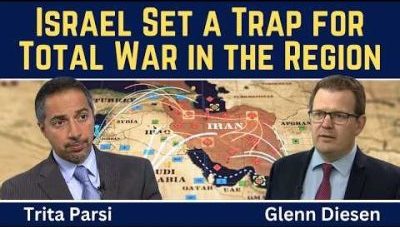
Trita Parsi: Israel Set a Trap for Total War in the Region
or go to
Aletho News Archives – Video-Images
From the Archive
Zionism’s Violent Legacy
By Donald Neff | Washington Report On Middle East Affairs | January 1996
On January 4, 1948, Jewish terrorists drove a truck loaded with explosives into the center of the all Arab city of Jaffa and detonated it, killing 26 and wounding around 100 Palestinian men, women and children.[1] The attack was the work of the Irgun Zvai Leumi – the “National Military Organization,” also known by the Hebrew letters Etzel – the largest Jewish terrorist group in Palestine. The Irgun was headed by Revisionist Zionist Menachem Begin and had been killing and maiming Arabs, Britons and even Jews for the previous ten years in its efforts to establish a Jewish state.
This terror campaign meant that at the core of Revisionist Zionism there existed a philosophical embrace of violence. … continue
Blog Roll
 Aletho News
- Trita Parsi: Israel Set a Trap for Total War in the Region
- Trump’s Iran war is on an Israeli leash
- Saudi oil boss issues global supply warning
- Riyadh Says Its Oil System Is Intact. The Numbers Say Otherwise.
- Trump and Netanyahu Want to “Finish the Job” on Iran
- US ‘one-sided dictation’ not Iran’s beliefs makes rational talks impossible: Baghaei
- Iran’s Next Strike May Not Explode. It Could Shut You Down /Col Doug Macgregor
- Iran: US political targets legitimate if assassinations return
- Iraq shuts key border crossing with Iran under US pressure: Report
- Undersea Internet cables could be targeted in retaliation for attacks on Iran: IRGC deputy chief
- If Americans Knew
- The Israel Lobby’s Changing Fortunes
- AIPAC has become such a political liability that it’s shifting to a more “nimble” approach to buying politicians
- At least 160 Israeli settler attacks in 2 weeks
- Will Gaza’s Ancient Christian Community Disappear Forever?
- Israel’s vision of regional security rests on keeping Arab states weak
- Heidi Levine recounts how Palestinian youths helped save her in settler attack
- DAILY UPDATE: Latest essential news on Palestine, Israel, & region
- Trump’s Intensifying Sabotage of the ICC, for Israel’s Sake
- Israeli military detain US and UK volunteers in West Bank including Democratic NY politician Brad Lander
- Americans at National Conservatism Conference held in Israel this year criticize Israel
- No Tricks Zone
- E-Cars Reduce CO2 Emissions By Only 41% Compared To Internal Combustion Engine Vehicles
- Predictions Made By Renowned Climate Professor Over Past Decades Have Been Proven To Be Poor
- New Study Suggests Large Regions Of The Pacific Ocean Have Been Cooling For The Last 80 Years
- Germany’s Green Energy Debacle: High Energy Costs Force Kahla Porzellan to Close After 182 Years!
- New Study: 50 Years Of The Most Aggressive ‘Net Zero’ Policies Can Only Affect The Global Climate By 0.03°C
- US September “Heat” Was No Record…Many Records Set Decades Ago
- Latest European Green Energy Debacle; Portugal’s Largest Flagship Solar Park Insolvent!
- Green Energy Debacle: German Expert Professor Fritz Vahrenholt Warns Of Severe Economic And Social Consequences
- Two More Paleo Reconstructions Affirm Meters-Higher Sea Levels Across Ireland, Brazil 7000-6000 Years Ago
- New Study: Earth And Venus Surface Warmth Largely Explained By Convection And Lapse Rate, Not CO2 Or Radiation

