More Suggestions for Dealing with Israel
Recusal and banning dual nationality good places to start
By Philip Giraldi | Unz Review | March 2, 2021
My article last week that made some suggestions about what ordinary Americans can do to put pressure on Israel and on the lopsided bilateral relationship with Washington that has done so much damage to the United States proved to be quite popular. It also resulted in some comments by readers who saw other issues that might be considered pressure points that could be exploited to bring about change or at least to mitigate some of the damage.
 Two areas that were mentioned a number of times were the possibility of recusing the most strident Israeli partisans from some discussions on Middle East policy and also refusing to issue security clearances to American government employees and politicians who are “dual national” citizens, which raises the issue of dual loyalty. Recusal is defined as removing oneself from participation to avoid a conflict of interest due to lack of impartiality while refusing to issue clearances would completely block dual national Israeli and other foreign citizens from having high level positions in the U.S. government.
Some would argue that recusal is an excessive punishment that will limit debate on a key foreign policy issue. It will also inevitably be perceived by the usual suspects as anti-Semitic since the only ones who would be excluded would be some Zionists, but they miss the point, which is that the current system does not in any way permit the review of a range of points of view on the Middle East since it is monopolized by Jews and friends of Israel. And there is a precedent. Not so long ago the U.S. State Department had an informal policy that discouraged the selection of Jewish ambassadors for Israel. The intent was to prevent any conflicts of interest and also to protect the ambassadors from inappropriate pressure. There also existed a cadre of so-called Arabists who dealt with issues in the Middle East alongside Jewish officers in the State Department. In the 1950s and 1960s a concerted effort was made by Jewish organizations and Congress to weed out the Arabists and currently nearly all the working level handling of policy formulation for that region is being done by Jews.
One might assume reasonably that the concentration of decision making in the hands of a partisan group, whether Arabists or Zionists, would inevitably not be in the U.S. national interest, and so it has proven if one looks at the shambles in the arc from Afghanistan over to Lebanon.
The following description of how the process actually works comes from Ben Rhodes, who is himself half-Jewish, and it describes the decision making on the Middle East during the administration of President Barack Obama where Rhodes served as Deputy National Security Advisor. During his time in office he observed how same 10 to 20 individuals who invariably took the position of the Israeli government were in on discussions of Middle East policy but if anyone in the White House paid attention to Arab-American or peace groups, they could “get in trouble.”
Rhodes observed that “You meet more with outside, organized constituency groups on Israel than any other foreign policy issue. I’d actually go as far to say that… as a senior White House official working on national security… the number of people you meet from the organized pro Israel community equals all the other meetings that you might do with kind of diaspora or constituency groups on all the other issues. It’s that degree of dwarfing. I’m pretty confident that’s consistent across [presidential] administrations…
“You just have this incredibly organized pro-Israel community that is very accustomed to having access in the White House, in Congress, at the State Department. It’s taken for granted, as given, that that’s the way things are going to be done… I remember looking around the situation room on a meeting on the Israel Palestine issue and every single one of us in the meeting was Jewish or of Jewish origin like me…”
The United States has many interests in the Near East, but if every move is seen through the optic of Israel the inevitable results will not be beneficial to Americans. So, if recusal, either voluntary or forced, is employed to obtain a better mix of opinion on policy options it can only beneficial. And it will also ipso facto loosen the overweening influence that successive Israeli governments have exercised over U.S. presidents and Congress.
Preventing individuals holding two passports from obtaining sensitive government jobs would also be a highly desirable step but it will be hard to execute in practice as the Israeli government does not make available lists of American citizens who have also taken up Israeli citizenship. Holding two passports was, in fact, illegal in the United States up until 1964. New citizens were required to turn in old passports and swear loyalty to the United States. Retention of former citizenship could be punished by the loss of the American citizenship.
Numerous online lists of dual Israeli-Americans in government circulate on the internet, but it is clear from the content that most of the compilations are speculative. Senate Majority Leader Chuck Schumer describes himself as the “shomer” or protector of Israel in the Senate and appears on such lists. So too does former Congressman Tom Lantos, described as holocaust survivor and very active in his support of Israel. And then there is former Senator Frank Lautenberg was often described as the “Senator from Israel” and Senator Arlen Specter from Pennsylvania who tried to cover up the Jewish source of the enriched uranium that Israel stole to construct its nuclear weapon.
Protecting Israel sometimes includes bending the rules. Lautenberg, for example, was responsible for the “Lautenberg amendment” of 1990 which brought many thousands of Russian Jews into the United States as refugees, even though they were not in any danger and were therefore ineligible for that status. As refugees, they received significant taxpayer provided housing, subsistence and educational benefits.
One might also include Rahm Emanuel, former White House Chief of Staff and mayor of Chicago, who reportedly served as a volunteer in the Israeli Army, and Doug Feith, who caused so much mischief from his perch at the Pentagon in the lead-up to the Iraq War. Feith had a law office in Jerusalem, suggesting that he might have obtained Israeli citizenship. Obama Ambassador to Israel Daniel Shapiro chose to live in Israel after his term in office ended and wound up working for an Israeli national security think tank. He quite likely obtained Israeli citizenship and never registered under the Foreign Agents Registration Act, as required by law. Both he and Emanuel are reportedly being considered by President Biden for major ambassadorial assignments.
But in reality, few in Congress and in the federal government bureaucracy are likely to have actual Israeli citizenship even if they regularly exhibit what amounts to “dual loyalty” sympathy for the Jewish state. Nevertheless, Jews who are Zionists are vastly overrepresented in all government agencies that have anything at all to do with the Middle East.
That said, there was one individual dual national who truly stood out when it came to serving Israeli interests from inside the United States government. She might be worthy of the nickname “Queen of Sanctions” because she was the Department of the Treasury’s Under Secretary for Terrorism and Financial Intelligence (OTFI), who handed the punishment out and had her hand on the throttle to crank the pain up. She is our own, unfortunately, and also Israel’s own Sigal Pearl Mandelker, and it is wonderful to be able to say that she finally resigned in late 2019!
Mandelker was born in Israel and largely educated in the United States. She is predictably a lawyer. She has never stated how many citizenships she holds while repeated inquiries as to whether she retains her Israeli citizenship have been ignored by the Treasury Department. It is not clear how she managed to obtain a security clearance given her evident affinity to a foreign country. The position that she held until October 2019 was created in 2004 by George W. Bush and is something of a “no Gentiles need apply” fiefdom. Its officials travel regularly on the taxpayer’s dime to Israel for consultations and also collaborate with pro-Israel organizations like the American Israel Public Affairs Committee (AIPAC), the Washington Institute for Near East Policy (WINEP) and the Foundation for the Defense of Democracies (FDD). Mandelker’s predecessor was Adam Szubin and he was preceded by David Cohen and, before that, by the office’s founder Stuart Levey, who is currently Group Legal Manager and Group Managing Director for global bank HSBC. Since its creation, OFTI has not surprisingly focused on what might be described as Israel’s enemies, most notably among them being Iran.
During her time in office, Mandelker, who predictably claims to be the child of “holocaust survivors,” was clear about her role, citing her personal and business relationship with “our great partner, Israel.” Referring to her office’s imposed sanctions on Iran, she has said that “Bad actors need money to do bad things. That is why we have this massive sanctions regime … Every time we apply that pressure, that crunch on them, we deny them the ability to get that kind of revenue, we make the world a safer place.”
So the answer is pretty clearly that there are Israelis and/or dual nationals working for the federal government and possibly also ensconced in the Congress. Refusing them clearances so they would not wind up in policy making jobs would be a good step forward, particularly if it is combined with recusal from policy planning for obvious partisan representatives of organizations dedicated to protecting Israel.
As a final observation, one might only suggest three additional bastions of “Israel-first” think that need to be assailed to permit any rational discussion of an appropriate U.S. role in the Middle East. They are the deeply flawed accepted holocaust narrative, which is used to grant Israelis and Jews special exemption due to their status as perpetual victims; the cynical use of the label anti-Semitism to silence critics; and the still undisclosed role of Israel in 9/11, which has never been adequately addressed. For more information, I would refer the reader to Norman Finkelstein’s The Holocaust Industry, Ron Unz’s American Pravda piece on Mossad Assassinations and Justin Raimondo’s book on 9/11 The Terror Enigma. They are all major areas of inquiry on which some new information has developed and are worthy of separate articles in the future.
Philip M. Giraldi, Ph.D., is Executive Director of the Council for the National Interest, a 501(c)3 tax deductible educational foundation (Federal ID Number #52-1739023) that seeks a more interests-based U.S. foreign policy in the Middle East. Website is https://councilforthenationalinterest.org address is P.O. Box 2157, Purcellville VA 20134 and its email is inform@cnionline.org
US Foreign Policy: War Is Peace
By Stephen Lendman | March 1, 2021
A permanent state of war on invented enemies is longstanding US policy.
It’s been this way throughout most of the post-WW II period.
Terror-bombing Syria last Thursday was one of many examples — escalating US aggression against the nation and people by Biden.
The Syrian Arab Republic threatens no one. President Assad is supported by most Syrians.
Yet Obama/Biden launched preemptive war on the country in March 2011.
US forces illegally occupy northern and southern areas.
The Pentagon and CIA use ISIS and likeminded jihadists as proxy forces to advance US imperial aims in Syria and elsewhere.
Washington under both right wings of its war party intends permanent occupation of the country.
Sergey Lavrov noted the diabolical scheme, saying:
Washington is “making the decision to never leave Syria, even to the point of destroying this country” — more than already he should have added.
Lavrov also stressed the US forces occupy “Syrian territory illegally, in violation of all norms of international law, including Security Council Resolutions on reconciliation in the Syrian Arab Republic.”
“They continue to play the separatism card.”
“They continue to block, using their levers of pressure on other states, any supply even of humanitarian aid, not to mention equipment and materials necessary to restoring the economy in the territories controlled by the government, and in every way possible force their allies to invest in territories outside Damascus’s control.”
“At the same time, they illegally exploit Syria’s hydrocarbon resources” by stealing them.
Longstanding US plans call for partitioning Syria and other regional countries for easier control.
According to former Global Policy Forum director James Paul, partitioning Syria “is the Israeli solution,” adding:
The Jewish state’s “overarching goal is to weaken every Arab state by bringing religion and ethnicity into the equation.”
The plan for Syria is partitioning it into Kurdish, Alawite and Sunni states.
Balkanization of Middle East countries is also longstanding US policy.
Regional expert Mahdi Nazemroaya earlier explained that “(r)egime change and balkanization in Syria is very closely tied to the objective of dismantling the ‘resistance bloc’ formed by Iran, Syria, Hezbollah, the Palestinians, and various Iraqi groups opposed to the US and Israel.”
US/NATO/Israeli regional aggression aims to achieve this objective — what failed so far and won’t likely fare better ahead, but continues anyway.
In cahoots with Israeli interests, Obama/Biden launched preemptive war on Syria in 2011.
For hardliners in both countries, the road to Tehran runs through Damascus.
Control over the Syrian Arab Republic is seen as a way to weaken and isolate Iran and Lebanon’s Hezbollah.
According to Algerian academic Abdelkrim Dekhakhena, Bush/Cheney’s 2003 aggression against Iraq “metamorphosed into an apocalypse that swept the core nations of the region.”
“Chaos and destruction” followed with no end of it in prospect.
Washington’s notion of democracy building is suppressing its emergence everywhere and eliminating it wherever it exists.
Endless US Middle East wars created instability and human misery.
US regional aggression is aided by ISIS and other terrorist groups — created by the CIA to advance Washington’s control over regional countries, their resources and populations.
According to Biden’s doublespeak through his press secretary Psaki — paid to lie for her boss — he OK’d escalated US aggression in Syria to “protect Americans (sic),” adding:
Further aggression will aim to “deescalate tensions.”
The above doublespeak mumbo jumbo defines Washington’s war is peace policy.
Endless US wars by hot and/or other means have nothing to do with democracy building, pursuing peace, or protecting Americans.
They have everything to do with advancing Washington’s diabolical imperial agenda that prioritizes unchallenged global dominance.
Psaki also defied reality by claiming that preemptive terror-bombing of Syria on Thursday underwent a “thorough legal process (sic).”
There’s nothing remotely legal about naked aggression in Syria or anywhere else.
A decade of US war against the Syrian Arab Republic and its long-suffering people perhaps will continue in perpetuity.
The same diabolical agenda continues in Afghanistan, Yemen, and Libya, along with war by other means against numerous invented US enemies — notably China, Russia and Iran.
Washington’s rage to dominate other countries by brute force defines what the scourge of imperialism is all about.
There’s no end of it in prospect.
Biden’s longstanding support for wars on invented enemies suggests further escalation of hostilities on his watch.
Confrontation by belligerence and other means will likely be prioritized over pursuing peace and cooperative relations with other countries.
It’s the diabolical American way — addicted to warmaking, abhorring peace and stability.
Samidoun: We will not be silenced by Israel’s “terrorist” designation
Samidoun Palestinian Prisoner Solidarity Network | February 28, 2021
In response to Israeli Defense Minister and war criminal Benny Gantz’s designation of Samidoun as a “terrorist organization”, Samidoun Palestinian Prisoner Solidarity Network affirms that we will continue to organize and mobilize internationally in defense of Palestinian rights and liberation. This is the latest manifestation of a smear campaign that is intended to silence international support for the Palestinian people and especially the nearly 5,000 Palestinians jailed by the Israeli occupation. This is an attack on the Palestinian prisoners’ movement as well as the right of Palestinians in exile and diaspora to organize. We affirm that we will not be silenced or deterred by Israel’s smear campaigns.
The Israeli allegations are replete with false, misleading and careless allegations, beginning with listing an incorrect date for the founding of Samidoun (we actually mark our 10-year anniversary this year, in 2021, as is easily learned from our website). Palestinian writer Khaled Barakat has expressed his support for Samidoun’s work on multiple occasions, and we are proud to share his writings and thoughts. However, Israel’s complete disregard for facts once again comes into play here: Khaled Barakat is not now, nor has he ever been, a director or “chief coordinator” of Samidoun.
We are a grassroots organization with no paid full-time staff and that does not fundraise for any organization except for sustaining our advocacy campaigns. We have chapters in the US, Canada, Germany, the Netherlands, Spain, Sweden, Brazil, Greece and occupied Palestine, and a network of member organizations including the Collectif Palestine Vaincra in France. This is a blatant attempt to disrupt and undermine this growing mobilization of support for Palestine around the world.
We conduct our work openly, visibly and publicly, as is visible at our website, samidoun.net, and we are proud to call for the freedom of Palestinian political prisoners like Ahmad Sa’adat, Khalida Jarrar, and thousands of Palestinians of diverse political backgrounds. The entire Israeli campaign is based on a complete disregard for facts and reality.
In fact, most of the listed points appear to come directly from right-wing propaganda organization NGO Monitor, which aims to shield Israel from international accountability for war crimes by smearing human rights defenders in Palestine and around the world./ NGO Monitor’s “baseless claims and factual inaccuracies” are a long-standing feature of their defense of Israeli apartheid, extrajudicial killings, land confiscation, arbitrary detention, military occupation, siege and colonialism.
Samidoun is an independent international, Arab and Palestinian organization that mobilizes for the liberation of nearly 5,000 Palestinian political prisoners in Israeli jails. We advocate for the boycott of Israel, and we uphold the right of Palestinians to resist occupation, apartheid and oppression, and the right of all Palestinian refugees to return to their homes and lands. We stand for a free Palestine, from the river to the sea.
It is for these reasons and these reasons alone that Israel’s Defense Ministry, engaged in daily war crimes and crimes against humanity against the Palestinian people under occupation, is attacking Samidoun’s work. This is a further attempt to use repression and threats against the Palestinian people and their international allies as a campaign activity for Benny Gantz’s party in the Israeli elections. This is also an attempt to divert attention from the serious problem facing hundreds of Zionist officials – including Gantz himself – who are afraid from the next steps of the investigations by the International Criminal Court (ICC) after its last announcement on 5 February 2021 affirming that it has the authority to investigate war crimes in the Palestinian occupied territories.
Further, it is no surprise that this public announcement comes only days after 300 international organizations have joined in a collective campaign to free Palestinian student prisoners.
In fact, this should not be conceived of as an attack on Samidoun alone: instead, it comes hand in hand with a series of smear campaigns directed at Palestinian human rights defenders and those who uphold Palestinian rights around the world — and the Palestinian prisoners and the Palestinian people themselves. The same designation has been levied against a number of international organizations engaged in public advocacy for Palestinian rights and freedom. This attack is an attempt to isolate the Palestinian prisoners, not only behind bars, but from their international base of support and solidarity. It is further an attempt to silence support for the legitimate resistance of the Palestinian people, targeting opposition to imperialist wars, the Oslo process and the ongoing colonization of Palestine.
We are among many activists and organizations who have been attacked by Israel — many of whom have paid a much higher price, including those Palestinians, Arabs and internationalists who have been jailed, tortured and assassinated by Israel. Always, the goal is the same: an attempt to undermine the growing international support for the Palestinian people and their just cause.
Almost every organization, movement and even individual activist that stands for Palestinian freedom is targeted by the Israeli occupation and its leading war criminals for harassment, threats and attempts to mobilize state power to suppress an anti-colonial, anti-racist movement for justice and liberation. We are proud to stand with all of those who face such smear campaigns and repressive attacks — by intensifying our work and coming together to confront Israeli apartheid, occupation, war crimes and colonization, and organizing for the liberation of Palestine.
We invite activists and organizations to join the Samidoun Network and build together with us. Contact us at samidoun@samidoun.net.
The massacre of Ibrahimi Mosque
By Bilal Yasin | MEMO | February 27, 2021
Twenty-seven years ago, on 25 February, 1994, an Israeli settler named Baruch Goldstein shot at hundreds of Palestinians gathering for Al-Fajr prayer at the Ibrahimi Mosque in the occupied city of Hebron.
Goldstein took advantage of the gathering of the worshippers in the prostration position and the closure of the mosque’s doors by the occupation soldiers, to kill 29 Palestinians and wound more than 150 others.
The massacre did not end until the Israeli forces shot at the attendees of the victims’ funeral, raising the death toll of the massacre to 60.
Despite the atrocity of the massacre, it was widely supported by the Israeli occupation and settlers. When asked if he felt sorry for those killed by Goldstein, Jewish Rabbi Moshe Levinger remarked: “The death of an Arab makes me feel sorry as much as I pity the death of a fly.”
Goldstein is considered a saint by Israeli authorities, who transformed his grave into a shrine and assigned a number of honour guards to perform the military salute every day before his grave.
The Arab and Muslim countries were outraged and condemned the criminal attack via peaceful demonstrations, demanding an end to the Israeli settlements and the prosecution of the occupation for its repeated crimes. However, the Israeli authorities argued that Goldstein was insane and was receiving treatment, making it legally impossible to hold him responsible for his actions. This is how the occupation managed to escape the legal responsibility for this crime.
Despite the attempts of Israeli media to mislead the public about what really happened during the massacre, the United Nations (UN) Security Council approved, on 18 March, 1994, a resolution condemning the Ibrahimi Mosque massacre, and called on the Israeli authorities to take measures to protect the Palestinians, including the disarming of settlers.
This decision resulted in the formation of an international mission in the city of Hebron, with the aim of monitoring the practices of the occupation. Because of a report issued by the international mission, which between 1994 and 2019 monitored more than 42,000 violations committed by the Israeli authorities against the Palestinians, Israeli Prime Minister Benjamin Netanyahu refused in January 2019 to extend the stay of the international observers.
The media office of Netanyahu quoted him stating: “We will not allow an international force that works against us to stay any longer,” considering that the mission of the observers, which consisted of documenting violations of his soldiers against the Palestinians, is an anti-Israel act.
The Ibrahimi Mosque massacre was not just a passing event, but rather an act planned to impose a new reality through which the occupation could achieve its goals, seeking to expel the Palestinians from the Old City and control the Ibrahimi Mosque – exactly what Hebron is witnessing now.
Since the massacre, the city of Hebron has been subjected to a series of measures that changed its historical features and strengthened Israeli settlement, including:
- Closing the Ibrahimi Mosque and the Old City for six months, under the pretext of holding investigations.
- Unilaterally forming the investigation committee, known as “Shamgar”.
- The most prominent recommendations of the committee consisted of dividing the Ibrahimi Mosque into a synagogue and a mosque.
- Imposing tight security measures on the mosque, with electronic gates placed at its entrances.
- Granting settlers the right to sovereignty over 60 per cent of the Ibrahimi Mosque.
- Closing the roads leading to the mosque, except for one gate that was subjected to heavy security measures.
- Closing the Hisbah market, the Hebron Khan Khalil, Khan Shaheen, Al-Shuhada and Al-Sahla streets.
- Closing more than 1,800 shops in the Old City.
- Preventing Adhan (the call to prayer) in the mosque dozens of times a month.
- 1,400 families abandoned their homes, fearing for their lives.
According to the aforementioned, it is clear that the Israeli authorities are encouraging settlers to commit more massacres against the Palestinians by iconising the perpetrator of the Ibrahimi Mosque massacre, and refusing to commit to the UN Security Council resolution, recommending the protection of Palestinians and disarming the settlers.
On the other hand, the occupation state restricted the movement of Palestinians and gave the green light to settlers to expand their settlements and kill Palestinians, destroying their property and attacking their religious sanctities. This prompted many residents of the Old City to leave for fear of being harmed by Zionist gangs. Therefore, the international institutions must work harder to end the Israeli occupation and implement UN Resolution 242 to ensure that such massacres do not happen again, and to end the daily violations against Palestinians in the city of Hebron.
Israel’s killing of Palestinian man at checkpoint was ‘extrajudicial execution’, concludes report

Ahmed Erekat, a 27 year old Palestinian man was killed by Israeli soldiers near a checkpoint in Abu Dis on 23 June 2020
MEMO | February 24, 2021
Further doubts have been raised over Israel’s killing of Ahmad Erekat. The 27-year-old was shot dead in June at an Israeli military checkpoint near the town of Abu Dis, east of Jerusalem. Israeli police claimed that Erekat was a “terrorist” conducting an attack.
But a new report by Forensic Architecture, a British research body based at Goldsmiths, University of London, has challenged the Israeli narrative following a “frame-by-frame” analysis of the security camera footage which clearly showed Erekat’s movement prior to his killing.
The report found that Erekat posed no “immediate threat” to Israeli soldiers; that he was denied medical treatment after he was fatally shot; his body was treated in a “degrading” manner and that following his death his family was subjected to collective punishment.
Details of the report, which includes the reconstruction of the scene using available film, including security footage published by police, cast “significant doubt” over the Israeli narrative. It cited collision experts who concluded that Erekat’s car was not accelerating significantly. “Our analysis also comes across evidence that raises the possibility that Erekat braked before impact with the checkpoint,” the report said.
Collision expert Dr Jeremy J Bauer concluded that “the driver did not rapidly accelerate into the checkpoint. Had the driver truly wanted to maximize the chance that he would surprise the guards and strike them with his vehicle, he could have accelerated to the maximum capacity of the vehicle.”
After the impact, video footage shows Erekat leaving the vehicle unarmed and moving away from the soldiers, raising his hands in the air. He is first shot when standing around four metres away from the nearest soldier. He then continues to move backwards as he falls to the ground. Israeli soldiers fired six shots in the space of two seconds.
Detailed analysis of the footage contradicts the Israeli army’s claim and confirms that Erekat did not pose any immediate threat. It also found that Israeli forces offered no immediate medical aid, even while Erekat was clearly alive. The killing amounted to an extrajudicial execution, it concluded.
Israel said to warn Hamas leader not to run in polls
MEMO | February 23, 2021
Hamas leader Nayef al-Rajoub said Tuesday he was warned by Israeli intelligence agents against running in the Palestinian elections later this year, Anadolu Agency reported.
Speaking to Anadolu Agency, al-Rajoub, 63, said he was searched during an Israeli raid on his home in the town of Dura, west of Hebron.
“An intelligence officer then threatened me not to run in the upcoming polls,” al-Rajoub said, adding that he was only allowed to cast a ballot in the elections.
Al-Rujoub, a brother of prominent Fatah leader Jibril al-Rujoub, received the most votes during the 2006 parliamentary elections won by Hamas.
In the Hamas-led government that emerged from those elections, Al-Rujoub served as minister of religious endowments. He had previously been detained by Israeli forces and served more than eight years in prison.
Earlier Tuesday, Israeli forces arrested 13 Palestinians, including Hamas leader Faze’ Sawafta, in overnight raids in the occupied West Bank.
Hamas, which rules the Gaza Strip, had earlier warned of Israeli plans to stage a mass arrest campaign against the resistance group ahead of Palestinian elections later this year.
Over the past month, several Hamas members were detained in Israeli raids, with the Palestinian group warning that the Israeli arrests aim to disrupt the Palestinian elections and affect its results.
Palestinians are scheduled to vote in legislative elections on May 22, presidential polls on July 31, and National Council polls on Aug. 31.
The last legislative elections, in which Hamas won a majority, were held in 2006.
African governments are crushing opposition using Israeli spyware
By Suraya Dadoo | MEMO | February 24, 2021
As internet penetration and smartphone usage increases across Africa, digital spaces have become increasingly important for organising political uprisings and opposition movements. In response, several of the continent’s regimes have shut down the internet or blocked social media apps. To sidestep the economic costs and global criticism that these online shutdowns incur, governments have turned to digital surveillance technology as a shrewder way to crush all opposition.
In a recently-released report titled “Running in Circles: Uncovering the Clients of Cyberespionage Firm, Circles”, the University of Toronto’s Citizen Lab — which investigates digital espionage against civil society — details how government agencies in Botswana, Equatorial Guinea, Kenya, Morocco, Nigeria, Zambia and Zimbabwe are using the surveillance technology developed by Israeli telecom company Circles to snoop on the personal communications of opposition politicians, human rights activists and journalists. These seven African countries are among 25 around the world using Circles, which is affiliated with the notorious NSO Group whose invasive Pegasus spyware has been used to target human rights defenders and journalists around the world.
How does it work?
Circles technology is sold to nation states only, and intercepts data from 3G networks, allowing the infiltrator to read messages and emails, and listen to phone calls in real time. Using only the telephone number, a Circles platform can identify the location of a phone anywhere in the world within seconds.
Circles exploits flaws in Signalling System No.7 (SS7), the set of protocols that allows networks to exchange calls and text messages between each other. This allows government agencies to track individuals across borders without a warrant, bypassing international conventions.
In 2019, 3G became the leading mobile technology in Sub-Saharan Africa, accounting for over 45 per cent of all connections. With the faster — and possibly more secure — 4G networks being at least five years away from becoming the standard for mobile connectivity on the continent, Circles’ 3G-manipulating technology is ideal for power-hungry African leaders looking to cling to power by spying on critics.
The spying revelations came as African governments — including some named in the Citizen Lab report — are cracking down brutally on protestors and opposition groups.
Nigeria
Recent #EndSARS protests triggered a deadly response from Nigeria’s state security apparatus, with the government able to infiltrate the movement’s organisational structures successfully.
Citizen Lab identified two Circles systems in Nigeria that both began operating in June 2015. One of them was being used by the Nigerian Defence Intelligence Agency (DIA). In 2016, the governors of Delta and Bayelsa states also purchased Circles systems to spy on political opponents and critics. The presence of Circles products in Nigeria goes back more than a decade, when former Rivers state governor, Rotimi Amaechi, became the first Nigerian politician to use the surveillance technology in 2010.
Circles’ government clients in Nigeria have a long history of abusing surveillance technologies to conduct mass surveillance of citizens’ telecommunications. Femi Adeyeye, a Lagos-based political activist who has been detained several times for criticising the Nigerian government, is not surprised that Muhammadu Buhari’s regime is using the invasive spying technology.
Adeyeye cited several cases where Nigerians were swiftly traced, arrested and detained after criticising the government. These include journalists Omoyele Sowore, Abubakar Idris Dadiyata and Stephen Kefas. The Committee to Protect Journalists (CPJ) has also reported numerous cases of the Nigerian authorities abusing phone surveillance by targeting journalists’ phones to reveal and track sources for stories investigating government corruption.
“We are already in the worst stage of dictatorship,” warns Adeyeye. “Freedom of expression, media, and political association have been further weakened by this spying technology.”
He says that Nigerian political analysts now self-censor when commenting on national political issues, after witnessing the government’s infiltration of #EndSARS. “They have seen how people have been traced, their passports seized and bank accounts frozen, and how they have been forced to go into exile.”
Zimbabwe
In Zimbabwe — which has witnessed intense anti-government protests recently — Citizen Lab detected three Circles platforms, with one dating back to 2013. A second platform was activated in March 2018 and is still operating.
As in Nigeria, there has been a government crackdown on anyone exposing corruption. Investigative journalist Hopewell Chin’ono, and Jacob Ngarivhume, the leader of the opposition group Transform Zimbabwe, were detained ahead of anti-government protests last year. Circles technology is facilitating this suppression.
Equatorial Guinea
A Circles surveillance system was also found in Equatorial Guinea, where dictator Tedoro Obiang has ruled for 40 years in a climate of torture, extra-judicial executions, arbitrary arrests and the persecution of political activists and human rights defenders. Obiang has crushed protests violently and ignored demands for electoral reforms and limits on terms of office.
Morocco
Morocco’s Ministry of the Interior has been a Circles client since 2018. Rabat has a history of leveraging digital technology to unlawfully target Moroccan human rights activists.
Eroding democracy in Botswana
It’s not just countries such as these facing protests, or those with a dismal record of human rights abuses, that are spying on their citizens. Even supposed democracies are involved. Botswana is hailed widely as one of Africa’s most stable democracies. Yet, the country’s Directorate of Intelligence and Security Services (DISS) was linked to two Circles surveillance systems dating back to 2015. The targets were journalists investigating corruption by politicians.
According to Moeti Mohwasa, spokesperson for the opposition Umbrella for Democratic Change (UDC), Israeli companies have been selling spyware to the Botswana government for years. Mohwasa says that some of this equipment has been used to eavesdrop on opposition politicians and union leaders in the country.
Enabling authoritarianism in Kenya
Citizen Lab also reported a Circles system in Kenya. While the East African nation is often lauded as a strong democracy, critics accuse the Uhuru Kenyatta administration of being an authoritarian regime.
“In Kenya, freedom of expression and media freedoms are under constant threat,” says Suhayl Omar, a policing, surveillance and militarism researcher from Nairobi. “The Kenyatta regime has waged a war against constitutionalism and any form of opposition in Kenya.”
Omar believes that the Kenyan government relies heavily on surveillance of its citizens to crack down on any form of opposition. “For this, they look to undemocratic and violent states — like Israel — to fund, equip and train their agents and armies for these unconstitutional missions.”
Zambia
Zambia is also a Circles client. In 2019, the Zambian authorities reportedly used a cyber-surveillance unit in the offices of Zambia’s telecommunications regulator to pinpoint the location of a group of bloggers who ran an opposition news site. They were duly arrested, with the authorities in constant contact with the police units on the ground throughout the operation. Given its capabilities, it is likely that a Circles system was used to do this.
Should the Israeli government be held accountable?
African governments will justify spying by claiming that it is a matter of national security. The Israeli government, meanwhile, has distanced itself from these anti-democracy purges. Israeli Minister Zeev Elkin denied any government involvement, telling Israeli radio, “Everyone understands that this is not about the state of Israel.” But it is.
The Israeli government, through its Ministry of Defence, implicitly sanctions such activities by providing tech firms with export licences. In January 2020, Amnesty International filed a lawsuit in Israel calling for the ministry to ban the export of invasive spying software, as it was being used to attack human rights activists by the governments purchasing them. Last July, an Israeli court denied Amnesty’s request.
“The Israeli regime has actively enabled the authoritarianism of Uhuru Kenyatta,” explains Suhayl Omar, commenting on the situation in Kenya. Moeti Mohwasa in Botswana agrees about official Israeli involvement. “In recent years, the Botswana government has increasingly been eroding civil rights, and becoming intolerant of political dissent. Israel is aiding these dangerous trends.”
Friends with benefits
Although developed by private companies, the spying equipment is also a key part of the Israeli government’s diplomatic charm offensive in Africa. By helping African governments cling to power through arming them with the weapons to wage cyber-warfare on their citizens, Tel Aviv is hoping to make more African friends. The aim is to dissolve African solidarity with Palestine, and capture African votes at the UN and so defeat resolutions that are critical of Israel’s brutal military occupation. Israel is also trying to find partners to lobby the African Union to grant the occupation state observer status.
In his book War Against the People, Jeff Halper writes that Israel is exporting its expertise in population control gained through its occupation of Palestine, and leading the “global pacification” industry, assisting state security agencies around the world. The danger, Halper warns, is that gradually we will all become like Palestinians, fearful of being tracked and detained for organising a protest, defending human rights or trying to hold the powerful to account.
As repressive African governments continue looking to Israel to help them shrink the safe space for human rights defenders even further, the danger is that Abuja, Nairobi, Gaborone and other capitals across the continent may end up under digital occupation just like Ramallah, East Jerusalem and Gaza City.
READ ALSO:
Featured Video
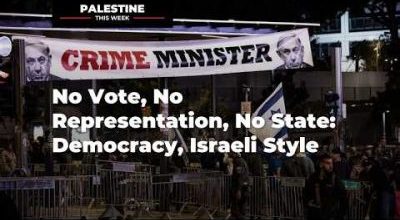
No Vote, No Representation, No State: Democracy, Israeli Style
or go to
Aletho News Archives – Video-Images
From the Archives
Sanctions, War and the Policy of Dual Containment
By SASAN FAYAZMANESH | March 17, 2008
It is now nearly three decades since the Unites States adopted the policy of dual containment of Iran and Iraq. While much has been written about the containment of Iraq, there has been very little in-depth analysis of this policy when it comes to Iran. In a book that is going to be released on March 31, 2008, entitled The United States and Iran: Sanctions, Wars and the Policy of Dual Containment (Routledge), I attempt to address this shortcoming by investigating when and why the US policy of containment of Iran came about, how it evolved, and where it stands today.[1] To the extent that Israel has been involved in US policy making, the study will also include the role that Israel has played in the containment of Iran. Also, since the fate of Iran has been inextricably linked to that of Iraq, occasionally the investigation will overlap with the containment of Iraq.
The policy of dual containment of Iran and Iraq originated during the Carter Administration, but it was not until the Clinton Administration that the expression “dual containment” became popular. … continue
Blog Roll
 Aletho News
- Europe’s Establishment Is Embracing War – and Losing Voters
- NATO chief advocates war of aggression
- No Vote, No Representation, No State: Democracy, Israeli Style
- Zionist Bought Senate Blocks Information About American Citizens Killed By Israel
- While Gaza dominates the UN, these are the people keeping it alive
- New Report: “Scholasticide and Genocide in Gaza: Assessment, Testimonies and Legal Analysis”
- ‘THAAD Delusion’: Iran war exposes US missile shield limits – The Atlantic
- Moscow issues warning to NATO over Russian exclave
- Yes, the Iran war has destroyed Trump’s presidency
- The fallacy of US delusions about Iran’s economic collapse
- If Americans Knew
- Mamdani releases plan to combat antisemitism and hate crimes in New York City
- Iran’s Revolutionary Guards Publish Letter to the American People
- DMFI launches $1 million ad campaign supporting Virginia’s Elaine Luria
- US Senate blocks resolution seeking report on Americans killed by Israel
- Israeli Attacks Kill Ten Palestinians in Gaza
- Massacre at Minab: The School That Became a Grave
- Israeli media: The IDF Shows It Doesn’t Turn a Blind Eye; It Actively Emboldens Settler Havoc
- As settlers ravage West Bank, Israeli forces kill 10 in Gaza – Daily Update
- New Report: “Scholasticide and Genocide in Gaza: Assessment, Testimonies and Legal Analysis”
- Ex-Biden officials are desperate for a Gaza scapegoat
- No Tricks Zone
- Green Energy Debacle: German Expert Professor Fritz Vahrenholt Warns Of Severe Economic And Social Consequences
- Two More Paleo Reconstructions Affirm Meters-Higher Sea Levels Across Ireland, Brazil 7000-6000 Years Ago
- New Study: Earth And Venus Surface Warmth Largely Explained By Convection And Lapse Rate, Not CO2 Or Radiation
- 2025 Nature Paper Claiming Worsening Global Drought Gets RETRACTED …Heavily Flawed
- New Study: ‘Global Drought Shows No Detectable Recent Acceleration Under Climate Warming’
- Economic Masterminds: German Socialists Suggest Taxing Productivity Gains Stemming From Using AI
- The South China Sea Has Not Been Cooperating With The Climate Change Narrative
- Energy Crisis: Germany Enters Heating Season With Historically Low Gas Reserve Fill Levels
- New Study: The Antarctic Ice Sheet Gained Mass From 2020-2024 Due To Staggering Snow And Ice Accumulation
- Study: Ocean Heating Rates From Thousands Of Years Ago ‘Dwarf’ Modern Ocean Heating Rates

