Will California Zionise K-12 Education?
By Rick Sterling | Global Research | October 2, 2025
Factual information about Israel and Palestine may soon be outlawed in the California K-12 school system. Assembly Bill 715 is currently on Governor Newsom’s desk. The legislation was recently rushed through the California legislature, amended just days before passage, and voted on at 1 a.m. with almost no time for public comment.
The hurry is intentional because opposition grows whenever people learn about it. AB715 is opposed by educators across the spectrum, including the California Teachers Association, California Faculty Association, Association of School Board Administrators, California School Boards Association, and Council of UC Faculty Associations. Civil rights organizations, such as ACLU Action, also oppose the legislation.
What It Purports to Do
Assembly Bill 715 aims to “prevent antisemitism.” It asserts, “Jewish and Israeli pupils are facing a widespread surge in antisemitic discrimination, harassment, and bullying. In many cases, such discrimination, harassment, and bullying has been so severe and pervasive that it has placed Jewish pupils at risk, or completely impeded their ability to learn or engage in school programs or activities.”
The Anti-Defamation League (ADL) is the main source for the claim that there is a “widespread surge” in antisemitism. Their accuracy is widely disputed. As the Jewish Currents publication reports, “A line-by-line reassessment of the organization’s data illuminates the flaws in its methodology.”
There is already protection in the California Education Code for genuine cases of discrimination or bullying. Section 220 of the code specifies that “No person shall be subjected to discrimination on the basis of disability, gender, gender identity, gender expression, nationality, race or ethnicity, religion, sexual orientation, or any other characteristic that is contained in the definition of hate crimes.” Through their ethnicity and religion, Jewish students are clearly a protected group. So are Israeli students. They can file claims of discrimination under existing legislation.
What It Will Actually Do
AB715 aims to expand the definition of “discrimination” and outlaw any textbook, instructional material, or course content that “would subject a pupil to unlawful discrimination.”
But what is “unlawful discrimination”? AB715 specifies that the U.S. National Strategy to Counter Antisemitism is the basis for identifying antisemitism. That report asserts, “Jewish students and educators are targeted for derision and exclusion on college campuses, often because of their real or perceived views about the State of Israel. When Jews are targeted because of their beliefs or their identity, when Israel is singled out because of anti-Jewish hatred, that is antisemitism.” The document claims, “an unshakeable commitment to the State of Israel’s right to exist, its legitimacy, and its security. In addition, we recognize and celebrate the deep historical, religious, cultural, and other ties many American Jews and other Americans have to Israel.”
The U.S. National Strategy to Counter Antisemitism embraces the controversial “working definition” of antisemitism advanced by the International Holocaust Remembrance Alliance (IHRA). This definition has been widely criticized for its conflation of antisemitism with anti-zionism and criticism of the State of Israel. Over 100 human rights and civil society organizations reject the IHRA definition. Yet this is the definition which AB715 is based on.
If passed, AB715 will result in strict regulation of education and educational material that might subject Jewish students to “unlawful discrimination”. Facts and informed opinions about the reality in Israel and Palestine may be considered “antisemitic” or likely to cause discomfort. For example, students will not learn:
- The International Criminal Court has issued an arrest warrant for Israeli PM Netanyahu charging him with crimes against humanity.
- The International Association of Genocide Scholars determined that Israel is committing genocide in Gaza.
- Human Rights Watch, Amnesty International and Israel’s B’Tselem have ALL independently investigated and determined that Israel is an apartheid state.
- The greatest scientist of the 20th century, Albert Einstein, was against the creation a Jewish state and sought a binational Arab Jewish state in Palestine.
- In 1948, Einstein, Hanna Arendt, and other Jewish leaders denounced Menachim Begin as a Nazi and fascist.
- The Israeli newspaper Haaretz documents a Jewish scholar who was zionist but now supports Hamas and considers their armed resistance legitimate and legal.
All of the above are facts and assessments by credible organizations and individuals. AB715 is so vague yet sweeping that such education about Israel and Palestine may be considered “unlawful discrimination” against a pro-Israel student and therefore prohibited.
The Costs of AB715
If passed, AB715 will cost Californians dearly. It mandates the creation of a new Office of Civil Rights with an Antisemitism Prevention Coordinator and staff producing regular reports, investigations, etc. Incredibly, AB715 allows any member of the public to file a complaint, even anonymously. These complaints must be investigated and responded to within time requirements. School boards and superintendents, already busy, will have to spend precious time and resources investigating each and every complaint in a timely manner. The predictable result will be fear or prohibition on saying anything about Israel or Palestine. The Antisemitism Prevention Coordinator is also mandated to provide antisemitism education to teachers, administrators, and school boards.
Under California’s “Golden State Plan to Counter Antisemitism,” millions of dollars are appropriated for education about the genocide which ended 80 years ago. Meanwhile, there is no funding and it appears the California legislature seeks to prevent education about the genocide happening today in Gaza.
Making it even worse, AB715 invites lawsuits which will further burden the education system. The legislation says, “Civil law remedies, including but not limited to injunctions, restraining orders, or other remedies, may also be available to complainants.” Under AB715, as a gift for zionist activists, any member of the public can be a complainant.
AB715 Should Not Be Signed into Law
The organizations representing California teachers, adminstrators, school superintendents and school boards are ALL against this legislation. AB715 will be costly, wasteful, and damaging to K-12 education in California. Where there are genuine cases of discrimination or bullying, existing legislation is adequate. All students are protected against discrimination or bullying under section 220 of the California Education Code. Where Jewish or Israeli students have been victimized, they have the same recourse as all students. They do not need preferential treatment.
Teaching facts and expert opinions about Israel and Palestine is not antisemitic. It is history and current events.
Feeling uncomfortable when learning some facts or opinions is not being a victim; it is being educated. People can disagree and have different perceptions; they should not be prevented from hearing facts and different perspectives.
The intent of AB715 is clear: to restrict factual information about an important region of the world and to punish educators who present the Palestinian and anti-zionist Jewish perspective. Governor Newsom should not sign the legislation. To encourage him to make the right decision, contact him via this link.
This legislation does not prevent antisemitism; it actually promotes it by demonstrating that major Jewish organizations and the Jewish Legislative Caucus have the power to push this legislation which will deny the history and current reality of the Palestinian people. Meanwhile, Jewish Voice for Peace and organizations across the education profession are working hard to stop this assault on the California education system.
Recognise a state and prevent it from existing?
By José Goulão | Strategic Culture Foundation | October 2, 2025
And suddenly, the overwhelming majority of countries in the so-called Collective West decided to recognise the State of Palestine. Among them were some of the most loyal allies of the Zionist regime and accomplices to its atrocities, such as France, the United Kingdom, Australia, Canada and even, despite its negligible specific weight, the government of the Portuguese Republic. We know that consistency is not the strong point of the Montenegro clique: recognition was declared just a few weeks after the Minister of Foreign Affairs, Paulo Rangel, went to bless the crimes of the Israeli regime, precisely at one of the most intense stages of human and physical devastation in the Gaza Strip.
Any reader will naturally wonder what has now led so many important countries, the guardians of “our civilisation”, to adopt a stance that they could, and should, have taken years ago. Was it the blatant and dramatic exposure of the decades-old genocide of the Palestinian people, which is ravaging the Gaza Strip and which the hypocrisy of fine words and the most beautiful intentions can no longer hide? Perhaps a little, although we should not attach too much importance to this response because shame is not something that abounds in Western governments.
Another reason, this one with a much more important political and strategic significance, is the certainty of all those making the declarations that their decision, apart from being couched in plenty of half-truths, has no practical effect on the real recognition of Palestinian rights and on the murderous conduct of the State of Israel. On the same days that the declarations of recognition were made, the Zionist Prime Minister, Benjamin Netanyahu, assured with complete conviction that there would never be a Palestinian state. This was a challenge to the attitudes of Western countries, which they received with the most devout silence.
And now?
The most relevant situation, and also the one that raises the most doubts about the genuineness of Western governments’ intentions regarding the restoration of the rights of the Palestinian people, is based on a simple question: What now?
Yes, what could these declarations of recognition of the State of Palestine change in the current situation, controlled by the fascist impulses of the Israeli government and the US administration, this time under Trump’s baton – as it could be, with the same effects, under Biden’s orders?
At first glance, they will change nothing. Colonial and expansionist arbitrariness continues unabated in East Jerusalem and from north to south in the West Bank, while the human and physical levelling of Gaza continues unhindered, except for the guerrilla pockets of Hamas.
Western governments have recognised an abstract state with no effective powers over what should be its territory, disappearing every day in the face of the genocidal advances of hordes of settlers imported from all over the planet. Are Western governments doing anything concrete to force Israel to stop colonisation? Are they stopping sending weapons to Israel? Are they considering imposing sanctions capable of suffocating a state run by a criminal clique that is incapable of living on its own?
So far, there is no indication that any of the Western powers are willing to take these steps, which are essential if any qualitative changes in the balance of power throughout Palestine are to lead to negotiations capable of defining the paths for establishing and applying international law in the region. This would imply that, at least in this case, Western leaders would have to put aside their bureaucratic adherence to the ‘rules-based international order’ defined in Washington. The truth is that no government seems willing to take this risk, which, in practice and under these conditions, reveals that recognising or not recognising the State of Palestine will amount to the same thing, that is, more of the same.
Recognise, yes, but…
Western governments have been careful (which opens the door to backtracking) not to recognise the State of Palestine unconditionally, thus continuing to put the strict application of the principles established by international law on hold. Endowed with authority and power granted by five centuries of colonial violence, which allowed them to invent an entity such as the State of Israel, Western governments have attached a series of conditions to the decision. Taken literally, these translate into recognition without recognition because they effectively limit the Palestinian people’s decision-making powers on matters that concern them and on which only they have the right to deliberate.
In a manoeuvre that transfigures much of what is positive about recognition, Western governments are attempting to breathe new life into Mahmoud Abbas’s moribund Palestinian Authority, confined to Ramallah, by giving it powers that it will be unable to exercise. They also demand its absolute surrender to Israel – a demand that is unnecessary in the situation that has been dragging on throughout this century – and they attribute sole responsibility for terrorism in Palestine to Hamas, while ignoring Israeli terror – disguised as ‘security’ and ‘right to exist’. As always, this double standard vitiates the very declarations of recognition from the outset.
The condition that demonstrates how hypocritical and, for now, useless the declarations of recognition are, however, relates to the demand for the disarmament not only of Hamas but of all structures of the Palestinian Resistance. Such demands leave the entire Palestinian people even more helpless and at the mercy of the criminal free will of the Zionist regime, which can thus pursue its genocidal goal, free from any hindrance, while remaining exempt from accountability before international bodies. In the practical consequences of the measures imposed by Western governments in exchange for the recognition of the State of Palestine, the Zionist state would find the best of all worlds and the full realisation of all its objectives.
The shadow of collaborationism
The most recent developments in the recognition process help to dispel some uncertainties about the interests that lie behind the decision, which are not favourable to the Palestinian people.
It was clear from the outset that the recognition of Palestinian independence by Western governments was not, it bears repeating, unconditional. Most of the speeches on the subject clearly overvalued the Palestinian Authority, which is inactive in practice and, more seriously, entirely conditioned by Israel’s demands. The “shared” management of much of the West Bank between the Ramallah government and the Zionist occupation forces means, in fact, that the former has been placed at the service of the latter’s interests. This is often confirmed by the actions of the Palestinian police forces in repressive actions against the Palestinian population itself.
This situation suits Western governments because it means that the ‘autonomous’ authorities are willing to collaborate in ways that run counter to the legitimate interests of the Palestinian people, which have never been recognised by Western states.
At the same time, the West attributes sole representation of the Palestinians to the decrepit Palestinian Authority and its leader Mahmoud Abbas, who is in fact perpetuated in power despite being completely hamstrung by Israel and the United States. It should be remembered, as it is a fact, that his accession to the presidency was achieved through a soft coup organised in 1994 by the United States, Israel and Western powers, as a result of which the historic leader of the Resistance, Yasser Arafat, was removed from the main positions of power (to which he had been elected) and assassinated a few months later.
It should also be remembered that Mahmoud Abbas, very recently described as ‘pragmatic’ by a pro-Israeli publication such as the weekly newspaper Expresso, was received at the White House, from where Arafat had been banned, shortly after taking office as president of the so-called ‘Autonomy’ in 1994.
These circumstances help to better understand the Western constraints that accompanied the recognition of independence. And they lead to the elementary conclusion that there will be no representative entity that reflects the will of the Palestinian people without the holding of free, open and democratic general elections under the control of international bodies supervised by the UN. This process cannot involve the intervention of Israel and the United States of America, which is by definition biased and self-serving.
Another demand common to Western governments is that the Resistance (wrongly and maliciously equated with Hamas) should ‘renounce’ terrorism, that is, armed struggle, while, it should be repeated, sparing Israeli terrorism. This ‘renunciation’ must be accompanied by the disarmament of the Resistance, which means the total surrender of the Palestinian people to the discretionary and genocidal power of Israel. From this perspective, the recognition of Palestine becomes a poisoned gift.
Abbas’ recent speech to the UN General Assembly, delivered via the internet because, this time, the Trump administration illegally refused to grant the Palestinian president a visa to travel to New York, confirmed the existence of dangerous collaboration with Israeli and Western colonial interests.
Mahmoud Abbas, as Palestinian president, promised that ‘Hamas will never be the government’. But how can the most prominent Palestinian leader, whose party was defeated in the last general elections held in the occupied territories, promise that the most voted political force (according to the last poll, held more than 15 years ago) will not be able to govern the state? By manipulating the election results? By adopting a single-party regime or a personal dictatorship? By preventing a party with significant popular support, Hamas or any other, from being a legitimate and necessary part of a majority government? Let us remember that Abbas and his Western and Arab allies prevented Hamas from governing after it won an absolute majority in free elections; and that, despite multiple negotiations and supposed draft agreements, they always sabotaged the creation of ‘national unity governments’ that would have brought Gaza, the West Bank and East Jerusalem under the same ‘autonomous government’. ‘One of our strategic objectives is to maintain the separation between Gaza and the West Bank,’ Netanyahu confessed to his Likud party’s parliamentary group.
None of these paths implied in the content of the recognition statements correspond to the ‘democratic values’ proclaimed by the Western world, which seems willing to impose, through its latest decision, an authoritarian and undemocratic ‘solution’ centred on Abbas.
In his speech, the Palestinian president stated that he does not want Palestine to be ‘an armed state’. What does this idea mean, which is incompatible with the existence of a full state as established in international law? Would the defence and security of Palestine be handed over to Israel? Would the Palestinian people no longer have anyone to defend them, whether it be the armed resistance or the state apparatus?
In his time, shortly before being assassinated by Zionism in 1995, Israeli Prime Minister Isaac Rabin admitted that the maximum status he would grant to a Palestinian entity at the end of the ‘peace process’ would be ‘less than a state’. Have Mahmoud Abbas and the Western leaders who manipulate him revived this idea? Will Palestine ‘less than a state’ be the future state of Palestine as understood? There will be no better way, then, already considered as the ‘final solution’ to the problem, for the continuation of genocide and the creation of Greater Israel – throughout Palestine, as a first step.
The fundamental question, however, remains: what will come after the recognition of independence, given that Israel occupies almost the entire territory where this state would be created? What will Western countries do to give substance to their decision? It should be remembered that international law requires the creation of an ‘independent and viable’ Palestinian state. In prosaic terms, a state like any other. However, this is not what is being planned, with the collaboration of the incompetent Palestinian Authority. Israel’s dizzying policy of creating settlements is gradually eating away at the territory that is essential for the creation of a viable state. Taking a clear-headed view, the Portuguese head of state admitted that one day there will be no territory left to establish a state. This is a reality that I began denouncing many years ago, because it is obvious and Israel makes no secret of it. Despite recognising these circumstances, the Western world is doing nothing concrete to stop the colonisation and make the state it claims to recognise viable.
Once again, the West’s main objective has been to create propaganda and delaying tactics and, with them, to try to neutralise the increasingly strong, active and genuine solidarity of Western peoples with the Palestinian people. This solidarity cannot be allowed to wane; it must be strengthened, because if we rely on the promises and decisions of our governments, the Palestinian people will continue to be the biggest victims. And we cannot allow that to happen.
Hamas denies links to suspects arrested in Germany over alleged plot against Israeli targets
MEMO | October 2, 2025
Hamas on Wednesday denied having any connection to suspects arrested in Germany on charges of trying to buy weapons to carry out potential attacks on Israeli or Jewish targets.
In a statement, the movement said: “The claims that the detainees are linked to Hamas are baseless, and aim to damage the reputation of the movement and distort the German people’s sympathy with our Palestinian cause.”
The statement added that “Hamas confirms its policy has always been, and remains, to restrict its struggle against the Zionist occupation to Palestine only.”
Earlier on Wednesday, Germany’s federal prosecutor announced the arrest of three suspects in Berlin accused of belonging to Hamas. They are alleged to have attempted to obtain firearms and ammunition to prepare possible attacks on Israeli or Jewish targets inside the country.
IOF kidnaps Gaza nurse as medical staff struggle to work under fire

Palestinian Information Center – October 2, 2025
GAZA – Israeli occupation forces (IOF) on Thursday abducted nurse Tasneem al-Hems from a medical point in Khan Yunis, in the southern Gaza Strip, in yet another attack on Palestinian health workers. She is the daughter of Dr. Marwan al-Hems, the director of Gaza’s field hospitals, who was kidnapped by an IOF undercover unit in July this year.
Family sources confirmed that Tasneem was seized by a special IOF unit near her workplace. Her father, Dr. al-Hems, was shot in the leg and abducted on July 21 near the International Committee of the Red Cross hospital in western Khan Yunis. He has since been held in Ashkelon prison, denied access to his lawyer, and remains in detention under extended orders.
The Gaza-based al-Dameer Association for Human Rights condemned the kidnapping and confirmed that Israel is using enforced disappearance against medical professionals. According to the Ministry of Health in Gaza, at least 361 Palestinian medical staff are currently imprisoned by Israel.
Meanwhile, Gaza’s Ministry of Health warned that the few hospitals still partially operating in Gaza City are facing extreme risks. In a statement Thursday, the ministry said that reaching Al-Shifa Medical Complex, Al-Quds Hospital, and Al-Helou Hospital has become “highly dangerous” due to ongoing Israeli bombings.
The ministry urged international bodies to intervene immediately to protect medical institutions and staff and to ensure safe access to health facilities.
Health authorities recently reported that 20 hospitals in Gaza have been forced out of service, with only eight functioning at limited capacity under constant threat of IOF strikes.
Since August 11, 2025, Israel has intensified its genocide against Gaza, attempting to destroy the city and forcibly displace its population southward.
Italian dockworkers block ships bound for Israel amid Gaza flotilla tensions
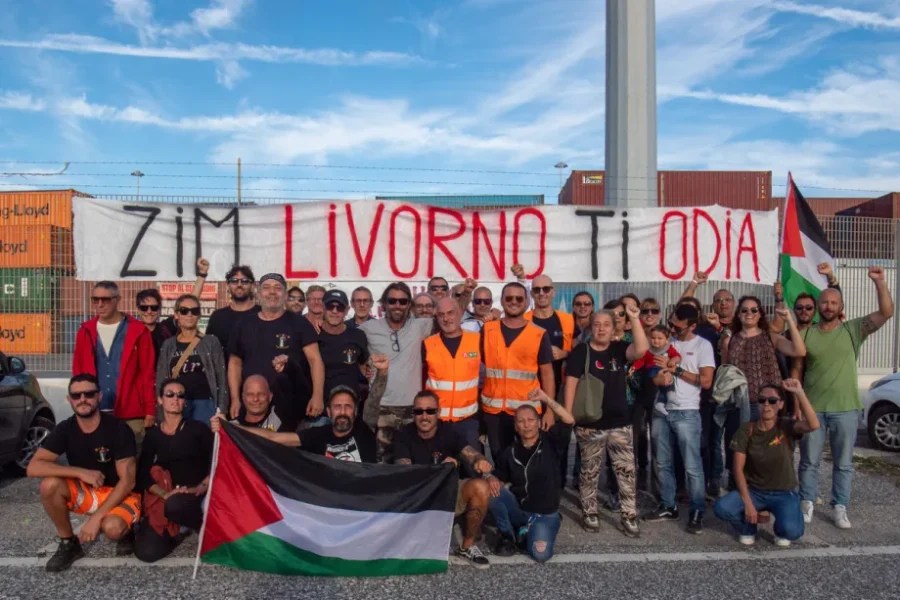
Dockworkers and citizens at the garrison outside the Tuscan dock pose for a photo and rejoice at the news that Israeli ship Zim is preparing to leave the port of Livorno without unloading or loading after Italian dockworkers on strike, block the Darsena Toscana terminal during a protest in support of Gaza, Palestine and Global Sumud Flotilla on September 29, 2025 in Livorno, Italy. [Photo by Laura Lezza/Getty Images]
MEMO | October 2, 2025
Dockworkers in several Italian ports are stepping up actions to block shipments to Israel as tensions mount over the approach of the “Sumud Flotilla” to Gaza.
Labour unions across Europe have pledged coordinated efforts to disrupt maritime trade with Israel if the flotilla comes under attack. In a meeting held in Genoa, union representatives said they had set up an alert system to monitor shipments and respond rapidly by halting the loading or unloading of vessels.
Italy has become the epicenter of the movement. Genoa was the first port to act, followed by Livorno, where union-led strikes have already disrupted operations. The container ship Zim Virginia was kept waiting for five days off the Tuscan coast after dockworkers refused to allow it to dock.
Another vessel, the Zim Iberia, is expected to arrive in Livorno on 3 October and is likely to encounter similar resistance, according to union organizers.
In Genoa, tensions escalated last week when about 2,000 protesters gathered at the port. The demonstration forced the Zim New Zealand to leave without loading any cargo after reports that several containers were suspected of being linked to Israeli shipments.
Union leaders said their campaign is aimed at putting pressure on Israel and demonstrating solidarity with Gaza. They warned that actions would intensify if the flotilla is obstructed.
Protests erupt worldwide against Israeli attack on Global Sumud Flotilla
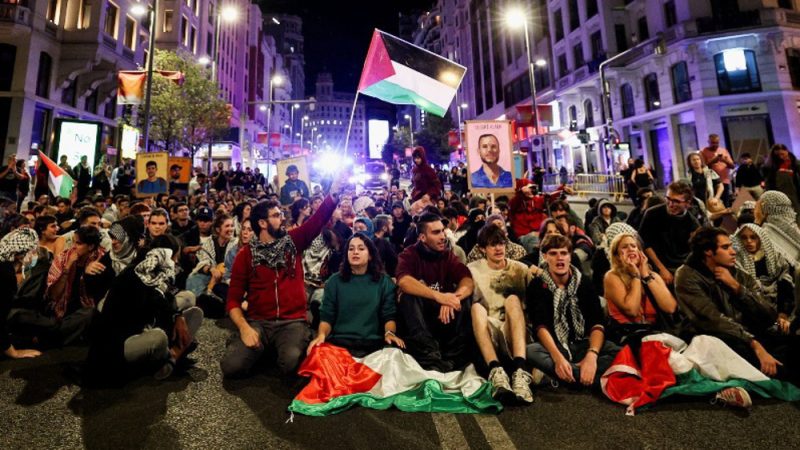
The Cradle | October 2, 2025
Protests erupted across cities worldwide on the night of 1 October after Israel intercepted the Gaza-bound Global Sumud Flotilla, with thousands taking to the streets to denounce the raid, demand the release of detained activists, and call for an end to the siege on the enclave.
Demonstrations broke out in Greece, Spain, Sweden, and Belgium, as large rallies took place in Italy, where the country’s largest trade unions announced a general strike for 3 October.
Among the largest gatherings overnight, tens of thousands marched through Rome in support of the Sumud Freedom Flotilla.
Hundreds more blocked traffic at Piazza dei Cinquecento, while in Milan, large crowds shut down train stations, blocking rail traffic as part of nationwide demonstrations.
Organizers estimated around 1,000 people would march toward Piazza Barberini. Italy’s unions USB and CGIL confirmed a nationwide strike call, while dock workers carried out their pledge to blockade in response to the flotilla’s interception.
Hundreds also gathered outside the US consulate in Istanbul, chanting slogans, praying for Palestinians, and denouncing what they called genocide.
In Berlin, protesters gathered at Central Station, and in Brussels, marchers moved from Place de la Bourse to the Belgian Foreign Ministry.
In London, thousands marched to the prime minister’s residence, chanting against him. In Germany, demonstrators briefly shut down the main train station.
The Tunisian capital also saw a mass demonstration, while Mauritania’s Nouakchott hosted protests denouncing the flotilla raid.
A snap protest was held outside Sydney Town Hall in support of the Global Sumud Flotilla, with demonstrators voicing solidarity and chanting “From the river to the sea,” which echoed through the rally.
Latin American cities witnessed parallel mobilizations. Local media in Buenos Aires said hundreds demonstrated against what they called an “assault by the Israeli occupation forces” and demanded an end to the genocide in Gaza.
In Mexico City, Reuters captured images of marchers outside the Foreign Ministry, with demonstrators demanding the release of seven Mexican nationals detained in the flotilla raid.
Activists Arlin Medrano and Sol Gonzalez confirmed in a video that their ship had been intercepted in international waters, calling it an illegal act.
David Pena, the Mexican delegation’s legal representative, told protesters Israel planned to charge them with trespassing and deport them.
In Colombia, protesters gathered outside the headquarters of the National Business Association (ANDI) after the Global Movement to Gaza accused it of ties to Israel’s economic mission – an allegation the group denied in a statement.
Demonstrations also swept Bogota, Montevideo, and several Argentine cities, with protesters in Uruguay’s capital calling for the imprisonment of Israeli Prime Minister Benjamin Netanyahu.
Out of 44 vessels that departed with the Global Sumud Flotilla, only four are still marked as ‘sailing’ as of 12:15 pm Thursday, according to live tracking data on the flotilla’s website.
One vessel appeared to have reached Gaza’s waters before communications were lost.
Organizers said one of the boats intercepted was rammed by an Israeli naval vessel.
Israel’s Foreign Ministry labeled the mission on its official X account as the “Hamas Flotilla.”
Colombia expels Israeli diplomats after Gaza aid flotilla raid
MEMO | October 2, 2025
Colombian President Gustavo Petro has ordered the expulsion of all remaining Israeli diplomats from the country, after the interception of the Global Sumud Flotilla heading to Gaza.
He also called for suspending trade agreements with Israel after two Colombian citizens were arrested on board one of the ships. “Israel detained two Colombian women in international waters,” Petro said, demanding their immediate release.
Only four Israeli diplomats were still in Colombia after President Petro cut ties with Israel last year.
In a statement, Colombia’s Ministry of Foreign Affairs, on behalf of the government and the Colombian people, strongly condemned what it described as the kidnapping carried out by Israeli armed forces in international waters. The ministry said this act violated international law and the Geneva Conventions, and targeted the two Colombian nationals, Luna Barreto and Manuela Bedoya, both members of the Global Sumud Flotilla.
The ministry also called for the immediate release of its citizens, as well as all other members of the flotilla. It urged the governments of Spain, Bangladesh, Brazil, Slovenia, Indonesia, Ireland, Libya, Malaysia, the Maldives, Mexico, Oman, Pakistan, Qatar, Thailand, Turkey, and South Africa to take urgent and joint action to protect the lives and safety of their nationals.
According to the ministry, the international flotilla set sail in the Mediterranean with three objectives: to deliver humanitarian aid to Gaza, to raise awareness of the urgent humanitarian needs of the Palestinian people, and to highlight the need to end the war in Gaza.
The Israel Lobby Wants Thomas Massie Gone. Will Voters Obey?
By Jose Alberto Nino | The Occidental Observer | September 29, 2025
The knives are out for Rep. Thomas Massie (R-KY), and his political survival could prove whether Congress still answers to American voters or to a foreign lobby with limitless cash.
Pro-Israel Republican megadonors recently set up the MAGA Kentucky super PAC with $2 million specifically to oust Massie. Paul Singer contributed $1 million, John Paulson added $250,000, and Miriam Adelson’s Preserve America PAC provided $750,000. The Republican Jewish Coalition has promised “unlimited” campaign spending if Massie runs for Senate, with CEO Matt Brooks declaring that “if Tom Massie chooses to enter the race for US Senate in Kentucky, the RJC campaign budget to ensure he is defeated will be unlimited.”
President Donald Trump has also jumped into the fray, branding Massie a “pathetic loser” who should be dropped “like the plague.” Overall, a constellation of pro-Zionist forces is mobilizing at full force to unseat Congress’s most principled non-interventionist politician since Ron Paul retired in 2013. In many respects, Massie has taken up Paul’s mantle of foreign policy restraint — a political agenda that has never sat well with organized Jewry. Massie’s legislative track record on foreign policy speaks for itself.
Massie’s Long Track Record of Voting Against Foreign Policy Interventionism
Throughout his congressional career, Massie has established himself as Congress’s most consistent opponent of the neoconservative/neoliberal foreign policy consensus. His principled opposition to endless wars and foreign entanglements has earned him the nickname “Mr. No” — similar to his predecessor Ron Paul — for frequently casting lone dissenting votes against military interventions.
In 2013, Massie introduced the War Powers Protection Act to “block unauthorized U.S. military aid to Syrian rebels.” He argued that “since our national security interests in Syria are unclear, we risk giving money and military assistance to our enemies.” When Obama sought to arm Syrian rebels in 2014, Massie voted against the plan, declaring it “immoral to use the threat of a government shutdown to pressure Members to vote for involvement in war, much less a civil war on the other side of the globe.”
Massie consistently opposed U.S. involvement in Yemen’s civil war, co-sponsoring multiple bipartisan resolutions to invoke the War Powers Resolution and “remove United States Armed Forces from unauthorized hostilities in the Republic of Yemen.” He stated that “Congress never authorized military action in Yemen as our Constitution requires, yet we continue to fund and assist Saudi Arabia in this tragic conflict.”
His opposition to NATO expansion proved equally consistent. In 2017, Massie was one of only four House members to vote against a pro-NATO resolution, explaining that “the move to expand NATO in Eastern Europe is unwise and unaffordable,” and such expansion contradicted Trump’s campaign assertion that “NATO is obsolete.”
Regarding the Russo-Ukrainian war, Massie maintained his non-interventionist stance, receiving an “F” grade from Republicans for Ukraine. He opposed the Ukraine Democracy Defense Lend-Lease Act, multiple aid packages, and efforts to strip Ukraine funding. Massie argued that supporting Ukraine aid was “economically illiterate and morally deficient,” declaring that “the American taxpayers have been conscripted into making welfare payments to this foreign government.”
Most recently, in June 2025, Massie introduced a bipartisan War Powers Resolution with Rep. Ro Khanna to “prohibit United States Armed Forces from unauthorized involvement” in the Israel-Iran conflict. After Trump’s strikes on Iranian nuclear facilities, Massie criticized the action as “not Constitutional,” remaining the only Republican co-sponsor of the war powers resolution.
Massie’s Anti-Zionist Streak
Massie’s most politically dangerous positions involve his consistent opposition to pro-Israel legislation, earning him the distinction of being the lone Republican opposing numerous Israel-related measures.
In July 2019, Massie cast the sole Republican vote against a resolution opposing the Boycott, Divestment, and Sanctions movement. The resolution passed 398-17, but Massie defended his position by stating he does not support “federal efforts to condemn any type of private boycott, regardless of whether or not a boycott is based upon bad motives” and that “these are matters that Congress should properly leave to the States and to the people to decide.”
In September 2021, Massie was the only Republican to vote against $1 billion in funding for Israel’s Iron Dome defense system. He explained that “my position of ‘no foreign aid’ might sound extreme to some, but I think it’s extreme to bankrupt our country and put future generations of Americans in hock to our debtors.” This vote prompted AIPAC to run Facebook ads stating “When Israel faced rocket attacks, Thomas Massie voted against Iron Dome.”
Perhaps most controversially, on May 18, 2022, Massie cast the lone vote against a resolution condemning antisemitism, which passed 420-1. The American Jewish Committee criticized him, stating that “while Democrats and Republicans united, Rep. Massie, who has also opposed bills on Holocaust education and Iron Dome funding, decided that combating rising hatred is not important.” Massie defended his vote by tweeting that “legitimate government exists, in part, to punish those who commit unprovoked violence against others, but government can’t legislate thought.”
In October 2023, Massie opposed a $14 billion aid package for Israel, proclaiming that “if Congress sends $14.5 billion to Israel, on average we’ll be taking about $100 from every working person in the United States. This will be extracted through inflation and taxes. I’m against it.” When AIPAC criticized him, Massie responded that “AIPAC always gets mad when I put America first. I won’t be voting for their $14+ billion shakedown of American taxpayers either.”
On October 25, 2023, Massie was the sole Republican to vote against a resolution affirming Israel’s right to defend itself following the October 7 Hamas attacks. A month later, on November 28, 2023, he became the only member of Congress to oppose a resolution affirming Israel’s right to exist and equating anti-Zionism with antisemitism, which passed 412-1.
The most explosive moment came in December 2023 when Massie posted a meme of the rapper Drake contrasting “American patriotism” with “Zionism,” implying Congress prioritized the latter. Senate Majority Leader Chuck Schumer called the post “antisemitic, disgusting, dangerous” and demanded he remove it. The White House labeled it “virulent antisemitism.” Republican Jewish Coalition CEO Matt Brooks condemned it, stating “Shame on you @RepThomasMassie. You’re a disgrace to the US Congress and to the Republican Party.”
Massie vs. Trump
Trump’s escalating attacks on Massie reveal the extent to which the sitting president serves pro-Israel interests rather than pursuing genuine ideological differences. The timing and intensity of Trump’s criticism align suspiciously with Massie’s most vocal challenges to Israeli influence in Congress.
In June 2025, after Massie criticized Trump’s Iran strikes as “not Constitutional,” Trump unleashed a scathing Truth Social response calling Massie “not MAGA” and declaring that “MAGA doesn’t want him, doesn’t know him, and doesn’t respect him.” Trump branded Massie a “simple-minded ‘grandstander’ who thinks it’s good politics for Iran to have the highest level Nuclear weapon” and concluded that “MAGA should drop this pathetic LOSER, Tom Massie, like the plague!”
This vitriol represents a dramatic shift from Trump’s 2022 endorsement, when he called Massie a “Conservative Warrior” and “first-rate Defender of the Constitution.” The transformation occurred precisely as Massie intensified his criticism of Israeli influence and foreign aid. Trump’s attacks escalated further after Massie’s explosive June 2024 Tucker Carlson interview where he revealed that “everybody but me has an AIPAC person. … It’s like your babysitter, your AIPAC babysitter who is always talking to you for AIPAC.”
Massie elaborated that “I have Republicans who come to me and say that’s wrong what AIPAC is doing to you, let me talk to my AIPAC person… I’ve had four members of Congress say I’ll talk to my AIPAC person and like it’s casually what we call them my AIPAC guy.” This revelation exposed the systematic nature of Israeli influence over Congress, prompting immediate backlash from pro-Israel organizations and likely contributing to increased donor funding against his re-election campaign.
The pattern makes clear that Trump’s hostility toward Massie stems less from policy disagreements than from his deference to powerful Jewish donors. Although he often claims to oppose “endless wars,” Trump’s attacks on Massie — the most consistent non-interventionist in Congress — expose where his true loyalties lie in advancing the agenda of Jewish supremacist interests rather than pursuing an independent foreign policy. House Speaker Mike Johnson has signaled that GOP leadership will abandon Massie, stating that “he is actively working against his team almost daily now and seems to enjoy that role. So he is, you know, deciding his own fate.”
AIPAC is on the Hunt
AIPAC’s 2024 electoral victories demonstrate the lobby’s willingness to spend unprecedented sums to eliminate critics of Israeli policy. The organization’s success in defeating progressive Democrats and protecting establishment Republicans reveals a coordinated strategy to purge Congress of independent voices. AIPAC will look to replicate its successes against the likes of Israel critics such as Massie.
Against Rep. Jamaal Bowman in New York’s 16th District, AIPAC’s United Democracy Project (UDP) spent $14.5 million opposing Bowman while also propping up challenger George Latimer. Independent media outlet Sludge reported that “the $14.5 million AIPAC’s super PAC has spent in the NY-16 Democratic primary is more than any outside group has ever spent on a single House of Representatives election race.”
The spending was fueled by Republican megadonors channeled through AIPAC, with WhatsApp founder Jan Koum donating $5 million to UDP. Responsible Statecraft noted that “AIPAC effectively acted to launder campaign funds for Republican megadonors into the Democratic primary, where the spending was generally identified in media as ‘pro-Israel,’ not ‘Republican.’” By election day, Latimer-aligned groups had outspent Bowman’s backers by over seven-to-one.
Against Rep. Cori Bush in Missouri’s 1st District, UDP spent over $8.5 million to attack her record on Israel and support her pro-Zionist challenger Wesley Bell. The Bush-Bell primary became one of the most expensive House primaries ever with over $18 million in total ad spending. Bush called it “the second most expensive congressional race in our nation’s history, $19 million and counting” funded by “mostly far-right-funded super PACs, against the interests of the people of St. Louis.”
Even in Republican primaries, AIPAC intervened to protect establishment allies. To defend moderate Rep. Tony Gonzales against challenger Brandon Herrera in Texas’s 23rd District, UDP spent $1 million opposing Herrera in a “two-week ad buy.” The Republican Jewish Coalition added $400,000 in attack ads against Herrera. Combined AIPAC and RJC spending totaled approximately $1.4-1.5 million, helping Gonzales narrowly defeat Herrera by just 354 votes with 50.6% to 49.4%.
These victories came as part of AIPAC’s broader $100+ million spending cycle, with Common Dreams noting that “AIPAC money has already made a significant impact, helping a pair of pro-Israel Democrats defeat progressive Reps. Jamaal Bowman (D-N.Y.) and Cori Bush (D-Mo.)—two of Congress’ most vocal critics of Israel’s assault on Gaza—in recent primary contests.”
How Massie’s Race Could Determine the Israel Lobby’s Actual Power
Massie’s 2026 primary represents the ultimate test of whether any politician can survive the full force of pro-Israel opposition. The Kentucky race will determine if AIPAC’s previous victories represent sustainable power or pyrrhic victories that expose the lobby’s long-term vulnerabilities.
Massie’s unique position may prove more defensible than Bowman’s or Bush’s urban districts. His rural Kentucky constituency shows less susceptibility to urban media campaigns and maintains stronger skepticism of foreign entanglements. Moreover, his local roots provide credibility that transcends typical political attacks. The Kentucky representative’s ability to frame opposition as foreign interference rather than domestic policy disagreements could resonate with voters increasingly suspicious of the pro-Israel establishment that dominates Washington’s political scene.
The financial strain of AIPAC’s previous victories may also constrain future spending. The organization’s $100+ million commitment across multiple races represents an unsustainable pace that could face donor fatigue. Each expensive victory exposes the lobby’s methods to greater scrutiny and potential backlash. Progressive groups increasingly highlight AIPAC’s role in primary defeats, potentially mobilizing opposition that limits future effectiveness.
Massie’s survival would demonstrate that principled politicians can withstand pro-Israel pressure through constituent loyalty and grassroots support. His defeat would confirm that no elected official can challenge Israeli interests regardless of their domestic support. The Kentucky race thus represents a pivotal moment in determining whether American foreign policy serves American interests or remains subordinate to foreign influence.
If Massie withstands the assault, it will mark the first crack in the façade of Zionist invulnerability; if he falls, it will prove that American politicians can be bought and buried by World Jewry’s limitless stockpiles of cash.
Israeli officers commandeered Pentagon meetings during June’s Israel-Iran war: Tucker Carlson
Press TV – October 2, 2025
Israeli officers stormed meetings at the Pentagon during June’s Israel-Iran war, issuing orders unchecked while Trump administration officials stood by doing nothing, says a former Fox News host, raising fresh questions about foreign influence on US military decisions.
Prominent American commentator Tucker Carlson said that Israeli military officers stormed into closed-door meetings at the Pentagon during Israel’s 12-day aggression against Iran in June, stressing that they issued direct orders to US officials, a controversial move that raises serious concerns over foreign interference in the decision-making process at the US Department of War.
During a video titled “Speeding Toward World War Three” published on his X account on Thursday, Carlson further said that officials in the Trump administration failed to respond to or prevent these intrusions, allowing the Israeli officers to continue their actions unchecked.
The ex-Fox News host also touched on the ongoing tensions over US-Israel relations and questioned the extent of influence wielded by foreign powers within American military institutions.
“During the 12-day war with Iran, the US and Israel versus Iran, bombing on all sides, during that short conflict, a bunch of Israeli officers in the Pentagon during that week enraged American Pentagon staff by barging into the meetings, giving orders and making demands and nobody did anything about it. How can a foreign military officer barge into military headquarters? The more you allow that kind of deeply unhealthy behavior the more you are going to get,” Carlson said.
He stressed that because of the weakness of “our leaders”, Israel takes advantage of the US.
On June 13, Israel launched a blatant and unprovoked act of aggression against Iran, triggering a 12-day war that killed at least 1,064 people in the country, including military commanders, nuclear scientists, and ordinary civilians.
The United States also entered the war by bombing three Iranian nuclear sites in a grave violation of international law.
In response, the Iranian Armed Forces targeted strategic sites across the occupied territories as well as the Al-Udeid air base in Qatar, the largest American military base in West Asia.
A recent New York Times–Siena survey shows that a majority of Americans are turning against Israel’s war on Gaza, with 51 percent opposing further economic and military aid.
About 35 percent strongly reject such support, compared to 19 percent in favor, and roughly 40 percent believe Israel is deliberately targeting civilians amid the genocidal war in the besieged Palestinian territory.
US deploys abortion law against Israel critics who picketed synagogue
RT | October 1, 2025
The US Justice Department has filed a civil lawsuit against several anti-Israeli protesters, using a law historically applied to protect women entering abortion clinics from pro-life demonstrators.
The complaint, filed on Monday by the DOJ’s Civil Rights Division, could mark the first of more cases to come, Assistant Attorney General Harmeet Dhillon said at a press conference. She argued that the 1994 Freedom of Access to Clinic Entrances Act (FACE) was previously “weaponized” against pro-life activists, while those disrupting religious practices were not targeted.
The case stems from a November 2024 incident in West Orange, New Jersey. Congregation Ohr Torah synagogue was hosting a real estate fair promoting the sale of homes in Jewish settlements in the occupied West Bank. The DOJ maintains that it was “a religious event centered on the Jewish obligation to live in the Land of Israel.”
Around 50 pro-Palestinian demonstrators staged a protest outside, which Dhillon characterized as a “mob.” An altercation broke out involving organizer Moshe Glick and his associate, David Silberberg. The complaint claims that one protester blasted a vuvuzela horn inches from Glick’s ear, an action prosecutors say amounted to a “physical attack” due to potential hearing damage.
Local media reported in February that Glick and Silberberg were charged in connection with the brawl after Glick allegedly pepper-sprayed a protester and struck his head with a metal flashlight. The DOJ complaint, however, described these actions as self-defense. One of the named defendants is accused of choking Silberberg and tackling him to the ground.
The fair was one of several US events promoting settlement property sales that drew pro-Palestinian protests as Israel pressed its military operation in Gaza. Jewish settlements in occupied territories are considered illegal under international law and remain a flashpoint in the broader Middle East conflict.
Enforcement of the FACE Act was reportedly scaled back early in US President Donald Trump’s term in office. In June, the House Judiciary Committee considered a bill introduced this year by Representative Chip Roy to repeal the measure entirely.
Australia secretly ships F-35 jet parts to Israel amid Gaza genocide, leaks reveal
Press TV – October 1, 2025
Leaked documents reveal that Australia has exported multiple F-35 fighter jet components directly to Israel, bypassing global supply hubs, even as Israel’s military continues its genocidal campaign in Gaza.
Declassified Australia published a report on Wednesday saying detailed shipping records reveal a total of 68 shipments of F-35 Joint Strike Fighter components flown from Australia to Israel on commercial passenger planes between October 2023 and September 2025.
The most recent shipment departed Sydney two weeks ago, carried in the cargo hold of a scheduled passenger flight bound for Tel Aviv, the report said.
According to the documents, direct shipments from Australia spiked immediately after Israel unleashed its genocidal campaign on Gaza on October 7, 2023, with 10 separate shipments sent in November 2023 alone.
Of the 68 documented shipments, 51 were destined for Nevatim Airbase in Israel’s Negev desert, home to the Israeli military’s three F-35 squadrons, the report stated.
The actual number of shipments may be even higher, with at least another 24 parts matching previous export approvals being sent during the same period.
The latest shipment, sent in mid-September 2025, contained an “Inlet Lube Plate” for the F-35 Joint Strike Fighter.
Shipping records show the export was classified as “Military Goods – Aircraft parts,” highlighting the direct military support Australia is providing for the Israeli regime.
The shipment left Sydney for Tel Aviv just 24 hours after a United Nations investigation had concluded that “Israel’s actions in Gaza constitute genocide.”
Despite mounting evidence of direct F-35 parts shipments being supplied from Australian bases to Israel, the government has repeatedly claimed that it “has not supplied weapons or ammunition to Israel since the conflict began and for at least the past five years.”
The revelation comes less than two weeks after Australia, along with Britain and Canada, formally recognized Palestinian statehood.
International human rights groups have constantly warned that sending weapons or military components to Israel makes states complicit in the regime’s genocide in Gaza.
Featured Video

Bombing Hitler’s Hometown
or go to
Aletho News Archives – Video-Images
From the Archives
‘Conspiracy Theory’ Now Fact: Greater Israel Has Arrived
By Kit Klarenberg | Mint Press News | January 28, 2025
Ever since Tel Aviv’s 1948 creation, much has been said and written about ‘Greater Israel’ – the notion Zionism’s ultimate end goal is the forcible annexation and ethnic cleansing of vast swaths of Arab and Muslim lands for Jewish settlement, based on Biblical claims this territory was promised to Jews by God. The mainstream media typically dismisses this concept as antisemitic conspiracy theory, or at most the fringe fantasy of a minuscule handful of extremist Israelis.
In reality … continue
Blog Roll
 Aletho News
- Trump admits Iran hit USS Ford carrier: ‘We ran for our lives’
- Battle for Hungary: EU attacks on Orban are a sign of worse things to come
- Iraqi resistance conducts drone strike on US-run base in Syria
- Failing to Defeat Hezbollah, Israel & US Pressure Syria’s Ahmed al-Sharaa to Join War
- US-Israeli war on Iran drives global fertilizer prices up 40%
- Hezbollah’s Surprise Weapons Redefine Ground Battle with Israel
- Yemen joins fight against US, Israel by firing missiles at occupied territories
- Seizing the Kharg: Washington’s path to defeat in the Persian Gulf
- Iran reports 500 US casualties in strikes on covert US military sites
- Pro-Israel terrorist arrested before assassination of pro-Palestinian activist
- If Americans Knew
- Researchers at Human Rights Watch Resign Over Blocked Report on Palestinian Refugee Return
- Jewish Groups Are Backing a War Americans Don’t Want
- Eric Fingerhut Thinks He’s the President of the Jews
- Top Jewish Philanthropists, Rabbis Urge Israeli President to Take Action Against ‘Jewish Extremists’
- Don’t Be Fooled. Zionist Leaders Have Always Wanted to Control Southern Lebanon
- Israel’s widespread use of torture is a core element of its genocide against the Palestinian people
- In Israel’s War on Iran, Many Middle East US Bases Rendered “All But Uninhabitable”
- ‘Burn the lawn’: Israel pursues ‘Rafah model’ in southern Lebanon
- A genocide here, an amputation there
- Reports: Iran mobilizing 1M fighters, Israel-US run low on ammo, Israeli army faces shortage – Not a ceasefire Day 168
- No Tricks Zone
- Devastating Assessment Of Comirnaty Vaccine By Former Senior Pfizer Europe Toxicologist
- New Study: CO2 Is ‘Effectively Negligible’ As An Explanatory Climate Change Factor Since 2000
- Former Pfizer Toxicologist Dr. Helmut Sterz Tells Bundestag Hearing Pfizer Vaccine Should Have Never Been Approved
- Energy Expert: Germany’s Nuclear Phaseout Was A “500 Billion Euro Mistake”
- New Research: South Australia’s Mid-Holocene Sea Surface Temperatures Were 4°C Warmer Than Today
- Storing Green Energy To Last Germany 10 Days Would Require A 60-Million Tonne Battery
- New Studies: UK Sea Levels Were 4 Meters Higher Than Today During The Mid-Holocene
- Destructive Green New Deal: German Energy And Metal Group Warns Of Drastic Crisis
- New Study Documents A 20-Year Pause In Arctic Sea Ice Decline – Driven By Internal Variability
- Wake-up Call: Survey Shows Majority Of Germans Now Favor Postponing Climate Targets!
 Aletho News