Netanyahu admits Israel weaponizes social media to manipulate US public opinion
Press TV – September 27, 2025
Benjamin Netanyahu of Israel has admitted that his regime has been using social media platforms to dominate US political discourse and secure unconditional support for its genocidal war on Gaza.
Speaking at a closed-door meeting with US influencers at Israel’s Consulate General in New York, Netanyahu was filmed describing social media as “the most important weapon … to secure our base in the US.”
The head of the Israeli regime singled out TikTok as “the most important purchase going on right now,” claiming that whoever controls this Chinese app will wield “consequential” influence.
He also claimed that gaining influence over TikTok and X would allow Israel to “get a lot.”
Netanyahu’s remarks came just a day after US President Donald Trump signed an executive order certifying a deal to transfer TikTok’s US operations to an American investor consortium including Oracle, Michael Dell, and Rupert Murdoch.
Concerns have since mounted that Oracle founder Larry Ellison—a staunch supporter of the Israeli regime—could ensure the platform’s power is exploited to advance the regime’s coordinated propaganda efforts.
The move comes as Israel faces mounting isolation over its genocidal war on Gaza, where more than 65,600 Palestinians—most of them women and children—have been killed since October 2023.
At the 80th UN General Assembly this week, Netanyahu addressed a largely empty hall after numerous delegations staged a walkout in protest of his regime’s war on Gaza, now entering its third year.
UN blacklist expands to 158 firms over Israeli settlement ties
Al Mayadeen | September 27, 2025
The United Nations has expanded its blacklist of companies linked to Israeli settlements in the occupied West Bank, adding 68 firms from 11 countries accused of contributing to violations of Palestinian human rights.
The updated “database of companies,” released Friday by the UN human rights office, now includes 158 businesses, most of them Israeli. Others are headquartered in the United States, Canada, China, Britain, France, Germany, Spain, Portugal, the Netherlands, and Luxembourg.
The list highlights firms engaged in activities deemed supportive of settlement expansion, which much of the international community considers illegal under international law. These include suppliers of construction materials, heavy equipment vendors, and providers of financial, security, and travel services.
Among the latest additions are German building materials giant Heidelberg Materials, Portuguese rail systems provider Steconfer, and Spanish engineering firm Ineco. US-based Expedia Group, Booking Holdings Inc., and Airbnb, Inc. also remain on the list.
First update since 2023
While 68 new companies were named, seven were removed following a UN review of 215 enterprises. The delisted firms include French transport company Alstom and online travel agencies eDreams (Spain) and Opodo (Britain).
“Businesses working in contexts of conflict have a due diligence responsibility to ensure their activities do not contribute to human rights abuses,” said Ravina Shamdasani, spokesperson for the UN human rights office. “We call on businesses to take appropriate action to address the adverse human rights impacts of their activities.”
Shamdasani added that governments also bear responsibility for ensuring that corporations under their jurisdiction are not complicit in rights violations.
The newly flagged companies are concentrated in industries such as construction, real estate, mining, and quarrying. Each was notified of its inclusion and granted the right of reply.
This marks the first update to the database since 2023, when 97 companies were listed, down from 112 in the original 2020 publication. Fifteen firms, including US food conglomerate General Mills, were removed during that previous revision.
Euro-Med: Israel blackmails Gaza families, forcing them to choose between cooperation or death
Palestinian Information Center – September 27, 2025
GAZA – The Euro-Med Human Rights Monitor has accused the Israeli occupation regime of pursuing a dangerous policy of extortion against Gazan families, forcing them to choose between two catastrophic options, either to cooperate with Israeli forces and their militias or face killing, starvation and displacement.
In a statement on Saturday, Euro-Med described this policy as “an escalating genocidal pattern that has shifted from individual coercion to collective extortion aimed at dismantling the social fabric of Palestinians.”
This policy “involves pressuring individuals to betray their society, destroy social bonds, and subject survivors to conditions that destroy their collective identity and their ability to stay alive,” Euro-Med added.
Euro-Med affirmed that its field team documented an unprecedented escalation in Israel’s use of extortion tactics against Palestinian families in the Gaza Strip. “Entire families are facing a horrific dilemma, either to join militias formed by Israel or face persecution, mass killing, starvation and forced displacement, as part of a systematic effort to dismantle the Palestinian society and force it to yield to the will of the Israeli occupation.”
Euro-Med said that Gazan families are explicitly threatened with death if they do not comply with the Israeli occupation army’s orders.
Euro-Med called on all countries to shoulder their legal responsibilities and take urgent action to stop Israel’s genocidal crimes in Gaza, provide the Palestinian population with protection, and ensure Israel’s compliance with international law and the International Court of Justice’s rulings.
Visual evidence shatters Israeli claims over attack on Gaza hospital
Al Mayadeen | September 27, 2025
A Reuters investigation into the Israeli strike on Nasser Hospital in Gaza has dismantled the occupation’s official narrative of the massacre. Visual evidence and corroborating reports reveal that the camera targeted as a supposed Hamas asset was in fact owned and operated by Reuters, routinely used by one of its journalists.
The strike on August 25 killed 22 Palestinians, including six journalists. Israeli occupation forces reportedly planned the attack using drone footage that allegedly showed a Hamas camera. However, Reuters’ findings indicate the footage actually depicted the agency’s own camera, used consistently by its reporter.
After Reuters presented its investigation, an Israeli military official admitted that troops had acted without the required approval from the senior regional commander in Gaza. “The troops acted without the required approval of the senior regional commander in charge of operations in Gaza,” the official told Reuters, acknowledging a breach of command protocol.
The day of the harrowing massacre
The day after Israeli tanks shelled Nasser Hospital, the official said the occupation’s initial review concluded that troops had targeted a Hamas camera allegedly filming them. The device, covered by a cloth, raised suspicion. “A decision was made to destroy it,” the official said.
Drone footage shows the camera on a hospital stairwell draped with a two-toned cloth. The military official confirmed this was the intended target.
Reuters’ investigation, however, revealed that the cloth was not a Hamas disguise but a prayer rug belonging to Hussam al-Masri, a Reuters journalist killed in the brutal Israeli massacre. Since May, al-Masri had positioned his camera at that spot at least 35 times for live broadcasts, often covering it with the rug to protect it from heat and dust.
Confirmation of ownership
Comparisons of photos of al-Masri with IOF drone images confirmed ownership of the targeted device. One picture, taken on August 13, shows al-Masri beside his camera, covered with the same prayer mat seen in the drone screenshot.
This investigation provides the most detailed account yet of the attack and confirms that the camera was Reuters‘ property. The Associated Press, which also lost a journalist in the strike, had earlier noted indications that the device “Israel” alleged as Hamas-owned was, in fact, Reuters’.
Unsurprisingly, Israeli Prime Minister Benjamin Netanyahu described the attack as a “tragic mishap”. The military official claimed that al-Masri and other journalists present were not the intended targets and were not suspected of Hamas ties.
Hamas rejects PA president’s alignment with Zionist narrative in UN speech
Palestinian Information Center – September 26, 2025
DOHA – The Islamic Resistance Movement, Hamas, responded Thursday to Palestinian Authority President Mahmoud Abbas’s speech before the United Nations General Assembly, affirming that Palestinian resistance is a “national and moral responsibility, deriving its legitimacy from our steadfast Palestinian people and their natural right to resist occupation, as recognized by international laws and conventions.”
Hamas categorically rejected what it described as Abbas’s “alignment with the false Zionist narrative,” asserting that accusing the resistance of targeting civilians is an attempt to distort its image.
The Movement underlined that “all attempts to impose guardianship over our people and their will are doomed to fail,” adding that Abbas’s declaration that Hamas will have no role in governance constitutes “an infringement on the inherent right of our Palestinian people to determine their own destiny and choose their leadership, and an unacceptable submission to external agendas and projects.”
Hamas emphasized that “the weapons of resistance are untouchable as long as the occupation remains entrenched on our land.”
It condemned Abbas’s call to surrender arms, especially “in light of the genocidal war being waged against our people in Gaza, and the brutal crimes and savage assaults committed by armed settlers and the occupation army against unarmed civilians in the occupied West Bank.”
Hamas reiterated that the only path to safeguarding the national cause and confronting the occupation’s plans to “exterminate and displace our people in Gaza, annex the West Bank, and Judaize Jerusalem and al-Aqsa,” lies in “national unity and consensus around a comprehensive resistance program to confront the criminal Zionist occupation, until our people’s aspirations for liberation, return, and the establishment of a Palestinian state with Jerusalem as its capital are fulfilled.”
The statement concluded by affirming that “our steadfast people are the source of legitimacy, and the weapons of resistance are a red line that cannot be compromised.”
Since October 7, 2023, Israeli occupation forces, backed by the United States and Western countries, have been waging a devastating war in Gaza, resulting in the martyrdom and injury of approximately 233,000 Palestinians to date. According to the Palestinian Ministry of Health in Gaza, 442 Palestinians, including 147 children, have died from starvation.
White House backs plan for Tony Blair to lead interim Gaza authority
Al Mayadeen | September 26, 2025
The White House is reportedly supporting a proposal that would place former UK Prime Minister Tony Blair at the helm of a temporary administration to govern the Gaza Strip, according to reports in Haaretz and The Times of Israel, which completely sidelines the demands and stances of the Palestinian people.
The plan envisions the creation of the Gaza International Transitional Authority (GITA), which would act as Gaza’s “supreme political and legal authority” for up to five years. Blair would lead a 25-member secretariat and chair a seven-person board overseeing an executive body responsible for managing the territory.
Initially based in the Egyptian city of El-Arish, GITA would later move into Gaza, accompanied by a UN-endorsed multinational force largely drawn from Arab states. The proposal is modeled on transitional administrations that previously oversaw Kosovo and Timor-Leste.
The White House argues the initiative offers a middle ground between US President Donald Trump’s earlier proposal for the US and the Israeli regime to directly control Gaza and a UN-backed plan endorsed by over 140 states calling for a one-year technocratic administration under the New York declaration.
Divisions over Blair’s role
Blair’s potential appointment is controversial, for while he enjoys credibility among several Gulf leaders, many Palestinians view him with deep mistrust due to his support for the 2003 US-led invasion of Iraq and his record as Middle East envoy from 2007 to 2015. Western diplomats noted it was not guaranteed that Blair would take on the role and suggested the administration could last only two years.
The proposal’s lack of a clear timeline for transferring authority to the Palestinian Authority (PA) may complicate its acceptance by Palestinians and Arab leaders. Critics fear the plan could amount to another form of foreign-imposed governance, albeit under an international framework rather than the Israeli occupation.
Details of the plan surfaced after Trump met in New York with Qatar’s Emir Sheikh Tamim bin Hamad Al Thani, Saudi Foreign Minister Prince Faisal bin Farhan Al Saud, Jordan’s King Abdullah II, Indonesian President Prabowo Subianto, and Turkish President Recep Tayyip Erdogan. Trump described the discussions as “successful”, adding that “we’re close to getting some kind of deal done.”
Arab states have stressed that any international involvement must be tied to a credible timeline for Palestinian statehood. Without such assurances, some argue the Blair-led body risks being perceived as an extended foreign trusteeship.
Palestinian response
Addressing the UN General Assembly, PA President Mahmoud Abbas reaffirmed that Gaza remains “an integral part of the state of Palestine” and said the PA was ready to assume full responsibility for governance and security. He rejected any role for Hamas in postwar administration, echoing US and Israeli conditions after Washington revoked his visa ahead of the 80th UN session, which forced him to deliver his speech via video.
Meanwhile, Trump told reporters at the White House that he would not support the Israeli occupation’s “annexation” of the West Bank. “I will not allow Israel to annex the West Bank. Nope. I won’t allow it. It’s not going to happen,” he said.
Arab and Muslim forces in Gaza?
Washington is pushing for Arab and Muslim states to commit troops to Gaza as part of a so-called peacekeeping force that would enable an Israeli withdrawal. The US is also seeking financial pledges from these countries for reconstruction and to support Gaza’s transitional administration.
On Monday, Indonesian President Prabowo Subianto announced that his country was prepared to send soldiers as part of such a mission.
The initiative comes as negotiations to end the war and secure a prisoner exchange remain stalled. On the ground, “Israel” has launched a large-scale offensive, deploying three armored and infantry divisions into Gaza City, in hopes of forcibly displacing the city’s residents.
Meanwhile, at UN headquarters in New York, a conference on the “two-state solution” concluded with France and several European countries recognizing the State of Palestine. The Gaza Ministry of Health reports that more than 65,000 Palestinians, most of them civilians, have been killed in the Israeli assault since October 7.
An Israeli plan relayed to Washington?
A US official told Axios that “tomorrow’s meeting could be fairly significant,” stressing that the Trump administration wants “regional buy-in and support to make it successful.” An Arab official added that Trump is seeking “feedback and support for the US plan to end the war and then push it forward.”
Officials insisted the proposal would be a US initiative rather than an Israeli plan relayed through Washington. However, Israeli officials acknowledged that Prime Minister Benjamin Netanyahu is aware of its outlines.
One Israeli official admitted that “there will be bitter pills we’ll have to swallow,” particularly regarding any potential role for the Palestinian Authority in Gaza.
Malaysian army ready to join possible peacekeeping force in Gaza, says army chief
MEMO | September 25, 2025
Malaysian Army Chief Gen. Muhammad Hafizuddeain on Thursday said that his force is ready to join a possible peacekeeping force in Gaza, according to state-run media, Anadolu reports.
Speaking to reporters at the closing ceremony of the 14th Indo-Pacific Armies Chiefs Conference, he said that the Malaysian forces have experience in peacekeeping and are ready to join any mission, including a possible deployment to Gaza, Palestine, if asked to do so, Bernama News reported.
“We have been involved in peacekeeping operations since 1960, starting in Congo, and then in Somalia, Bosnia and Cambodia,” he said.
However, Hafizuddeain noted that any participation would depend on the government’s decision, as well as an evaluation of the mission’s effectiveness and safety.
His statement came after Indonesian President Prabowo Subianto said Tuesday that his country is ready to deploy 20,000 peacekeepers in Gaza.
Addressing the 80th session of the UN General Assembly in New York, Prabowo said: “If and when the Security Council and this Assembly decide,” Indonesia is ready to dispatch 20,000 or “even more” soldiers to “help secure peace in Gaza or elsewhere in Palestine as part of a united multilateral force — so that peace in both Palestine and Israel, can become real, not just envisioned.”
The Israeli army has killed more than 65,500 Palestinians, most of them women and children, in Gaza since October 2023. The relentless bombardment has rendered the enclave uninhabitable and led to starvation and the spread of diseases.
Greece is aiding Netanyahu regime’s genocidal project: Former Greek Finance Minister Varoufakis
MEMO | September 25, 2025
Former Greek Finance Minister Yanis Varoufakis has accused Athens of “violating International Law to aid and abet the Netanyahu government’s genocidal project” after a Gaza-bound humanitarian aid flotilla was attacked by drones off southern Crete, Anadolu reports.
Varoufakis, a prominent author, opposition politician, and commentator, said on X that he had spoken to the crew of the Family, the main vessel of the Global Sumud Flotilla, which was struck on the night of Sept. 23 by “a swarm of drones with explosives and CS (tear) gas.”
The flotilla, he said, had requested urgent help from the Greek Coast Guard to repair damage and provide protection while sailing through Greece’s Search and Rescue area.
“Remarkably, nauseatingly to be precise, the Greek Coastguard turned both requests down!” he said.
“Such is the determination of the Greek government to aid and abet Israel’s genocide in Gaza and, more generally, its ethnic cleansing of Palestine, that the Greek authorities took the step of refusing assistance that the Law of the Sea obliges them to provide.”
According to Varoufakis, the refusal highlights how “readily, in a bid to satisfy (Israeli Prime Minister) Netanyahu, the Greek government has forfeited not only its responsibilities but also its sovereignty.”
Under Prime Minister Kyriakos Mitsotakis, he added, “a long process by which Greece has become a satellite of the last Apartheid State is now complete,” referring to Israel’s policies of discriminating against and oppressing Palestinians.
He also pointed to wider evidence of complicity. On the night of the flotilla attack, Varoufakis claimed, a Beechcraft King Air 350 spy plane took off from the US Air Force base at Souda in northwestern Crete and flew south.
The aircraft, he said, belongs to the US leasing company Metrea Special Aerospace ISR and had previously been used to monitor Gaza from a British base in the Greek Cypriot Administration.
“One thing is clear from all of the above,” Varoufakis added.
“Through a mixture of omission and commission, the Greek government is violating International Law to aid and abet the Netanyahu government. Our party, MeRA25, will fight this government on the streets, in the workplaces, across a country – Greece – which refuses to be counted as complicit with Israel’s genocide.”
Since October 2023, the Israeli army has killed more than 65,000 Palestinians, most of them women and children, in Gaza. The relentless bombardment has rendered the enclave all but uninhabitable and led to starvation and the spread of diseases.
Pro-Israel tech giant to take over TikTok’s US algorithm to censor Gaza genocide
Press TV – September 23, 2025
A pro-Israel American company is supposed to provide data security and recreate an algorithm for the new US version of TikTok as part of attempts to censor the occupying regime’s genocide of Palestinians in the besieged Gaza Strip, a report says.
The move was prompted following the forthcoming sale of the popular Chinese-owned social media application to US investors, with the financial news outlet Bloomberg citing a White House official as saying on Monday that the arrangement with Oracle Corp. seeks to ensure US control of TikTok’s algorithm, which recommends videos and determines what users in the US see on their feeds.
Under a proposed agreement, owners of the US-based TikTok would lease a copy of the algorithm from its Chinese parent, ByteDance Ltd., that Oracle would then retrain “from the ground up,” according to the official.
“Data from US users would be stored in a secure cloud managed by Oracle with controls established to keep out foreign adversaries, including China,” the official was quoted as saying by Bloomberg.
“Beijing-based ByteDance would not have access to information on TikTok’s US subscribers, nor would it have any control over the algorithm in the US.”
The White House official underlined, “Oracle, the US security partner, will operate, retrain, and continuously monitor the US algorithm to ensure content is free from improper manipulation or surveillance.”
Austin-headquartered Oracle, which is controlled by its founder, Larry Ellison, already provides cloud services for TikTok and hosts user data in the US and other countries as part of a multibillion-dollar partnership dubbed “Project Texas.”
Ellison is one of Silicon Valley’s most pro-Israel figures and has made significant donations to the so-called charity “Friends of the Israel Defense Forces (FIDF)”, which supports the Israeli occupation soldiers and is involved in funding emergency medical supplies and mental health treatment to those wounded in the Gaza Strip.
After the start of Israel’s genocide in Gaza in October 2023, Ellison pledged Oracle’s support for the occupying regime with cloud and cybersecurity infrastructure, highlighting his commitment to Israel’s military and tech sectors.
The Boycott, Divestment, and Sanctions (BDS) movement says that US tech companies, notably Microsoft, Amazon, Google, Cisco, Oracle, and IBM, “are deeply complicit in atrocity (including apartheid and genocide)” for providing cloud infrastructure and AI technologies to the Israeli occupation army.
Social media companies, including TikTok, employ large numbers of former intelligence officers from Israel’s Unit 8200.
The Israeli regime also lobbies social media companies to remove pro-Palestine content, giving Tel Aviv significant influence over censorship decisions at the major US social media platforms.
In 2024, US Congress enacted the “TikTok divest-or-ban” law after Jewish lobby groups were ruffled by the large numbers of young American people viewing and sharing videos of Israel’s mass killing of Palestinian civilians in Gaza.
Access to TikTok was briefly blocked for US users in January as the ban came into effect. However, President Donald Trump issued an extension for a deal to be reached, allowing access to resume after just one day.
The move comes as the Israeli regime persists in its systematic oppression of Palestinians by worsening the humanitarian crisis in Gaza and launching a full-scale ground invasion across the territory.
Disturbing images and videos depicting emaciated children, relentless bombardments, and widespread destruction continue to surface on social media platforms, shedding light on the dire situation faced by Palestinians in the region.
Backed by the US, Israel launched its onslaught on Gaza on October 7, 2023, after Palestinian resistance fighters waged the surprise Operation al-Aqsa Flood against the Zionist entity in response to the regime’s decades-long campaign of bloodletting and devastation against Palestinians.
The Israeli military has so far killed more than 65,300 Palestinians, mostly women and children.
Thousands of victims are also feared trapped under rubble, inaccessible to emergency and civil defense teams due to relentless Israeli attacks.
Settler arson attack on vital West Bank agricultural hub is blow to Palestinian food security
International Solidarity Movement – Palestine | September 23, 2025
The Mishtil Al-Junaidy Al-Hadith plant nursery in Deir Sharaf, a major West Bank seed distributor and the heart of the region’s agriculture, was set on fire by illegal Israeli settlers on 8 September 2025, costing the owners over three million shekels and seriously damaging the already fragile Palestinian food system.
The footage captured by security cameras shows seven masked settlers descending on the nursery at 8pm to destroy the agricultural hub. Using diesel fuel, the settlers set fire to several buildings, stole supplies, and broke the windows of the main office, destroying seeds, computers, and most importantly, invaluable data centers holding information on agricultural practices in the region, which cannot be retrieved.
The fire department was informed immediately, but the Israeli authorities didn’t permit the firemen to reach the site for 45 minutes, which uninterrupted would only be a ten minute drive from the station in nearby Nablus. The attack was caught on camera, and the Israeli military, Shin Bet and Civil administration all arrived, but – just like past attacks – no updates on the investigation have been provided and no arrests have been made.
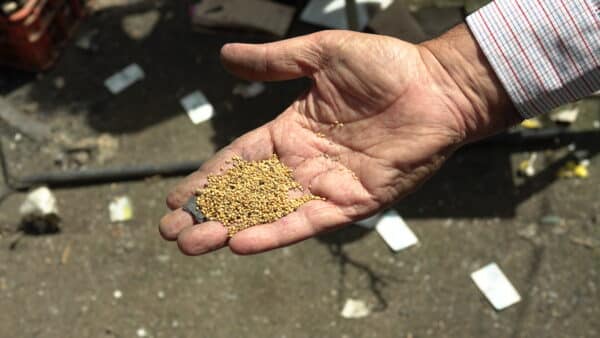
Sameer Al Junaidy, one of the four Al Junaidy brothers who owns and runs the nursery, says he doesn’t hire security because he would rather take damage to the property than put a Palestinian’s life at risk. Unarmed guards would be powerless against armed settlers, who regularly assault and murder local Palestinians.
The nursery is situated next to the illegal Shavei Shomron settlement, one of the West Bank’s first illegal settlements built in 1977 on land seized from Deir Sharaf and An-Naqura. Just before October 7, 2023, illegal settlers established an outpost on the other side of the nursery and have been intent on building a road that goes through it to connect them.
Since then, settlers have attacked the nursery at least five times. Recently, they set fire to bulldozers, a truck, and a forklift owned by the nursery. Settlers have also burned down olive trees, destroyed water pipes, and attacked Palestinians in neighboring communities. Footage from previous attacks that contains the assailants’ faces captured by Al Junaidy has been handed over to police, but no arrests were ever made.
Al Junaidy says that the Israeli Civil Administration told him that they understand how important the center is to West Bank agriculture and communities but they said: “There are two policies on the ground”, and some in the Israeli government want to see the assailants go unpunished. The nursery is also adjacent to Kedumin, the settlement where Israeli far-right Finance Minister Benzamar Smotrich lives, which is in the same council of settlements as Shavei Shomron.
The attack is a devasting blow to an already precarious food system in the besieged territory, bound to raise costs for local farmers who buy their seeds through the company. The nursery produces 80% of the West Bank’s olive tree saplings and all of its almond tree saplings, two crops central to Palestinian food security.
The destruction of over forty years of data could have far reaching impacts on agriculture across the West Bank. The data which has been lost included detailed information on how to best cultivate their thousands of seeds, meaning without this data, farmers may not know the ideal way to cultivate the crops. It is also used by agricultural engineering students at universities across Palestine.
Assaults on the West Bank’s economy and food systems through attacks like this one on the Al Junaidy Nursery are just one tactic in the occupiers’ overall project to ethnically cleanse the territory of all of its Palestinian inhabitants by disconnecting them from their land, their traditions, and the resources they need to survive.
Dozens missing after Israeli strike levels residential building in central Gaza
MEMO | September 23, 2025
At least 60 Palestinians are missing after an Israeli airstrike flattened a residential building in central Gaza City on Monday, local sources reported. Residents of the building were inside when it was bombed without prior warning, according to eyewitnesses.
The strike took place near the Shawa Building in the Al-Samar area, which itself has been threatened with attack. Gaza has come under heavy Israeli bombardment since 11 August as part of the army’s ongoing military campaign to seize control of the city.
Eyewitnesses said efforts to recover those trapped under the rubble are severely hampered by the lack of rescue equipment. Videos shared by Palestinians on social media showed the building reduced to rubble.
In one video, a woman—whose name was withheld—said her brother and his family were among those missing. Another man, standing nearby in tears, was heard calling out for his daughter trapped beneath the debris.
‘Peace through diplomacy’ is an excuse for collaboration with the Israelis
By Robert Inlakesh | Al Mayadeen | September 23, 2025
Following what has been widely dubbed as the failure of a recent emergency Arab-Islamic Summit, following the Israeli attack in Doha, many Arab Nations and political actors continue to pursue the concept of “peace through diplomacy”. This is not only a failed strategy, but also disingenuous.
The recent emergency conference, convened as a supposed step towards imposing a price on the Israelis for violating Qatari sovereignty and striking Doha, in a failed assassination attempt against Hamas leaders, has largely been dubbed a failure. Immediately after the conclusion of this summit, the Zionists escalated their terror bombing of Gaza City, and Israeli media announced the beginning of their ground operation to occupy the area.
Similarly, following the United Nations General Assembly (UNGA)’s adoption of the so-called “New York Declaration” on Palestinian Statehood, which is a combined Saudi-French initiative that is bringing about greater Western recognition of Palestine, the Israelis took it as a greenlight to escalate in the occupied West Bank.
Meanwhile, the Lebanese government and a range of ministers have adopted a plan towards disarming Hezbollah. Lebanese Prime Minister, Nawaf Salam, has also publicly stated his desire to normalise ties with the Zionist regime in a CNN interview, while claiming that diplomacy will be a sufficient response to force the Israelis to stop attacking his country.
Perhaps more embarrassingly, Syria’s ruler, Ahmad al-Sharaa, who is being widely mocked for his weak 50-second speech at the recent Arab-Islamic Summit, has now been offered a normalisation agreement by the Zionist regime, according to a report from Axios. This normalisation agreement is being sold as a “security deal”, yet has been compared to the 1979 Egyptian-Israeli normalisation accord.
In Syria, this so-called diplomatic approach will lead only to greater Israeli domination of the fractured nation. The Zionist entity demands that all of Syria south of Damascus be demilitarised, while it remains in the occupied Golan Heights, including the territory they just captured late last year. The Israelis were also revealed by Reuters to be funding around 3,000 militants in the Druze majority area of Suweida.
The Israeli demands in Syria are that they be allowed to have total air dominance and a corridor that would allow direct access to strike Iran, while the authorities in Damascus escalate their efforts to crack down on the Palestinian Resistance and prevent weapons transfers to Hezbollah in Lebanon.
As for the Lebanese government’s approach, the Israelis send their high-ranking officials to tour southern occupied Lebanon and forcefully assert that they will not leave the south of the country. They have carried out over 5,000 violations of the ceasefire agreement over the past year, continue to murder and abduct civilians, while the US-backed rulers in Beirut twiddle their thumbs and complain about Iran allegedly violating their sovereignty.
What is currently taking place is a public humiliation ritual against the Arab leaders, who behave like battered wives who refuse to admit that their rich husbands are abusive narcissists.
The Zionist Entity has bombed Gaza, the West Bank, Lebanon, Syria, Iraq, Yemen, Egypt, Qatar, Tunisia, and Iran over the past two years. Israeli Prime Minister Benjamin Netanyahu openly states that he pursues the so-called “Greater Israel” project, as he occupies more territory in Lebanon and Syria, threatening to annex the occupied West Bank and portions of Gaza too. The Israelis are even now threatening Egypt.
The leaders of the Arab and Islamic countries know all this, yet they continue to speak to their populations as if they are intellectually inferior to them and can’t figure out what is going on. The military spokesperson for the al-Qassam Brigades, Abu Obeida, stated in his last speech that these Arabs and Muslims are the enemies of Gaza and will one day be held accountable. His condemnation didn’t come out of nowhere, as he asserted that the whole Muslim world has failed to even deliver food to the people of Gaza.
Last year, prior to his assassination in Beirut, Sayed Hassan Nasrallah warned the Arab leaders that their complicity will come back to bite them, that they too would fall victim to the Zionists they have been collaborating with, and that nobody will be spared.
Frontline leaders in the battle against the Zionist regime have warned the Arab nations of what is to come, yet all of them decided to ignore these calls. Now, the chickens have come home to roost.
Featured Video

Bombing Hitler’s Hometown
or go to
Aletho News Archives – Video-Images
From the Archives
‘Conspiracy Theory’ Now Fact: Greater Israel Has Arrived
By Kit Klarenberg | Mint Press News | January 28, 2025
Ever since Tel Aviv’s 1948 creation, much has been said and written about ‘Greater Israel’ – the notion Zionism’s ultimate end goal is the forcible annexation and ethnic cleansing of vast swaths of Arab and Muslim lands for Jewish settlement, based on Biblical claims this territory was promised to Jews by God. The mainstream media typically dismisses this concept as antisemitic conspiracy theory, or at most the fringe fantasy of a minuscule handful of extremist Israelis.
In reality … continue
Blog Roll
 Aletho News
- Trump admits Iran hit USS Ford carrier: ‘We ran for our lives’
- Battle for Hungary: EU attacks on Orban are a sign of worse things to come
- Iraqi resistance conducts drone strike on US-run base in Syria
- Failing to Defeat Hezbollah, Israel & US Pressure Syria’s Ahmed al-Sharaa to Join War
- US-Israeli war on Iran drives global fertilizer prices up 40%
- Hezbollah’s Surprise Weapons Redefine Ground Battle with Israel
- Yemen joins fight against US, Israel by firing missiles at occupied territories
- Seizing the Kharg: Washington’s path to defeat in the Persian Gulf
- Iran reports 500 US casualties in strikes on covert US military sites
- Pro-Israel terrorist arrested before assassination of pro-Palestinian activist
- If Americans Knew
- Over 300 US service members wounded, majority have brain injuries – Not a ceasefire Day 169
- Researchers at Human Rights Watch Resign Over Blocked Report on Palestinian Refugee Return
- Jewish Groups Are Backing a War Americans Don’t Want
- Eric Fingerhut Thinks He’s the President of the Jews
- Top Jewish Philanthropists, Rabbis Urge Israeli President to Take Action Against ‘Jewish Extremists’
- Don’t Be Fooled. Zionist Leaders Have Always Wanted to Control Southern Lebanon
- Israel’s widespread use of torture is a core element of its genocide against the Palestinian people
- In Israel’s War on Iran, Many Middle East US Bases Rendered “All But Uninhabitable”
- ‘Burn the lawn’: Israel pursues ‘Rafah model’ in southern Lebanon
- A genocide here, an amputation there
- No Tricks Zone
- Devastating Assessment Of Comirnaty Vaccine By Former Senior Pfizer Europe Toxicologist
- New Study: CO2 Is ‘Effectively Negligible’ As An Explanatory Climate Change Factor Since 2000
- Former Pfizer Toxicologist Dr. Helmut Sterz Tells Bundestag Hearing Pfizer Vaccine Should Have Never Been Approved
- Energy Expert: Germany’s Nuclear Phaseout Was A “500 Billion Euro Mistake”
- New Research: South Australia’s Mid-Holocene Sea Surface Temperatures Were 4°C Warmer Than Today
- Storing Green Energy To Last Germany 10 Days Would Require A 60-Million Tonne Battery
- New Studies: UK Sea Levels Were 4 Meters Higher Than Today During The Mid-Holocene
- Destructive Green New Deal: German Energy And Metal Group Warns Of Drastic Crisis
- New Study Documents A 20-Year Pause In Arctic Sea Ice Decline – Driven By Internal Variability
- Wake-up Call: Survey Shows Majority Of Germans Now Favor Postponing Climate Targets!
 Aletho News