Last White Helmets in Aleppo: in lieu of a film review
By Tim Hayward | June 14, 2017
In the wake of Netflix’s Oscar winning The White Helmets comes the Sundance Festival Grand Jury Prize winning Last Men of Aleppo. According to early reviews, audiences leave screenings with a desperate feeling that something ought to be done, but with a sense of helplessness about not knowing what.[1]
While that is very understandable, there are some things we can know if we really want to, even though the film does not reveal them.
First, in case it is true that among audiences are people who wish there was something they could do to just make the bombing in Aleppo stop, I would mention that it has stopped. It stopped before Christmas 2016. The siege of Aleppo ended, and the citizens who had been trapped there, essentially as human shields, were able to leave. Most went to the Western part of the town that had remained under government control.[2] The fighters who had been in control of the eastern quarters were given amnesty and left town in green buses laid on by the Syrian government. They were allowed to take their handheld weapons. The White Helmets went with them to Idlib, although some may have gone to Turkey (where their video clips were edited into this new film).
Since their departure, law and order has been restored across the whole of Aleppo. The eastern part is no longer bombed. Nor does it any longer experience the kidnappings, rape, murder, crucifixion, torture, sexual exploitation and organ trafficking that had been permitted and perpetrated by the “rebels”. It also no longer serves as the launch pad for mortars and hell cannon fired into the civilian population in the Western part of town.[3]

Aleppo 2017
Citizens are returning and starting to rebuild their lives in East Aleppo. The White Helmets, meanwhile, are providing their services in the Al Qaeda held territory of Idlib.
Viewers of the film may find this puzzling news, given they’ll have heard ‘the White Helmets’ collective insistence that they’ll never abandon Aleppo’ and that ‘Aleppo will always be their home’.[4] The fact is no White Helmets operate in Aleppo now, just as none did before the “rebels” seized its Eastern part. Incidentally, the real Syrian Civil Defence volunteers, who have operated in areas under legitimate government since 1953, wear red helmets.[5]
Several further facts about the White Helmets are not much publicised either in the news media or these films. One is that they are not actually volunteers in the usual sense, for they are paid. The funding comes from foreign governments, notably UK and USA (as explained, respectively, by Boris Johnson and Mark Toner).
The White Helmets do not typically put others first, at least according to witnesses, and in Aleppo had a reputation for robbing the houses they entered and the people they helped.[6] Not that they helped ordinary citizens, for the most part, since it appears their main practical role was to provide support to the fighters.[7] Their filmed rescues are not all necessarily genuine.[8] Nor is it true that they assembled as a group spontaneously. This was the work of British military man James Le Mesurier, with funding from Western governments, notably Britain and America. He organised training for them in Turkey.
Among the White Helmets are fighters who, despite what we are told, can be seen with weapons.[9] They are also accessories at executions.[10]
A beauty of film is that it can conjure a world of pure imagination. When this potent capacity is applied in the making of a documentary it can make the material more compelling. It can, of course, also serve to manipulate and distort the evidence it presents.
The film does not aspire to help audiences understand better “what they can do” about the terrible situation in Syria. It tends to reinforce the received wisdom about the supposed heroes of Aleppo. But anybody wondering how truthful it is will want to review that received wisdom, and perhaps consider some of the now numerous critical accounts of the role the White Helmets have actually been playing in the Syrian war.
One might then also try to understand what the deep motivation is for Western media and even film industry award institutions to be involved in glorifying people who are at a maximum of one degree of separation from active terrorists. By thinking about this, one may better understand – unswayed by the artful manipulations of a motion picture – exactly what one should really be worrying about.
The West’s support for regime change wars has brought devastation to whole countries. Think about Iraq or Libya as well as Syria. It has brought refugees. It has involved allowing British citizens freely to train for jihad. It has allowed them to fight against legitimate governments abroad and return home. We have seen them here. We saw them in Manchester recently, and on Tower Bridge. I fear we may see more.
We live in a time, I believe, when it is vital to be challenging the assumptions that support the escalation of conflicts. While the message of White Helmets films may seem to be about the need for peace and humanity, their underlying function – and the reason for their being funded by hawkish governments – is to reinforce the need for intervention to overthrow another country’s government.
That is why I think films like this are not really best described as documentaries. For what the White Helmets are, as John Pilger has succinctly observed, is ‘a complete propaganda construct’.[11]
Not having seen the film ‘Last Men in Aleppo’, I am not in a position to recommend it. A short film I can recommend is this. At less than 4 minutes, a view of it will be time well spent if you are tempted to believe what is said in White Helmets promotional material.
Notes
[1] ‘I suspect it’s the filmmakers’ wish that once those initial feelings ebb, moviegoers will ask what they can do to help. This picture doesn’t offer hope; its aim is to compel us to create some.’ Glenn Kenny in the New York Times 2 May 2017 https://www.nytimes.com/2017/05/02/movies/last-men-in-aleppo-review.html?_r=0
[2] This is recorded by Aron Lund in an article that is by no means sympathetic to Assad’s government: https://www.irinnews.org/analysis/2017/04/12/eastern-aleppo-under-al-assad
[3] You would not know it from this film, or the Netflix one, or the Western media more generally, but the Western part of Aleppo is far more populous than the eastern part and has remained functioning – despite the incoming shells from the “rebel” areas – throughout the war.
[4] This is from the review by Vikram Murthi, 3 May 2017 http://www.rogerebert.com/reviews/last-men-in-aleppo-2017
[5] http://21stcenturywire.com/2017/04/02/the-real-syria-civil-defence-saving-real-syrians-not-oscar-winning-white-helmets-saving-al-qaeda/ This resource gives detailed information about the real Syrian civil defence as well as some further insight into operations by the White Helmets.
[6] See for instance this account by Aleppo journalist Khaled Iskef: https://www.youtube.com/watch?v=bSl1wT6Q0Lg . Indicative is this interview with a young boy from Aleppo: https://www.youtube.com/watch?v=WSBvd9i_jAs
[7] Abu Jaber Al-Sheikh, the leader of Hay’at Tahreer Al-Sham (Al-Qaeda in Syria) thanks the White Helmets and calls them “the hidden soldiers of the revolution”. This was part of his speech commemorating the 6th anniversary of the Jihadist insurgency in Syria: https://www.youtube.com/watch?v=lvTAi0MXY6w See also the evidence on the ground in Eastern Aleppo: https://www.youtube.com/watch?v=wpyCkk47Hhs
[8] We cannot be certain exactly what is and what is not staged in White Helmets films, but we can be certain of their capacity to make convincing fakes for the camera, since they demonstrated it with their notorious Mannequin Challenge video: https://www.youtube.com/watch?v=Zgl271A6LgQ .
[9] https://www.youtube.com/watch?v=5k6hSS6xBTw
[10] Evidence can be found on social media but I have opted not to link to it here since it is disturbingly graphic.
[11] https://www.youtube.com/watch?v=X27B0yuazGo. Since Pilger is known to be on the political left, it is interesting to note that a similarly critical view of the White Helmets is given by someone usually regarded as on the political right, Peter Hitchens: https://www.youtube.com/watch?v=iwjw0vkV7_I
Hollywood Honors Terrorism
By Stephen Lendman | February 27, 2017
Hollywood Academy Awards are all about film promotion for profits, unrelated to the industry’s best, way too little of it around.
They also reflect longstanding Tinseltown ties to Washington. Scripts feature pro-Western propaganda.
Studio bosses are well compensated for colluding in glorifying America’s wars and demonizing its enemies – including “Islamic terrorists” and Russia.
Washington has final say on content and characters in propaganda films. It wants its agenda promoted, most people none the wiser.
History is reinvented. The state-sponsored 9/11 event is exploited. Rogue CIA agents are portrayed as heroes. Supporting America’s imperial agenda is more important than truth.
In 2013, Argo was chosen Hollywood’s top film. It should have been denounced instead of honored – reinventing a 1979/1980 Iranian hostage crisis episode.
The film was malicious, unjust and one-sided, Hollywood propaganda at its worst, ignoring what should have been featured, stereotypically portraying Iran according to Western misinformation.
At Hollywood’s 89th Academy Awards on Sunday, the White Helmets propaganda film was honored as the past year’s best documentary short – portraying terrorists as heroes.
The group has nothing to do with civil defense as claimed, everything to do with supporting terrorism against sovereign independent Syria.
Its personnel operate in al-Nusra (al-Qaeda in Syria) controlled areas. Calling themselves volunteer rescue workers responsible for saving tens of thousands of lives is rubbish.
America and Britain support the group. So does the Soros Open Society Foundation and like-minded pro-Western interests.
White Helmets have been photographed and videotaped together with al-Nusra terrorists during beheadings and other atrocities. They support creation of a no-fly zone to prevent Syrian aerial self-defense.
The Syria Solidarity Movement calls them al Qaeda “with a facelift,” fostering terrorism and imperial ravaging on the pretext of humanitarianism.
People associated with the group are enemies of fundamental freedoms – warriors, not peacemakers, foreign-supported dark forces wanting tyranny replacing Syrian sovereign independence.
They were nominated for the 2016 Nobel Peace Prize. Instead it went to narco-state terrorist Juan Manuel Santos, Colombia’s president. As Alvaro Uribe’s defense minister, he was notorious for massacring “entire population centers,” James Petras explained.
Nobel committee members honored state terrorism. So did Hollywood last night in naming The White Helmets last year’s best documentary short.
Stephen Lendman can be reached at lendmanstephen@sbcglobal.net. His new book as editor and contributor is titled Flashpoint in Ukraine: How the US Drive for Hegemony Risks WW III.
The “White Helmets” Go to Hollywood

By Rick Sterling | Dissident Voice | February 21, 2017
The Netflix movie The White Helmets may win an Oscar in the “short documentary” category at the Academy Awards on Sunday February 26. It will not be a surprise, despite the fact that the group is a fraud and the movie is a contrived infomercial.
The White Helmets are a “feel good” story like a Disney hero movie: 90% myth and fabrication. Most of what is claimed about the Syrian rescue group is untrue. They are not primarily Syrian; the group was initiated by British military contractor James LeMesurier and has been heavily funded (about $100 million) by the USA, UK and other governments. They are not volunteers; they are paid. This is confirmed in the Al Jazeera video which shows some White Helmet “volunteers’ talking about going on strike if they don’t get paid soon. Most of the heavy funding goes to the marketing which is run by “The Syria Campaign” based in New York. The manager is an Irish America woman Anna Nolan who has never been to Syria. As an example of its deception, “The Syria Campaign” website features video showing children dancing and playing soccer implying they are part of the opposition demand for a “free and peaceful” Syria. But the video images are taken from a 2010 BBC documentary about education in Syria under the Baath government.

White Helmets and Nusra
When eastern Aleppo was finally freed from the armed militants, it was discovered that the White Helmets headquarters were alongside the headquarters of the Al Qaeda Syrian militant group. Civilians from east Aleppo reported that the White Helmets primarily responded when the militants were attacked. Soon after departing Aleppo in government supplied buses (!) the White Helmets showed up in the mountains above Damascus where they allied with terrorist groups in poisoning then shutting off the water source for five million people in Damascus.
The White Helmets’ claim to be neutral and independent is another lie. They only work in areas controlled by the rebel groups, primarily Nusra/Al Qaeda. Their leaders actively call for US and NATO intervention in Syria. Video shows White Helmet workers picking up the corpse of a civilian after execution and celebrating Nusra/Al Qaeda terrorist battle wins.

White Helmets and Nusra
The movie is as fraudulent as the group it tries to heroize. The film-makers never set foot in Syria. Their video footage takes place in southern Turkey where they show White Helmet trainees in a hotel and talking on cell phones. Thrilling. There is some footage from inside Syria but it looks contrived. The opening scene depicts a White Helmet “volunteer” going to work and beseeching his son not to give mommy a hard time. Real or scripted?
The message is simple: here are people we can support; they are under attack by the brutal “regime” … shouldn’t we “do something” to stop it??!

ISIS and One Finger Salute

White Helmets’ One Finger Salute
Khaled Khatib is said to be the person who filmed the footage from inside Syria. He has reportedly received a US visa and will attend the Oscars. This will likely garner special media attention. Ironically, some of those who have exploited the refugee issue for their own fund-raising campaigns, like Human Rights Watch, are groups which promote the war which created the refugee crisis.
Khatib has tweeted the first video he took showing the White Helmets. It looks remarkably unrealistic, with a girl who was totally buried being removed without injuries or wounds or even much dirt. Is it really possible to rescue people that quickly? In the real world, rescue workers are told to work slowly so as to not damage or exacerbate body injuries. The original video has the logo of Aleppo Media Center (AMC) which was created by the Syrian Expatriates Organization. Their address on K Street in Washington DC suggests this is yet another Western funded media campaign driven by political objectives.
In the past few days, with perfect timing for the upcoming Oscars, there is yet another “miracle” rescue … another girl totally buried but then removed and whisked away in record breaking time — perfect for social media. Is it real or is it contrived?
This raises a question regarding the integrity of the Academy Awards. Are awards given for actual quality, authenticity, skill and passion? Or are Oscars sometimes given under political and financial influence? There is political motivation to promote the White Helmets as part of the effort to prevent the collapse of the Western/Israeli/Gulf campaign to overthrow the Syrian government. These same governments have given boatloads of money to fuel the propaganda campaign. Last week Syria Solidarity Movement reached out to three marketing firms in the LA area to request help challenging the White Helmets nomination. Two of the firms declined and the third said they were already being paid to promote the nomination!
The true source and purpose of the White Helmets was exposed almost two years ago. More recently Vanessa Beeley has documented the fact there is a REAL Syrian Civil Defence which was begun in the 1950’s and is a member of the International Civil Defense Organizations. This organization is opposite to the group created in Turkey in 2013. According to on-the-ground interviews in Aleppo, terrorists began by killing real Syrian rescue workers and stealing their equipment. Since then the White Helmets have been supplied, by the West through Turkey, with brand new ambulances and related rescue equipment.
Max Blumenthal has written a two part detailed examination of the “shadowy PR firm” behind the “White Helmets”. And Jan Oberg has written an overview survey of the “pro” and “con” examinations in his work “Just How Gray are the White Helmets“.
Yet mainstream media, and some ‘alternative’ media, continue to uncritically promote the myth of the “White Helmets”. The promoters of the group absolutely deserve an award for marketing and advertising. This is a field where truth and reality is irrelevant; it’s all about sales and manipulation. On that basis, the “White Helmets” has been an incredible success. The group was started as “Syria Civil Defense” in Turkey in 2013. It was re-branded as the “White Helmets” in 2014. It was heavily used in 2014 and 2015 by Nicholas Krisof, Avaaz and others to campaign for all out aggression against Syria. In 2016 the group received the Rights Livelihood Award and was seriously considered for a Nobel Peace Prize. These facts show how corrupt and politically and financially influenced the Rights Livelihood Award and Nobel Peace Prize can be.

Meet the White Helmets
The White Helmets movie is a tactic in the ongoing campaign of distortion and deception around Syria. It’s a fraud, just like the fake kidnapping of NBC reporter Richard Engel. The Oscars will be a demonstration of the integrity of the Academy Awards. The reporting on the story will be a test of the integrity and accuracy of media outlets. Ironically, the Israeli mainstream TV program I24 presented both sides and titled the segment “White Helmets: Heroes or Hoax?” In contrast, the highly popular and widely respected DemocracyNow! has only broadcast a puff piece promoting the “White Helmet” disinformation. The coming days will reveal more about the ongoing information war against Syria. Meanwhile an on online petition continues to gather signatures to NOT give the Oscar to the White Helmets deception.
Rick Sterling is an investigative journalist and member of Syria Solidarity Movement. He can be reached at rsterling1@gmail.com.
Film about Israeli imprisonment of Palestinians wins top award in Berlin
By Celine Hagbard | IMEMC | February 21, 2017
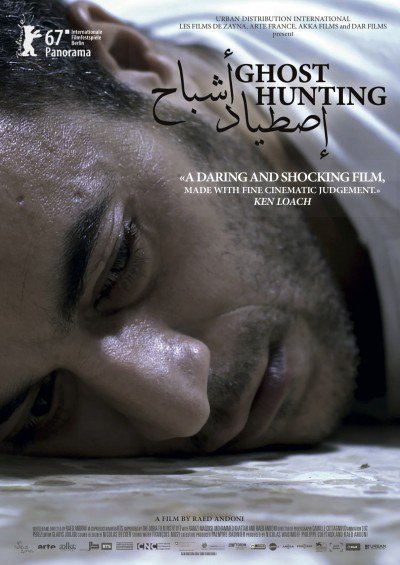 A film depicting the torture, humiliation and violence experienced by Palestinians imprisoned by Israel won the first ever “Silver Bear” award at the Berlinale international film festival.
The film, “Istiyad Ashbah” (Ghost Hunting), was produced by Palestinian filmmaker Raed Andoni.
It was one of 18 finalists competing for the top honor at the Berlinale film festival this year. The ‘Golden Bear’ award was won by Hungarian filmmaker Ildiko Enyedi for the film “Testrol es lelekrol” (On Body and Soul).
Andoni’s film “Ghost Hunting” involves a powerful re-enactment of interrogation rooms and prison facilities in the infamous ‘Russian Compound’ prison run by Israel.
According to journalist Rene Windangel, who spoke with Andoni about the creation of the film, the director began by confronting his own ghosts, having been imprisoned during the first intifada in the late 1980s. He then “turned to newspaper ads as he set out to find a group of former inmates able to work as set designers and craftsmen in recreating a prison on the film set. He also sought out ex-detainees willing to play the roles of prison wardens and prisoners. And so this group of people, who had themselves experienced imprisonment, began to meticulously build their own prison.”
German commentator Rene Windangel wrote in the paper ‘Qantara’, in a review of the film, “By giving the actors and crew room to express themselves, Andoni’s film manages to avoid cliches. In no way is the film limited to the observation of suffering or the re-enactment of victimisation. Raed Andoni’s film functions as both trauma therapy and as an opportunity to discuss the political problem of prisoners. First and foremost, though, the film works as an impressive piece of cinematography dealing with the basic questions of the human condition.”
Currently there are around 7000 Palestinian men and women imprisoned by Israel. Over 750,000 Palestinians have been imprisoned since 1967 and the start of the Israeli occupation of Gaza, the West Bank and East Jerusalem. Most were sentenced by military courts, while others were held without any charges in so-called “administrative detention”. There are practically no Palestinian families that have been spared the experience of prison.
The U.S. National Bird Is Now a Drone
By David Swanson | Let’s Try Democracy | October 27, 2016
Officially, of course, the national bird of the United States is that half-a-peace-sign that Philadelphia sports fans like to hold up at opposing teams. But unofficially, the film National Bird has it right: the national bird is a killer drone.
Finally, finally, finally, somebody allowed me to see this movie. And finally somebody made this movie. There have been several drone movies worth seeing, most of them fictional drama, and one very much worth avoiding (Eye in the Sky ). But National Bird is raw truth, not entirely unlike what you might fantasize media news reports would be in a magical world in which media outlets gave a damn about human life.
The first half of National Bird is the stories of three participants in the U.S. military’s drone murder program, as told by them. And then, just as you’re starting to think you’ll have to write that old familiar review that praises how well the stories of the victims among the aggressors were told but asks in exasperation whether any of the victims of the actual missiles have any stories, National Bird expands to include just what is so often missing, and even to combine the two narratives in a powerful way.
Heather Linebaugh wanted to protect people, benefit the world, travel, see the world, and use super cool technology. Apparently our society did not explain to her in time what it means to join the military. Now she suffers guilt, anxiety, moral injury, PTSD, sleep disorder, despair, and a sense of responsibility to speak out on behalf of friends, other veterans, who have killed themselves or become too alcoholic to speak for themselves. Linebaugh helped murder people with missiles from drones, and watched them die, and identified body parts or watched loved ones gather up body parts.
Even while still in the Air Force, Linebaugh was on a suicide watch list and had a psychologist recommend moving her to a different sort of job, but the Air Force refused. She has episodes. She sees things. She hears things. But she’s forbidden to discuss her work with friends or even with a therapist who doesn’t have the proper “security clearance.”
We let Daniel down even more than Heather. He says he actually opposed militarism but was homeless and desperate, so he joined the military. We could have given him a house for much less than we paid him to help murder people at Fort Meade.
Lisa Ling worked on a database filled by drone surveillance that compiled information on 121,000 “targets” in two years. Multiply that by a dozen years. With 90% of victims not among the targets, add up how many people would die in the targeting of the whole list. That’d be over 7 million. But it’s not numbers that have poisoned the souls of these three veterans; it’s children and mothers and brothers and uncles lying in pieces on the ground.
Ling travels to Afghanistan to see the place at ground level and to meet with drone victims. She meets a little boy who lost his leg and his 4-year-old brother and his sister and his father. On February 2, 2010, drone “pilots” at Creech Air Base murdered 23 innocent members of one family.
The filmmakers have voices read the written transcript of what the drone operators said to each other before, during, and after sending in the missiles that did the damage. This is worse than Collateral Murder. The people whose job it is to identify children and others who should not be murdered have identified children among the group of people being targeted. The “pilots” at Creech are eager to reject this information and to get on to killing as many people as they can. Their lust for blood drives the decision process. Only after they’ve killed 23 people do they recognize children among the survivors, and the lack of guns.
We see the bodies brought home to bury. Those injured describe their suffering, physical as well as mental. We see people being fitted with artificial legs. We hear Afghans describe their perception of drones. They imagine, just as many Americans may imagine, and just as viewers of Eye in the Sky would imagine, that drone operators have a clear, high resolution view of everything. In fact, they have a view of fuzzy little blobs on a computer screen that looks like it was created in the 1980s.
Linebaugh says there is no way to distinguish the little “civilian” blobs from little “militant” blobs. When Daniel hears President Obama claim that there is always near certainty that no civilians will be killed, Daniel explains that such knowledge is simply not possible. Linebaugh says she was often on the side of the conversation telling the “pilots” at Creech not to murder innocents, but that they always pushed for permission to kill.
Jesselyn Radack, attorney for whistleblowers, says in the film that the FBI told two whistleblowers that a terrorist group had put them on a kill list. She said that the FBI has also contacted Linebaugh’s family and warned her that “terrorists” have been searching for her name online, suggesting that she fix this problem by shutting up. (She had written an op-ed in the Guardian).
The FBI also raids Daniel’s house, arriving with 30 to 50 agents, badges, guns, cameras, and search warrants. They take away his papers, electronics, and phone. They tell him he is under investigation for a possible indictment under the Espionage Act. This is the World War I-era law for targeting foreign enemies that President Obama has made a routine of using to target domestic whistleblowers. While Obama has prosecuted more people under this law than did all previous presidents combined, we probably have no way of knowing how many people have been explicitly threatened with the possibility.
While we should be apologizing to, comforting, and aiding these young people rather than denying them the right to speak to anybody and threatening them with decades in prison, Lisa Ling did manage to find some kindness. Victims of drone strikes in Afghanistan told her that they forgave her. As the film ends, she’s planning another trip to Afghanistan.
Michael Moore Owes Me $4.99
By David Swanson | Let’s Try Democracy | October 28, 2016
Michael Moore has made some terrific movies in the past, and Where to Invade Next may be the best of them, but I expected Trumpland to be (1) about Trump, (2) funny, (3) honest, (4) at least relatively free of jokes glorifying mass murder. I was wrong on all counts and would like my $4.99 back, Michael.
Moore’s new movie is a film of him doing a stand-up comedy show about how wonderfully awesome Hillary Clinton is — except that he mentions Trump a bit at the beginning and he’s dead serious about Clinton being wonderfully awesome.
This film is a text book illustration of why rational arguments for lesser evilist voting do not work. Lesser evilists become self-delusionists. They identify with their lesser evil candidate and delude themselves into adoring the person. Moore is not pushing the “Elect her and then hold her accountable” stuff. He says we have a responsibility to “support her” and “get behind her,” and that if after two years — yes, TWO YEARS — she hasn’t lived up to a platform he’s fantasized for her, well then, never fear, because he, Michael Moore, will run a joke presidential campaign against her for the next two years (this from a guy who backed restricting the length of election campaigns in one of his better works).
Moore maintains that virtually all criticism of Hillary Clinton is nonsense. What do we think, he asks, that she asks how many millions of dollars you’ve put into the Clinton Foundation and then she agrees to bomb Yemen for you? Bwahahaha! Pretty funny. Except that Saudi Arabia put over $10 million into the Clinton Foundation, and while she was Secretary of State Boeing put in another $900,000, upon which Hillary Clinton reportedly made it her mission to get the planes sold to Saudi Arabia, despite legal restrictions — the planes now dropping U.S.-made bombs on Yemen with U.S. guidance, U.S. refueling mid-air, U.S. protection at the United Nations, and U.S. cover in the form of pop-culture distraction and deception from entertainers like Michael Moore.
Standing before a giant Air Force missile and enormous photos of Hillary Clinton, Michael Moore claims that substantive criticism of Clinton can consist of only two things, which he dismisses in a flash: her vote for a war on Iraq and her coziness with Wall Street. He says nothing more about what that “coziness” consists of, and he claims that she’s more or less apologized and learned her lesson on Iraq.
What? It wasn’t one vote. It was numerous votes to start the war, fund it, and escalate it. It was the lies to get it going and keep it going. It’s all the other wars before and since.
- She says President Obama was wrong not to launch missile strikes on Syria in 2013.
- She pushed hard for the overthrow of Qadaffi in 2011.
- She supported the coup government in Honduras in 2009.
- She has backed escalation and prolongation of war in Afghanistan.
- She skillfully promoted the White House justification for the war on Iraq.
- She does not hesitate to back the use of drones for targeted killing.
- She has consistently backed the military initiatives of Israel.
- She was not ashamed to laugh at the killing of Qadaffi.
- She has not hesitated to warn that she could obliterate Iran.
- She is eager to antagonize Russia.
- She helped facilitate a military coup in Ukraine.
- She has the financial support of the arms makers and many of their foreign customers.
- She waived restrictions at the State Department on selling weapons to Saudi Arabia, Algeria, Kuwait, United Arab Emirates, Oman, and Qatar, all states wise enough to donate to the Clinton Foundation.
- She supported President Bill Clinton’s wars and the power of the president to make war without Congress.
- She has advocated for arming fighters in Syria and for a “No Fly” zone.
- She supported a surge in Iraq even before President Bush did.
That’s just her war problem. What about her banking problem, prison problem, fracking problem, corporate trade problem, corporate healthcare problem, climate change problem, labor problem, Social Security problem, etc.?
Moore parts company from substantive critique in order to lament unproven rightwing claims that Hillary Clinton has murdered various people. “I hope she did,” screams Moore. “That’s who I want as Commander in Chief!” Hee hee hee.
Then Moore shamelessly pushes the myth that Hillary tried to create single-payer, or at least “universal” healthcare (whatever that is) in the 1990s. In fact, as I heard Paul Wellstone tell it, single-payer easily won the support of Clinton’s focus group, but she buried it for her corporate pals and produced the phonebook-size monstrosity that was dead on arrival but reborn in another form years later as Obamacare. She killed single-payer then, has not supported it since, and does not propose it now. (Well, she does admit in private that it’s the only thing that works, as her husband essentially blurts out in public.) But Moore claims that because we didn’t create “universal” healthcare in the 1990s we all have the blood of millions on our hands, millions whom Hillary would have saved had we let her.
Moore openly fantasizes: what would it be like if Hillary Clinton is secretly progressive? Remember that Moore and many others did the exact same thing with Obama eight years ago. To prove Clinton’s progressiveness Moore plays an audio clip of her giving a speech at age 22 in which she does not hint at any position on any issue whatsoever.
Mostly, however, Moore informs us that Hillary Clinton is female. He anticipates “that glorious moment when the other gender has a chance to run this world and kick some righteous ass.” Now tell me please, dear world, if your ass is kicked by killers working for a female president will you feel better about it? How do you like Moore’s inclusive comments throughout his performance: “We’re all Americans, right?”
Moore’s fantasy is that Clinton will dash off a giant pile of executive orders, just writing Congress out of the government — executive orders doing things like releasing all nonviolent drug offenders from prison immediately (something the real Hillary Clinton would oppose in every way she could).
But when he runs for president, Moore says, he’ll give everybody free drugs.
I’ll tell you the Clinton ad I’d like to see. She’s standing over a stove holding an egg. “This is your brain,” she says solemnly, cracking it into the pan with a sizzle. “This is your brain on partisanship.”

Destroying the Magnitsky Myth
By Gilbert Doctorow | Consortium News | June 21, 2016
Despite all the threats of lawsuits and physical intimidation which hedge fund executive William Browder brought to bear over the past couple of months to ensure that a remarkable investigative film about the so-called Magnitsky case would not be screened anywhere, it was shown privately in a museum of journalism in Washington, D.C., last week.
The failure of the intimidation may give heart to others. There is talk that the film may be shown publicly in Norway, where its production company is located, but where an attempt several weeks ago to enter it into a local festival for documentaries was rejected by the hosts for fear of lawsuits. Moreover, a Norwegian court has in the past week declined to hear the libel charges which Browder’s attorneys were seeking to bring against the film’s director and producers.
Browder was more successful in intimidating the European Parliament where a screening of the film was cancelled in late April while I was in the audience. But I have now seen the banned documentary privately and “The Magnitsky Act. Behind the Scenes” is truly an amazing film that takes the viewer through the thought processes of well-known independent film maker Andrei Nekrasov as he sorts through the evidence.
At the outset of his project, Nekrasov planned to produce a docu-drama that would be one more public confirmation of the narrative that Browder has sold to the U.S. Congress and to the American and European political elites, that a 36-year-old whistleblower “attorney” (actually an accountant) named Sergei Magnitsky was arrested, tortured and murdered by Russian authorities for exposing a $230 million tax fraud scheme.
This shocking tale of alleged Russian official corruption and brutality drove legislation that was a major landmark in the descent of U.S.-Russian relations under President Barack Obama to a level rivaling the worst days of the Cold War.
But what the film shows is how Nekrasov, as he detected loose ends to the official story, begins to unravel Browder’s fabrication which was designed to conceal his own corporate responsibility for the criminal theft of the money. As Browder’s widely accepted story collapses, Magnitsky is revealed not to be a whistleblower but a likely abettor to the fraud who died in prison not from an official assassination but from banal neglect of his medical condition.
The cinematic qualities of the film are evident. Nekrasov is highly experienced as a maker of documentaries enjoying a Europe-wide reputation. What sets this work apart from the “trade” is the honesty and the integrity of the filmmaker as he discovers midway into his project that key assumptions of his script are faulty and begins an independent investigation to get at the truth.
An Inconvenient Truth
It is an inconvenient truth that he stumbles upon, because it takes him out of his familiar milieu of “creative people” who are instinctively critical of the Putin regime and of its widely assumed violation of human rights and civil liberties.
We see how well-known names in the European Parliament, in the Parliamentary Assembly of the Council of Europe and in NGOs that are reputed to be watchdogs have taken on faith the arguments and documentation (largely in Russian and inaccessible to them) which they received from William Browder and then rubber-stamped his story as validated without making any attempt to weigh the evidence.
Their intellectual laziness and complacency is captured fully on film and requires no commentary by the director. One of those especially skewered by her own words is German Bundestag deputy (Greens) Marieluise Beck. It is understandable to me now that I have viewed the film why she was one of the two individuals whose objections to its showing scuttled the screening in the European Parliament in April.
By the end of the documentary, Nekrasov finds that he has become a dissident in his own subculture within Russia and in European liberal circles.
Another exceptional and striking characteristic of the filmmaker is his energetic pursuit of all imaginable leads in his investigative reporting. Some leads end in “no comment” while others result in exposing whole new areas of lies and deception in the Browder narrative.
Nekrasov’s diligence is exemplary even as he takes us into the more arcane aspects of the case such as the money flow from the alleged tax fraud. These bits and pieces are essential to his methodology and justify the length of the movie, which approaches two hours.
Nekrasov largely allows William Browder to self-destruct under the weight of his own lies and the contradictions in his story-telling at various times. Nekrasov’s camera is always running, even if his subjects are not thinking about the consequences of being taped. The film also shows a videotaped deposition of Browder fumbling during an interrogation in a related civil case that is devastating to those politicians and commentators who fully swallowed Browder’s Magnitsky line.
Browder’s supposed lapses of memory, set in the context of involuntary facial expressions of stress and nervousness, would be compelling to jurors if this matter ever got into an open court of law in an adversarial proceeding.
At the end of the twists and turns in this expose, the viewer is ready to see Browder sink through the floor on a direct transfer to hell like Don Giovanni in the closing scene of Mozart’s opera. Nothing so colorful occurs, but it is hard to see how Browder can survive the onslaught of this film if and when it gets wide public viewing.
But the goal of many powerful people, including members of the U.S. Congress, the European Parliament and the Western news media who gullibly accepted Browder’s tale, will be to ensure that the public never gets to see this devastatingly frank deconstruction of a geopolitically useful anti-Russian propaganda theme.
Gilbert Doctorow is the European Coordinator of The American Committee for East West Accord. His most recent book, Does Russia Have a Future? was published in August 2015.
© Gilbert Doctorow, 2016
Israel Lobby Fails to Block Screening of Palestinian Film at Cannes
teleSUR – May 18, 2016
Despite the efforts of Israeli lobby groups, a Palestinian film about the 1972 Munich Olympics events was screened at the Cannes Film Festival’s Marche Marche du Film in Paris Monday as planned.
An excerpt of Nasri Hajjaj’s documentary, Munich: A Palestinian Story, was shown to film industry professionals in partnership with the Cannes Film Festival and the Dubai International Film Festival.
Hajjaj’s documentary came under attack by Israeli lobby groups who claimed that the film wrongly accuses German security forces for the deaths of 11 Israeli athletes, a German police officer and five hostage-takers at the 1972 Munich Olympics after a raid by the Palestinian group Black September.
The biggest lobbying group, the Council of Jewish Organizations in France, claimed that the film was an example of “historical revisionism” about the event.
Lobby groups reportedly put intense pressure on the organizers for the film to be banned.
Hajjaj, a former journalist who grew up in a Palestinian refugee camp, said that lobby groups and other critics made false claims about his documentary, which none of them have seen.
“Eight films have been made on the Munich chapter, but none of them are Palestinian or Arab. I want to present the Palestinian version of this story, which is not necessarily uncritical of the operation and its sequences,” Hajjaj was quoted as saying on the Dubai International Film Festival website.
Featured Video

The Most Important Bet You’ve Never Heard Of
or go to
Aletho News Archives – Video-Images
From the Archives
The Occupied Mentality Syndrome
Saudi Arabia on the American chessboard – Part 2
By B. J. Sabri | American Herald Tribune | April 19, 2016
Since the Korean War, but particularly since the Iranian Revolution of 1979 until today, the United States has been steadily escalating its military presence in the Persian Gulf. Taking advantage of many colossal events of the past 36 years, [1] the hyper-empire has institutionalized its massive presence on land and sea, and expanded its objectives to include the unambiguous physical control of the area, as well as the clear understanding that local Arab governments should abide by them. The pretext is always the same: in “defense” of the national interests and security of the United States. From observing how the United States has been interacting with the governments of the region, and by judging from the size of its expeditionary force, we could reach a basic conclusion. The United States is occupying, de facto, the entire Arabian Peninsula. (Yemen, devastated by Saudi and American jets is yet to be conquered. Oman? Britain returned not as colonial ruler but as a soft occupying power.)
Under this articulation, Saudi Arabia, Qatar, Kuwait, and the United Arab Emirates are virtually occupied countries. If we compare this type of occupation to the mandate and protectorate regimes of the past, the results might be identical—the nations affected by it lose sovereignty. When Arab governments comply with the objectives of a foreign power that station military forces on their national milieu, then that power controls them in multiple ways including how they react to policy deliberations and what decisions they intend to take on specific issues. A good method to verify the concept of effective occupation is this: take notice of what the United States says and wants, and then compare it to what the gulf rulers do in response. (I shall discuss this detail at some point in the upcoming parts.)
If the presence of US forces or other means of political pressure are a factor in Saudi Arabia’s interventionist Arab wars, then we need to debate this issue. However, from the history of resistance to colonialism, we learnt: if a powerful state imposes its order on a nation by military means or other forms of coercion, and if this nation does not resist that imposition, then a mental subordination to the powerful state will ensue. This is especially true in the case of Saudi Arabia. One single event, 9/11, has transformed it from a US “ally” into an instant political hostage of the American Empire. … continue
Blog Roll
 Aletho News
- Official reveals evidence of Arab states’ involvement in US-Israeli war on Iran
- His Majesty’s head-chopper: Syria’s MI6-backed president bows to King Charles
- Forced to backtrack: ‘Israel’ drops Hezbollah disarmament goal
- Britain’s Lebanon surveillance network: A digital map for war
- Bahrain faces scrutiny for opposition crackdown after detainee killed
- Hegseth’s Pentagon Purge Designed to Prevent a Mutiny: Karen Kwiatkowski
- Greek shipping firms secretly transporting oil, weapons to Israel
- UN vote on Hormuz force delayed as Iran issues warning
- Trump and the debris of Iran war
- IRGC hits US tech giant Oracle’s data center, computing site in UAE over new assassinations
- If Americans Knew
- Israel-US kill negotiators, destroy civilian structures, but Iran’s military capabilities still largely intact – Daily Update
- ‘War crime’: Global condemnation as Israeli ministers celebrate death penalty law targeting Palestinian prisoners
- 7 Ways Israel Is Turning Lebanon Into Gaza
- World’s Leading Football Bodies Under Fire Over Israel Policies
- Experts warn of possible use of nukes against Iran
- Israeli invasion of Lebanon could be worse than 1982, warn European officials
- Passover: Liberation and collective punishment
- Trump says the quiet part out loud: (Israel’s) war on Iran > Americans’ health – Daily Update
- Gaza families reunite years after babies evacuated amid Israel’s war
- International Rescue Committee warns Gaza’s children face grave protection risks
- No Tricks Zone
- Low Intensity Tornado Wrecks Major Solar Farm, Creating A Potential Toxic Dump
- New Study Finds Warming Saves Lives…Cold Temperatures 12 Times More Deadly Than Excess Heat
- German Science Blog Accuses PIK Climate Institute Of Hallucinating Climate Tipping Points
- Devastating Assessment Of Comirnaty Vaccine By Former Senior Pfizer Europe Toxicologist
- New Study: CO2 Is ‘Effectively Negligible’ As An Explanatory Climate Change Factor Since 2000
- Former Pfizer Toxicologist Dr. Helmut Sterz Tells Bundestag Hearing Pfizer Vaccine Should Have Never Been Approved
- Energy Expert: Germany’s Nuclear Phaseout Was A “500 Billion Euro Mistake”
- New Research: South Australia’s Mid-Holocene Sea Surface Temperatures Were 4°C Warmer Than Today
- Storing Green Energy To Last Germany 10 Days Would Require A 60-Million Tonne Battery
- New Studies: UK Sea Levels Were 4 Meters Higher Than Today During The Mid-Holocene
 Aletho News