Free Speech Groups Call on Congress To Block NewsGuard Funding
By Didi Rankovic | Reclaim The Net | November 26, 2023
As many as 36 groups advocating free speech, the Free Speech Alliance, have turned to US Congress with a request to stop any further funding of NewsGuard.
NewsGuard is an outfit that describes itself as countering “misinformation on behalf of news consumers, brands and democracies.”
That “mission” also includes (trust) rating system for news sites – right in people’s browsers.
But members of the Free Speech Alliance, and those supporting it are not buying this pitch, summing up and denouncing NewsGuard instead as an ideologically-motivated “internet traffic cop.”
And they are warning that taxpayer money should never have been spent on financing it, and its ilk – and even less so, that the US authorities should continue to spend taxpayer money on what is described as politically motivated censorship of speech.
And these free speech groups want Congress to make sure the Biden White House is prevented from bankrolling such an organization – a particularly sensitive issue given the stage of the election cycle in the country – via the National Defense Authorization Act (NDAA).
In a letter this week, Senate Republican leader Mitch McConnell and House Speaker Mike Johnson are urged to make sure Congressman Richard McCormick’s free speech amendment to the NDAA sticks.
We obtained a copy of the letter for you here.
It seeks to ensure that the Department of Defense (DoD) is prevented from handing out contracts to NewsGuard and others, such as another highly controversial group, the Global Disinformation Index (GDI).
The complaint against them is that they show obvious and damaging ideological and political bias against the media in the right-oriented space.
The letter comes in the context of the news that NewsGuard and GDI thus far received money from the DoD, and the Department of State, respectively (NewsGuard to the tune of $750,000 from the DoD).
“As shown by two MRC (Media Research Center, one of the letter’s signatories) Free Speech America studies, NewsGuard’s ratings are heavily skewed in favor of leftist media and consistently target right-leaning outlets with scathingly low ratings,” it is stated by NewBusters.
As for GDI, its track record includes blacklisting the New York Post, The Daily Wire, Real Clear Politics and The Federalist.
The key point of the letter is that in case a (private, or NGO) organization is suspected of having political bias – well, that’s unconstitutional for a US government to support financially.
And a very pertinent point is made in the letter, regarding the “outsourcing of censorship.” Namely:
“That which government is constitutionally prohibited from doing, it cannot contract with others to do. Please ensure that Section 1532 is preserved in the final version of the NDAA.”
Explainer: Why are Celtic fans staunch supporters of Palestinian cause?

By Ivan Kesic | Press TV | November 26, 2023
Amid the Israeli regime’s devastating blitzkrieg on the blockaded Gaza Strip, a football club based in Glasgow has grabbed headlines in recent weeks for its support of Palestine.
Despite the Union of European Football Associations (UEFA) slapping fine on the Celtic Football Club, the club fans have vowed to continue their support for Palestine against the Israeli occupation.
On Wednesday, Europe’s top football body announced a new fine of $19,000 against the club over a “number of incidents” during its Champions League match against Atletico Madrid in late October, which ended in a 2-2 draw.
Celtic was ordered to shell out €17,500 for its supporters’ displaying “a provocative message of an offensive nature,” €8,000 for “blocking of public passageways” and €3,500 for “lighting of fireworks.”
The club fans, led by the Green Brigade group, were heard singing ‘You’ll Never Walk Alone’ while unfurling two large banners that read ‘Free Palestine’ and ‘Victory to the Resistance’.
The Green Brigade was banned by the Scottish club in October from attending its away matches but has remained insistent on showing support for Palestine by displaying its flags at Celtic matches.
Two pro-Palestinian displays
The incident took place at the match between Celtic and Atletico on October 25 at the club’s home ground Celtic Park in Glasgow, attended by 60,000 Celtic fans, including the Green Brigade group.
As the start of the Champions League group stage match approached, the stadium turned into a sea of Palestinian flags, every stand awash with the colors of Palestine in a show of solidarity with those bombed and killed by the Israeli occupying regime in the Gaza Strip.
A few days earlier, after a home match against Kilmarnock, Celtic fans strongly criticized the broadcasters for not wanting to show the North Curve corner section with Palestinian flags displayed.
This time the media was not able to cover up anything because the Palestinian symbolism was not limited to one corner of the stand, but the whole stadium was painted with colors of the Palestinian flag.
Spectacular photos and videos of pro-Palestinian Celtic fans, singing collectively “You’ll Never Walk Alone,” quickly spread around the world and were shared by millions of netizens on social media.
During the earlier Scottish premiership match against Kilmarnock in Glasgow on October 7, the Green Brigade displayed two large banners saying “Free Palestine” and “Victory to the Resistance.”
Defiance of club appeals
Two days after the 3-1 victory against Kilmarnock, the club’s board distanced itself from the fan group’s show of solidarity, issuing a statement saying “Celtic is a football club and not a political organization.”
“We ask that banners, flags and symbols relating to the conflict and those countries involved in it are not displayed at Celtic Park at this time,” the club said in a statement before the game against Atletico.
However, the Green Brigade ignored the club’s directives and, on the contrary, called on all Celtic fans to raise the Palestine flag during the club’s UEFA Champions League match.
“We must apply learning from apartheid South Africa to dismantle apartheid Israel; if we are neutral in situations of injustice, we have chosen the side of the oppressor,” the Green Brigade said in a counter-statement.
“We send our sincere solidarity and prayers to our friends across all of Palestine at this traumatic time when yet again much of the international community turns its back in cowardice while war crimes are inflicted on a largely defenseless, imprisoned population.”
Keeping the fan tradition
In another statement, issued as a response to the club’s appeals, the Green Brigade also highlighted their tradition of supporting the oppressed and criticized hypocrisy by the political and media class.
“Football remains one of the few areas of public life where working-class people have genuine political agency, and we will not be dictated to by an elitist board that has repeatedly demonstrated contempt for the history and traditions of Celtic FC,” the fan club said.
“Celtic was born out of famine and oppression, a product of colonial rule, death and the mass displacement of people. It is because of this history that Celtic fans are renowned for their empathy and solidarity; consistently siding with the oppressed and destitute,” they added.
It slammed the “hypocrisy” of the club staff, which it said is in line with “much of the political and media class, epitomized through the example of Ukraine.”
“Political messaging was welcome at Celtic Park then, yet it is being condemned now,” the statement noted. “The question on any reasonable mind should be – why? Why are Ukrainian lives more sacred than Palestinian lives.”
The fans referred to the fact that some months ago, pro-Ukrainian support on the pitches and sports stadiums was not prohibited but encouraged, ibyUEFA’s official policy.
While the Green Brigade is renowned for its Irish Republicanism and steadfast support for Palestine, fans of Celtic’s local rival Rangers have in turn supported the Israeli regime when facing Celtic.
In recent weeks, Rangers fans have waved Israeli regime flags and held a minute’s silence for the Israeli victims, but the club has not been punished for such actions.
Humanity of the club
The support of Celtic fans is much more than waving flags and is not a result of the ongoing Israeli aggression on Gaza, they have been organizing pro-Palestinian support since the 2000s.
In 2012, they organized a display of solidarity with Palestinian prisoners on hunger strike, featuring a banner reading “Dignity is More Precious than Food” alongside Palestinian flags.
Their most noble pro-Palestinian action came in 2016 after UEFA fined them £8,600 for flying Palestinian flags in a match against Israeli club Hapoel Beer-Sheva.
Defiant as always, the Green Brigade launched a crowdfunding campaign and ultimately a remarkable £176,076 was raised and split between two beneficiaries that provide medical aid to Palestinians.
One of the results of those donations was the establishment of the refugee football club Aida Celtic, based in the Palestinian city of Bethlehem.
The Green Brigade has continued with humanitarian actions in recent weeks, collecting donations for health organizations that help the Palestinian people.
Interestingly, the club was formed in 1888 by Brother Walfrid, an Irish Catholic cleric, to raise money for poor Irish immigrants in the West of Scotland, according to reports.
So, as it appears, the foundation of the Scottish club itself was based on a human cause.
Silenced: Journalists in Gaza, south Lebanon killed for exposing Zionist crimes

By Humaira Ahad | Press TV | November 25, 2023
“Life will not last, hug those you love.” This was a post the 25-year-old Lebanese journalist Farah Omar had pinned on her X account, formerly Twitter, days before her killing.
Omar and her colleague Rabih al-Maamari, Beirut-based journalists, were killed in an Israeli airstrike on Tuesday while reporting from the outskirts of the town of Tayr Harfa – about 3.5 kilometers from the Lebanese border with occupied territories.
A video clip of the location where they were targeted showed bodies strewn in an open field, a camera mounted on a tripod and press vests scattered all around the place.
Omar had been working as an editor and correspondent for the Lebanon-based Al Mayadeen news network since 2021.
The intrepid journalist had covered important events for the channel, including the Turkish presidential elections in May and the Lebanese parliamentary elections in 2022.
“Farah is gone, but there will be a million more like her… What happened is an offering for the sake of Sayyed Hassan Nasrallah (the leader of the Lebanese Hezbollah resistance group), and the resistance will live on,” the grieving father said at his daughter’s funeral.
In her last tweet, the young war reporter had lauded Yemen’s Ansarallah resistance movement for seizing an Israeli ship, calling it “a heroic and honorable act.”
“Known for her bravery, Farah insisted on covering the unfolding events in southern Lebanon, conveying the truth, and giving the ultimate sacrifice in pursuit of her message,” her employers said in a statement after her tragic death.
A senior Al Mayadeen photojournalist Maamari, also killed in the attack, was working with the Beirut-based news network since 2012. Father of two children, aged 4 and 2 respectively, he was an important member of Al Mayadeen’s news team.
The 44-year-old photojournalist was in the field since October 7, covering all developments in southern Lebanon amid the Israeli regime’s indiscriminate shelling.
In its condolence message, the Lebanese resistance group Hezbollah condemned the heinous crime, extending its commiserations to the Al Mayadeen channel and the families of the two martyrs, asserting that the Israeli aggression “will not go unanswered.”
In his statement, the Lebanese caretaker prime minister, Najib Mikati said the attack “proves once again that there are no limits to Israeli crimes, and that its only goal is to silence the media that exposes its crimes.”
Al Mayadeen’s director Ghassan Bin Jeddou, in his statement, said “Every correspondent in Lebanon today feels like Farah and every cameraman in Lebanon also feels like Rabih.”
Shooting the messenger
The killing of two Lebanese journalists came amid a spate of murderous attacks by the Israeli regime on journalists in both southern Lebanon and the Gaza Strip since October 7.
As of November 25, the Committee to Protect Journalists (CPJ) says at least 53 journalists and media workers are among more than 14,000 Palestinians killed in the besieged Gaza Strip since the no-holds-barred onslaught was launched seven weeks ago.
Independent Palestinian groups have put the number of fatalities of journalists much higher.
The Palestinian Journalists Syndicate, in a statement on Saturday, said 66 journalists and media professionals have been killed in the Israeli aggression on the Gaza Strip since October 7.
A day before the killing of Omar and Maamari, a Palestinian freelance journalist Ayat Khadoura was killed along with her family members in an Israeli strike on her home in Beit Lahya, northern Gaza.
On November 6, Khadoura shared a video called “my last message to the world”, in which she said: “We had big dreams but our dream now is to be killed in one piece so they know who we are.”
On the same day that Khadoura was killed, Alaa Taher Al-Hassanat, a Palestinian journalist and presenter at AlMajedat Media Network, was also killed with her family members.
A day before their killing, on November 19, Jadallah, a prominent Palestinian journalist and director of Press House-Palestine was killed in his car in Gaza in an Israeli airstrike.
On November 18, Abdelhalim Awad, a media worker and driver for the Al-Aqsa TV was killed in an Israeli airstrike. His killing came hours after Mansour, director of the Quds News Network, and his colleague Hassouneh Salim were killed in an airstrike on the Bureij refugee camp in central Gaza.
Hassouneh Salim, a Palestinian freelance photojournalist, was also killed in the same airstrike on the Bureij refugee camp. Mostafa El Sawaf, a Gaza-based writer and analyst was also killed on the same day with his wife and two sons in an Israeli airstrike on his home in Gaza City.
Amro Salah Abu Hayah, a media worker with Al-Aqsa TV, and Ashour, a photojournalist, were also killed the same day in separate attacks. Ashour’s killing reportedly has taken place before.
Ahmed Fatima, a photojournalist for Al Qahera TV and a worker with Press House Palestine, was killed on November 13. The same day, Yaacoub Al-Barsh, a director of the Namaa Radio, succumbed to his injuries sustained in an attack a November 12.
On November 10, Ahmed Al-Qara, a photojournalist who worked for Al-Aqsa University and was a freelance journalist, was killed in an Israeli airstrike near Khan Yunis.
Three days before that, Yahya Abu Manih, a journalist with A-Aqsa radio station, was killed in a strike in Gaza City. Mohamed Abu Hassira, who worked for Wafa news agency, was also killed on the same day along with 42 members of his extended family.
Mohamed Al Jaja, a consultant at Press House Palestine, was killed in an airstrike with his wife and two daughters on November 5 in the Al-Naser neighborhood in northern Gaza.
On November 2, Mohammed Abu Hatab, a journalist and correspondent for Palestine TV was killed along with 11 members of his family in an Israeli airstrike on their home in Khan Yunis.
A day before that, Majd Fadl Arandas, a member of the Palestinian Journalists Syndicate, was killed in an airstrike on the Nuseirat refugee camp in the Gaza Strip. Iyad Matar, an Al-Aqsa TV journalist, was also killed earlier that day with his mother in the Gaza Strip.
Gaza – cemetery of journalists
It was the continuation of the killing spree of journalists in the Gaza Strip, occupied West Bank and southern Lebanon that started on October 7.
In the last seven weeks, hundreds of other journalists have also been reported missing, detained, or injured or their media offices and homes have been damaged in Israeli strikes.
The attack on Omar and Maamari was not an isolated incident in southern Lebanon. Israeli regime attacked a group of journalists there on 13 October as well, killing Essam Abdullah of Reuters and wounding three other journalists working for AFP and Al Jazeera.
CPJ President Jodie Ginsberg has dubbed the Israeli aggression since October 7 as the “deadliest period for journalists covering conflicts that CPJ has ever documented”, adding that they have been recording attacks on journalists for more than thirty years worldwide.
In a statement, an organization for journalists in the Middle East and North Africa, CPJ MENA called for an “independent investigation” into the killing of journalists and emphasized that “journalists are civilians doing important work during times of crisis and must not be targeted by warring parties.”
Describing Gaza as the “cemetery of journalists,” Reporters Without Borders (RSF) also voiced its concerns over journalism being eradicated in the Gaza Strip as a result of Israel’s aggression and a refusal to heed calls to protect media personnel.
“This rate of attrition among media workers has deeply shocked journalists the world over. No one can watch the growing tally of fallen colleagues without mounting horror,” Anthony Bellanger, the secretary-general for the International Federation of Journalists (IFJ), said in a statement on November 2.
RSF asserted that journalists were clearly identifiable by the virtue of wearing press vests and that missiles that struck them came from occupied Palestinian territories.
The Paris-based organization also submitted a complaint to the International Criminal Court (ICC) on October 31, saying the Israeli regime perpetrated war crimes against journalists in Gaza.
On Wednesday, Jonathan Dagher, the head of RSF’s West Asia desk said this is “one of the deadliest tolls in a century”, adding that “reporters there have no safe refuge and no way of leaving.”
“They are being killed one after another. Since 7 October, the Palestinian territory has been subjected to a veritable eradication of journalism,” he said.
Microsoft’s ‘Democracy Forward’ Initiative Aims to Manipulate Our Society
Plans to To ‘Shape Information Ecosystem’, ‘Integrate Into Election Software’, ‘Provide Election Security’, and much more.
BY IGOR CHUDOV | NOVEMBER 24, 2023
Microsoft, founded in 1975 by Bill Gates, is a software firm that developed and owns monopoly rights to the famous Windows operating system.
My readers might be surprised to learn that Microsoft’s interests go far beyond the computer software market and involve inserting itself into every aspect of many civil societies’ decision-making. Its plans affect the most essential parts of our collective, democratic decision-making in ways that raise multiple questions.
Take a look at its “Democracy Forward” initiative.
Microsoft is actively doing the following (direct quotes below):
- Deeply involves itself with elections in various countries, emphasizing what it calls “election integrity”.
- Provides software called ElectionGuard to be integrated with all election software systems to be used along with vote counting.
- Preserves and supports journalism (that aligns with Microsoft’s goals) and helps with pre-publication review (!).
- Helps local publications create business models for sustainable journalism, thus sponsoring journalism.
- Partners with NewsGuard, a “trust” service ranking news sources based on highly biased fact-checks.
All of the above efforts are highly partisan and quite peculiar.
Microsoft aims to control discourse and elections in many ways, allowing it to steer our decision-making process to benefit Microsoft or its leadership. Let’s consider their activities a bit more closely:
Microsoft aims to “support trustworthy news sources,” leaving the selection of outfits to be supported mainly to itself.
Working directly in five communities across the country, Microsoft, in partnership with community foundations and other organizations, is providing new tools, technology, and capacity to explore hybrid business models for sustainable journalism to journalists and newsrooms.
I am sure that newsrooms and journalists, generously supported by Microsoft, will gladly provide Microsoft-friendly sustainable journalism.
Microsoft also wants to vet content provenance to filter the content journalists would report. As it proudly explains further, it works on filtering all content, using AI to decide what is or is not trustworthy and, therefore, should not be reported on:
Some 93% of these campaigns included the creation of original content, 86% amplified pre-existing content and 74% distorted objectively verifiable facts. Recent reports also show that disinformation has been distributed about the COVID-19 pandemic, leading to deaths and hospitalizations of people seeking supposed cures that are actually dangerous.
Our readers are very familiar with Covid-19 fact-checking and news-vetting, which never allowed even a bit of criticism of Covid vaccines.
Microsoft is intent on embedding itself into the election process. Many webpages linked by the “Democracy Forward” initiative describe multi-pronged efforts to “help manage elections”.
First of all, Microsoft wants to be in the vote-counting and vote-ascertainment business:
ElectionGuard is a free open-source software developer toolkit (SDK) that, when integrated into a voting system, provides voters and the public with reassurance that votes were counted accurately.
Microsoft hopes that ElectionGuard will be part of every electronic voting system. It wants to track votes.
Microsoft’s plans for election involvement are massive. It also wants to manage cyber security of every election:
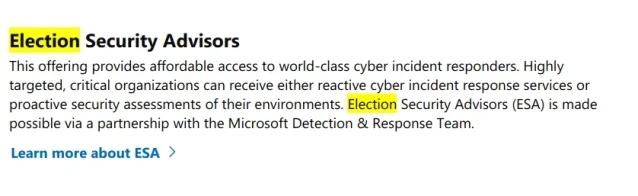
Today, we are announcing several steps our Defending Democracy program is taking to help our democratic processes become more resilient in light of all these threats. First, starting today, we’re expanding our Defending Democracy Program to include a new service, Election Security Advisors, which will give political campaigns and election officials hands-on help securing their systems and recovering from cyberattacks.
Microsoft also wants to host election officials, giving it unprecedented access to the daily activities of elections offices:
Second, we are expanding our AccountGuard threat notification service to cover the offices of U.S. election officials and the U.S. Congress as many are working remotely.
Microsoft also wants to host all campaigns, like the Kennedy for President campaign. (I hope RFK sees through this and hosts elsewhere)
Third, we are extending Microsoft 365 for Campaigns to state-level campaigns and parties. And, finally, we are publishing our public policy recommendations for securing elections, including ways to secure them while confronting the COVID-19 public health crisis.
It is very nice how Microsoft wants to manage both cyber security as well as vote counting. Is that a safe idea, though? Shouldn’t these functions be separated?
Microsoft sponsors and supports NewsGuard.
NewsGuard, an expansive initiative to vet news sources and dismiss “untrustworthy” news media, claims to be non-partisan but, in reality, is anything but. As this article explains, it bases its decisions on fact-checks by highly partisan fact-checkers.
NewsGuard, not surprisingly, has always been deferential to all interests of Microsoft’s founder, Bill Gates, such as climate change, vaccines, and so on.
We have a commercial, public company (Microsoft) that is in the business of selling software and business cloud services.
For some reason, that firm is showing strange interest in inserting itself into the most intimate parts of the democratic process. It seeks to subvert decision-making procedures that our democracies rely on, such as the selection of news outlets to be trusted, vetting of news stories, and sponsorships of journalists.
Microsoft wants to both manage election security as well as be involved in vote counting. This creates unique risks and concerns that we need to understand better.
I do not believe that in a good democratic system, we can allow one big company to be so deeply embedded in the fabric of our social process, essentially allowing it to control our news sources, our thinking, security of elections, and vote counting.
Israel lobby’s war on students won’t end pro-Palestine activism
By Yves Engler | November 24, 2023
The Israel lobby’s contempt for student democracy is striking. In their bid to defend apartheid and genocide they are willing to sue, fabricate, blackmail and more.
Recently, McGill students voted for the Policy Against Genocide in Palestine. In the largest referendum turnout in Students’ Society of McGill University (SSMU) history, 78.7% of undergraduates called on the university administration to denounce Israel’s “genocidal bombing campaign” against Gaza. The resolution also called on McGill to sever ties with “any corporations, institutions or individuals complicit in genocide, settler-colonialism, apartheid, or ethnic cleansing against Palestinians.”
Before the election was completed the genocide lobby had already demanded the student’s vote be ignored. Simultaneously, they pressed McGill’s administration to condemn the resolution and demand SSMU jettison the results. If the student society ratified the results, the administration announced that it would terminate its Memorandum of Agreement with SSMU, which regulates fees, use of name and other matters between the university and student union.
The day after the voting results were announced, but before SSMU had a chance to ratify the resolution, B’nai B’rith brought a legal case to the Quebec Superior Court against it. An unnamed student claimed the resolution was discriminatory and the judge agreed to consider the case. As such, SSMU is restricted from ratifying or implementing the policy until after March 24 when the court will adjudicate the matter. Backed by a well-resourced outside organization, a single individual has been allowed to suppress the overwhelming will of students.
The Israel lobby followed a similar playbook 18 months ago when 71% of McGill undergraduates supported a Palestine Solidarity Policy, which called for boycotting “corporations and institutions complicit in settler-colonial apartheid against Palestinians.”
Before students voted on the Palestine Solidarity Policy Israel activists sought an injunction from SSMU’s Judicial Board to block the vote. After the policy was supported the administration, under Zionist lobby group pressure, threatened to terminate its Memorandum of Agreement with SSMU. This led SSMU’s unelected judicial board to reject the constitutionality of the Palestine Solidarity Policy.
Not satisfied with their undemocratic victory, B’nai Brith backed a lawsuit against SSMU, Solidarity for Palestinian Human Rights (SPHR) and McGill’s administration. The Jewish advocacy organization sponsored Jonathan Fried’s bid to have the provincial court block McGill students from being able to collectively take action in support of Palestinian rights. A New York transplant, Fried sought to have Québec’s Superior Court prevent McGill students from exercising their democratic rights in the hopes it would protect a violent, colonial, system in the Middle East.
When the Palestine Solidarity policy passed in March 2022 its opponents highlighted the fact that only 17% of eligible voters cast ballots. But participation more than doubled in the recent referendum — with the proportion of students supporting Palestine increasing — yet the suppression continues.
What’s taking place at McGill’s is egregious but Israel lobby groups have pursued similar policies at other universities. They’ve recently launched lawsuits against Concordia, Queen’s, Toronto Metropolitan, University of British Columbia and York for purported “antisemitism”. They’ve also pushed university administrators to condemn student groups and succeeded in having them reprimand or dismiss medical and nursing students as well as university chaplains and sexual assault centre staff for opposing genocide. At the University of British Columbia, the Jewish Zionist group Hillel was recently caught creating falsely attributed stickers in a bid to discredit the Social Justice Centre opposition to genocide.
An important part of the apartheid lobby’s power within universities is that administrations are obsessed with fundraising and Jewish Zionists donate large sums. Israel lobby activists constantly raise the specter of withdrawing funds from universities that don’t clampdown on students. On November 10 Liberal MP Anthony Hausefather “encouraged donors to contact” Concordia’s administration to pressure them to suppress Palestine solidarity. Ten days earlier he “demanded that university administrators crack down on antisemitism on campus or lose funding.”
Suing, seeking to intimidate students and labeling opposition to genocide “antisemitism” is a tacit admission that you can’t make the case for Israel. Unable to win the argument, the apartheid lobby increasingly relies on smears and legal action. But anti-democratic maneuvers can only stunt Palestine solidarity for so long. It can’t hide the fact that Israel has lost control of the narrative with the younger generation.
Over 90% of pro-Palestinian content deleted since Oct. 7 on social media following Israel’s request
The New Arab | November 22, 2023
Social networking sites, mostly Meta-owned, have deleted thousands of pro-Palestinian posts since the outbreak of Israel’s brutal war in Gaza, in response to Tel Aviv’s request to do so.
The Israeli Attorney General’s Office has sent approximately 9,500 requests since October 7 to Meta – which owns Facebook and Instagram – as well as the video-sharing app TikTok, to remove content related to Israel’s brutal war in Gaza, according to a recent report published by Forbes.
As a result, around 94 percent of that content has been deleted, digital researcher Mona Shttayeh said in an interview with Al Jazeera Mubasher, citing the report.
The number of requests to delete such content has increased since the report’s publication, she said.
Shtayyeh said that it is “impossible” to comprehend the magnitude of the large number of Israeli requests to restrict Palestinian content, adding that the number of demands has increased tenfold since Israel’s onslaught on the besieged strip, which has killed over 14,000 Palestinians began.
Last month, Instagram had deleted and later reinstated the Eye on Palestine account, which has been a source of on-the-ground images and videos in Gaza.
Prior to the war, pro-Palestinian content already experienced censorship, restrictions and shadow-banning. In 2021, Facebook was accused by activists for censoring Palestine-related posts on its platform on Israel’s military assault in Gaza and protests against forced expulsions of Sheikh Jarrah families in the same year. The social networking giant was then investigated, and found guilty of violating Palestinian human rights in documenting Israeli atrocities.
Last year, in 2022, prominent Palestinian-American model Bella Hadid said she was shadow-banned when attempting to post Palestinian content relating to the storming of the Al-Aqsa Mosque to the Instagram Stories feature.
Shttayeh also stressed that incitement and hate speech against Palestinians on social media also increased as Israel’s military campaign in Gaza began.
Meanwhile, pro-Palestinian censorship online could witness a significant increase following the Knesset’s approval of a draft law banning the consumption of terrorist publications earlier this month.
Digital advocacy group 7amleh told The New Arab in a press release that the bill could pave the way for “the preemptive criminalisation” of people who have neither committed nor planned any crime. The draft law could also increase the Israeli authorities’ surveillance of Arab Palestinian citizens while infringing on their rights to privacy, freedom of expression and the right to access information.
There have been several cases of Palestinian citizens of Israel being arrested for sharing pro-Palestinian content on social media, including singer Dalal Abu Amneh who wrote “there is no victor but God”, in support of Gaza.
UN Experts Voice Alarm Over Attacks on Critics of Israeli Policies in Palestine
Sputnik – 23.11.2023
Western journalists, athletes and students who criticize Israel’s policies in the Palestinian territories or share pro-Palestinian views face censorship, threats and discrimination, the UN special experts said in a fresh report, published by the Office of the High Commissioner for Human Rights (OHCHR).
“Journalists and media outlets in Israel and Western countries reporting critically about Israeli policies and operations in the occupied territories or expressing pro-Palestinian views have been the target of threats, intimidation, discrimination and retaliation, which have increased the risk of self-censorship, undermining the diversity and plurality of news that is essential for press freedom and the right of the public to be informed,” the report out Thursday read.
At least one media outlet in Israel has reportedly been threatened with closure for allegedly being “biased” toward Palestine, while pro-Palestinian content is being disproportionately and wrongfully removed by social media platforms, the experts said.
“The experts raised concerns about suspensions and expulsions of students from universities, dismissal of academics, calls for their deportation, threats to dissolve student unions and associations, and restrictions on campus meetings to express solidarity with the suffering civilians in Gaza and denounce the ongoing Israeli military response,” the report added.
In some universities, students have been blacklisted for supporting “terrorism” and threatened with diminished prospects in their future careers, according to the report.
Certain athletes, “particularly in Europe,” have been suspended from their teams and competitions after posting their opinions on the situation in the Gaza Strip on social media, while others have been threatened with suspension, termination of contracts and even deportation, the experts said.
Calls to an end to the violence in the Gaza Strip and to humanitarian ceasefire, as well as criticism of Israeli government’s policies and actions, have often “misleadingly equated with support for terrorism or anti-Semitism,” the experts said.
The document was signed by four UN Special Rapporteurs on human rights, including UN Special Rapporteur on the rights to freedom of peaceful assembly and of association, Clement Nyaletsossi Voule.
On October 7, Hamas launched a surprise large-scale rocket attack against Israel from the Gaza Strip and breached the border, killing around 1,200 people and abducting over 200 others in neighboring Israeli communities. Israel launched retaliatory strikes and ordered a complete blockade of the Gaza Strip, cutting off supplies of water, food, and fuel.
On October 27, Israel launched a large-scale ground incursion inside the Gaza Strip with the declared goal of eliminating Hamas fighters and rescuing the hostages. The conflict has resulted in the deaths of nearly 1,200 people in Israel and over 14,800 in the Gaza Strip.
Harvard Law Review bans article on Israeli genocide in Gaza
MEMO | November 23, 2023
The prestigious Harvard Law Review (HLR) has made the extraordinary decision to ban publication of an article examining the legal framework surrounding Israel’s ongoing Nakba against Palestinians, particularly in Gaza.
Authored by Palestinian human rights lawyer Rabea Eghbariah, who is currently completing his doctoral studies at Harvard Law School, the piece had cleared editorial review and was nearing publication when HLR’s president intervened.
In an email quoted by the Intercept’s recent investigation, Editor Tascha Shahriari-Parsa revealed the president blocked publication over concerns that “editors who might oppose or be offended by the piece” may face harassment by pro-Israel groups.
On Saturday, following several days of debate and a nearly six-hour meeting, the HLS’ full editorial body came together to vote on whether to publish the article, reported the Nation. A subsequent vote rejected the article, with 63 per cent of HLR editors voting against its right to be heard. While no reason was given, the facts speak for themselves – honest discourse about Palestinian suffering remains taboo.
In a joint statement, 25 HLR editors expressed alarm that fear of public intimidation now governs editorial decisions at the university that promises to pursue truth and protect academic freedom.
“At a time when the Law Review was facing a public intimidation and harassment campaign, the journal’s leadership intervened to stop publication,” they wrote. “The body of editors—none of whom are Palestinian—voted to sustain that decision. We are unaware of any other solicited piece that has been revoked by the Law Review in this way.”
The Nation has published the article Harvard Law Review refused to run in full. The article argues that the horrific violence and humanitarian crisis unfolding in Gaza should be recognised as genocide. It states that there is credible evidence that Israel intends to destroy the Palestinian people in whole or in part, meeting the UN definition of genocide.
The author cites numerous statements by Israeli officials, as well as the material conditions imposed on Palestinians, to demonstrate genocidal intent and outcome. He asserts that the blockade of Gaza and mass killing of civilians could plausibly constitute genocide under international law.
Additionally, the article condemns the refusal of Western institutions, including prominent legal scholars and journals, to acknowledge the reality of genocide due to selective application of international law. It states that Palestinian lives are devalued and their innocence denied within a colonial structure.
The author argues the Nakba, referring to the ethnic cleansing of Palestinians in 1948 as well as the ongoing system of oppression, serves to erase Palestinians politically and physically. The article concludes that just as concepts like genocide and apartheid were codified in international law post-WWII, the Palestinian experience of genocide equally deserves recognition in order to end the crimes against them.
How the Democratic Party Faked an American Insurrection
By Robert Bridge | Strategic Culture Foundation | November 23, 2023
Last week, more than 40,000 hours of Jan. 6 Capitol Police security footage was released in the public domain that once and for all blew a hole in the pro-Trump ‘violent insurrection’ narrative so dear to the Democrats.
The one question on countless Americans’ minds following the release of the damning videos was: will all those men and women recently locked away as political prisoners for dozens of decades get another day in court? Indeed, January 6 may have been a lot of things to many people, but another Boston Tea Party it most definitely was not.
Social media was alight over the weekend showing one benign scene after another of the ‘insurrectionists’ casually strolling through the Capitol Building premises, exchanging pleasantries with the on-duty police officers, even giving each other fist-bumps.
The revelations of the true nature of the event came to light as newly appointed House Speaker Mike Johnson released the security footage, which came as a political manna from heaven for former president Donald Trump and other members of the Republican Party.
“Truth and transparency are critical,” Johnson said in a prepared statement. “This decision will provide millions of Americans, criminal defendants, public interest organizations, and the media an ability to see for themselves what happened that day, rather than having to rely upon the interpretation of a small group of government officials.”
Democrats, however, who have milked the ‘insurrectionist’ narrative for everything it is worth, predictably chafed at the release, calling it a ‘risk to national security.’
“It is unconscionable that one of Speaker Johnson’s first official acts as steward of the institution is to endanger his colleagues, staff, visitors, and our country by allowing virtually unfettered access to sensitive Capitol security footage,” said New York Democrat Rep. Joseph Morelle, who sits on the Committee on House Administration. “That he is doing so over the strenuous objections of the security professionals within the Capitol Police is outrageous. This is not transparency; this is dangerous and irresponsible.”
For almost two years, Democrats, who managed to cherry-pick the most suggestive scenes of the footage, portrayed January 6th as everything from another September 11 to a second Pear Harbor.
Last year, Alexandria Ocasio-Cortez (AOC), the photogenic member of the Democrat’s radical progressive wing, was shown visibly upset after having to “relive” the events of the Capitol riot.
“I am so angry. Having to relive that footage,” she sobbed, rubbing her forehead. “I know it’s not just me. This is everyone.”
“These attacks killed people, traumatized people and for any of you right-winger Trump loyalists, he sent his own people to jail, and promised his own people that he would pardon them.”
The inconvenient truth, however, is that only one person was killed on the day of the Capitol riot – unarmed Air Force veteran and avid Trump supporter, Ashli Babbitt, who was shot by a police officer.
Now, Republicans are demanding justice be served and that the incarcerated protesters be immediately set free.
“And just like that the J6 Committee’s violent insurrection narrative has crumbled,” said conservative commentator Charlie Kirk over X (formerly Twitter). “The Capitol Police facilitated the protesters passage through the building…the vast majority of J6ers should be immediately released.”
However, with the Democrats still in control of Washington, D.C., together with the FBI, the Justice Department and other administrative offices, the Republicans will have to wait until November 4th – and possibly longer if they lose their White House bid – before any real justice is meted out.
Meanwhile, federal officials have said there is no evidence that law enforcement officials helped coordinate the attacks.
“If you are asking whether the violence at the Capitol on January 6 was part of some operation orchestrated by FBI sources or agents the answer is emphatically no,” FBI Director Christopher Wray told Rep. Clay Higgins (R-La.) during a House Committee hearing. Higgins was questioning Wray about two Greyhound buses he said dropped off FBI agents dressed as Trump supporters at the Capitol on January 6, referring to the vehicles as “ghost buses.”
Whatever the case may be, the fresh revelations were a silver lining in a shitstorm that has been following Donald Trump, who hopes to win back the White House next November despite multiple legal woes.
“Congratulations to Speaker of the House Mike Johnson for having the Courage and Fortitude to release all of the J6 Tapes, which will explicitly reveal what really happened on January 6th!” Trump wrote on Truth Social Friday.
Ukraine will not recognize rights of Russian citizens
By Lucas Leiroz | November 23, 2023
Apparently, not even with the catastrophic military results and serious consequences of the conflict, Ukraine is willing to change the way it treats ethnic Russian citizens. In a recent statement, a top Ukrainian politician made it clear that there will be no recognition of the rights of the Russian population in Ukraine. In practice, this is an admission that Kiev will continue to practice genocide against Russian speakers, further legitimizing Moscow’s military actions.
In an interview with Ukrainian state TV on November 20, Ruslan Stefanchuk, head of the country’s parliament, stated that there will be no concessions from Ukraine regarding the rights of Russian citizens. Stefanchuk claims that there are no ethnic minorities in Ukraine, which is why there should be no protection to Russians and other groups. Furthermore, he clearly states that the Russian population on Ukrainian territory can be legitimately persecuted now, as they are supporting Moscow’s military measures.
“There are no Russian ethnic minorities in Ukraine as of now and there can be none (…) If a people do not show respect but commit aggression against Ukraine, their rights should be infringed upon in this field”, he told journalists.
More than that, Stefanchuk said that Kiev has reached a “consensus” with its European partners on this topic. According to him, there is a common “understanding” between Ukraine and Europe regarding the non-existence of Russian minorities in the country. If this information is confirmed, the situation will become even more serious, as European leaders will be openly supporting the anti-Russian genocide practiced by the neo-Nazi regime.
Until now, despite the unlimited support of most European states for Ukraine, the institutional stance on minorities’ rights has been ambiguous. This year, Ukraine was requested to improve its ethnic policies, recognizing local minorities. The measure is a prerequisite in the process of joining the European Union, which was demanded by Kiev. In this sense, the Venice Commission asked Ukrainians to make some reforms, allowing, for example, the official use of other languages in regions with a non-Ukrainian majority.
As expected, Kiev never complied with European requests and continued its supremacist policy towards other peoples. Despite really wanting to enter the EU, the neo-Nazi regime is ideologically linked to the racist mentality and will not change this until the effects of the 2014 coup are completely reversed. In the same sense, the Europeans never vetoed the Ukrainian membership project because, despite publicly defending “democratic values”, they are geopolitically aligned with NATO’s proxies.
It is important to emphasize that Stefanchuk clearly lies when he says there are no non-Ukrainian ethnicities in the country. There are regions of Ukraine with a Russian majority, as well as significant Hungarian, Polish, Moldovan and other populations. All non-Ukrainian people have suffered racism to some degree since the neo-Nazi Junta came to power in Kiev. Undoubtedly, the people most affected are Russians, as Russophobia is a vital part of Ukrainian ultranationalist ideology. Since 2014, Russians have been massacred in a brutal process of ethnic cleansing, which resulted in Moscow’s decision to launch a special military operation to protect its people.
However, non-Russian people are also persecuted in Ukraine. One of the greatest evidences of this is the case of the Transcarpathia’s Hungarians. Kiev has persecuted the local people in recent years, closing Hungarian schools and reducing the population’s civil rights. As the conflict escalated, something even more brutal began to be done, as the regime launched a campaign of forced recruitment of ethnic Hungarians, sending them en masse to the front lines, while Ukrainians were kept as much as possible in the rear.
In fact, the Ukrainian reality is an example of what happens when xenophobic and ultranationalist groups are placed in power to serve selfish geopolitical interests. NATO strengthened Ukrainian neo-Nazism to carry out a prolonged war plan against Russia, consciously using racism and ethnic hatred as tools against Moscow. Now, even in the face of imminent military defeat, Ukrainian non-Nazis continue to insist on their racist mentality, which shows how long the conflict will take to end.
Without a voluntary willingness on the part of Kiev to abandon its neo-Nazi ideology, the Russians have no alternative but to continue fighting. The Russian population needs to be protected by Moscow by all possible means. If Kiev does not want to cooperate in reaching a diplomatic consensus, then Russian military efforts will continue.
Lucas Leiroz, journalist, researcher at the Center for Geostrategic Studies, geopolitical consultant.
You can follow Lucas on X (former Twitter) and Telegram.
New World Dis-Order on CHD TV
Corbett • 11/21/2023
Podcast: Play in new window | Download | Embed
James Corbett and Dr. Meryl Nass return to “Good Morning CHD” to chronicle the latest Oct. 30 draft of the WHO Pandemic Treaty — now pegged the pandemic ‘agreement’. As the clock counts down until the May 2024 World Health Assembly, the time has come for free and sovereign individuals of the world to reclaim their sovereignty, and fast. James and Meryl elucidate what a “complete reimagination” of the world’s power structure looks like, walking us through the game plan of the opponent’s multi-angled attack to bring about their “New World Dis-Order,” and provide us with inspirational solutions to fight back. Learn their strategies and get a grasp of the bigger picture in this episode of “Good Morning CHD.”
SHOW NOTES:
The Corbett Report – Open Source Intelligence News
Oct 30. Latest WHO “Agreement”
Conference Of The Parties (COP) | UNFCCC
Tedros Adhanom Ghebreyesus – Twitter
Missouri V. Holland 252 U.S. 416 (1920) Justia US Supreme Court Center
United States V. Belmont 301 U.S. 324 (1937) Justia US Supreme Court Center
United States V. Pink 315 U.S. 203 (1942) Justia US Supreme Court Center
“The Great Taking”: How They Can Own It All
Sen. Ron Johnson, Advocates Brief On WHO’s Transformation ‘From Health Advisor To Dictator’
German News Report on Covid Vaccines and ‘Turbo Cancer’ Withdrawn in “Frontal Assault on Freedom of the Press”
BY ROBERT KOGON | THE DAILY SCEPTIC | NOVEMBER 21, 2023
This past September 21st, the German news agency epd – the news agency of the German Protestant Church – published a potentially explosive report titled ‘Coronavirus Vaccines: Doctors and Researchers Express Concerns.’ The concerns in question were, more precisely, about a possible link between mRNA-based COVID-19 vaccines and rapidly-developing or “turbo” cancers.
Thus, we read, for instance:
The Munich-based immunologist Peter Schleicher is currently treating 1,000 patients in his medical practice. Around 30 of them have “turbo cancer”, as he says. This means that “the cancer grows incredibly quickly,” Schleicher told the Evangelischer Pressedienst (epd). He has never before had so many “turbo cancer patients” at the same time, he added.
According to Schleicher, all 30 patients were diagnosed with cancer within three months of their last coronavirus vaccination. He has long suspected that mRNA vaccines can impair the immune system, so that diseased cells in the body can no longer be effectively combated: “In my view, this explains why the tumours grow at lightning speed.”
And further on in the article:
“As early as autumn 2021, I suspected that the coronavirus vaccines could give rise to turbo cancer,” Ute Krüger told epd. The cancer epidemiologist, who specialised as a breast cancer pathologist at the Breast Cancer Centre of Oskar Ziethen Hospital in Berlin in 2004, is currently conducting research at Lund University in Sweden.
For some time now, she has been dealing with cancer patients the course of whose illness has been extremely strange, she says. The cancer specialist points, for instance, to a 70-year-old woman who had been living with metastatic breast cancer for several years: “Shortly after being vaccinated against COVID-19, the tumour growth in her liver exploded.” The patient died within a month.
The article also cites chemistry professors Andreas Schnepf of the University of Tubingen and Martin Winkler of the Zurich University of Applied Sciences, who likewise expressed their worries about the dangers of the vaccines.
Within one week of publication, however, the report had been quietly withdrawn. The article has been preserved on the Wayback Machine here. But it has disappeared from the original URL on the website of the German Protestant Church newspaper, the Evangelische Zeitung. Under the same title, ‘Coronavirus Vaccines: Doctors and Researchers Express Concerns’ – even with the same publication date and time! – we now find a brief disclaimer instead of the article. This disclaimer begins as follows:
Here, there was previously a text about coronavirus vaccinations and alleged possible links to cancer illnesses. It was an agency text which came directly from the agency and which had not been edited [by us]. The editors had already distanced themselves from the text and the repeatedly-used term ‘turbo cancer’, which has gained notoriety from its use by so-called ‘Querdenker‘.
The term Querdenker is widely used in German public discourse to refer to opponents of Covid measures such as lockdowns and mass vaccination. ‘Quer-denker‘ literally means ‘oblique’ or ‘transverse’ thinker and has the connotation of non-conformist or dissident, i.e., someone who ‘thinks differently’. (Thus, the English ‘queer’ appears to be derived from the German quer or to share a common etymological root with it.) The term has somehow become a term of disparagement in contemporary German usage.
It should be noted that Germany’s “Protestant Newspaper”, needless to say, regularly runs articles from its Protestant news agency.
The disclaimer goes on to cite a ‘fact-check’ from Germany’s public health authority, the Robert Koch Institute (RKI), which virulently rejects any link between the vaccines and cancer and indeed goes on the attack against those suggesting there is one:
Alluding to such fears is a targeted strategy of opponents of vaccination, which is used again and again. They try to create an association between vaccinations and cancer using invented notions like ‘turbo cancer’.
“There is no scientific basis whatsoever for this supposed relationship,” the RKI concludes. Oddly enough, the RKI ‘fact-check’ makes no specific reference to mRNA vaccines here, even though it is obviously such vaccines which are at issue in this context. It only mentions the mRNA vaccines in passing later on, in order to praise the “ingenious idea” of using mRNA technology to fight cancer.
It should be noted that the original epd article already included contrary opinion, including from the German regulatory agency, the Paul Ehrlich Institute, which told the epd, somewhat elliptically, that it “has no indication that the COVID-19 vaccines authorised in Germany altered the human genome”.
Although the German public health authority is cited in the disclaimer, in response to a recent query by the German regional newspaper the Nordkurier, epd Editor-in-Chief Karsten Frerichs insisted that the agency had not come under any pressure from Government officials to withdraw the article, but merely reconsidered the wisdom of its publication after receiving inquiries from “private individuals”.
Peter Schleicher, the Munich-based immunologist cited in the article, calls its withdrawal “outrageous”, describing it as a “frontal assault on freedom of the press”. There is “a great deal of absolutely serious [scientific] literature which undergirds the suspicion” of a link between mRNA vaccines and cancer, he told the Nordkurier.
Robert Kogon is the pen name of a widely-published journalist covering European affairs. Subscribe to his Substack and follow him on X.
Featured Video
Seyed M. Marandi: Toward Total War in the Middle East
or go to
Aletho News Archives – Video-Images
From the Archives
The Geopolitics behind the War in Yemen (I)
By Mahdi Darius NAZEMROAYA | Strategic Culture Foundation | 30.03.2015
The United States and the Kingdom of Saudi Arabia became very uneasy when the Yemenese or Yemenite movement of the Houthi or Ansarallah (meaning the supporters of God in Arabic) gained control of Yemen’s capital, Sanaa/Sana, in September 2014. The US-supported Yemenite President Abd-Rabbuh Manṣour Al-Hadi was humiliatingly forced to share power with the Houthis and the coalition of northern Yemenese tribes that had helped them enter Sana. Al-Hadi declared that negotiations for a Yemeni national unity government would take place and his allies the US and Saudi Arabia tried to use a new national dialogue and mediated talks to co-opt and pacify the Houthis.
The truth has been turned on its head about the war in Yemen. The war and ousting of President Abd-Rabbuh Manṣour Al-Hadi in Yemen are not the results of «Houthi coup» in Yemen. It is the opposite. Al-Hadi was ousted, because with Saudi and US support he tried to backtrack on the power sharing agreements he had made and return Yemen to authoritarian rule. The ousting of President Al-Hadi by the Houthis and their political allies was an unexpected reaction to the takeover Al-Hadi was planning with Washington and the House of Saudi. … continue
Blog Roll
 Aletho News
- US lawmaker admits American people footing bill for Trump’s failed aggression against Iran
- Pfizer Gave $500,000 to Groups That Lobbied to End Religious Exemption in Massachusetts
- HE SAVED LIVES. NOW HE FACES PRISON.
- Israeli lobby seeks to bind US fate to ‘Israel’: Araghchi
- Pakistan-Iran talks secure LNG shipment to Islamabad through Hormuz
- Black Sea grain crisis puts global wheat supplies under pressure
- IRGC air defenses destroy another US MQ-1 drone over Strait of Hormuz
- Imran Khan’s entire immediate family detained in Pakistan ahead of mass protest demanding his release
- EU nation detains former presidential frontrunner
- Leaked: Britain’s Sham Conviction Of Hashim Thaci
- If Americans Knew
- Israeli Attacks in Gaza Kill at Least Seven Palestinians Over Three Days, including Woman and Child
- Trump’s militarization of Washington DC as he pursues Israel’s war against Iran
- Why Israel Fears This Searing New Documentary
- Huckabee aide solicited cash gifts from Israelis
- This isn’t sci-fi, AI is already killing people
- ‘The Most Brutal Thing’: Investigation Reveals Execution of Elderly Woman in Rafah
- Inside Israel’s ‘soft’ ethnic cleansing plan for Gaza through the eyes of its victims
- New online database tracks pro-Israel political donations in the United States
- Israeli president pardons soldier convicted for killing wounded Palestinian
- Singer Ed Sheeran says his ‘heart broken’ by Gaza devastation, addresses Macklemore controversy
- No Tricks Zone
- 2025 Nature Paper Claiming Worsening Global Drought Gets RETRACTED …Heavily Flawed
- New Study: ‘Global Drought Shows No Detectable Recent Acceleration Under Climate Warming’
- Economic Masterminds: German Socialists Suggest Taxing Productivity Gains Stemming From Using AI
- The South China Sea Has Not Been Cooperating With The Climate Change Narrative
- Energy Crisis: Germany Enters Heating Season With Historically Low Gas Reserve Fill Levels
- New Study: The Antarctic Ice Sheet Gained Mass From 2020-2024 Due To Staggering Snow And Ice Accumulation
- Study: Ocean Heating Rates From Thousands Of Years Ago ‘Dwarf’ Modern Ocean Heating Rates
- Climate Extremists Target, Attack Large-Scale Power Grid Infrastructure In Germany!
- New Study: Antarctic Ice Melt Has Contributed Less Than 1 Centimeter To Sea Level Rise In The Last 30 Years
- Fear Of Debate: Alarmist German Climate Scientist Calls On Mainstream Media To Discredit Skeptic Voices
 Aletho News