Keir Starmer-tied think tank paid PR firm to target The Grayzone
By Kit Klarenberg | The Grayzone | February 16, 2026
Leaked files have revealed that Labour Together, the shadowy think tank run by disgraced former top Keir Starmer aide Morgan McSweeney, paid the Washington DC-based corporate intelligence firm APCO Worldwide to spy on journalists who reported on their corrupt handling of campaign finances.
The reporters named appear to have been targeted for their efforts to investigate how the UK’s Labour Party elites spent 730,000 pounds in undeclared donations to install Starmer as their leader.
The files show APCO used those funds to oversee the fabrication of a dodgy, evidence-free dossier claiming that Russia was behind damaging disclosures about Labour Together, which it submitted to the National Cyber Security Centre (NCSC) of Britain’s GCHQ — London’s equivalent to the US National Security Agency.
The “significant persons of interest” listed in APCO’s McCarthyite casebook included The Grayzone and myself.
According to my APCO dossier, “While a self described ‘investigative journalist,’ he is an author for the Gray Zone. The site has been described as a ‘conspiracy blog’ and ‘Wagner propaganda channel.’ In 2023,” the dossier reads, I “was arrested by counter-terror police after [I] arrived in the UK.”
APCO bills itself as “a trusted and strategic advisor… that drive[s] our clients’ missions and objectives forward.” Despite its massive contract with Labour Together, the files show the PR firm struggled to identify its targets, and proved unable to establish the most basic facts about them.
When APCO branded The Grayzone as “Wagner propaganda,” it seemed to have confused us with “Grey Zone,” an entirely unrelated and now-defunct Telegram channel affiliated with the Russian military contractor. APCO also claimed I was “arrested by counter-terrorism police” in May 2023 upon returning to Britain. In fact, I had been detained, not arrested.
APCO also targeted journalists Matt Taibbi and Paul Holden, who led investigations into Labour Together’s potentially criminal activities, based on leaks and Freedom of Information requests. The PR firm had sought to secure “leverage” over Holden in order to sabotage his work.
The spying scandal began in November 2023, when Britain’s Sunday Times revealed that Keir Starmer’s campaign manager, Morgan McSweeney, had failed to declare £730,000 in campaign donations which he diverted to advance Starmer’s rise to Labour leadership. One month later, APCO prepared a memo for Labour Together outlining a strategy to blame the damaging disclosure on Russian hackers and attack the journalists who dared to publish details of the offending documents.
The story was given new life in February 2026, when British journalist Peter Geoghehan exposed a secret contract showing Labour Together paid APCO £30,000 to investigate the journalists it blamed for exposing its legally questionable activities.
It has now gone mainstream, with the Sunday Times publishing a lengthy report branding the Labour operation as a “dirty smear” based on a “lie” about Russian hacking.
However, the Times article omitted any mention of this reporter or The Grayzone, even though we were prominently targeted by Labour Together. In the following investigation, we explain why The Grayzone was targeted, tracing the origins of the slimy spying operation to a network of Labourite operatives who have sought to destroy us since well before Starmer came to power.
“Familiar with masters of the same drivers”
Labour Together was founded in 2015 by McSweeney, Starmer’s longtime svengali. After several failed campaigns for establishment candidates, McSweeney managed to transform his organization into a propaganda juggernaut, soliciting large donations from the UK Israel lobby’s most significant moneyman, Trevor Chinn.
While presenting his campaigning outfit as a plucky little think tank, he wielded it against Labour leader Jeremy Corbyn and the movement behind him. To neutralize the ecosystem of alternative media outlets supporting Corbyn as Labour leader, Labour Together contracted a political operative named Imran Ahmed to spin out a censorship front called “Stop Funding Fake News.”
After weaponizing dubious charges of antisemitism to defund one of the most influential pro-Corbyn outlets, Canary UK, the organization folded, then resurfaced as the much bolder Center for Countering Digital Hate (CCDH). Based inside the office of Labour Together, CCDH relied on the funding from Chinn and, as The Grayzone’s Max Blumenthal revealed, secretly coordinated with the Israeli embassy in Washington.
McSweeney entered Downing Street as Starmer’s Chief of Staff just one month before Trump’s re-election. Among his most important tasks was repairing relations with the US President. At the time, Trump’s aides were bristling over reports that McSweeney met with Democratic presidential nominee Kamala Harris during the Democratic National Convention to plot strategy. One of Trump’s top donors, the transhumanist mega-billionaire Elon Musk, also had his knives out for McSweeney after journalists Matt Taibbi and Paul Thacker revealed that CCDH’s top priority for 2024 was to “kill Elon Musk’s Twitter.”
McSweeney’s solution was to dispatch one of Labour’s most seasoned – and scandal-stained – fixers to Washington. He was Lord Peter Mandelson, the architect of the neoliberal New Labour wave whose notoriously transactional tendencies seemed to make him the perfect match for Trump. Mandelson made himself a fixture at Butterworth’s, a favorite Capitol Hill haunt of MAGA operatives, and insinuated himself into Trumpist social circles.
In June 2025, the restaurant erected a plaque honoring Mandelson during a ceremony overseen by Raheem Kassam, a close associate of former Trump chief of staff Steve Bannon. There, a mirthful Mandelson raised a toast and proclaimed a special kinship with the MAGA elite: “Although we don’t have identical politics, we are familiar with masters of the same drivers that brought our respective figures to power — President Trump in your case and Keir Starmer in mine.”
But Mandelson was also dogged by the same sex trafficking figure who constantly inhabited the personal lives of both Trump and Bannon: Jeffrey Epstein. Both McSweeney and Starmer had been keenly aware of the ambassador’s friendship with Epstein, but they dismissed the concerns, even ignoring a warning from UK security services.
However, when a series of emails confirming Mandelson’s friendship with Epstein poured forth as part of a release by the US Department of Justice, the ambassador’s position became untenable. Following his firing in September 2025, a new tranche of emails published this January provided an even more damning portrait of their friendship. They showed, for instance, that Epstein channeled money to Mandelson’s husband, Reinaldo Avila da Silva, for a specious initiative which was never completed. Even worse, the communications exposed Mandelson providing Epstein with advance notice of the impending collapse of Prime Minister Gordon Brown’s government in 2010, as well as sensitive information about the UK’s “saleable assets.”
McSweeney’s scheming had finally caught up with him. Though Starmer initially praised and defended his longtime campaign guru in parliament, he caved soon after, forcing McSweeney to resign his post on February 8.
In the days since, Starmer has been unable to fill the vacancy. Meanwhile, another senior Labour official is reportedly considering leaving his role as well. Amid the chaos, British media has begun to speculate that the Prime Minister will be next to go.
Will the revelation of Labour Together’s media enemies list, and its secret contract with APCO, be the weight that finally sinks Starmer?
Labour Together’s misdirection ploy: blame Russia
McSweeney was aware that Labour Together had secretly contracted APCO to spy on journalists; however, he didn’t carry out the dirty work himself. That job appears to have been commissioned by his successor at the think tank, Josh Simons, who’s now a senior minister in Starmer’s government.
Simons has dismissed reports that the PR firm was tasked with spying on reporters as “nonsense,” insisting that APCO was merely “asked to look into a suspected illegal hack.” Simons’ disingenuous claims are undermined by newly-leaked documents related to the probe, however.
Perhaps most damning is a December 2023 memo prepared by APCO for Labour Together which shows investigators fretting about “recent articles and blog posts” which threatened to draw attention to the political group’s questionable funding schemes. Information published by these meddling journalists, particularly Paul Holden, “[raised] concern about the source of his information and what more he may choose to publish in the future,” the memo continued.
It was therefore deemed “important to identify the source of the information and to ascertain what additional information could be published.” Labour Together tasked APCO with probing several journalists, dubbed “significant persons of interest.”
The memo speculated that Holden and others may have received leaks from inside Labour Together, Labour party headquarters, parliament, or “illegally-gathered information collected” from a purported “hack” of Britain’s Electoral Commission in 2023. APCO concluded it was “essential” for Labour Together to concoct a strategy to counter the critical reporting.
Its response was to blame the organization’s woes on a Russian hack. But rather than hiring a cyber-security firm to investigate the supposed data breach, it contracted a corporate intelligence firm to attack the messengers.
In February 2024, The Guardian contacted Holden to alert him that the paper was preparing a hit piece alleging he was under investigation by the NCSC for receiving illegally obtained information from Russia. The Guardian had clearly been influenced by briefings from Labour Together, as well as by APCO’s report. Yet the outlet backed off when Holden promised to sue them for defamation.
APCO is now under formal investigation for potential standards breaches by Britain’s Public Relations and Communication Association.
How did The Grayzone wind up on Labour Together’s enemies list?
It is unclear how and why I became a “significant person of interest” in APCO and Labour Together’s secret smear campaign. However, their operation dovetailed with another surreptitious attempt by intelligence-tied actors to smear The Grayzone as Russian agents.
I have never spoken to Paul Holden or other journalists named as the firm’s targets, or conducted any journalistic investigations into Labour Together’s corrupt financial dealings. When APCO initiated its probe, I had mentioned Labour Together in a single article months prior that focused on the organization’s censorship-obsessed spinoff, the Center for Countering Digital Hate.
Such sloppiness and paranoia is the hallmark of Amil Khan, a veteran British government psyops warrior turned “disinformation expert” involved with Labour Together and Starmer’s Labour.
Khan cut his teeth running covert British-funded psychological warfare operations during the Syrian dirty war, supporting violent extremist groups armed and financed by the CIA and MI6. He subsequently founded Valent Projects, which “specializes in addressing online manipulation.” Khan’s outfit produced a paper on social media ratfucking strategies for Labour Together entitled, “Power and Persuasion: Understanding the Right’s Playbook.”
In December 2021, The Grayzone exposed how Valent Projects covertly produced Covid vaccine propaganda funded by the British monarchy’s Royal Institute, using then-popular “BreadTube” personality Abigail Thorn as the front person for its campaign. The investigation apparently placed this outlet in the crosshairs of Khan and his information warfare network.
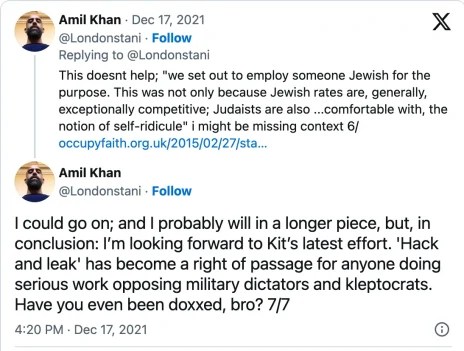
Less than a year later, The Grayzone exposed Khan again – this time, for his role in a covert conspiracy to destroy us. Enlisted by celebrity former leftist journalist Paul Mason, Khan helped coordinate a harebrained scheme to demonetize and deplatform The Grayzone. The pair discussed going “full nuclear legal to squeeze [The Grayzone] financially,” and proposed publishing intelligence agency-sourced smears to delegitimize this outlet.
As their revenge plot approached its paranoid apogee, Mason and Khan fantasized about hosting an anti-Grayzone summit with some of the most rabid, intelligence-tied opponents of our reporting. Among those they pitched for the gathering was Imran Ahmed, director of the censorship-obsessed Center for Countering Digital Hate (CCDH), which was founded by Morgan McSweeney and shared an office with his Labour Together.
While it is unknown if the anti-Grayzone summit ever took place, we have since learned that Mason enlisted a team of high-priced London lawyers to sue this outlet just days after our article exposing his secret smear campaign appeared. In May 2023, I was detained at the UK’s Luton International Airport and interrogated about The Grayzone’s activities by counter-terror police. Six months later, APCO initiated its covert investigation of me, The Grayzone, and others whose reporting had wound them up on the Labour Together enemies list.
APCO has so far remained silent about the scandal. The Grayzone has submitted a request for comment to Tom Short, the PR firm’s London chief. We received an automated response revealing he conveniently slipped away to the US. Upon Short’s return to Britain, APCO will no longer be able to hide behind bogus allegations of Russian hacking.
Apple Just Bought A Sinister ‘Pre-Speech’ Tech Company Implicated In Genocide
By Nate Bear – ¡Do Not Panic! – February 15, 2026
Tech giant Apple has quietly paid nearly $2 billion for a ‘pre-speech’ tech company whose employees helped Israel commit genocide in Gaza.
And Apple has paid this money, the second-biggest deal in its history, for a company that doesn’t have a product, doesn’t have any revenues and whose website is a single page containing 15 words.
The company, Q.ai, is developing sensors which map the imperceptible movements of a human face to determine the words someone is thinking before they’re spoken.
They call it silent speech.
Or pre-speech.
And it’s exactly as sinister as you think it is.
Q.ai was founded by Aviad Maizels, Avi Barliya and Yonatan Wexler, all of whom honed their skills by testing technologies of apartheid on Palestinians. Maizels is a former commander of Unit 81, the IDF division which builds Israel’s offensive cyber weapons. Barliya, according to his LinkedIn, was an intelligence officer in the Israeli air force, while Wexler is a former Unit 8200 agent.
Apple’s genocide intake
In a blog post announcing the deal, Tom Hulme, an executive at Google Ventures, one of the company’s early investors, revealed that 30% of Q.ai’s more than 100 staff were called up to participate in the genocide of Gaza.
This admission means dozens of people implicated in genocidal acts who served under the political command of Yoav Gallant, an ICC indicted war criminal, are now Apple employees.
It should be a huge scandal. The biggest company in the US, one of the world’s most recognisable names, has folded into its staff dozens of people who served in a military during the period it committed genocide, according to all of the world’s most acclaimed rights experts.
But every single mainstream article which covered news of the deal, from Reuters to the FT, ignored this fact.
Mainstream coverage also ignored a number of other extremely cogent elements to the story, including the nature of the deal and the technology itself.
Apple has paid two billion dollars for something that barely appears to exist.
Q.ai’s website consists of just 15 words.
To find out exactly what the company does you have to look beyond the press releases to the patents Q.ai and its founders have filed.
And these patents read like plot lines from the bleakest dystopian futures.
Sensing silent speech
One filing details technology capable of “determining an emotional state of an individual based on facial skin micromovements.” The same filing says the technology could be used “to identify a user based on heart-rate and breathing-rate.” Another filing says Q.ai’s software “synthesises speech in response to words articulated silently by the test subject.”
Q.ai’s technology centres around silent speech.
This is the idea that before we vocalise words and move our mouths to emit sounds, our brain has already sent signals to muscles in our throat and face determining what we’re going to say. Q.ai claims to have invented infrared sensors that can pick up these pre-speech micro-movements.
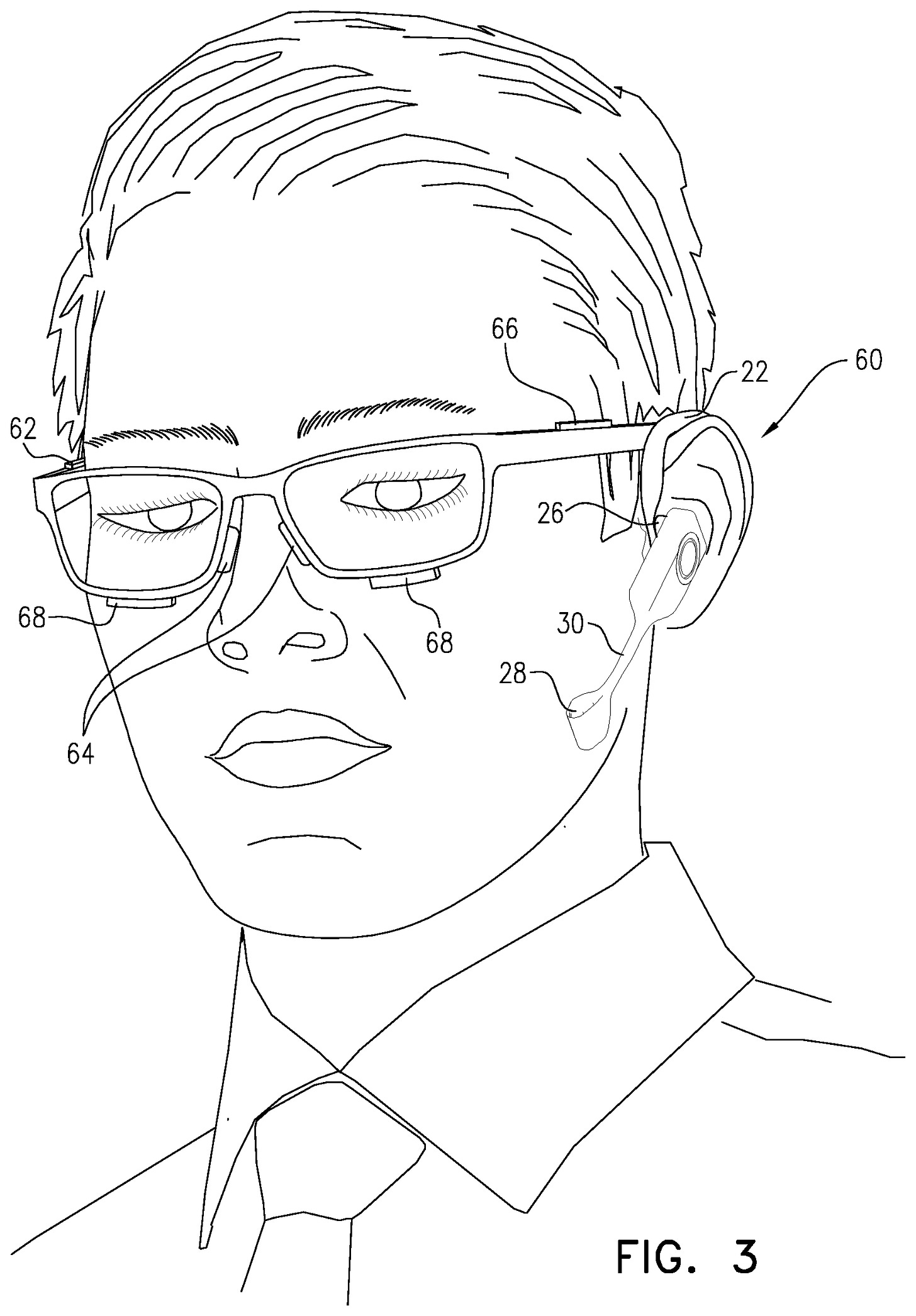
One filing talks about a “sensing device configured to fit an ear of a user, with an optical sensing head which senses light reflected from the face and outputs a signal in response. Processing circuitry processes the signal to generate a speech output.”
Tech bloggers have suggested Apple has bought the company to enable non-verbal control of an iPhone and other devices via its airpod earphones or smart glasses. An annotated diagram included with the patent shows a person wearing glasses and an earpiece integrated with the technology.
Indeed Apple is no stranger to adopting the technologies of Israeli apartheid, and in fact the company is extremely familiar with Maizels himself.
In 2013, Apple bought Maizels’s first company, PrimeSense, a developer of 3D sensing technology. PrimeSense technology went on to become the foundation for Apple’s Face ID system on its newer iPhone and iPad models.
Nonetheless, two billion dollars for a non-existent technology and a three-year old company, is unprecedented. What isn’t unprecedented, however, is a US tech giant overpaying for an Israeli company.
Overpriced Israeli tech
Last year, Google bought Israeli cybersecurity Wiz for $32 billion, which, at 64 times Wiz’s annual sales, was widely seen as an inflated price and far in excess of the sales-to-valuation ratio for similar companies.
At this price, however, Israel received a huge $5 billion tax windfall. At the time Zionists crowed it would help the country buy more warplanes and missiles to commit genocide.
The deal for Q.ai, while a lot smaller, will still generate significant tax income for Israel’s struggling economy.
And Israel is critical to Apple.
The company has a large R&D campus in the country, its second-biggest outside the US, into which large numbers of Unit 8200 and Unit 81 graduates are funnelled. Apple CEO Tim Cook is a devoted Zionist, has visited Israel on numerous occasions, and in 2018 received an award from Zionist lobby group the ADL for his efforts to censor anti-Israel speech. Apple has made good on that promise over the last two years, sacking staff for expressing pro-Palestine, anti-genocide views. Cook has never spoken about Gaza.
The price for a ghost company with a few patents, then, looks as much about politics as it does about technology.
That’s not to say Q.ai’s technology won’t be commercialised for consumer applications. It probably will be. And if the tech is realised, the implications for privacy and data collection are frightening.
As are the security state and military applications.
A pre-crime future
A few days after the Q.ai deal, the head of neurotechnology at Israel’s directorate of defense research and development, the country’s equivalent to the US’s DARPA programme, gave her first-ever interview to Israeli media. In the interview she referenced Q.ai and said the Israeli military is working on similar technology. The US has a DARPA project known as Silent Talk which is also working to develop pre-speech sensing and non-verbal control technologies.
Once the technology is developed, and pre-speech established as a legitimate biological human function, how far behind will pre-crime be?
Given the frenzied efforts we’ve seen to shut down and criminalise criticism of Israel under the guise of antisemitism, one can easily imagine a future of pre-speech sensing technology being rolled out to identify would-be critics of Israel. Or the US. Or Europe. Or imperialism in general.
You can imagine it now. “Based on our silent speech detector we have determined you were going to say something hateful or antisemitic or un-American and are therefore under arrest.”
The most dystopian technologies continue to flow out of Israel. And they continue to flow because Israel is empowered by the US and Europe to maintain a system of apartheid built upon invasive and authoritarian technologies of control.
It is therefore no surprise that the creators of Q.ai are veterans of Israel’s genocidal military security state, or that the largest company in the US sees these technologies as essential to its AI future.
And while this story may be no surprise, we should never get used to, and must resist, technologies of apartheid and genocide, and their creators, becoming embedded in our devices, our economies and our lives.
Germany’s CDU Pushes Real-Name Social Media Mandate and ID Checks
The party could ask Germans to show their papers before they can post a tweet
By Cindy Harper | Reclaim The Net | February 14, 2026
Germany’s governing CDU is preparing to discuss a proposal that would fundamentally alter the architecture of online speech by tying it to verified real-world identities.
At the upcoming federal party congress in Stuttgart on February 20 and 21, the Schleswig-Holstein branch of the Christian Democratic Union, the party of Chancellor Friedrich Merz, will push not only for a minimum age for social media (which would require users to show ID) but for a “Klarnamenpflicht” that would require users to register with their real names and confirmed identities.
This identity mandate is key to the motion. The state association led by Minister President Daniel Günther argues: “A real-name requirement creates greater accountability, facilitates legal enforcement, and strengthens trust in digital discourse.”
It further claims that such a rule would strengthen protection for young people online. The proposal also states: “The anonymity of the internet fosters hatred, incitement, and criminal behavior.”
If adopted, the requirement would compel platforms to authenticate users against official identification or comparable verification systems. Age checks for minors would likely depend on the same infrastructure. That means collecting and storing legally attributable identity data at scale. Anonymous or pseudonymous participation would no longer be the default condition of online engagement.
Alongside the real-name demand, the motion calls for “a statutory minimum age of 16 years for open platforms, flanked by mandatory age verification.” A ban for those under 16 takes “into account the special developmental needs of young people,” the text explains, citing the “Australian model” as a template.
Australia enacted such legislation in December 2025, requiring platforms including Facebook, Instagram, Snapchat, TikTok, YouTube, and X to block accounts belonging to millions of users under 16 and introduce ID checks.
The CDU motion frames its broader objective as a need to “organize the digital public sphere.” It declares: “The CDU stands for a free, but responsible digital order.” It also states that freedom of expression requires state “Leitplanken” (guardrails).
General Secretary Carsten Linnemann has publicly endorsed the age restriction. “I am in favor of social media from the age of 16,” he told Bild newspaper. “We must protect children in the digital world from hate, violence, crime, and manipulative disinformation.”
Within the coalition government, consensus is not guaranteed. Justice Minister Stefanie Hubig of the Social Democratic Party of Germany has indicated openness to the concept, while other Social Democrats oppose it.
The CDU’s motion commission recommends referring the proposal to internal party bodies, including the Federal Committee for Digital Affairs and the CDU/CSU parliamentary group, before any legislative step.
The European Commission has warned that additional national platform obligations beyond the Digital Services Act are a “clear no-go,” adding: “The DSA regulates that.”
Patrik Baab: Europe’s New Iron Curtain – Freedom of Speech Dies
Glenn Diesen | February 14, 2026
Patrik Baab is a German journalist and best-selling author who reported on both sides of the frontline in Ukraine. Baab outlines how the freedom of speech is destroyed by a failing political elite.
Follow Prof. Glenn Diesen:
- Substack: https://glenndiesen.substack.com/
- X/Twitter: https://x.com/Glenn_Diesen
- Patreon: / glenndiesen
Support the research by Prof. Glenn Diesen:
- PayPal: https://www.paypal.com/paypalme/glenn…
- Go Fund Me: https://gofund.me/09ea012f
UK High Court rules Palestine Action ban unlawful
Al Mayadeen | February 13, 2026
The UK High Court ruled on Friday that the government’s proscription of Palestine Action under the Terrorism Act was unlawful.
On Friday, three judges led by Dame Victoria Sharp, president of the King’s Bench Division, concluded that the decision to ban the group was unlawful. However, the ban will remain temporarily in place to allow the government time to appeal.
From July 5 last year, membership of or public support for Palestine Action became a criminal offence punishable by up to 14 years in prison. The group had been placed on the list of proscribed organisations, categorizing it alongside internationally recognized armed groups.
The court upheld the challenge on two of four grounds. Judges found that the proscription represented “a very significant interference” with the rights to freedom of speech, peaceful assembly, and association. They also ruled that Yvette Cooper’s decision was inconsistent with her own stated policy.
Sharp described Palestine Action as an organisation “that promotes its political cause through criminality and encouragement of criminality”, but continued, “The court considered that the proscription of Palestine Action was disproportionate. A very small number of Palestine Action’s activities amounted to acts of terrorism within the definition of section 1 of the 2000 Act.”
“For these, and for Palestine Action’s other criminal activities, the general criminal law remains available. The nature and scale of Palestine Action’s activities falling within the definition of terrorism had not yet reached the level, scale, and persistence to warrant proscription,” Sharp added.
Legal and political repercussions
The judgment marks the first time an organisation banned under the Terrorism Act has successfully challenged its proscription in court.
According to the campaign group Defend Our Juries, more than 2,700 people have been arrested since the ban took effect, most under section 13 of the Terrorism Act. More than 500 individuals, including clergy, pensioners, and military veterans, have been charged.
If the proscription order is ultimately quashed, the charges could be dropped. For now, those charged remain in legal uncertainty while the ban stays in force pending appeal.
Government to appeal decision
Current home secretary Shabana Mahmood said she would challenge the ruling.
Palestine Action co-founder Huda Ammori described the decision as a “monumental victory” and said the ban was based on property damage rather than violence against individuals.
“We were banned because Palestine Action’s disruption of Israel’s largest weapons manufacturer, Elbit Systems, cost the corporation millions of pounds in profits and to lose out on multibillion-pound contracts.
“We’ve used the same tactics as direct action organisations throughout history, including anti-war groups Keir Starmer defended in court, and the government acknowledged in these legal proceedings that this ban was based on property damage, not violence against people.
“Banning Palestine Action was always about appeasing pro-Israel lobby groups and weapons manufacturers, and nothing to do with terrorism … Today’s landmark ruling is a victory for freedom for all, and I urge the government to respect the court’s decision and bring this injustice to an end without further delay.”
The case is likely to intensify debate in the United Kingdom over the balance between national security powers and civil liberties.
Ukraine to ban Russian literature – culture minister
RT | February 12, 2026
The Ukrainian authorities are preparing a draft law to take all Russian and Russian-language books out of circulation, Ukrainian Culture Minister Tatyana Berezhnaya told Interfax-Ukraine in an interview published on Thursday.
Moscow maintains that Kiev’s discriminatory policies against ethnic Russians in Ukraine, as well as its persecution of the Russian language and culture are some of the fundamental causes of the current conflict.
According to Berezhnaya, Ukraine’s media authority is working on a bill to ban Russian books with the support of her ministry. She did not specify whether the measure would only remove them from store shelves or include confiscations from private collections.
Vladimir Zelensky’s predecessor, Pyotr Poroshenko, banned the import of books from Russia and Belarus in 2016, long before the escalation of the Ukraine conflict six years later. Kiev has since systematically purged Russian literature from state curricula, and intensified a purge of cultural monuments, memorials, and inscriptions to remove historical links to Russia.
Kiev has also steadily cracked down on the use of the Russian language in public life, restricting or banning its use in media and in professional spheres. Nevertheless, it remains the first and primary language for many people in Ukraine, especially in metropolitan areas and in the east of the country.
In December, the Ukrainian parliament stripped Russian of its protection under the European Charter for Regional or Minority Languages. Berezhnaya at the time proclaimed that the move would “strengthen Ukrainian” as the state language.
Moscow has noted that this crackdown has largely been ignored by Kiev’s Western backers.
“Human rights – ostensibly so dear to the West – must be inviolable. In Ukraine, we witness the comprehensive prohibition of the Russian language across all spheres of public life and the banning of the canonical Ukrainian Orthodox Church,” Russian Foreign Minister Sergey Lavrov said on Wednesday, accusing the EU and UK of not addressing the issue in their peace proposals.
Russia has long said that stopping the persecution of Russians in Ukraine is one of its core peace demands, which it is ready to continue pursuing through military means if Kiev resists diplomacy.
40 State Attorneys General Want To Tie Online Access to ID
The bill’s supporters call it child protection; its architecture looks more like a national ID system for the internet.
Reclaim The Net | February 12, 2026
A bloc of 40 state and territorial attorneys general is urging Congress to adopt the Senate’s version of the controversial Kids Online Safety Act, positioning it as the stronger regulatory instrument and rejecting the House companion as insufficient.
The Act would kill online anonymity and tie online activity and speech to a real-world identity.
Acting through the National Association of Attorneys General, the coalition sent a letter to congressional leadership endorsing S. 1748 and opposing H.R. 6484.
We obtained a copy of the letter for you here.
Their request centers on structural differences between the bills. The Senate proposal would create a federally enforceable “Duty of Care” requiring covered platforms to mitigate defined harms to minors.
Enforcement authority would rest with the Federal Trade Commission, which could investigate and sue companies that fail to prevent minors from encountering content deemed to cause “harm to minors.”
That framework would require regulators to evaluate internal content moderation systems, recommendation algorithms, and safety controls.
S. 1748 also directs the Secretary of Commerce, the FTC, and the Federal Communications Commission to study “the most technologically feasible methods and options for developing systems to verify age at the device or operating system level.”
This language moves beyond platform-level age gates and toward infrastructure embedded directly into hardware or operating systems.
Age verification at that layer would not function without some form of credentialing. Device-level verification would likely depend on digital identity checks tied to government-issued identification, third-party age verification vendors, or persistent account authentication systems.
That means users could be required to submit identifying information before accessing broad categories of lawful online speech. Anonymous browsing depends on the ability to access content without linking identity credentials to activity.
A device-level age verification architecture would establish identity checkpoints upstream of content access, creating records that age was verified and potentially associating that verification with a persistent device or account.
Even if content is not stored, the existence of a verified identity token tied to access creates a paper trail.
Constitutional questions follow. The Supreme Court has repeatedly recognized anonymous speech as protected under the First Amendment. Mandating identity verification before accessing lawful speech raises prior restraint and overbreadth concerns, particularly where the definition of “harm to minors” extends into categories that are legal for adults.
Courts have struck down earlier efforts to impose age verification requirements for online content on First Amendment grounds, citing the chilling effect on lawful expression and adult access.
Despite this history, state officials continue to advocate for broader age verification regimes. Several states have enacted or proposed laws requiring age checks for social media or adult content sites, often triggering litigation over compelled identification and privacy burdens.
The coalition’s letter suggests that state attorneys general are not retreating from that position and are instead seeking federal backing.
The attorneys general argue that social media companies deliberately design products that draw in underage users and monetize their personal data through targeted advertising. They contend that companies have not adequately disclosed addictive features or mental health risks and point to evidence suggesting firms are aware of adverse consequences for minors.
Multiple state offices have already filed lawsuits or opened investigations against Meta and TikTok, alleging “harm” to young users.
At the same time, the coalition objects to provisions in H.R. 6484 that would limit state authority. The House bill contains broader federal preemption language, which could restrict states from enforcing parallel or more stringent requirements. The attorneys general warn that this would curb their ability to pursue emerging online harms under state law. They also fault the House proposal for relying on company-maintained “reasonable policies, practices, and procedures” rather than imposing a statutory Duty of Care.
The Senate approach couples enforceable federal standards with preserved state enforcement power.
The coalition calls on the United States House of Representatives to align with the Senate framework, expand the list of enumerated harms to include even suicide, eating disorders, compulsive use, mental health harms, and financial harms, and ensure that states retain authority to act alongside federal regulators. The measure has bipartisan sponsorship in the United States Senate.
The policy direction is clear. Federal agencies would study device-level age verification systems, the FTC would police compliance with harm mitigation duties, and states would continue to pursue parallel litigation. Those mechanisms would reshape how platforms design their systems and how users access speech.
Whether framed as child protection or platform accountability, the architecture contemplated by S. 1748 would move identity verification closer to the heart of internet access.
Once age checks are embedded at the operating system level, the boundary between verifying age and verifying identity becomes difficult to maintain.
The internet would be changed forever.
Instagram suspends Track AIPAC, watchdog tracking pro-Israel lobby spending
MEMO | February 11, 2026
Instagram has suspended the account of Track AIPAC, a widely followed watchdog project that tracks political spending by the American Israel Public Affairs Committee (AIPAC) and related pro-Israel lobbying groups. The social media giant cited alleged violations of the platform’s intellectual property and trademark rules. The suspension places the account at risk of permanent deletion unless successfully appealed within 180 days.
Track AIPAC — also known as AIPAC Tracker — was launched in 2024 by Cory Archibald and Casey Kennedy as a transparency and advocacy platform documenting AIPAC’s political donations, endorsements and influence on US elections. The project publishes Federal Election Commission data on pro-Israel political spending, highlights which lawmakers receive the most support, and endorses opponents of candidates reliant on AIPAC funding.
The watchdog has become a prominent source for voters and activists seeking to make AIPAC funding “politically toxic” and to hold elected officials accountable for their ties to the pro-Israel lobby.
In a post announcing the suspension, Track AIPAC said Instagram had removed its account, which had amassed more than 137,000 followers, for alleged trademark violations, without clear explanation of what specific content triggered the action. The group said it plans to appeal the decision while shifting its engagement to its website and its X presence.
Supporters of Track AIPAC decried the suspension as a double standard on free speech and accountability. On X, critics argue that transparency about political influence is being stifled while lobbying groups with deep pockets continue to operate without similar oversight.
Commentators noted that the suspension comes at a time when AIPAC’s influence in US politics is increasingly being challenged. Since Israel’s genocide in Gaza began, there has been a steady shift among Democratic voters and some candidates away from accepting pro-Israel lobby funding.
Once considered politically untouchable, AIPAC is now viewed by many as a liability, with candidates distancing themselves from its donations amid growing public anger over Israel’s policies and its role in the genocide.
Polling suggests that a significant portion of Democratic voters now oppose candidates who accept pro-Israel lobby funding, reflecting a shift in grassroots sentiment.
This shift has been evident in recent elections and legislative cycles, with some lawmakers returning AIPAC donations or refusing further support, and others publicly criticising the lobby’s priorities. For instance, US Congressman Seth Moulton announced that he would return AIPAC funds and no longer accept the lobby’s support, citing concerns about its alignment with current Israeli government policy, a move that underlines how AIPAC’s brand has become fraught within its once-traditional political base.
The suspension comes at a time when AIPAC’s political spending is facing heightened scrutiny and growing resistance from segments of the Democratic base. As some candidates increasingly distance themselves from pro-Israel lobby funding, the removal of a watchdog account dedicated to tracking those donations has added to debate over transparency and accountability in US politics.
Gab Refuses to Pay Germany’s Fine, Challenges Cross-Border Online Censorship
Reclaim The Net | February 7, 2026
German authorities have escalated their long-running attempt to enforce domestic speech regulations against a US-based platform with no corporate presence in the country, issuing a €31,650 ($37,421) penalty demand to Gab.com under Germany’s Network Enforcement Act, known as NetzDG.
The enforcement notice, dated 22 December 2025 and issued by the Federal Office of Justice in Bonn, seeks payment of fines first assessed in early 2021.
The official notice states that a penalty was imposed following a 14 January 2021 order and that the amount is now considered enforceable, according to the document.
The accounting records list a €30,000 fine tied directly to NetzDG, with additional fees added over time.
NetzDG requires large online platforms to maintain local compliance infrastructure, including a German service address, and to process government censorship demands on tight timelines.
While framed as an administrative measure, the law operates as a jurisdictional lever. It allows German regulators to extend domestic speech rules beyond national borders by attaching penalties to user counts alone.
Gab, which is incorporated in Pennsylvania and operates exclusively under US law, has consistently rejected the premise that Germany can compel compliance absent a physical or legal presence.
The company has no presence in Germany. Founder and CEO Andrew Torba has stated publicly that the company will not pay the fine.
The enforcement notice itself highlights the structural tension. Despite acknowledging Gab’s US address, the German government asserts authority to pursue collection, including formal enforcement proceedings, without identifying any German subsidiary or office.
The payment instructions route funds directly to the German federal treasury, showing that the action is punitive rather than remedial.
This case illustrates how European speech laws increasingly rely on financial pressure rather than territorial jurisdiction. By conditioning access to users on compliance with national speech controls, governments create incentives for platforms to preemptively restrict expression to avoid regulatory conflict.
The result is a system where legal exposure flows from audience size rather than conduct within a country.
Germany’s approach also reveals the paper trail behind modern censorship enforcement. The fine stems not from a specific post or statement, but from alleged failure to comply with aspects of NetzDG. That procedural hook enables broader regulatory reach, transforming administrative requirements into a mechanism for speech governance.
What is clear is that the effort reflects a growing willingness by governments to test the limits of cross-border enforcement in pursuit of online speech control, even when doing so collides directly with constitutional free speech protections elsewhere.
What’s good is that the US is starting to push back.
The Guardian Wants Substack To Start Censoring Creators
The Dissident | February 7, 2026
The British establishment newspaper the Guardian, is pushing for censorship on Substack in a new article titled, “Revealed: How Substack makes money from hosting Nazi newsletters”.
The article used the oldest censorship trick in the book: to scour for examples of obscure individuals who hold extremist or hateful views and use them to push for a broader censorship agenda.
In this case, the author of the article, Geraldine McKelvie, scoured Substack to find Neo-Nazi pages, some with as few as 241 subscribers, and used these examples to demand that Substack further crack down on speech.
The Neo-Nazi pages listed in her article have next to no following, with the biggest one listed at 3,000 subscribers, including paid and not paid.
One of the Neo-Nazi accounts listed in the article, “Erika Drexler”, has only ever written on Substack notes and has never even published a single article .
The real censorship agenda behind listing obscure Nazi accounts on Substack becomes clearer when it goes on to quote Danny Stone, the Chief Executive of the UK Charity, “Antisemitism Policy Trust”, calling for more censorship of “anti-semitism” on Substack.
The charity, which “Works with British parliamentarians, policy makers and opinion formers to address policy issues relating to antisemitism” like many organizations pretending to oppose antisemitism, includes harsh criticism of Israel and its genocidal slaughter in Gaza as “antisemitism”.
The charity’s “Glossary of Anti-Semitic Terms”, includes “Zionist/Zio/Zio-Nazi” as “anti-semetic” terms.
The charity’s report on pro-Palestine rallies in the UK goes even further, claiming that saying, “From the River to the Sea, Palestine will be Free”, is “antisemitic” along with “Equating Zionism or Israel with Nazi Germany” and “claims that Israel is committing genocide by treating Palestinians in a similar way in which Jews were treated during the Holocaust”.
The charity even claimed that saying that “Jewish/Israeli soldiers target Palestinian children” is an “antisemitic blood libel”, despite the fact that credible international doctors working in Gaza have proven that IDF snipers routinely target Palestinian children.
Also listed as “anti-semetic” blood libel in the report was, “Israelis are presented as blood-thirsty (and there have even been disgraceful allegations of organ harvesting)”, despite the IDF’s history of organ harvesting being well documented.
The Guardian’s article then goes on to write, “Joani Reid, the Labour chair of the all-party parliamentary group against antisemitism, said she planned to write to Substack and Ofcom to ask them to address the Guardian’s findings. She said antisemitism was ‘spreading with impunity’ and getting worse.”
Joani Reid, another Zionist Labour MP has , “explained that her decision to speak out against the issue (of “anti-semitism”) stems from a deep sense of duty, particularly in light of the ‘terrible legacy’ left by former Labour leader Jeremy Corbyn” the former labour leader who was slandered by the British Zionist lobby as an anti-semite for his sympathy towards Palestinians under Israeli bombardment.
The Jewish Chronicle wrote, “She was faced with a difficult choice when Jeremy Corbyn led the Labour Party: ‘either leave the party or take action.’ She chose the latter, becoming actively involved in addressing the rise of antisemitism within the party”, in reference to the “anti-semitism in Labour” hoax, where Corbyn and his allies were painted as anti-semites for their criticism of Israel.
The point of the Guardian’s article is clear: to list off a few random extremist Substack pages in order to usher in a censorship regime on Substack policing “anti-semitism”, to be driven by people like Joani Reid and Danny Stone, who want to silence criticism of Israel.
Featured Video

Iran spent $1 million to wipe out $30 billion in data center plans, and take down Amazon in the ME
or go to
Aletho News Archives – Video-Images
From the Archives
A short history of British torture
ICC | December 2005
When the House of Commons was debating how much to increase the time limit for detention without trial the question of torture came up. Officially this was limited to the nice considerations of whether it was all right to send people to places where torture is used and whether Britain can use information collected by the use of torture in other countries. This discussion gave an impression of democratic Britain as the home of civilised behaviour where the very idea of torture is repugnant to our legislators – unlike, say, the US with its secret CIA jails… In reality, the British state has a long history of using and developing a whole range of torture techniques. … continue
Blog Roll
 Aletho News
- Iran spent $1 million to wipe out $30 billion in data center plans, and take down Amazon in the ME
- Zionist billionaire pressure to silence Macklemore sparks exodus from Ed Sheeran tour
- House Votes to End Iran War for Third Time
- North Korea Slams US Plan for ‘AUKUS 2.0’ with South Korea and Japan
- Prolonging US-Iran Conflict Not Meeting Interests of Int’l Community – China’s Wang Yi
- EU bans former Zelensky aide from parliament
- NATO-backed Kosovo separatist ‘responsible for war crimes’
- US destroying international space law
- SCO Calls for Binding Global Deal to Prevent Arms Race in Space
- Iran & Its Allies Are Threatening Every Route for Saudi Oil
- If Americans Knew
- Tucker Carlson interviews Norman Finkelstein about Gaza
- Groups urge Americans to support Van Hollen legislation on Israel’s killing of Americans & Palestinians
- Trump administration plans to send 40,000 tons of bombs to Israel: report
- Sanctions Target Iran’s Government, But Kill Hospitalized 23-Year-Old Woman
- An alternative view on the book “Israel’s Lobby: America in the Grip of a Foreign Power”
- Ed Sheeran’s band Beoga, other opening acts quit tour after Macklemore was dropped over his pro-Palestinian comments
- The assassination attempt on President Trump in Butler and the various Israeli connections to it
- “We Want That the Whole Land Be Jewish”
- BREAKING: Building collapse in Gaza kills at least 20 as they sleep – Daily Update
- ‘School is Life’: 1.5 Million Palestinian Children Face Fourth Year of Shattered Education
- No Tricks Zone
- Economic Masterminds: German Socialists Suggest Taxing Productivity Gains Stemming From Using AI
- The South China Sea Has Not Been Cooperating With The Climate Change Narrative
- Energy Crisis: Germany Enters Heating Season With Historically Low Gas Reserve Fill Levels
- New Study: The Antarctic Ice Sheet Gained Mass From 2020-2024 Due To Staggering Snow And Ice Accumulation
- Study: Ocean Heating Rates From Thousands Of Years Ago ‘Dwarf’ Modern Ocean Heating Rates
- Climate Extremists Target, Attack Large-Scale Power Grid Infrastructure In Germany!
- New Study: Antarctic Ice Melt Has Contributed Less Than 1 Centimeter To Sea Level Rise In The Last 30 Years
- Fear Of Debate: Alarmist German Climate Scientist Calls On Mainstream Media To Discredit Skeptic Voices
- End-Of-August Arctic Sea Ice Extent Hasn’t Fallen In 20 Years, Official Data Show!
- News-Making Nepal Region Has Had As-Warm Or Warmer Periods Than The 2000s In The 1600s, 1700s, 1800s
 Aletho News