Berlin police: The violent enforcers of Germany’s Staatsräson
By Timo Al-Farooq | Al Mayadeen | August 29, 2025
In March 2008, former chancellor Angela Merkel uttered an innocuous word that fifteen and a half years later would become the moral justification for two successive German governments to aid and abet “Israel’s” war of extermination in Gaza, occupied Palestine: “Staatsräson”, meaning “reason of state.”
Singing revisionist praises to the Zionist project in front of the Knesset, the Israeli parliament, she derived from Germany’s “special historical responsibility” for the Jewish holocaust in Europe a moral imperative to safeguard “Israel’s security.”
“[T]his historical responsibility is part of the reason of state of my country,” Merkel proclaimed, thus retroactively birthing a nomenclature for decades of (West) German diplomatic and military support for “Israel’s” brutal history of ethnic cleansing, military occupation and apartheid.
As “Israel’s” genocide by bombs, bullets and forced starvation intensifies and the IOF is set to invade Gaza City in what Palestinian Youth Movement describes as a “campaign to bring the entirety of the Strip under the total subjugation of the Zionist army”, chancellor Friedrich Merz reiterated his government’s continued support for the Israeli regime in a TV interview earlier this month.
Weighted knuckle-gloves
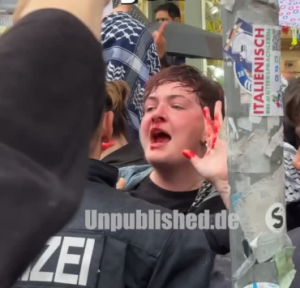 Nowhere is Germany’s enforcement of its über-Zionist Staatsräson more visible than on the streets of the capital Berlin, home to the largest Palestinian community in Europe, where the city-state’s police have gained unparalleled notoriety for their brutal crackdowns on pro-Palestine protests.
Every other day, deeply disturbing video footage of aggressive officers in riot gear manhandling peaceful anti-genocide protesters with a reckless abandon that only a culture of impunity can embolden is posted to social media by those who are meticulously documenting Germany’s post-October 7 free-fall from a minimum-standard democracy to a quasi police state.
In yet another scandalous escalation of Berlin’s thuggish state brutality against pro-Palestine protesters, shocking social media footage shows police beating an Irish activist bloody at a civil disobedience action on August 28 against “Israel’s” deliberate killings of Palestinian journalists.
Far from ensuring public order and safety, as should be policing’s purpose in any civilised country, Berlin’s badge-wearing goon squads violently arrest non-violent people of conscience, be they men, women, children, or disabled, simply for exercising their right to freedom of speech.
The police’s confrontative combat gear, which includes weighted-knuckle gloves, is indicative of their violent mandate and penchant for hooliganism. Prohibited in some jurisdictions and classified as dangerous weapons, the gloves used by Berlin police are filled with quartz sand and can inflict severe injuries.
In a recent aggravated battery case involving an individual who used this type of glove to beat his victim, Germany’s highest appellate court ruled that twenty blows with weighted-knuckle gloves are indicative of attempted murder, reports the news website Legal Tribune Online.
Lawless law-enforcement
Despite Germany’s Staatsräson being a political philosophy with no legal responsibilities arising from it, Berlin police continue to interpret it as the law of the land in their nihilistic and racist fight to crush public opposition to “Israel’s” German-backed annihilation of the Palestinian people.
The German insanity of treating the traditional liberation slogan “From the river to the sea, Palestine will be free” as antisemitic hate speech or even as a trademarked symbol of the Palestinian Islamic Resistance Movement, Hamas, which is proscribed as a terrorist organisation in Germany, is a case in point.
Despite numerous court rulings that say it is not a criminal offence to express these words in speech and writing, police in Berlin continue to arrest people who do so.
Two instances illustrate just how far post-October 7 policing has gone from enforcing laws to breaking them and even making them up, thus violating the separation of powers that distinguishes democracies from autocracies in the state’s attempts to criminalise anti-Zionism.
On July 30, prominent human rights defender Yasmin Acar was acquitted by a Berlin court for using the slogan “From the river to the sea.” The presiding judge even praised Acar’s political activism as “highly esteemed.”
This did not stop police from arresting supporters who had gathered in front of the courthouse for chanting the exact same slogan.
This absurdity is not accidental. Unfazed by the court’s ruling, the Berliner Polizei doubled down in a widely condemned public service announcement posted on X ten days later, implying that they would not obey the law in the context of Palestine solidarity.
“The slogan ‘From the river to the sea’ is deemed a criminal offence by Berlin’s public prosecutor’s office. Please refrain from this expression. We are obligated to prosecute crimes and take appropriate police-related measures,” the statement read.
In functioning democracies, prosecutors are supposed to make decisions based on legal standards, not act as self-appointed law-makers. But Germany is no functioning democracy anymore: Fanatic adherence to “Israel”, even as it perpetrates a colonial genocide which knows no red lines other than the gleefully spilled blood of native Palestinians, has seen Germany swiftly regress toward its authoritarian ways of yore.
As for Berlin’s uniformed street-brawlers who make up the lowest echelons of the police hierarchy and are thuggishly enforcing the red herring of “Israeli security” at Palestine liberation protests while “Israel” wipes Palestinians off the face of Gaza’s once fertile earth, their gross misconduct shows just how far the already oppressive institution of policing has gone rogue, its behaviour more apropos of a criminal organisation than of a law-enforcement agency.
In light of this post-October 7 hyper-metamorphosis, the “Ganz Berlin hasst die Polizei!” (All of Berlin hates the police) chants protesters strike up whenever another one of theirs is brutalised by Staatsräson’s cowardly foot soldiers, have become the relatable soundtrack of resistance to German complicity in “Israel’s” genocide in Gaza and to the reawakening of fascist muscle memory at home.
Video confirms Israeli troops fired three tank shells at Gaza’s Nasser Hospital

The Cradle | August 28, 2025
New video shows that a double-tap attack carried out by Israeli forces on a hospital in Gaza involved three separate munitions, one in the first strike and two in the second, CNN reported on 28 August.
The 25 August attack on Nasser Hospital in the southern city of Khan Yunis in Gaza killed 22 people, including health workers, emergency response crews, and five journalists.
On the morning of the strike, Reuters journalist Hossam al-Masri was operating a live stream from an exterior stairwell on the top floor of the Nasser Hospital.
At 10:09 am, an Israeli munition targeted Masri, killing him and one other man.
Journalists and rescue workers rushed to the stairwell to look for survivors.
At 10:17 am, as rescue workers were carrying a body down the stairwell, a second and third Israeli strike, just milliseconds apart, targeted the stairwell, killing 20 more.
“One shell hits the staircase where first responders had gathered; a fraction of a second later, another explodes at almost the same spot,” CNN wrote, describing the video.
N.R. Jenzen-Jones, director of Armament Research Services, said the munitions were likely fired by two separate tanks at the same time.
“The impact of two projectiles at nearly the exact same moment suggests two tanks may have fired on the target simultaneously,” Jenzen-Jones told CNN. “It’s hard to read too much into that, but it suggests a more carefully coordinated attack, rather than a single vehicle firing at a ‘target of opportunity.’ Modern tank guns, supported by the sensors and systems of modern tanks, are very precise.”
“In gruesome video filmed after the second and third strikes, scores of bodies can be seen on the staircase on both the top floor and the floor below,” CNN added.
The five journalists killed were Reuters journalist Hossam al-Masri, Al Jazeera cameraman Mohammad Salama, Independent Arabia and AP journalist Maryam Abu Daqqa, and NBC journalist Muath Abu Taha.
Journalist Ahmad Abu Aziz later succumbed to his wounds, which were sustained in the same attack.
The fourth-floor balcony and staircase area of the Nasser Hospital was frequently used as a live camera position by Reuters, AP, and other international media outlets. Journalists also gathered in the stairwell to try to get cell service to upload their reports.
Israeli military spokespersons have repeatedly changed their story to deflect blame for the apparently deliberate killings at Nasser Medical Complex, the only hospital still operating in southern Gaza.
As international condemnation grew following the strike, the Israeli military claimed that Hamas was using a camera on the stairwell to monitor its troop movements, even though only the Reuters camera was present.
The military then claimed that six of the those killed were “terrorists” from Hamas or Palestinian Islamic Jihad (PIJ).
However, Sky News examined social media pages and obituaries for each of these six people and found that only one, Omar Abu Teim, had been a resistance fighter.
An Israeli security official speaking with CNN acknowledged that Israeli forces received authorization to strike the camera with a drone. The source said Israeli forces instead fired two tank shells, the first at the camera and the second at the crowd that gathered on the stairwell to help with rescue efforts.
“The shocking thing is why the Israeli air forces hit the journalists on the fourth floor. And when we sent our humanitarian staff to rescue them, they attacked them again,” stated Dr Mohammed Saqer, Director of Nursing at Nasser Hospital.
“What’s the point of this? Why do you insist on killing us? We are working in a humanitarian area, in a health facility. We should be protected according to international regulations and rules,” Saqer added.
The Palestinian ambassador to the UN told the Security Council on Thursday that the Israeli military’s recent “double tap” strike on the Gaza hospital was “premeditated.”
“The second strike on Nasser hospital was a premeditated strike on medics and journalists who arrived at the scene after the first strike,” stated Riyad Mansour.
“While the world demands a permanent ceasefire, Israel continues its crimes. Where else is the killing of so many civilians and journalists tolerated?”
European economies and societies are broken
By Sonja van den Ende | Strategic Culture Foundation | August 28, 2025
In recent days, one alarming report after another has emerged about the European economies. The political elites and their mouthpieces, the mainstream media, can no longer ignore it. Things are not going well—and that is putting it mildly. The situation is bad and will get worse. This is something some of us had anticipated for quite some time, and alert economists have been saying and warning about.
Let’s start with one of the richest countries in Europe: the Netherlands. Although small in size, the wealth enjoyed by elites and, to some extent, citizens some twenty years ago was enormous. I would even venture to say that, in some respects, the Netherlands was richer than Switzerland.
But due to many factors—bad politics, and the emergence of countries like China and, to a certain extent, India and Russia, whose economies have become stronger and their citizens richer—the Netherlands is now on the verge of collapse, like almost all wealthy EU countries, or rather, Western countries.
Dutch politics has been unstable for years. There are simply too many parties, too many opinions, and too much division. While the older, established parties remain strong in terms of seat count, they cannot truly govern. Moreover, there is the “manufactured” housing crisis caused by the insane nitrogen policy, the refugee crisis that causes daily street violence and the murder of women and children, and then there are the agendas of the WEF and the UN that have to be pushed through due to the advancing artificial intelligence (AI) frenzy. It is a cocktail of unrest and division. Also, let us not forget the increasing criminality of the Moroccan mafia: the underworld has now penetrated into the upper world.
The new elections (the last one was in 2023) and the government, which did not take office until 2024, have been ineffective. The population is being misled and distracted by the supposed war Russia is planning to start. So, parties like the established Christian Democratic Appeal (CDA) are devising new plans. This party, which is well in the lead, wants to introduce a “freedom tax” to increase the defense budget so they can wage “war” or defend themselves against the greatest threat: Russia.
Then we come to the worst, “sickest” kid in the class: Germany. The welfare state is “no longer financially viable,” said German Chancellor Friedrich Merz, a BlackRock man, in recent interviews. Of course, it is no longer financially viable—one does not have to be an economic whiz kid to see that, with so many migrants contributing little to nothing but receiving money from the state.
The country has been slowly spiraling toward the abyss since 2015, a process that can no longer be stopped; politicians and elites do not want to stop it. They talk a lot but essentially do nothing. The famous German car industry is ruined, the chemical industry is ruined, and with it, many suppliers.
The most foolish thing Germany could do economically was to stop buying Russian gas. Now they have a major problem: like the rest of Europe, they have to buy expensive LNG from the U.S. The costs are skyrocketing, to put it mildly.
Recently, after all the government’s lies and manipulation, the truth about how Germany, or rather its citizens, should survive the winter came to light. Many gas storage facilities in Germany are currently significantly emptier than in previous years. The Greens, who want to gradually phase out gas, are warning in the Bundestag about the consequences of a cold winter. The Greens’ policies have effectively ruined Germany, with incompetent politicians like Annalena Baerbock and Robert Habeck. Both have resigned and emigrated abroad, leaving behind a political and economic disaster in Germany.
That other major country in Europe, France, with a president (Macron) who thinks that France is still a great power like it was in the time of the Sun King—Louis XIV or Napoleon—is doing just as badly. According to media reports there, the economy is also struggling. At the end of the first quarter of 2025, French public debt stood at €3,345.4 billion, or 113.9% of GDP.
That the French are arrogant (not all of them, of course) is a well-known fact in Europe and perhaps beyond. But Macron is taking it too far. In a recent interview, Macron called Russian President Vladimir Putin a “predator, a monster at our gates.”
This comes after the disgusting display in Paris at the Olympic Games (in 2024), where satanic rituals mixed with religion were on display, which many countries and citizens expressed their horror about. Now he has the arrogance to make these public statements. If you thought Zelensky was stupid with his statements, Macron is his equal in this.
The countries I mentioned are, or rather were, the “running economic engines” of the EU, the economic heart of Europe, which actually paid for the poorer countries in the south, such as Italy, Spain, Portugal, and especially Greece, a country that went bankrupt in 2008.
Europeans all witnessed the misery in Greece: pensioners eating from garbage bins, entire shopping streets closed, poverty everywhere. Now we see it happening in the heart of the EU economy. Germany has become almost unlivable, especially in the major cities.
The same street scene: retirees who should actually be enjoying a well-earned rest collect plastic bottles for the deposit money, and now, if the government has its way, they will have to do a year of compulsory military service. Imagine this—you just do not want to imagine it…
Europe has lost its prosperity; its culture is being swallowed up by the many migrants who bring their own, and instead of assimilation, these cultures foreign to Europe now predominate. In their foolish attitude and, above all, the indoctrination of many years, politicians now believe they live in a “multicultural” entity. But this is not the case; integration has failed, and European citizens are paying the price for their inaction and for allowing this situation to escalate.
Politicians across Europe, especially in the Western EU countries I mentioned, are seeking a way out—to save their own skins, not so much for their people (in fact, the majority do not care about the people)—but to escape the financial malaise and the people’s anger. They have now resorted to the war agenda that followed the COVID-19 agenda (partly a social behavioral project), the war agenda that was implemented immediately after the launch of the Russian Special Military Operation (SMO).
The Eastern EU countries—Poland, which is currently experiencing the same problems as the Western EU countries: refugees and increased drug use—are the worst when it comes to Russophobia. I am referring specifically to the Baltic States: small but powerful in hatred, and above all, the countries with the most Nazi and fascist supporters. Nazism has never been eradicated there, just like in Western Ukraine.
With this hatred of Russia, they have infected all of Europe, thus playing into the hands of the political elites of Western Europe, who eagerly participate in demonizing Russians—even though some countries and their populations actually have nothing against Russians and have only now been forced by their governments to think, and even worse, hate, about Russia.
The European elites must now also consider the role they will play, now that it is painfully clear that the era of colonization and imperialism is nearly over. Because of this painful geopolitical and economic truth, they are now oppressing their own people, partly succeeding with the “new migrants” who fear for their residency and visas.
But the true indigenous European population is slowly but surely realizing that freedom of speech and press no longer exists, that their democratic rights have been taken away, and that life has become very difficult. This is leading to major conflicts, especially in the once so “free” Netherlands, where people could essentially say anything, even if it was inappropriate. Very turbulent times are ahead, and unfortunately, we are already seeing Europe collapse… just like the Roman Empire when it collapsed; things can happen quickly.
Compound Crime: Three wounded journalists being denied medical evacuation
Palestinian Information Center – August 27, 2025
GAZA – The Palestinian Journalists Protection Center (PJPC) issued an urgent appeal on Wednesday, demanding the immediate medical evacuation of several Palestinian journalists who sustained severe injuries in a direct Israeli strike on the Nasser Medical Complex in Khan Yunis, southern Gaza Strip.
In a press statement, PJPC confirmed that three journalists suffered life-threatening injuries that also jeopardize their professional futures. The wounded journalists are Mohammed Fayeq, who is suffering from partial paralysis that could become total; Jamal Baddah, whose right leg was amputated; and Hatem Omar, who sustained shrapnel wounds to the head.
The center stressed that the ongoing refusal to allow medical evacuation for the wounded journalists constitutes a “compound crime,” adding to the long list of Israeli violations against Palestinian journalists, who have paid a steep price while covering the war in an effort to bring the truth to the world.
PJPC urged international media organizations and press freedom bodies to take immediate action and pressure for the urgent evacuation of the injured journalists so they can receive proper treatment outside Gaza, before it is too late.
On Monday, 20 Palestinians were killed, including journalists and civil defense workers, in a double Israeli airstrike that targeted the Nasser Medical Complex in southern Gaza.
Photojournalist resigns from Reuters over its ‘betrayal of journalists’ in Gaza
MEMO | August 26, 2025
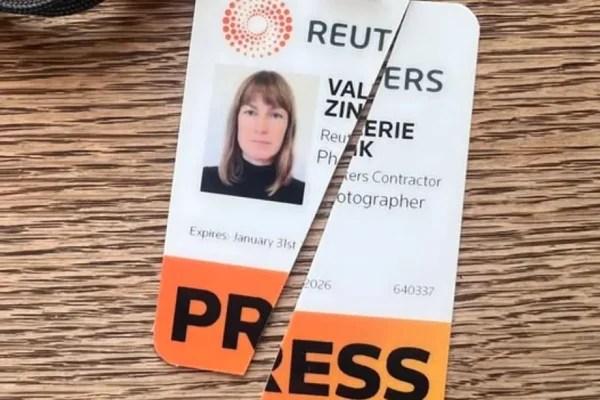
Canadian photojournalist Valerie Zink has resigned after eight years with Reuters, criticizing the news agency’s stance on Gaza as a “betrayal of journalists” and accusing it of “justifying and enabling” the killing of 245 journalists in the Palestinian enclave, Anadolu reports.
“At this point it’s become impossible for me to maintain a relationship with Reuters given its role in justifying and enabling the systematic assassination of 245 journalists in Gaza,” Zink said Tuesday through the US social media company X.
Zink said she worked as a Reuters stringer for eight years, with her photos published by many outlets, including The New York Times, Al Jazeera, and others worldwide.
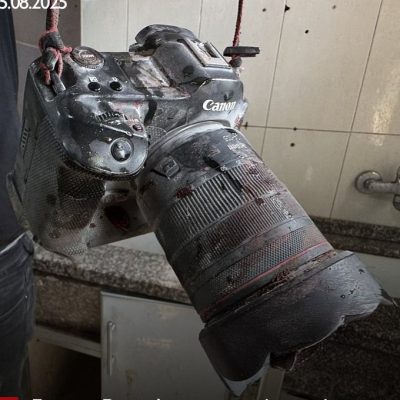 She criticized Reuters’ reporting after the killing of Anas Al-Sharif and an Al Jazeera crew in Gaza, accusing the agency of amplifying Israel’s “entirely baseless claim” that Al-Sharif was a Hamas operative, which was “one of countless lies that media outlets like Reuters have dutifully repeated and dignified,” she said.
“I have valued the work that I brought to Reuters over the past eight years, but at this point I can’t conceive of wearing this press pass with anything but deep shame and grief,” Zink said.
Zink also emphasized that the agency’s willingness to “perpetuate Israel’s propaganda” has not spared their own reporters from Israel’s genocide.
“I don’t know what it means to begin to honour the courage and sacrifice of journalists in Gaza, the bravest and best to ever live, but going forward I will direct whatever contributions I have to offer with that front of mind,” Zink highlighted, reflecting on the courage of Gaza’s journalists.
“I owe my colleagues in Palestine at least this much, and so much more,” she added.
Referring to the killing of six more journalists, including Reuters cameraman Hossam Al-Masri, in Israel’s Monday attack on the Nasser hospital in Gaza, Zink said: “It was what’s known as a “double tap” strike, in which Israel bombs a civilian target like a school or hospital; waits for medics, rescue teams, and journalists to arrive; and then strikes again.”
Zink underlined that Western media is directly culpable for creating the conditions for these events, quoting Jeremy Scahill, who said major outlets—from the New York Times to Reuters—have served as “a conveyor belt for Israeli propaganda,” sanitizing war crimes, dehumanizing victims, and abandoning both their colleagues and their commitment to true and ethical reporting.
She said Western media outlets, by “repeating Israel’s genocidal fabrications without determining if they have any credibility” and abandoning basic journalistic responsibility, have enabled the killing of more journalists in Gaza in two years than in major global conflicts combined, while also contributing to the suffering of the population.
The new fatalities among the media personnel in Gaza brought the number of Palestinian journalists killed in Israeli attacks since October 2023 to 246.
Israel has killed more than 62,700 Palestinians in Gaza since October 2023. The military campaign has devastated the enclave, which is facing famine.
Last November, the International Criminal Court issued arrest warrants for Israeli Prime Minister Benjamin Netanyahu and his former Defense Minister Yoav Gallant for war crimes and crimes against humanity in Gaza.
Israel also faces a genocide case at the International Court of Justice for its war on the enclave.
READ ALSO: China ‘shocked’ over Israeli killing of journalists in Gaza
The Palestine Chronicle case: When truth becomes the crime
By Mohamed El Mokhtar | MEMO | August 26, 2025
The Palestine Chronicle is not a militant organisation. It is a modest, independent publication, sustained by small donations and animated by a singular mission: to bear witness. It tells the untold stories of Palestine, documenting dispossession, resistance, and the endurance of a people condemned to silence. In a media landscape dominated by powerful conglomerates repeating the language of governments, the Chronicle insists on a journalism of proximity — grounded in daily lives, in the rubble of Gaza, in voices otherwise erased. Its true offense, in the eyes of its detractors, is not invention but truth.
At the heart of this endeavor stands Ramzy Baroud. His career is the antithesis of clandestine. For decades he has written, taught, and spoken in public, producing books translated into multiple languages, contributing columns to international publications, addressing audiences in universities and public forums across continents. He is not a shadowy figure; he is a man whose work has been consistent, transparent, and intellectually rigorous. His life is not untouched by the tragedy he describes: many members of his family were killed under Israeli bombardments. Yet while mainstream media rushed to amplify unproven allegations against him, they remained deaf to his personal grief. His tragedy was ignored, his integrity overlooked, his voice distorted — because his engagement is unbearable to those who would prefer silence.
A crime of conscience, not of law
He is an engaged journalist in the noblest sense: independent, lucid, unflinching. His so-called crime is not collusion with violence but fidelity to memory. That is why he is demonised — not for what he has done in law, but for what he represents in conscience. America, unable to silence Palestinian voices through censorship alone, now instrumentalises its justice system to achieve by indictment what it failed to achieve by argument. Having harassed universities, intimidated students, and punished professors for their solidarity with Gaza, it turns the courtroom into a new battlefield. And Congress, captive to the whims of its Zionist masters, joins the manhunt, targeting a journalist for the sole offense of telling the truth of his people. As for the mainstream press, it chooses cowardice: ignoring his family’s suffering, ignoring the emptiness of the charges, while echoing the accusations of power as if they were evidence.
Law twisted into a weapon
The complaint filed against Ramzy Baroud and the organization (People Media Project) that runs the Palestine Chronicle rests on the Alien Tort Statute, grotesquely overstretched to criminalise editorial decisions rather than acts of war. It alleges that by publishing articles from Abdallah Aljamal — described by Israel as a Hamas operative killed during a hostage rescue — the Chronicle “aided and abetted” terrorism. But here lies the first fissure: this characterisation of Aljamal comes exclusively from Israeli military sources, themselves a belligerent party. It has never been independently verified. The claim that he was both a journalist and a Hamas operative remains an allegation, not an established fact. To treat it as judicial evidence is to replace proof with propaganda.
Even if—hypothetically—Aljamal had, at the demand of a militant group, harbored hostages, such a circumstance would not in itself render him culpable: what ordinary civilian in a war zone can refuse the command of militants under threat of force? And even if it occurred, how could Ramzy Baroud have known of it? Even taken at face value, the allegation collapses upon scrutiny. No evidence demonstrates that the Chronicle or its editor had actual knowledge of Aljamal’s supposed operational role, nor that modest freelance payments — if any at all — bore any causal nexus to hostage-taking. The federal judge, in February 2025, dismissed the original complaint precisely for lack of proof of knowledge or intent. The plaintiffs returned with an amended filing, repackaged in rhetoric and pathos, but still devoid of the material elements required under international law: actus reus (a substantial contribution to the crime) and mens rea (intent or knowledge).
To equate the publication of articles with material support for terrorism is not jurisprudence but a juridical contortion. It is the substitution of law by politics, the criminalisation of journalism under the mask of counterterrorism. What is sought is not justice but intimidation — to cast suspicion on every Palestinian voice, to brand their words as weapons, their witness as crime.
Thus the legal emptiness is evident:
- Jurisdiction overstretched: the Alien Tort Statute (ATS) was never intended to criminalise editorial contracts.
- Elements unmet: no proven knowledge, no intent, no substantial assistance.
- Factual foundation unstable: the Hamas label rests on unverified allegations from one warring party.
- Political aim transparent: to silence Palestinians and punish one of their most articulate representatives for his independence.
This case is not justice. It is intimidation. It is not law. It is propaganda dressed in the robes of a courtroom. The allegation against Ramzy Baroud rests not on proof, but on the word of a belligerent army. An army that bombs, besieges, and kills — and then dictates who is journalist, who is terrorist, who is fit to speak. To transform those claims into evidence is to surrender law itself to war.
Ramzy Baroud is not a conspirator. He is a journalist of record, a man of books, a teacher, a witness. His own family has been buried under rubble. And yet, America has not mourned them, has not spoken of them. Instead, it chooses to hunt him — to turn his grief into accusation, his fidelity into crime.
Some congressmen have joined this manhunt, eager to please their Zionist patrons. Universities have been disciplined, their students silenced. The press, that great sentinel of truth, has abandoned him, repeating only the charges while ignoring his suffering. This is not democracy. It is servitude.
The elements of law are absent. There is no actus reus, no mens rea, no causal link. There is only suspicion. There is only the will to silence.
And so the true purpose stands naked: to criminalise the Palestinian word, to punish a journalist for speaking the truth of Gaza, to make an example of him so that others will be afraid to write.
But intimidation is not justice. A trial without evidence is not law. And silencing the witness will not erase the truth.
Law or servitude
Here one hears Thurgood Marshall’s axiom: “The Constitution does not permit the discrimination of silence.” One hears Cochran’s defiance: “If the proof is not there, the case cannot stand.” One hears Vergès exposing the colonial reflex that brands resistance as terror. One hears Vedel’s warning: that when law is bent to politics, law ceases to exist.
Ramzy Baroud stands here not accused, but accusing. He accuses a system that bends to power, a Congress that bows to lobbyists, a press that betrays its duty, and a nation that dares call itself free while shackling its own justice.
Therefore, the American justicial system has a choice: to lend its authority to propaganda, or to defend the very principle that sustains law — that guilt must be proven, not declared. To condemn Ramzy Baroud would be to condemn journalism itself. To acquit him is to restore some dignity to justice. The choice is clear.
Israel systematically targeting journalists in Gaza, says senior Hamas official
Press TV – August 25, 2025
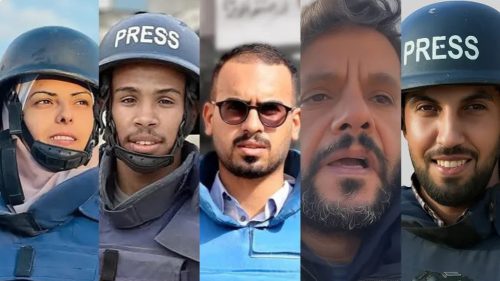
A senior Hamas official has condemned in the strongest terms Israel’s killing of five journalists in an attack on Nasser Medical Complex in southern Gaza, saying that the occupying regime is deliberately and systematically targeting members of press to cover up its atrocities in the besieged Palestinian territory.
“The crime of targeting Nasser Hospital could only be committed by a rogue terrorist entity, with the continued complicity of the United States and the helplessness of international law,” Basem Naim said on Monday.
He added, “The repeated targeting of Palestinian journalists and the prevention of foreign media from entering the Gaza Strip have become a constant goal for the Zionist enemy so that it can hide its crimes from the international public opinion.”
Five journalists were among 20 people killed in an Israeli attack on Nasser Medical Complex in southern Gaza, according to the region’s Ministry of Health.
The ministry said that the victims were killed on the fourth floor of the hospital in a double-tap strike – one missile hitting first, then another moments later as rescue crews arrived.
Those killed included Al Jazeera photographer Mohammad Salama; Hussam al-Masri, who worked as a photojournalist for the Reuters news agency; Mariam Abu Daqqa, who worked as a journalist with several media outlets, including The Independent Arabic and The Associated Press news agency; and journalist Moaz Abu Taha, according to Gaza’s Government Media Office.
A fifth journalist Ahmed Abu Aziz, who worked for the Quds Feed Network and other media outlets, succumbed to his wounds, according to the media office statement.
“The journalist colleagues were martyred when the Israeli occupation committed a horrific crime by bombing a group of journalists who were on a press coverage mission at Nasser Hospital in Khan Younis Governorate and many martyrs fell victim to this crime,” the statement read.
“We hold the Israeli occupation, the American administration, and the countries participating in the genocide crime such as the United Kingdom, Germany, and France fully responsible for committing these heinous brutal crimes.” the media office noted.
As Israel persists in prohibiting foreign journalists from accessing the coastal territory, Palestinian reporters continue to be the exclusive source of firsthand reporting from within the war zone.
The Federation of News Agencies of the Organization of Islamic Cooperation (OIC) has expressed its deep concern over the continued assassination of Palestinian journalists by the Israeli forces while carrying out their duties.
The federation emphasized that what is happening in Gaza constitutes a clear violation of international laws and norms, and comes in the context of Israeli violations of freedom of the press and media, and its policy of confiscating the truth, gagging, covering up its daily violations, and preventing them from reaching global public opinion.
France has ruined its reputation as a free country – Durov
RT | August 24, 2025
Telegram founder Pavel Durov has said that France ruined its reputation as a free country by briefly detaining him last year.
Durov was arrested at a Paris airport in August 2024 on charges of allowing criminals to use his messenger for illegal activities, including extremism and child abuse. The Russian-born tech entrepreneur was later released on €5 million ($5.86 million) bail and allowed to return to Dubai, where he resides.
In a post on Telegram on Sunday, Durov described his detention as “unprecedented” and “legally and logically absurd.” He said the investigation had produced no evidence of wrongdoing, stressing that Telegram’s moderation practices follow industry standards and that the company has complied with all legally binding requests from French authorities.
Durov also claimed that French investigators bypassed EU-mandated legal channels when sending queries to the platform, a mistake he argued could have been avoided “simply by googling the process or asking.”
“Sadly, the only outcome of my arrest so far has been massive damage to France’s image as a free country,” Durov said, adding that he must still return to Paris every two weeks with no appeal date in sight.
Telegram has since updated its privacy policy to allow the collection of metadata, including IP addresses, device information, and username changes, for up to one year, with the option of handing it over to “relevant judicial authorities.”
Last month, Durov accused France of waging “a crusade” against free speech, claiming that intelligence officials had tried to pressure him into censoring conservative content during Romania’s 2024 presidential election. The French intelligence agency, the DGSE, later said it had merely “reminded” him of the responsibility to police content while denying election interference.
Tulsi Gabbard Shuts Down Foreign Malign Influence Center, Citing Political Censorship
By Dan Frieth | Reclaim The Net | August 22, 2025
The Foreign Malign Influence Center (FMIC), a government office created during the Biden administration under the pretense of countering foreign disinformation, has been officially shut down as part of a broad overhaul of the Office of the Director of National Intelligence (ODNI) led by Director Tulsi Gabbard.
The move is being described by the administration as an effort to dismantle wasteful, politicized, and unconstitutional programs that have operated well beyond the intended scope of US intelligence work.
A fact sheet released by ODNI reveals that FMIC, along with its earlier incarnations, served as a tool for suppressing domestic political speech, particularly viewpoints at odds with the previous administration.
“FMIC and its predecessor entities were used by the previous administration to justify the suppression of free speech and to censor political opposition,” the document states.
Furthermore, it details the existence of a sustained partnership between the center and major technology companies, including X, Facebook, and Google, which ODNI says lacked any objective or scientific grounding and may have been weaponized against Americans.
This coordination, according to ODNI, took place under the guise of countering foreign influence but functioned in practice as a mechanism to police and control public discourse online.
The fact sheet highlights a specific incident from October 2020, when FMIC, then operating as the Election Threats Executive, was involved in shaping how social media platforms responded to the New York Post’s reporting on Hunter Biden’s laptop.
That reporting was rapidly suppressed across major platforms, an act that later drew widespread condemnation from free speech advocates. The ODNI document directly connects FMIC to that censorship effort, noting its coordination with platforms on their response to the story.
Gabbard, speaking with Fox News host Jesse Watters, condemned the center’s activities in clear terms. “It was essentially used as a means to censor Americans’ free speech, calling it, ‘Hey, you’re spreading disinformation,’” she explained.
Gabbard further stated that FMIC worked directly with social media companies to silence dissent, particularly criticism of the Biden administration, which she described as “a direct contradiction and undermining of our fundamental constitutional rights.”
Although the ODNI fact sheet stops short of using the term “abolished,” it does confirm that FMIC’s functions are being dismantled and its personnel absorbed elsewhere.
The agency’s language states it is “refocusing functions within the Foreign Malign Influence Center” and integrating any necessary components into other divisions like Mission Integration and the National Intelligence Council. Nevertheless, in her interview, Gabbard was clear that the center’s days of operating as an independent entity are over.
Beyond FMIC, the Gabbard-led reforms are targeting a range of other ODNI entities accused of serving partisan purposes rather than advancing national security.
Among those being eliminated are the External Research Council and the Strategic Futures Group, both criticized for pushing politically motivated intelligence. According to the fact sheet, the overall restructuring, referred to as “ODNI 2.0,” will slash agency staffing by nearly half and save taxpayers over $700 million per year.
4chan Rejects UK Ofcom Fine, Citing US Free Speech Protections and Threatening Legal Action
By Cindy Harper | Reclaim The Net | August 22, 2025
4chan’s legal team has firmly rejected an attempt by UK regulator Ofcom to impose penalties under Britain’s new Online Safety Act, declaring the proposed fine unenforceable and a direct challenge to free expression protected by US law.
The media regulator wants the site to pay a £20,000 ($27,010.78) penalty, with additional daily fines if it continues to ignore requests tied to its ongoing investigation.
However, Preston Byrne, the attorney representing 4chan, argues that the demand lacks legal standing in the United States.
Speaking to the BBC, Byrne described the regulator’s actions as “an illegal campaign of harassment” directed at American tech firms.
Byrne made clear his client would not comply: “4chan has broken no laws in the United States, my client will not pay any penalty.”
Ofcom launched its investigation to determine whether the platform meets requirements laid out in the Online Safety Act, which compels digital services to shield UK-based users from “harmful” content.
In August, the regulator issued what it called a “provisional notice of contravention,” accusing 4chan of failing to respond to two formal data requests.
The site, long known for its loose moderation policies and anonymous posting, has been a regular target of controversy over the years. Its open nature allows for a broad range of user expression, which some governments now seek to restrict under the pretext of safety.
In a public statement released on X, legal representatives for 4chan doubled down.
Byrne & Storm, alongside Coleman Law, stated: “American businesses do not surrender their First Amendment rights because a foreign bureaucrat sends them an email.” They argued that US courts have consistently refused to enforce foreign censorship fines, and if necessary, they would escalate the matter in federal court to protect those constitutional rights.
The statement added that US authorities were already briefed on the situation, and it urged the Trump administration to “invoke all diplomatic and legal levers” in defense of US-based platforms against what it called “extraterritorial censorship mandates.”
Ofcom declined to provide further comment while the investigation remains open.
TikTok bars calling Israeli forces ‘terrorists’ after hiring ex-soldier
Press TV – August 24, 2025
TikTok updated its content guidelines to prohibit labeling Israeli forces as “terrorists,” shortly after appointing a former Israeli soldier and self-described “proud Zionist” to oversee its so-called “anti-Semitism” policies.
TikTok appointed Erica Mindel as its new Public Policy Manager for Hate Speech 15 days before the ban was announced, according to users on X.
They also pointed out that the guidelines previously prohibited “all racial supremacy” but have now been narrowed to exclusively address “White supremacy.”
According to her LinkedIn profile and job description, Mindel is tasked with shaping the company’s hate speech policy and serving as TikTok’s internal and external expert on anti-Semitism.
Mindal spent two and a half years in the Israeli military as a madrichot shirion – an instructor in the occupation army – and also worked with the US State Department.
“I am a proud American Jew,” she once said.
She was hired following pressure from the Anti-Defamation League (ADL), a notorious Zionist lobby group in the US. She is based in New York City and is reported to earn an estimated £280,000 annually.
Her two-and-a-half years as an Israeli military instructor, coupled with her work for US Special Envoy to Monitor and Combat Antisemitism Deborah Lipstadt, suggest that her role is aimed at censoring pro-Palestinian content while amplifying Israeli narratives amid the ongoing genocidal war on Gaza.
The move comes as the Israeli regime persists in its systematic oppression of Palestinians by worsening the humanitarian crisis in Gaza.
Disturbing images and videos depicting emaciated children, relentless bombardments, and widespread destruction continue to surface on social media platforms, shedding light on the dire situation faced by Palestinians in the region.
Backed by the US, Israel launched its onslaught on Gaza on October 7, 2023, after Palestinian resistance fighters waged the surprise Operation Al-Aqsa Storm against the Zionist entity in response to the regime’s decades-long campaign of bloodletting and devastation against Palestinians.
The Israeli military has so far killed more than 62,600 Palestinians, mostly women and children.
Bands boycott UK festival after Irish group ‘cut off’ for waving Palestinian flag

Press TV – August 24, 2025
Several bands have pulled out of a major UK music festival after an Irish folk band said organizers cut their set when they displayed a Palestinian flag and chanted “Free Palestine.”
The Mary Wallopers were performing at Victorious Festival in Portsmouth on Friday when organizers accused them of using a chant “widely understood to have a discriminatory context.”
The Mary Wallopers dismissed the allegation as “misleading,” saying, “Our video clearly shows a Victorious crew member coming on stage, interfering with our show, removing the flag from the stage and then the sound being cut following a chant of ‘Free Palestine’.”
Organizers first claimed the set was stopped over a chant, but later admitted the sound was cut after the flag was shown. They apologized “to all concerned” and pledged a “substantial donation” to humanitarian relief for Palestinians.
In protest, The Last Dinner Party, The Academic and Cliffords announced on Saturday that they would boycott the festival over censorship.
“We are outraged by the decision to silence The Mary Wallopers,” The Last Dinner Party wrote on Instagram, calling it “political censorship.”
The Academic said they could not “in good conscience” perform at a festival that silences free speech, while Cliffords said they “refuse to play if we are to be censored for showing our support to the people of Palestine.”
The festival, which continues through Sunday with headliners including Kings of Leon, Bloc Party and Gabrielle, now faces growing backlash over silencing pro-Palestinian protest.
Featured Video

More Iran War fallout: Maritime insurance industry shifts from London to China
or go to
Aletho News Archives – Video-Images
From the Archives
The Biggest Threat to Peace in Middle East
By Dr. Elias Akleh* | Sabbah Report | May 24, 2010
A build up of heightened tension in the Middle East is escalating in the last few weeks. American and Israeli postures towards Lebanon, Syria, and Iran have become more threatening. Listening to speeches of political leaders one hears talks only about war not peace. Iranians and Israelis are continuously training hard for a possible showdown. Both sides are conducting extensive war games every month. This led Syrians to claim that Israel is preparing for a soon-to-come another war. The Jordanians also are warning that current stalemate of the peace process is an indication of a war breaking out this summer. The Russian President and his army chief hinted, a few months ago, that the US and Israel were planning for an attack on Iran.
Indeed Iran is, as it has been for last few years, the target of most of the threats and accusations of supporting terrorism. Escalating incitement against Iran the American Defense Department sent last month (April) to Congress a report on Iran’s military claiming Iran could develop intercontinental ballistic missiles capable of reaching the US by 2015.
Ignoring the fact that N. Korea, India, Pakistan, and Israel are proven to have nuclear weapons while Iran does not, the US Secretary of State Hillary Clinton chose in her speech, to the nuclear Non-Proliferation Treaty review conference at the UN, to focus on Iran’s alleged nuclear ambitions putting the whole world at risk as she put it. According to Clinton Iran’s acquisition of nuclear weapons, rather than Israel’s more than 200 nuclear bombs, is destabilizing the Middle East. She called on the world’s nations to rally around US efforts to hold Iran, not other nuclear countries, to account.
The accusation that Usama Bin Laden is living comfortably in Iran had received a boost after the broadcast of a documentary called “Feathered Cocaine”. This echoed the June 2003 claims of the Italian newspaper Corre de la Sierra that Bin Laden was in Iran according to some intelligence report, and according to Richard Miniter’s book “Shadow War”. … continue
Blog Roll
 Aletho News
- More Iran War fallout: Maritime insurance industry shifts from London to China
- US-Israeli aggression on Iran triggers review of GCC countries’ investment pledges to Washington
- Russia slams UK plan to seize tankers suspected of carrying its oil
- Pakistan ramps up food exports to Persian Gulf nations as war deepens food insecurity
- Iran submits response to US plan, sets terms for war’s end: Tasnim
- US vs Iran: Kharg Island Talk — Bluff or Escalation? Ex-Military Officer Weighs In
- Zelensky unnecessarily involves Ukraine in the Middle East crisis
- Turkish tanker blacklisted by Ukraine hit in drone attack – media
- Canada, the U.S., and NATO: the inescapable trap
- Villains of Judea: Leonid Radvinsky
- If Americans Knew
- ‘No Innocent Children’: Far-right Israeli Lawmaker Defends Killing of Palestinian Family
- Mossad’s promises helped Netanyahu convince Trump that Iran could be toppled
- US Arms Control Official Refuses To Comment When Asked If Israel Has Nuclear Weapons
- Veterans warn US landing could be ‘more Gallipoli than Vietnam’
- Israel may be committing war crimes in Lebanon – Not a ceasefire Day 167
- In the West Bank, life is a constant battle – 3 articles
- Jacob Reses, one of the most powerful pro-Israel operatives in Trump’s Washington
- Israeli-US assaults kill or injure 87 children a day – Not a ceasefire Day 166
- ‘Forever live by the sword’: Understanding Israelis’ massive support for Iran war
- UN’s special rapporteur on human rights says Israel is systematically torturing Palestinians
- No Tricks Zone
- Devastating Assessment Of Comirnaty Vaccine By Former Senior Pfizer Europe Toxicologist
- New Study: CO2 Is ‘Effectively Negligible’ As An Explanatory Climate Change Factor Since 2000
- Former Pfizer Toxicologist Dr. Helmut Sterz Tells Bundestag Hearing Pfizer Vaccine Should Have Never Been Approved
- Energy Expert: Germany’s Nuclear Phaseout Was A “500 Billion Euro Mistake”
- New Research: South Australia’s Mid-Holocene Sea Surface Temperatures Were 4°C Warmer Than Today
- Storing Green Energy To Last Germany 10 Days Would Require A 60-Million Tonne Battery
- New Studies: UK Sea Levels Were 4 Meters Higher Than Today During The Mid-Holocene
- Destructive Green New Deal: German Energy And Metal Group Warns Of Drastic Crisis
- New Study Documents A 20-Year Pause In Arctic Sea Ice Decline – Driven By Internal Variability
- Wake-up Call: Survey Shows Majority Of Germans Now Favor Postponing Climate Targets!
 Aletho News