Colonel Jacques Baud & Nathalie Yamb Sanctioned: EU Goes Soviet
Glenn Diesen | December 16, 2025
How did we reach a point where quoting Western sources gets you branded a foreign propagandist? Is the EU’s executive branch now completely out of its mind, punishing dissenters without trial under the guise of fighting “propaganda”?
Who gets to be a hostage? The language that legitimises Palestinian captivity
By Jwan Zreiq | MEMO | December 17, 2025
The answer lies deeply entangled within global biases in how violence and captivity are framed. Consider two seemingly similar terms: “hostage” and “prisoner.” Hostage evokes an image of innocence violated; a life unjustly taken. Prisoner implies process, legality, perhaps even guilt. A prisoner, after all, tells us less about the person held captive than about the system that confines them. But what happens when the system itself is one of oppression and racial apartheid? Should we blindly adopt these terms without questioning the power structures that deploy them?
The answer here lies within the global biases in how violence and captivity are framed. For instance, consider Israeli soldiers like Matan Angrest, who were captured from his tank following October 2023. International media outlets, such as The New York Times, consistently describe these incidents like Matan as being “kidnapped from his tank,” a phrase that emphasises personal vulnerability while intentionally sidestepping the soldier’s combatant status. This framing shifts focus, drawing on narratives of personal suffering rather than the broader political and military context. As these soldiers are released, they are often publicly reintegrated as civilians and family figures, and some, like Edan Alexander, announced their intent to resume his service in the Israel Defense Forces (IDF). These statements and the media’s celebration of their return shape perceptions of their humanity, painting IDF prisoners of war as victims of violence rather than active participants in the system of oppression and apartheid against Palestinians.
In contrast, the media reduces Palestinians to the category of “prisoners,” a term that pretends to give legality while erasing the reality of their captivity. Across the West Bank, Israeli forces routinely conduct raids targeting men, women, children and the elderly with neither charges nor trials, a process that is at once arbitrary and normalised. Israeli forces take these individuals hostage through a system designed to make indefinite imprisonment routine under the legal label of “security measures” and “administrative detention.” Violence, home demolitions and the deliberate cultivation of fear accompany these operations, while Israel systematically takes over the surrounding lands to expand its settler colonies.
Right now, thousands of Palestinians remain hostages in Israeli prisons, where they endure systematic torture. The numbers speak for themselves. Prior to recent releases, more than 10,000 Palestinians were held in Israeli prisons, including at least 3,500 in administrative detention without trial. The number of political prisoners had doubled, rising from 5,250 to nearly 10,000. From rape and torture to electric shocks and the full range of degradation that no human being should ever endure, this constant assault on the Palestinian body and soul is inseparable from the system that detains them. Yet, despite overwhelming evidence that Israeli forces arbitrarily hold many Palestinians, the world calls them merely “prisoners.”
One might wonder why Israel bothers with even putting up with the terms of legality; after all, this is a regime whose very logic is apartheid and colonisation. Each raid, each detention, is a small yet indispensable step in the relentless machinery of land seizure. Israel maintains the fiction of legality because international law requires it. The label “prisoner” thus functions to sanitise violations of international law that are, in reality, structural and deliberate. This terminology transforms oppression into procedure, erases the moral weight of captivity and normalises systemic violence. It governs not only how we perceive the victims of violence but whose pain we deem worthy of recognition.
In this discourse, the Palestinian experience is characterised by collective endurance, an abstract suffering with little room for individual human stories. By contrast, Israeli suffering is personalised, humanised and sanctified. Such language, which distinguishes between “hostage” and “prisoner,” produces profound inequalities in empathy and legitimacy, reinforcing power imbalances and shaping international opinion and perception.
The Red Ribbon Movement rejects the sanitised language that permits this violence to continue. The red ribbon is visible refusal, a refusal to accept the terms “administrative detention” and “security measures” for what amounts to collective hostage-taking designed to terrorise an entire population and facilitate ongoing dispossession.
Dr Mustafa Barghouti calls on people worldwide to join the Red Ribbon Movement to wear red ribbons in solidarity with Palestinian hostages held in Israeli prisons. This visible act of refusal demands that we interrogate the language that permits this violence to continue.
The urgency of this moment demands immediate action and solidarity. We return to the question the labels themselves preserve: who is deemed human enough to be a hostage, and who is simply a statistic?
The red ribbon answers: Palestinians held in Israeli prisons are hostages of apartheid, and the world must recognise this truth now, not later, not eventually, but in this moment of ongoing violence and captivity.
Israel’s all-seeing eye is the stealthiest cruelty of all in Gaza
Journalist Mohammed Mhawish describes how total surveillance is relentlessly controlling, often lethally, the violence is determined algorithmically.
By Connor Echols – Responsible Statecraft – December 16, 2025
Discussions of the war in Gaza tend to focus on what’s visible. The instinct is understandable: Over two years of brutal conflict, the Israel Defense Forces have all but destroyed the diminutive strip on the Mediterranean coast, with the scale of the carnage illustrated by images of emaciated children, shrapnel-ridden bodies, and flattened buildings.
But underlying all of this destruction is a hidden force — a carefully constructed infrastructure of Israeli surveillance that powers the war effort and keeps tabs on the smallest facets of Palestinians’ lives.
Few people understand this system more deeply than Mohammed Mhawish, a Palestinian journalist who fled Gaza in 2024 after being targeted by Israeli airstrikes for his reporting. In a recent essay for New York Magazine, Mhawish traced the contours of Israel’s surveillance system through the eyes of the Gazans who live through it every day.
RS spoke with Mhawish over email to get his insights about how this system of surveillance has powered the war in Gaza and created a culture of fear among Palestinians. The conversation also touches on Mhawish’s decision to leave Gaza — and how he knows that Israel tried to kill him for his journalism.
RS: In your piece, you mention a poll saying that “nearly two-thirds of Gazans believed they were constantly watched by the Israeli government.” How does this feeling of surveillance affect life in Gaza? How would you describe the feeling to those of us who have never experienced it?
Mhawish: In Gaza, surveillance actively structures daily life. It determines how people move, communicate, gather, and survive. Nearly everyone I spoke to understood themselves as data points inside a system that continuously observes, records, and evaluates them.
This awareness produces a constant state of constraint. Phones are treated with suspicion, even fear. People limit calls, change SIM cards, power down devices, avoid repeated routes, and hesitate before gathering with others. Parents instruct children not to linger in certain places. Journalists and medics described modifying their work because they knew patterns could be extracted and interpreted later. Surveillance works by narrowing the range of what feels safe for everyone there.
What distinguishes Gaza is that surveillance is both totalizing and opaque. People know they are being watched, but they don’t know how, by whom, or according to what criteria. There is no way to clarify a misunderstanding or correct a false assumption. The system does not explain itself. That uncertainty turns ordinary behavior into potential exposure.
For those who have never lived under it, they might need to imagine that every movement, call, or association could be logged and assigned meaning by an unseen authority, and that those judgments could lead directly to deadly consequences in real time. It is fear of being misclassified by a system that can not be challenged.
RS: Israeli officials often point to the fact that they withdrew from the Gaza Strip in 2006 as evidence of their benevolence. They argue Israel had essentially allowed Palestinians to have a territory that they could govern on their own, and Palestinians had wasted that chance by allowing Hamas to take power. How does your work complicate the narrative of Israeli disengagement from Gaza? What did surveillance look like before the war?
Mhawish: My reporting shows that Israeli “disengagement” from Gaza was never a withdrawal from control. It was merely a shift in how control was exercised. Physical presence was replaced with technological dominance.
Long before the current war, Gaza existed under constant aerial surveillance, communications interception, population registries, and data-driven monitoring. Israel controlled Gaza’s borders, airspace, coastline, electromagnetic spectrum, and civil registries. Movement in and out of the Strip, access to medical care, imports, and even family reunification were all mediated through Israeli databases informed by surveillance.
Surveillance allowed Israel to manage Gaza remotely and comprehensively. Intelligence sources and prior investigations describe systems that mapped neighborhoods, tracked social and familial networks, and analyzed behavioral patterns. Control did not require soldiers on every street, only access to required sensors, databases, and algorithms capable of rendering the population legible from afar.
This fundamentally undermines the idea that Gaza was ever allowed to govern itself. Governance without sovereignty is not autonomy. Surveillance ensured that Israel retained decisive authority over Gaza’s population while maintaining the fiction of withdrawal.
RS: Israel bombed your apartment in late 2023, destroying your home and injuring you and your family. What led you to conclude that this attack was a response to your journalistic work? Did other press colleagues have similar experiences?
Mhawish: The bombing of my apartment was a direct result of my reporting.
In the weeks leading up to the strike, I received multiple threats from the Israeli military in response to my journalistic work. These included direct communications warning me about my reporting. Eventually, I received a phone call informing me that my house would be bombed. Shortly afterward, it was.
My apartment was civilian. There was no military activity there. My family was inside. The strike destroyed our home and injured my family members.
What made this experience even more unmistakable was how common it was among Palestinian journalists. Colleagues told me a similar sequence: reporting, threats, warning calls, and then strikes on their homes rather than on them in the field. These attacks often targeted family residences, maximizing harm while sending a clear message.
This is part of a systematic effort to intimidate journalists by demonstrating that reporting carries consequences not only for them, but for their family. It collapses the distinction between professional risk and private life and makes journalism itself a punishable act.
RS: What do we know about the role of American companies in this surveillance regime?
Mhawish: American technology companies are not peripheral to Israel’s surveillance architecture. Israeli military and intelligence units rely on U.S.-based cloud infrastructure, data storage, data processing, and AI-related technologies to collect, analyze, and retain vast amounts of information on Palestinians.
This relationship is reinforced by the movement of personnel between Israeli intelligence units and major tech firms, creating a feedback loop in which military expertise informs commercial products and commercial tools enable military surveillance. While companies often claim neutrality, their technologies are embedded in systems that monitor, categorize, and target a civilian population under occupation.
Gaza demonstrates how commercial technologies developed for efficiency, scale, and optimization can be repurposed for population-level surveillance and warfare. The issue is [companies] are not willing to accept responsibility when their tools become foundational to systems of domination.
RS: How could this surveillance regime be used for the proposed system of only allowing “vetted” Palestinians to live in rebuilt communities on the Israeli-occupied side of the yellow line in Gaza?
Mhawish: The proposed vetting system is only possible because the surveillance infrastructure already exists. Israel has spent years building databases capable of assigning suspicion and risk scores to individuals based on opaque criteria derived from communications data, movement patterns, and social networks.
Applied to reconstruction, this system could determine who is allowed to return, who receives travel permits, who is denied treatment outside, and who is permanently excluded. Vetting does not follow a transparent legal process, because it’s based on an algorithmic judgment rendered without explanation or appeal.
This kind of system enables displacement without explicit expulsion. People would be filtered out quietly — through denied access, stalled applications, or unexplained rejections — while the underlying logic remains hidden. Surveillance becomes a mechanism for shaping the postwar population under the language of security.
In that sense, Israel’s surveillance of Palestinians in Gaza is about controlling who is allowed to exist, where, and under what conditions afterward.
Connor Echols is a reporter for Responsible Statecraft. He was previously the managing editor of the NonZero Newsletter.
EU nation ‘disrupting normal religious life’ – UN experts
RT | December 17, 2025
Estonian authorities are undermining religious freedoms by fostering an “adversarial environment” for the country’s largest church community because of its spiritual ties to Russia, a panel of experts advising the UN Human Rights Council has warned.
In a statement issued on Monday, the experts criticized Tallinn’s approach toward the Estonian Orthodox Christian Church (EOCC), which maintains canonical links with the Russian Orthodox Church. They pointed to a series of administrative actions, a court decision that stripped the EOCC of state funding on security grounds, and a proposed legislative amendment that the panel said would “disproportionately affect a single religious community.”
“Canonical identity, ecclesiastical hierarchy and spiritual allegiance are integral components of the freedom of religion and are fully protected under international law,” the three-member panel emphasized.
The experts highlighted as particularly troubling a bill being advanced in the Estonian parliament despite objections from President Alar Karis. He has argued that the proposed ban on religious organizations accused of links to a foreign entity labeled a security threat by the government would violate the constitution.
The panel also condemned refusals to grant rent agreements and residency permits to clergy, stating: “Such actions disrupt normal religious life and may undermine the autonomy that should be granted under freedom of religion or belief.”
Moscow has long accused Estonia of pursuing discriminatory policies allegedly driven by entrenched Russophobia. The Estonian Orthodox Christian Church includes both ethnic Estonians and members of the country’s sizable Russian-speaking minority among its faithful.
NATO’s Red Pen on Ukraine: Jacques Baud and the Silencing of Dissent
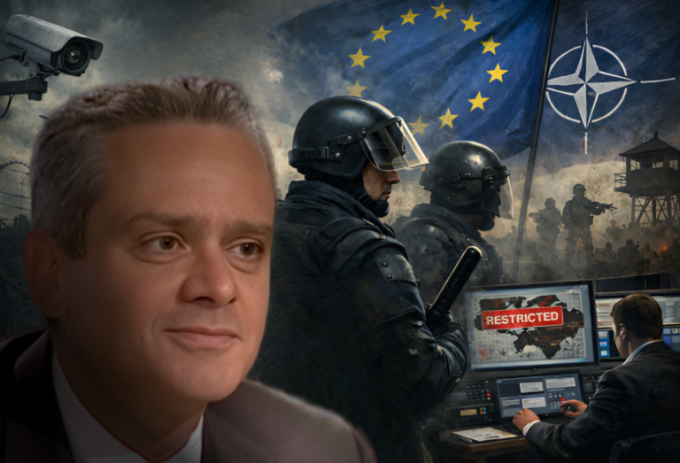
By Freddie Ponton | 21st Century Wire | December 17, 2025
On 15 December, the European Union took a step that few could have imagined: it sanctioned twelve individuals, including Swiss analyst and former intelligence officer Jacques Baud and French national Xavier Moreau, not for breaking the law, but for expressing views deemed politically inconvenient. Asset freezes, travel bans, and economic restrictions were imposed without any judicial process. While presented as an EU initiative, the fingerprints of NATO’s strategic communications and information-control apparatus are unmistakable, shaping both the targets and the justification. Europe is no longer simply countering disinformation; it is policing interpretation itself, turning independent analysis into a potential liability. The question now is not whether dissent will be punished, but how far these measures will go, and who will decide the boundaries of acceptable thought.
Baud, a Swiss national, is not a political activist, influencer, or anonymous online provocateur. He is a former Swiss intelligence officer and army colonel, trained in counter-terrorism, counter-guerrilla warfare, and chemical and nuclear weapons. Over the course of his career, he helped design the Geneva International Centre for Humanitarian Demining (GICHD) and its Mine Action Information Management System (IMSMA), served with the United Nations as Chief of Doctrine for Peacekeeping Operations in New York, worked extensively in Africa, and later held senior responsibilities at NATO, where he led efforts against the proliferation of small arms. He is also the author of multiple books on intelligence, asymmetric warfare, and terrorism, texts widely read well before the Ukraine war.
Yet this résumé, once considered exemplary, has now been recast as suspicious. On 15 December, the EU placed Baud under sanctions, freezing assets and restricting travel, accusing him of acting as a “spokesperson of Russian propaganda” and of participating in “information manipulation and influence.” No criminal charges have been filed. No judicial process has taken place. No evidence has been publicly tested in court. The punishment is administrative, political, and immediate.
DOCUMENT: COUNCIL DECISION (CFSP) 2025/2572 of 15 December 2025 amending Decision (CFSP) 2024/2643 concerning restrictive measures in view of Russia’s destabilising activities (Source: EUR-Lex)
This is not an isolated case. Baud joins a growing list of European journalists, analysts, and commentators sanctioned or publicly stigmatised for expressing views that diverge from official EU and NATO positions. Germans living in Russia, independent journalists, and alternative media figures have already faced similar measures. What unites these cases is not proof of coordination with Moscow, but a shared refusal to reproduce the sanctioned narrative framework through which the war must be interpreted.
From Foreign Policy to Narrative Enforcement
Officially, these sanctions are justified as defensive measures against “foreign information manipulation and interference”, a phrase now deeply embedded in EU and NATO communications. The stated objective is to protect European democracies from destabilisation. In practice, however, the definition of “manipulation” has expanded so broadly that any analysis which echoes, overlaps with, or even partially aligns with Russian positions can be deemed suspect, regardless of sourcing, intent, or transparency.
The problem is not that governments counter disinformation. Every state does. The problem is how disinformation is defined, who defines it, and what instruments are used to combat it.
In Baud’s case, the EU does not allege clandestine activity, secret funding, or covert coordination with Russian authorities. Instead, he is held responsible for contributing to a narrative environment that, in Brussels’ view, undermines Ukraine and EU security. This is a crucial shift: The target is no longer falsehood, but interpretation.
Once interpretation itself becomes sanctionable, the boundary between security policy and censorship collapses.
France’s Role, and NATO’s Shadow
Several reports indicate that the initiative to sanction Baud and eleven others originated with France. French Foreign Minister Jean-Noël Barrot publicly announced that Europe would impose sanctions on what he described as “pro-Russian agents,” including individuals accused of repeatedly influencing French and European public debate. Among those named was Xavier Moreau, a French analyst long critical of NATO policy.
Barrot’s declaration on X was unambiguous:
“At France’s initiative, Europe is today imposing sanctions against Kremlin propaganda outlets and those responsible for foreign digital interference. Zero impunity for the architects of chaos.”
The language is revealing. “Architects of chaos” is not a legal category; it is a political one. It frames speech as an act of aggression and analysts as hostile operators.
Behind this framing lies a figure little known to the public but central to the architecture of Europe’s contemporary information policy: Marie-Doha Besancenot, Senior Advisor for Strategic Communications in the French Foreign Ministry. Prior to assuming this role, Besancenot served from 2020 to 2023 as NATO Assistant Secretary General for Public Diplomacy.
In an interview published in English by the French Ministry of the Armed Forces and Veteran Affairs, in March 2025, Besancenot openly described founding a task force in late 2023 dedicated to detecting and analysing what she termed “hostile narratives,” with the capacity to alert authorities “in real time” and propose political responses. The task force’s mission, she explained, was to detect, track, and report information threats against NATO in the information domain. In this interview, Besancenot articulates how “France understood what was happening in the information domain was a matter of national security”, and speaks of Viginum, a French agency created in response to these perceived threats, and that is responsible for monitoring and protecting the state against foreign digital interference that, according to them, affects the digital public debate in France.
The continuity is striking. The doctrine developed inside NATO’s strategic communications apparatus appears to have migrated almost seamlessly into national and EU-level policy, without democratic debate, parliamentary oversight, or public consent.
Strategic Communications as Political Power
NATO insists that it does not police speech and that it respects freedom of expression. Formally, this is true. NATO does not arrest journalists or pass laws. Instead, it develops conceptual frameworks, “hybrid threats,” “information laundering,” and “foreign information manipulation”, which are then adopted by member states and EU institutions.
Once a narrative framework is institutionalised, it becomes self-enforcing. Media outlets internalise red lines. Publishers hesitate. Platforms over-moderate. Governments justify extraordinary measures as technical necessities or national security. The perfect storm in which sanctions replace debate.
One of the most insidious concepts to emerge from this ecosystem is that of “information laundering”, the idea that domestic journalists or analysts can unwittingly “clean” foreign propaganda simply by engaging with it critically. Under this logic, intent becomes irrelevant. What matters is effect, as defined by strategic communicators.
This doctrine eliminates the possibility of good-faith analysis. To examine Russian claims, even to refute them selectively or partially, is to risk being accused of amplifying them. The only safe position is total dismissal, which appears to be NATO and the EU’s endgame.
The Democratic Cost
The danger of this approach extends far beyond Jacques Baud.
Sanctions are no longer being used to punish illegal acts, but to discipline discourse. They operate without due process and create chilling effects far wider than their immediate targets. An analyst does not need to be sanctioned to be silenced; seeing a peer sanctioned is often enough.
Moreover, these measures are imposed by non-elected bodies, EU councils, commissions, and advisory structures, drawing heavily on NATO doctrine, an alliance that itself is not subject to democratic accountability. National parliaments are largely absent from the process. Courts intervene only after the damage is done.
The precedent is dangerous. If today the target is analysts accused of being “pro-Russian,” tomorrow it could be critics of EU defence spending, sceptics of military escalation, or scholars questioning intelligence claims. Once the machinery exists, its scope inevitably expands.
History offers ample warning. Democracies do not usually collapse through sudden repression, but through the gradual normalisation of exceptional measures, each justified by urgency, each framed as temporary, each defended as necessary.
Security Without Freedom Is Not Security
The EU and NATO argue that they are facing unprecedented hybrid threats and that extraordinary responses are required. That claim deserves serious consideration. But security achieved by narrowing the space of permissible thought is a brittle security, one that ultimately undermines the democratic resilience it claims to protect.
A society confident in its values does not need to freeze bank accounts to win arguments. It does not need to conflate analysis with subversion. It does not need to outsource intellectual authority to strategic communications units.
Jacques Baud may be wrong in some of his assessments. He may be right in others. That is beside the point. What matters is that his arguments exist in the open, supported by sources, available for rebuttal. The appropriate response to analysis is counter-analysis, and certainly not sanctions. By choosing punishment over debate, Europe is not defending democracy. It is redefining it, quietly, administratively, and without asking its citizens whether this is the kind of polity they wish to inhabit.
The sanctions against Baud are therefore not merely about Ukraine, Russia, or NATO. They are about who gets to speak, who decides what is permissible to think, and whether Europe still trusts its citizens to judge arguments for themselves.
That question, once raised, cannot be easily swept away.
Villains of Judea: Ronald Lauder and his War on American Dissent
For Lauder, Israel always comes first.
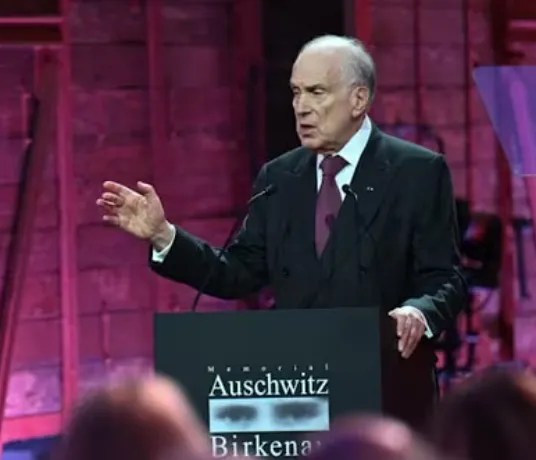
José Niño Unfiltered | December 16, 2025
World Jewish Congress President Ronald Lauder likes to present himself as a civic minded elder statesman, a sober billionaire warning America about a rising tide of antisemitism.
At the Israel Hayom Summit on December 2, 2025, he framed the moment as a crisis of the West itself, calling it “a full-scale assault on truth, on democracy, and on the safety of Jewish people everywhere,” and insisting, “This is not normal. And it is not ‘just criticism of Israel.’ It is the world’s oldest hatred, once again wearing political clothing.”
Lauder was referring to the rise of antisemitism and anti-Israel sentiment worldwide in the wake of Israel’s 2-year bombing campaign in Gaza.
Then he sharpened the spear and aimed it at domestic enemies like Tucker Carlson, who has been one of the most vocal critics of Israel in the post-October 7 reality we live in. He told the audience, “Tucker Carlson is the Father Coughlin of our generation.” In the same speech he warned that complacency is over, because “antisemitism is rampant throughout our culture,” and he demanded a political and institutional counteroffensive.
That is the Lauder formula in its purest form. He wraps a totalizing political program in the language of safety and moral emergency, then treats America’s public life as territory to be reorganized around his crusade. The target is never merely hatred. The target is dissent, drift, and disobedience from the priorities he has chosen, priorities that consistently put Israel first.
Lauder did not arrive at this posture late in life. He was born into power in New York City in 1944, the heir to the Estée Lauder fortune, raised in elite institutions, and trained for international influence through business and foreign policy studies. He entered the family company early, then moved into government in the Reagan era, where he served at the Pentagon as Deputy Assistant Secretary of Defense for European and NATO policy.
Ronald Reagan then tapped him as U.S. ambassador to Austria in 1986. In Vienna, he did not behave like a neutral American emissary. He turned his diplomatic post into a stage for historical confrontation and political signaling. Lauder refused to attend the inauguration of Austria’s president Kurt Waldheim amid allegations of him being involved in or being aware of National Socialist atrocities in the Balkans during his service as a German army lieutenant in World War II. He also fired U.S. diplomat Felix Bloch for engaging in suspected espionage activities.
After government service, Lauder tried to convert his vast wealth into formal power at home. In 1989, he ran for mayor of New York City as a Republican, where he spent big bucks to get his name out and campaign to the right of Rudy Giuliani, only to lose the primary. Even in defeat, the pattern held. He treated politics as an arena where money does all the talking, and he kept looking for levers that could bend public life to his will.
He found one in term limits. During the 1990s he poured resources into imposing term limits on New York City officials, selling it as a democratic reform and a check on machine party politics. Yet in 2008, when Mayor Michael Bloomberg wanted a third term, Lauder reversed course and supported extending those limits, a turn that mainstream critics interpreted as a billionaire bargain dressed up as civic necessity. However, from the perspective of long-time observers of Jewish behavior, Lauder’s support for Bloomberg reflects a pattern of co-ethnic solidarity among Jewish power brokers.
While Lauder played these games in New York, his real career was consolidating leadership in the organized Jewish political world. Notably, Lauder was a member of the Mega Group—a mysterious network of Jewish oligarchs that worked behind the scenes to advance Jewish interests and strengthen pro-Israel bonds among Jews in America. Leslie Wexner, founder of The Limited and Victoria’s Secret, and the late Jewish sex criminal Jeffrey Epstein were among the most prominent members of this Jewish consortium. By 2007, Lauder had become president of the World Jewish Congress, a position that turned him into a roaming power broker who meets heads of state and treats international politics as a permanent lobbying campaign.
From that perch, he repeatedly framed Western security architecture as a vehicle for Israeli priorities. In 2011, he publicly argued that Israel should be admitted into NATO, insisting, “Israel needs real guarantees for its security,” and pressing NATO states to bring Israel into the alliance.
In 2012, he attacked European pressure campaigns on Israel with maximalist rhetoric. When Irish officials floated an EU ban on goods from Israeli communities in the West Bank, Lauder called boycott talk “cynical and hypocritical,” and declared, “Minister Gilmore is taking aim at the only liberal democracy in the Middle East while keeping quiet about those who really wreak havoc in the region: the Assads, Ahmadinejads and their allies Hezbollah and Hamas.” He added that the West Bank was “legally disputed and not illegally occupied.”
He carried the same posture with respect to Iran — enemy #1 for world Jewry at the moment. In 2013, as Western diplomats negotiated with Tehran, he mocked their perceived softness and conjured Munich analogies, warning, “Just as the West gave up Czechoslovakia to Hitler in Munich in 1938, we see what is happening again and the world is silent,” and boasting, “Frankly, only France stands between us and a nuclear Iran.” In 2015, he escalated again, attacking the nuclear deal with a moral curse, saying, “The road to hell is often paved with good intentions,” and arguing that the agreement could revive Iran economically without stopping long term nuclear ambitions.
The story kept darkening as his proximity to Israeli power deepened. In 2016, Israeli police questioned Lauder in connection with “Case 1000,” the Netanyahu gifts affair. Reports said investigators sought his testimony because of his closeness to Netanyahu and the broader allegations involving luxury gifts and favors. Lauder was not charged, but the episode revealed how near he operated to Israel’s governing circle, not as an outside friend, but as part of the broader, transnational Jewish network.
By 2023, he openly wielded donor money as a disciplinary weapon in American institutions. After the October 7 attacks and campus controversies, he warned the University of Pennsylvania that, “You are forcing me to reexamine my financial support absent satisfactory measures to address antisemitism.” The message was simple. If a prestigious American university fails to police speech and activism the way he demands, he will squeeze it financially until it complies.
In 2025, Lauder continued supporting Israel’s ethnic cleansing campaign in Gaza. He categorically rejected the idea that Israel bears any responsibility for ending the conflict, insisting, “The truth is simple: the war could end tomorrow if Hamas were to release the remaining hostages and disarm.” On education and propaganda, he stopped pretending the solution is persuasion alone. At the World Jewish Congress gala in November 2025, he argued that the education pipeline must be rebuilt from the ground up, declaring, “The entire education system — K-12 to college — must be retaught,” and adding, “It’s time we fight back with stronger PR to tell the truth.”
He also made the threat explicit. In a widely shared clip, he vowed, “Any candidate running for a seat… whose platform includes antisemitism, we will target them as they target us.”
Like most of the Israel First set, Lauder was ecstatic about the toppling of Bashar al-Assad’s government in Syria in late 2024. In September 2025, he met former al-Qaeda terrorist-turned Syrian President Ahmad al-Sharaa on the sidelines of the United Nations General Assembly and afterward said, “We had a very positive discussion about normalization between Israel and Syria.”
Seen in order, the picture is not complicated. Lauder builds influence through money, embeds himself in elite institutions, and uses both to steer policy and culture toward a relentless Zionist agenda. He does not talk like a man defending American sovereignty. He talks like an agent of world Jewry who expects America’s parties, schools, media, and alliances to function as enforcement arms for a foreign cause.
That is why his December 2025 sermon about antisemitism matters. It is not only a warning. It is a blueprint. When Lauder says “If we don’t tell our own story, others will rewrite it,” he is not describing a cultural debate. He is declaring ownership over the narrative, and claiming the right to punish anyone in American life who refuses to repeat it.
In the end, Ronald Lauder emerges not as a guardian of American civic life but as a disciplined enforcer of a foreign political creed, using wealth, intimidation, and moral blackmail to bend institutions to his will. What he calls a fight against hatred looks increasingly like a campaign to subordinate American sovereignty, speech, and policy to the imperatives of Israel and the transnational Jewish clique that sustains it.
Stop The Hate UK: The Shadowy Israel-Aligned Group Targeting MintPress staff & anti-genocide organizers
Mint Press News | December 9, 2025
In October, MintPress graphic designer and field photographer, Ibrahim Abul-Essad opened his door to find Patrick Sawer of The Daily Telegraph demanding answers.
A prolific writer who has penned 28 pro-Israel articles in the past two months alone, Sawer asked the British Palestinian journalist to respond to pro-Israel pressure group Stop The Hate U.K.’s campaign for him to be prosecuted for “anti-Semitic hate crimes.”
Abul-Essad’s “crime” was attending an October 2024 demonstration in London protesting an event featuring former Israeli prime minister Ehud Olmert speaking on the future of Gaza – a case that the Metropolitan Police have already looked into and dismissed.
Sawer has previous connections to Stop The Hate U.K. A 2024 Daily Telegraph article framing pro-Palestine marchers as racists, for instance, appears to have been based largely on intelligence gathered by Stop The Hate U.K., and features multiple images of protestors taken without their knowledge.
But who are Stop The Hate U.K.? And where did they come from? MintPress News explores the group’s rise, its agenda, and its scandalously close links to both the British and Israeli governments.
Israeli Front Group?
Stop the Hate U.K. was founded in early 2024, at the height of the Israeli attack on Gaza, in order to stymie and oppose the growing wave of support for Palestinian liberation across Great Britain. The group has attempted to equate support for human rights with terrorism.
As their official Twitter bio reads, “We stand in opposition to the hate marches that have swamped our country since the 7.10 massacre. We shall not be cowed. Terrorist supporters off our streets!” The organization has repeatedly pressured the British government to ban demonstrations, and condemned the police for their insufficient vigor in suppressing the movement.
Although it states that it is a non-profit organization, MintPress could find no registration of the group with the Charity Commission for England and Wales.
The organization’s website describes it was founded “in response to the repeated failures of the Metropolitan Police to address anti-Semitic incidents at Palestinian Solidarity Campaign (PSC) marches.”
This will be news to many in the U.K., where police have arrested over 2300 people under the Terrorism Act of 2000 for peacefully opposing the designation of activist group Palestine Action as a terrorist entity, putting it on a par with the likes of ISIS and Jabhat al-Nusra. So aggressive has British authorities’ repression of free speech been, that it was officially rebuked by Amnesty International as a grave breach of human rights.
Stop the Hate U.K. organizes their own demonstrations. However, they have not been successful in attracting mass participation. Unlike pro-Palestine marches that can draw in as many as one million Britons, an image posted by Stop The Hate U.K. of their recent protest in Brighton shows fewer than 40 attendees. They have, however, had more success disrupting solidarity events, filming or harassing protestors and pushing for their prosecution. In this role, The Canary notes, they serve as unofficial “police informants.” Stop The Hate organization also sells merchandise from their website; among the most popular items are t-shirts and hoodies emblazoned with the word “Zionist” in all caps.
While trying to expose the identities of pro-Palestine marchers, Stop The Hate U.K. appears to try to keep their own a secret. There is no information about their key members on their own website, only multiple egregious typos. For example, their “About Us” section offers little about their background, except that their organization is “is a call to action for a world without racism or anti-Semitism. Every voice counts in rejecting intolerance and fostering understandinWho We Are” (sic).
Nevertheless, pro-Israel outlet Jewish News identified two Israelis, Itai Galmudy and Yochy Davis, as among the founders. Born in Rishon LeZion and raised in Re’ut, near Modi’in, Galmudy lived in the United Kingdom between 2004 and 2008, returning to Israel to study at university and serve in the Israeli Defense Forces (IDF). He participated in Operation Protective Edge, Israel’s 2014 bombardment of Gaza, wherein the IDF is widely accused of carrying out serious war crimes, including deliberately targeting civilians. Images from Galmudy’s social media show him proudly in uniform, serving in what appears to be a tank brigade.
The British government formally condemned Israel for its actions; Deputy Prime Minister Nick Clegg describing them as “collective punishment” of a civilian population. Despite this, Galmudy himself was able to move back to London immediately after Operation Protective Edge, and works in the pub industry, where he proudly notes that he refuses to serve anyone wearing Palestinian clothing.
In 2024, he co-founded Stop The Hate U.K., a group that has gained plaudits from the Israeli government itself. Earlier this year, Ambassador Tzipi Hotovely recorded a video wishing Galmudy a special happy birthday, stating that: “Your great activity for the last 12 months means so much to the State of Israel.”
“It is concerning that a former Israeli soldier who represented a military which is being investigated for genocide responsible for killing 150 members of my family is part of an organization targeting me and other British citizens in the U.K. calling for a free Palestine,” Abul-Essad told MintPress.
Like Galmudy, Yochy Davis is from Israel; her Facebook profile identifying her as from Kiryat Motzkin, near Haifa. Describing herself as a “passionate” adherent of Zionism, Davis first came to public attention in 2023, when she and three other pro-Israel activists disrupted Roger Waters’ London show. The rock star is a high-profile supporter of progressive causes, including Palestinian statehood. Davis shouted at Waters, unfurling an Israeli flag and calling his views “disgusting.” The incident was well-covered in the British press, who appeared keen to undermine Waters’ message.
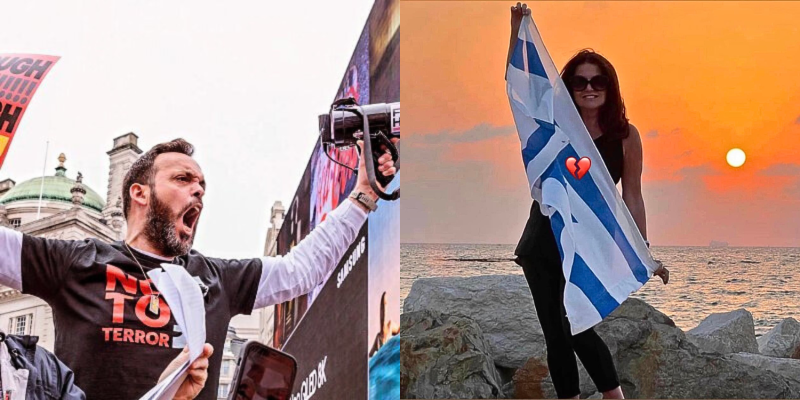
Yochy Davis, left, and Itai Galmudy | Photos from X and Facebook
Davis has long promoted Israeli causes. In 2019, for instance, she worked with Israeli organization, My Truth, to bring a squad of IDF soldiers to Britain to visit the Houses of Parliament and carry out a series of “educational” lectures promoting Israel and its military as benevolent forces.
Israeli charity website, Israel Gives, describes My Truth as “an educational organization that is comprised of Israeli Defense Force reservists that educate about the IDF operations and the moral standards it holds,” adding that:
’My Truth’ reservists speak up openly and with a firsthand perspective about their army experiences in response to those who attempt to slander Israeli soldiers in the name of so-called ‘full disclosure.’”
And like Galmudy again, Davis’ activism has earned her official praise from Israeli government officials. In 2019, former Shin Bet official and then-Minister of Justice, Amir Ohana, recorded a video expressing his deep gratitude, stating:
I want to tell Yochy Davis and the My Truth organization: thank you for providing justice. Thank you for providing truth to the world, and thank you for everything you are doing for the State of Israel and for the people of Israel. Thank you.”
Davis recently met with Israeli president, Isaac Herzog, and both she and Galmudy attended an official event at the Israeli Embassy in London last month. Earlier this year, the pair also traveled to Israel and the Golan Heights – Syrian territory illegally occupied by Israel – where they liaised with and took photos with IDF soldiers.

Yochy Davis and Itai Galmudy pose for a photo in front of an Israeli military vehicle during a visit to the Golan Heights, as posted on social media. (Instagram)
Stop The Plagiarism
The choice to name a pro-Israel advocacy group “Stop The Hate U.K.” clearly attempts to equate support for Palestine and opposition to genocide with anti-Semitism. Yet it has also caused significant confusion, as a well-known and respected charity, “Stop Hate U.K.” (SHUK) already exists.
SHUK was established in the wake of the Stephen Lawrence affair. Stephen Lawrence was a Black British teenager murdered in London in a racially motivated killing in 1993. The attack, and the subsequent inadequate response from the Metropolitan Police, made Lawrence a cause célèbre, the George Floyd of his day. An official inquiry found that the police force was “institutionally racist” and needed to be radically reformed. Since 1995, SHUK has carried out vital work challenging hatred and intolerance. Lawrence’s mother serves as its patron.
Pro-Israel group Stop The Hate U.K. is frequently misidentified as the more legitimate body, including in Sawer’s aforementioned Daily Telegraph article, where it attributes the intelligence provided to SHUK. It is eminently possible that this sort of confusion was deliberate, and Stop The Hate U.K. is trying to bask in the legitimacy of an established anti-racist charity. MintPress contacted SHUK for this investigation, but did not receive a response.
Gaza and the rise of Stop The Hate U.K. provokes a number of important questions. How is it that a pro-Israel pressure group, co-founded by two Israeli citizens, can have such an outsized effect on British public life? How can a former member of an army carrying out a massacre put such successful pressure on U.K. authorities to arrest journalists exposing the IDF’s crimes? And who gets to decide who and who is not a terrorist: British citizens or pressure groups allied to a foreign nation carrying out a genocide?
Trump Files Sweeping $10 Billion Lawsuit Against BBC — Exposing a Global Machinery of Narrative Suppression
By Sayer Ji | December 15, 2025
President Donald Trump has filed a sweeping defamation lawsuit against the British Broadcasting Corporation (BBC), alleging that the UK’s state-backed broadcaster deliberately edited his words to falsely portray him as inciting violence. You can view my report on the details of the initiating event here.
The 33 page suit, filed in U.S. federal court, seeks billions in damages and cites internal whistleblower documents, leadership resignations, and a documented pattern of prior misconduct to argue that the edit was not an error — but an intentional act of malice with real-world and political consequences.
The lawsuit stems from a BBC Panorama documentary that spliced together two separate portions of Trump’s January 6 speech — spoken nearly an hour apart — while omitting his explicit call for peaceful protest. According to the complaint, this manipulation created a false impression that Trump urged violence. The BBC has since issued a formal apology, withdrawn the documentary, and seen its Director-General and Head of News resign in disgrace.
But the significance of the case extends far beyond a single documentary or a single speech.
For the first time, a court filing squarely places legal scrutiny on the institution that has long functioned as a global arbiter of “misinformation” — and asks whether that authority has been weaponized against American political speech.
A Defamation Case With Systemic Implications
At face value, Trump’s lawsuit is a high-profile defamation action against one of the world’s most powerful media institutions. Yet embedded in the filing is a far more consequential allegation: that the BBC knowingly falsified political speech in pursuit of a narrative objective, and did so as part of a repeat pattern rather than a one-off lapse.
The complaint cites an internal memorandum by a former BBC editorial standards adviser who concluded that the edit “materially misled viewers,” as well as evidence that senior leadership was warned in advance. It also documents prior BBC broadcasts that used similar splicing techniques to misrepresent Trump’s words, including a 2022 Newsnight segment and a separate 2024 incident in which BBC presenters falsely suggested Trump had called for a political opponent to be shot.
In other words, the lawsuit alleges not mere negligence, but institutional intent.
That distinction matters — because it forces a broader reckoning with how narrative authority is exercised, exported, and enforced.
Why the BBC Matters More Than This Case
The BBC is not just another media outlet. It is a globally trusted, publicly funded broadcaster whose reporting is routinely cited by governments, technology companies, NGOs, and newsrooms worldwide.
Remarkably, US taxpayers have historically been compelled to fund BBC through USAID, as reported below.
USAID & BBC Caught Laundering Censorship—Unconstitutional & Unforgivable!
Moreover, British citizens are forced to pay the BBC license fees, even if they don’t use the service, with non-payment resulting in tens of thousands of prosecutions annually. You can find more details on this here.
When the BBC labels something “dangerous,” “extreme,” or “misinformation,” those labels do not remain confined to British television screens.
They travel.
For years, BBC investigations — particularly through programs like BBC Click — have been used to frame American websites, platforms, and political movements as threats to public order. In fact, their 2020 collaboration with the Institute for Strategic Dialogue (ISD) and the US-Based NewsGuard listing 34 sites they wanted demonetized and removed from the internet including GreenMedInfo.com (yours truly), which I documented in detail here.
Those framings have then been echoed by advocacy groups, relied upon by technology companies, and quietly incorporated into content moderation policies, reputational risk assessments, and even intelligence briefings that labeled dissenting voices challenging medical orthodoxies as equivalent to domestic extremists.
This is how narrative power becomes operational power.
Trump’s lawsuit matters because it places that process — long taken for granted — under legal examination.
Before Trump: How the Architecture Was Built
Long before the BBC edited Trump’s speech, it had already positioned itself at the center of a transnational ecosystem that defines and enforces acceptable discourse.
Through partnerships with non-governmental organizations, alignment with “counter-disinformation” initiatives, and collaboration with philanthropic and government-adjacent funding streams, the BBC helped construct a system in which certain viewpoints could be labeled, marginalized, and suppressed — often without any judicial process or meaningful recourse.
That system did not begin with Trump.
Years earlier, similar mechanisms were deployed against U.S. presidential candidate Robert F. Kennedy Jr., against independent media platforms, and against journalists whose speech was lawful under U.S. law but nonetheless treated as suspect once filtered through foreign media authority.
At the time, these actions were routinely dismissed as editorial disagreement or platform policy enforcement. In light of the Trump lawsuit, they now appear less accidental — and more like early applications of a model that would later be used against a sitting president.
From Narrative Framing to Enforcement
What the Trump case exposes is not simply bias, but a supply chain of suppression:
- Media institutions generate authoritative narratives
- NGOs and advocacy groups translate those narratives into risk frameworks
- Technology platforms operationalize them through moderation and deplatforming
- Targets — often U.S. citizens — absorb the consequences without due process
Once established, this architecture allows reputational harm and speech suppression to occur at scale, while responsibility remains diffuse and accountability elusive.
The BBC’s unique role in this system is precisely why Trump’s lawsuit is so consequential. It targets the node where authority originates — not merely where enforcement occurs.
A Personal Note of Corroboration
I have seen this system up close. Years before Trump filed suit, my own reporting and platforms were targeted following BBC-, ISD, Newsguard, and CCDH-linked reporting and targeting that framed lawful health and policy speech as dangerous. Some of these reports even made it into foreign court proceedings, to which I was not a party and had no standing, but nonetheless was named as a ‘shadow defendant.’ At the time, there was no mechanism to challenge those labels — only consequences to endure. More details of my plight can be found here.
Trump’s lawsuit does not vindicate any single individual. It does something more important: it makes visible the machinery that was previously invisible — and untouchable.
Why This Moment Is Different
Trump is not the first to be harmed by this system. But he may be the first with sufficient power, evidence, and legal standing to force it into the open.
Whether the lawsuit ultimately succeeds or fails on the merits, it has already accomplished something unprecedented: it has transformed what was once dismissed as “media controversy” into a matter of legal accountability.
That shift should concern anyone who cares about free expression, democratic self-governance, and the dangers of unaccountable narrative power — regardless of political affiliation.
EU Sanctions Swiss Analyst For Criticism Of The Ukraine Proxy War
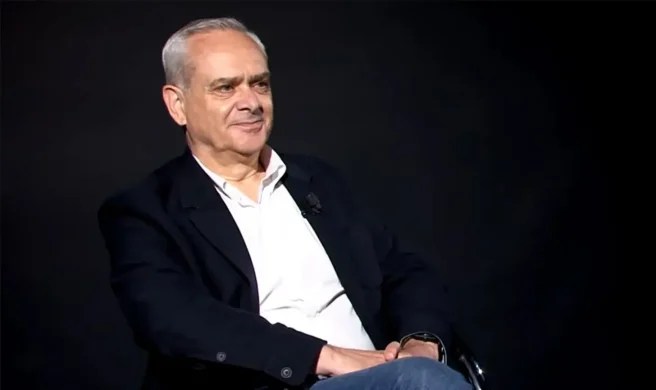
The Dissident | December 15, 2025
The European Union has just released a new sanctions package intended to impose “restrictive measures in view of Russia’s destabilising activities”.
Among the people slapped with EU sanctions is Jacques Baud, a retired colonel in the Swiss army; former strategic analyst, intelligence and terrorism specialist, solely for his position and analysis of the war in Ukraine.
The EU accuses Baud of being “a regular guest on pro-Russian television and radio programmes” and being a “mouthpiece for pro-Russian propaganda” and claiming he “makes conspiracy theories, for example, accusing Ukraine of orchestrating its own invasion in order to join NATO.”
The EU accuses him of being “responsible for, implementing or supporting actions or policies attributable to the Government of the Russian Federation which undermine or threaten stability or security in a third country (Ukraine) by engaging in the use of information manipulation and interference” and imposed sanctions on him, solely because his position differs from NATO’s and the EU’s on the Ukraine war.
The outlet Switzerland24 noted that the sanctions on Baud, “provide for the freezing of the assets of sanctioned persons, a ban on entry into the EU and a ban on making funds available to them”.
Commenting on this, Alfred de Zayas, a former UN expert, noted, “We are witnessing a civilizational collapse with the EU sanctioning Jacques Baud, a retired Swiss colonel and intelligence officer, for publishing books and articles expressing views on the Ukraine war contrary to those of the NATO leadership.”
In reality, Jacques Baud’s position, as laid out in his article, “The Military Situation In The Ukraine” from April of 2022, is that, “the dramatic developments we are witnessing today (in Ukraine) have causes that we knew about but refused to see”, including
- The expansion of NATO
The fact that NATO expansion led to the Ukraine war has been acknowledged by multiple Western officials.
U.S. diplomat George Kennan, said as far as 1997 that NATO expansion towards Russia’s borders would be “the most fateful error of American policy in the entire post-Cold War era” adding that it would, “be expected to inflame the nationalistic, anti-Western and militaristic tendencies in Russian opinion; to have an adverse effect on the development of Russian democracy; to restore the atmosphere of the cold war to East-West relations, and to impel Russian foreign policy in directions decidedly not to our liking”.
In 1998, George Kennan said that NATO expansion was “the beginning of a new cold war” and said, “the Russians will gradually react quite adversely and it will affect their policies”.
In 2008, when NATO first invited Ukraine and Georgia to join, then U.S. ambassador to Russia, William Burns, said, “Ukraine and Georgia’s NATO aspirations not only touch a raw nerve in Russia, they engender serious concerns about the consequences for stability in the region. Not only does Russia perceive encirclement and efforts to undermine Russia’s influence in the region, but it also fears unpredictable and uncontrolled consequences which would seriously affect Russian security interests” adding, “Experts tell us that Russia is particularly worried that the strong divisions in Ukraine over NATO membership, with much of the ethnic-Russian community against membership, could lead to a major split, involving violence or at worst, civil war. In that eventuality, Russia would have to decide whether to intervene; a decision Russia does not want to have to face”.
Most recently, Amanda Sloat, a top Biden administration official for European affairs admitted that, “We had some conversation even before the war started, about what if Ukraine comes out and just says to Russia, ‘fine, you know, we won’t go into NATO if that stops the war, if that stops the invasion,’ which at that point it may well have done” adding that promising no NATO membership for Ukraine “certainly would have prevented the destruction and the loss of life”.
David Arakhamia, one of the lead Ukrainian negotiators during the Istanbul talks of 2022 also said, “Russia’s goal was to put pressure on us so that we would take (NATO) neutrality. This was the main thing for them: they were ready to end the war if we accepted neutrality, as Finland once did”.
- The Western refusal to implement the Minsk Agreements
Similarly, the fact that the West blocked the Minsk accords in 2019, the peace agreement that would have ended the civil/proxy war in Eastern Ukraine that sparked after the U.S.-backed 2014 Maidan coup, is well documented.
As former UK Prime Minister Boris Johnson admitted, “Zelensky is not an unreasonable guy, he got elected as a peacenik, in 2019 he tried to do a deal with Putin, as far as I can remember, his basic problem was that the Ukrainian nationalists couldn’t accept the compromise”.
What Johnson was referring to as the NGO Finnish Peace Defender documented was that,“While President Zelensky is trying to follow commitments given to his electorate and international obligations in implementation of the Minsk Agreements, he has to overcome obstacles placed by irregular armed groups who identify themselves as patriots of Ukraine” including “open threats and blackmail by far-right military circles in Ukraine, including the National Corps led by Andrii Biletski”.
Instead of backing Zelensky in implementing the Minsk Accords, Western-funded NGOs sided with the far-right nationalists in blocking them.
Ukranian-Canadian academic Ivan Katchanovski has documented, “The Western governments and foundations, such as Soros foundation, funded all but one of about two dozen Ukrainian NGOs, which initially issued in 2019 a collective statement that any talks with Donbas separatists were impermissible after the head of the Zelenskyy’s presidential administration supported creation of a consulting group with representatives of the separatist-controlled Donbas during the Minsk negotiations.”
- The continuous and repeated attacks on the civilian population of the Donbass over the past years, and the dramatic increase in late February 2022.
Indeed, while blocking the Minsk Accords, the Trump administration- trying to prove it was not controlled by the Russians as the media claimed based on the Russiagate hoax- approved sending lethal arms to the Ukrainian government in 2017 and 2019, which increased the civilian casualties on the pro-Russia side of the Donbas conflict.
Jacques Baud, in his article, cites a UN report which found that there were 381 civilians killed in the conflict between 2018 and 2021 and that 81.4% occurred “in territory control led by the self-proclaimed ‘republics’”, the pro-Russian separatist side.
Jacques Baud concluded that, “we can naturally deplore and condemn the Russian attack. But WE (that is: the United States, France and the European Union in the lead) have created the conditions for a conflict to break out”.
One is free to agree or disagree with Jacques Baud’s perspective, but the reality is, it is not a “conspiracy theory” or “information manipulation” but a fact-based analysis on the Western policies that led to the war in Ukraine, which is shared by well-respected foreign policy analysts, including John Mearsheimer, Jeffrey Sachs and Noam Chomsky.
The EU’s claim that Jacques Baud accuses “Ukraine of orchestrating its own invasion in order to join NATO”, appears to be a reference to the fact that Jacques Baud has cited a 2019 interview with the Ukrainian presidential advisor Oleksiy Arestovych where he said the best case scenario for Ukraine was “a large scale war with Russia and joining NATO as a result of defeat of Russia”, saying that currently, “NATO would be reluctant in accepting us”, but defeating Russia would lead to Ukraine joining NATO.
Again, directly quoting a Ukrainian government official is hardly a “conspiracy theory”.
Furthermore, it is blatantly undemocratic and authoritarian for the EU to slap sanctions on someone solely because he has a critical perspective on Western and EU foreign policy.
While the EU pushes for the continuation of the Ukraine war based on the principles of “democracy” and “freedom”, they blatantly disregard democracy and freedom in order to crack down on critics of this policy.
Substack Imposes Digital ID Checks in Australia
By Christina Maas | Reclaim The Net | December 15, 2025
Australian readers opening Substack this fall have found a new step inserted between curiosity and the page. Click the wrong post and a full-screen message appears, informing users they “may be asked to verify your age before viewing certain content.”
Due to authoritarian internet laws, reading now comes with paperwork.
Substack says the change is not a philosophical shift but a legal one. The trigger is Australia’s Online “Safety” Act, a regulatory framework that treats written words with the same suspicion once reserved for explicit video.
The law requires platforms to block or filter material deemed age-restricted, even when that material is lawful.
The Online Safety Act hands the eSafety Commissioner broad authority to order platforms to restrict, hide, or remove content considered unsuitable for minors.
The definition of unsuitable is wide enough to cover commentary, essays, or creative writing that falls nowhere near criminal territory.
To comply, Substack now asks some Australian readers to confirm they are over 18. That can mean uploading identity documents or passing through third-party verification services.
Readers who already verified their identity through payment systems might be spared another check, though the underlying system remains the same. Access depends on linking a real person to a specific act of reading.
This marks a shift for a platform built on the idea that subscribing and reading could be done quietly. The act of opening an essay now risks leaving a record that connects identity with interest.
In an October 2025 statement titled Our Position on the Online Safety Act, Substack warned that the law carries “real costs to free expression.”
The company made clear it would follow Australian law, while arguing that mandatory age verification threatens the independence of digital publishing.
This is not the familiar filter used by streaming services or adult entertainment platforms. This is text. Essays. Journalism. Political argument. Material that has long circulated without checkpoints. The same machinery sold as child protection now sits in front of discussions about social issues, politics, or art.
Australian users trying to access posts marked as adult content are met with a demand to confirm their age before proceeding.
The process may be quick, but it requires data exchanges that associate a reader with specific material. Even if those links are temporary, they represent a break from the historical norm of private reading.
For writers and readers who valued Substack as a direct channel, the dynamic has changed. Subscribing is no longer enough. Proof is required. That requirement may not ban content outright, but it introduces friction that discourages engagement with sensitive or controversial topics. It also normalizes the idea that access to writing should depend on disclosing personal identity.
Once such systems exist, expanding them becomes an administrative decision.
Australia is not alone. Similar problems are underway in the United Kingdom and the European Union, where online safety proposals also rely on digital identity frameworks.
The common premise is that anonymous access is a problem to be solved rather than a feature to be preserved.
Substack’s choice reflects the bind facing global platforms. Defy the rules and risk being blocked. Comply and accept the slow reshaping of how people read. For now, Australian readers can still reach their favorite writers, provided they show ID first. The price of admission is proof that you are old enough to read.
UK Lawmakers Propose Mandatory On-Device Surveillance and VPN Age Verification
By Cindy Harper | Reclaim The Net | December 15, 2025
Lawmakers in the United Kingdom are proposing amendments to the Children’s Wellbeing and Schools Bill that would require nearly all smartphones and tablets to include built-in, unremovable surveillance software.
The proposal appears under a section titled “Action to promote the well-being of children by combating child sexual abuse material (CSAM).”
We obtained a copy of the proposed amendments for you here.
The amendment text specifies that any “relevant device supplied for use in the UK must have installed tamper-proof system software which is highly effective at preventing the recording, transmitting (by any means, including livestreaming) and viewing of CSAM using that device.”
It further defines “relevant devices” as “smartphones or tablet computers which are either internet-connectable products or network-connectable products for the purposes of section 5 of the Product Security and Telecommunications Infrastructure Act 2022.”
Under this clause, manufacturers, importers, and distributors would be legally required to ensure that every internet-connected phone or tablet they sell in the UK meets this “CSAM requirement.”
Enforcement would occur “as if the CSAM requirement was a security requirement for the purposes of Part 1 of the Product Security and Telecommunications Infrastructure Act 2022.”
In practical terms, the only way for such software to “prevent the recording, transmitting (by any means, including livestreaming) and viewing of CSAM” would be for devices to continuously scan and analyze all photos, videos, and livestreams handled by the device.
That process would have to take place directly on users’ phones and tablets, examining both personal and encrypted material to determine whether any of it might be considered illegal content. Although the measure is presented as a child-safety protection, its operation would create a system of constant client-side scanning.
This means the software would inspect private communications, media, and files on personal devices without the user’s consent.
Such a mechanism would undermine end-to-end encryption and normalize pre-emptive surveillance built directly into consumer hardware.
The latest figures from German law enforcement offer a clear warning about the risks of expanding this type of surveillance: in 2024, nearly half of all CSAM scanning tips received by Germany were errors.
According to the Federal Criminal Police Office (BKA), 99,375 of the 205,728 reports forwarded by the US-based National Center for Missing and Exploited Children (NCMEC) were not criminally relevant, an error rate of 48.3 percent, up from 90,950 false positives the year before.
Many of these reports originate from private companies such as Meta, Microsoft, and Google, which voluntarily scan user communications and forward suspected material to NCMEC under the current “Chat Control 1.0” framework, a system that is neither mandatory nor applied to end-to-end encrypted services.
Such a high error rate means that users are having their legal and private photos and videos falsely flagged and sent to authorities, a massive invasion of privacy.
Other parts of the same bill introduce additional “age assurance” obligations. On pages 19 and 20, the section titled “Action to prohibit the provision of VPN services to children in the United Kingdom” would compel VPN providers to apply “age assurance, which is highly effective at correctly determining whether or not that person is a child.”
On page 21, another amendment titled “Action to promote the well-being of children in relation to social media” would require “all regulated user-to-user services to use highly-effective age assurance measures to prevent children under the age of 16 from becoming or being users.”
Together, these amendments establish a framework in which device-level scanning and strict age verification become legal obligations.
While described as efforts to “promote the wellbeing of children,” they would, in effect, turn personal smartphones and tablets into permanent monitoring systems and reduce the privacy of digital life to a conditional privilege.
The proposal represents one of the most widespread assaults on digital privacy ever introduced in a democratic country.
Unlike the European Union’s controversial “Chat Control” initiative, which has faced strong resistance for proposing the scanning of private communications by online services, the UK plan goes a step further.
The EU proposal focused on scanning content as it passed through communication platforms. The UK’s version would build surveillance directly into the operating system of personal devices themselves.
Every photo taken, every video saved, every image viewed could be silently analyzed by software running beneath the user’s control.
The bill would turn every connected device into a government-mandated inspection terminal.
Even though it is presented as a measure to protect children, the scope of what it enables is staggering. Once a legal foundation for on-device scanning exists, the definition of what must be scanned can easily expand.
A system designed to detect child abuse imagery today could be repurposed to search for other material tomorrow. The architecture for continuous surveillance would already be in place.
The United Kingdom is seeing a steady erosion of civil liberties as surveillance and speech policing expand at the same time.
People are being arrested over online posts and private messages under loosely applied communications laws, while police are rolling out live facial recognition systems that scan the public without consent and rely on error-prone biometric data.
When this is combined with proposals for device-level content scanning and mandatory age verification, the result is a climate in which privacy, anonymity, and free expression are increasingly treated as risks to be managed rather than rights to be protected.
New York Times’ Bret Stephens Baselessly Blames Israel Critics For Bondi Terrorist Attack
The Dissident | December 14, 2025
The New York Times published an opinion article by the neo-con columnist Bret Stephens, where he baselessly blamed critics of Israel for today’s horrific terrorist attack targeting Jews while they were celebrating Hanukkah at Bondi Beach in Australia, killing 16 people and severely injuring at least 40.
Despite the fact that very little information has even emerged as to what the motivation of the attackers was, Bret Stephens jumped the gun and used the massacre of civilians to smear his political enemies.
Among the people Stephens blamed for the terrorist attack are:
- Green Party legislator Jenny Leong for her criticism of the Israel lobby.
- Australian Prime Minister Anthony Albanese, because he “recognized a Palestinian state and has been outspoken in its condemnation of Israeli actions in Gaza”.
- Palestinian protestors for saying “globalize the intifada”, “resistance is justified”, and “by any means necessary” while protesting the genocide in Gaza.
Stephens admits in the article that there is no evidence that the attack even had anything to do with Gaza or Israel and admitted that it was baseless speculation on his part, writing, “Though we’ll probably learn more in the weeks ahead about the mind-set of Sunday’s killers, it’s reasonable to surmise that what they thought they were doing was ‘globalizing the intifada.’”
Stephens blamed critics of Israel for the attack at Bondi, admitting that the people he slandered have a “political attitude in favor of Palestinian freedom rather than a call to kill their presumptive oppressors,” but added, “But there are always literalists — and it’s the literalists who usually believe their ideas should have real-world consequences. On Sunday, those consequences were written in Jewish blood.”
Stephens’ smear closely mirrors that of the Israeli Prime Minister Benjamin Netanyahu, who similarly weaponized the massacre to score political points, blaming Australia’s recognition of a Palestinian state for the attack, saying, “your call for a Palestinian state pours fuel on the antisemitic fire” and calling for more censorship of Israel-critical protests, saying, “Calls such as ‘Globalise the Intifada’, ‘From the River to the Sea Palestine Will be Free’, and ‘Death to the IDF’ are not legitimate, are not part of the freedom of speech, and inevitably lead to what we witnessed today.”
While Bret Stephens’ repetition of Netanyahu’s claim that opposition to Israel’s mass murder campaign in Gaza led to the senseless violence against civilians at Bondi is baseless-Bret Stephens has openly called for and cheered on the same mass violence against civilians he baselessly blames Israel’s critics for.
In March of 2024, Bret Stephens, in a New York Times article, said that “Israel Has No Choice but to Fight On” and called for the Biden administration to “help Israel win the war decisively” in reference to Israel’s genocide in Gaza, which included shooting children in the head and chest, opening fire on starving civilians at aid sites, bombing hospitals and targeting doctors, slaughtering journalists, mass raping and torturing detainees, bombing fertility clinics and setting refugee camps on fire, among other genocidal crimes.
In Ocotber of 2024, Stephens wrote another Op-Ed where he wrote that “We Should Want Israel to Win,” again referring to Israel’s genocide in Gaza, where even the IDF’s own internal data shows that at least 83 percent of people killed were civilians.
Similarly, in a 2023 article, Stephens wrote, “20 Years On, I Don’t Regret Supporting the Iraq War,” adding, “Readers will want to know whether, knowing what I know now, I would still have supported the decision to invade. Not for the reasons given at the time. Not in the way we did it. But on the baseline question of whether Iraq, the Middle East and the world are better off for having gotten rid of a dangerous tyrant, my answer remains yes”, in reference to the criminal U.S. invasion which killed 187,499 – 211,046 civilians.
Most recently, Stephens wrote an article titled, “The Case for Overthrowing Maduro”, cheering on the Trump administration’s slaughter of 80 people on boats in the Caribbean – who they admit they don’t know the identity of- and calling for more strikes on Venezuela in service of a regime change war.
Bret Stephens is using the massacre of civilians at Bondi Beach to smear opponents of the much larger-scale massacres of civilians that he openly supports.
Featured Video
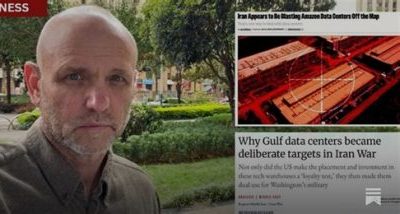
Iran spent $1 million to wipe out $30 billion in data center plans, and take down Amazon in the ME
or go to
Aletho News Archives – Video-Images
From the Archives
A short history of British torture
ICC | December 2005
When the House of Commons was debating how much to increase the time limit for detention without trial the question of torture came up. Officially this was limited to the nice considerations of whether it was all right to send people to places where torture is used and whether Britain can use information collected by the use of torture in other countries. This discussion gave an impression of democratic Britain as the home of civilised behaviour where the very idea of torture is repugnant to our legislators – unlike, say, the US with its secret CIA jails… In reality, the British state has a long history of using and developing a whole range of torture techniques. … continue
Blog Roll
 Aletho News
- Houthis Keep Advancing as the Red Sea Crisis Deepens
- Iran spent $1 million to wipe out $30 billion in data center plans, and take down Amazon in the ME
- Zionist billionaire pressure to silence Macklemore sparks exodus from Ed Sheeran tour
- House Votes to End Iran War for Third Time
- North Korea Slams US Plan for ‘AUKUS 2.0’ with South Korea and Japan
- Prolonging US-Iran Conflict Not Meeting Interests of Int’l Community – China’s Wang Yi
- EU bans former Zelensky aide from parliament
- NATO-backed Kosovo separatist ‘responsible for war crimes’
- US destroying international space law
- SCO Calls for Binding Global Deal to Prevent Arms Race in Space
- If Americans Knew
- U.S. Makes, Israel Takes: The Real Story of U.S.-Israeli Military Cooperation
- Night raids rise in Palestine
- Tucker Carlson interviews Norman Finkelstein about Gaza
- Groups urge Americans to support Van Hollen legislation on Israel’s killing of Americans & Palestinians
- Trump administration plans to send 40,000 tons of bombs to Israel: report
- Sanctions Target Iran’s Government, But Kill Hospitalized 23-Year-Old Woman
- An alternative view on the book “Israel’s Lobby: America in the Grip of a Foreign Power”
- Ed Sheeran’s band Beoga, other opening acts quit tour after Macklemore was dropped over his pro-Palestinian comments
- The assassination attempt on President Trump in Butler and the various Israeli connections to it
- “We Want That the Whole Land Be Jewish”
- No Tricks Zone
- New Study: ‘Global Drought Shows No Detectable Recent Acceleration Under Climate Warming’
- Economic Masterminds: German Socialists Suggest Taxing Productivity Gains Stemming From Using AI
- The South China Sea Has Not Been Cooperating With The Climate Change Narrative
- Energy Crisis: Germany Enters Heating Season With Historically Low Gas Reserve Fill Levels
- New Study: The Antarctic Ice Sheet Gained Mass From 2020-2024 Due To Staggering Snow And Ice Accumulation
- Study: Ocean Heating Rates From Thousands Of Years Ago ‘Dwarf’ Modern Ocean Heating Rates
- Climate Extremists Target, Attack Large-Scale Power Grid Infrastructure In Germany!
- New Study: Antarctic Ice Melt Has Contributed Less Than 1 Centimeter To Sea Level Rise In The Last 30 Years
- Fear Of Debate: Alarmist German Climate Scientist Calls On Mainstream Media To Discredit Skeptic Voices
- End-Of-August Arctic Sea Ice Extent Hasn’t Fallen In 20 Years, Official Data Show!
 Aletho News