Election? What Election? EU Elite Will Censor Their Way Out of This Mess (or Die Trying)
By Helen Buyniski | Aletho News | June 7, 2019
The neoliberal establishment is wringing its hands in the wake of European elections that proved a resounding victory for populist parties across the continent, casting around for someone to blame but utterly incapable of realizing their own interference has doomed them. Doubling down on the censorship, they are determined to provoke the catastrophe they need to make free speech history.
The NGO-industrial complex was operating at maximum capacity in the weeks leading up to the election, shutting down hundreds of Facebook pages deemed “fake” or “hate speech” in the hope of controlling the messages reaching voters before they made the terrible mistake of voting for a candidate who represents their interests.
Led by Avaaz, which claims to be a “global citizens’ movement monitoring election freedom and disinformation,” this well-heeled fifth column whipped the press into paranoid frenzies with reports like “Fakewatch,” which breathlessly documented 500 “suspicious” pages and groups it claims are “spreading massive disinformation.” The groups have little in common other than their alleged “link[s] to right-wing and anti-EU organizations,” a capital offense for the promoters of “democracy,” which can only be permitted where it doesn’t stray from the center-left path of most #Resistance.
“Far-right and anti-EU groups are weaponizing social media at scale to spread false and hateful content,” the study warns, gloating that after sharing its findings with Facebook, the platform shut down an “unprecedented” number of pages on the eve of the election (77 out of the 500, according to VentureBeat, which has credulously signal-boosted every utterance of Avaaz as if it is divine truth from the Oracle of Delphi). Avaaz’s reports frame the problem as an affliction of the right wing only, even though disinformation is second nature to political operatives at both ends of the spectrum (and, more importantly, in the sanctified center).
The Computational Propaganda Project, an Oxford-based research group, made no secret of its elitist leanings, declaiming, “On Facebook, while many more users interact with mainstream content overall, individual junk news stories can still hugely outperform even the best, most important, professionally produced stories,” as if users have no choice but to consume “professionally-produced” Oxford-approved material or wallow in junk content. And Facebook’s own statistics bear out the hypothesis that coordinated inauthentic behavior has surged – the site removed almost 3.4 billion “fake” accounts from October 2018 to March 2019, more than the number of actual users.
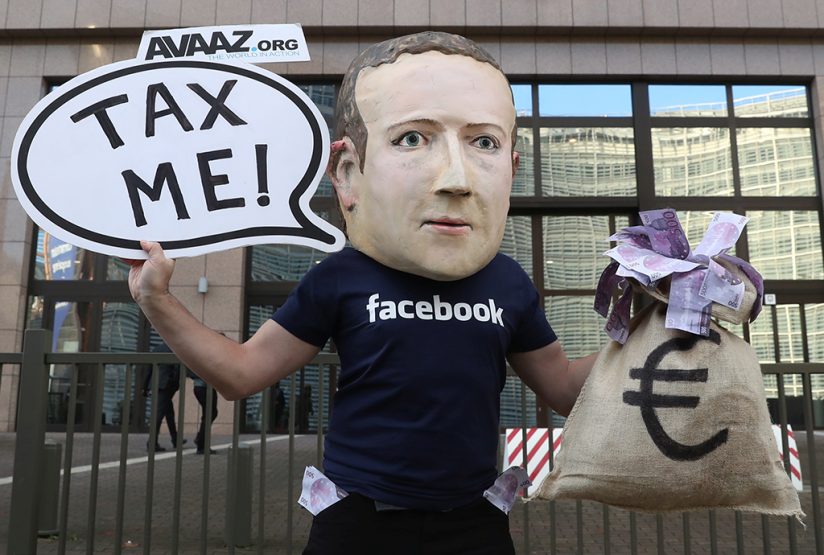
Activist wearing a mask depicting Facebook CEO Mark Zuckerberg demonstrates during the EU finance ministers meeting at EU headquarters in Brussels, Belgium, December 4, 2018. REUTERS/Yves Herman
But Facebook is not simply targeting fake accounts for takedown. Last Sunday, as Europeans prepared to head out to the polls, Facebook froze the largest group used by the Yellow Vests to organize protests and share information, silencing its 350,000+ members at a critical moment in French politics. More than one group member, reduced to commenting on existing posts, pointed out that President Emmanuel Macron met with Facebook chief executive android Mark Zuckerberg three weeks earlier to discuss a first-of-its-kind collaboration in which French government officials are being given access to material censored from users’ newsfeeds, essentially permitting them direct control of what the French are allowed to see on social media. Facebook, then, is providing France with the same techno-fascist services it provides the US government: Facebook will take on the burden of actually censoring dissent, thus skirting any pesky free-speech laws that might otherwise trip up a government that attempted to do the same.
Avaaz focused on the Yellow Vests in its coverage of the French elections, complaining RT France was getting huge quantities of views compared to native French media – perhaps because native French media have been doing Macron’s bidding and attempting to minimize the protests. By framing RT as a perpetrator of “information warfare,” the NGO was making a deliberate effort to have it deplatformed under one of Macron’s controversial police-state laws passed in 2018, by which any outlet spreading so-called “false information” can be gagged for three months leading up to an election. Yet Macron’s own interior minister, Christophe Castaner, lied on Twitter when he claimed the Yellow Vests had attacked the Pitié-Salpêtrière hospital in Paris, and RT was the first outlet to publish the truth about the incident. Who is the disinfo agent?
When the election results came in, Avaaz and its political allies in the neoliberal center could only gape in disbelief. Surely they had wiped La Liga and the Front National (now National Rally) from social media, salting the earth in their wake? How had they won? And what happened in Germany, where Angela Merkel’s CDU performed worse than ever in European election history? Merkel could blame YouTube – 70 influential video stars put out a call to their followers to shun her coalition – but the creators also called for shunning the far-right AfD, so the platform couldn’t be demonized as a tool of the ever-present Nazi Threat. That didn’t stop her party from trying, of course – CDU party leader Annegret Kramp-Karrenbauer complained about online “propaganda” and promised to “tackle this discussion quite aggressively.”
The populist parties won in large part because of the establishment’s unseemly embrace of fascist tactics, from the UK’s totalitarian information warfare disguised as “protecting citizens” or France’s visceral police violence, maiming protesters as if for sport. Europeans voted out of disgust with an establishment so insecure in its control of the narrative that it has sought to annihilate all signs of dissent, dismissing euroskepticism as Russian astroturfing and xenophobia and plugging its ears to the legitimate grievances of its subjects. The National Rally may have beat Macron’s jackbooted thugs, who in the past two months have hauled half a dozen journalists in for questioning by intelligence agencies for publishing stories that embarrassed the regime, but nearly half of French voters refused to vote for anyone at all, according to an Ipsos poll, and Germany’s Greens mopped the floor with Merkel’s coalition among young voters.

The triumph of Nigel Farage’s Brexit party in the UK is the product of a populace wrestling with cognitive dissonance, forced to realize that the “constitutional monarchy” they believed they lived in isn’t so constitutional after all, having jettisoned its democratic mask to cling to the EU under the guise of good old British pragmatism. Even passionate Remainers are happy to see Theresa Maybe go, though it remains to be seen whether her successor will be any more inclined to honor the result of 2016’s referendum. Meanwhile, the Guardian’s embarrassing attempt to shame Farage over a handful of appearances on the Alex Jones show – the paper claimed any reference to “globalists” and “new world order” were dog-whistles for the dreaded “antisemitic conspiracy theories” – proves the establishment media will never regain narrative primacy as long as alternatives exist. Jones, for all his flaws (and they are legion), has a massive audience; the Guardian, despite being propped up by the UK government’s Operation Mockingbird-esque “Integrity Initiative” (and the award for most ironic name ever goes to…), does not.
With the vast American election-fraud apparatus scrambling to prepare itself for 2020, now enabled by Pentagon-funded, Unit-8200-approved Microsoft “election security” software from the makers of the wrongthink-babysitter browser plugin NewsGuard, the US ruling class seems to be poised to make the same mistake as its global peers. Facebook, working hand in hand with the Atlantic Council, has banned and shadowbanned legions of anti-neoliberal activists over the past year, selectively applying (and inventing) new rules in an effort to keep popular content-creators jumping through hoops instead of influencing the discourse. Facebook has been allowed its place of privilege because as a “private corporation” it is legally permitted to violate users’ free speech rights in ways the US government cannot. But if Facebook can’t deliver a victory for the “right guys” this time around, it will be punished. Indeed, a massive anti-trust probe appears to be in the offing, 14 years of Zuckerberg apologies notwithstanding.
The site learned back when it tried to roll out a “disputed” tag for “wrongthink” stories that people were actually more likely to click on those stories; it learned the lesson again when its hugely expensive Facebook Watch news show featuring Anderson Cooper flopped last year. Zuckerberg is on the record begging for government regulation; will Facebook and Twitter use the outcome of this round of elections as a springboard for further crackdowns?
YouTube already has – thousands of creators found their channels demonetized and riddled with takedown notices this week in what has been dubbed the #VoxAdpocalypse after a pathologically whiny Vox blogger became the face of the mass deplatforming, but the censorship appears to be more of a response to Macron’s Orwellian “Christchurch call” to censor “extremism” – that ill-defined conveniently-variable catch-all whose borders are perpetually expanding to engulf all inconvenient speech – aided and abetted by the ADL than Google taking pity on a thin-skinned professional victim.
A sinister coalition of MEPs, “civil society” groups, and the Transatlantic Commission on Election Integrity – a who’s who of war criminals, psychopaths, and oligarchs that includes Michael Chertoff, John “death squad” Negroponte, Victor Pinchuk, and Anders Fogh Rasmussen – has already demanded “parliamentary inquiries into the impact of the use and abuse of technology platforms on democracy and elections.” It’s no coincidence that several of these “election integrity” enthusiasts sit on the board of NewsGuard, which is currently trying to weasel into the EU’s internet regulatory framework by playing up the “disinformation” threat.
The blue-check intelligentsia has been trying for years to convince the hoi polloi that “conspiratorial” thinking is somehow detrimental to democracy. Former Obama labor secretary Robert Reich told Buzzfeed exactly that – “If we become a conspiracy society, we all carry around a degree of paranoia and that’s not healthy for democracy.” But this divorces cause from effect, as if “conspiracy theorists” have formulated their theories out of whole cloth – as if there isn’t evidence for these theories piled knee-deep, as if once-trusted institutions haven’t proven themselves time and again to be as trustworthy as tabloid tales of Elvis risen from the grave. If paranoia is unhealthy for democracy, how is a media incentivized to lie, misdirect and obfuscate any better?
The populist wave has been conflated with an uptick in “hate” in an attempt to delegitimize and demonize it. Outside of groups like the ADL, whose statistics are easily debunked, there is no credible evidence bigotry is on the rise, but as an actual Nazi once said, tell a big enough lie often enough, and it might as well be real. Beginning around 2012, the establishment media began relentlessly flogging the “white privilege” narrative in an effort to fan the flames of interracial conflict. Political science doctoral student Zach Goldberg performed an analysis of several terms using the LexisNexis database and found evidence of heavy narrative manipulation – “whiteness” was mentioned in four times as many news articles in 2017 as in 2012, “white privilege” was mentioned ten times as often in 2017 as in 2012, and “racism” was mentioned ten times as often in the New York Times alone in 2017 as in 2012. Yet even as the media has seemingly talked of nothing else, actual prejudice – by whites against non-whites, at least – has declined since 2008, according to a University of Pennsylvania study published last month, and the FBI’s own statistics show hate crimes against most minority groups are on the decline. Because few European governments separate “hate crimes” from “normal” crime statistics, information on bigotry in Europe often comes solely from NGOs and “civil society” groups that rely for their funding on the perception that Hate is on the march. Populists are capable of prejudice like anyone else, but it is their defining characteristic – a “prejudice” against oligarchy – that motivates the smears churned out by the media.
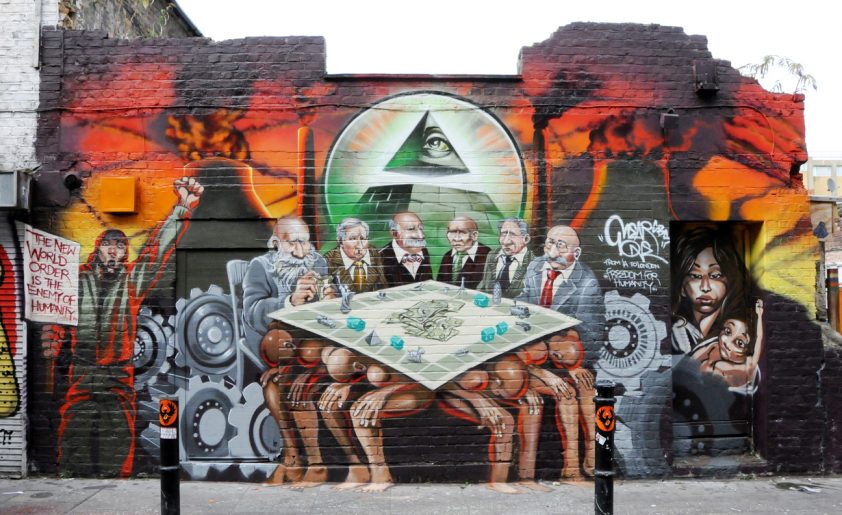
Protest votes like Trump and Brexit are cries for help from a disenfranchised populace. The European elections boasted the highest turnout in decades, and the ruling class ignores the results at its peril. When the election ritual no longer satisfies a population’s need to feel it is exerting its free will on society, we get public hexings of political figures, people reasoning black magic is more likely to solve their problems than voting. This is the same desperation that leads people like Arnav Gupta to set themselves on fire in front of the White House. Europeans have demonstrated unequivocally that they are sick of unaccountable dictatorship from Brussels, where EC President Jean-Claude Juncker, never one for sympathy with the little guy, sneers at the “populist, nationalists, stupid nationalists” who are “in love with their own countries.” They are sick of being displaced from their homes by a seemingly endless tide of migrants, just as those migrants themselves are displaced from their homes by a seemingly endless tide of American wars. Both groups are victimized by the IMF’s neoliberal austerity policies, epitomized by Juncker, who has done more than perhaps any one person to help Europe’s corporate “citizens” dodge taxes while nickel-and-diming the humans.
Instead of addressing these legitimate grievances, those in power on both sides of the Atlantic tighten the screws on online discourse – out of sight, out of mind. YouTube declares conspiracy theorizing a form of hate speech and plays whack-a-mole with a documentary confirming everyone’s long-standing suspicions that “save-the-migrants” NGOs are cashing in on the desperate human tide. Big Tech promises to work even more closely with Big Brother to crack down on dissident speech, tarring its victims as Nazis while hoping no one will point out such collusion is one of the defining characteristics of fascism.
These measures are guaranteed to further radicalize the discontent. Deleting social media accounts does not delete the people behind them, and France has already proven that starving a protest movement of media attention only makes it angrier. The ruling class may welcome their rage, aiming to use the inevitable outbreak of violence to choke off the last avenues of free expression, but once the guillotines come out, it isn’t the masses’ heads that will be rolling in the streets.
Zionists Call Up Heavy Artillery to Blast Disobedient UK Labour
But could it backfire?
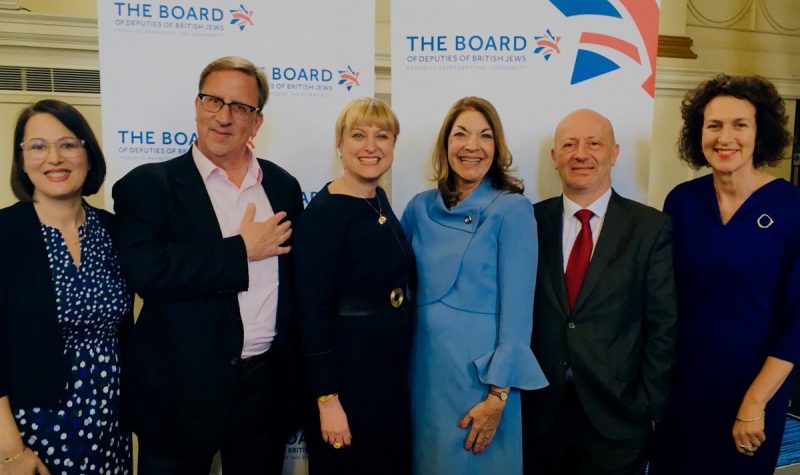
Marie van der Zyl. Credit:Twitter)
By Stuart Littlewood | American Herald Tribune | June 4, 2019
Zionist pressure groups are crowing with delight at the decision by the Equalities and Human Rights Commission’s to investigate anti-Semitism within the Labour Party.
Board of Deputies president Marie van der Zyl welcomed it. “In the past four years we have seen a large number of cases of anti-Semitism throughout the party from bottom to top. Despite the Jewish community demonstrating in their thousands outside Parliament, this has still not been addressed seriously by the party leadership.”
The Jewish leadership Council issued a statement on what it called the Labour Party’s unlawful discrimination against Jewish people. “We have drawn public attention over the last year to the leadership of the Party’s failure to address the anti-Jewish racism in the party. The fact that they have obfuscated, denied the problem and we have been accused of smears should be countered by today’s announcement by the EHRC. This is a very serious development.”
The EHRC for its part says it took the decision to investigate after receiving a number of complaints about allegations of anti-Semitism in the Party. The investigation will seek to determine:
- whether unlawful acts have been committed by the Party and/or its employees and/or its agents, and
- whether the Party has responded to complaints of unlawful acts in a lawful, efficient and effective manner
The terms of reference also state that the investigation will focus on “the Party’s response to a sample of complaints of alleged unlawful acts”.
In the course of the investigation, the Commission says it may have regard to the IHRA (International Holocaust Remembrance Alliance’s) working definition of anti-Semitism and associated examples “while recognizing it is a non-legally binding definition”.
So perhaps the complainers shouldn’t celebrate too soon.
Two ‘sample’ cases that I doubt will be investigated
Some readers may remember that I conducted my own investigation last year into a small sample of anti-Semitic cases that turned out to be utterly bogus. Two Scottish Labour politicians, both regional councilors, had been accused of anti-Semitic remarks and were languishing, paralyzed, under the cosh of the party’s blundering, slow-motion disciplinary regime.
In the first case Constituency party officials declared the councilor guilty and issued a press statement to that effect without waiting for him to be heard, hugely prejudicing any inquiry. His Council leader publicly called on him to resign as a councilor, saying his thinking belonged to the Dark Ages: “To smear an entire community both past and present, to say he has lost ‘all empathy’ for them is utterly deplorable,” he told the press.
What was the ‘crime’? The councilor had tweeted: “For almost all my adult life I have had the utmost respect and empathy for the Jewish community and their historic suffering. No longer, due to what they and their Blairite plotters are doing to my party and the long-suffering people of Britain…”
The other councilor was accused of anti-Semitism by a former Labour MP who, in 2015, wrote to the Culture Secretary urging a debate to ban Hitler’s Mein Kampf, a best seller, and claiming many would argue that it is “too offensive to be made available”. He suggested there was “a compelling case for a national debate on whether there should be limits on the freedom of expression”.
A Tory MP then put the boot in, telling the media it was clear to the vast majority of people that the councilor in question was no longer fit to hold office and suspension didn’t go far enough.
What exactly was this councilors‘ crime’? She’d had the audacity to voice suspicion on social media that Israeli spies might be plotting to get rid of Jeremy Corbyn as Labour leader after three Jewish newspapers ganged up to publish a joint front page warning that a Corbyn-led government would pose an “existential threat to Jewish life in this country”.
She added that if it was a Mossad assisted campaign to prevent the election of a Labour Government (which would be pledged to recognize Palestine) it amounted to an unwarranted interference in our democracy. For good measure she said Israel was a racist State and since the Palestinians are also Semites, an anti-Semitic State too.
Everyone and his dog, including the entire Labour Party and the Zionist movement, surely knew that in January 2017 a senior political officer at the Israeli embassy in London, Shai Masot, had plotted with stooges among British MPs and other maggots in the political woodwork to “take down” senior government figures including Boris Johnson’s deputy at the Foreign Office, Sir Alan Duncan. And that Mark Regev, Netanyahu’s former chief spokesman and the mastermind behind Israel’s hasbara program of disinformation and dirty tricks, had recently arrived in London as the new ambassador.

Masot was almost certainly a Mossad asset. His hostile activities were revealed not by Britain’s own security services and media, as one would have wished, but an Al Jazeera undercover news team. Her Majesty’s Government’s response? “The UK has a strong relationship with Israel and we consider the matter closed.” But not everyone considered it closed and at a Labour Party conference fringe meeting Israel insider Miko Peled warned that “they are going to pull all the stops, they are going to smear, they are going to try anything they can to stop Corbyn…. the reason anti-Semitism is used is because they [the Israelis] have no argument….”
As for the councilor’s claim that Israel is a racist State, its discriminatory laws, ethnic cleansing and other brutal policies over 70 years make it obvious. And its new Nation State laws reinforce the fact. The councilor’s point about Semitism is also fair comment. DNA research shows that only a tiny proportion of Jews are Semitic (see for example the Johns Hopkins University study published by Oxford University Press) whereas most indigenous Arabs in the Holy Land, especially Palestinians, are Semites. ‘Anti-Semitism’, although meant to describe hatred of Jews, is a term that’s misused.
And what happens to the false accusers?
Remember the Tory MP who said the councillor wasn’t fit to hold office and suspension wasn’t good enough? It turned out that he was chairman of the All-Party Parliamentary Group on British Jews which is funded, supported and administered by the Board of Deputies who were, and still are, a major player in the campaign to humiliate Jeremy Corbyn and weaken the Labour Party. I don’t suppose the Conservative Party took disciplinary action against him.
Both Scottish Labour councilors were suspended for months without a hearing and the accusations against them paraded in public, seriously disrupting performance of their duties and their work on behalf of their constituents. One of them had to wait 16 weeks ‘under sentence’ and posted on Facebook: “I can’t make any decisions about my personal, political, or professional future whilst this hangs over me. I am constantly tired and anxious, and feel I am making mistakes. I have lost paid work because of what has happened.”
In these two cases a simple, informal assessment at the outset would have shown no need for formal action. Councilors don’t ‘belong’ to the Labour Party or any other party; if they belong to anybody it’s the public who elect them as their representative. Their right to free expression is guaranteed by international convention and domestic law. Labour (and the other parties) ought to heed the warnings by top legal opinion (for example Hugh Tomlinson QC and Sir Stephen Sedley) that the IHRA definition of anti-Semitism is “most unsatisfactory” and has no legal force, and using it to punish could be unlawful.
When a suspension is lifted the Labour Party rarely issues a statement exonerating the wrongly accused. They are left struggling to re-establish their good name. The accuser, often motivated by political or racial malice or plain ignorance, gets off scot-free after causing untold damage and isn’t even disciplined.
Why, in the first place, take allegations of anti-Semitism seriously from bully-boys who themselves practice or support racism? And why suspend someone without first checking whether the allegations, on the face of it, are remotely valid?
There are within Labour’s ranks some who say idiotic things about Jews, gratuitously insulting them to the detriment of the campaign for justice in the Holy Land. Their remarks are so stupidly provocative that one suspects those making them are Zionist plants. OK, anti-semitic feeling is often brought on by Israel’s endless crimes and brutality. But what is the point of bringing up Hitler and the Holocaust when Israel is the perpetrator of more war crimes and other breaches of international law and human decency than you can shake a stick at?
The investigation needs to happen. I don’t suppose the two cases I looked at will be included in the EHRC’s ‘sample’. Nevertheless, the Labour Party must get its act together if only to protect the free-thinking innocent. This investigation may force it to.
A piece of good news – maybe – for those under Zionist bombardment is the launch of a new campaign group, Labour Against Zionist Islamophobic Racism (LAZIR), which aims to build a network of Labour activists who will work to “kick Zionism out of the British Labour Party” and to “stop the creeping Zionism that pollutes politics in the UK”.
While insisting they are not anti-Jewish they intend working against “the toxic Jewish Labour Movement” in a campaign to allow anyone to decry apartheid in Israel without being branded anti-Semites.
They set out 7 policies which, at this early stage, are perhaps best regarded as work in progress.
YouTube’s Latest Purge
Video sharing platform enforces new rules against “extremist content”
By Kit Knightly | OffGuardian | June 5, 2019
YouTube has just announced they have changed their “community standards” to combat “extremist content” on their platform. This is just the latest step in the war against free speech online.
This move comes as no surprise – the press have been laying the groundwork for this for weeks, even months.
Three weeks ago Buzzfeed reported that YouTube’s monetised chat was “pushing creators to more extreme content”, and just yesterday it was reported that YouTube’s recommend algorithm was “sexualising children”.
You cannot move for stories about how bad YouTube is.
Given that, it comes as no surprise that the mainstream media are celebrating this latest “purge”.The Guardian reported:
YouTube bans videos promoting Nazi ideology
Whilst the Financial Times went with:
YouTube to ban supremacist videos
Both these headlines are wildly inaccurate, deliberately playing the racism/white supremacy angle in the hopes that people will clap along without reading anything else.
Vox was a little more truthful in its headline, reporting:
YouTube finally banned content from neo-Nazis, Holocaust deniers, and Sandy Hook skeptics
The Independent likewise:
YouTube to delete thousands of accounts after it bans supremacists, conspiracy theorists and other ‘harmful’ users
However, even these headlines – though a touch closer to the whole truth – leave out some really important information (I’m sure entirely by accident).
As much as the media are playing the neo-Nazi/hate speech angle, there’s far more to it than that.
To really dig down into what this means, we need to ignore the media and go straight to the source. This is YouTube’s official statement on the matter, posted on their blog.
The bans, contrary to the media headlines, are not about racism. They are far more incoherent than that – they are about “supremacist content”.
YouTube’s delightfully vague description of which, is as follows:
videos alleging that a group is superior in order to justify discrimination, segregation or exclusion based on qualities like age, gender, race, caste, religion, sexual orientation or veteran status.
Honestly, almost any video you wanted – that expresses a political position – could be twisted into fitting that description. But it doesn’t end there:
Finally, we will remove content denying that well-documented violent events, like the Holocaust or the shooting at Sandy Hook Elementary, took place.
What does “well documented” mean? It’s a deliberately ambiguous phrase.
The cited examples, the Holocaust and Sandy Hook, are chosen for shock value – but they are only examples: “Like the holocaust”.
What other examples might there be? The Douma gas attack from last year? The poisoning of Sergei Skripal?
You can’t deny people the right to ask simple questions. “Did that really happen?”, “Is the government telling the truth?”
These are the basic questions of journalism. You can’t simply pass history off as “well documented” and put it beyond question. Don’t let them cite the Holocaust as an example to bully you into silence. Free speech applies to all topics, and all opinions, no matter how “well documented” they are.
In an increasingly fake world, where government actions are routinely narrative-based rather than reality-based, outlawing the ability to simply say “that didn’t happen, you made that up!” is incredibly powerful.
It doesn’t stop at that either, “violent incidents” are just the start. There are other kinds of “harmful content”:
harmful misinformation, such as videos promoting a phony miracle cure for a serious illness, or claiming the earth is flat
Again, note the use of extreme examples – flat earth and “miracle cures”. It’s manipulation. What they’re talking about is “well documented” science. They mean the big three: Climate change, GM crops and vaccinations. Questioning any of those will become “harmful”.
People will say “obviously people shouldn’t be allowed to question vaccination”, but they’re wrong. People should – people must – be allowed to question everything. That’s what free speech means. Imagine this was seventy years ago, corporate consensus then was that smoking was good for you. Studies saying otherwise would have been described as “harmful misinformation” that were “shaking public confidence in our industry”.
Whether censoring lies or censoring truth, censorship serves the same agenda – protecting authority. What is “harmful content”? Harmful content is anything that attacks the “well documented” official consensus.
For that matter, what is hate speech? The phrase is used half-a-dozen times in the statement, but it can mean all kinds of things.
Critics giving bad reviews to Star Wars: The Last Jedi and the Ghostbusters remake were described as “misogynists” just because the main characters were women. Will poorly reviewing films with a female, or ethnic minority, main character be hate speech too?
This might seem a trivial example, but it hands enormous power to film studios to shut down negative opinions on their films, and Hollywood is a huge propaganda outlet for mainstream ideology. Besides, the triviality is the point.
This blanket term can be applied anywhere and everywhere, and with the increasingly hysterical tone of identity politics, almost anything could be deemed “hate speech”.
As we have said many times, “hate speech” is a term which can mean whatever they want it to mean. YouTube are expanding on that though, creating a whole new category called “almost a bit like hate speech”.
Yes, you don’t even have to actually break the rules anymore:
In addition to removing videos that violate our policies, we also want to reduce the spread of content that comes right up to the line.
See? YouTube will ban channels, or at least suppress creators, who “bump up against the line”.
Meaning, even if you’re incredibly clever, and work seriously hard to keep anything that a dishonest mind could potentially twist into “hate speech” out of your content…they’ll just ban you anyway and claim you “nearly did hate speech”.
Another way they’re combatting all this “dangerous misinformation” is by “boosting authoritative sources”:
For example, if a user is watching a video that comes close to violating our policies, our systems may include more videos from authoritative sources (like top news channels) in the “watch next” panel.
For example, if you watch an alt-news interview with Vanessa Beeley, your next “recommended video” will be a piece of western propaganda mainstream news from a massive corporate interest an authoritative source telling you to ignore everything you just heard, and/or calling Beeley an “apologist for war crimes”.
It’s a beautiful system, really. Very efficient and not-at-all Orwellian.
Don’t worry though, you can still use the platform, as long as Google trusts you [emphasis ours]:
Finally, it’s critical that our monetization systems reward trusted creators who add value to YouTube. We have longstanding advertiser-friendly guidelines that prohibit ads from running on videos that include hateful content and we enforce these rigorously…In the case of hate speech, we are strengthening enforcement of our existing YouTube Partner Program policies. Channels that repeatedly brush up against our hate speech policies will be suspended from the YouTube Partner program, meaning they can’t run ads on their channel or use other monetization features like Super Chat.
See? If you’re a “trusted creator” you still get your ad money. Just don’t break the rules – or even come near breaking the rules – or the money stops.
This is about creating an environment free of hate, and NOT enforcing a state-backed consensus using vague threats to people’s financial well-being. Shame on you for thinking otherwise.
Now, how will YouTube decide which stories “come up to the line” or “spread misinformation” or “hate speech”? How is it determined which users are “trusted creators”?
Well, simply put, the government will tell them. YouTube freely admits to this. Outside of its wishy-washy definitions, its incredibly vague buzzwords, and its platitude filled “reassurances”, the most important part of YouTube’s statement is this:
As we do this, we’re partnering closely with lawmakers and civil society around the globe to limit the spread of violent extremist content online.
“Partnering closely with lawmakers” means “working with the government”, essentially an admission that YouTube (owned by Google, in turn, owned by Alphabet Corp.) will remove any videos the state orders them to remove.
Something we all knew already, but it’s refreshing they’re admitting it.
So, some questions arise:
- Will this be the death of youtube as any kind of source for alternate information?
- What will be classified as “conspiracy theories”?
- What about, for example, people questioning the official story of the Douma “attack”? Or MH17?
- How long before there is a mass migration to rival platforms?
- Will those platforms be allowed to exist?
If you know of any good channels that are being shut down, let us know below and we’ll see if we can put together a list.
In the meantime, we suggest migrating to other video platforms, such as d.tube or bitchute. We will be embedding/linking to non-YouTube videos wherever possible. If you have any other alternate platforms to recommend, post them below and we’ll add links to them as well.
Australian feds raid broadcaster’s office over Afghan war crime stories
RT | June 5, 2019
Australian police have raided national broadcaster ABC’s headquarters over a 2017 story series exposing crimes committed by special forces in Afghanistan, the second raid on journalists in two days.
Six officers, including three police technicians, descended on the broadcaster’s Sydney offices with a warrant explaining the raid was “in relation to allegations of publishing classified material, contrary to provisions of the Crimes Act 1914.” The classified material in question? Hundreds of pages of leaked defense documents marked AUSTEO (Australian Eyes Only) that formed the basis of ABC’s 2017 story series ‘The Afghan Files.’ The warrant names the report’s authors, Dan Oakes and Sam Clark, as well as ABC news director Gaven Morris.
The officers rounded up ABC’s IT staff to assist in examining their email server looking for “a series of key words,” while others scoured a hard drive, according to John Lyons, ABC executive editor and head of investigations department, who live-tweeted the raid. Officers helpfully told him they were interested in “very specific matters” and “certain things,” dryly noting “this could take some time,” Lyons reported. Four hours into the raid, they had collected over 9,200 files and were deciding which could be seized under the warrant.
“It is highly unusual for the national broadcaster to be raided in this way,” ABC managing director David Anderson told news.com.au, promising to support its journalists, protect its sources, and “continue to report without fear or favor on national security and intelligence issues when there is a clear public interest.”
The federal police released a statement after the raid on Wednesday claiming “no arrests are planned today as a result of this activity” and denying it was connected to an intimidating visit paid to another journalist in Canberra the previous day – though it’s hard not to see a connection, given both were publishing stories on government misconduct based on documents unavailable to the public.
Officers raided News Corp journalist Annika Smethurst’s home on Tuesday, triggered by a story she wrote last year revealing the government’s plans to dramatically expand the Australian Signals Directorate’s spying on its own citizens, giving the agency power to secretly access bank records, text messages, and emails without an individual’s knowledge. Officers reportedly spent seven hours picking through Smethurst’s possessions; an unauthorized “leak of national security information” was cited as the cause.
That same day, 2GB radio host Ben Fordham said he had been contacted by the Department of Home Affairs in an effort to find out how he’d obtained “highly confidential” information for his reporting on asylum seeker vessels.
Condemning the “disturbing pattern of assaults on Australian press freedom,” the Media, Entertainment and Arts Alliance, Australia’s journalists’ union, called the raids “nothing short of an attack on the public’s right to know.”
“It seems that when the truth embarrasses the government, the result is the Federal Police will come knocking at your door.”
The Afghan Files describes a number of incidents in which Australian special forces shot civilians in addition to the insurgents they were supposed to be fighting and reveal Afghan authorities “were becoming increasingly agitated over Australians allegedly killing unarmed civilians” to the point that they “threatened to stop working with Australians.”
PM Scott Morrison has refused to condemn the raids, declaring all Australians must abide by national security laws. He won a “miracle” reelection last month, giving his Liberal National party a third straight term in power. Morrison appears to be using his mandate to crack down on antagonistic journalism, the MEAA noted.
SDF Detains Syrian Reporter, Moves Him to Unknown Location – Report
Sputnik – 05.06.2019
DAMASCUS – The Syrian Democratic Forces (SDF) have detained a correspondent of Syria’s Ikhbariya state TV channel, Muhammad as-Saghir, and moved him to an unknown location, the TV channel said.
“Muhammad as-Saghir was detained by the SDF at a checkpoint while returning from Al Hasakah to Qamishli and was moved to an unknown location”, his colleague told the TV channel on Tuesday.
According to the journalist, the detained correspondent filmed wheat field fires in Al Hasakah province and had evidence that the SDF was “in no hurry to put out the fires.”
 He noted that the channel currently had no contact with the correspondent, thereby being unable to establish his exact location.
The journalist also argued that the Kurdish-led SDF were seeking to destroy Syrian authorities’ wheat stocks, with their actions being “one of the means of the US economic war” against Damascus.
The US-backed Syrian Democratic Forces retain control over the northeast of Syria. The cities of Al Hasakah and Qamishli are, however, under the Syrian government’s control.
The armed conflict in Syria has been ongoing since 2011. A victory over the Daesh terrorist group in Iraq and Syria was announced in late 2017. Government forces, led by President Bashar Assad, have regained control over most of the country’s territories. Operations against militants continue in some parts of Syria, but their focus has largely shifted toward political settlement and creating favourable conditions for the repatriation of refugees Moscow supports Damascus in this process by providing humanitarian aid and acting as a ceasefire guarantor.
Aussie Feds Raid News Corp Journalist’s Home After Government Spying Exposé
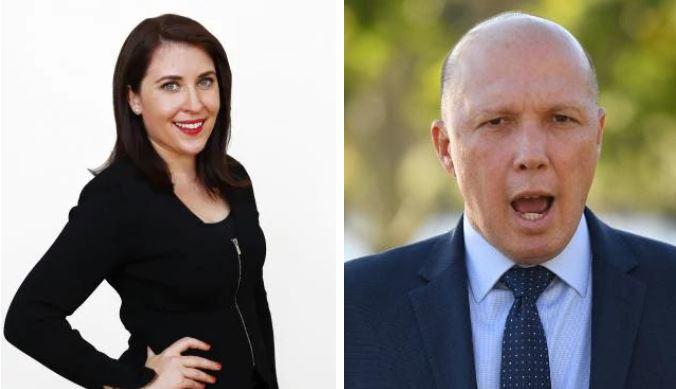
News Corp Australia’s Annika Smethurst, Home Affairs minister Peter Dutton
By Tyler Durden | Zero Hedge | June 3, 2019
Australian federal police officers are raiding the home of News Corp Australia journalist Annika Smethurst over an April, 2018 story accusing the government of radical new espionage powers allowing the Australian Signals Directorate (ASD) to monitor citizens for the first time, according to the Daily Telegraph (via the Herald Sun).
Ms Smethurst, the political editor for News Corp Sunday titles including The Sunday Telegraph, was at home preparing to leave for work this morning when several Australian Federal Police officers arrived with a warrant from an ACT magistrate giving them authority to search her home, computer and mobile phone.
Ms Smethurst complied with the warrant and is presently waiting for the raid to be completed. She has declined to answer questions apart from confirming her identity. –Herald Sun
Smethurst’s article revealed that the emails, bank accounts and text messages of Australian citizens could be secretly accessed by government spies without a trace under the proposal, as long as the Defense and Home Affairs ministers approved the plan.
The raid comes three weeks after the federal election returned the Morrison government to power, leaving Home Affairs minister Peter Dutton at the helm.
Ms Smethurst’s original story included images of top-secret letters between the secretary of Home Affairs, Mike Pezzullo, and his counterpart in Defence, Greg Moriarty, outlining a plan to potentially allow government hackers to “proactively disrupt and covertly remove” onshore cyber threats by “hacking into critical infrastructure.” –Herald Sun
Current Australian law prohibits the ASD from spying on citizens – a power left to the Australian Federal Police (AFP) and the Australian Security Intelligence Organization, the country’s domestic spy agency.
Smethhurt revealed that Dutton and former Defense Minister Marise Payne had reviewed the proposal, however it had not moved beyond that stage to be formally presented to the government.
The Apparently Irresistible Cry of Anti Semitism

By Eve Mykytyn | June 3, 2019
What does it take to force a university to act contrary to the principles of free expression that are at the core of academic freedom? If the story of Dr. Maaruf Ali is representative, then the answer is: not much. In the 25-30 news stories I read in preparing this summary, each article repeated the characterization of Dr. Ali’s posts as anti Semitic and none offered any counter interpretation. It seems no institution offered support to Dr. Ali. Not a union, nor a political party nor the university itself.
Dr. Ali’s problems at The University of Essex began with a vote the student union held in February over whether to authorize a proposed new Jewish student society, a branch of the Union of Jewish Students. The UJS is frankly Zionist and political, offering on its website as its ‘core values:’ 1.) cross communalism defined as “open to all Jewish students regardless of political or religious affiliation or denomination. 2.) Peer-leadership 3.) Representation: “… Jewish students should have their voices heard both locally and nationally.” And, 4.) Engagement with Israel. “… to strengthen, celebrate and explore a personal relationship with Israel as part of an evolving expression of Jewish identity.”
The few students who bothered to vote on the issue voted overwhelmingly in favor of the new society. 200 students out of the 600 who voted (the University of Essex boasts over 15,000 students) voted against the society. None of the news outlets that covered this story mentioned that very few students cared to participate, exaggerating the importance of the issue at the University. Apparently panicked by this lopsided vote in its favor, the student union cancelled the vote and authorized the society’s immediate creation.
Histrionics prevailed in the Jewish press and among the UK’s Jewish advocates. Following the vote, the national Union of Jewish Students said the fact that so many people were against the ratification of the society was “simply shocking.” Apparently not constrained by facts, Amanda Bowman, vice-president of the Board of Deputies of British Jews said: “This is racism, pure and simple. Those students who voted to exclude Jewish students should hang their heads in shame.” Of course, 200 students voted against a society, there was no vote to exclude Jewish students.
Luckily for those seeking to extract revenge for the elusive sin of anti Semitism, they had an object for their wrath in University lecturer, Dr. Maaruf Ali. Ali opposed the society and shared a number of posts alleging that “the Zionists next want to create a society here at our University.” This quote was widely circulated as evidence of his anti Semitism although UJS is an openly Zionist organization.
In support of his opinion Ali posted that: “50,000 Jews protest[ed] Israel” in New York, but that there was a “total mainstream media blackout by the Zionist mafia.” There indeed was such a protest in New York, and it was only lightly covered in the media.
Ali wrote that Israel planned to expel 36,000 Palestinians from the Negev. In fact, Israel was expelling 36,000 Palestinian Bedouins from the Negev, and his point was correct.
Then Ali shared a claim from smoloko.com that a French police officer allegedly killed in terror attacks in Paris was actually a Mossad agent. I couldn’t verify this claim, but there are many such theories about the 2015 attacks See.
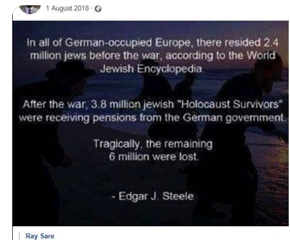
Dr. Ali also shared the following post from Edgar Steele, an Idaho lawyer who defended members of the Aryan nation.
Hello, World!
The Incredible Disappearance of Shai Masot
By Craig Murray | June 2, 2019
A Google news search reveals that not one single mainstream media outlet has mentioned Shai Masot in 2019. Not even once.
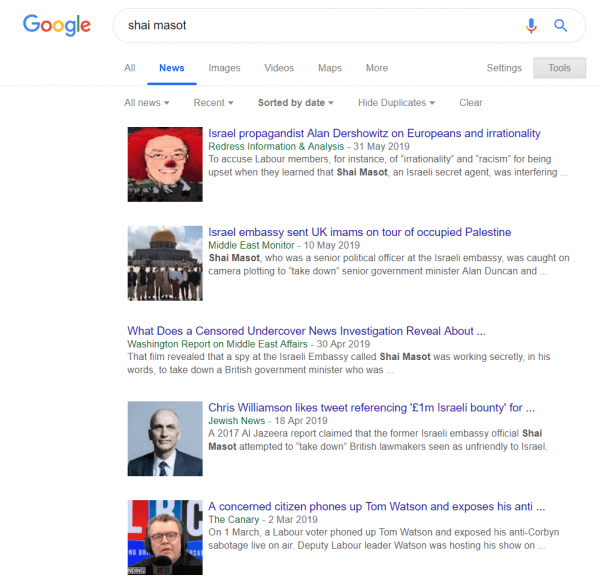
Yet the main political news story the last two days has been the suspension of Labour’s Peter Willsman for “anti-semitism” for making the suggestion that the “anti-semitism” witch-hunt is promoted by the Israeli-Embassy. This has been demonstrably a massive story:
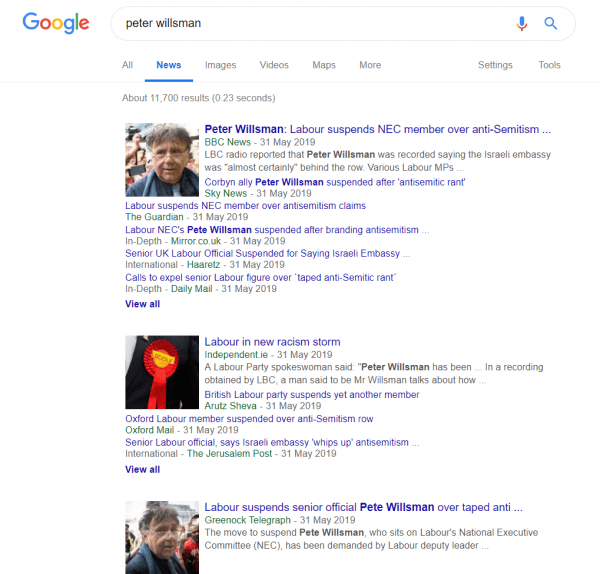
The overwhelming majority of the tens of thousands who will read this article know who Shai Masot is and know why his activities are absolutely central to the Willsman story.
And here is the truly terrifying thing.
The overwhelming majority of the mainstream media “journalists” who produced those scores of stories about Willsman also know exactly who Shai Masot is and why his activities are central to the Willsman narrative. And every single one of those journalists chose to self-censor the crucial information that casts a shade over the “Willsman is an anti-semite” line. Every single one. Their self-censorship is not necessarily a conscious and singular act, though in many cases it will be. They are simply imbued with the line they are supposed to adopt, the facts they are supposed to ignore, to forward their career and remain accepted in their social group.
Because the plain truth is that the Al Jazeera documentary The Lobby (part 1 below) showed to the entire political world that Mr Willsman’s thesis about the involvement of the Israeli Embassy in British politics and its objectives is broadly true. It says something about the current dystopia that is the UK, that this truly shocking documentary did not result in any official action against Joan Ryan (who has thankfully since hurtled herself into the political abyss), but that pointing out the undeniable truth about Israeli Embassy interference in British politics is an expulsion offence.
I should be very happy to go on the BBC and say this and so would many other people. Yet the mainstream media have been unable to quote this point of view from a single person. Yesterday’s 12 noon news on the BBC had Willsman as the top story with interviews with first Charlie Falconer, calling for Mr Willsman’s expulsion, then a six minute live rant from extreme zionist John Mann, calling for Mr Willsman’s expulsion. There was no attempt to balance this at all with a remotely sane guest. To be fair, the presenter did baulk at some of Mr Mann’s more frothy mouthed utterances, but the BBC knew precisely what they would get when they invited him, and the decision to have a major news item with only two intervewees, both from the same side of the argument, was a quite deliberate one.
This was a much worse example of lack of balance than those for which Russia Today is routinely censured by Ofcom and threatened with closure. But doubtless as it was a pro-Israel and anti-Corbyn lack of balance (Corbyn was condemned by both interviewees) Ofcom will take no action whatsoever. I am however putting in a complaint to Ofcom about this specific news item and I urge you to do the same.
Al Jazeera’s exposure of Shai Masot led to his quietly being removed from the UK, however he was but the tip of the iceberg. With my FCO inside knowledge I could show that the Israeli Embassy has an extraordinary and disproportionate number of “technical and administrative staff” like Masot, and that there was a mystery over what kind of visa he had to live in the UK. The FCO refused to answer my questions and no mainstream media “journalist” was willing to pursue the case.
The readership of this blog has grown fast over the last two years. I therefore do recommend that you read this blog post which ties in Masot’s activities to the Mossad collaboration of Liam Fox and Adam Werritty – which was the real story behind the Werritty scandal, again completely hidden by the mainstream media. I should mark my debt to the late Paul Flynn MP in helping me prove that fact beyond dispute, as you will see if you read the article. Not one of the media and political hypocrites who so recently eulogised Paul was willing to support him in this or even mention the facts that he had winkled out. Jeremy Corbyn also helped me expose the Werritty/Israel links in his pre-leadership days by asking parliamentary questions.
I do blame Jeremy for not taking a more robust line. Genuine anti-semitism should always be called out and condemned, and it plainly exists, even in the Labour Party. But the open attempt to stifle all criticism of Israel, and in effect to make adherence to Zionism a pre-condition for membership of the Labour Party – or indeed acceptance in wider society – is a vicious form of authoritarianism that should have been repudiated robustly from day one.
Facebook Jail for truth tellers
By Gilad Atzmon | June 1, 2019
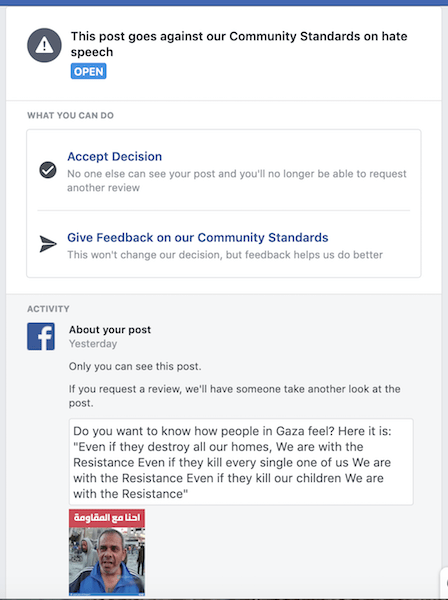
Once a day the Palestinian poet Nahida Izzat is being thrown into the FB Jail for 30 days for telling the truth about Palestine and the crime that has been committed against her people for almost a century. Nahida has never promoted violence or written any type of hate speech. The routine is pretty exhausting. She receives a FB notification about her suspension, she then appeals and after a few hours FB lifts her suspension.
The Palestinian poet is subject to a relentless vilification campaign by both Zionists and Anti Zionist Zionists (AZZ). Yesterday, Nahida was suspended again. This time her crime was posting a clip of a Palestinian man who just lost his home to an Israeli bomb. Nahida provided an English translation of the Gazan victim.
Nahida’s post read:
Do you want to know how people in Gaza feel?
Here it is: “Even if they destroy all our homes,
We are with the Resistance
Even if they kill every single one of us
We are with the Resistance Even if they kill our children
We are with the Resistance”
FB has now rejected Nahida’s appeal on the ridiculous ground that the above “goes against our community standards on hate speech”
Apparently reporting on a war crime committed by Israel and providing a first hand account of the destruction and the anguish inflicted on Palestinian refugees is considered ‘hate speech’ according to the authoritarian social network.
Amazon Pulls Hezbollah Deputy Leader’s Book After Israeli Media Outcry
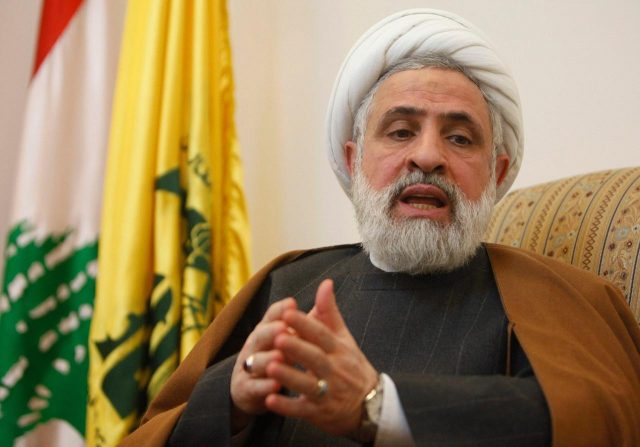
Deputy leader of Hezbollah Gen. Naim Qassem, via Reuters.
By Tyler Durden – Zero Hedge – 05/23/2019
This week Amazon pulled a controversial book being sold through its website after Israeli media led an outcry against it, charging the US retail giant with hosting Hezbollah propaganda containing incitement to violence against Israelis written by the group’s second in command.
 “Hezbollah: The Story from Within” was published in 2010 by Naim Qassem, the deputy head of Hezbollah, who is a designated international terrorist by the United States. The rare “insider account” of Iran-backed Hezbollah has been translated into several languages and had reportedly long been available in English through Amazon.com.
According to the Israeli national Hebrew-language daily newspaper Maariv, “a reporter found that the English edition of the book was being offered for sale on the Amazon site,” and was alarmed at “a clear instance of breaking sanctions and helping to finance terrorism” on the part of Amazon.
“A Maariv reporter contacted Amazon with findings in the book and Amazon subsequently decided to immediately remove the book from its sales sites in the United States and around the world,” a rough English translation of the Maariv story said. The Hebrew-language report said the book was filled with anti-Semitic statements and questioned Israel’s right to exit.
Though it had apparently been offered by Amazon for years, the book was spotlighted this week after controversy erupted between Israel and a United Nations official, after the official called it “necessary reading”.
On Tuesday Israel slammed the United Nations Special Coordinator for Lebanon Jan Kubis for holding a high level meeting with Qassem after which the UN official publicly praised the senior Hezbollah official.
Kubis had confirmed on Twitter that he not only met with Qassem, but received a copy of his most well-known book, which he also praised.
The Times of Israel reported of the statement:
Kubis was likely referring to “Hizbullah (Hezbollah): The Story from Within,” a 464-page tome first published in English a decade ago. The book, published by the London-based Saqi Books, is available on Amazon.
The Israeli Defense Forces (IDF) spokesman went so far as to denounce the meeting via Twitter, saying “You know what else is ‘necessary reading’? U.N. Resolution 1701” — in reference to a resolution intended to resolve the 2006 Israel-Lebanon conflict.
Within two days following the incident, the initial link through which the book had been sold on Amazon led to an error page, in apparent confirmation that Amazon banned the book at the request of the Israeli reporter.
On Thursday, Middle East and Iran analyst Matthew Levitt confirmed that the “Hezbollah deputy Secretary General’s book [is] no longer available on Amazon after journalist points out its anti-Israel incitement to violence & sanctions implications of selling it.”
The fresh controversy comes following new efforts by Israel to convince the UN to officially recognize Hezbollah as a terror group — an effort which has reportedly failed to gain traction.
The Trump administration has also of late taken more aggressive sanctions measures on Hezbollah leadership amid the ongoing heightened tensions with Iran. Hezbollah has long been seen as an arm of the Ayatollahs in Lebanon and Syria.
Israel government admits journalists beaten by soldiers were not ‘rioters’
MEMO | May 22, 2019
The Israeli government has retracted its claim that two journalists “led a riot” in Nabi Saleh in 2015, “and that their beating by soldiers was therefore justified”, reported Haaretz.
According to the article, “this is the gist of a compromise reached between the Jerusalem district attorney and the two photographers, Abbas Mumani and Haim Schwarczenberg”, who had sued the Israeli military over the assault.
While the plaintiffs have been awarded a fraction of the damages initially sought, “the significance of the compromise”, Haaretz reported, “lies in the state’s admission that its version of events, throughout the proceedings, was incorrect”.
The incident occurred on 24 April 2015, as Israeli occupation forces violently suppressed a Palestinian demonstration in Nabi Saleh, a village in the West Bank.
Soldiers approached Schwarczenberg and Mumani and told them to leave, before kicking, shoving, beating, and verbally abusing the pair. One soldier even “threw a rock at Schwarczenberg, and ran at him and knocked him down”.
That same day, the Israeli army spokesperson claimed that soldiers had used “reasonable force” against the journalists. However, after viewing footage of the assault, the army described the forces’ conduct as “very serious” and “not in keeping with the commanders’ instructions”.
Subsequently, a deputy company commander “was sentenced in a disciplinary hearing to 14 days in military prison”, while the platoon commander was “confined to base for 30 days”.
However, in response to the lawsuit filed by the journalists in February 2016, the state attorney had alleged that “the plaintiffs acted in concert with the Palestinian rioters”, and were “an inseparable part of the serious rioting…and absolutely were not solely engaged in documenting the event”.
US Navy wants to create archive of 350 BILLION social media posts for ‘research’ purposes
RT | May 21, 2019
The US Navy is seeking to create an archive that will store no less than 350 billion social media posts, as part of the military branch’s “research efforts” into “modes of collective expression.”
The Department of the Navy has posted a solicitation asking contractors to bid on a project that would amass a staggering 350 billion social media posts dating from 2014 through 2016. The data will be taken from a single social media platform – but the solicitation does not specify which one.
“We seek to acquire a large-scale global historical archive of social media data, providing the full text of all public social media posts, across all countries and languages covered by the social media platform,” the contract synopsis reads. The Navy said that the archive would be used in “ongoing research efforts” into “the evolution of linguistic communities” and “emerging modes of collective expression, over time and across countries.”
The archive will draw from publicly available social media posts and “no private communications or private user data” will be included in the database. However, all records must include the time and date at which each message was sent and the public user handle associated with the message. Additionally, each record in the archive must include all publicly available meta-data, including country, language, hashtags, location, handle, timestamp, and URLs, that were associated with the original posting.
The data must be collected from at least 200 million unique users in at least 100 countries, with no single country accounting for more than 30 percent of users, the advert says.
While the stated intentions of the project may sound benign, the US government has previously expressed interest in collecting social media data for more eyebrow-raising purposes. Last year, the US Department of Homeland Security issued a notice asking contractors to bid on a database that tracks 290,000 global news sources in over 100 languages. The contract also mentioned the ability to keep tabs on “influencers,” leading some reports to speculate that the proposed database could be used to monitor journalists.
Also on RT:
‘Conspiracy theory’? US Homeland Security wants to track journalists & analyze media ‘sentiment’
Massive Instagram data dump by Indian firm exposed records of millions of influencers – report
Featured Video
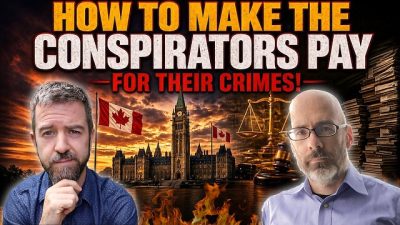
Dan Dicks with James Corbett on Solutions Watch
or go to
Aletho News Archives – Video-Images
From the Archives
MMR (Measles, Mumps and Rubella) – Vaccine Risk Statement
MMR Vaccine (Measles, Mumps, and Rubella) Is It Safer Than Measles, Mumps and Rubella?
Physicians for Informed Consent | December 2024
… It has not been proven that the MMR vaccine is safer than measles, mumps, and rubella. The vaccine package insert raises questions about safety testing for cancer, genetic mutations, and impaired fertility. Although VAERS tracks some adverse events, it is too inaccurate to measure against the risk of measles, mumps, and rubella. Clinical trials do not have the ability to detect less common adverse reactions, and epidemiological studies are limited by the effects of chance and possible confounders. Safety studies of the MMR vaccine are particularly lacking in statistical power. A review of more than 60 MMR vaccine studies conducted for the Cochrane Library states, “The design and reporting of safety outcomes in MMR vaccine studies, both pre- and post-marketing, are largely inadequate.”19 Because permanent sequelae (aftereffects) from measles, mumps, and rubella are so rare (especially in children with normal levels of vitamin A and infected after birth),6,15-17 the level of accuracy of the research studies available is insufficient to rule out the possibility that the MMR vaccine causes greater death or permanent disability than measles, mumps, and rubella. – Read full article
Blog Roll
 Aletho News
- The fallacy of US delusions about Iran’s economic collapse
- Hezbollah denies Syria cell link, warns of Israeli plan to sow discord
- The legacy of US sanctions, war, and occupation in Iraq
- Iraqi resistance group rejects disarmament, vows to maintain support for Lebanon
- Sheikh al-Asadi warns of Iraqi government compliance with US demands
- How to MAKE THE CONSPIRATORS PAY for their crimes! Dan Dicks with James Corbett on Solutions Watch
- There’s a drought in academia: A drought in honest research on the subject of drought and other weather extremes
- Department of War Awards $20.7 Billion Contract to Raytheon for Air-to-Air Missiles
- ‘Distance yourselves from Israel’: IRGC urges US population to question govt policies
- America’s Greenland deal has a radioactive backstory
- If Americans Knew
- New Report: “Scholasticide and Genocide in Gaza: Assessment, Testimonies and Legal Analysis”
- Ex-Biden officials are desperate for a Gaza scapegoat
- Israeli “settlers” Invade Al-Aqsa; Pour Boiling Water on 75-Year-Old
- Israel Has Kidnapped Another American Teenager
- US arms sales to Israel worth $21.6 billion in 20 months
- Three Palestinians Killed in Israeli Attacks on Gaza
- Revealed: German “Anti-Semitism Expert” Driving Crackdown on Palestine Solidarity is Former Israeli Spy
- Egypt’s Warning to Israel Before Oct 7
- Israel’s siege signals another cruel winter for 1.8 million Gazans – Daily Update
- Netanyahu Asked UAE Leader to Deny Report on Oct. 7 Warning in Secret Visit, Sources Say
- No Tricks Zone
- Two More Paleo Reconstructions Affirm Meters-Higher Sea Levels Across Ireland, Brazil 7000-6000 Years Ago
- New Study: Earth And Venus Surface Warmth Largely Explained By Convection And Lapse Rate, Not CO2 Or Radiation
- 2025 Nature Paper Claiming Worsening Global Drought Gets RETRACTED …Heavily Flawed
- New Study: ‘Global Drought Shows No Detectable Recent Acceleration Under Climate Warming’
- Economic Masterminds: German Socialists Suggest Taxing Productivity Gains Stemming From Using AI
- The South China Sea Has Not Been Cooperating With The Climate Change Narrative
- Energy Crisis: Germany Enters Heating Season With Historically Low Gas Reserve Fill Levels
- New Study: The Antarctic Ice Sheet Gained Mass From 2020-2024 Due To Staggering Snow And Ice Accumulation
- Study: Ocean Heating Rates From Thousands Of Years Ago ‘Dwarf’ Modern Ocean Heating Rates
- Climate Extremists Target, Attack Large-Scale Power Grid Infrastructure In Germany!


