Canada to Russia: Interference Is Okay If It Destabilizes You but Not the Other Way Around
By Matthew EHRET | Strategic Culture Foundation | 15.04.2019
In the midst of one of the most de-stabilizing scandals to rock Canada in years, Foreign Affairs Minister Chrystia Freeland announced on April 5 that the threat of “Foreign interference” going into the October 2019 elections was at an all-time high.
Sitting beside her UK counterpart at a G7 meeting in France, Freeland stated: “Interference is very likely and we think there have already been efforts by malign foreign actors to disrupt our democracy”. Her warning was echoed by an embattled puppet Prime Minister in Ottawa who stated it is “very clearly that countries like Russia are behind a lot of the divisive campaigns … that have turned our politics even more divisive and more anger-filled than they have been in the past.”
The Measures to Defend the British Deep State
In order to counteract this “foreign threat”, several Canadian mechanisms have been announced to “keep democracy safe” in alignment with the G7, Five Eyes and NATO. These mechanisms are:
The creation of an “Incident Public Protection Panel” run by five Privy Council bureaucrats under the Clerk of the Privy Council which will exist outside of the authority of the Chief Electoral Officer of Canada, whose job is to maintain the integrity of elections. In defense of this mysterious group, Canada’s Democratic Institutions Minister Karina Gould stated that “it won’t be one person who will decide what Canadians will be allowed to know”(apparently having five people decide is more democratic). The new Clerk of the Privy Council is Ian Stugart, who served as former deputy minister to Chrystia Freeland until just a few weeks ago.
A Security and Intelligence Election Threats Task Force which will incorporate all of Canada’s intelligence agencies such as the Canadian Security Intelligence Service, the RCMP, the Communications Security Establishment (CSE) and Freeland’s Global Affairs Canada. All of these agencies are Privy Council organizations.
The Rapid Response Mechanism of the G7 created in June 2018 and headquartered in Ottawa Canada in Freeland’s Global Affairs Office and Privy Council Office.
While Russia is being set up as the scapegoat of the collapsing western liberal establishment, this most recent red alarm by Freeland and Canada’s response to the “danger” is useful for two reasons:
First and foremost, Freeland’s shameless warnings over “foreign interference” have become so loud that an irony has become unavoidable. She has after all been caught red handed behind the destabilization of both Ukraine and Venezuela. Secondly, by reviewing the mechanisms being created by Canada to counteract this “threat”, a clear insight is provided into the inner workings of the actual foreign influences which infiltrated Canada many decades ago.
Chrystia Freeland: Regime Change Princess of Ukraine and Venezuela
On the first point, Freeland’s role as a co-architect of the nazi-fueled overthrow of a pro-Russian government in February 2014 is now well known. Aside from her family’s Nazi connections going back to her grandfather Michael Chomiak’s leading role as a Nazi collaborator in WWII, and her own mother’s role in helping to draft Ukraine’s neo-liberal constitution, Freeland herself not only befriended leading neo-Nazi collaborators such as Canadian Ukrainian Congress’ president Paul Grod and but has also promoted NATO’s anti-Russian expansion across eastern Europe.

Less well known but equally important is Freeland’s leading role in planning for the Venezuelan coup attempt which has been recently halted thanks to Russia’s March 23rd intervention.
Working alongside fellow Oxford operative Ben Rowswell (now head of the Canadian International Council/ Chatham House of Canada) during his three year tenure as Ambassador to Venezuela (2014-2017), Freeland set up a program for regime change which involved a two-part formula of 1) mobilizing mass direct support for the overthrow of a government, and 2) gaining international support for said overthrow.
Rowswell’s on-the-ground work was designed to achieve the former as he himself admitted in a 2017 interview saying “We became one of the most vocal embassies in speaking out on human rights issues and encouraging Venezuelans to speak out”. Before leaving his post to become the head of the Chatham House of Canada, he tweeted “I don’t think they (anti-Maduro forces) have anything to worry about because Minister Freeland has Venezuela way at the top of her priority list”.
Working on fulfilling the 2nd part of the formula, Freeland directed the creation of the “Lima Group”. A Global News article of January 24 described the group in the following terms: “Playing a key role behind the scenes was Lima Group member Canada, whose Foreign Minister Chrystia Freeland spoke to Guaido the night before Maduro’s swearing-in ceremony to offer her government’s support should he confront the socialist leader”.
It shouldn’t be too surprising in our day and age that a nation with such a high reputation as “polite Canada” is in actuality, an active agency for regime change and global governance. Canada’s very Prime Minister did assert in 2016 that “Canada is the world’s first post national-state nation”. What may surprise some readers is that Canada itself was infiltrated by a foreign player many years ago and what we will briefly see is that Canada can only be called the “world’s first post national-state nation” because it never really became a genuine nation in the first place, but was always manipulated by a foreign power… although not the one you think.
The “Foreign Influence” Controlling Canada
While a longer presentation is needed to do this story justice, it is enough to note for now that neither Freeland, nor Rowswell are operating on behalf of Canada’s interests, but are rather both operatives run by an entity that took over Canada many decades ago and are currently directed by two interlocking organizations: The Privy Council Office and the Rhodes-Milner Round Table Group.
The Privy Council Office
The Privy Council office was set up in 1867 in order to act as the British hand guiding its newly formed confederacy (Canada nearly became a part of Lincoln’s America in the wake of the Civil War. The only thing stopping that outcome was Britain’s creation of a confederation. The full story is told in the Imperial Myth of Canada’s National Policy). While its power was always great, there was still room for independent policy making by nationalistic elected officials when the international conditions were favorable.
This was nearly entirely destroyed during the reign of technocratic golden boy Pierre Elliott Trudeau during his 1968-1973 reform of the Federal Government under the guidance of the OECD’s Sir Alexander King. It was during this time Sir King’s Club of Rome (Ottawa branch) was set up in Ottawa under the guidance of Trudeau and his clerk of the Privy Council Michael Pitfield, and other neo-Malthusian technocrats such as Privy Council President Michel Lamontagne, Maurice Strong, and Governor General Roland Mitchener. It was from this control point in Ottawa in 1971 that the work later to become known as Limits to Growth was funded by tax payers and which became the bible for the new Malthusianism and blueprint for the “post-industrial society”. It is from this cybernetics central node that the web of governance both in Canada and also across other British infiltrated territories in the Trans-Atlantic system is coordinated under the directives of London.

Sir Alexander King, working through the Club of Rome advanced the Malthusian revival known as “Carrying Capacity” which presupposed a world of fixed resources and discounted the parameter of human creativity
The current President of the Privy Council is Justin Trudeau’s childhood friend Dominic Leblanc, son of former Governor General (i.e.: Head of State of Canada) and co-controller of the Canada 2020 think tank which created Justin as an Obama-modelled puppet in 2006. Following in the footsteps of Pierre Trudeau’s Limits to Growth, it is this very network which is at the heart of the Green New Deal now being pushed internationally. Another leading member of Canada2020 is Facebook Canada’s Kevin Chan who will be working closely with the Freeland’s Security and Intelligence Election Threats Task Force.
The oath of every member of the Privy Council member (which includes both private individuals and also every cabinet minister of government) is: “I, [name], do solemnly and sincerely swear that I shall be a true and faithful servant to Her Majesty Queen Elizabeth the Second, as a member of Her Majesty’s Privy Council for Canada.” Additionally to becoming a Privy Councillor, the Prime Minister must additionally give another oath stating: “I, [name] do swear (declare) that I will be faithful and bear true allegiance to Her Majesty Queen Elizabeth the Second, Queen of Canada, Her Heirs and Successors.
The Milner-Rhodes Trust Group
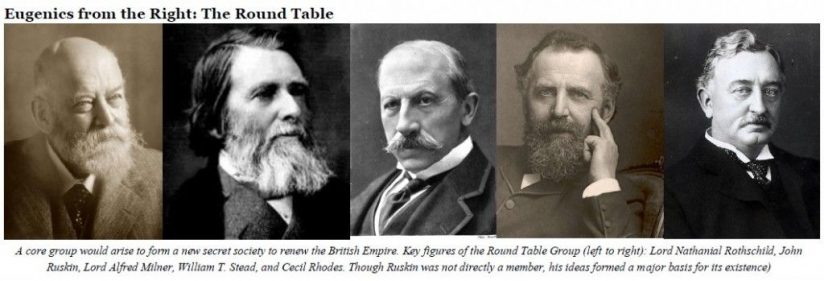
Coordinating closely with the Privy Council office for over 100 years is an organization known as the Round Table Group (c.1902) which was created with funds from South Africa’s “race patriot” and diamond magnate Cecil Rhodes who wished to use his wealth in order to advance a “church for the extension of the British Empire” and “the ultimate recovery of the United States of America as an integral part of the British Empire, the inauguration of a system of Colonial representation in the Imperial Parliament which may tend to weld together the disjointed members of the Empire.”
Upon Rhodes’ death in 1902, Lord Alfred Milner directed Rhodes’ trust and created the Round Table Movement across all British Territories. The trust was also directed towards the creation of the Rhodes Scholarship system designed to indoctrinate talented young minds around the world in Oxford before deploying them back into their countries of origin in order to infiltrate all public and private fields of influence. The Roundtable groups (dubbed the Council on Foreign Relations upon its creation in the United States in 1921), changed its name several times and today is known as the Royal Institute for International Affairs/Chatham House in the UK and the Canadian International Council (CIC) in Ottawa*.
Regime Change disciple Ben Rowswell’s presidency as head of the CIC and Chrystia Freeland’s status as an Oxford Rhodes Scholar (having been brought into Liberal politics via Rhodes Scholar/Canada2020 controller Bob Rae in 2013) should give any thinker a moment of grave pause.
The Strategic Issue at Hand
As ugly as this picture may appear to some, it should not cause sadness or even anger.
Only pity mixed with a dose of hope are appropriate, since we are in fact witnessing the desperate death rattle of a Monarchical system of empire which has too long poisoned the well of human civilization and which must now give way for something better. Although this imperial system may be deploying every asset and dirty trick it has in opposition to the new paradigm now emerging under the guiding leadership of Russia and China, it is becoming increasingly clear that this empire cannot win. Its regime change plans have failed, its Green New Deals are failing and even the irrational aesthetical traditions underlying this system of post-modernism are giving way to an optimistic artistic sensibility that seeks to re-unite beauty with truth evidenced by the renewed interest in classical art and music during the recent Belt and Road Musical Festival on March 24, 2019.

Russia and China’s leadership have not only consolidated a partnership of nations across Eurasia and Africa around this new paradigm, but they have also found what no one thought was possible just a few years ago: a potential ally in an America which is returning to its nationalist sensibilities under the surprising leadership of Donald Trump.
During Trump’s two first years as President, the long British infiltration of America has finally begun to fall apart with the collapse of the Mueller investigation and the exposure of the British-run deep state that Mueller was a part of.
The question now remains: With the impending meltdown of the trans-Atlantic financial system, and olive branch of cooperation which China has offered to the west via the Belt and Road Initiative and the World Landbridge which can bring this system of development into the Americas and Africa, will America join hands as an ally and will Canada follow suit in order to become a true sovereign nation freed of all foreign imperial influence once and for all?
* Original research on the Roundtable/Rhodes Trust infiltration of North America can be found in the Canadian Patriot #18 (British Roots of the Deep State Exposed), Canadian Patriot #19 (Green New Deal vs New Silk Road) and volumes 2-4 of the Untold History of Canada.
Gradually Re-establishing Historical Truth about Jeju Uprising
By Konstantin Asmolov – New Eastern Outlook – 14.04.2019
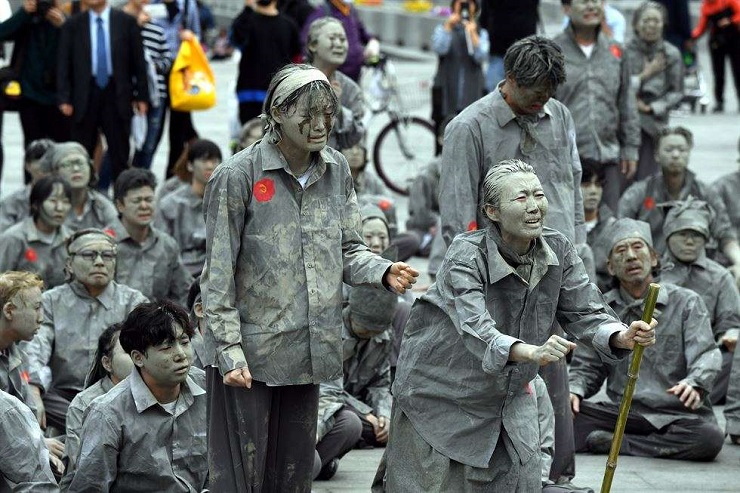
On 3 April, 2019 a commemoration ceremony to honor victims of a bloody suppression by government forces of the people’s uprising in 1948-1954 was held on the island of Jeju. More than 10,000 people, including representatives of the government and the National Assembly, revolt participants and offspring of the victims of its clampdown, took part in the memorial. South Korea’s Prime Minister, Lee Nak-yeon, gave a speech at the ceremony. He proposed to honor the memory of all those lost and expressed his deepest condolences to their families. The minister also referred to the incident in Jeju as the worst event in South Korea’s modern history. Lee Nak-yeon emphasized that Moon Jae-in’s administration has undertaken the monumental task of uncovering the truth behind the Jeju massacre, and of restoring the victims’ dignity.
The head of South Korea’s National Police Agency, Min Gap-Ryong, participated in a commemoration ceremony in Seoul. He wrote the following words in the visitor’s book: “I humbly share my condolences before the spirits of all those innocent people who were killed during Jeju April 3, and I respectfully share my wishes that they rest in peace.” Vice Minister of National Defense Seo Joo-seok, who made the aforementioned statement, was also in attendance. He highlighted that the army was fully committed “to the government investigation efforts going forward” and would “take part in healing the wounds and suffering of the family members while restoring the honor of those who were slain”. This was the first comment about the incident made by a South Korean military agency.
Officially, at least 10,000 Jeju residents were killed and almost 3,600 went missing, as a result of the tragedy that stemmed from Korea’s ideological split following its emancipation from Japanese colonial rule, which lasted from 1910 to 1945. In reality, the situation was even more complex. Propaganda from both North and South Koreas portray the uprising as a communist revolt against elections, which were to take place in the South on dividing the peninsula. However, in reality, the uprising was instigated by actions of the police and agitators from so-called “youth groups”, who used racketeering and violence to bring the region, with a powerful left-wing movement, under control.
South Korea’s current strategic policy has its origins at the start of the rebellion, 1 March 1947, when a child who suffered a blow from a police horse’s hoof died during a street protest in celebration of May Day. This led to a confrontation with the police and the crowd was fired on. In response, the Workers’ Party of South Korea declared a general strike. Instead of calming people down, the government made a decision to destroy the left-wing forces once and for all, which led to an even tougher response from the people.
On 3 April 1948, more than 350 armed civilians simultaneously attacked 12 police precincts and homes of representatives of legislative bodies, in order to free detained relatives and force the government to reconsider its policy. The leadership reacted even more violently in turn. Death squads mercilessly dealt with protesters and local residents who helped them. On 17 October 1948, a ban on movement in inner and mountainous regions of the island, with the exception of its 5-km coast line, was introduced. All the villages outside this perimeter were completely destroyed and so were their residents if they refused to leave these territories. 2,500 islanders were imprisoned although there were no charges against them or any written verdicts.
The bloodshed continued during the Korean War too. The truth is, however, in 1953 armed units had only approximately 60 people in them, and by the beginning of 1954, this number decreased to 5. 21 September 1954 is viewed as the last day of the uprising, when the ban on movement was finally lifted. The last guerrilla member was arrested on 2 April 1957.
Since a substantial portion of the population was massacred, and their bodies were often submerged or burned, the number of estimated victims ranges from 14,000 to 30,000 people. And if those who were indirectly affected by the government’s crackdown (i.e. victims of hunger or subsequent social cleansing) are added to the total, the number is even higher. Incidentally, only 14% of protesters were killed.
For decades after the uprising, memories of this event and the atrocities committed during the rule of Syngman Rhee were hidden from the public by means of censorship and repression. And only on 12 January 2000, a Special Act was decreed, in accordance with which a truth committee was established to investigate the Jeju massacre and to exonerate its victims. Approximately 14,000 people applied to have the status of a victim of those events. On 28 August of the same year, the special committee for investigating causes of death of the residents and their exoneration began their work.
In 2006, Roh Moo-hyun’s government issued an official apology for its role in the massacre. The leadership also promised reparations for the victims, but by the end of 2018 nothing had been done to this end.
On the plus side, a lot of work is being done to clear the good name of people, who, during the uprising, were preemptively jailed and tortured, without a single charge brought against them. Those who were released had to live under the umbrella of suspicion. And, finally, in January 2019, the Jeju District Court dismissed military court’s rulings with regard to the 18 plaintiffs, who survived, and recognized them as victims instead. The accusations levelled against them were deemed unsubstantiated since the military court did not follow prescribed legal procedures. This conclusion, in the opinion of those who issued the verdict, is supported by the fact that the plaintiffs were not aware of the criminal charges against them. Also the sheer number of people brought before the military courts-martial within a short period of time indicated relevant investigations were unlikely to have been carried out.
The plaintiffs demanded that their cases be reviewed as far back as 2017, as they claimed to have been arrested and jailed for a period of up to 20 years without as much as a fair trial. Since that time not a single court record has been found to indicate why the plaintiffs received such harsh sentences. Even after researchers had travelled to the peninsula and accessed central archives, they were unable to find any existing records about the investigation at that time. It turns out that people were detained and tortured without being charged for any crimes , which is consistent with the practice of preemptive arrests.
The court decided to retry the case in September 2018 due to renewed interest in the incident following the commemoration of its 70th anniversary and the official apology issued by President Moon Jae-in.
A few months later, on 17 January 2019, the Jeju court exonerated all the participants of the people’s uprising on 3 April 1948, who had served the sentences handed down to them by the military courts-martial.
This policy, exercised by Moon Jae-in’s government towards residents of Jeju, is part of a common trend. As part of this new shift, “a former police investigation building in Namyeong-dong, Seoul”, where intelligence agents “tortured hundreds of pro-democracy” and anti-government “activists in the 1970s and 1980s, has been turned into a memorial hall for human rights and democracy.” The Ministry of the Interior and Safety plans to outsource the building’s “operation to the Korea Democracy Foundation”. Prime Minister Lee Nak-yon participated in the transfer ceremony, along with Minister of the Interior and Safety Kim Boo-kyum; Seoul Mayor Park Won-soon; Commissioner General of the Korean National Police Agency Min Gap-Ryong, and victims of torture and their family members.
In 1976, the anti-communism investigation division office was located where the current facility stands now. During both the Park Chung-hee and Chun Doo-hwan administrations, the building was used to detain, interrogate and torture anti-government activists. Over a period of approximately 30 years, a combined total of 391 activists were tortured there. Their ranks included Seoul National University student Park Jong-chul, whose death resulted in mass protests that led to the fall of the Fifth Republic of South Korea.
In response to criticism, in 2005 the National Police Agency closed the Namyeong-dong division and transformed it into a human rights police center. However, civic groups demanded that the police stop operating this facility. This process began in earnest in June 2018, when Moon Jae-in promised to convert the building into a memorial for human rights and democracy.
In his speech, Prime Minister Lee Nak-yon said that Namyeong-dong “will forever contribute to the people and history as a place to warn against the state’s abuse of power”.
A similar policy is being used with respect to persecuted members of the Bodo League. This political organization was comprised of “re-educated” left-wing activists. But once the Korean War began, most of its members were subject to repression (as a preventative measure), and the majority were executed by firing squads. Groups, such as the Korean War Bereaved Family Members’ Association, claim that after this war 200,000 members of the League were killed throughout the country.
Numerous testimonies from family members of victims paint a grim picture: activists were gathered together under the pretense of going on an excursion to the mountains or to a ceremony. They were then transported out of town or city, executed by a firing squad and buried in unmarked graves.
Only in June 2014, did a number of residents gather enough courage to corroborate evidence of a civilian massacre, which local witnesses remembered. They carried out an excavation and unearthed burial sites, but there have not been any official exhumations so far.
On 22 June 2016, a testimony by prosecutor Song Jung-won (1918-2014), who is viewed as the founder of the Bodo League, became public knowledge. On 18 October 2007, he testified in front of the Truth and Reconciliation Commission and said that many members of the League were not partisans and, in fact, did not even know what a communist party was. As a rule, these were simple peasants or intellectuals, who wished to expunge the “Red Menace” label from their family name.
Civilian activists think this testimony may be viewed as proof of the fact that the government massacred countless numbers of innocent people knowing full well that they were not members of the Communist Party.
In addition, as far back as 2009, the Truth and Reconciliation Commission confirmed mass killings of at least 3,400 civilians and inmates held in prisons in Busan, Masan and Jinju from July to September 1950. Jail employees, police officers and members of counterintelligence services took part in these reprisals. Victims were either killed inside prisons or taken to the mountains, executed, and their bodies were disposed of in the sea. Only in a few cases were executions carried out after an official sentence was handed down by a military tribunal. Incidentally, most of these victims were prisoners sentenced to less than three years in jail, and they were killed only because of concerns that they would collaborate with DPRC.
Most investigations of this nature were conducted in the course of the work performed by the Truth and Reconciliation Commission. It was established in December 2005 and tasked with researching information connected with the anti-Japanese independence movement; mass killings of civilians during the Korean War, and violation of human rights by government forces during the military dictatorship. During a fairly short 5-year period, the commission uncovered the truth about 8,468 cases by concluding that extrajudicial massacres had taken place during the Korean War and earlier. In addition, the commission ascertained that evidence in a number of espionage cases from the 1980s was either distorted or completely fabricated.
However, during Lee Myung-bak’s presidency the work conducted by the Truth and Reconciliation Commission was discontinued. The final report highlighted the fact that both sides were responsible for atrocities, but failed to mention the fact that there were twice as many victims of the “White Terror”, and many culprits were absolved of responsibility. “As a result, true reconciliation and reckoning with the past ended up being put off until another day.”
And now, possibly, this day has arrived. Although old political myths often have a tendency to transform into new ones during Moon Jae-in’s presidency, hope remains that the final picture will be an accurate reflection of the historical truth.
Konstantin Asmolov, Ph.D. in History, is a leading research fellow at the Center for Korean Studies of the Institute of the Far East at the Russian Academy of Sciences.
Canadian Regime Change Fanatics Scream of Russian Interference into Canada’s Elections
By Matthew Ehret | The Duran | April 13, 2019
On April 5 Canada’s foreign minister embodied the essence of hypocrisy by complaining loudly that Canada’s upcoming October 2019 elections were under threat by a regime change operation steered by Russia which was seeking to undermine the international democratic order.
In order to respond to the threat of foreign interference, the Minister of Global Affairs Canada announced the creation of a “democratic” five person body staffed entirely with unelected senior bureaucrats from the Privy Council Office under the control of the Clerk of the PCO which will act as a new Propaganda bureau to determine what Canadians are and are not allowed to know. This body will focus on social media and will interface closely with the head of Facebook Canada CEO Kevin Chan. She also announced the creation of a Security Threats Task Force which unites all intelligence agencies of Canada (RCMP, Canadian Security Intelligence Service, Communications Security Establishment under the office of Global Affairs Canada. Lastly, the creation of a G7 Rapid Response Mechanism would be created in order to protect all of Canada’s G7 partners from similar “foreign meddling” and run out of Freeland’s Global Affairs Office.
Justin Trudeau, whose administration is collapsing under the weight of self-contradictions built into the green technocratic worldview that he was selected to advance, was quick to jump on this new narrative stating “it is very clearly that countries like Russia are behind a lot of the divisive campaigns.”
Canadian Regime Changers Exposed
Chrystia Freeland’s role as a regime change darling of the British Empire has been increasingly known since the Ukrainian Maidan. It was that British Empire that groomed her under a Rhodes scholarship at Oxford and groomed her for years as an agent controlling mass perception by her management of Reuters and Canada’s Globe and Mail before placing her in a controlling position of Justin Trudeau in 2013.
Her role in steering the vast networks of Canadian Banderites who have long grown in numbers and influence in Canada is as well-known as her friendship with leading Svoboda/Pravi Sektor leaders in Ukraine who were deployed to overthrow a legitimately elected pro-Russian government from Nov. 2013-Feb. 2014. Increasingly well known is her own family’s deeply rooted Nazi sympathies going back to her grandfather’s role in working directly with the Waffen-SS during the latter’s occupation of Ukraine.
When the Ukraine “color revolution” steered by the British-run Deep State (of which Freeland is a senior member) failed to achieve its goal of de-stabilizing Russia, attention was turned to Venezuela where both Russia and China have invested tens of billions in infrastructure and whose government has been extremely favorable to cooperation on the Belt and Road initiative.
For this job, Freeland was deployed alongside her Oxford-trained colleague Ben Rowswell who together worked diligently for several years for a color revolution. As ambassador to Venezuela from 2014-2017, Rowswell managed to coordinate anti-government forces on the ground stating “We became one of the most vocal embassies in speaking out on human rights issues and encouraging Venezuelans to speak out”. Upon leaving Venezuela he said “I don’t think they (anti-Maduro forces) have anything to worry about because Minister Freeland has Venezuela way at the top of her priority list”.
What Rowswell was referring to was Freeland’s role in garnering the semblance of international support for the overthrow by her creation of the Lima Group of 13 Latin American countries (plus Canada) who could be said to “represent the consensus view of South America” in order to give the regime change a “democratic” look. Apparently the deep state managers of Canada didn’t think there was anything weird in an Anglo Saxon monarchy leading a group of Latin American republics and assumed the world would feel the same way.
As it turns out, even though the majority of Lima Group Foreign ministers were induced to support the regime change (very likely due to the vast control of South American mining operations controlled by Canadian mining giants), the world wasn’t so quick to jump enthusiastically on the regime change bandwagon with both Russia and China firmly denying their recognition of opposition leader Guaido’s legitimacy as the country’s leader culminating in Russia’s March 23 deployment of military aircraft and personnel into Venezuela as a message to all Deep State fanatics to back off.
It is noteworthy, that even though Donald Trump paid limited lip service to the hawks in his own government and internationally by telling Russia to leave Venezuela, the fact is that the rift between Trump and those war hawks exemplified by Bolton, Pence, and Pompeo, was made very clear as the President took several opportunities from April 3-6 to call for greater cooperation with Russia and China.
The Collapse of the Deep State and Rise of the New Paradigm
Freeland, Rowswell and their British handlers are undoubtedly not sleeping well at night. Their system is collapsing and there isn’t very much that they can do about it. The empire’s control structures so long kept in the shadows are increasingly exposed to the light of day with the collapse of Russia-Gate, and the exposure of the role of Canada’s Privy Council Office and Round Table movement (aka: Chatham House groups) as guiding (British) hands behind global affairs.
With the Brexit, Italy’s joining the BRI, the failure of the EU and bankruptcy of the City of London-Wall Street banking system, the world is finally waking up to the fact that the “great game” which so perverted the 20th century is falling apart. Not only that but only one serious alternative is on the table: the Belt and Road Initiative/New Silk Road as a global force of cooperation and long term investment into the real (vs speculative/fictitious) part of the economy.
In weeks, Beijing will host the 2nd Belt and Road Conference from and Trump, speaking alongside China’s vice Premier stated a very important intention as a lead up to that conference: 1) an end to the trade war is immanent with a major deal expected in weeks and 2) that Russia, China and America should stop wasting billions on war machines and start re-directing those expenditures towards long term great projects that benefit everyone. The places to do this not only include Belt and Road projects in Eurasia, Africa and the Americas but also the important domain of space exploration and cooperation. Both Russia and China have made it clear that space is a domain for peace on earth with Russia moving ahead with a lunar colony for 2040 and China’s far side of the moon landing on January 3, 2019 being a precursor to a larger lunar mining/industrialization program to access rare earths and Helium-3 fusion fuel.
Donald Trump has joined this chorus of nations pushing for a space based economy by announcing a revival of NASA’s mission with a Moon-Mars program on March 26.
While the future looks increasingly hopeful, and the British Empire’s ugly hand is increasingly exposed for the world to see, there are still many dirty tricks which the devil can still throw at the world.
BIO: Matthew J.L. Ehret is a journalist, lecturer and founder of the Canadian Patriot Review. His works have been published in Executive Intelligence Review, Global Research, Global Times, The Duran, Nexus Magazine, Los Angeles Review of Books, Veterans Today and Sott.net. Matthew has also published the book “The Time has Come for Canada to Join the New Silk Road” and three volumes of the Untold History of Canada (available on untoldhistory.canadianpatriot.org). He can be reached at matt.ehret@tutamail.com
Journalists worried as new UK law could send citizens to jail for going to terror hotspots
RT | April 12, 2019
New UK counter-terrorism legislation could see Britons face up to 10 years in jail if it’s proven they have entered or remained in a “designated area” overseas, as free press campaigners warn British journalists face arrest.
Coming into force on Friday, the Counter-Terrorism and Border Security Act 2019, will give UK border guards enhanced powers to stop and search individuals without suspicion, on the grounds of tackling “hostile state” activity.
UK ministers unveiled the sweeping new proposals last year in a bid to tackle the threat from so-called foreign fighters. The act allows Home Secretary Sajid Javid to designate an area, dependent on parliamentary approval.
There are exemptions written into the legislation to protect those that have legitimate reasons to be in ‘designated areas,’ but campaigners fear that varying interpretations of the new laws could see journalists being locked up.
Free press and free speech groups, including Reporters Without Borders and Index, warn that due to the vague nature of the new counter-terrorism act, it could lead to a crackdown on journalists’ freedom to travel if they fail to answer questions.
A journalist taking a domestic flight could be stopped without any suspicion of wrongdoing. It would be an offence for the journalist not to answer questions or hand over materials, with no protection for confidential sources.
A UK cross-party committee report on human rights last year, warned the government that the new powers on counter-terrorism risk crossing the line on human rights, restrict freedom of speech and place obstacles on access to information.
US bars entry to Palestinian co-founder of BDS movement
MEMO | April 12, 2019
The US has denied entry to the co-founder of the Boycott, Divestment and Sanctions (BDS) movement, Washington-based advocacy group the Arab American Institute (AAI) said Thursday, Anadolu reports.
AAI said Omar Barghouti, a Palestinian activist, was barred from taking a flight to New York on Wednesday. He was stopped at Ben Gurion Airport in Israel, according to the institute, which had been coordinating his trip to the US
Barghouti, the co-founder of the BDS movement, had a valid US visa as well as the proper travel documents, AAI said.
“Omar Barghouti is a leading Palestinian voice on human rights. Omar’s denial of entry into the US is the latest example of the Trump administration’s disregard for those rights,” James Zogby, president of AAI, said in a statement.
Barghouti also released a statement, which was posted online, saying the denial of entry is part of Israel’s repression of the Palestinian people.
“The US entry ban against me, which is ideologically and politically motivated, is part of Israel’s escalating repression against Palestinian, Israeli and international human rights defenders in the BDS movement for freedom, justice and equality,” Barghouti said, according to the statement, which was posted on the BDS movement’s Twitter account.
“Supporters of Israeli apartheid in the US are desperately trying to deny US lawmakers, media, diverse audiences at universities, a bookstore and a synagogue their right to listen, first-hand, to a Palestinian human rights advocate calling for ending US complicity in Israel’s crimes against our people,” he added.
“But all my talks will go ahead, with me speaking online.”
The BDS movement was formed in 2005 by 170 Palestinian civil society and rights groups and calls for a boycott of Israeli companies involved in violating Palestinian human rights and for institutions to withdraw their investments in those companies as a form of non-violent pressure on Israel.
It also calls for sanctions campaigns to pressure governments to fulfil their legal obligation to hold Israel to account.
The movement works to end international support for Israel’s oppression of Palestinians and pressure Israel to comply with international law, according to its official website.
The ban on Barghouti’s entry comes as Republicans in the House of Representatives pushed forward a petition to force the Senate to vote on a bill that would allow state and city governments to penalize entities seeking to boycott, divest from or sanction the state of Israel.
Some 26 states across the US have imposed anti-BDS measures.
President Carter: Congress should reject unconstitutional anti-BDS laws
Carter Center – April 5, 2019
In the past year, 26 states in the U.S. have adopted legislation to discourage support to the “Boycott, Divestment, Sanctions” (BDS) campaign advocated by Palestinian activists. The campaign aims to pressure Israel to respect Palestinian rights. These laws apply to individuals and business entities, and prevent them from receiving U.S. government contracts. Courts in Kansas and Arizona have struck down anti-BDS laws, declaring them unconstitutional as they infringe on rights protected by the First Amendment to freedom of expression.
On February 5, 2019, the US Senate adopted a bill to safeguard the right of states to adopt such anti-BDS laws. While stressing that they do not support the BDS movement, 23 senators opposed the anti-BDS provision on grounds that it is unconstitutional. The bill is now pending in the House of Representatives.
“Under our Constitution, people and legal entities have the right to express political views without fear of consequences,” stated former U.S. President Jimmy Carter. “U.S. courts have protected the right of individuals to participate in boycotts as a form of political protest. The same protection applies to the right to advocate or oppose BDS. The House of Representatives should reject this unconstitutional bill.”
[Read the text of the bill here. The bill would also decree that the U.S. give Israel a minimum of $38 billion over the coming ten years, over $7,000 per minute – approximately $23,000 per Jewish Israeli family of four]
Facebook Pulls Plug on Anti-Immigration News Site Ahead of Danish Elections
Sputnik – 12.04.2019
The Danish alternative news outlet 24Nyt has had its Facebook page with over 34,000 followers closed. State-owned Danish Radio (DR) has acknowledged its role in the shutdown.
According to 24Nyt, Facebook announced that its page “doesn’t follow Facebook’s policy”, which is the standard message for users and organisations who have their profiles switched off. “It is known that people and media critical of immigration are exposed to Facebook’s censorship”, 24Nyt suggested.
The same day, 24Nyt started a new Facebook page that was also subsequently shut down.
Later, state-run Danish Radio acknowledged its part in the shutdown of their independent competitor.
A week ago, DR contacted Facebook and presented a dossier of 24Nyt’s actions on their platform, triggering an investigation. Facebook later confirmed that 24Nyt’s page had been closed with info from that exact investigation, but without disclosing the reason.
Danish Radio described 24Nyt as a page “that urged to fight against established media and left-wing bias”. Danish Radio also admitted that over the past two years, 24Nyt had had a “significant impact” on Facebook, which is now “over”.
Social media expert Johan Farkas of Malmö University called the measure “extraordinary”.
“It is highly unusual that Facebook throws out a Danish media. As far as I know, this is a first”, Farkas said.
24Nyt was banned from Facebook only weeks or months before the Danish election, which is to be held no later than June this year.
“We have discovered that Facebook chose to close our site. Immediately afterwards, I was called by a journalist from Danish Radio. He wanted to know if I knew what the basis for Facebook’s decision was. I didn’t. Shortly afterwards, DR published an article on his website where they wrote that Facebook closed us down based on the material they received from them. We believe that this is very problematic, of course, because DR is a tax-financed media that does not have the task of silencing independent network media, or otherwise engaging in political activism”, 24Nyt’s editor-in-chief André Rossmann told the Swedish news outlet Samhällsnytt.
24Nyt is was founded in 2017 by Jeppe Juhl of the New Right party. The site is run by private enthusiasts and is funded by advertising revenues and donations. 24Nyt makes no secret that they are an opinion-based media. It bills itself as a “system-critical online newspaper with ‘dangerous opinions’ opposed to mainstream media”. Admittedly, they attempt “through strong opinions to open up the social debate trapped in an echo-chamber”. Their website informs that they are against “open EU borders and Muslim mass immigration”, “Islamisation of Danish society”, “totalitarian EU”, and “political correctness”.
Leading tech companies have been repeatedly accused of quietly suppressing conservative political views. Earlier this week, Republican lawmakers publicly accused the “big three” (Facebook, Google, Twitter) of political bias and suppression of free speech. The way Senator Ted Cruz (R-TX) put it, tech companies abuse their de-facto monopoly to promote left-leaning values.
Dozens of alt-media pages with millions of subscribers, including InfoWars and the Free Thought Project were previously banned from Facebook.
Facebook Removes Page of Ecuador’s Former President on Same Day as Assange’s Arrest
By Elias Marat | The Mind Unleashed | April 11, 2019
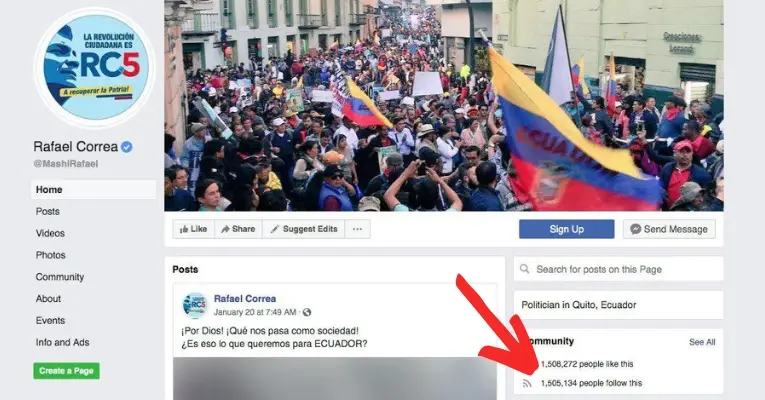
Facebook has unpublished the page of Ecuador’s former president, Rafael Correa, the social media giant confirmed on Thursday, claiming that the popular leftist leader violated the company’s security policies.
In a statement republished by Ecuadorean newspaper El Comercio, a company spokesperson said:
“Protecting the privacy and security of people is central to Facebook [and] we have clear policies that do not allow the disclosure of personal information such as phone numbers, addresses, bank account data, cards, or any record or data that could compromise the integrity physical or financial of the people in our community.”
The move comes on the same day that Ecuador’s government allowed British security personnel to enter their embassy in London to arrest journalist and WikiLeaks founder Julian Assange, who has been sought by U.S. officials for years due to his role in releasing scandalous information implicating Washington in a range of crimes, including war crimes.
US Government’s Refusal to Confirm or Deny It Put American Journalist on Drone Kill List Called ‘Chilling’
“The government seeks to shield itself from all inquiry into the process by which it acts as prosecutor, judge, jury, and executioner.”
By Julia Conley |Common Dreams | April 2, 2019
Lawyers for an American journalist who believes he was placed on the government’s infamous “kill list” warned Tuesday that the rights of all U.S. citizens are at stake if the country’s drone assassination program is allowed to continue.
The organization’s comments came as part of a response to the U.S. government’s attempt to dismiss a lawsuit regarding its use of the list. Reprieve is representing Bilal Abdul Kareem, a journalist and U.S. citizen who claims he was repeatedly targeted —and nearly killed on five separate occasions—by drone and missile attacks in 2016 when he was reporting on the ongoing conflict in Syria.
Kareem joined an Al Jazeera journalist in 2017 in a lawsuit against the government, demanding that the Trump administration remove their names from the “kill list” of potential targets for the U.S. drone program.
If the government manages to have the lawsuit dismissed, legal experts warn it would allow the Trump administration and future presidents to secretly place any American on a kill list without telling them why, therefore stripping them of their constitutional right to due process.
“The right to due process has been a bedrock of the judicial system, and one of the pillars that support a free society going back eight centuries to the Magna Carta,” wrote Tom Emswiler and Will Isenberg in the Boston Globe last summer. “It is the birthright of every American. Gaining a tactical advantage is not worth losing that heritage.”
As Common Dreams reported at the time of the filing, Kareem believes the Obama administration placed him on the kill list and wants President Donald Trump to remove his name, asserting that his inclusion “is the result of arbitrary and capricious agency action, accomplished without due process, and in violation of the United States Constitution and U.S. and international law.”
The government responded that if those included on the U.S. kill list were to be informed and given a trial, national security could be jeopardized during the court case.
Such a claim suggests that the right of the U.S. to operate its drone program trumps Kareem’s—and all Americans’—Fifth and 14th Amendment rights, Reprieve said.
“By invoking the state secrets privilege in the context of designating a U.S. citizen for lethal action, the government seeks to shield itself from all inquiry into the process by which it acts as prosecutor, judge, jury, and executioner of plaintiff Bilal Abdul Kareem,” said Reprieve and the law firm Lewis Baach Kaufmann Middlemiss, which is also representing Kareem, in a statement Tuesday.
The government, in its motion to dismiss, said that Kareem’s due process rights would be satisfied simply by allowing him to present evidence that he has been wrongly placed on the kill list, and that the government was under no obligation to repond.
Reprieve rejected that argument, saying it was akin to “limiting the accused to unilaterally contending that he is innocent of unknown charges in the hopes of persuading a silent, opaque coterie of government officials not to kill him.”
“The government’s assertion that it has the right to mark its own citizens for death, based on secret information, without affording them the legal protections offered by the Constitution, is chilling,” said Jennifer Gibson, co-counsel for Kareem.
“The consequences of this action are too severe,” Reprieve added, “and the right [to due process] too foundational to a constitutional democracy, to allow the government to secretly condemn an American citizen to death.”
There’s Something Rotten in Virginia: Israel Is a Malignant Force in Local Politics
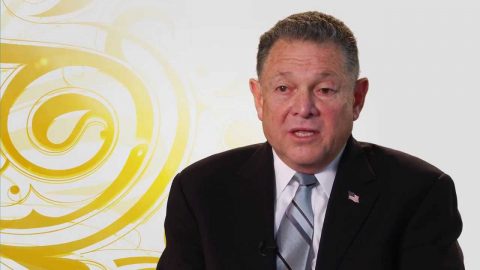
Mel Chaskin, Chairman of Virginia Israel Advisory Board. Credit: YouTube
By Philip Giraldi | American Herald Tribune | April 7, 2019
One of the more interesting aspects of the relentless march of the Israel Lobby in the United States is the extent to which it has expanded its reach down into the state and even local level. Previously, the American Israel Public Affairs Committee (AIPAC) and the hundreds of other Jewish and Christian Zionist organization dedicated to promoting Israeli interests had concentrated on the federal government level and the media, believing correctly that those were the key players in benefiting Israel while also making sure that its public image was highly favorable. The media was the easy part as American Jews were already well placed in the industry and inclined to be helpful. It also turned out that many Congressmen and the political parties themselves had their hands out and were just waiting to be bought, so “Mission Accomplished” turned out to be a lot easier than had been anticipated.
But amidst all the success, the Israeli government and its diaspora supporters discovered that it was receiving a lot of unwelcome publicity from an essentially grassroots movement that went by the label “Boycott, Divest and Sanctions” or BDS. BDS was strong on American campuses and its appeal as a non-violent tool meant that it was growing, to include many young Jews disenchanted with the Prime Minister Benjamin Netanyahu version of the Jewish state.
Israel works hard to influence the United States at all levels and is generally very successful, but it seemed a stretch to try to pass legislation banning a non-violent movement at a national level so it focused on the states, where legislators would presumably be less concerned over the Bill of Rights. It mobilized its diaspora resources to focus on elections at local and state government levels where Jewish constituents were active in interviewing candidates regarding their views on the Middle East. Candidates understood very well what was happening and also appreciated that their answers could determine what level of donations and the kind of press coverage they might receive in return.
Put together enough intimidated legislators in that fashion and you eventually will have a majority willing to pass legislation blocking or even criminalizing the BDS movement while also granting special benefits to Israel. As of this writing, there is anti-BDS legislation in 27 states, some of which denies state services or jobs to anyone who does not sign an agreement to not boycott Israel. Particularly draconian bills currently advancing in Florida equate any criticism of Israel with anti-Semitism, explicitly define Israel as a Jewish state and also enable anyone who says otherwise to be sued.
Another blatant propaganda program that is being used with congressmen, as well as state and local officials plus spouses, is the sponsorship of free “educational” trips to Israel. The trips are carefully coordinated with the Israeli government and many of them are both organized and paid for by an affiliate of the American Israel Public Affairs Committee called the American Israel Education Foundation (AIEF). There are also other trips sponsored by AIEF as well as by regional Jewish organizations that particularly focus on politicians at state and even local levels as well as journalists who write about foreign policy.
 Everyone is expected to return from the carefully choreographed trips singing the praises of the wonderful little democracy in the Middle East, and many of the travelers do exactly that. The pro-Israel sentiment is buttressed by the activity of the state and local diaspora Jewish groups, which tend to be very politically active and generous with their political contributions.
This coziness often borders on corruption and inevitably leads to abuses that do not serve the public interest, particularly as American citizens are quite openly promoting the interests of a foreign nation. An interesting example of how this works and the abuse that it can produce has recently surfaced in Virginia, where a so-called Virginia-Israel Advisory Board (VIAB) has actually been funded by the Commonwealth of Virginia taxpayers to promote and even subsidize Israeli business in the state, business that currently runs an estimated $500 million per annum in favor of Israel.
Grant Smith’s Institute for Research: Middle Eastern Policy (IRMEP) has done considerable digging into digging into the affairs of VIAB, which was ostensibly “created to foster closer economic integration between the United States and Israel while supporting the Israeli government’s policy agenda” with a charter defining its role as “advis[ing] the Governor on ways to improve economic and cultural links between the Commonwealth and the State of Israel, with a focus on the areas of commerce and trade, art and education, and general government.” Smith has observed that “VIAB is a pilot for how Israel can quietly obtain taxpayer funding and official status for networked entities that advance Israel from within key state governments.”
Documents released under Virginia’s Freedom of Information Act indicate that not only does VIAB not create opportunities for Virginians, it also is active in working against the BDS movement. According to the documents, VIAB, which avoids any public disclosure of its activities, is currently also being scrutinized by the state Attorney General over its handling of government funds.
VIAB was founded in 2001 but it grew significantly under governor Terry McAuliffe’s administration (2014-2018). McAuliffe, regarded by many as the Clintons’ “bag man,” received what were regarded as generous out-of-state campaign contributors from actively pro-Israeli billionaires Haim Saban and J.B. Pritzker, who were both affiliated with the Democratic Party. McAuliffe met regularly in off-the-record “no press allowed” sessions with Israel advocacy groups and spoke about “the Virginia Advisory Board and its successes.”
The Virginia Coalition for Human Rights (VCHR) reports that VIAB is “the only Israel business promotion entity in the United States embedded within a state government and funded entirely by the state’s taxpayers. In terms of the overall state budget, VIAB’s direct share is small ($209,068 for fiscal years 2017 and 2018). However, VIAB’s diversion of state, federal and private grants, as well as demands on state-funded entities like colleges and universities to collaborate in projects designed primarily to benefit Israel, run in the millions of dollars per year. VIAB’s main objective is to provide preferential and unconditional funding to oftentimes secretive Israeli business projects designed to entwine Israeli industries into Virginia industries and government. VIAB seeks to transcend warranted, growing and legitimate American grassroots concerns about human rights in Israel-Palestine by pressuring state lawmakers and the local business community into providing unconditional support and developing a long-term ‘stake’ in Israel.”
Per VCHR, documents released under the Freedom of Information Act found that VIAB, among other suspect practices, had “Provided reports of success that the office of the Governor found to be “inflated without merit.” VCHR concluded that “there should be no preferential and unconditional Commonwealth of Virginia support for Israeli business projects for four key concerns: moral, economic, good governance and state public opinion.” Moral was due to Israel’s “dismal human rights record,” economic because Virginia has a half-billion dollar trade deficit with Israel, good governance because VIAB’s board and leadership are drawn from the “Israel advocacy ecosystem,” and public opinion because opinion polls suggest that over one third of Virginians favor halting all funding for “Israeli business ventures.”
On a similar issue a shadowy group called the Institute for Curriculum Services (ICS), which is actually a “partisan group with backing by state and local Israel advocacy organizations,” is seeking to change the information conveyed by the history and social studies textbooks used in K-12 classrooms across Virginia. ICS recommended changes include: “1. Emphasizing Arab culpability for crisis initiation leading to military action and failure of peace efforts—and never Israeli culpability, even when it is undisputed historic fact. 2. Replacing the commonly used words of “settlers” with “communities,” “occupation” with “control of,” “wall” with “security fence,” and “militant” with “terrorist.” 3. Referencing Israeli claims such as “Israel annexed East Jerusalem” and the Golan Heights as accepted facts without referencing lack of official recognition by the United Nations and most member nation states.”
The activity of the VIAB is little more than robbery of Virginia state resources being run by mostly local American Jews to benefit their co-religionists in Israel. What is significant is that the theft from the American taxpayer, having long occurred at the federal treasury level, now extends down to state and local jurisdictions. And the ICS is yet one more example of attempted Israeli brainwashing of the American public on behalf of the Jewish state to completely alter the narrative about what is going on in the Middle East. Will it ever end? Perhaps, but only when the American people finally wake up to what is being done to them and by whom.
Deadly Dust: US Spreading Radiation and No One Wants to Raise the Issue – Author
Sputnik – April 3, 2019
In a new book named “Deadly Dust – Made in the USA: Uranium Weapons Contaminating the World” German author Frieder Wagner gives a detailed account of how the US has contaminated vast territories using depleted uranium (DU) ammunition and the cover-up strategy of the military, industry and governments, as well as those in the media and politics.
Sputnik: Mr Wagner, in your book “Deadly Dust — Made in the USA: Uranium Weapons Contaminating the World” you talk about the use of uranium ammunition. What is especially dangerous about these weapons?
Frieder Wagner: Weapons containing uranium are produced from nuclear industry’s waste (byproducts of uranium enrichment). If, for example, you want to produce a ton of natural uranium fuel rods for nuclear power plants, you get about eight tons of depleted uranium. It is a source of alpha radiation — radioactive and, moreover, very poisonous. It needs to be stored somewhere, and it is not very cheap.
Sputnik: How can it be used in weapons?
Frieder Wagner: About 30-40 years ago, military scientists made a discovery: uranium is almost twice as dense as lead. If you turn depleted uranium into a projectile and give it proper acceleration, then within a fraction of a second it will pierce through tank armor, concrete or cement.This, of course, was an important discovery. Furthermore, when a shell hits an armored tank the impact produces dust caused by the detonation and the subsequent release of heat energy causes it to ignite and it explodes at a temperature of 3000 to 5000 degrees — incinerating the tank’s interior and destroying it.
Sputnik: But what happens afterwards is also a problem — after the use of DU ammunition, isn’t it?
Frieder Wagner: Yes! After its use depleted uranium, which, as I have already said, is a source of alpha radiation (that is, a radioactive and very toxic substance), burns down to nano-particles that are a hundred times smaller than a red blood cell.
This way, I would say, a sort of metallic gas forms that people can inhale, and which is released in the atmosphere and can be carried anywhere by wind. People who inhale it are at risk for developing cancer.These nano-particles can also penetrate the body of a pregnant woman, overcoming the barrier between a child and a mother, and affect the health of an unborn baby, can infiltrate the brain and by travelling through the bloodstream end up in any human or animal organ. Everything that goes around the planet, sooner or later settles and, of course, contaminates, in particular, drinking water and everything else.
Sputnik: In what wars have DU weapons been used so far?
Frieder Wagner: It was actively used during the first Gulf war in 1991 against Iraq. The military has admitted that about 320 tons were used. Then in the second war in Iraq in 2003 over 2,000 tons were used. In between, it was used during the war in Kosovo, in Yugoslavia (1999), and in Bosnia in 1995, and after 2001 in Afghanistan, where it still used today.
Sputnik: Your book title says Made in the USA, were these weapons only used by the United States?
Frieder Wagner: They were being developed in several countries at the same time. In Germany, they were also working on these weapons, as, of course, in Russia. However, it was used and on such a large scale, only by the US. They were reckless and they did not pay attention to any possible side effects — just as it was back when the first atomic bombs were used. That’s why I called the book: “Deadly Dust — Made in the USA”.
Sputnik: How did you manage to prove the use of this ammunition in the course of your research?
Frieder Wagner: For example, the Serbs gave us maps where they showed the locations where depleted uranium was used. When we were in Iraq, we talked to the locals. We traveled to places where large tank battles took place and took soil samples there, as well as dust samples from tanks. Looking at the tank, you can see whether it was hit by an ordinary projectile or a uranium munition.
Uranium munition leaves dust that burns everything around the hole made by the projectile. So you can determine the use of uranium ammunition. In all soil samples, we found depleted uranium. Unfortunately, uranium-236 was also found in most of the soil and dust samples — it is even more intense and poisonous. Its radiation is even stronger and does not occur in nature. It can only be produced artificially during reprocessing of fuel rods. This means that we were able to prove that the military, the United States and its coalition allies used uranium munitions made from spent uranium fuel rods.
Sputnik: Your book is based on the films The Doctor, the Depleted Uranium, and the Dying Children of Basra (Der Arzt und die verstrahlten Kinder von Basra, 2004) and Deadly Dust (Todesstaub, 2007). What did you see in Basra during your work on the documentary?
Frieder Wagner: It was horrific and still sometimes haunts me in my dreams. These were children with deformities, which we saw in orphanages in Basra and Baghdad. Some of them had such deformities that they had almost nothing human anymore.
There were children without a head or a nose, either with one eye or without eyes at all, with internal organs in a kind of “sack” outside their body. These ‘creatures’ can live only for a few hours, experiencing terrible pain, and then die.
Sputnik: The film “Deadly Dust” is linked to the book, but it is no longer distributed. WDR channel after this film did not make any more orders? Why is that?
Frieder Wagner: My exposes which I sent to WDR, as well as to the ZDF channels were rejected. Then I contacted an editor at WDR, for which I always made good films and with which I always had good relations with, because these films had doubled or trippled their ratings, and asked him: “What’s going on here?”” And after some hesitation he said: “Yes, Frieder Wagner, someone must tell you this. WDR considers you a ‘difficult’ person. And most importantly, the topics you suggest are especially hard. Right now I’ve got nothing more to tell you.” And that’s when I understood everything. It was in 2005.
I can also tell you the story of how, for example, a female editor at ZDF offered the TV channel a story on the use of these weapons during the war in Yugoslavia and also in Croatia. She wanted to talk about it with me prior so I could share my experiences. But when her boss found out that she wanted to talk to Frieder Wagner, he refused to pay for her trip — without any further explanation.
Sputnik: The so-called “deadly dust” is, as you have already described it, is spread by the wind. So should the use of uranium ammunition, in fact, be considered a war crime and banned?
Frieder Wagner: This is definitely a war crime. The dust from southern Iraq is carried to the north by the constant storms, the so-called desert storms — for example, to Erbil, where it meets the mountains and can’t travel further as the mountains make it difficult for it to go past towards Turkey. So this huge mass of dust settles in Erbil.We, for example, took samples of beef from around Erbil, and this is what we found out: depleted uranium used in ammunition has a characteristic atomic “fingerprint”. In northern Iraq we found the same “uranium fingerprint” as in the south. This means that the uranium dust that had originally settled in the south of Iraq is now also in the north, and children are now getting sick there and are born with deformities. It is now spreading all over the world.
Sputnik: Have the victims of uranium munition use in Kosovo or, for example, in Iraq, tried to go to court?
Frieder Wagner: So far no such attempts have been made in Kosovo or Iraq. Now in Kosovo, a whole group of lawyers are working on a lawsuit against NATO, because after the war they unleashed, people were injured, fell ill and died. The morbidity rate has increased by 20 to 30 percent, and there are more effected each year. So there will be an attempt to file a lawsuit.
Out of the approximately two thousand Italian soldiers stationed in Iraq and Kosovo, 109 have later developed cancer and died — this is proven information. 16 families, out of the 109 dead, filed lawsuits and won their cases. The courts ordered the Italian state or the country’s Ministry of Defence to pay them compensation. Since each cancer was of a different type, the payout amounts differed. But they ranged between 200,000 and 1,4 million euros.
Sputnik: How are things in Germany? Have there been lawsuits filed by the soldiers of the Bundeswehr?
Frieder Wagner: The German Ministry of Defense constantly denies any connection to this. Our soldiers are stationed in Afghanistan and Kosovo. About 100,000 soldiers served in Afghanistan, and we found out that about 30% of those who returned got sick, although at first, of course, they do not notice this. If they subsequently marry and have children, then there’s a great risk that their children will have disabilities.These children will have the same toxic substances in their DNA as their parents. And this will be passed on for several generations — from children to grandchildren and to great-grandchildren.
Sputnik: But none of these people ever filed a lawsuit?
Frieder Wagner: In Germany there were no such precedents. About 600 servicemen went to court in the United States who could not appeal on their own behalf, but they filed lawsuits on behalf of their children who were born with developmental disabilities. And we’re not talking about a mere 90 or even 900 million pay out, but about billions of dollars now. The United States, of course, will try to delay the adoption of a ruling as much as it is possible and hope for a “biological” resolution of the situation — that is, that the plaintiffs will simply die.
US spies helped UAE hack phones of Al Jazeera chairman, BBC host & other journalists – report
RT | April 2, 2019
Former US intelligence hackers helped the United Arab Emirates spy on Al Jazeera’s chairman, a BBC host, and other media figures as part of a secret Emirati intelligence program called Project Raven during the blockade on Qatar.
At least 9 former National Security Agency (NSA) and US military operatives worked within Project Raven, which was exposed in January after spying on US journalists and a British activist, along with dissidents and opponents of the UAE royal family.
The targeting of Arab media figures began during the 2017 diplomatic dispute with Qatar, which saw the UAE, Saudi Arabia, Bahrain, Egypt and others turn against the small Gulf nation after accusing it of supporting terrorism. The countries imposed an air, sea and land blockade on Qatar and demanded it shut down Al Jazeera, which is funded by the Qatari government.
It was then that Project Raven hacked into the iPhones of at least 10 journalists and media executives to see if they had ties to the Qatar government or the Muslim Brotherhood in order to uncover something that would show Qatar royal family influence over Al Jazeera and other media outlets, a Reuters investigation has revealed.
They used a program called Karma, which gives access to a target’s phone by simply inputting their email and phone number. There is no need for the target to click a link or download anything to gain access. They then passed the data gathered on to UAE intelligence.
Among those targeted were BBC Arabic host Giselle Khoury, Al Jazeera host Faisal al-Qassem, and Al Jazeera chairman Hamad bin Thamer bin Mohammed Al Thani.
Abdullah Al-Athba, editor of Qatar newspaper Al-Arab, Al Araby TV director Abdulrahman Elshayyal and Al-Araby Al-Jadeed founder Amzi Bishara were also targeted, along with journalists from London-based Al-Araby TV and Al-Hiwa media outlets.
The revelation that former US government employees are working with a Gulf monarchy to spy on the media raises questions about US oversight over its former employees, who are sharing the hacking capabilities they learned while working for the US government to assist a foreign government to spy on media and dissidents.
Project Raven was set up in 2009 with the assistance of former George W Bush White House officials and US intelligence contractors, it was originally meant to track terrorism but soon evolved into spying on opponents.
Featured Video
Dan Dicks with James Corbett on Solutions Watch
or go to
Aletho News Archives – Video-Images
From the Archives
MMR (Measles, Mumps and Rubella) – Vaccine Risk Statement
MMR Vaccine (Measles, Mumps, and Rubella) Is It Safer Than Measles, Mumps and Rubella?
Physicians for Informed Consent | December 2024
… It has not been proven that the MMR vaccine is safer than measles, mumps, and rubella. The vaccine package insert raises questions about safety testing for cancer, genetic mutations, and impaired fertility. Although VAERS tracks some adverse events, it is too inaccurate to measure against the risk of measles, mumps, and rubella. Clinical trials do not have the ability to detect less common adverse reactions, and epidemiological studies are limited by the effects of chance and possible confounders. Safety studies of the MMR vaccine are particularly lacking in statistical power. A review of more than 60 MMR vaccine studies conducted for the Cochrane Library states, “The design and reporting of safety outcomes in MMR vaccine studies, both pre- and post-marketing, are largely inadequate.”19 Because permanent sequelae (aftereffects) from measles, mumps, and rubella are so rare (especially in children with normal levels of vitamin A and infected after birth),6,15-17 the level of accuracy of the research studies available is insufficient to rule out the possibility that the MMR vaccine causes greater death or permanent disability than measles, mumps, and rubella. – Read full article
Blog Roll
 Aletho News
- Moscow issues warning to NATO over Russian exclave
- Yes, the Iran war has destroyed Trump’s presidency
- The fallacy of US delusions about Iran’s economic collapse
- Hezbollah denies Syria cell link, warns of Israeli plan to sow discord
- The legacy of US sanctions, war, and occupation in Iraq
- Iraqi resistance group rejects disarmament, vows to maintain support for Lebanon
- Sheikh al-Asadi warns of Iraqi government compliance with US demands
- How to MAKE THE CONSPIRATORS PAY for their crimes! Dan Dicks with James Corbett on Solutions Watch
- There’s a drought in academia: A drought in honest research on the subject of drought and other weather extremes
- Department of War Awards $20.7 Billion Contract to Raytheon for Air-to-Air Missiles
- If Americans Knew
- As settlers ravage West Bank, Israeli forces kill 10 in Gaza – Daily Update
- New Report: “Scholasticide and Genocide in Gaza: Assessment, Testimonies and Legal Analysis”
- Ex-Biden officials are desperate for a Gaza scapegoat
- Israeli “settlers” Invade Al-Aqsa; Pour Boiling Water on 75-Year-Old
- Israel Has Kidnapped Another American Teenager
- US arms sales to Israel worth $21.6 billion in 20 months
- Three Palestinians Killed in Israeli Attacks on Gaza
- Revealed: German “Anti-Semitism Expert” Driving Crackdown on Palestine Solidarity is Former Israeli Spy
- Egypt’s Warning to Israel Before Oct 7
- Israel’s siege signals another cruel winter for 1.8 million Gazans – Daily Update
- No Tricks Zone
- Green Energy Debacle: German Expert Professor Fritz Vahrenholt Warns Of Severe Economic And Social Consequences
- Two More Paleo Reconstructions Affirm Meters-Higher Sea Levels Across Ireland, Brazil 7000-6000 Years Ago
- New Study: Earth And Venus Surface Warmth Largely Explained By Convection And Lapse Rate, Not CO2 Or Radiation
- 2025 Nature Paper Claiming Worsening Global Drought Gets RETRACTED …Heavily Flawed
- New Study: ‘Global Drought Shows No Detectable Recent Acceleration Under Climate Warming’
- Economic Masterminds: German Socialists Suggest Taxing Productivity Gains Stemming From Using AI
- The South China Sea Has Not Been Cooperating With The Climate Change Narrative
- Energy Crisis: Germany Enters Heating Season With Historically Low Gas Reserve Fill Levels
- New Study: The Antarctic Ice Sheet Gained Mass From 2020-2024 Due To Staggering Snow And Ice Accumulation
- Study: Ocean Heating Rates From Thousands Of Years Ago ‘Dwarf’ Modern Ocean Heating Rates

