Telegram’s Durov names French official he accused of censorship request
RT | May 19, 2025
Telegram founder Pavel Durov has claimed that French foreign intelligence chief Nicolas Lerner personally asked him to censor conservatives on his platform ahead of the contentious rerun of Romania’s presidential elections. The Russian-born entrepreneur said he refused the request.
The accusations of foreign meddling first surfaced last year after Romania’s top court annulled the November election results, in which independent right-wing candidate Calin Georgescu came first with 23%. Authorities cited “irregularities” in his campaign, along with intelligence reports alleging Russian interference – claims Moscow has denied. Georgescu was later barred from running again.
On Sunday, pro-EU centrist Nicusor Dan was elected president of Romania. His conservative, Eurosceptic opponent George Simion accused France and Moldova of attempting to sabotage his campaign.
In a post on X on Sunday evening, Durov said he met with Lerner, head of France’s Directorate-General for External Security (DGSE), in Paris. The agency, operating under the Ministry of the Armed Forces, is tasked with gathering intelligence and combating terrorist threats.
“This spring at the Salon des Batailles in the Hotel de Crillon, Nicolas Lerner, head of French intelligence, asked me to ban conservative voices in Romania ahead of elections. I refused,” Durov wrote. “We didn’t block protesters in Russia, Belarus, or Iran. We won’t start doing it in Europe,” he added.
Durov had previously hinted that France asked him to “silence” Romanian conservatives. The French Foreign Ministry rejected the allegations of election meddling as “completely unfounded.”
“France categorically rejects these allegations and calls on everyone to exercise responsibility and respect for Romanian democracy,” the ministry stated, labeling the accusations “a diversionary maneuver” aimed at distracting the public from “the real threats of interference targeting Romania.”
Last year, French authorities charged Durov with facilitating the distribution of child sexual exploitation material and drug trafficking due to alleged moderation failures on Telegram. He was arrested at Paris-Le Bourget Airport in August before being released on €5 million ($5.46 million) bail. Durov, who has denied any wrongdoing, was eventually allowed to leave France in March.
Five more Palestinian journalists killed in Israeli strikes in Gaza; death toll rises to 222

Deceased Palestinian photojournalist Aziz al-Hajjar
Press TV | May 18, 2025
Five more Palestinian journalists have been killed in separate Israeli strikes in the Gaza Strip, bringing the death toll to 222 since the start of the Israeli genocidal war against the besieged coastal territory in early October of 2023, according to local authorities.
Photojournalist Aziz al-Hajjar, his wife, and their children were killed on Sunday when Israeli warplanes bombed a house in the Saftawi neighborhood in the northern Gaza Strip.
The family of Abdul Rahman Tawfiq al-Abadleh also confirmed that the Palestinian journalist was killed in an Israeli bombardment in the town of al-Qarara, located north of Khan Yunis. They said they had lost contact with Abadleh two days earlier.
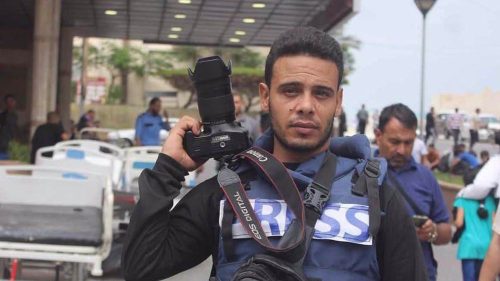
Deceased Palestinian journalist Abdul Rahman Tawfiq al-Abadleh
Gaza’s government media office also said Palestinian journalists Nour Qandil and Khaled Abu Seif lost their lives alongside their young daughter in the Israeli strike that targeted their home in Deir el-Balah in the central Gaza Strip.

Deceased Palestinian journalist Nour Qandil and her husband Khaled Abu Seif
Furthermore, Palestinian journalist Ahmad al-Zinati was killed alongside his wife, Nour al-Madhoun, and their children, Muhammad and Khaled, on Saturday night when their tent was bombed in Khan Yunis.

Deceased Palestinian journalist Ahmad al-Zinati alongside his family
The deaths came only two days after Ahmed al-Halou, a reporter for the local al-Quds News Network, was killed in an Israeli attack in the Gaza Strip.
The Israeli military resumed bombardment of Gaza on March 18, killing thousands of Palestinians, and injuring many others, after it shattered the 2-month ceasefire agreement with the Palestinian group Hamas and the deal on the exchange of Israeli captives with Palestinian abductees.
At least 53,272 Palestinians have been killed, mostly women and children, and another 120,673 individuals injured in the brutal Israeli military onslaught on Gaza since October 7, 2023.
The International Criminal Court issued arrest warrants last November for Netanyahu and former Israeli minister of military affairs Yoav Gallant, citing war crimes and crimes against humanity in Gaza.
Israel also faces a genocide case at the International Court of Justice for its war on the besieged coastal territory.
Western European Country Asks Telegram to ‘Silence’ Conservatives in Romania
Sputnik – 18.05.2025
A Western European country [Durov did not actually name the country responsible for the request directly but posted an emoji of a baguette, a thinly veiled reference to France] has asked Telegram to “silence” conservatives in Romania ahead of the presidential election run-off, Telegram founder Pavel Durov said on Sunday.
“A Western European government approached Telegram, asking us to silence conservative voices in Romania ahead of today’s presidential elections. I flatly refused,” Durov wrote on his Telegram channel.
He added that Telegram would not limit the freedom of Romanian users or block their political channels.
“You cannot ‘defend democracy’ by destroying democracy. You cannot ‘fight election interference’ by interfering with elections. You either have freedom of speech and fair elections — or you do not. And the Romanian people deserve both,” Durov said.
The presidential election run-off is taking place in Romania on Sunday. The leader of the opposition hard-right Alliance for the Union of Romanians, George Simion, who won the first round with 41% of the vote, is facing Bucharest Mayor Nicusor Dan, an independent candidate who came in second with 21%.
US House Judiciary Committee Warns EU and Poland’s Tusk Government Over Censorship Threat to US Free Speech
By Dan Frieth | Reclaim The Net | May 15, 2025
The US House Judiciary Committee is sounding the alarm over an escalating threat to free expression, warning that censorship efforts by Poland’s current government, coupled with the European Union’s regulatory framework, could extend their reach into American speech online.
In a letter addressed to EU Commissioner for Justice and Rule of Law Michael McGrath, Committee Chairman Jim Jordan and four congressional colleagues requested a briefing on how the EU plans to respond to what they described as disturbing developments under Prime Minister Donald Tusk.
We obtained a copy of the letter for you here.
Since coming to power in December 2023, Tusk’s government has launched legal actions against members of the conservative Law and Justice (PiS) party.
These efforts include removing the legal immunity of PiS leader Jarosław Kaczyński, pressing forward with criminal charges that appear politically motivated, and subjecting detainees to harsh treatment.
One former aide denied access to her attorney during questioning, reportedly suffered a fatal heart attack shortly after. Another case involved the arrest and alleged mistreatment of Father Michał Olszewski, a Catholic priest tied to the former justice minister.
The Judiciary Committee points to these incidents as evidence of a political strategy designed to suppress opposition speech ahead of Poland’s 2025 presidential election.
According to the letter, the pattern includes targeting conservative activists and media outlets. A key example is the Polish government’s threat to revoke the license of Telewizja Republika, a station known for criticizing the Tusk administration.
Lawmakers expressed concern that these actions are taking place without pushback from EU institutions. They argue that the European Commission, which was quick to condemn the previous PiS-led government for its alleged violations of democratic norms, has so far failed to hold Tusk’s coalition to the same standard. The result, the committee says, is a perceived double standard that undermines the EU’s credibility and emboldens further censorship.
Of particular concern is the potential for EU censorship laws to ripple beyond Europe. The Digital Services Act, which requires platforms to remove “misleading or deceptive content,” may end up influencing global content moderation practices. Because platforms typically apply one uniform set of rules, the DSA could effectively establish a worldwide censorship template. The committee warned that this might restrict Americans’ speech online as companies adjust to foreign legal requirements.
Supporting this concern, the committee cited documentation showing that Poland’s Ministry of Digital Affairs, through the National Research Institute, requested the removal of TikTok videos that criticized electric vehicles. The content in question was not overtly political, but the request demonstrates, in the committee’s view, a willingness to use regulatory power to suppress opinions the government dislikes.
This pattern of behavior, if left unchecked, could allow foreign governments to influence global information flows. The letter emphasized that such interference is unacceptable, particularly when it has the potential to impact the speech of American citizens. The concern is not merely theoretical; as the letter points out, the Tusk government accused foreign actors of electoral interference through online ads just one day after the Committee’s communication to the EU.
The letter was signed by Chairman Jim Jordan, Subcommittee Chairman Darrell Issa, and Representatives Chris Smith, Warren Davidson, and Andy Harris. Their message to Brussels is direct: silence in the face of repression is not neutrality. If left unchallenged, the EU’s regulatory apparatus and inaction on political censorship risk becoming tools for silencing voices far beyond Europe’s borders.
Germany: Police block activists from leaving country to attend Remigration Summit in Italy in major crackdown
Remix News | May 16, 2025
German activists leaving the airport for the Remigration Summit taking place in Milan on Saturday were stopped and detained at the airport, interrogated for hours, and issued with an exit ban from leaving the country.
The summit will be attended by well-known activists from across Europe, such as the Austrian author Martin Sellner, Dutch commentator Eva Vlaardingerbroek, and Belgian activist Dries Van Langenhove.
The latter currently faces a potential prison sentence for memes that were posted in a group chat seven years ago. However, not only are German police now cracking down on activists, even leaving the country for the event, but Italian police are also showing up at the hotels of activists attending the event.
Sellner has been putting out a video and posting updates on X on the various actions taken against activists involved in the summit.
“I know them, they are great guys, Generation Identity activists, who have been detained for hours by the German police. They were arrested at the airport in Munich. Two of them were arrested on the plane, where they tried to enter a plane to Milan, Italy, to attend a conference about remigration. And the German state now bans them from exiting Germany for several days until the conference is over. Bans them from exiting. They banned me from entering, and then they threw me out of several cities and basically crushed my readings, and now they’re banning their own citizens, EU citizens from exiting.”
Sellner says that the German government’s reasoning is “crazy,” arguing that allowing the activists to leave “would be detrimental to the German state, the reputation of the German state, if they would go outside and take part in those events, because this would look like the German state endorses those events.”
Sellner argues that the German state is headed into dark territory, mimicking the GDR, communist East Germany, with this exit ban.
“No, you are our property, and it’s our property, our citizens. If you go there, it’s bad for our reputation. That’s why we lock you in like nasty little children. The German state is going full GDR. That’s exactly what the GDR did with the Berlin Wall. They didn’t let their own citizens leave the country, and that’s the case right now. It would be now punishable by law if they try to exit to Italy, Austria, and Switzerland. They’re banned from going to Switzerland, Austria, and Italy for a certain amount of days. The German state can extend this at will.
Of course, they will take immediate legal measures. They have very good lawyers. You need good lawyers in Germany. If you’re an activist, if you’re posting memes on X, you need an excellent lawyer by now. But it’s really crazy. These laws exist, but they might be lying dormant for a while and now the German state is shutting down, switching off the democracy simulation, and moving up and activating the totalitarian mode, the GDR mode.
As for the German activists, six men and two women who were stopped at the airport, Sellner stated they were released after hours of interrogation. They must now report to the police station twice a day.
“Eight young Germans are now banned from LEAVING Germany. If they try it, they commit a crime. They have to check in daily at their local police station. If not, they have to pay an extra fine. The democracy simulation is shutting down,” wrote Sellner.
The explanation they were given for the exit ban was also delivered to them in written form. It reads:
“In the event of an exit from German right-wing extremists, there is a considerable risk of damage to the reputation of the Federal Republic of Germany due to the stays of German right-wing extremists who promote the transnational networking of the right-wing extremist scene, actively promote the inhuman ideology and give it more scope, thus harbors the risk of radicalization of other people and their trips for the development of financial resources and the like.”
Freilich also writes that “it is also due to the history of Germany that the arrival of the activist concerned gives the international impression that the Federal Republic of Germany supports the right-wing extremist ideas openly spread at the event or at least does not adequately address them.”
Essentially, the German state is attempting to make the argument that allowing the activists to attend the summit would be the equivalent of endorsing their beliefs and harming the reputation of Germany. If that is the standard, then apparently it could be argued that any activists Germany does not detain in the future for any conference is a sign that the German state officially endorses the contents of that conference? Such reasoning reaches into the realms of the absurd.
The exit ban on the activists not only applies to Italy, but also to countries like Switzerland and Austria, and will be in effect until May 17, just a minute before midnight.
The activists also shared photos of the last moments they had before they were detained at the airport.
Although Sellner says the Italian police are not involved in this travel ban, and it is the German police at fault, he recently also posted an update on X, noting that an activist staying in Milan was also visited by police and questioned at his hotel.
Sellner says that booking the Remigration Summit has been fraught with difficulties, as vendors and hotels have been continuously canceling on organizers, likely due to pressure from activists. Antifa groups are also active and may try to disrupt the conference, or even more importantly, physically attack those involved.
NYU withholds diploma of student who condemned Israel’s Gaza genocide

MEMO | May 16, 2025
In the latest example of escalating repression against Palestine solidarity activism on US campuses, New York University (NYU) has withheld the diploma of student speaker Logan Rozos after he used his commencement address to denounce Israel’s ongoing genocide in Gaza and the US’s complicity.
Rozos, graduating from NYU’s Gallatin School of Individualised Study, told his fellow students on Wednesday: “The only thing that is appropriate to say in this time and to a group this large is a recognition of the atrocities currently happening in Palestine.”
In his speech, Rozos condemned the genocide “supported politically and militarily by the United States, paid for by our tax dollars and livestreamed to our phones for the past 18 months.” He further stated: “I do not wish to speak only to my own politics today, but to speak for all people of conscience, and all people who feel the moral injury of this atrocity.”
Razos’s remarks were met with widespread applause from students. NYU swiftly responded by issuing a statement denouncing Rozos, accusing him of violating university rules and announcing it would withhold his diploma pending disciplinary action.
The university also removed Rozos’s student profile from its website, adding to concerns about institutional retaliation.
This incident comes amid a wider crackdown on free speech and pro-Palestinian activism at US universities. NYU, like many elite institutions, has adopted the highly controversial International Holocaust Remembrance Alliance (IHRA) definition of anti-Semitism, which conflates political opposition to Zionism and Israel’s colonial violence with anti-Jewish hatred. Critics, including human rights scholars and Jewish groups, warn that such measures are being weaponised to suppress Palestinian advocacy and silence dissenting voices.
Rozos’s speech, and NYU’s reaction, follows a pattern of repression at the university. Over the past year, NYU administrators have called police to disperse peaceful encampments and arrested dozens of students and faculty protesting Israel’s war on Gaza. The university has also updated its conduct guidelines to classify phrases such as “Zionist” as discriminatory, explicitly erasing the distinction between anti-Zionism and anti-Semitism.
In December 2024, NYU declared two tenured professors, Andrew Ross and Sonya Posmentier, “persona non grata” after they joined a sit-in demanding the university divest from companies profiting from Israel’s war crimes in Gaza. Months later, NYU cancelled a talk by Doctors Without Borders’ former president Dr Joanne Liu, deeming her slides on Gaza civilian casualties potentially “anti-Semitic.”
Human rights advocates and academic freedom organisations have condemned these actions, warning that universities like NYU are sacrificing core principles of free speech and academic independence under pressure from pro-Israel donors, political figures, and lobby groups.
Rozos’s speech, which framed Israel’s war on Gaza as a genocide livestreamed in real time, resonates with warnings from genocide scholars, legal experts and international bodies that Israel’s actions meet the legal definition of genocide. Despite this, Rozos now faces institutional reprisals for expressing what many human rights defenders see as an urgent moral truth.
Declassified files expose secret Western support for Israeli assassinations
MEMO | May 16, 2025
Newly declassified documents have revealed that Western intelligence services secretly collaborated with Israel’s Mossad in the 1970s, providing critical intelligence that enabled the assassination of Palestinian activists across Europe, without any parliamentary oversight or democratic scrutiny. The revelation has fuelled concerns that similar clandestine intelligence-sharing arrangements are likely facilitating Israel’s ongoing genocide in Gaza today.
According to a detailed exposé by the Guardian, a covert network known as “Kilowatt”—comprising at least 18 Western intelligence agencies including those of the UK, US, France, and West Germany, was established in 1971 to share sensitive intelligence on Palestinian groups. The information shared included personal details, safe house locations, and vehicle registrations of Palestinian individuals who were subsequently targeted by Mossad hit squads.
Dr Aviva Guttmann, the historian who uncovered the encrypted cables in Swiss archives, confirmed that the intelligence shared was granular and critical to Israel’s covert killings, many of which took place in Paris, Rome, Athens, and Nicosia. “At the very beginning, perhaps officials were unaware of the extrajudicial assassinations, but later, they certainly knew and continued sharing intelligence,” Guttmann told the Guardian.
This covert support, the paper reported, operated entirely beyond the purview of elected officials, and would likely have triggered public outrage had it been exposed at the time. Indeed, some of those assassinated were publicly disputed as innocent, such as Wael Zwaiter, a Palestinian intellectual gunned down in Rome in 1972, whom Israel accused of being linked to the Black September Organisation. Evidence supporting such claims was largely based on intelligence fed through the Kilowatt system.
The revelations, while historical, have sparked urgent comparisons to the present day, where Israel is prosecuting what rights experts and genocide scholars widely describe as an ongoing genocide in Gaza, once again behind a wall of secrecy and political impunity.
Dr Guttmann herself underlined the relevance of these disclosures, warning that the shadowy practices of intelligence-sharing without political oversight remain largely unchanged: “International relations of the secret state are completely off the radar of politicians, parliaments, or the public. Even today, there will be a lot of information being shared about which we know absolutely nothing,” she stressed to the Guardian.
Critics argue that such secrecy underpins the UK’s and other Western states’ complicity in Israel’s Gaza genocide, which since October 2023 has killed over 53,000 Palestinians, mostly women and children. Despite the International Court of Justice opening a genocide case against Israel, British intelligence cooperation with Israeli agencies continues in the dark, with no democratic accountability or transparency. The UK government has also refused to clarify the purpose of more than 500 Royal Air Force surveillance flights over Gaza, raising fears these may be contributing to targeted killing.
Why is the secret German spy report on the AfD party only filled with public statements?
Remix News | May 15, 2025
The German domestic spy service, the Office of the Protection of the Constitution (BfV), has released a 1,100-page report on the Alternative for Germany (AfD), which it used to label the party a “confirmed” right-wing extremist party. The report is huge and reads like it was written by Antifa, but that was to be expected. However, one interesting point is that it contains only public statements, including quotes made by AfD politicians and a lot of memes.
Why is that?
We already know that the BfV is secretly surveilling AfD members in certain German states, mostly in the east, where the party is “confirmed right-wing extremist” already. This designation allows for the BfV in those states to partake in extraordinary surveillance powers over AfD members, including reading their chats and emails. Presumably, they can also track their browsing history, and perhaps they are even listening in on their conversations at home.
What this means is that the BfV has plenty of statements, memes and content to use based on private statements, but it is purposefully choosing not to use them. After all, a certain number of those AfD members, in private moments, probably also express opinions, post memes, or share thoughts that the BfV would love to include in a secret report on the party, which many hope will eventually justify an outright ban.
Again, why is the BfV not using these private statements?
There are multiple reasons. For one, a big part of the apparatus of spy agencies is to obtain information, but not release it to the public. The public may not be able to stomach such personal and private information and the means that were used to obtain it. Since the Edward Snowden revelations, and even before then, we have become acutely aware that we have accepted devices into our lives and homes that can be used to spy on us on a scale never seen before in history. However, even now — even after all this information has been revealed — I believe nearly all of us still cannot quite grasp what this means — nor do we want to.
Yes, we know that AfD members are being spied on across Germany. Their emails are read, their phone calls are recorded. AI is being used to sort out keywords of interest to the security services. However, nobody really knows how this information is being processed and what it is being used for, or even who is reading it. The spies who control this information have extraordinary power. As a significant portion of them are now far left, at least in Germany, they believe they are acting as a bulwark against the rise of Nazism, and the ends justify the means when it comes to the AfD. There are other psychological motives at work, of course, as spy agencies are on the whole very good at keeping their secrets, not even necessarily because of internal controls, but because the spies are dedicated to their mission. There is, also, the sense of power that comes with being the watcher, and for many spies, this is a powerful intoxicant. They know, while you are in the dark.
In practice, these spies know which AfD members are having affairs, their personal struggles, their health issues, their financial situation, and even their personal browsing history. In other words, they know their targets better in many cases than even their close friends and family. The spies of the world, not just in Germany, are now in many ways gods and mind readers, seeing through the walls people build up around themselves and accessing their darkest fears and secrets — all due to rapid advances in technology and the rise of smartphones.
Earlier this month, commentator Eva Vlaardingerbroek, the famed Dutch activist reported that she was alerted that her phone was being breached with Pegasus-like spyware, mainly produced in Israel, which can unlock essentially every aspect of her personal life, including chats, location data, photos, contacts, and so on. With this software, they can even record her in real time, including personal conversations in her home, as well as turn on her camera to record her in her most personal moments.
This software, and software like it, has been used on thousands of people, including journalists, politicians, and activists, sometimes with deadly results. It is not just the right, but far-left activists have also been targeted, including human rights activists. It is also unclear how long Vlaardingerbroek may have been targeted in such a manner. Previous versions of Apple iOS may have not been able to detect this software on her phone. In short, much of her personal life may already be in a database somewhere waiting to be used by intelligence.
Vlaardingerbroek is not in the AfD or even German, but she has backed the party, and she and people like her are most certainly the target of intelligence operatives in countries across Europe.
The point is that this software and the means for surveilling people are very unsettling. In a privacy-minded country like Germany, revealing the scale of surveillance being used against the AfD may be a scandal within itself, and could taint the entire report, which at the end of the day, should be used to justify a ban of the AfD.
There may have been voices in the BfV who were calling to use secretly recorded data in the report as well, but the agency also knew this report would eventually be leaked and made public. The agency does not appear to want to divulge who they are surveilling, what information they have about them, and how they obtained this information.
Another important consideration is also to be taken into account. The BfV decided it did not need to include this secret information in the report because it is likely confident that it can get what it wants using public statements alone. It can still keep the scale of its surveillance secret and get the ban it desires — at least that is the gamble the agency is making.
Surveillance is everywhere, it is being practiced by the left, the right, and many foreign governments are also active in the West, collecting data on targets. So, this is not a uniquely German issue by any means. However, if the establishment in Germany becomes truly desperate, there is probably a secret report waiting that includes far more information and personal details than many Germans want to believe is possible.
US court hits Israeli spyware firm NSO with $167m fine over Pegasus abuses
MEMO | May 14, 2025
A federal jury in California has ordered Israeli surveillance firm NSO Group to pay Meta $167 million in punitive damages, marking the first time a court has imposed financial liability on a spyware vendor for abuses linked to its software.
The ruling sends a strong signal that private firms profiting from invasive surveillance technology will not be shielded by their association with government clients. After a single day of deliberation, jurors found that NSO had acted with “malice, oppression or fraud” in deploying its Pegasus spyware against 1,400 WhatsApp users.
Pegasus, which grants near-total access to a target’s device, including microphones, cameras and encrypted messages, was used not against criminals, but journalists, human rights defenders and political dissidents. Meta, which owns WhatsApp, described the hacking as “despicable” and a clear violation of privacy rights.
NSO has long claimed that its spyware is sold only to vetted state clients for national security purposes. However, investigations have shown Pegasus being deployed to facilitate transnational repression by authoritarian regimes.
The previous US administration blacklisted NSO over its role in such abuses, making it the first company added to the US entity list for enabling state surveillance. The jury’s decision is expected to add pressure on Washington to further regulate the commercial spyware sector.
While the financial penalty may prove difficult to collect, the judgement itself sets a precedent: spyware firms can be held directly accountable in US courts, regardless of the state affiliations of their customers.
In doing so, the case reframes digital privacy not merely as a user expectation, but as a civil right and signals that the impunity long enjoyed by private surveillance actors is coming to an end.
Florida Rejects Controversial Encryption Backdoor Bill
By Didi Rankovic | Reclaim The Net | May 13, 2025
Legislators in the US state of Florida have shot down a bid to introduce a law that would have mandated encryption backdoors.
The outcome of the effort – known as SB 868: Social Media Use by Minors – means that the backdoors would have allowed encryption to be weakened in this fundamental way affecting all platforms where minors might choose to open an account.
As the fear-mongering campaign against encryption is being reiterated over and over again, it’s worth repeating – there is no known way of undermining encryption for any one category of users, without leaving the entire internet open and at the mercy of anything from government spies, to plain criminals.
And that affects both people’s communications and transactions.
Not to mention that while framing such radical proposals as needed for a declaratively equally large goal to achieve – the safety of youth online – in reality, by shuttering encryption, young people and everyone else are negatively affected.
If anything, it would make everyone online less secure, and, by nature of the world – young people more so than others.
And so, Florida’s Senate on announced that SB 868 is now “indefinitely postponed and withdrawn from consideration.”
The idea behind the proposal was to allow law enforcement access to communications on a social platform – by forcing a company to build in backdoors any time law enforcement came up either with a warrant – or merely a subpoena.
The focus of the bill was “ephemeral” messages – as in, preventing those defined as minors from using the associated features. At the same time, their parents or guardians would have “full access” to their online activities.
“Dangerous and dumb” – is how the digital rights groups Electronic Frontier Foundation (EFF) earlier summed up and alliterated the proposal.
The US, and its individual states, are not the only ones attempting to create a chink in the armor of global online security by repeatedly attacking online encryption.
Thus far, cooler heads seem to be prevailing, but the battle is far from over, as this fundamental piece of online security continues to be in the crosshairs of, most of the time, authorities hungry for ever-easier ways to conduct ever more invasive mass surveillance.
EU Council pushes overhaul to expand speech regulation, target influencers, and tighten control over online platforms
By Dan Frieth | Reclaim The Net | May 14, 2025
As the European Union lays the groundwork for a sweeping overhaul of its audiovisual media regulations, the European Council is doubling down on its campaign to police online speech, draped in the familiar language of “safety” and “harm reduction.”
In a set of draft conclusions ahead of the 2026 review of the Audiovisual Media Services Directive (AVMSD), the Council is urging the European Commission to expand regulatory oversight over video-sharing platforms like YouTube and TikTok, demanding stricter measures to counter what it vaguely labels “disinformation” and “societal risks.”
We obtained a copy of the draft conclusions for you here.
Under the surface of these bureaucratic formulations lies an unmistakable effort to entrench centralized control over online speech across the EU. While dressed as a protective measure, especially toward children and young people, the Council’s recommendations represent a coordinated push to tighten the screws on independent voices, alternative narratives, and the chaotic, open nature of internet communication.
Wrapped in vague definitions and bolstered by expanding EU digital legislation, these proposals are paving the way for a more surveilled, less spontaneous digital public sphere.
Particularly troubling is the call for the Commission to “engage regularly with Member States” to assess how very large online platforms (VLOPs) comply with self-regulatory codes meant to eliminate what the EU designates as “harmful content.”
This not only formalizes political pressure on private platforms to suppress speech but does so under a self-justifying cycle where the same institutions define both the problem and the acceptable solution.
The Council also throws its weight behind efforts to classify influencers and independent content creators as formal audiovisual media providers. If adopted, such a move would bring an entire ecosystem of decentralized communication under a regulatory regime designed for legacy broadcasters. This is not about leveling the playing field. It is about reining in anyone who communicates outside the narrow channels of state-sanctioned media.
“In an ever-changing media landscape, we need rules that are both robust and adaptable,” stated Hanna Wróblewska, Polish Minister for Culture and National Heritage.
“Today’s conclusions highlight the most pressing challenges facing the EU’s audiovisual media sector and call for an approach that will ensure all our citizens are protected from harmful content for years to come.” The sentiment may sound benign, but in practice, “robust” rules often translate into bureaucratic tools for censorship, and “adaptability” into a blank check for regulators to constantly redraw the boundaries of permissible expression.
The Council’s emphasis on combating “foreign information manipulation and interference” (FIMI) also deserves scrutiny. While it invokes threats from abroad, the solutions offered inevitably point inward, toward greater institutional control over speech flows within Europe. The specter of “foreign influence” has long served as a justification to erode civil liberties, and in this context, it becomes a pretext to further entangle state actors in decisions about what citizens can see, share, and say.
The AVMSD was never intended to be a speech-regulating weapon. It was built to coordinate standards across media markets, not dictate what truths may circulate. Yet the Council’s conclusions betray a shift away from this principle, echoing a broader authoritarian drift in the EU’s digital policymaking. Initiatives like the Digital Services Act and the European Media Freedom Act are increasingly being used to empower unelected bodies to interfere in editorial processes and curate public discourse under the banner of safety.
Calls for “media literacy,” “pluralism,” and “support for journalistic standards” now serve as euphemisms for state-aligned narratives. Rather than equipping citizens to think critically, these measures promote compliance with officially approved information streams while marginalizing dissent, satire, and counter-establishment viewpoints.
Michigan AG Pins Blame for Failed Prosecutions of Student Protesters on Rep. Debbie Dingell
The Michigan attorney general provided no evidence for her claim, which Dingell rejected
By Ryan Grim and Tom Perkins | Drop Site | May 11, 2025
Michigan Attorney General Dana Nessel continues to do damage control in the wake of her failed prosecution of student protesters at the University of Michigan. Nessel was forced to drop charges against students who had been arrested at a pro-Palestinian encampment last year after the judge overseeing the case indicated he was sympathetic to the defense’s argument that Nessel had been improperly biased against the defendants.
This week, in public remarks on the prosecution, she claimed without evidence that Democratic Rep. Debbie Dingell of Michigan had been the one who urged her to charge students involved in protests over Gaza. Pinning the pressure for the prosecutions on Dingell was Nessel’s way of arguing that the bias claims made against her were inaccurate—that she was not in fact pushed to take the cases by donors to her campaign who serve as senior officials at the university, but rather by the local congresswoman, Dingell.
“I heard it was from the Jewish Regents,”—that is, the Jewish members of the University of Michigan Board of Regents—“they forced me to take these cases,” Nessel said at an event this week called a “Town Hall on Hate Crimes & Extremism” in West Bloomfield Township. “I heard it was from the [Michigan Legislative] Jewish Caucus because of the money I get from them. I heard it was from Jewish donors. You know how those cases came to my office? Debbie Dingell. Debbie Dingell, I don’t know if you know this: Not Jewish. But it had to be some sort of Jewish influence.”
In a statement to Drop Site, Dingell spokesperson Michaela Johnson suggested the congresswoman was not behind the investigations, pointing to a May 2024 letter from Nessel’s office to the university in which Nessel offered to take over any investigations. The letter, which has not previously been reported, makes no reference to Dingell, but instead suggests that protests outside the homes of Board of Regents members triggered Nessel to launch an effort targeting student protesters.
“Nessel did not write the letter at our request, and Rep. Dingell had not seen that letter until today,” Johnson said. Dingell represents Ann Arbor, but previously represented Dearborn until redistricting in 2014, and she still has strong ties to the Arab-American community there. But she has remained largely silent with regard to the protests.
Amir Makled, an attorney for some of the students, said he called Dingell’s office on Friday to ask about Nessel’s allegations. He said a Dingell staffer denied the congresswoman had pushed for the investigation.
Makled said he didn’t think it was done at Dingell’s behest, but he said Dingell has been involved with the discussions because the incident occurred in her district, and she “has been giving lip service to all sides.”
But, he added, “Nessel is trying to do anything to deflect blame for her office’s misdeeds – that much seems clear to me.”
Nessel’s office didn’t respond to a request for comment over the weekend.
The university, its regents and Nessel have denied that the school recruited the attorney general.
This was not the first time Nessel had pointed the finger at Dingell. She told a local reporter several weeks ago that “the congresswoman from the 6th Congressional District” – Dingell – had put her up to it. “I stand behind the evidence and I stand behind the charges, and I appreciate the fact that this matter was referred by the congresswoman from the 6th Congressional District, who asked the state to intervene because they were concerned about what was happening on campus,” she said. “I believe what we did was the right thing, and that will be borne out in court.”
Following that report, supporters of the students who’d been charged approached Dingell at an event on March 3 to ask if Nessel’s allegation was true. According to an audio recording provided to Drop Site, it was not. “She’s told a lot of people a lot of stuff,” Dingell told the students. She was then asked directly by Jared Eno, a grad student at Michigan, if that was true: “No!” Dingell said. “She called the university and offered.” The letter supports that claim.
Nessel, in her remarks at the town hall, again claimed Rep. Rashida Tlaib of Michigan had accused her of bias linked to her Jewish background, but Tlaib’s public statements have never referenced this. “I think people at the University of Michigan put pressure on her to do this, and she fell for it,” Tlaib had said. “I think President Ono and Board of Regent members were very much heavy-handed in this.” UMich President Santa Ono, the only person Tlaib named as having applied pressure to Nessel, is not Jewish.
The AG letter was sent to Timothy G. Lynch, vice president and general counsel at the University of Michigan, and signed by Danielle Hagaman-Clark, a prosecutor in Nessel’s office. “I write today to offer the DAG’s assistance with investigating and prosecuting any cases that arise from the recent demonstrations on UM’s campus,” she wrote. “It has been widely reported that the demonstrators have not limited their protests to the campus but have also appeared at the homes of the Board of Regents. My understanding is that the Regents are not required to live in Washtenaw County, the location of UM, but that they reside in several different counties. Because the DAG has state-wide criminal authority to bring charges, we are ideally situated to review any potential cases.”
The reference to the protests outside the homes of Regents matches reporting that suggested those demonstrations, even more than the encampments, enraged the board members, who urged Nessel to prosecute.
Nessel’s prosecutor added her office was well suited to determine whether any of the speech from the protesters was illegal. “I would also note that our Department has specialized expertise in the intersection of First Amendment free speech rights in the context of a criminal prosecution. We are fluent in the law around what speech is protected and what speech is not protected,” said Hagaman-Clark, making the pitch to Michigan. The letter was sent shortly after local prosecutor Eli Savit (who is also Jewish) declined to prosecute 36 of 40 protesters arrested in connection with the occupation of an administration building, and recommended four others for diversion. “General Nessel has discussed the potential jurisdictional issues that might arise with Washtenaw County Prosecutor Eli Savit. Prosecutor Savit recognizes that his authority is confined to Washtenaw County. He is comfortable with the DAG overseeing these cases based on his jurisdiction being limited to only Washtenaw County.”
In her effort at damage control this week, Nessel claimed Dingell’s supposed request was common. “Now it’s not unusual for a congressional representative to call up the department of the attorney general and to call the attorney general herself and say ‘I’m really worried about what I see to be criminal activity occurring and either the local prosecutor is not doing anything about it,’ or ‘they’re not equipped to do anything about it. But I am scared about what I am seeing. And I think the AG’s office has to take action.’”
Nessel also told the town hall audience that she dropped the charges because the judge had ordered an evidentiary hearing into the defense’s charge that Nessel was biased against the defendants. Defense attorneys, in their recent motion to disqualify Nessel’s office over bias, pointed to a previous analysis that found she had prosecuted protesters at a much higher rate than other prosecutors in the state.
They also pointed to Nessel recusing herself from an investigation into alleged election fraud by Muslim-American city council members in nearby Hamtramck. Nessel said she wanted to avoid the appearance of bias because she was Jewish and the suspects were of Arab descent. She also noted that she had previously been critical of the Hamtramck City Council. In their motion to disqualify Nessel’s office, defense attorneys questioned how she could consider herself biased in Hamtramck but unbiased in Ann Arbor under similar circumstances.
A letter sent by the Jewish Federation of Ann Arbor to the judge urging him to allow her to remain on the case, she said, put improper pressure on the judge and should not have been sent. And the cases against the students were becoming a distraction to staff, she added, who couldn’t even attend a job fair without being “shut down by protesters.”
“We elected that rather than me being put on trial for being a Jewish prosecutor, and rather than having the federation be put on trial for an email they should not have sent—but the kind that gets sent all the time—that we would dismiss the charges against those particular defendants,” she said. An evidentiary hearing would have opened her office to discovery and made public communications about how the cases came together. Defense attorneys say she wanted to avoid that.
Liz Jacob, an attorney from the Sugar Law Center, said the claim from Nessel was another effort to deflect responsibility. “It’s alarming to see the ways that Nessel is trying to avoid accountability for her repression of free speech and brutal targeting of protesters at all costs,” Jacob said. “Both in that video and over the last several months AG Nessel has tried to blame anyone—from Congresswoman Rashida Tlaib to Debbie Dingell to the Jewish Federation of Greater Ann Arbor—to deflect criticism regarding her own deplorable treatment of pro-Palestine protesters.”
Nessel’s decision was a serious one, and Nessel should treat it seriously, Jacob said. “As the Attorney General who is directing the FBI to raid protesters homes and bringing baseless and retaliatory criminal charges against protesters, it is Nessel who must bear responsibility for targeting young people who bravely speak out against war and genocide. Nessel’s actions speak for themselves — she has aligned herself with the Trump administration’s criminalization and repression of pro-Palestine speech,” she said.
Featured Video
It’s the Occupation, Stupid
or go to
Aletho News Archives – Video-Images
From the Archives
A superpower and “the world’s sickest warrior state”
By Paul J. Balles | March 8, 2010
Living through five or six major wars has hardened me to what I thought were the extremes of inhuman cruelty and brutality.
Two things made those extremes almost bearable: the brutality always revealed – at least according to the media coverage – the viciousness of the enemy. It was therefore quite understandable when our “brave men and women” pulverized the enemy.
Films of Japanese torturing captive Americans somehow justified holding Japanese Americans in internment camps during World War II; and only a small percentage of Americans found the bombing of Hiroshima and Nagasaki unreasonably vengeful at best, at worst, depraved.
The media giants in America portrayed the North Koreans as barbaric beasts with their captives, quite unlike their southern counterpoints – our allies during the Korean War. No one ever felt the need to explain how the South Koreans were a civilized breed while the North Koreans were absolute savages, at least according to the official line.
In Vietnam, our warriors justifiably (or so the media made us believe) dropped napalm on the North Vietnamese who had the gall to hide in villages and tunnels to ravage our invaders. At least it was accepted practice until some rogue photojournalist filmed a young girl screaming down a Vietnamese road in flames. … continue
Blog Roll
 Aletho News
- Pakistan to Host US-Iran Talks
- How Indonesia’s tilt toward the US left it stranded in the Strait of Hormuz
- US has no choice but to retreat from Iranian borders: Top commander
- Iran Retaliation Strikes Chemical Plant Near Dimona
- AWACS’ Destruction is a Major Loss for US Military – Ex-DoW Analyst
- Israel’s Iran Strategy Uses US Military & Gulf States as Its Pawns
- Iran: Trump wanted regime change, now just begging for Hormuz to open
- IRGC: Israeli, US universities in region legitimate targets after strikes on Iranian university
- Trump admits Iran hit USS Ford carrier: ‘We ran for our lives’
- Battle for Hungary: EU attacks on Orban are a sign of worse things to come
- If Americans Knew
- Israel is assassinating journalists again, more than any other nation, anywhere, ever – Not a ceasefire Day 170
- Over 300 US service members wounded, majority have brain injuries – Not a ceasefire Day 169
- Researchers at Human Rights Watch Resign Over Blocked Report on Palestinian Refugee Return
- Jewish Groups Are Backing a War Americans Don’t Want
- Eric Fingerhut Thinks He’s the President of the Jews
- Top Jewish Philanthropists, Rabbis Urge Israeli President to Take Action Against ‘Jewish Extremists’
- Don’t Be Fooled. Zionist Leaders Have Always Wanted to Control Southern Lebanon
- Israel’s widespread use of torture is a core element of its genocide against the Palestinian people
- In Israel’s War on Iran, Many Middle East US Bases Rendered “All But Uninhabitable”
- ‘Burn the lawn’: Israel pursues ‘Rafah model’ in southern Lebanon
- No Tricks Zone
- German Science Blog Accuses PIK Climate Institute Of Hallucinating Climate Tipping Points
- Devastating Assessment Of Comirnaty Vaccine By Former Senior Pfizer Europe Toxicologist
- New Study: CO2 Is ‘Effectively Negligible’ As An Explanatory Climate Change Factor Since 2000
- Former Pfizer Toxicologist Dr. Helmut Sterz Tells Bundestag Hearing Pfizer Vaccine Should Have Never Been Approved
- Energy Expert: Germany’s Nuclear Phaseout Was A “500 Billion Euro Mistake”
- New Research: South Australia’s Mid-Holocene Sea Surface Temperatures Were 4°C Warmer Than Today
- Storing Green Energy To Last Germany 10 Days Would Require A 60-Million Tonne Battery
- New Studies: UK Sea Levels Were 4 Meters Higher Than Today During The Mid-Holocene
- Destructive Green New Deal: German Energy And Metal Group Warns Of Drastic Crisis
- New Study Documents A 20-Year Pause In Arctic Sea Ice Decline – Driven By Internal Variability
 Aletho News