The Real Jan. 6th Coup
By Ron Paul | September 29, 2025
In my first column after the events of Jan. 6th, 2021, I criticized those who called the protest a “coup,” pointing out that, “Some of the same politicians and bureaucrats denouncing the ridiculous farce at the Capitol as if it were the equivalent of 9/11 have been involved for decades in planning and executing real coups overseas. In their real coups, many thousands of civilians have died.”
The media at the time played up the violence committed by a relative few at the protest to stoke a national outcry and demands for “justice.” More than 1,500 Americans were charged over the incident and nearly 500 were imprisoned, including outrageous prison sentences for relatively minor crimes like entering the Capitol building through doors opened by the police, and filming the event.
While most Democrats and Republicans in Congress harshly denounced the January 6th “insurrectionists,” a few Members displayed the appropriate skepticism over accepted government narratives. Rep. Thomas Massie, for example, was relentless in his search for answers to a simple but critically important question: How many of the “insurrectionists” were actually undercover FBI agents and other law enforcement officers and what role might they have played in inciting the violence.
Massie grilled then-Attorney General Merrick Garland several times, but Garland would not budge. He refused to say whether there had been any undercover federal agents in the crowd, though of course he must have known.
Last week we learned a little more of the truth. With the release of the FBI’s long lost “after action” report, we now know that more than 250 undercover agents were in the crowd. According to the report, they were given roles including crowd control that they were not suited for. Some agents cited in the report complained of political biases in the Bureau against conservatives. What other tasks might have been given to a “politicized” FBI undercover team?
In addition to the undercover agents, there were more than two dozen paid informants in the Jan. 6th crowd. Rep. Barry Loudermilk (R-Ga.), who chairs the subcommittee investigating the matter, asks an important question: “With that many paid informants being in the crowd, we want to know how many were in the crowd, how many were in the building, but I also want to know, were they paid to inform or instigate?”
Were they paid to inform, or to instigate? That is a good question. We do know that the event was used by the incoming Biden Administration to demonize and persecute the political opposition. There is no telling how many Americans would have liked to use their First Amendment guarantee of free speech to criticize the Biden Administration but were silenced by fear of persecution, or worse. It’s easy to conclude, seeing so many arrested and handed long sentences for non-violent “crimes,” that it’s better to keep quiet. At the time, the US was still in the grip of Covid tyranny, where speaking out against “the Science” could get you “cancelled” or worse. This was another way to silence people who were not “going along with the program.”
In the end, January 6th, 2021, was a coup of sorts. It was a coup against the First Amendment. The lesson for all of us is that if we do not regularly but peacefully exercise our First Amendment guarantees we will definitely lose them, regardless of who is in power.
Kiev wants Western platforms to enforce Ukrainization – official
RT | September 29, 2025
Ukraine is pressuring major Western media platforms such as YouTube and Spotify to adjust their recommendation algorithms to reduce the amount of Russian-language material shown to Ukrainian users, Kiev’s language ombudsman revealed in interview published on Monday.
Speaking to RBC-Ukraine, Elena Ivanovskaya claimed that Russian content “is not just entertainment, it’s a soft power that subliminally affects consciousness, normalizes aggression, [and] deludes identity.”
She argued that when platforms recommend Russian songs or TV series to Ukrainians, “it is not a choice, but manipulation,” and called for policies ensuring that “Russian products do not sound in the background and form unconscious habits.”
Recommendation algorithms typically maximize user engagement by promoting content popular or trending within a demographic group to users from the same group. Ivanovskaya said that allowing this to favor Russian media undermines Ukraine’s cultural identity.
Since the 2014 Western-backed armed coup in Kiev, Ukrainian authorities have pursued policies aimed at reducing the use of Russian – a language spoken by much of the population – in public life. Laws require Ukrainian in media, education, and commerce, and officials have nudged citizens to use Ukrainian in private settings as well.
Ivanovskaya said her office is encouraging parents to raise their children speaking Ukrainian because “if the mom puts the ‘shackles of the Russian language’ on her kid, removing them later would be difficult.” The state, she said, must be “uncompromising,” not only opposing Russian content, but also “going on the offensive by supporting the Ukrainian product,” so that “every sphere of life is made pro-Ukrainian through a concise, deliberate legislative effort.”
She rejected accusations of censorship, insisting Ukrainians have “made their civilizational choice,” while acknowledging that Russian-language use has recently increased.
Moscow has accused Kiev of attempting to eradicate Russian culture and says ending such discriminative policies is one of its key objectives in the ongoing conflict.
New Book: Covid Through Our Eyes
Review by Maryanne Demasi, PhD | September 28, 2025
 When Covid hit, governments, health agencies and the media marched in lockstep. Their united front was sold as “consensus.”
In reality, it was compliance by coercion. Dissenters were punished, questions suppressed, and the public was fed slogans instead of science.
Covid Through Our Eyes tears away that façade.
This collection of essays—written by doctors, scientists, lawyers, journalists, economists and ordinary Australians whose lives were upended—restores the voices silenced during the pandemic.
Each chapter forms part of a collective testimony. And in a final act of principle, not a cent of the book’s sales goes to the authors; all proceeds support Australia’s vaccine injury class action.
A chorus of voices
Editors Robert Clancy, an immunologist, and Melissa McCann, a physician, have gathered an extraordinary range of perspectives.
Among them, British oncologist Angus Dalgleish describes patients relapsing into aggressive cancers after years in remission. He argues that repeated boosters and chronic spike protein exposure created a “pro-cancer milieu.”
Vaccinologist Nikolai Petrovsky recounts how his homegrown vaccine, built on decades of expertise, was cast aside in favour of untested mRNA technology.
Statistician Andrew Madry lays out devastating evidence of excess mortality and the government’s refusal to investigate the causes.
Other contributors highlight phenomena dismissed at the time: immune system imprinting, shifts in antibody subclasses, and persistence of mRNA in the body.
Regulatory expert Philip Altman details how the Therapeutic Goods Administration ignored clear safety signals, choosing convenience over caution.
Lawyers and doctors tell of their battles in the courts and on the streets against vaccine mandates—small victories, bitter defeats, and governments that seemed more determined to silence critics than to defend their policies with evidence.
Clancy himself turns a sharp eye on Australia. Once a nation of independent scientists—from Burnet to Fenner, with pandemic plans crafted at the Commonwealth Serum Laboratories—by 2020 it had surrendered to bureaucracy.
He argues that recovery depends on restoring the doctor–patient relationship and returning vaccine development to proven antigen platforms, not experimental technologies rushed to market.
The media that failed
My own chapter in the book examines how mainstream media collapsed.
Newsrooms abandoned their adversarial role and parroted government lines. Contradictory evidence was buried. Scientists who asked questions were branded fringe. Patients who reported harm were cast as public health risks.
The press did not simply fail; it became an enforcer. That betrayal corroded trust, and the damage persists today.
Stories of loss
The most haunting chapters are personal.
Antonio DeRose, left in a wheelchair after transverse myelitis, describes doctors who refused to acknowledge the cause.
Queenslander Caitlin Gotze died six weeks after her second Pfizer dose, with her myocarditis misdiagnosed as asthma.
Actor and writer Katie Lees collapsed from clotting linked to AstraZeneca; her death was reduced to a single line on a regulator’s website.
These are stories of grief, stark reminders of what happens when agencies, designed to protect, instead deny responsibility.
This book matters
Covid may have slipped from the headlines, but its consequences have not.
Excess deaths remain unexplained. Injured families still fight for recognition. Trust has been squandered. And this nation has yet to hold a Royal Commission into Covid.
Covid Through Our Eyes is essential reading for anyone who wants to understand what really happened to Australians—a nation of people once known for their laid-back spirit, now grappling with a legacy of coercion and injury.
Buy it, read it, and judge for yourself.
THE ATTACK ON GEORGE AND GAYATRI GALLOWAY
PARTY STATEMENT ON CENSORSHIP AND INTIMIDATION
Workers Party of Britain | September 28, 2025
Our party believes in freedom of speech and defends the Rights won by our parents, grandparents and previous generations that allow us to speak our minds and challenge those in power. British people are proud of their freedoms.
In recent years these freedoms have been eroded. It has gone too far.
Our Party Leader George Galloway and Deputy Chair of our Members Council Gayatri Galloway were yesterday detained and denied legal services whilst held at Gatwick airport.
Neither under arrest nor allowed to leave, the Workers Party was prevented from providing legal support as officers seized personal items.
In recent months our One State Palestine (https://t.me/OneStatePalestine) and No 2 NATO (https://t.me/no2nato) campaigns have both been banned from X and suppressed on other platforms. In recent years our meetings have been cancelled, even at so-called free speech venues like Conway Hall.
During election campaigning our members have been physically assaulted, suffered hit and run attacks and abuse. All of this is documented in the press and known to the police.
We are not unique. From the Right and Left individuals and organisations of all types face censorship and intimidation. The only people left alone are the extreme liberals who seek to police everything, even the English language.
No matter what they do, the ruling elite cannot stop the forward march of history. Russia has won in Ukraine, China has won the technology race, Israel is exposed as a genocidal outpost of the old colonial world.
Britain needs to replace those who seek to censor and intimidate us. We need working class leaders who can chart a new peaceful path of development.
If you agree, you should join,
👍 https://www.workerspartygb.org/join
📱 Subscribe here https://t.me/workerspartybritain
Charlie Kirk Murder Mysteries Multiply
By Kit Klarenberg | Al Mayadeen | September 26, 2025
Every day, grave questions and deeply concerning mysteries surrounding the September 10th murder of Turning Point USA chief Charlie Kirk multiply. Per the FBI, the case is open and shut. College dropout Tyler Robinson, an apparent political radical who despised the right-wing activist and influencer for “spreading hate”, seized the opportunity of Kirk’s appearance at Utah Valley University to take him out permanently. While the Bureau and mainstream media have worked overtime to convict Robinson in the court of public opinion, many are unconvinced.
Their doubt is understandable. Robinson turned himself in to the police, as publicly-released photos of Kirk’s alleged killer resembled him and he feared being killed in a SWAT raid on his home. Nonetheless, he denies responsibility, and the assassination scenario posited by authorities – including multiple clothing changes, Robinson leaving his rifle wrapped in a towel in nearby woods for police to find, while dawdling around UVU campus for hours after the shooting despite having the means to immediately flee afterwards in his car – is patently absurd.
What evidence has been released supporting his guilt ranges from woeful to literally non-existent. For example, FBI Director Kash Patel has claimed Robinson wrote a letter confessing to the killing, only for it to be destroyed in uncertain circumstances by persons unknown. Still, “forensic evidence” related to the note apparently somehow confirms its contents. This letter was authored despite Robinson stating in private messages purportedly sent to his roommate and lover that he “had hoped to keep this secret till I died of old age.”
Those exchanges, contained in a publicly-available charging document against Robinson, have been subject to widespread allegations of fakery, and outright mockery. The texts are not replete with time stamps, and appear incongruously self-incriminating for a shooter who allegedly undertook extensive measures to cover his tracks, to the extent that it effectively makes a water-tight case against Robinson on behalf of authorities. Robinson is also quoted using terms such as “squad car” and “drop zone”, among other language, it seems highly improbable a 22-year-old left-winger would employ.
More sinisterly, there is the open question of whether Israel was in any way involved in Kirk’s slaying. While an ardent Zionist for much of his time in the public eye, in the last months of Kirk’s life he began to voice criticism of Tel Aviv’s influence over US politicians, and the threat of Benjamin Netanyahu dragging Washington into war with Iran. In July, a TPUSA conference featured numerous speakers deeply critical of the Zionist entity.
Knowledgeable sources have informed The Grayzone this summit prompted numerous wealthy allies of Netanyahu to bombard Kirk with threatening phone calls and text messages, demanding he correct course and cease platforming anti-Zionist voices. The backlash reportedly left the TPUSA chief feeling “frightened”, and he publicly bemoaned the malign pressure to which he was being subjected in an August 6th interview. Weeks before Kirk’s assassination too, hardline Zionist billionaire Robert Shillman ended his longstanding financial sponsorship of TPUSA.
Concrete proof of Tel Aviv’s culpability for Kirk’s murder is unforthcoming, although one might reasonably enquire why Netanyahu has felt it necessary to issue multiple statements denying the charge. Even hardcore Zionists have cautioned his determination to prove Israel’s innocence smacks of protesting too much. It’s also vital to ask why TPUSA security apparatchiks were responsible for a little-examined litany of catastrophic professional failures on September 10th, leaving Kirk an open, ready target for execution.
‘So Impressive’
The most substantive documentation implicating Tyler Robinson in the shooting is video footage of an individual leaping from the roof of a UVU building directly facing the central campus area where Kirk’s event was held, before making a run for it while lugging a backpack. The FBI and prosecutors charge it was from here Kirk was shot, and the mainstream media has universally accepted this account. A screwdriver, reportedly used to construct and then deconstruct the murder weapon, bearing Robinson’s DNA was allegedly found there.
However, the clip isn’t proof the individual pictured was Robinson, or that they were carrying a rifle. Even more suspiciously, this clip was captured by a static CCTV camera trained directly on the area from where Robinson supposedly targeted Kirk. It was thus perfectly positioned to record him arriving, setting up, assembling the rifle, calibrating its sights, taking the shot, disassembling and camouflaging his weapon, then starting his escape. Bizarrely, no images of this chain of far more incriminating and noteworthy events have emerged.
This deficit can hardly be regarded as inconsequential, given the UVU building’s roof serving as Robinson’s sniper’s nest is absolutely fundamental to the conclusion Kirk was shot from the front. There are other significant problems with this core component of the official narrative. For one, the hole spurting blood that erupted in Kirk’s neck far more resembles an exit rather than an entry wound, strongly suggesting the bullet was fired from elsewhere.
Moreover, if that gory spurt was an entry wound, there should’ve been a massive eruption of blood behind him emanating from an even bigger exit wound – but there was none. Authorities have failed to address or even acknowledge this glaring issue. On September 21st, TPUSA spokesperson Andrew Kolvet attempted to offer an explanation. He relayed how the surgeon who tended to Kirk in the hospital told him the bullet “absolutely should have gone through,” and such a shot “would have taken a moose or two down.”
Yet, in a medically unprecedented “miracle”, Kirk’s “body stopped it”. Kolvet claimed his “bone was [sic] so healthy and the density was so impressive that he’s like the man of steel.” More unbelievably still, a coroner conveniently found the bullet that claimed Kirk’s life lodged “just beneath [his] skin”. This bullet has not to date been presented publicly. There was a camera mounted behind Kirk during the event, which might confirm from which direction he was shot. But what it captured remains another mystery.
‘Main Threat’
In the days following Kirk’s murder, smartphone footage of the shooting’s immediate aftermath began to circulate widely. The video shows that while the crowd had almost fully dispersed, there was virtually zero visible police presence on the ground, or indication of any efforts being undertaken by law enforcement or TPUSA’s security detail to isolate the scene of Kirk’s shooting to prevent evidence being contaminated, degraded or tampered with – quite the reverse, in fact.
An individual wearing dark sunglasses is seen in the clip standing Kirk’s bloodspattered chair upright, then using it as a makeshift stool to remove a camera situated behind where Kirk was sitting. He steps away and removes the memory card, hands it to another person, who then appears to stuff the device into his baseball cap before walking away. The primary individual in question, confirmed to be a TPUSA operative, also removed the memory card from a camera directly facing Kirk.
Both moving Kirk’s chair and removing the camera memory cards represent unambiguous evidence tampering, a serious crime under US federal and state law, for which perpetrators can face prison time and financial penalties. Why capturing those cards was considered an urgent priority for Kirk’s associates isn’t remotely clear. There is no indication that the TPUSA operative responsible is wanted for questioning by authorities, let alone that he will be punished for his actions. This is despite even more suspect footage of the as-yet-unnamed individual subsequently emerging.
The clip shows Kirk’s security team rushing him to an SUV parked behind his speaking spot following the shooting, and bystanders racing after them to safety. Incredibly, the TPUSA operative who subsequently interfered with the crime scene can be spotted perched on a wall filming the chaos below, as if he was already in position before Kirk was shot, and knew precisely what was about to happen. He then moved to capture the memory cards.
The degree of professionalism exhibited by the TPUSA operative in both seemingly situating himself preemptively to ideally capture the dramatic scenes instantly following Kirk’s assassination, and swiftly moving to seize and spirit away crucial evidence before police investigators arrived on the scene, starkly contrasts with the apparent incompetence of TPUSA’s security detail, and UVU’s own. Just six campus police officers were deployed to oversee the event, which attracted around 3,000 people.
Attendees testify that UVU implemented no formal entry gates for the event, their bags weren’t searched, and there was no indication that nearby rooftops or buildings were being monitored for suspicious activity. These literally fatal failings have been harshly condemned by US Secret Service veterans, with particular criticism reserved for the decision to hold the event outdoors, which UVU claims was specifically requested by TPUSA representatives. Kirk’s prior public appearances had invariably been subject to intensive security measures.
On September 2nd, Kirk gave his penultimate rally in Visalia, California. Held indoors, 60 officers were deployed for a crowd of 2,000. Clear restrictions were in place on what attendees could have in their possession, including signs. Over the preceding days, local law enforcement conducted wide-ranging reconnaissance in preparation, researching spots of interest to prospective shooters, and identifying locals ill-disposed to Kirk. On the day itself, both police drones and officers closely monitored his movements to and from the venue, scouting nearby rooftops.
Commenting on the rank professional blunders that supposedly facilitated Kirk’s assassination, Greg Shaffer, who headed TPUSA’s protection detail 2015 – 2022, suggested Kirk’s security team may have erroneously focused exclusively “on threats coming from a much closer distance” rather than a sniper, as “the main threat” had “always” been “somebody getting in the inner circle and attacking Charlie.” Shaffer’s remarks might be more illuminating than he intended – for “somebody” certainly could have infiltrated Kirk’s “inner circle”, explicitly to clear a path for his execution.
Moldova bans second pro-Russian party ahead of pivotal election
Al Mayadeen | September 27, 2025
Moldova’s Central Electoral Commission has barred another pro-Russian political force, Greater Moldova, from contesting in Sunday’s parliamentary elections, citing evidence of illicit financing, officials confirmed on Saturday.
The decision, taken late Friday, marks the second time in just days that a pro-Russian party has been excluded, intensifying concerns over foreign influence, the integrity of the electoral process, and Moldova’s long-term EU aspirations.
According to the commission, the ban followed findings by police, security, and intelligence services that Greater Moldova had engaged in illegal financing and received money from foreign sources. Officials alleged that the party distributed funds to sway voters and concealed financial resources.
Party leader Victoria Furtuna denounced the ruling as politically motivated and vowed to challenge it in court, the Moldpress news agency reported.
Authorities suspect that Greater Moldova was effectively continuing the activities of the previously outlawed party of Ilan Shor, the fugitive businessman living in Moscow who has been accused of corruption but denies any wrongdoing.
Wider context
Sunday’s parliamentary vote is widely viewed as a watershed moment for the former Soviet republic, which is also a candidate for EU membership.
Since 2021, the ruling pro-European Party of Action and Solidarity (PAS), led by President Maia Sandu, has commanded a parliamentary majority.
However, recent opinion polls suggest the PAS could lose ground as opposition parties tap into public frustration over high living costs, rising poverty, and economic stagnation.
Analysts warn that a weakened PAS may be forced into coalition rule, potentially complicating its target of securing EU accession by 2030.
The exclusion of Greater Moldova comes just a week after another pro-Russian faction, Heart of Moldova, part of the Patriotic Bloc, was also banned from participating in the vote.
Moscow, for its part, maintains it does not interfere in Moldova’s internal affairs.
Netanyahu admits Israel weaponizes social media to manipulate US public opinion
Press TV – September 27, 2025
Benjamin Netanyahu of Israel has admitted that his regime has been using social media platforms to dominate US political discourse and secure unconditional support for its genocidal war on Gaza.
Speaking at a closed-door meeting with US influencers at Israel’s Consulate General in New York, Netanyahu was filmed describing social media as “the most important weapon … to secure our base in the US.”
The head of the Israeli regime singled out TikTok as “the most important purchase going on right now,” claiming that whoever controls this Chinese app will wield “consequential” influence.
He also claimed that gaining influence over TikTok and X would allow Israel to “get a lot.”
Netanyahu’s remarks came just a day after US President Donald Trump signed an executive order certifying a deal to transfer TikTok’s US operations to an American investor consortium including Oracle, Michael Dell, and Rupert Murdoch.
Concerns have since mounted that Oracle founder Larry Ellison—a staunch supporter of the Israeli regime—could ensure the platform’s power is exploited to advance the regime’s coordinated propaganda efforts.
The move comes as Israel faces mounting isolation over its genocidal war on Gaza, where more than 65,600 Palestinians—most of them women and children—have been killed since October 2023.
At the 80th UN General Assembly this week, Netanyahu addressed a largely empty hall after numerous delegations staged a walkout in protest of his regime’s war on Gaza, now entering its third year.
Digital ID UK: Starmer’s Expanding Surveillance State
By Christina Maas | Reclaim The Net | September 26, 2025
UK Prime Minister Keir Starmer came into office promising competence and calm after years of alleged political chaos.
What has followed is a government that treats civil liberties as disposable.
Under his watch, police have leaned on broad public order powers to detain people over “offensive” tweets.
Critics argue that what counts as “offensive” now changes depending on the political mood, which means ordinary citizens find themselves guessing at what might trigger a knock on the door.
This is happening while mass facial recognition cameras are being installed in public places.
The pattern is clear: expand surveillance, narrow dissent, and then assure the public it is all in the name of safety and order.
Against that backdrop, a digital ID system looks less like modernization and more like the missing piece in an expanding control grid.
Once every adult is forced to plug into a centralized identity wallet to work, rent, or access services, the state’s ability to monitor and sanction becomes unprecedented.
Starmer’s Labour government is dusting off one of its oldest obsessions: the dream of tagging every citizen like a parcel at the post office.
The latest revival comes in the form of a proposal to create mandatory digital ID cards, already nicknamed the “Brit Card,” for every working adult in the country.
The sales pitch sounds noble enough: crack down on illegal work, cut fraud, plug loopholes. The real effect would be to make ordinary life a permanent identity check.
Officials want job applications, rental agreements, and other basic transactions to be filtered through a government database, accessed through an app.
This, the people are told, will finally stop the shadow economy of dodgy employers. If that logic sounds familiar, it is because it is the same rationale Labour used for its last ID card scheme in the 2000s, a project that ended up in the political landfill in 2010 after enough voters realized what was happening.
“Digital ID is an enormous opportunity for the UK. It will make it tougher to work illegally in this country, making our borders more secure,” Starmer said in his announcement. “And it will also offer ordinary citizens countless benefits, like being able to prove your identity to access key services swiftly – rather than hunting around for an old utility bill.”
Campaigners and data rights groups are not buying the rebrand.
For Liberty’s Gracie Bradley cut straight to the point: the new version “is likely to be even more intrusive, insecure and discriminatory” than the one the country already threw out a decade ago.
That does not bode well for a government trying to convince citizens this time will be different.
Rebecca Vincent of Big Brother Watch spelled out where this all leads: “While Downing Street is scrambling to be seen as doing something about illegal immigration, we are sleepwalking into a dystopian nightmare where the entire population will be forced through myriad digital checkpoints to go about our everyday lives.”
Her warning does not require much imagination. Britain has a spotty track record on protecting sensitive data.
A poll commissioned by Big Brother Watch found that nearly two-thirds of the public already think the government cannot be trusted to protect their data. That is before any giant centralized ID system is rolled out.
Privacy advocates see this as a recipe for disaster, arguing that hackers and snooping officials alike will treat the system as a buffet of personal information.
Former Cabinet Minister David Davis, one of the longest-serving critics of ID schemes, described the risks as existential. “The systems involved are profoundly dangerous to the privacy and fundamental freedoms of the British people,” he said, noting the government has not explained how or if it would compensate citizens after the inevitable breach.
Silkie Carlo, the director of Big Brother Watch, issued a blunt forecast of where the “Brit Card” could lead.
She warned it could extend across public services, “creating a domestic mass surveillance infrastructure that will likely sprawl from citizenship to benefits, tax, health, possibly even internet data and more.”
In other words, once the pipes are laid, the water does not stop at employment checks.
Labour, of course, has been here before. The last time it rolled out ID cards, in 2009, the experiment barely survived a year before being junked by the incoming Conservative-led coalition as an “erosion of civil liberties.”
Labour is leaning heavily on polling that allegedly suggests up to 80 percent of the public backs digital right-to-work credentials.
Starmer himself recently adopted that framing. Earlier this month, he claimed digital IDs could “play an important part” in tackling black market employment.
He is pushing the case again at the Global Progress Action Summit in London, noting that “we all carry a lot more digital ID now than we did 20 years ago.”
What complicates the sales pitch is Labour’s own history of skepticism. Both Keir Starmer and Foreign Secretary Yvette Cooper previously raised concerns about ID systems and their potential for government overreach.
That past caution has not stopped the new Home Secretary, Shabana Mahmood, from becoming one of the loudest champions of the plan. She recently declared the system “essential” for enforcing migration and employment laws.
Labour-aligned think tanks are also providing cover. Labour Together released a report describing digital ID as a “new piece of civic infrastructure,” with the potential to become a routine part of life.
***
Tony Blair has reemerged as a central architect of Britain’s dystopian digital future.
Through his think tank, the Tony Blair Institute for Global Change, the former Prime Minister is pushing the nationwide digital ID system, pitching it as the backbone of a tech-enabled state.
With Keir Starmer now in office, Blair’s vision is no longer an abstract policy paper. It is edging into reality with a new host.
For Blair, digital ID is not about convenience. It is about rewriting how government functions and can be what he calls a “weapon against populism.”
He has argued that a leaner, cheaper, more automated state is possible if citizens are willing to give up parts of their privacy. “My view is that people are actually prepared to trade quite a lot,” he once said, suggesting that resistance will dissolve once faster services are dangled in front of the public.
This project is not limited to streamlining bureaucracy. His version of efficiency is a frictionless state that also monitors, verifies, and restricts in ways that would have been inconceivable before the digital era.
With Starmer’s government now developing a digital ID wallet and considering a national rollout, Blair’s agenda is closer to official policy than ever. Marketed as modernization, the plan points toward a permanent restructuring of the relationship between citizen and state, locking personal identity into a centralized system that future governments will be able to expand at will.
‘Digital Chokehold’: Tool Developed by Tech Giants to Stop Terrorists Enables Mass Surveillance, Censorship
The Defender | September 24, 2025
Most people have no idea how far-reaching modern digital surveillance has become. In the wake of the Epstein scandal and the rise of the Internet Crimes Against Children Task Force Program, the public has largely accepted new monitoring tools as necessary to fight crimes against society’s most vulnerable.
That acceptance has allowed governments and Big Tech to quietly deploy one of the largest surveillance infrastructures in human history — an invisible, always-on monitoring system that watches nearly everything we send, store and share online.
PhotoDNA: Trojan horse for scanning everything
At the heart of this infrastructure is PhotoDNA. Developed by Microsoft in 2009, PhotoDNA generates a digital fingerprint, or hash, for every image or video uploaded to participating platforms, which include Google, Meta, Apple, Dropbox, Twitter, Discord and many more.
These hashes are compared against a shared global database of known child sexual abuse material. If a match is found, the platform automatically flags, quarantines or reports the file.
The database is continuously updated and instantly synchronized across all partners, allowing near real-time takedowns.
This was sold to the public as a tool exclusively for catching predators. But the technology itself can’t discern the difference between illegal images and political speech. And over time, the scope of its use has quietly expanded.
From predators to ‘extremists’: enter GIFCT
In 2017, tech giants — Meta, Microsoft, YouTube and Twitter (now X) — founded the Global Internet Forum to Counter Terrorism (GIFCT). Publicly, its mission was noble: stop terrorists from using digital platforms to recruit, organize or spread propaganda.
Privately, however, GIFCT built something far more powerful — a centralized global database of “objectionable content” — modeled after PhotoDNA but repurposed for ideological policing.
Here’s how GIFCT works:
- When one partner flags content as “extremist” or “terrorist,” GIFCT generates a hash, a string of characters used to create a unique digital fingerprint for data (a file, photo or data) that can’t be decoded. A hash is obtained by running a mathematical formula over the data.
- That hash is instantly shared across all member platforms.
- Any matching content is blocked, throttled or erased in real time — often without informing the user.
- The flagged account may also be shadow-banned (hidden without the user’s knowledge), suspended or referred to law enforcement.
The system’s integration across multiple companies and platforms effectively bypasses borders, legal jurisdictions and constitutional protections. Once content enters the GIFCT database, it can vanish from the internet everywhere at once.
The silent redefining of ‘extremism’
GIFCT’s power becomes more troubling when we examine how “extremism” is defined.
In 2021, internal GIFCT documents revealed discussions about expanding its hash database beyond terrorism to include:
“Fringe groups [whose] non-violent ideologies … are on the periphery of social movements or larger organizations, with more extreme views than those of the majority.” (“Broadening the GIFCT Hash-Sharing Database Taxonomy,” p.53)
This is a turning point. It moves GIFCT from targeting violent threats to monitoring dissenting ideas.
Civil rights groups, health freedom advocates, independent journalists, whistleblowers and reformers — anyone operating outside mainstream consensus — could now be flagged, throttled or silenced under GIFCT’s framework.
And because private companies make these decisions in closed-door sessions, there is:
- No public oversight.
- No appeal process.
- No democratic accountability.
The mechanisms of invisible control
GIFCT’s technology operates quietly in the background, shaping information flows without most users realizing it:
- Shadow banning: content gets published but algorithmically suppressed, so almost no one sees it.
- Real-Time erasure: posts or videos vanish instantly across multiple platforms if hashed.
- Behavioral profiling: data about what you read, share and discuss can be tied to “risk profiles.”
- Proactive takedowns: artificial intelligence, or AI, now predicts “likely extremist content” before it’s even posted. What began as a fight against terrorism has evolved into an unprecedented capability for narrative control — one where Big Tech and government-backed nongovernmental organizations quietly manage what the world can see, share and believe.
The threat to civil rights and social reform
Surveillance networks like GIFCT don’t just monitor — they shape activism itself. By algorithmically suppressing controversial, dissenting or reformist voices, these systems can:
- Preemptively neutralize protest movements before they organize.
- Silence journalists who challenge entrenched power.
- Marginalize minority political perspectives.
- Narrow public debate until only approved narratives remain visible.
This has profound consequences for democracy and civil liberties. History shows us that nearly every major social reform — civil rights, women’s suffrage, LGBTQ rights, antiwar movements — began as fringe positions.
If today’s automated surveillance systems had existed decades ago, many transformative reforms might never have gained visibility.
Without transparency and democratic oversight, GIFCT risks creating a digital chokehold on cultural evolution itself.
What must be done
To preserve free speech, open debate and the possibility of reform:
- Congress must act to place limits on GIFCT’s scope and require full public transparency.
- Privacy and civil rights organizations must be empowered to audit GIFCT’s hash lists and review what’s being censored.
- Users must have due process rights — the ability to appeal labels, removals and bans.
- Citizens deserve public reporting on who decides what gets suppressed and why.
A choice between freedom and control
The question is no longer whether you have “something to hide” but “who gets to decide what is hidden?”
What began as a narrowly focused child protection tool has grown into a globally integrated surveillance apparatus capable of monitoring nearly all speech, thought and dissent online.
If we fail to act, GIFCT and its partners will continue to quietly rewrite the boundaries of acceptable discourse — undermining civil rights movements, weakening reform efforts, and placing democratic freedoms in the hands of unelected private boards.
This article was originally published by The Defender — Children’s Health Defense’s News & Views Website under Creative Commons license CC BY-NC-ND 4.0. Please consider subscribing to The Defender or donating to Children’s Health Defense.
Google admits Biden regime pressured content removal, promises to restore banned YouTube accounts
By Dan Frieth | Reclaim The Net | September 23, 2025
After years of denying bias, Google now concedes that it gave in to pressure from the Biden White House to remove content that did not breach its own rules.
The admission comes alongside a promise to restore access to YouTube accounts permanently removed for political speech related to COVID-19 and elections, topics where government officials had applied behind-the-scenes pressure to control the narrative.
This move follows sustained scrutiny from the House Judiciary Committee, which Reclaim The Net covered extensively, led by Chairman Jim Jordan (R-OH), who issued a subpoena and spearheaded an investigation that revealed the extent of government influence on content moderation decisions at Google.
In a letter from its legal representative, Google confirmed that it faced pressure from the federal government to suppress lawful speech.
We obtained a copy of the letter for you here.
Google revealed that it had been contacted multiple times by top federal officials regarding content on its platforms, even when that content did not break any rules.
The company stated that “Senior Biden Administration officials, including White House officials, conducted repeated and sustained outreach to Alphabet and pressed the Company regarding certain user-generated content related to the COVID-19 pandemic that did not violate its policies.”
According to the company, this outreach took place in a broader political climate that made it difficult to operate independently.
Google noted that “The political environment during the pandemic created significant pressure on platforms, including YouTube, to address content that some deemed harmful.”
While describing the situation, Google made clear its disapproval of such efforts, stating bluntly that “This pressure was – and remains – unacceptable and wrong.”
In response to this period of politicized enforcement, the company said it is now taking steps to reverse prior censorship decisions.
As part of that process, Google confirmed that “Reflecting the Company’s commitment to free expression, YouTube will provide an opportunity for all creators to rejoin the platform if the company terminated their channels for repeated violations of COVID-19 and elections integrity policies that are no longer in effect.”
The letter also clarified YouTube’s approach to content moderation, explicitly rejecting the use of outside arbiters. “YouTube does not use third-party fact checkers to determine whether content should be removed or labeled,” the company said.
Acknowledging the role of political diversity on its platform, Google stated that “YouTube values conservative voices on its platform. These creators have extensive reach and play an important role in civic discourse.”
The company concluded with a broader statement rejecting government interference in lawful online speech, saying that “The federal government should not play a role in pressuring private companies to take action on lawful speech.”
The revelations echo findings in the Murthy v. Missouri case, where lower courts found that federal agencies had taken on a role similar to an “Orwellian ‘Ministry of Truth.’” While the Supreme Court dismissed the case on procedural grounds, the core issues around government pressure on speech remain unresolved.
The investigation into Google is part of a broader probe into how tech firms handled information related to the 2020 election, COVID-19, and high-profile political topics such as Hunter Biden’s laptop. The committee’s findings show a pattern of censorship aligned with political objectives.
Propaganda, Cognitive Warfare, and Europe’s Path to Self-Destruction
By Ricardo Martins – New Eastern Outlook – September 24, 2025
Media narratives, a superiority complex, and psychological battles are shaping Europe’s future. Europe’s self-image as a “garden” blinds it to global realities, while irrational narratives about war risk accelerating its own decline.
Jowett and O’Donnell (2012), scholars in the field of political communication and propaganda studies, define propaganda as “the deliberate, systematic attempt to shape perceptions, manipulate cognitions, and direct behaviour to achieve a response that furthers the desired intent of the propagandist.”
Propaganda has always been a weapon of war, but in today’s Europe, and especially Germany, it has reached new levels of sophistication. What once targeted foreign adversaries is now increasingly directed at domestic populations.
Supported by mainstream media, NATO strategies, and elite consensus, propaganda in Europe has become less about informing citizens and more about shaping their cognitive environment.
The German scholar Dr. Jonas Tögel calls this phenomenon “cognitive warfare,” a deliberate attempt to mold the thoughts, emotions, and even instincts of entire populations.
In this article, I intend to examine the current status of propaganda in Germany and Europe, its aims and self-destructive trajectory, NATO’s role in weaponizing cognition, and the cultural mindset that enables Europeans to view themselves as a “garden” surrounded by the “jungle.”
Drawing on the voices of Dr. Tögel, interviewer and scholar Pascal Lottaz from the Institute for Neutrality Studies at Kyoto University, and the German philosopher Hans-Georg Moeller, I explore where this propaganda is leading Europe and whether there is room for optimism.
The Present State of Propaganda in Germany and Europe
Dr. Jonas Tögel’s analysis shows that German media today is more propagandistic than at any point since the Cold War. In his study of Tagesschau, Germany’s most-watched evening news program, he found systematic framing: starting with seemingly neutral reporting, then subtly guiding viewers toward one-sided conclusions. Russian war crimes are emphasized, Ukrainian war crimes are ignored, and Russia’s demands are depicted as irrational, while Ukraine’s are legitimate.
This is not accidental. Tögel highlights that Germany spends over €100 million annually on “public relations,” a euphemism for state-funded propaganda. Intelligence services monitor narratives circulating in the media and deploy rapid countermeasures when alternative views gain traction.
NATO itself has established “centers of excellence” dedicated to narrative warfare, while European laws, such as the Digital Services Act, create the legal infrastructure for controlling online dissent, according to the scholar.
In short, propaganda in Germany today is not just biased news; it is a coordinated, professional, and well-funded campaign that blurs the line between information and psychological operations.
NATO’s Cognitive Warfare: Turning Inward
Traditionally, propaganda was aimed at foreign enemies. Today, NATO openly describes “cognitive warfare” as a new battlefield domain, alongside land, sea, air, space, and cyberspace. The sixth domain is the human mind itself.
According to Tögel, NATO’s resilience strategy requires “resilient citizens,” defined not as people capable of independent thought, but as individuals who “think and feel the right things.” In practice, this means shaping public opinion to ensure alignment with NATO objectives, while dismissing dissent as “Russian disinformation.”
The hypocrisy is striking: Western leaders claim to defend democracy and open discourse by censoring dissenting voices. As Tögel notes, this inversion—“defending freedom through censorship”—is not hidden in shadowy rooms but discussed openly at NATO conferences. Citizens are told cognitive warfare is a defense against foreign manipulation, yet in reality, their own minds are the battlefield.
Censorship in the West is becoming more overt. The Trump administration’s Pentagon policy now requires journalists to obtain authorisation before reporting some or even unclassified information, or risk losing access. “Information must be approved for public release by an appropriate authorizing official before it is released, even if it is unclassified,” according to a Pentagon memo.
Why Do Europeans Believe Their Own Propaganda?
One of the striking questions raised is why Europeans so readily trust their own propaganda, while viewing manipulation as something that happens only “elsewhere.” This is a question I have posed many times, but I never receive an answer, only offended looks.
According to Tögel, part of the answer lies in professionalization: German TV debates and news are carefully staged to create credibility. By starting with neutral reporting (the “foot-in-the-door” technique), audiences are more likely to accept biased conclusions later.
Another factor is sociological. Journalists often operate as freelancers or contractors, meaning their livelihood depends on fitting the expectations of editors. This creates a “natural mechanism,” as Lottaz puts it, where conformity is rewarded and dissent punished. Over time, propaganda becomes less about direct orders and more about systemic self-censorship.
The consequences are dangerous: public fear of Russia is deliberately cultivated, not to encourage peace negotiations, but to sustain support for weapons deliveries and military escalation. Statistically, higher levels of fear correlate with greater public acceptance of war and loss of their welfare.
German Innocent Arrogance and European Superiority
Hans-Georg Moeller of the University of Macau offers another dimension: the cultural mindset that underpins Europe’s propaganda. He describes Germany’s attitude as “innocent arrogance,” the assumption that German superiority, once based on nationalism, now manifests through the European Union.
Germany projects moral superiority onto Europe, framing the EU as a “garden” surrounded by a chaotic “jungle,” as put forward by Josep Borrell. This worldview assumes Europeans are enlightened guardians of civilization, while the rest of the world lags behind.
Moeller recalls the German politician who complained to Namibia’s president that there were more Chinese than Germans in the country, a remark rooted in colonial nostalgia and superiority, forgetting that Namibians have not forgotten the genocide that colonial Germany committed there.
This European arrogance blinds policymakers to global realities. While Europe clings to moral rhetoric, countries like China are overtaking it in modernization and development. Believing their welfare state is eternal, Europeans underestimate their vulnerability. As Moeller warns, this superiority complex leaves Europe “caught off guard,” unprepared for a shifting global order.
Propaganda as Self-Destruction
Both Tögel and Moeller converge on a disturbing conclusion: propaganda is not strengthening Europe but accelerating its decline because it impedes its leaders and citizens from seeing reality.
By framing the Ukraine war as a “battle for democracy” without realistic goals, European leaders are gambling with their own destruction. Unlike the U.S. or Russia, any escalation would devastate Europe directly.
Moreover, propaganda fosters irrationality. While Russia and China (and the U.S. in certain measure) act according to geopolitical logic, Europe clings to emotional narratives that contradict themselves: Russia is both weak and about to conquer Berlin; Ukraine is both winning and desperately dependent on aid to survive. These contradictions are sustained only through constant manipulation.
The welfare state, once Europe’s crown jewel, faces strain from ballooning military spending. Germany alone spends around €200 billion annually on defense, diverting resources from schools, healthcare, infrastructure, and pensions. If propaganda continues to suppress dissent, citizens may realize too late that their security and prosperity were sacrificed on the altar of illusions, according to the scholars.
Reasons for Optimism?
Despite this grim picture, Tögel offers a cautious hope: awareness is growing through independent media, alternative research channels, and citizen activism are exposing the mechanics of propaganda. He insists that if the public demands peace, political elites must eventually follow.
The optimism lies not in NATO or European elites, but in ordinary citizens reclaiming their capacity for reason. The antidote to propaganda is pluralism: exposure to multiple perspectives, critical debate, and genuine democracy where decisions about war and peace rest with the people, not with insulated elites.
Conclusion
Propaganda built through one-sided news and debates in Germany and Europe today is unprecedented in scale, sophistication, and self-destructive potential. It sustains irrational policies, suppresses dissent, and blinds Europeans to global geopolitical realities. NATO’s cognitive warfare, far from defending democracy, undermines it by targeting the minds of its own citizens with the excuse to protect them.
Hans-Georg Moeller’s critique of German arrogance reveals the deeper cultural logic: Europe’s superiority complex sustains the illusion that it is the “garden” of civilization, even when it is being overtaken by others.
Where is this leading? Unless Europeans wake up, the result may be a decline in economic, political, academic, and even civilizational terms. But if awareness spreads, if citizens reclaim their role as decision-makers, propaganda could yet collapse under the weight of its contradictions or still revive the democratic spirit that propaganda was meant to silence. The other possibility is to continue down the path of self-destruction.
Pro-Israel tech giant to take over TikTok’s US algorithm to censor Gaza genocide
Press TV – September 23, 2025
A pro-Israel American company is supposed to provide data security and recreate an algorithm for the new US version of TikTok as part of attempts to censor the occupying regime’s genocide of Palestinians in the besieged Gaza Strip, a report says.
The move was prompted following the forthcoming sale of the popular Chinese-owned social media application to US investors, with the financial news outlet Bloomberg citing a White House official as saying on Monday that the arrangement with Oracle Corp. seeks to ensure US control of TikTok’s algorithm, which recommends videos and determines what users in the US see on their feeds.
Under a proposed agreement, owners of the US-based TikTok would lease a copy of the algorithm from its Chinese parent, ByteDance Ltd., that Oracle would then retrain “from the ground up,” according to the official.
“Data from US users would be stored in a secure cloud managed by Oracle with controls established to keep out foreign adversaries, including China,” the official was quoted as saying by Bloomberg.
“Beijing-based ByteDance would not have access to information on TikTok’s US subscribers, nor would it have any control over the algorithm in the US.”
The White House official underlined, “Oracle, the US security partner, will operate, retrain, and continuously monitor the US algorithm to ensure content is free from improper manipulation or surveillance.”
Austin-headquartered Oracle, which is controlled by its founder, Larry Ellison, already provides cloud services for TikTok and hosts user data in the US and other countries as part of a multibillion-dollar partnership dubbed “Project Texas.”
Ellison is one of Silicon Valley’s most pro-Israel figures and has made significant donations to the so-called charity “Friends of the Israel Defense Forces (FIDF)”, which supports the Israeli occupation soldiers and is involved in funding emergency medical supplies and mental health treatment to those wounded in the Gaza Strip.
After the start of Israel’s genocide in Gaza in October 2023, Ellison pledged Oracle’s support for the occupying regime with cloud and cybersecurity infrastructure, highlighting his commitment to Israel’s military and tech sectors.
The Boycott, Divestment, and Sanctions (BDS) movement says that US tech companies, notably Microsoft, Amazon, Google, Cisco, Oracle, and IBM, “are deeply complicit in atrocity (including apartheid and genocide)” for providing cloud infrastructure and AI technologies to the Israeli occupation army.
Social media companies, including TikTok, employ large numbers of former intelligence officers from Israel’s Unit 8200.
The Israeli regime also lobbies social media companies to remove pro-Palestine content, giving Tel Aviv significant influence over censorship decisions at the major US social media platforms.
In 2024, US Congress enacted the “TikTok divest-or-ban” law after Jewish lobby groups were ruffled by the large numbers of young American people viewing and sharing videos of Israel’s mass killing of Palestinian civilians in Gaza.
Access to TikTok was briefly blocked for US users in January as the ban came into effect. However, President Donald Trump issued an extension for a deal to be reached, allowing access to resume after just one day.
The move comes as the Israeli regime persists in its systematic oppression of Palestinians by worsening the humanitarian crisis in Gaza and launching a full-scale ground invasion across the territory.
Disturbing images and videos depicting emaciated children, relentless bombardments, and widespread destruction continue to surface on social media platforms, shedding light on the dire situation faced by Palestinians in the region.
Backed by the US, Israel launched its onslaught on Gaza on October 7, 2023, after Palestinian resistance fighters waged the surprise Operation al-Aqsa Flood against the Zionist entity in response to the regime’s decades-long campaign of bloodletting and devastation against Palestinians.
The Israeli military has so far killed more than 65,300 Palestinians, mostly women and children.
Thousands of victims are also feared trapped under rubble, inaccessible to emergency and civil defense teams due to relentless Israeli attacks.
Featured Video
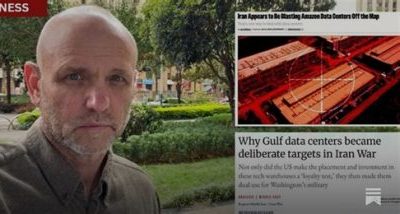
Iran spent $1 million to wipe out $30 billion in data center plans, and take down Amazon in the ME
or go to
Aletho News Archives – Video-Images
From the Archives
Clash of Civilization, Iran Part II
By Jamal Kanj – Intifada-Palestine.com – January 14, 2011
Israel’s survival kit is: perpetuate conflict, insecurity to rationalize collective hate and finally playing victim.
Devoid of conflict, Israel implodes internally; without hate, Zionism loses its justification; and playing eternal victim to continue blackmailing the West. Absence of this holy trinity, Israel ceases to exist. … continue
Blog Roll
 Aletho News
- China Rejects Outside Pressure on Trade Ties After New US Russia Sanctions Bill
- Houthis Keep Advancing as the Red Sea Crisis Deepens
- Iran spent $1 million to wipe out $30 billion in data center plans, and take down Amazon in the ME
- Zionist billionaire pressure to silence Macklemore sparks exodus from Ed Sheeran tour
- House Votes to End Iran War for Third Time
- North Korea Slams US Plan for ‘AUKUS 2.0’ with South Korea and Japan
- Prolonging US-Iran Conflict Not Meeting Interests of Int’l Community – China’s Wang Yi
- EU bans former Zelensky aide from parliament
- NATO-backed Kosovo separatist ‘responsible for war crimes’
- US destroying international space law
- If Americans Knew
- U.S. Makes, Israel Takes: The Real Story of U.S.-Israeli Military Cooperation
- Night raids rise in Palestine
- Tucker Carlson interviews Norman Finkelstein about Gaza
- Groups urge Americans to support Van Hollen legislation on Israel’s killing of Americans & Palestinians
- Trump administration plans to send 40,000 tons of bombs to Israel: report
- Sanctions Target Iran’s Government, But Kill Hospitalized 23-Year-Old Woman
- An alternative view on the book “Israel’s Lobby: America in the Grip of a Foreign Power”
- Ed Sheeran’s band Beoga, other opening acts quit tour after Macklemore was dropped over his pro-Palestinian comments
- The assassination attempt on President Trump in Butler and the various Israeli connections to it
- “We Want That the Whole Land Be Jewish”
- No Tricks Zone
- New Study: ‘Global Drought Shows No Detectable Recent Acceleration Under Climate Warming’
- Economic Masterminds: German Socialists Suggest Taxing Productivity Gains Stemming From Using AI
- The South China Sea Has Not Been Cooperating With The Climate Change Narrative
- Energy Crisis: Germany Enters Heating Season With Historically Low Gas Reserve Fill Levels
- New Study: The Antarctic Ice Sheet Gained Mass From 2020-2024 Due To Staggering Snow And Ice Accumulation
- Study: Ocean Heating Rates From Thousands Of Years Ago ‘Dwarf’ Modern Ocean Heating Rates
- Climate Extremists Target, Attack Large-Scale Power Grid Infrastructure In Germany!
- New Study: Antarctic Ice Melt Has Contributed Less Than 1 Centimeter To Sea Level Rise In The Last 30 Years
- Fear Of Debate: Alarmist German Climate Scientist Calls On Mainstream Media To Discredit Skeptic Voices
- End-Of-August Arctic Sea Ice Extent Hasn’t Fallen In 20 Years, Official Data Show!
 Aletho News