Israel bans travel of noted Jerusalemite figure abroad & to West Bank
Palestinian Information Center – July 21, 2016
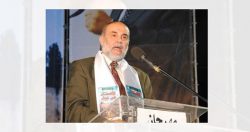 OCCUPIED JERUSALEM – The Israeli occupation police have handed professor Jamil Hamami, secretary-general of the higher Islamic commission in Occupied Jerusalem, a written order banning his travel abroad and to the West Bank.
According to this police order, Hamami will be prohibited from entering the West Bank for four months and the previous ban on his travel abroad will be extended for six months.
The police justified the measure against Hamami by saying that he is involved in banned activities and his departure for other countries will constitute a security threat to Israel.
For his part, Hamami, who works as a lecturer at al-Quds University, condemned Israel’s decision against him as “unjust and a violation of the Palestinians’ right to travel and movement”. He considered this Israeli step as “part of the Israeli campaign that targets the Palestinian dignitaries in Jerusalem.”
Ukrainian Regime Turns Into ‘Mass Grave’ for Journalists – Moscow

Journalist Pavel Sheremet © Sputnik/Ramil Sitdikov
Sputnik — 20.07.2016
MOSCOW — Ukrainian political system is turning into “mass grave” for journalists and journalism in general, Russian Foreign Ministry spokeswoman Maria Zakharova said Wednesday, commenting on the killing of journalist Pavel Sheremet in a car bomb attack in Kiev.
Earlier in the day, a car bomb claimed Sheremet’s life in the Ukrainian capital of Kiev. The Ukrainian general prosecutor confirmed Sheremet’s death, classifying it as murder.
“A vehicle with Pavel Sheremet was blown up in Kiev. [He was] a professional journalist, who was not afraid of telling the authorities what he thinks about them — to different authorities and at different periods of time. And he was respected for this. Ukraine (not the country, but the system) is turning into mass grave for journalists and journalism,” Zakharova wrote on her Facebook page.
President Petro Poroshenko ordered investigators to ensure the perpetrators of the attack are brought to justice.
Sheremet is a well-known journalist who worked in Russia, Belarus and Ukraine. He had worked in Kiev for the last five years for the Ukrayinska Pravda news portal and Radio Vesti broadcaster.
In April 2015, Ukrainian opposition journalist Oles Buzina was shot dead in Kiev by two masked gunmen near his home. The incident occurred less than a day after former lawmaker and government critic Oleh Kalashnikov was murdered at his residence in the Ukrainian capital. Another Ukrainian journalist, Donetsk-born Serhiy Sukhobok, was also killed the same month near his house in Kiev.
Reporters Without Borders has repeatedly urged the Ukrainian authorities to investigate the killing of journalists.
Palestinian journalist Samah Dweik sentenced to six months in Israeli prison

Samidoun Palestinian Prisoner Solidarity Network – July 18, 2016
Palestinian journalist Samah Dweik has been sentenced by the Israeli Jerusalem court to six months and one day in prison, on charges of “incitement” for posting on her Facebook page. She was arrested on 10 April 2016 from her home in the Ras al-Amud neighborhood of Silwan, Jerusalem, in a pre-dawn raid in which occupation soldiers invaded and ransacked her home, accused of posting in support of the intifada on Facebook.
She is one of hundreds of Palestinians targeted for arrest and persecution on the basis of postings on social media. Dweik, 25, is a freelance journalist who works with Quds News Network. She is one of over 20 Palestinian journalists detained and imprisoned by Israel, including Palestinian Journalists’ Syndicate leader Omar Nazzal, Addameer media coordinator Hasan Safadi, and multiple journalists accused of “incitement” for posting on social media.
 Dweik is one of over 60 Palestinian women imprisoned by Israel, held in HaSharon and Damon prisons. On Saturday, 16 July, two more Palestinian women were arrested: Banan Mahmoud Mafarjah, 21, a medical student at Al-Quds University in Abu Dis, Jerusalem, was arrested at an Israeli occupation “flying checkpoint” west of Ramallah; while Amal Masalmah of al-Khalil was among 10 Palestinians detained in late night and pre-dawn raids on 17 July.
Palestinian journalist ordered to administrative detention, campaign launched for syndicate leader’s release

Samidoun Palestinian Prisoner Solidarity Network – July 18, 2016
The Israeli Ofer military court issued a thee-month administrative detention order against Palestinian journalist Adib al-Atrash on Sunday, 17 July, as the Palestinian Journalists Syndicate launched an international effort to free syndicate leader Omar Nazzal, also held under administrative detention without charge or trial.
Al-Atrash, who recently graduated from Eastern Mediterranean University in Cyprus, was arrested by Israeli occupation forces on Monday, 20 June from his family’s home in Al-Khalil. Al-Atrash and Nazzal are two of over twenty Palestinian journalists detained and imprisoned by the Israeli occupation.
Nazzal was arrested by Israeli occupation forces on 23 April 2016, as he attempted to cross at the Karameh crossing from Palestine’s West Bank to Jordan, to travel to the European Federation of Journalists’ annual general meeting in Sarajevo, Bosnia and Herzegovina. Nazzal, a member of the PJS’ general secretariat, was representing the syndicate at the conference; he was also ordered to four months’ administrative detention without charge or trial.
The Palestinian Journalists Syndicate is working with the International Federation of Journalists and international syndicates of journalists to campaign for freedom for Nazzal and his imprisoned colleagues. The IFJ has called for the release of Nazzal and other imprisoned Palestinian journalists, including former hunger striker and administrative detainee Mohammed al-Qeeq.
Al-Atrash and Nazzal are among nearly 750 Palestinians held under administrative detention without charge or trial, out of a total of 7,000 Palestinian prisoners in Israeli jails. Administrative detention orders, issued for periods of one to six months on the basis of secret evidence, are indefinitely renewable.
Palestinian youth activist and former prisoner arrested by Israeli occupation forces
Samidoun Palestinian Prisoner Solidarity Network – July 12, 2016

Palestinian youth activist and former prisoner Hassan Karajah was arrested this evening, 12 July, by Israeli occupation forces at Beit Ur checkpoint west of Ramallah, reported family sources to Samidoun. They are concerned about his situation, especially because he spent 22 months in Israeli prisons after being targeted for his work as a human rights defender.
He was arrested on 23 January 2013 and freed on 19 October 2014, facing an Israeli military court on allegations of participation in a prohibited organization (all Palestinian political parties are prohibited organizations) and contact with an enemy state (frequently used to target Palestinians who travel to Lebanon for conferences and other events.)
Karajah, well known for his work in a number of civil society organizations, including the Stop the Wall Campaign and the Partnership for Development Project, and his advocacy for boycott, divestment, and sanctions (BDS) against Israel, was the subject of an international campaign for his release, which highlighted the Israeli targeting of Palestinian human rights defenders.
A letter Karajah wrote from prison was widely distributed: “Here, we draw our energy to continue from you. We, the newly detained prisoners, our hearts are full of happiness when, while being transported from prisons to court, we meet prisoners we have heard about for decades, whose photos and posters we have carried in the streets, prisoners from whom we learned our readiness to struggle since childhood.
In conclusion, I affirm to you that they will never be able to bring about our end. We are stronger than they are able to weaken us. We are higher than they are able to lower us. We are deeper than they are able to reach us. We continue.
I say to you at the end of this message – I will see you soon. I will come out as you have known me and better, and I will greet you with the single word, ‘Freedom.’”
34 violations against Palestinian journalists in June
MEMO | July 5, 2016
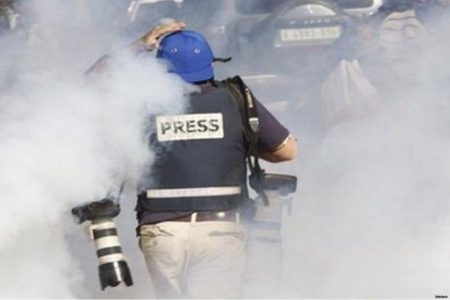
Israeli occupation forces and the Palestinian Authority carried out 34 violations against Palestinian journalists in June, Quds Press reported an NGO saying.
Palestinian Youth Congress for Journalists said in a statement that the Israeli violations included direct assaults, firing rubber bullets at journalists and cameramen, arbitrary arrests and the closure of media offices.
The group said the attacks happened while the journalists were documenting Israeli aggression at Al-Aqsa Mosque. Photographer Rami Al-Khatib and journalists Osaid Amarneh and Ahmed Jaradat were wounded during the violence.
Moreover, the statement noted that the Israeli policy of arbitrary detention of Palestinian journalists continued as several journalists, including 25-year-old Nasser Al-Khatib from Ramallah, 27-year-old Iyad Al-Taweel and 43-year-old Bassam Al-Safadi from the Golan Heights were arrested.
There are currently 20 journalists being held in Israeli jails, the statement said.
The group added that Israel had closed Musawat TV which broadcasts from occupied Palestinian territories under the pretext that it incites hatred.
The Youth Congress reported 17 violations against journalists at the hands of the Palestinian Authority.
Jeremy’s Jewish Friends
By Gilad Atzmon | July 2, 2016
Labour leader Jeremy Corbyn could do with better advisers. Yesterday, in a press conference Corbyn announced, “our Jewish friends are no more responsible for the actions of Israel or the Netanyahu Government than our Muslim friends are for those of various self-styled Islamic states or organisations.” This ‘equivalence’ of the Jews and the Muslims is weak.
Despite Israel’s devastating record of war atrocities, the vast majority of the world’s Jews support the Jewish state and identify with Zionism. The Jewish lobby dominates American, British and French foreign affairs. This lobby pushes for criminal immoral interventionist wars. Corbyn obviously knows this since he has consistently voted against these wars. None of these factors apply to Muslims or Islam. Only a fraction of Muslims worldwide support the Islamic state. In fact, the vast majority of Islamic leaders denounce Isis politically, religiously and culturally. There are no Islamic lobbies operating in our midst and pushing for wars. Finally, unlike Jewish oligarchs such as Haim Saban and George Soros, Muslim billionaires do not attempt to buy our political system. So I can’t imagine what led Corbyn to make such a comparison.
And who are these ‘Jewish friends’ to whom Corbyn referred?
Is the pro- Israel Chief Rabbi Ephraim Mrivis, who was quick to denounce Corbyn, one of Corbyn’s Jewish friends? Probably not.
Is the former Chief Rabbi Lord Jonathan Sacks, who added his voice to the complaint that Corbyn’s comparison was “demonisation of the highest order, an outrage and unacceptable.” Is he one of Corbyn’s Jewish friends?
Are the Labour Friend Of Israel, who have utilised every trick in the Book of Esther to destroy Corbyn, Corbyn’s Jewish friends?
Maybe Corbyn reckons that the Jews who pushed for the suspension of the heroic Ken Livingstone and many other Labour politicians and members, maybe they are his Jewish friends. Who knows?
Corbyn probably thinks that ‘Jews for Corbyn’ are his true Jewish friends. However, they formed their group only after it was clear that Corbyn was about to win Labour in a storm, and this was done so they could control the opposition.
No, as far as I can see, Corbyn has only ever had one true Jewish friend and his name is Paul Eisen. Paul Eisen was the first ‘Jewish friend’ to support Corbyn, the first ‘Jewish friend’ to praise the old proletariat leader, the first ‘Jewish friend’ to believe in Corbyn’s ability to win the Labour leadership and even to bring change to this country.
Such a pity that Corbyn dropped Paul the moment his ‘Jewish friends’ told him to.
Female politicians (sometimes) receive more abuse than male counterparts, apart from when they don’t…

OffGuardian | June 29, 2016
The Guardian have tried their hand at statistical analysis again – after resounding failures the last two times, you have to at least salute their determination.
As part of their “web we want” initiative, the Guardian have published Max Kelsen’s extensive study of twitter “abuse” suffered by politicians. The study seeks to demonstrate and explain the “concerning” level of abuse, and manages to do neither. Instead it becomes just a tool for the Guardian to justify and renew their assault on the idea of internet free speech.
Methods and Data
The first point that needs to be addressed is how this study defines, and subsequently identifies, “abuse”:
Tweets were filtered into those that contained abusive words, and those that didn’t. While this will include false positives in the case of tweets primarily directed at one politician but containing abuse directed at another, these are in the minority.
Their method WILL produce false positives. Not “might produce”, “ will produce”; a very important distinction.
But don’t worry, these “false positives” are, they assure us, definitely “in the minority”. They never say how they know this, or how they could know, since no data is given. For all we – and possibly they – know the admitted “false positives” could make up literally 100% of their sample.
And it should be noted that these “false positives” could include total reversion of the intent of the tweet. For example the phrase “Hillary Clinton is not a bitch”, would be shuffled into the “abuse” pile simply for containing the word “bitch”.
Still, it’s not every statistics firm that would have the chutzpah to freely admit that anything up to 49% of their data may be totally and irrevocably flawed. So hats off Max Kelsen on that score anyway.
The study also suggests that the vast majority (75%+) of “abusive” tweets come from men, without in turn pointing out that Twitter never specifically asks for a user’s gender, and actually “assigns” it using an algorithm that famously skews male.
… but wait a minute:
The gender of tweeters was assigned where possible based on available information, such as bio information or the tweets themselves.
So twitter’s algorithm doesn’t actually matter, because this “analysis” didn’t even get that technical. No, they just looked at the accounts and sort of guessed. Brilliant.
None of which really matters, in the end, because their graphs reveal that – even including all those false positives – less than 2% of twitter posts are abusive.
Less than two percent. 98% of tweets are non-abusive.
That’s hardly a tickly cough, let alone the “epidemic” that the Guardian is so fond of describing. The study itself seems to recognise the minuteness of the alleged problem, saying this in their summary:
A key point to make is that data alone is not an accurate way to reflect the impact of abuse.
Again, it’s not every statistical study that would sum up: “OK, there’s not much data here… but it feels bigger than it looks”. Maybe this is some new, progressive mathematics – much like the Common Core syllabus in the US – where numbers are given increased weight based on how they make one feel.
The Agenda
It doesn’t take a skilled reader of subtext to see where this is going – the intent of the “Web We Want” section, coincidentally launched parallel to Yvette Cooper’s “Reclaim the Internet” campaign, has always been clear. They attack free speech under the guise of protecting the “oppressed” and the “bullied” – most of the time, this means women.
That slant is clear here. The headline reads:
From Julia Gillard to Hillary Clinton: online abuse of politicians around the world
…which implies there is disparity between men and women in the amount of abuse received. This early paragraph does the same:
The abuse of politicians online, particularly women, is perceived by some to come with the territory. But as high-profile cases flag the urgent need to clean up the web, the scope of the problem is now revealed in greater detail in work by a Brisbane-based social data company, Max Kelsen.
The bolded phrase above – “particularly women” – is an interesting one. Especially since, just a little way down the page, they reveal that the abuse is, in reality, evenly split between men and women over their samples.
Hillary Clinton receives more “abuse” than Bernie Sanders, and Julia Gillard was apparently abused more than Kevin Rudd… but Chris Christie received more abuse than Carly Fiorina, and Andy Burnham and Jeremy Corbyn both received nearly twice as much “abuse” as their female counterparts. In short: There’s no real difference between the genders.
You’d be forgiven, given the tone, for thinking the opposite – the article cites the Jess Philips claim of 600 threats in one night, repeats Yvette Coopers famous “threat” (which, to me, reads as an obviously rather tasteless joke), and then treats us to some pictures of Jo Cox’s mournful public, suggesting that controlling what people are allowed to say on the internet might have saved her life.
The study tells us to disregard the data, and focus on the “emotional impact” of the abuse. I would say disregard the data (or lack thereof), and instead focus on how the Guardian is choosing to present it.
Leaked FBI doc reveals secret policy of targeting journalists, sources
RT | July 1, 2016
FBI documents sought after in Freedom of Information Act requests for the last year are now available, thanks to a leak to the Intercept. They lay out secret rules for collecting phone records of journalists, bypassing normal judicial processes.
The documents, published Thursday, outline how FBI agents would utilize National Security Letters in obtaining journalists’ phone records. They date back to 2013, the same year the agency’s overseer, the US Department of Justice, amended its standards for subpoenaing for such records.
However, the newly leaked papers are marked “last updated October 2011,” and they seem to conflict with DOJ policy as well as reveal information that many say never should have been secret in the first place.
The FBI’s National Security Letters, or NSLs, are used like search warrants, but unlike a normal warrant, they are not signed off on by any judge or court. They are approved in-house without even a requirement to notify the target. For the purposes of these documents, that means not even the news organization employing the journalist would necessarily be informed. Furthermore, they nearly always come with some form of a gag order, preventing the target from talking about their NSL case.
Getting an NSL authorized typically requires the signatures of the FBI’s general counsel and its National Security Branch’s executive assistant director as well as other chain of command OK’s following the agent making the request, the Intercept reported. That is, as long as the NSL is deemed “relevant” to an investigation pertaining to national security.
Except in investigations over a leak, such as how these FBI documents came to be available, when the purpose of an NSL is “to identify confidential news media sources,” according to the documents, the general counsel and executive assistant director defer to the DOJ National Security Division’s assistant attorney general. To identify a leaker, however, the DOJ is not needed for NSL approval.
The Freedom of the Press Foundation sued the DOJ for a more complete release of these rules, since they had previously been divulged under ample redaction in 2011, along with the rest of the FBI’s Domestic Investigations and Operations Guide, or DIOG.
“These supposed rules are incredibly weak and almost nonexistent — as long as they have that second sign-off they’re basically good to go,” Trevor Timm, the executive director of the media advocacy group told the Intercept. “The FBI is entirely able to go after journalists and with only one extra hoop they have to jump through.”
FBI spokesman Christopher Allen gave little comment to the Intercept, only to say the agency was “very clear” that “the FBI cannot predicate investigative activity solely on the exercise of First Amendment rights.”
Press advocates have criticized President Obama’s administration harshly, as it has pursued more cases, including under the Espionage Act, against publishers, leakers and reporters than prior administrations.
In 2013, in response to backlash over its seizing the phone lines of the Associated Press and keeping tabs on Fox News’s James Rosen, the DOJ released new “Media Guidelines” that conveyed a tightening up of the practices. The information just leaked to the Intercept, though, “makes a mockery” of those guidelines, the Freedom of the Press Foundation wrote Thursday.
It is important to note that NSLs are covered by rules wholly separate from the DOJ’s media guidelines.
Efforts on Capitol Hill to loosen restrictions on NSLs have failed recently, but only by slim margins, and the fight does not seem to be letting up. An amendment to a Senate criminal justice funding bill failed last week by just two votes, while this past Monday, a similar amendment allowing the FBI to demand email header information, web browser history, social media account access and other metadata was blocked by Senator Ron Wyden (D-Oregon), Reuters reported.
Corbyn: Clowns to the left of him, Jokers to the right
By Stuart Littlewood | Dissident Voice | June 30, 2016
A political beacon is about to be extinguished unless he breaks with the doomed Labour Party and sets up on his own.
Well, I don’t know why I came here tonight
I got the feeling that something ain’t right,
I’m so scared in case I fall off my chair,
And I’m wondering how I’ll get down the stairs,
Clowns to the left of me,
Jokers to the right, here I am,
Stuck in the middle with you.
Yes I’m stuck in the middle with you,
And I’m wondering what it is I should do,
It’s so hard to keep this smile from my face,
Losing control, yeah, I’m all over the place,
Clowns to the left of me, Jokers to the right…— Lyrics from ‘Stuck in the Middle with You’, a 1972 recording by Stealers Wheel
Only last December I was writing a piece titled ‘You have better things to do than captain a sinking ship – Message to Corbyn: dump the baggage, build from new’.
That message said:
Commiserations, comrade.
Last Wednesday – ‘Let’s Bomb Syria Day’ – was a day of infamy. Tomorrow you’ll need to come to terms with the UK Labour party’s unswerving death-wish.
Its integrity is in tatter, brand image beyond repair, and the very voters it needs to win round regard it as a joke. And the thousands who became your supporters in the heady days of the leadership campaign, exhilarated and inspired by the promise of better politics, are dismayed that their high hopes can never be delivered through such a bitterly divided party machine.
In that debate on bombing Syria senior Labour MPs and shadow ministers supported the Tory warmongers. In particular Hilary Benn (son of the illustrious Tony) played on human fears, ignored operational shortcomings and discounted the risk of reprisals against ‘soft’ targets on our streets. His scare tactics were exactly what the warmongers wanted to hear and his speech was triumphantly applauded by Tory Government benches and praised in the media. The party’s Blairite rump, who had shamed the nation by blindly voting for the Iraq war 12 years earlier, trooped into the lobbies to vote for war in Syria.
In a recent speech to Labour Friends of Israel Benn, the shadow foreign secretary, dishonestly called the rogue state “a vibrant democracy”, talked of shared values and claimed the bonds between it and the Labour party were “strong and run deep”. The puzzle was how Jeremy Corbyn could have appointed such a person to that key post. Earlier this week Corbyn finally sacked him, a move that set off a vengeful chain reaction.
Only 10 months ago Corbyn came from nowhere and panicked the Westminster Establishment by winning the Labour leadership with nearly 60% of first-choice votes. His nearest rival mustered only 19% so he had sufficient mandate to silence plotters who threatened a coup if he won. They have smouldered ever since.
The Conservatives reacted by broadcasting that Corbyn and Labour were “a serious risk to our nation’s security, our economy’s security and your family’s security. Whether it’s weakening our defences, raising taxes on jobs and earnings, racking up more debt and welfare or driving up the cost of living by printing money – Jeremy Corbyn’s Labour Party will hurt working people.”
So slender was his support in the Parliamentary Labour Party (as opposed to the party membership) that his shadow team inevitably included many critics. Mounting an effective opposition has thus been near impossible with so many colleagues willing him to fail, although he has chalked up a number of successes. Of course, the effectiveness of a leader depends in large measure on the performance of his senior colleagues.
Just lately the pressure on Corbyn to step down has been ratcheted-up, with accusations that he didn’t try hard enough to galvanise the Remain vote in the EU referendum. The official party line is pro-EU but ‘Old Labour’ Corbyn has been opposed to the EU for decades and knew perfectly well that at least one-third of Labour supporters would vote Leave.
This week there were mass resignations from his shadow team, at such regular intervals that they were clearly orchestrated for maximum effect. Replacements were hurriedly appointed. In the House of Commons David Cameron made an unusually good joke of it. Welcoming the newly elected Labour MP for Tooting he advised her to “keep her mobile switched on – you might be in the shadow cabinet by the end of the day”.
On Corbyn’s referendum effort Cameron quipped: “I know he says he put his back into it. All I’d say is, I’d hate to see him when he’s not trying.” That might have been funny except that Cameron, when setting up the referendum, couldn’t be bothered to appoint a team to examine the way forward in the event of a Brexit win. Hence the damaging post-Brexit confusion that will probably go on for months.
Then, very rudely, Cameron turned on Corbyn, telling the House: “It might be in my party’s interest for him to sit there, it’s not in the national interest and I would say, for heaven’s sake man, go!”
To illustrate the depths of silliness to which the campaign to oust Corbyn has sunk, the Labour Party today released a report on antisemitism. In a speech introducing it Corbyn said: “Our Jewish friends are no more responsible for the actions of Israel or the Netanyahu government than our Muslim friends are for those of various self-styled Islamic states or organisations.”
Fair comment, you might think. But it was eagerly seized on for wild accusations that he was making direct comparison between the Israeli government and Isis, which calls itself the Islamic State, although several other terrorist groups use the same name. A Labour councillor said on Twitter: “For that alone, he should resign. I am red with fury.”
The Telegraph quoted a statement by Lord Sacks in which the former Chief Rabbi accused the Labour leader of comparing the State of Israel to ISIS and “demonisation of the highest order, an outrage and unacceptable”. He added: “Israel is a democratic state with an independent judiciary, a free press and a diverse population of many cultures, religions and creeds. ISIS is a terrorist entity whose barbarities have been condemned by all those who value our common humanity.”
No, you couldn’t make it up.
And the current Chief Rabbi is reported calling Corbyn’s comments “offensive, and rather than rebuilding trust among the Jewish community, are likely to cause even greater concern”.
On top of everything Ruth Smeeth, a Labour MP, stormed out of the press conference complaining she was verbally abused by a Corbyn supporter who accused her of being part of a ‘media conspiracy’, and Corbyn failed to intervene. “I call on Jeremy Corbyn to resign immediately and make way for someone with the backbone to confront racism and antisemitism in our party and in the country,” she announced. Reports omit to mention that Smeeth is a former director of BICOM, a pro-Israel propaganda organisation.
So the picture is bleak for Jeremy.
Clowns to the left of me,
Jokers to the right, here I am…
That song is possibly running through his mind repeatedly, and won’t go away.
Featured Video
10K More U.S. Troops Deploy as Trump Weighs New Iran Strikes
or go to
Aletho News Archives – Video-Images
From the Archives
Genetic baloney in thick slices
MAYBE COULD BE INC.
By Jon Rappoport | No More Fake News | July 8, 2021
Gene research companies tend to come and go. They start out banging and popping like fireworks in the sky, and then they fade out—selling themselves to larger outfits who’ve hired better liars…
Once upon a time, it sounded easy. Start with a disease, find the gene responsible for the disease, and correct the problem.
Then, researchers wondered, was disease the result of one gene or a group of genes acting together?
Either way, the proof would be in devising cures for diseases using gene therapy. “Not yet, but soon…”
And regardless, the major need was: money. Lots and lots of money.
This need required good PR people. “We have to pump up the idea that we’re on the edge of tremendous breakthroughs. We’re always on that edge…”
This hype also needed to obscure the fact that there wasn’t (and isn’t) ANY gene cure for ANY disease. … continue
Blog Roll
 Aletho News
- Florida AG Sues Pfizer, Bourla Over Deceptive Marketing of COVID Vaccines
- Von der Leyen gifts her spin doctor a job for life
- 10K More U.S. Troops Deploy as Trump Weighs New Iran Strikes /Suliaman Ahmed
- Iranian crew declared Dena training vessel ‘unarmed’ to US warship before deadly torpedo strike: Report
- Iran’s NPT debate moves beyond parliament
- Houthis condemn Saudi claims of attack on Medina
- Fatuous False Flags
- Are Europe’s Smallest Nations Dragging the Continent into War?
- EU draws up contingency plans for possible Merz exit
- G7 caves to US blackmail, announces ‘massive’ release of diesel reserves
- If Americans Knew
- The Israeli Right Portrays Islam as Murderous. It Serves a Political Purpose
- Jordan Has Had Enough: King Abdullah’s Scathing Warning to Israel
- Israeli Colonizers (i.e. Settlers) Kill Palestinian Man Near Salfit
- New Google Maps images reveal massive scale of devastation in Gaza
- Jewish supremacy, anti-Palestinian bigotry on display in Israel – Daily Update
- Israeli Soldiers Abduct At Least 22 Across Occupied West Bank
- Eight Palestinians Killed in Israeli Attacks on Gaza
- Israeli former leaders and security chiefs threaten legal action over ‘Jewish terrorism’
- Israel map in LA Times ad includes all land from the river to the sea
- Inside Lebanon’s 200-page dossier on Israeli war crimes
- No Tricks Zone
- Green Energy Debacle: German Expert Professor Fritz Vahrenholt Warns Of Severe Economic And Social Consequences
- Two More Paleo Reconstructions Affirm Meters-Higher Sea Levels Across Ireland, Brazil 7000-6000 Years Ago
- New Study: Earth And Venus Surface Warmth Largely Explained By Convection And Lapse Rate, Not CO2 Or Radiation
- 2025 Nature Paper Claiming Worsening Global Drought Gets RETRACTED …Heavily Flawed
- New Study: ‘Global Drought Shows No Detectable Recent Acceleration Under Climate Warming’
- Economic Masterminds: German Socialists Suggest Taxing Productivity Gains Stemming From Using AI
- The South China Sea Has Not Been Cooperating With The Climate Change Narrative
- Energy Crisis: Germany Enters Heating Season With Historically Low Gas Reserve Fill Levels
- New Study: The Antarctic Ice Sheet Gained Mass From 2020-2024 Due To Staggering Snow And Ice Accumulation
- Study: Ocean Heating Rates From Thousands Of Years Ago ‘Dwarf’ Modern Ocean Heating Rates

