Honduras: A Second Human Rights Attorney Is Murdered
Weekly News Update on the Americas | September 30, 2012
Unidentified assailants gunned down Eduardo Manuel Díaz Mazariegos, a prosecutor with the Honduran Public Ministry, shortly before noon on Sept. 24 near his office in Choluteca, the capital of the southern department of Choluteca. Díaz Mazariegos had worked on human rights cases as well as criminal cases for the ministry. He was the seventh Honduran prosecutor murdered since 1994, and his killing came less than two full days after the similar murder of Antonio Trejo Cabrera, an activist private attorney who represented a campesino collective in a dispute over land in the Lower Aguán Valley in northern Honduras [see Update #1145]. (La Tribuna (Tegucigalpa) 9/24/12; EFE 9/25/12 via Univision)
The Associated Press wire service reported on Sept. 24 that Trejo had written a request in June 2011 for the Inter-American Commission on Human Rights (IACHR, or CIDH in Spanish) in Washington, DC, to order emergency precautionary measures for his protection. “If anything happens to me, to my goods or to my family,” Trejo wrote, “I hold responsible Mr. Miguel Facussé [and two others that AP declined to name], who can attack my life through hit men, since they know that the lawsuits against them are going well and that the campesinos are going to recover the lands that [Facussé and the others] stole from them illegally.”
Cooking oil magnate Facussé is the main owner of disputed land in the Aguán; presumably Trejo also named the two other major landowners in the dispute, René Morales and Reinaldo Canales. After Trejo’s murder Facussé issued a written denial of any “direct participation of my person or of the personnel of my companies in so abominable an act,” although he added that Trejo had committed “fraudulent acts against [Facussé’s] company.” Marlene Cruz, an attorney who represents another Aguán collective, told AP that she and Trejo were scheduled to attend a hearing at the CIDH in Washington on Oct. 19. Cruz is now thought to be in danger.
Trejo, who came from a campesino family and was born in the San Isidro collective in northern Honduras, was also involved in another high-profie case: he had filed a complaint against a neoliberal project, the Special Development Regions (RED, also known as “Model Cities”), for creating privatized autonomous regions in the country. Trejo denounced the project in a television debate less than 24 hours before his assassination, saying it was backed by “Ali Baba and the 40 thieves of the government.” Michael Strong, the director of the US-based MGK Group, a leading “model cities” sponsor [see Update #1144], said he was “horrified” by the murder and that “if Trejo had lived long enough to be acquainted with us, he would have concluded that our approach is beneficial for Honduras.” (AP 9/24/12 via El Nuevo Herald (Miami))
Related articles
- Honduras: Lawyer for Aguán and “Model Cities” Struggles Is Murdered (alethonews.wordpress.com)
US: Student Rights Disappearing
Staff Writers | October 1, 2012
In the aftermath of 9/11, we’ve seen plenty of attacks on privacy and personal security, and students are not immune to this effect. From RFID tracking to mandatory drug and pregnancy testing, new laws and policies are slowly beginning to creep in and take over the privacy that students have enjoyed in the past. We’ve discovered nine troubling signs that student rights are in danger. If these can slip by, what’s coming next?
Some students are required to wear IDs:
At Northeast Mississippi Community College, students are required to keep their NEMCC ID badge in plain sight at all times or face warnings and tickets. The administration’s primary reason for the IDs is safety, but the policy raises privacy concerns for students, who cannot opt out of the program. Northeast Mississippi isn’t the only school adopting student IDs, and some are going so far as to include RFID in their IDs to assist with attendance records. Experts believe that this could become a trend in American schools, but some parents are outraged. In at least one elementary school, the push back has been so extreme that the RFID program was terminated due to privacy concerns.
Students are required to share their contact information with the Armed Forces:
High school students are automatically signed up to share their contact information with the Armed Forces, presumably for recruiting purposes. This is a part of the No Child Left Behind law, and although students can opt out, the parent or student must explicitly request otherwise. Releasing student contact information is viewed as a serious violation of student privacy.
Mandatory drug testing is becoming more prevalent:
Linn State Technical college, a small technical school with just 1,200 students, has become the first university in the country to make drug testing mandatory for enrollment. Every new student at LSTC is required to take a urine test within their first five to 10 days of the school year, or withdraw from the university. Students are also subject to random testing throughout the rest of the year. The university community has pushed back, asserting that mandatory drug testing is too much of an invasion, setting a dangerous precedent for the ability of schools to regulate students’ lives.
Pregnancy testing is also a concern:
In one Louisiana public school, female students who are suspected of being pregnant must submit to a pregnancy test. If they refuse to take the test or are found to be pregnant, they’re kicked out of school and forced to pursue homeschooling instead. This policy is in clear violation of federal law, specifically, Title IX of the Education Amendments of 1972 that mandates schools can’t exclude students based on pregnancy or related conditions. But it’s not just this one school with a problematic policy: the ACLU evidence suggests that illegal discrimination is a major contributing factor to the high dropout rate (70%) of teen girls who give birth.
Educational records can be shared with outside entities:
Schools are privy to lots of sensitive information about their students, including grades, discipline records, income, and even mental health issues. This is the sort of information that most families would prefer to keep private, but new rules allow it to be shared with entities outside the scope of education. That means student information can be placed in state databases without the consent of students and parents.
Students can be monitored via wiretaps:
The FCC has recently released a campaign that is forcing universities to comply with national wiretapping laws. This means that universities are altering their private networks and the Internet in order to allow for monitoring of Internet usage, instant messaging, and even cell phone texts. Additionally, these mandates allow universities to be subpoenaed for medical and other student records. Previously, universities were exempted from wiretapping due to their private networks, but following the 2001 terrorist attacks the Department of Justice asked the FCC to expand their reach.
Schools are blocking student access to LGBT websites:
Blocking pornographic websites is a common practice among public schools, but some are taking things a step further, blocking access to LGBT websites that are not at all pornographic. Many of the commonly used web filtering software packages block out LGBT-positive websites that share information about LGBT issues and organizations. These packages do not, however, block out anti-LGBT websites that condemn LGBT people and encourage them to change their sexual orientation. The ACLU has argued that this “viewpoint discrimination” violates students’ rights under the First Amendment.
Free speech is getting edged out:
On many college campuses, free speech is dramatically limited. Campuses typically have a “free speech zone,” but at some schools, this zone is in a low traffic area so far from the heart of campus that it’s not an ideal location to share messages. At other schools, free speech can be limited to certain days or hours, and even give administrators the right to review and approve of materials before they’re shared. For some students pursuing free speech, these restrictions can keep them from effectively sharing their message. Specifically, at Yuba College in California, students had to apply for permission to speak 14 business days in advance, register literature 48 hours prior to distribution, and are limited to the hours of 12 p.m. and 1 p.m. on Tuesdays and Thursdays for public speeches, extreme measures for any student or group wanting to spread the word about their issue.
Student due process rights are being threatened:
It’s not hard to understand why many college campuses take a hard line on rape, but it’s important to remember that accused rapists have rights, too. Under the Violence Against Women Reauthorization Act, it was proposed that universities receiving federal funding must allow sexual assault victims to appeal the results of college disciplinary hearings. That means that students accused of sexual assault could be tried twice for the same crime, a “double jeopardy” situation that is not allowed in U.S. courts. This is troublesome and an unfortunate way for presumably innocent accused rapists to be held back from moving on with their lives.
Related articles
- Peeing to participate (economist.com)
- Hell No! Texas Students Revolt Against Mandatory RFID Tracking Chips – Video – MSM Ignores (jhaines6.wordpress.com)
- Middle Schooler Forced to Take Drug Test to Join Scrapbooking Club (reason.com)
- University Of Oregon Begins Mandatory Drug Testing for Athletes (thinkprogress.org)
Americans already detained under NDAA?
RT | September 28, 2012
The plaintiffs that are suing US President Barack Obama over his insistence on keeping the National Defense Authorization Act on the books said Thursday that they fear Americans are already being held indefinitely and without trial under the NDAA.
US President Barack Obama refrained from even once commenting on his efforts to keep his power to indefinitely detain Americans without charge when he appeared on Reddit.com recently and urged users to “Ask Me Anything.” His opponents in the matter aren’t shying away from speaking up online, though.
The plaintiffs in the case to ban the White House from imprisoning Americans indefinitely without trial or due justice took to Reddit on Thursday to answer questions involving the National Defense Authorization Act of Fiscal Year 2012, or the NDAA, and blamed corrupt media and a broken governmental establishment for letting the Obama administration maintain its [power] to book Americans in military prisons without charge.
On December 31, 2011, President Obama authorized the NDAA, and with it he approved a controversial provision that permits the government to indefinitely detain US citizens without trial for mere allegations of ties to suspected terrorists. Journalists and activists filed a lawsuit against the president earlier this year over the provision, Section 1021, which US Federal Judge Katherine Forrest in turn agreed was unconstitutional. Last month Judge Forrest decided that an earlier, temporary injunction on the clause should be made permanent, but the Obama Justice Department pleaded for an emergency stay only hours later. A lone federal appeals judge has since heard that plea and has momentarily blocked Judge Forrest’s injunction. Now pending the results of an appeals panel’s formal investigation, the NDAA’s indefinite detention provision remains on the books.
On Thursday, the plaintiffs in the case — journalist Chris Hedges, activist Tangerine Bolen, Pentagon Papers leaker Dan Ellsberg, their attorneys and others — told users of Reddit to ask them anything.
“The Obama DOJ has vigorously opposed these efforts, and immediately appealed her ruling and requested an emergency stay on the injunction – claiming the US would incur ‘irreparable harm’ if the president lost the power to use Section 1021 – and detain anyone, anywhere until the end of hostilities on a whim. This case will probably make its way to the Supreme Court,” the plaintiffs acknowledged in their introduction.
From there, President Obama’s opponents in federal court combed through hundreds of posts to answer questions regarding the NDAA over the course of several hours. And although the plaintiffs have not exactly been silent with the status of their fight since suing the White House earlier this year, the insight they offered on Reddit provided a fresh update on the case against the NDAA amid some of the government’s most unusual legal maneuvers yet.
Offering his take on the case, Hedges said that he even believes the NDAA’s indefinite detention clause is already being used to imprison Americans, “because they filed an emergency appeal.”
“If the Obama administration simply appealed it, as we expected, it would have raised this red flag,” Hedges added. “But since they were so aggressive it means that once Judge Forrest declared the law invalid, if they were using it, as we expect, they could be held in contempt of court. This was quite disturbing, for it means, I suspect, that US citizens, probably dual nationals, are being held in military detention facilities almost certainly overseas and maybe at home.”
“The signing statement is the most ridiculous part to this for me. He writes this statement saying he’s not happy about the power existing, but then his administration fights so hard to keep that specific power in place,” a Reddit user responded.
“If Obama didn’t want it to happen, he would not have signed it, especially after stating that he would veto it,” co-counsel Carl Mayer explained. Mayer has represented the plaintiffs in the case of Hedges v. Obama and said that he plans on continuing his pursuit to take indefinite detention off the books.
“We will do whatever it takes,” Mayers added. “We are prepared for a Supreme Court battle.”
Activist and journalist Tangerine Bolen is also insistent on prevailing over the Obama administration, but says “The biggest obstruction to our winning this case . . . is our broken systems.” Bolen blames a lack of media coverage, insufficient public awareness “and the government behaving very badly, even in court, on the record,” for the difficulties the plaintiffs have had to endure, adding that the Obama administration’s constant missteps have been noticed by no one except “seven plaintiffs, four attorneys, one federal judge and the activists who have been following this case.”
“Amazing,” she added.
Journalist Chris Hedges extrapolated on Bolen’s opinion, singling out “a corporate-owned system of information” for not informing Americans that they can be imprisoned without trial at this very moment.
“MSNBC, which is a propaganda arm of the Democratic establishment, just as Fox is a propaganda arm of the Republican establishment, is not going to raise this as Obama is as guilty as Romney. If we had a healthy press this would have gotten more coverage, although the print media, and in particular my old paper the NY Times, finally did good coverage,” Hedges wrote. […]
A three-judge appeals panel is expected to soon weigh in on the stay placed on Judge Forrest’s injunction, in the meantime keeping Section 1021 and the rest of the NDAA applicable to every American. – Full article
Related articles
- White House demands military prisons for Americans under NDAA (alethonews.wordpress.com)
- Obama Administration Argues That Blocking the NDAA’s Indefinite Detainment Provision Will Harm the U.S. (reason.com)
Cleansing the Internet of Terrorism: EU-Funded Project Seeks To Erode Civil Liberties
By Jillian C. York and Katitza Rodriguez | EFF | September 26, 2012
A new project aimed at “countering illegal use of the Internet” is making headlines this week. The project, dubbed CleanIT, is funded by the European Commission (EC) to the tune of more than $400,000 and, it would appear, aims to eradicate the Internet of terrorism.
European Digital Rights, a Brussels-based organization consisting of 32 NGOs throughout Europe (and of which EFF is a member), has recently published a leaked draft document from CleanIT.
On the project’s website, its stated goal is to reduce the impact of the use of the Internet for “terrorist purposes” but “without affecting our online freedom.” While the goal may seem noble enough, the project actually contains a number of controversial proposals that will compel Internet intermediaries to police the Internet and most certainly will affect our online freedom. Let’s take a look at a few of the most controversial elements of the project.
Privatization of Law Enforcement
Under the guise of fighting ‘terrorist use of the Internet,’ the “CleanIT project,” led by the Dutch police, has developed a set of ‘detailed recommendations’ that will compel Internet companies to act as arbiters of what is “illegal” or “terrorist” uses of the Internet.
Specifically, the proposal suggests that “legislation must make clear Internet companies are obliged to try and detect to a reasonable degree … terrorist use of the infrastructure” and, even more troubling, “can be held responsible for not removing (user generated) content they host/have users posted on their platforms if they do not make reasonable effort in detection.”
EFF has always expressed concerns about relying upon intermediaries to police the Internet. As an organization, we believe in strong legal protections for intermediaries and as such, have often upheld the United States’ Communications Decency Act, Section 230 (CDA 230) as a positive example of intermediary protection. While even CDA 230’s protections do not extend to truly criminal activities, the definition of “terrorist” is, in this context, vague enough to raise alarm (see conclusion for more details).
Erosion of Legal Safeguards
The recommendations call for the easy removal of content from the Internet without following “more labour intensive and formal” procedures. They suggest new obligations that would compel Internet companies to hand over all necessary customer information for investigation of “terrorist use of the Internet.” This amounts to a serious erosion of legal safeguards. Under this regime, an online company must assert some vague notion of “terrorist use of the Internet,” and they will have carte blanche to bypass hard-won civil liberties protections.
The recommendations also suggest that knowingly providing hyperlinks to a site that hosts “terrorist content” will be defined as illegal. This would negatively impact a number of different actors, from academic researchers to journalists, and is a slap in the face to the principles of free expression and the free flow of knowledge.
Data Retention
Internet companies under the CleanIT regime would not only be allowed, but in fact obligated to store communications containing “terrorist content,” even when it has been removed from their platform, in order to supply the information to law enforcement agencies.
Material Support and Sanctions
The project also offers guidelines to governments, including the recommendation that governments start a “full review of existing national legislation” on reducing terrorist use of the Internet. This includes a reminder of Council Regulation (EC) No. 881/2002 (art. 1.2), which prohibits Internet services from being provided to designated terrorist entities such as Al Qaeda. It is worth noting that similar legislation exists in the US (see: 18 U.S.C. § 2339B) and has been widely criticized as criminalizing speech in the form of political advocacy.
The guidelines spell out how governments should implement filtering systems to block civil servants from any “illegal use of the Internet.”
Furthermore, governments’ criteria for purchasing policies and public grants will be tied to Internet companies’ track record for reducing the “terrorist use of the Internet.”
Notice and Take Action
Notice and take action policies allow law enforcement agencies (LEAs) to notify and act against Internet companies, who must remove “offending” content as fast as possible. This obligates LEAs to determine the extent to which content can be considered “offensive.” An LEA must “contextualize content and describe how it breaches national law.”
The leaked document contains recommendations that would require LEAs to, in some cases, send notice that access to content must be blocked, followed by notice that the domain registration must be ended. In other cases, sites’ security certificates would be downgraded.
Real Identity Policies
Under the CleanIT provisions, all network users, whether in social or professional networks, will be obligated to supply their real identities to service providers (including social networks), effectively destroying online anonymity, which EFF believes is crucial for protecting the safety and well-being of activists, whistle-blowers, victims of domestic violence, and many others (for more on that, see this excellent article from Geek Feminism). The Constitutional Court of South Korea found an Internet “real name” policy to be unconstitutional.
Under the provisions, companies can even require users to provide proof of their identity, and can store the contact information of users in order to provide it to LEAs in the case of an investigation into potential terrorist use of the Internet. The provisions will even require individuals to utilize a real image of him or herself, destroying decades of Internet culture (in addition to, of course, infringing on user privacy).
Semi-Automated Detection
The plan also calls for semi-automated detection of “terrorist content.” While content would not automatically be removed, any searches for known terrorist organizations’ names, logos or other related content will be automatically detected. This will certainly inhibit research into anything remotely associated with what law enforcement might deem “terrorist content,” and would seriously hinder normal student inquiry into current events and history! In effect, all searches about terrorism might end up falling into an LEA’s view of terrorist propaganda.
LEA Access to User Content
The document recommends that, at the European level, browsers or operating systems should develop a reporting button of terrorist use of the Internet, and suggests governments draft legislation to make this reporting button compulsory for browser or operating systems.
Furthermore, the document recommends that judges, public prosecutors and (specialized) police officers be able to temporarily remove content that is being investigated.
Banning Languages
Frighteningly, one matter up for discussion within the CleanIT provisions is the banning of languages that have not been mastered by “abuse specialists or abuse systems.” The current recommendation contained in the document would make the use of such languages “unacceptable and preferably technically impossible.”
With more than 200 commonly-used languages and more than 6,000 languages spoken globally, it seems highly unlikely that the abuse specialists or systems will expand beyond a select few. For the sake of comparison, Google Translate only works with 65 languages.
At a time when new initiatives to preserve endangered languages are taking advantage of new technologies, it seems shortsighted and even chauvinistic to consider limiting what languages can be used online.
What Is Terrorism, Anyway?
While the document states that the first reference for determining terrorist content will be UN/EU/national terrorist sanctions list, it seems that the provisions allow for a broader interpretation of “terrorism.” This is incredibly problematic in a multicultural environment; as the old adage goes, “one man’s terrorist is another man’s freedom fighter.” Even a comparison of the US and EU lists of designated terrorist entities shows discrepancies, and the recent controversy in the US around the de-listing of an Iranian group shows how political such decisions can be.
Overall, we see the CleanIT project as a misguided effort to introduce potentially endless censorship and surveillance that would effectively turn Internet companies into Internet cops. We are also disappointed in the European Commission for funding the project: Given the strong legal protections for free expression and privacy contained in the Charter of Fundamental Rights of the European Union [PDF], it’s imperative that any efforts to track down and prosecute terrorism must also protect fundamental rights. The CleanIT regime, on the other hand, clearly erodes these rights.
Related articles
- EU proposal to stop terrorist sites even more ridiculous than it sounds (arstechnica.com)
- Leak shows EU’s plans for largescale surveillance of all communications (edri.org)
- Leaked Clean IT Document Is Frightening (webpronews.com)
- Police across Europe will “patrol” Facebook, Google and Twitter for postings supporting terrorism under an EU project says leaked report (familysurvivalprotocol.com)
Press TV correspondent killed in Syrian capital
Press TV – September 26, 2012
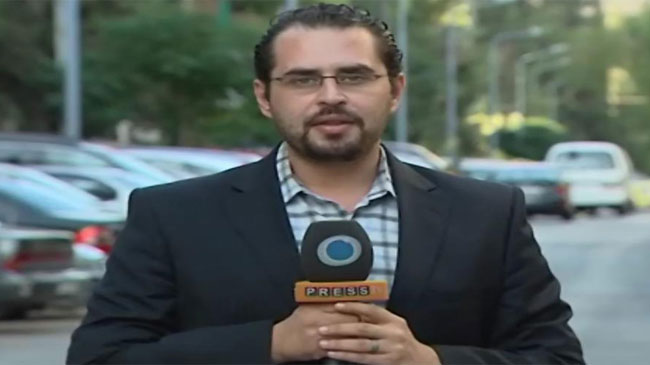 Insurgents in the Syrian capital Damascus have attacked Press TV staff, killing the Iranian English-language news network’s correspondent Maya Naser, and injuring its Damascus Bureau Chief Hossein Morteza.
Naser came under attack while reporting on air just hours ago. He was shot and killed by a sniper.
Press TV and Al-Alam Damascus Bureau Chief Hossein Morteza also came under attack and was injured.
The two were covering twin blasts in Damascus and the ensuing fighting.
“We hold Turkey, Saudi Arabia and Qatar, who provide weapons and militants to kill civilians, military personnel and journalists, responsible for killing Maya,” Press TV’s News Room Director Hamid Reza Emadi said.
“Press TV will pursue the matter of the murder of Maya and would not let those who killed the correspondent feel like they can kill the media people and get away with it,” he emphasized.
Syria has been experiencing unrest since March 2011. Damascus says outlaws, saboteurs, and armed terrorists are behind the unrest, but the opposition accuses the security forces of being behind the violence.
The Syrian government says that the chaos is being orchestrated from outside the country, and there are reports that a very large number of the armed militants are foreign nationals.
Related articles
- French journalist killed by Syrian opposition: Report (alethonews.wordpress.com)
US: House to Vote on FISA Amendments Act Wednesday
By Michelle Richardson, ACLU Washington Legislative Office – September 10, 2012
It’s back. On Wednesday the House of Representatives is scheduled to vote on a five-year reauthorization of the FISA Amendments Act (FAA), the 2008 law that legalized the Bush administration’s warrantless wiretapping program and more. It permits the government to get year-long orders from the secret Foreign Intelligence Surveillance Act (FISA) court to conduct dragnet surveillance of Americans’ international communications—including phone calls, emails, and internet records—for the purpose of collecting foreign intelligence. The orders need not specify who is going to be spied on or even allege that the targets did anything wrong. The only guarantees that the FAA gives are that no specific American will be targeted for wiretapping and that some (classified) rules about the use of intercepted information will be followed.
After four years, you’d hope that some basic information or parameters of such a massive spying program would be divulged to the public, or at least your rank-and-file member of Congress, but they haven’t. Only a small handful of members have either personally attended classified briefings or have staff with high enough clearances to attend for them. Sen. Ron Wyden—who has been on the Senate Intelligence Committee for years—has even been stonewalled by the Obama administration for a year and a half in his attempts to learn basic information about the program, such as the number of Americans who have had their communications intercepted under the FAA.
Yet the House ambles on, ready to rubber stamp another five years of expansive surveillance that can pick up American communications without meaningful judicial oversight and without probable cause or any finding of wrongdoing. Instead of blind faith in the executive branch, every member of the House should demand that the administration publicly disclose the following before proceeding with reauthorization:
Can you believe that 435 members of Congress who have sworn to uphold the Constitution are about to vote on a sweeping intelligence gathering law without this basic information?
Act now to let them know that it’s time for Congress to fix FISA.
Related articles
- Testing “The Most Transparent Administration in History” (cato-at-liberty.org)
- NSA Surveillance Violated Constitution, Secret FISA Court Found (cato-at-liberty.org)
Photographers in Los Angeles considered terrorists under official LAPD policy
RT | September 7, 2012
The next time a tourist snaps a picture of the famous Hollywood sign, their photo won’t be the only item added to the annals. The LAPD considers photography a suspicious activity, and trying to take certain shots may add a page to your personal file.
A memo released last month by Police Chief Charlie Bucks re-categorizes certain behaviors — including photo shoots in public spots — to constitute suspicious activity, which is enough to have cops file a report, open an investigation and forward any further information about a suspect to the federal authorities — all over just an itchy shutter finger.
In an interdepartmental statement dispatched on August 16, Beck writes, “Taking pictures or videos of facilities/buildings, infrastructures or protected sites in a manner that would arouse suspicion in a reasonable person” is enough of a red flag to have authorities file a suspicious activity report, or SAR. According to departmental policies, those SAR files are then sent into a Consolidated Crime and Analysis Database (CCAD), where they are occasionally added to a Crime Analysis Mapping System (CAMS) for further investigation. From there, intelligence can be stored in a Information Sharing Environment (ISE) Suspicious Activity Reporting (SAR) Shared Space and accessed at fusion centers across the country, such as the LA area’s Joint Regional Intelligence Center, where other intel is interpreted, dissected and divulged by agencies like the FBI and the US Department of Homeland Security.
In a 2010 evaluation conducted by the US Justice Department, the DoJ writes, “Ultimately, the ISE-SAR EE, through the use of the Shared Spaces concept, provides a solution for law enforcement agencies to share terrorism-related suspicious activity information, while continuing to maintain control of their data through a distributed model of information sharing.”(.pdf)
Further in the report, the Justice Department determined that “The FBI and DHS should continue to support the interface with the Shared Space environment to allow continue ease of sharing SAR data with all law enforcement agencies,” which now includes any reports written up for something as boring as a blurry snapshot. Under the LAPD’s 2008 guidelines, taking photographs or video footage “with no apparent esthetic value” could warrant filing a SAR, but the department has now broadened what they considered potential terroristic activity.
According to the latest LAPD memo, the office notes that the suspicious behavior included on their updated list is “generally protected by the First Amendment” and should not be reported in a SAR, but could be considered if the witness thinks the action in question is “reasonably indicative of criminal activity associated with terrorism,” an explanation that is as broad and open ended as the NDAA, the federal legislation signed last year that lets the government imprison Americans without charge over suspected ties with affiliates of al-Qaeda.
On the official website of the American Civil Liberties Union, the ACLU writes, broadly speaking, “Taking photographs of things that are plainly visible from public spaces is a constitutional right… Unfortunately, there is a widespread, continuing pattern of law enforcement officers ordering people to stop taking photographs from public places, and harassing, detaining and arresting those who fail to comply.”
University of Chicago law professor Geoffrey Stone tells the Center for Investigative Reporting that just as any civilian can shoot photos in public spaces, though, surveillance from the authorities is allowed as well. “This would be constitutional under existing law, as long as the government is not doing this in a discriminatory manner,” Stone says. “There may be some constitutional limitations on the government’s use or preservation of such information, but at present, such limitations do not exist, except perhaps in truly egregious circumstances.”
In the days after the latest memo was made public, a backlash directed at the LAPD forced the police commission to establish a five-member civil oversight panel to decide on a set of guidelines for when SARs can be written. The Los Angeles Times reports that the panel unanimously approved an order that will continue to allow officers to write up SARs on any activity that can be interpreted, somehow, as a terroristic threat, however, and things don’t end there either.
Trying to take a picture isn’t the only action being elevated to the level of potential-terrorism in LA. In last month’s memo, Chief Bucks writes, “Demonstrating unusual interest in facilities/buildings, infrastructures or protected sites beyond mere casual or professional (e.g., engineers) interest, such that a reasonable person would consider the activity suspicious.” Examples, he adds, include observations through binoculars, taking notes and attempting to measure distances.
Days after the LAPD memo was made public, Deputy Chief Michael Downing, commanding officer of the LAPD’s counter-terrorism unit, told members of the media, “In this region we have active terrorist plots, in this region, right now,” although authorities have not corroborated those claims with details for the public yet. Chief Downing later told the Times that he was unaware of any specific terrorism plot aimed at targeting the city, but was adamant that law enforcement should be on the ready to handle any reports.
The lengths at which they will go to in an effort to stay ahead of the game has others worried scared, though.
“We ought to be ashamed of ourselves,” National Lawyers Guild attorney Jim Lafferty tells the Times.
In an op-ed published this week in the Huffington Post, Yaman Salahi of the American Civil Liberties Union says the LAPD’s latest memo makes it so that cops can consider “Anyone snapping a photograph or taking notes in a public place [as] a potential threat to public safety.”
“This kind of information sharing might sound good in theory, but a recent study from George Washington University, co-authored by the LAPD’s very own Deputy Chief Michael Downing, the head of the LAPD’s Counter-Terrorism and Special Operations Bureau, found that suspicious activity reporting has ‘flooded fusion centers, law enforcement, and other security entities with white noise.’ In practice, the profusion of SAR reports ‘complicates the intelligence process and distorts resource allocation and deployment decisions,’” Salahi writes. “The head of LAPD’s own counterterrorism bureau knows that low value SAR reports hurt counterterrorism efforts more than they help. So we should ask the LAPD to take the simple steps necessary to protect our free speech and privacy rights, and to stop harassing people engaged in perfectly lawful – and often, constitutionally protected – activities.”
Because the LAPD is now narrowing their eyes to focus in on suspicious activity at critical infrastructure sites, seemingly normal behavior anywhere — from power plants and theme parks to even a basketball game — can get you in trouble. In 2004, then Mayor Jim Hahn said, “Los Angeles’ critical infrastructure goes beyond power plants and water mains and includes facilities like Staples Center, which generates millions of dollars for our economy and is, thanks to the Lakers, an internationally-known symbol of Los Angeles.”
LA was awarded $3 million that year through the Urban Area Security Initiative Operation Archangel grant to protect its infrastructure, including the Staples Center, Disneyland and Hollywood Boulevard, and began their involvement in the Nationwide Suspicious Activity Reporting (SAR) Initiative (NSI) a few years later.
As RT wrote earlier this year as part of their ongoing investigation into the TrapWire surveillance system, the portal on the LAPD’s website that allows for civilians to contribute anonymous SARs is linked with an international intelligence database, as are surveillance cameras across the city. The iWatch reporting program has also been picked up in Washington, DC, where emails perpetrated to have been hacked from the servers of Strategic Forecasting last year suggest that the police department and closed-circuit cameras across the nation’s capital are tied to TrapWire as well. Intelligence collected in those instances are also fed to nationally-run fusion centers.
Related articles
- LAPD Now Arresting Photographers (poorrichards-blog.blogspot.com)
- Photographers in Los Angeles considered terrorists under official LAPD policy (EndtheLie.com)
The Battle for Privacy Intensifies in Australia
By Rebecca Bowe | EFF | August 31, 2012
Australians are fending off threats to their right to privacy from all directions. First, there was Australian Attorney General Nicola Roxon’s push to expand government online surveillance powers, submitted to Parliament in a package of reforms sought in a National Security Inquiry.
Then, on Aug. 22, the Australian Senate approved the Cybercrime Legislation Amendment Bill 2011, granting authorities the power to require phone and Internet providers to store up to 180 days worth of personal communications data. The purpose is to aid in investigations by both foreign and domestic law enforcement agencies, making it especially controversial since it can result in granting foreign governments access to Australian citizens’ communications data. The legislation only allows for data retention in the cases of specifically targeted individuals.
The bill is based on the Council of Europe Convention on Cybercrime – which we’ve flagged in the past as one of the world’s worst Internet law treaties – and the passage of the bill opens the door for Australia to join the Convention.
At least we can welcome the news that one of the most controversial aspects of Roxon’s National Security Inquiry proposal, a vague mandatory data retention provision that would have required service providers to retain all users’ communications data for up to two full years, seems to have been placed on hold – for now, anyway.
Yet at the same time, the newly approved Cybercrime Legislation Amendment Bill 2011 is viewed by some in Australia as a kind of “data retention lite,” and a precursor to the mass, untargeted surveillance that the more extreme proposal may yet usher in. An outcome of the approval of this bill, after all, is that providers will now have to install systems enabling data retention for up to 180 days – and pay for it themselves.
Public Fights Back
Despite the steady march toward expanded online snooping powers for law enforcement in the name of “national security,” a hefty pile of submissions landed in Parliamentary chambers last week, reflecting strong public opposition to the proposed reforms. A total of 177 submissions, representing thousands of individuals and organizations, flowed in to the Joint Parliamentary Committee on Intelligence and Security even though the government allowed only a brief time frame for comment.
Below, we collected some reactions of various Australian stakeholders who drafted lengthy submissions to convey their serious concerns. Civil liberties advocates aren’t the only ones worried about where this is going. The Australian Mobile Telecommunications Association and Communications Alliance, a telecom industry group, also chimed in to express concerns about costly new requirements for telecoms that would come attached to these surveillance measures. Since data retention disproportionately burdens smaller ISPs affected by requiring expensive equipment upgrades, the measure has the potential to hamper innovation by discouraging new startups from entering the market.
Re: Making it a Crime to Refuse to Aid in Decryption
One of the worst ideas contained in the National Security Inquiry package is the creation of a new crime under the Telecommunications (Interception and Access) Act of 1979: Refusing to aid law enforcement in the decryption of communications. That interception law granted law enforcement agencies, such as the Australian Federal Police (AFP) and the Australian Crime Commission (ACC), the ability to legally intercept communications for the first time. Reactions to the proposal hinged on the threat it poses to Australians’ right to silence.
Senator Scott Ludlam, speaking on behalf of the Australian Green Party, had this to say:
While the integrity of Australianʹs right to silence has been damaged by the anti‐terrorism laws, with regard to other criminal offences it remains intact. This proposal further degrades the right to silence, presumably to pre‐trial investigations and undermines the privilege against self incrimination. … The Committee should oppose this proposal as a serious erosion of the legal and human rights of Australians.
Electronic Frontiers Australia, a digital civil liberties organization (which is not formally affiliated with EFF), pointed out a number of problems with this idea:
EFA is concerned about the possible creation of an offence for failing to assist in the decryption of communications for the following reasons:
- it undermines the right of individuals to not cooperate with an investigation
- it poses a threat to the independence of journalists and their sources, particularly in circumstances involving whistle-blowing activity related to cases of official corruption
- it could undermine the principles of doctor-patient and lawyer-client confidentiality and other trusted relationships
- there are foreseeable and entirely legitimate circumstances in which decryption of data is not possible, such as where a password has been forgotten and is unrecoverable.
EFA therefore believes that the Committee should reject this proposal.
Re: Extending the Regulatory Regime to “Ancillary Service Providers”
A discussion paper submitted as part of the National Security Inquiry proposal makes it clear that the Australian government is “considering the need for a new interception regime that better reflects the contemporary communications environment,” i.e. a total overhaul of existing legislation to allow law enforcement to pry into communications taking place over platforms like Facebook or Twitter. The discussion paper defines “ancillary service providers” as “Telecommunications industry participants who are not carriers or carriage service providers.” Ultimately, this suggests the government is angling to bring all forms of online communications into the reach of interception laws.
The Australian Privacy Foundation cited the privacy concerns inherent in this proposal.
Telecommunications legislation already goes much further than regulation in most other sectors in mandating a role for private sector businesses as agents of the state in surveillance and law enforcement (banking and finance is the other main area where this has happened). These proposals would see a further significant extension of this role. Online intermediaries in particular host our communications with our friends, relatives, co-workers etc. They host a vast amount of information, the volume and scope of which is growing exponentially as we move to the cloud, use social networks, etc. Using online intermediaries as an agent of the State dramatically impacts on the state’s surveillance capabilities. Even minor changes in what they are required to do on behalf of government agencies can have very broad implications for people’s privacy.
Ludlam, of the Australian Greens, also blasted the idea.
The Attorney Generalʹs paper does not explain how covering ʹancillary service providersʹ – the many and ever increasing forms of social media – in legislation will address ʹcurrent potential vulnerabilities in the interception regime that are capable of being manipulated by criminalsʹ. The Greens believe it is excessive to extend the reach of surveillance into the retention of all social media exchanges. Does this include all business exchanges on video conferencing platforms?
And EFA pointed out that this proposal could expose anyone to law enforcement scrutiny, not just people suspected of wrongdoing.
Central to many of the services that Australians deliberately sign-up for— e.g. Facebook, Twitter, Pinterest, Apple iCloud, etc.—is the concept of sharing across networks. In surveilling a target’s activities in such services, shared friends or media objects connect target and non-target individuals such that following one surveillance target inescapably involves collateral surveillance necessarily breaching the privacy of non-targets. …. Indeed, “cloud computing” itself underlies “social networking”. As such, the information flows pertaining to individuals cross and recross such services to the point where, again, separating surveillance of a particular target is almost inevitably going to encounter that of other individuals, but in this case in ways that cannot be anticipated and very deeply undermine Australians’ reasonable expectation of privacy.
Related articles
- Roxon edges towards keeping online data for two years (smh.com.au)
- Roxon backs new online data powers (theage.com.au)
- Australian Government Moves to Expand Surveillance Powers (alethonews.wordpress.com)
- Australian customers could pay for govt spying (zdnet.com)
Featured Video

Diplomacy is Now a Crime in Britain / Ian Proud
or go to
Aletho News Archives – Video-Images
From the Archives
Genetic baloney in thick slices
MAYBE COULD BE INC.
By Jon Rappoport | No More Fake News | July 8, 2021
Gene research companies tend to come and go. They start out banging and popping like fireworks in the sky, and then they fade out—selling themselves to larger outfits who’ve hired better liars…
Once upon a time, it sounded easy. Start with a disease, find the gene responsible for the disease, and correct the problem.
Then, researchers wondered, was disease the result of one gene or a group of genes acting together?
Either way, the proof would be in devising cures for diseases using gene therapy. “Not yet, but soon…”
And regardless, the major need was: money. Lots and lots of money.
This need required good PR people. “We have to pump up the idea that we’re on the edge of tremendous breakthroughs. We’re always on that edge…”
This hype also needed to obscure the fact that there wasn’t (and isn’t) ANY gene cure for ANY disease. … continue
Blog Roll
 Aletho News
- Diplomacy is Now a Crime in Britain / Ian Proud
- UK Government Body Kept Files on People Criticizing Prevent Program
- US military withdrawal from Iraq and the collapse of US-Israeli hegemonic project in West Asia
- What does Europe want – a war with Russia?
- She Followed the Actual Data on COVID Vaccines and Masks — Her Career Took a Huge Hit
- Florida AG Sues Pfizer, Bourla Over Deceptive Marketing of COVID Vaccines
- Von der Leyen gifts her spin doctor a job for life
- 10K More U.S. Troops Deploy as Trump Weighs New Iran Strikes /Suliaman Ahmed
- Iranian crew declared Dena training vessel ‘unarmed’ to US warship before deadly torpedo strike: Report
- Iran’s NPT debate moves beyond parliament
- If Americans Knew
- An error has occurred; the feed is probably down. Try again later.
- No Tricks Zone
- Green Energy Debacle: German Expert Professor Fritz Vahrenholt Warns Of Severe Economic And Social Consequences
- Two More Paleo Reconstructions Affirm Meters-Higher Sea Levels Across Ireland, Brazil 7000-6000 Years Ago
- New Study: Earth And Venus Surface Warmth Largely Explained By Convection And Lapse Rate, Not CO2 Or Radiation
- 2025 Nature Paper Claiming Worsening Global Drought Gets RETRACTED …Heavily Flawed
- New Study: ‘Global Drought Shows No Detectable Recent Acceleration Under Climate Warming’
- Economic Masterminds: German Socialists Suggest Taxing Productivity Gains Stemming From Using AI
- The South China Sea Has Not Been Cooperating With The Climate Change Narrative
- Energy Crisis: Germany Enters Heating Season With Historically Low Gas Reserve Fill Levels
- New Study: The Antarctic Ice Sheet Gained Mass From 2020-2024 Due To Staggering Snow And Ice Accumulation
- Study: Ocean Heating Rates From Thousands Of Years Ago ‘Dwarf’ Modern Ocean Heating Rates

