Illegal settler visits impose severe restrictions on Palestinian presence in al-Khalil
International Solidarity Movement | April 27, 2016
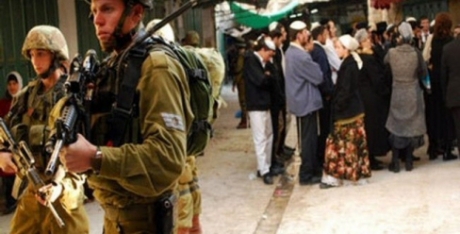
Hebron, Occupied Palestine – During this week’s ‘Pessach’ celebrations from 22nd to 29th April, Israeli settlers and Israeli forces throughout occupied al-Khalil (Hebron) have been taking over Palestinians houses, rooftops, streets and entire areas while denying passage for Palestinians.

Settlers ‘celebrating Pesaach’ while Palestinians are denied access to the area
Last Friday night, with the start of the ‘holiday’, large groups of settlers were going from the illegal Kiryat Arba settlement on the outskirts of al-Khalil, towards the Ibrahimi mosque, 60% of which has been taken over by the settlers that installed a ‘synagogue’ following the 1994 Ibrahimi mosque massacre; while Palestinians were stopped, frisked and delayed.

Israeli forces taking over the roofs of Palestinian family homes
On Monday and Tuesday, Palestinians’ movement was entirely restricted and H2 was completely void of any Palestinian presence in order to facilitate the settler’s freedom of movement and to enable a space for the main ‘Pessach celebrations’. During these two days the checkpoint at the Ibrahimi mosque has remained closed, thus closing off the main entrance for Palestinians heading to the mosque. Palestinians were entirely barred from entering the mosque during these two days, while settlers used the additional 40% of the mosque that has so far remained for Palestinians – with the ‘usual’ entry restrictions and harassment by Israeli forces.

Closed Ibrahimi mosque checkpoint barring Palestinian movement
While bus loads of settlers from all over Palestine are arriving in the Old City of al-Khalil, new barricades, entry and movement restrictions for Palestinians are springing up throughout the city. Al-Faiha’a girls school, right opposite the parking lot used for the settler only buses, has been forced to finish early in order to at least attempt to provide a safe way home for the girls, despite the heavy army and settler presence. During Monday and Tuesday, a sharp decrease in the number of girls attending school was noted by both the teachers and international human rights defenders offering protective presence. Israeli forces have also taken control of two shops right next to the school building and turned it into a military base.

Israeli forces moving into the building next to the girls school
On Monday, Israeli forces escorted endless groups of settlers on a ‘tour’ through the main Palestinian market in the Old City during the busy noon hours – blocking the narrow alleyways while giving a Zionist version of the history of the city. Palestinians were stopped and forced to wait for the tours to pass. One Palestinian man was arrested while another one was seriously injured when settlers threw a rock into the Palestinian market hitting him right on the head.
Despite the area behind Shuhada checkpoint being H1 and thus supposedly under full Palestinian control, Israeli forces on Tuesday brought large groups of settlers, after ‘clearing’ the area for bombs, in a sheer show of their power and in total disregard of any (international) agreement. Shuhada checkpoint has during the ‘holiday’ season seen repeated and arbitrary delays, causing Palestinians to wait for, at times, hours to be allowed to go to their homes located in the ‘closed military zone’ while settlers were freely roaming the streets and could be seen from the checkpoint chit-chatting with the soldiers.
What Kerry’s ‘Absolute Lines’ in Syria Really Mean
Sputnik | April 27, 2016
US Secretary of State John Kerry wants to draw “absolute” lines across Syria to create the Western “areas of influence” there. Such an approach resembles nothing so much as neo-colonialism, experts say.
The idea to create spheres of influence in Syria voiced recently by US Secretary of State John Kerry clearly indicates that Washington continues to pursue its Plan B in Syria.
In his interview with The New York Times editorial board Kerry narrated that the White House proposed to draw clear lines in Syria to the Kremlin.
“We’ve even proposed drawing a line, an absolute line, and saying, ‘You don’t go over there, we don’t go over here, and anything in between is fair game.’ And they are considering that, and I think we will get there in the next week or so,” Kerry told the editorial board.
However, according to the Russian Foreign Ministry, such an approach is oversimplified.
“This approach is slightly simplistic. The principal goal is to fight against terrorism [in Syria],” Russian Foreign Minister Sergei Lavrov said during a press conference on Monday, as quoted by RIA Novosti.
It should be noted that Kerry’s ‘offer’ followed the Saudi-backed High Negotiations’ Committee (HNC) decision to suspend its participation in the Geneva talks on April 21.
On that day most HNC members left Geneva in protest against the ongoing violence in Syria which they blindly blame on Damascus.
The HNC is well-known for its anti-Assad stance. However, by no means the entity represents the Syrian opposition as a whole. The HNC brought together Saudi-backed rebels in Syria, including notorious Ahrar ash-Sham and Jaysh al-Islam groups which actually share the same Islamist ideology as Daesh and al-Qaeda’s affiliate al-Nusra Front.
A day after the HNC demarche Lavrov called attention to the fact that besides the HNC there are also the Moscow and Cairo groups, Hmeymim group and the group of independent opposition members which express their willingness to continue the dialogue with Damascus over the situation in Syria.”Some people have already left [the Syrian opposition’s] High Negotiations Committee [HNC]. They disagreed that radicals ruled the committee, including Jaysh al-Islam leaders. This fact confirms that we were right while proposing to include it in the list of terrorist groups… This group, as well as Ahrar ash-Sham are actively proving in action that they fully support those anti-humane, brutal approaches used by Daesh and Jabhat al-Nusra [al-Nusra Front],” the Russian Foreign Minister underscored.
According to Elena Suponina, President of the Center for Asia and the Middle East at the Russian Institute for Strategic Studies, John Kerry’s offer to divide Syria into spheres of influence with Russia means that Washington now regards Moscow as an equal player in the Middle East.
In her Op-Ed for RIA Novosti Suponina recalls, that four years ago the Obama administration did not even bother to take Russia’s interests in the region into consideration.
However, in general, the White House continues to demonstrate a double-standard approach toward Syria and other regional players, according to the expert.
“It looks as if the colonial epoch and the times of re-division of the world by global powers have returned” Suponina writes, calling attention to the fact that Western policy-makers (most notably John Kerry himself) have repeatedly claimed that it is highly inappropriate to behave “in 19th-century fashion” in the 21st century.
And now Kerry proposes to draw “absolute lines” across the Middle Eastern region, she remarks, warning that Syria is “only the beginning.”
Kerry’s “fair game” in Syria will most likely prompt more destruction and devastation. Is Washington ready to take responsibility for chaos in the region?
On the other hand, Kerry’s proposal looks rather controversial since it was Russia, not the US that was invited to Syria by the legitimate Syrian government.
In his interview with Radio Sputnik political scientist Alexander Kamkin echoed Suponina’s stance.”Genuine peace still looks a way off and it looks like the Western nations still hope to implement the Libyan scenario in Syria… They use the war with Daesh as just a means of building large coalitions, but if you look at the previous such campaigns you will see that our American ‘partners’ rarely practice what they preach,” Kamkin told Radio Sputnik.
Hans-Christof Von Sponeck, former UN Assistant Secretary-General, expressed his concerns regarding the fact that Washington continues to conduct a “series of experiments” in Syria.
“The Americans are never short of experiment, never short of trying something new… It is jumping from one laboratory test to another, and in the meantime the country continues to go further towards a destroyed nation,” Sponeck told Russia Today.
Interestingly enough, it seems that there is no concordance in Washington regarding what to do next in Syria.
US President Barack Obama said Sunday that he does not support the idea of creating so-called “safe” or “buffer” zones in Syria as it would need Washington’s deeper military involvement in the region.
At the same time, Obama has signaled that 250 US Special Operation Forces troops will be soon deployed in the war-torn country.
Read more:
Syrian Parliament Election: Washington Unable to Strangle Assad’s Legitimacy
Bernie Sanders Says US ‘Kill List’ Legal, Backs Troops in Syria
teleSUR – April 26, 2016
People in the United States have “a lot of right to defend ourselves,” presidential contender Bernie Sanders said at a town hall meeting Monday when asked if he too would have an extrajudicial “kill list” like President Barack Obama. The senator from Vermont also endorsed Obama’s recent deployment of another 250 soldiers to Syria as part of the war against the Islamic State group.
“Look. Terrorism is a very serious issue,” Sanders told MSNBC’s Chris Hayes. “There are people out there who want to kill Americans, who want to attack this country, and I think we have a lot of right to defend ourselves.” However, the senator added, “it has to be done in a constitutional, legal way.”
The New York Times revealed in 2012 that President Obama hosts a meeting every Tuesday at the White House where he decides which suspected terrorists will be added to a so-called “kill list.” Those on the list can then be targeted for killing, typically with an unmanned drone.
“Do you think what’s being done now is constitutional and legal?” Hayes asked Sanders, noting the existence of “a list of people that the U.S. government wants to kill.”
“In general I do, yes,” Sanders replied.
Sanders, locked in a tight race with former Secretary of State Hillary Clinton for the Democratic Party’s presidential nomination, was also asked about President Obama’s decision to deploy another 250 U.S. Special Forces to Syria, where they are expected to help largely Kurdish militias fight the Islamic State group.
“Here’s the bottom line,” said Sanders. “ISIS has got to be destroyed, and the way that ISIS must be destroyed is not through American troops fighting on the ground.” However, “I think what the president is talking about is having American troops training Muslim troops, helping to supply the military equipment they need, and I do support that effort.”
“We need a broad coalition of Muslim troops on the ground,” Sanders continued. “We have had some success in the last year or so putting ISIS on the defensive, we’ve got to continue that effort.”
Sanders’ comments on the eve of primaries in Pennsylvania, Maryland, Connnecticut and Rhode Island demonstrate that while he may be less inclined to deploy the U.S. military than Clinton, who he has knocked for backing the 2003 invasion of Iraq, he is no dove himself.
In addition to the the use of drones in Pakistan, Yemen and Somalia, and troop deployments in Syria, Sanders also supports extending the presence of roughly 10,000 U.S. troops in Afghanistan and continuing airstrikes in Iraq and Syria that have likely killed more than 1,000 civilians, according to the independent monitoring group Airwars.org.
Israeli army take control of street under Palestinian authority for illegal settlers’ visit
International Solidarity Movement | April 27, 2016
Hebron, Occupied Palestine – At around 11.30am on Tuesday 26 April, heavily armed Israeli occupation soldiers and border police started appearing in large numbers through Shuhada checkpoint (also called checkpoint 56). This area is H1 area, supposedly controlled by the Palestinian Authority, where Israelis have no legal authority. In blatant disregard of this fact they proceeded to walk down Bir Saba Street, stopping at each shop demanding all cars on the street were removed, but did not make the shops close as they usually do. At the same time the soldiers closed Shuhada checkpoint for registered resident Palestinians, who could neither leave or enter to reach their homes.
The soldiers moved up and down the street, ensuring their demands were met and the cars removed. Where they could not find the owners, they broke into cars to search for explosives. While this was ongoing, more soldiers and border police arrived blocking off the road at the other end from the checkpoint. A sniffer dog was led up and down the street by the soldiers to also search for non existent explosives. The army rummaged around rubbish piles along the road, or made local shop keepers move rubbish for them to inspect, leaving a mess for the Palestinians to clean up.

Occupation soldiers searching for explosives outside local shops. Photo credit: ISM
Several hours later, having also made locals move off the road and sit on the pavement, the reason for this elaborate exercise was clear when a group of approximately 40 settlers, escorted by the same number of border police and soldiers, moved from the illegal settlement inside Shuhada checkpoint into Palestinian territory down the road to a clearly revered tomb, where they spent ten minutes or so. They were then escorted back into the illegal settlement, and followed by five subsequent groups of illegal settlers, again escorted by police and army.
 Illegal settlers escorted by occupation soldiers and border police to the tomb in H1. Photo credit: ISM
Local and international activists were present at several points along the road to monitor and photograph events, and any incidents. When the settlers walked past several of them took photos and/or filmed the activists along the road, for unknown reasons. One settler asked where the internationals were from, and welcomed them to Israel. Not only was this factually inaccurate and a disregard of the Oslo agreement, but a highly insensitive and conflictual comment, made on Palestinian territory.
At three o’clock the “tours” were finished and all the settlers escorted back through the checkpoint into H2 area, where large groups of Palestinians live under Israeli military control. A day of trading was lost for the local shops keepers; not to mention that an Israeli incursion into a Palestinian area is illegal and unacceptable.
Palestinians forced to close shops in Hebron for Israeli Passover visits
Ma’an – April 26, 2016
BETHLEHEM – Palestinian shop owners were forced to close their storefronts in Hebron Tuesday as Israeli politicians called for the annexation of the occupied city during visits by thousands of right-wingers for Passover.
Hebron local and prominent activist Issa Amro told Ma’an that Israeli forces instructed shopkeepers in both the H1 and H2 areas of Hebron to remain closed.
Amro said that by forcing shops to close in H1 — the area of the city under jurisdiction of the Palestinian Authority — the Israeli authorities were supporting right-wing Israelis aiming to push Palestinian locals from the city.
“They want to make it look [to Israeli settlers] like Palestinians don’t live here,” Amro said.
The closures of shops in H1 is likely to come as a detriment to shop owners’ livelihoods while road closures typically implemented by Israeli forces during the visits will impede the movement of Palestinians throughout the Hebron district, Amro added.
The H2 area, under full Israeli military control, continued under lockdown as the Ibrahimi Mosque — known to Jews as the Cave of Patriarchs — was sealed to Palestinian Muslims for the second consecutive day as Israelis visited holy sites in and around the Old City, Amro said.
Amro told Ma’an that large groups of Israelis visiting the area under armed protection on Monday launched verbal abuse at Palestinian locals, and several Palestinian families refused to leave their homes out of fear of violence from the groups.
An Israeli army spokesperson did not have immediate information on increased security measures or closure in the Hebron area for Passover.
Thousands of Israelis descended on Hebron’s Old City Monday as Israeli politicians held a rally in the center of the flashpoint area, under heavy protection by Israeli security forces.
Israeli media outlets reported that Israeli Deputy Defense Minister Eli Ben-Dahan of the Habayit HaYehudi party called on the Israeli leadership to annex the occupied West Bank in its entirety.
“We have to connect Judea and Samaria to the State of Israel. We have returned to our land, so that we will never again have to leave it,” Ben-Dahan said, referring to the West Bank.
Knesset member Oren Hazan, of the Likud party, demanded Israel’s defense ministry allow more Jewish Israelis to settle in Hebron, referring specifically to two buildings reportedly purchased by far-right groups.
“The buildings in Hebron are the basis of peace, not dispute. The time has come to populate Hebron, just as the time has come to populate every hilltop in Judea and Samaria and in all of Israel,” the Jerusalem Post reported Hazan as saying.
Hebron — the largest Palestinian city in the West Bank — has long stood at the epicenter of violence in the occupied West Bank as the Israeli military and settlers attempt to expel Palestinians from their homes, particularly in the Old City where Monday’s rally took place.
The Israeli leadership has long ignored demands by the international community to halt settlement activity in occupied Palestinian territory, and the UN has in the past slammed Israel for expansion of settlements in Hebron’s Old City in particular, where increased Jewish presence has come at the detriment to Palestinian locals.
Emily Mulder contributed reporting from Bethlehem.
BDS suppression backfires as universities pass resolutions
RT | April 25, 2016
The United Auto Workers (UAW) union at the University of California has been fighting to uphold a resolution passed to support the BDS movement against Israel. Its struggle has inspired other university unions to pass their own resolutions.
The UAW Local 2865, which includes some 14,000 students and teaching assistants working for the University of California, passed a resolution to support the Boycott Divestment and Sanctions movement in 2014, becoming the first major labor union to do so, with 65 percent voting in favor of divestment and 52 percent supporting an academic boycott among the student-workers union of the University of California.
“The University of California divest from companies involved in the occupation of Palestine; that UAW International to divest from these same entities; the US government to end military aid to Israel. Fifty-two percent of voting members pledged not to ‘take part in any research, conferences, events, exchange programs, or other activities that are sponsored by Israeli universities complicit in the occupation of Palestine and the settler-colonial policies of the state of Israel’ until such time as these universities take steps to end complicity with dispossession, occupation, and apartheid.” UAW Local 2865 Resolution
An anti-BDS arm of the union called Informed Grads appealed the result, with the help of Gibson, Dunn & Crutche, a law firm that has defended Walmart, Amazon and Chevron, Salon reports. The firm has represented Lockheed Martin, Boeing and other corporations that gain from Israel’s defense spending.
While the International Executive Board defended the integrity of the vote, saying it represented the will of the members, it claimed it could interfere with the flow of commerce and pointed to the possibility of discrimination, despite the number of Jewish and Israeli members that supported the resolution and later wrote a letter attesting to the fact.
Following the decision, lawyer Scott Edelman expressed pleasure at the UAW’s “forceful rejection of BDS, which sets a powerful precedent for other labor unions and national organizations.”
UAW Local 2865 appealed the decision, saying the “IEB improperly ignored the UAW constitutional mandate to solidify the labor movement and build solidarities with other unions, such as the Palestinian labor unions representing hundreds of thousands of workers who issued the call for BDS in 2005.”
The appeal has gone to the UAW Public Review Board who will make a final ruling in the next few months.
The nullification of the resolution has led to increased support for both UAW Local 2865 and the BDS movement among university staff.
UAW chapters at the University of Washington, Univeristy of Massachusetts Amherst and NYU wrote letters of support for the resolution, and went on to pass their own resolutions in April with Massachusetts securing 95 percent of the vote and NYU’s chapter taking 67 percent.
Both groups cited the nullification as a motivating factor for their own votes.
Jennifer Mogannam, a PhD candidate at UC San Diego and member of the union, told Shadowproof the attacks are “part and parcel of the larger Zionist movement’s suppression and attacking of those fighting for Palestinian self-determination and against Israeli settler colonialism.”
A recent BDS victory that saw security firm G4S announce it would end its contracts in Israel has caused Florida country club members to partake in their own boycott. The country club members are threatening to end G4S’s contract with their country clubs in a show of support for Israel.
READ MORE: Israel connects BDS with terrorism while cracking down on German banks
Turkey exercises ‘decisive influence’ on Syrian ‘HNC’: Lavrov
Press TV – April 25, 2016
Russian Foreign Minister Sergei Lavrov says Turkey exercises a “decisive influence” on the so-called opposition group High Negotiations Committee (HNC) which is in peace talks with the Damascus government.
Lavrov made the remarks on Monday while commenting on the progress of the latest round of negotiations between the Syrian government and HNC, which began in Geneva on April 13.
Syria peace talks are going on despite the absence of the Saudi-backed opposition as the group’s leaders left the talks on April 19 to protest at what they called escalating violence and restrictions on humanitarian access in Syria.
A ceasefire, brokered by Russia and the US, went into effect on February 27 across Syria. Fighting, however, picked up and left the truce in tatters. Meanwhile, the UN Security Council has agreed on a six-month deadline for drafting a new constitution for the Arab country in line with the proposal of the International Syria Support Group.
“In order to come to terms over six months it is necessary not to slam the door and dig in heels, as several delegates of the so-called Riyadh group have done, Lavrov said, adding that “it’s no secret” that Turkey has a “decisive influence” on them.
“So one should not come for talks with ultimatums but should sit down at the negotiating table and reach an agreement,” Lavrov added, noting that the situation at the UN-brokered talks could have been better if HNC had not left Geneva.
The top Russian diplomat also said that Moscow was preparing a report for the UN Security Council to extend the list of terrorist groups in Syria.
“We are currently collecting information that Jebhat al-Nusra (al-Nusra Front) subjugates groups that seemed to have declared truce and readiness to join ceasefire,” Lavrov said, adding, “We will summarize facts and present them to [the] UN Security Council to adjust terrorist lists.”
Syria has been gripped by foreign-backed militancy since March 2011. Damascus says Saudi Arabia, Turkey and Qatar are the main supporters of the militants fighting the government forces.
According to UN special envoy for Syria Staffan de Mistura, some 400,000 people have lost their lives as a result of over five years of conflict in Syria.
Saudi-led forces enter town after Qaeda exit
Press TV – April 25, 2016
Forces loyal to Saudi-backed ex-president Abd Rabbuh Mansur Hadi and Emirati troops have reportedly overrun Mukalla after al-Qaeda militants left the seaport in southeast Yemen.
Reuters quoted residents as saying that local clerics and tribesmen negotiated with al-Qaeda to exit quietly and that militants withdrew Sunday westward to neighboring Shabwa province.
They said there was no fighting after Saudi-backed units mobilized their forces at Mukalla’s suburbs. However, the official Saudi news agency SPA claimed on Monday that more than 800 al-Qaeda members had been killed.
Around 2,000 pro-Hadi and Emirati troops reportedly advanced into Mukalla, home to an estimated 200,000 people, taking control of its maritime port and airport and setting up checkpoints.
Mukalla has been the center of a rich mini-state that al-Qaeda in the Arabian Peninsula (AQAP) built up over the past year. The group took control of an almost 600-km (370-mile) band of Arabian Sea coastline.
Once faded into irrelevance, AQAP has gone from strength to strength in Yemen since Saudi Arabia began its ferocious military campaign against the impoverished neighbor.
Al-Qaeda and other Takfiri groups such as Daesh have become stronger as Houthis – their arch enemy in Yemen – have come under the heaviest Saudi attacks for more than a year.
The Rai al-Youm newspaper on Monday pointed out that Saudi Arabia had supplied weapons to al-Qaeda militants in the Abyan and Hadhramaut to confront Houthi fighters.
The paper, edited by prominent Palestinian journalist Abdel Bari Atwan, wrote that Saudi Arabia had decided to retake Mukalla from al-Qaeda in the face of rising criticism in the West of the fallout of the invasion.
The decision was also linked to a US congressional motion to hold the Saudi ruling family accountable for potential roles in the September 11, 2001 terrorist attacks, it added.
Pro-Saudi forces, however, retreated from Zinjibar, the capital of Abyan province in south Yemen, after they entered it on Saturday night.
A bomb-laden vehicle exploded Sunday killing seven pro-Hadi militants who had launched an offensive with the help of Saudi air power.
“The withdrawal was decided following information that al-Qaeda was preparing other car-bomb attacks against our troops,” AFP quoted a pro-Hadi officer as saying.
The alleged recapture of Mukalla coincided with UN-brokered peace talks in Kuwait after a ceasefire entered into effect on April 11, but from which Takfiri groups are excluded.
There was no immediate official reaction to the reports from Houthis and their allies who are to hold their fifth day of peace talks on Monday in a bid to end 13 months of war.
More than 9,400 people have been killed and at least 16,000 others injured since Saudi Arabia launched its airstrikes against Yemen last March.
Merkel’s Syria Safe Zone Partition Scheme
By Stephen Lendman | April 24, 2016
Longstanding US/Israeli plans call for redrawing the Middle East map – including partitioning Iraq and Syria, installing pro-Western/Zionist puppet regimes.
Turkey wants a Syria buffer zone to annex border areas between both countries. Weeks earlier, Russian Foreign Minister Sergey Lavrov blasted the idea, saying creating one would “violate every principle of international law and will lead to a substantial, qualitative escalation” of tensions.
In February, John Kerry told Senate Foreign Relations Committee members that establishing a buffer or safe zone in Syria would require up to 30,000 troops to enforce it, according to Pentagon estimates.
Last November, Trump endorsed the idea, saying “(b)uild a big, beautiful safe zone, and you have whatever it is so people can live, and they’ll be happier.”
Hillary Clinton earlier urged establishing a no-fly zone, the same scheme she used to wage US-led NATO aggression on Libya.
Merkel supported the idea. Now she seeks creating “safe zones” on the phony pretext of protecting internally displaced Syrians, saying:
Establish “zones where the ceasefire is particularly enforced and where a significant level of security can be guaranteed.”
Syria and Russia categorically reject the idea, a thinly veiled partition plan, flagrantly violating international law, also aiming to stem the refugee flow caused by Obama’s war – NATO and regional rogue states complicit in his high crime.
On Friday, Syrian chief peace talks negotiator Bashar al-Jaafari minced no words blasting Western and regional regimes for supporting “organized networks of international terrorism,” continuing to send them cross-border into Syria, “sabotaging the rules of international law,” while claiming to support diplomatic conflict resolution.
War without resolution continues. Peace prospects are unattainable as long as Washington demands regime change.
Stephen Lendman can be reached at lendmanstephen@sbcglobal.net.
His new book as editor and contributor is titled “Flashpoint in Ukraine: US Drive for Hegemony Risks WW III.”
US Supreme Court upholds ruling to seize Iranian assets
Press TV – April 20, 2016
The US Supreme Court has upheld Congress and President Barack Obama’s actions to hold Iran financially responsible for the 1983 bombing that killed 241 Marines at their barracks in the Lebanese capital city of Beirut.
The 6-2 ruling on Wednesday allowed the families of the Marines and victims of other attacks that courts have linked to Iran to seize some $2 billion in assets held in New York’s Citibank, belonging to Bank Markazi, the Central Bank of Iran (CBI), which has been blocked under US sanctions.
The Supreme Court determined that a law passed by Congress did not dictate to the courts how to handle the dispute despite appeals by the CBI.
In 2012, Congress passed a law that specifically directed the American bank to turn over the Iranian assets to victims’ families. Obama also entered the battle in an effort to force the payments on Iran.
Iran, however, argued that Obama and Congress were intruding into the business of federal courts, a practice banned by the US Constitution.
“The US judicial apparatus, with the support of the country’s administration and Congress, has been issuing and enacting rulings against the Islamic Republic of Iran for years, violating basic principles of international law with recourse to unsubstantiated and baseless allegations,” Iranian Foreign Ministry Spokesman Hossein Jaberi Ansari said in December last year.
Associate Justice of the US Supreme Court Ruth Bader Ginsburg rejected the view on Wednesday, saying the legislation “does not transgress restraints placed on Congress and the president by the Constitution.”
Chief Justice John Roberts and Justice Sonia Sotomayor dissented, with Roberts stating that “the authority of the political branches is sufficient; they have no need to seize ours.”
The case involves over 1,300 plaintiffs, who have demanded compensation over several attacks, namely the Beirut bombing, and the 1996 Khobar Towers bombing in Saudi Arabia.
Featured Video
Seyed M. Marandi: Toward Total War in the Middle East
or go to
Aletho News Archives – Video-Images
From the Archives
The Geopolitics behind the War in Yemen (I)
By Mahdi Darius NAZEMROAYA | Strategic Culture Foundation | 30.03.2015
The United States and the Kingdom of Saudi Arabia became very uneasy when the Yemenese or Yemenite movement of the Houthi or Ansarallah (meaning the supporters of God in Arabic) gained control of Yemen’s capital, Sanaa/Sana, in September 2014. The US-supported Yemenite President Abd-Rabbuh Manṣour Al-Hadi was humiliatingly forced to share power with the Houthis and the coalition of northern Yemenese tribes that had helped them enter Sana. Al-Hadi declared that negotiations for a Yemeni national unity government would take place and his allies the US and Saudi Arabia tried to use a new national dialogue and mediated talks to co-opt and pacify the Houthis.
The truth has been turned on its head about the war in Yemen. The war and ousting of President Abd-Rabbuh Manṣour Al-Hadi in Yemen are not the results of «Houthi coup» in Yemen. It is the opposite. Al-Hadi was ousted, because with Saudi and US support he tried to backtrack on the power sharing agreements he had made and return Yemen to authoritarian rule. The ousting of President Al-Hadi by the Houthis and their political allies was an unexpected reaction to the takeover Al-Hadi was planning with Washington and the House of Saudi. … continue
Blog Roll
 Aletho News
- Pakistan-Iran talks secure LNG shipment to Islamabad through Hormuz
- Black Sea grain crisis puts global wheat supplies under pressure
- IRGC air defenses destroy another US MQ-1 drone over Strait of Hormuz
- Imran Khan’s entire immediate family detained in Pakistan ahead of mass protest demanding his release
- EU nation detains former presidential frontrunner
- Leaked: Britain’s Sham Conviction Of Hashim Thaci
- Seyed M. Marandi: U.S. Strike Imminent – Toward Total War in the Middle East
- Russia Voted Under Fire. Washington Is Loading the Tankers.
- 12 Things Your Oncologist Was Trained Not to Tell You
- Anthrax Attacks Paved Way for COVID-Era ‘Junk Drugs and Vaccines’
- If Americans Knew
- An error has occurred; the feed is probably down. Try again later.
- No Tricks Zone
- 2025 Nature Paper Claiming Worsening Global Drought Gets RETRACTED …Heavily Flawed
- New Study: ‘Global Drought Shows No Detectable Recent Acceleration Under Climate Warming’
- Economic Masterminds: German Socialists Suggest Taxing Productivity Gains Stemming From Using AI
- The South China Sea Has Not Been Cooperating With The Climate Change Narrative
- Energy Crisis: Germany Enters Heating Season With Historically Low Gas Reserve Fill Levels
- New Study: The Antarctic Ice Sheet Gained Mass From 2020-2024 Due To Staggering Snow And Ice Accumulation
- Study: Ocean Heating Rates From Thousands Of Years Ago ‘Dwarf’ Modern Ocean Heating Rates
- Climate Extremists Target, Attack Large-Scale Power Grid Infrastructure In Germany!
- New Study: Antarctic Ice Melt Has Contributed Less Than 1 Centimeter To Sea Level Rise In The Last 30 Years
- Fear Of Debate: Alarmist German Climate Scientist Calls On Mainstream Media To Discredit Skeptic Voices
 Aletho News