Israel’s secret plan for migration of Indian Jews draws fire
Press TV – March 27, 2016
The Israeli regime is under fire for a secret plan to renew the permission for the immigration of members of a Jewish tribe in northeastern India to the occupied Palestinian territories.
Earlier this week, Ksenia Svetlova, an opposition member of the Knesset (Israeli parliament), wrote a letter to Immigrant Absorption Minister Zeev Elkin denouncing Tel Aviv’s recent decision to bring 700 Indian nationals to Israel.
Svetlova said the move contradicts the regime’s latest measure to prevent the immigration of members of the Ethiopian Jewish community over budgetary considerations.
“It turns out there is a budget. While the Ethiopian Jews are being left behind, quietly and secretly hundreds of members of the Bnei Menashe community, who identify as descendants of one of the 10 lost tribes, are being brought over,” she said.
While the Ethiopian citizens are living in dire conditions, the Indians “whose Jewishness has yet to be clarified, are being brought over with urgency,” she said.
The newcomers will be settled in illegal settler units in the occupied West Bank settlements, the Knesset member said, adding, “And all this is happening away from the public eye.”
The Bnei Menashe say they have descended from Jews banished to India in the eighth century B.C.
A senior Israeli rabbi recognized the community as a lost tribe in 2005 and about 1,700 moved to Israel over the next two years before the regime stopped giving them visas.
A private organization called Shavei Israel, headed by American-born Michael Freund, a former aide to Israeli Prime Minister Benjamin Netanyahu, runs the campaign for the Bnei Menashe relocation.
Last month, the Israeli regime halted plans to bring over another 9,000 members of the Falash Mura community from Ethiopia. This is while Ethiopians have repeatedly complained about discrimination by Israeli authorities against Jews of African descent.
Third of Palestinian village left homeless by demolitions this year
Ma’an – March 25, 2016
NABLUS – Mass Israeli demolitions in the Jordan Valley village of Khirbet Tana have left more than a third of its Palestinian residents homeless since the beginning of the year, the UN said Friday.
The UN Office for the Coordination of Humanitarian Affairs (OCHA) said 87 of the village’s 250 residents, including 35 children, had lost their homes in three separate demolitions since January.
The demolitions are part of one of the most extensive demolition campaigns in the occupied West Bank in the last seven years, which has left a total of more than 650 Palestinians homeless in less than three months, more than half of whom were children, OCHA said.
“These demolitions generate a coercive environment, exacerbating residents’ risk of forcible transfer, prohibited by international humanitarian law,” the body said.
In Khribet Tana, 53 structures have been destroyed, including 22 homes, 19 animal shelters, six latrine units, five traditional ovens, and a water reservoir.
The UN body said 18 of these structures had been donated as humanitarian aid by the international community, the majority after demolitions were carried out earlier this year.
Half of all Israeli demolitions across the occupied West Bank this year have taken place in areas declared by Israel as “firing zones,” or restricted military areas, which OCHA said constitute nearly 20 percent of the occupied West Bank.
Khirbet Tana is located in “Firing Zone 904A,” in a part of the Jordan Valley that rights groups say Israel intends to fully annex.
Thousands of Bedouins, who have lived there for decades, face the threat of forced displacement, a threat that rights groups say has become more acute in recent years, particularly with large numbers of resident forced to flee during Israeli military training exercises.
Israel’s Civil Administration demolished all structures in Khirbet Tana in 2012, leaving 152 Palestinian residents homeless, including 64 children, according to Israeli rights groups B’Tselem.
That was the fifth wave of demolitions the village had faced since 2005.
Israel’s Coordination of Government Activities in the Territories previously told Ma’an the demolitions were carried out in the village because they were built illegally and were endangered due to their situation inside the firing zone.
However, OCHA noted two illegal Israeli settlement outposts — recently established and built in the same firing zone — where the Israeli authorities have not carried out any demolitions, despite issuing demolition orders.
Trump Makes Same Promise on Jerusalem We’ve Been Hearing Since 1972
By Nima Shirazi | Wide Asleep In America | March 21, 2016

Breaking news!
The news media is abuzz today with reports that, speaking before the American Israeli Public Affairs Committee (AIPAC) conference, an annual gathering of rabid right-wing Israel supporters, a presidential candidate vowed to move the U.S. Embassy in Israel from Tel Aviv to Jerusalem.
So who was it this time? Donald Trump.
So why is this news? It’s not.
Promising to recognize Jerusalem as Israel’s undivided capital and to move the American embassy there is part of Pandering 101 for Oval Office hopefuls. Every candidate in the past few decades knows this. It’s an easy vow to make, and no one ever pays any political price for inevitably breaking it (since half of Jerusalem remains occupied territory and actually moving the embassy there would be a clear violation of international law, which doesn’t recognize Israel’s claim over the historic city). Making such an absurd promise plays well to the writhing masses at AIPAC confabs, establishes one’s Zionist bona fides, and is a quick and easy way to offend indigenous Palestinians living under occupation, apartheid and blockade without actually flipping them the bird.
Nevertheless, the press continues to report on this blustery promise, no matter who utters it, as if it actually merits attention.
While he repeated the promise today for AIPAC, Trump had already said it back in January. And Ted Cruz has too:

And Jeb Bush before him:

So did Mitt Romney in 2012:

And Ron Paul and Rick Santorum the same year before they dropped out of the race:

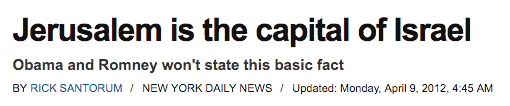
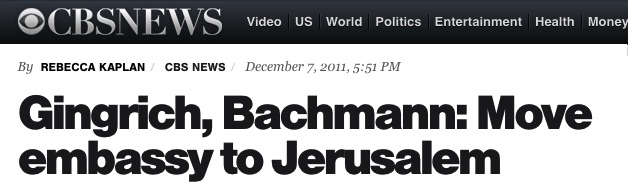
And Newt Gingrich and Michelle Bachmann (and Herman Cain) before them:
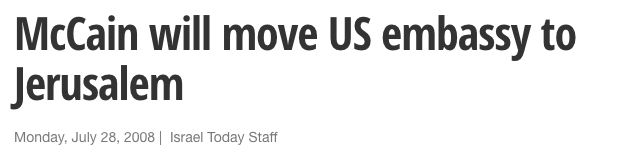
Both John McCain and running mate Sarah Palin made the promise back in 2008:
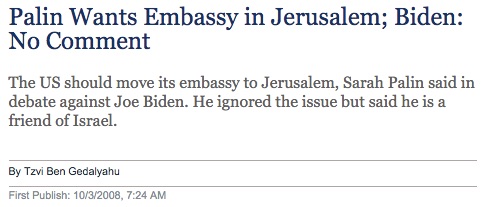
Four years earlier, John Kerry did the same, while also touting his record of making similar demands during his tenure in the Senate:

Before that was Al Gore and George W. Bush in 2000. As reported by The New York Times in May 2000:

(Supporters of moving the embassy were subsequently disappointed in Bush’s failure to act on his promise.)
The year before, while beginning her campaign for New York’s Senatorial seat, the then-First Lady Hillary Clinton weighed in on the matter herself:
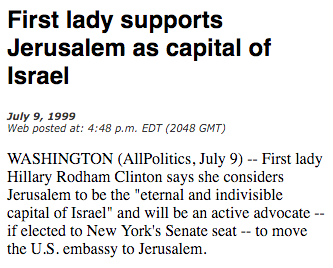
In the mid-1990s, Senate Majority Leader Bob Dole and House Speaker Newt Gingrich similarly pandered like pros:

Before that, in 1992, the Clinton/Gore campaign hit the incumbent Bush administration for balking at the official recognition of “Israel’s sovereignty over a united Jerusalem.” Their campaign promised voters that “Bill Clinton and Al Gore will… support Jerusalem as the capital of the state of Israel.”
Even Mike Dukakis tacked to the right of both the outgoing Reagan administration and George H.W. Bush campaign in 1988:
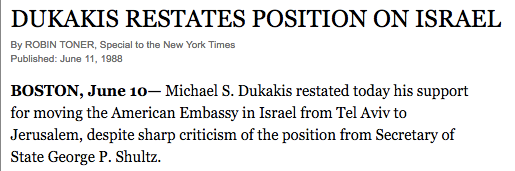
Al Gore, who tried to win the Democratic nomination for president that year, reportedly said in September 1987 that “he would consider moving the U.S. embassy from Tel Aviv to Jerusalem.”
In April 1984, during a heated Democratic primary season, Walter Mondale and Gary Hart bent over backwards to assure voters in New York City that they too supported moving the U.S. Embassy from Tel Aviv to Jerusalem.
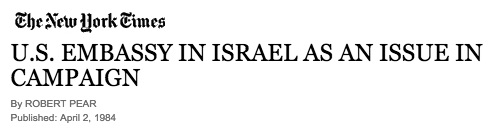
The New York Times reported at the time:
Walter F. Mondale said he had supported such a move for 20 years, and he asserted that Senator Gary Hart had changed his position on the issue five days ago. In the past two weeks, Mr. Hart has denied that he suddenly changed his position, but has said his position has ”evolved.” He has said firmly that if he became President, he would move the embassy to Jerusalem.
The Rev. Jesse Jackson is the only one of the three candidates who opposes moving the embassy. The Reagan Administration also opposes such a move because the status of Jerusalem has long been disputed and the United States does not support Israeli sovereignty over the city.
Despite efforts by New York Senator Daniel Moynihan and California Congressman Tom Lantos to introduce a bill mandating the move, Reagan was adamant about not moving the embassy, as such a divisive policy would, according to his Secretary of State George P. Shultz, “be very bad for the United States” and “damage our ability to be effective in the peace process.”
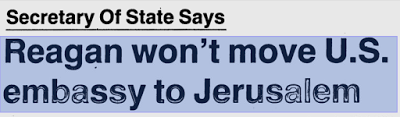
The pandering was so thick, however, that a month later the Reagan administration had to pretend to consider supporting the move in order to stave off losing votes in the upcoming election.

Though the bill eventually stalled, Los Angeles Times syndicated columnist Nick Thimmesch, who called the proposal “one of the dumbest ideas to be advanced in Congress this session,” lamented that “some of the election-year pandering in the Republic verges on the obscene” and credited the ill-conceived gambit to the lawmakers’ “blind obedience to the Israel lobby (American Israeli Public Affairs Committee).” That was October 3, 1984.
By 1986, another bill was introduced to move the embassy, this time brought to the Senate floor by Republican Jesse Helms.
But even in the mid-1980s, though, this was an old political ploy. The New York Times pointed out that the 1976 Democratic Party platform – on which Jimmy Carter and Walter Mondale ran for office – declared:
We recognize and support the established status of Jerusalem as the capital of Israel, with free access to all its holy places provided to all faiths. As a symbol of this stand, the U.S. Embassy should be moved from Tel Aviv to Jerusalem.
Before that, on March 17, 1972, Michigan Congressman Gerald Ford, then the Republican Minority Leader, told a Zionist Organization of America regional meeting in Cleveland that the Nixon Administration should transfer the U.S. Embassy to Jerusalem.
Two years later, after first replacing Spiro Agnew as Vice President and then becoming President himself following Nixon’s resignation, Ford backtracked on his previous position. “Under the current circumstances and the importance of getting a just and lasting peace in the Middle East, that particular proposal ought to stand aside,” Ford said at his very first presidential press conference on August 9, 1974.
It’s been nearly 42 years since then and, sadly, while Palestine remains under brutal occupation, Israeli colonies continue to expand with impunity, and Palestinians are subject to ongoing oppression and violence, election-year pandering in the United States has become more obscene than ever.
Iraqi Shiite militias say US troops ‘forces of occupation,’ demand withdrawal
RT | March 21, 2016
Iran-backed Shiite militia forces in Iraq have strongly opposed new US troops deployed in the country. The militias warned that if Washington does not withdraw its forces “immediately,” they will deal with them “as forces of occupation.”
The US military are “making a new suspicious attempt to restore their presence in the country under the pretext of fighting their own creation, Daesh [acronym for Islamic State, IS, formerly ISIS/ISIL],” the Asaib Ahl al-Haq militia said on its TV channel, al-Ahd on Monday, as quoted by Reuters.
The Shiite group added that “if the US administration doesn’t withdraw its forces immediately, we will deal with them as forces of occupation.”
Additional troops deployed by Washington on Sunday were also strongly objected to by Iraqi Hezbollah on Monday.
The Hezbollah movement in Iraq said the new deployment of US marines is a plot to help IS terrorists.
Stressing its resistance against Washington’s “occupation of the regional states,” Hezbollah said the US has sent its forces to Iraq to further assist IS, the Iranian Fars news agency reported, citing the al-Mayadeen news channel.
Despite Baghdad saying it doesn’t need foreign assistance in fighting jihadists, the Pentagon announced the new deployment on Sunday, saying it has sent a detachment of US Marines to Iraq to bolster the fight against IS.
A group of Marines from the 26th Marine Expeditionary Unit (MEU), was on the ground in Iraq, the US military said, without specifying exactly how many personnel have been sent to Iraq. The move followed the killing of a US marine in an IS rocket attack last week.
Canada rejects the rule of international law and embraces international barbarity
By Mark Taliano | American Herald Tribune | March 18, 2016
The United Nations’ (UN) Security Council Resolution 2254 clearly states that the war in Syria demands a “Syrian-led, Syrian-owned political transition to end the conflict.” Additionally, it endorses “free and fair elections pursuant to the new constitution.”
In November, 2015, however, Canada defense minister Harjit Sajjan publically stated that “Assad must go”, basing his assessment on the “complexity of the problem” and “the horrible atrocities that have been committed to his (Assad’s) own people”. On both counts he is wrong: sustained evidence demonstrates that the foreign-backed mercenaries invading and destroying Syria are the culpable parties who are committing the atrocities. We also know that the invasion of Syria was planned well in advance, and that ISIS and its terror cohorts are deemed to be “strategic assets” by imperial war planners. Additionally, both historical evidence – the illegal invasions and destruction Iraq and Libya for example, and the US military doctrine of “unconventional warfare” present a clear case that the terrorist invaders are Western proxies. The West uses proxies to avoid culpability and to avoid “putting boots on the ground”.
Decoded, then, Sajjan’s assertion is an endorsement for illegal regime change – in a sovereign country led by a (hugely popular) elected president — and it is an incitement to terrorism.
In the context of the carnage, imposed by the West, on the Syrian peoples, an important question needs to be answered: What should Canada do?
A first step would be to reverse what Canada has already done.
Ken Stone, of the Hamilton Coalition To Stop The War, explained in a 2013 article, Canada’s Harper Government Supports Covert Mercenary War On Syria, Funds AL Qaeda Affiliated Rebels, what Canada was already doing to support illegal regime change in Syria:
1. Organizing the covert mercenary war against Syria through the Group of Friends of the Syrian People (“Friends of Syria Group”);
2. Establishing a regime of economic sanctions against Syria and hosting, in Ottawa, the Friends of Syria Group’s International Working Group on Sanctions;
3. Funding and supporting the so-called “rebel” side;
4. Planning for an overt western military action against Syria;
5. Working with Syrian-Canadians antagonistic to the Assad government;
6. Contributing to the demonization of Syrian President Bashar al-Assad and to the de-legitimation and isolation of his government.
In an interview with this writer, Stone explained what we should be doing:
We should withdraw our troops from the (illegal) US Coalition “against ISIS”; we should normalize diplomatic relations with Syria; we should end the (illegal) sanctions against Syria; we should withdraw from the “Friends of Syria Group”; and we should get out of NATO.
Canada needs an independent foreign policy within the framework of international law. The US coalition does not have UN Security Council approval, nor does it have the consent of the elected government of the independent sovereign nation of Syria. Merely “shifting assets” within the illegal coalition is not the answer, nor does it represent “real change”.
Currently, there are over 6 million internally displaced Syrians – those fleeing the invading mercenaries by seeking refuge in government-controlled areas – and over 4 million refugees. Thanks to Syria and its allies, including Russia and Iran, these people are now slowly returning home.
The return of refugees and displaced Syrians to their homes so that they can rebuild their country and their lives, is much preferable to the hardships that surviving refugees and displaced peoples are currently enduring.
Lifting sanctions would be a first important step in achieving this goal. We have already witnessed the devastating effects of (pre-war) sanctions against Iraq, which were directly responsible for the deaths of about five million children under age five and over one million others, so we should not tolerate sanctions against Syria. Propagandists pretend that the suffering of the Syrian people is Assad’s fault, but evidence demonstrates over and over again that we are responsible for the carnage, and illegal sanctions are part of the nexus of crimes creating the carnage. Instead of increasing spending with the framework of an illegal coalition, Canada should focus on legal, life-enhancing, humanitarian goals.
Current NATO efforts to illegally balkanize Syria should also be condemned. On a “macro” level, it is increasingly apparent that this criminal plan for a New Middle East, (as described by Professor Tim Anderson) is creating an overseas holocaust, and is pushing us to the brink of a third world war.
Instead of participating in this clearly fraudulent “war on terror”, the offshoot of the 9/11 neo-con coup d’etat, and the subsequent wars of aggression that have destroyed Libya, Iraq, Ukraine, and Syria, Canada needs to take a stand for humanity and justice.
An acceptance of a “Syrian solution” as stipulated by UN Security Council Resolution 2254, coupled with humanitarian aid – as opposed to illegal warmongering and selling military weaponry to ISIS’s chief financier, Saudi Arabia — would represent “real change”. Canada’s present course, disguised beneath a façade of humanitarianism, needs to be rejected.
Moscow Calls New Expropriation of Land by Israel in Palestine ‘Illegal’
Sputnik – 18.03.2016
MOSCOW — The Russian Foreign Ministry called illegal the new expropriation of land by Israel in the Palestinian territories, according to a statement issued on Friday.
Moscow expressed “concern about the settlement projects of Israel in the occupied Palestinian territories.”
“A few days ago, the Israeli authorities announced the expropriation of 154.5 hectares of land near the town of Jericho in the West Bank of the Jordan River. This area has been declared ‘the land of the Israeli state,'” the statement reads.
“These actions are illegal under international law and the decisions on them should be reviewed,” the ministry stressed.
Moscow urged “all the sides to refrain from unilateral steps that undermine the prospects of the Palestinian issue settlement on the internationally recognized basis.”
Israeli forces close East Jerusalem streets for marathon, detain 4

Ma’an – March 18, 2016
JERUSALEM – The Israeli authorities early Friday shut down streets across Palestinian neighborhoods in occupied East Jerusalem and detained four in preparation for the annual Jerusalem marathon, locals said.
Locals told Ma’an that a number of roads were blocked by iron barricades and buses, as thousands of Israeli runners joined in the marathon for the sixth year in a row.
Four residents of al-Issawiya neighborhood were detained prior to the marathon. Two of them, identified by locals as Fadi Matwar and Jad al-Ghoul, were reportedly warned against being in Jerusalem during the marathon.
Al-Issawiya popular committee spokesman Muhammad Abu al-Hummus, who was detained prior to the marathon last year, was also detained Friday morning.
Locals told Ma’an that Israeli intelligence also summoned Jihad Oweida, the secretary-general of the National Committee against Normalization. The committee has in the past been a vocal opponent of the Jerusalem marathon for going through occupied territory.
Participants in the marathon run through West Jerusalem as well as segments of Jerusalem’s occupied eastern half, including along the walls of the Old City and near other historical sites.
The marathon last year drew large numbers of Palestinian protesters to places where the run passes through neighborhoods under Israeli military occupation, with residents waving Palestinian flags and proclaiming slogans supporting Palestinian claims to Jerusalem.
East Jerusalem is internationally recognized as Palestinian territory, but Israel occupied it in 1967 and later annexed it in a move never considered legitimate abroad.
Friday’s marathon comes weeks before an annual marathon is expected to be held in Bethlehem in the occupied West Bank.
This year will mark the fourth consecutive “Right to Movement” marathon, which is comprised of two 11 kilometer loops, as race organizers were unable to find a contiguous stretch of 42 kilometers due to Israeli military restrictions on Palestinian movement.
Saudi airstrike on Yemeni market had no apparent military reason – UN

RT | March 18, 2016
UN inspectors, who visited the Al Khamees market in north-western Yemen, where Saudi airstrikes killed over a hundred people this week, found no evidence that the attack could have any military goal.
The closest target of any value to justify the bombing is a small checkpoint some 250 meters from the market, which is manned by a small group of Houthis, UN High Commissioner for Human Rights Zeid Ra’ad Al Hussein said on Friday.
The market attack in Hajja Governorate on Wednesday was one of the deadliest incidents in Saudi Arabia’s year-long campaign in Yemen, Zeid said, describing it as “carnage.” The death toll was reported as 106 people, including 24 children. The high figures are explained by the timing of the airstrikes, which were delivered during the afternoon rush hour at the market. It serves as the main shopping destination for some 15 surrounding villages.
Since the Yemeni campaign was launched in March last year by the Saudi-led coalition of Arab nations, the UN has recorded just under 9,000 casualties in Yemen, including 3,218 civilians killed and a further 5,778 injured, Zeid said.
“Looking at the figures, it would seem that the coalition is responsible for twice as many civilian casualties as all other forces put together, virtually all as a result of airstrikes,” he said.
“They have hit markets, hospitals, clinics, schools, factories, wedding parties – and hundreds of private residences in villages, towns and cities including the capital Sana’a,” he added. “Despite plenty of international demarches, these awful incidents continue to occur with unacceptable regularity. In addition, despite public promises to investigate such incidents, we have yet to see progress in any such investigations.”
He warned that “we are possibly looking at the commission of international crimes by members of the Coalition.”
“I urge both sides to swallow their pride and bring this conflict to a halt,” Zeid said. “The people of Yemen have suffered enough. A very poor country is having its limited infrastructure decimated, and people are struggling desperately to survive.”
Earlier, the Al Khamees market bombing was condemned by UN Secretary General Ban Ki-moon and a number of international organizations. Saudi Arabia said it would scale down its aerial campaign in Yemen and focus on training Yemeni troops.
The campaign’s goal in Yemen was to push back Houthi rebels and forces loyal to former President Ali Abdullah Saleh and bring back to power exiled former President Abd Rabbuh Mansur Hadi.
Tunisian Foreign Minister Denounces Legally Baseless Intervention in Libya
By Svetlana Alexandrova – Sputnik – March 15, 2016
Tunisia strongly opposes any military intervention in Libya outside the framework of international law, Tunisian Foreign Minister Khemaies Jhinaoui told Sputnik.
In January, media reported that US President Barack Obama was making plans to open a third front against Daesh in Libya, following military operations in Syria and Iraq started by a US-led coalition in 2014.
“The impact of any foreign involvement or military strikes in Libya will be significant to our security. We are saying to our partners, who are willing to hit the strongholds of terrorists, that they have to inform us about their plans and, of course, we are against any strikes without legal ground. We think that any strike should be made [according to] the international legal framework and UN,” the minister said.
He added that the international community should shift its focus and help Libyans strengthen bonds and resolve their differences.
“We would like to see a new national accord government in Libya assume power and taking care of the terrorism issue. It is a task for the Libyans, not for foreigners to fight terrorism in Libya,” Jhinaoui pointed out.
Libya has been engulfed in conflict since the 2011 overthrow of long-term leader Muammar Gaddafi and the subsequent civil war. There are currently two governments in Libya: the internationally-recognized Council of Deputies based in Tobruk and the Tripoli-based General National Congress. The two sides came to an agreement on December 17, paving the way to the formation of the Government of National Accord.
On Monday, Russian Foreign Minister Sergei Lavrov said that any military operations against terrorists in Libya should only be possible if the UN Security Council agrees to them.
Libya military intervention needs UN approval, says Russian FM
Press TV – March 14, 2016
Russia’s Foreign Minister Sergei Lavrov says any military operation in Libya requires the approval of the United Nations Security Council (UNSC).
Lavrov said during a joint press conference in Moscow with visiting Tunisian Foreign Minister Khemaies Jhinaoui on Monday that Russia is aware of some plans for military involvement in Libya, but insisted that those plans could be implemented only with the permission of the 15-member council.
“We know about what’s being discussed openly and not so openly on plans of military intervention, including with the situation in Libya. Our common position is that this is possible only under the UN Security Council’s decision,” Lavrov said.
The top Russian diplomat also noted that a possible mandate for an operation against the terrorists in Libya must be defined unambiguously so as not to allow misinterpretations.
Russia says that the US-led military alliance NATO abused a United Nations resolution in 2011 to protect Libyan civilians from slain Libyan dictator Muammar Gaddafi’s forces in order to pursue regime change and political assassinations during a popular uprising across the North African country.
The remarks come as New York Times recently reported that the Pentagon and the highly secretive Joint Special Operations Command have provided the White House with “the most detailed set of military options yet” in Libya.
France’s Le Monde newspaper also reported last month that the country’s special forces and members of the country’s external security agency Directorate-General for External Security (DGSE) were in Libya for “clandestine operations” in cooperation with the US and Britain.
Meanwhile, a UN panel is also investigating claims that Turkey, the United Arab Emirates (UAE) and Sudan have violated an existing arms embargo by providing weapons to warring groups operating in Libya.
In mid-February, Libya’s internationally recognized Prime Minister Abdullah al-Thinni accused Ankara of interference in his country’s internal affairs.
Since 2014, when militants seized the capital Tripoli, Libya has had two parallel parliaments and governments.
Daesh took advantage of the chaos and captured Libya’s northern port city of Sirte in June 2015, almost four months after it announced its presence in the city, and made it the first city to be ruled by the militant group outside of Iraq and Syria.
Featured Video
Seyed M. Marandi: Toward Total War in the Middle East
or go to
Aletho News Archives – Video-Images
From the Archives
The Geopolitics behind the War in Yemen (I)
By Mahdi Darius NAZEMROAYA | Strategic Culture Foundation | 30.03.2015
The United States and the Kingdom of Saudi Arabia became very uneasy when the Yemenese or Yemenite movement of the Houthi or Ansarallah (meaning the supporters of God in Arabic) gained control of Yemen’s capital, Sanaa/Sana, in September 2014. The US-supported Yemenite President Abd-Rabbuh Manṣour Al-Hadi was humiliatingly forced to share power with the Houthis and the coalition of northern Yemenese tribes that had helped them enter Sana. Al-Hadi declared that negotiations for a Yemeni national unity government would take place and his allies the US and Saudi Arabia tried to use a new national dialogue and mediated talks to co-opt and pacify the Houthis.
The truth has been turned on its head about the war in Yemen. The war and ousting of President Abd-Rabbuh Manṣour Al-Hadi in Yemen are not the results of «Houthi coup» in Yemen. It is the opposite. Al-Hadi was ousted, because with Saudi and US support he tried to backtrack on the power sharing agreements he had made and return Yemen to authoritarian rule. The ousting of President Al-Hadi by the Houthis and their political allies was an unexpected reaction to the takeover Al-Hadi was planning with Washington and the House of Saudi. … continue
Blog Roll
 Aletho News
- Israeli lobby seeks to bind US fate to ‘Israel’: Araghchi
- Pakistan-Iran talks secure LNG shipment to Islamabad through Hormuz
- Black Sea grain crisis puts global wheat supplies under pressure
- IRGC air defenses destroy another US MQ-1 drone over Strait of Hormuz
- Imran Khan’s entire immediate family detained in Pakistan ahead of mass protest demanding his release
- EU nation detains former presidential frontrunner
- Leaked: Britain’s Sham Conviction Of Hashim Thaci
- Seyed M. Marandi: U.S. Strike Imminent – Toward Total War in the Middle East
- Russia Voted Under Fire. Washington Is Loading the Tankers.
- 12 Things Your Oncologist Was Trained Not to Tell You
- If Americans Knew
- Israeli Attacks in Gaza Kill at Least Seven Palestinians Over Three Days, including Woman and Child
- Trump’s militarization of Washington DC as he pursues Israel’s war against Iran
- Why Israel Fears This Searing New Documentary
- Huckabee aide solicited cash gifts from Israelis
- This isn’t sci-fi, AI is already killing people
- ‘The Most Brutal Thing’: Investigation Reveals Execution of Elderly Woman in Rafah
- Inside Israel’s ‘soft’ ethnic cleansing plan for Gaza through the eyes of its victims
- New online database tracks pro-Israel political donations in the United States
- Israeli president pardons soldier convicted for killing wounded Palestinian
- Singer Ed Sheeran says his ‘heart broken’ by Gaza devastation, addresses Macklemore controversy
- No Tricks Zone
- 2025 Nature Paper Claiming Worsening Global Drought Gets RETRACTED …Heavily Flawed
- New Study: ‘Global Drought Shows No Detectable Recent Acceleration Under Climate Warming’
- Economic Masterminds: German Socialists Suggest Taxing Productivity Gains Stemming From Using AI
- The South China Sea Has Not Been Cooperating With The Climate Change Narrative
- Energy Crisis: Germany Enters Heating Season With Historically Low Gas Reserve Fill Levels
- New Study: The Antarctic Ice Sheet Gained Mass From 2020-2024 Due To Staggering Snow And Ice Accumulation
- Study: Ocean Heating Rates From Thousands Of Years Ago ‘Dwarf’ Modern Ocean Heating Rates
- Climate Extremists Target, Attack Large-Scale Power Grid Infrastructure In Germany!
- New Study: Antarctic Ice Melt Has Contributed Less Than 1 Centimeter To Sea Level Rise In The Last 30 Years
- Fear Of Debate: Alarmist German Climate Scientist Calls On Mainstream Media To Discredit Skeptic Voices
 Aletho News