Reacting to antagonized Palestinian snowballing protests to her government’s decision on June 5 to reverse a 47-year old bipartisan consensus on describing eastern Jerusalem as “occupied,” Foreign Minister Julie Bishop on June 13 denied any “change in the Australian government’s position.”
On June 5, Australian Attorney-General George Brandis in a statement said: ”The description of East Jerusalem as ‘Occupied East Jerusalem’ is a term freighted with pejorative implications, which is neither appropriate nor useful.”
The new Australian terminology provoked Jordan, the third largest importer of Australian sheep in the Middle East, to summon Australia’s charge d’affaires, John Feakes, to convey its “concern” because “The Australian government’s decision violates international law and resolutions that consider east Jerusalem as an integral part of all Palestinian territories occupied in 1967.”
Similarly, the Australian Representative in Ramallah, Tom Wilson, was summoned by the Palestinian Ministry of Foreign Affairs to convey “deep concern” because Brandis’ remarks “contradict all international resolutions.” They requested “official clarification.”
Bishop’s “no change” statement came in response. It was followed on June 14 by Prime Minister Tony Abbott who said, while on a trip to North America, that his government had made only a “terminological clarification.”
Australia still “strongly” supports the “two-state solution” and “there has been no change in policy – absolutely no change in policy,” Abbot said, but at the same time confirmed that, “We absolutely refuse to refer to occupied East Jerusalem.”
Abbot two days earlier stated that the Occupied Palestinian Territories (OPT) are in “truth … disputed territories.”
Canberra is showing no signs of backing down. Australian ambassador to Israel, Dave Sharma, on June 11 said Brandis’ reasoning could lead his government to similar official linguistic change on the West Bank.
“I think we just call the West Bank, ‘the West Bank,’ as a geographical entity without adding any adjectives to it, whether ‘occupied’ [the Palestinian position] or ‘disputed’ [the Israeli position]. We’ll just call it what it is, which is ‘the West Bank.’,” he told the Tablet. However, this is not official yet, he said.
“There has been no change in the Australian government’s position on the legal status of the Palestinian Territories, including East Jerusalem,” Bishop “clarified” in her statement. She was not convincing. The credibility of Bishop’s and Abbot’s denial of “change” could hardly be plausible.
It is a “radical change in the Australian position on Palestine,” Palestinian Foreign Minister Riyad al-Maliki said. The head of the Palestinian delegation to Canberra, Izzat Abdulhadi, said Australia’s new stance is “very provocative.”
On June 12, Arab and Islamic ambassadors from 18 countries, including Saudi Arabia, Egypt and Indonesia, protested to Australia’s Department of Foreign Affairs in Canberra.
Jerusalem is the permanent headquarters of the Organization of Islamic Cooperation (OIC). The organization was founded in response to the burning of Al-Aqsa Mosque, Islam’s third holiest site, by the Australian arsonist Michael Dennis Rohan in 1969.
The Australian on June 10 reported from Jerusalem that the 57-member OIC will hold a joint emergency meeting this month with the 22-member Arab League to decide their response to Australia’s “terminology” declaration.
Secretary General of the Arab League, Nabil al-Arabi sent Bishop a “letter of protest” requesting “official clarification,” his deputy Ahmad bin Hilli said last Monday.
Palestinians are on record to invoke the multi-billion annual Australian agricultural exports to the member states in the discussions. Australian Deputy Prime Minister Warren Truss told reporters last Friday that “we will work very hard with them … to maintain the trade,” but so far his government has shown no signs to that effect.
Bishop’s and Abbot’s “no change” statements tried to imply that their country’s policy has not changed and that if there was a change it is a linguistic one only.
Either case the change in “terminology” serves neither Australian nor Palestinian interests. Coming ahead of Israeli Prime Minister Benyamin Netanyahu’s upcoming visit to Australia this summer, to be the first ever sitting Israeli premier to visit Canberra, it serves only as a free of charge welcoming present.
However, coming on the 47th anniversary of the Israeli occupation of the Palestinian territory in eastern Jerusalem, West Bank and Gaza Strip and in 2014, which the United Nations proclaimed an International Year of Solidarity with the Palestinian People, the Australian “change of language” was “absolutely disgraceful and shocking,” according to the member of the Executive Committee of the Palestine Liberation Organization (PLO), Hanan Ashrawi.
“Such inflammatory and irresponsible statements … are not only in blatant violation of international law and global consensus, but are also lethal in any pursuit of peace and toxic to any attempt at enacting a global rule of law,” Ashrawi was quoted as saying by the Times of Israel on June 6.
In fact, describing the Palestinian territories, eastern Jerusalem inclusive, as “occupied” is not only a Palestinian position.
The Israeli annexation of East Jerusalem has not been recognized by the international community and all 193 countries of the UN, including the U.S., refuse to have their embassies in Jerusalem because it would imply their recognition of the city as Israel’s capital.
Published by The Guardian on this June 11, Ben Saul wrote: “Calling east Jerusalem ‘occupied’ simply recognizes the near-universal legal status quo, namely that it is not sovereign Israeli territory.”
“Declaring that east Jerusalem will not be described as ‘occupied’ implies that Australia rejects the application of international humanitarian law … The term “occupation” is therefore not pejorative or judgmental.” Saul said, adding that “Australia’s new view … corrodes the international rule of law and violates Australia’s international law obligations” in accordance with the Geneva conventions to which both Australia and Israel are signatories.
The UN Security Council Resolution 478 on August 20, 1980 censured “in the strongest terms the enactment by Israel of the ‘basic law’ on Jerusalem,” affirmed “that the enactment of the ‘basic law’ by Israel constitutes a violation of international law” and determined “that all legislative and administrative measures and actions taken by Israel, the occupying Power, which have altered or purport to alter the character and status of the Holy City of Jerusalem, and in particular the recent ‘basic law’ on Jerusalem, are null and void and must be rescinded forthwith.”
Ninety UNSC resolutions, let alone 40 others vetoed by the U.S., rule accordingly. Now Australia is the only other nation that joins and supports Israel in its violation of all these resolutions. Aside from Israel, it is also the only nation to change its language on the Palestinian Occupied Territories.
Australian linguistics in context
The Palestinian people are not known for their short memory. They view the Australian government’s “terminological clarification” in the context of the country’s recent pro-Israel changes of policy as well as in Australia’s historical anti-Palestinian policies.
Last month, Ambassador Sharma met in East Jerusalem with the Israeli Minister of Housing Uri Ariel, who is in charge of the illegal construction of the colonial settlements in the OPT.
In January this year, while on an official visit to Israel, Foreign Minister Bishop told the Times of Israel that she isn’t convinced that Israeli construction of illegal settlements in OPT is a violation of international law, and called international boycotts of these settlements “anti-Semitic” and “Hypocritical beyond belief.”
Last November, Australia failed to join 158 nations who supported a UN General Assembly resolution calling for an end to Israeli settlements or to join 160 countries which supported another resolution calling on Israel to “comply scrupulously” with the 1949 Geneva Conventions.
In November 2012, Australia abstained from supporting the UNGA recognition of Palestine as a “non-member observer state” by a vote of 138 to 9, rendering PM Abbot’s latest “clarification” that Australia still “strongly” supports the “two-state solution” a hollow statement.
Quoted by Emeritus Professor Peter Boyce AO, President of the Australia Institute of International Affairs in Tasmania, a 2010 study found that 78% of Australians were opposed to Israel’s settlements policy and only 22% thought Jerusalem should be recognized as Israel’s capital. More recently, at the time of the 2012 General Assembly vote on Palestinian non-member observer State status, 51% of Australians thought their country should vote “Yes” and only 15% “No.”
“Australia has had an important role in the establishment of the Israeli state” and it “stood alone among western governments in its uncritical alignment with Israel,” Professor Boyce wrote.
Certainly Boyce had history in mind. Australia in its capacity as the Chairman of the UN General Assembly’s Ad Hoc Committee on Palestine helped to push through the UN Partition Plan on November 29, 1947. It was the first UN member state to vote in favor of Israeli statehood and the first to grant Israel de-jure recognition when the U.S. recognized it de-facto only. Israel was also the first Middle East country with which Australia established diplomatic relations in 1949.
Australia had defended all Israeli wars on Palestine, Egypt, Jordan, Lebanon and Syria as “in self defense,” especially the 1967 war in which it occupied more Palestinian territories and the lands of four Arab countries.
Nicola Nasser is a veteran Arab journalist based in Birzeit, West Bank of the Israeli-occupied Palestinian territories. nassernicola@ymail.com
June 17, 2014
Posted by aletho |
Ethnic Cleansing, Racism, Zionism, Illegal Occupation, Timeless or most popular | Australia, Jerusalem, Palestine, West Bank, Zionism |
Leave a comment
The 2 million-member Presbyterian Church (USA) is about to make history in the Middle East, yet again. In the coming days, local delegates from the Church will travel to Detroit to attend the 221st Presbyterian General Assembly to consider a set of eight overtures that ask church leaders to review support of two states for Palestine and Israel in light of unfolding facts on the ground. Other issues to be considered are backing of equal rights and unblocked economic development for all inhabitants of Israel, and divesting from the likes of Caterpillar, Hewlett-Packard, and Motorola Solutions. The Church is clearly stepping up to the plate and realigning its policies with its values.
Political America and Corporate America should be taking note.
Reminiscent of the struggle against Apartheid South Africa, the Church is poised to step in where successive US administrations have failed to hold Israel accountable to international and humanitarian law, not to mention sheer common sense.
The U.S. has paid never-ending lip service to the need to end Israel’s 47-year military occupation of the West Bank, including East Jerusalem, and the Gaza Strip. During the past two decades, the U.S. has coupled lip service with the monopolizing of a peace process that has led the international community to a dead end; not to mention leaving Muslim and Christian Palestinians on the ground, in the occupied territory as well as in Israel, standing naked in front of a state bent on militarily controlling another people and discriminating against over 20 percent of their own non-Jewish population. Presbyterians have had enough and are taking the lead to change the equation and stop the damage being perpetrated by Israel.
Political America should not take lightly the new reality that mainstream churches and civil society have reached a point where they can no longer blindly repeat calls for a resolution based on “two states” when Israeli actions on the ground, by way of continued illegal settlement building and much more, have created a single state reality between the Mediterranean Sea and Jordan River. Secretary of State John Kerry alluded to exactly this at the outset of the last failed round of U.S.-led negotiations when he testified to the House Foreign Affairs Committee in April 2013 and noted, “I believe the window for a two-state solution is shutting, I think we have some period of time – a year to year-and-a-half to two years, or it’s over.” The Presbyterian Church is crying out from the highest mountain it can that for a two-state solution not to be “over” immediate action must be taken. They are calling for the Church to review this core issue over the next two years.
Corporate America should also be closely following the Presbyterian General Assembly’s proceedings.
In the 2012 Assembly, delegates addressed the issue of divesting from firms that benefit from or contribute to Israel’s military occupation by attempting to pass a resolution calling for divestment from Israel. When the so-called pro-Israel lobby got word of this, they mobilized to introduce and pass a counter overture that promotes “positive investment” instead of divestment. In a perfected Orwellian move, these lobbyists publicly promote investment in Palestine, while simultaneously turning a blind eye to the systematic Israeli polices strangling the Palestinian economy.
Investment in Palestine — without divestment from the Israeli occupation — only continues to underwrite the status quo of military occupation. For investment to be successful occupation must be dismantled and sovereign control of Palestine’s economic resources passed to the Palestinians.
In this month’s Assembly, the divestment resolution will be brought to the floor once again for a vote. Now it comes at the heels of Secretary Kerry’s failed blitz to resolve the conflict and a momentous trip by the Pope to Bethlehem where he prayed at the illegal Separation Wall. The US-based organization, Jewish Voice for Peace, recently noted that the Israel lobby’s efforts have included offering Presbyterian leaders all-expenses-paid trips to Israel. Presbyterians can use this opportunity to straighten the White House’s spine based on what the administration already knows: Israel is intentionally blocking progress in the peace talks while jeopardizing US strategic interests in the region, not to mention the fate of Palestinians and Israelis alike.
Palestinian civil society and Palestinians — Christians and Muslims — have urged everyone interested in seeing peace with justice to divest from the occupation and to invest only where the occupation does not benefit. We struggle to remain hopeful while a cement wall as high as 24 feet tall snakes through our homeland. After all, we do not seek a beautified prison. We want the prison walls dividing Palestinians from Palestinians to come tumbling down, and that will not happen unless economic pressure is placed on Israel to end the occupation. Thus, the upcoming Assembly’s overture that calls for divestment from firms benefiting from the occupation, while affirming “Occupation-Free Investment in Palestine,” is spot on.
Palestinians did not invent the non-violent tool of divestment. After unsuccessfully trying to secure their rights using a multitude of other means, Palestinians have focused their efforts on non-violent methods of resisting military occupation that have been used throughout history by others: boycott, divestment, sanction, international law, civil disobedience, diplomatic efforts, economic resistance, and the like. Supporting these tools is supporting non-violence; the alternative is to push Palestinians into using violent means of resistance. If nonviolence is deemed unacceptable then violence becomes that much more likely.
The upcoming Presbyterian vote provides an important opportunity to say yes to nonviolence as the means to overcoming Israeli occupation and discrimination.
Sam Bahour is a Palestinian-American business consultant in Ramallah, the West Bank, and blogs at epalestine.com.
June 17, 2014
Posted by aletho |
Ethnic Cleansing, Racism, Zionism, Illegal Occupation | Human rights, Israel, Palestine, United States, Zionism |
Leave a comment
RAMALLAH – The Palestinian Authority on Sunday condemned the Israeli arrest campaign across the West Bank and airstrikes against the Gaza Strip, denouncing the “collective punishment of the Palestinian people” by Israeli forces.
Spokesman for the Palestinian national consensus government Ehab Bessaiso on Sunday also reiterated Palestinian insistence that they have no responsibility for security in the settlements, as Israel continued assaults against Palestinians that began after the disappearance of three Israeli teenagers from the Gush Etzion settlement between Bethlehem and Hebron on Thursday.
“The Israeli government cannot hold the Palestinians responsible for security in occupied territories which are not under Palestinian sovereignty and which house dozens of settlements and outposts,” Bessaiso said in a statement.
Bessaiso highlighted that the three youths went missing in the approximately 62 percent of the West Bank that is considered Area C and is under full Israeli control.
Bessaiso also said that the detention of 80 people across the West Bank and the bombing of Gaza overnight constitute “collective punishment against the entire Palestinian people,” and called upon the “international community and all international human rights organizations to protect the Palestinian people against the Israeli escalation.”
Bessaiso highlighted that even Palestinian prisoners in Israeli custody were being punished by Israel, through the banning of family visits and “other oppressive procedures,” even as around 125 administrative detainees entered their 53rd day of a collective hunger strike.
Bessaiso also said that Israel had imposed a general closure on the Hebron area in the southern West Bank, leaving thousands of Palestinians under siege.
Earlier Sunday, Hamas denied Israeli allegations that their members were involved in the kidnapping of the three Jewish youths, calling the claims “stupid.”
Overnight Sunday Israeli forces detained 80 Palestinians including a number of former ministers and top lawmakers and carried out airstrikes across the Gaza Strip, injuring a woman and a 15-year-old girl.
On Saturday, Netanyahu had said he held the Palestinian Authority responsible for the disappearance of the youths, while the PA has insisted it has no authority over the territory in which the youths disappeared.
June 15, 2014
Posted by aletho |
Ethnic Cleansing, Racism, Zionism, Illegal Occupation, Subjugation - Torture | Human rights, Israeli settlement, Palestine, Zionism |
Leave a comment

‘I have a vision that suddenly all the Jewish people will come to live here… And if there were 10 million Jews here, we wouldn’t have to give up on anything.’
Reuven Rivlin was elected yesterday the tenth president of Israel. He has previously served as Speaker of the Knesset (2003-’06, 2009-’13), and has been a Member of Knesset since 1988. Hailing from PM Netanyahu’s Likud party, Rivlin also served as a minister in Ariel Sharon’s government (2001-’03). He will replace Shimon Peres when the latter’s term ends in July.
“I whole-heartedly believe that the land of Israel is ours in its entirety.”
“The communities in Judea and Samaria [Ed. referring to West Bank settlements] do not threaten our existence, they guarantee our existence.”
“Today, almost 20 years after Oslo, we can see clearly that the idea of separating the [Israeli and Palestinian] nations failed.”
“For some reason the settlement enterprise is being accused of being an obstacle to peace. Personally, I explain at each possible forum that the obstacle to peace is the objection by the Arabs to it and the fact that they do not want us here”.
Israeli citizens who marry Palestinians need to move to “the other side“.
“Dividing Jerusalem will bring disaster for the city. It cannot be that every time something is built in Jerusalem, the international community censures it. This constant criticism is a mark of disgrace for the international community.”
“We will not apologize – not for conquering Katamon or Jaffa or Tzfat, nor for liberating Hebron, and not for building Jerusalem our capital.”
“The residents here [in Migron settlement] are not thieves and are not trying to banish people from their land. They came here innocently, with the encouragement of the State of Israel.”
“There is no consensus in Israel regarding the two state formula. We will not, under any circumstances, allow the establishment of a neighbouring state that will be a genuine threat on our existence.”
“Zionism from its outset was a settlement movement. If we stop going on this path, how can we justify the faith that all of Zion belongs to us?”
“There are red lines that I as a democrat, say you cannot cross. I see it as defiance against Israel and Jerusalem as its capital as well as another protest against the historical narrative, a matter already pending before the High Court.” (Responding to a MK Tibi-proposed bill recognising Jerusalem as the capital of a Palestinian state)
“I have a vision that suddenly all the Jewish people [from around the world] will come to live here… And if there were 10 million Jews here, we wouldn’t have to give up on anything.”
“If the Nakba is a tragedy, then the establishment of the State of Israel is a tragedy. The Palestinians experienced a catastrophe that was brought on by their leaders, but the establishment of the State of Israel is not the reason for it.”
“Terrorism is trying to paralyze and silence democracies fighting against it, exactly as was manifest in the world’s reaction to Israel’s counter-terrorist offensive Cast Lead in light of the Goldstone Report.”
“We miss [Rehavam Ze’evi’s] clear, ideological voice, his leadership, his larger than life presence.”
June 11, 2014
Posted by aletho |
Ethnic Cleansing, Racism, Zionism, Illegal Occupation | Hebron, Human rights, Israel, Jerusalem, Palestine, Zionism |
Leave a comment
Yesterday morning on the 8th June, Israeli police forces raided the village of Iqrit (located on the northern tip of Israel, within eyesight of Lebanon). The police uprooted trees, destroyed and confiscated all the personal belongings of Palestinian activists present in the village. Furthermore they beat and violently arrested 3 Palestinian men who were present in the village at the time. The 3 arrested are: Walla Sbait, Nidal Khoury and Jeries Khiatt. They were taken to the police station in Nahariyya, where they were kept in detention over night.
Today at 8:30 AM the three detainees were brought before the Kiryat Gat Magistrates’ Court, following a police request for an extension of their detention. The police have charged the detainees with trespassing the land owned by the ILA, obstructing the work of public officials, assaulting a public employee and endangering public order.
The court ruled that Nidal Khoury is kept in detention until Wednesday 11th of June. Walaa Sbeit and Jeries Khiatt was sentenced house arrest until Sunday 15th of June and they are not allowed to go back to Iqrit for 60 days.
As the season of Advent approached in November 1948, the Israeli military forced residents of Iqrit and the neighboring village of Kufr Bir’im —all citizens of the newly created state of Israel— to leave their homes near the northern border with Lebanon because of military operations in the area. The Israeli forces made a promise to the inhabitants, that they could return to their homes after 15 days. The people of Iqrit are still waiting. In July 1951, the Israeli High Court ruled that the people of Iqrit and Kufr Bir’im had the right to return to their homes. The military refused to comply, and on Christmas Eve 1951 blew up all houses in both villages.
Shortly thereafter, all village lands were confiscated by the state and has been rented out to the nearby Kibbutz for their cows to graze until this day. Since then, decades of demonstrations and legal appeals for the villagers’ right to return have seen a string of favorable decisions by courts and commissions that have resulted only in more broken promises and unenforced rulings.In the 1970s, the government had granted use of the cemetery —allowing only the dead to return to Iqrit after they lived and died in exile at Kufr Yasif, Rameh, Haifa or other places. The original villagers and their descendants —now around 1,500 people scattered across northern Israel— are allowed only to hold services in the church and bury their dead in the cemetery. Every first Saturday of the month there has been a mass held at the village church and every year a summer camp has been organised on the hillside. In August 2012 the third generation reclaimed their village.
Around 20 descendants from Iqrit took the initiative to begin resurrecting the village despite the village’s legal limbo. The activists make sure that the village is constantly inhabited, sleeping in tents, under the stars or in rooms attached to the church. The group consists of university students, factory and restaurant workers, and teachers.
Their attempts to construct or plant anything in the village have been met with immediate demolition by the Israeli authorities. But over time, they’ve been able to add a few amenities, including solar panels on the church roof, determined to bring back life to Iqrit.
Iqrit’s 80 homes are long gone, but the activists goal is to rebuild Iqrit for the villagers-in-exile, refusing only to return to their home in coffins, but alive. The activists have returned to the area and are discussing on how to proceed with their campaign, determined not to be intimidated by Israeli forces and their harassment.
June 9, 2014
Posted by aletho |
Ethnic Cleansing, Racism, Zionism, Illegal Occupation, Timeless or most popular | Israel, Palestine, Zionism |
Leave a comment
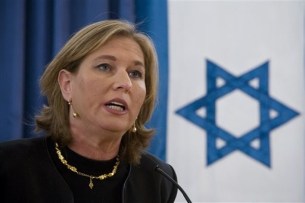 An Israeli committee tasked with putting forward a law on the “Jewish State” is scheduled to be formed today, Sunday, 8 June.
The committee will be chaired by Justice Minister Tzipi Livni and is expected to have among its members MK Ruth Calderon (Yesh Atid) and the initiators of the proposal MKs Oielit Shaked (Jewish Home) and Yariv Levin (Likud).
Livni and Yair Lapid had previously stated that they would oppose the bill.
The formation of the committee has been approved by the Israel PM Benjamin Netanyahu, Haaretz said, adding that Netanyahu will adopt any agreement reached by the committee and will help adopt a legislation as proposed by the committee.
According to Haaretz, bills on the “Jewishness of Israel” proposed in recent years aimed at obliging courts to favor “Jewish identity” over “the Decmocratic nature” of decisions, since the Jewishness of the state contradicts with its being democratic.
The text of the bill describes Israel as “the national home of the Jewish people,” and that “the right to determine the destiny of the nation in Israel is owned by the Jewish people alone.” The bill also states that “The land of Israel is the historic home of the Jewish people.”
June 9, 2014
Posted by aletho |
Ethnic Cleansing, Racism, Zionism, Illegal Occupation, War Crimes | Israel, Palestine, Zionism |
Leave a comment

Slavyansk residents take shelter in the basement of their house during a heavy artillery shelling on June 8, 2014. (RIA Novosti / Andrey Stenin)
Death and destruction is reported in eastern Ukraine as Kiev’s artillery has resumed shelling the rebellious city of Slavyansk. Locals tell RT they have been without running water and power for days, and that hope is fading.
“The shells broke just near the central square. They hit residential houses, a furniture factory, a cafe and communications post,” an unnamed representative of the local city council told Itar-Tass. “There are victims among the civilians and some people received shrapnel wounds.”
“At this time there were many people in the center because of the Pentecost Mass in the nearby church has just ended,” the source added.
Four people were killed in the result of the shelling, a small girl among them. Seven people were taken to hospital with injuries, RT’s correspondent Andrey Krasnoschyokov reports from the scene.
Kiev’s artillery also has hit a gas pipe in the city, but there was no explosion threat, the city council told RIA Novosti. Another shell struck a petrol station outside Slavyansk, and a blast and fire followed.
Slavyansk residents say their spirits are getting lower, as the city is completely surrounded by Kiev’s armed forces and there is constant shooting and shelling while evacuation is hindered.
“Slavyansk has been attacked by massive shelling overnight,” a local resident told RT, adding that the shelling never stops.
As the man was speaking to RT in the morning, he saw massive columns of smoke coming from the city outskirts. The sounds of shelling were heard distinctly over the phone.
The city is preparing to survive without drinking water and electricity.
“Residents are living a third day without water, some people even the fifth… Half [of the city population] doesn’t have electricity,” the man said.
As shops ran out of drinking water supplies too, Twitter images showed that residents had started scooping the remaining water out of fountains.
According to RT’s witness, those water and electricity lines that have been broken are located in the “war zones,” where most of the fighting takes place, that’s why it is almost impossible to repair them.
“There is an impression that [Kiev forces] are striking in the vicinity of high-voltage lines to disrupt them and leave the city without water and electricity,” he added.
‘Slavyansk is a total nightmare’
Slavyansk residents are leaving the besieged city with shells whistling above their heads, local driver Vladimir, who evacuates at least 10 residents a day, told RT.
“This is a total nightmare what is happening in Slavyansk. They [Kiev troops] only let women and children leave the city – they are forced to walk through the checkpoints,” Vladimir says. “Men are not allowed to leave or enter the city.”
Vladimir, who literally drives through never-ending gunfire, says Slavyansk residents are mostly seeking refuge in Crimea or in nearby regions.
Meanwhile, Ukraine’s National Guard has begun artillery fire in the outskirts of Slavyansk, according to a video released on YouTube. The footage shows a huge amount of smoke coming from the hill on the outskirts.
Kiev authorities have recently intensified what Kiev calls an “anti-terrorist” operation with a massive artillery attack on Slavyansk. The plan was to conduct a “clean-up” of Donetsk and Lugansk regions ahead of the presidential inauguration held on June 7.
June 8, 2014
Posted by aletho |
Illegal Occupation, Militarism, War Crimes | Ukraine |
Leave a comment
Potential 2016 presidential candidate Hillary Clinton says the United States made a tactical mistake to put pressure on Israel to freeze its settlement activities on the Palestinian territories.
The former US secretary of state made the remarks in her new book ‘Hard Choices,’ scheduled to be released on June 10.
“I was concerned that we not be seen as pushing a longtime partner out the door, leaving Egypt, Israel, Jordan and the region to an uncertain, dangerous future,” she wrote.
“In retrospect, our early, hard line on settlements didn’t work.”
Clinton said Washington’s demand only hardened the stance of the now President of the Palestinian National Unity Government Mahmoud Abbas.
Abbas himself ultimately rejected the freeze because it failed to include the East Jerusalem (al-Quds).
She noted that when Israeli Prime Minister Benjamin Netanyahu announced plans to resume settlement construction, it strained relations between Tel Aviv and Washington, leaving US President Barack Obama infuriated with Netanyahu.
Clinton is preparing for a presidential run in 2016 and in her new memoir she does not shy away from criticizing President Obama.
June 8, 2014
Posted by aletho |
Corruption, Ethnic Cleansing, Racism, Zionism, Illegal Occupation | Hillary Clinton, Israel, Palestine, United States, Zionism |
Leave a comment
GAZA CITY – A Palestinian fisherman shot by the Israeli navy two weeks ago succumbed to his wounds Sunday morning, Gaza medical authorities said.
Spokesman for the Gaza Ministry of Health Ashraf al-Qidra told Ma’an that 52-year-old Imad Shukri Salim was announced dead Sunday morning.
 Salim was shot in the chest by the Israeli navy two weeks ago while he was fishing off the coast in the area of al-Sudaniya in the northern Gaza Strip, al-Qidra said.
Israeli forces shot two Palestinian fishermen off the al-Sudaniya area coast in the month of May alone.
Palestinian fishermen are only being allowed to go three nautical miles from Gaza’s shore, even though an agreement previously settled on 20 nautical miles.
Israeli naval forces frequently harass Palestinian fishermen who near the three-mile limit, as well as those inside the zone.
There are 4,000 fishermen in Gaza. According to a 2011 report by the International Committee of the Red Cross 90 percent are poor, an increase of 40 percent from 2008 and a direct result of Israeli limits on the fishing industry.
June 8, 2014
Posted by aletho |
Ethnic Cleansing, Racism, Zionism, Illegal Occupation, Subjugation - Torture | Gaza, Human rights, Israel, Palestine, Zionism |
Leave a comment
Pope Francis’ “pilgrimage” to the Holy Land last week proved to be an unbalanced impossible mission. The pontiff failed to strike a balance of neutrality between contradictory and irreconcilable binaries like divinity and earth, religion and politics, justice and injustice and military occupation and peace.
Such neutrality is viewed by the laity of Christian believers, let alone Muslim ones, in the Holy Land as religiously, morally and politically unacceptable.
The 77-year old head of the world’s 1.2 billion Catholics “is stepping into a religious and political minefield,” Naim Ateek, the Anglican priest who founded the Palestinian liberation theology movement and runs the Sabeel Ecumenical Center in Jerusalem and Nazareth, was quoted as saying by Time on last May 24, the first day of the pope’s “pilgrimage.”
Ironically, the symbolic moral and spiritual power of the Holy See was down to earth in Pope Francis’ subservient adaptation to the current realpolitik of the Holy Land in what the Catholic Online on May 26 described as “faith diplomacy.”
The pontiff’s message to the Palestinian people during his three-day “pilgrimage” to the Holy Land boils down to an endorsement of the Israeli and U.S. message to them, i.e.: “The only route to peace” is to negotiate with the Israeli occupying power, refrain from unilateral actions and “violent” resistance and recognize Israel as a fait accompli.
The UK-based Jordanian-Palestinian journalist Lamis Andoni, a Christian herself, wrote on May 27: “We don’t need the Vatican blessing of negotiations … Whoever sees occupation and remains neutral has no justice in his vision.”
The Vatican and the pope himself had insisted that his visit to the birthplace of the three monotheistic “Abrahamic faiths” of Islam, Christianity and Judaism was “purely spiritual,” “strictly religious,” a “pilgrimage for prayer” and “absolutely not political.”
But the Vatican expert John Allen, writing in the Boston Globe a week ahead of the pope’s visit, had expected it to be a “political high-wire act,” and that’s what it truly was, because “religion and politics cannot be separated in the Holy Land,” according to Yolande Knell on BBC online on May 25.
Pope Francis would have performed much better had he adhered “strictly,” “purely” and “absolutely” to making his trip a “pilgrimage for prayer” and one that is committed to Christian unity and to helping indigenous Christians survive the highly volatile and violent regional environment.
Instead he had drowned his spiritual role in a minefield of symbolic political semantics and semiotics.
The pope finished his “pilgrimage,” which was announced as a religious one but turned instead into a political pilgrimage, with a call for peace.
However, the grand mufti of Jerusalem, Muhammad Hussein, while welcoming the pontiff inside Islam’s third holiest site of Al-Aqsa Mosque on May 26, said: “Peace in this land will not happen until the end of the [Israeli military] occupation.”
Palestinian-American Daoud Kuttab on May 25 wrote in a controversial column that the pope “exceeded expectations for Palestinians.”
He flew directly from Jordan to Bethlehem in Palestine without passing through any Israeli entry procedures, implicitly and symbolically recognizing Palestinian sovereignty.
He addressed the Palestinian President Mahmoud Abbas as the head of the “State of Palestine,” announced that there must be “recognition of the right of the Palestinian people to a sovereign homeland and their right to live with dignity and with freedom of movement” and met with Palestinian children whose parents were refugees whom Israelis displaced from their homes in 1948.
And in an undeniable expression of solidarity with the Palestinians, he made an unplanned stop to pray at Israel’s apartheid wall of segregation in Bethlehem, because, as he said, “the time has come to put an end to this situation which has become increasingly unacceptable.”
However, the word “occupation” was missing in more than thirteen of his speeches during his “pilgrimage” as was any reference to the world’s “largest open-air prison” in Gaza Strip or to Dahiyat a-Salam (literally: Neighborhood of Peace) and five other neighbourhoods in eastern Jerusalem, including the Shu’fat Refugee Camp, where some eighty thousand Palestinians have been cut off from the city services, including water, since March 2014 and isolated from Jerusalem by Israel’s segregation wall. His itinerary did not include the Galilee and Nazareth where most Palestinian Christians are located.
Eight papal messages
However, within less than twenty four hours the pontiff was to offset his positive overtures to Palestinians and his call for a “just solution” and a “stable peace based on justice” for the Palestinian-Israeli conflict with eight messages to them.
The pontiff’s arrival in the Palestinian Holy Land came three days before Israel’s celebration of its 47th anniversary of its military occupation and annexation of the Christian and Muslim holy sites in the Arab east Jerusalem and ten days after the Palestinian commemoration of the 66th anniversary of their Nakba on the creation of Israel in 1948 on the ruins of more than 500 towns and villages from which the Zionist paratroops ethnically cleansed forcefully more than 800,000 Arab Muslim and Christian native Palestinians.
The pope had nothing to say or do on both occasions to alleviate the ensuing plight of the Palestinians except prayers, because “the concrete measures for peace must come from negotiations … It is the only route to peace,” according to the pope aboard his flight back to Rome.
That was exactly the same futile message the Israeli occupying power and its U.S. strategic ally have been sending to Palestinians for sixty six years, but especially since 1967: Palestinians should be held hostages to exclusively bilateral negotiations with their occupying power. This was the pope’s first message to Palestinians.
For this purpose, the pope invited Palestinian and Israeli presidents, Abbas and Shimon Peres, to pray for peace at “my home in the Vatican as a place for this encounter of prayer” on June 8. The pope’s spokesman, Federico Lombardi, told the BBC it was “a papal peace initiative.” This was his second message.
His third message to Palestinians was to “refrain from initiatives and actions which contradict the stated desire to reach a true agreement” with Israel, i.e. to refrain from unilateral actions, which is again another Israeli and U.S. precondition which both allies do not deem as deserving Israeli reciprocity.
By laying a wreath at the grave of Theodor Herzl, the atheist founder of Zionism who nonetheless believed in God’s promise of the land to His Jewish “chosen people,” the pope legitimized Herzl’s colonial settlement project in Palestine. This was his fourth message: Israel is a fait accompli recognized by the Vatican and blessed by the papacy and Palestinians have to adapt accordingly. The Washington Post on May 23 went further. “Some are interpreting” the pope’s act “as the pontiff’s tacit recognition of the country’s Jewish character.”
The pope sent his fifth message to Palestinians when he addressed young Palestinian refugees from the Dehiyshe Refugee Camp in Bethlehem: “Don’t ever allow the past to determine your life, always look forward.” He was repeating the Israeli and U.S. call on Palestinian refugees to forget their Nakba and look forward from their refugee camps for an unknown future in exile and diaspora.
On the same occasion he sent his sixth message: “Violence cannot be defeated by violence; violence can only be defeated with peace,” the pope advised the young Palestinian refugees. This is again the Israeli and U.S. message to them, which after more than two decades of Palestinian commitment produced neither peace nor justice for them.
The pope prayed at the Holocaust memorial, the western al-Buraq Wall of Al-Aqsa Mosque, which Israelis call “The Wailing Wall,” the memorial of the Israeli victims of Palestinian resistance, laid a wreath at Herzel’s grave, visited Israeli president at his residence where he “vowed to pray for the institutions of the State of Israel,” which are responsible for the Palestinian Nakba, and received Israeli Prime Minister Benjamin Netanyahu at the Notre Dame complex. The pontiff was in fact blessing and granting the Vatican legitimacy to all the Israeli symbolic casus belli claims to the land, which justify the Palestinian Nakba. This was his seventh message.
All those events took place in Jerusalem, which Israel annexed as the “eternal” capital of the Hebrew state and the “Jewish people.” Reuven Berko, writing in Yisrael Hayom, said that the Pope’s meetings with Peres and Netanyahu were “de facto expressions of the Vatican’s recognition of Jerusalem as capital of Israel.”
The pope’s eighth message to Palestinians was on the future of Jerusalem: “From the negotiations perhaps it will emerge that it will be the capital of one State or another … I do not consider myself competent to say that we should do one thing or another.”
Normalization with Israel
The “greatest importance” of Pope Francis’ visit “may lie in the fact that it reflects the normalization of relations between the Vatican and the State of Israel,” head of the Anti-Defamation League, Abraham Foxman, wrote on May 23.
The Second Vatican Council early in the sixties of the last century rejected the collective Jewish guilt for Jesus Christ’s death. Since then the Vatican’s “normalization” of relations with the Jews and Israel has been accumulating.
Rabbi David Rosen, director of inter-religious affairs at the American Jewish Committee, was quoted as saying by the USA Today on May 26: There “has been a revolution in the Christian world.”
At Ben-Gurion airport on May 25, Pope Francis reiterated his predecessor Benedict’s call for “the right of existence for the [still borderless] State of Israel to be recognized universally,” but was wise enough not to reiterate his “thanks to God” because “the Jews returned to the lands of their ancestors.”
To emphasise interfaith coexistence he broke the precedent of including a Jewish rabbi and a Muslim sheikh in his official delegation. “It’s highly symbolic,” said Rev. Thomas Rosica, a consultant to the Vatican press office.
By laying a wreath of white and yellow flowers, the colours of the Vatican, on the Herzl’s grave, the pope broke another historic precedent. It was an unbalanced act, 110 years after Pope Pius X met Herzl and rejected the idea of a Jewish state.
The pontiff’s “pilgrimage” could not dispel the historical fact that lies deep in the regional Arab memory that papacy is “still linked to the Crusades of the 11th through 13th centuries” when the successive popes’ only link to the Holy Land was a military one, according to the international editor of NPR.org, Greg Myre, on this May 24.
Of course this does not apply to Christianity. The indigenous oriental churches’ link to the land has never been interrupted while the Catholic Church was cut off from the region since the end of the Crusades until it came back with the European colonial domination since the nineteenth century.
No pope ever travelled to Jerusalem until Paul VI spent one day in the city, on January 4, 1964, when the holy sites were under the rule of the Arab Jordanians. John Paul visited thirty six years later and established a new papal tradition that has been followed by Pope Benedict, who visited in 2009, and now Pope Francis.
It doesn’t bode well with the Arabs and the Palestinians in particular that the new papal tradition is building on the background of recognizing Israel, which is an occupying power and still without constitutional demarcated borders, as a fait accompli that the Palestinian people should recognize as well.
~
Nicola Nasser is a veteran Arab journalist based in Birzeit, West Bank of the Israeli-occupied Palestinian territories. An edited version of this article was first published by the Middle East Eye. nassernicola@ymail.com
June 5, 2014
Posted by aletho |
Ethnic Cleansing, Illegal Occupation | Israel, Palestine, Pope Francis, Vatican, Zionism |
Leave a comment
The “fog of war” is a reference to the moral chaos on the battlefield as well as the rampant confusion. Individuals kill others for no other reason than that they are ordered to. Things deemed unambiguously bad in civilian life are authorized and even lauded in war. The killing and maiming of acknowledged innocents — in particular children and the elderly — is excused as “collateral damage.”
No wonder that some individuals thrust into this morass sometimes act differently from how soldiers behave in romantic war movies. The hell of war is internal as well as external.
We might remember this as the story of Sgt. Bowe Robert Bergdahl unfolds.
Bergdahl volunteered for the U.S. military and was apparently a gung-ho soldier. Americans have not been conscripted since 1973, but young Americans are propagandized from childhood with the message that time in the military is service to their country. Few question this narrative; fewer seek rebuttals to it. You have to want to face the facts that governments lie and that the service is to an empire having nothing to do with Americans’ security.
This, however, doesn’t relieve military personnel of responsibility for their own conduct. In 1951 — while Americans were fighting in Korea — Leonard E. Read, one of the founders of the modern libertarian movement, published “Conscience on the Battlefield,” in which a dying American soldier hears his conscience say that he — not the army or government — bears responsibility for his deadly conduct: “Does not the fault inhere in your not recognizing that the consequences of your actions are irrevocably yours…?”
Bergdahl seems to have been plagued by this question. (See Michael Hastings’s revealing 2012 article.)
In his novel Nineteen Eighty-Four, George Orwell described a regime that used war to keep its population too frightened to ask questions and in which the enemy could change without notice. Orwell may have exaggerated, but not by much. The United States sided with one Afghan faction against the Soviets and their Afghan allies in the 1980s, then switched when it replaced the Soviets as invaders in 2001.
On the surface, the war in Afghanistan seems easy to understand. The Taliban government gave sanctuary to Osama bin Laden and al-Qaeda, which attacked American targets in the 1990s and on September 11, 2001.
But things are not so simple. During the Soviet war in Afghanistan, the U.S. government sided with the future Taliban and al-Qaeda. President Reagan called the Afghan mujahideen“freedom fighters,” subsidized their war, and hosted them at the White House.
After the Soviet exit and years of civil war, the Taliban became the brutal theocratic government of Afghanistan, but not an anti-American terrorist organization. Indeed, as late as May 2001, President George W. Bush was helping the Taliban suppress opium production. After 9/11, the Taliban made various offers to surrender or expel bin Laden, but the Bush administration was uninterested. (This lack of interest predated 9/11.) Taliban attacks on American military targets since the U.S. invasion should not be construed as terrorism, but rather as combat between former government officials and the foreign force that overthrew them.
Anand Gopal, author of No Good Men Among the Living: America, the Taliban, and the War through Afghan Eyes, points out that soon after American forces invaded Afghanistan, “there was no enemy to fight”:
By mid-2002 there was no insurgency in Afghanistan: al-Qaeda had fled the country and the Taliban had ceased to exist as a military movement. Jalaluddin Haqqani [whose “network” held Bergdahl captive] and other top Taliban figures were reaching out to the other side in an attempt to cut a deal and lay down their arms.
But, Gopal writes, “driven by the idée fixe that the world was rigidly divided into terrorist and non-terrorist camps, Washington allied with Afghan warlords and strongmen. Their enemies became ours, and through faulty intelligence, their feuds became repackaged as ‘counterterrorism.’”
When Haqqani, a celebrated freedom fighter during the Soviet war, turned down a deal from the Americans because it included detention, the U.S. military attacked his home province and other areas, killing his brother-in-law and innocent children.
If he wasn’t with the Americans, he was against them, and therefore it was open season.
In this whirlwind of cynicism and relativism, can anyone be blamed for wondering what the point of the war was?
June 5, 2014
Posted by aletho |
Illegal Occupation, Militarism, War Crimes | Afghanistan, United States |
Leave a comment
By Robert Fantina | CounterPunch | June 4, 2014
As Detroit, Michigan grapples with bankruptcy, requiring at least $1 billion in aid, it is probably not alone. “More U.S. cities could be heading towards bankruptcy”, said Richard Ravitch, a former Lieutenant-Governor of New York, who was instrumental in helping New York City navigate through its financial woes in the 1970s.
So with Detroit, once the world leader in automobile manufacturing, now on its deathbed, and other major U.S. cities selling off their buildings to pay current expenses, it may be informative to look at how the Federal government is spending U.S tax dollars.
Half a planet away is the glittering city of Tel Aviv. One wonders why that city can be so successful, while U.S. cities are dying. Could it be the $9 million dollars the U.S. gives to Israel, every single day of the year, more in foreign aid than the United States give to all other countries combined?
One might reasonably ask what Detroit could do with $9 million dollars a day. That city is trying to cobble together $1 billion to stay afloat this year; Israel is getting more three times that much from U.S. taxpayers, every year.
‘But’, the august, so-called representatives of the U.S. citizenry will proclaim, ‘Israel is the only democracy in the Middle East, a major ally of the U.S., and therefore must be supported’. Really? One wonders why this ally not only refuses to cooperate with the U.S.’s hapless and insincere efforts to broker a peace agreement between Israel and Palestine, but actually spits in the face of the U.S., as it accepts $9 million a day. When the joke of peace talks is announced, with the U.S. saying neither side should do anything to jeopardize them, Israel announces more illegal settlements. When the United Nations proposes condemning increased settlement-building, which the U.S. has stated it believes to be in violation of international law, Israel knows it can rely on the U.S. to veto any such resolution. When the U.S. hypocritically decries the human rights abuses so prevalent around the world, Israel knows that it is exempt from any such condemnation, if it only brutally abuses Palestinians.
Sadly, this is not a new phenomenon. Looking at one incident from the administration of President Ronald Reagan indicates Israel’s sure knowledge that it can do as it pleases, with no repercussions from the U.S.
In 1988, Mr. Reagan’s Secretary of State, George Shultz, crafted a plan that he hoped would resolve some ongoing, underlying issues between Palestine and Israel. His three point plan was as follows:
1) The convening of an international conference;
2) A six-month negotiating period that would bring about an interim phase for Palestinian self-determination for the West Bank and Gaza Strip, and
3) A date of December, 1988 for the start of talks between Israel and Palestine for the final resolution of the conflict.
Israeli Prime Minister Yitzhak Shamir immediately rejected this plan, claiming, incredibly, that it did nothing to forward the cause of peace. In response, the U.S. issued a new memorandum, emphasizing economic and security agreements with Israel, and accelerating the delivery of seventy-five F-16 fighter jets. This, ostensibly, was to encourage Israel to accept the peace plan proposals. Yet Israel did not yield. An Israeli journalist commented that the message received was: “One may say no to America and still get a bonus.” And thus it has been for generations.
The reason for this is hardly a mystery. The Israeli lobby, the American Israel Political Affairs Committee (AIPAC), funnels millions of dollars into the election and re-election campaigns of candidates and elected officials who are willing to jump as high as AIPAC demands. And it seems there is no height to which these worthies will not jump for the almighty dollar. In return, they send a fortune to Israel every year, defend its horrific human rights abuses, and ignore international laws, laws the U.S. has signed on to. And when Palestinians are occasionally able to gather supplies sufficient to send an ineffective rocket into Israel, the U.S. condones and finances the carpet-bombing of the beleaguered Gaza Strip.
Never mind that much of Detroit looks like it has annoyed Israel, and been victim of its bombs. Ignore the spiraling, out-of-control crime rate, the poverty, poor educational standards, failing infrastructure and despair that are so much a part of that once great city. Rather, fawn over Israel, send it vast amounts of money that could be going to assist the taxpayers who provide it, and accept those checks into campaign coffers from grateful Zionists.
The Palestinians have just sworn in a new unity government (why the media insists on saying that Hamas ‘seized control’ of the Gaza Strip in 2006, when it was democratically elected, is a mystery to this writer), and Israel is in panic mode. There now exists the possibility that Palestine will petition the International Criminal Court for redress from Israel’s many horrific crimes. Israel, with complete U.S. support, has successfully resisted every effort by the international community to investigate allegations of human rights abuses. The time may be approaching when it can hide no longer.
And what of that? As Israel becomes increasingly isolated in the world community, due at least partly to the success of the ‘Boycott, Divest and Sanction’ (BDS) campaign, including commercial, academic and entertainment boycotts, will not the U.S. always be there to come to the financial rescue? As more and more U.S. cities decay, as the educational level of U.S. schools falls further and further behind other industrialized nations, leaving a citizenry ill-prepared to work in the global economy, as the number of those living in poverty grows, what is all that, when AIPAC pulls the puppets’ strings?
A generation ago, when the U.S. first began moon exploration, with the goal of landing a person on the moon, some critics said that the vast amounts of money that that would cost could be better used on this planet. Today, as the U.S. bows and scrapes at the unholy altar of AIPAC, mightn’t the same argument be used? When U.S. citizens are in deep poverty, living in unsafe, decaying cities, is it a stretch of the imagination to think that U.S. tax dollars should go first to assisting them?
There remain, in isolated pockets of the U.S., people who believe that the United States is a democracy, with voters electing people to represent them, who will act in their best interests. When the tax burden falls mainly on the dwindling middle class, and the taxes they pay go not to assist the communities in which they live, but to support and uphold a barbaric apartheid regime, the time for the putting to bed of that myth has long since passed.
Detroit and countless other U.S. cities will continue to struggle to survive, as tax revenues are sent to a nation that holds the U.S. in complete contempt. But politicians will continue to have unlimited funds for their election campaigns, so business will remain as usual.
Robert Fantina’s latest book is Empire, Racism and Genocide: a History of US Foreign Policy (Red Dill Press).
June 4, 2014
Posted by aletho |
Civil Liberties, Illegal Occupation, Timeless or most popular, War Crimes | AIPAC, Israel, Palestine, United States, Zionism |
Leave a comment