Withdrawal from Afghanistan to benefit Israel, says US official
MEMO | August 26, 2021
A US official has defended the withdrawal from Afghanistan by claiming that it will benefit Israel. Speaking at a briefing ahead of a meeting between the far-right Israeli Prime Minster Naftali Bennett and US President Joe Biden, the unnamed official said that Washington will be in a better position to direct resources and attention to its allies such as Israel, the Times of Israel has reported.
The newspaper claimed that Biden will use the meeting with Bennett to reinforce his commitment to the occupation state and other US allies in the region.
Washington is redirecting its resources towards the threat posed by China and Russia. However, US officials rejected a frequently reported claim by analysts that the Middle East is no longer a key priority for the US.
“Nothing could be further from the truth,” said a senior official. “If anything, in the Biden administration, we are not pursuing… unachievable goals.” This is believed to mean that Biden will not make demands on Israel.
“We’re not trying to transform the Middle East. We’re not trying to overthrow regimes. We are pursuing a very steady course, centred on achievable aims; alignment of ends and means; and, first and foremost, support for our partners and, of course, Israel being second to none,” the official added.
Despite early cautious optimism on the back of the Biden administration reversing some of the more controversial policies of former US President Donald Trump — Biden has reopened the Palestine Embassy in Washington, for example, and restored humanitarian aid to the Palestinians — there is a new realism within America over what is achievable. No new peace plan is expected to be unveiled, nor is there an expectation on Israel to return to the negotiation table with a view to ending its brutal military occupation of Palestine.
Bennett goes into today’s meeting having made a renewed pledge that there will be no independent Palestinian state under his watch. As a former settler leader who opposes the creation of such a state, Bennett said that there would be no resolution of the conflict with the Palestinians for the foreseeable future.
US relations with Iran and the so-called Abraham Accords, which saw four Arab countries (the UAE, Bahrain, Morocco and Sudan) normalise relations with the occupation state last year, are expected to be discussed during the Biden-Bennett meeting. Apparently, the US president will be looking to see how Israel feels about the US entering into a nuclear deal with Iran, and to find ways to expand the list of countries signed up to the accords.
America’s $800 Million Kabul Embassy To Be Abandoned – No Troops Will Guard It
By Tyler Durden | Zero Hedge | August 25, 2021
The initial Biden plan for the complete US troop draw down from Afghanistan was to authorize a security force of some 600 Marines to guard the massive US embassy compound in Kabul. This was announced last Spring – of course long before the chaotic botched evacuation events of this month, which has seen all diplomats and military retreat to the confines of Hamid Karzai international airport.
Plans have drastically changed as on Wednesday during a Pentagon press briefing a military spokesman confirmed that the embassy will be completely abandoned.
“After the US military leaves Kabul on Aug. 31, no Americans will guard the $800 million dollar US embassy in Kabul,” Fox’s Pentagon corresponded Lucas Tomlinson reports.
As Forbes has recently reviewed, US taxpayers have sunk a whopping $1.5 billion to erect and maintain it soon after the post 9/11 American invasion of Afghanistan in 2001, though most estimates commonly put it at $800 million in value (minus maintenance, upkeep, and security costs).
The publication recently went through 10 U.S. investments in Afghanistan that didn’t pan out (a bit of an understatement):
U.S. Embassy: $1.5 billion for the U.S. Embassy (security, construction and maintenance) plus $157 million for operations since 2001. Embassy officials lowered the American flag this week as the embassy was totally evacuated.
Since last week embassy operations have relocated to the airport, though it seems there may be a minimal US security force still guarding it and perhaps destroying any final sensitive equipment so it’s not left to Taliban hands.
Military helicopters have been airlifting personnel from the embassy since the collapse of the US-backed Afghan national government, and as the Taliban approached and took control of the capital city.
At the same time recent reports have indicated both Russia and China plan to keep their embassies in Afghanistan operational, with last week both countries confirming their intent, also as China has signaled it plans to formally ‘recognize’ the Taliban as the legitimate government of Afghanistan.
Israeli forces shoot, kill 15-year-old Palestinian boy in Nablus

Imad Khaled Saleh Hashash, 15, was shot dead by Israeli forces during a raid on Balata refugee camp near Nablus on August 24, 2021. (Photo courtesy of the Hashash family)
Defense For Children International | August 24, 2021
Ramallah – Israeli forces shot and killed a 15-year-old Palestinian boy today in the northern occupied West Bank.
Imad Khaled Saleh Hashash, 15, was shot and killed by Israeli forces around 4 a.m. this morning as he stood on the roof of his home watching as Israeli forces conducted a raid in the Balata refugee camp located southeast of Nablus in the occupied West Bank, according to information collected by Defense for Children International – Palestine. Imad sustained a gunshot wound to the head and was taken to Rafidia hospital in Nablus where he was pronounced dead.
“Israeli forces continue to kill Palestinian children with impunity,” said Ayed Abu Eqtaish, accountability program director at DCIP. “Systemic impunity means Israeli forces can kill Palestinian children in their homes without fear of any consequences.”
Israeli forces raided Balata refugee camp to conduct search and arrest operations around 3 a.m., an eyewitness told DCIP. After being awakened by gunshots, Imad and his brother went to the roof of their home to observe the raid, according to information gathered by DCIP. Imad had taken out his cell phone and was attempting to photograph or film the raid, when he was shot in the head.
Imad’s brothers were initially unable to evacuate him from the home due to tear gas fired by Israeli forces, according to information gathered by DCIP. Imad was transported to Rafidia hospital in Nablus in a neighbor’s taxi, where he was pronounced dead.

Israeli forces shot and killed 15-year-old Imad Khaled Saleh Hashash during a raid on Balata refugee camp near Nablus on August 24, 2021. (Photo courtesy of the Hashash family)
Imad is the 12th Palestinian child shot and killed by Israeli forces in the occupied West Bank since the beginning of 2021. Israeli forces shot Mohammad Mo’ayyad Bahjat Abu Sara on July 28, while he was a passenger in his father’s car. Israeli forces fired 13 bullets at the vehicle as it retreated from the area in which they were deployed.
Israeli forces shot Mohammad Munir Mohammad Tamimi, 17, in the back on July 24. Mohammad underwent surgery at Salfit governmental hospital but succumbed to his wounds later that evening.
In June, Israeli forces killed two Palestinian teens from the occupied West Bank village of Beita located southeast of Nablus. Israeli forces shot and killed 15-year-old Ahmad Bani-Shamsa in the head with live ammunition around 5:30 p.m. on June 16 in Beita, DCIP reported. Ahmad did not present any threat to Israeli forces at the time he was shot. On June 11, Israeli forces shot and killed 16-year-old Mohammad Hamayel in the chest with live ammunition around 4:30 p.m. during a protest, DCIP reported.
Under international law, intentional lethal force is only justified in circumstances where a direct threat to life or of serious injury is present. However, investigations and evidence collected by DCIP regularly suggest that Israeli forces use lethal force against Palestinian children in circumstances that may amount to extrajudicial or wilful killings.
The Evil That Men Do Lives After Them
How about some accountability for Afghanistan, Iraq, Libya, Syria and Yemen?
BY PHILIP GIRALDI • UNZ REVIEW • AUGUST 24, 2021
If you want to know how the United States wound up with “government by stupid” one need only look no farther than some of the recent propaganda put out by members of Congress, senior military officers and a certain former president. President George W. Bush, who started the whole sequence of events that have culminated in the disaster that is Afghanistan, is not yet in prison, but one can always hope.
Regarding the current crisis, former FBI special agent and 9/11 whistleblower Coleen Rowley cited Richard W. Behan who mused over “How perverse we have become. We chastise President Biden for a messy ending of the war in Afghanistan and fail to indict George Bush for its illegal beginning.” She then observed, in her own words on Facebook, “So Rehabilitated War Criminal Bush can maintain his legacy as stalwart statesman as he cutely dances with Ellen DeGeneris and Michelle Obama on television screens. Washington is just a big fact-free political show where the blame game winners are the best manipulators.”
I would add to that the hubris of the “Mission Accomplished” banner on the tower of an aircraft carrier as Bush, wearing a flight suit, inaccurately announced victory and an end of combat in Afghanistan, presumably so he could focus on his new war in Iraq. As the Taliban had not attacked or threatened America, had no means of doing so, and were even willing to turn over “their guest” Osama bin Laden to US justice after the bombing of the USS Cole in late 2000, they were hardly a formidable foe. The Bush Administration refused the offer to surrender bin Laden on four occasions before 9/11 and once more five days after the attack because it wanted a war. Given all of that backstory, what Bush and his posse of Cheney, Rumsfeld, Rice, Wolfowitz, Tenet, Feith, Powell and Libby did was indisputably a war crime. And they followed up with fake intelligence to justify a second war against Saddam Hussein, who had also sought to avoid war by offering to go into voluntary exile. The Nuremberg tribunals considered aggressive war against an unthreatening nation to be the ultimate war crime. That would make it an ultimate war crime times two, not to mention the killing of civilians and torture that went along with it. And President Barack Obama added to that toll by subsequently destroying an unthreatening Libya. Unfortunately, many of those war criminals from the Bush and Obama cliques who are still alive are sitting fat and pretty in retirement or in lucrative private sector positions while the only ones who have been punished are the whistleblowers who tried to stop the madness.
George W. Bush is not particularly good at apologies so it is not surprising that he did not deliver one regarding the war he unnecessarily started and even more unnecessarily prolonged through the US occupation. In his view, the US should now remain in Afghanistan and he claims to be worrying about what will happen to Afghan women in particular and to the growing number of refugees, who he opines should be allowed to enter the United States. His statement includes a tip of the hat to the armed forces: “Many of you deal with wounds of war, both visible and invisible… And some of your brothers and sisters in arms made the ultimate sacrifice in the war on terror. Each day, we have been humbled by your commitment and your courage. You took out a brutal enemy and denied Al Qaeda a safe haven while building schools, sending supplies, and providing medical care. You kept America safe from further terror attacks, provided two decades of security and opportunity for millions, and made America proud. We thank you from the bottom of our hearts and will always honor your contributions.”
The delusional Bush makes it all sound like a mission of mercy which inter alia destroyed a ruthless enemy preparing to strike and kept America free of terror, none of which is true but it certainly sounds nice. But what is really interesting is how the fall of Afghanistan is being used by some to hype Bush’s war on terror, making the case that it is now more important than ever to strengthen US counterterrorism efforts. Which is another way of saying, “keep the cash flowing!” Those who have a vested interest in the war on terror are warning that the Taliban’s rapid takeover of Afghanistan has raised concerns relating to a possible resurgence of terror groups that might once again use the country as a home base. The frequently wrong on every issue General Mark Milley, the chairman of the Joint Chiefs of Staff, has said that “the United States could now face a rise in terrorist threats from a Taliban-run Afghanistan.”
Of course, if that were the case, Afghanistan might well face a bout of heavy strategic bombing by the United States, so there is not exactly an incentive for them to do something that provocative. Nor do they have the resources to act outside their own borders and they presumably would not welcome any of their “guests” provoking another US invasion.
Milley’s dumb comments on Afghanistan, to include the astonishingly wrong claim that US intelligence did not report in extenso the sorry state of the Afghan Army and the imminent collapse of the government, demonstrate that ignorance on major issues relating to foreign policy is not limited to those who call themselves Republicans. Secretary of State Tony Blinken insists that the retreat from Kabul is not a replay of Saigon, nor were the withdrawal plans, such as they existed, “botched.” Word in Washington is that Blinken will be the designated fall guy for the disaster to protect his boss.
Apart from the Afghanistan fiasco, stupid extends to how the government operates, particularly in Congress. In a recent memo to supporters and constituents Virginia Democratic Senator Mark Warner, who heads the Senate Intelligence committee described his top priorities. Three of them are quite interesting. They are: “(1) Root out anti-government extremism, including the white nationalist militias who participated in the January 6th insurrection at our Capitol; (2) Rebuild intelligence community agencies and departments that were understaffed and under-resourced in the previous administration, and (3) Depoliticize our intelligence-gathering apparatus, so these tireless and patriotic public servants can stay above the partisan fray and focus on their jobs: defending the American homeland.”
Enough has been said about the Democratic Party’s obsession with putting white Americans in their proper place, which is some deep hole where they can be ignored and berated as necessary. Purges are already taking place at the Pentagon and at the Justice and Homeland Security Departments. But Warner’s stated “priority” to engage in the rebuilding of an intelligence community that has seen its budget grow year after year comes as somewhat of a surprise. Perhaps it needs the extra cash to root-out those pesky whites. And finally, “depoliticizing” intelligence gathering has to be something of a joke, coming as it does from the party that did the most to politicize it in the first place under President Barack Obama working hand-in-hand with the Democratic National Committee and the Hillary Clinton campaign to promote the Trump-Russia collusion hoax. I suppose Senator Warner does not see the party in power using the CIA, NSA and FBI to discredit an opponent and destroy his campaign as politicization. Or you can always blame it on the Russians.
All in all, we have had a fine team working in harmony to protect the American people. Hopefully the time they spend in prison somewhere down the road will not discourage them and they will emerge with their brilliant insights fully intact. With leaders like Bush, Milley, Blinken and Warner, what could possibly go wrong?
Philip M. Giraldi, Ph.D., is Executive Director of the Council for the National Interest, a 501(c)3 tax deductible educational foundation (Federal ID Number #52-1739023) that seeks a more interests-based U.S. foreign policy in the Middle East. Website is https://councilforthenationalinterest.org address is P.O. Box 2157, Purcellville VA 20134 and its email is inform@cnionline.org
Hamas congratulates Afghan people on liberating their land
Palestine Information Center – August 16, 2021
OCCUPIED JERUSALEM – The Hamas Movement has congratulated the Muslim Afghan people on liberating their land from the American occupation.
In a press release on Monday, Hamas said that the victory that was achieved by the Taliban Movement and its courageous leadership came as a culmination to its long struggle against the American occupation over the past 20 years.
Hamas said that the ousting of the US occupation and allies from Afghanistan proved that victory is the destiny of every occupied nation struggling for the liberation of its homeland.
Finally, the Movement has wished the Afghan people and its leadership every success in achieving unity, stability and prosperity in their liberated land.
Taliban seek peaceful transfer of power in ‘next few days’: Spokesman
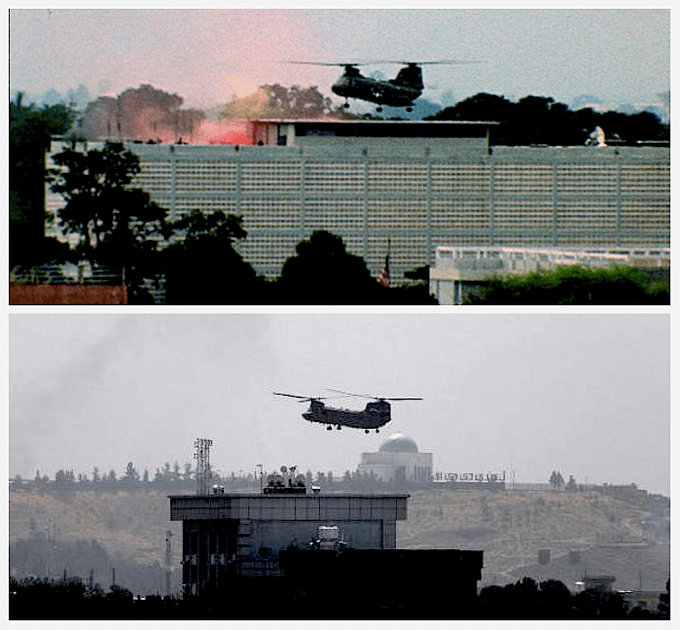
A US military helicopter is pictured flying above the US embassy in Kabul on August 15, 2021. (Photo by AFP) Top photo – Saigon, 1975.
Press TV – August 15, 2021
A Taliban spokesman says the group expects a “peaceful transition of power” in the next few days after the militants entered Afghanistan’s capital Kabul with little resistance amid evacuation of US diplomats from its embassy by helicopter.
“We are awaiting a peaceful transfer of power” as soon as possible, Suhail Shaheen said in an interview with BBC on Sunday, adding the Taliban expected that to happen in a matter of days.
The spokesman added that the group is in talks with the Afghan government “for a peaceful surrender” of Kabul, calling on President Ashraf Ghani and other leaders of Afghanistan “to work with us.”
He emphasized that the group would protect the rights of women, who “will be allowed to leave homes alone,” as well as freedoms for media workers and diplomats.
Shaheen said media would be allowed to criticize anyone but should not indulge in character assassination.
“We assure the [Afghan] people, particularly in the city of Kabul, that their properties, their lives are safe,” the Taliban spokesman said.
He added that the group seeks to establish an inclusive Afghan government in which all Afghans will be represented.
The spokesman said the Taliban have no intension of taking revenge on anyone, adding that all those who have served the government and military will be forgiven.

The Taliban capture Afghanistan’s key eastern city of Jalalabad
The Taliban spokesman called on Afghan civilians to stay in their country and do not leave due to fear.
Meanwhile, Mohammad Naeem, a spokesman for the Taliban’s political bureau, rejected as “mere rumor” reports that Mullah Abdul Ghani Baradar, the political chief of Taliban, has travelled to Kabul, saying he is in the Qatari capital city of Doha.
Afghan state sources denied reports about the presence of a Taliban delegation in the presidential palace.
Afghan President Ghani leaves country for Tajikistan: Interior ministry official
Later on Sunday, a senior official at Afghanistan’s Interior Ministry said the country’s President Ashraf Ghani has left the capital Kabul for the neighboring Tajikistan.
Asked for comment, the president’s office said it “cannot say anything about Ashraf Ghani’s movement for security reasons.”
A top Afghan foreign ministry official said separately that Ghani had left Afghanistan, but that it was not clear which country he was heading for.
Afghanistan’s top peace negotiator, Abdullah Abdullah, also confirmed Ghani’s exit from the country, saying in a video posted on his Facebook page, “”The former Afghan president has left the nation.”
Abdullah blamed President Ghani for the current situation in the war-ravaged country.
The new revelation came as a representative of the Taliban said the group was checking on Ghani’s whereabouts.
Taliban forces ordered to enter Kabul to prevent looting after police desert posts
The Taliban spokesman released a statement on Sunday afternoon, saying that the group has ordered its forces to enter the Afghan capital Kabul to prevent looting after local police deserted their posts.
The statement by Zabihullah Mujahid came shortly after it was announced that President Ashraf Ghani had left the country.
Kabul handover will be peaceful: Afghan acting interior minister
In a related development, Afghan acting Interior Minister Abdul Sattar Mirzakwal also said on Sunday that the “power will be peacefully transferred to a transitional government.”
“It is agreed that power will be transferred in a peaceful manner to a transitional administration,” Mirzakwal said in a televised message broadcast in local media.
“People should not worry about the safety and security in Kabul. The security of the city has been guaranteed. There will be no attack on the city,” he added.
The official emphasized that the big city of Kabul and the power will be handed over to a temporary third party and called on the people not to be “victim” of Taliban propaganda.
Russia: No plan to evacuate Kabul embassy
Meanwhile, Russia announced on Sunday that it does not plan to evacuate its embassy in Kabul as Taliban fighters reached the outskirts of the Afghan capital, a Russian Foreign Ministry official, Zamir Kabulov, told Russian news agencies.
“No evacuation is planned,” Kabulov said, adding that he was “in direct contact” with Moscow’s ambassador in Kabul and that Russian embassy employees continued to work “calmly,” AFP reported.
According to the RIA Novosti agency, Kabulov also said that Russia is among countries that have received assurances from the Taliban that their embassies would be safe.
“We received these guarantees a while ago. It was not only about Russia,” RIA Novosti quoted Kabulov as saying.
“The situation in Kabul is a bit tense, but there is no war in the city,” a spokesman for the Russian embassy in Kabul was quoted by TASS news agency as saying.
The spokesman was also cited by the Interfax news agency as saying that Moscow is ready to cooperate with Afghanistan’s interim government, adding that Russia is taking part in political contacts in Afghanistan.
TASS also quoted a Taliban official as saying, “We have good relations with Russia and our policy, in general, is to ensure safe conditions for operations of the Russian and other embassies.”
The Russian Foreign Ministry, however, was quoted by RIA state news agency as saying that Moscow does not yet recognize the Taliban militants as Afghanistan’s new lawful authority.
The ministry also told RIA that Afghanistan’s President Ashraf Ghani was unlikely to head to Russia after leaving his country.
Afghan delegation to meet Taliban in Qatar on Sunday
An Afghanistan peace negotiator said later on Sunday that a delegation representing the Afghan government, including senior official Abdullah Abdullah, will travel to Qatar the same day to meet with representatives of the Taliban.
Fawzi Koofi, a member of the Kabul negotiating team, confirmed to Reuters the delegation would meet with the Taliban in the Persian Gulf state after the militant group earlier entered Kabul.
A source familiar with the matter told Reuters the Afghan delegation and Taliban representatives would discuss a transition of power, adding that US officials would also be involved.
Pope voices ‘concern’ over Afghanistan, calls for ‘dialogue’
In a related development, Pope Francis expressed his “concern” Sunday over the conflict in Afghanistan, calling for dialogue so that the “battered population” can live in peace.
“I join in the unanimous concern for the situation in Afghanistan,” the pontiff said during the weekly Angelus at the Vatican, Reuters reported.
“I ask all of you to pray with me to the God of peace so that the clamor of weapons might cease and solutions can be found at the table of dialogue.
“Only thus can the battered population of that country – men, women, elderly and children – return to their own homes, and live in peace and security, in total mutual respect.”
Political solution in Afghanistan ‘more urgent than ever’: NATO
Meanwhile, the North Atlantic Treaty Organization (NATO) military alliance said on Sunday that finding a political solution to Afghanistan conflict was more pressing “than ever” as the Taliban stood poised to take power on the outskirts of Kabul.
“We support Afghan efforts to find a political solution to the conflict, which is now more urgent than ever,” an official at the 30-nation alliance told AFP.
The official said “NATO is constantly assessing developments in Afghanistan,” adding, “We are helping to maintain operations at Kabul airport to keep Afghanistan connected with the world.”
“We also maintain our diplomatic presence in Kabul. The security of our personnel is paramount, and we continue to adjust as necessary,” the NATO official added.
Taliban show off US-made war spoils in Kandahar
The Taliban released footage showing captured US-made Afghan military helicopters at the key Kandahar airport in southern Afghanistan, which has until recently one of the most important US bases in the country.
The militants have been quick to show off their war spoils in the city, which is generally considered as their spiritual birthplace.
The Taliban posted footage on their social media accounts on Saturday, showing a militant walking around a US-made Black Hawk military helicopter, which is in brown-green camouflage with Afghan Air Force markings, purportedly at a Kandahar airport hangar.
He then walked out and another Black Hawk was seen in the distance on the tarmac.
The Black Hawk inside the hangar was seemingly in storage, with a black sheet covering its windshield and its left engine apparently missing.
Two Russian military helicopters are also seen as another person is heard saying “Mashallah” — an Islamic term of praise. However, it was not clear if any of the helicopters were airworthy.
The helicopters outside the hangar were missing their blades, with a sheet covering the front of one airframe.
It is heard that one of the militants is claiming there are five military helicopters at the airport and several jets.
Washington supplied much of that hardware to the Afghan military, to the tune of $88 billion since 2002.
An Afghan government official confirmed on Friday that Kandahar, the most important city in the south, was under the control of the Taliban as foreign occupying forces complete their withdrawal.
US has NO mandate to keep troops in Syria & it’s interpretation of international law is ‘ridiculous’: Russian ambassador
By Jonny Tickle | RT | August 10, 2021
Washington has no legal mandate to keep its armed forces in Syria, and the presence of American soldiers in the country contradicts the 2015 UN Security Council resolution that called for a ceasefire and a political settlement.
That’s according to the Russian embassy in Washington, which responded to a tweet by Wayne Marotto, the official military spokesman for Operation Inherent Resolve, the American campaign in the Middle East to defeat ISIS.
Writing on social media, Marotto said that the US has a “clear mandate under international law” to keep boots on the ground in Syria.
On Monday night, the Russian Embassy publicly disagreed.
“It’s a matter of fact that US armed forces have no legal mandate to stay in Syria. Your interpretation of UNSCR 2254 is just ridiculous. Please, read the document thoroughly,” the diplomatic mission said, including a link to the text.
Passed in 2015, UNSCR 2254 calls for all parties to immediately end attacks against civilian targets but allows offensives against groups determined to be “terrorists” by the UN Security Council, such as ISIS. It also planned to create a Syrian-led political transition with free and fair elections.
As things stand, both Moscow and Washington have troops on the ground in Syria. The Russian operation began in 2015, after Syrian President Bashar Assad requested military aid from the Kremlin, in a legal move. However, according to international law, the US military presence is an illegal occupation, because the American troops entered the country without an invitation from the government.
The murder of the ‘menacing’ water technician: On the shadow wars in the West Bank
By Ramzy Baroud | MEMO | August 9, 2021
There is an ongoing, but hidden, Israeli war on the Palestinians which is rarely highlighted or even known. It is a water war, which has been in the making for decades.
On 26 and 27 July, two separate but intrinsically linked events took place in the Ein Al-Hilweh area in the occupied Jordan Valley, and near the town of Beita, south of Nablus.
In the first incident, Jewish settlers from the illegal settlement of Maskiyot began construction in the Ein Al-Hilweh Spring, which has been a source of freshwater for villages and hundreds of Palestinian families in that area. The seizure of the spring has been developing for months, all under the watchful eye of the Israeli occupation army.
Now, the Ein Al-Hilweh Spring, like most of the Jordan Valley’s land and water resources, is annexed by Israel.
Less than 24 hours later, Shadi Omar Salim, a Palestinian municipal employee, was killed by Israeli soldiers in the town of Beita. The Israeli army quickly issued a statement which, expectedly, blamed the Palestinian for his own death.
The Palestinian victim approached the soldiers in a “menacing manner”, while holding “what appeared to be an iron bar,” before he was gunned down, the Israeli army claimed.
If the “iron bar” claim was true, it might be related to the fact that Salim was a water technician. Indeed, the Palestinian worker was on his way to open the pipes that supply water to Beita and other adjacent areas.
Beita, which has witnessed much violence in recent weeks, is facing an existential threat. An illegal Jewish settlement, called Givat Eviatar, is being built atop the Palestinian Sabih Mountain, in Arabic, Jabal Sabih. As usual, whenever a Jewish settlement is constructed, Palestinian life and livelihood are threatened. Thus, the ongoing Palestinian protests in the area.
The struggle of Beita is a representation of the wider Palestinian struggle: unarmed civilians fighting against a settler-colonial state that ultimately wishes to replace a Palestinian village or town with a Jewish settlement.
There is another facet to what may see as a typical story, where the Israeli army and Jewish settlers work together to ethnically cleanse Palestinians: Mekorot. The latter is a state-owned Israeli water company that literally steals Palestinian water and sells it back to the Palestinians at an exorbitant price.
Unsurprisingly, Mekorot operates near Beita as well. The Palestinian worker, Salim, was killed because his job of supplying water to the people of Beita was a direct threat to Israeli colonial designs in this region.
Let us put this in a larger context. Israel does not just occupy Palestinian land, it also systematically usurps all of its resources, including water, in flagrant violation of international law which guarantees the fundamental rights of an occupied nation.
The occupied West Bank obtains most of its water from the Mountain Aquifer, which is divided into three smaller aquifers: the Western Aquifer, the Eastern Aquifer and the North-Eastern Aquifer. In theory, Palestinians have plenty of water, at least enough to meet the minimally-required water allotment of 102-120 litres per day, as recommended by the World Health Organisation (WHO). In practice, however, this is hardly the case. Sadly, most of the water in these aquifers is appropriated directly by Israel. Some call it “water capture”; Palestinians call it, more accurately, “theft”.
While in Israel the daily per capita water consumption is estimated at 300 litres, illegal Jewish settlers in the West Bank consume over 800 litres per day. The latter number becomes even more outrageous if compared to the meager amount enjoyed by a Palestinian, that of 70 litres per day.
This problem is accentuated in the so-called ‘Area C’ in the West Bank, for a reason. ‘Area C’ consists of nearly 60 per cent of the total size of the West Bank and, unlike ‘Areas A’ and ‘B’, it is the least populated. It is mostly fertile land and it includes the Jordan Valley, known as the ‘breadbasket of Palestine’.
Despite the fact that the Israeli government had, in 2020, decided to postpone its formal annexation of that area, a de facto annexation has been in effect for years. The illegal appropriation of the Ein Al-Hilweh Spring by illegal Jewish settlers is part of a larger stratagem that aims at appropriating the Jordan Valley, one dunum, one spring, and one mountain at a time.
Of the more than 150,000 Palestinians living in ‘Area C’, nearly 40 per cent – over 200 communities – suffer from “severe shortage of clean water”. That shortage can be remedied if Palestinians are allowed to drill new wells, expand current ones or to use modern technologies to allocate other sources of freshwater. Not only does the Israeli army prohibit them from doing so, even rainwater is off-limits to Palestinians.
“Israel even controls the collection of rainwater throughout most of the West Bank and rainwater harvesting cisterns owned by Palestinian communities are often destroyed by the Israeli army” an Amnesty International report, published in 2017, concluded.
Since then, the situation became even worse, especially since the idea of officially annexing a third of the West Bank obtained widespread support in the Israeli Knesset and society. Now, every move made by the Israeli army and Jewish settlers in the West Bank is directed towards that end, controlling the land and its resources, denying Palestinians access to their means of survival and, ultimately, ethnically cleansing them altogether.
The Beita protests continue, despite the heavy price being paid. Last June, a 15-year-old boy, Ahmad Bani Shamsa, was killed when an Israeli army bullet struck him in the head. At the time, Defense for Children International-Palestine issued a statement asserting that Bani-Shamsa did not pose any threat to the Israeli army.
The truth is, it is Beita that is under constant Israeli threat, as well as the Jordan Valley, ‘Area C’, the West Bank and the whole of Palestine. The protest in Beita is a protest for land rights, water rights and basic human rights. Bani Shamsa and, later, Salim, were killed in cold blood simply because their protests were mere irritants to the grand design of colonial Israel.
The irony of it all is that Israel seems to love everything about Palestine: the land, the resources, the food and even the fascinating history, but not the indigenous Palestinians themselves.
Taliban capture 6th provincial capital weeks after rejecting reports of a ceasefire, amid US withdrawal
RT | August 9, 2021
The Taliban have seized control of its sixth provincial capital in Afghanistan within a matter of days, according to a spokesperson for the group, as the militants continue to secure territory after America’s military withdrawal.
The military victory for the Taliban was confirmed by the deputy governor of Samangan Province, home to the city of Aibak. Speaking to AFP, Afghanistan official Sefatullah Samangani declared that “the Taliban have captured the city of Aibak and have complete control over it.”
The Taliban formally took control of the city on Monday, after a “senator surrendered” and asked Afghanistan to withdraw its forces from the area to avoid further conflict.
Taliban spokesperson Zabihullah Mujahid declared on Twitter that the city center was completely under its control, while the governor, the police chief, the intelligence department, and all its affiliates were cleared.
The capture of Aibak comes days after Taliban militants seized control of the provincial capital of Sar-e Pul and the region’s fifth-largest city. All major government buildings in the two locations have been secured by Taliban fighters, although Afghan soldiers were reportedly trying to retain control of the Kunduz airport.
The continued military advance of the Taliban throughout Afghanistan follows the group’s rejection of reports that a ceasefire deal had been reached with the country’s government in return for the release of 7,000 prisoners.
Since America’s withdrawal from the region earlier this year, the Taliban claims to have secured 85% of the territory in Afghanistan. Afghan officials dispute this figure, however, claiming it has been exaggerated by the group.
Taliban overruns most of Kunduz as Afghan military clings to strategic city’s airport – reports
RT | August 8, 2021
Taliban militants have captured another provincial capital, Sar-e Pul, and most of the fifth-largest city of Kunduz, according to local officials. Afghan special forces have been deployed in a bid to re-take the latter.
The militants seized all the key government buildings in the two cities overnight, pushing the government troops to military installations on their outskirts. The troops are currently clinging onto the airport in Kunduz, in the north of the country.
“Heavy clashes started yesterday afternoon. All government headquarters are in the control of the Taliban. Only the army base and the airport is with ANDSF [Afghan security forces] from where they are resisting the Taliban,” provincial lawmaker Amruddin Wali told Reuters.
Footage circulating online shows the militants roaming the city streets en masse, with the group’s flags hoisted on multiple military vehicles.
Kunduz’s market was destroyed in the fighting, with disturbing footage purporting to show the whole location on fire. It was not immediately clear how exactly the market was obliterated, with some reports suggesting it was targeted by American warplanes supporting the Afghan troops. On Saturday, the US military launched airstrikes against the Taliban in a bid to halt its offensive, sending in B-52 Stratofortress strategic bombers and AC-130 Spectre gunships.
Although the Taliban claimed it was in full control of Kunduz, the government said it had re-deployed special forces units to the city and was trying to push back the militants. A short video released by Afghan military spokesperson Fawad Aman shows special forces troops advancing through the streets, firing at unseen adversaries.
The situation in the northwestern city of Sar-e Pul appears to be similar to that in Kunduz. Its key locations have been overrun by the militants, with government forces retreating to a military base on its fringes.
“Government headquarters, including the governor’s house, police command, and the National Directorate of Security compound, are captured by the Taliban,” Mohammad Noor Rahmani, a Sar-e Pul provincial council member, told Reuters.
Over the past few days, the Taliban has put the government troops under heavy pressure, apparently switching the focus of its offensive from rural areas to major cities. Two provincial capitals, Zaranj in the southwest and Sheberghan in the north, have already fallen into the hands of the militant group.
American Tax Dollars Financing Israeli Tourist Park Atop Historic Palestinian Neighborhood
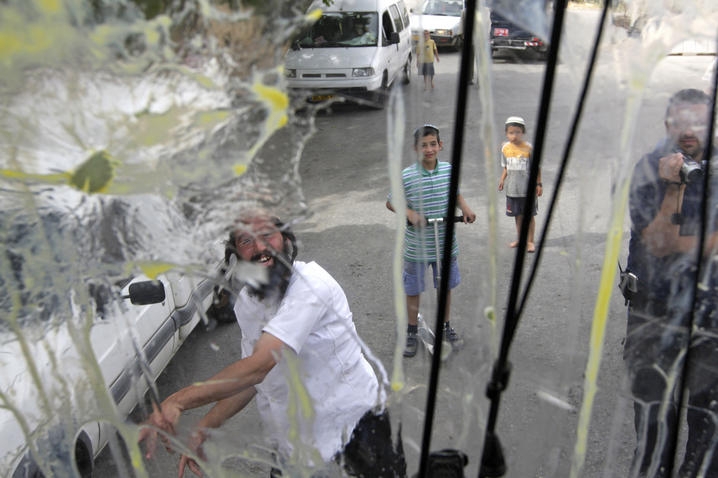
 Illegal colonist throws eggs
By Jessica Buxbaum | MintPress News | July 12, 2021
Roughly 2.5 miles from Sheikh Jarrah — the Palestinian neighborhood that grabbed the world’s attention in May — lies Silwan. This neighborhood in Occupied East Jerusalem is perched atop the steep slopes just outside the Old City. Houses are tightly compacted and stacked on top of each other as they dip into the valley below. And here, Palestinian residents face the same fate as their brethren in Sheikh Jarrah.
Israeli forces raided the al-Bustan neighborhood in Silwan with bulldozers on June 29 — razing a butcher shop and dispersing Palestinian protesters defending their homes with tear gas, stun grenades, batons and rubber-coated steel bullets. At least 13 people were injured and six arrested including the owner of the butcher shop, Nidal al-Rajabi, and his sons and brothers.
In regard to the recent demolition, Norwegian Refugee Council’s Palestine country director, Caroline Ort, said in a press release, “Under the Fourth Geneva Convention, Israel has an obligation to protect civilians under its occupation and to refrain from destroying private property.”
Al-Rajabi’s store was destroyed on the pretext of lacking a building permit. Various human rights organizations involved in the issue state conflicting numbers, but according to Fakhri Abu Diab, spokesman for Silwan, 16 buildings in al-Bustan are also at immediate risk of being torn down. About 1,500 Palestinians live in more than a hundred houses in al-Bustan.
On June 7, two structures — including the butcher shop — received notices from the Municipality of Jerusalem to self-demolish their homes within 21 days or municipality authorities would do so and charge the residents the demolition fees, calculated at about $6,000.
Amy Cohen, director of International Relations and Advocacy at Ir Amim, a Jerusalem nonprofit, told MintPress News the second structure, a residential unit, has yet to receive a visit from municipality inspectors. Government officials typically come to a building with a pending demolition order to check whether it has already been demolished by the owners. If not, the inspectors then notify the residents that Israeli authorities will carry out the demolition within days, or even within 24 hours.
Discriminatory housing policies
According to Ir Amim, 68 homes in al-Bustan have pending demolition orders so as to execute the Jerusalem Municipality’s “King’s Garden” plan. The municipality outlined the initiative in 2010, stating:
The King’s Garden area [al-Bustan in Arabic] will be developed into a tourist and residential district. Commercial sections, restaurants, and art galleries will be built, turning it into a bustling tourist zone. For the first time, the local residents will have the legitimate right to live in this neighborhood.
The development plan has not moved forward since 2010, but the municipality’s recent objection to extending the demolition freeze suggests the plan could be reactivated.
In February, the Jerusalem Municipality filed an objection in the Local Affairs Court against al-Bustan residents’ request to extend the demolition freeze, arguing the proposed zoning plan for the area doesn’t follow proper guidelines and isn’t advancing quick enough. In March, the court ruled to extend the demolition freeze until August 15.
Negotiations have been ongoing between the municipality and the residents to develop a suitable zoning plan for al-Bustan since 2005. In 2009, the residents’ plan was rejected by the municipality in favor of the King’s Garden Plan.
According to Murad Abu Shafee, an al-Bustan resident who received a demolition order, the municipality told the residents, “This structure plan can’t happen in Israel. This might happen in Europe or any Arab country, but not here.”
“Our plan was very modern and it doesn’t fit with the Israeli government’s standards for East Jerusalem,” Abu Shafee explained. “[Israel] doesn’t want us to have a modern neighborhood. They want us always to be below the line.”
Despite the local court’s ruled extension, 20 demolition cases (including the butcher shop’s order) were excluded from the freeze due to the Israeli Kaminitiz Law — known as Amendment 116 to Israel’s Planning and Building Law — which was fully enacted in 2019. This legislation intensifies enforcement against unauthorized construction and allows for little legal intervention in preventing demolitions of structures built after 2017. The amendment has been partially frozen since 2020 amid ongoing discussions with Palestinian parliamentary members in the Israeli government.
In a statement to MintPress, the Jerusalem Municipality said:
There is no intention to build a ‘biblical garden’ in the area. This is a false claim. The area is designated for gardens and parks for the benefit of the local residents of Silwan.
The vast majority of demolition orders in Al-Bustan are suspended. There are a very few demolition orders that the court has recently decided to unfreeze. It should be emphasized that these orders are old. No new orders [were] issued whatsoever.
As to the execution [of] these orders, the municipality is obliged to act in accordance with the law and with the court rulings. We are still studying the latest ruling profoundly, and will decide on our next steps according to the situation on the ground.
The municipality noted that al-Bustan is designated as a green area because of its location near the Kidron River. Jeff Halper, director of the Israeli Committee Against House Demolitions, explained that when Israel annexed East Jerusalem in 1967 following the Six-Day War, it declared the entirety of East Jerusalem as open, green space, meaning the area is frozen for future building.
Halper pointed out the hypocrisy of this development policy in how Israel treats settlement building versus Palestinian building, explaining:
Today, more than a hundred thousand Israelis live in East Jerusalem in these big settlements. But if East Jerusalem was frozen 100 percent for building, then how did you get all that building for Israelis? The answer is Israel rezones for Jewish settlements. But when a Palestinian wants to build, [the government] says, ‘Sorry, this area isn’t zoned for residential development but for open, green space. So, it’s really the use of bureaucracy and law and planning as tools of control.”
Construction in al-Bustan was done primarily by Palestinian residents themselves on their own land, but often without the necessary building permits. Ir Amim’s Cohen explained this is mostly owing to a lack of viable zoning plans rather than the municipality’s flat-out rejection of building permits:
With the absence of an outline plan, residents are precluded from acquiring the permits. You either have a lack of a zoning plan or you have such outdated zoning plans, which are from say 30 to 40 years ago, that it’s impossible to then receive building permits. And this is a very acute way that the Israeli authorities have neglected their municipal responsibility to provide this service.”
“Since 1967, this has been a means to suppress Palestinian building and planning within Palestinian areas,” Cohen concluded.
American tax dollars financing settler activity
Silwan is located in the Holy Basin—an area coveted by religious settlers for its proximity to the Old City and alleged connections to King David. Ir David or Elad settler organization runs the City of David National Park in the al-Bustan area. Since the 1990s, Elad has sought to transform Silwan into a symbol of Jewish biblical past. Al-Bustan is specifically targeted because it stands as an obstacle to achieving Ir David’s vision of a biblical paradise.
Elad’s actions aren’t focused solely on building settlements but also on promoting archaeological excavations, tourist attractions and parks. According to the Foundation for Middle East Peace’s report on al-Bustan, the settlers’ goals became the official policy of the Israeli government in 2005 when then-Prime Minister Ariel Sharon’s government approved plans to develop the Holy Basin area.
“In essence, the DNA of Elad’s biblical ideology became the DNA of the Government of Israel in and around the Old City, with [the] Government outsourcing many of its authorities to Elad in order to pursue these objectives,” FMEP wrote in its report. “The lines between government and the settlers became so blurred that they almost disappeared.”
Quteibah Odeh — whose family faces displacement in al-Bustan and in Batan al-Hawa, another neighborhood in Silwan and settler target — described the deep interconnections between settlers and the Israeli government, citing as an example that Arieh King is Jerusalem’s deputy mayor but is also a notorious settler leader responsible for displacing Sheikh Jarrah residents. “These settler organizations are the people running the government,” Odeh said. “They receive full support from the military and any ministry and municipality.”
Ir David isn’t just supported by the Israeli government but also backed by American money. Ir David’s sister nonprofit in the U.S., Friends of Ir David, secures tax-exempt donations for the organization.
According to a January investigation by MintPress News, the Hertog Foundation, Irving I. Moskowitz Foundation, Adelson Family Foundation, Mindel Foundation, Samueli Foundation, Jay and Jeanie Schottenstein Foundation, and the Jewish Communal Fund have all donated to Friends of Ir David. The organization’s biggest contributors are the Irving I Moskowitz and Adelson Family Foundations. In 2018, the Irving I. Moskowitz Foundation gave Friends of Ir David $1.5 million and the Adelson Family Foundation contributed about $3 million.
The Ir David Foundation did not respond to a request for comment.
U.S. Congress members speak out
Israel’s forcible displacement of East Jerusalem Palestinians has caught the attention of the international community, including the U.S. government. On July 1, Illinois Representative Marie Newman delivered a speech on the House floor, urging President Joe Biden’s administration to intervene and stop the ongoing demolitions.
“Today I rise on behalf of the thousands of Palestinian families in the West Bank that face the prospect of eviction, demolition and displacement from their homes by the Israeli government,” the Democratic congresswoman said. “We have received word that demolition orders have already begun for homes in the al-Bustan neighborhood of Silwan in East Jerusalem.”
In the face of international condemnations, Silwan spokesman Abu Diab said the recent demolition in al-Bustan demonstrates Israel’s willingness to go against these objections. He elaborated in a statement:
People know members of Congress are speaking out about these issues, yet [the demolition of the butcher shop] proved to the community that Israel is prepared to defy the international community, including members of the U.S. Congress. They assert, yet again, that demolitions and forcible displacement, including Israeli court-ordered evictions, are against international law, are codified as war crimes, and that the occupying power, Israel, has a duty to protect those under its occupation.
The residents of Silwan therefore call on the international community to uphold their third state responsibility, to call on Israel to cease forthwith such illegal policies, with real accountability being the price for any further demolitions or evictions.
As in Sheikh Jarrah, Palestinians remain steadfast against Israel’s ongoing ethnic cleansing efforts. Demonstrations against the demolitions occur daily, Silwan resident Odeh said, adding:
These are our houses. Our parents, our grandparents and our great grandparents have lived here. We have memories, we have history and the people are the past, the present and the future.”
Featured Video

Chinese jet fuel and the myth of energy independence
or go to
Aletho News Archives – Video-Images
Book Review
Former Insiders Criticize Iran Policy as U.S. Hegemony
By GARETH PORTER | CounterPunch | February 27, 2013
“Going to Tehran” arguably represents the most important work on the subject of U.S.-Iran relations to be published thus far.
Flynt Leverett and Hillary Mann Leverett tackle not only U.S. policy toward Iran but the broader context of Middle East policy with a systematic analytical perspective informed by personal experience, as well as very extensive documentation.
More importantly, however, their exposé required a degree of courage that may be unparalleled in the writing of former U.S. national security officials about issues on which they worked. They have chosen not just to criticise U.S. policy toward Iran but to analyse that policy as a problem of U.S. hegemony. … continue
Blog Roll
 Aletho News
- What is fueling unrest across the EU?
- Why no power can undermine Iran’s eternal dominance over the Strait of Hormuz
- Is The War Against Iran Over?
- Iran war will leave long-term ‘scar’ on Wall Street, investors warn
- How Iran decimated US power projection in West Asia: Military lessons of 40-day war
- Iran’s report details US-Israeli war crimes in targeting schools, hospitals, livelihoods
- NATO’s Slow Fracture: How Trump’s Iran War Exposed the Instrument of Hegemony
- Chinese jet fuel and the myth of energy independence
- Ukraine Sea Drone Fired From Libya Hit Russian Tanker in Mediterranean
- IRGC: Iranian forces launched no attacks during ceasefire hours
- If Americans Knew
- Military aid to Israel emerges as the latest political litmus test for Democrats
- The only Palestinian children’s rights organization closes following years-long Israeli campaign against it
- ‘I Can’t Forget the Smell’: Lebanese Reel After Israel Kills Over 300 in Single Day
- DNC Shoots Down Resolutions Calling Out AIPAC and Limiting Arms to Israel
- TCN: Is Israel Blackmailing President Trump?
- Israel killed at least 303 Lebanese yesterday – who were they? Daily Update
- Amnesty: Urgent – Protect Lebanese civilians from brutal escalation in Israeli attacks
- Is The War Against Iran Over?
- Inside the Israeli army’s propaganda wing
- Hundreds of Gaza Amputees Stranded in Legal Limbo
- No Tricks Zone
- New Study: No Linear Warming Or Glacier Retreat Along Northern Antarctic Peninsula Since 1980s
- An Inconvenient Tree: Uncovered In Alps… Europe Much Warmer Than Today 6000 Years Ago
- New Study Reports A 60% Slowdown In Greenland’s Ice Loss Rate In The Last Decade
- Low Intensity Tornado Wrecks Major Solar Farm, Creating A Potential Toxic Dump
- New Study Finds Warming Saves Lives…Cold Temperatures 12 Times More Deadly Than Excess Heat
- German Science Blog Accuses PIK Climate Institute Of Hallucinating Climate Tipping Points
- Devastating Assessment Of Comirnaty Vaccine By Former Senior Pfizer Europe Toxicologist
- New Study: CO2 Is ‘Effectively Negligible’ As An Explanatory Climate Change Factor Since 2000
- Former Pfizer Toxicologist Dr. Helmut Sterz Tells Bundestag Hearing Pfizer Vaccine Should Have Never Been Approved
- Energy Expert: Germany’s Nuclear Phaseout Was A “500 Billion Euro Mistake”
 Aletho News