Trump-Kushner “Peace” Plan ignores elephants in the room: Israel created this mess
The Trump-Kushner ‘Peace’ Plan is slick and businesslike, with an aura of objectivity and balance – but it’s exactly the opposite, and something about it stinks.
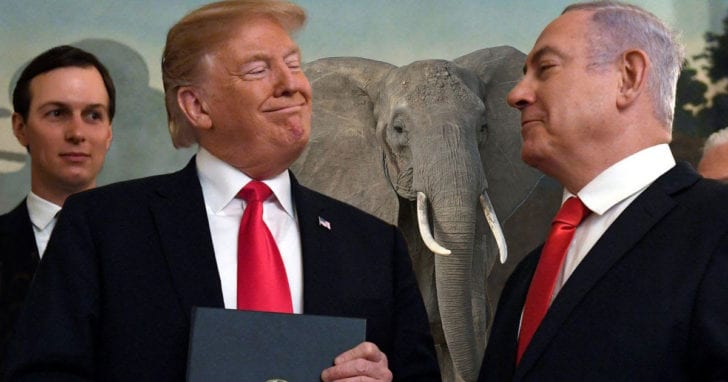
Israeli PM Benjamin Netanyahu and US President Donald Trump are always accompanied by their shared comfort animal, the elephant in the room (Photo-collage by If Americans Knew)
By Kathryn Shihadah – If Americans Knew – February 21, 2020
There is a giant herd of elephants circling the Trump-Kushner Peace Plan, and they’re not going away. The fragrance of pachyderms is unmistakable, but Trump administration, the Netanyahu government, and Israel partisans have decades of experience in ignoring whatever is inconvenient to their agendas.
That unmistakable throng of elephants is the disenfranchisement and subjugation of the Palestinian people that has gone for a hundred years, and is presently so flagrant that numerous human rights organizations and experts have called it apartheid.
And while the Trump administration claims it wants a future of peace, this Plan will not bring peace.
Because, elephants.
 Elephants from the get-go
Shortly after the Plan’s release, Kushner boasted on Fox & Friends, “This is an 80 page proposal, with a map. Never been done before.” Pachyderm prints are on every page (and the map), starting with the very first sentence:
“Israelis and Palestinians have both suffered greatly from their long-standing and seemingly interminable conflict.”
To start the document with this statement is to ignore a fundamental truth: the creation of Israel – the Zionist project – wreaked havoc on the people of Palestine, and continues to do so today.
Yes, both sides have suffered, but only one side has lost its homeland, lived under decades of injustice and oppression, and is being slowly starved and poisoned.
“Since 1946, there have been close to 700 United Nations General Assembly resolutions and over 100 United Nations Security Council resolutions in connection with this conflict.”
Missing factoid: Almost every one of the 800+ resolutions (Kushner left out 45 UN Human Rights Council resolutions) connected with this conflict, was critical of Israeli policies and actions that defied international law.
“These resolutions have not brought about peace.”
The resolutions have not brought about peace because (elephant alert) Israel has defied every one of them.
Elephants in basic assumptions: Palestinians “need” the Plan
The basic premise on which the Trump-Kushner Plan is based shows disdain for fundamental facts:
Palestinian society is languishing because of Israel’s policies – not some deficiency in Palestinians or their leadership.
Blaming Palestinian resistance
“For comprehensive peace to be achieved, it is up to the Palestinian people to make clear that they reject the ideologies of destruction, terror and conflict.”
Palestinian people aren’t committed to conflict – they are committed to resistance against occupation and apartheid (resistance is legal, but occupation and apartheid are illegal). For comprehensive peace to be achieved, Israel must abandon the elephants of discrimination and violence, and adhere to international law.
Blaming Palestinian backwardness
“The economic plan will empower the Palestinian people to build the society that they have aspired to establish for generations. It will allow Palestinians to realize a better future and pursue their dreams…By developing property and contract rights, the rule of law, anti-corruption measures, capital markets, a pro-growth tax structure, and a low-tariff scheme with reduced trade barriers, this initiative envisions policy reforms coupled with strategic infrastructure investments that will improve the business environment and stimulate private-sector growth.”
This suggests that the Palestinian people have been unable to build a great society because they lack a pro-growth tax structure and other first-world, art-of-the-deal schemes. While Kushner’s words dazzle, they ignore the myriad, incessant turmoil and economic hardship created by occupation, apartheid, and blockade. Israel has initiated wars, withheld food and medicine, and traumatized generations of Palestinians.
A 2016 publication by the UN Conference on Trade and Development (UNCTAD) noted:
The relationship between the Israeli economy and that of the Occupied Palestinian Territory remains that of two dissimilar and unequal economies, whereby the large, dominant economy practices policies that keep the small economy weak and dependent…depriving the Palestinian people of their ability to produce and, in the process, cultivating a dependence on the Israeli economy and donor aid.
Without the occupation, the Palestinian economy could easily produce twice the GDP it currently generates, while the chronic trade and budget deficits, as well as poverty and unemployment, could recede and the economic dependence on Israel could end.
Blaming Palestinian ineptness/laziness
“This Vision has been developed to reduce over time the Palestinians’ dependence on aid from the international community.”
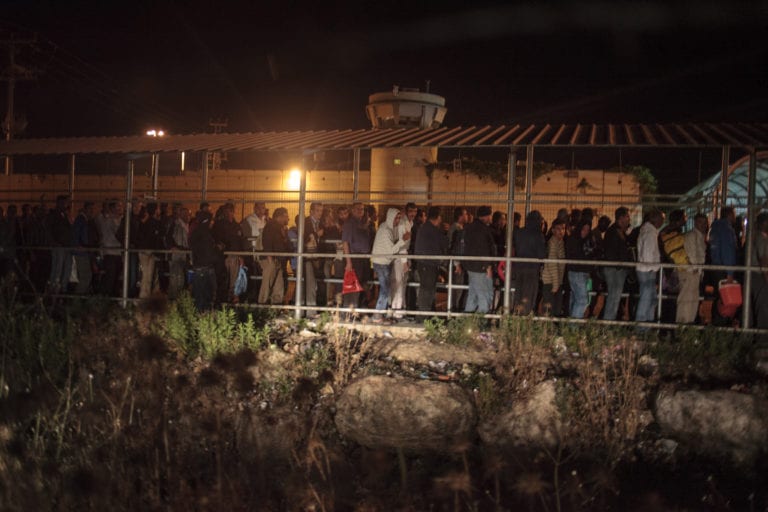
Palestinians have been aid-dependent because farmers have been restricted access to their fields, fishermen the sea, and workers their jobs; Israel has collected taxes on behalf of the Palestinian Authority (PA), and then refused to hand funds over; Israel denies access to needed medicines, building supplies, and parts to repair crucial equipment like power plants and flour mills; and Israel has often destroyed or confiscated items that were donated to the Palestinian people.
UNCTAD reported in 2019 that between 2000 and 2017, Israel’s occupation of the West Bank cost the Palestinian people approximately $47.7 billion – over $2.5 billion a year. As Israel controls agriculture (more below), exports, natural resources, and tourism, it deliberately siphons money away from the Palestinian economy and into its own coffers.
The way to reduce Palestinians’ dependence on aid is to free them from occupation and blockade so they can work and produce, instead of standing at checkpoints and fighting a system that is stacked against them.
Blaming Hamas
“Gaza has tremendous potential but is currently held hostage by…terrorist organizations committed to Israel’s destruction… [that are] fueling a war machine of thousands of rockets and missiles, dozens of terror tunnels and other lethal capabilities… Gaza is run by terrorists who provoke confrontations that lead to more destruction and suffering for the people of Gaza…
As a result of Hamas’ terror and misrule, the people of Gaza suffer from massive unemployment, widespread poverty, drastic shortages of electricity and potable water, and other problems that threaten to precipitate a wholesale humanitarian crisis.”
While Hamas’ rule leaves much to be desired, Hamas is not the cause of Gaza’s humanitarian crisis. Gaza is under a brutal blockade because its people dare to resist the de facto occupation of their land. Some militants shoot mostly-homemade rockets toward Israel in defiance – these “lethal” rockets (which began after Israeli violence) have killed about 50 Israelis in 19 years, while Israel’s army (the most powerful in the Middle East) has killed over 7,000 Gazan Palestinians in the same time period and at least 461 West Bankers and East Jerusalemites.
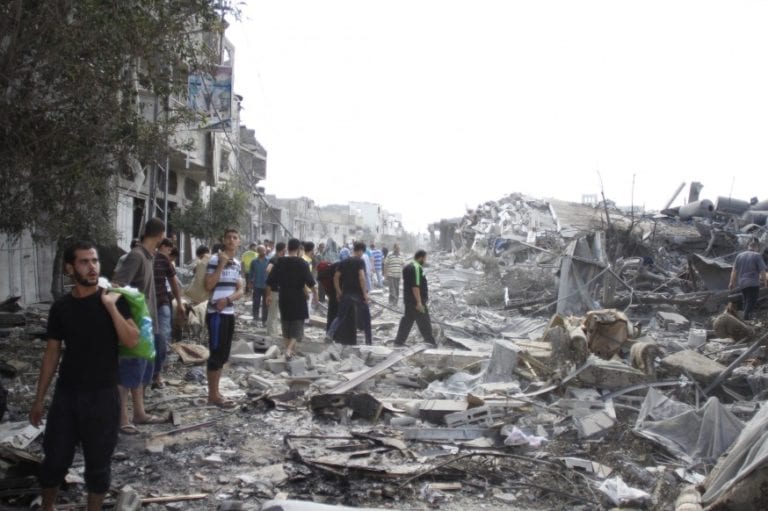
In the rush to demonize Hamas, Israel and its supporters (including Jared Kushner) once again disregard inconvenient facts: Hamas’ efforts are nothing more or less than resistance against oppressive, illegal Israeli policies; Hamas operations have been restrained; and – contrary to Israeli hype – its actions are not provocations but responses to Israeli provocation (not the least of which is the catastrophic blockade); Hamas has on multiple occasions offered long-term ceasefire deals, to which Israel has responded with violence; and most brokered ceasefires (79%) have been broken by Israel.
Hamas and other resistance groups’ actions have been less deadly than Israel’s by a large margin. Witness these statistics from Israeli human rights organization, B’Tselem:
“Peacetime,” Sept 2000 – Dec 2008
- 136 Israelis killed (14 by rockets)
- 3,000 Gazans killed
Israeli incursion into Gaza, 2008-9 (“to stop rockets”)
- 9 Israelis killed (4 by rockets)
- 1400 Palestinians killed
“Peacetime,” 2009-2012
- 3 Israelis killed (by rockets)
- 291 Palestinians killed
Israeli incursion into Gaza, 2012 (“to stop rockets”)
- 6 Israelis killed (by rockets)
- 174 Palestinians killed
“Peacetime,” 2012-14
- 1 Israeli killed (not by a rocket)
- 27 Palestinians killed
Israeli incursion into Gaza, 2014 (“to stop rockets”)
- 72 Israelis killed (17 by rockets)
- 2,200 Palestinians killed
Gaza/Israel since 2014
- 5 Israelis killed (1 by Gazan sniper, 4 by rockets)
- over 400 Gazans killed (most by Israeli snipers)
It is perhaps not surprising that multiple human rights organizations have placed the blame for the humanitarian crisis squarely on Israel’s shoulders.
For a Timeline of deaths in the conflict go here.
Elephants in basic expectations of the “Peace” Plan
Basic expectations of the Kushner Plan are unsound, blatantly partisan, and tell only the convenient parts of the story:
There will be no population transfer
“Peace should not demand the uprooting of people – Arab or Jew – from their homes. Such a construct, which is more likely to lead to civil unrest, runs counter to the idea of co-existence.”
This is a handy position to take after Israel has illegally transferred 600,000 Jews onto West Bank and East Jerusalem land stolen from Palestinians. “No population transfer” would have been a useful policy in 1948, to stop the Zionist army from depopulating hundreds of Palestinian villages and exiling 750,000 Palestinians, and then refusing to allow them to return. Transfer of population into occupied territory has been against international law since the Fourth Geneva Convention was ratified in 1949.
The transfer of Israeli Jews from their settlements back to Israel (also stolen) no doubt would cause “civil unrest,” but it was a grave error to position them in someone else’s land to begin with.
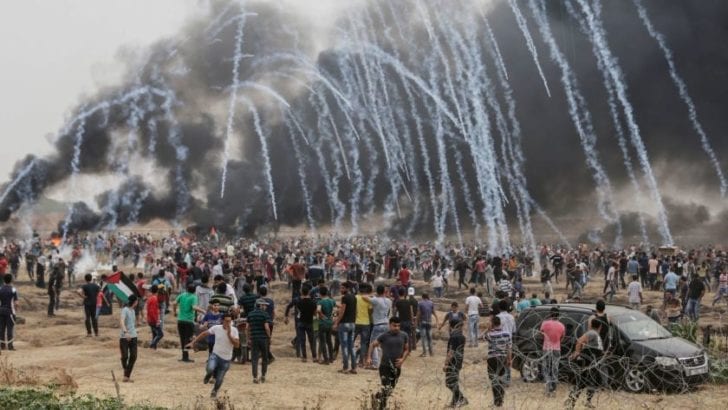
As an aside, when Palestinians participated in civil unrest circa 1939, protesting British rule and the population transfer of Jews into Palestine, they were brutally suppressed. In 1987, Israeli soldiers employed “force, might, and beatings,” in addition to live ammunition to subdue unarmed demonstrations against the occupation. The Great March of Return in Gaza, a massive and ongoing peaceful protest, has been answered with sniper fire. When Palestinians are the ones with grievances, no attempt is made to appease and avoid civil unrest.
Israel will sacrifice historical claims
“This Vision provides for the transfer of sizable territory by the State of Israel [to the Palestinians] – territory to which Israel has asserted valid legal and historical claims, and which are part of the ancestral homeland of the Jewish people — which must be considered a significant concession.”
This statement completely ignores Palestinians’ legal and historical claims to the land – their ancestral homeland. And while the claim of Jewish Israelis is based on a religious document and a short-lived mini kingdom 3,000 years ago, Palestinians have lived on the land recently enough to have Ottoman-era ownership records and deeds. Meanwhile, Israel controls all of the land. A large number of Palestinians have expressed willingness to settle for just 22% of what was once theirs. Is this not a significant concession on the part of Palestinians?
Of course, resolving a problem with these complexities isn’t easy, but no resolution will be valid when the arbiter is disingenuous.
Normalization as a starting point
“Since the moment of its establishment, the State of Israel has not known a single day of peace with all of its neighbors…The United States will strongly encourage Arab countries to begin to normalize their relations with the State of Israel…These countries are expected to end any boycott of the State of Israel and oppose the Boycott, Divestment, and Sanctions (commonly referred to as BDS) movement and any other effort to boycott the State of Israel.”
The statement that “Israel has not known a single day of peace with all of its neighbors” provokes another elephant alert: Israel started or caused its wars (Israel launched the Six Day War, the 1973 war was waged by countries trying to regain land that Israel had unlawfully taken over, and Israel has invaded Lebanon several times). In addition, both Jordan and Egypt recognized Israel long ago.
Ordering Arab neighbors to normalize relations with Israel in the current environment overlooks the legitimate reasons for the global BDS movement: Israel’s noncompliance with international law (not anti-Semitism).
Conflict with Israel’s neighbors was inevitable since the state was created on land belonging to another people group, who were pushed out to become a burden on their neighbors.
First Israel must make the appropriate changes. Then its neighbors – and the world – may consider normalizing relations.
Elephants in the education plan
“The [education] initiative will empower the Palestinian people to realize their ambitions. Through new data-driven, outcomes-based education options at home, expanded online education platforms, increased vocational and technical training… students can fulfill their academic goals and be prepared for the workforce.”
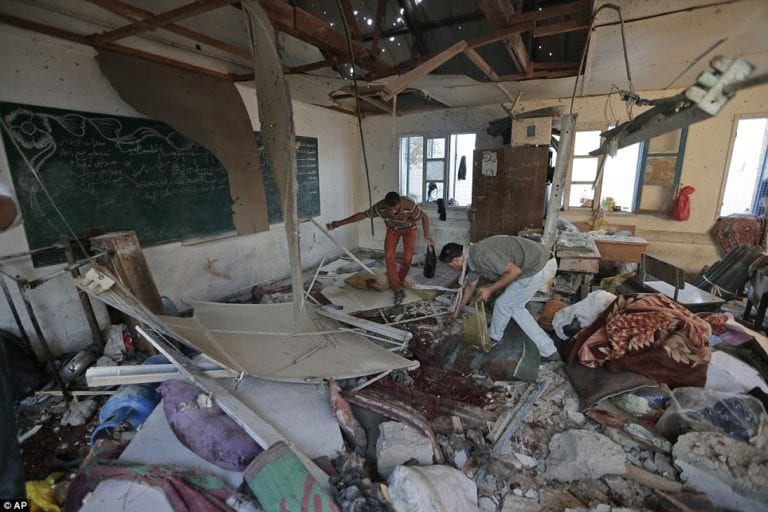
Again, the Trump-Kushner plan neglects the true reason why Palestinians can’t “realize their ambitions.” Under occupation, students often can’t get past checkpoints in time for classes; school days are regularly interrupted by Israeli military tear gas attacks or invasions, followed by arrests of students and/or teachers; a huge number of students have been traumatized by Israeli violence.
Against the odds, Palestinians have among the highest literacy rates in the world, and Gaza has one of the highest rates of PhD holders per capita in the world.
“While Palestinians have among the highest graduation rates in the region, many Palestinian schools are stretched beyond their capacity, with too few teachers and classrooms to support their students.”
In this statement, the Plan glosses over the fact that Palestinian students are succeeding at an impressive rate under impossible conditions. Their academic achievements should lead to a prosperous society, but it does not – because of the elephants.
The statement also fails to mention that overcrowding is due to Israeli forces’ regular practice of demolishing and refusing building permits for West Bank schools. In Gaza, over half of the schools were damaged during an Israeli assault in 2014 – and many are still not rebuilt, since Israel regularly blocks the delivery of construction materials.
“Unfortunately, Palestinians currently experience one of the highest youth-unemployment rates in the world… By providing the Palestinian public sector with policy advice on best practices, encouraging private-sector attention to this problem, and promoting a comprehensive strategy to empower youth and women, more women and youth will join the Palestinian labor force.”
Senior Advisor Kushner is under the impression that Palestinians can’t flip their graduates into successful careers because they need foreign billionaires to give them advice. This is the height of arrogance.
Elephants in the agriculture plan
“While agriculture accounts for approximately eight percent of Palestinian employment, this sector has not met its potential due to limited access of Palestinian farmers to land, water, and technology. An improved business environment in the West Bank and Gaza and access to more land will create an enormous opportunity for farmers to expand their operations.”
Why in the world would Palestinian farmers have “limited access” to their own land? It’s a simple question with a simple answer: Israel has built a wall that separates farmers from much of their farmland. The International Court of Justice declared the wall illegal in 2004 (when it was less than half built) and ordered it torn down. In spite of this, Israel has continued construction along a route that effectively severs Palestinians from the nearly 10% of West Bank land – much of it agricultural – that lies outside the wall.

A 2016 publication by the UN Conference on Trade and Development (UNCTAD) noted some of the measurable effects of the occupation on Palestinian agriculture:
Since the onset of the occupation in 1967, the Palestinian people have lost access to more than 60 per cent of West Bank land and two thirds of its grazing land. In Gaza, half of the cultivable area and 85 per cent of fishery resources are inaccessible to Palestinian producers…
The UN Conference on Trade and Development (UNCTAD) reports that inside the wall, the Israeli expropriation for expanding illegal Israeli settlements and Jewish-only roads “includ[es] the most fertile and best grazing land.”
For those Palestinians who are able to access their land during the harvest season, much or all of their crops can be lost “due to violence and threats by settlers” – who are aided and abetted by the Israeli military.
Up to 1 million olive trees and 2.5 million fruit trees have been uprooted since 1967, many due to illegal Israeli settlement expansion and the construction of the wall, others as a form of vandalism.
All told, the occupation caused a drop in agricultural sector from over half of the Palestinian GDP prior to 1967, to just 6% by 2012.
In addition, Israeli military and illegal settlers destroy or vandalize infrastructure, buildings, and water systems, and the Israeli government restricts the import of fertilizers, seedlings, and certain types of livestock, ensuring “that most of the advantages present in the Israeli agricultural sector are beyond the reach of Palestinian farmers.”
Again, the assistance Palestinians need is not advice from billionaires, but freedom from Israeli domination and oppression.
Elephants in the water and wastewater plan
“The parties [must] recognize mutual water rights… [s]hared aquifers… and jointly seek to provide easily available, reasonably priced water to both parties.”
The wording in this statement suggests that Israel and the Palestinians endure roughly equal water hardship and suffer from exorbitant prices.
In reality, one of the “parties” already has more than enough water, the other too little, too expensive, and too toxic. Again, UNCTAD spells out the cause:
Palestinian farmers are denied the right to construct wells to meet the growing demand for water, even when that water originates almost entirely in the West Bank… [O]rganizations, such as Oxfam, report that Palestinian assets, including sources of water, have often been vandalized by Israeli settlers…
Environmental degradation is also caused by settlers, through the discharge of untreated wastewater into nearby wadis and release of solid domestic and industrial waste from settlements onto Palestinian lands. In addition, several incidents of dumping of hazardous and toxic waste in the West Bank have been documented.
Israel confiscates 82% of Palestinian groundwater for its own use or that of its settlers, piping it efficiently to Israelis, but avoiding Palestinian villages. Many poor Palestinian families spend up to 40% of their meagre income on trucked-in, high-priced water.
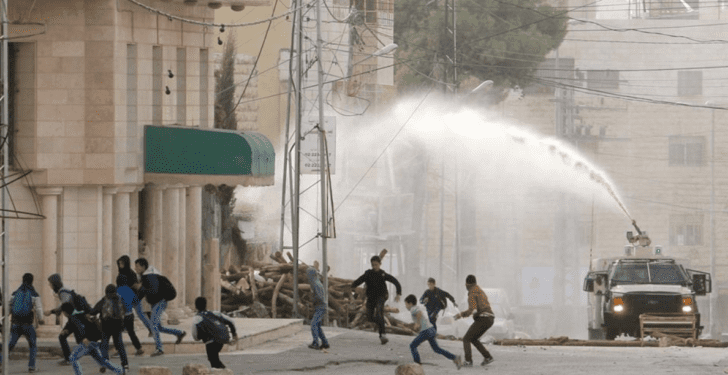
In addition, the Israeli military routinely destroys Palestinians’ own water pipes and wells. And as a variation on the theme, the Israeli military uses skunk water to break up protests or as collective punishment. (some US police forces have imported the product).
In Gaza, the situation is even more dire, with 97% of its water unfit for human consumption, thanks in great part to Israeli restrictions on import of supplies needed for wastewater treatment.
Elephants in the healthcare plan
“The [healthcare] program will provide new resources and incentives to transform the Palestinian healthcare sector and ensure the Palestinian people have access to the care they need within the West Bank and Gaza. This program will rapidly increase the capacity of Palestinian hospitals by ensuring that they have the supplies, medicines, vaccines, and equipment to provide top-quality care and protect against health emergencies.”
Once again, the Kushner Plan insinuates that Palestinians lack proper health care because they lack enlightenment or competence.
In reality, the healthcare sector in Gaza is in disarray because hospitals have been bombed, medicines and equipment have been withheld by the blockade, and huge numbers of critically wounded people seek medical help – many with devastating injuries from Israeli weapons that are likely illegal. Over the years, the Israeli military has shown a pattern of denying Palestinian women in labor permission to go to the hospital; Israeli soldiers chase away ambulances (even from small children), ultimately leaving Palestinians to die.
To top it off, the Trump administration recently cut off aid to hospitals in East Jerusalem.
These are some of the factors that have caused an infant mortality rate in the Palestinian territories of 18.8 per 1,000 births (in Israel mortality is 3.7/1,000), and an average life expectancy for Palestinians of 74 (vs. 83 for Israelis).
Elephants in the sports and athletics plan
“[S]ports and athletics can help Palestinian youth foster new ties…and Palestinian teams can be a source of entertainment and pride for all Palestinians. This project will expand options for competitive, healthy activities for Palestinians through the construction of public athletic facilities in the West Bank and Gaza. This project seeks to inspire the next generation of Palestinian athletes dreaming to be on, and training for, future Palestinian teams competing on the world stage.”
Sports and competition are already in the hearts of Palestinians – they don’t need Jared Kushner to inspire them. What they do need is an end to the occupation that denies them permits to participate in events, holds them back from competing in the Olympics, and maims their bodies. Even children playing soccer on the beach are unsafe under Israeli oppression.

Elephants in the transportation plan
“[Palestinians face] transportation challenges. The lack of ports has raised the costs of Palestinian economic activity. Though the State of Palestine will include Gaza, security challenges make the building of a port in Gaza problematic for the foreseeable future.”
This notion is illegal according to the UN Convention on the Law of the Sea. Gaza has 25 miles of shoreline, but the Israeli-American coalition would forbid Palestinians from building a port. This is not how self-determination and sovereignty work. The Plan would essentially enforce the devastating, 13-year-old, illegal blockade, and license the now 53-year de facto occupation, as Israel would control all Palestinian imports and exports.
Conclusion
“Generations of Palestinians have lived without knowing peace, and the West Bank and Gaza have fallen into a protracted crisis.”
Did Palestinian bad luck cause them to “fall” into a “protracted crisis”? No, Palestinians have had a protracted crisis forced upon them – by Israel. They have resisted in every way they know how, but to no avail.
Reading the Kushner Plan, one would never know that the devastation, the desolation within Palestinian society was created by Israel. In 181 pages and a map, there is no acknowledgement that the Zionist project brought great injustice to generations of Palestinians.
“Yet the Palestinian story will not end here. The Palestinian people continue their historic endeavor to build a better future for their children.”
Correct: Palestinians have endeavored for generations to build a future that includes justice, freedom, and equality – and they have no intention of giving up.
“If implemented, Peace to Prosperity will empower the Palestinian people to build the society that they have aspired to establish for generations. “
Incorrect: Palestinians don’t need a plan imposed on them by Western businessmen – they need justice, freedom, and equality, which Israel has steadfastly withheld.
“Ultimately, however, the power to unlock it lies in the hands of the Palestinian people. Only through peace can the Palestinians achieve prosperity.”
A better statement might be, “Only through justice can there be peace and prosperity. Israel and the US have the power to bring justice.”
“While the vision is ambitious, it is achievable. The future of the Palestinians is one of huge promise and potential. The Palestinian story does not end here. Their story is just being written.”
The story is just being written…by a partisan, privileged group that has nothing but disdain for the Palestinian people. They promise no peace, only more elephants.
Crippling lockdown on Kashmir surpasses 200 days
By Javed Rana – Press TV – February 21, 2020
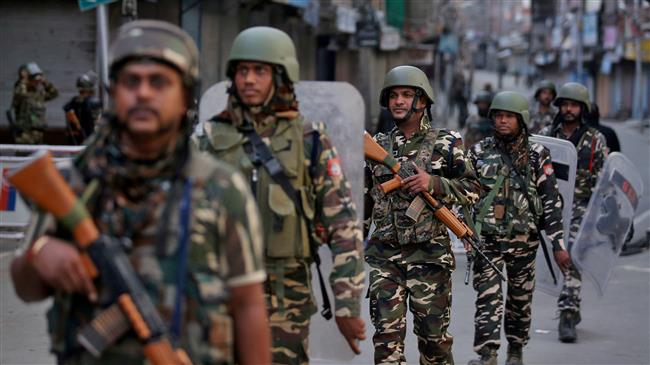
The crippling security and communications lockdown in the Muslim-majority Indian disputed Kashmir region has entered its 200 days. Nearly 900,000 military and paramilitary troops are deployed to prevent mass agitation since August 5 last year when New Delhi revoked Kashmir’s special status and forcibly annexed it into India.
The controversial merger of the disputed territory was in defiance of eleven UN Security Council resolutions which call for a plebiscite to allow Kashmiris to decide on whether they want to stay with India or join Pakistan.
Since then, the top Kashmiri leaders including three former chief ministers have been imprisoned. In their absence, the second tier leaders held press conference in Islamabad to inform the world of what India seeks to hide.
India has banned the entry of independent journalists, human rights activists, observers and even many western politicians from entering into disputed Kashmir region.
Kashmiri leaders believe that the Indian government has been deliberately crippling the economy to create adverse conditions for Kashmiris to force them to sell their properties to Hindu businessmen. This, they say, is aimed at altering the demography of the Muslim-majority state.
Iraq regime needs to be changed again, argues ex-aide for Cheney and Bolton… referring to something he helped to install
RT | February 21, 2020
Baghdad’s ruling class is beyond saving, so it’s time to scrap it in its entirety, believes a neocon pundit who served in the Bush administration. What was the saying about doing the same thing and hoping for different results?
Things are really bad in Iraq these days. There are mass protests, where young people demand democracy, an end to corruption and that Iranians go back to their country. But Iranians have been “imperially usurping the authority of Iraq’s elected leaders,” and now “the rot of Iranian penetration” has rendered the entire Iraqi ruling class beyond saving. They need to go, and the US has things to do.
That’s the premise of an op-ed published by Foreign Policy magazine under the title ‘Iraq Needs Regime Change Again’. The author is John Hannah, a neoconservative pundit with the Foundation for Defense of Democracies. During the George W Bush era, Hannah worked as an aide to mustached arch-hawk John Bolton before moving to the team of Vice President Dick Cheney. A few years ago, he was part of Donald Trump’s transition team.
With credentials like these, Hannah’s position is unsurprising, but his line of reasoning gives a good insight into the kind of gaslighting and wishful thinking feeding US Middle East policy.
Take, for example, his description of events leading to the US’s assassination of Iran’s General Qassem Soleimani and Abu Mahdi al-Muhandis, deputy commander of the Iraqi Popular Mobilization Forces (PMF). PMF launched rocket attacks against facilities hosting US forces and killed a US contractor, thus “crossing an unambiguous red line.” After the US retaliated, the Iraqi government allowed “a mob” to “lay siege” to the US embassy in Baghdad, where “heavily armed but outnumbered US Marines steeled themselves to repel a potential assault a la Tehran in 1979 or Benghazi in 2012.” And then the US was “forced into the position of droning convoys on major Baghdad highways carrying senior Iraqi and Iranian military commanders openly conspiring to attack US interests.”
So, Washington is pretty much a victim here! Never mind, for instance, Israeli airstrikes at PMF bases in Iraq, which have been killing Iraqis since July 2019. Or the fact that the embassy ‘siege’ resulted in zero casualties on the American side.
Hannah’s plan for the proposed new regime change doesn’t seem to include any Shock and Awe-style action. Instead, Washington should “invest less in the Iraqi government and more in the [anti-government] protest movement”. The protesters are “an historic challenge to all that Iran has perpetrated in Iraq”, he argues, and while they “have no love lost for an America that they blame for saddling them after 2003 with a botched occupation and a failed political system,” they are secretly somewhat pro-American.
“After the targeted killings of Soleimani and Muhandis, the protesters did make a point of coupling their standard chant of ‘No, no Iran’ with ‘No, no America.’ But talk to them confidentially and they will admit that including the United States is largely a means of reducing the risk of being attacked by Iran’s unforgiving proxies,” he wrote. Or, to cite Hannah’s former boss, “My belief is we will, in fact, be greeted as liberators.”
The big goal for Hannah is “banishing Iraq’s current crop of corrupt rulers, Islamist parties, and Iranian toadies to the political margins”. But wasn’t that exactly what the US did to Iraq after Saddam Hussein’s rule? And the chaos created afterwards brought about the rise of various insurgency and terror groups, including the Islamic State.
And last, but not least: Hannah’s big argument in favor of toppling the Iraqi government again is that it has been perpetrating violence against its own people and is beyond redemption. Assuming this is true, and Iran’s puppets are waiting for an excuse to unleash tanks on democratic protests… An almost 3,000-word suggestion to use the demonstrators as a patsy to stick it to Tehran and publishing it in a leading US magazine doesn’t seem like a far-sighted thing to do.
Hamas delegation meets Russia’s Deputy Foreign Minister
MEMO | February 20, 2020
A senior Hamas delegation has met with Russia’s Deputy Foreign Minister Mikhail Bogdanov in Doha, the capital of Qatar.
In a statement issued on Wednesday, the Islamic Resistance Movement said that its delegation was led by the head of its International Office, Mousa Abu Marzook, accompanied by Political Bureau member Sami Khater and the former leader of its Political Bureau, Khaled Meshaal, as well as its representative in Moscow.
The Hamas delegation briefed Bogdanov on the latest political developments in the Palestinian cause, including the US “deal of the century”.
They reiterated that the deal is targeting the Palestinian people, their legitimate right to return and the efforts to establish an independent and sovereign state, which is why it has been rejected not only by the movement, but also all segments of Palestinian society.
Bogdanov reaffirmed his country’s support for the Palestinian people and rejection of any “peace plan” rejected by them. Russia, he explained, is ready to provide support for the Palestinians in order to end the internal division and achieve the national unity that is the key to achieving their legitimate objectives.
Furthermore, the Russian official stressed that the Israeli-Palestinian conflict should be solved on the basis of international law, including UN General Assembly resolutions and the Arab Peace Initiative.
Russian Air Force strikes repel militant attack on Syrian government army in Idlib – Defense Ministry
RT | February 20, 2020
The Russian Air Force launched strikes to repel a militant offensive against the Syrian Army in Idlib, which had sought to breach the government forces’ defensive lines, the Russian Defense Ministry said.
The militants, supported by Turkey, had shelled the Syrian Army’s positions in the region. However, the Turkish forces stopped the artillery barrage after Moscow contacted Ankara, the ministry added.
The militants had launched a “massive offensive” southeast of the city of Idlib, using many armored vehicles, the Russian Reconciliation Center in Syria said on Thursday, adding that it was Turkish artillery that helped them breach the Syrian Army’s defenses in some areas.
Aerial footage published by the Russian Defense Ministry shows a Turkish self-propelled howitzer battery shelling the Syrian Army positions.
At the request of Damascus, Russian Su-24 strike aircraft hit the advancing armed groups, helping Syrian forces to repel the offensive, destroying a tank and six infantry-fighting vehicles, among other hardware.
The reconciliation center also said that the Turkish shelling left four Syrian soldiers injured. Moscow also once again called on Ankara to cease its support for terrorists in Idlib, and stop handing over weapons to them.
Meanwhile, Turkey’s Defense Ministry said that two Turkish soldiers were killed and five others injured in the air strikes.
The incident comes amid a spike in tensions between Damascus and Ankara. Turkey has opposed the Syrian Army’s advances in the battle against extremists and militants entrenched in Idlib province for quite some time. On Wednesday, President Recep Tayyip Erdogan said that Turkey would not “leave Idlib to the Assad regime” and threatened to launch an incursion into the province.
Turkey had already reinforced its outposts in the area, which is the last remaining major militant stronghold on the Syrian territory. Russia repeatedly warned Turkey against attacking the Syrian Army and has continued diplomatic efforts to ease tensions around Idlib.
Russia warns Turkey against rash moves in Idlib

Turkish military reinforcements preparing to cross the border into Syria’s northwestern province of Idlib, February 12, 2020
By M. K. BHADRAKUMAR | Indian Punchline | February 19, 2020
Moscow has taken with a pinch of salt Turkish President Recep Erdogan’s statement on Wednesday that a Turkish incursion into the northwestern Syrian province of Idlib is imminent.
Objectively speaking, Erdogan should be out of his mind to order a military offensive against the Syrian and Russian forces in Idlib. A Russian military delegation, which visited Ankara last week, had advised the Turks to back down, but Erdogan instead beefed up the deployments in Idlib.
Again, the Russian side proposed to the Turkish delegation, which visited Moscow this week for further talks, that a new ceasefire is the best option, necessitated by the ground reality that Damascus will not vacate the strategic areas flanking the M4 and M5 highways.
The Turkish delegation not only disputed the Russian demarche that terrorist attacks from Idlib continue still against the Hmeimim airbase but Erdogan’s statement today goes a step further.
Clearly, Moscow cannot take chances. The Kremlin spokesmen Dmitry Peskov calmly shrugged off Erdogan’s threat by saying, “Let us not expect the worst scenario to become a reality.”
He added, “We are determined to continue to use our working contacts with our Turkish counterparts to prevent the situation in Idlib from escalating further.” Peskov stressed that “contacts with Turkey would continue at various levels.”
But the Russian intention is to forewarn Erdogan against making any rash moves. The point is, the Idlib situation evolved over a period of time since last summer when Russia and Syria reached an estimation that Turkey had no intentions of fulfilling its commitments to evict the al-Qaeda affiliates.
Turkey was instead utilising its 12 “observation posts” in Idlib to keep an eye on the Syrian and Russian forces beyond the ceasefire line.
When the Russian-Syrian offensive finally got under way, Turks could do nothing to stop it and very soon, these observation posts got surrounded by the Syrian army. Erdogan lost face. And he ordered a deployment of 5,000 troops to Idlib with heavy armour, tanks and artillery.
But the Syrian forces took on the challenge and13 Turkish soldiers were killed. Erdogan had probably thought that the Syrian forces would hesitate to take on a NATO power. Again, he lost face. And this time around, he threatened to attack the Syrian and Russian forces.
But the offensive rolled on and more towns and territories came under control of the Syrian government. As a commentary featured today in the Kremlin-funded RT puts it, “Erdogan’s bluff had been effectively called. The Turks now find themselves in an impossible situation.”
Erdogan has pulled back the rebel groups that are Turkey’s proxies and left the al-Qaeda groups to fend for themselves where they are being systematically decimated by the Syrian and Russian forces. The RT commentary concludes:
“For the Turkish troops still deployed inside Idlib, their situation has become increasingly perilous. Their numbers and dispositions preclude any chance of a meaningful defense of Idlib, even if the decision was made to engage the Russian Air Force and Syrian Army. The best that Turks can hope for at this juncture is a new ceasefire that allows its military forces in Idlib to be withdrawn safely with their honour intact… Turkey has made its position in Idlib unsustainable both militarily and politically.”
However, Russia won’t take chances. In a display of military superiority, two Russian Tupolev Tu-22M3 strategic bombers performed a scheduled flight over the Black Sea today, covering a distance of about 4,500 km and staying in the air for more than five hours, while fighter jets of Russia’s Southern Military District escorted the bombers.
Again, today, Foreign Minister Sergey Lavrov repeated Moscow’s full backing for the Syrian operations in Idlib. He said in a clear rebuff to Turkey, “It is only natural that the Syrian armed forces, reaffirming their commitment to the original agreements on Idlib, including an agreement on a ceasefire, respond to such inadmissible provocations. We support them in this.”
“The Syrian army’s actions are a response to a flagrant violation of the agreements on Idlib… Syrian troops are not pushing militants and terrorists back on a foreign territory but on their own soil, thereby reestablishing the legitimate Syrian government’s control over its territories.”
Although US President Trump keeps cheering Erdogan to buck up his spirits, the NATO as such is not getting involved in the Turkish adventure in Idlib. Tass quoted a NATO diplomatic source in Brussels that NATO countries will neither support the invocation of Article 5 over the death of Turkish troops in Idlib nor provide Turkey with military assistance in the event of a military operation in the region.
Moscow has been far too lenient toward Erdogan who has “significant challenges at home, where the Turkish economy is slowing down, and overseas, where Turkey’s military is over-stretched, from Syria to Libya,” as a scholar at the Washington Institute noted.
In a clear message warning Erdogan from punching so far above his weight, Haftar’s forces had fired shells at a Turkish ship at Tripoli harbour last week, which was carrying arms and supplies. Interestingly, Russian Defence Minister Sergei Shoigu met today with the Libyan commander Khalifa Haftar, who is Erdogan’s bête noire.
The astonishing part is that amidst all this cacophony, on Tuesday, the Turkish military quietly resumed joint patrols with Russian forces in northeastern Syria where both countries have a common interest in preventing a US return to the Turkish-Syrian border regions with their Kurdish allies. Certainly, as Peskov signalled today, the Kremlin has reason to hope that the better sense will prevail in Ankara.
Sanders tells New York Times he would consider a preemptive strike against Iran or North Korea
By Jacob Crosse and Barry Grey | WSWS | February 14, 2020
Bernie Sanders has won the popular vote in both the New Hampshire and Iowa presidential primary contests in considerable part by presenting himself as an opponent of war. Following the criminal assassination of Iranian General Qassem Suleimani last month, Sanders was the most vocal of the Democratic presidential aspirants in criticizing Trump’s action. His poll numbers have risen in tandem with his stepped-up anti-war rhetoric.
He has repeatedly stressed his vote against the 2003 invasion of Iraq, reminding voters in the Iowa presidential debate last month, “I not only voted against that war, I helped lead the effort against that war.”
However, when speaking to the foremost newspaper of the American ruling class, the New York Times, the Sanders campaign adopts a very different tone than that employed by the candidate when addressing the public in campaign stump speeches or TV interviews.
The answers provided by Sanders’ campaign to a foreign policy survey of the Democratic presidential candidates published this month by the Times provide a very different picture of the attitude of the self-styled “democratic socialist” to American imperialism and war. In the course of the survey, the Sanders campaign is at pains to reassure the military/intelligence establishment and the financial elite of the senator’s loyalty to US imperialism and his readiness to deploy its military machine.
Perhaps most significant and chilling is the response to the third question in the Times’ survey.
Question: Would you consider military force to pre-empt an Iranian or North Korean nuclear or missile test?
Answer: Yes.
A Sanders White House, according to his campaign, would be open to launching a military strike against Iran or nuclear-armed North Korea to prevent (not respond to) not even a threatened missile or nuclear strike against the United States, but a mere weapons test. This is a breathtakingly reckless position no less incendiary than those advanced by the Trump administration.
Sanders would risk a war that could easily involve the major powers and lead to a nuclear Armageddon in order to block a weapons test by countries that have been subjected to devastating US sanctions and diplomatic, economic and military provocations for decades.
Moreover, as Sanders’ response to the Times makes clear, the so-called progressive, anti-war candidate fully subscribes to the doctrine of “preemptive war” declared to be official US policy in 2002 by the administration of George W. Bush. An illegal assertion of aggressive war as an instrument of foreign policy, this doctrine violates the principles laid down at the Nuremberg Trials of Nazi officials after World War II, the United Nations charter and other international laws and conventions on war. Sanders’ embrace of the doctrine, following in the footsteps of the Obama administration, shows that his opposition to the Iraq war was purely a question of tactics, not a principled opposition to imperialist war.
The above question is preceded by another that evokes a response fully in line with the war policies of the Obama administration, the first two-term administration in US history to preside over uninterrupted war.
Question: Would you consider military force for a humanitarian intervention?
Answer: Yes.
Among the criminal wars carried out by the United States in the name of defending “human rights” are the war in Bosnia and the bombing of Serbia in the 1990s, the 2011 air war against Libya that ended with the lynching of deposed ruler Muammar Gaddafi, and the civil war in Syria that was fomented by Washington and conducted by its Al Qaeda-linked proxy militias.
The fraudulent humanitarian pretexts for US aggression were no more legitimate than the lie of “weapons of mass destruction” used in the neo-colonial invasion of Iraq. The result of these war crimes has been the destruction of entire societies, the death of millions and dislocation of tens of millions more, along with the transformation of the Middle East into a cauldron of great power intervention and intrigue that threatens to erupt into a new world war.
Sanders fully subscribes to this doctrine of “humanitarian war” that has been particularly associated with Democratic administrations.
In response to a question from the Times on the assassination of Suleimani, the Sanders campaign calls Trump’s action illegal, but refuses to take a principled stand against targeted assassinations in general and associates itself with the attacks on Suleimani as a terrorist.
The reply states:
Clearly there is evidence that Suleimani was involved in acts of terror. He also supported attacks on US troops in Iraq. But the right question isn’t ‘was this a bad guy,’ but rather ‘does assassinating him make Americans safer?’ The answer is clearly no.
In other words, the extra-judicial killing of people by the US government is justified if it makes Americans “safer.” This is a tacit endorsement of the policy of drone assassinations that was vastly expanded under the Obama administration—a policy that included the murder of US citizens.
At another point, the Times asks:
Would you agree to begin withdrawing American troops from the Korean peninsula?
The reply is:
No, not immediately. We would work closely with our South Korean partners to move toward peace on the Korean peninsula, which is the only way we will ultimately deal with the North Korean nuclear issue.
Sanders thus supports the continued presence of tens of thousands of US troops on the Korean peninsula, just as he supports the deployment of US forces more generally to assert the global interests of the American ruling class.
On Israel, Sanders calls for a continuation of the current level of US military and civilian aid and opposes the immediate return of the US embassy from Jerusalem to Tel Aviv.
On Russia, he entirely supports the Democratic Party’s McCarthyite anti-Russia campaign and lines up behind the right-wing basis of the Democrats’ failed impeachment drive against Trump:
Question: If Russia continues on its current course in Ukraine and other former Soviet states, should the United States regard it as an adversary, or even an enemy?
Answer: Yes.
Question: Should Russia be required to return Crimea to Ukraine before it is allowed back into the G-7?
Answer: Yes.
Finally, the Times asks the Sanders campaign its position on the National Security Strategy announced by the Trump administration at the beginning of 2018. The new doctrine declares that the focus of American foreign and military strategy has shifted from the “war on terror” to the preparation for war against its major rivals, naming in particular Russia and China.
In the following exchange, Sanders tacitly accepts the great power conflict framework of the National Security Strategy, attacking Trump from the right for failing to aggressively prosecute the conflict with Russia and China:
Question: President Trump’s national security strategy calls for shifting the focus of American foreign policy away from the Middle East and Afghanistan, and back to what it refers to as the ‘revisionist’ superpowers, Russia and China. Do you agree? Why or why not?
Answer: Despite its stated strategy, the Trump administration has never followed a coherent national security strategy. In fact, Trump has escalated tensions in the Middle East and put us on the brink of war with Iran, refused to hold Russia accountable for its interference in our elections and human rights abuses, has done nothing to address our unfair trade agreement with China that only benefits wealthy corporations, and has ignored China’s mass internment of Uighurs and its brutal repression of protesters in Hong Kong. Clearly, Trump is not a president we should be taking notes from. [Emphasis added].
In a recent interview Ro Khanna, a Democratic congressman and national co-chair of the Sanders campaign, assured Atlantic writer Uri Friedman that Sanders would continue provocative “freedom of the seas” navigation operations in the Persian Gulf and the South China Sea, while committing a Sanders administration to “maintain some [troop] presence” on the multitude of bases dotting “allied” countries from Japan to Germany.
Millions of workers, students and young people are presently attracted to Sanders because they have come to despise and oppose the vast social inequality, brutality and militarism of American society and correctly associate these evils with capitalism. However, they will soon learn through bitter experience that Sanders’s opposition to the “billionaire class” is no more real than his supposed opposition to war. His foreign policy is imperialist through and through, in line with the aggressive and militaristic policy of the Democratic Party and the Obama administration.
The Democrats’ differences with Trump on foreign policy, though bitter, are tactical. Both parties share the strategic orientation of asserting US global hegemony above all through force of arms.
No matter how much Sanders blusters about inequality, it is impossible to oppose the depredations of the ruling class at home while supporting its plunder and oppression abroad.
Sanders is no more an apostle of peace than he is a representative of the working class. Both in foreign and domestic policy, he is an instrument of the ruling class for channeling the growing movement of the working class and opposition to capitalism back behind the Democratic Party and the two-party system of capitalist rule in America.
EU delaying tactics bring it closer to Trump’s deal
By Ramona Wadi | MEMO | February 18, 2020
For all its purported peace-building efforts and support for Palestinian rights, the EU is committed to supporting Israel’s colonial-settler expansionism. Its feeble response to US President Donald Trump’s so-called “deal of the century” was accentuated in the recent decision to refuse to pass any official resolutions until after next month’s Israeli General Election.
Palestine is never a priority in foreign policy anywhere. Yet the Palestinian Authority persists in pursuing non-existent international support, notably that of the EU, ostensibly to navigate the labyrinth of dispossession which the UN’s 1947 Partition Plan forced upon the people of Palestine. The truth is that the PA is scrambling to retain its bequeathed diplomatic standing and the funding that allows it to function as the “sole representative” of the Palestinians.
In return, the PA facilitates the waiting game for the international community, while Palestinians suffer statements such as the latest by EU Foreign Affairs Chief Josep Borrell. “We briefly discussed how best to relaunch a political process that is acceptable to both parties and how best to defend the internationally agreed parameters, equal rights and international law,” he declared on Monday. Defending internationally agreed parameters has nothing to do with protecting Palestinian rights, and PA leader Mahmoud Abbas is aware of this discrepancy.
Meanwhile, Israel is lobbying EU countries to refrain from taking a stance against Trump’s plan. Israeli media highlights the fact that recognition of the State of Palestine by several European countries has “little, if any, diplomatic effect.” While in previous years, recognition of Palestine raised Israel’s ire, it is now being touted as a futile PA effort in comparison with the US-Israeli partnership to colonise Palestine, as well as the EU’s increasingly non-committal stance towards Palestinians and their legitimate political rights.
Nevertheless, Israel will not take any risk that the EU might voice a unified condemnation of Trump’s plan. The delay communicated by the EU with regard to its response over US-Israeli scheming indicates diplomatic activity that favours Israel. The latter allegedly “fears” the EU playing a major role in any future negotiations. Netanyahu has pledged to carry out the annexation of the occupied West Bank if re-elected, and the EU has done nothing other than issue the usual bland condemnation. If the EU does indeed take on a more influential role in negotiations, whether these are based on the defunct two-state compromise or Trump’s proposal, it will clearly adopt a pro-Israel stance.
Behind the scenes, Israel is lobbying for such a scenario and there is nothing to impede the EU from continuing with its track record of marginalising Palestinians. Before Trump’s deal was revealed, EU diplomats attempted to differentiate between the allegedly law-abiding EU and the international law-abusing US. The illusion of a political struggle between both entities was the focus of analysis, which suited Israel as it shifted attention away from the Palestinians.
The final step in this process will matter little to Israel as long as the EU does not depart from its decades-long policy of pretending to support Palestinian rights while actively pursuing stronger ties with Israel. One point, however, must be clarified. If the EU is seeking additional delays before issuing a statement regarding the deal of the century, the words of former EU representative for Foreign Affairs Federica Mogherini must be recalled: the EU would consider working with the US plan if the two-state paradigm is included. One obsolete imposition has now been replaced by another that offers fragments of a state, which the EU and its backing for Israeli expansionism has supported tacitly all along.
Explaining Syria
It’s everyone’s fault except the U.S. and Israel
By Philip Giraldi • Unz Review • February 18, 2020
The first week in February was memorable for the failed impeachment of President Donald Trump, the “re-elect me” State of the Union address and the marketing of a new line of underwear by Kim Kardashian. Given all of the excitement, it was easy to miss a special State Department press briefing by Ambassador James Jeffrey held on February 5th regarding the current situation in Syria.
Jeffrey is the United States Special Representative for Syria Engagement and the Special Envoy for the Global Coalition to Defeat ISIL. Jeffrey has had a distinguished career in government service, attaining senior level State Department positions under both Democratic and Republican presidents. He has served as U.S. Ambassador to both Turkey and Iraq. He is, generally speaking, a hardliner politically, closely aligned with Israel and regarding Iran as a hostile destabilizing force in the Middle East region. He was between 2013 and 2018 Philip Solondz distinguished fellow at the Washington Institute for Near East Policy (WINEP), a think tank that is a spin-off of the American Israel Public Affairs Committee (AIPAC). He is currently a WINEP “Outside Author” and go-to “expert.”
Professor John Mearsheimer of the University of Chicago and Stephen Walt, academic dean at Harvard University’s Kennedy School of Government, describe WINEP as “part of the core” of the Israel Lobby in the U.S. They examined the group on pages 175-6 in their groundbreaking book The Israel Lobby and US Foreign Policy and concluded as follows:
“Although WINEP plays down its links to Israel and claims that it provides a ‘balanced and realistic’ perspective on Middle East issues, this is not the case. In fact, WINEP is funded and run by individuals who are deeply committed to advancing Israel’s agenda … Many of its personnel are genuine scholars or experienced former officials, but they are hardly neutral observers on most Middle East issues and there is little diversity of views within WINEP’s ranks.”
In early 2018 Jeffrey co-authored a WINEP special report on Syria which urged “…the Trump administration [to] couple a no-fly/no-drive zone and a small residual ground presence in the northeast with intensified sanctions against the Assad regime’s Iranian patron. In doing so, Washington can support local efforts to stabilize the area, encourage Gulf partners to ‘put skin in the game, drive a wedge between Moscow and Tehran, and help Israel avoid all-out war.”
Note the focus on Iran and Russia as threats and the referral to Assad and his government as a “regime.” And the U.S. presence is to “help Israel.” So we have Ambassador James Jeffrey leading the charge on Syria, from an Israeli perspective that is no doubt compatible with the White House view, which explains why he has become Special Representative for Syria Engagement.
Jeffrey set the tone for his term of office shortly after being appointed by President Trump back in August 2018 when he argued that the Syrian terrorists were “. . . not terrorists, but people fighting a civil war against a brutal dictator.” Jeffrey, who must have somehow missed a lot of the head chopping and rape going on, subsequently traveled to the Middle East and stopped off in Israel to meet Prime Minister Benjamin Netanyahu. It has been suggested that Jeffrey received his marching orders during the visit.
Two months later James Jeffrey declared that he would like to see Russia maintain a “permissive approach” to allow the Israelis to attack Iranian targets inside Syria. Regarding Iran’s possible future role in Syria he observed that “Iranians are part of the problem not part of the solution.”
What Jeffrey meant was that because Israel had been “allowed” to carry out hundreds of air attacks in Syria ostensibly directed against Iran-linked targets, the practice should be permitted to continue. Israel had suspended nearly all of its airstrikes in the wake of the shoot down of a Russian aircraft in September 2018, an incident which was caused by a deliberate Israeli maneuver that brought down the plane even though the missile that struck the aircraft was fired by Syria. Fifteen Russian servicemen were killed. Israel reportedly was deliberately using the Russian plane to mask the presence of its own attacking aircraft.
Russia responded to the incident by deploying advanced S-300 anti-aircraft systems to Syria, which can cover most of the more heavily developed areas of the country. Jeffrey was unhappy with that decision, saying “We are concerned very much about the S-300 system being deployed to Syria. The issue is at the detail level. Who will control it? what role will it play?” And he defended his own patently absurd urging that Russia, Syria’s ally, permit Israel to continue its air attacks by saying “We understand the existential interest and we support Israel” because the Israeli government has an “existential interest in blocking Iran from deploying long-range power projection systems such as surface-to-surface missiles.”
Later in November 2018 James Jeffrey was at it again, declaring that U.S. troops will not leave Syria before guaranteeing the “enduring defeated” of ISIS, but he perversely put the onus on Syria and Iran, saying that “We also think that you cannot have an enduring defeat of ISIS until you have fundamental change in the Syrian regime and fundamental change in Iran’s role in Syria, which contributed greatly to the rise of ISIS in the first place in 2013, 2014.”
As virtually no one but Jeffrey and the Israeli government actually believes that Damascus and Tehran were responsible for creating ISIS, the ambassador elaborated, blaming President Bashar al-Assad for the cycle of violence in Syria that, he claimed, allowed the development of the terrorist group in both Syria and neighboring Iraq.
He said “The Syrian regime produced ISIS. The elements of ISIS in the hundreds, probably, saw an opportunity in the total breakdown of civil society and of the upsurge of violence as the population rose up against the Assad regime, and the Assad regime, rather than try to negotiate or try to find any kind of solution, unleashed massive violence against its own population.”
Jeffrey’s formula is just another recycling of the myth that the Syrian opposition consisted of good folks who wanted to establish democracy in the country. In reality, it incorporated terrorist elements right from the beginning and groups like ISIS and the al-Qaeda affiliates rapidly assumed control of the violence. That Jeffrey should be so ignorant or blinded by his own presumptions to be unaware of that is astonishing. It is also interesting to note that he makes no mention of the U.S. invasion of Iraq, kneejerk support for Israel and the unrelenting pressure on Syria starting with the Syrian Accountability Act of 2003 and continuing with embrace of the so-called Arab Spring. Most observers believe that those actions were major contributors to the rise of ISIS.
Jeffrey’s unflinching embrace of the Israeli and hardline Washington assessment of the Syrian crisis comes as no surprise given his pedigree, but in the same interview where he pounded Iran and Syria he asserted oddly that “We’re not about regime change. We’re about a change in the behavior of a government and of a state.”
Some of James Jeffrey’s comments at last week’s press conference are similarly illuminating. Much of what he said concerned the mechanics of relationships with the Russians and Turks, but he also discussed some core issues relating to Washington’s perspective on the conflict. Many of his comments were very similar to what he said when he was appointed in 2018.
Jeffrey expressed concern over the thousands of al-Nusra terrorists holed up in besieged Idlib province, saying “We’re very, very worried about this. First of all, the significance of Idlib – that’s where we’ve had chemical weapons attacks in the past… And we’re seeing not just the Russians but the Iranians and Hizballah actively involved in supporting the Syrian offensive… You see the problems right now in Idlib. This is a dangerous conflict. It needs to be brought to an end. Russia needs to change its policies.”
He elaborated, “We’re not asking for regime change per se, we’re not asking for the Russians to leave, we’re asking…Syria to behave as a normal, decent country that doesn’t force half its population to flee, doesn’t use chemical weapons dozens of times against its own civilians, doesn’t drop barrel bombs, doesn’t create a refugee crisis that almost toppled governments in Europe, does not allow terrorists such as HTS and particularly Daesh/ISIS emerge and flourish in much of Syria. Those are the things that that regime has done, and the international community cannot accept that.”
Well, one has to conclude that James Jeffrey is possibly completely delusional. The core issue that the United States is in Syria illegally as a proxy for Israel and Saudi Arabia is not touched on, nor the criminal role in “protecting the oil fields” and stealing their production, which he mentions but does not explain. Nor the issue of the legitimate Syrian government seeking to recover its territory against groups that most everyone admits to be terrorists.
Virtually every bit of “evidence” that Jeffrey cites is either false or inflated, to include the claim of use of chemical weapons and the responsibility for the refugees. As for who actually created the terrorists, that honor goes to the United States, which accomplished that when it invaded Iraq and destroyed its government before following up by undermining Syria. And, by the way, someone should point out to Jeffrey that Russia and Iran are in Syria as allies of its legitimate government.
Ambassador James Jeffrey maintains that “Russia needs to change its policies.” That is not correct. It is the United States that must change its policies by getting out of Syria and Iraq for starters while also stopping the deference to feckless “allies” Israel and Saudi Arabia that has produced a debilitating cold war against both Iran and Russia. Another good first step to make the U.S. a “normal, decent country” would be to get rid of the advice of people like James Jeffrey.
Philip M. Giraldi, Ph.D., is Executive Director of the Council for the National Interest, a 501(c)3 tax deductible educational foundation (Federal ID Number #52-1739023) that seeks a more interests-based U.S. foreign policy in the Middle East. Website is councilforthenationalinterest.org, address is P.O. Box 2157, Purcellville VA 20134 and its email is inform@cnionline.org.
Erdogan Escalates Threats, Syria Ignores Him, Scores Massive Gains
Aleppo celebrates, but Erdogan has 7000 troops in Idlib, unquestioned US support, and a penchant for occupying pieces of Syria
By Marko Marjanović | Anti-Empire | February 17, 2020
Erdogan has escalated threats, saying he will not wait until end of February to push the Syrian army back to its starting lines if it does not start withdrawing:
“The solution in Idlib is the regime withdrawing to the borders in the agreements. Otherwise, we will handle this before the end of February,” Erdoğan said.
“Until we clear Syria of terrorist organizations and the cruelty of the regime, we will not rest easy,” he said.
The Trump administration’s unqualified (if wholly rhetorical) support for whatever Erdogan may wish to do there, as long as it goes against the Russians may have had something to do with that:
In a statement released by the White House on Sunday, Deputy Press Secretary Judd Deere said Trump – in a phone call with Turkish President Recep Tayyip Erdogan – “conveyed the United States’s desire to see an end to Russia’s support for the Assad government’s atrocities and for a political resolution to the Syrian conflict”.
“Trump expressed concern [yesterday] over the violence in Idlib, Syria and thanked Erdogan for Turkey’s efforts to prevent a humanitarian catastrophe,” Deere said.
Either way, the Syrian army has been completely ignoring Erdogan’s demands, ultimatums and threats and it has paid off handsomely for Damascus. It has continued to make gains daily, and scored a gigantic success yesterday as rebel defenses in western Aleppo suburbs crumbled after they were outflanked from the south.
Inside a day the Syrian army gained the majority of the urbanized territory that represented the most valuable real-estate still in rebel hands. The rest of the salient will follow today or tomorrow at the latest.
This marks the definite end of the 8-year Battle of Aleppo as rebels which two days ago still held some suburbs technically inside the city limits have now been pushed far to the west. Aleppo citizens, completely besieged by Islamists in 2013, for one celebrated:
In fact, the rebel’s number one sympathizer on Twitter, Julian Ropcke, aka Jihadi Julian, has done invaluable work in counting that since Erdogan first vowed to stop the Syrian army the latter has retaken 96 settlements from the rebels:
Nonetheless, Erdogan has by now poured 7,000 Turkish soldiers with 2,000 vehicles into rebel-held Idlib. That is a very considerable force. What he will do with that is anyone’s guess.
The danger is not so much that he’ll counter-attack the Syrian army trying to throw it back, as that would risk Russian wrath, but that he’ll try to occupy a part of the rebel enclave for Turkey as he has done in northern Syria.

Situation at February 14 day-end, just before Erdogan made his latest round of threats the next day

Situation halfway through today, February 17
Erdogan and Turkey are now the biggest obstacles standing before the Syrian state and army as rebels appear to be completely broken with low morale and quick to retreat.
US names members of panel for West Bank annexation
PNN – February 16, 2020
The US government has appointed members of a committee tasked with mapping out areas of the occupied West Bank that Israel plans to annex as part of President Donald Trump’s self-proclaimed “Deal of the Century.”
A senior Trump administration official told the Israel Hayom daily that US ambassador to Israel David Friedman will lead the joint committee.
“Honored to serve on the Joint Committee,” tweeted Friedman Saturday. “Looking forward to getting started right away,” he said.
Other committee members will include Friedman’s senior adviser Aryeh Lightstone, and Scott Leith, a US National Security Council expert on Israel.
Israeli members will include tourism minister Yariv Levin and Israeli ambassador to the United States Ron Dermer.
The committee was announced by Trump last month during the unveiling of his scheme, which would see Israel control swathes of the West Bank in violation of the fundamental rights of the Palestinians.
Trump said the joint committee would be formed to “convert the conceptual map into a more detailed and calibrated rendering so that recognition can be immediately achieved.”
There is still no set timeline for when the committee will finish its work, but Israeli prime minister Benjamin Netanyahu has been pressured by right-wing lawmakers in recent weeks to announce the immediate annexation of all settlements before Israelis head to the polls.
Three weeks ago, both Netanyahu and Friedman said that Israel would be able to do so before the election, and Netanyahu planned to turn the issue into the cornerstone of his re-election campaign.
Trump’s son-in-law and adviser Jared Kushner, who is believed to be the architect of the so-called “Vision for Peace,” has said the US administration and Israel had decided to wait until a team was formed to examine the maps, and that he hoped Israel would wait until after the election.
On January 28, Trump unveiled his plan negotiated with Israel but without Palestinians, as one side of any agreement, being involved in the process.
Palestinian leaders immediately rejected the plan, with President Mahmoud Abbas saying it “belongs in the dustbin of history.”
They view the deal as a colonial plan meant to unilaterally control Palestine in its entirety and remove Palestinians from their homeland.
Sayyed Nasrallah: Trump’s Two Recent Crimes Usher Direct Confrontation with Resistance Forces
By Mohammad Salami – Al-Manar – February 16, 2020
Hezbollah Secretary General Sayyed Hasan Nasrallah stressed Sunday that the United States of America has recently committed two major crimes, the assassination of the head of IRGC’s Al-Quds Force general Qasem Suleimani as well as the deputy chief of Iraq’s Hashd Shaabi Abu Mahdi Al-Muhandis and the announcement of Trump’s Mideast plan.
Sayyed Nasrallah stressed that those two crimes had ushered a direct confrontation with the axis of resistance in Lebanon, calling for forming a comprehensive resistance front against the United States all over the world.
Delivering a speech during Hezbollah’s “Martyrdom & Insight” Ceremony which marks the anniversary of the martyrs Sheikh Ragheb Harb, Sayyed Abbas Al-Moussawi and Hajj Imad Mughniyeh and the 40th day after the martyrdom of General Suleimani and Hajj Al-Muhandis, Sayyed Nasrallah emphasized that in this confrontation with the United States, we have to trust God’s help, keep hopeful for a bright future and challenge our fear.
Sayyed Nasrallah pointed out that the so-called “deal of the century” cannot be described as a ‘deal’ because it refers merely to the plan of the US president Donald Trump’s plan to eradicate the Palestinian cause.
All the Palestinian forces have rejected and may never approve Trump’s scheme, according to Sayyed Nasrallah who considered that this is basic in frustrating the US plan.
Sayyed Nasrallah noted that consistency of stances which reject Trump’s plan is required to frustrate it, adding that the US will is not an inevitable destiny and citing previous cases of Washington’s failure when opposed by resistance.
No one approved the US plan except Trump and Netanyahu, according to Sayyed Nasrallah who underscored the Palestinian, Arab and international rejection of the scheme.
The Hezbollah leader hailed the consensus of the Lebanese political parties which have rejected Trump’s plan, attributing this attitude to the recognition of the dangers of the scheme to Lebanon and the entire region.
Sayyed Nasrallah noted that Trump’s plan affects Lebanon because it grants the occupied Shebaa Farms, Kfar Shuba hills and the Lebanese part of Al-Ghajar town to the Zionist entity, stipulates naturalizing the Palestinian refugees and impacts the border demarcation.
“The spirit of Trump’s plan will be decisive in the issue of demarcating the land and sea borders with occupied Palestine and will affect Lebanon’s oil wealth.”
Sayyed Nasrallah pointed out that what reassures the Lebanese about the rejection of the naturalization of the Palestinian refugees is the consensual attitude of all the parties in this regard, calling for respecting certain groups’ fears related to this issue.
Featured Video

Answers to Myocarditis and Heart Conditions
or go to
Aletho News Archives – Video-Images
From the Archives
Casuistry
By Thomas S. Harrington | CounterPunch | August 19, 2016
… What will almost never be talked about are the many very good reasons a person from the vast region stretching from Morrocco in the west, to Pakistan in the east, have to be very angry at, and to feel highly vengeful toward, the US, its strategic puppeteer Israel, and their slavishly loyal European compadres like France, Germany and Great Britain. … Read full article
Blog Roll
Recent Comments
loongtip on Eilat port faces worst crisis… loongtip on British minister dreams of kid… loongtip on Kiev awards major mining proje… loongtip on UK believes it can seize any t… loongtip on Pirates of the Caribbean loongtip on Australian festival boycotted… loongtip on Kiev seeks to ban Russian musi… seversonebcfb985d9 on Somaliland and the ‘Grea… John Edward Kendrick on Kidnapped By the Washington… aletho on Somaliland and the ‘Grea… John Edward Kendrick on Somaliland and the ‘Grea… aletho on Donald Trump, and Most America…


 Aletho News
- Knesset advances bill mandating death by hanging for Palestinian prisoners
- Eilat port faces worst crisis as Red Sea shipping collapses
- Iran protest-riots can only achieve US-Israeli intervention, ‘shadow CIA’ concludes
- The Coming War on Iran: What Has Really Been Happening?
- US Cargo Planes Have Flooded the Persian Gulf Since the First of December
- Deep-state forces from abroad instigated violence in Nepal – former foreign minister
- Rare Earths—or Arctic Control? Greenland’s Riches May Just Be Excuse
- Kiev awards major mining project to Trump-linked investors
- US makes money from weapons, not from Ukrainian minerals
- Drone hits Kazakh tanker en route to Russian port
- If Americans Knew
- The New Neoconservatives
- As more Gaza children freeze to death, Trump eyes Gaza as starting point for world domination – Not a ceasefire Day 95
- More death: in Gaza, West Bank, Israeli prison – Not a ceasefire Day 94
- The Israeli Influence Operation Aiming to Install Reza Pahlavi as Shah of Iran
- Avoidable tragedy: another infant dies from cold – Not a ceasefire Day 93
- Israel is quietly erasing Palestinian refugee camps from existence in the West Bank
- The “Zionist tint” to the Maduro abduction, if not operational, then normative
- Press association condemns Israel’s continued ban on media access to Gaza
- Israeli Indifference to Palestinian Suffering Is Fertile Ground for the Growth of Sadism
- Surge in premature births, congenital defects, cancer deaths in Gaza – Not a ceasefire Day 92
- No Tricks Zone
- Denmark Places Climate Protection Above Animal Welfare, Poisoning And Culling Cows
- New Study: Greenland Was 3-7°C Warmer And Far Less Glaciated Than Today 6000-8000 Years Ago
- German Media Report That Current Frigid Weather Can Be Explained By Arctic Warming!
- Berlin Blackout Shows Germany’s $5 Trillion Green Scheme Is “Left-Green Ideological Pipe Dream”
- Modeling Error In Estimating How Clouds Affect Climate Is 8700% Larger Than Alleged CO2 Forcing
- Berlin’s Terror-Blackout Enters 4th Day As Tens Of Thousands Suffer In Cold Without Heat!
- Expect Soon Another PIK Paper Claiming Warming Leads To Cold Snaps Over Europe
- New Study: Human CO2 Emissions Responsible For 1.57% Of Global Temperature Change Since 1750
- Welcome To 2026: Europe Laying Groundwork For Climate Science Censorship!
- New Study Finds A Higher Rate Of Global Warming From 1899-1940 Than From 1983-2024
 Aletho News