“Tyrant”, Hollywood’s novel plot to vilify Arabs
By Roqayah Chamseddine | In Homage to the Struggle | July 10, 2014
Our earliest intimate interaction with the foreign characters in Tyrant comes in the form of an aggressive sexual assault where we quickly learn that Bassam’s older brother Jamal is a sexual predator and philanderer in a scene featuring the first close encounter with an Arab woman. She is brutalized while her husband and small children wait outside, clearly able to hear the sounds. Juxtapose this with the show’s inaugural note between Bassam’s American and non-Arab wife, and children, who are made to appear as the quintessential American family, as the teens sit discussing the prospect of being attacked during their visit to Abbudin by “them.” We are sent flashing back and forth between the naiveté of Bassam’s immediate family and episodes of violence that overwhelm and saturate the fictional land of Abbudin, with the sounds of traditional Arabic music tossed at viewers as a constant emotional trigger which exaggerates the foreign element of the land and those who occupy it. “You better be careful, this isn’t America,” warns Bassam’s teenage daughter after her brother is told he’ll be attending a bachelor party. The Arab man is a daunting figure after all and even during the bachelor party, which is held at a sauna, there is no escaping his malevolence. Bassam calls his brother out of the sauna so they may deal with the relative of a man who is allegedly planning to attack the wedding Bassam’s family is in Abbudin to attend, and then he watches as his brother beats this man nearly to death. The towel draped around Jamal falls as he applies blow after blow to the defenseless man and then attempts to cut off his fingers. Not even the shame of his nakedness pulls him away from wielding violence.
As the story marches forward we notice that Bassam, who had left Abbudin for a more tedious but unrestrained life in America, is clearly disturbed, possibly dealing with post-traumatic stress disorder, and cannot even attend his nephew’s wedding without being reminded of the brutality he witnessed as a child. In a flashback we see a younger Jamal being pulled out of a vehicle by his father so he can shoot a man in the head. “The Arabs teach their children to hate,” as the stale orientalist adage goes, so it is not a far stretch for the writers to construct a murderous child influenced by the savagery of his culture. The audience now knows that his violence was part of the greater Arab mentality, which fosters a culture of hate and barbarism. Jamal’s savagery continues as we watch it being unleashed upon the next stock character we see in film and television – the Arab woman – the docile, obedient, easily manipulated and disposable creature. After witnessing his newlywed son’s wife laughing publicly alongside a male attendee of the wedding the audience immediately knows where things are going. The Arab man is angry. How dare she dishonor her husband and his relatives. Jamal soon follows her into the dressing room where she stands playing with her hair, and then the tension builds. His hands glide around the lines of her face as he lectures her on purity. “It would break Ahmed’s heart if the woman he married was not pure,” he whispers. Then, as we watch her beg him to stop, viewers are once again thrown into a brutal rape scene, this time with the second Arab woman they have been familiarized with. This is not even the last rape scene the writers crammed into the 50-some minute pilot, as later on we are shown the Arab woman at the beginning being viciously raped once more by Jamal in a moving vehicle. If you did not already view Jamal’s character as being nothing more than an insatiable barbarian it is pounded into you for good measure in that scene.
Bassam’s character, who may be categorized as being the “good Arab” in this series, is slowly undressed as we begin to examine his psychology and that of the Arab mind. Bassam is emotionally inhibited at all times and once in Abuddin his wife begins to feel a great disconnect, and the distance only grows after Bassam slaps his son across the face, twice, as she looks on – terrified. Here we find that even the “good Arab” is a monster in disguise and his identity as an American is nothing more than a frail shroud of deception, and the violence of the Arab culture is one which Bassam cannot escape, no matter how long his self-imposed exile lasts. Bassam’s wife grows anxious, confessing “I don’t know who you are anymore, I don’t think I ever did,” and suddenly a flashback: Jamal, who had been instructed by his father to kill a man, drops the gun and scurries back into the vehicle. As his father screams for him to return and finish the job we see Bassam, the younger of the pair, exit the car and stand before the man. Without hesitation he coldly points the gun at the weeping man and shoots him twice, killing him. Bassam does not flinch. The point being made here is that this is Bassam at his core, and at his core he is frighteningly cold.
The stock characters and sounds in Tyrant are the same as all other mainstream films and TV shows involving the Arabs – men with darkened beards, unnerving and penetrating rounds of ululation from veiled women and the muezzin’s call to prayer as a haunting backdrop. Then there are the elite Arabs who are flashy, play American music, and mingle with affluent white Americans. They do not adhere to religious dress codes, nor to religious moral codes, and they drink and fill themselves with the best liquor money can buy. Yet despite all this they cannot break away from the shackles of Arab society. No matter how Westernized the elite Arab woman is, with her casting away of the hijab and her captivating sexual presence, she remains a device, written into this script as being almost entirely silent but for whimpers and terse statements bolstering the fanaticism of male characters. Bassam’s teenage daughter is written into the script as being intellectually superior to the foreign Arab woman – when she is invited to the bachelorette party and told she would have fun and get a “henna tattoo” she scoffs, refusing to take part in what she finds to be a “patriarchal tradition.” The Arab woman is either dressed in subdued colours, her head lowered and sexually inhibited or she is a sensual and hyper-exotic creature that still has no authority over her sexuality but for being exploited and dehumanized by the Arab man. In Tyrant, and other similar television shows, the Arab man is a savage creature who rapes and pillages. He lovingly kisses his mother’s cheeks and hands but strikes his wife’s face and brings her crumbling to the floor beneath him. He gets drunk, dresses like the white man and speaks like the white man in bouts of broken English but is nothing more than an animal in a suit.
The evil Arab archetype is ever-present in film and television – the Arab is inept, blood-thirsty and unscrupulous in the serial drama 24, in Homeland we see the Arab and Muslim through American eyes as an abusive and murderous infiltrator and in Tyrant the one-dimensionality of the Arab is almost cartoonish. The impacts of these orientalist depictions are far reaching. These portrayals work to justify the day-to-day xenophobia Arabs and Muslims face to Israel’s current butchery in the besieged Gaza Strip; from encouraging the US spy on Muslim-Americans to rationalizing setting a Palestinian boy on fire or carpet bombing an entire people. Hollywood has not moved far beyond Lawrence of Arabia or Disney’s stereotypical portrayal of Arabs in the fictional desert-land of Agrabah who “will cut off your ear if they don’t like your face” (as the original lyric from the soundtrack goes). “It’s barbaric,” sang the peddler in Agrabah, “but hey, it’s home!” — the exotic natives dancing with veils in the streets, gargantuan swords, sorcery and over-exaggerated accents are as much a part of film and television today as they were long ago. In the 1992 film the protagonist and thief Aladdin (nicknamed “Al”) takes magic carpet rides with Princess Jasmine while in the TV series Tyrant Bassam (‘Barry’) and his family arrive in Abbudin in style by way of airplane, where they are the only passengers aboard, and their feet land on thick oriental rugs that have been laid on the ground. Here they come, straight from an American whole new world to the desert.
Roqayah Chamseddine is a Sydney based Lebanese-American journalist and commentator. She tweets @roqchams and writes ‘Letters From the Underground.‘
Justice Corrupted
By Lawrence Davidson | To The Point Analyses | July 10, 2014
Dogmatists in the Justice System
Scattered throughout the ranks of U.S. federal prosecutors and judges there have always been men and women who are unwilling to make a distinction between their own biases and the rules of evidence that are designed to keep the system focused on the goal of justice. Such closed-minded individuals, embedded in the system, can find themselves set free to act out their prejudices by special circumstances. One might think back to the “hanging judges” who appeared here and there on the American frontier in the 19th century. Being among the few enforcers of law and order in an otherwise anarchic environment, they indulged their fantasies of playing the wrathful god.
The “War on Terror” has likewise created a special circumstance that has liberated Justice Department dogmatists: Islamophobes, Zionists, neoconservatives and others who fancy themselves on a special mission to protect the nation from evil and conspiratorial forces. And, as with the hanging judges before them, the result has been an enhanced possibility not of justice, but rather of the miscarriage of justice.
The Case of Sami Al-Arian
In the past twenty years one of the most notable victims of doctrinaire judges and prosecutors has been Sami Al-Arian. Al-Arian is the son of Palestinian-refugee parents. He came to the United States in 1975 to attend university and earned his degree in computer systems engineering. Eventually he earned a Ph.D. and obtained a tenure-track position at the University of South Florida.
Not only did Al-Arian become a prominent professor, winning several teaching awards, but he also became a community activist, defending the civil liberties of minority groups, particularly Muslim Americans. During the Clinton administration he was an active campaigner against the Justice Department’s pre-9/11 use of “secret evidence” to hold people in jail indefinitely. He also actively and publicly supported the right of Palestinians to resist Israeli oppression.
At some point in the mid-1990s what may have been a coordinated effort to ruin Dr. Al-Arian developed among neoconservative and Zionist elements. Steven Emerson, a man who has made his living as a faux expert on terrorism and a professional Islamophobe, accused one of Al-Arian’s organizations, the World and Islam Studies Enterprise, of being a “terrorist front.” This accusation proved to be baseless, but it nonetheless led other Islamophobe radicals to focus on Al-Arian. Some of these people resided within the Justice Department and the FBI, and they went on a fishing expedition looking for alleged connections between Al-Arian and a recently designated “terrorist organization” called the Palestine Islamic Jihad (PIJ).
During the 2000 presidential election Al-Arian became a prominent figure in national politics as it played out in Florida. His major concern was the government’s use of secret evidence, and it was George W. Bush who promised to rein in the practice. Therefore Al-Arian backed Bush in the election. His trust in this regard proved horribly misplaced.
On September 26, 2001, Bill O’Reilly invited Al-Arian onto his TV show ostensibly to discuss Arab-American reactions to the 9/11 attacks. It was a trap. O’Reilly immediately asked Al-Arian if he had said “Jihad is our path. Victory to Islam. Death to Israel” at a rally thirteen years before (in 1988). Though Al-Arian tried to explain that it was a reference to his support for Palestinian resistance against apartheid policies in Israel, O’Reilly proclaimed that the CIA should watch Al-Arian from now on. Almost at once Al -Arian started to receive death threats. At this point the University of South Florida placed him on administrative leave. He would eventually be fired by the University.
The O’Reilly interview may have been a public relations booster for the ongoing Justice Department investigation mentioned above. That lasted until September 2003, when Al-Arian and three others were indicted on 25 counts of “racketeering” for the PIJ. The Bush administration’s Attorney General John Ashcroft went on television to extol the indictment as a great blow against terrorism (thus confusing an indictment with a conviction) that was made possible by the extensive powers of the USA PATRIOT Act. Among these powers were those George W. Bush had promised Al-Arian he would rein in.
After a 5-month, 13-day trial Al-Arian was acquitted on 8 counts and the jury deadlocked on the remaining 17. When a juror was interviewed after the trial and asked what was lacking in the government’s case he replied, “evidence.” Nonetheless, the outcome allowed the government to hold Al-Arian pending retrial on those deadlocked counts. The case had a distinctly contrived and corrupt feel to it – the result of Islamophobes turned loose by the events of 9/11 to substitute their own biases for the rules of legal evidence.
In 2006 Dr. Al-Arian was still in prison. His health was deteriorating and the strain on his family (his wife and five children) was great. Given the situation he agreed to a plea bargain agreement whereby he would plead guilty to one count of acting in a fashion that benefited the PIJ. In exchange the other counts would be dismissed by the government. He would be incarcerated for a relatively short period on the guilty count with time already served counting toward this sentence. In order to secure the plea bargain, Al-Arian also had to agreed to be deported upon release.
Once more the government, in this case the judge and the federal prosecutor, proved untrustworthy. Despite the jury verdict, the judge had decided that Sami Al-Arian was a “master manipulator” and “a leader of Palestine Islamic Jihad.” This was exactly what the jury decided the evidence could not substantiate. However, the judge, moved by emotional convictions, had equated statements on the part of Al-Arian showing understanding of acts of Palestinian resistance with actual material support of those actions. In doing so the judge went beyond the rules of evidence and corrupted the system he was sworn to serve. The judge gave Dr. Al-Arian not the minimum recommended in the plea bargain but the maximum of 57 months for the one count to which he pled guilty.
Then began a series of additional prosecutorial steps involving the issuing of repeated subpoenas demanding that Al-Arian testify at grand jury investigations. This was also in defiance of his plea bargain and so he refused. He was held in civil and later criminal contempt which added substantially to his jail time.
So egregious was the behavior of the prosecutors seeking his testimony that another, more objective judge eventually stepped in and halted the government’s efforts to force Sami Al-Arian’s to appear before grand juries. Dr. Al-Arian was also let out of prison and allowed to live under a liberal form of house arrest at his daughter’s home in Virginia. His case was held in a kind of legal limbo until just recently, when on 27 June 2014, prosecutors decided to drop all charges against Al-Arian. One should not think of this as a total victory, for the government still intends to deport Sami Al-Arian.
Sami Al-Arian and his family had to endure eleven years of persecution on the basis of assumptions that were substituted for evidence. In the process the life of an upright man, devoted to teaching, charitable works and the cause of a persecuted people, was ruined. The people who did this to him simultaneously corrupted the justice system the integrity of which they were sworn to uphold.
Other Victims
While Sami Al-Arian was perhaps the most high-profile of these cases, his was not the only one. Four members of the Holy Land Foundation charity were charged with materially aiding Hamas when, in fact, all the foundation did was supply money to charitable Palestinian organizations which had been accredited by Israel. It took two trials, one in 2007 and another 2008, for the U.S. government to eke out a conviction on weak evidence that included the testimony of anonymous Israeli witnesses. The Supreme Court refused to interfere with this prima facie unconstitutional procedure.
At present a Palestinian civil rights activist in Chicago, Rasmea Odeh, is being prosecuted for an alleged immigration fraud for failing to report on her immigration application that forty-five years ago, when she was a child, she was arrested by the Israeli military and briefly held without charge. The same prosecutor who went after the Holy Land Foundation is involved in the prosecution of Odeh.
Conclusion
Times of high tension often result in the lowering of important standards in the application of law. They do so by heightening the fears of the general public, which in turn gives license to bigots embedded in the justice system such as judges and prosecutors who have Islamophobic prejudices, Zionist biases, or neoconservative delusions. All of these motives may come into play in cases such as those mentioned above.
Normally the appeals process should catch and reverse such problematic behavior. However, if the period of public fear is prolonged, the appeals process might also become corrupted by public hysteria and political pressures. It took Sami Al-Arian eleven years to overcome his prosecutorial ordeal and those of the Holy Foundation members and Rasmea Odeh are ongoing.
The last word on this dilemma should go to Sami Al-Arian’s son, Abdullah, who in a recent statement observed,“It’s a sad day when you have to leave America to be free.” Indeed, when dogmatists are in control none of us are really free.
The Israel Lobby and French Politics
By Evan Jones | CounterPunch | July 9, 2014
Pascal Boniface is a specialist in what the French call ‘geopolitics’. His output has been prodigious, traversing a wide variety of subjects. His latest book was published in May, titled: La France malade du conflit israélo-palestinien. For his literary efforts in this arena, Boniface has moved from respected commentator to being persona non grata in the mainstream media.
This story begins in 2001. Boniface was an adviser to the Parti Socialiste, with the PS then in a cohabitation government under RPR President Jacques Chirac and PS Prime Minister Lionel Jospin. In April 2001, he wrote an opinion for PS officials. The Party’s approach to Israel is based on realpolitik rather than on ethical principles, and it was time for a reappraisal.
Boniface published an article to the same effect in Le Monde in August 2001, which led to a response and rebuke by the then Israeli ambassador. Boniface then became fair game for the Israel lobby (my term – Boniface assiduously avoids it). Boniface was accused, via selective quotation, of urging the PS to cynically cater to the French Arab/Muslim community, more numerous than the Jewish community, to gain electoral advantage. As recently as January 2014, Alain Finkielkraut (rabble-rouser on the ‘Islamist’ problem in France) denounced Boniface on the same grounds.
The 1300 word 2001 note is reproduced in Boniface’s latest book. In a prefatory note to the reproduction, Boniface notes: “How many times have I not heard that one can’t move on the Middle East because of the ‘Jewish vote’ (sic) which of course does not exist but which nevertheless is largely taken on board by the elected of all sides.” Again, “It is not because there are more Arabs than Jews that it is necessary to condemn the Israeli Occupation; it is rather because the Occupation is illegal and illegitimate, contrary to universal principles and to the right of peoples to govern themselves.”
In the note itself, Boniface opines: “The intellectual terrorism that consists of accusing of anti-Semitism those who don’t accept the politics of Israeli governments (as opposed to the state of Israel), profitable in the short term, will prove to be disastrous in the end.” Paraphrasing Boniface: ‘… it will act to reinforce and expand an irritation with the French Jewish community, and increasingly isolate it at the national level.’ Boniface concludes:
“It is better to lose an election than to lose one’s soul. But in putting on the same level the government of Israel and the Palestinians, one risks simply to lose both. Does the support of Sharon [then Prime Minister] warrant a loss in 2002? It is high time that the PS … faces the reality of a situation more and more abnormal, more and more perceived as such, and which besides does not serve … the interests in the medium and long term of the Israeli people and of the French Jewish community.”
As Boniface highlights in 2014, “This note, alas, retains its topicality.”
Then comes 9/11 in September. There is the second Intifada in Palestine. Boniface wanted an internal debate in the PS, but is accused of anti-Semitism. The glib denunciation of terrorism brings with it a prohibition against the questioning of its causes.
Not content to be silenced, Boniface wrote a book in 2003, titled Est-il permis de critique Israël ?. Boniface was rejected by seven publishing houses before finding a publisher. In 2011, Boniface published a book titled Les Intellectuels Faussaires (The Counterfeit Intellectuals). In that book he called to account eight prominent individuals, not for their views (virulently pro-Israel, Neo-cons, Islamophobes) but because he claims, with evidence, that they persistently bend the truth. Yet they all regularly appear on the French mainstream media as expert commentators. The point here is that the 2011 book was rejected by fourteen publishers; add those who Boniface knew would be a waste of time approaching. Belatedly, Boniface found a willing small-scale publisher for Faussaires, and it has sold well in spite of a blackout in outlets that Boniface had expected some coverage.
Boniface also notes that Michel Bôle-Richard, recognized journalist at Le Monde, experienced a rejection for his manuscript Israël, le nouvel apartheid by ten publishing houses before he found a small-scale publisher in 2013. Boniface’s La France malade was rejected by the house that published his 2003 book. By default, it has been published by a small-scale Catholic press, Éditions Salvator. As Boniface notes, ‘this is symptomatic of the climate in France and precisely why this book had to be written’. It’s noteworthy that much of the non-mainstream media, including Marianne, Le Canard Enchainé and Mediapart, steers clear of the issue.
Boniface’s book is not about the Israel-Palestine conflict. Rather, it is about the parlous influence of the domestic Israel lobby on French politics and French society more broadly. Boniface claims that one can criticize any government in the world (one can even mercilessly attack the reigning French President), but not that of Israel.
After 2001, the PS was pressured to excommunicate him. Two regional presses ceased to publish his articles. There were attempts to discredit his organization – the Institut de Relations Internationales et Stratégiques – and to have him removed. He has been slurred as an anti-Semite.
At the peak of French Jewish organizations is the Conseil Représentatif des Institutions Juives de France. CRIF’s formal dominant concern is the combating of anti-Semitism. At its annual dinner, its President cites the yearly total of recorded anti-Semitic incidents, berating the assembled political elite (‘the turn up of Ministers rivals that of the 14th July’) who don’t dare to reply.
There are indeed recurring anti-Semitic events, and there was a noticeable surge for several years in the early 2000s. Prime Minister Jospin was blamed for not keeping a lid on troublemakers (read Arab/Muslim) from the banlieues. The Socialists were ousted in 2002 and CRIF became a vocal advocate for and supporter of the new Interior Minister Nicholas Sarkozy’s domestic hard-line against civil disorder.
But Jospin was ‘guilty’ of more. One of the PS’s most ardent supporters of Israel, Jospin visited Israel and the Occupied Territories in 1999. Experiencing the latter first hand, his government’s policy towards Sharon-led Israel becomes less ardent. For CRIF, France’s less than a 100% plus pro-Israel stance puts French Jews at greater risk, so CRIF maintains as its imperative to influence both foreign and domestic policy. After the Merah murders of (amongst others) three Jewish children and an adult at a Toulouse school in 2012, CRIF was still laying blame on Jospin. As Boniface notes, CRIF perennially attempts to influence France’s policies but refrains from attempting to influence Israel’s policies.
When the publisher of Boniface’s 2003 book rejected the latest proposal (originally planned as a revised edition of the earlier book), the excuse was that it was over-laden with statistics. Statistics there are (helped by French infatuation with surveys and polling), and they ground Boniface’s cause.
Boniface highlights a change in attitudes after the 1960s. Anti-Semitism was still observably prevalent in the 1960s (would you accept Jews as in-laws?, a Jewish President?, etc.) but has since been consistently in decline. At the same time, popular support for Israel has experienced consistent decline. Until 1967, support for Israel, as the ‘underdog’, in France was high. Gradually attitudes have changed. Israel’s invasion of Lebanon in 1982 is a turning point. Increasingly the manifestations of conflict – the intifadas, the failures at Camp David and later of Oslo – are blamed on Israel. Increasingly, the sympathy is more in favor of the occupied rather than the occupier.
In 2003, a European-wide survey produced the result that the greatest percentage of those surveyed thought that, of all countries, Israel was a threat to world peace – ahead of the US, Iran and North Korea, and so on. If the facts are ugly then bury them. There has been no subsequent comparable survey.
With anti-Semitism down and dislike for Israeli government policies up, the main agenda of CRIF has been to become a ‘second ambassador’ for Israel under cover of the supposed omnipresent pall of anti-Semitism in France. Other organizations like the Bureau national de vigilance contre l’anti-sémitisme (BNVCA) and the Union des étudiants juifs de France (UEJF) are part of the Israel cheer squad.
Boniface cites CRIF President Roger Cukierman in 2005: “Teachers have a demanding task to teach our children … the art of living together, the history of religions, of slavery, of anti-Semitism. A labor of truth is also essential to inscribe Zionism, this movement of emancipation, amongst the great epics of human history, and not as a repulsive fantasy.” And CRIF President Richard Prasquier in 2011: “Today Jews are attacked for their support of Israel, for Israel has become the ‘Jew’ amongst nations.” After 2008, following the ascendancy of Prasquier to the CRIF presidency, CRIF institutionalizes the organization of trips to Israel by French opinion leaders, and the reception in France of Israeli personalities.
Boniface finds it odious that anti-Semitism should be ‘instrumentalized’ to protect Israeli governments regardless of their actions. There is the blanket attempt at censorship of all events and materials that open Israel’s policies to examination.
Representative is a planned gathering in January 2011 at the prestigious École normale supérieure of 300 people to debate the ‘boycott’ question. Among the participants were the Israeli militant peacenik Nurit Peled, who lost her daughter in a suicide bombing, and the formidable Stéphane Hessel. The ENS’s director cancelled the booking under direct pressure. The higher education Minister and bureaucracy were also lobbied, in turn putting pressure on the ENS.
In February 2010, Sarkozy’s Justice Minister Michèle Alliot-Marie issued a directive criminalizing those calling for a boycott of Israeli products. The formal reason given was that such a boycott militates against the freedom of commerce. The directive imposes a jail sentence and a heavy fine, and the Justice Minister instructed prosecutors that it is to be vigorously applied. Even the magistrature has criticized the directive, noting that its claimed dependence on a 2004 anti-discrimination law is inadmissible, and that it involves ‘a juridical assault of rare violence’ against a historic means of combating crimes of state. The directive remains in force under the Hollande Presidency.
The most striking reflection of the wholesale censorship agenda of the Israel lobby is the abuse of Jewish critics of Israel.
April 2010, under the banner Jcall.edu, a group of respected European Jews criticize the Occupation in defense of a more secure Israel, urging ‘two peoples, two states’ – they are attacked. March 2012, Jacob Cohen, Jewish critic of Israel, is physically menaced by the Ligue de défense juive (LDJ) during the launch of his book. November 2012, the mayoralty of the 19th arrondisement is attacked by the BNVCA for supporting an exhibition on the Negev Bedouins. Its sponsors, the Union juive française pour la paix (UJFP), are characterized as fronts for Palestinian propaganda. December 2012, Israeli Michel Warschawski is awarded the ‘prix des droits de l’homme de la République française’ – he is demonized. Other prominent Jewish intellectuals – Franco-Israeli Charles Enderlin, Rony Brauman, Edgar Morin, Esther Benbassa, members of the UJPF – are demonized.
July 2014, three young Jewish Israelis have been murdered. Charles Enderlin reports from Israel. The television channel France 2 mis-edits Enderlin’s reportage of ‘three young Israelis’ as ‘young colonists’. Widely respected for his sober reporting, Enderlin has been subsequently subject to a volley of abuse – thus: ‘it’s time to organise a commando to bump off this schmuck’.
April 2012, at the first Congress of friends of Israel. Israeli Ofer Bronchtein, President of the Forum international pour la paix, arrives as an official invitee. The LDJ attack him; the organisers, including CRIF, ask him to leave. Bronchtein later noted:
“If I had been attacked by anti-Semites in the street, numerous Jewish organisations would have quickly called for a demonstration at the Bastille. When it is fascist Jewish organisations that attack me, everybody remains silent …”
February 2013, Stéphane Hessel dies. Hessel’s life is an exemplar of courage and moral integrity; in his advanced years, this life was brought to our attention with the publication of his Indignez-vous ! in 2010. Hessel, part Jewish, was a strong critic of the Occupation and of the 2008-09 Gaza massacre. His death is met with bile from the lobby. CRIF labelled him a flawed thinker from whom they had little to learn and a doddery naïf giving comfort to the evil of others. A blogger on JssNews ranted: ‘Hessel! The guy who stinks the most. Not only his armpits but his inquisitorial fingers regarding the Jews of Israel.’ The LDJ celebrated – ‘Hessel the anti-Semite is dead! Champagne! [with multiple exclamation marks].’
Peculiarly in France, there is the LDJ. Its counterparts banned in Israel and the US (albeit not in Canada), the LDJ represents the strong-arm end of the Israel lobby. CRIF looks the other way. Boniface notes that it has been treated leniently to date by the authorities; is it necessary to wait for a death to confront its menace? On the recent murder of the three young Israelis, an LDJ tweet proffers: ‘The murders are all committed by the apostles of Islam. No Arabs, no murders! LDJ will respond rapidly and forcefully.’
As a de facto ambassador for Israel, the lobby has long attempted to influence French foreign policy. Boniface notes that in 1953 the new Israeli ambassador was met by Jewish representatives with the claim that ‘we are French citizens and you are the envoy of a foreign state’. That was then.
At successive annual dinners, CRIF has called for France to acknowledge Jerusalem as Israel’s ‘eternal’ capital, and to incorporate Israel as a member state in the Francophonie (with the associated financial benefits and cultural leverage). On those fronts, CRIF has been unsuccessful. But it has had success on the broader front.
The turning point comes with President Chirac’s refusal to sanction the coalition of the willing in its criminal rush to invade Iraq in March 2003. The lobby is not amused. Now why would that be? In whose interests did the invasion and occupation occur? Chirac’s reluctance is met with a concerted strategy of the French lobby in combination with the US Israel lobby and US government officials to undermine the French position. Thus the ‘French bashing’ campaign – not generated spontaneously by the offended American masses after all. In his 2008 book, then CRIF President Roger Cukierman notes his gratitude for the power of the US lobby, and its capacity to even pressure the French leadership over Iraq.
Boniface claims that Chirac falls into line as early as May 2003. There is the establishment of high level links between France and Israel. After that … Sharon is welcomed to France in July 2005. France denies acknowledgement of the Hamas electoral victory in January 2006. France demurs on Israel’s invasion of Lebanon in 2006 (in spite of the historic ties between Beirut and Paris). France remains ‘prudent’ regarding Israel’s Operation Cast Lead against Gaza in late 2008 and the murderous assault on the Turkish-led flotilla in May 2010. France did vote ‘yes’ to a Palestinian state at the UN in November 2012, but in general French foreign policy has become captive to Israeli imperatives, thanks in particular to the domestic lobby.
* * *
In February 2006 a young Jew Ilam Halimi is tortured and murdered. The shocking event becomes a cause célèbre in the media. Halimi’s killer was an anti-Semite. The killer’s hapless gang members receive various sentences, but parts of the Jewish community complain of their inadequacy, want a retrial and lobby the Élysée. The Halimi murder has since been memorialized with a school prize for the guarding against anti-Semitism, and several films are being produced. At about the same time an auto worker had been murdered for money (as was Halimi). The latter murder received only a couple of lines in the press.
Boniface produces summary statistics that highlight the violent underbelly in French society. A shocking count of conjugal murders, large-scale infanticide and rampant child abuse. Tens of thousands of attacks on police and public sector workers. A string of shocking gang attacks with death threats against members of the Asian and Turkish communities – those presumed to keep much liquid cash in their homes. Boniface notes that the anti-Semitic attacks (some misinterpreted in their character) need to be put into perspective.
And then there’s the Arab/Muslim communities. A survey was desirably undertaken in schools to combat racism. A student innocently notes that any tendency to display anti-Semitism is met with a huge apparatus of condemnation. (The 2002 Lellouche Law raised the penalties for racism and explicitly for anti-Semitism.) On the other hand, noted the student, tendencies to racist discrimination against blacks or Arabs are ignored or treated lightly.
There is, as Boniface expresses it, deux poids, deux mesures – two weights, two measures. It is widely felt and widely resented. TWTM could be the motif of Boniface’s book.
Arabs and blacks often refrain from reporting abuse or assaults with the prospect that the authorities will not pursue the complaint. Women wearing the veil are perennially harassed and physically attacked. A young pregnant woman is punched in the stomach; she loses her child. There is perennial use of the term ‘dirty Arab’. Arabs and blacks are perennially harassed by police because of their appearance and presumed ethnicity. Islamophobia escalates, with implicit support from CRIF and from pro-Israel celebrities such as Alain Finkielkraut. (Finkielkraut was recently beamed up to the celestial Académie française; his detractors were labelled anti-Semites.)
Salutary is the perennial humiliation experienced by Mustapha Kessous, journalist for Le Monde. Boniface notes that Kessous ‘possesses a perfect mastery of social conventions and of the French language’. Not sufficient it appears. On a cycle or in a car he is stopped by police who ask of him if he has stolen it. He visits a hospital but is asked, ‘where is the journalist’? He attends court and is taken to be the defendant, and so on.
In 2005, a Franco-Palestinian Salah Hamouri was arrested at a checkpoint and eventually indicted on a trumped up charge of involvement in the murder of a rabbi. In 2008 he took a ‘plea bargain’ and was given 7 years in jail. He was released in 2011 in the group exchange with the release of French IDF soldier Gilad Shalit. In France, Shalit is treated with reverence, though a voluntary enrolee of an occupying force. Hamouri’s plight has been treated with indifference. TWTM.
In March 2010, Said Bourarach, an Arab security guard at a shop in Bobigny, is murdered by a group of young men, Jewish and known to the police. They get off, meanwhile alleging that the murdered guard had thrown anti-Semitic insults. In December 2013, young Jews beat up an Arab waiter for having posted a quenelle (an anti-authority hand gesture ridiculously claimed to be replicating a Nazi stance and thus anti-Semite) on a social network. The event received no coverage.
TWTM. The media is partly responsible. The authorities in their manifest partisanry are partly responsible. The lobby is heavily responsible.
Boniface is, rightly, obsessed with the promise of universalism formally rooted in Republican France. He objects to the undermining of this imperative by those who defend indefensible policies of Israeli governments and who divert and distort politics in France towards that end.
For his pains, Boniface is denigrated and marginalized. Evidently, he declines to accept defeat. Hence La France malade …
Evan Jones is a retired political economist from the University of Sydney. He can be reached at:evan.jones@sydney.edu.au
FEMEN And The Suppression Of Native Voices
By Roqayah Chamseddine | Letters From The Underground | April 6, 2013
I loathe the premise that people of colour should be ‘grateful’ that others are taking notice of their subjugation, or that they should bite their tongues and clench their fists and instead show gratitude because their varied plights are being in some way ‘acknowledged‘ by others.
“Shouldn’t you be glad that people are recognizing these issues?” is the arrogant lamentation which customarily follows even the most cautious criticism of these perverse pseudo-solidarity actions – FEMEN’s nude predominantly white, predominantly thin photo-ops “for Amina,” a 19 year-old Tunisian woman who posed for them with the words “my body belongs to me, it is not the source of anyone’s honour” scrawled across her torso, being the latest example, and KONY2012 being an earlier one. This aforementioned response contends that we should withhold criticism, alleging that even being ‘noticed’ should be good enough.

Despite having our religious attire, skin colour and even facial hair, being routinely mocked and worn as makeshift costumes as a part of ‘solidarity actions’ it is said time and time again that we should be ‘grateful’ that anyone simply has reason enough to ‘care.’
Despite the watered down slogans of liberation and freedom being copy-pasted by the parade of online followers of groups such as FEMEN many of these same activists are so inebriated with colonial feminist doctrine that they gleefully take part in patronizing, Islamophobic and misogynistic rhetoric in response to women of colour telling them that they take great offence, that their voices will not be usurped, that they are the sole guardians of their plights and no one has the authority to speak on their behalf, no matter how allegedly ‘well-intentioned’.
In response to FEMEN’s topless “jihad day” event Muslim women created #MuslimahPride on Twitter; Sofia Ahmed, one of the women behind “Muslimah Pride Day” described the campaign as follows:
“Muslimah [term for a female Muslim] pride is about connecting with your Muslim identity and reclaiming our collective voice. Let’s show the world that we oppose FEMEN and their use of Muslim women to reinforce Western imperialism.”
Using #MuslimahPride many Muslim women began voicing their disapproval of FEMEN, one such woman was Zarah Sultana who posted the following photograph on her public Twitter page, which I have received permission to post here, and which in turned catalyzed many other Muslim women to do the same in an array of languages, by women from multifarious backgrounds:

The responses Sultana received were drenched in perverse Islamophobia, sexism and pure, unashamed hatred: “Fuck off back to your own country”, “burn in hell”, “grab your ankles and remain silent”, “Mohammad was a pedophile”, “put on your burka”, “she’s happy with her chains” etc.- all coming from those who, just moments earlier, were tweeting gleefully in support of Muslim women.
When it comes to non-natives speaking in regards to native issues – it is a path that must be tread upon lightly in order to avoid (a) tokenization and (b) the usurpation of native voices. Solidarity is great, but it is when campaigns turned publicity stunts like the ones FEMEN indulges in begin using brown bodies as props while at the same time perpetuating orientalism and engaging in blatant prejudicial acts to promote their idea of ‘liberation’ does this become more a theft of native voices than a rallying cry for ‘freedom’. FEMEN, and other such groups, offer no solution to the undeniable subjugated of women present in the Middle East-North Africa, it is all a show of thin, white grandeur.
Simply stating that you are in solidarity, that you support a woman’s right to don the headscarf, remove it, cover/uncover etc. is in no way dubious. It is when aforementioned solidarity crosses the red line and veers into the seizure of native voices and the tokenization of these voices does this become intensely problematic, ineffective and perverse.
Also it has long been chronicled that women of colour are often left out of mainstream feminist discourse, unless it is by means of humanitarian imperialism channels where they are simply tokenised. Bell Hooks (Gloria Jean Watkins), a feminist, social activist, does a magnificent job describing this in much of her work.
In terms of the mounting questions in regards to how one is to raise awareness in light of such groups as FEMEN: you raise awareness by highlighting native voices, not co-opting them. It is your duty to amplify, not commandeer.
As Sara Salem, PhD researcher at the Institute of Social Studies in the Netherlands, notes:
“Feminism has the potential to be greatly emancipatory by adopting an anti-racist, anti-homophobic, anti-transphobic and anti-Islamophobic rhetoric, instead of often actively being racist, homophobic, transphobic and Islamophobic. By clearly delineating the boundaries of what is “good” and “bad” feminism, Femen is using colonial feminist rhetoric that defines Arab women as oppressed by culture and religion, while no mention is made of capitalism, racism, or global imperialism. It is actively promoting the idea that Muslim women are suffering from “false consciousness” because they cannot see (while Femen can see) that the veil and religion are intrinsically harmful to all women.
Yet again, the lives of Muslim women are to be judged by European feminists, who yet again have decided that Islam – and the veil – are key components of patriarchy. Where do women who disagree with this fit? Where is the space for a plurality of voices? And the most important question of all: can feminism survive unless it sheds its Eurocentric bias and starts accepting that the experiences of all women should be seen as legitimate?”
Post-Colonial feminists worth mentioning, a few of many:
Arundhati Roy
Gloria Anzaldúa
Chandra Talpade Mohanty
Audre Lorde
June Jordan
Responses to FEMEN by women of colour, others:
The Inconsistency of Femen’s Imperialist “one size fits all” Attitude – Bim Adewunmi
Femen’s Neocolonial Feminism: When Nudity Becomes A Uniform – Sara Salem
The Fast-Food Feminism of the Topless FEMEN – Mona Chollet
That’s Not What A Feminist Looks Like – Elly Badcock
The African History of Nude Protest – Maryam Kazeem
My piece on rediscovering Feminism
Suggested reading:
“Is Western Patriarchal Feminism Good For Third World/Minority Women?” By Azizah Al-Hibri
“Women and Gender in Islam” by Leila Ahmed
And two relevant books by Edward Saïd:
Culture and Imperialism
Orientalism
School witch-hunt fuels UK Islamophobia
By Finian Cunningham | Press TV | June 10, 2014
An official British probe this week into alleged “Islamic extremism” in schools is replete with rumor, hearsay and sensationalist accusations.
But, as it turns out, the government report is based on scant factual evidence.
What this amounts to is a “witch-hunt” against British Muslims fuelled at the highest level of government.
This exercise in fear mongering not only denigrates Muslim communities; it recklessly adds to an already hostile climate of Islamophobia in British society, where ordinary citizens are being targeting by racism and hate crimes.
This week the British government’s regulatory body, Ofsted, released a report into more than 20 schools in the midlands city of Birmingham, where it has been alleged that there is a secret plot to infiltrate the education system with “Islamic extremism.”
Six of the schools investigated have been accused of promoting “intimidation” and “intolerance” of non-Muslims. The British government has now placed the schools on a watch-list, which will involve future no-warning snap inspections.
British Prime Minister David Cameron has vowed “a robust response to protect children” with “an extremism taskforce” that will from now on promote “British values” in schools.
The Birmingham establishments in question may now see their governors and staff sacked, and replaced by government-vetted personnel.
The local education trust that runs the facilities in Birmingham has flatly rejected the Ofsted report and the “baseless allegations.”
A senior member of Parkview Trust, which governs three of the schools investigated, said the government probe has found no evidence to support its claims. Trust chairman David Hughes said:
“This report has been conducted in a climate of suspicion… Ofsted inspectors came to our schools looking for extremism, looking for segregation, looking for proof that our children have religion forced upon them as part of an Islamic plot. The Ofsted reports find absolutely no evidence of this because this is categorically not what is happening at our schools.”
So, what is going on here? The whole affair into alleged extremism in the Birmingham schools, both secondary and primary, began some four years ago when an anonymous teacher supposedly wrote a letter to the British government claiming that there was a “Trojan Horse” plot operating in schools in majority Muslim communities across Birmingham.
That plot was said to involve the takeover of teaching staff at the schools and the infiltration of students with extremist ideology.
The letter has since been widely seen as a hoax. Even right-wing British newspapers, such as The Daily Mail, have acknowledged that the document and its accusations therein are fabrications.
Nevertheless, the allegations have taken on a life of their own and have gained credibility, largely due to incessant media vilification of the schools and Muslim communities in general.
Reprehensibly, senior British government ministers have heightened this climate of fear and the ensuing Islamophobia by giving these groundless claims of extremism credence.
Last week, the interior minister Theresa May and education minister Michael Gove engaged in a bizarre public row, accusing each other of “being soft on Islamic fundamentalism.” Then Conservative party leader David Cameron stepped in to the war of words – not to dismiss the damaging allegations against Muslim majority schools, but to merely discipline his ministers for their public bickering.
There is more than a suspicion that the Conservative ministers, May and Gove, are each exploiting the issue as a way of garnering personal publicity and to further their ambitions for taking over the party leadership from the hapless Cameron. For his part, Cameron seems to be reacting in a heavy-handed way to shore up his image as a “tough leader” instead of being seen as the lame duck premier that he is increasingly appearing to be.
With the release of the Ofsted report this week, Cameron has not challenged the dubious premise of the probe, but has instead promised a “robust response,” thus giving its claims a veneer of veracity.
Teachers, parents and community leaders in Birmingham have roundly condemned the “political agenda” of the government’s so-called probe into Islamic extremism.
Lee Donaghey, a principal at the now black-listed Parkview Academy, said the accusations were “absolutely untrue,” adding: “This is a normal state school, like thousands of others across Britain – 98 percent of our pupils just happen to be Muslims. British Muslims.”
As several local people also pointed out, the schools being targeted by the British government report have staff of different religious faiths, including Muslim and Christian. Some are agnostic.
One parent, Arshad Malik, said the conclusions of the Ofsted report claiming the existence of extremism were “completely alien” to him.
“The only thing extreme about our school is the excellence of student achievement in exams,” he added, saying that Park View had been turned around from an academically failed school into an award-winning one in recent years, thanks to the resilient efforts of the teaching staff.
What forms the basis of the British government probe is nothing but a litany of hearsay and unfounded rumor, which has been pursued with prejudice among the government school-regulators. That is a symptom of the worrying trend of increasing Islamophobia in British society at large, not the existence of “hard-line Islamic” influence in schools.
This very real and unconscionable Islamophobia is now being further whipped up at senior government level for self-serving political reasons that bear no relation to alleged problems.
Furthermore, what is even more deplorable is that the government fuelled anti-Muslim attitude in Britain is placing the lives of ordinary Muslims, including young students, at grave risk. Already, there is disturbing evidence of a soaring number of physical attacks, some of them lethal, on Muslim citizens across Britain. In the mindset of racist street thugs, all Muslims are dehumanized as “terrorists.”
What the British government is doing with its scaremongering reports of “extremist plots” at schools in Muslim communities is setting the stage for even more hate crimes.
Ironically, the one entity that can be most associated with so-called Islamic extremism is the British government itself, with its covert support for terrorists in Syria and Libya, as well as its long-held cozy relationship with the Wahhabi rulers of Saudi Arabia.
Tragically, Muslim communities across Britain are at risk of paying an even bigger price of human suffering for the reckless policies of the British government and its so-called “British values.”
The Holocaust Religion’s New Offshoot
By Richard Edmondson | Fig Trees and Vineyards | May 18, 2014
To considerable media fanfare, the National September 11 Memorial Museum held a dedication ceremony on Thursday, May 15 and plans to open its doors to the general public this coming Wednesday, May 21.
The new museum pledges itself to “demonstrating the consequences of terrorism on individual lives and its impact on communities at the local, national, and international levels”—and if 9/11 hasn’t already been elevated to the status of a full-blown religion in America, this should do it once and for all.
The new 9/11 religion will be devoted to endlessly remembering the events of 9/11 (“Never forget!”), and its main center of worship will be—where else?—“Ground Zero.” Ah, but the vast majority of the museum is not above ground, but rather below it. This was done so that visitors may “be in the very space where the Twin Towers once stood,” and also “because federal preservation law mandated that those remnants be publicly accessible.”
In some respects you could think of the new religion as an offshoot of the holocaust religion, and should you doubt the analogy, consider that the museum houses a 2,500 square foot repository in which are now stored the unidentified human remains—mostly bags of pulverized bone—of more than a thousand 9/11 victims…or…that no less than the president of the United States, along with the mayor of New York, have pronounced the ground upon which the museum sits to be “sacred.”
“A lot of family members have agreed that this is the right approach,” said Mayor Bill de Blasio, referring to the decision to store human remains on the site. “I’m confident this is being done respectfully after a lot of consultation with family members, and in a way that really dignifies this moment and the sacred ground we’re discussing.”
Consider also that, according to the museum’s website, “The National September 11 Memorial & Museum has partnered with the New York City Department of Education and the New Jersey Commission on Holocaust Education to develop a robust set of 9/11 lessons for K-12 classrooms.” It sounds almost like they’re planning to teach the kids the holocaust and 9/11 in the same lesson.
Built at a cost of $700 million, the museum features two “core” exhibition areas, both underground and located at the “archaeological heart of the World Trade Center site.” The exhibition halls are in proximity to what are known as the “Survivors’ Stairs,” and are packed with exhibits, including “artifacts, photographs, audio and video tapes” and much, much more.
But the possibility that Israel may have been one of the principle perpetrators behind the 9/11 attack doesn’t seem to be in the mix anywhere. At least there’s no mention of it on the official website, so if you do plan to visit the museum (admission $24), I wouldn’t count on seeing any exhibits on the luck of Larry Silverstein, the five dancing Israelis, Urban Moving Systems or its activities as a Mossad front operation, or a vast body of other evidence pointing to Israeli involvement in the attacks.
You will, however, should you show up on May 25—that’s four days after the main opening—get to attend a program entitled “9/11 Conspiracy Theories: Why They Exist and What Role They Play in Society,” featuring talks by Kathryn Olmstead and Michael Barkun. Both are noted academics, and both have authored books on the subject of conspiracy theories.
In fact, the 9/11 religion, as a main tenet of its faith, seems very much devoted to espousing the grandest conspiracy theory of them all—i.e. the official government narrative as determined by the 9/11 Commission, whose executive director, Philip Zelikow, is reportedly an Israeli/US dual citizen.
In that narrative, of course, we have 19 hijackers outwitting the intelligence agencies of the West, winging past NORAD defenses, ramming planes into the Twin Towers and the Pentagon, and accomplishing all this with relatively little flight training. And in case you should happen to forget, the 9/11 Museum seems quite intent on reminding you—these people were Muslims. One of the museum exhibits is to be a film entitled “The Rise of Al Qaeda,” which has set off a controversy (more about which below).
The 9/11 Memorial Museum consists of both the museum itself, as well as the 9/11 Memorial. The latter is located on the grounds above and around the museum, and its prominent features are two cascading reflection pools, each nearly an acre in size, bordering which the names of 9/11 victims are set in bronze.
The director of the museum is Alice Greenwald, while the CEO of the nonprofit overseeing both the museum and the memorial is Joseph Daniels. And then there is Clifford Chanin, who serves as the museum’s education director. Together the trio seems to be heavily involved in the day-to-day administration of the enterprise, and further they seem to be the three officials most often mentioned or quoted by the media.
In addition, all three—Chanin, Greenwald, and Daniels—are listed as having helped host a conference of the Council of American Jewish Museums that took place in March of 2013, while Chanin himself participated in one of the event’s panel discussions—entitled “Handle With Care: Sensitive Issues Surrounding Cultural Property”—along with Gabriel Goldstein, of Yeshiva University Museum, and Richard Freund, of the University of Hartford.
Chanin, by the way has also served as curator of the Legacy of Absence collection for the Illinois Holocaust Museum and Education Center, and reportedly also founded the Legacy Project, described as a nonprofit group “dedicated to documenting contemporary responses—in visual art, literature, film and public debates about memory—to historical traumas around the world.”
As you may imagine, obsessing over the holocaust— “in visual art, literature, film…” etc.—is a central preoccupation of the Legacy Project, but it seems Chanin has carried the same template into his work with the 9/11 Museum. On the official museum website, you can find an artists registry featuring a variety of artwork—from music and poetry to visual arts—with a 9/11 theme, plus information about the artists who created them.
One artist so featured is Lana Sokolov, an Israeli vocalist, choir conductor, and composer, who has a CD out entitled “Jewish Love Songs.” Ms. Sokolov is described as having been “active on the music scenes of Israel, Russia, and the US for the last 17 years,” and you can click here to watch a music video of her 9/11 song, “On That Day.”
Is there a continuum through all this? If Israelis were behind, or had a hand in, the destruction of the Twin Towers, then would it perhaps stand to reason that Israelis would also be behind (and profit from) the construction of the memorial built upon the same spot in their place?
The architect who designed the 9/11 Memorial, including its two pools, is Michael Arad, an Israeli/US dual national who previously served in the Israeli military. Reportedly Arad was chosen on the basis of having entered a competition, held back in 2003, in which contestants were invited to submit their designs for a 9/11 memorial. His design was selected out of a total of 5,201 entries, it was divulged.
“When I was in the Army, the unit I served in, you could never stop,” said Arad, speaking of his time served in the Israeli Army, which was during the first Intifada. “It was a volunteer unit, and there was a fairly high rate of attrition. The people stayed through are the people who were either great at it or the people who just didn’t know how to stop. And I fell into that second category.”
By all counts, Arad has an explosive temper, and he frequently clashed not only with other architects on the project, but also with the Lower Manhattan Development Corporation, the government agency overseeing the task. Especially rocky, it seems, was his relationship with architect Daniel Libeskind, who is also Jewish.
Libeskind drew up what has been referred to as the “ground zero master plan,” and it seems an habitual source of friction between the two men was Arad’s “significant departures,” in his own design for the memorial, from Libeskind’s overall master plan for the entire 16-acre site. (Two other architectural firms also involved in the project were Davis Brody Bond and Snøhetta, and reportedly there was considerable bickering between Arad and the rest).
“I will fight this!” Libeskind reportedly railed at one point. “I am the people’s architect!”
Perhaps the old adage about “two Jews and three opinions” is applicable here. But whatever the case, it seems the national memorial to the events of September 11 has been “hijacked,” in a manner of speaking, apparently in an effort to shape national perceptions—not only as they pertain to the substance and meaning of the tragic episode (tragic for the entire world), but also as to the character and distinctive traits of those purportedly behind the attacks.
As mentioned above, one of the museum exhibits is a film entitled “The Rise of Al Qaeda,” a short documentary—less than seven minutes long—but one over which there has been considerable controversy.
While it has not yet been made available to the general public, the video, narrated by NBC anchor Brian Willams, was screened before an interfaith advisory group, whose members have criticized it as inflammatory toward Muslims.
Their reactions are reported in an April 23, 2014 New York Times article, while two members of the group also registered their concerns in a letter to Greenwald, a letter which can be accessed in PDF form here.
As you know, many members of the Interfaith Advisory Group have expressed reservations about the narrative script for the documentary. Following our group’s request for a second viewing of the documentary and for a meeting with you, we expressed our concerns that, given the content of the video, museum visitors who do not have a very sophisticated understanding of the issues could easily come away equating al-Qaeda with Islam generally. We continue to posit that the video may very well leave viewers with the impression that all Muslims bear some collective guilt or responsibility for the actions of al-Qaeda, or even misinterpret its content to justify bigotry or even violence toward Muslims or those perceived to be Muslim (e.g., Sikhs). Equally troubling is Brian William’s narrative juxtaposed to the English translations. All American sources, news quotations and narrative are recorded in “Media English”, whereas translations from Middle Eastern sources were recorded in English or broken English with a heavy Middle Eastern accent.
The writers of the above are Peter Gudaitis, of New York Disaster Interfaith Services, and the Rev. Chloe Breyer, of the Interfaith Center of New York. According to the Times, they and other members of the group had been invited to take a pre-opening tour of the museum, to walk through and view its exhibits, and for the most part, says the Times, their impressions were favorable—that is, until they saw the film.
“As soon as it was over, everyone was just like, wow, you guys have got to be kidding me,” Gudaitis said.
Objections centered around the film’s use of such words as “Islamist” and “jihadist” without sufficient elaboration, possibly leaving the impression that Muslims in general condone terrorism. It was at this point that Gudaitis and Breyer wrote their letter to Greenwald—and yes, they did receive a reply from museum officials, but according to the Times, it was an unintentional one:
The response from the museum was immediate, though accidental: Clifford Chanin, the education director, inadvertently sent the group an email intended solely for the museum’s senior directors, indicating he was not overly concerned.
“I don’t see this as difficult to respond to, if any response is even needed,” he wrote.
A Muslim member of the interfaith group was so incensed over the matter he resigned from the panel.
“The screening of this film in its present state would greatly offend our local Muslim believers as well as any foreign Muslim visitor to the museum,” said Shiekh Mostafa Elazabawy, imam of Masjid Manhattan. “Unsophisticated visitors who do not understand the difference between Al Qaeda and Muslims may come away with a prejudiced view of Islam, leading to antagonism and even confrontation toward Muslim believers near the site.”
But the film has also been defended by Bernard Haykel, a professor of Near Eastern studies at Princeton University, who supposedly “vetted” the script.
“The critics who are going to say, ‘Let’s not talk about it as an Islamic or Islamist movement,’ could end up not telling the story at all, or diluting it so much that you wonder where Al Qaeda comes from,” said Haykel, whose father is a Lebanese Christian and whose mother is Jewish.
Gudaitis and Breyer, in their letter, suggested some re-editing prior to the museum’s opening, or, should that not be possible, a disclaimer, placed either at the front of the film or in the room where it is shown, reading:
“This video in no way intends to imply that the vast majority of Muslims agree with or support the attacks perpetrated by the members of al-Qaeda. Most Muslim leaders and Muslim organizations worldwide have disavowed the ideology and actions of Al Qaeda. The Museum’s documentation of Al-Qaeda-inspired terrorism should not be mistaken for any implicit or explicit justification for racial, religious or ethnic profiling.”
But their suggestion was rejected. You can go here to watch a video of Chanin interviewed by Megyn Kelly on Fox News and insisting that, “The film will be shown as we’ve developed it.”
The issue of the storage of human remains at the museum has also stirred up a controversy. Museum officials assert that the decision was made in conjunction with the family members of 9/11 victims, and that it was handled respectfully… but not all the families are in agreement on that matter.
On Saturday, May 10, in a ceremony that had all the flavor of a religious rite, the remains were transported from the medical examiner’s office, where they were stored in the past, to the museum, to be housed in the special, 2,500 foot repository. Accompanied by blinking red lights, the procession was a solemn one, with more than 7,900 bags of bones and other remnants of the deceased victims being carried in three large, flag-draped containers.
According to one report, officials have stressed that “the remains will not be part of the museum’s exhibit and that their lost relatives’ bones will not be subjected to ghoulish gawking by strangers.” Nonetheless, the procession was met with a protest by a group of family members, many of them wearing black ribbons tied around their mouths. One of the protesters, Jim Riches, is quoted at length in a report at Voice of Russia.
“He was the hero before 9/11 and he was the hero after 9/11,” said Riches, speaking of his son, a 29-year-old firefighter who died in the attack and whose remains are among those that have yet to be positively identified by DNA sample.
Riches said the families were never polled to find out what they thought about the placement of the remains. He said many families wanted the remains above ground in a place that could be visited at any time, not one that closes at night like the museum will. “People have to pay 24-dollars to go pay their respects; it’s ridiculous”, he said.
Riches called the museum “a cash cow”. He said the nonprofit that runs the museum has paid their top executive and director close to half-a-million dollars a year. He said he thinks it’s “double what people from the National Park Service would bring in to do the same job at other national memorials like Pearl Harbor, Gettysburg and Shankesville.
“These guys are thinking of this as a revenue generating tourist attraction rather than being a memorial to our loved ones that would tell the story of what happened that day. We’re outraged,” he said.
You can also go here to access a website put up by the family members.
The dedication ceremony, held last Thursday, was attended in the main by dignitaries, family members (though presumably not the same ones protesting), and the media. On hand to deliver a speech was Obama, who at one point referred to the museum as a “sacred place of healing and of hope.”
But is it really? What are we to make of this museum, its architectural finesses, and its $700 million aggrandizement of a national tragedy? How do we interpret the stubborn refusal to change the “Rise of Al Qaeda” video or to at least put up the altogether reasonable disclaimer requested by the interfaith group? The museum seems very much to have been built, at least in part, with the intention of buttressing the official 9/11 narrative.
“In the battle for the American mind, reinforcements are often needed to stem the tide of truth,” writes Kenny, of the blog Kenney’s Sideshow, in a post on the museum put up on the day of the dedication ceremony.
And that may be an apt way of looking at it. The official 9/11 narrative is unraveling. Increasing numbers of people all over the world, including here in the US, have come to realize that it simply does not hold water. Perhaps, then, “reinforcements” were put in place, $700 million worth, in an effort to keep the whole artifice from falling apart at the seams.
The events of 9/11 gave birth to something truly monstrous. Nearly 3,000 people lost their lives that day in New York, but it is a number relatively miniscule compared to the millions who perished in the wars which were fought afterward and which still go on to this day. At this point perhaps all one might do is ask the perennial question: Who benefited? The official mission of the 9/11 Memorial Museum, as defined on its website, is to “bear solemn witness” to the attacks, and also to “honor” the victims. Yet I wonder if this man…
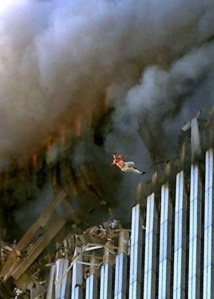
…would feel himself so honored had he known that one day, in his memory, rising up in place of the building from which he plummeted, would arrive what could perhaps be thought of as a festival of the victorious posing itself as a canto to the dead. They say that in such moments as this, captured in the frame above, your whole life passes in front of your eyes. And truly I can only believe that at some point on the way down, free-falling past the office windows one by one, there came over him a sense of heightened consciousness, a moment of consummate awareness, of celestial, perhaps even omniscient realization, when the question mark in his mind turned into… an exclamation point!
FBI adds to no-fly list Muslims who refuse to spy on their communities
Voice of Russia | April 23, 2014
A lawsuit, filed on behalf of four different men, blames the United States of violating their rights by keeping them on the no-fly list after they declined to spy on local Muslim communities, notably in New York, New Jersey and Nebraska. Some view the move as a punishment, though more likely this is a rigid coercive tool, plaintiffs argue.
“The no-fly list is supposed to be about ensuring aviation safety, but the FBI is using it to force innocent people to become informants,” said Ramzi Kassem, associate professor of law at the City University of New York, adding the practice looks more like an extortion.
The four plaintiffs have different stories to tell, however sharing one common feature: all the four point to US authorities over-policing the local Muslim society.
Awais Sajjad, for instance, a Muslim, lawfully naturalized US resident living in the New York area learnt he was on the no-fly list after he was turned back at the boarding zone at John F. Kennedy International Airport.
At the airport, FBI agents questioned Sajjad, a Muslim, before he was finally released. But later returned with an offer. In exchange for working for them, the FBI could provide him with US citizenship and compensation. To score a deal, the agents reminded Sajjad, it was up to the FBI to decide who was on the no-fly list.
“The more you help us, the more we can help you,” FBI agents said, according to the lawsuit filed Tuesday.
Another plaintiff, Naveed Shinwari, hasn’t seen his wife in more than two years, ever since they got married, he living permanently in the US, while his wife being an Afghan citizen. He strongly suspects it’s due to his refusal to become an informant for the FBI.
Returning back from the wedding, before he could even get home to Omaha, Nebraska, he was twice detained and questioned by FBI agents. These, he recollects, asked if he knew anything about national security threats. A third FBI visit followed when he got home, with the officer wanting to know about the “local Omaha community”, if he knew “anyone who’s a threat.”
Next time he was denied a boarding pass on a domestic US flight as he was to embark on a temporary job in Connecticut. Police told him he had been placed on the US no-fly list, although he had never in his life been accused of breaking any law.
Two more stories slightly varied from the previous ones, in that they contain a certain straight-forward directive, in line with the Muslims’ belief that law enforcement at times considers them a target, particularly thanks to mosque infiltrations and other surveillance practices.
Jameel Algibhah of the Bronx alleges that the FBI explicitly asked him to infiltrate a Queens mosque and pose as an extremist in online forums.
Their case follows at least one other, brought by the ACLU in Oregon, according to which the FBI attempted to leverage no-fly selectees into informants. Most sadly, the agency that’s behind the practice ever since no-fly lists emerged, is uniquely responsible for taking names off them. What all the four Muslims, who have never been convicted of a crime seek for, is to be cleared of the unjust punitive measures.
The FBI refused to comment Tuesday. But the process used to place individuals on the no-fly list has always been considered legal and well founded by officials, who said the practice relies on credible intelligence. Notably, MI5 in Britain openly thanked those Muslims who contributed to spying on others.
NYPD Shutters Muslim Mapping Unit – But What About Other Tactics?
By Noa Yachot | ACLU | April 15, 2014
The New York Police Department is disbanding the unit that mapped New York’s Muslim communities, their places of worship, and businesses they frequent – based on nothing but their religious beliefs and associations. To this we say: Good Riddance.
But the end of the Zone Assessment Unit – better known by its former, more apt name, the Demographics Unit – doesn’t necessarily mean an end to the NYPD’s unconstitutional surveillance of New York’s Muslims.
The NYPD’s discriminatory spying program has many components, of which the Demographics Unit was just one. (The ACLU, along with the NYCLU and CLEAR Project at CUNY Law School sued the NYPD over the program – read about our case here.) Before we celebrate the end of bias-based policing, we need to ensure that the other abusive tactics employed by the NYPD meet the same fate as the unit. For example:
- Use of informants: A wide network of NYPD informants have infiltrated community organizations, mosques, restaurants, bookstores, and more to monitor, record, and take notes on innocent people and innocuous conversations. This needs to stop.
- Designation of entire mosques “terrorism enterprises”: The NYPD has used “terrorism enterprise investigations” against entire mosques to justify the surveillance of as many people as possible. That unmerited designation has allowed the police department to record sermons and spy on entire congregations.
- Discriminatory use of surveillance cameras: Cameras have been set up outside mosques and community events – even weddings – to record community members’ comings and goings and collect license plate numbers of congregants and attendees.
- Radicalization theory: The NYPD must disavow its debunked “radicalization” theory, on which discriminatory surveillance is based. This misguided notion, which we’ve described in detail here, treats with suspicion people engaging in First Amendment-protected activities including “wearing traditional Islamic clothing [and] growing a beard,” abstaining from alcohol, and “becoming involved in social activism” – meaning, basically, anyone who identifies as Muslim, harbors Islamic beliefs, or engages in Islamic religious practices.
- Discriminatory surveillance by other units: The Demographics Unit’s discriminatory mapping activities shouldn’t be carried out by other parts of the NYPD and its Intelligence Division.
The Demographics Unit has sown fear and mistrust among hundreds of thousands of innocent New Yorkers – creating “psychological warfare in our community,” Linda Sarsour of the Arab American Association of New York told the New York Times. Shutting it down is a welcome step, but it’s only the first one. New York’s Muslims — and all its communities — deserve more and better from their police force than bias-based policing.
Should the left call for Taliban victory?
Socialist Worker | August 18, 2009
 AS SOCIALISTS, we support the right of oppressed peoples to fight for self-determination unreservedly, just as we oppose imperialism, without caveat.
This perspective is generally accepted by the left without question in contexts such as Latin America or Africa, where bitter fights against U.S. and European imperialism have been fought and, in some cases, won.
Yet, when it comes to the Middle East and Afghanistan today there is suddenly much less clarity about what radicals and Marxists should be saying. Nowhere is that more evident than in the case of Afghanistan, which has suffered under the yoke of U.S. imperialism since 2001 (with active U.S. interference in the country since at least the 1970s).
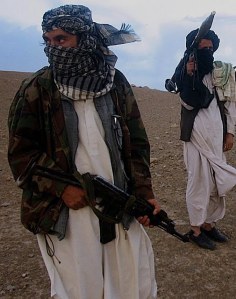
The idea that the Taliban, as a movement fighting against U.S. occupation, is a force we should be supporting is, unfortunately, a somewhat controversial position to hold, even on the far left. This is a serious mistake and speaks both to the extent to which Islamophobia has penetrated the left, as well as to the lack of understanding of the social dynamics of an oppressed and devastated country like Afghanistan.
We are all familiar with the lies and excuses used to justify the invasion and occupation of Afghanistan in the wake of the September 11 attacks. Bush and his coterie of crooks and warmongers told us that only a military invasion could liberate the people, and especially the women, of Afghanistan from the brutal, misogynistic and “medieval” Taliban movement.
There was no mention, of course, of the substantial support offered to the Taliban regime in the late 1990s when Clinton was president and in the early days of the Bush presidency, nor of the long and ugly history of U.S. intervention in Central and South Asia, which was an important precondition for the rise of Islamism.
We should condemn unreservedly the oppression of women and the general social conservatism of the pre-2001 Taliban regime, as well, of course, as their efforts to cut deals with regional and global superpowers against the interests of the vast majority of Afghans. However, we must also unreservedly condemn the racism and Islamophobia used as an ideological fig leaf to justify invasion and imperialism, and it is the left’s weakness on this issue, which has blinded many to the new realities on the ground in Afghanistan.
Before addressing the important question of who the Taliban actually are, it is important to understand the material conditions Afghans face. Afghanistan is a devastated country. It is ranked at or near the bottom of a broad range of social indicators, such as levels of poverty, infant mortality, literacy, per capita income, prevalence of easily preventable diseases and so forth. Most major cities in Afghanistan, including the capital Kabul, are in ruins (despite claims of “reconstruction” by NATO imperialists) and decent roads, electricity, clean water, sanitation and basic social services are unheard of for most of the population, especially in the rural areas. The majority of the population ekes out a living on a subsistence basis, and the struggle for survival is the overarching concern for most Afghans.
In a nutshell, there is no Afghan working class or progressive petit bourgeoisie to speak of, and the major social classes (aside from the puppet regime and it’s assortment of bandits and thugs) are the poor peasantry and the Islamic clergy.
THE SIGNIFICANCE of this to a discussion of anti-imperialist resistance in Afghanistan should be obvious to any serious historical materialist. This question cannot be thought about in the abstract, it must be considered in light of the material realities on the ground. Such realities necessarily shape the kinds of social forces and the character of class struggle in that country and make it highly likely that any grassroots resistance will have a strongly religious character, given that the rural clergy are the only force capable of uniting the peasantry against the comprador ruling class.
The following point cannot be stressed enough; whilst the U.S. remains in Afghanistan, economic and social development will not occur much beyond current levels. This in turn means that the Taliban, as a broad-based movement of poor farmers and lower clergy, is the face of anti-imperialist resistance in Afghanistan for the foreseeable future.
To put it another way, if we, as avowed anti-imperialists, intend to wait around for a resistance movement that agrees with us on every issue, including the need to fight the oppression of women, gays, racial and religious minorities, etc., we’ll be waiting a long time. The Taliban is the resistance in Afghanistan and we must support it, critically, but unreservedly.
The Taliban that ruled Afghanistan prior to the U.S. invasion no longer exists. The U.S. and NATO routinely refer to any act of resistance as the work of the “Taliban” (meaning the followers of Mullah Omar), much as every act of resistance in Iraq was the work of “Baath loyalists.”
To be sure, there are attacks being carried out by people who support the former regime, but many, perhaps most, resistance fighters have no particular loyalty to the former leadership and some are actively hostile to it.
Anand Gopal, one of the few independent journalists actively trying to find out what is actually happening in Afghanistan has written some very useful and insightful work on this, and as he points out, the ranks of the Taliban have been swelled in recent years by rural peasants who have been radicalized as a result of US/NATO brutality, including the indiscriminate air attacks which have killed thousands of Afghans.
The Taliban are increasingly espousing a strong nationalist message and, in some cases, have substantially moderated their social conservatism in order to build a more broad-based and effective resistance movement.
It is also the case that the “Taliban” is effectively a blanket term for a coalition of groups, some drawn from the tiny strata of educated middle class Afghans, which aim to eject foreign troops from their country. In short, when the U.S. and its allies use the term “Taliban” they want us to think of public stonings, music bans and ultra-conservative clerics–and if we follow their lead we do a grave disservice to the Afghan resistance and only help to perpetuate Islamophobic caricatures of “crazed, bearded extremists.”
There is no fundamental difference between the liberation theology movements in South America and the popular Islamist resistance movements in the Middle East and Asia, movements such as Hezbollah, Hamas and the Taliban. To be sure, the former were less socially conservative, but as religiously colored grassroots resistance movements they are essentially the same kind of manifestation of class resistance.
The left needs to ask itself why it is much more critical of Muslims expressing class anger in a religious form than of South American Christians; to my mind, unexamined Islamophobia explains much of this discrepancy.

Anti-Arab brainwashing by the US media
By Paul J. Balles | August 8, 2009
More insidious than the wars with tanks and guns, aircraft and bombs, missiles and guidance systems, shock and awe campaigns. The wickedest wars are the wars for people’s minds – the propaganda campaigns that exercise thought control…
Western brainwashing comes from the media. Readers, listeners and viewers need to be aware of these propaganda sources. About the media in general, Steven Salaita correctly observed:
The flippancy with which US media apply the word “terrorism” to Arab populations reinforces the notion that violence in the Arab world is ahistorical and therefore senseless. Arabs in turn become a people without narratives who belong to a culture incapable of rationality.
Steve Emerson has a website and blog with as much anti-Arab ranting on it as any bigot might produce. Harvard law professor Alan Dershowitz has implied that all Arabs are potential terrorists and therefore worthy of slaughter. American Israeli Caroline Glick, Deputy Managing Editor of The Jerusalem Post, writes two weekly syndicated columns preaching hard-line Israeli propaganda.
InThe Progressive, Ruth Conniff validated the false but widespread notion that while violence exists among both Arabs and Israelis, terrorism is exclusive to the Arabs. When Arabs fight against Israelis, the Arabs are guilty of “terrorist violence” but the Israelis are engaging in “military reprisals”.
On anti-Arab radio you hear things like “Arabs love dictators” and “Obama is an Arab,” as if being an Arab disqualifies one from humanity. If they aren’t referring to Arabs as “camel jockeys” or “rag heads”, they’re calling them as Islamo-fascists. Along with O’Reilly, Sean Hannity, Lou Dobbs and Glenn Beck give Fox news stable of anti-Arab propagandists.
Hollywood films have been vilifying Arabs for decades. Jack Shaheen revealed, in The TV Arab, how television stereotypes Arabs as “billionaires, bombers and belly dancers”.
Even as a youngster, Shaheen was disturbed by the Arab stereotypes in children’s cartoon characters.
In Shaheen’s Reel Bad Arabs, a long line of degrading images – from Bedouin bandits and submissive maidens to sinister sheiks and gun-wielding “terrorists” – have vilified Arabs since the days of silent films.
In his research, Shaheen identified more than 1150 films that defile Arabs. His newest book, Guilty: Hollywood’s Verdict on Arabs after 9/11, reveals how the film industry continues to shape American understanding of Arabs and Arab culture.
Muslim scholar Ziauddin Sardar made it clear that anti-Islamic brainwashing is not new: “From the days of Voltaire right up to 1980, thanks largely to the efforts of Enlightenment scholars, it was a general Western axiom that Islam had produced nothing of worth in philosophy, science and learning.”
That the propaganda has reached the masses should be clear from some of the slurs on the internet, examples of which are displayed here:
F**K ALL YOU SAND NIGGERS! I HOPE WE BLOW YOU ALL UP AND TAKE THE ONLY THING YOU ARE GOOD FOR OIL!
It wasn’t enough to curse Arabs. He had to shout it, writing his message in uppercase letters, revealing how effective anti-Arab propaganda has been in America.
Those who control the media control the mental attitudes of the population; Americans have been programmed to hate Arabs and Muslims and to love Israelis. How could compassionate Americans be nonchalant about their slaughter of a million Arabs in Iraq, even though they know that it was all based on lies? Decades of propaganda and brainwashing.
Related articles


Featured Video

Iran Is Not Our Enemy
or go to
Aletho News Archives – Video-Images
Frlom the Archives
The 52 Major Jewish American Organizations and Israel Celebrate Passover with the Slaughter of 25 Muslim, Christian and Secular Palestinians
By James Petras • Unz Review • April 8, 2018
Introduction
As of April 7, nearly three thousand unarmed Christian, Muslim and secular Palestinians have been wounded, over three dozen are in critical condition and at least twenty-five unarmed protestors, including children have been assassinated by hundreds of Israeli snipers and heavily armed troops shooting tank shells into crowds of civilians protesting their decades of incarceration by the racist Israeli state.
The Israeli government praised the ‘restraint and morality’ of the IDF, as did the fifty-two Major Jewish American Organizations (MJAO) who largely control the US Congress. These grotesque massacres began during the Christian Holy Week on Good Friday and Easter, coinciding with the Jewish Passover. The self-righteous officials of the MJAO and their relatives and friends broke matzos at joyful Seders as the blood of Palestinians soaked into ground at the fence containing the largest open-air prison camp in history, Gaza.
While tribal loyalties bonded the Israeli and Jewish American leaders, the politicians of the Western oligarchic electoral regimes refrained from criticizing the shocking display of brute force and even defended Israel’s cold blood mass killings of Palestinian civilians in their Gaza prison.
This paper will discuss and analyze the reasons for Israel’s willing Western accomplices and the centrality of its fifth column in the United States. … continue
Blog Roll
 Aletho News
- No Liability, No Studies, No Accountability: The Vaccine System Aaron Siri Exposed in Federal Court
- No time for losers: Why the war meant to save Israel may destroy it
- Top US Counterterrorism Official Resigns in Protest of Operation Against Iran
- Just Get Out! Now!
- Unpacking glaring contradictions in US-Zionist justifications for war against Iran
- Iranian model of warfare bleeds US dry while Persian Gulf states watch and learn: Analyst
- IRGC orders ‘defeated’ US to evacuate industrial facilities in region
- Hegseth’s call for ‘no mercy’ to Iranians deemed war crime
- Iran War Exposes Limits of US Military Power – Journalist
- Even The Neo-Cons Admit The Iran War Is Failing
- If Americans Knew
- Trump’s counterterrorism chief, whose own wife was killed by ISIS, quits over Iran War saying Tehran posed ‘no imminent threat’
- Here’s what US could fund instead of Bibi’s war on Iran
- Israel Killed Over a Dozen Lebanese Paramedics in Three Days, Now Claiming That Ambulances Are “Hezbollah” Targets
- War on Iran: These are the heritage sites devastated by US and Israeli attacks
- Four news stories from Israeli media that illustrate Israeli “justice”
- CIA Prepares Criminal Referral of Tucker Carlson, as Israel and Its Loyalists Demand His Arrest
- Top US counterterror advisor resigns in protest of “war manufactured by Israel” – Not a ceasefire Day 157
- ‘I Liked the House’: When Israeli Soldiers Turn Palestinian Homes into Barracks
- ‘They Were All I Had’: Lebanese Father Buries Parents, 4 Daughters Killed by Israeli Bombing
- Israel and its supporters are causing attacks on Jewish institutions. Case in point: Michigan synagogue tragedy.
- No Tricks Zone
- Storing Green Energy To Last Germany 10 Days Would Require A 60-Million Tonne Battery
- New Studies: UK Sea Levels Were 4 Meters Higher Than Today During The Mid-Holocene
- Destructive Green New Deal: German Energy And Metal Group Warns Of Drastic Crisis
- New Study Documents A 20-Year Pause In Arctic Sea Ice Decline – Driven By Internal Variability
- Wake-up Call: Survey Shows Majority Of Germans Now Favor Postponing Climate Targets!
- Televised! Leading German Political Candidate Tells Schoolchildren CO2 Makes Sun Hotter!
- New Study: A Century Warming Of 1.1°C Is ‘Commonplace’ And ‘Not Unusual’ During This Interglacial
- New Study: ‘Internal Noise’ And Volcanic Forcing Can Trigger 10-15°C Warming Within Decades
- Glaciers Worldwide Are Suddendly Surging, Experts Blame Warming!
- Surprising Discovery: Sahara Is Greening…Billions Of Trees Where Once Thought To Be Barren
 Aletho News