David Horowitz’ problem with Norway
David Horowitz recently carried an incendiary article by Joseph Klein in his Front Page magazine, entitled The Quislings of Norway, excerpts below:
“The infamous Norwegian Vidkun Quisling, who assisted Nazi Germany as it conquered his own country, must be applauding in his grave…In the latest example of Norwegian collaboration with the enemies of the Jews, Norwegian Foreign Minister Jonas Gahr Stoere declared during a press conference this week, alongside Palestinian President Mahmoud Abbas, that “Norway believes it is perfectly legitimate for the Palestinian president to turn to the United Nations” to seek recognition of an independent Palestinian state.”
“During the Nazi occupation of Norway, nearly all Jews were either deported to death camps or fled to Sweden and beyond. Today, Norway is effectively under the occupation of anti-Semitic leftists and radical Muslims, and appears willing to help enable the destruction of the Jewish state of Israel.”
“Norway’s Labor Party lawmaker Anders Mathisen has gone even further and publicly denied the Holocaust. He said that Jews “exaggerated their stories” and “there is no evidence the gas chambers and or mass graves existed.” While the Norwegian political establishment and opinion-maker elite may not have reached that point of lunacy just yet, they do tend to treat Muslims as the victims of Israeli oppression – as if today’s Muslims are filling the shoes of the Jewish victims of the Holocaust and today’s Nazis are the Israelis.”
“Socialist leader Kristin Halvorsen has been leading the boycott Israel campaign. While serving as Norway’s finance minister, she was amongst the demonstrators at an anti-Israel protest, in which a poster read (translated): “The greatest axis of evil: USA and Israel.” Among the slogans repeatedly shouted at the demonstration was (as translated) “Death to the Jews!”
“Last year, the Norwegian government decided to divest from two Israeli entities working in the West Bank. Norway’s sovereign wealth fund divested from the Israeli company Elbit, because it has worked on the Israeli security fence that keeps out Palestinian suicide bombers. Israel has also been blocked from bidding for Norwegian defense contracts.”
“Part of the motivation for this anti-Semitism is the influx into Norway in recent decades of masses of Muslims from Pakistan, Iraq, Somalia and elsewhere. Multiculturalism has taught Norway’s cultural elite to take an uncritical, even obsequious, posture toward every aspect of Muslim culture and belief. When Muslim leaders rant against Israel and the Jews, the reflexive response of the multiculturalist elite is to join them in their rantings. This is called solidarity.”
The threshold for a terrorism expert must be very low
By Benjamin Doherty – The Electronic Intifada – 07/23/2011
Immediately after news of the bombing of government buildings in Norway’s capital Oslo, the Internet buzzed with speculation about who might have done it and why. Most speculation focused on so-called Islamist militancy and Muslims. The urge to speculate after grave events is understandable, but the focus of speculation, its amplification through social media, its legitimization in mainstream media, and the privilege granted to so-called experts is a common pattern…
From the “experts” to The New York Times
The New York Times originally reported:
A terror group, Ansar al-Jihad al-Alami, or the Helpers of the Global Jihad, issued a statement claiming responsibility for the attack, according to Will McCants, a terrorism analyst at C.N.A., a research institute that studies terrorism.
In later editions, the story was revised to read:
Initial reports focused on the possibility of Islamic militants, in particular Ansar al-Jihad al-Alami, or Helpers of the Global Jihad, cited by some analysts as claiming responsibility for the attacks. American officials said the group was previously unknown and might not even exist.
The source is Will McCants, adjunct faculty at Johns Hopkins University. On his website he describes himself as formerly “Senior Adviser for Countering Violent Extremism at the U.S. Department of State, program manager of the Minerva Initiative at the Department of Defense, and fellow at West Point’s Combating Terrorism Center.” This morning, he posted “Alleged Claim for Oslo Attacks” on his blog Jihadica:
This was posted by Abu Sulayman al-Nasir to the Arabic jihadi forum, Shmukh, around 10:30am EST (thread 118187). Shmukh is the main forum for Arabic-speaking jihadis who support al-Qaeda. Since the thread is now inaccessible (either locked or taken down), I am posting it here. I don’t have time at the moment to translate the whole thing but I translated the most important bits on twitter.
The Shmukh [no kidding] web site is not accessible to just anyone, so he is the primary source for this claim. McCants stated from the beginning that the claim had been removed or hidden, and on Twitter he even cast doubt on whether it was a claim of responsibility at all.
@will_mccants
Will McCants This is not necessarily a claim of responsibility. Could just be forum user blowing hot air. forum members also confused abt who this guy is
Jul 22 via webFavoriteRetweetReply
Will McCants For those asking, the “claim” from the Helpers of the Global Jihad was posted to Shmukh, the most elite jihadi forum (it’s in Arabic)
Jul 22 via webFavoriteRetweetReply
Will McCants @leialya it is a password protected forum. you won’t be able to access it without password. www.shamikh1.info
Jul 22 via webFavoriteRetweetReply
McCants later reported that the claim of responsibility was retracted by the author “Abu Sulayman al-Nasir.” Furthermore, according to McCants, the moderator of this forum declared that speculation about the attack would be prohibited because the contents of the forum were appearing in mainstream media. It does seem more than a little bit odd that genuine “jihadis” would post on a closed forum that a former US official and “counterterrorism expert” openly writes about infiltrating.
It’s too bad McCants didn’t exercise the caution and restraint that he says the forum moderator did.
All of this comes only from Will McCants. In his original post, he named the source and identified the organization (in Arabic) but provided no context. Did he know who the author Abu Sulayman al-Nasir was? Had he heard of this group Ansar al-Jihad al-Alami before? These are the kinds of answers a “terrorism expert” should provide.
How media amplified a false claim
The media also failed. They reported on the claims McCants disseminated because his position and perceived expertise gave these claims credibility. Would The New York Times have required multiple sources and independent confirmation of the existence of the posting and its contents if it had not come from someone with McCants’ supposedly solid credentials?
For hours after McCants posted the update that the claim of responsibility was retracted, BBC, the New York Times, The Guardian, The Washington Post were still promoting information originally sourced from him. The news was carried around the world and became the main story line in much of the initial coverage.
The threshold for a terrorism expert must be very low…
Speculation hurts real people
A crucial absence in everyone’s concept of “terrorism expertise” is insight into the functioning of this knowledge in a sensationalistic, reckless media and political environment where Islamophobia is the norm. Even the Christian President of the United States is routinely suspected of being Muslim as if it were a crime, and accused of sympathy with Islamist “radicals” and “terrorists.”
Disseminating false, unverifiable information should be a blemish on McCants’ credibility, but what is more likely is that his failure will harm other communities elsewhere before it harms his career.
As the scale of the catastrophe to strike Norway was revealed, we also learned that Anders Behring Breivik, the only suspect to be arrested in the attack, had a history of disseminating anti-Muslim and xenophobic ideas on the Internet, and cited approvingly none other than Daniel Pipes, a notorious Islamophobe, Bush administration appointee to the United States Institute of Peace and self-described “terrorism expert.”
Mohammad Mahjoub: The life of a security certificate detainee
By sara falconer | Rabble | June 1, 2011
It’s a fresh spring day in Toronto, and Mohammad Mahjoub is experiencing something for the first time in over a year: the simple pleasure of small talk.
Since March 2010, Mahjoub, a security certificate detainee, was forbidden to speak to anyone he encountered in the few hours he was allowed outside. That one condition has now been lifted, but it’s a small comfort against the daily deprivation he continues to endure, under the harshest house arrest conditions in Canadian history.
And the kicker? He hasn’t been charged with a crime.
In 1995, Mahjoub fled political persecution in Egypt, where he had been tortured and imprisoned without trial. He was granted refugee status by Canada in 1996, and settled in Toronto, where he married Mona el Fouli and later had two sons, Ibrahim and Yusuf.
In June 2000, Mahjoub was arrested on a security certificate, a controversial measure of the Immigration and Refugee Protection Act that was used to indefinitely detain five Muslim men, without charges or trial, on secret evidence. They became known as the Secret Trial Five.
A 2007 Supreme Court ruling abolished the process, calling it unconstitutional. Eight months later, the Conservatives created Bill C-3, re-introducing security certificates with few substantial changes. Bill C-3 also failed to address what many view as a fundamental issue with the process: that matters of national security have no place being legislated in immigration policy, but should instead be dealt with under the Criminal Code. But the bill passed, and no time flat, secret trials were back in business.
For over a decade, Mahjoub has attempted to contest the certificate, fearing torture or worse if he is deported to Egypt. Throughout the process, he has denounced the conditions of his detention, resorting to a 76-day hunger strike in 2005 and losing 110 pounds before he was hospitalized. In 2006, he and three other members of the Secret Trial Five were transferred to a specially constructed, multi-million dollar facility in Kingston dubbed “Guantanamo North.” Mahjoub went on another hunger strike, this time lasting for 93 days before the Federal Court ordered him released in Feb. 2007.
But the conditions of his release were so severe that he described his home as a prison, and his family as reluctant guards. “His family were forced to act as his sureties,” says his lawyer, Yavar Hameed. “When they reported information to the Canadian Border Services Agency (CBSA), that information was not taken at face value. The CBSA would try to find ways to find them in violation… It was a very adversarial process with Canada Border Services, making it impossible for anyone to lead a normal life.”
In March 2009, Mahjoub asked to be returned to Guantanamo North, rather than continuing to subject his family to the constant surveillance and pressure from the CBSA and Canadian Security Intelligence Service (CSIS). In early 2010, following yet another hunger strike, he was again released on house arrest. This time, he opted to protect his family from his conditions by moving into a small basement apartment on St. Clair West in Toronto.
“There is no liberty by any means under these severe conditions,” Mahjoub said in a recent recording. “It has massive mental, physical and psychological impact on me and my family… I don’t know what to do after 11 years.”
One of his infrequent visitors is Murray Lumley, who first became aware of Mahjoub’s case through a small group called Toronto Action for Social Change. He attended rallies at CSIS headquarters and wrote letters to his MP and government ministers, and eventually became one of Mahjoub’s court-approved “supervisors.” Lumley helps accompany him when he needs something outside of his authorized area, such as a lawyer visit or a new fax machine. “I would like people to know what an honourable man Mohammad is,” he says.
Despite a recent detention review that relaxed his conditions slightly, Mahjoub is still held under surveillance that is completely unprecedented in the judicial system in Canada. He wears a GPS tracking bracelet at all times. A camera outside his door monitors his every move, and he is only permitted to leave the house for four hours a day, and only within a few blocks of his apartment. CSIS monitors every phone call — in fact, they were caught listening to protected solicitor-client phone calls between Mahjoub and his lawyer, contrary to a court order.
He has limited contact with his wife and young sons, which Lumley says has been very difficult. “It is quite amazing to me that they have been so resilient in the face of such abuse — that seems to go on and on… While they do complain of the length of time taken from their lives, they still live with some hope that this may one day end.”
If it all sounds a bit Orwellian… it is, says Hameed, who specializes in immigration and refugee law work as well as national security cases. He has been representing Mahjoub since last August, and is deeply familiar with the security certificate process, having assisted Adil Charkaoui’s legal team with their Supreme Court appeals. Charkaoui won his case against a security certificate in 2009.
A series of public hearings to determine the “reasonableness” of the certificate against Mahjoub are expected to continue until mid-July, when the in camera part of the process begins. Hameed’s job is complicated by the fact that he is only given access to a small portion of the evidence against his client for reasons of “national security.” “There’s an understanding of what the basic allegation is, but what we don’t know… is the source of the information,” he explains. “It’s kind of like a puzzle trying to put it together.”
He knows, for instance that Mahjoub is accused of being a high-ranking member of the Vanguards of Conquest, a militant Islamic group that seeks to overthrow the Egyptian government. What’s missing is the source of the “intelligence” that led to the accusation. Much of the secret evidence being used against security certificate detainees is believed to have been obtained using torture by foreign agencies. Last summer, in a significant court victory, the Federal Court ruled that part of the evidence against Mahjoub was probably obtained using torture, and could not be accepted.
“Based on the evidence we see publicly, there is a flimsy case against Mr. Mahjoub. It’s supported by innuendo; it’s weak,” Hameed says. Some of the “sources” in the case include Internet articles from foreign news services. “We’re not actually talking about things that have been investigated… The kind of information that passes for evidence in the public case is what we call hearsay.”
Hameed is also skeptical of any claims that Mahjoub poses a potential future threat to Canadian security. “The argument is that [Mahjoub’s] liberty, the fact of his liberty, would act as sort of a beacon of radicalization for persons who would be interested in supporting terrorist or Islamic extremist views,” Hameed scoffs. “We were quite shocked to learn that that’s what the case is against him, going forward. The absurdity of this process… That is so offensive to the character of what it means to live in a free and democratic society.”
You can sign a petition calling for an end to security certificates at www.justiceforharkat.com.
Sara Falconer is a Toronto-based freelance journalist.
Dressing Like a Terrorist
By Steven Salaita / Dissident Voice / May 19th, 2011
Like many others, I was dismayed to learn of the two imams wearing traditional Muslim garb who were forcibly removed from an airplane that was to carry them to a conference on Islamophobia. The passengers who were removed from a Delta/ASA flight in Memphis, Masudur Rahman and Mohamed Zaghloul, apparently frightened other passengers and upset one of the pilots, who refused to fly with them on board. Not everybody was dismayed, however. The Delta/ASA pilot and the frightened passengers have received support from numerous voices among the American commentariat.
The situation was a clear-cut case of ethnic profiling. On this everybody should agree. Some of those who support the pilot’s action want to disclaim their support of profiling, but such a desire is dishonest. People need to accept the realities of the positions they express, even if those positions attach to descriptors that have negative connotations. If you support the pilot, you are supporting an instance of ethnic profiling. Either accept that fact or develop a different opinion.
I have been reading commentaries about the case with much interest. One argument in particular keeps arising: the notion that Rahman and Zaghloul deserve what happened to them because they dressed like terrorists. The reasoning goes like this: Muslims commit terrorism; Muslims look a certain way; a certain look thus portends the possibility of terrorism. In short, those who appear to be Muslim are worthy of extra scrutiny because they are more likely to be terrorists than other people.
I want to leave aside the fact that the belief that Muslims are more likely than others to commit terrorism is a myth with no basis in factual evidence. I also do not have the space to illustrate that there are thousands of variations of traditional Muslim dress. Even Rahman and Zaghloul wore different types of clothing on the day they were profiled.
I’d like instead to focus on this notion of “dressing like a terrorist,” a phrase that has the peculiar intimation of a fashion statement. There is no quantifiable evidence to show that dress is a predictor of any sort of behavior, especially the behavior of terrorism. What we’re dealing with in the Rahman and Zaghloul case is an overexerted imagination that associates political violence with what I call the terrorist costume.
The terrorist costume is a simulated reality, circulated in Hollywood and countless news broadcasts, that evokes a causal relation between appearance and action. The terrorist costume is familiar to nearly all Americans: a thick beard, an ashen robe, brown skin, sandals holding dirty feet, and some sort of headgear, usually a Sikh-style turban. The terrorist wearing this costume often sports a Qu’ran, so the audience can be certain that he is a Muslim.
Yet the acts of terrorism that have been committed by Muslims involved perpetrators, like Mohamed Atta, who didn’t at all resemble the image of the Hollywood terrorist. Rahman and Zaghloul unfortunately resembled a racist simulation that could define them to an American audience. But that simulation has never actually been implicated in a real crime.
To impugn Rahman and Zaghloul for their dress, then, is to engage in highly troublesome judgment, one that not only contravenes their Constitutional rights, but also the rules of basic logic. The United States has long been a place where appearance is believed to foreground attitude or behavior (vis-à-vis skin color, clothes, physiognomy, ethnic typology, gender, sexuality, possessions, and so forth). Yet judgment by appearance is a terribly ineffective indicator of either attitude or behavior, not to mention being highly unethical and often illegal.
Those who believe that Rahman and Zaghloul brought their unjust treatment on themselves ought to think about what their lives would be like if their own logic were applied to them. In the end, if we are to let fanciful stereotypes dictate access to basic rights of citizenship, then none of us will ever live up to the grandiose promise of our own worthiness.
~
Steven Salaita’s two latest books are Israel’s Dead Soul and Modern Arab American Fiction: A Reader’s Guide.
Three Muslim clerics forced off US plane
Press TV – May 7, 2011
Three Muslim clerics traveling to a religious conference in the United States have been forced to get off a Delta flight because the pilot refused to fly with them on board.
The imams were heading to a conference on Islamphobia in Charlotte, North Carolina.
Imam al-Amin Abdul-Latif was barred from boarding a flight from New York to Charlotte late on Friday.
The other two clerics were traveling from Memphis, Tennessee to Charlotte.
Masudur Rahman and Mohamed Zaghloul of the Islamic Association of Greater Memphis were pulled from a connecting flight from Memphis to Charlotte on Friday, The Daily Mail reported.
“It’s racism and bias because of our religion and appearance and because of misinformation about our religion,” Rahman said. “If they understood Islam, they wouldn’t do this.”
The aircraft had pulled away from the gate when the pilot announced that the plane had to return. The two men, who were wearing tradition Indian and Arab clothing, were then asked to go back to the boarding gate for “additional screening.”
The two clerics — who had already cleared a Transportation Security Administration check — went through the additional screening only to be told by a Delta supervisor that the pilot was refusing to let them board the plane.
Rahman said they were told that the pilot thought “some passengers might be uncomfortable” with their presence on the plane. They were booked on another flight later that day.
Jarek Beem, a spokesman for Atlantic Southeast Airlines, which operates the Delta Connection flight, said, “We take security and safety very seriously, and the event is currently under investigation.”
“We sincerely apologize for any inconvenience that this may have caused,” he added.
Stoking the Fires of Islamophobia
By ISMAEL HOSSEIN-ZADEH | CounterPunch | March 25, 2011
The House Homeland Security Committee’s hearings on “Muslim radicalization,” which began on March 10 and expected to be held periodically for 18 months, are objectionable on a number of grounds.
To begin with, the hearings are championed and chaired by a politician, Congressman Peter King, who is known for his notoriously negative attitude toward Muslims. In an interview with Politico, for example, Mr. King argued that there are “too many mosques in this country. . . . There are too many people sympathetic to radical Islam. . . . We should be looking at them more carefully and finding out how we can infiltrate them.” In an earlier interview with radio and television host Sean Hanity, he had said that 85 percent of the mosques in this country are controlled by “extremist leadership,” a claim that has been roundly refuted by evidence:
“American Muslims recognize the validity of the democratic process and are eager to participate in it to shape the political environment in which they live. Recent surveys on political attitudes within the community have clearly indicated that American Muslims will participate quite vigorously in the coming presidential elections and will also engage the political process at multiple levels. For example, a recent study of Detroit Muslims showed that over 93% of those surveyed were determined to vote. A survey by the Washington DC based Council of American Islamic Relations (CAIR) found that 93% of its respondents were registered to vote; of them, 92% were determined to vote.”
Not surprisingly, King’s insistence that 85% of American mosques have “extremist leadership” has come under criticism by many law enforcement officials, counter-terrorism professionals, civil rights organizations, religious/interfaith leaders, editorial boards, the American Civil Liberties Union, and more.
Second, by focusing exclusively on Muslims, King and his cohorts close their eyes to the more numerous instances of violent acts committed by non-Muslims. Using the FBI statistics, Franklin Lamb points out that between 1980 and 2005 only six percent of terrorist incidents in the US were committed by Muslims while 94% were committed by non-Muslims. “The FBI claims that of the 83 terrorist attacks in the United States between 9/11 and the end of 2009, only three were clearly connected with the jihadist cause (3.6% of total).” Lamb further points out that “The picture is similar in Europe. Of a total of 1,571 terrorist attacks in the E.U. from 2006-2008 only 6 were committed by Islamist terrorists which translates to less than 0.4% of all attacks, which means 99.6% of all attacks were committed by non-Muslims.”
In light of this evidence, it is not surprising that a number of critics have characterized King’s hearings on the “Radicalization of Muslims” as witch hunting or McCarthyism, comparing them with earlier prejudices and persecutions of other ethnic and religious minorities such as Catholics, Jews, African Americans, Asian Americans, and others.
Third, and more importantly, the champions of Muslim hearings completely fail the elementary principle of any problem-solving endeavor: a sound diagnosis of the problem. They make no effort to shed light on the submerged factors or causes that may contribute to some Muslims’ suspicion of security forces, or some misguided acts of violent behavior. Instead, they (implicitly) attribute such suspicions or behaviors to their religion, or the “pathological problems of the Muslim mind.” Rather than asking “Why convulsive reactions of the disenfranchised Muslims (or other ethnic/religious minorities) sometimes take religious form,” they ask “What is in Islam that leads to such convulsive reactions?”
While extreme, King is unfortunately not alone in demonizing Islam and/or Muslims. His is simply a more blatant case of a broader narrative of Muslim-bashing. Mainstream media reports, editorials, political pundits, and talk shows tend to harp on the narrative—some directly, like Fox News, others in subtle ways—that the roots of “Muslim radicalization” must be sought in Islam itself, or in their “hatred of our way of life,” as President George W. Bush famously put it.
The pernicious view that “they hate our way of life” is essentially a popularized version of the so-called theory of “the clash of civilizations,” which was initially expounded by Samuel P Huntington in the early 1990s. Huntington sets out to identify “new sources” of international conflicts in the post–Cold War world. During the Cold War years, major international conflicts were explained by the “threat of communism” and the rivalry between the two competing world systems. In the post–Cold War era, however, argue Huntington and his co-thinkers, the sources of international rivalries and collisions have shifted to competing and incompatible civilizations, which have their primary roots in religion and/or culture. In other words, international conflicts erupt not because of imperialistic pursuits of economic advantage, territorial conquests, or geopolitical ambitions but because of “Muslim’s inability to change.”
A more insidious version of Huntington’s “clash of civilization” is Richard Perle’s strategy of “de-contextualization.” Perle, a leading neoconservative militarist (and a prominent advisor to Israel’s ultra-nationalist Likud Party) coined the term “de-contextualization” as a way to explain both the desperate acts of terrorism in general and the violent tactics of the Palestinian resistance to occupation in particular. He argued that in order to blunt the widespread global criticism of the Israeli treatment of Palestinians, their resistance to occupation must be de-contextualized; that is, we must stop trying to understand the territorial, geopolitical and historical reasons that some groups turn to terrorism. Instead, he suggested, the reasons for the violent reactions of such groups must be sought in the arenas of culture and/or religion.
Like Huntington’s “clash of civilizations” theory and Perle’s “de-contextualization” strategy, King’s “radicalization of Muslims” is part of a well-orchestrated effort to divert attention from the root causes of terrorism, and attribute it to “Islamic way of thinking.” There are both economics and political forces behind this insidious effort at demonization of Muslims.
Economic interests behind the effort are vested largely in the military-security industries that have mushroomed around Homeland Security. There is a whole host of security-based technology industries and related businesses that have rapidly spun around the Pentagon and the Homeland Security apparatus in order to cash in on the Pentagon’s and Homeland Security’s spending bonanza. For example, as William Hartung and Michelle Ciarrocca point out, “Air Structures is introducing fortified vinyl domes for quarantining infected communities in the aftermath of a potential bioterror attack, Visionics is looking into designing facial recognition technology, and PointSource Technologies is developing a sensor to detect biological agents in the air or water.”
Just as the notorious military-industrial complex is known for inventing external enemies in order to justify the continued escalation of the Pentagon budget, so does Homeland Security need enemies and “threats to national security” in order to justify both its parasitic role and its lion’s share of our tax dollars. In light of the fact that Homeland Security has become an effective money-making machine in the hands of some of the powerful technology corporations, it is no accident that King, one of the most Islamophobic members of Congress, is selected to chair the Homeland Security Committee of the House of Representatives.
The politics of the witch-hunting Muslim hearings are equally dubious. In his pursuit of higher office and re-election, King is known for groveling to the Christian Right and the Israeli lobby. His McCarthy-type hearings suit this nefarious purpose well. While monetary and military support for the colonial policies of the state of Israel is essential to garnering the electoral clout of the Jewish and Christian Zionism, demonization of Muslims is also viewed to be an added service to these powerful groups. Muslim-bashing has indeed become a major component of the support for Israel.
While an extreme case, King’s political strategy of pandering to special interests at the expense of social cohesion and long-term national interests is tragically not rare. It includes most American politicians. Indeed, the overwhelming majority of the members of the US Congress, as well as the President, routinely compete with each other in doing the bidding of the military-industrial-security-Israeli lobbies.
Bigotry, intolerance and xenophobia also play an important role in the demonization of Muslims. Not only is the anti-Muslim propaganda divisive and detrimental to social peace and stability, it is also disingenuous. I suspect that King and his Islamophobic cohorts are afraid not so much of the US “Muslim radicalization/terrorism,” or of the absurd view that “Muslims may establish the Sharia judicial system in America,” as they are of the Muslims’ steady advancements and achievements in all fields of the American socio-economic and political life—that is, of their gradually becoming part of the American mainstream.
Not only does the insidious view that Islam is “incompatible” with change and Western values tend to sow the seeds of ignorance, hatred and social tension, it also fails the test of history. The history of the relationship between the modern Western world and the Muslim world shows that, contrary to popular perceptions in the West, from the time of their initial contacts with the capitalist West more than two centuries ago until almost the final third of the twentieth century, the Muslim people were quite receptive of the socio-economic and political models of the modern world. Many people in the Muslim world, including the majority of their political leaders, were eager to transform and restructure their societies after the model of the capitalist West. The majority of political leaders, as well as a significant number of Islamic experts and intellectuals, viewed the rise of the modern West and its spread into their lands as inevitable historical developments that challenged them to chart their own programs of reform and development. John L. Esposito, one of the leading experts of Islamic studies in the United States, describes the early attitude of the political and economic policy makers of the Muslim world toward the modern world of the West:
“Both the indigenous elites, who guided government development programs in newly emerging Muslim states, and their foreign patrons and advisers were Western-oriented and Western-educated. All proceeded from a premise that equated modernization with Westernization. The clear goal and presupposition of development was that every day and in every way things should become more modern (i.e., Western and secular), from cities, buildings, bureaucracies, companies, and schools to politics and culture. While some warned of the need to be selective, the desired direction and pace of change were unmistakable. Even those Muslims who spoke of selective change did so within a context which called for the separation of religion from public life. Western analysts and Muslim experts alike tended to regard a Western-based process of modernization as necessary and inevitable” (The Islamic Threat: Myth or Reality? Oxford University Press, 1992, p. 9.)
In light of this background, the question arises: What changed that entire earlier receptive and respectful attitude toward the West to the current attitude of suspicion and disrespect?
The answer to this question rests more with the policies of the Western powers in Muslim lands than the alleged rigidity of Islam, or “the clash of civilizations.” It was only after more than a century and a half of imperialistic pursuits, and a series of humiliating policies in the region, that the popular masses of the Muslim world turned to religion as sources of defiance, mobilization, and self-respect. In other words, for many Muslims the recent turn to religion represents not so much a rejection of Western values and achievements as it is a way to resist or defy the oppressive policies and alliances of Western powers in the Muslim world.
Most of today’s regimes in the Muslim world such as those ruling in Pakistan, Saudi Arabia, Egypt (even after Mubarak), Jordan, Kuwait, and a number of smaller kingdoms in the Persian Gulf area are able to maintain their dictatorial rule not because their people want them to stay in power but because they are useful to some powerful interests abroad.
It is not surprising, then, that many people in these countries are increasingly asking: Why can’t we elect our own governments? Why can’t we have independent political parties? Why can’t we breathe, so to speak? Why are our governments so corrupt? Why are our people, especially Palestinians, treated like this? Why are we ruled by regimes we don’t like and don’t want, but cannot change? And why can’t we change them? Well, the majority of these countries’ citizens would answer, “Because certain powerful interests in the West, especially in the United States, need them and want them in power.”
Nor is it surprising that many people in the Muslim world, especially the frustrated youth, join the ranks of militant anti-U.S. forces and employ religion as a weapon of mobilization and defiance. Correlation between U.S. foreign policy and such reactions was unambiguously acknowledged by the members of the United States’ Defense Science Board, who wrote in a 1997 report to the Undersecretary of Defense for acquisition and science, “Historical data shows a strong correlation between U.S. involvement in international situations and an increase in terrorist attacks against the United States.”
~
Ismael Hossein-Zadeh, author of The Political Economy of U.S. Militarism (Palgrave-Macmillan 2007), teaches economics at Drake University, Des Moines, Iowa.
A Gazan’s Reflection on the Murder of Jews in Itamar
By Samah Sabawi | Palestine Chronicle | March 20, 2011
The morning news of the Itamar murders broke out, I got a call from my father, a man from Gaza whose entire life was derailed by Israel’s occupation of his land. He was fuming: “nothing could justify these murders” he yelled “even if we were to bring up the occupation, the harassment, the brutality of Israel’s army and settlers – the minute we entertain an act so criminal as to kill a baby in cold blood, we become no better than those whose acts we despise.” I posted his comment on my Facebook wall.
A day later, some of my Jewish friends sent me messages inquiring if it was true that Palestinians in Gaza celebrate the killing of Jews. One of them asked “Is there a custom to give out sweets after such events?” The messages came with several links. I expected to see the usual pro-Israel hasbara sites but to my surprise one link was to the Australian Herald Sun which lead me to an article titled ‘White House Condemns Killing’.
The article had no mention of any Gaza celebrations, but was accompanied by a large AFP credited photo of a man standing in a street in Gaza offering a small platter of sweets to two somber looking Hamas Policemen. The only reference or clue to celebration came in the photo caption: ‘A Palestinian man distributes sweets in the streets of the southern Gaza Strip town of Rafah on March 12, 2011 to celebrate an attack which killed five Israeli settlers at the Itamar settlement near the West Bank city of Nablus.’ I did some more research and found that the same article also appeared on Perth Now, News.com.au and The Daily Telegraph.
From here I began an extensive search on the internet. There were references to Gaza’s celebrations in a variety of international media websites including Fox News and Washington Post, but all the references pointed to one original source – three photos by AFP cameraman posted on Getty images, so I followed the trail.
The three original photos starred the same man with the same small sweet platter. In the first shot, he offers the platter to the two policemen; in the second he offers it to a man in a car at a traffic light who looks a bit confused but is accepting the offer of sweets; and in the third photo, the same man offers the small platter of sweets to an old lady sitting on a pavement. The backdrop of the photos revealed nothing more than an average busy day in a street in Gaza with the normal amount of traffic, a few cars, vans etc. There was nothing in the photos to convey a sense of joy or celebration: there were no crowds, no smiling faces, no banners, no flags and no scarfs… in fact, no people appeared in the photos except for the man with the platter and his subjects. This was highly unusual for a Gaza celebration.
But even if we were to assume that this lone man with the sweet platter was genuinely celebrating, how on earth does something like that make international media? One Palestinian man in a population of 1.5 million offering a tray of deserts? Did the same newspapers that published these photos also publish photos of busloads of Israeli tourists standing on a hill top celebrating while watching phosphourous rain fall on Palestinians during Israel’s bombardment of Gaza in 2009? The double standard here is astonishing.
It mattered little that no Palestinian faction claimed responsibility and even Hamas issued a statement saying that Palestinians do not target children. Palestinian president Mahmoud Abbas said in an interview on Israel Radio: “Scenes like these – the murder of infants and children and a woman slaughtered – cause any person endowed with humanity to hurt and to cry.” The frenzy of demonisation continues even though until this article was written there was no real proof that any Palestinians were involved in the murder.
The photos of so called ‘Gaza celebrations’ are becoming an internet sensation because they offer desperately needed proof that Palestinians are evil in nature. One headline from a hasbara site read “How do you start a party in Palestine? You kill a Jewish family.”
The campaign to demonise is indeed in full swing and seems to have no moral boundaries. Barely had the blood of the murdered children dried up the Ministry of Public Diplomacy and Diaspora Affairs in Israel hastened to release the graphic images of the murdered children to be used as fodder in the war to demonise the Palestinian people. The minister – who authorised the release – stated in an interview with the Israeli daily Haaretz “on the internet the images are really catching on and circulating”. After all, what could be worse than people who murder children and then celebrate?
See also:
We planned the Purim party, then my partner actually read the Book of Esther…
and
US Gov’t Attorneys: Providing Detailed Charges to Those on Terror Lists ‘Extremely Burdensome’
Activist Post | March 9, 2011
Defense lawyers for organizations on the U.S. government’s “terror list” are frustrated fighting the designation, and seizure of assets in many cases, because the government claims it is too tedious to give an explanation of the charges. “It would be extremely burdensome to give a list of charges,” said the government’s attorney, Douglas Letter, the Associated Press reported today:
Attorneys for the U.S. government told a federal appeals court Wednesday that informing each person and organization listed as a global terrorist of the reasons they are so designated would be too much work.
They made the argument in a case involving the government’s seizure of assets belonging to the U.S. chapter of Al Haramain Islamic Foundation Inc., a Saudi Arabia-based charity. The case is being heard by a three-judge panel of the 9th U.S. Circuit Court of Appeals.
Al Haramain attorney David Cole said outside court that representatives of Al Haramain were left in the dark after the organization was put on the global terrorist list. They continued to fight the designation without knowing what was driving it.
Cole said he and other attorneys could have provided a much more effective defense for the organization if they knew the reasons for the charges.
Organizations that are arbitrarily placed on the terror list who have their assets frozen are finding the burden of proof to be on them. Yet, they don’t even know what they are supposed to prove given the lack of detailed charges.
In a previous case, U.S. Judge, Gary Karr, ruled that freezing the assets of organizations suspected of terrorist ties has been done without due process by the Treasury Department. However, he also ruled that the “Treasury Department Office of Foreign Assets Control needed only a reasonable belief that the charity was a component of a larger organization that funds terrorism” to take action.
This erosion of due process and reversal of burden of proof, along with Obama’s recent Executive Order to detain suspected terrorists indefinitely, are troubling signs for the “Land of the Free.”
Featured Video
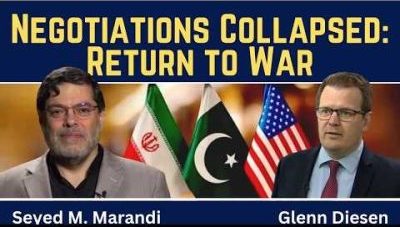
Seyed M. Marandi: Negotiations Collapsed – Return to War
or go to
Aletho News Archives – Video-Images
From the Archives
The US-Iran Scenario That Most Scares Israel
By Ali Haydar | Al-Akhbar | October 9, 2013
Israeli Prime Minister Benjamin Netanyahu issued a series of threats toward Iran and its interlocutors in the West, including the US, as serious negotiations on Iran’s nuclear program seem more plausible.
As a possible rapprochement looms between the US and Iran, Netanyahu has attempted to impose impossible Israeli conditions on the negotiators, such as the full dismantling of Iran’s nuclear program, not to mention threatening military force.
Whatever the deal that could materialize between Iran and the West, Israel is going to find itself before an open-ended path. One can foresee three possible scenarios… continue
Blog Roll
 Aletho News
- Seyed M. Marandi: Negotiations Collapsed – Return to War
- Tomorrow’s naval blockade showdown
- ‘Israel’ attacks civilians to hide its embarrassing military failures & out of pure sadism
- Any Foreign Military Vessel Approaching Hormuz Under Any Pretext ‘Will Be Dealt With Severely’: IRGC
- Diplomats slam US negotiators’ performance in Iran talks
- Trump Refuses Exit Ramp, War with Iran will Continue
- Trump Says US Naval Blockade in Strait of Hormuz Will Begin Shortly
- US, Iran end 21-hour talks without agreement
- US IRAN TALKS: Who Are the Crazy Ones Here? /Lt Col Daniel Davis
- Talks with the US end without a deal over excessive US demands: Iran
- If Americans Knew
- Critical shortages in Gaza, Lebanon in ruins, “piracy” in Iran – Daily Update
- US-Iran ceasefire negotiations make zero progress – Daily Update
- Pro-Israel ‘Thinktanks’ and Individuals who Influence U.S. Foreign Policy
- Mearsheimer reveals how Israel dictates US policies on Iran, Gaza – video
- After killing 350+, Israel still has a “score to settle” with Lebanon before ceasefire – Daily Update
- Military aid to Israel emerges as the latest political litmus test for Democrats
- The only Palestinian children’s rights organization closes following years-long Israeli campaign against it
- ‘I Can’t Forget the Smell’: Lebanese Reel After Israel Kills Over 300 in Single Day
- DNC Shoots Down Resolutions Calling Out AIPAC and Limiting Arms to Israel
- TCN: Is Israel Blackmailing President Trump?
- No Tricks Zone
- Cave Discovery Reveals Today’s Desert Climates Were Recently Far Warmer, Wetter, Teeming With Life
- German Expert: Heat Dome Led To Record Temps In Western USA…Warmer In 1934, 1936
- New Study: No Linear Warming Or Glacier Retreat Along Northern Antarctic Peninsula Since 1980s
- An Inconvenient Tree: Uncovered In Alps… Europe Much Warmer Than Today 6000 Years Ago
- New Study Reports A 60% Slowdown In Greenland’s Ice Loss Rate In The Last Decade
- Low Intensity Tornado Wrecks Major Solar Farm, Creating A Potential Toxic Dump
- New Study Finds Warming Saves Lives…Cold Temperatures 12 Times More Deadly Than Excess Heat
- German Science Blog Accuses PIK Climate Institute Of Hallucinating Climate Tipping Points
- Devastating Assessment Of Comirnaty Vaccine By Former Senior Pfizer Europe Toxicologist
- New Study: CO2 Is ‘Effectively Negligible’ As An Explanatory Climate Change Factor Since 2000
 Aletho News
