US Journalism’s New ‘Golden Age’?
By Robert Parry | Consortium News | May 22, 2017
The mainstream U.S. media is congratulating itself on its courageous defiance of President Trump and its hard-hitting condemnations of Russia, but the press seems to have forgotten that its proper role within the U.S. democratic structure is not to slant stories one way or another but to provide objective information for the American people.
By that standard – of respecting that the people are the nation’s true sovereigns – the mainstream media is failing again. Indeed, the chasm between what America’s elites are thinking these days and what many working-class Americans are feeling is underscored by the high-fiving that’s going on inside the elite mainstream news media, which is celebrating its Trump- and Russia-bashing as the “new golden age of American journalism.”
The New York Times and The Washington Post, in particular, view themselves as embattled victims of a tyrannical abuser. The Times presents itself as the brave guardian of “truth” and the Post added a new slogan: “Democracy dies in darkness.” In doing so, they have moved beyond the normal constraints of professional, objective journalism into political advocacy – and they are deeply proud of themselves.
In a Sunday column entitled “How Trump inspired a golden age,” Washington Post columnist Dana Milbank wrote that Trump “took on the institution of a free press – and it fought back. Trump came to office after intimidating publishers, barring journalists from covering him and threatening to rewrite press laws, and he has sought to discredit the ‘fake news’ media at every chance. Instead, he wound up inspiring a new golden age in American journalism.
“Trump provoked the extraordinary work of reporters on the intelligence, justice and national security beats, who blew wide open the Russia election scandal, the contacts between Russia and top Trump officials, and interference by Trump in the FBI investigation. Last week’s appointment of a special prosecutor – a crucial check on a president who lacks self-restraint – is a direct result of their work.”
Journalism or Hatchet Job?
But has this journalism been professional or has it been a hatchet job? Are we seeing a new “golden age” of journalism or a McCarthyistic lynch mob operating on behalf of elites who disdain the U.S. constitutional process for electing American presidents?
For one thing, you might have thought that professional journalists would have demanded proof about the predicate for this burgeoning “scandal” – whether the Russians really did “hack” into emails of the Democratic National Committee and Hillary Clinton campaign chairman John Podesta and then slip the information to WikiLeaks to influence the outcome of the 2016 election.
You have surely heard and read endlessly that this conclusion about Russia’s skulduggery was the “consensus view of the 17 U.S. intelligence agencies” and thus only some crazy conspiracy theorist would doubt its accuracy even if no specific evidence was evinced to support the accusation.
But that repeated assertion is not true. There was no National Intelligence Estimate (or NIE) that would compile the views of the 17 intelligence agencies. Instead, as President Obama’s Director of National Intelligence James Clapper testified before a Senate Judiciary subcommittee on May 8, the Russia-hacking claim came from a “special intelligence community assessment” (or ICA) produced by selected analysts from the Central Intelligence Agency, National Security Agency and Federal Bureau of Investigation, or as Clapper put it, “a coordinated product from three agencies – CIA, NSA, and the FBI – not all 17 components of the intelligence community.”
Further, as Clapper explained, the “ICA” was something of a rush job beginning on President Obama’s instructions “in early December” and completed by Jan. 6, in other words, a month or less.
Clapper continued: “The two dozen or so analysts for this task were hand-picked, seasoned experts from each of the contributing agencies.” However, as any intelligence expert will tell you, if you “hand-pick” the analysts, you are really hand-picking the conclusion.
You can say the analysts worked independently but their selection, as advocates for one position or another, could itself dictate the outcome. If the analysts were hardliners on Russia or hated Trump, they could be expected to deliver the conclusion that Obama and Clapper wanted, i.e., challenging the legitimacy of Trump’s election and blaming Russia.
The point of having a more substantive NIE is that it taps into a much broader network of U.S. intelligence analysts who have the right to insert dissents to the dominant opinions. So, for instance, when President George W. Bush belatedly ordered an NIE regarding Iraq’s WMD in 2002, some analysts – especially at the State Department – inserted dissents (although they were expunged from the declassified version given to the American people to justify the 2003 invasion of Iraq).
An Embarrassing Product
Obama’s “ICA,” which was released on Jan. 6, was a piece of work that embarrassed many former U.S. intelligence analysts. It was a one-sided argument that lacked any specific evidence to support its findings. Its key point was that Russian President Vladimir Putin had a motive to authorize an information operation to help Hillary Clinton’s rival, Donald Trump, because Putin disdained her work as Secretary of State.
But the Jan. 6 report failed to include the counter-argument to that cui bono assertion, that it would be an extraordinary risk for Putin to release information to hurt Clinton when she was the overwhelming favorite to win the presidency. Given the NSA’s electronic-interception capabilities, Putin would have to assume that any such undertaking would be picked up by U.S. intelligence and that he would likely be facing a vengeful new U.S. president on Jan. 20.
While it’s possible that Putin still took the risk – despite the daunting odds against a Trump victory – a balanced intelligence assessment would have included such contrary arguments. Instead, the report had the look of a prosecutor’s brief albeit without actual evidence pointing to the guilt of the accused.
Further, the report repeatedly used the word “assesses” – rather than “proves” or “establishes” – and the terminology is important because, in intelligence-world-speak, “assesses” often means “guesses.” The report admits as much, saying, “Judgments are not intended to imply that we have proof that shows something to be a fact. Assessments are based on collected information, which is often incomplete or fragmentary, as well as logic, argumentation, and precedents.”
In other words, the predicate for the entire Russia-gate scandal, which may now lead to the impeachment of a U.S. president and thus the negation of the Constitution’s electoral process, is based partly on a lie – i.e., the claim that the assessment comes from all 17 U.S. intelligence agencies – and partly on evidence-free speculation by a group of “hand-picked” analysts, chosen by Obama’s intelligence chiefs.
Yet, the mainstream U.S. news media has neither corrected the false assertion about the 17 intelligence agencies nor demanded that actual evidence be made public to support the key allegation that Russia was the source of the WikiLeaks’s email dumps.
By the way, both Russia and WikiLeaks deny that Russia was the source, although it is certainly possible that the Russian government would lie and that WikiLeaks might not know where the two batches of Democratic emails originated.
A True ‘Golden Age’?
Yet, one might think that the new “golden age of American journalism” would want to establish a firm foundation for its self-admiring reporting on Russia-gate. You might think, too, that these esteemed MSM reporters would show some professional skepticism toward dubious claims being fed to them by the Obama administration’s intelligence appointees.
That is unless, of course, the major U.S. news organizations are not abiding by journalistic principles, but rather see themselves as combatants in the anti-Trump “resistance.” In other words, if they are behaving less as a Fourth Estate and more as a well-dressed mob determined to drag the interloper, Trump, from the White House.
The mainstream U.S. media’s bias against Putin and Russia also oozes from every pore of the Times’ and Post’s reporting from Moscow. For instance, the Times’ article on Putin’s comments about supposed secrets that Trump shared with Russian Foreign Minister Sergey Lavrov at the White House had the headline in the print editions: “Putin Butts In to Claim There Were No Secrets…” The article by Andrew Higgins then describes Putin “asserting himself with his customary disruptive panache” and “seizing on foreign crises to make Russia’s voice heard.”
Clearly, we are all supposed to hate and ridicule Vladimir Putin. He is being demonized as the new “enemy” in much the way that George Orwell foresaw in his dystopian novel, 1984. Yet, what is perhaps most troubling is that the major U.S. news outlets, which played instrumental roles in demonizing leaders of Iraq, Syria and Libya, believe they are engaged in some “golden age” journalism, rather than writing propaganda.
Contempt for Trump
Yes, I realize that many good people want to see Trump removed from office because of his destructive policies and his buffoonish behavior – and many are eager to use the new bête noire, Russia, as the excuse to do it. But that still does not make it right for the U.S. news media to abandon its professional responsibilities in favor of a political agenda.
On a political level, it may not even be a good idea for Democrats and progressives who seem to be following the failed strategy of Hillary Clinton’s campaign in seeking to demonize Trump rather than figuring out how to speak to the white working-class people who voted for him, many out of fear over their economic vulnerability and others out of anger over how Clinton dismissed many of them as “deplorables.”
And, by the way, if anyone thinks that whatever the Russians may have done damaged Clinton’s chances more than her colorful phrase disdaining millions of working-class people who understandably feel left behind by neo-liberal economics, you may want to enroll in a Politics 101 course. The last thing a competent politician does is utter a memorable insult that will rally the opposition.
In conversations that I’ve had recently with Trump voters, they complain that Clinton and the Democrats weren’t even bothering to listen to them or to talk to them. These voters were less enamored of Trump than they were conceded to Trump by the Clinton campaign. These voters also are not impressed by the endless Trump- and Russia-bashing from The New York Times, The Washington Post, CNN and MSNBC, which they see as instruments of the elites.
The political danger for national Democrats and many progressives is that mocking Trump and thus further insulting his supporters only extends the losing Clinton strategy and cements the image of Democrats as know-it-all elitists. Thus, the Democrats risk losing a key segment of the U.S. electorate for a generation.
Not only could that deny the Democrats a congressional majority for the foreseeable future, but it might even get Trump a second term.
Investigative reporter Robert Parry broke many of the Iran-Contra stories for The Associated Press and Newsweek in the 1980s.
Guardian’s Seed Nonsense
By Paul Homewood | Not A Lot Of People Know That | May 21, 2017
Latest doommongering from the Guardian :

It was designed as an impregnable deep-freeze to protect the world’s most precious seeds from any global disaster and ensure humanity’s food supply forever. But the Global Seed Vault, buried in a mountain deep inside the Arctic circle, has been breached after global warming produced extraordinary temperatures over the winter, sending meltwater gushing into the entrance tunnel.
The vault is on the Norwegian island of Spitsbergen and contains almost a million packets of seeds, each a variety of an important food crop. When it was opened in 2008, the deep permafrost through which the vault was sunk was expected to provide “failsafe” protection against “the challenge of natural or man-made disasters”.
But soaring temperatures in the Arctic at the end of the world’s hottest ever recorded year led to melting and heavy rain, when light snow should have been falling. “It was not in our plans to think that the permafrost would not be there and that it would experience extreme weather like that,” said Hege Njaa Aschim, from the Norwegian government, which owns the vault. … Full article
The temperature record at Svalbard Airport only goes back to 1977, but the nearest long running station is at Tromo on the north coast of Norway.
Annual temperatures there were just as high in the 1930s.

https://data.giss.nasa.gov/tmp/gistemp/STATIONS/tmp_634010250000_7_0_1/station.png
In particular, winter temperatures have been as high, and even higher, many times since 1921.

https://data.giss.nasa.gov/tmp/gistemp/STATIONS/tmp_634010250000_1_0/station.txt
At Svalbard itself, the winter of 1985 was actually milder than this year’s.
But facts never bother the Guardian or its readers.
The Gaping Holes of Russia-gate
By Ray McGovern and William Binney | Consortium News | May 20, 2017
Official Washington got to relive the excitement of Watergate in a “gotcha” moment after President Trump fired FBI Director James Comey. There were fond recollections of how righteous the major newspapers felt when condemning President Nixon over his “Saturday Night Massacre” firing of special prosecutor Archibald Cox.
But the overriding question from “this Russia thing, with Trump and Russia” — as President Trump calls it — is whether there is any there there. The President labeled it a “made-up story” and, by all appearances from what is known at this time, he is mostly correct.
A few days before Comey’s firing, the FBI Director reportedly had asked for still more resources to hunt the Russian bear for supposedly “interfering” with last year’s election to hurt Hillary Clinton and help Donald Trump. And so the firing allowed the Watergate-recalling news outlets to trot out the old trope that “the cover-up is worse than the crime.”
But can that argument bear close scrutiny, or is it the “phony narrative” that Senate Republican Whip John Cornyn of Texas claims it to be? Cornyn quipped that, if impeding the investigation was Trump’s aim, “This strikes me as a lousy way to do it. All it does is heighten the attention given to the issue.”
Truth is, President Trump had ample reason to be fed up with Comey, in part for his lack of enthusiasm toward investigating actual, provable crimes related to “Russia-gate” — like the flood of sensitive national security leaks, such as the highly sensitive intercepted communications used to precipitate the demise of Trump aide Michael Flynn.
The retired Army lieutenant general was “caught” talking with Russia’s ambassador last December, a normal undertaking for a person designated as the incoming National Security Adviser. But Obama administration holdovers twisted that into a supposed violation of the archaic 1799 Logan Act and then used a transcript of the phone call to trip up Flynn because he didn’t have perfect recollection of the conversation.
So, a trumped-up federal case was used to help get Flynn fired, but an apparent criminal act – the Flynn leak among many other leaks – was apparently ignored. We suspect that one reason for Comey’s disinterest was that he already knows who was responsible.
In contrast to Comey’s see-no-evil reaction to criminal leaking, the FBI Director evinced strong determination to chase after ties between Russia and the Trump campaign until the cows came home. The investigation (already underway for 10 months) had the decided advantage of casting doubt on the legitimacy of Trump’s presidency and putting the kibosh on his plans to forge a more workable relationship with Russia, a win-win for the Establishment, the Military-Industrial Complex, and the FBI/CIA/NSA “Deep State”; a lose-lose for the President – and arguably the American people and the world, both of whom might benefit from fewer big-power tensions and lower spending on an arms race.
An Evidence Shortage
What has been particularly noteworthy about this “scandal” is how much spooky music we’ve heard and how many sinister suspicions have been raised versus actual “evidence” of the core allegations. So far, it has been smoke and mirrors with no chargeable offenses and not a scintilla of convincing proof of Russian “meddling” in the election.
The oft-cited, but evidence-free, CIA/FBI/NSA report of Jan. 6 — crafted by selected senior analysts, according to then-Director of National Intelligence James Clapper — is of a piece with the “high-confidence,” but fraudulent, National Intelligence Estimate 15 years ago about weapons of mass destruction in Iraq.
But what about the “Russian hacking,” the centerpiece of the accusations about Kremlin “interference” to help Trump? Surely, we know that happened. Or do we?
On March 31, 2017, WikiLeaks released original CIA documents — almost completely ignored by the mainstream media — showing that the agency had created a program allowing it to break into computers and servers and make it look like others did it by leaving telltale signs (like Cyrillic markings, for example). The capabilities shown in what WikiLeaks calls the “Vault 7” trove of CIA documents required the creation of hundreds of millions of lines of source code. At $25 per line of code, that amounts to about $2.5 billion for each 100 million code lines. But the Deep State has that kind of money and would probably consider the expenditure a good return on investment for “proving” the Russians hacked into Democratic Party emails.
In other words, it is altogether possible that the hacking attributed to Russia was actually one of several “active measures” undertaken by a cabal consisting of the CIA, FBI, NSA and Clapper — the same agencies responsible for the lame, evidence-free report of Jan. 6.
Comey displayed considerable discomfort on March 20, explaining to the House Intelligence Committee why the FBI did not insist on getting physical access to the Democratic National Committee’s computers in order to do its own proper forensics, but chose to rely on the examination done by the DNC’s private contractor, Crowdstrike. The firm itself has conflicts of interests in its links to the pro-NATO and anti-Russia think tank, the Atlantic Council, through Dmitri Alperovitch, who is an Atlantic Council senior fellow and the co-founder of Crowdstrike.
Given the stakes involved in the Russia-gate investigation – now including a possible impeachment battle over removing the President of the United States – wouldn’t it seem logical for the FBI to insist on its own forensics for this fundamental predicate of the case? Or could Comey’s hesitancy to demand access to the DNC’s computers be explained by a fear that FBI technicians not fully briefed on CIA/NSA/FBI Deep State programs might uncover a lot more than he wanted?
President Trump has entered into a high-stakes gamble in confronting the Deep State and its media allies over the accusations of his colluding with Russia. Senate Minority Leader Charles Schumer, a New York Democrat, publicly warned him of the risk earlier this year. “You take on the intelligence community, they have six ways from Sunday at getting back at you,” Schumer told MSNBC’s Rachel Maddow on Jan. 3.
If Mr. Trump continues to “take on” the Deep State, he will be fighting uphill, whether he’s in the right or not. It is far from certain he will prevail.
Ray McGovern (rrmcgovern@gmail.com) was a CIA analyst for 27 years; he briefed the president’s daily brief one-on-one to President Reagan’s most senior national security officials from 1981-85. William Binney (williambinney0802@comcast.net) worked for NSA for 36 years, retiring in 2001 as the technical director of world military and geopolitical analysis and reporting; he created many of the collection systems still used by NSA.
Harvard Study Shows Unprecedented Anti-Trump Media Bias — Except For When He Bombed Syria
By Chris Menahan – InformationLiberation – May 19, 2017
A new Harvard study published on Thursday found unprecedented levels of anti-Trump bias from the major media in Trump’s first 100 days in office, with NBC, CBS and CNN generating over 91 percent negative coverage.
The Harvard Kennedy School’s Shorenstein Center on Media, Politics and Public Policy analysed news reports from the print editions of The New York Times, The Wall Street Journal, and The Washington Post, as well as “the main newscasts of CBS, CNN, Fox News, and NBC, and three European news outlets (The UK’s Financial Times and BBC, and Germany’s ARD).”
Here’s what they found:
– President Trump dominated media coverage in the outlets and programs analyzed, with Trump being the topic of 41 percent of all news stories—three times the amount of coverage received by previous presidents. He was also the featured speaker in nearly two-thirds of his coverage.
– Republican voices accounted for 80 percent of what newsmakers said about the Trump presidency, compared to only 6 percent for Democrats and 3 percent for those involved in anti-Trump protests.
– European reporters were more likely than American journalists to directly question Trump’s fitness for office.
– Trump has received unsparing coverage for most weeks of his presidency, without a single major topic where Trump’s coverage, on balance, was more positive than negative, setting a new standard for unfavorable press coverage of a president.
– Fox was the only news outlet in the study that came close to giving Trump positive coverage overall, however, there was variation in the tone of Fox’s coverage depending on the topic.
Charts:


Note, the one week he got the most positive coverage was week 12 when he attacked Syria and started ditching all his campaign promises and acting like he was being blackmailed. Since going rogue again and firing Comey the coverage has no doubt gotten worse than ever.

The tone of coverage was overwhelmingly positive for his Tomahawk missile strike on Syria:

Fox News is not much better than other networks on a lot of issues and as we know they’ve recently shifted even further to the left.

This is death by a thousand paper cuts and on top of it all the deep state is sabotaging Trump’s every move.
If you really look at these polls, it’s clear the only way he could get positive news coverage is if he came out for open borders and amnesty, then launched a full-scale ground invasion of Syria and started a war with Russia.
New Holocaust Claims Against Assad Are Based On Old, Debunked Propaganda
By Brandon Turbeville | Activist Post | May 17, 2017
As the propaganda coming from Washington regresses to an even more infantile level each year, so does the danger of that propaganda being used to justify a greater American military involvement in the Syrian crisis which Washington itself created. Always ready to invoke the memories of Adolf Hitler, Nazis, and the Holocaust at every opportunity, the U.S. State Department is now claiming that not only is Bashar al-Assad controlling massive prisons where mostly innocent civilians are starved and tortured, but that he is operating crematoriums where the bodies of victims are destroyed, thus cheating the moral West out of having any actual evidence of Assad’s “crimes against humanity.”
This new round of propaganda is based upon the debunked Amnesty International report released in February, 2017, entitled “Human Slaughterhouse: Mass Hangings And Extermination At Sednaya Prison, Syria.” The report contained great writing but it was totally devoid of actual evidence. In fact, the only evidence contained in those pages was satellite photos that showed a building that AI claimed was a prison. The photos thus showed the same thing that any American could have provided had they taken a picture of an American public school.
Still, the propaganda report was full of accounts gathered from “survivors” who themselves had been terrorist fighters or affiliated with terrorist groups and from other anti-Syrian pro-terrorist NGOs. This and the satellite photos were all they were able to produce. Now, however, the U.S. has more to add to the story – crematoriums. With Americans so seemingly impervious to subtlety, the Washington Post saw fit to point out the obvious – that the State Department briefing was “accusations of mass murder and incinerated bodies, evoking the Holocaust.”
Interestingly enough, the first time this report was published, it was on the eve of the Geneva talks, an obvious attempt to muddy the waters and provide the United States with more leverage in the negotiations. This time, we are yet again heading into a round of Geneva talks and the United States yet again has lost leverage in negotiations.
This little tidbit has not been lost on some Russians. Konstantin Kosachev, Chairman of the Russian Federation Council’s Committee For Foreign Affairs (in the Upper House of Parliament), stated “New ‘sensational’ and ‘declassified’ US revelations on the alleged ‘mass executions’ in Syria and a crematorium at the Sednaya Prison near Damascus are not very trustworthy.”
“Now, when an absolutely new phase in the Geneva talks (held without the US) is around the corner, the Americans apparently try to once again shift attention to the ‘Assad regime,’ undermining the peace process, wishing this or not,” he added.
The Washington Post, one of many corporate media outlets to have latched on to the story, stated that “The Syrian government has constructed and is using a crematorium at its notorious Sednaya military prison near Damascus to clandestinely dispose of the bodies of prisoners it continues to execute inside the facility, the State Department said Monday.”
Assistant Secretary of State, Stuart Jones, stated “What we’re assessing is that if you have that level of production of mass murder, then using the crematorium would . . . allow the regime to manage that number of corpses . . . without evidence.”
“We believe that the building of a crematorium is an effort to cover up the extent of mass murders taking place in Sednaya prison,” he added.
As for the State Department’s evidence, we are, once again, treated to wholly unconvincing “satellite photos” of alleged construction that the State Department takes a wild leap to claim is a crematorium. One need only read the Washington Post’s description of the evidence in order to see just how flimsy it is. Karen DeYoung writes,
The newly released information included a satellite photo of the snow-covered Sednaya complex with an L-shaped building labeled “probable crematorium.” Assessment of the facility, Jones said, included the presence of “the discharge stack, the probable firewall, the probable air intake — this is in the construction phase — this would be consistent if they were building a crematorium.” In a photo taken Jan. 15, he said, “we’re look[ing] at snowmelt on the roof that would be consistent with a crematorium.”
Probable crematorium. Probable firewall. Probable air intake. With all the use of the word “probable” in the description, I would probably say the evidence is probably no evidence at all. Indeed, would any serious intelligence agency base its strategy on such a glaringly obvious lack of evidence?
Tony Cartalucci of Land Destroyer Report agrees when he writes that,
No responsible intelligence agency would submit final reports containing the word “probable,” and more importantly, no responsible state department would cite reports containing the word “probable” to accuse a foreign government of crimes against humanity.
But an intelligence agency tasked with fabricating a narrative and a state department tasked with selling it to the international community would – and as the US State Department has done numerous times in the past and at great cost in human lives and global stability – Iraq, Afghanistan, and Libya for example – that is precisely what has happened yet again.
. . . . . .
While the US State Department and the Washington Post attempt to paint an elaborate picture of abuse to shock the international community into condemnation of Syria, what it has really essentially done is resort to the schoolyard tactic of calling the Syrian government, “Hitler.”
The Amnesty International report was published in February 2017. Admittedly presenting no actual evidence, and considering the industrial scale of alleged mass murder and now alleged “incineration” taking place at the facility, one would assume the largest, most powerful intelligence network on Earth in human history could present something months later more substantial than a photograph taken from outer space labeled, “probable crematorium.”
That the largest, most powerful intelligence network on Earth, in human history failed to find anything more substantial indicates there is nothing to find and that instead, the US has deferred once again to fabricating pretexts for its continued meddling beyond its borders, amid catastrophic conflicts it itself engineered and is perpetuating, toward an outcome that suits Washington first and foremost – and especially at the cost of all others involved.
While spokespeople behind the US State Department’s podiums insist that the Syrian “slaughterhouse” is being organized and directed from Damascus, it is clear that just like the dismemberment and destruction of Iraq and Libya – the Syrian “slaughterhouse” is a project organized and directed from Washington.
Indeed, that is exactly what this report and the new accusations are.
Please see my article, “Amnesty International ‘Human Slaughterhouse’ Report Lacks Evidence, Credibility, Reeks Of State Department Propaganda” for a more detailed critique of the original HRW report.
Donald Trump at a Lonely Crossroads
By Alastair Crooke | Consortium News | May 19, 2017
It is time to pause, take a deep breath, and reflect. It is very clear that Trump’s Presidency is at a crossroads. This is not because there is any evidence of any wrongdoing. To date, there is a torrent of innuendo, but zero “evidence.” Rather, events have converged at a point of inflection, not because the President might be impeached – that is improbable because the bar in terms of evidence, and of Congressional votes required, is very high – but because recent days have unmasked the sheer breadth and visceral animosity of the forces determined to “take down” the President, by whatever means present themselves.
President Trump faces a mainstream media (MSM) that has become hysterical in perceiving collusion with Russia everywhere – even to the extent of querying how Russian Foreign Minister Sergei Lavrov, the Russian Ambassador, and a Russian photographer could have been allowed access to the Oval Office, thereby compromising American “security.” Trump faces a coalition of Clintonites, “corporate” Republicans, neocons, and more significantly, a fifth column within the intelligence services which regards any attempt at détente with Russia to constitute prima facie treason.
In response to a question from Sen. Lindsey Graham, R-South Carolina, who asked FBI Director James Comey in the Senate Judiciary Committee “what kind of threat” Russia presents “to the democratic process” (that is to say Graham’s question was not about Russia’s military capabilities, but on the threat to Western democracies), Comey answered: “Certainly, in my view, the greatest threat of any nation on Earth, given their [Russia’s] intention and their capability.”
One might reasonably conclude then, that Trump inevitably will be overwhelmed by this onslaught. Certainly the noise from the East Coast media bubble is overwhelming. And that, precisely, is the threat to the President: the drip, drip, of innuendo that Professor Stephen Cohen has dubbed “the accusation of treason.”
“And”, Cohen added, “we have a whole array of allegations that Putin helped him [Trump] get in the White House – to his [Trump’s] associates doing wrong things with Russians … This, [the allegations lacking any solid evidence] is beyond belief now … This has become a national security threat to us, in and of, itself.”
A Paralyzed Administration
And now a Special Prosecutor has been appointed. One commentator summed it up thus: “That’s how special prosecutors work … they hobble the president, drain away his political credibility, separate him from his supporters, and paralyze his administration. No legislator is willing to lend his support for fear of what the prosecutor might find. Each one will run for cover rather than work with Trump to get something done. In appointing a prosecutor, [Deputy Attorney General Rod] Rosenstein has killed this Administration’s ability to function. No health care overhaul. No tax cuts. No government reform. All while we await the results of a nothing investigation into a nothing scandal.”

Deputy Attorney General Rod Rosenstein
The noise is overwhelming, but it is nearly all emanating from the coastal élites who inevitably speak the loudest. Polls may say that Trump’s favorability rating is slipping. That is so; but the polls also speak to the growing polarity between the Republican base, and the coastal Establishment: 81 percent of Clinton voters support impeaching the President, but 83 percent of Trump voters adamantly oppose it. Equally 91 percent of Clinton supporters “disapprove” of Trump, whereas 86 percent of the Trump base “support” him. There is evidence that the “deplorables” have been deeply angered by the impeachment talk.
And here lies the “inflection point”: President Trump’s base is pretty clear in identifying the “game plan” (it is widely dissected on the New Right, and Alt Right sites): The onslaught is not about finding the “evidence” (which probably doesn’t exist): The “Russian interference” meme emerged primarily from the Democratic National Committee email leaks that were originally attributed to a Russian “hack” (rather than a “leak” by Seth Rich, since murdered), via a private company, Crowd Strike, (evidence that experts now contest); from the discredited “dirty dossier” of ex-British spy Christopher Steele; and from unmasked intercepts of Trump aides (which have as yet shown no evidence of electoral collusion).
It is rather the drip, drip of innuendo which is intended – the Trump base avers – to collapse the President’s ratings (among his base) to the point at which even the Republican members of Congress will abandon the President, and join the “movement” to remove him, via one or other of the provisions of the U.S. Constitution.
Obstruction of Justice is unlikely to serve: As George Washington University law professor Jonathan Turley has said, former FBI Director James Comey’s memo offers “no proof for impeachment” of Trump. Turley noted: “Indeed, it raises as many questions for Comey as it does Trump in terms of the alleged underlying conduct.
“A good place to start would be with the federal law, specifically 18 U.S.C. 1503. The criminal code demands more than what Comey reportedly describes in his memo. There are dozens of different variations of obstruction charges ranging from threatening witnesses to influencing jurors. None would fit this case. That leaves the omnibus provision on attempts to interfere with the ‘due administration of justice.’
“However, that still leaves the need to show that the effort was to influence ‘corruptly’ when Trump could say that he did little but express concern for a longtime associate. The term ‘corruptly’ is actually defined differently under the various obstruction provisions, but it often involves a showing that someone acted ‘with the intent to secure an unlawful benefit for oneself or another.’ Encouraging leniency or advocating for an associate is improper but not necessarily seeking an unlawful benefit for him.”
What the point of inflection calls for (Trump’s supporters’ say), is to insist that the FBI investigation be concluded expeditiously, and that a counter-attack on the leaders of those forces (whomsoever they are), and on their “moles” — “embedded insurgents committed to forcing Trump from office” — who are leaking innuendo to the MSM, be prosecuted.
It is a crossroads. Trump has to halt the drumbeat, or see his Presidency crumble into dust. And the blade of “defamation politics” can be two-edged: Hillary Clinton was no paragon of virtue.
An Elusive Achievement
In this context, Trump now needs a policy achievement more than ever. A legislative success in the domestic arena is – evidently – not in prospect, but rather the political convulsions in D.C. may finally spook a somnolent and supine Wall Street to think about risk again (VIX, a litmus of market volatility, has been at historic lows) – especially as market insiders are warning their clients “not to expect to [be] bailed out by the Fed this time.” Indeed the entire Trump reflation program looks as if will be a long time coming (if it comes at all, this year).
At such times, foreign policy may come to the fore. We have already noted that the Astana Process has witnessed a White House, more ready than Obama’s, to work with Russia, Turkey and Iran, to reach some sort of settlement in Syria. The triumph of the “defeat” of ISIS in Raqa’a and Mosul might constitute just such an achievement to rally Trump’s base.
Trump was politically courageous in inviting Lavrov into the Oval Office (at a time when “the drumbeat” of Russia collusion was reaching a crescendo). It seems that Russia and its allies are ready to concede to Trump the taking of Raqa’a, (the Syrian Foreign Minister has effectively acknowledged this); and in return, Russia and Iran have been put on test by the White House.
The hostile rhetoric from Washington on Iran, has been notably absent since Astana, and the secondary sanctions waiver in connection with the JCPOA (the nuclear agreement) has been renewed. It seems Trump has realized that Generals James Mattis (Defense Secretary) and H.R. McMaster (National Security Adviser) were intent on leading the President back into a series of (unwinnable) wars – at least that seems to be the message of Astana which has put two negotiators, Russian Foreign Minister Lavrov and Secretary of State Rex Tillerson firmly in the driver’s seat.
But here too, the onslaught on the President, and on the Astana political process is likely to continue. Recall that President Obama, who was ever more hesitant than Trump – (never fully endorsing) Secretary of State John Kerry’s and FM Lavrov’s negotiating marathons – witnessed those political efforts sabotaged by his own Pentagon (the “accident” at Dier Azor, killing 68 Syrian Army soldiers defending their besieged base against ISIS militants), and Defense Secretary Ashton Carter’s public equivocation about sharing intelligence on ISIS and al-Qae’da with the Russians).
Already the signs of similar sabotage are present: i.e. the Acting Assistant Secretary of State Stuart Jones’s dubious announcement — on the eve of a Geneva round of Syria talks — that the U.S. had found evidence of a crematorium at a Syrian prison, in which the remains of mass executions of prisoners were burned. Two days later Jones resigned from the State Department, with a colleague noting that while Jones was retiring early for personal reasons, his departure was a case of “another senior government official with real competence leaving.” (Or, in other words another anti-Trump dissident leaving the ship.)
Even Anne Barnard of the New York Times noted that the timing of the crematorium allegations seemed “political.” Yes, indeed political, but directed at the Russians or at Trump? There are also reports that a contingent of U.S. and British Special Forces are operating in southern Syria to stymie any Syrian army or Hezbullah advance in order to regain control of the Syrian-Iraqi border. On Thursday, a U.S.-led airstrike hit Syrian military forces that were deemed too close to the U.S.-British base.
So President Trump should beware. Peace settlements require huge efforts to assemble, but can be undone in a moment. And Saudi Defense Minister Prince Mohammad bin Salman should note: Trump just might be more interested in defeating ISIS at this moment, than suffering a further Saudi lecture on the misdeeds of Iran. Though President Trump will be happy to receive whatever boodle with which the Saudis may care to shower him. Rumors say up to $300 billion – $400 billion in arms deals! “Quite nice,” as the Donald might say.
Alastair Crooke is a former British diplomat who was a senior figure in British intelligence and in European Union diplomacy. He is the founder and director of the Conflicts Forum.
The Tiananmen “Massacre”?
The Unrelenting Monopoly Media Agenda
By Wei Ling Chua | Dissident Voice | May 17, 2017
When we search the internet for ‘Tiananmen Square Massacre’, there are hundreds of thousands of hyperlinks to books, news, articles, and videos that describe the event as a “Massacre”; and even the reputable Encyclopaedia Britannica also cites the Western media as sources to describe the 1989 incident as a “Massacre”.
This is despite the fact that, in 1998, Washington Post journalist Jay Mathews reported in the Columbia Journalism Review that “no one died at Tiananmen Square” and that “it is hard to find a journalist who has not contributed to the misimpression”.
In 2004, the Christian Science Monitor revealed that Human Rights Watch decided not to publish their 52-page eye-witness report that confirmed the Chinese side of the story. In 2009, BBC journalist James Miles admitted that he had “conveyed the wrong impression.” CBS journalist Richard Roth also stated in 2009:
“we saw no bodies, injured people, ambulances or medical personnel – in short, nothing to even suggest, let alone prove, that a ‘massacre’ had recently occurred in that place,” however, Roth continues: “after a debrief[ing] on-air by Dan Rather (London office), I made an effort to avoid using the word ‘massacre’”, and acknowledged that he did not “make a point trying to contradict a colleague on the air.”
Are you aware of the circumstances under which these journalists suddenly decided to admit their years of contribution to the “misimpression”? Are you aware that they then tried to change the story from a Tiananmen Massacre” to a “Beijing Massacre” with the odd exception, such as Graham Earnshaw – a Reuters journalist in whose personal memoirs there was not a single word suggesting that he had witnessed any killing by the People’s Liberation Army (PLA) inside or outside Tiananmen Square? As a matter of fact, after witnessing how the PLA took control of Tiananmen Square without injuring anyone, Earnshaw left the Square and walked to one of the alleys where he witnessed how a PLA commander dispersed a crowd. This is a direct quote from Earnshaw’s memoirs:
A PLA commander shouts at the crowd to disperse and warns that his troops will fire if people didn’t go. Still, people hold their ground. The troops lift their rifles and fire above the heads of the crowd.
In fact, there is ample silent evidence in the images produced by the Western media that tells the story of a highly restrained Chinese government facing a protest of a similar nature to ones in the West at that particular stage of economic development. My book, Tiananmen Square “Massacre”? The Power of Words v Silent Evidence (2014; see review) compares dozens of images (silent evidence) from the Western media to their corresponding captions to explain how the power of language can easily overpower the silent evidence that tells the opposite story.
The Western media also lied about the protesters’ desire for a Western-style democracy. The Financial Times journalist James Kynge wrote in 2009 that:
People say journalism is merely a first, rough draft of history. But the problem here is that this draft appears to have been canonised, passing largely unedited into popular conscience. I do question, however, the Western media’s basic assertion that the demonstrations had been “pro-democracy”. Even now, a raft of editorials commemorating the event’s 20th anniversary repeats the mantra that the students were “demanding democracy”.
Former Australian China Desk officer Gregory Clark wrote in the Japan Times (2008) complaining about how none of the media from the USA, the UK, and Australia, including “the New York Times, the usually impartial Guardian and Independent, and the Sydney Morning Herald, are interested in publishing rebuttals.”
The irony is that, after decades of portraying the protesters as unarmed and peaceful, the Guardian decided in 2009 to publish for the first time images of violence against the Chinese military outside Tiananmen Square but using the word “violence” in an ambiguous manner.
Here is an example of how BBC manufactured the perception of a “massacre” without showing their viewers a single clip of a dead person.

In fact, there is further evidence from the work of historians, the WikiLeaks release of U.S. embassy cables, and the National Security Archive’s declassified history, all pointing to the accuracy of the Chinese official story. Unfortunately, to this day, the event is still described by many as a “massacre”.
Given the massive evidence of U.S. false flags and western media stenography of such events — e.g., the explosion of the USS Maine in Havana, the phantom missiles in the Tonkin Gulf, the phantom WMDs in Iraq, and the crude manipulation of gas attacks in Syria to frame the Syrian government — what credibility do western governments and the western monopoly media have? Given that this writer has presented western media recantations and reporting that is contrary to the prevalent monopoly media narrative on what occurred in Tiananmen Square, one must consider what is revealed by the fact that the China-demonizing narrative persists in the West.
Wei Ling Chua is an accredited INS and ANFS Freelance Journalist. He is also the author of Tiananmen Square ‘Massacre’? and Democracy: What the west can learn from China. He can be reached at: wchua62@gmail.com. Twitter: OcastJournalist. Visit Wei Ling’s website.
Syria Dismisses US Accusations of Crematory at Sednaya Prison as Totally Baseless
Al-Manar | May 16, 2017
Syrian Foreign and Expatriates Ministry categorically denied the US administration’s accusations that Damascus is using a crematory to hide mass murders at Sednaya prison.
In a statement to SANA, an official source at the Ministry described the U.S. accusations about “a crematorium” used by the Syrian government at Sednaya prison to cover up mass murders as “a new Hollywood story” that is dissociated from reality and “fundamentally untrue”, referring also to the old accusations repeatedly brought up on the alleged use of “barrel bombs” and “chemical weapons”.
These new accusations about a crematory are part of the act of fabricating lies and creating false allegations persistently practiced by the successive U.S. administrations with the aim to justify their policies of aggression and intervention in sovereign states, the source said.
The Syrian government, the source said, affirms that these allegations are “totally baseless” and are fabrications made by the US administration and its agents.
The source noted that the Syrian government is not surprised by these statements as similar ones have been repeatedly brought up whenever any round of political talks was to be held whether in Geneva or Astana, adding that goals, content and timing of these allegations and the intentions behind them are totally known.
Imaginary interior of Saydnaya now has imaginary crematorium – State Dept.
By Catte | OffGuardian | May 16, 2017
Remember “Saydnaya Military Prison”? It was the subject of enormous media attention a while back on the basis of a “report” from Amnesty International that turned out to have been fabricated in the UK by a virtual reality company “using 3D models, animations, and audio software, based on the admittedly baseless accounts of alleged witnesses who claim to have been in or otherwise associated with the prison.”
Well, the totally imaginary interior of Saydnaya now – according to US State Dept – has a totally imaginary “crematorium” added to it in which to dispose of all the totally theoretical corpses being generated by the completely unsubstantiated mass-murders. Here is the impressive and plausible Stuart Jones telling us all about it.
Yes, he lies about the “well-documented” chemical attacks. Yes, he manipulates and exaggerates and omits to the point of fraudulence in his summary of the “civil war.” Yes almost every detail of his claims about the goings-on in Saydnaya is based on Amnesty’s invented “report” and the completely unverified testimony of alleged inmates…
… but, but… they have satellite images! :
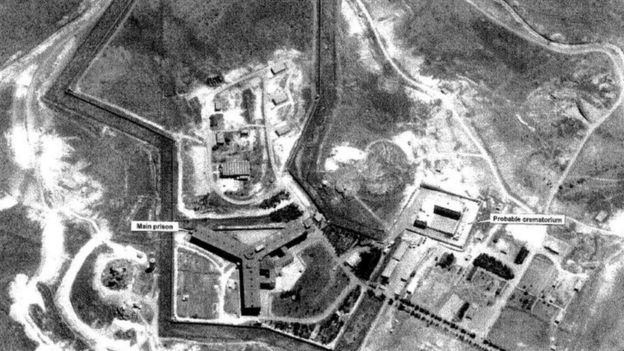
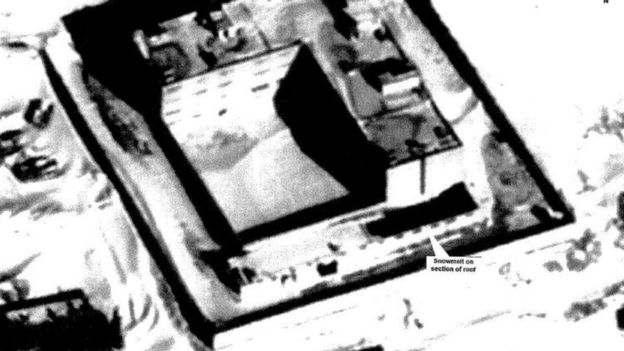
In case you’re not getting the message WaPo kindly enhanced and simplified things:
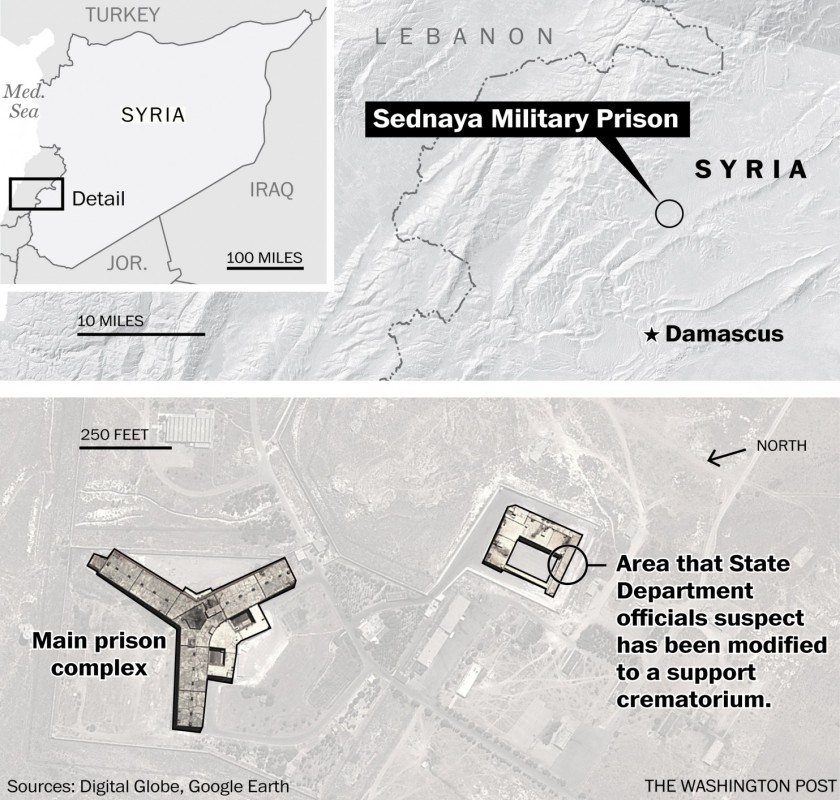
See? That thing on the right that could be absolutely anything is actually a crematorium. The State Department “believes” it with all its heart and wants us to believe it too. As do the Guardian the WaPo and the BBC and every other mainstream outlet. They want us to ignore the total absence of any evidence whatsoever for any part of their narrative and simply take their word.
That’s a “crematorium”. And it’s being used to burn masses of bodies. Just like in the Holocaust.
Because Assad (and Russia) = Hitler.
We need to tear up the ceasefires and ignore the de-escalation zones and invade Syria.
Everyone got that?
David Ignatius’ 15 Years of Running Spin for Saudi Regime
By Adam Johnson | FAIR | April 28, 2017
Last week, in “A Young Prince Is Reimagining Saudi Arabia. Can He Make His Vision Come True?,” Washington Post foreign affairs columnist David Ignatius (4/20/17) wrote what read like a press release for the Saudi regime. What’s more, he’s written the same article several times before. For almost 15 years, Ignatius has been breathlessly updating US readers on the token, meaningless public relations gestures that the Saudi regime—and, by extension, Ignatius—refer to as “reforms.”
Ignatius columns on Saudi Arabia break down roughly into two groups: straight reporting mixed with spin and concern trolling, and outright press releases documenting the dictatorship’s spectacular reforms. First the latter:
- “Home-Grown Saudi Reform” (3/7/03)
- “Saudis Act Aggressively to Denounce Terrorism” (6/13/10)
- “Change and Balance in the Saudi Kingdom” (11/21/11)
- “Women Gain Newfound Stature in Saudi Arabia” (1/18/13)
- “Reshuffling the House of Saud” (2/3/15)
- “A 30-Year-Old Saudi Prince Could Jump-Start the Kingdom — or Drive It Off a Cliff” (6/26/16)
Let’s begin by taking a look at his most recent iteration of this genre (4/20/17), featuring a brave Saudi prince taking on “religious conservatives” (vague reactionaries who are never named or defined) to change his own monarchy:
Two years into his campaign as change agent in this conservative oil kingdom, Deputy Crown Prince Mohammed bin Salman appears to be gaining the confidence and political clout to push his agenda of economic and social reform.
Ignatius begins by doing something a lot of “reformer” boosters do in Saudi Arabia: conflating “economic reform” with social reform. The latter is typically the neoliberal lubricant to get to what really matters, the further privatization and leveraging of Saudi’s immense wealth. Indeed, the only social reforms even mentioned in the glowing report are “a Japanese orchestra that included women” performing to “mixed audience,” and a co-ed Comic Con. Perhaps by 2025 they’ll have mixed-gender D&D tournaments.
Ignatius’ cheerleading columns always rely on vague person-on-the-street sources as a placeholder for the Voice of the People. Take, for example, this framing in “Women Gain Newfound Stature in Saudi Arabia” (1/18/13):
King Abdullah announced January 11 that 30 women would join the kingdom’s Shura Council, a consultative body of 150 persons, and that women henceforth would hold 20 percent of the seats. Skeptics cautioned that it’s a symbolic move, since this is an advisory group that doesn’t actually enact any legislation. But it’s a powerful symbol, according to men and women here.
Which men and women? Was a poll done? It’s unclear. He goes on to interview a Cambridge-educated woman who appears hand-picked by the regime for a glossy profile. She’s from a humble background and was about to drop out of college until the king stepped in and benevolently paid her tuition. A story Ignatius, of course, dutifully repeats without skepticism.
Then there’s the other genre of Saudi coverage we’ll call Checking In On the House of Saud:
- “Can Saudi Arabia Help Combat the Islamic State?” (7/28/14)
- “Saudi Arabia’s Coming Struggle” (1/22/15)
- “Saudi Arabia Stirs the Middle East Pot” (8/21/13)
- “The Son Who Would Be the Saudis’ King?” (9/8/15)
- “A Cyclone Brews over Saudi Arabia” (10/13/15)
- “The Costly Blunders of Saudi Arabia’s Anxiety-Ridden Monarchy” (1/5/16)
These pieces generally consist of down-the-middle updates about the status of Saudi Arabia, with some light criticism around the margins. Saudi Arabia is painted as a fearful, almost childlike place, whose evil deeds are animated by paranoia rather than ambition—bumbling “misfires” and “mistakes” rather than sinister motives.
The one piece whose headline seems to indicate actual criticism of the Saudi regime is anything but. In “The Costly Blunders of Saudi Arabia’s Anxiety-Ridden Monarchy” (1/5/16), our tough-luck Saudis are bumbling around the Middle East under siege:
Saudi Arabia is a frightened monarchy…. Countries that feel vulnerable sometimes do impulsive and counterproductive things, and that has been the case recently with Saudi Arabia.
Counterproductive? Saudi Arabia has been a bad boy and needs a timeout.
Strangely, in 15 years of writing columns about the monarchy, David Ignatius has not himself used the term “human rights,” much less addressed their abuse in a meaningful way. In one of the few columns (1/5/16) in which Ignatius actually levels criticism of the Saudi rulers’ gross human rights abuses, they are stripped of all autonomy, with the beheading of a minority religious figure painted as a response to the Evil Iranians: “The kingdom’s fear of a rising Iran led it to execute a dissident Shiite cleric.”
Ignatius went on to lament the execution in equally middle-management terms, saying it was a “mistake” and an “error.” What it wasn’t: “criminal,” “immoral” or “murder.” Moralizing is reserved for US enemies; US allies are simply under-performing employees in need of guidance and mild chiding.
Saudi Arabia, despite being an oppressive absolute monarchy that arbitrarily detains, tortures, executes and mercilessly bombs civilians, is never given the dreaded “regime” moniker like Assad and Gaddafi and North Korea. Actions are not done by an anthropomorphized state, but a nebulous blob of reluctant bureaucrats. And they are not even actions; they are always good-faith reactions to “Iranian hegemony.”
The Saudis’ ruthless bombing of Yemen, which has claimed over 10,000 civilian lives since March 2015, is almost never mentioned by Ignatius, and the few times it is touched upon it is glossed over as “costly and unsuccessful.” It is bad—not in terms of morals, but in process. It’s “costly” like an ill-advised real-estate investment.
Even more shockingly, Ignatius simply takes the regime’s word that all 47 people—including two minors—subject to its 2016 mass execution were guilty of being “extremists”:
A defensive, anxious Saudi leadership tried to show its resolve with last week’s execution of 47 extremists.
That “defensive, anxious Saudi leadership”—a caged animal always responding to threats and occasionally over-correcting.
In 2015, when King Abdullah died, Ignatius (1/22/15) insisted that the monarch who ruled for ten years over a country that didn’t allow women to drive, swim, own property or travel alone “was seen by many Saudi women as their secret champion.” A pretty well-kept secret, it must have been—aside from allowing women to take part in meaningless local “elections” and meaningless advisory councils, it’s unclear what Ignatius’ evidence is for this, but it’s “seen by many Saudi women,” so that’s good enough.
One Washington Post reader put it best in a letter to the editor (2/4/15):
The Saudis have been talking reform at least since I was a student of Middle East affairs in the 1960s. Yet it still is the epicenter of inequality, human rights violations and gratuitous state-sponsored violence.
The wheels of alleged reform in that country are perpetually spinning but going nowhere. The rulers continue to steal the oil revenue that belongs to the people; civil liberties and personal rights are repressed; beheadings, stonings and whippings for nonviolent offenses continue unabated; and people such as Mr. Ignatius still crow about how the regime is a force for change.
Ignatius, of course, is not alone. He joins a long line of faithful Western pundits who frame the Saudi regime as a reformist entity, earnestly pushing change in a fundamentally reactionary country under perma-threat from Shia forces. The Al Saud mafia is not in league with religious extremists, but a bulwark against them; they are not an illegitimate dictatorship, but an enlightened ruling class helping usher in “reform” in the face of a hyper-religious population.
And throughout it all, they are on a 71,500-year reform plan where they are effusively praised for moving their country toward the 19th century every five years or so. Other regimes that oppress their people and bomb civilians “must go” now, and are beyond the moral pale—mere allegations of being friendly with them, a career-ender. But the Saudi regime, a friendly host to light-touch US pundits, is just a well-meaning scrappy band of reformers this close to turning into Switzerland. All they need is a bit more time.
Messages can be sent to the Washington Post at letters@washpost.com, or via Twitter @washingtonpost. Please remember that respectful communication is the most effective.
Time to Confront the Media’s Anti-Corbyn Bias
By Jonathan Cook | Dissident Voice | June 1, 2017
Those journalists who should have been behind Corbyn from the start – who could have been among his few allies as he battled the corporate media for nearly two years as Labour leader – are now starting to eat humble pie. Polls suggest that Corbyn may be gradually turning the election around, to the point where the latest poll, published in the Times, indicates that Britain could be heading for a hung parliament.
No one is surprised that the Daily Mail, Telegraph and Times have been relentless in their hatchet jobs on Corbyn. But it has been disconcerting for the left that the Guardian and BBC never gave him a chance either. He was in their gun-sights from day one.
Owen Jones, a Labour stalwart and Guardian columnist, should have been Corbyn’s number one ally in the press. And yet he used the invaluable space in his columns not to challenge the media misrepresentations, but to reinforce them. He engaged in endless and morose navel-gazing, contemplating a Labour rout.
In an Evening Standard interview in February, he imparted the following wisdom: “Things change but only if people will it to be.” But then almost immediately ignored his own advice, saying that if another Labour leadership election were held: “I’d find it hard to vote for Corbyn.”
In early May, Jonathan Freedland, the Guardian’s most senior columnist, wrote a commentary entitled: “No more excuses: Jeremy Corbyn is to blame for this meltdown.” In fact, though he did not mention it, he had been making that very same argument for the previous two years.
But as Corbyn has begun chipping away at Theresa May’s lead – and equally significantly, forced the media to widen the public debate into political territory it has avoided for nearly four decades – Freedland finally admitted this week, very reluctantly, that he and others may have misjudged the Labour leader.
Freedland’s reassessment, however painfully made, was still an evasion. He and Jones continue to avoid facing up to the central problem of British politics – and must do, because they are at its very heart.
The lesson of Corbyn’s much-improved polling, according to Freedland, is this:
If May is returned with a Commons presence far below the expectations of even a month ago, it will suggest that one more bit of conventional wisdom needs to be retired along with all the rest. It will prove that campaigns matter.
But that is not the real lesson. The turnaround in Labour’s fortunes is not chiefly about the party getting its act together, staying on-message and communicating better with the media. Rather, it is that the formal requirements of an election campaign – equal coverage, reporting the speeches of candidates, leaders’ debates – have made it much harder for the media, especially the broadcasters, to entirely obscure Corbyn’s winning qualities. His honesty, warmth and humanity eclipse May’s stiff, evasive and charmless demeanour.
It was precisely those qualities in Corbyn that proved so attractive to voters in the Labour leadership elections. He inspires a rare passion for politics when he is heard. That is why he is the only politician filling stadiums. That is why the Labour party now has hundreds of thousands of members, making it the largest party in Europe. That is why young people have been registering for the election in record numbers.
The demographic breakdown of support for Corbyn and May is largely generational. Corbyn enjoys a huge lead among young people, while May can rely on overwhelming backing from those aged over-65.
It may be comforting to imagine this is simply the natural order of things. Radicalism is the preserve of those starting out in life, while old age encourages caution and conservatism. This may be one factor in explaining the generational divide, but it clearly will not suffice. In much of the post-Thatcher era, the young have proved to be even more conservative than their parents.
The reason for the Corbyn-May split has to be found elsewhere.
The fact is that the young are least likely to trust the traditional, corporate media, and most likely to seek out information from alternative sources and social media, which have been fairer to Corbyn. Youtube clips of Corbyn’s speeches, for example, are one way to bypass the corporate media.
Conversely, elderly voters are mostly still relying on the BBC, Sky and the Daily Mail for the bulk of their information about politics. The over-65s have little sense of who Corbyn is apart from what they are told by a media deeply wedded to the current neoliberal order he is threatening to disrupt.
But neither Freedland nor Jones has been prepared to admit that all of the corporate media – not just their trusted scapegoat of the “rightwing press” – have been to blame for preventing Corbyn getting a fair hearing. It is an admission they cannot make because it would expose their own complicity in a media system designed to advance the interests of corporate power over people power, oligarchy over democracy.
A desire to avoid facing this simple truth has led to some quite preposterously contorted reasoning by Freedland. In a commentary before his recent reappraisal of Corbyn, he dismissed suggestions that the media had played any significant role in the Labour leader’s troubles. Freedland cited two focus groups he had witnessed. It is worth quoting the section at length to understand quite how ridiculous his logic is.
With no steer from the moderator, who remained studiedly neutral, they described Jeremy Corbyn as a “dope”, “living in the past”, “a joke”, as “looking as if he knows less about it than I do”. One woman admired Corbyn’s sincerity; one man thought his intentions were good. But she reckoned he lacked “the qualities to be our leader”; and he believed Corbyn was simply too “soft”. …
Corbyn’s defenders will blame the media, but what was striking about these groups was that few of the participants ever bought a paper and they seldom watched a TV bulletin. Corbynites may try to blame disloyal MPs, but, whatever its impact elsewhere, none of that Westminster stuff had impinged on either of these two groups, who couldn’t name a single politician besides May, Corbyn and Boris Johnson. They had formed their own, perhaps instinctive, view.
Blaming others won’t do.
How do people form an “instinctive view” on political matters, if they never read a paper, never watch TV and never attend a political rally? Through the ethers?
The answer should be obvious. They can do so only through conversations with, or impressions gained from, family, friends, acquaintances and work colleagues who do watch TV and read papers. Given that it is impossible for most voters to see Corbyn in the flesh, most are either getting their information and opinions directly mediated for them by the media, or receiving the mediated information second-hand, from people they know who have been influenced by the media.
Freedland’s assumption that it is possible for voters to form a view instinctively that Corbyn is a “dope” – the view of him that has been uniformly cultivated by the media – is laughable. It is evidence of a profound unwillingness to confront the power of the media, and his own irresponsible complicity in wielding that power.
Corbyn is a “dope” not because that’s the way he’s seen by voters. He is a “dope” because that is the way he has been characterised for two years by all of the media, including the Guardian. The fact that a growing number of voters are starting to question whether Corbyn is quite the dope they assumed is because he has finally had a chance to talk to voters directly, even if in the leaders’ debate Jeremy Paxman did his best to prevent Corbyn from forming a complete sentence.
If we had a fair, pluralistic media driven primarily by the desire to serve the public’s interests rather than those of corporations, who can doubt that Corbyn would be winning hands-down in the polls?
The Existential Question of Who to Trust
By Robert Parry | Consortium News | April 30, 2017
The looming threat of World War III, a potential extermination event for the human species, is made more likely because the world’s public can’t count on supposedly objective experts to ascertain and evaluate facts. Instead, careerism is the order of the day among journalists, intelligence analysts and international monitors – meaning that almost no one who might normally be relied on to tell the truth can be trusted.
The dangerous reality is that this careerism, which often is expressed by a smug certainty about whatever the prevailing groupthink is, pervades not just the political world, where lies seem to be the common currency, but also the worlds of journalism, intelligence and international oversight, including United Nations agencies that are often granted greater credibility because they are perceived as less beholden to specific governments but in reality have become deeply corrupted, too.
In other words, many professionals who are counted on for digging out the facts and speaking truth to power have sold themselves to those same powerful interests in order to keep high-paying jobs and to not get tossed out onto the street. Many of these self-aggrandizing professionals – caught up in the many accouterments of success – don’t even seem to recognize how far they’ve drifted from principled professionalism.
A good example was Saturday night’s spectacle of national journalists preening in their tuxedos and gowns at the White House Correspondents Dinner, sporting First Amendment pins as if they were some brave victims of persecution. They seemed oblivious to how removed they are from Middle America and how unlikely any of them would risk their careers by challenging one of the Establishment’s favored groupthinks. Instead, these national journalists take easy shots at President Trump’s buffoonish behavior and his serial falsehoods — and count themselves as endangered heroes for the effort.
Foils for Trump
Ironically, though, these pompous journalists gave Trump what was arguably his best moment in his first 100 days by serving as foils for the President as he traveled to Harrisburg, Pennsylvania, on Saturday and basked in the adulation of blue-collar Americans who view the mainstream media as just one more appendage of a corrupt ruling elite.
Breaking with tradition by snubbing the annual press gala, Trump delighted the Harrisburg crowd by saying: “A large group of Hollywood celebrities and Washington media are consoling each other in a hotel ballroom” and adding: “I could not possibly be more thrilled than to be more than 100 miles away from [the] Washington swamp … with much, much better people.” The crowd booed references to the elites and cheered Trump’s choice to be with the common folk.
Trump’s rejection of the dinner and his frequent criticism of the mainstream media brought a defensive response from Jeff Mason, president of the White House Correspondents’ Association, who complained: “We are not fake news. We are not failing news organizations. And we are not the enemy of the American people.” That brought the black-tie-and-gown gathering to its feet in a standing ovation.
Perhaps the assembled media elite had forgotten that it was the mainstream U.S. media – particularly The Washington Post and The New York Times – that popularized the phrase “fake news” and directed it blunderbuss-style not only at the few Web sites that intentionally invent stories to increase their clicks but at independent-minded journalism outlets that have dared question the elite’s groupthinks on issues of war, peace and globalization.
The Black List
Professional journalistic skepticism toward official claims by the U.S. government — what you should expect from reporters — became conflated with “fake news.” The Post even gave front-page attention to an anonymous group called PropOrNot that published a black list of 200 Internet sites, including Consortiumnews.com and other independent-minded journalism sites, to be shunned.

Secretary of State Colin Powell, Feb. 5, 2003
But the mainstream media stars didn’t like it when Trump began throwing the “fake news” slur back at them. Thus, the First Amendment lapel pins and the standing ovation for Jeff Mason’s repudiation of the “fake news” label.
Yet, as the glitzy White House Correspondents Dinner demonstrated, mainstream journalists get the goodies of prestige and money while the real truth-tellers are almost always outspent, outgunned and cast out of the mainstream. Indeed, this dwindling band of honest people who are both knowledgeable and in position to expose unpleasant truths is often under mainstream attack, sometimes for unrelated personal failings and other times just for rubbing the powers-that-be the wrong way.
Perhaps, the clearest case study of this up-is-down rewards-and-punishments reality was the Iraq War’s WMD rationale. Nearly across the board, the American political/media system – from U.S. intelligence analysts to the deliberative body of the U.S. Senate to the major U.S. news organizations – failed to ascertain the truth and indeed actively helped disseminate the falsehoods about Iraq hiding WMDs and even suggested nuclear weapons development. (Arguably, the “most trusted” U.S. government official at the time, Secretary of State Colin Powell, played a key role in selling the false allegations as “truth.”)
Not only did the supposed American “gold standard” for assessing information – the U.S. political, media and intelligence structure – fail miserably in the face of fraudulent claims often from self-interested Iraqi opposition figures and their neoconservative American backers, but there was minimal accountability afterwards for the “professionals” who failed to protect the public from lies and deceptions.
Profiting from Failure
Indeed, many of the main culprits remain “respected” members of the journalistic establishment. For instance, The New York Times’ Pentagon correspondent Michael R. Gordon, who was the lead writer on the infamous “aluminum tubes for nuclear centrifuges” story which got the ball rolling for the Bush administration’s rollout of its invade-Iraq advertising campaign in September 2002, still covers national security for the Times – and still serves as a conveyor belt for U.S. government propaganda.
The Washington Post’s editorial page editor Fred Hiatt, who repeatedly informed the Post’s readers that Iraq’s secret possession of WMD was a “flat-fact,” is still the Post’s editorial page editor, one of the most influential positions in American journalism.
Hiatt’s editorial page led a years-long assault on the character of former U.S. Ambassador Joseph Wilson for the offense of debunking one of President George W. Bush’s claims about Iraq seeking yellowcake uranium from Niger. Wilson had alerted the CIA to the bogus claim before the invasion of Iraq and went public with the news afterwards, but the Post treated Wilson as the real culprit, dismissing him as “a blowhard” and trivializing the Bush administration’s destruction of his wife’s CIA career by outing her (Valerie Plame) in order to discredit Wilson’s Niger investigation.
At the end of the Post’s savaging of Wilson’s reputation and in the wake of the newspaper’s accessory role in destroying Plame’s career, Wilson and Plame decamped from Washington to New Mexico. Meanwhile, Hiatt never suffered a whit – and remains a “respected” Washington media figure to this day.
Careerist Lesson
The lesson that any careerist would draw from the Iraq case is that there is almost no downside risk in running with the pack on a national security issue. Even if you’re horrifically wrong — even if you contribute to the deaths of some 4,500 U.S. soldiers and hundreds of thousands of Iraqis — your paycheck is almost surely safe.
The same holds true if you work for an international agency that is responsible for monitoring issues like chemical weapons. Again, the Iraq example offers a good case study. In April 2002, as President Bush was clearing away the few obstacles to his Iraq invasion plans, Jose Mauricio Bustani, the head of the Organization for the Prohibition of Chemical Weapons [OPCW], sought to persuade Iraq to join the Chemical Weapons Convention so inspectors could verify Iraq’s claims that it had destroyed its stockpiles.
The Bush administration called that idea an “ill-considered initiative” – after all, it could have stripped away the preferred propaganda rationale for the invasion if the OPCW verified that Iraq had destroyed its chemical weapons. So, Bush’s Undersecretary of State for Arms Control John Bolton, a neocon advocate for the invasion Iraq, pushed to have Bustani deposed. The Bush administration threatened to withhold dues to the OPCW if Bustani, a Brazilian diplomat, remained.
It now appears obvious that Bush and Bolton viewed Bustani’s real offense as interfering with their invasion scheme, but Bustani was ultimately taken down over accusations of mismanagement, although he was only a year into a new five-year term after having been reelected unanimously. The OPCW member states chose to sacrifice Bustani to save the organization from the loss of U.S. funds, but – in so doing – they compromised its integrity, making it just another agency that would bend to big-power pressure.
“By dismissing me,” Bustani said, “an international precedent will have been established whereby any duly elected head of any international organization would at any point during his or her tenure remain vulnerable to the whims of one or a few major contributors.” He added that if the United States succeeded in removing him, “genuine multilateralism” would succumb to “unilateralism in a multilateral disguise.”
The Iran Nuclear Scam
Something similar happened regarding the International Atomic Energy Agency in 2009 when Secretary of State Hillary Clinton and the neocons were lusting for another confrontation with Iran over its alleged plans to build a nuclear bomb.
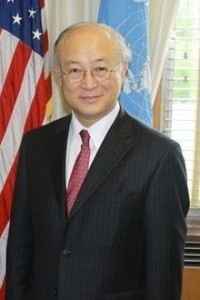
IAEA director Yukiya Amano
According to U.S. embassy cables from Vienna, Austria, the site of IAEA’s headquarters, American diplomats in 2009 were cheering the prospect that Japanese diplomat Yukiya Amano would advance U.S. interests in ways that outgoing IAEA Director General Mohamed ElBaradei wouldn’t; Amano credited his election to U.S. government support; Amano signaled he would side with the United States in its confrontation with Iran; and he stuck out his hand for more U.S. money.
In a July 9, 2009, cable, American chargé Geoffrey Pyatt said Amano was thankful for U.S. support of his election. “Amano attributed his election to support from the U.S., Australia and France, and cited U.S. intervention with Argentina as particularly decisive,” the cable said.
The appreciative Amano informed Pyatt that as IAEA director-general, he would take a different “approach on Iran from that of ElBaradei” and he “saw his primary role as implementing safeguards and UNSC [United Nations Security Council] Board resolutions,” i.e. U.S.-driven sanctions and demands against Iran.
Amano also discussed how to restructure the senior ranks of the IAEA, including elimination of one top official and the retention of another. “We wholly agree with Amano’s assessment of these two advisors and see these decisions as positive first signs,” Pyatt commented.
In return, Pyatt made clear that Amano could expect strong U.S. financial assistance, stating that “the United States would do everything possible to support his successful tenure as Director General and, to that end, anticipated that continued U.S. voluntary contributions to the IAEA would be forthcoming. Amano offered that a ‘reasonable increase’ in the regular budget would be helpful.”
What Pyatt made clear in his cable was that one IAEA official who was not onboard with U.S. demands had been fired while another who was onboard kept his job.
Pandering to Israel
Pyatt learned, too, that Amano had consulted with Israeli Ambassador Israel Michaeli “immediately after his appointment” and that Michaeli “was fully confident of the priority Amano accords verification issues.” Michaeli added that he discounted some of Amano’s public remarks about there being “no evidence of Iran pursuing a nuclear weapons capability” as just words that Amano felt he had to say “to persuade those who did not support him about his ‘impartiality.’”
In private, Amano agreed to “consultations” with the head of the Israeli Atomic Energy Commission, Pyatt reported. (It is ironic indeed that Amano would have secret contacts with Israeli officials about Iran’s alleged nuclear weapons program, which never yielded a single bomb, when Israel possesses a large and undeclared nuclear arsenal.)
In a subsequent cable dated Oct. 16, 2009, the U.S. mission in Vienna said Amano “took pains to emphasize his support for U.S. strategic objectives for the Agency. Amano reminded ambassador [Glyn Davies] on several occasions that he was solidly in the U.S. court on every key strategic decision, from high-level personnel appointments to the handling of Iran’s alleged nuclear weapons program.
“More candidly, Amano noted the importance of maintaining a certain ‘constructive ambiguity’ about his plans, at least until he took over for DG ElBaradei in December” 2009.
In other words, Amano was a bureaucrat eager to bend in directions favored by the United States and Israel regarding Iran’s nuclear program. Amano’s behavior surely contrasted with how the more independent-minded ElBaradei resisted some of Bush’s key claims about Iraq’s supposed nuclear weapons program, correctly denouncing some documents as forgeries.
The world public got its insight into the Amano scam only because the U.S. embassy cables were among those given to WikiLeaks by Pvt. Bradley (now Chelsea) Manning, for which Manning received a 35-year prison sentence (which was finally commuted by President Obama before leaving office, with Manning now scheduled to be released in May – having served nearly seven years in prison).
It also is significant that Geoffrey Pyatt was rewarded for his work lining up the IAEA behind the anti-Iranian propaganda campaign by being made U.S. ambassador to Ukraine where he helped engineer the Feb. 22, 2014 coup that overthrew elected President Viktor Yanukovych. Pyatt was on the infamous “fuck the E.U.” call with Assistant Secretary of State for European Affairs Victoria Nuland weeks before the coup as Nuland handpicked Ukraine’s new leaders and Pyatt pondered how “to midwife this thing.”
Rewards and Punishments
The existing rewards-and-punishments system, which punishes truth-tellers and rewards those who deceive the public, has left behind a thoroughly corrupted information structure in the United States and in the West, in general.
Across the mainstream of politics and media, there are no longer the checks and balances that have protected democracy for generations. Those safeguards have been washed away by the flood of careerism.
The situation is made even more dangerous because there also exists a rapidly expanding cadre of skilled propagandists and psychological operations practitioners, sometimes operating under the umbrella of “strategic communications.” Under trendy theories of “smart power,” information has become simply another weapon in the geopolitical arsenal, with “strategic communications” sometimes praised as the preferable option to “hard power,” i.e. military force.
The thinking goes that if the United States can overthrow a troublesome government by exploiting media/propaganda assets, deploying trained activists and spreading selective stories about “corruption” or other misconduct, isn’t that better than sending in the Marines?
While that argument has the superficial appeal of humanitarianism – i.e., the avoidance of armed conflict – it ignores the corrosiveness of lies and smears, hollowing out the foundations of democracy, a structure that rests ultimately on an informed electorate. Plus, the clever use of propaganda to oust disfavored governments often leads to violence and war, as we have seen in targeted countries, such as Iraq, Syria and Ukraine.
Wider War
Regional conflicts also carry the risk of wider war, a danger compounded by the fact that the American public is fed a steady diet of dubious narratives designed to rile up the population and to give politicians an incentive to “do something.” Since these American narratives often deviate far from a reality that is well known to the people in the targeted countries, the contrasting storylines make the finding of common ground almost impossible.
If, for instance, you buy into the Western narrative that Syrian President Bashar al-Assad gleefully gases “beautiful babies,” you would tend to support the “regime change” plans of the neoconservatives and liberal interventionists. If, however, you reject that mainstream narrative – and believe that Al Qaeda and friendly regional powers may be staging chemical attacks to bring the U.S. military in on their “regime change” project – you might favor a political settlement that leaves Assad’s fate to the later judgment of the Syrian people.
Similarly, if you accept the West’s storyline about Russia invading Ukraine and subjugating the people of Crimea by force – while also shooting down Malaysia Airlines Flight 17 for no particular reason – you might support aggressive countermoves against “Russian aggression,” even if that means risking nuclear war.
If, on the other hand, you know about the Nuland-Pyatt scheme for ousting Ukraine’s elected president in 2014 and realize that much of the other anti-Russian narrative is propaganda or disinformation – and that MH-17 might well have been shot down by some element of Ukrainian government forces and then blamed on the Russians [see here and here] – you might look for ways to avoid a new and dangerous Cold War.
Who to Trust?
But the question is: who to trust? And this is no longer some rhetorical or philosophical point about whether one can ever know the complete truth. It is now a very practical question of life or death, not just for us as individuals but as a species and as a planet.
The existential issue before us is whether – blinded by propaganda and disinformation – we will stumble into a nuclear conflict between superpowers that could exterminate all life on earth or perhaps leave behind a radiated hulk of a planet suitable only for cockroaches and other hardy life forms.
You might think that with the stakes so high, the people in positions to head off such a catastrophe would behave more responsibly and professionally. But then there are events like Saturday night’s White House Correspondents Dinner with self-important media stars puffing about with their First Amendment pins. And there’s President Trump’s realization that by launching missiles and talking tough he can buy himself some political space from the Establishment (even as he sells out average Americans and kills some innocent foreigners). Those realities show that seriousness is the farthest thing from the minds of Washington’s insiders.
It’s just too much fun – and too profitable in the short-term – to keep playing the game and hauling in the goodies. If and when the mushroom clouds appear, these careerists can turn to the cameras and blame someone else.
Investigative reporter Robert Parry broke many of the Iran-Contra stories for The Associated Press and Newsweek in the 1980s.
Featured Video
US IRAN TALKS: Who Are the Crazy Ones Here? /Lt Col Daniel Davis
or go to
Aletho News Archives – Video-Images
From the Archives
Wartime internment camps in Australia
National Archives of Australia
World War I
During World War I, for security reasons the Australian Government pursued a comprehensive internment policy against enemy aliens living in Australia.
Initially only those born in countries at war with Australia were classed as enemy aliens, but later this was expanded to include people of enemy nations who were naturalised British subjects, Australian-born descendants of migrants born in enemy nations and others who were thought to pose a threat to Australia’s security.
Australia interned almost 7,000 people during World War I, of whom about 4,500 were enemy aliens and British nationals of German ancestry already resident in Australia.
Records of World War I internment camps
World War II
During World War II, Australian authorities established internment camps for three reasons – to prevent residents from assisting Australia’s enemies, to appease public opinion and to house overseas internees sent to Australia for the duration of the war.
Unlike World War I, the initial aim of internment during the later conflict was to identify and intern those who posed a particular threat to the safety or defence of the country. As the war progressed, however, this policy changed and Japanese residents were interned en masse. In the later years of the war, Germans and Italians were also interned on the basis of nationality, particularly those living in the north of Australia. In all, just over 20 per cent of all Italians resident in Australia were interned. … continue
Blog Roll
 Aletho News
- Diplomats slam US negotiators’ performance in Iran talks
- Trump Refuses Exit Ramp, War with Iran will Continue
- Trump Says US Naval Blockade in Strait of Hormuz Will Begin Shortly
- US, Iran end 21-hour talks without agreement
- US IRAN TALKS: Who Are the Crazy Ones Here? /Lt Col Daniel Davis
- Talks with the US end without a deal over excessive US demands: Iran
- Feeling Better, Getting Worse: How Psychiatric Drugs Create the Illusion They Cure
- ‘Nobody Told Me’: Former Mental Health Patient Calls Out Dangerous Side Effects of Psychiatric Drugs
- Dr. Abu-Sitta: Beirut ‘felt like a day in Shifa Hospital’
- Iran Has Won the War, It Will Be Up to the US to Secure the Peace: Mohammad Marandi
- If Americans Knew
- US-Iran ceasefire negotiations make zero progress – Daily Update
- Pro-Israel ‘Thinktanks’ and Individuals who Influence U.S. Foreign Policy
- Mearsheimer reveals how Israel dictates US policies on Iran, Gaza – video
- After killing 350+, Israel still has a “score to settle” with Lebanon before ceasefire – Daily Update
- Military aid to Israel emerges as the latest political litmus test for Democrats
- The only Palestinian children’s rights organization closes following years-long Israeli campaign against it
- ‘I Can’t Forget the Smell’: Lebanese Reel After Israel Kills Over 300 in Single Day
- DNC Shoots Down Resolutions Calling Out AIPAC and Limiting Arms to Israel
- TCN: Is Israel Blackmailing President Trump?
- Israel killed at least 303 Lebanese yesterday – who were they? Daily Update
- No Tricks Zone
- German Expert: Heat Dome Led To Record Temps In Western USA…Warmer In 1934, 1936
- New Study: No Linear Warming Or Glacier Retreat Along Northern Antarctic Peninsula Since 1980s
- An Inconvenient Tree: Uncovered In Alps… Europe Much Warmer Than Today 6000 Years Ago
- New Study Reports A 60% Slowdown In Greenland’s Ice Loss Rate In The Last Decade
- Low Intensity Tornado Wrecks Major Solar Farm, Creating A Potential Toxic Dump
- New Study Finds Warming Saves Lives…Cold Temperatures 12 Times More Deadly Than Excess Heat
- German Science Blog Accuses PIK Climate Institute Of Hallucinating Climate Tipping Points
- Devastating Assessment Of Comirnaty Vaccine By Former Senior Pfizer Europe Toxicologist
- New Study: CO2 Is ‘Effectively Negligible’ As An Explanatory Climate Change Factor Since 2000
- Former Pfizer Toxicologist Dr. Helmut Sterz Tells Bundestag Hearing Pfizer Vaccine Should Have Never Been Approved
 Aletho News
