US in Deep Turmoil as Trump Confronts the Establishment
By Salman Rafi Sheikh | New Eastern Outlook | 28.02.2017
With the departure of the Trump’s national security adviser, political crisis in the US has only depended and is likely to exacerbate into a full-fledged struggle for power and control between Trump and what some call ‘deep-state.’ While Donald Trump is an elected president of the United States of America, he doesn’t seem to be able to exercise power in actual terms. This is evident from the way a so-called ‘pro-Russian’ adviser has been forced to resign. Following this resignation an intense debate has emerged in the US, leading a considerable number of people, 48 per cent according to a recent poll, to reject the way Trump has performed in the first month of his presidency. Already Trump has retracted on Crimea. Accordingly, he is in no hurry to engage Russia in Syria nor does he consider NATO to be “obsolete.” In the same vain, his U-turn towards China is something that nobody could foresee during his election campaign. As of now, a great deal of Trump’s election rhetoric is dead and lies buried deep inside the rubric of deep structures of power, marking the very first instance of its sort when an American president has found himself deeply at odds with the system. And, there is no certainty that he can or may overcome this tussle and emerge as the American ‘knight in shining armour.’
While this may or may not happen, a lot of questions about Trump’s ability to steer the course of American foreign and domestic policies have emerged following Flynn’s resignation and with it the so-called crisis of legitimacy has deepened, leaving minimum to no space for Trump to freely determine the course of American policy making.
The crisis, or the power struggle, has deepened to an extent where an American elected president has been forced to publicly blame American intelligence agencies for feeding the media with information against him and claimed that today’s America was `just like Russia’.
The Russophobia campaign is, indeed, being fed to the American public and the declining support for Trump is more a direct result of this spread of false information than an outcome of actual ‘bad performance.’
The media leaks have already led to Michael Flynn’s resignation. The Washington Post has recently reported that Flynn had “discussed sanctions” with a Russian official during the transition period, although Flynn had assured Vice President Mike Pence that this did not happen.
In turn, The New York Times noted on February 14, 2017, that other officials of the Trump administration and his election campaign have had contacts with Russian intelligence agents as well.
Flynn’s departure just three weeks after Trump’s inauguration as president has allowed the media to claim that the White House was in total disarray.
The media’s propagandist claim has certainly irked Trump who went to his favourite medium of communication, Twitter, to fire off a series of tweets, attacking the media as well as the intelligence agencies. In at least two tweets, Trump named the agencies the Federal Bureau of Investigations (FBI) and National Security Agency (NSA) that he said were `running a campaign against him’.
`The real scandal here is that classified information is illegally given out by `intelligence’ like candy. ‘Very un-American’, he tweeted. `Information is being illegally given to the failing New York Times and Washington Post by the intelligence community.
The crisis that has thus ensued and which is being fanned out by the mainstream US media is asking for changes in the policies, particularly towards Russia about Crimea and co-operation in Syria, that Trump had advocated during his election campaign.
We have already seen that some of it has already changed. What this retraction implies, in political terms, is that the establishment has also shown that it has the ability and the grit to undermine Trump if he were to deviate from their script—a script that is premised on the existence of an enemy (Russia) and which the establishment and the deep-state can use to protect, enhance and materialize its own political and economic interests in both domestic and global political and economic arenas.
The “Russophobia” based containment of Donald Trump is, however, not going to remain exclusive to the US’ domestic political circles. On the contrary, it is likely to, and already has, expanded into international political arena and is going to define and shape Trump’s relations with the US’ European allies, who in turn are neither comfortable with Trump’s foreign policy nor are going to allow him to retract the US-NATO security system (read: NATO is no longer “obsolete”).
Interestingly enough, this ‘trans-Atlantic Russophobia’ is being transformed into a new Cold War. The NATO defence ministers have been recently been discussing the presence of their fleets in the Black Sea in a closed summit in Brusells. Clearly, the western bloc on the whole loathes Trump, creating an unprecedented disequilibrium within the Western alliance wherein Trump leads the alliance, but the partners do not know how far he is to be taken seriously due to his inability to control things (read: establishment’s course of action is more appealing to the NATO allies for its anti-Russia, pro-sanctions commitments).
The Trump administration has lost, by losing Flynn, its authority and the ability to guide the American public to its vision. On the contrary, the media-establishment nexus has hijacked Donald Trump’s own vision, forcing him to forget his election rhetoric promises and come out in the open to fight for his political survival through social media.
Just as Trump’s confrontation with the American establishment is causing unease in the domestic and European political arena, Trump’s fight with the establishment is being equally fought in both domestic and European arenas. Whereas Trump has resorted to twitter to fight back against a sustained media campaign, in the European arena he has hit back by re-casting doubts over the US’ commitment to NATO.
That is to say, while he no doubt has willy-nilly accepted NATO as the “bedrock” of American security, Mattis’ remarks at NATO defence ministers’ meeting show that the crisis is not yet over and that it will remain unsettled unless the dust of the tussle between Trump and American establishment remains in the air—something that may not happen overnight—and unless the all-powerful American establishment succeeds in modifying Trump into a typical Neo-Con hawk.
Salman Rafi Sheikh, research-analyst of International Relations and Pakistan’s foreign and domestic affairs.
No Evidence of Trump Team’s Ties With Russia – US House Intel Committee Chair
Sputnik – 27.02.2017
WASHINGTON – The US House Intelligence Committee did not find any evidence so far proving that President Donald Trump’s advisers had any contacts with Russian officials during the 2016 US presidential campaign, Committee Chair Devin Nunes said in a press conference on Monday.
On February 15, The New York Times reported, citing phone records and intercepted calls, members of Trump’s presidential campaign team and several associates allegedly contacted Russian intelligence and government officials prior to the 2016 US elections. Both Washington and Moscow have repeatedly refuted the allegations.
“Nor there [were] any evidence presented about Trump advisers speaking to Russians,” Nunes stated. “I don’t have any evidence of any phone calls. It does not mean that they do not exist, but I don’t have that. And what I have been told by many folks that there is nothing there. But we are still looking into that.”
The US House Intelligence Committee will publicly release findings of its ongoing investigation into alleged Russia’s interference in 2016 US presidential election, Nunes said.
“They will be public, they will be publicized,” Nunes stated when asked whether the committee’s findings would be released. “Likely what will happen is we will probably have just an interim report of some kind that we will put out on what we have.”
“At this point what are we going to appoint a special prosecutor to do exactly?” Nunes stated. “If at some point we have serious crimes committed, it would be something that we would consider, but at this point we don’t have that.”
The Republican lawmaker added that right now the only serious crimes committed were the leaking of documents to the press.
The tensions between Trump and a number of US news outlets has intensified since the inauguration of the politician in January.
Earlier in the month, the president slammed “fake news” reports that kept citing anonymous White House sources alleging chaos in his administration as well as contacts with Russian intelligence services.
The soft coup against Jeremy Corbyn is under way
By John McDonnell | Labour Briefing | February 26, 2017
WE HAVE TO ALERT PARTY MEMBERS and supporters that the soft coup is underway. It’s planned, co-ordinated and fully resourced. It is being perpetrated by an alliance between elements in the Labour Party and the Murdoch media empire, both intent on destroying Jeremy Corbyn and all that he stands for.
The coup is not being waged up front in public but strictly behind the scenes. Having learned the lesson of the last coup attempt – that a direct attack on Jeremy and his policies will provoke a backlash from many party members – the coup perpetrators are this time round pursuing a covert strategy.
The aim of these covert coup plotters is to undermine the support Jeremy has secured among Labour Party members, and also importantly to undermine support from Labour voters.
Undermining support for Jeremy from Labour voters is important to the plotters because their objective is to ensure Jeremy trails in the polls and can’t win elections. In this way they can destroy morale among party members and their confidence in him.
The tactics include daily and constant behind-the-scenes non-attributable briefings against Jeremy and his Shadow Cabinet every time he or his shadow ministers make a statement, intervene in Parliament or launch a policy. The plotters use every opportunity to chip away at Jeremy’s standing to seek to demean him and undermine support for him in the Labour Party and among Labour supporters. This constant barrage of negative briefings also crowds out any positive initiatives or narrative from Jeremy and his team. It also feeds and confirms in the public’s mind that the Labour Party is split.
The plotters are effective in distorting the media coverage because they have extensive contacts and allies in the media, many inherited from Mandelson’s days. The professional planning of interventions in which attacks to undermine Jeremy are framed evidences an exceptionally well resourced ‘dark arts’ operation of the old spin school. The coup plotters are willing to sacrifice the Party at elections just to topple Jeremy and prevent a socialist leading the Party. It is more important to them that they regain control of the Party than it is to win elections.
The irony is that they are willing to go so far in denigrating Jeremy that they endanger their own parliamentary seats and endanger the very existence of the party they want to use to get into power. We saw the methods they use with the leaking of the Party’s internal polling. This was a carefully planned and executed operation. Let’s use it as a case example.
Both quantitative and qualitative polling is undertaken by the Party regularly under the direction of Jon Trickett, the Party’s National Campaign Co-ordinator. Jon arranged for one focus group to be carried out by the Party’s polling agency in Manchester to assess how our frontbench members appearing on television programmes at the time were being perceived in the north west. This polling took place back in November and its results were only accessible to a small number of party officials, Jon Trickett and the polling agency. To this day I have still not seen the results. The polling was leaked by someone to James Lyons, a Times journalist who has regularly received leaks from within the Labour Party – usually used to attack Jeremy and his team.
The Murdoch media had already run earlier in the week fake news stories in The Times and Sun alleging that Jeremy was planning to stand down as leader of the Party. No matter how many times it was explained that this story was completely untrue and absolute fiction, the The Times and Sun continued to run it – and the BBC and other broadcast media took it up and reported it extensively. The media then invented the story that the polling on the perception of Shadow Cabinet members in the north west was the Party testing the perceptions of potential successors to Jeremy.
This was a classic negative story framing and transmission exercise. It is just one example of what we confront on a weekly and at times almost daily basis. It is vitally important that our supporters understand and appreciate what we are facing. What we are experiencing is completely predictable and expected. Spreading that understanding of what we are up against enables us all to organise how we can fight back and overcome the soft coup strategy.
We all have an important role to play in explaining what we are facing and how, by standing together, we can defeat the plotters again. This is the testing time for the Corbyn transformation. The challenges are great and the times are tough – but we all know that this is the socialist opportunity of a lifetime.
John McDonnell is Shadow Chancellor, MP for Hayes and Harlington, Chair of the Socialist Campaign Group of Labour MPs and Chair of the Labour Representation Committee.
contact – office@labourbriefing.org
© Labour Briefing 2017
No Amount of Propaganda Qualifies as Humanitarian Aid
By Jean Perier – New Eastern Outlook – 26.02.2017
Last month, Helsinki hosted an international conference on the humanitarian situation in Syria, resulting in the launch of a regional refugee plan for the next two years, focused on assisting Syria’s neighboring states in dealing with the refuge crisis. In accordance with this plan, UN officials seek 4.6 billion dollars worth of humanitarian aid to provide relief both to the Syrian refugees and the communities that provide them shelter. A spokesman for UN Secretary General Stefan Dyuzharrik emphasized the fact that the funds are going to help some 4.7 million refugees from Syria and 4.4 million people who assist them in Turkey, Lebanon, Jordan, Iraq and Egypt. At the same time, as it’s been noted by Dyuzharrik, these funds are not meant to provide assistance to 13.5 million people in Syria itself.
So who is going provide those peaceful Syrians, who neither have the capacity nor the money to leave the country, with humanitarian aid?
According to UN estimates, out of more than 13.5 million Syrians that have found themselves in dire need of humanitarian assistance, some 6.3 million people are internally displaced persons, while another 5 million live in remote areas and destroyed cities with no infrastructure to support them.
Unfortunately, one is forced to admit that the absolute majority of Western countries are reluctant to provide any form of assistance to the Syrian population, who have witnessed their everyday life consumed by the the war. In particular, a full month has passed after the complete liberation of Aleppo, but no international humanitarian organization has made a single step to provide real assistance to the civilian population of the city.
The recent joint delivery of humanitarian aid organized by the International Committee of the Red Cross and the Syrian Arab Red Crescent and the United Nations failed when the convoy was ambushed in the rural areas of the Aleppo province. As a result, militants took a part of the humanitarian aid destined for the Syrian inhabitants of the city of Homs.
Against this background, the sole real supplier of humanitarian aid to Syria at this moment is Russia, since the aid provided by other countries is often too insignificant to make a difference, if there is any.
However, a number of European and American media sources are still trying to push the blame for the humanitarian catastrophe in Syria on Russia. By rehearsing the mantras repeated by organizations funded by George Soros and various Western governments, they choose to completely ignore that it was the United States and its NATO allies that have been trying to destroy the Middle East as a whole, by destabilizing regional players, destroying their infrastructure, and thus subjecting the population of the Middle East to unbearable hardship and starvation. It’s hardly a secret these days that Washington has been sponsoring ISIS and its affiliates from day one.
At the same time, some official UN staff choose to ignore the United Nations Charter that binds them to remain impartial observers, and have started repeating the delusional stories that Western media sources publish. A specific example of this deeply disturbing situation is the string of accusations against Russia that was made during the final stages of the liberation of the city of Aleppo. Allegedly, the assistance Russia provided to pro-government forces aggravated the humanitarian situation that inhabitants of this city found themselves in.
Yet, those same UN staff members chose to ignore the fact that Syrian forces discovered warehouses full of medicine and food in eastern Aleppo after the liberation of the city. This fact has been completely omitted in the report presented by the UN Secretary General about the humanitarian situation in the Syrian Arab Republic. Meanwhile, those warehouses had enough goods to support the entire civil population of the city for several months, but militants kept the supplies for themselves and only allowed locals to take food when they agreed to join militant groups.
Against this background, the hysteria that some senior members of the International Syria Support Group (ISSG) and the UN staff indulged in, by announcing that a humanitarian catastrophe was taking place in Aleppo, while urging Russia to immediately ensure the delivery of food and medicine to areas of the city occupied by militants can only be qualified as propaganda, since they were deliberately deceiving the international community.
It appears that these actions of UN staff should become the subject of a thorough investigation in and of itself. This investigation should also clarify why the UN Secretary General’s advisers chose not to feature the facts about militant warehouses in Aleppo in the above mentioned report.
Human Rights Watch Cites Al Qaeda and Collaborators in Latest Syria Report
By Tony Cartalucci – New Eastern Outlook – 26.02.2017
On the heels of Amnesty International’s admittedly and entirely fabricated report regarding Syria’s Saydnaya prison, Human Rights Watch (HRW) has published its own baseless report on Syria – this one regarding alleged chlorine bomb attacks in Aleppo during the city’s liberation late last year.
In a post on HRW’s website titled, “Syria: Coordinated Chemical Attacks on Aleppo,” it claims:
Syrian government forces conducted coordinated chemical attacks in opposition-controlled parts of Aleppo during the final month of the battle for the city, Human Rights Watch said today.
However, when qualifying HRW’s accusations, it admits:
Through phone and in-person interviews with witnesses and analysis of video footage, photographs, and posts on social media, Human Rights Watch documented government helicopters dropping chlorine in residential areas on at least eight occasions between November 17 and December 13, 2016. The attacks, some of which included multiple munitions, killed at least nine civilians, including four children, and injured around 200.
Watching the videos and viewing the photographs reveals that none of them actually link any of the alleged “chlorine attacks” to Syrian forces, or even to chlorine itself.
The body of evidence presented by HRW also reveals that the interviews they conducted with alleged “witnesses” included almost exclusively opposition forces. Among them were the US-UK funded White Helmets – referred to disingenuously as “Syria Civil Defense” in HRW’s report – who served as designated terrorist organization Jabhat Al Nusra auxiliaries, often found on the battlefield shoulder-to-shoulder with armed militants.
Not only are these clearly compromised sources of information based on their admitted political alignments, but also because of their respective, systematic fabrications throughout the Syrian conflict. It is telling of HRW’s systematic bias that it would base an entire report on compromised sources drawn from the opposition, but not even a single report based on government claims. United Arab Emirate-based Al Nusra propaganda platform Orient News was also cited, as were other notorious anti-government propaganda networks including the Aleppo Media Center. In reality, a true rights advocacy organization would only report what is physical evidence verified. Human Rights Watch has deliberately avoided doing so not only in Syria, but amid virtually every conflict it involves itself in.
From conflating the number of civilians “trapped” in eastern Aleppo, to attempts to downplay or dismiss the role designated terrorist organizations played in the occupation of Aleppo, the groups and individuals cited by Human Rights Watch have practiced deliberate deceit throughout the battle for Aleppo, and the Syrian conflict at large.
For Human Rights Watch – an allegedly world-renowned rights advocacy organization – to cite such sources indicates that this latest report, like Amnesty International’s recently fabricated report, constitutes a politically-motivated attack hiding behind rights advocacy, not upholding it.
Considering the timing of Amnesty International, Human Rights, and also the Atlantic Council’s reports, rolled out in a multi-organizational campaign attacking the Syrian government, the individual deceit of each organization transforms into collective and coordinated impropriety.
A final consideration in the wake of Human Rights Watch’s latest, politically-motivated report is the fact that all actual evidence points to the opposition itself for being behind both the production and deployment of chlorine-based weapons.
TIME Magazine in an article titled, “Syria’s Civil War: The Mystery Behind a Deadly Chemical Attack,” would admit:
In August rebel forces took Sabbagh’s factory by force, as part of a sweep that also netted them an electricity station and a military airport about 30 km from Aleppo. Sabbagh, who has since fled Aleppo for Beirut, says his factory is now occupied by Jabhat al-Nusra, a militant group with strong ties to al-Qaeda that has been designated a terrorist group by the U.S. He knows this because his site manager has struck a deal with the rebels — they supply 200 L of fuel a day to keep the generator running so that the valves of his $25 million factory don’t freeze up. The factory isn’t operational anymore, but this way at least, says Sabbagh, it might be one day in the future. In the meantime, he has no idea what has happened, if anything, to the 400 or so steel barrels of chlorine gas he had stored in the compound. The yellow tanks, which hold one ton of gas each, are used for purifying municipal water supplies. “No one can know for certain, but if it turns out chlorine gas was used in the attack, then the first possibility is that it was mine. There is no other factory in Syria that can make this gas, and now it is under opposition control,” he says.
Military experts since the advent of modern chemical warfare have noted its limited utility during combat. It has very temporary tactical advantages when used on a very large scale – a scale much larger than any of the alleged attacks cited by Human Rights Watch. Strategically, a military force with superior conventional means would have no logical use for chemical weapons.
Likewise, chemical weapons would not turn the tide in the battle of Aleppo for the occupying terrorists. However, the use of chemical weapons in Aleppo and the use of the West’s powerful propaganda arms to assign blame to the Syrian government did promise a very significant political and possibly strategic advantage. It was accusations of “weapons of mass destruction” that served as a pretext for war with Iraq in 2003 – a pretext the US attempted to recreate versus Syria in 2013.
With these latest, weak, and baseless accusations presented by Amnesty International, Human Rights Watch, and the Atlantic Council, we are witnessing a redux of 2013 propaganda aimed at undermining the Syrian government and expanding the West’s pretext for more direct involvement in the Syrian conflict.
Milo Djukanovic’s Claims of Russian Assassination Plot Are a Desperate Ploy to Further NATO Bid
By James George JATRAS | Strategic Culture Foundation | 26.02.2017
Reports surfacing in the British media of a Russian plot to kill Montenegro’s former prime minister Milo Djukanovic should be seen for the cynical ploy they are. To give just the smallest bit of defense to these British publications – yes, it is true Djukanovic is making these allegations. Is there any substance or proof to these allegations? No. The UK media has shown it is as politicized as its American mainstream counterparts like CNN by publishing such fake news.
Good reason to doubt these baseless charges starts from the fact that they come from Djukanovic, who has a stupendous reputation for corruption and is trying to move forward desperately with NATO accession for Montenegro which has stalled in the U.S. Senate for about two months. At this point if he were to say the sky is blue, it would be reason to disbelieve him and look for an ulterior motive.
Djukanovic transparently is throwing this red meat on the table in the context of hysteria that is going on in Washington concerning allegations of Moscow’s hacking the American election (“the Russians did it!”) and the open attack by the “deep state,” by elements of the intelligence community with their leaks, and by the mainstream media that just claimed the scalp of general Mike Flynn, President Donald Trump’s former National Security Adviser. Besides criminally seeking to overthrow the constitutionally elected government – as they have imposed “regime change” on other countries – they want to do anything they can to block any rapprochement from the Trump administration with Moscow.
Djukanovic has very artfully inserted himself into this narrative. His message is simple: you can’t let the Russians win. Nothing else matters. He is trying to use “the Russians are coming” meme as a way to jumpstart Montenegro’s stalled NATO bid. Let’s remember the debate in Washington isn’t about letting Montenegro into NATO because having it as an ally makes American more secure. Montenegro obviously does nothing for our defense. The question is whether the NATO door will remain open, particularly for Georgia and Ukraine.
It seems no one cares to ask why America should be allied with a nation that doesn’t particularly want to be allied with us. According to opinion polls, it is far from clear that most Montenegrins want to be in NATO and aligned to us in the first place. Most recent polls indicate a slight plurality in the “against” camp despite relentless government propaganda and the braying of Soros-controlled media. A recent survey indicated that some 84% of Montenegrins want a vote on the matter. Even a solid majority of NATO supporters favor a referendum. Djukanovic won’t hold a referendum because he knows he would lose it.
Djukanovic’s ploy is well timed. It both feeds and feeds off of the anti-Russian frenzy, which is the basis of what former Congressman Denis Kucinich has called an attempted coup to bring down the Trump administration. Calls are openly heard for “patriots” in the intelligence services to overthrow Trump for the “good of the country.”
It is uncertain whether Djukanovic will successfully ride the wave of Russophobia to get Montenegro into NATO. What is certain is that America is on the edge of turning into a banana republic. Trump has very little time to strike back, hard. One way for him to show who’s boss is to turn thumbs down on Djukanovic and his trickery.
How ‘New Cold Warriors’ Cornered Trump
By Gareth Porter | Consortium News | February 25, 2017
Opponents of the Trump administration have generally accepted as fact the common theme across mainstream media that aides to Donald Trump were involved in some kind of illicit communications with the Russian government that has compromised the independence of the administration from Russian influence.
But close analysis of the entire series of leaks reveals something else that is equally sinister in its implications: an unprecedented campaign by Obama administration intelligence officials, relying on innuendo rather than evidence, to exert pressure on Trump to abandon any idea of ending the New Cold War and to boost the campaign to impeach Trump.
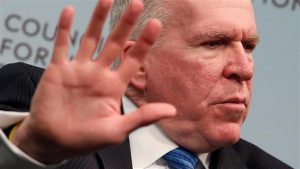 A brazen and unprecedented intervention in domestic U.S. politics by the intelligence community established the basic premise of the cascade of leaks about alleged Trump aides’ shady dealing with Russia. Led by CIA Director John Brennan, the CIA, FBI and NSA issued a 25-page assessment on Jan. 6 asserting for the first time that Russia had sought to help Trump win the election.
Brennan had circulated a CIA memo concluding that Russia had favored Trump and had told CIA staff that he had met separately with Director of National Intelligence James Clapper and FBI Director James Comey and that they had agreed on the “scope, nature and intent of Russian interference in our presidential election.”
In the end, however, Clapper refused to associate himself with the document and the NSA, which agreed to do so, was only willing to express “moderate confidence” in the judgment that the Kremlin had sought to help Trump in the election. In intelligence community parlance, that meant that the NSA considered the idea the Kremlin was working to elect Trump was merely plausible, not actually supported by reliable evidence.
In fact, the intelligence community had not even obtained evidence that Russia was behind the publication by Wikileaks of the e-mails Democratic National Committee, much less that it had done so with the intention of electing Trump. Clapper had testified before Congress in mid-November and again in December that the intelligence community did not know who had provided the e-mails to WikiLeaks and when they were provided.
The claim – by Brennan with the support of Comey – that Russia had “aspired” to help Trump’s election prospects was not a normal intelligence community assessment but an extraordinary exercise of power by Brennan, Comey and NSA Director Mike Rogers.
Brennan and his allies were not merely providing a professional assessment of the election, as was revealed by their embrace of the the dubious dossier compiled by a private intelligence firm hired by one of Trump’s Republican opponents and later by the Clinton campaign for the specific purpose of finding evidence of illicit links between Trump and the Putin regime.
Salacious Gossip
When the three intelligence agencies gave the classified version of their report to senior administration officials in January they appended a two-page summary of the juiciest bits from that dossier – including claims that Russian intelligence had compromising information about Trump’s personal behavior while visiting Russia. The dossier was sent, along with the assessment that Russia was seeking to help Trump get elected, to senior administration officials as well as selected Congressional leaders.
Among the claims in the private intelligence dossier that was summarized for policymakers was the allegation of a deal between the Trump campaign and the Putin government involving full Trump knowledge of the Russian election help and a Trump pledge – months before the election – to sideline the Ukraine issue once in office. The allegation – devoid of any verifiable information – came entirely from an unidentified “Russian emigre” claiming to be a Trump insider, without any evidence provided of the source’s actual relationship to the Trump camp or of his credibility as a source.
After the story of the two-page summary leaked to the press, Clapper publicly expressed “profound dismay” about the leak and said the intelligence community “has not made any judgment that the information in this document is reliable,” nor did it rely on it any way for our conclusions.”
One would expect that acknowledgment to be followed by an admission that he should not have circulated it outside the intelligence community at all. But instead Clapper then justified having passed on the summary as providing policymakers with “the fullest possible picture of any matters that might affect national security.”
By that time, U.S. intelligence agencies had been in possession of the material in the dossier for several months. It was their job to verify the information before bringing it to the attention of policymakers.
A former U.S. intelligence official with decades of experience dealing with the CIA as well other intelligence agencies, who insisted on anonymity because he still has dealings with U.S. government agencies, told this writer that he had never heard of the intelligence agencies making public unverified information on a U.S. citizen.
“The CIA has never played such a open political role,” he said.
The CIA has often tilted its intelligence assessment related to a potential adversary in the direction desired by the White House or the Pentagon and the Joint Chiefs of Staff, but this is the first time that such a slanted report impinges not only on domestic politics but is directed at the President himself.
The egregious triple abuse of the power in publishing a highly partisan opinion on Russia and Trump’s election, appending raw and unverified private allegations impugning Trump’s loyalty and then leaking that fact to the media begs the question of motive. Brennan, who initiated the whole effort, was clearly determined to warn Trump not to reverse the policy toward Russia to which the CIA and other national security organizations were firmly committed.
A few days after the leak of the two-page summary, Brennan publicly warned Trump about his policy toward Russia. In an interview on Fox News, he said, “I think Mr. Trump has to understand that absolving Russia of various actions that it’s taken in the past number of years is a road that he, I think, needs to be very, very careful about moving down.”
Graham Fuller, who was a CIA operations officer for 20 years and was also National Intelligence Officer for the Middle East for four years in the Reagan administration, observed in an e-mail, that Brennan, Clapper and Comey “might legitimately fear Trump as a loose cannon on the national scene,” but they are also “dismayed at any prospect that the official narrative against Russia could start falling apart under Trump, and want to maintain the image of constant and dangerous Russian intervention into affairs of state.”
Flynn in the Bull’s Eye
As Trump’s National Security Adviser, Michael Flynn presented an easy target for a campaign to portray the Trump team as being in Putin’s pocket. He had already drawn heavy criticism not only by attending a Moscow event celebrating the Russian television RT in 2016 but sitting next to Putin and accepting a fee for speaking at the event. More importantly, however, Flynn had argued that the United States and Russia could and should cooperate in their common interest of defeating Islamic State militants.
That idea was anathema to the Pentagon and the CIA. Obama’s Defense Secretary Ashton Carter had attacked Secretary of State John Kerry’s negotiating a Syrian ceasefire that included a provision for coordination of efforts against Islamic State. The official investigation of the U.S. attack on Syrian forces on Sept. 17 turned up evidence that CENTCOM had deliberately targeted the Syrian military sites with the intention of sabotaging the ceasefire agreement.
The campaign to bring down Flynn began with a leak from a “senior U.S. government official” to Washington Post columnist David Ignatius about the now-famous phone conversation between Flynn and Russian Ambassador Sergei Kislyak on Dec. 29. In his column on the leak, Ignatius avoided making any explicit claim about the conversation. Instead, he asked “What did Flynn say, and did it undercut the U.S. sanctions?”
And referring to the Logan Act, the 1799 law forbidding a private citizen from communicating with a foreign government to influence a “dispute” with the United States, Ignatius asked, “Was its spirit violated?”
The implications of the coy revelation of the Flynn conversation with Kislyak were far-reaching. Any interception of a communication by the NSA or the FBI has always been considered one of the most highly classified secrets in the U.S. intelligence universe of secrets. And officers have long been under orders to protect the name of any American involved in any such intercepted communication at all costs.
But the senior official who leaked the story of Flynn-Kislyak conversation to Ignatius – obviously for a domestic political purpose – did not feel bound by any such rule. That leak was the first move in a concerted campaign of using such leaks to suggest that Flynn had discussed the Obama administration’s sanctions with Kislyak in an effort to undermine Obama administration policy.
The revelation brought a series of articles about denials by the Trump transition team, including Vice President-elect Mike Pence, that Flynn had, in fact, discussed sanctions with Kislyak and continued suspicions that Trump’s aides were covering up the truth. But the day after Trump was inaugurated, the Post itself reported that the FBI had begun in late December go back over all communications between Flynn and Russian officials and “had not found evidence of wrongdoing or illicit ties to the Russian government….”
Two weeks later, however, the Post reversed its coverage of the issue, publishing a story citing “nine current and former officials, who were in senior positions at multiple agencies at the time of the calls,” as saying that Flynn had “discussed sanctions” with Kislyak.
The story said Flynn’s conversation with Kislyak was “interpreted by some senior U.S. officials as an inappropriate and potentially illegal signal to the Kremlin that it could expect a reprieve from sanctions that were being imposed by the Obama administration in late December to punish Russia for its alleged interference in the 2016 election.”
The Post did not refer to its own previous reporting of the FBI’s unambiguous view contradicting that claim, which suggested strongly that the FBI was trying to head off a plan by Brennan and Clapper to target Flynn. But it did include a crucial caveat on the phrase “discussed sanctions” that few readers would have noticed. It revealed that the phrase was actually an “interpretation” of the language that Flynn had used. In other words, what Flynn actually said was not necessarily a literal reference to sanctions at all.
Only a few days later, the Post reported a new development: Flynn had been interviewed by the FBI on Jan. 24 – four days after Trump’s inauguration – and had denied that he discussed sanctions in the conversation. But prosecutors were not planning to charge Flynn with lying, according to several officials, in part because they believed he would be able to “parse the definition of the word ‘sanctions’.” That implied that the exchange was actually focused not on sanctions per se but on the expulsion of the Russian diplomats.
Just hours before his resignation on Feb. 13, Flynn claimed in an interview with the Daily Caller that he had indeed referred only to the expulsion of the Russian diplomats.
“It wasn’t about sanctions. It was about the 35 guys who were thrown out,” Flynn said. “It was basically, ‘Look, I know this happened. We’ll review everything.’ I never said anything such as, ‘We’re going to review sanctions,’ or anything like that.”
The Russian Blackmail Ploy
Even as the story of the Flynn’s alleged transgression in the conversation with the Russian Ambassador was becoming a political crisis for Donald Trump, yet another leaked story surfaced that appeared to reveal a shocking new level of the Trump administration’s weakness toward Russia.
The Post reported on Feb. 13 that Acting Attorney General Sally Yates, an Obama holdover, had decided in late January – after discussions with Brennan, Clapper and FBI Director James Comey in the last days of the Obama administration – to inform the White House Counsel Donald McGahn in late January that Flynn had lied to other Trump administration officials – including Vice President Mike Pence – in denying that he discussed sanctions with Kislyak. The Post cited “current and former officials” as the sources.
That story, repeated and amplified by many other news media, led to Flynn’s downfall later that same day. But like all of the other related leaks, the story revealed more about the aims of the leakers than about links between Trump’s team and Russia.
The centerpiece of the new leak was that the former Obama administration officials named in the story had feared that “Flynn put himself in a compromising position” in regard to his account of the conversation with Kislyak to Trump members of the Trump transition.
Yates had told the White House that Flynn might be vulnerable to Russian blackmail because of the discrepancies between his conversation with the Ambassador and his story to Pence, according to the Post story.
But once again the impression created by the leak was very different from the reality behind it. The idea that Flynn had exposed himself to a potential Russian blackmail threat by failing to tell Pence exactly what had transpired in the conversation was fanciful in the extreme.
Even assuming that Flynn had flatly lied to Pence about what he had said in the meeting – which was evidently not the case – it would not have given the Russians something to hold over Flynn, first because it was already revealed publicly and second, because the Russian interest was to cooperate with the new administration.
The ex-Obama administration leakers were obviously citing that clumsy (and preposterous) argument as an excuse to intervene in the internal affairs of the new administration. The Post’s sources also claimed that “Pence had a right to know that he had been misled….” True or not, it was, of course, none of their business.
Pity for Pence
The professed concern of the Intelligence Community and Justice Department officials that Pence deserved the full story from Flynn was obviously based on political considerations, not some legal principle. Pence was a known supporter of the New Cold War with Russia, so the tender concern for Pence not being treated nicely coincided with a strategy of dividing the new administration along the lines of policy toward Russia.
All indications are that Trump and other insiders knew from the beginning exactly what Flynn had actually said in the conversation, but that Flynn had given Pence a flat denial about discussing sanctions without further details.
On Feb. 13, when Trump was still trying to save Flynn, the National Security Adviser apologized to Pence for “inadvertently” having failed to give him a complete account, including his reference to the expulsion of the Russian diplomats. But that was not enough to save Flynn’s job.
The divide-and-conquer strategy, which led to Flynn’s ouster, was made effective because the leakers had already created a political atmosphere of great suspicion about Flynn and the Trump White House as having had illicit dealings with the Russians. The normally pugnacious Trump chose not to respond to the campaign of leaks with a detailed, concerted defense. Instead, he sacrificed Flynn before the end of the very day the Flynn “blackmail” story was published.
But Trump appears to have underestimated the ambitions of the leakers. The campaign against Flynn had been calculated in part to weaken the Trump administration and ensure that the new administration would not dare to reverse the hardline policy of constant pressure on Putin’s Russia.
Many in Washington’s political elite celebrated the fall of Flynn as a turning point in the struggle to maintain the existing policy orientation toward Russia. The day after Flynn was fired the Post’s national political correspondent, James Hohmann, wrote that the Flynn “imbroglio” would now make it “politically untenable for Trump to scale back sanctions to Moscow” because the “political blowback from hawkish Republicans in Congress would be too intense….”
But the ultimate target of the campaign was Trump himself. As neoconservative journalist Eli Lake put it, “Flynn is only the appetizer. Trump is the entree.”
Susan Hennessey, a well-connected former lawyer in the National Security Agency’s Office of General Counsel who writes the Lawfare blog at the Brookings Institution, agreed. “Trump may think Flynn is the sacrificial lamb,” she told The Guardian, “but the reality is that he is the first domino. To the extent the administration believes Flynn’s resignation will make the Russia story go away, they are mistaken.”
The Phony “Constant Contacts” Story
No sooner had Flynn’s firing been announced than the next phase of the campaign of leaks over Trump and Russia began. On Feb. 14, CNN and the New York Times published slight variants of the same apparently scandalous story of numerous contacts between multiple members of the Trump camp with the Russian at the very time the Russians were allegedly acting to influence the election.
There was little subtlety in how mainstream media outlets made their point. CNN’s headline was, “Trump aides were in constant touch with senior Russian officials during campaign.” The Times headline was even more sensational: “Trump Campaign Aides Had Repeated Contacts with Russian Intelligence.”
But the attentive reader would soon discover that the stories did not reflect those headlines. In the very first paragraph of the CNN story, those “senior Russian officials” became “Russians known to U.S. intelligence,” meaning that it included a wide range Russians who are not officials at all but known or suspected intelligence operatives in business and other sectors of society monitored by U.S. intelligence. A Trump associate dealing with such individuals would have no idea, of course, that they are working for Russian intelligence.
The Times story, on the other hand, referred to the Russians with whom Trump aides were said to be in contact last year as “senior Russian intelligence officials,” apparently glossing over a crucial distinction that sources had made to CNN between intelligence officials and Russians being monitored by U.S. intelligence.
But the Times story acknowledged that the Russian contacts also included government officials who were not intelligence officials and that the contacts had been made not only by Trump campaign officials but also associates of Trump who had done business in Russia. It further acknowledged it was “not unusual” for American business to come in contact with foreign intelligence officials, sometimes unwittingly in Russia and Ukraine, where “spy services are deeply embedded in society.”
Even more important, however, the Times story made it clear that the intelligence community was seeking evidence that Trump’s aides or associates were colluding with the Russians on the alleged Russian effort to influence the election, but that it had found no evidence of any such collusion. CNN failed to report that crucial element of the story.
The headlines and lead paragraphs of both stories, therefore, should have conveyed the real story: that the intelligence community had sought evidence of collusion by Trump aides with Russia but had not found it several months after reviewing the intercepted conversations and other intelligence.
Unwitting Allies of the War Complex?
Former CIA Director Brennan and other former Obama administration intelligence officials have used their power to lead a large part of the public to believe that Trump had conducted suspicious contacts with Russian officials without having the slightest evidence to support the contention that such contacts represent a serious threat to the integrity of the U.S. political process.
Many people who oppose Trump for other valid reasons have seized on the shaky Russian accusations because they represent the best possibility for ousting Trump from power. But ignoring the motives and the dishonesty behind the campaign of leaks has far-reaching political implications. Not only does it help to establish a precedent for U.S. intelligence agencies to intervene in domestic politics, as happens in authoritarian regimes all over the world, it also strengthens the hand of the military and intelligence bureaucracies who are determined to maintain the New Cold War with Russia.
Those war bureaucracies view the conflict with Russia as key to the continuation of higher levels of military spending and the more aggressive NATO policy in Europe that has already generated a gusher of arms sales that benefits the Pentagon and its self-dealing officials.
Progressives in the anti-Trump movement are in danger of becoming an unwitting ally of those military and intelligence bureaucracies despite the fundamental conflict between their economic and political interests and the desires of people who care about peace, social justice and the environment.
Palestinians face intense online hate from Israelis, say campaigners
Palestinian lawyers call for investigation of police minister as survey shows soaring levels of anti-Arab speech on Hebrew social media

By Jonathan Cook • Middle Eastern Eye • February 25, 2017
Israel’s 1.7 million Palestinian citizens are facing a tidal wave of incitement and hate speech on social media, including from government ministers, community leaders have warned.
They say the increasingly hostile political climate in Israel is stoking violence from the police and street gangs, and has laid the ground for a recent raft of racist legislative proposals.
The alert comes as a group of Palestinian lawyers demand that Israel’s attorney general investigates Gilad Erdan, the internal security minister, for incitement to racism.
Adalah, a legal group for Israel’s Palestinian minority, highlighted statements from Erdan blaming Palestinian citizens for “arson terrorism” last November after forest fires swept the country, despite their having been no prosecutions.
“Israel has experienced arson terrorism and I won’t let anyone sweep this fact under the rug,” he wrote on Facebook in December. “Why does it seem unrealistic that Arabs would attempt to harm Jews?”
Adalah argued Erdan’s comments were part of a wider government strategy to portray Palestinian citizens, about 20 per cent of Israel’s population, as a “fifth column”.
Although other government ministers had incited, the group said, Erdan’s statements were especially harmful because of his role overseeing the police. Adalah said he was bolstering a police culture that already treated Palestinian citizens as an “enemy within”.
“Incitement from Erdan is dangerous because it reinforces and sanctions existing prejudices in the police,” Nadim Shehadeh, a lawyer with Adalah, told Middle East Eye. “As a result, the police are likely to have an even lighter finger on the trigger.”
Concern about the effects of incitement from leading politicians has been underscored by a survey published this month that found rocketing levels of online abuse from Israeli Jews against Palestinians.
 7amleh, an organisation promoting social media rights for Palestinians, identified 675,000 posts in Hebrew last year expressing racism or hatred towards Palestinians – one every 46 seconds, and more than double the previous year’s figure.
“There are terrifying levels of hate speech online from Israeli Jews,” Nadim Nashef, 7amleh’s director, told MEE. “No one in Israel – politicians, the police, the courts and the social media companies – has shown any interest in doing something about it.
“But it’s worse than that. The politicians are fuelling the problem. It has become completely normal in Israel to incite against Palestinians. You find it everywhere. It is entirely mainstream.”
The research identified more than 50,000 Hebrew speakers as persistent offenders on social media, especially Facebook, said Nashef. Spikes in online abuse correlated with incitement from Israeli politicians and the media, he added.
Popular terms of abuse included threats to kill, rape, burn, expel, and assault Palestinians.
Both Adalah and 7amleh said incitement from Israeli Jews was rarely investigated or prosecuted. Palestinians in Israel and the occupied territories, on the other hand, had their accounts closed or were arrested and jailed over less serious online activity.
7amleh said its research showed that the brunt of online abuse was directed at leading Palestinian politicians in Israel.
The most common targets were Haneen Zoabi, one of only two Palestinian women in the parliament, and Ahmed Tibi, a former adviser to the late Palestinian leader Yasser Arafat, 7amleh said. Both Zoabi and Tibi have reported regular death threats.
According to the survey, they received more online abuse than the leader of the Palestinian Authority in the West Bank, Mahmoud Abbas.
“When we are targeted rather than the Palestinian leadership in the occupied territories, a clear message is sent to the [Jewish] public that we have no place in the parliament and those we represent have no right to be citizens,” Zoabi told MEE.
 The climate of incitement had very concrete effects, said Zoabi: “It gives a green light to police violence. It is converted into shootings and deaths.”
She said dozens of Palestinian citizens had died in unexplained circumstances at the hands of the police in the last 15 years.
Zoabi also pointed to the increasing reports of gangs chanting “Death to the Arabs!” in Israeli cities and Jerusalem, as well as a growing incidence of street assaults.
Polls have shown high levels of racial prejudice among Israeli Jews. A survey last year found 49 per cent would not live in the same building as a Palestinian citizen.
Another showed a similar number of 16 and 17-year-olds would deny Palestinian citizens the right to vote.
Adalah said constant incitement from government politicians had made possible the drafting of ever-more discriminatory and anti-democratic legislation.
Shehadeh noted that recent laws allowed the parliament to expel the minority’s legislators over their views, and hampered the work of human rights groups assisting Palestinians.
Zoabi agreed. “Every week we see bills being introduced, such as a ban on the mosque call to prayer, or moves to step up home demolitions in Palestinian communities. The political culture sanctions ever more violence through legislation.”
Nashef said a turning point in the levels of incitement could be traced to comments by Israel’s prime minister, Benjamin Netanyahu, at the last general election, in early 2015. Netanyahu posted a video on Facebook telling the Jewish public it was vital they voted because “Arab voters are coming out in droves to the polls”.
“When the prime minister talks like this, then everyone else understands that it is okay to do it too,” Nashef said.
7amleh’s survey showed a significant peak of online incitement and hate speech last November, as hundreds of fires broke out across Israel and the occupied territories, triggered by a prolonged drought and high winds.
Despite the exceptional weather conditions, Erdan led government ministers in accusing Palestinians, especially those in Israel, of being behind the fires.
Adalah cited Erdan’s Facebook post from early December. Dozens of Palestinian citizens were arrested by police, but none have been charged with “nationalist crimes” over the fires.
Nevertheless, Netanyahu has continued to make similar accusations, stating last month: “That fact that we can’t prove it [that the fires were terrorism] doesn’t mean it’s not what happened.”
 Nashef said: “These inciteful statements garner a lot of media attention and our research shows they have a powerful impact in shaping public attitudes. But few notice when they turn out to be based on lies or misinformation.”
Adalah also cited comments by Erdan justifying the fatal shooting of Yacoub Abu al-Qiyan by police last month during a demolition operation in Umm al-Hiran, a Bedouin community in Israel’s south.
A police video and post-mortem examination report indicated that Abu al-Qiyan lost control of his car after he was shot, and careered into a group of policemen, killing one of them.
According to Israeli media, a justice ministry report – due to published next month – has found no evidence that Abu al-Qiyan carried out an attack or belonged to an extremist organisation.
Nonetheless, said Shehadeh, Erdan and other government ministers repeatedly accused Abu al-Qiyan, without evidence, of being an Islamic State terrorist.
Erdan tweeted hours after the two deaths: “The terrorist sharply turned his wheel and quickly accelerated in order to run over a group of police officers.”
Netanyahu’s office similarly described the incident as a “car-ramming attack”. Implying that Abu al-Qiyan was part of global trend of Islamic terrorism, Netanyahu said Israel and the world were “fighting this murderous phenomenon”.
Adalah’s letter to the attorney general also pointed out that Erdan had repeatedly blamed the deaths in Umm al-Hiran on Palestinian legislators there to protest against the demolitions. Erdan singled out Ayman Odeh, the leader of the Joint List, the Palestinian coalition in the parliament.
In comments to the media, he said: “Ayman Odeh and the rest of the MKs from the Arab [sic] List who have come to enflame sentiments this morning: This blood is also on your hands. … You are a disgrace to the State of Israel.”
In Umm al-Hiran, Odeh was himself injured twice, including to the head, by sponge-tipped bullets fired at him by police.
Problem with Facebook
Nashef criticised Facebook, where most of the online hate speech was found, for contributing to the problem.
Last summer Facebook agreed to crack down on what Israel defines as incitement by Palestinians. Paradoxically, Erdan was the minister who met the tech companies.
According to reports, in the first half of 2016, a tenth of all content restrictions imposed by Facebook globally were at the Israeli government’s behest.
But Nashef said nothing was being done to deal with incitement and hate speech from the Jewish public.
“It is not reasonable that large numbers of Palestinians have their accounts shut down or are arrested and jailed for online hate speech, while Israeli Jews can engage in the same or worse activity and there are no consequences,” he said.
Neither the justice or police ministries were available for comment.
7amleh said the biggest peak in online abuse followed the arrest last March of army medic Elor Azaria. He was filmed executing a badly wounded Palestinian, Abdel Fattah al-Sharif. This week he was sentenced to 18 months’ jail for manslaughter.
Several government ministers, including Netanyahu, expressed strong support for Azaria.
The survey showed another outburst of online abuse followed attacks last September by the culture minister, Miri Regev, against two Palestinian cultural icons.
She described the late national poet Mahmoud Darwish as the “leader of the Palestinian industry of lies”, and accused a popular rapper, Tamer Nafar, of giving “legitimacy to terrorism”.
Castigated by the Southern Poverty Law Center

By Deir Yassin Remembered | Dissident Voice | February 24, 2017
The “public” that allegedly “protested” against this billboard in Ann Arbor, as reported by the Rochester Democrat and Chronicle, were not the only folks watching DYR.
The SPLC has now included DYR on its Hate Map.
Dan McGowan responds:
The Southern Poverty Law Center (SPLC) recently criticized Deir Yassin Remembered (DYR) by including it on the so-called Hate Map, purportedly for the high crime of Holocaust denial.
Apparently if the SPLC disagrees with you, it will label you as a racist or a hatemonger. There is no discussion, no defense, and no chance of winning a defamation suit against it.
The SPLC is the cash cow of the civil rights movement. Last year it took in over $58 million, some of which was added to its bloated endowment of over $328 million held in questionable investments, some in off shore accounts.
Its two chief executives together received over $800,000. Of its nine top executives, none come from minorities.
The SPLC claims to reject hate, embrace diversity, and respect differences. But often the SPLC and the people who believe their fear mongering behave exactly the opposite. The SPLC campaigns to deny free speech and freedom of association to groups of Americans with whom they disagree, often doing so to pander to other groups for more contributions all in the name of promoting “tolerance.” For example, if the British historian David Irving plans a lecture in Syracuse, the SPLC will protest any venue he might select, leaflet cars at his hotel saying, “There is a Nazi staying here,” and photograph and shout at anyone who might try to attend.
SPLC slime is not reserved solely for skinheads and members of the KKK. Dr. Ben Carson got a dose for opposing same sex marriage. SPLC later apologized but the charge never completely goes away, leading Carson to say that fear of being on the SPLC’s list serves to shut people up.
The SPLC makes money out of fear mongering and promoting the idea that Americans are inundated with hateful people, particularly on the radical right. The favorite target is the KKK and white supremacists.
The Baltimore Sun characterizes SPLC operations this way: “Its business is fundraising, and its success at raking in the cash is based on its ability to sell gullible people on the idea that present-day America is awash in white racism and anti-Semitism, which it will fight tooth-and-nail as the public interest law firm it purports to be.”1
It is understandable that the SPLC will run out of rocks under which to look for old KKK members and skinheads, but why criticize Deir Yassin Remembered, a small not-for-profit organization of Jews and non-Jews working to build a memorial for Palestinians murdered in 1948 on the west side of Jerusalem? DYR is certainly not the radical right. DYR practices and preaches tolerance; it has agreed to the advice of none other than the Latin Patriarch of Jerusalem that its memorial show the Christian tenet of forgiveness. Its advisory board boasts diversity; it is composed of half men, half women, half Jews, half non-Jews. It has worked continuously since 1994 for Palestinian human rights, including equal rights of citizenship, with no compensation for any executive and with less than $5,000 of reserves.
The answer lies in the writings of some of the DYR members who have questioned the use of the Holocaust as both the sword and shield of Israel. The Holocaust has been used to justify the need for a Jewish state and its expropriation of Palestinian land; the Holocaust is used to monopolize victimhood and defend Israel from criticism of its brutal and unending occupation.
But it is more than that. The Holocaust has morphed from a historical event to a religion, which must not be contradicted for fear of being branded an apostate or a hater or a denier or an anti-Semite. Religious faith is self-validating, impervious to reason, and regards proposals to scientifically validate its claims as profane in all senses of the word.
So, anyone who is skeptical about the number “six million,” about mass extermination in gas chambers, or about Nazi orders for extermination is to be named and shamed and hated. For this topic, there can be no diversity of opinion and no respect for inquiry or debate.
Don’t tell us that the United States government claimed Hitler murdered over 20 million people until the late 1970s when that number was officially revised downwards and carved in stone at 11 million. Don’t tell us that Jewish historians today claim the 5 million number of non-Jewish victims is overstated. Don’t remind us that the lampshade and the soap-from-human-fat stories were simple gruel propaganda and have no historical significance. Don’t remind us that Elie Wiesel took his violin to Auschwitz and that none of his family was gassed. Don’t remind us that Elie chose to retreat with the Nazis rather than be liberated from Auschwitz as was the father of Anne Frank.
Fear mongering and sliming little organizations like DYR is fake news. It is ridiculous disinformation to keep SPLC campaign money coming in. It foments hate and bigotry and intolerance by the very hypocrites who claim the opposite.
- “The truth about ʻhate crimesʼ and the racial justice racket” by Ron Smith, Baltimore Sun, December 3, 2008.
Deir Yassin Remembered seeks progress on behalf of the over 100 Palestinian men, women, and children who were victims of the Deir Yassin Massacre. Read other articles by Deir Yassin Remembered, or visit Deir Yassin Remembered’s website.
Double Standards over ‘Russian Interference’ in Western Elections
By Finian CUNNINGHAM | Strategic Culture Foundation | 23.02.2017
Just as polls show Marine Le Pen of the Front National taking a decisive lead over her two main rivals, Francois Fillon of the Republicans, and Emmanuel Macron of the newly formed En Marche, the latter gets a high-profile reception in Downing Street with British prime minister Theresa May.
Fillon has no plans to make a similar visit to Britain, while Downing Street officially announced that it would not be receiving Le Pen, reported the Independent.
With only weeks to go to the first round of the French presidential elections in April, the British government’s hosting of Macron this week can be seen as an extraordinary endorsement of his candidacy.
One could express it even more strongly and say that Britain is evidently interfering in the French democratic process by elevating one candidate over another.
A spokesman for premier May said that Macron had requested the meeting at Downing Street and «we were able to accommodate».
A smiling Macron photographed on the doorsteps of Number 10 clearly showed him relishing the singular honor bestowed by the British prime minister.
One can imagine the media hullabaloo if Marine Le Pen were greeted in Moscow by Russian President Vladimir Putin, and the Kremlin to then pointedly announce that her rival Macron would not be receiving a similar invitation. There would be howls of «Russian interference» in the French election.
Indeed, Russia is being accused of doing just that already on the basis of scant allegations. Emmanuel Macron has recently claimed that his campaign is being targeted by Russian hackers and «fake news». Macron’s campaign team is alleging – without providing any evidence – that its computers are being attacked by «Russian hackers».
The liberal pro-EU candidate is also claiming that «Kremlin-run news media» are mounting a fake news «influence campaign» to damage his credibility.
This follows the publication of a news article by the Sputnik outlet earlier this month which quoted French political rivals accusing Macron of being supported by global banking interests and a wealthy gay rights lobby.
Russian government-owned Sputnik has denied that it is trying to damage Macron’s candidacy, and that it was merely giving coverage to criticisms aired by French political rivals.
Based on such flimsy, partisan claims of political interference, the French Foreign Minister Jean-Marc Ayrault earlier this week issued a warning to Russia to «stop meddling in the French presidential election».
Thus, a one-sided overblown claim by one of the presidential candidates is raised to a state level as if it is an established fact of Russian subversion of French sovereignty.
This narrative of Russian interference in foreign elections has evidently become contagious. Ever since American intelligence agencies, amplified by US media, began accusing Russia of hacking into the presidential elections to favor Donald Trump, the narrative has become a staple in other Western states.
Last week, German news outlet Deutsche Welle published this headline: «Is Moscow meddling in everything?» The article goes on to ask with insinuating tone: «Does Putin decide who wins elections in the West? Many believe that he cost Clinton the US presidency; now Macron is next France, and then Merkel will be in the line of fire».
The Russian government is legitimately entitled, as are other governments, to hold views on the outcome of foreign elections. After all, many European governments, including those of Germany and France, were adamantly opposed to Trump winning the US election, instead preferring his Democratic rival Hillary Clinton. But they weren’t subjected to criticism that they were interfering in the American election.
Regarding France, Russian state interests might be best served by Marine Le Pen taking the presidency. She has expressed a desire to restore friendlier relations with Moscow and to jettison the NATO agenda of hostility towards Russia. Her anti-EU views would also help to undermine the Washington-led atlanticist axis which has driven enmity between Europe and Russia.
The Kremlin has been careful to not make any public statements on the outcome of the French election, nor of any other foreign election, maintaining that it does not interfere. Nevertheless, Moscow is entitled to have its own private assessment on what would serve its own national interests. There’s nothing untoward about that. It seems almost bizarre to have to explain that.
But such is the fever-pitch and hysteria about alleged Russian malfeasance that the slightest sign, such as a random news article airing critical comments as in the Macron example, is taken as «proof» of Kremlin interference.
This is in spite of the fact that no evidence is presented. German state intelligence, for instance, recently concluded that there was no evidence to support allegations that Russia was running a Trump-like influence campaign against Chancellor Merkel ahead of her country’s elections being held in September.
Perhaps the most egregious expression to date of the Russian interference narrative were claims made this week by Britain’s Telegraph newspaper that the Kremlin had sponsored a coup attempt against the government of Montenegro last October.
Russian foreign minister Sergey Lavrov lambasted the evidence-free claims as «absurd». Lavrov said it «is just another one in a series of groundless assertions blaming our country for carrying out cyberattacks against the entire West, interfering in election campaigns in the bulk of Western countries as well as allegations pointing to the Trump administration’s ties with Russian secret services, among other things».
The height of absurdity is Britain this week hosting Emmanuel Macron at the Downing Street residence of Prime Minister Theresa May.
May’s intervention is a full-on endorsement of this one candidate at a crucial time in the French election which sees his main rival Marine Le Pen taking a decisive lead in the polls.
But where are the headlines denouncing «British interference» in French democracy?
Western media are too preoccupied digging up far-fetched stories claiming Russian interference based on the flimsiest speculation.
That double standard is clear evidence of the irrational Russophobia that is gripping Western governments and news media. Russophobia that has become a psychosis.
NYT’s Fake News about Fake News
By Robert Parry | Consortium News | February 22, 2017
A grave danger from the Western mainstream media’s current hysteria about “fake news” is that the definition gets broadened from the few made-up stories that are demonstrably false – often fabricated by kids to get more clicks – to include reasonable disputes about the facts of a complex controversy.
This danger has grown worse because The New York Times, The Washington Post and other major Western news organizations have merged their outrage over “fake news” with the West’s propaganda campaign against Russia by claiming without evidence that the Russian government is somehow putting out false stories to undermine Western democracy.
However, when news organizations actually track down “fake news” outlets, they are usually run by some young entrepreneurs from outside Russia who saw made-up stories as a way to increase revenue by luring in more readers eager for “information” that supports their prejudices.
Yet, a front-page Times article on Tuesday, citing “fake news” as a threat to Europe, contains what arguably is “fake news” itself by claiming that many of the purported 2,500 stories “discredited” by the European Union’s East Stratcom operation have “links to Russia” although the Times doesn’t identify those links.
The article by Mark Scott and Melissa Eddy then goes on to blur these two separate concepts: “In a year when the French, Germans and Dutch will elect leaders, the European authorities are scrambling to counter a rising tide of fake news and anti-European Union propaganda aimed at destabilizing people’s trust in institutions.”
But it is this mushing together of “fake news” and what the Times describes as “anti-European Union propaganda” that is so insidious. The first relates to consciously fabricated stories; the second involves criticism of a political institution, the E.U., which is viewed by many Europeans as elitist, remote and disdainful of the needs, interests and attitudes of average citizens.
Whether you call such criticism “propaganda” or “dissent,” it is absurd to blame it all on Russia. When it comes to “destabilizing people’s trust in institutions,” the E.U. — especially with its inept handling of the Great Recession and its clumsy response to the Syrian refugee crisis — is doing a bang-up job on its own without Russian help.
Yet, rather than face up to legitimate concerns of citizens, the E.U. and U.S. governments have found a convenient scapegoat, Russia. To hammer home this point — to make it the new “groupthink” — E.U. and U.S. leaders have financed propaganda specialists to disparage political criticism by linking it to Russia.
Even worse, in the United States, the Times and other mainstream publications – reflecting the views of the political establishment – have editorialized to get giant technology companies, like Facebook and Google, to marginalize independent news sites that don’t accept the prevailing conventional wisdom.
There is an Orwellian quality to these schemes — a plan for a kind of Ministry of Truth enforced by algorithms to weed out deviant ideas — but almost no one whose voice is allowed in the mass media gets to make that observation. Even now, there is a chilling uniformity in the endless denunciations of Russia as the root of all evil.
Though the Times’ article treats the E.U.’s East Stratcom operatives as 11 beleaguered public servants sticking their fingers in the dike to protect the citizenry from a flood of Russian disinformation, “stratcom” actually is a euphemism for psychological operations, i.e., the strategic use of communications to influence the thinking of a target population.
In this case, the target populations are the European public and – to an ancillary degree – the American people who get to absorb the same propaganda from The New York Times. The real goal of stratcom is not to combat a few sleazy entrepreneurs generating consciously false stories for profit but to silence or “discredit” sources of information that question the E.U. and U.S. propaganda.
More Stratcom
NATO has its own Stratcom command based in Latvia that also is assigned to swat down information that doesn’t conform to Western propaganda narratives. The U.S. Agency for International Development and the U.S.-funded National Endowment for Democracy also pour tens of millions of dollars into media operations with similar goals as do major Western foundations, such as currency speculator George Soros’s Open Society. Last December, the U.S. Congress approved and President Obama signed legislation to create an additional $160 million bureaucracy to combat “Russian propaganda.”
In other words, the West’s stratcom and “psychological operations” are swimming in dough despite the Times’ representation that these “anti-disinformation” projects are unfairly outgunned by sinister forces daring to challenge what everyone-in-the-know knows to be true.
If these “stratcom” operations were around in 2002-2003, they would have been accusing the few people questioning the Iraq-has-WMD certainty of putting out “fake news” to benefit Saddam Hussein. Now, journalists and citizens who don’t buy the full-Monte demonization of Russia and its President Vladimir Putin are put into a similar category.
Instead of trusting in the free exchange of ideas, the new attitude at the Times, the Post and other Western news outlets is to short-circuit the process by smearing anyone who questions the official narratives as a “Putin apologist” or a “Moscow stooge.”
Beyond being anti-democratic, this anti-intellectual approach has prevented serious examination of the facts behind the West’s war or words against Russia. To shut down that debate, all you need to do is to say that any fact cited at a Russian news outlet must be false or “fake news.” Any Westerner who notes the same fact must be a “Putin puppet.”
Western “stratcom” doesn’t even want to allow Russian media to criticize politicians who are criticizing Russia. The Times article lamented that “Many false claims target politicians who present the biggest obstacles to Moscow’s goal of undermining the European Union.” The Times, however, doesn’t offer any examples of such “false claims.”
Instead, the Times writes that Russian news channels had “targeted the [French] presidential candidate Emmanuel Macron, who belongs to the party and is running on a pro-European Union platform.”
But what does that mean? Is it now an act of aggression when newscasts in one country criticize a leader of another country? If so, are the European news channels that have “targeted” U.S. President Donald Trump somehow deserving of U.S. government retaliation? Doesn’t the E.U. – and by extension The New York Times – accept the idea of political disagreement and debate?
This closed-mindedness is especially dangerous – indeed existentially risky – when applied to a confrontation between nuclear-armed powers. In such a case, the maximum amount of debate should be encouraged, instead of what amounts to blacklisting dissidents in the West who won’t toe the official propaganda lines.
Media Censors
Disturbingly, the leading forces in this suppression of skepticism are the most prestigious newspapers in the United States and Europe. Even after the disastrous experience with the Iraq War and the bogus WMD groupthink, Western news outlets that were party to that fiasco have virtually excluded well-reported articles and documentaries that question the U.S. and E.U. narratives of the New Cold War.
For instance, there has been almost no presentation in the mainstream Western media of an alternative – and I would argue more complete and accurate – narrative of the Ukraine conflict, taking into account the country’s complex history and deep ethnic divisions.
It is essentially forbidden to refer to the violent overthrow of elected President Viktor Yanukovych three years ago as a “coup” or a “putsch” or to cite evidence of a U.S.-backed “regime change,” such as an intercepted phone call between U.S. Assistant Secretary of State Victoria Nuland and U.S. Ambassador to Ukraine Geoffrey Pyatt in which they discussed how to “glue” and how to “midwife” the installation of a new leadership in Kiev.
In the supposedly “free” West, you can only refer to the post-coup events in Crimea, in which the people of the largely ethnic Russia area voted overwhelmingly to secede from Ukraine and rejoin Russia, as a “Russian invasion.” No skepticism is allowed even though there were no images of Russian troops wading ashore on Crimea’s beaches or Russian tanks crashing across borders. The “invasion” supposedly happened even though no invasion was necessary because Russian troops were already in Crimea under the naval basing agreement at Sevastopol.
Amid the West’s current hysteria about “Russian propaganda,” U.S. and E.U. citizens are not even given the opportunity to watch well-reported documentaries about key moments in the New Cold War, including an eye-opening investigative report debunking the Western propaganda myth constructed around the death of Russian accountant Sergei Magnitsky or a well-produced historical account of the Ukraine crisis.
Western news outlets and governments even take pride in blocking such dissenting views and contrary information from reaching the American and European publics. Like East Stratcom — the E.U.’s Brussels-based 11-member team of diplomats, bureaucrats and former journalists — establishment institutions see themselves bravely battling “Russian disinformation.” They see it as their duty not to let their people hear this other side of the story.
If that is what the West’s institutions have come to — dismissing reasonable criticism and thoughtful dissent as “Russian disinformation” — is it any wonder that they are losing the confidence of their people?
Investigative reporter Robert Parry broke many of the Iran-Contra stories for The Associated Press and Newsweek in the 1980s.
Featured Video
Seyed M. Marandi: Negotiations Collapsed – Return to War
or go to
Aletho News Archives – Video-Images
From the Archives
Wartime internment camps in Australia
National Archives of Australia
World War I
During World War I, for security reasons the Australian Government pursued a comprehensive internment policy against enemy aliens living in Australia.
Initially only those born in countries at war with Australia were classed as enemy aliens, but later this was expanded to include people of enemy nations who were naturalised British subjects, Australian-born descendants of migrants born in enemy nations and others who were thought to pose a threat to Australia’s security.
Australia interned almost 7,000 people during World War I, of whom about 4,500 were enemy aliens and British nationals of German ancestry already resident in Australia.
Records of World War I internment camps
World War II
During World War II, Australian authorities established internment camps for three reasons – to prevent residents from assisting Australia’s enemies, to appease public opinion and to house overseas internees sent to Australia for the duration of the war.
Unlike World War I, the initial aim of internment during the later conflict was to identify and intern those who posed a particular threat to the safety or defence of the country. As the war progressed, however, this policy changed and Japanese residents were interned en masse. In the later years of the war, Germans and Italians were also interned on the basis of nationality, particularly those living in the north of Australia. In all, just over 20 per cent of all Italians resident in Australia were interned. … continue
Blog Roll
 Aletho News
- Seyed M. Marandi: Negotiations Collapsed – Return to War
- Tomorrow’s naval blockade showdown
- ‘Israel’ attacks civilians to hide its embarrassing military failures & out of pure sadism
- Any Foreign Military Vessel Approaching Hormuz Under Any Pretext ‘Will Be Dealt With Severely’: IRGC
- Diplomats slam US negotiators’ performance in Iran talks
- Trump Refuses Exit Ramp, War with Iran will Continue
- Trump Says US Naval Blockade in Strait of Hormuz Will Begin Shortly
- US, Iran end 21-hour talks without agreement
- US IRAN TALKS: Who Are the Crazy Ones Here? /Lt Col Daniel Davis
- Talks with the US end without a deal over excessive US demands: Iran
- If Americans Knew
- US-Iran ceasefire negotiations make zero progress – Daily Update
- Pro-Israel ‘Thinktanks’ and Individuals who Influence U.S. Foreign Policy
- Mearsheimer reveals how Israel dictates US policies on Iran, Gaza – video
- After killing 350+, Israel still has a “score to settle” with Lebanon before ceasefire – Daily Update
- Military aid to Israel emerges as the latest political litmus test for Democrats
- The only Palestinian children’s rights organization closes following years-long Israeli campaign against it
- ‘I Can’t Forget the Smell’: Lebanese Reel After Israel Kills Over 300 in Single Day
- DNC Shoots Down Resolutions Calling Out AIPAC and Limiting Arms to Israel
- TCN: Is Israel Blackmailing President Trump?
- Israel killed at least 303 Lebanese yesterday – who were they? Daily Update
- No Tricks Zone
- Cave Discovery Reveals Today’s Desert Climates Were Recently Far Warmer, Wetter, Teeming With Life
- German Expert: Heat Dome Led To Record Temps In Western USA…Warmer In 1934, 1936
- New Study: No Linear Warming Or Glacier Retreat Along Northern Antarctic Peninsula Since 1980s
- An Inconvenient Tree: Uncovered In Alps… Europe Much Warmer Than Today 6000 Years Ago
- New Study Reports A 60% Slowdown In Greenland’s Ice Loss Rate In The Last Decade
- Low Intensity Tornado Wrecks Major Solar Farm, Creating A Potential Toxic Dump
- New Study Finds Warming Saves Lives…Cold Temperatures 12 Times More Deadly Than Excess Heat
- German Science Blog Accuses PIK Climate Institute Of Hallucinating Climate Tipping Points
- Devastating Assessment Of Comirnaty Vaccine By Former Senior Pfizer Europe Toxicologist
- New Study: CO2 Is ‘Effectively Negligible’ As An Explanatory Climate Change Factor Since 2000
 Aletho News