BBC’s Laura Kuenssberg ‘misreported’ Corbyn story… but no evidence of bias, says Trust
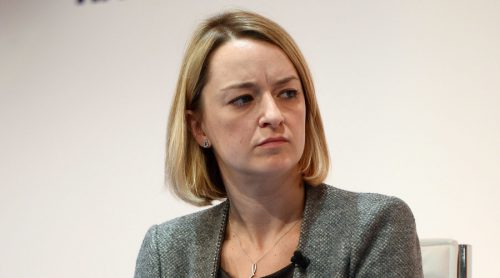
Laura Kuenssberg © ZUMAPRESS.com / Global Look Press
RT | January 18, 2017
Award winning BBC political editor Laura Kuenssberg has been reprimanded by the BBC Trust for inaccurately reporting Labour leader Jeremy Corbyn’s views on shoot-to-kill policies in the aftermath of the Paris attacks.
The Trust concluded that Kuenssberg breached the BBC’s impartiality and accuracy guidelines at a time of “extreme national concern,” but insisted there was no evidence of bias or of intent on the part of the journalist.
The report was broadcast for the News at Six in November 2015, shortly after terrorists attacked the Bataclan and other sites in Paris.
The news package included a clip of Corbyn saying: “I am not happy with a shoot-to-kill policy in general. I think that is quite dangerous and I think can often be counterproductive. I think you have to have security that prevents people firing off weapons where you can.”
Kuenssberg had presented Corbyn’s response as an answer to a question on whether he would be “happy for British officers to pull the trigger in the event of a Paris-style attack.”
However the BBC Trust concluded Corbyn had been responding to a question asking whether he would be happy to order police or military “to shoot to kill” on Britain’s streets – and not specifically in response to a Paris-style attack.
A viewer complained to the Trust about the broadcast after four separate complaints were rejected by the BBC.
The Trust found the inaccuracy was “compounded” when Kuenssberg went on to state that Corbyn’s message “couldn’t be more different” to that of then-prime minister David Cameron.
In its report, the Trust concluded the inaccuracy was particularly important when dealing “with a critical question at a time of extreme national concern.”
“According to this high standard, the report had not been duly accurate in how it framed the extract it used from Mr Corbyn’s interview.”
BBC News director, James Harding, rejected the Trust’s ruling and defended Kuenssberg as “an outstanding journalist and political editor with the utmost integrity and professionalism.”
He said: “While we respect the Trust and the people who work there, we disagree with this finding.”
Thousands of Corbyn supporters launched a campaign last May against Kuenssberg’s perceived bias against the Labour leader.
Some 35,000 people signed a petition calling for the journalist to be sacked.
The reporter was named Broadcaster of the Year by the Political Studies Association last November and Journalist of the Year by Press Gazette last December.
‘Trump: Kremlin Candidate?’: BBC doc becomes MSM manual to ‘verified’ journalism
RT | January 17, 2017
The BBC’s flagship current affairs programme has aired an edition on the alleged financial ties between U.S. President-elect Donald Trump and Vladimir Putin. It also reports on whether Russia played a key role in Trump’s election success. Making its assumptions very clear, the BBC called the programme ‘The ‘Kremlin Candidate’. RT’s Ilya Petrenko explains how pulling-in the viewers often means rolling with the rumours.
Is Politically Correct or Jingoistic Reporting Fake News?
Americans need to learn what is really going on both at home and abroad
By Philip Giraldi • Unz Review • January 17, 2017
When the Washington Post reports about violent crime online or in its print Metro Section it generally does not include descriptions of the alleged perpetrator even when that individual is still on the loose and continuing to pose a threat to the general public. This omission is conspicuous, particularly when the story itself makes it very clear that the presumed victim got a very good look at his or her assailant and would be able to provide a detailed physical description together with an account of what the attacker was wearing. One might even suggest that the Post is doing the general public no favor when it censors its account, making anyone who might cross the path of the miscreant more vulnerable to also becoming a victim.
The Post edits its coverage because it clearly does not want to associate violent crime with any particular race even though, as every Washingtonian knows full well, nearly all violent crime in the city is carried out by young black males. Rather than providing a public service by identifying the perpetrator the Post chooses to say nothing to avoid having to identify the assailant as black. But the reader, aware of that reticence, consequently automatically assumes that the perpetrator is black anyway, making the paper’s attempt to avoid any identification of criminals by race instead create the presumption in the reader’s mind that every single one of the violent acts that occur in the District of Columbia is done by people of color. What is intended to shield blacks hardly does them any favors, quite the contrary.
Partially reporting straightforward stories for politically correct reasons is in my mind equivalent to the fake news that everyone has been lamenting. The general perception that the news is slanted or manipulated has fed the lack of trust in the veracity of what is being reported and is a major contributor to the decline in newspaper readership. The Post, which also recently featured largely phony major stories about alternative news sites being tools of Russia as well as a wildly inflated tale about Russian hacking a utility in Vermont, is particularly much given to making up its coverage as it goes along. Every page in the news section is in reality an editorial as the paper assiduously mixes fact with fiction together with a heavy dose of opinion. It is Orwellian newspeak at its finest.
Inured to the Post’s p.c. coverage of racial issues, I was nevertheless shocked by some of the recent reporting on an incident in Chicago in which four teenagers videoed themselves and broadcast what they were doing live on Facebook as they beat a mentally impaired man. An early media account of the incident appeared on Reuters but is no longer available. It was written by Timothy McLaughlin and had, as its second paragraph, “At least one of the attackers on the video mentioned president elect Donald Trump as he taunted the man but police stopped short of calling the beating politically motivated and said they are still investigating.”
From that, I assumed that the journalist was implying that the attackers were Trump supporters since there has been so much reporting lately of incidents at schools where white bullies allegedly cite Trump as they torment their black or brown classmates. Many of those stories would themselves appear to be extremely improbable fake news since the schools in question frequently appear to have highly vulnerable white minorities in the student bodies, but white-on-black violence is not intrinsically unthinkable so the story appeared to be at least credible.
But reading on, the article seemingly reluctantly produced some additional information. The victim, who was tied, gagged and beaten, “appeared to be white” while one of the assailants “appeared to be African-American” and was heard making comments about “white people.” The story did not link to the Facebook video, but BBC, among other sites, showed the video and was unambiguous in its labelling the four assailants as black and the victim as white, which anyone viewing the recording would have clearly appreciated. Subsequent news stories made clear that the expressions that were being shouted by the attackers included “F**k Trump” and “F**k white people.” The victim was reportedly beaten for six hours, cursed at, cut and otherwise abused. The live broadcast of the beating went viral before Facebook deleted it.
The media and Chicago police both struggled with whether or not the abduction and beating constituted a hate crime. In fact, they seemed eager to mitigate and even explain the impact of what everyone who watched the video could clearly see. One cop explained “Kids make stupid mistakes, I shouldn’t call them kids, they are legally adults, but they are young adults and the make stupid decisions… That certainly will be part of whether or not we seek a hate crime, determine whether or not this is sincere or stupid ranting and raving.” Another cop said “I think part of it is just stupidity. People ranting about something they think might make a headline.”
The New York Times dodged the bullet on what kind of crime it might be by describing it as an attack on disabled people without any racial or political overtones at all. So it was maybe just kids having fun and since it was black on white Wolf Blitzer won’t be flying in tomorrow morning to pontificate on what is wrong with Donald Trump’s America.
From my point of view, quite frankly who cares if the incident is or was motivated by hate as kidnapping and torture should be enough and the designation hate crime is essentially phony anyway. If an assailant hates his victim does that make the brutality worse? If you kill me because you are bored and are looking for something to do should you spend less time in prison than if you do so because you hate me?
Once the story was essentially agreed upon by the media and police, comments posted on the beating universally expressed outrage over what had occurred. Many of those posting their observations were themselves black, some expressing their desire that the perpetrators be imprisoned “forever” for having carried out such a horrific crime.
Reading my way through the comments, it occurred to me that the media and police department’s apparent reticence to report black on white crime with the same horror that it reports white on black serves no one, as it creates the impression that black criminals are somehow being protected or coddled even when it is clear that that is not the case. Decent, law abiding African-Americans, the vast majority, know that the end result of the politically correct news coverage of black crime is to make many white Americans even more suspicious of black behavior. So is it both fake news and highly damaging when the Washington Post and Reuters refuse to report a crime story honestly? It almost certainly is.
I grin daily upon rising when I hear the CBS Morning News proclaiming that it is providing “real news.” Charlie Rose and company are prime examples of America’s enslaved corporate media and wouldn’t know real news if it hit them in the ass. The news team has been leading off each day, for example, with a series of uncritical recaps of the various half-truths being promoted by the White House to indict Donald Trump’s relationship with Moscow, the biggest fake news story currently making the rounds. Professor Michael Brenner of the University of Pittsburgh has called the Russian hack the “most surreal and passionate work of fiction of the 21st century.” In the stories featured in the mainstream media there is a consistent presumption that the United States is somehow the victim and Russia the perpetrator of a horrific crime, meaning that the media has considerable difficulty in dealing with real situations that challenge the Establishment consensus. It finds considering the viewpoints of other countries objectively as problematical as it does in dealing with the issue of black crime.
What Russia’s crime consisted of, by the most damaging interpretation, was hacking into a private server belonging to a political party and possibly allowing the admittedly factual but embarrassing material obtained to make its way into the media. Excuse me, but that is what intelligence agencies do routinely to justify their multiple billion dollar budgets. The United States is the world leader in such activity as revealed by Jim Bamford’s books on the subject and also through the revelations obtained in the Snowden papers. Now Russia is being condemned for possibly doing some of the same, though no evidence is being provided, and the story is being framed as if we are by definition the good guys and Vladimir Putin is the devil incarnate.
What I am saying is that the United States mainstream media is the primary source of fake news due to its inbuilt biases on what is acceptable and what is not. It actually hurts black people by its attempts to be protective and its unwillingness to consider a news story through the eyes of the other party for chauvinistic reasons means that Americans are particularly uninformed about what is going on in the world. To suggest that all of this is particularly dangerous, both in terms of domestic tranquility and possible foreign threats, would be an understatement.
NOAA’s Tornado Fraud
By Paul Homewood | Not A Lot Of People Know That | January 15, 2017
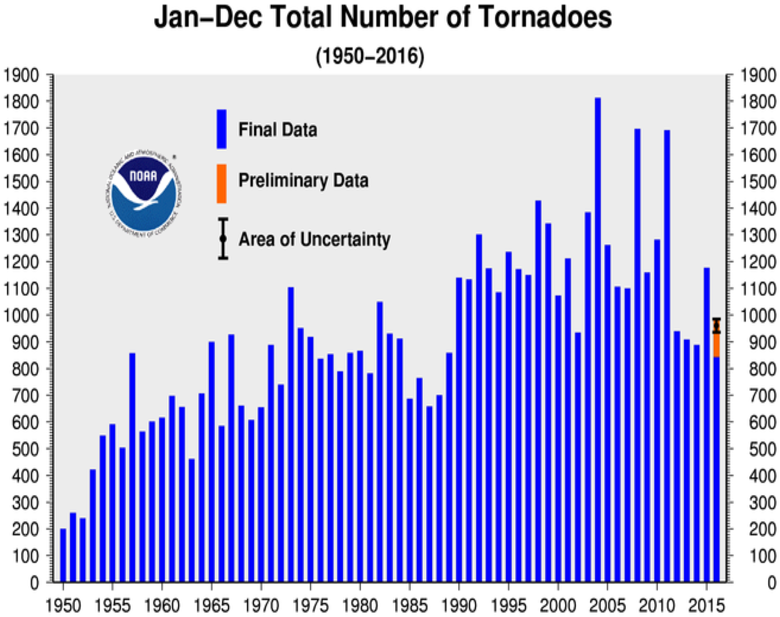
https://www.ncdc.noaa.gov/sotc/tornadoes/201613
According to NOAA, the number of tornadoes has been steadily growing since the 1950s, despite a drop in numbers in the last five years.
They show the above chart prominently in their Tornadoes – Annual 2016 Report.
However, they know full well that it is meaningless to compare current data with the past, as they explain themselves in the section Historical Records and Trends, which is hidden away on their own website:
One of the main difficulties with tornado records is that a tornado, or evidence of a tornado must have been observed. Unlike rainfall or temperature, which may be measured by a fixed instrument, tornadoes are short-lived and very unpredictable. If a tornado occurs in a place with few or no people, it is not likely to be documented. Many significant tornadoes may not make it into the historical record since Tornado Alley was very sparsely populated during the 20th century.
Much early work on tornado climatology in the United States was done by John Park Finley in his book Tornadoes, published in 1887. While some of Finley’s safety guidelines have since been refuted as dangerous practices, the book remains a seminal work in tornado research. The University of Oklahoma created a PDF copy of the book and made it accessible at John Finley’s Tornadoes (link is external).
Today, nearly all of the United States is reasonably well populated, or at least covered by NOAA’s Doppler weather radars. Even if a tornado is not actually observed, modern damage assessments by National Weather Service personnel can discern if a tornado caused the damage, and if so, how strong the tornado may have been. This disparity between tornado records of the past and current records contributes a great deal of uncertainty regarding questions about the long-term behavior or patterns of tornado occurrence. Improved tornado observation practices have led to an increase in the number of reported weaker tornadoes, and in recent years EF-0 tornadoes have become more prevelant in the total number of reported tornadoes. In addition, even today many smaller tornadoes still may go undocumented in places with low populations or inconsistent communication facilities.
With increased National Doppler radar coverage, increasing population, and greater attention to tornado reporting, there has been an increase in the number of tornado reports over the past several decades. This can create a misleading appearance of an increasing trend in tornado frequency. To better understand the variability and trend in tornado frequency in the United States, the total number of EF-1 and stronger, as well as strong to violent tornadoes (EF-3 to EF-5 category on the Enhanced Fujita scale) can be analyzed. These tornadoes would have likely been reported even during the decades before Doppler radar use became widespread and practices resulted in increasing tornado reports. The bar charts below indicate there has been little trend in the frequency of the stronger tornadoes over the past 55 years.


https://www.ncdc.noaa.gov/climate-information/extreme-events/us-tornado-climatology/trends
Of course it is nonsensical to claim that the bar charts below indicate there has been little trend in the frequency of the stronger tornadoes over the past 55 years – there has clearly been a large reduction.
Note as well that they have not even bothered to update the graph for 2015. Could it be they would rather the public did not find out the truth?
Meanwhile, over at the Storm Prediction Center (SPC) you can see that, when allowance is made for changing reporting procedures, last year may well have had the lowest number of tornadoes on record.

http://www.spc.noaa.gov/wcm/#data
The SPC is also part of NOAA, but is the department that actually deals with tornado events and data on a day to day basis. As such, they tend to be more interested in the facts, rather than a political agenda.
While we still await the final numbers and classification for last year, but what we do know is that there was no EF-5. Indeed the last occurrence was the Moore, OK tornado in May 2013.
It is unusual to go nearly four years without one, as there have been 59 since 1953, effectively one a year on average.
The bottom line is that the NOAA headline graph is grossly dishonest. Indeed, if a company published something like that in their Annual Accounts, they would probably end up in jail!
NOAA themselves know all of this full well.
Which raises the question – why are they perpetuating this fraud?
After the WaPost’s Latest Shot, It’s Time to Call ‘Fake News’ By Its Real Name ‘Weaponized Journalism’
By Claire Bernish | The Free Thought Project | January 16, 2017
Defying any sense of journalistic integrity and loyalty to the truth, the Washington Post did it again — publishing Fake News for clicks — which had the desired effect of worldwide outrage to suit a tightly-defined political agenda.
This latest astounding deviation from the facts, however, makes indisputably clear the weaponization of news. Journalists and media outlets make mistakes from time to time, but a pattern and practice of publishing unfounded, unverified, and fraudulent articles cannot be characterized simply as irresponsible.
We are in the midst of an information war of epic proportions — led haplessly astray of the truth with the Post leading the way — and it’s a dangerous and frightening portent of things to come, not the least of which will be propagandized truth and heavy-handed censorship.
On Friday, WaPo published an article claiming President-elect Donald Trump fired Washington, D.C., National Guard Major General Errol R. Schwartz — just in time for the inauguration — and that he would be forced to leave his post as soon as the president takes the oath of office.
But that isn’t true.
“My troops will be on the street,” Schwartz told the Post. “I’ll see them off, but I won’t be able to welcome them back to the armory.” He added he would “never plan to leave a mission in the middle of a battle.”
WaPo’s erroneous reporting included a statement from D.C. Council Chairman Phil Mendelson, who lamented, “It doesn’t make sense to can the general in the middle of an active deployment.”
“I’m a soldier,” the Post quoted Schwartz. “I’m a presidential appointee, therefore the president has the power to remove me.”
But WaPo left out a number of critical points — and horrendously slanted the rest — about this “firing” of the head of the D.C. National Guard.
That D.C. position — unlike the equivalent for states — is appointed by the president, not by the Pentagon, as the Post suggested, nor by any branch of the military. Also, the article glaringly omitted any statement from the Trump transition team, an inexcusable offense, considering it later emerged Schwartz had been offered to keep his position through the end of Inauguration Day — it was Schwartz who turned down the offer, preferring instead to vacate the role at 12 noon, when Trump will be sworn in.
Of course, the blatant misinformation presented by the Post seemed so juicy, countless corporate outlets parroted the claim. Thus this Fake News rippled around the planet earning the scorn of millions who believed Trump must have lost all sensibility for firing a man who had diligently performed his duties since his appointment to the post by former President George W. Bush — during a potentially dangerous event.
This also spawned a number of rumors — with raucous protests planned for Inauguration Day, and the week before, why would the incoming president fire the man in charge of security? Isn’t this a preposterous decision on Trump’s part? What is Trump thinking?
Like previous viral stories — at this point, one would be hard-pressed to deem them ‘news articles’ — the Washington Post published faulty information and subsequently began backtracking.
Notably, in each case, after erroneous information went viral worldwide, edits after publication go largely unnoticed by most of the populace. While retractions and post-publication editor’s notes sometimes appear on WaPo’s articles they are orders of magnitude less popular than the original story and, in this instance, the firing of Schwartz story has only been appended in content — no editor’s note yet graces the top or bottom of the article. (The original version can be found here.)
Any news organization actually practicing journalism would tell you this is egregiously irresponsible.
Except, it’s beginning to appear the Washington Post publishes misinformation and Fake News intentionally — knowing any subsequent disputation of its claims won’t gather as much steam as the original publication.
A distinct reason exists why this would be the case — Brandolini’s law.
“The amount of energy necessary to refute bullshit is an order of magnitude bigger than to produce it,” Alberto Brandolini, an Italian independent software development consultant, keenly observed in 2013 — the Post knows this, and has been manipulating public perception exactly this way.
It was, after all, the Washington Post who initiated the altogether ironic war on Fake News — first turning from journalistic duty in the publication of several items blaming disinformation for the downfall of, well, nearly everything.
WaPo published an ‘article’ about supposed blacklist of over 200 outlets a nascent and seemingly prepubescent website, PropOrNot, had decided were Russian propagandists — linked either directly to the Russian government or had haplessly joined the effort by reporting Fake News during the election.
Literally nothing in that Post article was true. None of the claims were backed by evidence, no research or investigation had been performed, nothing. WaPo just printed the claims of PropOrNot and inserted plausible deniability by failing to link to the list or site. A subsequent retraction at the top of the page was akin to plugging a crack in a dam that’s already burst — damage to many reputable and award-winning outlets listed had already been done.
Additional stories from the Post — none including any proof — blamed The Russians for everything from meddling in the U.S. election to install Trump, to hacking into the power grid in Vermont. ‘We’re all in peril because Russia,’ WaPo repeatedly claimed — without so much as a shred of evidence.
Has the Post — and the rest of mainstream media — abandoned journalism? … continue
Outgoing CIA Chief Warns Trump to “Watch His Words”
Al-Manar – January 16, 2017
Outgoing CIA chief John Brennan on Sunday launched a scathing attack on Donald Trump, warning him to watch what he says and suggesting the president-elect doesn’t understand the challenges posed by Russia.
Brennan’s stern words — which sparked a quick Twitter retort from Trump — were the latest salvo in the ongoing feud between the incoming Republican leader and US intelligence agencies, who have concluded Moscow meddled in the November election.
The 70-year-old Trump, who takes office on Friday, tweeted saying that if the Russian leader “likes” him, it would be an “asset” to help repair strained ties with Moscow.
“I don’t think he has a full appreciation of Russian capabilities, Russia’s intentions and actions,” Brennan said of Trump on Fox News Sunday.
“I think Mr. Trump has to be very disciplined in terms of what it is that he says publicly,” he added.
“He is going to be, in a few days’ time, the most powerful person in the world, in terms of sitting on top of the United States government and I think he has to recognize that his words do have impact,” the CIA chief said.
“He’s going to have the opportunity to do something for national security as opposed to talking and tweeting,” he added.
“Spontaneity is not something that protects national security interests.”
Brennan also bristled at Trump’s likening of the US intelligence community to Nazi Germany, calling it “outrageous.”
The Trump Dossier: Created by Spies”R”Us?
By Phil Butler – New Eastern Outlook – 14.01.2017
Chris Steele is a former MI6 and FBI asset who compiled a dossier of unsubstantiated allegations about President-elect Donald Trump. The current Director at the private security and investigation firm Orbis Business Intelligence, is a curious player in the sensational efforts of Trump adversaries. Here is what I discovered about the former British intelligence officer.
For Donald Trump’s part, his press conference this week revealed his righteous indignation at just how far his opponents will go to smear his coming administration. Shunning Buzzfeed and ostracizing CNN for their irresponsible broadcasting of the “dossier”, Mr. Trump was crystal clear in pointing the finger at crooked media and the people behind. The incoming president was also clear in identifying his adversaries, a fact that has been corroborated.
The Steele dossier was contracted by both Republican and Democratic adversaries of Mr. Trump. Senator John McCain, the notoriously hawkish Arizona arms industry puppet, admitted he turned over the dossier to the FBI. While McCain’s involvement is shocking enough, I believe other familiar faces funded the extended smear campaign. The Guardian has done some of the homework in tracking down how this dossier came into being, but this “Steele” character is still a bit of an enigma.
Chris Steele has only this week come into the limelight, but Mother Jones had actually reported on some of his activities back in October of 2016. By using The Guardian story, and what can be gleaned from the Mother Jones report, profiling Mr. Trump’s new nemesis is actually not so difficult. Steel’s LinkedIn profile and connections are telling. Steele has received some interesting endorsements on LinkedIn.
First, Jonathan Winer, who’s a Special Envoy at US Department of State, acknowledged the former MI6 agent on his international relations skills, it is key to note that Winer is not only the special envoy for Libya, but he was previously a senior director at Margery Kraus’ APCO Worldwide, a former Assistant Secretary of State, and Secretary of State John Kerry’s legislative assistant. Are your eyebrows raised?
Paul Andrews, who’s director of Ultrax Consulting Limited also recommended Steele. Of further interest is the fact Andrews was a member of Her Majesty’s Foreign Commonwealth Office for 15 years. Maybe a direct quote from Andrews’ security agency will shed more light:
“ULTRAX has, both directly and indirectly, been a leading provider of training services to Her Majesty’s Government and is one of a small number of private companies to have been entrusted with providing consultancy services and training to Ministry of Defence and Government Agencies with a National Security agenda.”
Clovis Meath Baker CMG OBE is a senior adviser to the UK Government’s so-called Stabilisation Unit. He recommended Steele for his “counterterrorism” capacity. As an interesting note here, Baker is an associate fellow at the Royal United Services Institute (RUSI), the world’s oldest independent think tank on international defense and security.
Chris Burrows, Steele’s fellow director at Orbis, he’s in the same circles as the Trump dossier author, but with a wider reach within the LinkedIn community. Burrows was the First Secretary of the UK Foreign and Commonwealth Office for 9 years, and is perhaps tied in part to the Moscow element of this story. His recommendations include one from Fedor Zhavoronkov, who is the most intriguing figure in this loop of spooks I found so far. Zhavoronkov was a key security account manager for the famous Grant Vympel agency in Russia formed from the famous special operations Group “Vympel, which took part in storming the Russian “White House” in support of then President Boris Yeltsin. I mention this only because the 2nd October Revolution only narrowly failed with the reluctant help of elements of the Russian military. Of dissenters in Russia, there are still many.
Tyler Durden at Zero Hedge takes the same track I did in framing the connections of Christopher Steele, but he goes further in assessing the credibility of the so-called “Trump dossier”. Durden quotes one Andrew Wordsworth, co-founder of London-based investigations firm Raedas, who often works on Russian issues, who called the dossier “unconvincing” at best. What is most “convincing” for me is the fact Chris Steele was involved with Alexander Litvinenko, the man whose death the British leadership tried to pin on Vladmir Putin. According to today’s reports, Steele has now fled his multimillion pound sterling home fearing his own life. You read this correctly, the web of “Putin probably did it” macabre is growing huge.
The murdered Russian double agent Alexander Litvinenko, Ukraine revolution cheerleader and warmonger Senator John McCain, MI6 spooks out the ying yang, Fake News going rampant, the US intelligence community melting down, and Donald Trump accused of more infidelity than Putin himself – what else can we expect in the next few days? McCain visits the scene of his war crimes, then flies home to turn over make-believe dossiers on a new president? Oh well, just read this Daily Mail piece and find a copy of Alice in Wonderland, then come back and tell me which crazy world we live in.
Phil Butler is a policy investigator and analyst, a political scientist and expert on Eastern Europe.
Dossiers, Make Believe and Fantasy
The CIA, Trump and Unverified News
By Binoy Kampmark | Dissident Voice | January 13, 2017
London — Morning breakfast news on the BBC’s Radio Four on Friday was a delightful affair filled with discussions on Russia (when do we not talk about that busy, stirring Bear these days?), Donald Trump, dossiers and the intelligence fraternity. Did it even matter that various sources have been unverified, subject matter lumped together in cumbersome conversations on fake news, sexual frolics and the like?
Discussants on the Beeb who kept listeners company over coffee included former, recently confessed spook Frederick Forsyth, for years the go-to creator of the spy narrative, and the official intelligence historian Sir Christopher Andrew.
For Forsyth, the allegations outlined by former British spy Christopher Steele that Trump found himself in prancing company with Russian hookers, dubious real estate deals targeted as bribes and a treasonous coordination with the Russian intelligence services to defeat Hillary Clinton, beggared belief. Trump was hardly that much of a buffoon, surely.
On Wednesday night, the US director of national intelligence, James R. Clapper Jr., issued a statement in the aftermath of a conversation with Trump on the Steele dossier, suggesting that the agencies had “not made any judgment that the information in this document is reliable.” Naturally, despite any claims about authenticity, the report had been circulated within the deepest recesses of spook central. Clapper would never want to deny his own officials the pleasure of that smut.
The New York Times conceded that much of the story remained “out of reach – most critically the basis question of how much, if anything, in the dossier is true.” You would think that this point was most salient, rendering any other discussion empty and flatulent.
Nonetheless, the paper would go on to assert that it was “possible to piece together a rough narrative of what led to the current crisis, including lingering questions about the ties binding Mr. Trump and his team to Russia.”
With the US presidential inauguration fast approaching, the press jackals have been swarming. The tid bits offered by the Steele report are themselves shrouded, stemming from September 2015 when an anti-Trump Republican donor (naturally, we do not know the name) commissioned Fusion GPS, a Washington-based research firm stacked by former journalists turned information hit-men, to do some digging. The mission was simple: find as much debilitating dirt as possible and sink the Trump ship.
Steele, considered at one point one of Britain’s foremost Russian experts within MI6, was considered ideal for the job of funneling information to Glenn Simpson at Fusion GPS. The themes of those memos were stock standard: the old compromising (kompromat) material, with sex being central; and the hacking of the Democratic National Committee with discussion by Trump officials with Russian entities.
Trump has not done himself any favours, preferring to throw meagre carrion at the press corps, and hope that it miraculously dissipates. His polemical advisors would have been best served to tell him to shut it. News is not interesting. Allegations have become the gold dust of political debate.
This latest battle of spite and indignation reveals that internally, there is a war between claims and institutions within the United States. The intelligence community finds itself unsheathing its weapons. Trump has duly responded.
The point being missed here is the possibility that the servants of the elected commander-in-chief may actually be subverting the Republic, for all Trump’s sullen, and childish authoritarianism. Sources garnered from the very foundry of deception have assumed an aura of reliability. The argument about fake news has been turned inside out.
While care should be taken in packaging the entire US intelligence community into a neat box of anti-Trump enthusiasts, a good number of former officials were very keen that Hillary Clinton take over the reins in the White House. Views were expressed throughout the election cycle: Trump had to be defeated at all costs.
Once it became clear that Trump was gaining electoral momentum at nerve racking pace, it was important to side with the Clinton electoral team on a revived Cold War mantra: the Russians were doing terrible things, with Trump operating in the shadow of Russian President Vladimir Putin.
For former CIA and NSA director under George W. Bush, Gen. Michael Hayden, Trump was “the useful fool, some naïf, manipulated by Moscow, secretly held in contempt, but whose blind support is happily accepted and exploited.”
Former CIA Director Michael J. Morell also took a step that can only be regarded as singular and institutionally troubling: coming out from the shadows to pick his preferred candidate while denigrating another.
In August, he bored readers with his resume in an opinion piece for the New York Times. (“In my 40 years of voting, I have pulled the lever for candidates of both parties.”) He expressed a solemn view that Trump was “not only unqualified for the job, but he may well pose a threat to our national security.” Russia’s Putin “had recruited Mr. Trump as an unwitting agent of the Russian Federation.”
The Fourth Estate used to be the solemn interrogating power of the parliamentary galleries. Being unelected, it was given, as an accident of history, a certain influence. Like all power, it can be misdirected, even ill-informed. The questioners can become vessels and conduits.
Over time, that same estate has withered, becoming a faint echo of investigation and fact checking. Even in notionally democratic states, it can be co-opted. As Glenn Greenwald has argued, the most useful tool of the deep state has been the US media, “much of which reflexively reveres, serves, believes, and sides with hidden intelligence officials.”
Leakers are punished; facts are not cross-checked. The hack now floats in an ether of speculation, fed by the unverifiable, and pampered by the intelligence official. The battles now seemingly are not over narratives of veracity but narratives of invention. Power, it would seem, to the creative in this new Republic of trouble that is the United States.
Binoy Kampmark was a Commonwealth Scholar at Selwyn College, Cambridge. He lectures at RMIT University, Melbourne and can be reached at: bkampmark@gmail.com.
Danish minister alleges ‘Russia ready to attack hospitals, infrastructure & electrical supply’
RT | January 13, 2017
Denmark’s Defense Minister Claus Hjort Frederiksen has launched a series of wide-ranging and grave accusations against Moscow, saying that it presents a “direct, very frightening and serious threat” against his homeland.
“We need to make clear to ourselves in Denmark that we are in danger, and we need to act upon this,” the center-right politician told the Danish Berlingske newspaper.
Frederiksen was asked to expound on his brief in the first extensive interview since the 69-year-old was appointed to his post in November last year. Instead, the politician, who previously served as minister of finance during two stints, spoke almost exclusively about Russia.
“State-supported Russian hacker groups are ready to attack hospitals, infrastructure and the electrical supply by breaking into computer systems and creating a mess of notices and treatments within the health system,” said Frederiksen, referring to a report published by the country’s intelligence agency last month, as well as conversations with other Western politicians and security officials.
And why would Russia target civilian infrastructure in a small country with which it shares no border? “To spread fear and insecurity among the population and paralyze our democracy.”
“It’s a way to destabilize our countries and democracies in a very physical and tangible way, and this places an urgent demand on our resources to defend ourselves against such attacks,” said Frederiksen.
Frederiksen’s accusations echo those of US intelligence officials, who published a report last week, alleging that Russia ordered hackers to meddle in the US election, specifically by releasing emails related to Democratic candidate Hillary Clinton. The Kremlin has repeatedly denied charges of interference.
‘We must spend more on NATO to stop Russians from trying anything’
The politician also believes that the Iskander-M missiles that Russia has deployed in its westernmost exclave of Kaliningrad pose an immediate danger to Denmark.
“We can confirm that the Russians are right now installing new missiles in Kaliningrad that can reach Copenhagen. That is of course a major risk,” said Frederiksen.
Moscow says the missiles are a response to the continuing unrolling of the US missile defense shield across Eastern Europe, and has beefed up its other armaments in the region, following an increase in NATO presence on the Russian border. The Western alliance is seeking to limit Moscow’s purported ambitions in the region through Operation Atlantic Resolve, commenced following the breakout of the conflict in Ukraine in 2014, and comprises the transfer of troops and modernized equipment to Eastern Europe.
Frederiksen also said that Russia’s “increased military activity” in the Arctic, in which both Moscow and Copenhagen have territorial claims – the latter through Greenland – were another potential source of conflict, which must require “extensive monitoring.”
As a solution, Frederiksen advocates increased military spending, though he declined to specify if Denmark intended to hit the NATO target of 2 percent of GDP being spent on defense (currently it spends 1.17 percent).
“NATO must be our common defense and our deterrent. We have to show the strength that it takes, and thus spend the money it takes to prevent the Russians from trying anything. That is basically what is the essence of our thinking,” said Frederiksen.
As a symbolic gesture Frederiksen emphasized the importance of the deployment of 200 Danish soldiers as part of the new 5,000-strong rapid response force in Eastern Europe next year.
“It is not of course because we think that the 200 Danish soldiers can stop the Russian army. But they should know that the territorial defense of the immediate area begins there and crossing the line, then the common solidarity in NATO will take effect,” said Frederiksen.
The newspaper said that the Russian embassy refused to comment on the accusations.
READ MORE:
‘Witch hunt’: Kremlin slams ODNI report claiming Russia hacked US elections
Over 1,000 soldiers to make up NATO’s new international battalion in Latvia
Featured Video
Pentagon insider says high US official Douglas Feith reported to Netanyahu
or go to
Aletho News Archives – Video-Images
Frlom the Archives
The Fiction of the Jewish History in Palestine
By Hasan Afif El-Hasan | The Palestine Chronicle | April 8, 2011
Prime Minister Benjamin Netanyahu told NNC Pierce Morgan on March 18, 2011 that he might agree to a Palestinian state through negotiations. And he added, “We will make territorial concessions although it is very painful to do that in our ancestral land.” Netanyahu was not talking about Poland where his ancestors lived. He was talking about Palestine where generations of its indigenous population ancestors lived, cultivated the land and are buried.
By the end of the nineteenth century, Zionism created a new Jewish identity of blood and soil. To mobilize their followers and supporters and appeal to their emotions, the Zionists created myths. Zionism started as a tribal religion without god, but in order to fulfill its function as a unifying force, Zionism required external religious and race symbols, not inner content. Its leaders regarded metaphysical religious belief and purity of race as having value in itself. They created a divine paradisiacal state of merger with the gods. Despite his non-religious ideology, Herzl’s writings were replete with religious references. The Jews should settle in Palestine because, in his words, “the Temple will be visible from long distance, for it is only our ancient faith that has kept us together”.
The Zionists and their supporters have invested tremendous financial and scholarly resources to work within the Hebrew Bible historical narratives to affirm the links between the intrusive Zionist population and the ancient Israelite past, and by doing so assert the right of that population to the land. The political end-game shaped the investigation and the outcome. Tracing the roots of Israel’s ethnic state in biblical antiquity is effectively to silence the indigenous Palestinian claim to the past and therefore to the land. The Biblical scholarship employs a bewildering array of terms for the region: “the Holy Land”, “the Land of the Bible”, “Eretz Israel”, “the Land of Israel”, or “Judah and Samaria.” To the casual reader these names appear interchangeable, but they all imply connection to ancient Israel.
Biblical narratives or poems that cannot be supported by archeology and common sense are treated by the Zionists and their supporters as historical language. … continue
Blog Roll
 Aletho News
- Pentagon insider says high US official Douglas Feith reported to Netanyahu
- The Sludging of Rural America
- Lawyers’ groups demand end to British military bases in Cyprus
- CIA Assessment: The Resistance Cannot Be Crushed
- Hezbollah Returns: It Didn’t Start a War, It Is Ending One
- EU states seek ‘talks’ with Iran for access to Strait of Hormuz: Report
- Trump on Hormuz: “Others must take care of it” after US falters
- Who Is closer to collapse?
- A War that Backfired: Why the US-Israeli Campaign Is Strengthening Iran
- How Zionist Control Is Hurting US Interests
- If Americans Knew
- As US-Israel war on Iran rages, Gaza faces massive dust storm – Not a ceasefire Day 156
- No let-up in attacks on Gaza as Israel takes on Iran, Lebanon – Not a ceasefire Day 155
- ‘Of Course’: IDF Drops Case Against Soldiers Accused of Raping Palestinian Prisoner
- Don’t Fall for the Regime Change Talk. Israel Is ‘Mowing the Lawn’ in Iran
- Will Israel and the US wreck the Gulf States along with Iran?
- US so far burned through ‘years’ of munitions in Iran war: Report
- How the Israeli Tail Wags the American Dog
- Outdated intel likely led to deadly U.S. strike on Iranian elementary school, sources say
- Pentagon insider says high U.S official Douglas Feith reported to Netanyahu
- In fond memory of Walid Khalidi, the historian of Palestine
- No Tricks Zone
- Storing Green Energy To Last Germany 10 Days Would Require A 60-Million Tonne Battery
- New Studies: UK Sea Levels Were 4 Meters Higher Than Today During The Mid-Holocene
- Destructive Green New Deal: German Energy And Metal Group Warns Of Drastic Crisis
- New Study Documents A 20-Year Pause In Arctic Sea Ice Decline – Driven By Internal Variability
- Wake-up Call: Survey Shows Majority Of Germans Now Favor Postponing Climate Targets!
- Televised! Leading German Political Candidate Tells Schoolchildren CO2 Makes Sun Hotter!
- New Study: A Century Warming Of 1.1°C Is ‘Commonplace’ And ‘Not Unusual’ During This Interglacial
- New Study: ‘Internal Noise’ And Volcanic Forcing Can Trigger 10-15°C Warming Within Decades
- Glaciers Worldwide Are Suddendly Surging, Experts Blame Warming!
- Surprising Discovery: Sahara Is Greening…Billions Of Trees Where Once Thought To Be Barren
 Aletho News
