Big Media’s Contra-Cocaine Cover-up
By Robert Parry | Consortium News | December 9, 2016
Amid the mainstream U.S. media’s current self-righteous frenzy against “fake news,” it’s worth recalling how the big newspapers destroyed Gary Webb, an honest journalist who exposed some hard truths about the Reagan administration’s collaboration with Nicaraguan Contra cocaine traffickers.
Webb’s reward for reviving that important scandal in 1996 – and getting the CIA’s inspector general to issue what amounted to an institutional confession in 1998 – was to have The New York Times, The Washington Post and Los Angeles Times lobby for, essentially, his banishment from journalism.
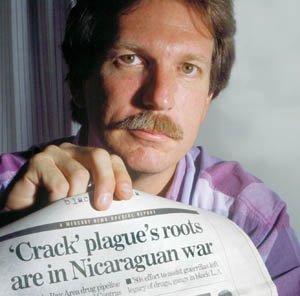
Journalist Gary Webb
The major media pile-on was so intense and so effective that Webb lost his job at the San Jose Mercury-News and could never find regular work in his profession again. Betrayed by his journalistic colleagues, his money gone, his family broken and his life seemingly hopeless, Webb committed suicide on Dec. 9, 2004.
Even then, the Los Angeles Times wrote up his obituary as if the paper were telling the life story of an organized-crime boss, not a heroic journalist. The Times obit was then republished by The Washington Post.
In other words, on one of the most significant scandals of the Reagan era, major newspapers, which now want to serve as the arbiters of truth for the Internet, demonstrated how disdainful they actually are toward truth when it puts the U.S. government in a harsh light.
Indeed, if it had been up to the big newspapers, this important chapter of modern history would never have been known. A decade earlier, in 1985, Brian Barger and I first exposed the Contra-cocaine connection for The Associated Press – and we watched as the big papers turned their backs on the scandal then, too.
The main point that Webb added to the story was how some of the Contra cocaine fed into the production of crack-cocaine that had such a devastating effect on America’s black communities in particular. Webb’s disclosure of the crack connection infuriated many African-Americans and the big papers acted as if it was their civic duty to calm down those inner-city folks by assuring them that the U.S. government would never do such a thing.
So, instead of doing their jobs as journalists, the major newspapers acted as the last line of defense against the people learning the truth.
A Solid Record
Yet, what’s remarkable now about the Contra-cocaine scandal is that – despite the cover-up efforts of the big papers – the truth is out there, available in official government documents, including the CIA’s inspector general’s report.
Collectively, the information also represents a damning indictment of The New York Times, The Washington Post and Los Angeles Times and demonstrates why they are unfit to lecture anyone about what’s real and what’s “fake.”
For instance, in 2013, at the National Archives annex in College Park, Maryland, I discovered a declassified “secret” U.S. law enforcement report that detailed how top Contra leader Adolfo Calero was casually associating with Norwin Meneses, described in the records as “a well-reputed drug dealer.” Meneses was near the center of Webb’s 1996 articles for the San Jose Mercury-News.
The report was typical of the evidence that the Reagan administration — and the big newspapers — chose to ignore. It recounted information from Dennis Ainsworth, a blue-blood Republican from San Francisco who volunteered to help the Contra cause in 1984-85. That put him in position to witness the strange goings-on of Contra leaders hobnobbing with drug traffickers and negotiating arms deals with White House emissaries.
Ainsworth also was a source of mine in fall 1985 when I was investigating the mysterious channels of funding for the Contras after Congress shut off CIA support in 1984 amid widespread reports of Contra atrocities inflicted on Nicaraguan civilians, including rapes, executions and torture.
Ainsworth’s first-hand knowledge of the Contra dealings dovetailed with information that I already had, such as the central role of National Security Council aide Oliver North in aiding the Contras and his use of “courier” Rob Owen as an off-the-books White House intermediary to the Contras. I later developed confirmation of some other details that Ainsworth described, such as his overhearing Owen and Calero working together on an arms deal as Ainsworth drove them through the streets of San Francisco.
As for Ainsworth’s knowledge about the Contra-cocaine connection, he said he sponsored a June 1984 cocktail party at which Calero spoke to about 60 people. Meneses, a notorious drug kingpin in the Nicaraguan community, showed up uninvited and clearly had a personal relationship with Calero, who was then the political leader of the Contra’s chief fighting force, the CIA-backed Nicaraguan Democratic Force (or FDN).
“At the end of the cocktail party, Meneses and Calero went off together,” Ainsworth told U.S. Attorney Joseph P. Russoniello, according to a “secret” Jan. 6, 1987 cable submitted by Russoniello to an FBI investigation code-named “Front Door,” a probe into the Reagan administration’s corruption.
After Calero’s speech, Ainsworth said Meneses accompanied Calero and about 20 people to dinner and picked up the entire tab, according to a more detailed debriefing of Ainsworth by the FBI.
Concerned about this relationship, Ainsworth said he was told by Renato Pena, an FDN leader in the San Francisco area, that “the FDN is involved in drug smuggling with the aid of Norwin Meneses who also buys arms for Enrique Bermudez, a leader of the FDN.” Bermudez was then the top Contra military commander.
Corroborating Account
Pena, who himself was convicted on federal drug charges in 1984, gave a similar account to the Drug Enforcement Administration. According to a 1998 report by the Justice Department’s Inspector General Michael Bromwich, “When debriefed by the DEA in the early 1980s, Pena said that the CIA was allowing the Contras to fly drugs into the United States, sell them, and keep the proceeds.
“Pena stated that he was present on many occasions when Meneses telephoned Bermudez in Honduras. Meneses told Pena of Bermudez’s requests for such things as gun silencers (which Pena said Meneses obtained in Los Angeles), cross bows, and other military equipment for the Contras. Pena believed that Meneses would sometimes transport certain of these items himself to Central America, and other times would have contacts in Los Angeles and Miami send cargo to Honduras, where the authorities were cooperating with the Contras. Pena believed Meneses had contact with Bermudez from about 1981 or 1982 through the mid-1980s.”
Bromwich’s report then added, “Pena said he was one of the couriers Meneses used to deliver drug money to a Colombian known as ‘Carlos’ in Los Angeles and return to San Francisco with cocaine. Pena made six to eight trips, with anywhere from $600,000 to nearly $1 million, and brought back six to eight kilos of cocaine each time. Pena said Meneses was moving hundreds of kilos a week. ‘Carlos’ once told Pena, ‘We’re helping your cause with this drug thing we are helping your organization a lot.”
Ainsworth also said he tried to alert Oliver North in 1985 about the troubling connections between the Contra movement and cocaine traffickers but that North turned a deaf ear.
“In the spring some friends of mine and I went back to the White House staff but we were put off by Ollie North and others on the staff who really don’t want to know all what’s going on,” Ainsworth told Russoniello.
When I first spoke with Ainsworth in September 1985 at a coffee shop in San Francisco, he asked for confidentiality, which I granted. However, since the documents released by the National Archives include him describing his conversations with me, that confidentiality no longer applies. Ainsworth also spoke with Webb for his 1996 San Jose Mercury-News series under the pseudonym “David Morrison.”
Though I found Ainsworth to be generally reliable, some of his depictions of our conversations contained mild exaggerations or confusion over details, such as his claim that I called him from Costa Rica in January 1986 and told him that the Contra-cocaine story that I had been working on with my AP colleague Brian Barger “never hit the papers because it was suppressed by the Associated Press due to political pressure primarily from the CIA.”
In reality, Barger and I returned from Costa Rica in fall 1985, wrote our story about the Contras’ involvement in cocaine smuggling, and pushed it onto the AP wire in December though in a reduced form because of resistance from some senior AP news executives who were supportive of President Reagan’s foreign policies. The CIA, the White House and other agencies of the Reagan administration did seek to discredit our story, but they did not prevent its publication.
An Overriding Hostility
The Reagan administration’s neglect of Ainsworth’s insights reflected the overriding hostility toward any information even from a Republican activist like Ainsworth that put the Contras in a negative light. In early 1987, when Ainsworth spoke with U.S. Attorney Russoniello and the FBI, the Reagan administration was in full damage-control mode, trying to tamp down the Iran-Contra disclosures about Oliver North diverting profits from secret arms sales to Iran to the Contra war.
Fears that the Iran-Contra scandal could lead to Reagan’s impeachment made it even less likely that the Justice Department would pursue an investigation into drug ties implicating the Contra leadership. Ainsworth’s information was simply passed on to Independent Counsel Lawrence Walsh whose inquiry was already overwhelmed by the task of sorting out the convoluted Iran transactions.
Publicly, the Reagan team continued dumping on the Contra-cocaine allegations and playing the find-any-possible-reason-to-reject-a-witness game. The major news media went along, leading to much mainstream ridicule of a 1989 investigative report by Sen. John Kerry, D-Massachusetts, who uncovered more drug connections implicating the Contras and the Reagan administration.
Only occasionally, such as when the George H.W. Bush administration needed witnesses to convict Panamanian dictator Manuel Noriega did the Contra-cocaine evidence pop onto Official Washington’s radar.
During Noriega’s drug-trafficking trial in 1991, U.S. prosecutors called as a witness Colombian Medellin cartel kingpin Carlos Lehder, who, along with implicating Noriega, testified that the cartel had given $10 million to the Contras, an allegation first unearthed by Sen. Kerry. “The Kerry hearings didn’t get the attention they deserved at the time,” a Washington Post editorial on Nov. 27, 1991, acknowledged. “The Noriega trial brings this sordid aspect of the Nicaraguan engagement to fresh public attention.”
But the Post offered its readers no explanation for why Kerry’s hearings had been largely ignored, with the Post itself a leading culprit in this journalistic misfeasance. Nor did the Post and the other leading newspapers use the opening created by the Noriega trial to do anything to rectify their past neglect.
Everything quickly returned to the status quo in which the desired perception of the noble Contras trumped the clear reality of their criminal activities. Instead of recognizing the skewed moral compass of the Reagan administration, Congress was soon falling over itself to attach Reagan’s name to as many public buildings and facilities as possible, including Washington’s National Airport.
Meanwhile, those of us in journalism who had exposed the national security crimes of the 1980s saw our careers mostly sink or go sideways. We were regarded as “pariahs” in our profession.
As for me, shortly after the Iran-Contra scandal broke wide open in fall 1986, I accepted a job at Newsweek, one of the many mainstream news outlets that had long ignored Contra-connected scandals and briefly thought it needed to bolster its coverage. But I soon discovered that senior editors remained hostile toward the Iran-Contra story and related spinoff scandals, including the Contra-cocaine mess.
After losing battle after battle with my Newsweek editors, I departed the magazine in June 1990 to write a book (called Fooling America) about the decline of the Washington press corps and the parallel rise of a new generation of government propagandists.
I was also hired by PBS Frontline to investigate whether there had been a prequel to the Iran-Contra scandal, whether those arms-for-hostage deals in the mid-1980s had been preceded by contacts between Reagan’s 1980 campaign staff and Iran, which was then holding 52 Americans hostage and essentially destroying Jimmy Carter’s reelection hopes. [For more on that topic, see Robert Parry’s Secrecy & Privilege and America’s Stolen Narrative.]
Finding New Ways
In 1995, frustrated by the growing triviality of American journalism, and acting on the advice of and with the assistance of my oldest son Sam, I turned to a new medium and launched the Internet’s first investigative news magazine, known as Consortiumnews.com. The Web site became a way for me to put out well-reported stories that my former mainstream colleagues ignored or mocked.
So, when Gary Webb called me in 1996 to talk about his upcoming series reviving the Contra-cocaine story, I explained some of this tortured history and urged him to make sure that his editors were firmly behind him. He sounded perplexed at my advice and assured me that he had the solid support of his editors.
When Webb’s “Dark Alliance” series finally appeared in late August 1996, it initially drew little attention. The major national news outlets applied their usual studied indifference to a topic that they had already judged unworthy of serious attention.
But Webb’s story proved hard to ignore. First, unlike the work that Barger and I did for AP in the mid-1980s, Webb’s series wasn’t just a story about drug traffickers in Central America and their protectors in Washington. It was about the on-the-ground consequences, inside the United States, of that drug trafficking, how the lives of Americans were blighted and destroyed as the collateral damage of a U.S. foreign policy initiative.
In other words, there were real-life American victims, and they were concentrated in African-American communities. That meant the ever-sensitive issue of race had been injected into the controversy. Anger from black communities spread quickly to the Congressional Black Caucus, which started demanding answers.
Secondly, the San Jose Mercury-News, which was the local newspaper for Silicon Valley, had posted documents and audio on its state-of-the-art Internet site. That way, readers could examine much of the documentary support for the series.
It also meant that the traditional “gatekeeper” role of the major newspapers, The New York Times, The Washington Post, and Los Angeles Times, was under assault. If a regional paper like the Mercury-News could finance a major journalistic investigation like this one, and circumvent the judgments of the editorial boards at the Big Three, then there might be a tectonic shift in the power relations of the U.S. news media. There could be a breakdown of the established order.
This combination of factors led to the next phase of the Contra-cocaine battle: the “get-Gary-Webb” counterattack. Soon, The Washington Post, The New York Times, and Los Angeles Times were lining up like some tag-team wrestlers taking turns pummeling Webb and his story.
On Oct. 4, 1996, The Washington Post published a front-page article knocking down Webb’s series, although acknowledging that some Contra operatives did help the cocaine cartels. The Post’s approach fit with the Big Media’s cognitive dissonance on the topic: first, the Post called the Contra-cocaine allegations old news, “even CIA personnel testified to Congress they knew that those covert operations involved drug traffickers,” the Post said, and second, the Post minimized the importance of the one Contra smuggling channel that Webb had highlighted in his series, saying it had not “played a major role in the emergence of crack.”
To add to the smug hoo-hah treatment that was enveloping Webb and his story, the Post published a sidebar story dismissing African-Americans as prone to “conspiracy fears.”
Next, The New York Times and Los Angeles Times weighed in with lengthy articles castigating Webb and “Dark Alliance.” The big newspapers made much of the CIA’s internal reviews in 1987 and 1988, almost a decade earlier, that supposedly had cleared the spy agency of any role in Contra-cocaine smuggling.
But the first ominous sign for the CIA’s cover-up emerged on Oct. 24, 1996, when CIA Inspector General Frederick Hitz conceded before the Senate Intelligence Committee that the first CIA probe had lasted only 12 days, and the second only three days. He promised a more thorough review.
Mocking Webb
But Webb had already crossed over from being treated as a serious journalist to becoming a target of ridicule. Influential Washington Post media critic Howard Kurtz mocked Webb for saying in a book proposal that he would explore the possibility that the Contra war was primarily a business to its participants. “Oliver Stone, check your voice mail,” Kurtz smirked.
Yet, Webb’s suspicion was no conspiracy theory. Indeed, Oliver North’s chief Contra emissary, Rob Owen, had made the same point in a March 17, 1986 message about the Contra leadership. “Few of the so-called leaders of the movement . . . really care about the boys in the field,” Owen wrote. “THIS WAR HAS BECOME A BUSINESS TO MANY OF THEM.” [Emphasis in original.]
Ainsworth and other pro-Contra activists were reaching the same conclusion, that the Contra leadership was skimming money from the supply lines and padding their personal wealth with proceeds from the drug trade.
According to a Jan. 21, 1987 interview report by the FBI, Ainsworth said he had “made inquiries in the local San Francisco Nicaraguan community and wondered among his acquaintances what Adolfo Calero and the other people in the FDN movement were doing and the word that he received back is that they were probably engaged in cocaine smuggling.”
In other words, Webb was right about the suspicion that the Contra movement had become less a cause than a business to many of its participants. Even Oliver North’s emissary reported on that reality. But truthfulness had ceased to be relevant in the media’s hazing of Gary Webb.
In another double standard, while Webb was held to the strictest standards of journalism, it was entirely all right for Kurtz, the supposed arbiter of journalistic integrity who was a longtime fixture on CNN’s “Reliable Sources,” to make judgments based on ignorance. Kurtz would face no repercussions for mocking a fellow journalist who was factually correct.
The Big Three’s assault, combined with their disparaging tone, had a predictable effect on the executives of the Mercury-News. As it turned out, Webb’s confidence in his editors had been misplaced. By early 1997, executive editor Jerry Ceppos, who had his own corporate career to worry about, was in retreat.
On May 11, 1997, Ceppos published a front-page column saying the series “fell short of my standards.” He criticized the stories because they “strongly implied CIA knowledge” of Contra connections to U.S. drug dealers who were manufacturing crack cocaine. “We did not have enough proof that top CIA officials knew of the relationship,” Ceppos wrote.
Ceppos was wrong about the proof, of course. At AP, before we published our first Contra-cocaine article in 1985, Barger and I had known that the CIA and Reagan’s White House were aware of the Contra-cocaine problem at senior levels. One of our sources was on Reagan’s National Security Council staff.
However, Ceppos recognized that he and his newspaper were facing a credibility crisis brought on by the harsh consensus delivered by the Big Three, a judgment that had quickly solidified into conventional wisdom throughout the major news media and inside Knight-Ridder, Inc., which owned the Mercury-News. The only career-saving move — career-saving for Ceppos even if career-destroying for Webb — was to jettison Webb and the Contra-cocaine investigative project.
A ‘Vindication’
The big newspapers and the Contras’ defenders celebrated Ceppos’s retreat as vindication of their own dismissal of the Contra-cocaine stories. In particular, Kurtz seemed proud that his demeaning of Webb now had the endorsement of Webb’s editor.
Ceppos next pulled the plug on the Mercury-News’ continuing Contra-cocaine investigation and reassigned Webb to a small office in Cupertino, California, far from his family. Webb resigned from the paper in disgrace. [See Consortiumnews.com’s “Hung Out to Dry.”]
For undercutting Webb and other Mercury-News reporters working on the Contra-cocaine project — some of whom were facing personal danger in Central America — Ceppos was lauded by the American Journalism Review and received the 1997 national Ethics in Journalism Award by the Society of Professional Journalists.
While Ceppos won raves, Webb watched his career collapse and his marriage break up. Still, Gary Webb had set in motion internal government investigations that would bring to the surface long-hidden facts about how the Reagan administration had conducted the Contra war.
The CIA published the first part of Inspector General Hitz’s findings on Jan. 29, 1998. Though the CIA’s press release for the report criticized Webb and defended the CIA, Hitz’s Volume One admitted that not only were many of Webb’s allegations true but that he actually understated the seriousness of the Contra-drug crimes and the CIA’s knowledge of them.
Hitz conceded that cocaine smugglers played a significant early role in the Contra movement and that the CIA intervened to block an image-threatening 1984 federal investigation into a San Francisco-based drug ring with suspected ties to the Contras, the so-called “Frogman Case.”
After Volume One was released, I called Webb (whom I had spent some time with since his series was published). I chided him for indeed getting the story “wrong.” He had understated how serious the problem of Contra-cocaine trafficking had been, I said.
It was a form of gallows humor for the two of us, since nothing had changed in the way the major newspapers treated the Contra-cocaine issue. They focused only on the press release that continued to attack Webb, while ignoring the incriminating information that could be found in the full report. All I could do was highlight those admissions at Consortiumnews.com, which sadly had a much, much smaller readership than the Big Three.
The major U.S. news media also looked the other way on other startling disclosures.
On May 7, 1998, for instance, Rep. Maxine Waters, a California Democrat, introduced into the Congressional Record a Feb. 11, 1982 letter of understanding between the CIA and the Justice Department. The letter, which had been requested by CIA Director William Casey, freed the CIA from legal requirements that it must report drug smuggling by CIA assets, a provision that covered the Nicaraguan Contras and the Afghan mujahedeen.
In other words, early in those two covert wars, the CIA leadership wanted to make sure that its geopolitical objectives would not be complicated by a legal requirement to turn in its client forces for drug trafficking.
Justice Denied
The next break in the long-running Contra-cocaine cover-up was a report by the Justice Department’s Inspector General Michael Bromwich. Given the hostile climate surrounding Webb’s series, Bromwich’s report also opened with criticism of Webb. But, like the CIA’s Volume One, the contents revealed new details about serious government wrongdoing.
According to evidence cited by Bromwich, the Reagan administration knew almost from the outset of the Contra war that cocaine traffickers permeated the paramilitary operation. The administration also did next to nothing to expose or stop the crimes.
Bromwich’s report revealed example after example of leads not followed, corroborated witnesses disparaged, official law-enforcement investigations sabotaged, and even the CIA facilitating the work of drug traffickers.
The report showed that the Contras and their supporters ran several parallel drug-smuggling operations, not just the one at the center of Webb’s series. The report also found that the CIA shared little of its information about Contra drugs with law-enforcement agencies and on three occasions disrupted cocaine-trafficking investigations that threatened the Contras.
As well as depicting a more widespread Contra-drug operation than Webb (or Barger and I) had understood, the Justice Department report provided some important corroboration about Nicaraguan drug smuggler Norwin Meneses, a key figure in Gary Webb’s series and Adolfo Calero’s friend as described by Dennis Ainsworth.
Bromwich cited U.S. government informants who supplied detailed information about Meneses’s drug operation and his financial assistance to the Contras. For instance, Renato Pena, the money-and-drug courier for Meneses, said that in the early 1980s the CIA allowed the Contras to fly drugs into the United States, sell them, and keep the proceeds. Pena, the FDN’s northern California representative, said the drug trafficking was forced on the Contras by the inadequate levels of U.S. government assistance.
The Justice Department report also disclosed repeated examples of the CIA and U.S. embassies in Central America discouraging DEA investigations, including one into Contra-cocaine shipments moving through the international airport in El Salvador. Bromwich said secrecy trumped all.
“We have no doubt that the CIA and the U.S. Embassy were not anxious for the DEA to pursue its investigation at the airport,” he wrote.
Bromwich also described the curious case of how a DEA pilot helped a CIA asset escape from Costa Rican authorities in 1989 after the man, American farmer John Hull, had been charged in connection with Contra-cocaine trafficking. [See Consortiumnews.com’s “John Hull’s Great Escape.”]
Hull’s ranch in northern Costa Rica had been the site of Contra camps for attacking Nicaragua from the south. For years, Contra-connected witnesses also said Hull’s property was used for the transshipment of cocaine en route to the United States, but those accounts were brushed aside by the Reagan administration and disparaged in major U.S. newspapers.
Yet, according to Bromwich’s report, the DEA took the accounts seriously enough to prepare a research report on the evidence in November 1986. One informant described Colombian cocaine off-loaded at an airstrip on Hull’s ranch.
The drugs were then concealed in a shipment of frozen shrimp and transported to the United States. The alleged Costa Rican shipper was Frigorificos de Puntarenas, a firm controlled by Cuban-American Luis Rodriguez. Like Hull, however, Frigorificos had friends in high places. In 1985-86, the State Department had selected the shrimp company to handle $261,937 in non-lethal assistance earmarked for the Contras.
Hull also remained a man with powerful protectors. Even after Costa Rican authorities brought drug charges against him, influential Americans, including Rep. Lee Hamilton, D-Indiana, demanded that Hull be let out of jail pending trial. Then, in July 1989 with the help of a DEA pilot — and possibly a DEA agent as well — Hull managed to fly out of Costa Rica to Haiti and then to the United States.
Despite these startling new disclosures, the big newspapers still showed no inclination to read beyond the criticism of Webb in the press release.
Major Disclosures
By fall 1998, Washington was obsessed with President Bill Clinton’s Monica Lewinsky sex scandal, which made it easier to ignore even more stunning Contra-cocaine disclosures in the CIA’s Volume Two, published on Oct. 8, 1998.
In the report, CIA Inspector General Hitz identified more than 50 Contras and Contra-related entities implicated in the drug trade. He also detailed how the Reagan administration had protected these drug operations and frustrated federal investigations throughout the 1980s.
According to Volume Two, the CIA knew the criminal nature of its Contra clients from the start of the war against Nicaragua’s leftist Sandinista government. The earliest Contra force, called the Nicaraguan Revolutionary Democratic Alliance (ADREN) or the 15th of September Legion, had chosen “to stoop to criminal activities in order to feed and clothe their cadre,” according to a June 1981 draft of a CIA field report.
According to a September 1981 cable to CIA headquarters, two ADREN members made the first delivery of drugs to Miami in July 1981. ADREN’s leaders included Enrique Bermudez and other early Contras who would later direct the major Contra army, the CIA-organized FDN which was based in Honduras, along Nicaragua’s northern border.
Throughout the war, Bermudez remained the top Contra military commander. The CIA later corroborated the allegations about ADREN’s cocaine trafficking, but insisted that Bermudez had opposed the drug shipments to the United States that went ahead nonetheless.
The truth about Bermudez’s supposed objections to drug trafficking, however, was less clear. According to Hitz’s Volume One, Bermudez enlisted Norwin Meneses the Nicaraguan cocaine smuggler, the friend of Adolfo Calero, and a key figure in Webb’s series to raise money and buy supplies for the Contras.
Volume One had quoted another Nicaraguan trafficker, Danilo Blandon, a Meneses associate (and another lead character in Webb’s series), as telling Hitz’s investigators that he (Blandon) and Meneses flew to Honduras to meet with Bermudez in 1982. At the time, Meneses’s criminal activities were well-known in the Nicaraguan exile community, but Bermudez told the cocaine smugglers that “the ends justify the means” in raising money for the Contras.
After the Bermudez meeting, Meneses and Blandon were briefly arrested by Honduran police who confiscated $100,000 that the police suspected was to be a payment for a drug transaction. The Contras intervened, gained freedom for the two traffickers and got them their money back by saying the cash, which indeed was for a cocaine purchase in Bolivia, belonged to the Contras.
There were other indications of Bermudez’s drug-smuggling complicity. In February 1988, another Nicaraguan exile linked to the drug trade accused Bermudez of participation in narcotics trafficking, according to Hitz’s report. After the Contra war ended, Bermudez returned to Managua, Nicaragua, where he was shot to death on Feb. 16, 1991. The murder has never been solved.
The Southern Front
Along the Southern Front, the Contras’ military operations in Costa Rica on Nicaragua’s southern border, the CIA’s drug evidence centered on the forces of Eden Pastora, another top Contra commander. But Hitz discovered that the U.S. government may have made the drug situation worse, not better.
Hitz revealed that the CIA put an admitted drug operative, known by his CIA pseudonym “Ivan Gomez,” in a supervisory position over Pastora. Hitz reported that the CIA discovered Gomez’s drug history in 1987 when Gomez failed a security review on drug-trafficking questions.
In internal CIA interviews, Gomez admitted that in March or April 1982, he helped family members who were engaged in drug trafficking and money laundering. In one case, Gomez said he assisted his brother and brother-in-law transporting cash from New York City to Miami. He admitted he “knew this act was illegal.”
Later, Gomez expanded on his admission, describing how his family members had fallen $2 million into debt and had gone to Miami to run a money-laundering center for drug traffickers.
Gomez said “his brother had many visitors whom [Gomez] assumed to be in the drug trafficking business.” Gomez’s brother was arrested on drug charges in June 1982. Three months later, in September 1982, Gomez started his CIA assignment in Costa Rica.
Years later, convicted drug trafficker Carlos Cabezas alleged that in the early 1980s, Ivan Gomez was the CIA agent in Costa Rica who was overseeing drug-money donations to the Contras. Gomez “was to make sure the money was given to the right people [the Contras] and nobody was taking . . . profit they weren’t supposed to,” Cabezas stated publicly.
But the CIA sought to discredit Cabezas at the time because he had trouble identifying Gomez’s picture and put Gomez at one meeting in early 1982 before Gomez started his CIA assignment. While the CIA was able to fend off Cabezas’s allegations by pointing to these minor discrepancies, Hitz’s report revealed that the CIA was nevertheless aware of Gomez’s direct role in drug-money laundering, a fact the agency hid from Sen. Kerry in his investigation during the late 1980s.
There was also more to know about Gomez. In November 1985, the FBI learned from an informant that Gomez’s two brothers had been large-scale cocaine importers, with one brother arranging shipments from Bolivia’s infamous drug kingpin Roberto Suarez.
Suarez already was known as a financier of right-wing causes. In 1980, with the support of Argentina’s hard-line anticommunist military regime, Suarez bankrolled a coup in Bolivia that ousted the elected left-of-center government. The violent putsch became known as the Cocaine Coup because it made Bolivia the region’s first narco-state.
By protecting cocaine shipments headed north, Bolivia’s government helped transform Colombia’s Medellin cartel from a struggling local operation into a giant corporate-style business for delivering vast quantities of cocaine to the U.S. market.
Flush with cash in the early 1980s, Suarez invested more than $30 million in various right-wing paramilitary operations, including the Contra forces in Central America, according to U.S. Senate testimony by an Argentine intelligence officer, Leonardo Sanchez-Reisse.
In 1987, Sanchez-Reisse said the Suarez drug money was laundered through front companies in Miami before going to Central America. There, other Argentine intelligence officers, veterans of the Bolivian coup, trained the Contras in the early 1980s, even before the CIA arrived to first assist with the training and later take over the Contra operation from the Argentines.
Inspector General Hitz added another piece to the mystery of the Bolivian-Contra connection. One Contra fund-raiser, Jose Orlando Bolanos, boasted that the Argentine government was supporting his Contra activities, according to a May 1982 cable to CIA headquarters. Bolanos made the statement during a meeting with undercover DEA agents in Florida. He even offered to introduce them to his Bolivian cocaine supplier.
Despite all this suspicious drug activity centered around Ivan Gomez and the Contras, the CIA insisted that it did not unmask Gomez until 1987, when he failed a security check and confessed his role in his family’s drug business.
The CIA official who interviewed Gomez concluded that “Gomez directly participated in illegal drug transactions, concealed participation in illegal drug transactions, and concealed information about involvement in illegal drug activity,” Hitz wrote.
But senior CIA officials still protected Gomez. They refused to refer the Gomez case to the Justice Department, citing the 1982 agreement that spared the CIA from a legal obligation to report narcotics crimes by people collaborating with the CIA who were not formal agency employees. Gomez was an independent contractor who worked for the CIA but was not officially on staff. The CIA eased Gomez out of the agency in February 1988, without alerting law enforcement or the congressional oversight committees.
When questioned about the case nearly a decade later, one senior CIA official who had supported the gentle treatment of Gomez had second thoughts. “It is a striking commentary on me and everyone that this guy’s involvement in narcotics didn’t weigh more heavily on me or the system,” the official told Hitz’s investigators.
Drug Path to the White House
A Medellin drug connection arose in another section of Hitz’s report, when he revealed evidence suggesting that some Contra trafficking may have been sanctioned by Reagan’s National Security Council. The protagonist for this part of the Contra-cocaine mystery was Moises Nunez, a Cuban-American who worked for Oliver North’s NSC Contra-support operation and for two drug-connected seafood importers, Ocean Hunter in Miami and Frigorificos De Puntarenas in Costa Rica.
Frigorificos De Puntarenas was created in the early 1980s as a cover for drug-money laundering, according to sworn testimony by two of the firm’s principals, Carlos Soto and Medellin cartel accountant Ramon Milian Rodriguez. (It was also the company implicated by a DEA informant in moving cocaine from John Hull’s ranch to the United States.)
Drug allegations were swirling around Moises Nunez by the mid-1980s. Indeed, his operation was one of the targets of my and Barger’s AP investigation in 1985. Finally reacting to the suspicions, the CIA questioned Nunez about his alleged cocaine trafficking on March 25, 1987. He responded by pointing the finger at his NSC superiors.
“Nunez revealed that since 1985, he had engaged in a clandestine relationship with the National Security Council,” Hitz reported, adding: “Nunez refused to elaborate on the nature of these actions, but indicated it was difficult to answer questions relating to his involvement in narcotics trafficking because of the specific tasks he had performed at the direction of the NSC. Nunez refused to identify the NSC officials with whom he had been involved.”
After this first round of questioning, CIA headquarters authorized an additional session, but then senior CIA officials reversed the decision. There would be no further efforts at “debriefing Nunez.”
Hitz noted that “the cable [from headquarters] offered no explanation for the decision” to stop the Nunez interrogation. But the CIA’s Central American Task Force chief Alan Fiers Jr. said the Nunez-NSC drug lead was not pursued “because of the NSC connection and the possibility that this could be somehow connected to the Private Benefactor program [the Contra money handled by the NSC’s Oliver North] a decision was made not to pursue this matter.”
Joseph Fernandez, who had been the CIA’s station chief in Costa Rica, confirmed to congressional Iran-Contra investigators that Nunez “was involved in a very sensitive operation” for North’s “Enterprise.” The exact nature of that NSC-authorized activity has never been divulged.
At the time of the Nunez-NSC drug admissions and his truncated interrogation, the CIA’s acting director was Robert Gates, who nearly two decades later became President George W. Bush’s second secretary of defense, a position he retained under President Barack Obama.
Drug Record
The CIA also worked directly with other drug-connected Cuban-Americans on the Contra project, Hitz found. One of Nunez’s Cuban-American associates, Felipe Vidal, had a criminal record as a narcotics trafficker in the 1970s. But the CIA still hired him to serve as a logistics coordinator for the Contras, Hitz reported.
The CIA also learned that Vidal’s drug connections were not only in the past. A December 1984 cable to CIA headquarters revealed Vidal’s ties to Rene Corvo, another Cuban-American suspected of drug trafficking. Corvo was working with Cuban anticommunist Frank Castro, who was viewed as a Medellin cartel representative within the Contra movement.
There were other narcotics links to Vidal. In January 1986, the DEA in Miami seized 414 pounds of cocaine concealed in a shipment of yucca that was going from a Contra operative in Costa Rica to Ocean Hunter, the company where Vidal (and Moises Nunez) worked. Despite the evidence, Vidal remained a CIA employee as he collaborated with Frank Castro’s assistant, Rene Corvo, in raising money for the Contras, according to a CIA memo in June 1986.
By fall 1986, Sen. Kerry had heard enough rumors about Vidal to demand information about him as part of his congressional inquiry into Contra drugs. But the CIA withheld the derogatory information in its files. On Oct. 15, 1986, Kerry received a briefing from the CIA’s Alan Fiers, who didn’t mention Vidal’s drug arrests and conviction in the 1970s.
But Vidal was not yet in the clear. In 1987, the U.S. Attorney’s Office in Miami began investigating Vidal, Ocean Hunter, and other Contra-connected entities. This prosecutorial attention worried the CIA. The CIA’s Latin American division felt it was time for a security review of Vidal. But on Aug. 5, 1987, the CIA’s security office blocked the review for fear that the Vidal drug information “could be exposed during any future litigation.”
As expected, the U.S. Attorney’s Office did request documents about “Contra-related activities” by Vidal, Ocean Hunter, and 16 other entities. The CIA advised the prosecutor that “no information had been found regarding Ocean Hunter,” a statement that was clearly false. The CIA continued Vidal’s employment as an adviser to the Contra movement until 1990, virtually the end of the Contra war.
Hitz also revealed that drugs tainted the highest levels of the Honduran-based FDN, the largest Contra army. Hitz found that Juan Rivas, a Contra commander who rose to be chief of staff, admitted that he had been a cocaine trafficker in Colombia before the war.
The CIA asked Rivas, known as El Quiche, about his background after the DEA began suspecting that Rivas might be an escaped convict from a Colombian prison. In interviews with CIA officers, Rivas acknowledged that he had been arrested and convicted of packaging and transporting cocaine for the drug trade in Barranquilla, Colombia. After several months in prison, Rivas said, he escaped and moved to Central America, where he joined the Contras.
Defending Rivas, CIA officials insisted that there was no evidence that Rivas engaged in trafficking while with the Contras. But one CIA cable noted that he lived an expensive lifestyle, even keeping a $100,000 Thoroughbred horse at the Contra camp. Contra military commander Bermudez later attributed Rivas’s wealth to his ex-girlfriend’s rich family. But a CIA cable in March 1989 added that “some in the FDN may have suspected at the time that the father-in-law was engaged in drug trafficking.”
Still, the CIA moved quickly to protect Rivas from exposure and possible extradition to Colombia. In February 1989, CIA headquarters asked that the DEA take no action “in view of the serious political damage to the U.S. Government that could occur should the information about Rivas become public.”
Rivas was eased out of the Contra leadership with an explanation of poor health. With U.S. government help, he was allowed to resettle in Miami. Colombia was not informed about his fugitive status.
Another senior FDN official implicated in the drug trade was its chief spokesman in Honduras, Arnoldo Jose “Frank” Arana. The drug allegations against Arana dated back to 1983 when a federal narcotics task force put him under criminal investigation because of plans “to smuggle 100 kilograms of cocaine into the United States from South America.” On Jan. 23, 1986, the FBI reported that Arana and his brothers were involved in a drug-smuggling enterprise, although Arana was not charged.
Arana sought to clear up another set of drug suspicions in 1989 by visiting the DEA in Honduras with a business associate, Jose Perez. Arana’s association with Perez, however, only raised new alarms. If “Arana is mixed up with the Perez brothers, he is probably dirty,” the DEA said.
Drug Airlines
Through their ownership of an air services company called SETCO, the Perez brothers were associated with Juan Matta-Ballesteros, a major cocaine kingpin connected to the 1985 torture-murder of DEA agent Enrique “Kiki” Camarena, according to reports by the DEA and U.S. Customs. Hitz reported that someone at the CIA scribbled a note on a DEA cable about Arana stating: “Arnold Arana . . . still active and working, we [CIA] may have a problem.”
Despite its drug ties to Matta-Ballesteros, SETCO emerged as the principal company for ferrying supplies to the Contras in Honduras. During congressional Iran-Contra hearings, FDN political leader Adolfo Calero testified that SETCO was paid from bank accounts controlled by Oliver North. SETCO also received $185,924 from the State Department for delivering supplies to the Contras in 1986. Furthermore, Hitz found that other air transport companies used by the Contras were implicated in the cocaine trade as well.
Even FDN leaders suspected that they were shipping supplies to Central America aboard planes that might be returning with drugs. Mario Calero, Adolfo Calero’s brother and the chief of Contra logistics, grew so uneasy about one air freight company that he notified U.S. law enforcement that the FDN only chartered the planes for the flights south, not the return flights north.
Hitz found that some drug pilots simply rotated from one sector of the Contra operation to another. Donaldo Frixone, who had a drug record in the Dominican Republic, was hired by the CIA to fly Contra missions from 1983 to 1985. In September 1986, however, Frixone was implicated in smuggling 19,000 pounds of marijuana into the United States. In late 1986 or early 1987, he went to work for Vortex, another U.S.-paid Contra supply company linked to the drug trade.
By the time that Hitz’s Volume Two was published in fall 1998, the CIA’s defense against Webb’s series had shrunk to a fig leaf: that the CIA did not conspire with the Contras to raise money through cocaine trafficking. But Hitz made clear that the Contra war took precedence over law enforcement and that the CIA withheld evidence of Contra crimes from the Justice Department, Congress, and even the CIA’s own analytical division.
Besides tracing the evidence of Contra-drug trafficking through the decade-long Contra war, the inspector general interviewed senior CIA officers who acknowledged that they were aware of the Contra-drug problem but didn’t want its exposure to undermine the struggle to overthrow Nicaragua’s leftist Sandinista government.
According to Hitz, the CIA had “one overriding priority: to oust the Sandinista government. . . . [CIA officers] were determined that the various difficulties they encountered not be allowed to prevent effective implementation of the Contra program.” One CIA field officer explained, “The focus was to get the job done, get the support and win the war.”
Hitz also recounted complaints from CIA analysts that CIA operations officers handling the Contras hid evidence of Contra-drug trafficking even from the CIA’s analysts.
Because of the withheld evidence, the CIA analysts incorrectly concluded in the mid-1980s that “only a handful of Contras might have been involved in drug trafficking.” That false assessment was passed on to Congress and to major news organizations, serving as an important basis for denouncing Gary Webb and his “Dark Alliance” series in 1996.
CIA Admission
Although Hitz’s report was an extraordinary admission of institutional guilt by the CIA, it went almost unnoticed by the big American newspapers.
On Oct. 10, 1998, two days after Hitz’s Volume Two was posted on the CIA’s Web site, the New York Times published a brief article that continued to deride Webb but acknowledged the Contra-drug problem may have been worse than earlier understood. Several weeks later, the Washington Post weighed in with a story that simply missed the point of the CIA’s confession. Though having assigned 17 journalists to tear down Webb’s reporting, the Los Angeles Times chose not to publish a story on the release of Hitz’s Volume Two.
In 2000, the House Intelligence Committee grudgingly acknowledged that the stories about Reagan’s CIA protecting Contra drug traffickers were true. The committee released a report citing classified testimony from CIA Inspector General Britt Snider (Hitz’s successor) admitting that the spy agency had turned a blind eye to evidence of Contra-drug smuggling and generally treated drug smuggling through Central America as a low priority.
“In the end the objective of unseating the Sandinistas appears to have taken precedence over dealing properly with potentially serious allegations against those with whom the agency was working,” Snider said, adding that the CIA did not treat the drug allegations in “a consistent, reasoned or justifiable manner.”
The House committee, then controlled by Republicans, still downplayed the significance of the Contra-cocaine scandal, but the panel acknowledged, deep inside its report, that in some cases, “CIA employees did nothing to verify or disprove drug trafficking information, even when they had the opportunity to do so. In some of these, receipt of a drug allegation appeared to provoke no specific response, and business went on as usual.”
Like the release of Hitz’s report in 1998, the admissions by Snider and the House committee drew virtually no media attention in 2000, except for a few articles on the Internet, including one at Consortiumnews.com.
Because of this journalistic misconduct by the Big Three newspapers, choosing to conceal their own neglect of the Contra-cocaine scandal and to protect the Reagan administration’s image, Webb’s reputation was never rehabilitated.
After his original “Dark Alliance” series was published in 1996, I joined Webb in a few speaking appearances on the West Coast, including one packed book talk at the Midnight Special bookstore in Santa Monica, California. For a time, Webb was treated as a celebrity on the American Left, but that gradually faded.
In our interactions during these joint appearances, I found Webb to be a regular guy who seemed to be holding up fairly well under the terrible pressure. He had landed an investigative job with a California state legislative committee. He also felt some measure of vindication when CIA Inspector General Hitz’s reports came out.
But Webb never could overcome the pain caused by his betrayal at the hands of his journalistic colleagues, his peers. In the years that followed, Webb was unable to find decent-paying work in his profession, the conventional wisdom remained that he had somehow been exposed as a journalistic fraud. His state job ended; his marriage fell apart; he struggled to pay bills; and he was faced with a forced move out of a house near Sacramento, California, and in with his mother.
On Dec. 9, 2004, the 49-year-old Webb typed out suicide notes to his ex-wife and his three children; laid out a certificate for his cremation; and taped a note on the door telling movers, who were coming the next morning, to instead call 911. Webb then took out his father’s pistol and shot himself in the head. The first shot was not lethal, so he fired once more.
Even with Webb’s death, the big newspapers that had played key roles in his destruction couldn’t bring themselves to show Webb any mercy. After Webb’s body was found, I received a call from a reporter for the Los Angeles Times who knew that I was one of Webb’s few journalistic colleagues who had defended him and his work.
I told the reporter that American history owed a great debt to Gary Webb because he had forced out important facts about Reagan-era crimes. But I added that the Los Angeles Times would be hard-pressed to write an honest obituary because the newspaper had ignored Hitz’s final report, which had largely vindicated Webb.
To my disappointment but not my surprise, I was correct. The Los Angeles Times ran a mean-spirited obituary that made no mention of either my defense of Webb, nor the CIA’s admissions in 1998. The obituary was republished in other newspapers, including the Washington Post.
In effect, Webb’s suicide enabled senior editors at the Big Three newspapers to breathe a little easier, one of the few people who understood the ugly story of the Reagan administration’s cover-up of the Contra-cocaine scandal and the U.S. media’s complicity was now silenced.
To this day, none of the journalists or media critics who participated in the destruction of Gary Webb has paid a price. None has faced the sort of humiliation that Webb had to endure. None had to experience that special pain of standing up for what is best in the profession of journalism, taking on a difficult story that seeks to hold powerful people accountable for serious crimes, and then being vilified by your own colleagues, the people that you expected to understand and appreciate what you had done.
On the contrary, many were rewarded with professional advancement and lucrative careers. For instance, for years, Howard Kurtz got to host the CNN program, “Reliable Sources,” which lectured journalists on professional standards. He was described in the program’s bio as “the nation’s premier media critic.” (His show later moved to Fox News, renamed “MediaBuzz.”)
But the Webb tragedy and the Contra-cocaine case remain relevant today because they underscore how the mainstream press cannot be trusted with decisions about what news is true and what is false. If such a Ministry of Truth had existed in the late 1990s, the dark chapter of the Reagan administration’s dealings with Nicaraguan drug traffickers would still be just a vague and easily dismissed rumor.
Investigative reporter Robert Parry broke many of the Iran-Contra stories for The Associated Press and Newsweek in the 1980s.
Disgraced ex-NBC ‘fake news’ journalist Brian Williams on crusade against false reporting
RT | December 9, 2016
Journalist Brian Williams has become the latest person to slam ‘fake news,’ claiming it influenced the US election. But there’s some irony in his apparent defense of quality journalism, as he was let go from his NBC gig last year for… reporting fake news.
“Fake news played a role in this election and continues to find a wide audience,” Williams said on MSNBC on Wednesday night.
He went on to mention retired Army Lt. Gen. Mike Flynn – President-elect Donald Trump’s pick for national security adviser – for promoting links to fake news stories on his Twitter account.
Those “gems,” as Williams called them, included claims that Hillary Clinton was involved in a child sex ring and that US President Barack Obama laundered money from Muslim terrorists.
But they say those in glass houses should not throw stones – and when it comes to spreading fake news, there is no denying that Williams has done the same.
The former anchor of NBC Nightly News was suspended without pay in 2015, eventually losing his job, after admitting that he had lied about a story in which three Chinook helicopters came under fire in Iraq in 2003.
Although Williams claimed that he was in one of the helicopters, it later emerged that he was actually traveling in a different helicopter, located about an hour behind the other three.
He was caught out after crew members from the helicopters that were actually hit came forward.
“I don’t know what screwed up in my mind that caused me to conflate one aircraft with another,” Williams told Stars and Stripes newspaper in 2015.
Following Williams’ apology on his Nightly News program, NBC launched an internal investigation to look into other statements made by the journalist.
Although the results of the investigation were never made public, The Washington Post reported at the time that the Iraq claim was one of 11 “suspect statements” made by Williams.
Despite his problems at NBC, another station later gave Williams another chance, awarding him the position of chief breaking news anchor a few months later.
“I am fully aware of the second chance I have been given,” Williams told NBC’s ‘Today Show’ after being hired by MSNBC.
Meanwhile, the notion of ‘fake news’ continues to dominate headlines, with Hillary Clinton – the target of several false stories – calling the situation a “danger that must be addressed and addressed quickly” on Thursday.
“This is not about politics or partisanship,” Clinton said during a tribute to departing Senate minority leader Harry Reid. “Lives are at risk. Lives of ordinary people just trying to go about their days to do their jobs, contribute to their communities.”
Clinton’s statements come after a fake news story alleging that she was running a child sex ring from the backrooms of a Washington DC pizzeria led to a dangerous incident inside the restaurant, after a man who believed the story began shooting a rifle in an effort to “self-investigate” the claim. The story, dubbed ‘Pizzagate,’ has led to the pizzeria’s staff and other nearby business owners receiving death threats.
Donald Trump fired the son of his national security adviser choice, Michael T. Flynn, on Tuesday, allegedly for his role in spreading the ‘Pizzagate’ scandal online.
Read more:
Washington Post admits article on ‘Russian propaganda’ & ‘fake news’ based on sham research
Witch Hunt: “Fake News” Software Touted by CBS News
Creator Admits He Made Up Who Went on Hit List
Yves Smith | Naked Capitalism | December 7, 2016
One of most pernicious means underway to crush independent news sites is the release of software tools that brand them as unreliable. This means that hidden developers and the parties that fed them information are beyond any accountability, yet would serve as censors.
Last week, the Financial Times described efforts to use software to designate certain sites as suspect:
Concern over the impact on voters of soaring amounts of fake news during the US election has sparked a hackathon where the technology industry and the media’s top thinkers are seeking to find new ways to prioritise the truth.
A community has gathered to share ideas around a 58-page Google document started by Eli Pariser, the author of a best-selling critique of social media, The Filter Bubble: What the Internet is hiding from you. A professor has circulated a spreadsheet of reliable and less reliable news sources for comment, while hackathons at Princeton and in the Bay Area have produced prototype products that Facebook could copy…
A team of students won a prize sponsored by Google at a Princeton hackathon last week by creating a quick and dirty prototype of a product that does just that: showing Facebook users a “trust rating” for stories they see, based on an online safety rating provided by “World of Trust”.
If you read the article in full, you’ll see it depicts Wikipedia as a gold standard. As Gary Null discussed yesterday in his Progressive Commentary Hour show (we were a guest; the archived interview should be up later today), it is in fact very difficult to get corrections of Wikipedia entries. Similarly, on certain topics, such as economics, Wikipedia minimizes or excludes non-mainstream views even when they have solid empirical underpinnings and have been given a hearing in academic journals and the press.
The faith in coders coming up with a magic bullet for information validation is similarly questionable. The concern about “fake news” on the Internet is almost comical given that more citizens encounter “fake news” via seeing National Enquirer and National Examiner covers in grocery stores than via websites. It is not hard to imagine that much of the tender concern expressed by the mainstream media is commercial: independent news and analysis sites threaten their legitimacy by exposing how dependent they are on stories planted by government or business sources that these press outlets often fail to vet adequately.
One approach is browser extensions that flag sites as suspect via undisclosed, unverifiable methods. Browser extensions are a particularly pernicious approach, since many users are not even aware that they have installed them, and they update automagically in the background. Most consumers do not know how to check for them or remove them.
Shadowproof exposed how this technological response is being deployed in a reckless, fact-free, libelous manner against Shadowproof, Naked Capitalism, and other long-standing, well-regarded websites. Worse, this dodgy tool was promoted by CBS News. As Kevin Gosztola reports:
CBS News reported developers increased pressure on Facebook to address its “fake news problem” with a browser extension for Chrome and Firefox called the “B.S. Detector.” It claimed the extension relies upon “a constantly-updated list of known fake news sites, propaganda mills and ‘promoters of kooky conspiracy theories’” as a reference point.
However, CBS News was wrong. The extension is not “constantly updated.” The extension, as developer Daniel Sieradski shared, was created to “make fun” of Facebook. Sieradski “scraped some data together” that included sites, which are not “fake news” websites. (One of those sites was Shadowproof.com.)
“B.S. Detector” displays a red banner that indicates a news website is “not a reliable news source.” Up until publication, the extension still flagged Consortium News, Naked Capitalism, Truthout, and Truthdig, even though Sieradski said they would not be listed in the update….
Sieradski claims he never expected this to achieve the kind of success or interest it has garnered in the past couple weeks. He seems reluctant to own the mistakes made and publish a list of the websites that were wrongly included in the initial launch in order to exonerate them.
It does not matter if the improper inclusion of certain websites was done maliciously or accidentally. The effect is the same, at this point. People who do not know better can install the extension, and if they become a unique or new viewer to Consortium News, Naked Capitalism, Truthout, or Truthdig, they will see a red banner that may discourage them from further reading and visits to these sites.
Gosztola is being unduly charitable in how he characterizes the casual way with which Sieradski went about smearing small websites. Sieradski’s Twitter handle is @selfagency and business name is The Self Agency, LLC. This page on GitHub, selfagency/bs-dector, contains this astonishing admission:
As I have repeatedly stated in the press, on our repo, and on our homepage, the dataset was somewhat indiscrimintely compiled and we are slowly making our way through it. We are also looking to partner with media watchdog groups to provide research to back up our inclusions and classifications so that it is neither arbitrary nor the decision of a sole authority.
This is an admission of reckless disregard for accuracy for someone who is making himself an arbiter and doing damage to small sites that have worked long and hard to establish their reputations. This is defamation, pure and simple. Sieradski claims that he is not acting as a censor when he is doing precisely that. The fact that he may get others to participate in this witch hunt does not change the fundamental nature of the activity.
In fact, Sieradski’s ability to rationalize that what he is doing here is on the up and up by virtue of his having donated to the EFF, ACLU, and Chelsea Manning’s defense funds is yet another example of Upton Sinclair’s aphorism, “It is difficult to get a man to understand something when his salary depends on his not understanding it.”
Gosztola points out that the reason that Sieradski was so casual about smearing well-established sites and so unapologetic about reputational harm is that they are assumed to lack the resources to take legal action:
The developers also possess a few viewpoints, which may inhibit their ability to develop an extension that is objective and valuable to news readers.
One, Sieradski has no idea how to handle the problem of corporate news media, which publishes “fake news.” Journalist Marcy Wheeler asked Sieradski why “mainstream fake news” was not flagged through this extension. She wondered why “Squawk Box” financial-type news that pushes a made-up “market” narrative is not flagged. Or what about Fox News? Why aren’t they flagged as a “fake news” website?
Sieradski replied, “We’re working on gathering data on all NewsCorp titles,” and looking for “examples of false stories that point to a pattern of intent to mislead the public.”
It is abundantly evident the developers are going through a much more rigorous process to determine whether it is proper to include Fox News than it is going through other independent news media sites that possibly should not be flagged. Of course, their inclusion is much more detrimental to them because unlike corporate news outlets they do not have significant money and resources.
Due to the traditional media’s eagerness to use the “fake news” meme to regain control over what they once called “the discourse,” independent news sites are under the threat of death by a thousand at best uninformed and at worst malicious efforts to silence them. And for a soi-disant progressive like Sieradski to take up this rancid cause is deeply disturbing.
Brutal US Colonialism in Puerto Rico
“No ambition to oppress them”?
By Leftist Critic | Dissident Voice | December 2, 2016
Recently, I’ve been reading Overthrow: America’s Century of Regime Change from Hawaii to Iraq, a book by veteran New York Times correspondent Stephen Kinzer, which focuses on US-backed coups from 1893 (Hawaii) to Iraq (2003). In the book, Kinzer devotes only fourteen pages to Puerto Rico, a small island nation controlled by the murderous empire of the United States. On page 94, he declares that “most Puerto Ricans” understand that the US, despite colonial “misdeeds,” harbors “no ambition to oppress them.” He goes on to say that most want to continue ties with the US and that colonial rule has been “relatively benign,” meaning it was partially beneficial to islanders. In his view, this hasn’t led to a “violent backlash” because of US efforts to take “direct political responsibility” to govern the island, and even floats the idea that there could be a reasonable case that US control over the island has made it “better off”! Kinzer ends optimistically, saying that “a happy end to the long story” would not only take away stigma of US citizens from “ruling another people” but would tell them that “toppling of foreign regimes need not end badly.” Such words, like this, reek of apologism for imperialism and existing US colonialism in Puerto Rico. In this article, using quotes from Kinzer’s own book, I plan to prove that US rule in the island nation has not been “relatively benign,” but that the US imperialists should not be seen as engaging in “nice” oppression, with “no ambition,” of Puerto Rico’s citizens.
On May 12, 1898, seven US warships appeared off the coast of San Juan. They soon began their bombardment, firing over 1,300 shells, met by a Spanish response of about 400 shells, killed a dozen people and one US soldier.1 The small island nation of Puerto Rico comprises of an island 3,515 square miles across, called Borinquen by many native residents, three inhabited islands (Vieques, Cuelbra, and Mona), and 140 other small reefs, islands, and atolls. For over 400 years, the island was an established Spanish colony (1493-1898), with the indigenous Taino nation pushed into forced labor as part of the encomienda system. It was not until the early nineteenth century that Puerto Rico would be integrated into the international capitalist economy.2
The island, which exported commodities such as coffee and tobacco, became a sugar colony, supported by the country’s Creole elite, with 276 sugar plantations dotting the island’s landscape.3 As the sugar industry thrived, thousands of white wage laborers and enslaved blacks suffered in the “sugar haciendas,” or plantations, concentrated near Ponce, Guayama, and Mayaguez.4 The number of enslaved black laborers, who were mistreated, abused, and overworked despite “favorable” laws, reached into the tens of thousands, numbering 17,890 in 1828.5 They were chosen over wage laborers as more profitable for the sugar industry.6 It would not be until 1873 that slavery would be abolished in the Spanish empire, but the exploitation would not end, continuing under the system of apprenticeship, for example.7
About two months before the US warships arrived, Puerto Rico had elected a new government. The Spanish, likely in a measure to stave off revolt, had offered the Puerto Ricans political autonomy.8 They didn’t want rebellions like the Lares Uprising (Grito de Lares) in 1868 or the Attempted Coup of Yauco (Intentona de Yauco) in 1897 which were strongly pro-independence and opposed to Spanish colonial rule. On March 27, 1898, Luis Munoz Rivera’s Liberal Fusion Party was elected in a legislative body, created with agreement from the “liberal” Spanish government, of the island’s autonomous government.9 However, this would not last. On July 25, US marines from the Glouchester gunboat waded ashore, raising a US flag above a customs house after a short exchange of firearms.10
As Kinzer puts it, after the US flag fluttered in the breeze above the customs house, the “United States effectively took control of Puerto Rico” with every institution of Spanish colonial control, and the autonomous Liberal Fusion Party government, would quickly disappear. The objective of the US imperialists like Theodore “Teddy” Roosevelt, who declared that “Puerto Rico is not forgotten [in this war] and we mean to have it” came to be true, with US trade routes protected and a naval base established on the island.11 While some Puerto Ricans welcomed the US presence, this quickly changed, as the US seizure of the island nation became “legal” with the Treaty of Paris.12
The imposition of US imperialism on Puerto Rico began in 1898 as the island was declared a colony. Luis Munoz Rivera, the former leader of the island before the US arrived, declared that “we are witnessing a spectacle of terrible assimilation… our present condition is that of serfs attached to conquered territory.”13 The “individual freedom” that was promised, was not delivered upon, with the US instead engaging in exploitation which, as Martinquis revolutionary Frantz Fanon said about all colonizers, was part of a spiral of “domination, exploitation and looting.”14
The bank on the island was transferred to US investors, who printed Puerto Rican dollars, pegged to the US dollar, replacing the Spanish peso. Other banks were established on the island by investors such as the American Colonial Bank, which opened in 1899. As a result, new taxes were imposed. The following years, as US military troops remained in place as an occupying force, the US Congress passed the Foraker Act which put the Puerto Rican assembly under direct US control.15 As the people of the island nation had “no liberty, no rights, no protection,” as civil rights campaigner Julio Henna once put it, four US corporations took over land on the island for mass production and farming.16 This was reinforced by one of Insular Cases, which some say established “political apartheid,” Downes v. Bidwell (1901) in which the Supreme Court held that Puerto Rico wasn’t a foreign country, allowing Congress to treat it like a dependent colonial possession.
In later years, the island nation forced “permanent uncertainty” in its political status. In 1910, foreign banks began foreclosing on land in Puerto Rico, and the island became an official protectorate in 1913 with the existing naval bases reinforcing economic and ideological interests.17 By World War I, with the imposition of US citizenship with the Jones Act, 18,000 Puerto Ricans were conscripted to fight in the forces of empire as 200 Puerto Ricans were arrested for refusing to participate. Such imposition did not end there. From 1920 to 1923, Moncho Reyes ruled as the Governor on the island, declaring English as the only official language, not Spanish, and that the US flag is the only one to be flown across the island. He was only forced out by corruption scandals. This was accompanied the Balzac v. Porto Rico (1922) case, in which the Supreme Court said that provisions of the US constitution did not apply to a “territory” that was not a US state. In the following years, more and more of the island was controlled by US corporations, including 80% of the farms, and half of the arable land!
By the 1930s, medicine went to war on the island’s inhabitants. In 1931, Dr. Cornelius P. Rhoads injected patients on the island with live cancer cells, with thirteen people dying. He bragged about killing them, calling for a “tidal wave or something to totally exterminate the population” and saying that the island’s inhabitants were “the dirtiest, laziest, most degenerate and thievish race of men ever inhabiting this sphere.” He went on to head the US Army’s Biological Weapons division, serve on the Atomic Energy Commission, and sent memos to US military leaders expressing the opinion that Puerto Rican supporters of independence should be “eradicated” with the use of germ bombs! This was only a prelude, in a sense.
Henry Laughlin, superintendent of the US Eugenics Record Office, pushed the Model Eugenical Sterilization Law, targeting “socially inadequate” people for sterilization in 30 US states and Puerto Rico. On the island itself, in 1936, Law 116 entered into force by making sterilization legal and free for women, with no alternative plan of birth control, backed by the International Planned Parenthood Federation18, the Puerto Rican government, and Human Betterment Association. It was voluntary, only in theory, with employer discrimination and a dearth of other options giving women the incentive to participate, coupled with the veneer of being “feminist” and sometimes a lack of informed consent. This was done after scientists conducted research experiments on Puerto Rican women who had taken birth control pills, with a high amount of estrogen. Such an approach was rejected by the Catholic Church, which supported sterilization instead. By the 1970s, this horrendous practice ended, with more than one-third of Puerto Rico’s female population of childbearing age undergoing the procedure.19
At the same time, repression of the island’s spirit and feelings for independence intensified. On October 24, 1935, police at the campus of the University of Puerto Rico confronted nationalists, resulting in the death of four nationalists and one police officer, in what has been called the Rios Piedras massacre, what police chief E. Francis Riggs declared was part of his “war to the death against all Puerto Ricans.” In response to this action, the nationalist party called for a boycott to all actions held while Puerto Rico was a part of the United States.
The nationalist party continued its actions on the island. On March 21, 1937, it peacefully marched to Ponce. As they requested a permit, it was denied, and as they continued the action, police cordoned off unarmed demonstrators, then firing upon them from multiple directions, killing a total of 21 and wounding 140-200 people, in what has been called the Ponce Massacre. As “hysteria and near civil war swept the island” with nationalists arrested and hunted on sight, 23 nationalists and four police officers were arrested for participation in the massacre, with the ACLU even investigating the matter, finding that the protesters were not armed and had been surrounded by the police.
As the years passed, the US strengthened its hold on the island. By 1940, 80% of the country’s arable land was US-owned. In 1939, the US began bombing on the island of Culebra (which it later fully occupied until protests in the 1970s forced it to move operations to Vieques), and two years later, it began the occupation of Vieques, an island of 7,000 inhabitants. As William Blum, a renowned critic of US foreign policy, writes, from 1940 to 2000, the Puerto Rican island of Vieques, had to endure years of “target practices and war games” which included dropping depleted uranium and napalm.20 This led to the island’s drinking water to be reportedly poisoned and resulted in the land being “contaminated by radioactivity.”
Even as US military officials outrageously said that they could only have a bombing range on that island since one on the East Coast would be too close to population centers, President Bill Clinton promised that the US would stop using the bombing range in 2005.21 With international pressure and local protests, the bombing range stopped being used in 2003, but was accompanied by the closing of the Roosevelt Roads naval facility, the following year, almost to make residents “regret” their decision. Still, this was another victory against the empire. Such bombing on Vieques and Culebra islands was not the only imposition. From 1948 to 1957, Law 53, also called Le Ley de Mondonza or “gag law,” made it illegal to support or say anything construed as pro-independence, with a penalty of ten years in prison.
As the Cold War started, by arrogant imperialists who didn’t want to have friendly relationships with the Soviets after World War II, the imperialists began their “charm offensive” to the world stage. US leaders were recognizing that “ruling an impoverished colony in the Caribbean made the United States look bad.”22 Of course, they could only say this, feeling assured that those in the Puerto Rican government, like Luis Munoz Martin, the “Father of Modern Puerto Rico,” were accommodationist to US imperial power, even pushing for Law 53 and by the 1950s, at least, was clearly a symbol of an organ of the machine of colonial control.
In the UN, the US government attempted to stifle criticism of US colonial control by working on changing the country to a commonwealth. Diplomats saw the island helping in the anti-communist Korean War as a vital “political association” which respects individuality and culture of the island, and declaring that the occupation was legal. As the diplomats frankly admitted, declaring colonial control of the island nation as “free choice” of the residents would head off attacks “by those who have charged the United States government with imperialism and colonial exploitation.” While the “Soviet bloc” argued correctly that self-government didn’t exist in Puerto Rico, diplomats claimed they had a “strong case” of moving Puerto Rico from the list of non-self-governing territories (discussed more in the following paragraph), even as they felt difficulties would arise in the “usual anti-colonial propaganda by Iron Curtain countries,” along with other factors.
This veneer was first reinforced by the Constitutional Referendum in 1952, which approved a constitution proposed in 1950 by the US Congress, stripped of social democratic measures before it was approved, after negotiation with the accommodationist leaders on the island, including Governor Marin. Not surprisingly, independence was never offered as an option, showing that the motive of the US could have been to douse revolutionary feelings. The second reinforcement was on November 27, 1953, when the US imperialists achieved a victory which allowed “approval” of the commonwealth status of the island. The passing of Resolution 748, in the UN’s General Assembly, after a push of US hegemony, made it clear that the US was given sanction to determine the “status of territories under its sovereignty.” Years later, the US imperialists have tried to soften the push for independence by allowing multiple plebiscites on the island to “decide” its fate, but none of these considered that the island is a colony and needs to have self-determination, as asserted in UN General Assembly resolution 1514, described later in this article.
This may be the basis of Kinzer’s claim that colonialism in Puerto Rico has been “benign” and that US imperialists had “no ambition” to oppress the island’s inhabitants. Some may even think the idea the island is under “self-rule” or a change in its status, means that neocolonialism is in place. These are both incorrect. For neocolonialism to be present, the island would have to be under indirect colonial control. Such domination, unlike direct colonial control of the past keeping people politically and economically exploited, often used by Britain, France, and the United States, would require formal recognition of political independence even with domination by political, economic, social, military, and other means.23
This “norm” of neocolonialism, which exists under imperial rivalry, and assists profitable enterprises, is not the case in Puerto Rico.24 This is because the island is not formally an independent political entity. As recently as October 2016, the Supreme Court held that while the island nation functioned as a separate sovereign entity for certain purposes, the authority to govern the island derives from the US Constitution, saying that the US Congress still has the supreme authority over the island.25
This is buttressed by the case of United States v. Sanchez in 1993, in which a US Court of Appeals which said that Congress may unilaterally repeal the constitution of Puerto Rico, and a congressional committee report in 1997 declaring that the island is “subject to the supremacy of the Federal Constitution and laws passed by Congress,” even including the rescinding of the current “commonwealth” status! Hence, while the current government in Puerto Rico is, officially, a separate political entity from the United States, the US is still the imperial overlord of the island. By extension, this means that the officially deemed US “territories” in Guam, American Samoa, US Virgin Islands, and Northern Marinas Islands are colonies, along with arguably Hawaii.26 Hence, for these “territories,” colonialism, rather than neocolonialism, is at work, a subset of imperialism.
Efforts by US imperialists to repress or weaken resistance was abundantly clear. The FBI, the secret “internal” police of the murderous empire, spent forty years (1936-1976) working to repress, disrupt, and surveil the independence movement (“independentista”) in Puerto Rico. This included surveillance of renowned nationalist leader Pedro Albizu Campos from 1936 until his death in 1965.27 Specifically, the FBI kept files, illegally, on 140,000 pro-independence individuals! Even Governor Marin, the founder of the Popular Democratic Party, and later pliant puppet leader, was originally under surveillance until the FBI changed its mind, trying to protect him from threats. Years later, FBI director Louis J. Freeh admitted that his agency engaged in “egregious illegal activity, maybe criminal action” and violated the civil rights of those on the island. This suppression was only part of the story. The island’s police, FBI, and US Army intelligence had dossiers on 100,000 Puerto Ricans, 75,000 who were under “political” surveillance. Apart from the police provocateurs who assassinated independentistas,15,000 Puerto Ricans (of the 75,000) had extensive police files for political activity.
There were other forms of US domination. In 1976, the US put in place Section 936 of the internal revenue code, which allowed US companies to operate on the island without paying any corporate taxes. This was released years later when there was a huge pharmaceutical boom on the island, and the provision was replaced by Section 30A, which had similar language, in 2006. In 1979, Jimmy Carter, trying to engage in a “significant humanitarian gesture” mainly to fend off criticism of the United States, commuted the sentences of four Puerto Rican nationalists who participated in the 1950 and 1954 actions, described in the next paragraph, saying they had served enough time in prison.28
Clearly, the FBI’s brutal streak did not end, with surveillance of Puerto Rican independence activists still occurring in 1995. Ten years later, in 2005, the FBI murdered a Puerto Rican independence leader named Ojeda Rios in a shootout.29 This outraged many islanders. The following year, the FBI engaged in violent raids on the island. And two years later, an FBI/NYPD anti-terrorism task force targeted three independentistas living in the US mainland, currently, handing them subpoenas.30 This clearly shows that the crackdown on independentistas has not ended in the slightest.
Such impositions were not met without resistance. In 1934, sugar workers went on strike, and gained a few wage concessions, one of the victories for the small island nation. Two years later, on February 23, 1936, Riggs, on the island to protect colonial investments, was killed by nationalist Elias Beauchamp, accompanied by Hiram Rosado, who were, in turn, murdered by police, within hours and without trial! This killing was one of the times that Puerto Ricans would engage in what Fanon called “counterviolence” and recognized that the “colonized men liberates himself in and through violence.”31 Flash forward to 1950. On October 30, there were uprisings in Ponce, Jayuya, Utado, Naranjito, and elsewhere, led by Campos. These uprisings were brutally crushed, some by National Guardsmen flying planes and firing down upon the crowd as ordered by Governor Martin, a reliable US puppet leader.32 The revolutionary spirit would not die. In 1950, two Puerto Rican nationalists struck at the heart of the empire: they attempted to kill President Truman.33 While the action was not successful, there was no doubt that the anti-colonial struggle by Puerto Ricans was connected to that of other peoples as Campos said before being arrested in 1950:
… it’s not easy to give a speech when we have our mother laying in bed and an assassin waiting to take your life… The assassin is the power of the United States of North America. One cannot give a speech while the newborn of our country are dying of hunger; while the adolescents of our homeland are being poisoned with the worst virus of them all, the virus of slavery… They must go to the United States to be the slaves of the economic powers, of the tyrants of our country… One cannot easily give a speech when this tyrant has the power to tear the sons right out of the hearts of Puerto Rico mothers to send to Korea, or into hell, to kill, to be the murderers of innocent Koreans, or to die covering a front for the Yankee enemies of our country, for them to return insane to their own people or for them to return mutilated beyond recognition… It’s not easy… We have called together here those who want the union of our brothers, of our Latin American brothers, and, very specially, the Cubans, all the people of the Antilles, the Haitians, the Dominicans, for all of them who love the independence of Puerto Rico as their very own, because as long as Puerto Rico is not free, every single one of those nations feels mutilated.
By the 1950s, the Puerto Rican Nationalist Party was starting to fade from the political landscape. By the 1960s, it was being replaced by armed revolutionary groups, like the Los Macheteras, with the latter engaging in counterviolence. In 1954, this was proven to be true when Campos led a group of 37 nationalists who fired on Congressmen from the house balcony, with many taken into custody after a two-hour gun battle.34 Campos would die years later, in 1965, after being tear gassed, tortured, and beaten in prison.35
By the 1960s, the equation was changing. Between 1955 and 1960, seventy-seven newly independent nations had been admitted to the UN, which formed an alliance to push for the adoption of resolution 1514 in the General Assembly in 1960. The resolution, initially proposed by Nikita S. Khrushchev of the USSR, declared that the “colonial situation in all its forms and manifestations” had to be remedied, with eighty-nine countries voting in favor. There were only nine abstentions (and no votes against) by the U.K., US, Western-backed apartheid South Africa, Portugal, Spain, Belgium, France, Australia, and the Dominican Republic, then controlled by the US-backed Rafael Trujillo. The latter was assassinated in 1961, with the CIA, without consent of the State Department, giving the assassins rifles and other firearms, as noted in pages 70-85 of the Rockefeller Commission’s report in 1975.
In the US, with the development of the “New Left”, social movements began to gain steam. The Young Lords Party, originally a gang in Chicago, re-organized itself as a pro-Puerto Rican organization, in 1968, that took a strong anti-imperialist position. In their principles, they argued that they had been colonized for five hundred years, first by Spain, then the United States, making them the “slaves of the gringo” and rejecting Puerto Rican rulers who were “puppets of the oppressor… who keep our communities peaceful for business,” instead of pushing for a socialist society, and ultimately against machismo, a fundamentally feminist position.
Like the Black Panthers, they supported armed self-defense and had free breakfast programs to support the community while increasing their base of support. In 1969, the Black Panthers reached out to them, the Brown Berets fighting for Chicano liberation, and anti-racist Young Patriots who tried to support young, white migrants who came from Appalachia, to create the first “rainbow coalition.” The name of the coalition was later taken by black opportunist Jesse Jackson, Jr. in a failed effort to run for the Democratic Party’s presidential nomination and push for political reforms. Years later, the Lords changed their name to the Puerto Rican Revolutionary Workers Organization (PRRWO), pushed for a revolutionary party, and fell apart in 1975 after FBI disruption, infighting and other factors.
The Puerto Ricans are not alone. Starting in 1972, the UN Special Committee on Decolonization (The Committee of 24) condemned the status of Puerto Rico, recognizing that the Commonwealth status is untenable, with US investors getting preferential treatment, and that the island should be independent from the supposedly “benign empire” of the United States. Due to the more than 33 resolutions calling for Puerto Rico’s independence by the Committee of 24 since 1972, building off of resolution 1514, it has been tarred by the US. In 1968, only five years into its existence, US diplomats declared that the Committee had become “anti-Western” because it criticized US imperialism and supported “independentistas” in Puerto Rico. Such criticism didn’t stop the Committee. Recently, the Committee concluded that the US violated Puerto Rico’s right to self-determination to be an independent nation. Specifically, representatives from Cuba, Nicaragua, Ecuador, and Iran have talked about independence for the island nation and relinquishing US colonial rule, with some witnesses talking about how the island was illegally taken and under corporate control. Latin America clearly did not abandon the island. Nicolas Maduro of Venezuela, former Argentine President Cristina Kirchner, and Raul Castro of Cuba have all supported the island’s independence.
Other organizations that have argued for independence include the Non-Aligned Movement and the Community of Latin American and Caribbean States (CELAC) founded by Latin American states in Carcas, Venezuela in 2011. Clearly, the Democratic and Republican parties, along with the island’s two major political parties (The Popular Democratic Party and the New Progressive Party) do not support independence.36 The island’s governors, under the constitution of the Puerto Rican “commonwealth,” five from the Popular Democratic Party (Luis Muñoz Marín, Roberto Sánchez Vilella, Rafael Hernández Colón, Sila Calderón, and Aníbal Salvador Acevedo Vilá) who want to maintain the current status of the island, five from the New Progressive Party (Luis A. Ferré, Carlos Romero Barceló, Pedro Rosselló, Luis Fortuño, Alejandro García Padilla, and newly elected Ricky Rosselló), who want the island to be a US state, have stayed within acceptable bourgeois opinion. While some may be liberal and others conservative, through all eleven of the governors, there has been concentration of corporate power on the island and maintenance of the colonial relationship. While some could claim the referendum in 2012 “solved” the status of the island, less than half supported statehood, with most, instead, wanting a change to the status quo.
In 1975, when Cuba pushed to give special status for the island for the Puerto Rican independence movement, the US balked with anger. Such a response is predictable. Deep down, the imperialists of the US are afraid of Puerto Rican independence. If the country became independent, it is possible that Vieques couldn’t become a bombing range again, the US couldn’t store nuclear weapons there, plan for strikes on Cuba, use the island to intercept “enemy” signals, and so on.37 Even some diplomats tried to say that if the island is separated from the US, the residents would be jeopardizing their “paramount interests in economic, social, education… [and] political matters.” This is reflexively talking about what US and foreign capitalists would lose, instead of referring to the real needs of Puerto Ricans.
The question remains: where do we stand now? Undoubtedly, the coverage of the island by the bourgeois media focuses on “unpayable debt.” The island is, as writer Nelson Denis argued (with likely feminist implications), the “battered spouse of the Caribbean.” An article last fall by Linda Backiel, in the Monthly Review, is vital in explaining the current situation. She writes that the dire straits of the island, $73 billion of debt, is not a surprise, since it has been “sacked by colonial powers for half of a millennium.” She goes on to say that IMF officials were paid $400,000 to make recommendations about the island’s economic crisis, which is ridiculous considering that the island has no access to financing from the World Bank, IMF, or elsewhere because it is a colony. Backiel adds that Article VI, section 8 of the island’s constitution, payment of interest and debt is the first priority, coupled with the country “running on bonds” held by US banks such as Morgan Stanley, JP Morgan, and Bank of America, along with numerous venture and hedge funds.
She then writes that “the vultures are circling” the small island nation, with the island in crisis, even as human misery caused by colonialism is ignored and over 45% of the people live below the poverty line, with the country seeming on the verge of economic collapse. If this occurs, it could threaten the “propaganda value” of the island and its economy, destroyed in part by the collaboration of the pro-statehood New Progressive Party and US Congress, leaving the Popular Democratic Party to “clean up” the mess. She closes by saying “in the battle between soul and capital, who will win? Until the people of Puerto Rico organize to defend their soul; it is not even a stalemate: Black is playing with nothing but pawns.” Other accounts affirm this assessment of the situation in Puerto Rico.38
In the most recent election cycle, the island’s precarious state got some play. Bernie Sanders, the “nice” imperialist running for the Democratic nomination, declared in June of this year that the US cannot “continue a colonial-like relationship with the people of Puerto Rico,” and saying he would offer it three options: becoming a state, enhancing its territorial rights, or becoming an independent country, which is no different than the previous plebiscites ordered by the US government.39 Predictably, he didn’t mention Resolution 1514, the efforts of the Committee of 24, or actions by Puerto Ricans to engage in counterviolence, instead posing himself as a “savior” of the island, an act of racist and imperialist positioning.
Jill Stein of the Green Party had a similar statement on the subject; however, she more clearly called out colonial exploitation, even calling for a bailout of the island.40
What Vladimir Lenin wrote in 1917 in his book, Imperialism: The Highest Stage of Capitalism is relevant here, as related to the island’s debt and plans for “restructuring.” Lenin writes that concentration of production leads to monopoly especially in the US, which was described, even then, as an “advanced country of modern capitalism.”41 In the island nation, the spreading of monopoly, specifically of “monopolist combines of big capitalists” or “gigantic monopolist combines” into every sphere of life would likely get a boost under a Trump administration.42 If he follows his cost-benefit formulation of “solving” the world’s problems, he would support debt restructuring, but let the “bondholders take a hit.” Even if this sounds “anti-business,” it is likely that his plan, whatever that is, would move away from the populist rhetoric and benefit the same economic actors, reinforcing the “world system of colonial oppression” manifested in capitalism, with “world marauders” like the United States “armed to the teeth.”43 It is also possible the newly-elected Puerto Rico Governor Rosselló will clash with Trump, but what happens in that realm remains to be seen.
At the present, Puerto Rico stands at a crossroads. US control of the island, which has never enjoyed real sovereignty, arguably led to a colonial mentality where Puerto Ricans feel they cannot engage in true self-rule, despite a strong nationalist sentiment. As a result, due to economic dependence on the US, and 25% unemployment, many are not supportive of independence from the US. These feelings are reinforced by existing assimilation showing that people haven’t been decolonized, with the possible compromise of Puerto Rican strong identity and culture. With the advent of neoliberal policies on the island, accommodationist Puerto Rican leaders, as described earlier, and blatant efforts to tamp down demands for independence, it hasn’t got any better.
According to the most recent report by the military establishment in September, there are 142 military personnel, 7,598 reservists, and 1,922 civilian personnel, coming to a total of 9,662!44 Such personnel are clearly used as a way of asserting colonial dominance. Still, Puerto Ricans have not remained silent, with continuing resistance to colonial rule. One example of this would be the student strikes which shut down the university system in the country and were repressed brutally. Either the status quo of neoliberal and capitalist exploitation can remain, or there can be a challenge and destruction to the existing colonial system, ending over 520 years of colonial rule (1493-2016) by the Spanish, then the United States. That is the choice at hand.
There is no doubt that Puerto Rico should be freed from colonial shackles of the murderous empire and its corporate clients. Negotiation may lead to a situation of neocolonialism, like in a number of African countries, where a national bourgeoisie on the island is subservient to the US, not changing the existing relationship between the US and the island nation. While the Puerto Rican people ultimately have to decide their fate, it is clear that decolonization, when part of a real liberation struggle, is “always a violent event,” as Fanon put it, where the colonized masses engage in violence, such as guerrilla warfare, to push for the demolition of the colonial system and allow for the emergence of a new nation.45 In the current economic situation, such counterviolence, which undermines the role of the US as “barons of international capitalism” and demands the independence of island from the imperial behemoth, could erupt once again.46
As one stands in solidarity with Puerto Rico in resisting “a monster where the flaws, sickness and inhumanity of Europe have reached frightening proportions,” what Fanon wrote in 1961 is apt to this island nation at the crossroads: “we must shake off the great mantle of night which has enveloped upon us, and reach for the light. The new day which is dawning must find us determined, enlightened and resolute.”47
- Stephen Kinzer, Overthrow: America’s History of Regime Change from Hawaii to Iraq (New York: Henry Holt & Company, 2006), 45. [↩]
- Francisco Scarano, “The Origins of Plantation Growth in Puerto Rico,” Caribbean Slave Society and Economy (ed. Hilary Beckles and Verene Shepherd, New York: The New Press, 1991), 57-59. [↩]
- Scarano, 56-58. [↩]
- Scarano, 58-60, 61, 63-64, 66. [↩]
- Scarano, 62-65. [↩]
- Howard Zinn, A People’s History of the United States: 1492 to Present (New York: HarperCollins, 2003, Fifth Edition), 532. This was not done without resistance in Puerto Rico, in terms of slave revolts, in the 1520s and 1530s. [↩]
- Scarano, 66. French abolition of slavery in its colonies in 1794 (while re-established in Haiti in 1802 by Napoleon in failed attempt to stop revolution, which succeeded in 1804 after twelve years) set off panic among Puerto Rican planters. [↩]
- Kinzer, 44. [↩]
- Ibid. [↩]
- Kinzer, 45. [↩]
- Kinzer, 44 [↩]
- Kinzer, 45, 46, 48, 70, 80; Zinn, 312, 408; Ziaudin Sardar and Merryl Wyn Davies, Why Do People Hate America? (New York: The Disinformation Company, 2002), 43. [↩]
- Kinzer, 91. [↩]
- Frantz Fanon, The Wretched of the Earth (New York: Grove Press, 2004 reprint, originally published in 1961, 14. [↩]
- Kinzer, 91-92. [↩]
- Kinzer, 92. [↩]
- Kinzer, 92, 104, 107, 108, 215, 300. [↩]
- Anti-abortion activists have even used this to criticize Planned Parenthood, with a lawyer for such a group, Casey Mattox, writing that Planned Parenthood worked with the government of Puerto Rico to sterilize women, which was not voluntary, and was a major part of the island’s sterilization program. Of course, Mattox uses it to argue against contraceptive use instead of developing it into a criticism of US imperialism.
- Some have argued that feminists on the US mainland too often framed the discussion around the idea that “Puerto Rican women are victimized and need to be saved,” denying the action of Puerto Rican feminists in support of the measure, and deny the possibility of “Puerto Rican feminist agency” (see pages 31-34 of Laura Briggs’s “Discourses of ‘Forced Sterilization’ in Puerto Rico: The Problem with the Speaking Subaltern”). Be that as it may, parts of this argument come very close to apology for US imperial and colonial action, such as imposed sterilization. Saying this does not deny that Puerto Rican women didn’t act in their best interests and engaged in sterilization in order to improve their own conditions. However, as said in the article, women had little choice but to engage in this procedure, so they didn’t even have “agency,” a word also used to throw off certain analysis, especially of a radical kind, or free choice to engage in all possible birth control measures if they wished to do so. [↩]
- William Blum, Rogue State (Monroe, ME: Common Courage Press, 2000), 98. [↩]
- Blum-Ibid. [↩]
- Kinzer, 92-93. [↩]
- Jack Woodis, Introduction to Neo-Colonialism:The New Imperialism in Asia, Africa, & Latin America (New York: International Publishers, 1969, second printing, originally published in 1967), 13, 16, 28, 32-33, 43-47, 49, 58, 61, 68-69. [↩]
- Woddis, 50, 68-69. [↩]
- The Court’s majority opinion, written by “liberal” Justice Elena Kagan, declared in flowery words that the colonial relationship is “unique” and built on the “island’s evolution into a constitutional democracy exercising local self-rule,” while admitting that the US Congress stripped the Puerto Rican constitution of social democratic qualities before it was approved since US colonies are “not sovereigns distinct from the United States” as noted on pages 2, 3, 10-11, 15 of the decision. Even Stephen Breyer, who accepted that federal power was the governing authority over US states and colonies, posited the “self-rule” argument, claiming that the island was self-ruling, citing numerous sources including the horrid Resolution 748. The dissenting opinion of Justice Ruth Bader Ginsburg did not not challenge, fundamentally, the court’s ruling, only saying that the matter warrants attention to future cases. Clarence Thomas had a similar opinion, only saying that he felt the decision would be a negative precedent on law governing indigenous peoples in the United States.
- The US also controls uninhabited islands in the Pacific including Baker Island, Howland Island, Jarvis Island, Johnston Atoll, Kingman Reef, Midway Atoll, Navassa Island, Palmyra Atoll, and Wake Island. They could be effectively considered part of the US colonial system.
- The FBI began its close attention on the island in 1936 when a local US attorney said that Campos was publishing articles insulting the US and giving “public speeches in favor of independence.” His influence was so widely recognized that when he refused to go to his parole officer, the Roosevelt administration didn’t order him back to prison for fear that there would be unrest on the island.
- In September 1999, Bill Clinton would commute the sentences of eleven Puerto Rican nationalists, which sparked anger among police officers, numerous leading Democrats, and numerous Republicans. Not surprisingly, Hillary Clinton opposed this move, expressing her opposition.
- See articles on this from Democracy Now!, USA Today, Associated Press, and Socialist Worker just for examples of differing reactions among those on the internet. [↩]
- From 1936 to 1995, the FBI generated 1.5 to 1.8 million pages on Puerto Rican independence activists! [↩]
- Fanon, 44, 47. [↩]
- Sardar and Davies, 96. [↩]
- Chronicle of America (Mount Kisco, NY: Chronicle Publications, 1988), 755, 758. The surviving man from this action, who was not killed in a gun battle with police officers, was sentenced to life imprisonment instead of being killed. [↩]
- Chronicle of America, 765. [↩]
- Laura Briggs, wrote in her article, as mentioned in an earlier footnote, that Campos was opposed to radicals who pushed for birth control on the island (along with independence), started by the Puerto Rican Socialist Party, and other efforts. This, in and of itself, would not be surprising, as machismo is widely cemented in many Latin American societies and reflected itself in liberation struggles. Despite this major flaw, it still worth recognizing his struggle in resisting US colonialism on the island nation of Puerto Rico, making him a hero to many. [↩]
- Politically, the Republicans would likely oppose statehood due to the large number of Puerto Ricans voting for the Democratic Party in presidential elections. [↩]
- In 1977, some diplomats claimed that the US could not place nuclear weapons on the island if it became a state. Whether this is actually true is not known.
- See articles on The Real News, The Hill, Democracy Now!, Telesur English, Mother Jones, Common Dreams, and Dissident Voice, of course
- Sanders is also on record for rejecting the neoliberal debt restructuring in place. However, due to his imperialist stance on foreign policy, there is no guarantee his debt restructuring would be any better overall.
- The Green Party of the United States has a plank on their platform declaring that the people of the island have the right to self-determination and independence, release of Puerto Rican political prisoners, environmental cleanup of Vieques, that the island’s debt is “unpayable” and that decolonization had to be supported as the “first step for the Puerto Rican people to live in a democracy.” Even the Communist Party USA, a political party that became rightist after the Hungarian “Revolution” in 1956 and with its call for a left-liberal inclusive coalition against the right-wing in the US instead of actively organizing people for socialism, declared in its 2006 “Road to Socialism” that the island nation composes an “oppressed national minority” who are mostly working class, dependent on the US, and says there needs to be a “free and independent Puerto Rico.” This is even further left, strangely enough, then the Socialist Party USA. In their recent platform, the party only calls for Guam, Puerto Rico, indigenous nations, and D.C. to have congressional representation, the similar to a position held by the Democratic Party. [↩]
- Vladimir Lenin, Imperialism: The Highest Stage of Capitalism (New York: International Publishers, 1972 reprint of 1939 English translation, originally published in 1917), 16-17, 20, 22, 32. [↩]
- Lenin, 25, 28, 31, 35, 58, 60, 62, 82. [↩]
- Lenin, 10-11. [↩]
- The “Military and Civilian Personnel by Service/Agency by State/Country (Updated Quarterly)” excel spreadsheet report from September 2016 is used here. That’s around the same number of personnel in the state of Delaware, which isn’t a colony in the slightest (although it is occupied indigenous land), which is telling. [↩]
- Fanon, 1, 10, 26, 30. [↩]
- Fanon, 38. [↩]
- Fanon, 235-237. [↩]
Claims Of Increasing Tornado Outbreaks Don’t Hold Water
By Paul Homewood | Not A Lot Of People Know That | December 3, 2016

http://science.sciencemag.org/content/early/2016/11/30/science.aah7393
Who will rid me of this junk science?
The latest attempt to prove that tornadoes are becoming more extreme:
ABSTRACT
Tornadoes and severe thunderstorms kill people and damage property every year. Estimated U.S. insured losses due to severe thunderstorms in the first half of 2016 were 8.5 billion USD. The largest U.S. impacts of tornadoes result from tornado outbreaks, which are sequences of tornadoes that occur in close succession. Here, using extreme value analysis, we find that the frequency of U.S. outbreaks with many tornadoes is increasing and is increasing faster for more extreme outbreaks. We model this behavior by extreme value distributions with parameters that are linear functions of time or of some indicators of multidecadal climatic variability. Extreme meteorological environments associated with severe thunderstorms show consistent upward trends, but the trends do not resemble those currently expected to result from global warming.
http://science.sciencemag.org/content/early/2016/11/30/science.aah7393
As any proper expert on tornadoes knows, many more tornadoes get to be reported nowadays, simply because of changes in reporting procedures.
McCarthy & Schaefer explained this fully in their paper, TORNADO TRENDS OVER THE PAST THIRTY YEARS, which they wrote in 2003:
This paper looks at the reported frequencies of tornadoes and their characteristics over the contiguous United States since 1970. There was a significant increase in tornado occurrence during two periods in the last 33 years – in the early 1980s when National Weather Service (NWS) warning verification began, and in 1990 when the WSR-88D [Dopppler] became operational…..
The years 1950-1969 were a growth period because it was the start of the public awareness and communication revolution that gave tornadoes increased publicity due to television news coverage and graphic depictions of tornadoes and tornado damage….
The increase in reported tornado frequency during the early 1990s corresponds to the operational implementation of Doppler weather radars. Other non-meteorological factors that must be considered when looking at the increase in reported tornado frequency over the past 33 years are the advent of cellular telephones; the development of spotter networks by NWS offices, local emergency management officials, and local media; and population shifts…..
The growing “hobby” of tornado chasing has also contributed to the increasing number of reported tornadoes. The capability to easily photograph tornadoes with digital photography, camcorders, and even cell phone cameras not only provides documentation of many weak tornadoes, but also, on occasion, shows the presence of multiple tornadoes immediately adjacent to each other.
When these weaker tornadoes are stripped out, it is clear that there is a declining trend of stronger tornadoes.

https://www.ncdc.noaa.gov/climate-information/extreme-events/us-tornado-climatology/trends
This Tippett paper defines a tornado outbreak as one containing at least six tornadoes. But given that more tornadoes are now reported than in earlier decades, it is inevitable that more such outbreaks are now being recorded, and that they will tend to have a higher number on average.
Indeed, McCarthy’s comment “shows the presence of multiple tornadoes immediately adjacent to each other”, is particularly relevant. Prior to the use of mobile phones and Doppler, many of these would have simply been lumped together as just one big tornado.
This paper seems to be a classic case of a team of scientists, who appear to have little knowledge of the subject, using computer models to arrive at a preordained conclusion.
Fake News “Cooks” Guardian’s Climate Credibility
Climatism | December 3, 2016
With 13 known fatalities and nearly a thousand buildings and structures destroyed in the tragic Tennessee fires, the usual climate ambulance chasers are out in force blaming, you guessed it, man-made “climate change”!
The hysterical Guardian

Fires and drought cook Tennessee – a state represented by climate deniers | John Abraham | Environment | The Guardian
•••
Author John Abraham notes “The causes of drought are combinations of lowered precipitation and higher temperatures.”
This is a no-brainer, however it is grossly dishonest to blame so-called, man-made climate change as the root cause of the fires based on “many weeks of weather (warm and dry) that have led to the current conditions.”
Climate change is measured over multi-decadal periods, usually over a 30 year period or ‘climate point’, not over “many weeks” as the Guardian ferments.
Abraham deliberately focuses on the “many weeks” time-scale because a longer look at Tennessee’s climate history wrecks his CO2-induced, man-made climate change theory…
Temperature
Tennessee temperature record shows no global warming climate change trend…

Climate at a Glance | National Centers for Environmental Information (NCEI)
Precipitation
Tennessee has been getting wetter…
Climate at a Glance | National Centers for Environmental Information (NCEI)
Drought
Tennessee is currently experiencing a bad drought as the Guardian correctly identifies

But, how severe is this drought historically? And, is it due to human CO2 carbon emissions or simply, natural cycles in climate?
Before WW2, the time period that the IPCC claims CO2-emissions were yet to have an effect on climate, the US experienced more severe drought.
In the low-CO2 (309 ppm) year of July 1934, 80% of the US was in severe to extreme drought…

By November, 50% of the US remained in severe to extreme drought…
Forest Fires
Finally, and the most glaring example of the hysterical Guardian’s dishonesty to its readership, is the simple fact that as CO2 has been increasing, the “Numbers of [Tennessee] wildfires have been trending downward since the late 1970’s.” !

forest fires in Tennessee___3.pdf
This is why “fake news” organisations like The Guardian, CNN, ABC, The Age, The Sydney Morning Herald, NYTimes, Washington Post, BBC et al., cannot be trusted on anything related to global warming climate change.
They are not interested in “the science” that they and fellow climate alarmists claim to own, rather, their primary interest lies in misinforming readers and viewers with cherry-picked propaganda to further their political goals and ideological agenda.
And to dear John Abraham, “belief” and “denial” are the words of zealots, not scientists.
Those who continue to slime with the “denier” meme, in a vile reference to “Holocaust denial” (designed to intimidate and isolate) indicate they’ve run out of arguments, and slurs are all they have left. The historical climate data above, that took 10 minutes to source, exposes this.
•••
Climatism extends its condolences to the victims and their families and all those effected by the Tennessee wildfires.
Why Are Media Outlets Still Citing Discredited ‘Fake News’ Blacklist?
By Adam Johnson | FAIR | December 1, 2016

Russians spread “fake news,” say anonymous “experts” (WaPo, 11/24/16).
The Washington Post (11/24/16) last week published a front-page blockbuster that quickly went viral: Russia-promoted “fake news” had infiltrated the newsfeeds of 213 million Americans during the election, muddying the waters in a disinformation scheme to benefit Donald Trump. Craig Timberg’s story was based on a “report” from an anonymous group (or simply a person, it’s unclear) calling itself PropOrNot that blacklisted over 200 websites as agents or assets of the Russian state.
The obvious implication was that an elaborate Russian psyop had fooled the public into voting for Trump based on a torrent of misleading and false information posing as news. Everyone from Bloomberg’s Sahil Kupar to CNN’s to Robert Reich to Anne Navarro to MSNBC’s Joy Ann Reid tweeted out the story in breathless tones. Center for American Progress and Clinton advocate Neera Tanden even did her best Ron Paul YouTube commenter impression, exclaiming, “Wake up people.”
But the story didn’t stand up to the most basic scrutiny. Follow-up reporting cast major doubt on the Washington Post’s core claims and underlying logic, the two primary complaints being 1) the “research group” responsible for the meat of the story, PropOrNot, is an anonymous group of partisans (if more than one person is involved) who tweet like high schoolers, and 2) the list of supposed Russian media assets, because its criteria for Russian “fake news” encompasses “useful idiots,” includes entirely well-within-the-mainstream progressive and libertarian websites such as Truth-Out, Consortium News, TruthDig and Antiwar.com (several of whom are now considering lawsuits against PropOrNot for libel).
PropOrNot says their criteria for “Russian propaganda” is “behavioral” and “motivation-agnostic,” so even those who publish views that simply coincide with the Russian government’s, regardless of intent or actual links to Russia, are per se Kremlin assets—an absurd metric that casts a net so wide as to render the concept meaningless.
Glenn Greenwald and Ben Norton of The Intercept (11/26/16) called PropOrNot “amateur peddlers of primitive, shallow propagandistic clichés” who were “engaging in extremely dubious McCarthyite tactics about a wide range of critics and dissenters.” Fortune magazine’s Matthew Ingram (11/25/16) insisted the report had the “beginnings of a conspiracy theory, rather than a scientific analysis,” while AlterNet’s Max Blumenthal (11/26/16) lamented that “insiders have latched onto a McCarthyite campaign that calls for government investigations of a wide array of alternative media outlets.”
As Matt Taibbi wrote in Rolling Stone (11/28/16):
The vast majority of reporters would have needed to see something a lot more concrete than a half-assed theoretical paper from such a dicey source before denouncing 200 news organizations as traitors.
Almost everyone outside of the Washington Post who critically examined the list concluded it was at best shoddy and ill-considered, and at worst a deliberate attempt to encourage a chilling effect on Russia-related reporting. That a group of Cold Warrior hacks would publish such a blacklist is not a surprise; that one of the most established names in American news would uncritically parrot it was. Its reporting, writing-up and referencing is a prime example of how fake real news on real fake news spreads without question.
USA Today (11/25/16), Gizmodo (11/25/16), PBS (11/25/16), The Daily Beast (11/25/16), Slate (11/25/16), AP (11/25/16) The Verge (11/25/16) and NPR (11/25/16) all uncritically wrote up the Post’s most incendiary claims with little or minimal pushback. Gizmodo was so giddy its original headline had to be changed from “Research Confirms That Russia Played a Major Role in Spreading Fake News” to “Research Suggests That Russia Played a Major Role in Spreading Fake News,” presumably after some polite commenters pointed out that the research “confirmed” nothing of the sort.
“Um ‘stories planted or promoted by the Russian disinformation campaign were viewed 213 million times,’” New York Times deputy Washington editor Jonathan Weisman (11/24/16) tweeted out to the tune of 2,800 retweets. But the report didn’t show this at all. There was no methodology provided, nor was there any consideration by Weisman that that “213 million” figure of Russian “fake news” included, for example, the third-most popular news site in the United States, the Drudge Report.
Drudge not only has no funding or backing from Putin, but predates his administration by several years. But because Drudge occasionally publishes stories that make the US look bad in relation to Russia, and because PropOrNot’s “useful idiots” criterion is “motivation-agnostic,” its entire footprint has become a “Russian disinformation campaign.” Did Weisman know this? Did he care?
(MaddowBlog, 11/28/16)
As reports debunking or discrediting The List came out, the story continued to spread. Joy Ann Reid (Daily Beast, 11/27/16) alluded to the PropOrNot story to bolster her claim that there was an “alarming consensus of experts” that Russia interfered in the US election by “pumping of fake news and propaganda into the country’s digital bloodstream,” despite no such consensus existing. On Monday, Business Insider (11/28/16) insisted that PropOrNot’s “methods uncover some connections that merit consideration,” while citing only two examples and ignoring all of the major objections advanced by Greenwald, Taibbi et al. Rachel Maddow’s popular blog (MSNBC, 11/28/16) added another breathless write-up hours later, repeating the catchy talking point that “it was like Russia was running a super PAC for Trump’s campaign.”
Despite respected media critics taking the report to task, the Post’s spurious claims are being cemented as conventional wisdom, all the while the writer of the story and his editor refuse to answer direct criticism or reveal who this anonymous person or persons is. What are their motives? Who are their funders? Why is “useful idiot” being propped up by a major news outlet as a useful distinction? Why weren’t those on the blacklist asked to comment? Despite numerous inquiries by The Intercept, Rolling Stone and The Nation (11/28/16), all these questions remain unanswered.
One would think reports on “fake news” would themselves be held to the highest possible editorial standards, if not out of some instinctual desire to avoid high doses of irony and cognitive dissonance, at least to shield against charges of blatant hypocrisy. But increasingly, as the moral panic surrounding “fake news” reaches fever pitch, the standards of skepticism and sourcing employed by some of our most trusted news sources have inversely sunk to tabloid levels.
Adam Johnson is a contributing analyst for FAIR.org. You can follow him on Twitter at @AdamJohnsonNYC.
The group Roots Action has a petition up calling for a retraction of the blacklist story: “Tell the Washington Post: Smearing Is Not Reporting.”
The mainstream media’s politics of illegitimacy
By Peter Lavelle | The Duran | December 2, 2016
As the mainstream media continues to produce biased stories and even fake news, their impact on audiences erodes.
During the American presidential campaign western media overwhelmingly disgraced itself with biased and even fake news. Common sense would dictate some level of self-assessment and the need to a return to real journalism. Sadly, but predictably, this is not happening. Something else is in play: the continued erosion of the mainstream corporate media’s impact on audiences.
A strong and compelling argument can be made the mainstream’s gross negligence when reporting on the election in fact helped propel Donald Trump into the White House. Legacy media attempted to turn Trump, and those who supported him, into a pathetic national joke. Interestingly this provided Team Trump with huge amounts of free exposure and advertising.
From the primaries to the election it was all about “what outrageous thing he said today.” Instead of focusing on issues and having an honest examination of Hillary Clinton’s disgraceful record and highly questionable ethical history, the media acted as if Clinton’s victory was a mere formality. This insulted millions of people and cast into doubt the legitimacy of the electoral process. It also angered voters who demanded to be listened to and not talked at.
The election also showed how millions of voters have had enough of the liberal elites vapidly ridiculous and divisive “cultural wars.”
When the votes were counted the political elites of the major parties, the donor cast, and most importantly the media were in “shock and awe.” The reason they got it so wrong is because they listened to themselves and ignored the election all together. They were disappointed with the outcome not because they got it so wrong, but because they arrogantly showed how they believe the people got it so wrong.
In the minds of these elites the popular will is manufactured from above and given to the people to validate. These elites have no need or even liking of democracy. In fact they loathe democracy. The recent vote recounts are a testament to this pathos.
Hillary supporters have opined the Russians were behind Wikileakes’ barrage of exposed emails damaging their candidate. The FBI is also faulted for re-opening (actually re-activating) its investigation into Hillary’s security lapses. Fox News is even blamed. In reality only a few vocal on-screen personalities were pro-Trump, while many others were lukewarm or even skeptical of Trump’s candidacy.
All of these claims are trivial and even token footnotes in the election. All of these claims deflect from what really happened – the liberal mainstream media failed to practice ethical journalism and it is abhorrent for them to admit this. Instead, they have decided to double-down on the failed strategy of delegitimizing anyone who disagrees with them. No one should be surprised about the mainstream’s sudden embrace of the “fake news” meme. This embrace is a form of shameless hypocrisy.
Trump won the election, but the mainstream acts as if the campaign continues. Its new goal is to de-legitimize Trump before he takes office, then later to de-legitimize his presidency. This is a childish, though dangerous strategy. It is a strategy that will only further the general disgust with the mainstream media and trust in democratic institutions.
The strategy that Trump should pursue is the same one he applied during the election and since: address the public directly via social media. Legacy demands it be the ultimate filter of news so it can shape and control the narrative (to serve its narrow interests). Trump needs to deny legacy media this all-important function. Let the mainstream media and their selfish backers continue to chatter among themselves – let them chatter themselves into oblivion.
Peter Lavelle is host of RT’s political debate program CrossTalk. His views may or may not reflect those of his employer.
Human Rights Watch Purposefully Mistranslated Syrian Leaflet to Aleppo Rebels
By Prof. As’ad AbuKhalil – The Angry Arab News Service – November 30, 2016
Rami Jarrah (who is widely cited as an authority by mainstream Western media) posted the Arabic leaflet dropped by Syrian government forces and the English translation by Human Rights Watch, which has been widely circulated.
I will provide to you my translation of the original Arabic and you judge how reliable the translation by Human Rights Watch is. [Moreover they have shortened the text of the message]
The Arabic says (in full):
“Read and Repeat. This is the last hope. Save yourselves.
If you don’t evacuate those areas soon, you shall be finished off (or vanquished or destroyed).
WE have provided you with a safe passage to exit. Take your decision fast. Save yourselves.
You know that all have abandoned you and left you by yourselves to face your destiny and they won’t provide you with any help. General Command of the army and armed forces.”
PS The word annihilation is very specific and has an equal Arabic equivalent “Ibadah” which does not appear in the original Arabic.
Featured Video

Iran Is Not Our Enemy
or go to
Aletho News Archives – Video-Images
Book Excerpt
“Vaccines Do Not Cause Autism!” The Science is Settled. Right?
ICAN urges the IACC to actually study infant vaccines and autism
 By Aaron Siri | Injecting Freedom | March 16, 2026
On behalf of ICAN, we just sent a copy of chapter 11 of Vaccines, Amen to the newly appointed members of the federal Interagency Autism Coordinating Committee (IACC).
If you haven’t already read this chapter, you can read the whole thing in the attached letter. I trust that after you read it, you’ll see why the statement “vaccines do not cause autism” is a belief, not science!

Blog Roll
 Aletho News
- Russia Strongly Condemns Actions Aimed at Harming Health of Iranian Leadership – Kremlin
- Israeli Journalist Demands Tucker Carlson and Candace Owens Be Placed in WWII-Style Internment Camps
- No Liability, No Studies, No Accountability: The Vaccine System Aaron Siri Exposed in Federal Court
- No time for losers: Why the war meant to save Israel may destroy it
- Top US Counterterrorism Official Resigns in Protest of Operation Against Iran
- Just Get Out! Now!
- Unpacking glaring contradictions in US-Zionist justifications for war against Iran
- Iranian model of warfare bleeds US dry while Persian Gulf states watch and learn: Analyst
- IRGC orders ‘defeated’ US to evacuate industrial facilities in region
- Hegseth’s call for ‘no mercy’ to Iranians deemed war crime
- If Americans Knew
- Trump’s counterterrorism chief, whose own wife was killed by ISIS, quits over Iran War saying Tehran posed ‘no imminent threat’
- Here’s what US could fund instead of Bibi’s war on Iran
- Israel Killed Over a Dozen Lebanese Paramedics in Three Days, Now Claiming That Ambulances Are “Hezbollah” Targets
- War on Iran: These are the heritage sites devastated by US and Israeli attacks
- Four news stories from Israeli media that illustrate Israeli “justice”
- CIA Prepares Criminal Referral of Tucker Carlson, as Israel and Its Loyalists Demand His Arrest
- Top US counterterror advisor resigns in protest of “war manufactured by Israel” – Not a ceasefire Day 157
- ‘I Liked the House’: When Israeli Soldiers Turn Palestinian Homes into Barracks
- ‘They Were All I Had’: Lebanese Father Buries Parents, 4 Daughters Killed by Israeli Bombing
- Israel and its supporters are causing attacks on Jewish institutions. Case in point: Michigan synagogue tragedy.
- No Tricks Zone
- New Research: South Australia’s Mid-Holocene Sea Surface Temperatures Were 4°C Warmer Than Today
- Storing Green Energy To Last Germany 10 Days Would Require A 60-Million Tonne Battery
- New Studies: UK Sea Levels Were 4 Meters Higher Than Today During The Mid-Holocene
- Destructive Green New Deal: German Energy And Metal Group Warns Of Drastic Crisis
- New Study Documents A 20-Year Pause In Arctic Sea Ice Decline – Driven By Internal Variability
- Wake-up Call: Survey Shows Majority Of Germans Now Favor Postponing Climate Targets!
- Televised! Leading German Political Candidate Tells Schoolchildren CO2 Makes Sun Hotter!
- New Study: A Century Warming Of 1.1°C Is ‘Commonplace’ And ‘Not Unusual’ During This Interglacial
- New Study: ‘Internal Noise’ And Volcanic Forcing Can Trigger 10-15°C Warming Within Decades
- Glaciers Worldwide Are Suddendly Surging, Experts Blame Warming!
 Aletho News