FBI admits it “has so far found no evidence” January 6th Capitol riot was organized on social media
By Tom Parker | Reclaim The Net | August 20, 2021
The narrative that the January 6 storming of the US Capitol was organized on social media contributed to the shutdown of alternative tech app Parler, led to mass social media censorship, and was even used by some Big Tech platforms to justify the permanent suspension of President Trump.
But now, the FBI is disputing this narrative, with multiple current and former law enforcement officials telling Reuters there is scant evidence that the events of January 6 were the result of an organized plot and no evidence that Trump was involved in organizing the storming of the Capitol.
Four current and former law enforcement officials, who have been either directly involved or regularly briefed on the FBI’s investigations into the storming of the Capitol, told Reuters that “the FBI at this point believes the violence was not centrally coordinated by far-right groups or prominent supporters of then-President Donald Trump.”
One of the sources added that “ninety to ninety-five percent of these are one-off cases” and that the remaining five percent “were more closely organized” but “there was no grand scheme with Roger Stone and Alex Jones and all of these people to storm the Capitol and take hostages.”
Additionally, the sources said that the FBI “has so far found no evidence” that Trump or people directly around him were involved in organizing the violence.
These revelations from law enforcement sources directly dispute the January 6 narrative that has been pushed by numerous media outlets which, in the immediate aftermath of the storming of the Capitol, blamed social media and Trump supporters for the events at the US Capitol.
In a January 6 article titled “The storming of Capitol Hill was organized on social media,” The New York Times claimed that groups that had been “bolstered by Mr. Trump” had “openly organized on social media networks and recruited others to their cause.”
The article also directly connected this alleged months-long organization on social media to the storming of the Capitol by stating “their online activism became real-world violence, leading to unprecedented scenes of mobs freely strolling through the halls of Congress and uploading celebratory photographs of themselves, encouraging others to join them.”
Countless other media outlets, including BuzzFeed and ProPublica, pushed the same narrative by claiming that the Capitol rioters had been planning online for weeks.
Not only did these media articles allege that the storming of the Capitol was organized on social media but many also suggested that alt-tech sites such as Gab, Parler, and Telegram were to blame.
The New York Times piece claimed that both Gab and Parler were being “used by the far-right” to share “directions on which streets to take to avoid the police and which tools to bring to help pry open doors.”
And BuzzFeed wrote:
“On pro-Trump social media website Parler, chat app Telegram, and other corners of the the far-right internet, people discussed the Capitol Hill rally at which Trump spoke as the catalyst for a violent insurrection. They have been using those forums to plan an uprising in plain sight, one that they executed Wednesday afternoon, forcing Congress to flee its chambers as it met to certify the results of the election.”
This media narrative, which is now being disputed by the FBI, triggered a wave of online censorship after January 6.
President Trump was banned from all of the major social media platforms days after January 6. Big Tech justified the bans by referencing the events at the Capitol and suggesting that Trump was inciting violence.
Twitter even pushed similar talking points to those being pushed by the media and claimed that “plans for future armed protests have already begun proliferating on and off-Twitter, including a proposed secondary attack on the US Capitol and state capitol buildings on January 17, 2021” were one of the factors that led to it banning Trump.
And Parler was booted from Apple and Google’s app stores and Amazon’s web hosting services within days of the Capitol riot. Apple even echoed the media’s assertion that Parler was being “used to plan, coordinate, and facilitate the illegal activities in Washington D.C. on January 6, 2021” in its threat to ban the alt-tech platform from the App Store.
Other examples of post-January 6 Big Tech censorship include Facebook banning photos and videos from protestors at the US Capitol and YouTube disabling live chats on some streams discussing protests at the Capitol.
As this media narrative that the storming of the Capitol was organized on social media starts to fall apart, those who were impacted by the subsequent censorship are still feeling its impact.
President Trump is still blacklisted from all of the Big Tech platforms and has lost his ability to reach the millions of followers he had accumulated on these platforms, even after these law enforcement sources said the FBI has found no evidence that Trump or his prominent supporters had anything to do with coordinating or organizing the events of January 6.
And since it was deplatformed by Apple, Google, and Amazon in January, Parler has lost more than 95% of its traffic. According to web analytics service SimilarWeb, Parler’s traffic declined from a peak of over 40 million visits in January to 1.93 million visits in July.
Meanwhile, the mainstream media outlets that pushed this narrative are still given preferential treatment by Big Tech through algorithms that boost their reach by up to 20x.
This phenomenon of mainstream media outlets pushing a narrative that leads to mass censorship, only for the narrative to crumble months later isn’t limited to January 6.
Countless social media users were censored for suggesting the possibility of the coronavirus leaking from the infamous Wuhan lab until the media reversed course and reported that this could in fact be a possibility. Facebook then changed its rules to allow discussions of the lab leak theory but most of those who were censored before the media reversed course still haven’t had their accounts or posts reinstated.
Yet the media outlets that previously claimed the lab leak theory was a “conspiracy” and then reversed course, haven’t faced any sanctions and get to maintain their status as “authoritative sources” that are boosted by Big Tech’s algorithms.
Related: How Big Tech’s “authoritative” mainstream media sources prop up each other’s falsehoods
CBS News: The Taliban has capitalized on Climate Change!
By Paul Homewood | Not A Lot Of People Know That | August 21, 2021
CBS making it up as they go along!

Rural Afghanistan has been rocked by climate change. The past three decades have brought floods and drought that have destroyed crops and left people hungry. And the Taliban — likely without knowing climate change was the cause — has taken advantage of that pain.
While agriculture is a source of income for more than 60% of Afghans, more than 80% of conflicts in the country are linked to natural resources, according to a joint study by the World Food Programme, the United Nations Environment Program and Afghanistan’s National Environmental Protection Agency. In 2019, Afghanistan ranked sixth in the world for countries most impacted by climate change, according to the Germanwatch Global Climate Risk Index.
Over the last 20 years, agriculture has ranged from 20 to 40% of Afghanistan’s GDP, according to the World Bank. The country is famous for its pomegranates, pine nuts, raisins and more. However, climate change has made farming increasingly difficult.
Whether from drought or flood-ravaged soil, farmers in the region struggle to maintain productive crops and livestock. When they cannot profitably farm, they’re forced to borrow funds to survive. When Afghans can’t pay off lenders, the Taliban often steps in to sow government resentment.
“If you’ve lost your crop and land or the Afghan government hasn’t paid enough attention [to you] then of course, the Taliban can come and exploit it,” said Kamal Alam, a nonresident senior fellow at the Atlantic Council’s South Asia Center.
The Taliban has capitalized on the agricultural stress and distrust in government to recruit supporters. Alam said the group has the means to pay fighters more, $5-$10 per day, than what they can make farming.
“[Farmers] fall into choices. That’s when they become prey to people who would tell them, ‘Look, the government is screwing you over and this land should be productive. They’re not helping you. Come and join us; let’s topple this government,’” said Nadim Farajalla, director of the climate change and environment program at the American University of Beirut.
https://www.cbsnews.com/news/climate-change-taliban-strengthen/
Back in the real world:

http://www.fao.org/faostat/en/#compare
Responsible journalism, RIP
By Liz Hodgkinson | TCW Defending Freedom | August 12, 2021
WHEN the American actress Jennifer Aniston declared that she would ‘unfriend’ anybody who had refused the Covid vaccine or was an anti-vaxxer, she gained thousands, if not millions, of new fans who agreed with her.
Since then, others have stepped in to say that the unvaccinated are no longer their friends.
For me, it is just the opposite. I fear I am fast losing friends among the vaccinated, among those who proudly proclaim that they have not only been double-jabbed, but will be queueing to have the booster, so-called, that will be ‘offered’ in the autumn.
Have these people, I wonder, read anything about the vaccines, studied how they work and what they do inside the body? I doubt it. Even journalists, who are supposed to have inquiring minds, have no hesitation in condemning those who have chosen not to be jabbed even while admitting that they are ignorant about vaccines.
The latest was Hilary Rose, writing in the Times on Monday. Having stated that she knew nothing about vaccines, she went on to say: ‘If the entire medical establishment says that something is for my own good and – crucially – those around me, then who am I to disagree?’
But Hilary, love, the entire medical establishment is not saying that these vaccines are for your own good. Far from it. All over the world, eminent doctors, scientists and virologists – those who DO know something about vaccines – are asking awkward questions about their efficacy and safety.
Hilary blithely ignores all this and instead denounces the ‘rabid anti-vaxxer conspiracy theorists who foam at the mouth in Trafalgar Square’. Warming to her theme, she adds: ‘They’re beyond help and beyond contempt.’ How can she be so sure they are ‘beyond contempt’ if she herself knows nothing about vaccines? Maybe it would be a good idea to mug up on the subject before castigating those who have the courage to protest against the imposition of an experimental drug on ever-younger members of society.
So the question I am asking is: why are we listening to people such as Jennifer Aniston, Sean Penn, Hilary Rose, Daily Mail columnist Amanda Platell and the ultimate loudmouth, Piers Morgan – none of whom know anything about the science of vaccination – and ignoring the research of informed doctors and scientists who are emphatically not ‘rabid anti-vaxxers’ and nor are they foaming at the mouth?
Instead, these scientists are presenting careful research in a calm and considered manner.
As a journalist myself, I used to be proud of my trade. I was given the opportunity to research and investigate many controversial areas, and report on them after I had amassed enough information to be able to write with some authority. I remember one fine journalist, Peter Martin, telling his employers the Sunday Times that he needed three months to research and write an article on cancer that was commissioned by his editor. As an old-school journalist, he wanted to get to the bottom of the subject before feeling confident enough to write about it.
All that has gone by the board since Covid reared its hydra head.
I have yet to read an informed, properly researched article in the mainstream media about coronaviruses, how they work and how they are best treated. No, that is too much like hard work. Much better to castigate all dissidents as nutjobs and crackpots without for a minute listening to what they have to say.
It seems that the louder you shout, the more you will be believed. The still small voice of truth is being drowned out while these ignoramuses – and I use the word in its literal sense – are allowed massive coverage in all sections of the media.
Kansas City Hospital Counters Media’s False Narrative That They’re Overwhelmed With Child Covid Cases
By Chris Menahan | InformationLiberation | August 9, 2021
Children’s Mercy Hospital in Kansas City pushed back against the media’s hysterical narrative that their hospital had “hit capacity” due to child covid cases by pointing out that most of their child patients have respiratory syncytial virus (RSV), not covid, and they have “plenty of capacity” to see kids in outpatient settings.
“Children’s Mercy hits capacity as COVID cases continue rising in KC Metro,” blared a headline from the Kansas City Star on July 27.
“As you may have heard, we are currently experiencing high patient volumes in the hospital, but we continue to be able to meet the needs of our patients requiring hospitalization,” Children’s Mercy responded in a statement posted to Facebook on July 28. “We also want to emphasize we have plenty of capacity to see your child in all of our outpatient settings.”
“While we continue to see COVID-19 cases increase in our community and in our hospital, the increase in children we are treating as in-patients is mainly due to respiratory illnesses, like RSV,” Children’s Mercy continued. “We encourage all families to keep their scheduled clinic appointments.”
Children’s Mercy, which has 367-beds, said Thursday that they had 19 hospitalized child covid patients in total.
There has been a significant surge of RSV cases among children throughout our country since July.
“So we’re all clear: when you read those worrying stories about a respiratory virus filling children’s hospitals, you are reading about RSV,” Alex Berenson said Saturday on Twitter. “And the likely reason this is happening now is because lockdowns prevented normal exposure, so 18 months of cases are happening at once.”
From WATE, “East Tennessee Children’s Hospital reports more RSV cases in July than first half of 2021”:
East Tennessee Children’s Hospital said they have treated more cases of Respiratory Syncytial Disease, or RSV, in July than the first six months of 2021 combined.
There have been a total of 303 RSV cases at the Knoxville hospital in the month of July, two more cases than reported in the first six months of 2021 combined.
RSV is a contagious virus in children and can cause respiratory infections that can lead to more serious illnesses such as pneumonia. In June, the Centers for Disease Control issued a health advisory after seeing an increase in RSV cases across the southern United States.
“Due to reduced circulation of RSV during the winter months of 2020–2021, older infants and toddlers might now be at increased risk of severe RSV-associated illness since they have likely not had typical levels of exposure to RSV during the past 15 months,” a release from the CDC said.
We have still yet to see the full extent of the damage caused by our government’s disastrous lockdown policies.
Some states are looking at yet more lockdowns come fall and winter and public health authorities working together with the media have gone into fearmongering overdrive outright terrorizing the population that we’re all going to die if every last person doesn’t take Big Pharma’s increasingly-ineffective mRNA injections.
Dr. Stella Immanuel sues CNN for $100 Million after being vindicated on Hydroxychloroquine
Big League Politics | July 31, 2021
Dr. Stella Immanuel, the pro-hydroxychloroquine doctor who was derided by the fake news media for attempting to save lives near the peak of the COVID-19 pandemic, is striking back against CNN.
Immanuel has launched a $100 million lawsuit against CNN and host Anderson Cooper for what she believes were false and defamatory statements made against her character.
“In an effort to vilify, demonize and embarrass President [Donald] Trump, Cooper and CNN published a series of statements of fact about Dr. Immanuel that injured her reputation and exposed her to public hatred, contempt, ridicule, and financial injury,” the lawsuit stated. It was filed in federal court on July 27.
Immanuel said that she believes Cooper and CNN “effectively caused the deaths of hundreds of thousands whose lives would have been spared if they had been treated early with HCQ.”
Big League Politics has reported on the suppressed science showing that hydroxychloroquine can effectively treat COVID-19:
“A new study has demonstrated that treating COVID-19 with hydroxychloroquine makes patients 84 percent less likely to be hospitalized.
The study is set to be published in the International Journal of Antimicrobial Agents in December. It has determined that “low-dose hydroxychloroquine combined with zinc and azithromycin was an effective therapeutic approach against COVID-19.”
The doctors came to their conclusions after treating 141 coronavirus patients with hydroxychloroquine for five days. They compared them with a control group of 377 coronavirus patients who did not receive hydroxychloroquine as a treatment. They found that “the odds of hospitalization of treated patients was 84% less than in the untreated patients.” Only one patient from the group treated with hydroxychloroquine died while 13 people died in the other group…
The elites are suppressing hydroxychloroquine because they want the public to feel helpless against the virus. They never intend to give the public their liberties back, hoping that the public will accept a “new normal” of globalism and technocracy.“
A victory for Immanuel in court would be a powerful rebuke to the propaganda machine set up to maximize profits for Big Pharma and demonize whistleblowers who actually want to help patients.
This Year’s “ Greenland Meltdown” Scare
By Paul Homewood | Not A Lot Of People Know That | July 30, 2021
Boy, they are getting desperate now!
From Sky:

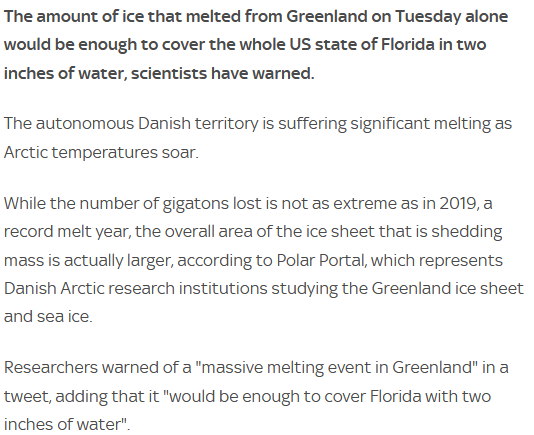
In fact, until this week Greenland had barely had a summer at all, with heavy snow meaning that the ice mass was way above average for the time of year. Even with the latest melt, the cumulative ice mass balance is still about a quarter above the 1981-2010 mean:

http://polarportal.dk/en/greenland/surface-conditions/
According to DMI, the grey band indicates:

http://polarportal.dk/en/greenland/surface-conditions/
In other words, anything within that grey band has happened at one time or another since 1981. There is therefore nothing unusual at all about the June 28th melt, and it certainly does not mean Florida will get flooded. It is something that happens every summer.
Melting of ice in Greenland, as well as the opposite, snowfall, is determined by the weather. Whereas the last two months have been dominated by low pressure, this week has seen high pressure take over. High pressure means plenty of sunshine, which in turn is what melts the ice. It has nothing to do with carbon dioxide.
Weather forecasts suggest high pressure will remain for a few more days, before giving way to low pressure and more snow:

BBC Forecast 30th June
With the end of Greenland’s melt season just a couple of weeks away, it looks as if we will end up with a pretty much average ice mass balance.
As for claims that the Arctic is warming three times faster than the global average, the Arctic has actually been colder than normal this summer. It is usually only during winter when Arctic temperatures are above normal, when of course it makes no difference whatsoever.
And so far this summer Arctic sea ice extent is doing what it always done at this time of year:


http://ocean.dmi.dk/arctic/index.uk.php
Yet every year, we get the same fraudsters out, trying to persuade the gullible public that the Arctic is melting down rapidly.
FBI Using the Same Fear Tactic From the First War on Terror: Orchestrating its Own Terrorism Plots
Questioning the FBI’s role in 1/6 was maligned by corporate media as deranged. But only ignorance about the FBI or a desire to deceive could produce such a reaction.
By Glenn Greenwald | July 24, 2021
The narrative that domestic anti-government extremism is the greatest threat to U.S. national security — the official position of the U.S. security state and the Biden administration — received its most potent boost in October 2020, less than one month before the 2020 presidential election. That was when the F.B.I. and Michigan state officials announced the arrest of thirteen people on terrorism, conspiracy and weapons charges, with six of them accused of participating in a plot to kidnap Michigan’s Democratic Governor Gretchen Whitmer, who had been a particular target of criticism from President Trump for her advocacy for harsh COVID lockdown measures.
The headlines that followed were dramatic and fear-inducing: “F.B.I. Says Michigan Anti-Government Group Plotted to Kidnap Gov. Gretchen Whitmer,” announced The New York Times. That same night, ABC News began its broadcast this way: “Tonight, we take you into a hidden world, a place authorities say gave birth to a violent domestic terror plot in Michigan — foiled by the FBI.”
Democrats and liberal journalists instantly seized on this storyline to spin a pre-election theme that was as extreme as it was predictable. Gov. Whitmer herself blamed Trump, claiming that the plotters “heard the president’s words not as a rebuke but as a rallying cry — as a call to action.” Rep. Maxine Waters (D-CA) claimed that “the president is a deranged lunatic and he’s inspired white supremacists to violence, the latest of which was a plot to kidnap Gov. Whitmer,” adding: “these groups have attempted to KILL many of us in recent years. They are following Trump’s lead.” Vox’s paid television-watcher and video-manipulator, Aaron Rupar, drew this inference: “Trump hasn’t commended the FBI for breaking up Whitmer kidnapping/murder plot because as always he doesn’t want to denounce his base.” Michael Moore called for Trump’s arrest for having incited the kidnapping plot against Gov. Whitmer. One viral tweet from a popular Democratic Party activist similarly declared: “Trump should be arrested for this plot to kidnap Governor Whitmer. There’s no doubt he inspired this terrorism.”
New York Governor Andrew Cuomo instantly declared it to be a terrorist attack on America: “We must condemn and call out the cowardly plot against Governor Whitmer for what it is: Domestic terrorism.” MSNBC’s social media star Kyle Griffin cast it as a coup attempt: “The FBI thwarted what they described as a plot to violently overthrow the government and kidnap Michigan Gov. Gretchen Whitmer.” CNN’s Jim Sciutto pronounced it “deeply alarming.”
A lengthy CNN article — dressed up as an investigative exposé that was little more than stenography of FBI messaging disseminated from behind a shield of anonymity — purported in the headline to take the reader “Inside the plot to kidnap Gov. Whitmer.” It claimed that it all began when angry discussions about COVID restrictions “spiraled into a terrorism plot, officials say, with Michigan Gov. Gretchen Whitmer the target of a kidnapping scheme.” CNN heralded the FBI’s use of informants and agents to break up the plot but depicted them as nothing more than passive bystanders reporting what the domestic terrorists were plotting:
The Watchmen had been flagged to the FBI in March, and one of its members was now an informant. That informant, others on the inside, as well as undercover operatives and recordings, allowed the bureau to monitor what was happening from then on.
The article never once hinted at let alone described the highly active role of these informants and agents themselves in encouraging and designing the plot. Instead, it depicted these anti-government activists as leading one another — on their own — to commit what CNN called “treason in a quaint town.” The more honest headline for this CNN article would have been: “Inside the FBI’s tale of the plot to kidnap Gov. Whitmer.” But since CNN never questions the FBI — they employ their top agents and operatives once they leave the bureau in order to disseminate their propaganda — this is what the country got from The Most Trusted Name in News:

Gov. Whitmer herself attempted to prolong the news cycle as much as possible, all but declaring herself off-limits from criticism by equating any critiques of her governance with incitement to terrorism. Appearing on Meet the Press two Sundays after the plot was revealed, Whitmer said it was “incredibly disturbing that the president of the United States—10 days after a plot to kidnap, put me on trial, and execute me, 10 days after that was uncovered—the president is at it again, and inspiring, and incentivizing, and inciting this kind of domestic terrorism.”
On October 22 — just two weeks before Election Day — MSNBC’s Rachel Maddow hosted Whitmer and told the Michigan Governor that the evidence was clear that Trump had been “turning on a faucet of violent threats” against her. Whitmer agreed that Trump was to blame for the kidnapping plot by having repeatedly attacked her in his rallies:
Joe Biden also made repeated use of this storyline. Appearing at a campaign rally in Michigan on October 16, the Democratic candidate blasted Trump for the crime of continuing to criticize Whitmer even after she was the target of a terror plot. He explicitly blamed Trump for having incited it: “When the president tweeted ‘Liberate Michigan, Liberate Michigan,’ that’s the call that was heard. That was the dog whistle.” And he accused Trump of purposely stoking a wave of the worst kind of terrorism on U.S. soil: “it’s the sort of behavior you might expect from ISIS,” he said of the accused.
Yet from the start, there were ample and potent reasons to distrust the FBI’s version of events. To begin with, FBI press releases are typically filled with lies, yet media outlets — due to some combination of excessive gullibility, an inability to learn lessons, or a desire to be deceived — continue to treat them as Gospel. For another, the majority of “terror plots” the FBI claimed to detect and break up during the first War on Terror were, in fact, plots manufactured, funded and driven by the FBI itself.
Indeed, the FBI has previously acknowledged that its own powers and budget depend on keeping Americans in fear of such attacks. Former FBI Assistant Director Thomas Fuentes, in a documentary called “The Newberg Sting” about a 2009 FBI arrest of four men on terrorism charges, uttered this extremely candid admission:
If you’re submitting budget proposals for a law enforcement agency, for an intelligence agency, you’re not going to submit the proposal that “We won the war on terror and everything’s great,” cuz the first thing that’s gonna happen is your budget’s gonna be cut in half. You know, it’s my opposite of Jesse Jackson’s ‘Keep Hope Alive’—it’s ‘Keep Fear Alive.’ Keep it alive.
In the Whitmer kidnapping case, the FBI’s own affidavit in support of the charges acknowledged the involvement in the plot of both informants and undercover FBI agents “over several months.”

Excerpt of FBI affidavit criminal complaint accompanying the criminal complaint in U.S. District Court against six defendants in the Whitmer plot
In sum, there was no way to avoid suspicions about the FBI’s crucial role in a plot like this absent extreme ignorance about the bureau’s behavior over the last two decades or an intentional desire to sow fear about right-wing extremists attacking Democratic Party officials one month before the 2020 presidential election. In fact, the signs of FBI involvement were there from the start for those who — unlike CNN — wanted to know the truth.
A report from the Detroit Free Press published just two days after CNN’s FBI stenography noted that the FBI agents were incapable of identifying any specifics of this supposed plot, adding that defense attorneys were adamant that those accused were merely engaged in idle chatter, boasting that they were never really serious about following through. Then the paper added that, for defense lawyers, “it remains to be seen what roles the undercover informants and FBI agents played in the case, and whether they pushed the others into carrying out the plan.” Meanwhile, an actually independent journalist, Michael Tracey, had no trouble identifying the telltale signs of FBI orchestration that were so apparent countless times during the first War on Terror. Three days before the CNN story, he wrote:

But the value of depicting Trump as having incited a frightening terrorist attack just weeks before the election, and the zeal to feed the broader narrative pushed by the U.S. security state that anti-government extremism is America’s greatest national security threat, drowned out any skepticism. The storyline was clear and unquestioned: Trump was inciting ISIS-like terrorism on U.S. soil and right-wing extremists, who would fester even after Trump was done, were the primary menace that requires new domestic powers and larger budgets in order to defeat.
Yet just as happened with so many other narratives — from the origins of COVID to Hunter Biden’s corrupt use of his ties to his father — Trump’s defeat means the media is now willing to reconsider some of the propaganda that was pushed in the lead-up to the election. An excellent piece of investigative journalism published by BuzzFeed on Tuesday documents that, far from being passive observers of the plot, FBI informants and agents were the key drivers of it:
An examination of the case by BuzzFeed News also reveals that some of those informants, acting under the direction of the FBI, played a far larger role than has previously been reported. Working in secret, they did more than just passively observe and report on the actions of the suspects. Instead, they had a hand in nearly every aspect of the alleged plot, starting with its inception. The extent of their involvement raises questions as to whether there would have even been a conspiracy without them.
So central to this plot were those acting at the behest of the FBI that many of the accused plotters only met each other because of meetings arranged at the direction of the FBI, who targeted them based on social media postings and other political activities that suggested anti-government and anti-Whitmer sentiments which could be exploited:
A longtime government informant from Wisconsin, for example, helped organize a series of meetings around the country where many of the alleged plotters first met one another and the earliest notions of a plan took root, some of those people say. The Wisconsin informant even paid for some hotel rooms and food as an incentive to get people to come.
One of the FBI’s informants, a former Iraq War soldier, “became so deeply enmeshed in a Michigan militant group that he rose to become its second-in-command.” With his leadership role in one of the key groups, and all while acting under the direction of the FBI, he was “encouraging members to collaborate with other potential suspects and paying for their transportation to meetings.” Indeed, he even “prodded the alleged mastermind of the kidnapping plot to advance his plan, then baited the trap that led to the arrest.”
A review of not only the BuzzFeed reporting but also the underlying court documents leaves little doubt that the primary impetus for this plot came over and over from the FBI. On July 12, a lawyer for one of the defendants filed a motion asking the court to compel the FBI to turn over all chats which their agents and informants involving the plot. He did so on the ground that the few chats they had obtained themselves — from their own clients — repeatedly show the FBI pushing and prodding its agents over and over to lure defendants into more meetings, to join in “recon” exercises, and to take as many steps as possible toward the plot.
While it was clear from the start that there were FBI informants and agents in the middle of all of this, it turns out that at least half of those involved were acting on FBI orders: twelve informants and agents. As BuzzFeed says, those acting at the behest of the FBI “had a hand in nearly every aspect of the alleged plot, starting with its inception.” All of that, concluded the reporters, “raises questions as to whether there would have even been a conspiracy without them.”
But this evidence does not so much raise that question as much as it answers it. The idea of kidnapping Gov. Whitmer came from the FBI. It was a plot designed by the agency, and they then went on the hunt to target people they believed they could manipulate into joining their plot — either people were easily manipulated due to psychological weakness, financial vulnerability, and/or their strongly held political views. In sum, the FBI devised this plot, was the primary organizer of it, funded it, purposely directed their targets to pose for incriminating pictures that they then released to the press, and then heaped praise on themselves for stopping what they themselves had created.
For anyone covering the FBI during the first War on Terror, none of this is new. So many of the supposed “terror plots” the FBI purported to disrupt over the last twenty years were — just like the Michigan plot — ones that were created and driven by, and would not have happened without, the FBI’s own planning, funding and direction.
Just as they are doing now, the FBI used those plots to elevate fear levels and justify more domestic surveillance power and funding for the U.S. security state. While the targets then were typically young American Muslims with anti-government views rather than young right-wing white men with anti-government views, the tactics were identical.
The examples are far too numerous to count. As one illustrative example, in 2015, the FBI flamboyantly praised itself for arresting three Brooklyn men on charges of “attempt and conspiracy to provide material support to the Islamic State of Iraq.” Then, as now, outlets such as The New York Times promoted the FBI’s maximalist-fear-mongering version of events: “3 Brooklyn Men Accused of Plot to Aid ISIS’ Fight,” blared the headline.
But even that largely pro-FBI Times article raised the question of whether this plot was real or manufactured by the bureau:
The case against the three men relies in part on a confidential informant paid by the government, court documents show. Defense lawyers have criticized the government’s use of informers in similar cases, saying they may lure targets into making extreme plans or statements. In some cases, the threat has turned out to be overstated.
And the FBI itself admitted that the “threats of violence” from the three arrested — such as killing President Obama — “had an ‘aspirational’ quality to them, with no indication that the suspects were close to staging an attack, large or small.” The Times article also noted that the FBI observed that “in online postings, the two younger men seem to be searching for meaning in their lives,” adding that “as they were led into court, the youthfulness of Mr. Juraboev and Mr. Saidakhmetov was striking.”
Analyzing all the evidence in this case, my then-colleague at The Intercept Murtaza Hussain documented “the integral role a paid informant appears to have played in generating the charges against the men, and helping turn a fantastical ‘plot’ into something even remotely tangible.” Indeed, he wrote, “none of the three men was in any condition to travel or support the Islamic State, without help from the FBI informant.” It was only when the FBI sent an older Muslim man to gain their trust — acting as an FBI informant and being paid for his services — did anything resembling a crime start to form. The paid FBI informant encouraged the young men to pursue the plan more concretely, and only then did they begin agreeing with the informant’s proposed plot. The informant befriended them, moved in with them, and spent months “convincing both of them that he intended to travel to Syria and join Islamic State.”
Just as was true in the Michigan case, Hussain wrote about this arrest: “Crucially, it appears that only after the introduction of the informant did any actual arrangements to commit a criminal act come into existence.” In sum, “the covert informant under the direction of the FBI” — which employs teams of psychologists and other mental health professions who are experts in how to manipulate people’s thinking — “evidently helped encourage the two toward terrorism over the course of these months.”

Article by Murtaza Hussain of The Intercept, Feb. 20, 2015
I have also covered countless other FBI plots over the years where all the same attributes were present. After the 2015 “ISIS arrest,” I wrote an article compiling how often the FBI was doing this and asked this question in the headline: “Why Does the FBI Have to Manufacture its Own Plots if Terrorism and ISIS Are Such Grave Threats?,” noting that the bureau’s behavior “is akin to having the DEA constantly warn of the severe threat posed by drug addiction while it simultaneously uses pushers on its payroll to deliberately get people hooked on drugs so that they can arrest the addicts they’ve created and thus justify their own warnings and budgets.”
Months before the 2015 ISIS arrests, the FBI issued a press release praising itself for arresting “a Cincinnati-area man for a plot to attack the U.S. Capitol and kill government officials.” But as I reported, the scary terrorist was “20-year-old Christopher Cornell, [who] is unemployed, lives at home, spends most of his time playing video games in his bedroom, still addresses his mother as ‘Mommy’ and regards his cat as his best friend; he was described as ‘a typical student’ and ‘quiet but not overly reserved’ by the principal of the local high school he graduated in 2012.”
Then House Speaker John Boehner immediately seized on that arrest to warn Americans to be afraid: “We live in a dangerous country, and we get reminded every week of the dangers that are out there.” Boehner also told Americans they should be grateful for domestic surveillance and not try to curb it: the Speaker claimed that “the National Security Agency’s snooping powers helped stop a plot to attack the Capitol and that his colleagues need to keep that in mind as they debate whether to renew the law that allows the government to collect bulk information from its citizens.” Yet the only way Cornell got close to any crimes was because the FBI informant began suggesting to him that he act on his rage against U.S. officials by attacking the Capitol.
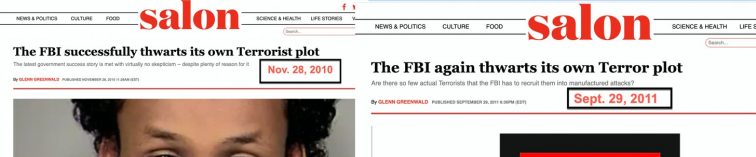
Salon articles of my reporting on FBI’s creation of terror plots it “stops”: Nov. 28, 2010 and Sep. 29, 2011
One of the most egregious cases I covered was the 2011 arrest of James Cromitie, an African-American convert to Islam who the FBI attempted to convince — over the course of eight months — to join a terror plot, only for him to adamantly refuse over and over. Only once they dangled a payment of $250,000 in front of his nose right after the impoverished American had lost his job did he agree to join, and then the FBI swooped in, arrested him, and touted their heroic efforts in stopping a terrorist plot.
The U.S. federal judge who sentenced Cromitie to decades in prison, Colleen McMahon, said she did so only because the law of “entrapment” is so narrow that it is virtually impossible for a defendant to win, but in doing so, she repeatedly condemned the FBI in the harshest terms for single-handedly converting Cromitie from a helpless but resentful anti-government fanatic into a criminal. The defendant “was incapable of committing an act of terrorism on his own,” she said, adding: “only the government could have made a terrorist out of Mr. Cromitie, whose buffoonery is positively Shakespearean in scope.” She added: “There is not the slightest doubt in my mind that James Cromitie could never have dreamed up the scenario in which he actually became involved.”
Her written ruling is worth quoting at length because of how relevant it is to current FBI activities. The judge began by noting that Cromitie “had successfully resisted going too far for eight months,” and agreed only after “the Government dangled what had to be almost irresistible temptation in front of an impoverished man from what I have come (after literally dozens of cases) to view as the saddest and most dysfunctional community in the Southern District of New York.” It was the FBI’s own informant, she wrote, who “was the prime mover and instigator of all the criminal activity that occurred.” She then wrote (emphasis added):
The Government indisputably “manufactured” the crimes of which defendants stand convicted. The Government invented all of the details of the scheme – many of them, such as the trip to Connecticut and the inclusion of Stewart AFB as a target, for specific legal purposes of which the defendants could not possibly have been aware (the former gave rise to federal jurisdiction and the latter mandated a twenty-five year minimum sentence). The Government selected the targets. The Government designed and built the phony ordnance that the defendants planted (or planned to plant) at Government-selected targets. The Government provided every item used in the plot: cameras, cell phones, cars, maps and even a gun. The Government did all the driving (as none of the defendants had a car or a driver’s license). The Government funded the entire project. And the Government, through its agent, offered the defendants large sums of money, contingent on their participation in the heinous scheme.
Additionally, before deciding that the defendants (particularly Cromitie, who was in their sights for nine months) presented any real danger, the Government appears to have done minimal due diligence, relying instead on reports from its Confidential Informant, who passed on information about Cromitie information that could easily have been verified (or not verified, since much of it was untrue), but that no one thought it necessary to check before offering a jihadist opportunity to a man who had no contact with any extremist groups and no history of anything other than drug crimes.
One of the reporters who has most extensively covered the FBI’s role in manufacturing terrorism cases it then proceeds to “break up” is Trevor Aaronson. In 2011, he documented, working with the Investigative Reporting Program at the University of California-Berkeley, that of 508 post-9/11 terrorism defendants, “nearly half the prosecutions involved the use of informants, many of them incentivized by money.” After 9/11, the FBI’s budget-increasing, power-enhancing strategy was to target “tens of thousands of law-abiding people, seeking to identify those disgruntled few who might participate in a plot given the means and the opportunity” by monitoring their social media postings, and “then, in case after case, the government provides the plot, the means, and the opportunity.” Of the terrorism arrests from sting operations, almost 1/3 were ones in which “defendants participated in plots led by an agent provocateur—an FBI operative instigating terrorist action.”
It is this long history and mountain of evidence that compels an investigation into the role played by the FBI in the planning of the 1/6 riot at the Capitol. And it is that same evidence that made the corporate media’s derisive reaction to such demands — as voiced by Darren Beattie’s Revolver News, Fox News’ Tucker Carlson and myself — so ignorant and subservient. They acted as if only some unhinged conspiracy theorist could possibly believe that the FBI would have informants and agents embedded in the groups that planned that Capitol riot rather than what it is: the only logical conclusion for anyone who knows how the FBI actually behaves.
Indeed, the BuzzFeed reporters who investigated the FBI’s key role in the Michigan case must have been very disturbed by what they found since they used their reporting to raise that taboo topic: what role did the FBI have in 1/6? Moreover, they asked, is this yet another era where the FBI is targeting Americans not for criminality but for their political views, and then orchestrating their own plots that justify the U.S. security state’s massive budget and unlimited powers?
Instead, [the accused] say, they were targeted because of their political views. Some describe the case as a premeditated campaign by the government to undermine the Patriot movement, an ideology based on fealty to the Second Amendment and the conviction that the government has violated the Constitution and is therefore illegitimate. They argue that the recordings and text messages that the government calls proof of a criminal conspiracy are in fact constitutionally protected speech — expressions of frustration at what they see as the government’s betrayal of its citizens.
The Michigan case is unfolding at another fraught moment in American history. In court, the government has drawn a direct line between the alleged kidnapping plot and the Jan. 6 insurrection, holding up the storming of the US Capitol as evidence that the Michigan defendants posed a profound threat. . . . [I]f the defense is able to undermine the methods used to build the Michigan case, it could add weight to the theory that the administration is conducting a witch hunt against militant groups — and, by extension, that the Jan. 6 insurrection was a black op engineered by the FBI.
When Carlson raised these same questions on his Fox program, he did what I did when doing so: cited my reporting as well as Trevor Aaronson’s about the FBI’s long history of orchestrating such plots and luring people into them using informants and undercover agents. Much of that reporting about the FBI’s tactics was published by The Intercept, which — when aimed at American Muslims during the First War on Terror — had an editorial view that it was extremely improper and dangerous for the FBI to do this. But now that it is being done to American anti-government activists on the right, the site’s liberal editors seem happy about it. They got Aaronson to write an article under the headline “Tucker Carlson Distorted My Reporting in His Latest Jan. 6 Conspiracy Theory.”
But that headline was an absolute lie. There was nothing in Aaronson’s article that pointed to any “distortions” in how Carlson (or I) cited Aaronson’s work. To the contrary, Aaronson himself acknowledged that the FBI’s past history — including in the Whitmer case — made such questions highly rational and necessary:
In many of these stings, informants or undercover agents provided all the money and weapons for terrorist plots, and sometimes even the ideas — raising significant questions about whether any of these people would have committed the crimes were it not for the FBI’s encouragement. Many targets of these FBI stings were mentally ill or otherwise easily manipulated. . . .
Carlson’s claim fits an existing and well-established argument: that the FBI creates crimes through aggressive stings where no crimes would otherwise exist. . . . I think it’s worth noting that there’s a reason for the cultural stickiness of the claim by Revolver and Carlson. It might be a conspiracy theory, but it’s not exactly “baseless,” as the Post described it. That’s because there are genuine concerns that the sting tactics used over the past two decades against impressionable Muslims will be used against equally impressionable Americans with right-wing ideologies. In the supposed plot to kidnap Michigan Gov. Gretchen Whitmer, for example, FBI agents and an informant played significant roles, raising the same question that surrounds so many supposed Islamic State and Al Qaeda cases in the United States: Would this plot have happened were it not for the FBI?
In addition, there is evidence the FBI is assigning informants to infiltrate groups based solely on right-wing ideology. And the increase in right-wing violence in recent years has prompted calls for new anti-terorrism laws that would give the FBI even more power.
I think the FBI’s investigation of potential right-wing threats, and the degree to which the bureau replicates its abusive post-9/11 tactics, will be a critically important story in the coming years. How news organizations report on it will be a significant test.
While Aaronson insists that no proof has yet been presented that the FBI had foreknowledge of the 1/6 plot or encouraged it to happen, and also seized on a minor error in the Revolver News article originally raising these questions about “confidential informants” — an error I noted in my own article about this topic while explaining that it was ancillary and insignificant to the overall question — Aaronson’s article has far more in common with the primary theme raised by Carlson than it does arguments that Carlson “distorted” anything. In particular, Aaronson writes, the FBI’s ample history requires a serious investigation into the role it may have played in knowing about and/or encouraging the 1/6 plotters.
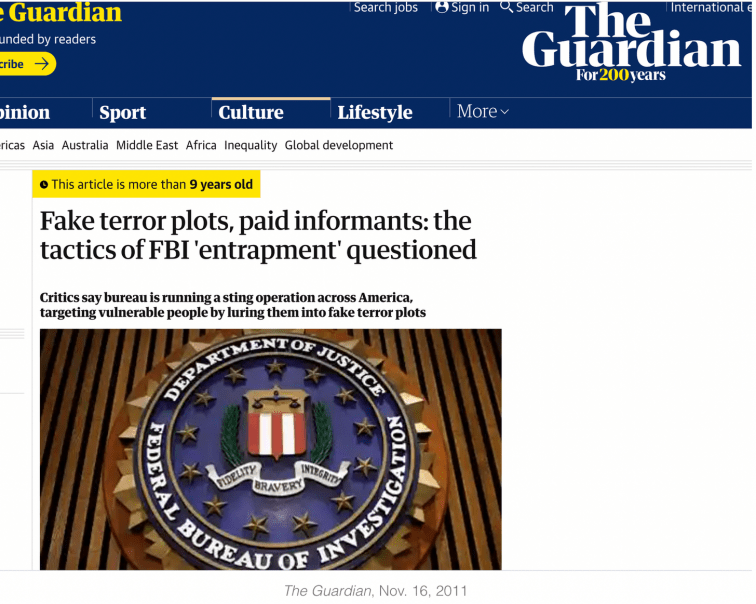
As I documented in my own reporting on this question, there is ample evidence to believe that the FBI had informants embedded in at least two of three key groups it says were behind the 1/6 Capitol riot. As I noted at the time, most of the corporate press spewed contempt and scorn on these questions because 1/6 has become an event that carries virtually religious importance to them, and their reverence for the U.S. security state makes them resistant to any suggestions that the FBI may have acted deceitfully — an utterly bizarre mindset for U.S. journalists to possess. But such is the state of the liberal sector of the corporate press today.
Now that one of their own liberal members in good standing — BuzzFeed — has not only proven the FBI’s key role in the Whitmer plot but also themselves suggested that it makes more plausible the bureau’s involvement in 1/6, these questions are becoming increasingly unavoidable. Both the Whitmer plot and especially 1/6 are absolutely crucial to everything that has happened since: the launch of the new War on Terror, billions more in funds for the security state, proposals for greater surveillance, Biden’s use of the intelligence community to insist that anti-government activists constitute the greatest threat to U.S. national security. Asking what role the FBI played in the episode at the Capitol is not only rational but imperative.
British Disinfo Machine Out of Whack: The Guardian’s Trump-Russia ‘Bombshell’ Reeks of Forgery
By Ekaterina Blinova – Sputnik – 22.07.2021
The Guardian’s latest “bombshell” story about how President Vladimir Putin ordered Russian spies at a closed session of the National Security Council to use “all possible force” to make Donald Trump win in 2016 has not got as much media attention as it was apparently planned.
The article written, by Luke Harding, Dan Sabbagh, and Julian Borger appeared on The Guardian’s website on 15 July at 10:00 GMT. Another op-ed on the matter with a byline containing only Harding and Sabbagh was published on the same day at 17:05 GMT. The news was also advertised in the website’s First Thing section on 15 and 16 July and yet, surprisingly, just a “few Western mainstream media outlets have written or reported on what they were all speculating and salivating about for all four years of the Trump presidency”, notes Mark Sleboda, a US military veteran and international affairs and security analyst.
Still, there’s an obvious explanation why the MSM has not taken the bait: the so-called “leak” smacks of an obvious bunk, according to the analyst, who outlines some obvious discrepancies in The Guardian’s “exposé”:
First, it’s absolutely unclear how the supposed “leaked docs” ended up in The Guardian’s hands: there is no chain of custody or explanation at all.
Second, despite The Guardian’s claims that Western intelligence agencies have had these documents for months, no Western government or intelligence agency, neither the British nor the Americans, has so much as made a comment or peep about it.
Third, almost universally native Russian speakers have noticed and called out numerous incidences of lexical awkwardness and mistakes in the snippets, suggesting that the text was written by a non-native Russian speaker with limited cultural fluency.
Fourth, the Russian National Security Council is a formal political body which is not designed for discussing sensitive clandestine operations.
Fifth, the President’s Expert Directorate headed by economist Vladimir Simonenko – named by The Guardian as the apparent author of the grand design to take over the US elections – in fact deals entirely with domestic matters, including the financing of the president and the presidential administration’s activities, as well as collecting, analysing and preparing materials for the president’s annual addresses.
Sixth, the alleged secret meeting took place in January 2016 when Donald Trump was not even considered as a serious presidential candidate, let alone the Republican nominee.
Seventh, the article is riddled with hedging words and expressions, papers “appear to show”, “documents suggest”, “assessed to be”, etc., as if the authors knew that they were peddling disinformation.
The Guardian report “reeks of disinformation operation”, former Director of Cybersecurity and Infrastructure Security Agency Chris Krebs remarked on 15 July. Krebs echoes another cybersecurity expert, Thomas Rid of John Hopkins University, who listed a series of issues with the “Kremlin leak” in a Twitter thread.
Many more former Western intelligence operatives and experts publicly questioned the documents’ veracity in both media and social media, including Director of Russian Studies at CNA Michael Kofman, former Information Security Specialist for GCHQ Matt Tait, and former US NSC staff Gavin Wilde.
Even Dmitri Alperovitch, a co-founder and former CTO of Crowdstrike, who groundlessly blamed “Russian hackers” for breaching DNC servers back in 2016, has weighed in, dismissing the “leak” as forgery.
What’s Behind the ‘Kremlin Leak’ Story?
On the surface, the “leak” appears to confirm practically every Russiagate fantasy and makes an oblique reference to unspecified “kompromat” on Trump – an apparent reference to ex-MI6 agent Christopher Steele’s “dirty dossier” on the then presidential candidate and his campaign, Sleboda points out.
The analyst highlights that one of the authors of The Guardian’s latest exposé – Luke Harding – has long been an ardent adept of the Steele dossier, despite the ex-British spook’s bizarre claims having neither been corroborated nor confirmed by Special Counsel Robert Mueller’s Trump-Russia investigation.
“There seems a likely possibility that these new ‘Kremlin documents’ like the previous Steele dossiers, were fabricated by British intelligence or elements within it, for the same purposes of discrediting Trump and preventing any, even faint, detente in US-Russian relations, whether under Trump or Biden”, suggests Sleboda.
The UK has played a special role in the Trump-Russia story: “There has long been a widely held belief by many because of the prominence of the Steele dossier during the whole Russigate episode that there was a significant degree of the British tail wagging the US political dog”, the analyst says.
Four years ago, Harding claimed that the UK intelligence service GCHQ became aware of “suspicious ‘interactions’ between figures connected to Trump and known or suspected Russian agents” as early as in 2015, well before their American counterparts. Citing unnamed sources in the UK intelligence community, the journalist presumed that British and EU spies collected information on Trump between late 2015 and summer 2016.
“It is understood that GCHQ was at no point carrying out a targeted operation against Trump or his team or proactively seeking information”, Harding asserted on 13 April 2017. “The alleged conversations were picked up by chance as part of routine surveillance of Russian intelligence assets”.
Furthermore, “[Harding] has previously claimed in The Guardian that British intelligence and Foreign Office was given the Steele dossier before it was sent to the United States and vouched for Steele’s ‘credibility’ in reference to it”, Sleboda remarks.
In 2021 alone, the British media has published a number of articles in support of Steele’s debunked narrative:
· in January, The Guardian ran an outlandish story of Trump being “cultivated” by the Soviet KGB for 40 years;
· in May, The Telegraph broke a story about a “second dossier” written by Steele during Trump’s presidency;
· four days prior to Harding’s “bombshell”, Guardian contributor Charles Kaiser tried to rehabilitate at least part of Steele’s “dirty dossier”, alleging that Trump aide Carter Page may have struck a lucrative deal with Russia’s Rosneft, something that wasn’t confirmed by Special Counsel Robert Mueller’s investigation.
The fact that Steele’s story is being kept alive in the British media would seem to indicate that the UK establishment is still backing Steele’s anti-Trump/anti-Russia disinformation campaign, the security analyst believes.
If the “Kremlin documents” were indeed deliberately planted by the UK intelligence elements to target Trump’s potential 2024 election bid as well as US-Russia relations under Biden, this is “an extremely important and dangerous situation”, according to Sleboda.
“It would mean that the British government and/or intelligence have repeatedly conducted active measures to manipulate and interfere in both US domestic elections and foreign policy, destabilising the US political system domestically and putting the entire world at risk by deliberately increasing tensions between the world’s two foremost nuclear armed powers”, he says. “There will likely be no investigation or accountability into this latest Guardian piece of disinformation about Russia in the Western MSM but there most certainly should and desperately needs to be one”.
Keir Starmer Is Self-Isolating Now. I Call Bullshit
By Richie Allen | July 21, 2021
Labour Party leader Keir Starmer has gone home to self-isolate this afternoon. The media has been told that one of his children has tested positive for covid.
According to the BBC:
A statement from his office said one of his children tested positive at lunchtime, but Sir Keir was doing daily tests and tested negative this morning.
Sir Keir was in the House of Commons for PMQs earlier. The PM and chancellor are also self-isolating after contact with the health secretary who tested positive.
This is the fourth time Sir Keir has had to self-isolate since the pandemic began. His spokesman said his family will also be self-isolating.
I’ve no proof whatsoever, but I call bullshit. The media has spent much of the past 48 hours discussing the NHS app and “pingdemic.” Millions of people have been pinged by the app and told to go home and isolate. It’s led to total chaos.
Business owners are tearing their hair out as staff shortages threaten the post-lockdown economic bounce. There are widespread reports that millions of younger people are deleting the app from their phones. Nobody wants to be forced into isolation, especially at this time of year.
The managers of the scamdemic, the entire political class and the media, are horrified that so many are deleting the wretched app. Maybe Johnson, Health Secretary Sajid Javid and Labour leader Keir Starmer have been sent to self-isolate to set an example.
You’d be well within your rights to ask me why. Because chaos is their desired outcome. They want to destroy the economy and cause a shortage of food and other products. They want to bankrupt businesses. They want to bankrupt you. Chaos is the plan.
Ordo Ab Chao. Order out of chaos. All roads lead to The World Economic Forum’s Great Reset. The people will only accept it when their worlds are turned upside-down.
The public is being manipulated 24/7 by the political class and the media working in tandem. They want you in a perpetual state of agitation and confusion. You become even more suggestible while in that low vibrational state.
There’s no covid now. There’s no threat if there ever was one. People should not be taking instructions from their phones to drop everything and rush home to isolate. It’s tyranny. People seem to be wising up to it and ditching the app. It’s about bloody time.
How convenient then, that the PM and the leader of the opposition party should be pinged and sent home, while at the same time the media is attacking anyone who suggests it’s time to move on and get on with our lives.
The BBC vs Donald Trump
By Freddie Attenborough | The Daily Sceptic | July 19, 2021
In March 2021, the BBC reported that one of their investigative teams had, “Been tracking the human toll of coronavirus misinformation”. During this investigation they claimed to have found links to “assaults, arsons and deaths”. Worryingly, experts also told them that, “The potential for indirect harm caused by rumours, conspiracy theories and bad health information could be much worse”. Sounds like an interesting investigation, doesn’t it? Public service output at its finest, you might think. Just the kind of article we’d all like to read.
Alas. Not quite.
The problem with the BBC is that it simply can’t help itself. Having teed an ostensibly interesting story up in this open, investigatory journalistic type of way, its authors then proceed to devote a good-ish chunk of what follows to that most favourite of all BBC pastimes, namely, implicating Donald Trump in the act of mass murder. As with the butterfly so beloved of chaos theory (you know the one: that little blighter who’s always flapping his wings and causing tsunamis to crash into the coast of Bangladesh) no sooner have the BBC shown us Trump tweeting about the FDA’s preliminary research into hydroxychloroquine as a prophylactic against Covid than the magic of non-deterministic linear physics kicks in and people all over Nigeria and Vietnam suddenly start mopping up the old bleach-based products like vacuum cleaners.
In the end, then, the only interesting thing about this article is the way it reminds us just how little time and attention the BBC have paid to exploring the link that surely must exist between Covid ‘misinformation’ (as they themselves insist on calling it) and the huge rise in cases of psychosomatic disorder – health anxiety in particular – that we’ve witnessed in the UK since the dawn of the Age of Lockdown (2020-present). Let me explain what I mean.
And to do so, let me start by asking a question: what might disinformation likely to precipitate new, or to heighten existing, levels of anxiety amongst those suffering from psychosomatic disorders look like? How, in other words, might we define such a thing? Well, perhaps we might say that it would be information that unduly exaggerated the risks associated with Covid. Perhaps we might go further and say that it would represent the risks associated with Covid in a highly misleading and/or a sensationalist way. Come to think of it, perhaps we might end up concluding that it would look rather like the BBC’s recent article, ‘Long COVID funding to unearth new treatments.’ Below is the thumbnail picture accompanying the piece.
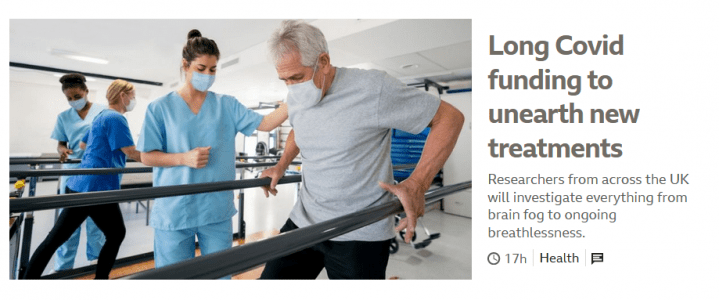
As you can see, it depicts two masked patients, chaperoned by two masked nurses, who look unmistakably like they’re having to learn how to walk again. (And by the way, anyone who’s going to counter that it could just as plausibly be a depiction of two patients being tested for, say, oxygen carrying capacity or pulse rate during recovery from a respiratory illness like Covid would need to explain to me why it is that neither patient is shown to be wearing any tracking/monitoring equipment, and, in addition, why neither nurse is shown to be holding/studying any data monitors). The male patient in the foreground of the image looks particularly unsteady on his feet, relying heavily on the metal frame surrounding him for bodily support. One of the masked nurses stands next to him, watching his legs and feet intently, presumably scanning for any warning signs of imminent collapse or a stumble. Her right arm is stretching out towards him, and no doubt a guiding/supportive hand is resting on the patient’s shoulder. Just behind the male patient, you can also see the lower half of the wheelchair in which he will have been brought from his hospital ward and into this rehabilitation class.
But if that’s what it shows, then what kind of patient might actually need rehabilitation of this kind; rehabilitation, that is, in which patients are having to learn how to walk again? It’s the type of thing that you’d imagine is normally reserved for patients needing post-surgery rehabilitation; patients who’ve suffered spinal cord injuries, neurological disorders, car-crashes, amputations and the like. That’s big league, serious stuff. We’re essentially talking about a type of rehabilitative treatment for people who’re on the cusp of, or who’re already suffering from, life-changing injuries/illnesses.
So is this the type of treatment that people suffering from Long Covid are likely to need? I ask because as we’ve already established, it’s the type of treatment that’s depicted in the image the BBC have attached to an article entitled, “Long Covid funding to unearth new treatments” the first paragraph of which reads: “Thousands of people with ‘long Covid’ could benefit from the funding of 15 new studies of the condition, its causes and potential treatments”. To help us on the way towards answering this question, here’s what the NHS guide to the symptoms currently associated with ‘Long Covid’ has to say for itself:
Common Long Covid symptoms include:
- extreme tiredness (fatigue)
- shortness of breath
- chest pain or tightness
- problems with memory and concentration (‘brain fog’)
- difficulty sleeping (insomnia)
- heart palpitations
- dizziness
- pins and needles
- joint pain
- depression and anxiety
- tinnitus, earaches
- feeling sick, diarrhoea, stomach aches, loss of appetite
- a high temperature, cough, headaches, sore throat, changes to sense of smell or taste
- rashes
Now I’m no doctor, admittedly, but I’m not entirely satisfied that a programme of rehabilitative walking usually reserved for wheelchair bound patients in post-surgery recovery is going to prove particularly efficacious when it comes to the treatment of long Covid patients with earache, diarrhoea and changes of smell or taste. In fact, I’m not satisfied at all.
Indeed it rather seems to me that the BBC’s choice of image, when considered as an accompaniment to this particular article, might justifiably be described as misinformation; that is, as information that unduly exaggerates the risks associated with long Covid in a highly misleading or a sensationalist way.
By the way, do you like my definition of misinformation? Thanks. Perhaps it might interest you, then, to know it’s culled from the BBC’s own editorial guidelines. Specifically, therein we find “Section 3, Accuracy”, and, more particularly, “Sub-section 3.3.24”, which states that, “Reconstructions [which this image undeniably is] are when events are quite explicitly re-staged”, and that in order to abide by the BBC’s editorial guidelines, “They should normally be based on a substantial and verifiable body of evidence… [and they] should not overdramatise in a misleading or sensationalist way”.
On this basis, then, is it not the case that the BBC’s own reality-check team, that bastion of fairness and impartiality in a world gone wrong, should hold the organisation to account for spreading long Covid misinformation? Is it not an article that exaggerates and sensationalises the effects of long Covid? Further, is it not likely to generate additional, or indeed to heighten existing cases of, psychosomatic health disorders in the U.K.?
I guess if you’re the type of person who’s already suffering from heightened worry about your health, about lockdown, about physical contact with others, about viruses, about disease; I guess if you surf the web but never really read anything carefully; if you scan the thumbnails on the BBC’s news homepage but never click through to the articles; if you look at an article’s opening image and then only scan the first two or three paragraphs of text thereafter… then I guess, absolutely, it might indeed be considered ‘misinformation.’
“But isn’t this all just a little pedantic?” I hear you ask. “A bit nit-picky?” Oh, absolutely. And doesn’t it feel good to be playing the BBC at their own game for a change. So good, in fact, that you really must forgive me. I’m enjoying myself so much that I’m going to continue to be pedantic for a little while yet.
Because you see I guess, too, that if you’re prone to experiencing psychosomatic disorders of one kind of another, if you’re already well-known to your local GP surgery and A&E, then it might panic you quite a bit to think that the image the BBC have chosen to use here depicts a fate that might lie in store for you too if you ever contracted Covid and then experienced Long Covid. I guess too that if you’re that way inclined, then you might even feel you needed to take the vaccine, any vaccine, right this minute, no questions asked, jab jab jab, please, put it in me doctor, oh God, put it in me… and to hell with any kind of informed consent.
Jabbed or not, if you’re that way inclined then I guess you might nevertheless see that picture, that image of the Long Covid patient struggling to walk in the BBC’s article, and then, at some point later, get around to thinking that you’re experiencing the symptoms of Long Covid, that you’re really ill, that you’re dying, that you’re in need of immediate and very urgent medical attention, that you’ve got to go to A&E immediately because you might end up in a wheelchair unable to walk; I guess, too, that you might see that picture and then end up yo-yo-ing in and out of the healthcare system for the rest of your life, costing the taxpayer money, wasting valuable medical time, worrying that there’s a direct line of causality that “the science” has established between you coughing, you sneezing and you ending up in hospital needing a wheelchair to get you to your rehabilitative walking therapy sessions.
It’s strange, isn’t it? I mean, the BBC is normally so keen, so eager, to castigate others for disseminating what they’ve decreed to be Covid misinformation capable of causing or exacerbating existing physical disorders. Yet in the case of psychosomatic disorders – i.e. panic, hyperventilating, health anxiety, generalised anxiety, hypertension, depression, chills, gastrointestinal disturbances – they’re curiously reluctant to take up those same sanctimonious ‘fact-checking’ cudgels.
It’s a reluctance that matters, though, isn’t it? The sad and unfortunate thing about psychosomatic disorders is that those suffering from them are more likely than almost any other group in society to place unnecessary pressure on the NHS. After all, if you’re worried that you’re seriously unwell and/or in imminent danger of dying, where’s the first place you’re going to go? That’s right: a primary or secondary healthcare provider. The problem, of course, is that people who suffer from those types of disorders are neither seriously ill nor in imminent danger of dying. What they ‘are’ is suffering from severe anxiety. That’s not nothing, of course; but it’s hardly first responder or A&E type stuff, is it?
That this might constitute a problem during a global pandemic of a mild respiratory illness in which we’ve all been told to put our lives, businesses, careers on hold because the NHS is under massive existential pressure, seems obvious. If the NHS is already clogged up with respiratory tract illness and you then go and add a whole bunch of psychosomatic patients to the mix… well, you’ve got a problem, haven’t you? You’d think the BBC would care about that sort of thing, particularly given the pious, reverent tone it normally adopts when it’s representing the NHS. You’d think they’d want to provide balanced, calm, rational reportage of what was going on; reportage that was clear about the extremely low risk Covid poses to the vast majority of people in this country.
I wonder. Could it be that if we were to widen the scope of the concept of ‘misinformation’ to include not only information capable of causing physical harm, but also that likely to cause psychosomatic harm, we’d be forced to conclude that the BBC, with all its Covid exaggerations, its hyperbole, its uncritical, unreflexive treatment of “the science” handed down to it by SAGE, its failure to hold the Government to account, to approach statistics sceptically, to put case numbers into perspective, its obsession with filming death porn reports from inside hospitals (etc etc)… if we were to consider all of that as misinformation too, might we not end up concluding that the BBC has done as much damage to the psychological health and wellbeing of the nation it purports to inform, educate and entertain as Donald Trump ever did with his tweety-tweety chit-chat about preliminary research into hydroxychloroquine as a prophylactic against Covid? I wonder indeed.
Dr Freddie Attenborough is a former academic. You can see his substack account here.
RUSSIAGATE: Luke Harding’s Hard Sell
By Joe Lauria | Consortium News | July 17, 2021
Luke Harding of The Guardian on Thursday came out with a new story that looks at first glance like an attempt to rescue the Russiagate story and the reputations of Harding and U.S. intelligence.
The headline reads, “Kremlin papers appear to show Putin’s plot to put Trump in White House” with the subhead: “Exclusive: Documents suggest Russia launched secret multi-agency effort to interfere in US democracy.”
Harding’s report says that during a Jan. 22, 2016 closed session of the Russian national security council, President Vladimir Putin ordered Russian spies to back a “mentally unstable” Donald Trump for the White House to “help secure Moscow’s strategic objectives, among them ‘social turmoil’ in the US.”
“Russia’s three spy agencies were ordered to find practical ways to support Trump, in a decree appearing to bear Putin’s signature,” Harding writes. “A report prepared by Putin’s expert department recommended Moscow use ‘all possible force’ to ensure a Trump victory.”
The article, starting with the headline, is littered with the use of qualifiers such as “appears,” “suggests,” “apparent,” and “seems.” Such qualifiers tell the reader that even the newspaper is not sure whether to believe its own story.
Quoting from what he says is an authentic document marked “secret,” Harding writes that there is “apparent confirmation” that the Kremlin had dirt on Trump it could use to blackmail him, gathered during earlier Trump “‘non-official visits to Russian Federation territory.’”
This would seem to confirm a central part of the so-called Steele dossier, which Harding hawked in his bestselling book Collusion.
Harding’s newest story though says nothing about the involvement of Trump operatives with this Kremlin plot, as that was unfounded by Special Counsel Robert Mueller’s report.
Harding also suggests that the documents that came into his possession provides evidence of a Russian hack of Democratic National Committee computers.
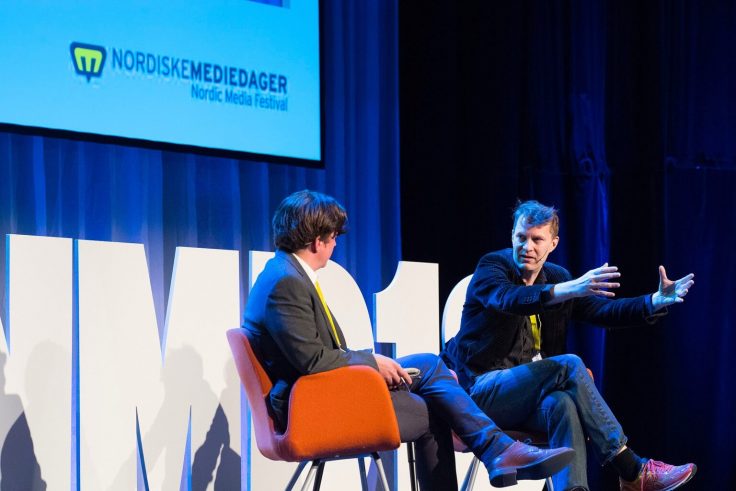
Harding at the Nordic Media Festival, 2018. (Thor Brødreskift / Nordiske Mediedager/ Wikimedia Commons)
He writes:
“After the meeting, according to a separate leaked document, Putin issued a decree setting up a new and secret interdepartmental commission. Its urgent task was to realise the goals set out in the ‘special part’ of document No 32-04 \ vd. …
The defence minister was instructed to coordinate the work of subdivisions and services. [Sergei] Shoigu was also responsible for collecting and systematising necessary information and for “preparing measures to act on the information environment of the object” – a command, it seems, to hack sensitive American cyber-targets identified by the SVR. …
The papers appear to set out a route map for what actually happened in 2016.
A matter of weeks after the security council meeting, GRU hackers raided the servers of the Democratic National Committee (DNC) and subsequently released thousands of private emails in an attempt to hurt Clinton’s election campaign.”
These documents would perfectly confirm the story put out by U.S. intelligence and an eager Democratic media: that Russia’s defense intelligence agency GRU hacked the DNC and Russia leaked DNC emails to damage Hillary Clinton.
Except that Shawn Henry, the head of the company CrowdStrike hired by the Democratic Party and the Clinton campaign (while keeping the FBI away) to examine the DNC servers declared under oath to the House Intelligence Committee that no evidence of a hack was discovered. “It appears it was set up to be exfiltrated, but we just don’t have the evidence that says it actually left,” Henry told the committee.
WikiLeaks, which Harding doesn’t mention, has also denied getting the DNC material from Russia that Harding says was released by Moscow. And Harding ignores the true contents of the emails.
Dmitri Peskov, Putin’s spokesman, told The Guardian the story was “great pulp fiction.”
Let’s look at the motives of the players involved in this story.
Harding’s Motives
Henry’s denial of a hack and Mueller’s inability to prove Collusion, embarrassed Harding after he staked his reputation on his bestseller of that name. The book is essentially the story of Christopher Steele, the ex-MI6 agent, who was paid by the DNC and the Clinton campaign to come up with opposition research against Trump.
Harding, like the Democratic media establishment, mistook opposition research, a mix of fact and fiction to smear a political opponent, for an intelligence document paid for by taxpayers, presumably in the interests of protecting the country rather than a political candidate. Of course, the FBI and the CIA sold it to the media as such to undermine the other candidate.
Harding has had a major omelet on his face after the Russiagate tale was ultimately exposed as opposition research paid for by the Democrats, who elevated it to a new Pearl Harbor.
Now I will engage in qualifiers here but it seems Harding is desperate to find anything that might rescue the story and his reputation. That’s a vulnerable position to be in, easily exploited by intelligence operatives, the way he was exploited with the original story.
An earlier attempt by Harding at rescuing himself was the disastrous piece he wrote for The Guardian that Paul Manafort, briefly Trump’s 2016 campaign manager, had visited Julian Assange at the Ecuador Embassy in London. It blew up in Harding’s face though his paper has never pulled the story.
U.S. Intelligence Motives
Members of the U.S. intelligence community were staring at possible prosecution in the investigation run by U.S. Attorney John Durham for their role in pushing the opposition research as truth, leading, among other things, to a doctored FBI report to the Foreign Intelligence Surveillance Court to monitor a Trump campaign worker.
The Steele dossier became the basis for other shenanigans by U.S. intelligence. Though in the end there were no indictments, the reputation of especially the FBI took a hit.
Leaking a story now that it was all true, after all, might do wonders to restore its standing among wide sections of the U.S. public who lost faith in the bureau over Russiagate.
A Kremlin Leakers’ Motives
Harding writes in a cryptic way about how he got hold of these materials. He says the story is based on “what are assessed to be leaked Kremlin documents.” As they were marked “secret,” and supposedly came from Putin’s innermost circle, as Harding says, it stands to reason that few people in the Russian government would have had access to them outside of that circle.
We are being asked to believe that someone closest to Putin leaked these documents either directly to Harding or to U.S. or British intelligence who then passed it on to Harding. (Harding calling it a leak would rule out that they were obtained through a Western intelligence hack.)
It can’t be dismissed that U.S. intelligence may have an active mole inside the Kremlin. But one must ask would that mole — if he or she exists — risk their freedom by leaking documents that have absolutely no current strategic or even political significance, rather than, say, classified information about Russian troop movements and military intentions?
The only interests this leak serves — if it was a leak — are those of Harding and U.S. intelligence, who were hung out to dry by the collapse of the Russiagate narrative.
Evaluating the Story
Harding is clearly reporting from Russian-language documents, snapshots of which are reproduced in The Guardian article. He writes that these documents were shown to “independent experts” who said they “appear” to be “genuine.” Harding does not reveal who these experts are.
To evaluate the credibility of Harding’s story would require knowing how he got the documents, not the names of the person or persons who gave them to him, but the interests they represent. He is especially vague about this.
Harding writes:
“Western intelligence agencies are understood to have been aware of the documents for some months and to have carefully examined them. The papers, seen by the Guardian, seem to represent a serious and highly unusual leak from within the Kremlin.”
If they were handed to Harding by U.S. or British intelligence who had them for months, the idea that these are the products of spycraft cannot be dismissed. Crafting what looks like classified evidence from an adversarial power and then leaking it to friendly press has long been in the arsenal of intelligence agencies the world over.
It is unlikely we will ever know how Harding came into possession of these documents or who the experts are who said they “seem” genuine.
But the purpose of this piece may have already been achieved.
Joe Lauria is editor-in-chief of Consortium News and a former UN correspondent for The Wall Street Journal, Boston Globe, and numerous other newspapers. He was an investigative reporter for the Sunday Times of London and began his professional career as a stringer for The New York Times. He can be reached at joelauria@consortiumnews.com
Featured Video

Bombing Hitler’s Hometown
or go to
Aletho News Archives – Video-Images
From the Archives
‘Conspiracy Theory’ Now Fact: Greater Israel Has Arrived
By Kit Klarenberg | Mint Press News | January 28, 2025
Ever since Tel Aviv’s 1948 creation, much has been said and written about ‘Greater Israel’ – the notion Zionism’s ultimate end goal is the forcible annexation and ethnic cleansing of vast swaths of Arab and Muslim lands for Jewish settlement, based on Biblical claims this territory was promised to Jews by God. The mainstream media typically dismisses this concept as antisemitic conspiracy theory, or at most the fringe fantasy of a minuscule handful of extremist Israelis.
In reality … continue
Blog Roll
 Aletho News
- Trump admits Iran hit USS Ford carrier: ‘We ran for our lives’
- Battle for Hungary: EU attacks on Orban are a sign of worse things to come
- Iraqi resistance conducts drone strike on US-run base in Syria
- Failing to Defeat Hezbollah, Israel & US Pressure Syria’s Ahmed al-Sharaa to Join War
- US-Israeli war on Iran drives global fertilizer prices up 40%
- Hezbollah’s Surprise Weapons Redefine Ground Battle with Israel
- Yemen joins fight against US, Israel by firing missiles at occupied territories
- Seizing the Kharg: Washington’s path to defeat in the Persian Gulf
- Iran reports 500 US casualties in strikes on covert US military sites
- Pro-Israel terrorist arrested before assassination of pro-Palestinian activist
- If Americans Knew
- Researchers at Human Rights Watch Resign Over Blocked Report on Palestinian Refugee Return
- Jewish Groups Are Backing a War Americans Don’t Want
- Eric Fingerhut Thinks He’s the President of the Jews
- Top Jewish Philanthropists, Rabbis Urge Israeli President to Take Action Against ‘Jewish Extremists’
- Don’t Be Fooled. Zionist Leaders Have Always Wanted to Control Southern Lebanon
- Israel’s widespread use of torture is a core element of its genocide against the Palestinian people
- In Israel’s War on Iran, Many Middle East US Bases Rendered “All But Uninhabitable”
- ‘Burn the lawn’: Israel pursues ‘Rafah model’ in southern Lebanon
- A genocide here, an amputation there
- Reports: Iran mobilizing 1M fighters, Israel-US run low on ammo, Israeli army faces shortage – Not a ceasefire Day 168
- No Tricks Zone
- Devastating Assessment Of Comirnaty Vaccine By Former Senior Pfizer Europe Toxicologist
- New Study: CO2 Is ‘Effectively Negligible’ As An Explanatory Climate Change Factor Since 2000
- Former Pfizer Toxicologist Dr. Helmut Sterz Tells Bundestag Hearing Pfizer Vaccine Should Have Never Been Approved
- Energy Expert: Germany’s Nuclear Phaseout Was A “500 Billion Euro Mistake”
- New Research: South Australia’s Mid-Holocene Sea Surface Temperatures Were 4°C Warmer Than Today
- Storing Green Energy To Last Germany 10 Days Would Require A 60-Million Tonne Battery
- New Studies: UK Sea Levels Were 4 Meters Higher Than Today During The Mid-Holocene
- Destructive Green New Deal: German Energy And Metal Group Warns Of Drastic Crisis
- New Study Documents A 20-Year Pause In Arctic Sea Ice Decline – Driven By Internal Variability
- Wake-up Call: Survey Shows Majority Of Germans Now Favor Postponing Climate Targets!
 Aletho News