Hope for a Breakthrough in Korea
By Ray McGovern – Consortium News – July 1, 2019
There is hope for some real progress in U.S.-North Korean relations after Sunday morning’s unscheduled meeting between President Donald Trump and North Korean leader Kim Jong-Un, largely because Russia and China seem more determined than ever to facilitate forward movement.
Sitting down before the talks began, Kim underlined the importance of the meeting.“I hope it can be the foundation for better things that people will not be expecting,” he said. “Our great relationship will provide the magical power with which to overcome hardships and obstacles in the tasks that needs to be done from now on.”
Trump was equally positive speaking of Kim:
“We’ve developed a very good relationship and we understand each other very well. I do believe he understands me, and I think I maybe understand him, and sometimes that can lead to very good things.”
Trump said the two sides would designate teams, with the U.S. team headed by special envoy Stephen Biegun under the auspices of Secretary of State Mike Pompeo, to start work in the next two to three weeks. “They’ll start a process, and we’ll see what happens,” he said.
New Impetus
Russian President Vladimir Putin and Chinese President Xi Jinping, who met individually with President Trump at the G20 in Osaka, have been singing from the same sheet of Korea music — particularly in the wake of Xi’s visit to North Korea on June 20-21. Putin’s remarks are the most illuminating.
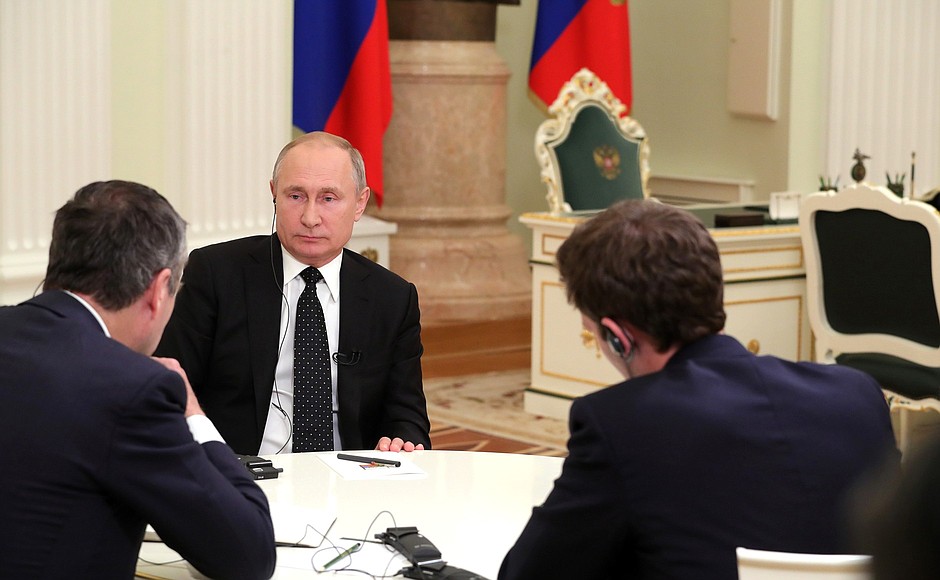
Putin at FT interview. (Kremlin photo)
In an interview with The Financial Times, Putin pointed to “the tragedies of Libya and Iraq” — meaning, of course, what happened to each of them as they lacked a nuclear deterrent. Applying that lesson to North Korea, Putin said,
“What we should be talking about is not how to make North Korea disarm, but how to ensure the unconditional security of North Korea and how to make any country, including North Korea, feel safe and protected by international law. …”
“We should think about guarantees, which we should use as the basis for talks with North Korea. We must take into account the dangers arising from … the presence of nuclear weapons,” he said, adding that if a way can be found to satisfy North Korea’s understandable determination to protect its security, “the situation may take a turn nobody can imagine today.”
“Whether we recognize North Korea as a nuclear power or not, the number of nuclear charges it has will not decrease. We must proceed from modern realities …” And those realities include fundamental, immediate security concerns for both Russia and China. Putin put it this way:
”[W]e have a common border, even if a short one, with North Korea, therefore, this problem has a direct bearing on us. The United States is located across the ocean … while we are right here, in this region, and the North Korean nuclear range is not far away from our border. This is why this concerns us directly, and we never stop thinking about it.”
Xi’s ‘Reasonable Expectations’
Last week in Pyongyang, Chinese President Xi Jinping said China is waiting for a desired response in stalled nuclear talks with the United States.
“North Korea would like to remain patient, but it hopes the relevant party will meet halfway with North Korea to explore resolution plans that accommodate each other’s reasonable concerns,” he said.
A commentary in China’s official Xinhua news agency said China could play a unique role in breaking the cycle of mistrust between North Korea and the U.S, but that both sides “need to have reasonable expectations and refrain from imposing unilateral and unrealistic demands.”
There is little doubt that the Russians and Chinese have been comparing notes on what they see as a potentially explosive (literally) problem in their respective backyards, the more so inasmuch as the two countries have become allies in all but name.
On a three-day visit to Moscow earlier this month, President Xi spoke of his “deep personal friendship” with Putin, with whom he has “met nearly 30 times in the past six years.” For his part, Putin claimed “Russian-Chinese relations have reached an unprecedented level. It is a global partnership and strategic cooperation.”
A Fundamental Strategic Change
Whether they are “best friends” or not, the claim of unprecedented strategic cooperation happens to be true — and is the most fundamental change in the world strategic equation in decades. Given the fear they share that things could get out of hand in Korea with the mercurial Trump and his hawkish advisers calling the shots, it is a safe bet that Putin and Xi have been coordinating closely on North Korea.
The next step could be stepped-up efforts to persuade Trump that China and Russia can somehow guarantee continued nuclear restraint on Pyongyang’s part, in return for U.S. agreement to move step by step — rather than full bore — toward at least partial North Korean denuclearization — and perhaps some relaxation in U.S. economic sanctions. Xi and Putin may have broached that kind of deal to Trump in Osaka.
There is also a salutary sign that President Trump has learned more about the effects of a military conflict with North Korea, and that he has come to realize that Pyongyang already has not only a nuclear, but also a formidable conventional deterrent: massed artillery.
“There are 35 million people in Seoul, 25 miles away,” Trump said on Sunday. “All accessible by what they already have in the mountains. There’s nothing like that anywhere in terms of danger.”
Obstacles Still Formidable
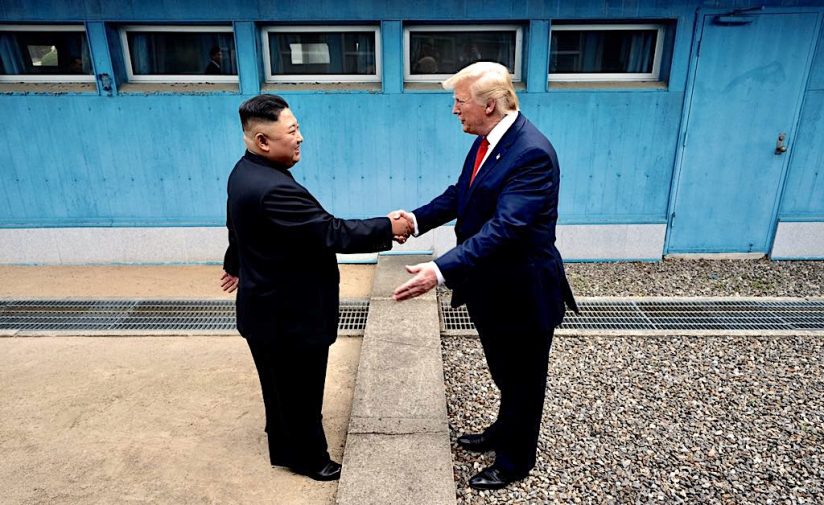
Trump and Kim meet Sunday before Trump became first US president to step on North Korean territory. (White House photo)
Trump will have to remind his national security adviser, John Bolton, and Secretary of State Mike Pompeo, that he is the president and that he intends to take a firmer grip on reins regarding Korean policy. Given their maladroit performance on both Iran and Venezuela, it would, at first blush, seem easy to jettison the two super-hawks.
But this would mean running afoul of the Military-Industrial-Congressional-Intelligence-Media-Academe-Think-Tank (MICIMATT) complex, in which the corporate-controlled media play the sine-qua-non role today.
In a harbinger of things to come, The Washington Post’s initial report on the outcome of the Trump-Kim talks contained two distortions: “Trump … misrepresented what had been achieved, claiming that North Korea had ceased ballistic missile tests and was continuing to send back remains of U.S. servicemen killed in the Korean War.”
The Trump administration could reasonably call that “fake news.” True, North Korea tested short-range ballistic missiles last spring, but Kim’s promise to Trump was to stop testing strategic not tactical missiles, and North Korea has adhered to that promise. As for the return of the remains of U.S. servicemen: True, such remains that remain are no longer being sent back to the U.S., but it was the U.S. that put a stop to that after the summit in Hanoi failed.
We can surely expect more disingenuous “reporting” of that kind.
Whether Trump can stand up to the MICIMATT on Korea remains to be seen. There is a huge amount of arms-maker-arms-dealer profiteering going on in the Far East, as long as tensions there can be stoked and kept at a sufficiently high level.
Ray McGovern works with Tell the Word, a publishing arm of the ecumenical Church of the Saviour in inner-city Washington. His first portfolio at CIA was referent-analyst for Soviet policy toward China, Korea, Vietnam, and Japan. In retirement he co-founded Veteran Intelligence Professionals for Sanity (VIPS).
Himalayan Glaciers–The Story The BBC Refuse To Tell You
By Paul Homewood | Not A Lot Of People Know That | June 30, 2019

Images from Cold War spy satellites have revealed the dramatic extent of ice loss in the Himalayan glaciers.
Scientists compared photographs taken by a US reconnaissance programme with recent spacecraft observations and found that melting in the region has doubled over the last 40 years.
The study shows that since 2000, glaciers heights have been shrinking by an average of 0.5m per year.
The researchers say that climate change is the main cause.
“From this study, we really see the clearest picture yet of how Himalayan glaciers have changed,” Joshua Maurer, from Columbia University’s Lamont-Doherty Earth Observatory in New York, told BBC News.
As usual the BBC fail to explain the wider picture.
Glaciers worldwide have been retreating since the mid 19thC, which marked the ending of the Little Ice Age. The Himalayas are no exception.
This is what the first IPCC Report had to say in 1990:

https://www.ipcc.ch/report/ar1/wg1/
Note the comment about the period 1920 to 1960.
They add this chart:

And comment:

And:

In other words, glacier melt may in large part be due to natural phenomenon, rather than man-made.
The rate of recession since the 19thC has not always been constant, as the IPCC noted:
Wood (1988) found that from 1960 to 1980 the number of retreating glaciers decreased. This may be related to the relatively cool period in the Northern Hemisphere over much of this time (Figure 7 10)
In other words, the fact that the rate of retreat seems to have speeded up in the Himalayas in recent years is of little significance, at least for such a short period of time.
Moreover recent studies have found that many glaciers in the Himalayas have actually started growing again in recent years:

Contrary to the UN’s report that the Himalayan glaciers would melt within a quarter of a century, a new study by researchers at the Universities of California and Potsdam has found out that the Himalayan glaciers are advancing rather than retreating.
Researchers studied 286 glaciers in six areas between the Hindu Kush on the Afghan-Pakistan border till Bhutan.
The report published in the journal Nature Geoscience found that the key factor affecting the advance or retreat of the Himalayan glaciers is the amount of debris— rocks and mud— strewn on their surface and not the general nature of climate change.
The report states that glaciers surrounded by high mountains and covered with more than two centimetres of debris are protected from melting.
Debris-covered glaciers are common in the rugged central Himalayas, but they are almost absent in subdued landscapes on the Tibetan Plateau, where retreat rates are higher.
In contrast, more than 50 percent of observed glaciers in the Karakoram range spanning the borders between Pakistan, India and China region in the north-western Himalayas are advancing or stable, states the report.
“Our study shows that there is no uniform response of Himalayan glaciers to climate change and highlights the importance of debris cover for understanding glacier retreat, an effect that has so far been neglected in predictions of future water availability or global sea level,” the authors wrote in the journal.
Contrary to popular belief, researchers have also discovered that half of the ice flows in the Himalayas are actually growing rather than shrinking.
The discovery adds a new twist to the row over whether global warming is causing the world’s highest mountain range to lose its ice cover.
The new study has found that half of the glaciers in the Karakoram range in the north-western Himalayas are in fact advancing and that global warming is not the deciding factor in whether a glacier survives or melts.
The real picture is much more complex than the BBC misleadingly portray.
MH17: Turning Truth & Victims into Pawns
By Ulson Gunnar – New Eastern Outlook – 29.06.2019
As the wreckage of Malaysian flight MH-17 laid scattered in eastern Ukraine, and many days before the first investigators even arrived on scene, the US had already blamed Russia and separatists it accused of aiding for the tragic downing of the passenger plane and the loss of all 298 people on board.
It would be a July 31, 2014 article by the BBC titled, “Ukraine MH17: Forensic scientists reach jet crash site,” nearly 2 weeks after the aircraft’s downing that would announce the arrival of forensic scientists at the crash site.
Yet as early as July 21, more than a week before investigators arrived, Newsweek in its article, “U.S. Report Outlines Evidence That Rebels Downed Flight MH17,” was already claiming:
The U.S. State Department has outlined the evidence behind its assertion that Russia-backed separatists are responsible for the missile strike that downed Malaysia Airlines flight MH-17. In a statement posted on the website of the U.S. embassy to Ukraine, it said the flight was “likely downed by a SA-11 surface-to-air missile from separatist-controlled territory in eastern Ukraine.”
The assertions made within the report were a summary of accusations the US leveled against Russia even earlier still.
An Australia’s ABC would report a day before the investigators’ arrival in eastern Ukraine that the US and EU had already leveled additional sanctions against Russia, spurred on by US accusations regarding MH-17.
The article, “MH17: US and EU to impose broad sanctions on Russia over support for Ukraine rebels; fighting keeps investigators from Malaysia Airlines crash site,” would note:
The measures mark the start of a new phase in the biggest confrontation between Moscow and the West since the Cold War, which worsened dramatically after the downing of MH17 over rebel-held territory on July 17.
German chancellor Angela Merkel, who had been reluctant to step up sanctions before the crash because of her country’s trade links with Russia, said the EU measures were “unavoidable”.
Washington’s accusations and its rush to leverage their impact on public and political circles at the time to pass further sanctions against Russia fits a pattern not of an impartial investigation or search for truth, but a cynical propaganda campaign carried out at the expense of both.
A Familiar Lack of Evidence…
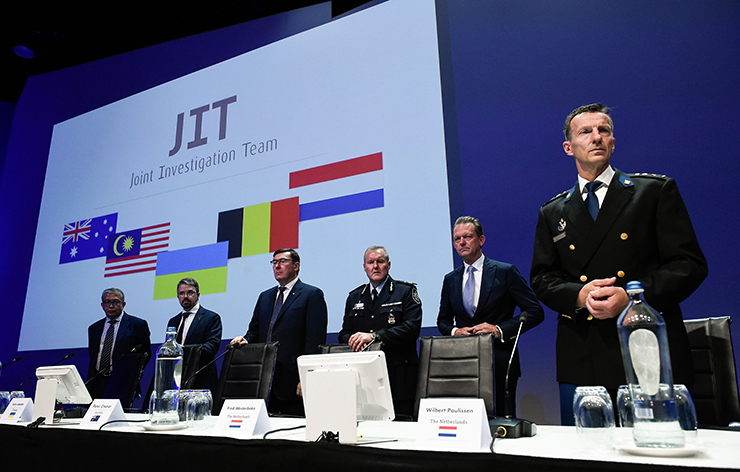
The subsequent Joint Investigation Team (JIT) assembled to supposedly ascertain the truth behind the airliner’s downing included among its member states, Ukraine. As others have pointed out, Ukraine was and still is a prime suspect.
Ukraine’s decision not to close airspace over contested areas where military aircraft were already being shot down alone makes Kiev at least partially culpable for the loss of MH-17.
Expectations of honesty and cooperation from Kiev (berated by even its Western sponsors as being corrupt, abusive and inept) are unrealistic and their inclusion within the JIT undermines its credibility and any conclusion they reach, especially if that conclusion lacks substantial evidence to support it.
The fact that no convincing evidence has been produced by either the JIT or the nations using it as a vehicle to target Russia years after the incident and that the JIT itself cited “social media” as an “important part of the investigation,” further illustrates the political motivations of the team.
Mentioning the use of “social media” as evidence points toward NATO-backed propaganda platforms like Bellingcat which, again, represent “investigators” and “experts” on the payroll of and working with potential suspects in the downing of MH-17 itself.
If it would be unreasonable to place Russia at the center of such an investigation, it is likewise unreasonable to place those who benefit most from Russia being found “guilty” at the center of it as well.
… And a Familiar Lack of Motivation
Russia and any separatists it was backing in eastern Ukraine at the time had nothing to gain by shooting down a civilian airliner. At best, if separatists did launch the missile that allegedly brought down MH-17, it would have been an accident with Ukrainian military aircraft undoubtedly their intended target.
Conversely, the US and its allies had everything to gain by either allowing a civilian airliner to stray over territory knowingly putting it at risk, or shooting it down themselves as part of a false flag operation.
It is already admitted fact, even across the Western media that Ukraine failed to close airspace over eastern Ukraine. This is despite Ukraine losing several military aircraft to separatist air defenses in the weeks leading up to MH-17’s downing.
The BBC just days before the MH-17 downing would report in their July 14, 2014 article, “Ukraine military plane shot down as fighting rages,” that:
A Ukrainian military transport aircraft has been shot down in the east, amid fighting with pro-Russian separatist rebels, Ukrainian officials say.
Despite this incident and others like it leading up to the loss of MH-17, Kiev has claimed it did not believe civilian airliners would be at risk.
A Reuters article titled, “Ukraine defends not closing airspace where MH17 shot down,” would claim:
Ukraine on Tuesday defended its decision not to close airspace in the east of the country where a Malaysian passenger plane was shot down, saying it was unaware that anti-aircraft weapons were being used in the area and that planes could be under threat.
How the JIT is moving forward with a “trial” implicating Russia while Kiev’s overt negligence remains not only unpunished, but now unmentioned, further illustrates the politically motivated nature of the JIT and the nations involved.
It should be noted however that Malaysia, a member of the JIT, has (to say the least) expressed skepticism over the JIT’s latest move to begin trials implicating Russia and Ukrainian separatists.
Malaysia’s PM Doubts the JIT’s Credibility
The BBC in its article, “MH17 crash: Malaysia PM Mahathir denounces murder charges,” would note:
A day after the MH17 plane crash inquiry team announced murder charges against four men, Malaysian Prime Minister Mahathir Mohamad has condemned the decision as “ridiculous”.
The article also noted:
“From the very beginning it became a political issue on how to accuse Russia of wrongdoing,” Mr Mahathir said.
Of course, Prime Minister Mahathir Mohamad is absolutely correct. As we’ve seen, the US and its allies accused Russia of MH-17’s downing before any investigation began, let alone any evidence was in hand. The conclusion was reached as MH-17’s wreckage still smoldered.
For the JIT, the Truth Doesn’t Matter, Just People’s Perception of it
If it is possible that Russia or separatists mistakenly identified MH-17 as a Ukrainian military aircraft (the only possible explanation if Russia or separatists were responsible) it was only because Ukraine itself intentionally left dangerous airspace its own military aircraft were being shot out of open to invite just such a disaster. They did so with every intention to politically exploit any potential tragedy to target Russia.
It is also possible that Ukraine and its US-NATO sponsors took advantage of their strategic losses on the ground and the growing tempo of lost military aircraft overhead by shooting down MH-17 themselves, also meaning that even before MH-17’s downing, they fully intended to frame Russia.
The entire “Skripal affair” follows the same pattern, complete with a crime blamed on Russia but lacking any conceivable motivation for Moscow to have carried it out. In fact, in both cases, either with the downing of a civilian aircraft at the height of separatist victories in eastern Ukraine or the alleged poisoning of the Skripals on British soil at the onset of the Russian-hosted World Cup, only Washington and London had anything to gain from either crime.
The immediate accusations made before investigations even began and the politically motivated nature of the investigations that followed, along with their predictable lack of evidence and their equally predictable conclusions only adds insult to injury for the victims of MH-17 and any notions of actual justice.
The truth and justice have been openly turned into pawns to the point of the Malaysian prime minister himself, whose nation is on the JIT, calling out this politically motivated circus for what it is.
We may never know what really happened on July 17, 2014 over eastern Ukraine because those with the power to find out have already long since decided the truth doesn’t matter. What matters is only how manipulating public perception regarding that day’s events benefits them politically, strategically and geopolitically.
With the JIT’s “trials” set to begin, their charges and trials will be cited as “evidence” Russia did it, rather than any actual evidence proving it did.
This leaves us with another example of the West’s so-called rules-based international order and maybe gives us a little more insight into why so many have lost faith in it or why it is no longer sustainable. We have to wonder though, do the people in Washington, London or Brussels stop and think about this when considering why their rules-based international order no longer inspires confidence and as it begins to fade?
Guardian Continues to Promote “Progressive” Censorship
But don’t worry, they only want to shut down “settled” debates
By Kit Knightly | OffGuardian | June 23, 2019
There’s a lot of talk about “free speech” being under threat these days, with reports of de-platforming at universities, academics losing their jobs because of their political opinions, artists and celebrities getting “cancelled” over an off-colour joke, an even vaguely non-PC opinion, or just supporting Donald Trump.
The entire reason this website exists is the sheer amount of censorship in both corporate media and social media.
We have an archive dedicated to it, that doesn’t include even half of 1% of the deleted comments on The Guardian alone.
Rather notably the US is trying to extradite (and perhaps execute) a man for simply telling the truth.
You’d be forgiven for thinking that free speech was, indeed, under attack.
But you’d be wrong. The Guardian says so, or at least Martha Gill says so. She headlines:
Free speech isn’t under threat. It just suits bigots and boors to suggest so
Before explaining:
But is free speech really under threat? The first thing to say is that the scale of the problem in universities has been exaggerated. The practice of denying people speaking slots over their views has rightly caused concern, but every single instance has also attracted vast coverage in national papers, giving the impression of an epidemic. They are not reflective of the feelings of most students.
Free speech advocates also misunderstand the motivation of those who might want to shut down a debate: they see this as a surefire mark of intolerance.
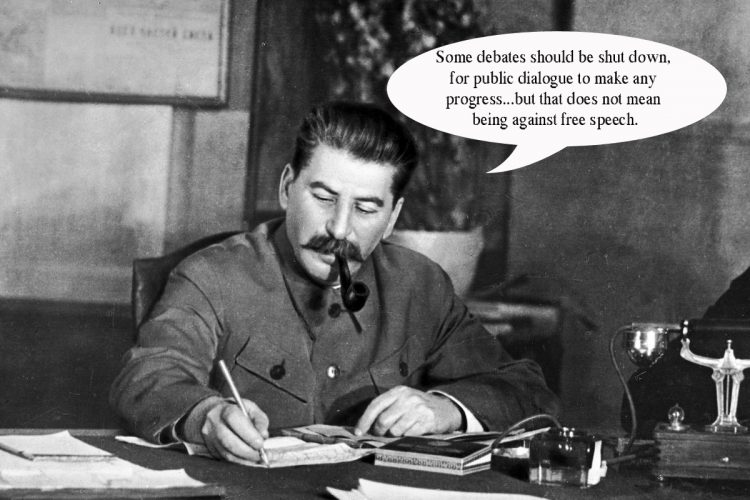
…some debates should be shut down. For public dialogue to make any progress, it is important to recognise when a particular debate has been won and leave it there.
It’s a magical journey:
- Censorship ISN’T happening, that’s just something racists say
- If censorship WERE happening it would be for a good reason
- Censorship IS happening, and is a good thing
Personally, I love the phrase “For public dialogue to make any progress, it is important to recognise when a particular debate has been won and leave it there”, wonderful. Perfect. The liberal argument for censorship – The debate isn’t shut down, it’s just over. We won. We need to move forward.
Dissent will be bad for “public dialogue”.
The examples she cites – Flat Earth, burning witches etc. are deliberately extreme and ridiculous, but the principle could equally apply to anything. Global warming, Assad’s “war crimes”, socialism, antisemitism. MH17. The Skripals.
The list is endless. All they have to do is assume a political position, declare the debate over and then silence the dissent for the sake of “public dialogue”. This does not make them “anti-free speech”:
No-platformers are not scared – they simply think certain debates are over. You may disagree, but it does not mean they are against free speech.
A beautifully totalitarian position. They will rebrand intolerance as being “enlightened” and “woke” and “progressive”.
Don’t worry guys – The only debates being shut down are ones which should be, because they’re over.
How comforting.
Will the Australian Government Join in a “Nuremberg Class” Attack on Iran?

U.S. Secretary of State Michael R. Pompeo welcomes Australian Foreign Minister Marise Payne to the U.S. Department of State in Washington, D.C., on January 30, 2019.
Credit: U.S. Department of State/ flickr
By David Macilwain | American Herald Tribune | June 24, 2019
As my father used to say in response to difficult questions – “ask no questions and you’ll be told no lies”. This seems to be the approach of Australia’s media organizations to our government’s extraordinary silence over events in the Gulf of Oman. Barring an anodyne statement condemning the attacks on civilian shipping, neither Australia’s foreign minister Marise Payne nor Prime Minister Scott Morrison has ventured an opinion on who might have been responsible for these provocative actions. This remains the case even when subsequent developments included a narrowly averted war with global repercussions, with no questions asked and no lies proffered.
In the aftermath of recent attacks on journalistic freedoms and intimidation of whistleblowers, many people have expressed the view that it is the job of journalists to hold governments and public servants to account. That the governments of both Australia and its parent Britain seek to avoid such scrutiny is clear from their actions. Draconian punishments now apply to those who are thought to “threaten national security” by revealing inconvenient truths.
So we might wonder whether the ABC’s failure to ask questions of Government ministers about the dangerous confrontation in the Persian Gulf is connected to these recent developments, which included a highly provocative police raid on the headquarters of the ABC. The ABC purports to be independent of Government, and is expected to interview ministers on behalf of the public when necessary, as well as seeking the view of shadow ministers from the opposition Labor party.
In those recent raids, which concerned an Australian equivalent of the “Collateral Murder” crime exposed by an insider in Australia’s Special Forces in Afghanistan and leaked to an ABC journalist two years ago, there was a widespread shock at the actions authorized under the police warrant. In examining the ABC’s files relating to the case, it was revealed that the recently expanded powers of police forensic officers included the deletion and alteration of computer files – though this was explained as limited to the removal of irrelevant material and identities. This could be true given that the need to rewrite history is now minimized thanks to current controls over access to information.
What was more shocking to some, however, was a widely expressed but ill-informed view from the “Murdoch Right” that the ABC raids were justified, as its actions had endangered national security. Similar views were expressed over the alleged crimes of Julian Assange, whether “narcissist” or “cyber-terrorist”, with little sympathy from fellow Australians for his persecution and torture by the UK regime.
Australian sentiment towards the Islamic Republic of Iran is similarly prejudiced, so persuading the public that Iran would have launched an attack on two tankers near the Straits of Hormuz on the basis of minimal evidence was never going to be difficult; a mere dog-whistle sufficed. What now seems worrying is that “Central Narrative Control” knew this in advance – that they could show a blurry video of Iranian forces rescuing a ship’s crew, while saying it showed them “removing a limpet mine”, and the US aligned media audience would believe that this was what they saw.
But how could people be fooled by this ridiculous story, presented with a video that didn’t stand the slightest scrutiny? Why anyway would Iran sabotage two ships as a direct provocation, while trying to make it look as though the US or its allies were responsible? This wouldn’t make any sense, as the US would have no motive for such an attack – other than to frame Iran for it as a pretext for what has now followed!
The corollary of this perverse provocation by the US or its local agents is that while an Iranian strike on the two tankers could have been understood as a response to newly imposed sanctions targeting Iran’s petrochemical industry, such an attack on civilian shipping by the US with the sole object of framing Iran would be an undoubted war crime. As in fact, it was – and we need to remember this as subsequent events and silence from the media relegate it to a later investigation, or the memory hole. (Iran has also registered a protest over the US accusations with the UN)
Those subsequent events, which we now discover have brought us to the point of a major military escalation, allow current news reports to state that “following the Iranian attack on two ships in the Gulf of Oman” – tensions on both sides are increasing; no longer is the ship attack “alleged”. Instead, a new “limpet mine” narrative has been created to reinforce the idea of the Iranian threat, and this, in turn, feeds into talk of new Uranium enrichment above the agreed levels in the JCPOA, despite this being an entirely legitimate Iranian response to the US’ failure to keep to the agreement. Contrary to the immediate wild accusations from the usual suspects that Iran is now “again” working on a nuclear bomb (it never was, since 2003 [if ever] ), the renewed enrichment remains only to the 3.7% base limit, as those nuclear-armed suspects know perfectly well.
The need to be reminded of these stages in the development of the false narrative that Iran is the aggressor is that the silence from both media and politicians has actually enabled it, simply by drawing on the prejudices of the population. It seems that only those who doubt or deny the US-led accusations against Iran have noticed the deafening silence of Australia’s leaders and the failure of the main media to ask them to show their hand. Is it possible that we could find ourselves supporting the real aggressors in a criminal attack on a peaceful and friendly nation – a classic case of “sleepwalking into war”?
Well, now it appears that this is the case. The ABC hasn’t thought to ask the foreign minister whether we agree with the US story, and whether we would support them in military action against Iran despite the lack of evidence, because there is already that assumption. Despite the early skepticism of US claims from some mainstream commentators, and parallels drawn with the proverbial Iraqi WMD fraud, those reservations appear to now be forgotten. With this comes the realization that my father’s riposte does not apply to our national broadcaster; it doesn’t fear being told lies but rather fears having to admit the obvious truth, which is that of course, we believe the US story, and will support any action that our alliance demands.
Such blindness to the truth, and blind submission to the whims of the world’s most dangerous state, was brought home by this quote from Sydney Morning Herald correspondent Michael Bachelard:
“Some have likened the escalating atmosphere to the feeling leading up to George Bush’s invasion of Iraq in 2003. So why are we suddenly using the “w” word in the Middle East again, and should Australia brace to be invited into another Coalition of the Willing?”
Bachelard presents – and perhaps believes – “Australia” to be a well-intentioned onlooker on the mixed-up politics of the Middle East, whose “contribution” would always be towards peace and security and resolution of conflict. It is a rosy-eyed view of Australia sadly prevalent amongst people whose own intentions are honorable – assuming that the leaders of our traditional allies and partner “democracies” share their honesty and integrity and benevolence. By contrast, these same people seem happy to assume the worst about our “enemies”; Bachelard’s inappropriate use of a photo of a smiling President Assad greeting Ayatollah Khamenei in Tehran in February in the above article nicely reflects this ingrained prejudice.
The reality of Australia’s role in Middle Eastern politics, on the battlefields of Syria, Iraq and Afghanistan and over Palestine and Israel is sadly very different. Despite a “modest contribution” to the Iraq invasion force, John Howard was George Bush’s closest ally, notably refusing to accept that Saddam Hussein had no WMD until around 2010. More recently the involvement of Australian fighter jets in the 2016 US coalition attack on the Syrian Army near Deir al Zour was symptomatic of Australia’s illegitimate presence in Syria, and complicity in NATO allies’ support for the insurgent forces. This intimate alignment with the US also saw Australia copying Trump’s “recognition” of Jerusalem as Israel’s capital, despite the damage this did to relations with our closest neighbor Indonesia.
In the light of this record, and the catalog of unasked questions and untold lies, we can only speculate on the Australian Government’s RSVP to America’s “invitation” to join in a “Nuremberg class” attack on Iran. With Foreign Minister Marise Payne’s record of meetings with both Pompeo and Bolton, and our shared bases and assets in the region, it seems likely such an invitation was a mere formality, likely preceding the first strikes on tankers in the Gulf of Oman.
And as with the story of the war crimes in Afghanistan, there won’t be any desire to rewrite the history of how the third Great War began, should the truth finally surface. That history has already been certified as true by the silence of “Australia’s most trusted news source” and recorded in the mind of the nation; no-one would now believe otherwise.
A National Narrative for Media on Climate Change
By Kip Hansen | Watts Up With That? | June 22, 2019
Those of you who closely watch the media — newspapers, broadcast & streaming news, national magazines, national public radio — may have noticed that all the news about climate change is beginning to sound the same — regardless of outlet (there are a few sensible exceptions). This is no accident. In fact, it is an organized movement among American journalists.
I have written here before about the Editorial Narratives at the New York Times. Here’s the working definition I proposed for Editorial Narrative:
“Editorial Narrative: A mandated set of guidelines for the overriding storyline for any news item concerning a specified topic, including required statements, conclusions and intentional slanting towards a particular preferred viewpoint. A statement from the Editors of “How this topic is to be presented.”
In that essay, I quoted Michael Cieply when, in November 2016, he told the world about the NY Times’ Editorial Narratives:
“It was a shock on arriving at the New York Times in 2004, as the paper’s movie editor, to realize that its editorial dynamic was essentially the reverse [of that at the LA Times]. By and large, talented reporters scrambled to match stories with what internally was often called “the narrative.” We were occasionally asked to map a narrative for our various beats a year in advance, square the plan with editors, then generate stories that fit the pre-designated line.
Reality usually had a way of intervening. But I knew one senior reporter who would play solitaire on his computer in the mornings, waiting for his editors to come through with marching orders. Once, in the Los Angeles bureau, I listened to a visiting National staff reporter tell a contact, more or less: “My editor needs someone to say such-and-such, could you say that?”
The bigger shock came on being told, at least twice, by Times editors who were describing the paper’s daily Page One meeting: “We set the agenda for the country in that room.”
I don’t know how many readers took this bit of news seriously or how many readers realized the implications of the exposé. Personally, I was not surprised, as I had long suspected it. But the implications of this are quite disturbing. It means, in layman’s terms, that the news that you read has been pre-determined by the Editors and has little to do with actual events (real news) that happen in the real world. Those of you who have recently read Orwell’s 1984 will recognize some of the features of the Ministry of Truth (writ small at the NY Times’ “Page One meeting”). At the NY Times, the profession of journalism has been turned to the task of pushing the narratives of editors down the throats of the people. Newspeak is rampant.
While I found Cieply’s revelations unsettling, I find the following story truly frightening in its ability to threaten the very underpinnings of democracy.
The story starts earlier in the year with a conference planned and held at the behest of Columbia Journalism Review and The Nation (“along with partners such as The Guardian”). You can watch the conference online (YouTube). The outcome of that conference is a growing cabal of journalists and their editors: (in their own words):
“How does the media cover—or not cover—the biggest story of our time? Last fall, UN climate scientists announced that the world has 12 years to transform energy, agriculture, and other key industries if civilization is to avoid a catastrophe. We believe the news business must also transform.”
“The Columbia Journalism Review and The Nation assembled some of the world’s top journalists, scientists, and climate experts to devise a new playbook for journalism that’s compatible with the 1.5-degree future that scientists say must be achieved. We also held a town hall meeting on the coverage of climate change and the launch of an unprecedented, coordinated effort to change the media conversation.”
source: https://www.cjr.org/watchdog/climate-crisis-media.php/
Journalists around the world are being contacted by email by CJR with a message that includes this appeal:
“Our ask of you is simple: commit to a week of focused climate coverage this September. We are organizing news outlets across the US and abroad—online and print, TV and audio, large and small—to run seven days of climate stories from September 16 through the climate summit UN Secretary General Antonio Guterres hosts in New York September 23. The stories you run are up to you, though we can offer ideas and background information and connect outlets looking for content with content providers looking for outlets.
We’d be happy to schedule a phone call to discuss this further.
Sincerely,
What is their playbook? What’s the narrative they expect journalists to stick to?
It starts with this: “Transforming the media’s coverage of the climate crisis” and morphs into a “FAQ” titled “The media are complacent while the world burns” with these ideas and suggestions like these:
1. Climate is a crisis.
2. The Green New Deal is “a plan to mobilize the United States to stave off climate disaster and, in the process, create millions of green jobs.” and the GND has massive public support. [ NB: see Postscript at the end of this column. ]
3. Climate is the “biggest story of our time”.
4. Journalists should push the “… warning that humanity has a mere 12 years to radically slash greenhouse-gas emissions or face a calamitous future in which hundreds of millions of people worldwide would go hungry or homeless or worse.” and that “our civilization today faces the prospect of extinction”.
If this all sounds like a Climate Pragmatists Worst Nightmare, then you are starting to understand correctly. The CJR/Nation/Guardian cabal is working on a “handbook” to help news organizations “get the story right”. In other words, they are writing the Climate Journalism Narrative – a point for point list of what every climate story should say and how it should say it (and, remember folks, ”every story is a climate story”). They call on journalists to “Learn the science” suggesting that instead of actually reading anything containing the science of the climate, such as the real science sections of the IPCC AR5 report, they recommend that journalists read “Four recent books—McKibben’s Falter, Naomi Klein’s On Fire, David Wallace-Wells’s The Uninhabitable Earth, and Jeff Goodell’s The Water Will Come—are good places to start.” — all of which are extreme climate alarmist propaganda.
Covering Climate Now movement is organizing:
“A focused week of coverage
We’ll work to organize as much of the news media as possible—large and small, national and local—to commit to one week of focused coverage of climate change this September. The Secretary-General of the United Nations, António Guterres, is convening a summit in New York on September 23, where nations are urged to show how they will limit global temperature rise to 1.5 degrees Celsius. We propose a week of concentrated climate coverage in the lead-up to the UN summit, beginning September 16.” [source]
Don’t be fooled, they are not planning any real journalistic attempts to explain the complexity of the wicked problem called Earth’s Climate and the current controversies surrounding the issues involved. They are planning an intensive propaganda campaign across as many media outlets as they can convince (or shame) into signing on to participate.
I have laid out my position on the Climate Question here at WUWT ( here and here ). I encourage climate realists, especially those with a broader reach into mainstream media, to begin now to plan for their own counter-campaign to help neutralize the propaganda blitz envisioned by CJR/The Nation/The Guardian cabal for September 2019. We too are journalists, even if in just a small way. I for one will be following the Covering Climate Now propaganda campaign and will update the readership here with details from their promised propaganda ”handbook”.
The science is very plain on such issues as US wildfires, hurricanes (US and worldwide), US flooding, so-called heat waves and weather extremes. Opinion columns and essays in national newspapers and magazines (both print and online) and video commentary for broadcast and streamed news stations, laying out the simple truth, with graphs, numbers, and images, can and will help cut the ground from under the alarmist propaganda effort.
If we, the readers and contributors here, don’t make the effort to counteract this planned act of ideological sabotage of the American mind, who will?
# # # # #
POSTSCRIPT: One of the propaganda points that will be pushed by the Climate Journalists Cabal is: “Not only do most Americans care about climate change, but an overwhelming majority support a Green New Deal—81 percent of registered voters said so as of last December, according to Yale climate pollsters. Trump and Fox don’t like the Green New Deal? Fine. But journalists should report that the rest of America does.”
This is an example of how warped the journalism being promoted by the Covering Climate Now group is. It is true that a poll by “Yale climate pollsters” (in reality the activist department Yale Program on Climate Change Communication) found, in December 2018: “The survey results show overwhelming support for the Green New Deal, with 81% of registered voters saying they either “strongly support” (40%) or “somewhat support” (41%) this plan.” There’s the 81%.
What a great quotable quote!
The reality is a bit different. The pollsters asked this question:
“Some members of Congress are proposing a “Green New Deal” for the U.S. They say that a Green New Deal will produce jobs and strengthen America’s economy by accelerating the transition from fossil fuels to clean, renewable energy. The Deal would generate 100% of the nation’s electricity from clean, renewable sources within the next 10 years; upgrade the nation’s energy grid, buildings, and transportation infrastructure; increase energy efficiency; invest in green technology research and development; and provide training for jobs in the new green economy. How much do you support or oppose this idea?”
And got this result:
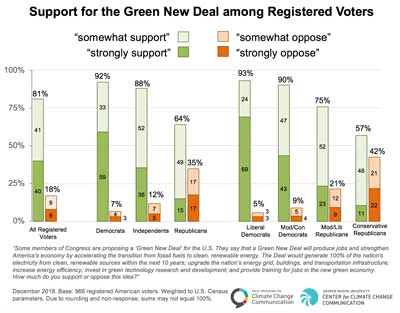 Now that looks pretty definitive, doesn’t it? But here’s the real deal…. the poll is taken in the first weeks of December 2018. The Green New Deal (in its current form) was announced the week following the November 2018 mid-term elections. So, less than 3 weeks after it is announced, put up on the web, taken down again, put up again (you remember the story), the climate advocacy group at Yale does a poll, preceded by a glowing recommendation of the GND, and then asks “How much to you support or oppose this idea?”
So, our Climate Journalist Cabal is not misrepresenting the poll… they are just misrepresenting the whole concept of public support for the GND.
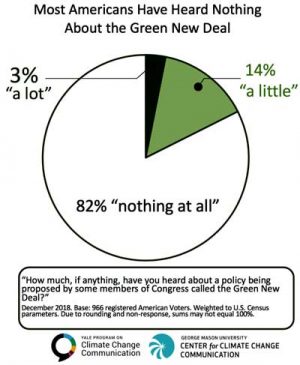 The same poll also asked:
“How much, if anything, have you heard about a policy being proposed by some members of Congress called the Green New Deal?”
The resounding answer?
“Nothing at all”
The same poll, the same cohort (same people polled), a greater percentage than those purportedly “supporting” it had heard “nothing at all” about the GND.
For those that interpret polls, this means, bluntly, that the “supporters” were responding solely to the pollsters “introduction” about the GND — they really didn’t know anything at all about it.
What does the public really think about the seriousness of climate issues? The Pew poll of January 2019:
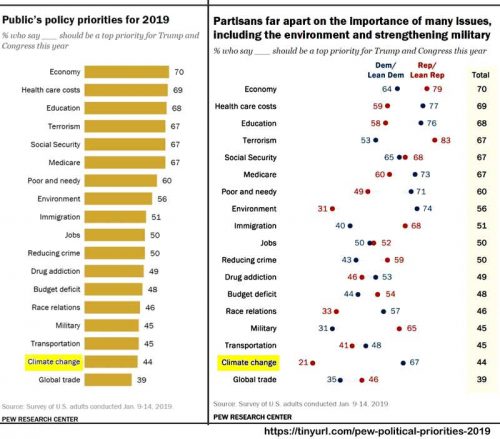
The Climate Journalist Cabal has already stated that it plans to use this near-total misrepresentation as part of its propaganda campaign. What they will do with other topics is not hard to imagine.
Iran ‘Violates’ Nuclear Deal, After US ‘Withdraws’

By Joshua Cho | Fair | June 21, 2019
Quick question: Does the US ever break, breach or violate its international agreements?
Apparently not, according to US coverage of Iran’s recent announcement that it intended to go beyond the limits of the 2015 Iran nuclear deal in enriching uranium for its civilian nuclear program (frequently mischaracterized as a nuclear weapons program in media coverage). Reading corporate media’s inversion of reality, it’s hard to escape the impression that while Iran betrays its international agreements, the US just leaves them behind.
An Associated Press report carried by USA Today (6/17/19) was headlined: “Iran Says It Will Break Uranium Stockpile Limit in 10 Days,” and reported that Iran’s announcement indicated its “determination to break from the landmark 2015 accord,” while noting that “tensions have spiked between Iran and the United States,” partly because the US “unilaterally withdrew” from the landmark agreement. Note that the US rejection of its obligations under the deal is referred to in neutral terms—Washington “withdrew”—while Iran’s response to US nonobservance gets negatively characterized as a “break”—a pattern that persists throughout the coverage.
There was no indication in the AP piece that Iran offered conditions under which it would continue to comply with the Iran Deal (formally known as the Joint Comprehensive Plan of Action), which gives the false impression that Iran’s decision to end compliance with the JCPOA is settled and unconditional.
The Wall Street Journal (6/17/19) offered the same kind of misleading headline: “Iran to Breach Limits of Nuclear Pact, as US to Send More Troops to the Middle East.” Again, Iran’s potential departure from the pact whose terms the US has vitiated is portrayed as a “breach,” while the US’s actual violation of the deal is labeled a “pullout” in the accompanying piece.
The Journal, unlike the AP, did note that Iran offered conditions under which it would continue to comply with the JCPOA’s terms:
The spokesman for Iran’s atomic energy agency, Behrouz Kamalvandi, said that by June 27—10 days from Monday—the country would surpass its enriched-uranium limits. He said Iran would further increase its production in early July, but could reverse both steps if Europe provided relief from [US] sanctions.
CNN (6/17/19) went with “Iran says it will break the uranium stockpile limit agreed under nuclear deal in 10 days,” as their headline. Only people who read past the headline, which most people don’t, would’ve known that that’s not really what Iran is saying:
Iran has reiterated that it could reverse the new measures should the remaining European signatories in the nuclear deal (France, Germany and the United Kingdom) step in and make more of an effort to circumvent US sanctions.
To its credit, CNN added “withdraw” in addition to the usual “violate,” “break” and “breach” in its list of words to describe Iran’s potential departure compared with just “withdrew” to describe the US’s actions.
The New York Post (6/17/19) chose “Iran Will Violate Nuclear Deal, Boost Uranium Stockpile” as the headline to mislead readers, and kept with the pattern of describing the US’s JCPOA breach as “pulling out of the deal.” However, unlike other reports, it didn’t feature any sources skeptical of Iran’s responsibility for the recent Gulf of Oman attacks on Japanese and Norwegian commercial oil tankers, despite crew members aboard the Japanese Kokuka Courageous contradicting US allegations of an Iranian mine attack by claiming to have been hit by a “flying object,” and European officials calling for further investigation and urging “maximum restraint.”
The New York Times’ headline (6/17/19): “Trump Adds Troops After Iran Says It Will Breach Nuclear Deal,” not only continued the above trends by not giving any hint that Iran might not depart from the pact, and characterizing the US’s JCPOA violations as a mere “withdrawal,” it also reported on US sanctions on Iran without mentioning that the sanctions themselves are violations of international law (Guardian, 10/3/18).
The Times uncritically cited Secretary of State Mike Pompeo’s statements that the US is “considering a full range of options”—including military strikes—without mentioning that these would be violations of international law because they go against UN Security Council Resolution 1887, which requires peaceful resolutions to disputes regarding nuclear issues, in accordance with the UN Charter and the Non-Proliferation Treaty, which both the US and Iran are parties to.
In fact, virtually all coverage fails to address the JCPOA in light of the NPT, because none of it challenges the legitimacy of the US’s prerogative to impose limits on Iran’s civilian nuclear program to begin with. Article IV of the NPT supports the “inalienable right of all the Parties to the Treaty to develop research, production and use of nuclear energy for peaceful purposes,” in accordance with Articles I and II forbidding the transfer and receiving of nuclear weapons from nuclear-weapon states.
FAIR (10/17/17) has observed that corporate media frequently attribute malicious intentions to Official US Enemies without going through the bother of presenting evidence. Iran is often accused of sneakily plotting to develop nuclear weapons, the way US ally Israel actually did when it built the only nuclear weapons arsenal in the Middle East (Guardian, 1/15/14).
This is ironic, because Iran has actually been a consistent leader in the nuclear disarmament movement. Foreign Minister Javad Zarif, when Iran was the chair of the Non-Aligned Movement, critiqued the JCPOA because it didn’t go far enough to ensure peace in the Middle East by not establishing a Nuclear Weapons–Free Zone there. Iran was also one of the first countries to propose making the Middle East a NWFZ, bringing up the proposal to the UN General Assembly in 1974 (CounterPunch, 12/13/13).
Journalist Gareth Porter (Foreign Policy, 10/16/14), reporting on Iran’s little-understood theocratic system, noted that Supreme Leader Ayatollah Khomeini’s fatwa against building any kind of WMDs in the 1990s is a formal ruling on Islamic jurisprudence, holding a legal status above mere legislation. He also pointed to Khomeini’s refusal to develop WMDs when up to 20,000 Iranians were killed by chemical weapons by then–US ally Saddam Hussein in the 1980s (Reuters, 9/16/13)—with an additional 100,000 survivors developing chronic diseases. Current US sanctions aiming to bring Iran’s “oil exports to zero” are exacerbating those chronic diseases, in addition to further strangling Iran’s economy, by restricting access to necessary medicine (Guardian, 9/2/13).
Of course, none of this can be mentioned, because it contradicts the corporate media narrative of Iran being an enemy that must be confronted, with US aggression against Iran being portrayed as defensive countermeasures (FAIR, 5/19/19, 6/6/19). For US media, Iran is the only JCPOA party with commitments that can be “breached,” “violated” or “broken,” with the US free to leave them whenever it wants to, without harming its reputation as a trustworthy party to international agreements.
Cyber sleuths responsible for Russiagate now warn of ‘Iranian hackers’
RT | June 21, 2019
Iranian hackers are threatening US computer systems, cybersecurity firms FireEye and CrowdStrike claimed just as tensions between Washington and Tehran pulled back from the brink of war.
“Really, we’re seeing increased cyber activity that seems to be focused on the West,” Adam Meyers, vice president of Intelligence at CrowdStrike, told Politico. “In early June, mid-June is when it really started to kick off.”
Ben Read, senior cyber-espionage analyst at FireEye, confirmed the timeline and told the paper that the latest campaign is led by a government-connected Iranian hacker group known as APT33 or “Refined Kitten.”
Wired magazine carried a story on Thursday also alleging Iranian attacks, based on information from CrowdStrike and another firm, Dragos – this time targeting the US Department of Energy with phishing emails pretending to come from the White House Council of Economic Advisers.
“The Department of Energy is aware of the reports of APT33 activity and for security reasons we do not comment on current cyber activity directed at the Department’s networks,” the agency said in a statement.
CrowdStrike is the contractor that accused Russia of hacking the Democratic National Committee in 2016. Federal investigators just took their word for it, never actually examining the DNC computers.
FireEye also accused Russia of trying to hack Democrats, this time during the 2018 midterms. The firm also picked Hillary Clinton – of the private email server in attic fame – as the keynote speaker at their upcoming cybersecurity conference in October.
Allegations of Iranian cyber-warfare came as almost everyone in Washington expected some form of US military action against Tehran following the shooting down of a US spy drone over the Strait of Hormuz on Thursday.
A shooting war seemed to have been avoided in the nick of time, however, with President Trump saying on Friday that he changed his mind about a “disproportionate” response just minutes before the operation was underway.
US Cyberwar on Russia? New York Times Does Psyops
Strategic Culture Foundation | June 21, 2019
A front-page article in the New York Times this week certainly generated a lot of reaction. In rather sensational terms, the paper claimed that the Pentagon’s cyber command was stepping up hacking intrusions into Russia’s power infrastructure.
So penetrated were the purported “digital” weapons, it was conjectured that Russia could suffer “black outs” at any moment and see its military instantly paralyzed.
Presidents Trump and Putin were obliged to react to the NYT’s article. Trump rubbished it as fake news, while Putin responded with a certain tone of alarm about possible consequences of a cyberwar breaking out.
Many commentators, including critical ones who normally show skepticism towards the NYT, were inclined to accept the article as an accurate account of US cyber aggression against Russia.
However, it is worth asking the basic question: are the claims reliable?
There are several reasons to be suspicious about the veracity of the NYT’s report, and what the real purpose of publishing it is.
For a start, America’s so-called “newspaper of record” has demonstrated itself to be more often than not an obedient purveyor of misinformation for the US military-intelligence apparatus.
Just two examples are cited here of dutiful functioning from many instances over the decades.
In July 1945, when the Pentagon detonated the first-ever atomic bomb in the desert of New Mexico, it was the NYT that put out dutiful reports claiming that the massive test explosion was not a new, far more destructive weapon. It also claimed that the local population had nothing to fear from health effects, despite thousands of Americans later dying from radiation fallout.
A second notorious example is how the “paper of record” was a chief conduit for propaganda about “weapons of mass destruction” (WMD) which was used to launch the genocidal war on Iraq in 2003. Those claims were later shown to be entirely false. The NYT thus engaged in telling barefaced lies to the public in order to launch a criminal war of aggression.
One of the main NYT’s writers who peddled the WMD propaganda for the destruction of Iraq was David Sanger whose byline appeared on the latest article claiming that the Pentagon was escalating cyberwar on Russia. Arguably, this so-called journalist should be in a prison for complicity in war crimes, not sitting behind a desk receiving a big fat salary.
A closer reading of the article indicates that many of the sensational claims are vague and unsubstantiated. The article is long-winded and jargonistic, raising more questions than answers, which usually means the content is more fabulation than factual. As usual, the sources are anonymous and often referred to as “former officials”.
There were also contradictions in the reporting, the most glaring of which is that the NYT claims the Trump White House signed off on the alleged new aggressive activities, yet President Trump panned the story as fake. Trump’s evident disgust seemed genuine. He called the article “treasonous” and suggested it was a desperate attempt by the “failing” NYT to scoop up readers.
So, let’s think about this. A loyal conduit of Deep State misinformation is purporting to be revealing secret cyberwar activities against Russia. If it were doing that, the Pentagon would not be happy. If the NYT is quoting anonymous secret agencies, the suspicioun is that those sources wanted the NYT to publish this article. Why would that be? To alert Russia of implanted malware in its infrastructure only for Russian computer experts to track down the offending bugs and eliminate them? That doesn’t make sense. Why would the Pentagon out itself for the benefit of Russia?
What’s likely going on here is that the NYT is serving – as it usually does – as a conduit for “psychological operations”. The real intention seems to be to unnerve Moscow about an impending cyber strike on the Russian nation.
Another intended effect from the article is to further poison bilateral relations between the US and Russia. Presidents Trump and Putin are expected to hold a meeting next week during the G20 summit in Japan. It seems that the higher authors of the NYT’ report and their stenographers like David Sanger have the intention to pre-empt the forthcoming conversation between the American and Russian leaders.
A further sinister twist is that the NYT claims President Trump has not been informed about the alleged cyberwar against Russia. It suggests that is because Trump is not trusted by intelligence agencies for fear he might leak details to Putin. This is another tawdry attempt by the paper to revive its failed previous claims of undermining the American president as a “Kremlin stooge”.
Moreover, the NYT quotes National Security Adviser John Bolton as appearing to confirm the Pentagon’s alleged cyber aggression against Russia. That is a further slight on the American president. Who is actually running the US government? Trump, Bolton or Deep State operatives?
Finally, it should be noted that the NYT claims are premised on past dubious allegations that Russia interfered in US elections and that it has also been hacking into America’s power grid. By taking its latest story at face value, one is obliged to accept its previous stories of Russian malfeasance as accurate, which they are not.
Russia, of course like all nations, must ensure its infrastructure and defenses are inviolable from foreign hacking of computer systems. There is no doubt US agencies have and are probing Russian systems for potential vulnerabilities. But such a scenario is significantly different from one where a digital sword is supposedly hanging over Russia’s head threatening to deliver a lethal blow at any time.
Frankly, the NYT has become a consummate parody of a newspaper. Its Pulitzer Prizes for “journalistic excellence” are more baubles for good conduct in the service of state propaganda; propaganda that has often led to criminal wars and the deaths of millions of people. It purports to “reveal” secret Pentagon activities, yet elsewhere honorable journalists like Julian Assange are being persecuted for doing just that.
The “paper of record” styles itself as a truth-teller. Its advertising slogan is “the truth is worth it”.
Indeed, the truth is worth it, especially when lies and fabrications could have such horrific consequences for international relations and human lives.
‘Politicised From the Start’: Malaysian PM Blasts Dutch-Led MH17 Probe as Anti-Russian Witch Hunt
Sputnik – June 20, 2019
On Wednesday, investigators from the Dutch-led Joint Investigative Team (JIT) announced that they would issue arrest warrants against four suspects, including three Russians and one Ukrainian, in connection with the downing of Malaysia Airlines Flight MH17 over eastern Ukraine in mid-2014. Moscow called the accusations “absolutely unsubstantiated.”
Malaysian Prime Minister Mahathir Mohamad has called the JIT’s latest claims in the MH17 case politically motivated and unproven.
“We are very unhappy, because from the very beginning it was a political issue on how to accuse Russia of wrongdoing,” Mahathir said, speaking to reporters on Thursday, according to Reuters.
A day earlier, the Joint Investigative Committee (JIT) announced that four suspects, Russians Igor Girkin, Sergei Dubinsky, and Oleg Pulato and Ukrainian Leonid Kharchenko, would be issued international arrest warrants on charges of murder, with a trial into the MH17 case set to begin in the Netherlands in March 2020.
Flight MH17 was shot down over civil war-hit eastern Ukraine by a surface-to-air missile on 17 July 2014, with all 298 passengers and crew on board, predominantly Dutch and Malaysian nationals, killed.
The JIT accuses the men of delivering the missile system to Ukraine from a Russian anti-aircraft missile brigade stationed in the city of Kursk, not far from the Ukrainian border. Russia has categorically denied claims that it was in any way involved in the tragedy.
“Even before they examine (the debris), they already said Russia. And now they said they have proof. It is very difficult for us to accept that,” Mahathir said. “It is a ridiculous thing,” Mahathir added. “As far as we are concerned we want proof of guilt. So far there is no proof. Only hearsay,” he stressed.
Malaysian authorities have repeatedly complained of being effectively excluded from the investigation into the MH17 case, with the country’s investigators reportedly barred from studying the airliner’s black box flight recorder and other important data, despite the fact that over three dozen of the 298 passengers and crew who died in the incident were Malaysian nationals.
‘Absolutely Unsubstantiated’ Claims
Almost immediately after the MH17 crash and before a formal investigation was launched, the US and many of its European allies accused Russia of responsibility for the tragedy. The Dutch-led Joint Investigation Team invited Belgium, Australia, and Ukraine to join the probe, with Malaysia invited to join in late 2014, and Russia barred from the inquiry despite repeated offers to help.
Russia subsequently conducted its own probe into the disaster, with its investigation including extensive studies of forensic evidence, the unprecedented declassification of previously secret information about advanced military hardware, and a complex experiment by defence concern Almaz-Antey, maker of the Buk type air defence missile thought to have shot down the passenger jet.
Based on these studies, Russian investigators concluded that an older variant of the missile built in 1986 and belonging to Ukraine downed the aircraft, with Russia fully retiring its older stocks of Buk missiles during a broader campaign to modernise the Russian army.
The Russian side has repeatedly attempted to provide Dutch investigators with its evidence, but JIT has shown no interest in the Russian information. In late 2016, Russia sent JIT raw, unprocessed primary radar data containing evidence about the trajectory of the missile which shot down Flight MH17. JIT first complained that it could not decrypt the data, but after Russia said that it would be ready to help investigators decode it, questioned its accuracy and declined to take it into consideration. JIT’s own investigation and the presentations of its findings did not provide any concrete evidence demonstrating Russia’s guilt, instead citing ‘classified information’ which Dutch and US authorities have said they could not divulge.
On Wednesday, the Russian Foreign Ministry dismissed the JIT’s latest claims in the MH17 case as “absolutely unsubstantiated,” saying that the charges were not based on evidence, and aimed only “at discrediting Russia in the eyes of the international community.”
June Madness Strikes Washington. Iranians, Russians and Britons Beware!
By Philip Giraldi | Strategic Culture Foundation | June 20, 2019
It has been a lively June so far in light of Washington’s apparent zeal to remake the world in its own image. There is considerable buzz among those networking in ex- or current government circles that the White House is preparing to “do something” about Iran. The recent incidents involving alleged attacks on Norwegian and Japanese tankers in the Gulf of Oman were immediately attributed to Iran by Secretary of State Mike Pompeo with so little regard for evidence that even the compliant American media was left gasping. In its initial coverage of the story The New York Times inevitably echoed the administration’s claims, but if one went to the readers’ comments on the story fully 90% of those bothering to express an opinion decided that the tale was not credible for any number of reasons.
Several commenters brought up the completely phony Gulf of Tonkin incident of 1964 that led to the escalation of American involvement in Vietnam, a view that was expressed frequently in readers’ comments both in the mainstream and alternative media. Others recalled instead the fake intelligence linking Iraq’s Saddam Hussein with the 9/11 conspirators as well as the bogus reports of an Iraqi secret nuclear program and huge gliders capable to delivering biological weapons across the Atlantic Ocean.
There were a number of questionable aspects to the Pompeo story, most notably the unlikelihood that Iran would attack a Japanese ship while the Japanese Prime Minister was in Tehran paying a visit. The attack itself, attributed to Iranian mines, also did not match the damage to the vessels, which was well above the water line, a detail that was noted by the Japanese ship captain among others. Crewmen on the ship also reportedly saw flying objects, which suggests missiles or other projectiles were to blame, fired by almost anyone in the area. And then there is the question of motive: the United States, Israel, Saudi Arabia and the Emirates all want a war with Iran while the Iranians are trying to avoid a B-52 attack, so why would they do something that would virtually guarantee a devastating response from Washington?
What is going on with Iran is certainly front-page material but there are two other stories confirming that brain-dead flesh-eating zombies have somehow gained control of the White House. The first comes from David Sanger of The New York Times, who reported last week that the United States had inserted malware into the Russian electrical grid to serve as both a warning and a possible response mechanism should the Kremlin continue with its cyberwarfare ways.
The astonishing thing about the story is the casual way it is presented because, after all, inserting malware into someone’s electrical grid might well be considered an act of war. The White House responded to the story with a tweet from the president claiming that “This is a virtual act of Treason by a once great paper so desperate for a story, any story, even if bad for our Country…” though he did not state that the account was untrue. In fact, if it was actually treason, that would suggest that the news article was accurate in its description of what must be a Top Secret program. But then Trump or one of his advisors realized the omission and a second tweet soon followed: “….. ALSO, NOT TRUE!”
Assuming that Sanger did his job right and the story is actually correct, a number of aspects of it might be considered. First, interfering with a country’s electrical grid, upon which so many elements of infrastructure depend, is extremely reckless behavior, particularly when the activity has been leaked and exposed in a newspaper. Sanger explained the genesis of his story, revealing that he had been working at it for several months. He wrote: “The United States is stepping up digital incursions into Russia’s electric power grid in a warning to President Vladimir V. Putin and a demonstration of how the Trump administration is using new authorities to deploy cybertools more aggressively, current and former government officials said. In interviews over the past three months, the officials described the previously unreported deployment of American computer code inside Russia’s grid and other targets as a classified companion to more publicly discussed action directed at Moscow’s disinformation and hacking units around the 2018 midterm elections. Advocates of the more aggressive strategy said it was long overdue, after years of public warnings from the Department of Homeland Security and the F.B.I. that Russia has inserted malware that could sabotage American power plants, oil and gas pipelines, or water supplies in any future conflict with the United States.”
The Sanger story elaborates: “Since at least 2012, current and former officials say, the United States has put reconnaissance probes into the control systems of the Russian electric grid. But now the American strategy has shifted more toward offense, officials say, with the placement of potentially crippling malware inside the Russian system at a depth and with an aggressiveness that had never been tried before. It is intended partly as a warning, and partly to be poised to conduct cyberstrikes if a major conflict broke out between Washington and Moscow. The commander of United States Cyber Command, Gen. Paul M. Nakasone, has been outspoken about the need to ‘defend forward’ deep in an adversary’s networks to demonstrate that the United States will respond to the barrage of online attacks aimed at it. President Trump’s national security adviser, John R. Bolton, said the United States was taking a broader view of potential digital targets as part of an effort to warn anybody ‘engaged in cyberoperations against us.’ ‘They don’t fear us,’ he told the Senate a year ago during his confirmation hearings.”
If the Sanger tale is true, and it certainly does include a great deal of corroborative information, then the United States has already entered into a tit-for-tat situation with Russia targeting power grids, largely initiated to “make them fear us.” One might suggest that the two countries are already at war. That is in no one’s interest and the signals it sends could lead to a major escalation very rapidly. Interestingly, the article states that President Donald Trump does not know about the program even though it could potentially lead to World War 3. That the piece appeared at all also inevitably makes some readers wonder why Sanger has not been arrested for exposing national security information a la Julian Assange.
The final story dates from early June when Secretary of State Mike Pompeo was privately meeting with American Jewish leaders who expressed concern about the possibility that British Labour Leader Jeremy Corbyn might become prime minister. Corbyn has been targeted by British Jews because he is the first U.K. senior politician to speak sympathetically about the plight of the Palestinians.
Pompeo was asked if Corbyn “is elected, would you be willing to work with us to take on action if life becomes very difficult for Jews in the U.K.?” He replied: “It could be that Mr. Corbyn manages to run the gauntlet and get elected. It’s possible. You should know, we won’t wait for him to do those things to begin to push back. We will do our level best. It’s too risky and too important and too hard once it’s already happened.”
There are certain ambiguities in both the question and the response, but it would appear that American Jews want to join with their British counterparts to either bring down or contain a top-level elected politician because he is not sufficiently pro-Israel. The American Secretary of State agrees with them that something must be done, to include quite possibly taking some presumably covert steps to make sure that Corbyn does not become prime minister in the first place. As Pompeo might just be thinking of subverting the institutions of America’s closest ally, it is a huge story that is being largely ignored in the media.
And June is not over yet! The good news is that the United States has not yet invaded Venezuela despite calls by America’s boy-Senator Marco Rubio and the demented Senator Lindsey Graham to do so.
Featured Video
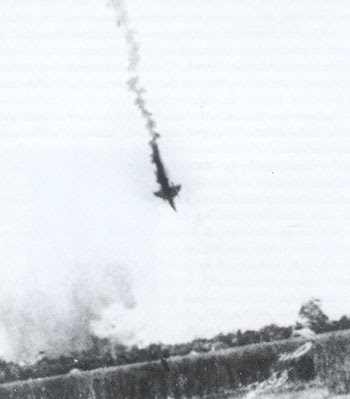
The Failed Air War Over Vietnam
or go to
Aletho News Archives – Video-Images
From the Archives
USS Liberty Massacre: A Pivotal Moment in the Hostile Takeover of America
By Kevin Barrett | Crescent | Dhu al-Qa’dah 24, 1445
In corporate America, hostile takeovers are commonplace. They occur when an aggressor—a larger corporation or rich individuals—seizes control of a smaller corporation without asking permission.
What few recognize is that the United States itself has been subjected to a hostile takeover. Since the aggressor, the illegitimate settler colony known as “Israel,” is much smaller than the US, the takeover has necessarily been surreptitious.
As of June, 2024, Israel’s gradual takeover of the US has become obvious and undeniable—a proverbial “elephant in the living room.” … continue
Blog Roll
 Aletho News
- Leaders Condemn Ansarallah Attack on Saudi Arabia While Ignoring Illegal War Against Yemen
- Leaked: Britain’s Covert Iraqi Psyops Network
- Yemeni Armed Forces Warn Airlines Against Using Saudi Airports, Exempt Mecca and Medina
- Iran security chief says powers greater than US tried to conquer Iran but ended in ‘dustbin of history’
- Europe’s mounting social chaos… chickens coming home to roost for proxy war against Russia
- US-Russia Diesel Deal Becomes Massive Defeat for Ukraine
- Hormuz and the Looming Economic Catastrophe
- Dhubab offensive, media blitz and the rapid unraveling of Saudi-backed coalition’s new gambit
- Putin Conveys to Trump Iran’s Vision on Possible Conflict Resolution – Kremlin
- The Search for Truth: Charlie Kirk’s Assassination One Year Later
- If Americans Knew
- For three years, Israel has killed a child in Gaza every 71 minutes – Daily Update
- Israeli forces kill another child in Gaza – Daily Update
- Gaza ceasefire exists in name only, say more than 100 organizations
- Nearly 2 Million in Gaza Need Urgent Shelter Assistance as Winter Looms: IOM Chief Warns
- Suppressing Palestinian resistance: US charity under fire for AI monitoring of Gaza classrooms
- Thousands Are Held in Israeli Torture Camps. This Is What Happens Inside
- Israel puts Gaza’s sick, injured, newborn in peril – Daily Update
- Report claimed Mark Levin used by Israeli government to influence Trump
- Over 2,000 Gazans have died awaiting medical evacuation amid Israel’s continued siege
- How a U.S. Diplomat Suppressed and Altered Reports Critical of Israel
- No Tricks Zone
- Germany’s Green Energy Debacle: High Energy Costs Force Kahla Porzellan to Close After 182 Years!
- New Study: 50 Years Of The Most Aggressive ‘Net Zero’ Policies Can Only Affect The Global Climate By 0.03°C
- US September “Heat” Was No Record…Many Records Set Decades Ago
- Latest European Green Energy Debacle; Portugal’s Largest Flagship Solar Park Insolvent!
- Green Energy Debacle: German Expert Professor Fritz Vahrenholt Warns Of Severe Economic And Social Consequences
- Two More Paleo Reconstructions Affirm Meters-Higher Sea Levels Across Ireland, Brazil 7000-6000 Years Ago
- New Study: Earth And Venus Surface Warmth Largely Explained By Convection And Lapse Rate, Not CO2 Or Radiation
- 2025 Nature Paper Claiming Worsening Global Drought Gets RETRACTED …Heavily Flawed
- New Study: ‘Global Drought Shows No Detectable Recent Acceleration Under Climate Warming’
- Economic Masterminds: German Socialists Suggest Taxing Productivity Gains Stemming From Using AI

