After US Bombs Syrian Government for Third Time in 8 Months, Media Ask Few Questions
By Ben Norton | FAIR | June 2, 2017
The United States has bombed Syrian government–allied forces three times in just eight months. Major media outlets have overwhelmingly failed to ask critical questions about these incidents, preferring instead to echo the Pentagon.
For years, media have consistently downplayed the extent of US military intervention in Syria, and repeatedly propagated the long-debunked myth that Washington never pursued regime change there in the first place. The distorted reporting on these US attacks reflects this longer trend.
On May 18, the US military launched an air raid against forces allied with the Syrian government, killing several soldiers. The Trump administration claimed Syrian- and Iranian-backed militias had entered a 55-kilometer (34-mile) “deconfliction zone” around a base in southern Syria, near the borders of Iraq and Jordan, where the US trains opposition fighters.
Yet US officials also later admitted that they do not themselves recognize the legitimacy of these de-escalation zones—even while using them to justify carrying out such attacks.
No major media outlets questioned the government narrative, or the notion that the Syrian-allied forces were a “threat.” (For context, 34 miles is the distance between Aleppo and Idlib, considered two separate theaters in the Syrian civil war. It is also roughly the distance between Baghdad and Fallujah, or between Washington, DC, and Baltimore.)
In its report on the attack, Reuters‘ cartoonish headline (5/18/17) was “US Strikes Syria Militia Threatening US-Backed Forces: Officials.” The article uncritically repeated that an unnamed pro-government militia “posed a threat to US and US-backed Syrian fighters in the country’s south.”
Reuters added that, when those “threatening” government-allied forces were hit, they were allegedly still a distant 27 kilometers (17 miles) from the US-led coalition’s al-Tanf base.
USA Today (5/18/17) simply noted that the “forces came within a 34-mile defensive zone around the al-Tanf base,” and unskeptically claimed the US airstrike “targeted pro-regime forces who were threatening a coalition base.”
Fox News (5/18/17) triumphantly declared, “US Airstrikes Pound Pro-Assad Forces in Syria.” Obediently echoing the US government, Fox claimed the Syrian forces “were near the Jordanian border and deemed a threat to coalition partners on the ground.”
The New York Times‘ report was similarly deferential (5/18/17), echoing Pentagon officials who insisted the pro-government convoy “ignored warnings.”
Unquestioned Double Standards
Later follow-up statements added a wrinkle to the US government narrative the media had parroted.
In peace talks in early May, Russia, Iran and Turkey signed an agreement to create four deconfliction zones in Syria. This deal was supposed to apply to the US as well, but the Trump administration has refused to recognize the legitimacy of these de-escalation zones—even while using them to justify attacks on Syrian government-allied forces.
The US military official who is leading the air war against ISIS, Air Force Lt. Gen. Jeffrey Harrigian, insisted at a May 24 press conference (The Hill, 5/24/17), “We don’t recognize any specific zone in itself that we preclude ourselves from operating in.”
Harrigian stressed that the US carries out whatever air strikes it wants in Syria. “We do not have specific zones that we are deconflicting with them,” the general said. “When we’ve talked to the Russians, we do not talk about those deescalation zones.”
Yet media reports still went along with the narrative that US forces were “threatened” by Syrian government-allied forces miles away in a zone that the US does not even accept as legitimate.
An anonymous CENTCOM official quoted two weeks after the attack by Military Times (5/30/17) complained, “These patrols and the continued armed and hostile presence of pro-regime forces inside the deconfliction zone are unacceptable and threatening to coalition forces.”
Meanwhile, Syrian rebels applauded the US attack and called for more strikes against the government.
‘First Time’ for a Third Time
Immediately after the May 18 airstrike, media portrayed the attack as something completely new. The Associated Press published a newswire headlined “US Airstrike Hits Pro-Syria Government Forces for First Time,” which was reprinted by the Washington Post and Yahoo News. Foreign Policy (5/18/17) similarly claimed “US Bombs Syrian Regime Forces for First Time.”
In reality, this was the third time in eight months that the US bombed Syrian government and allied forces. Some of these reports, strangely, even acknowledged the Trump administration’s April strike on a Syrian airfield, but acted as though this somehow did not constitute an attack.
In September 17, 2016, the Syrian military was leading a fight against the genocidal extremist group ISIS near the airport of Deir al-Zor, in eastern Syria. Suddenly, the US launched an hour of sustained airstrikes on the Syrian military, killing 106 soldiers in the attack, according to the Syrian government.
The US insisted the air raid was an accident and that it had meant to target ISIS militants. This has been called into question, however. A senior officer in the Syrian Arab Army said the US-led coalition had sent drones above the Syrian troops’ positions before the attack, so it knew where they were situated. The officer also recalled that the majority of the US airstrikes were not targeted at the frontline, where the Syrian soldiers were fighting ISIS.
Ultimately, it was the self-declared Islamic State that benefited from the US attack. The extremist group seized important areas around the Deir al-Zor airport. The US air raid also led to a breakdown in the ceasefire in Syria that had been agreed to just six days before.
Since President Donald Trump entered office, the US has launched two more intentional attacks on pro-government forces. In April, the US launched 59 Tomahawk missiles at Syria’s Shayrat airbase, in an attack that the Pentagon said destroyed 20 percent of Syria’s war planes. Trump claimed the strike was done in retaliation for a chemical attack in Khan Sheikhoun, a village in the Al Qaeda–dominated province of Idlib, although this accusation has been called into question by some arms experts.
This incident, the US’s first officially intentional attack on the Syrian government, also in effect aided ISIS, which launched an offensive near the city of Homs immediately afterward.
Unasked Questions
Many questions remain unanswered. Why can the US use deconfliction zones it does not even itself recognize to justify attacking Syrian government-allied forces? Do the US and UK have the right to tell Syria where its forces can go in its own country? How is 34, or 17, miles “close”? How can the US attack Syrian government forces without benefiting ISIS, a group that routinely threatens Western civilians?
A strong independent media should be asking these important questions. Instead, news outlets are effectively recycling government press releases.
For their part, Syria and Russia were furious after the May 18 strike. “This brazen attack by the so-called international coalition exposes the falseness of its claims to be fighting terrorism,” declared a Syrian military official on state media. The Syrian government said “a number of people” were killed, and equipment including a tank and a bulldozer were struck.
Syrian President Bashar al-Assad called the attack “a breach of Syrian sovereignty,” and Russia’s deputy foreign minister said it was “completely unacceptable.”
Yet the apparent presupposition shared and spread by corporate media is that Syria now belongs to the US, and the US can do whatever it wants in the country without anyone questioning it—especially not media outlets, which have been bending over backward to defend US actions.
Escalating US Military Intervention
The May 18 US air raid at the town of al-Tanf is only the latest in a string of attacks that have steadily been growing under Trump. The US has not officially declared war in Syria, although for more than 1,000 days it has waged thousands of airstrikes in the country, most of which have targeted ISIS.
Thousands of civilians have been killed in the US air campaign, which began in September 2014.
Even the Syrian Observatory for Human Rights—which is frequently cited by media as an impartial observer, even though it until recently had the Syrian opposition flag openly at the top of its website and consists essentially of one man in England—has acknowledged the massive civilian casualties.
In the month from mid-April to mid-May alone, at least 225 civilians were killed in US-led air strikes in Syria, including 44 children and 36 women, according to the Observatory. From February to March, another 220 civilians were killed.
The bombing campaign against ISIS has killed many civilians in Iraq as well as Syria. FAIR has previously detailed how media outlets have whitewashed and downplayed US complicity in the deaths of hundreds of civilians in Mosul, Iraq.
Media should be asking critical questions about US military intervention in Syria and beyond. Instead, they are downplaying US involvement and relaying Pentagon press releases.
Staircase History and the Subprime Morality of the Nanking Massacre

The Great Nanjing Massacre, by Zi Jian Li, 1992
By Colin Liddell | Occidental Observer | June 2, 2017
The French have a term for it, L’esprit de l’escalier, or “staircase wit.” It means bright and witty sayings thought of too late as one is exiting a party. But history has its own “staircase” element as well, namely events that receive historical attention much later than they should if, as we are supposed to believe, they were so important to begin with.
A perfect example of this is the “Nanking Massacre” of 1937, now a much-contested historical event in the Sino-Japanese War (1937—45). The Chinese claim that the Japanese went on a brutal rampage resulting in 300,000 deaths. The Japanese claim they were responding to irregular troops in civilian clothing using guerrilla tactics, with a much lower death toll.
Even though this is now presented as a pivotal historical event and something that we are all supposed to know, the surprising thing is that, like the Jewish Holocaust from the same era (which began to be used to advance Jewish ethnic interests after the 1967 Arab-Israeli war and really only gained traction in the 1970s [here, p. 42ff]), it got off to a rather late start, becoming suddenly very, very important decades after it actually happened.
Not only had Clio the Muse of History descended the staircase before anything of importance had been written about this supposedly groundbreaking event, but she had climbed into her carriage, arrived home, and kicked off her shoes as well. If Nanking was so important surely it should have been broached at the first practical opportunity, say in the immediate post-war period. Of course it wasn’t, not by the Chinese nor by anyone else. As it was, the event had to wait until the publication of Iris Chang’s best seller The Rape of Nanking in 1997 to really get its historical marching boots on — a full 60 years after the event! Some staircase!
James Dao, writing in the New York Times in 1998, called attention to the sudden spurt of interest:
As recently as five years ago, the 1937 Rape of Nanking, in which up to 300,000 Chinese were massacred in six weeks by Japanese troops, was barely a footnote in American popular culture. Since then the event has inspired two novels, a documentary film, a book of photographs, several Internet Web sites and a dozen academic conferences. Another documentary on the Rape of Nanking for the History Channel and one on the Sino-Japanese War for public television are also in production.
As remarkable as this sudden interest was, it was perhaps even more remarkable that Chang’s book became the vehicle for this, as it had serious flaws as a work of history, the main ones being its lack of credible causation for what was supposed to be a particularly violent incident by Japanese troops. Essentially Chang ascribed it to the inherently violent nature of the Japanese, something I have yet to notice in decades spent living here. More importantly for a book that was presented as a serious academic work, she did zero research in Japan, laying her work open to the charge of being extremely one-sided.
Despite this, the book was lionized, with the author getting the full “instant celebrity” treatment of newspaper profiles, talk show appearances, honorary degrees, and invitations to the Clinton White House. No doubt, the racy title in conjunction with a young Chinese female author — she was 29 at the time — played some part in stimulating interest.
This saga reveals once again that history is never just about what happened in such-and-such a place at such-and-such at time. It’s much more about what certain groups choose to focus on and why. Personally, I’m not overly interested in the minutiae of the Nanking Massacre. Trainspotterly hairsplitting about numbers of victims or whether the victims were blameworthy can get boring extremely fast. People died, how many, how, and why, take your pick. What is more interesting is why “Nanking 1937” suddenly jumped to life as “history” in the late 1990s.
To answer this, you first need to understand why it wasn’t considered historically important much nearer to the time in which it happened, in the same way that, say, Dunkirk, Stalingrad, or Hiroshima were.
There are two reasons for this. Firstly, Nanking 1937 wasn’t particularly unique or special. Secondly, it was an event that had no effect on the actual outcome of events at the time. Ironically, the only unique thing about it was how particularly ineffectual it was on outcomes. This is because the whole point of the Japanese advance on the city of Nanking was to force Chang Kai-Chek’s Nationalist government to come to terms, something that the fall of the city signally failed to do.
Beaten at Nanking, the Nationalists just moved their capital to Hankow, and when that city also fell, they moved it again. Like Napoleon in 1812, the Japanese seemed to naively think that they just had to show up at the opposition’s capital to win, possibly because that is exactly what would have forced them to surrender if the boot had been on the other foot.
Also, terrible as it was, the Nanking Massacre was just one of many incidents of a similar nature. I believe this makes it what is sometimes called, a “mere detail” of history. The Sino-Japanese War lasted 8 years and covered most of the heavily populated parts of China. It was so vast and violent, with millions dying, that there are many other examples of horrific butchery/ tragic violence besides Nanking to develop historical narratives with.
Indeed, just a few months before Nanking, the Chinese themselves committed an act demonstrably much worse than the Nanking Massacre — even if we accept the highest estimate of 300,000 deaths — when they deliberately destroyed the Huayuankou Dyke on the south bank of the Yangtze River in a ruthless attempt to halt the Japanese advance. This act of demolition unleashed flood waters across a wide area of Henan, Anhui, and Jiangsu provinces. In order to avoid Japanese counter-measures, the civilian population was not warned, so the flooding resulted in a massive death toll from drowning, estimated at 800,000, with many millions more displaced and made homeless.
In the context of the wider war, we can say that Nanking 1937 was not unique and not decisive, and furthermore that it was dwarfed by the Chinese government’s atrocities against its own people. From this, you can see there was no immediate reason for Nanking to become a significant part of history. Why then was it subsequently presented as such?
The most obvious answer to this is that it proved useful to the Chinese government and to a lesser extent Western elites. Internally Nanking serves as a useful unifying device for the Chinese state, giving the Chinese people an external hate figure — Japan — while also reminding them that they need a strong centralized government to avoid similar outrages. Externally the Chinese use it as a stick to beat Japan with, and keep them on the defensive regarding their historical pride and identity. This serves to weaken their Asian rival, although, overusing the tactic can backfire. It could be argued that this is one factor that has pushed Japan in a more assertively nationalist direction in recent years.
But why did the Chinese wait so long before resorting to this tactic? Iris Chang’s book put it down to the economic weakness and isolation of Communist China, which sought economic benefits from trading with Japan. By the 1960s “Red China” was opposed not just by the West but also by the Soviet Union, with which it had fallen out. It was only with the collapse of the Soviet Union in 1991 and the success of Deng Xiaoping’s economic reforms that the country felt strong enough to use this stick to beat Japan. Interestingly, by that time, those same economic reforms were creating big inequalities within China that challenged social cohesion. China’s version of Japan bashing arrived at an opportune moment.
But what about Western elites? The benefit of the Nanking Massacre for these people is less obvious, especially as it is occasionally used to undermine Japan, a key Western ally. But maybe this is exactly what is wanted, namely a Japan that is regarded as somehow historically flawed and morally tainted, because this is a Japan that can operate less on its own terms and has an obvious need for a geopolitical intermediary. As Dutch journalist Ian Buruma, writing in the Guardian in 2010 said:
Most Japanese were happy to be pacifists and concentrate on making money. Japanese governments could devote their energy to building up the country’s industrial wealth, while the US took care of security, and by extension much of Japan’s foreign policy. It was an arrangement that suited everyone: the Japanese became rich, the Americans had a compliant anti-communist vassal state, and other Asians, even Communist China, preferred Pax Americana to a revival of Japanese military clout.
But, there could well be less obvious reasons, connected to the strangely moralizing purpose to which history is put these days. Victim narratives are an important part of the “power eco-system” in Western societies, where they are typically used to “de-privilege” the core populations of Western states through White guilt. This is done for a variety of reasons: (1) to facilitate the importation of cheap labor, (2) to create “diversity” as an end in itself, and (3) to justifying the “affirmative action” necessary to maintain social cohesion in societies characterized by very substantial racial differences and divisions. In the case of the Holocaust, Jewish activists have used it as a rationalization for Israel and its policies, to silence critics of immigration and multiculturalism, to portray the relatively wealthy and successful Jewish community as victims, and pad the coffers of Jewish organizations (here, p. lvi ff).
Western elites get benefits from victim narratives that feature Jews, Blacks, and other non-Whites as “victims” of Whites. But, what about a narrative presenting the Chinese as victims of the Japanese? Aside from the geopolitical benefits outlined above, there are two possible additional benefits. The first one emphasizes the Japanese side of the equation and the other the Chinese side.
The first possible benefit is that narratives of Japanese guilt play into the wider narrative of White guilt. Japan has often been viewed as “honorary White” nation in the past, and was described by President Theodore Roosevelt as “the only nation in Asia that understands the principles and methods of Western civilization.”
The second possible benefit is that persuading the Chinese to participate in a victim narrative helps to strengthen the institution of victimology itself. In the decades leading up to Chang’s book, victim narratives in general had already been overextended and overused to the extent that they were in danger of losing their value. The obvious analogy here is with currency notes or government bonds, which quickly depreciate if too many are issued.
By 1997, when Chang’s book came out, the global guilt industry had enjoyed its first big spurt and needed a fresh infusion of energy. Getting China to buy into its own victim narrative, not only served specific Chinese and Western elite goals, but it also helped to keep the global guilt market afloat. As with America’s overproduction of fiat currency in the Chimerica years, here too China picked up the slack.
‘WikiLeaks’ Vault 7 cache shows US – not Russia – hacked past French elections’
RT | June 2, 2017
Any establishment-anointed political candidate wants to say they are under attack by the Russians because it gives them credibility, former MI5 intelligence officer Annie Machon told RT. Political analyst Adam Garrie joins the discussion.
Guillaume Poupard, the head of the National Cybersecurity Agency of France (ANSSI), said on Thursday there’s no trace of a Russian hacking group being behind the attack on Emmanuel Macron’s presidential election campaign.
According to him, the hack was “so generic and simple that it could have been practically anyone.”
RT: Where does this statement by France’s cybersecurity chief leave the claims of Macron’s team on Russian hacking?
Annie Machon: It leaves rather a lot of egg on their faces. It appears that this attack was of such of low technical level it could have been done by a script kiddie from their mom’s basement. So rather than this hysteria about: ‘The Russians must have done it, the Russians must have done it,’ which reminds me to a certain extent of the Monty Python script that ‘you must always expect a Spanish Inquisition.’ It is beyond parody. We have a situation now where he was trying to make political hay. It seems to me that any establishment-anointed political candidate now wants to immediately say they are under attack by the Russians because it gives them credibility. It is just crazy.
Now, the one thing we do know from this is that the one country that actually has hacked the French election was the USA, and that was back in the presidential election of 2012 where they were not only intercepting the electronic communications, they were actually running human agents in the political parties. We know this because of disclosures through the Vault 7 cache that WikiLeaks put out a month or two ago. For everyone to go around blaming the Russians, when in fact the Americans have been doing this for years, is rather rich?
RT: Why were members of Macron’s team so sure about Russia’s involvement? Do they know something France’s cybersecurity chief doesn’t?
AM: Obviously not. I think they were just jumping on the bandwagon because it was the sort of cool thing to do. After the fake buildup of the ‘Russians hacked the American elections,’ which started by the way with a leak from the DNC [Democratic National Committee] that was given to WikiLeaks, and somehow it moved into ‘Russians hacked the American election.’
Suddenly it has become established fact in the mainstream media in the West that the Russians are going to hack every Western democratic election. That is patently not the case in France, and it is also patently not the case in Germany, where there has also been a similar panic about Russia trying to hack the forthcoming chancellor’s elections in the autumn this year. In fact, the BND [Federal Intelligence Service] and BfV [Federal Office for the Protection of the Constitution,] the two major intelligence agencies in Germany, put out a report in February saying there was absolutely no evidence whatsoever the Russians were trying to do this. Merkel didn’t like that result. She told her intelligence agencies to go away and to find more evidence and to find a case to say that they were indeed trying to interfere in the German elections. It is collective hysteria.
‘Low-level hack’
Adam Garrie, political analyst
RT: Why were members of the Macron team so sure about Russia’s involvement in hacking the campaign? Do they know something France’s cybersecurity chief doesn’t?
AG: I strongly doubt that. They barely seem to know how to beat Marine Le Pen. But with a little help from their friends in the mainstream media, France and elsewhere they managed to just about accomplish that. It is simply the restating of a tired, old narrative; they have very little else to say. Macron as a man, if you can even really call him that in terms of his personality, is more of a viceroy, more of a governor general than he is a president. Putin, at the press conference he had at Versailles with Macron, questioned whether France is able to even independently conduct its foreign policy in Syria, independent of NATO and the US-led coalition. So these people that really don’t have much to offer their own country, let alone their political masters, are just churning out the narrative again and again. You’ve seen it with Hillary Clinton in America, and her supporters, and you see something similar in France. And likewise, the allegations are based – Donald Trump, probably accurately, said it could have been a 400-pound man in his bedroom somewhere. As the French authorities said today, it was probably the work of a lone hacker, and the hack itself wasn’t at the level of sophistication that would have even required state operators to be behind it.
RT: Do you think all these Russian hacking allegations during the presidential race had much impact on the final choice of the new president?
AG: I agree with President Putin on this. All of these hacks and allegations of hacks have very little impact on the actual electoral results. People are going to look first and foremost in all countries at domestic issues. Unless you’re in the war-zone that’s what the priorities are going to be for voters. They are going to look at tax; they are going to look at healthcare. They are going to look at living standards, wages, employment, etc. – these sorts of things. This idea that somehow magically Russia is pulling the political strings of various candidates in different Western countries is simply absurd. And I personally give the average voter – whether in France or America – more credit than the mainstream media is willing to give him.
Hillary Clinton’s Deceptive Blame-Shifting
By Robert Parry | Consortium News | June 1, 2017
Hillary Clinton has grown even more insistent that she was not at fault for her stunning election defeat last November, claiming that 1,000 Russian “agents” and their American collaborators were a decisive factor, a bizarre twist that further locks the Democrats into their evidence-light “Russia-gate” obsession.
In comments at a California technology conference on Wednesday, Clinton also repeated one of her favorite falsehoods – that all 17 U.S. intelligence agencies unanimously concluded that Russia hacked Democratic emails and ran a covert influence campaign against her.
Referring to a report released by President Obama’s Director of National Intelligence (DNI) on Jan. 6, Clinton asserted that “Seventeen agencies, all in agreement, which I know from my experience as a Senator and Secretary of State, is hard to get. They concluded with high confidence that the Russians ran an extensive information war campaign against my campaign, to influence voters in the election. They did it through paid advertising we think; they did it through false news sites; they did it through these thousand agents; they did it through machine learning, which you know, kept spewing out this stuff over and over again. The algorithms that they developed. So that was the conclusion.”
But Clinton’s statement is false regarding the unanimity of the 17 agencies and misleading regarding her other claims. Both former DNI James Clapper and former CIA Director John Brennan acknowledged in sworn testimony last month that the Jan. 6 report alleging Russian “meddling” did not involve all 17 agencies.
Clapper and Brennan stated that the report was actually the work of hand-picked analysts from only three agencies – the Central Intelligence Agency, National Security Agency and Federal Bureau of Investigation – under the oversight of the DNI’s office. In other words, there was no consensus among the 17 agencies, a process that would have involved some form of a National Intelligence Estimate (or NIE), a community-wide effort that would have included footnotes citing any dissenting views.
Instead, as Clapper testified before a Senate Judiciary subcommittee on May 8, the Russia-hacking claim came from a “special intelligence community assessment” (or ICA) produced by selected analysts from the CIA, NSA and FBI, “a coordinated product from three agencies – CIA, NSA, and the FBI – not all 17 components of the intelligence community,” the former DNI said.
And, as Clapper explained, the “ICA” was something of a rush job beginning on President Obama’s instructions “in early December” and completed by Jan. 6. Clapper continued: “The two dozen or so analysts for this task were hand-picked, seasoned experts from each of the contributing agencies.”
However, as any intelligence veteran will tell you, if you hand-pick the analysts, you are really hand-picking the conclusion since the agency chiefs would know who was, say, a hardliner on Russia and who could be trusted to deliver the desired product.
On May 23, in testimony before the House Intelligence Committee, former CIA Director John Brennan confirmed Clapper’s account about the three agencies involved.
“It wasn’t a full inter-agency community assessment that was coordinated among the 17 agencies, and for good reason because of the nature and the sensitivity of the information trying, once again, to keep that tightly compartmented,” Brennan said.
In other words, Clinton’s beloved claim that all 17 intelligence agencies were in agreement on the Russian “hacking” charge – an assertion that the “fact-checking” group Politifact has certified as “true” and that has been repeated endlessly by the mainstream U.S. news media – is not true. It is false. Gee, you might even call it “fake news.”
The Mysterious ‘Agents’
But Clinton’s false claim about the intelligence consensus was not her only dubious assertion. Her reference to the 1,000 Russian “agents” is not contained in the Jan. 6 report, either. It apparently derived from unconfirmed speculation from Sen. Mark Warner, D-Virginia, who mentioned this claim at a news conference on March 30, admitting that he didn’t know if it was true.
Warner, the ranking Democrat on the Senate Intelligence Committee, said: “We know about the hacking, and selective leaks, but what really concerns me as a former tech guy is at least some reports – and we’ve got to get to the bottom of this – that there were upwards of a thousand internet trolls working out of a facility in Russia, in effect taking over a series of computers which are then called botnets, that can then generate news down to specific areas.
“It’s been reported to me, and we’ve got to find this out, whether they were able to affect specific areas in Wisconsin, Michigan, Pennsylvania, where you would not have been receiving off of whoever your vendor might have been, Trump versus Clinton, during the waning days of the election, but instead, ‘Clinton is sick’, or ‘Clinton is taking money from whoever for some source’ … fake news.”
Of course, many stories about Clinton being sick or her taking money from special interests weren’t “fake news.” In late 2012, she suffered from a blood clot and – during the 2016 campaign – she was staggered by a bout of pneumonia. She also was paid hundreds of thousands of dollars for speeches to Wall Street and other groups.
Warner didn’t specify where his information about the “trolls” came from but it paralleled a claim by freelance journalist Adam Chen who asserted in a podcast with Longform that Russian “trolls” began writing favorably about Trump in late 2015. (The CIA/FBI/NSA report also apparently alluded to the same report without mentioning the name of the journalist or specifying the number of alleged “trolls.”)
“I created this list of Russian trolls when I was researching,” Chen said, referring to a 2015 reporting project that he turned into a rather thinly sourced New York Times Magazine article accusing a Russian oligarch of funding a professional “troll” operation in St. Petersburg, Russia. “I check on it once in a while, still. And a lot of them have turned into conservative accounts, like fake conservatives. I don’t know what’s going on, but they’re all tweeting about Donald Trump and stuff.”
Although such “troll” and “hacking” complaints are treated as a one-way street – coming only from the evil Russians – the reality is that U.S. intelligence agencies, their allies and U.S.-government-funded “non-governmental organizations” have mounted similar operations against Russia and other targets.
It is always difficult to nail down precisely where such operations are originating, but the Russians have cited previous cases of malicious hacking aimed at senior officials, including Prime Minister Dmitri Medvedev, whose accounts were hacked in 2013 and 2014 including publication of a false resignation and a confession of wrongdoing.
In 2015, the “Panama Papers,” a vast trove of documents purloined from a Panamanian law firm, became an investigative project that involved a USAID-funded news outlet and led to attacks on President Vladimir Putin for corruption even though his name did not appear in the documents.
So, this high-tech spy-vs.-spy game – if that’s what it is – does not appear to be originating entirely from the Russian side of the street. But the U.S. intelligence community is not going to divulge what it knows about the attacks against Russia, only what it can “assess” about Russia’s possible attacks against Western targets.
No Self-Criticism
Neither, of course, are Hillary Clinton and the Democratic Party eager to engage in a serious self-criticism about how they managed to blow an extremely winnable race against an extraordinarily flawed candidate in Donald Trump. Rather than look at their own missteps and misjudgments, they are presenting themselves as innocent victims.
In Wednesday’s interview – after misrepresenting what the Jan. 6 report actually said – Clinton suggested that the Trump campaign must have colluded with the Russians in “weaponizing” the data.
“How did they know what messages to deliver?” Clinton asked. “Who told them? Who were they coordinating with, or colluding with? … [The Russians] were conveying this weaponized information and the content of it. … So the Russians — in my opinion and based on the intel and the counterintel people I’ve talked to — could not have known how best to weaponize that information unless they had been guided. … Guided by Americans and guided by people who had polling and data information.”
Although Clinton lacked any proof of this convoluted accusation, she cited as her “best example” the fact that “within one hour, one hour of the ‘Access Hollywood’ tapes being leaked [in which Trump was caught boasting about groping women], within one hour, the Russians — let’s say WikiLeaks, something — dumped the John Podesta emails.”
However, if you changed the context of this claim slightly – and made a similar jump in logic – you would surely be labeled a nutty conspiracy theorist, but instead Clinton has drawn nods of agreement for this wholly unsubstantiated speculation.
Yet, besides blaming the Russians and WikiLeaks for her loss, Clinton spread the blame even wider, for instance, to The New York Times for focusing too much on her decision to use a private email server while Secretary of State – “they covered it like it was Pearl Harbor” – and for the Times’ Nate Silver publishing optimistic odds on her chances for victory. “I also think I was the victim of a very broad assumption I was going to win,” she said.
Clinton also placed blame on the Democratic National Committee for lacking money and sophisticated technology. “I get the nomination. So I’m now the nominee of the Democratic Party. I inherit nothing from the Democratic Party,” she said. “I mean it was bankrupt; it was on the verge of insolvency; its data was mediocre to poor, nonexistent, wrong. I had to inject money into it.”
Yet, when Clinton was asked about some of her own “misjudgments,” she slipped back into the defensive posture that contributed to her troubles as a presidential candidate. For instance, regarding why she gave lucrative speeches to Goldman Sachs between her time leaving the State Department and announcing her White House run, she answered coyly, “They paid me.”
When pressed on the point, Clinton retreated behind the sanctity of the 9/11 terror attack and the issue of women’s rights. Reminded that “you’re not somebody who needed that money for the next week’s shopping, and you knew you might run, so why do it?” – she responded:
“The most common thing that I talked about in all those speeches was the hunt for Bin Laden. You know, that was one of the central missions that I felt from the time the towers fell on 9/11 as a Senator from New York.”
Then, Clinton added, “you know, men got paid for the speeches they made. I got paid for the speeches I made. And it [the paid-speech issue] was used, and I thought it was unfairly used.”
Blocking Witnesses
So, while the Democrats dig themselves deeper into the so-far empty pit of blaming Russia for their electoral disaster, the Russia-gate investigation continues to take on other curious aspects, such as an unwillingness to hear from some of Donald Trump’s advisers who have been named in accusations and who have volunteered to testify publicly.

Former Trump foreign policy adviser Carter Page
On Wednesday, Carter Page, a Navy veteran and businessman who had lived in Russia, announced that his plans to defend himself in testimony next week before the House Intelligence Committee had been placed on hold by the Democrats.
Rep. Adam Schiff of California, the ranking Democrat on the committee and a major spark plug powering the investigation, offered a curious denial of Page’s complaint while confirming the truth of it.
The New York Times, which has been another advocate for blaming Russia, phrased the postponement of Page’s testimony as if Page were the unreasonable one, reporting:
“Representative Adam Schiff … dismissed accusations from Carter Page, another Trump adviser who is under scrutiny, that the committee is preventing him from testifying. Mr. Schiff …. said the investigation would first review relevant documents before interviewing witnesses.”
In other words, Page, who has been portrayed via intelligence leaks to the news media as essentially a traitor, won’t be given the opportunity to defend his reputation until Schiff and the other Democrats decide the time is ripe.
Yet, it’s not as if the House Intelligence Committee has not taken public testimony about Russia-gate. For instance, former CIA Director Brennan was allowed to speak indirectly about Page and other possibly treasonous Americans amid media reports naming Page as one of those suspected Russian “agents.”
Normal investigations grant the people under attack at least the opportunity to defend themselves and their reputations in a timely fashion, rather than make them live under the cloud of suspicion without having a chance to state their case.
If their sworn testimony is later undermined by evidence developed by investigators, the witnesses can be called back and called out on possible perjury. So, it’s not as if Schiff and the other Democrats are surrendering prerogatives by letting Page testify now rather than later. Indeed, Page would be putting himself in legal jeopardy if he is caught lying.
Even the Republican-driven “Benghazi investigation,” which also had the look of an over-the-top “witch hunt,” gave Secretary of State Clinton and other Obama administration officials multiple opportunities to explain their response to the Sept. 11, 2012 attack on the U.S. consulate.
But, so far, a similar courtesy has not been extended to the targets of the Russia-gate investigation.
Investigative reporter Robert Parry broke many of the Iran-Contra stories for The Associated Press and Newsweek in the 1980s.
European ‘Left’ Caves in to Censorship and Media Lies
By Tortilla Con Sal | teleSUR | May 31, 2017
In 2011, the former European colonial powers, backed by the United States, with the complicity of the United Nations, worked with minority opposition forces to overthrow legitimate governments in Libya, Syria and the Ivory Coast. They trashed the very international law and basic human rights they cynically proclaimed to defend. In 1961, the Belgian and U.S. governments colluded directly in the murder of Patrice Lumumba, the Democratic Republic of the Congo’s elected Prime Minister.
No one should be surprised at how easily the majority of progressive opinion in the West is intimidated by bullying from the mainstream. The overwhelming majority of progressive Western media outlets and intellectuals either accepted or openly supported Western aggression and intervention in 2011, as if they had learned nothing in the 50 years following the martyrdom of Patrice Lumumba. The 2011 events faithfully re-enacted the catastrophe of the Congo 50 years earlier.
Subsequently, that country has suffered over five million deaths from civil war and foreign intervention, a holocaust shamefully ignored internationally. Similarly, the destruction of Libya and Syria have provoked catastrophic human suffering with millions displaced and hundreds of thousands killed. Now, the U.S. elites and their allies are applying the age old formula of 1961 and 2011 to Venezuela. What still passes for the Western Left should be ferociously defending Venezuela’s right to self-determination.
Instead, less blatantly than in 2011, majority progressive opinion has crumbled and folded against the same old imperialist psychological warfare offensive used against every imperialist target since the end of WWII. Most progressive comments on Venezuela implicitly validate corporate media spin that, as in Syria, Venezuela’s opposition can be neatly segmented into moderates and extremists when in fact the main opposition leaders refuse dialogue.
With great restraint, President Nicolas Maduro has banned the use of lethal force and persisted in efforts at negotiation. Extensive Western media coverage falsely promotes an image of government repression in Venezuela in sharp contrast to their failure in 2009 to cover murderous government repression in Honduras of massive peaceful protests against the country’s coup regime. Those protests lasted over four months, much longer than the Venezuelan opposition’s latest prolonged coup attempt. But events in Honduras received nothing like the coverage of the current crisis in Venezuela. Western media soft-pedalled events in Honduras because the U.S. authorities supported the coup, one they hope to see repeated in Venezuela.
Despite that self-evident fact, Western progressive opinion has effectively caved in to the false mainstream corporate media narrative that the Venezuelan opposition offensive is a legitimate one against a dictatorial government. That moral and political collapse makes itself evident in many ways.
The latest example in Europe is the illegal summary dismissal by a leading Swedish progressive media outlet of its most experienced journalist writing on Latin America, Dick Emanuelsson. Dick has covered Latin American news for over 35 years for the Flamman weekly. Based for many years in Bogota before moving to Tegucigalpa in 2006 where he works with his partner Mirian, Dick’s reports cover all of Latin America and the Caribbean.
Very clearly, Flamman’s decision is blatantly political and should certainly be seen in the context of the Swedish authorities’ support for U.S. attempts to censor Wikileaks in the case of Julian Assange. In Emanuelsson’s case, the decision will surprise no one with any experience with the phony progressive non-governmental and media sector in Western Europe and North America.
Just as Western governments trample human rights while claiming to defend them, so Western non-governmental sector managers abuse basic rights when it suits them. Obviously, Flamman’s editors can no longer accommodate Emanuelsson’s uncompromising support for radical political and social movements in Latin America because it conflicts with received wisdom in Sweden.
Emanuelsson is among the very few European reporters with a lifetime’s experience of reporting on Latin America and one of only a handful writing as revolutionaries. Over the years, his work on Colombia relentlessly exposed the paramilitary and narcotics links of Colombia’s ruling elite. He was practically the only European reporter writing first hand about the FARC-EP’s guerrilla struggle against successive corrupt genocidal Colombian governments and the persistent efforts of the Colombian guerrilla to work for peace.
Similarly, following the 2009 coup in Honduras, Dick and Mirian fearlessly reported the events of the coup itself, the murderous repression of the peaceful protest movement and the return of ousted President Manuel Zelaya. Subsequently, along with a few North American activists, they have worked in constant solidarity with Honduran activists and reporters documenting the corrupt regimes of Porfirio Lobo and Juan Orlando Hernandez.
But now, the supposedly progressive editors of one of Sweden’s leading labor media outlets ignominiously dismissed Emanuelsson two years before retirement, despite his unique record of commitment and achievement.
In order to fire Emanuelsson, Flamman’s editor blew out of proportion minor errors made in relation to a task that only takes up about 10 percent of his overall agreed workload, totally disregarding the Swedish Law of Employment’s Protection – an odd thing to do for a media outlet that regards itself as a defender of worker’s rights. No criticisms about his regular feature reports on Latin America nor about his overall coverage were issued. In fact, no such criticisms against his work have ever been made in almost 35 years!
The paper’s readership has always regarded Emanuelsson’s work as exemplary reporting unavailable elsewhere. On the basis of their flimsy pretext and ignoring his impressive track record, Flamman tried to dismiss him with no compensation. The flagrant illegality of the dismissal notice under Swedish labor law is beyond dispute. When his union intervened, Flamman upped their offer to a measly four month’s salary, a recompense adding insult to the injury of chronic insecurity.
Flamman is an ostensibly left-wing weekly associated with the former VPK Left Communist political party which years ago aligned with acceptable pro-imperialist opinion in Sweden. That realignment is part of the general drift to the right in Europe which has seen the neo-fascist Sverigedemokraterna party become the second most popular in the country. Rather than fight that drift, many former communists and other progressives in Sweden have accommodated to it. That reality is clear from the support of most progressive opinion in Sweden for NATO’s role in the destruction of Libya and Syria and the decline in solidarity with Cuba.
Domestically, Flamman’s treatment of Emanuelsson reflects the accommodation of Swedish former communists with the neoliberal agenda of Sweden’s business sector. Like so many phony progressives across Western Europe, Flamman’s editors talk excitedly about Podemos in Spain, Jeremy Corbyn’s Labor Party in the U.K. or even Syriza in Greece.
But their real commitments reveal themselves in the practice they apply to cases like that of Emanuelsson. People may or may not agree with the politics of his reporting any more than they have to agree with the politics of Julian Assange, but basic justice demands we should defend their fundamental human rights.
Trump’s claims against Iran ‘lead to nowhere’: Russia
Press TV – May 31, 2017
US President Donald Trump’s claim that Iran supports terrorism will not lead anywhere, says Russian Foreign Ministry spokeswoman Maria Zakharova, citing Moscow’s own anti-terror work with Tehran.
Trump made the allegation during his recent visit to Saudi Arabia, where he accused Iran of destabilizing the Middle East and supporting what he called terrorist groups such as the Lebanese resistance movement of Hezbollah, which has been fighting Saudi-backed Takfiri terrorists in Syria.
“This [claim against Iran] does not help stabilize the situation,” Zakharova told reporters on Wednesday. “The United States accuses Iran of supporting terrorism, while Moscow has been closely cooperating with Tehran in the fight against terrorism in the Middle East.”
The Russian diplomat said, unlike the US, Iran had been actively engaged in the Astana peace talks to help find a solution to the ongoing conflict in Syria.
Launched by Iran, Russia and Turkey in the capital of Kazakhstan, the initiative has produced an agreement on de-escalation zones in Syria, sharply reducing fighting across the country.
“We have been holding active consultations with Iran within the Astana process,” Zakharova said, before criticizing Washington’s refusal to give serious consideration to the format.
“We have more than once invited the United Stated to get fully involved in these activities as practical work can help accommodate the concerns that the US has,” the Russian diplomat argued. “Focusing on accusations instead of doing practical work will not lead anywhere.”
The US has been reluctant to take part in the process, initially sending low-key delegations to Astana led by US Ambassador to Kazakhstan George Krol.
For the latest round, however, the White House agreed to send Acting Assistant Secretary of State for Near East Affairs Stuart Jones. The decision came after a phone conversation between Russian President Vladimir Putin and his American counterpart.
Jones’ presence at the talks showed Washington’s commitment to a political solution only on paper, because the US military’s behavior on the ground has signaled a different approach.
Targeting Syrian forces on their way to achieve significant gains over terror groups, airdropping weapons to militants fighting the government of Syrian President Bashar al-Assad and expanding ties with Saudi Arabia and other Arab governments openly funding and equipping militant groups are some of the erratic actions the White House has undertaken with regards to Syria.
Iran has dismissed Trump’s claims as “unbelievable” and “unacceptable,” noting that they were made in a country which is known for being “a haven and a promoter of violence and terrorism.”
Manufactured Hysteria Over Russia Requires 24/7 Upkeep
A Black Agenda Radio commentary by executive editor Glen Ford | May 31, 2017
Even at the height of the Cold War and the depths of McCarthyism, the U.S. corporate media was never even remotely as consumed with Russia as they are, today. The obsession with the Kremlin is a manufactured hysteria, a result of the panic that engulfed the U.S. ruling class — and its media — during last year’s election. What scared them witless, was the reaction of so-called “middle Americans” — white conservatives that call themselves Christian and “patriotic” – to Donald Trump’s statements on lessening tensions with Moscow and getting the U.S. out of the regime change business. Trump’s supporters didn’t bat an eye. It soon became clear that Trump’s base was nowhere near as gung-ho for endless war and confrontation as the rulers, and most of the rest of us, had assumed. And, that was very bad news for the War Party, which had gathered together in Hillary Clinton’s big tent. Because, if Donald Trump’s “middle Americans” – or “deplorables,” as Hillary called them — could not be counted on to applaud every war that their rulers chose to launch, then where was the reliable constituency for war? If not Trump’s people — who?
The rulers — from the spy chiefs in Washington to the Lords of Capital on Wall Street — were terror-struck at the sudden realization that the national constituency for war was way short of a majority, and that the middle Americans they depended on to hate whoever they were instructed to hate might have other concerns than Russians and overthrowing Arab governments. The lack of war fever in middle America signaled an existential crisis for the ruling class, whose dreams of world conquest require never-ending war.
The rulers now had to relearn a lesson: that war fever must be fed, throughout the 24-7 news cycle. The demonization must be constant, lies without let-up, so that the sheer weight of the propaganda masquerading as news convinces the public that the targeted nations and leaders are worthy of their hate. This is a retail, volume business, based on accumulation of impressions. After Trump eked out an Electoral College victory, the cascade of lies about Syria and Russia became a Niagara, so loud and incessant that some Democratic operatives lost their minds amid all the crazy noise. Black Los Angeles Congresswoman Maxine Waters, who in the mid-Nineties dared to accuse the CIA of being behind the crack cocaine epidemic, now accepts as the gospel truth every word the so-called “intelligence community” utters sliming Trump and the Russians. The Democrats are now the War Party, based on the polls, harboring about twice as much hatred for Russia as Republicans do. So-called liberal Democrats and phony “progressives” have allowed themselves to be convinced that the jihadist Islamic head cutters that the CIA and the U.S. military trains in Syria are not the same as the jihadist Islamic head cutters that the U.S. claims to have been at war with since at least 9/11.
But, the rulers still have a fundamental problem, because the Democratic base is not reliable as a long term war constituency. That had always been the assumed role of white middle America. But, as it turns out, there is no natural war constituency majority in the U.S. Therefore, the War Party will just have to keep screaming and lying, louder and louder, to keep the fever going.
Sheldon Adelson’s Crocodile Tears for Tillerson
Yet another round of Israeli political theater to perpetuate the victim mentality of Zionists

By Ali Salaam | American Herald Tribune | May 31, 2017
Due to a delay in the move of the US Embassy in the occupying Zionist entity from Tel Aviv to Jerusalem, Jewish Zionist billionaire Sheldon Adelson is reported to be angry with Secretary of State Rex Tillerson due to remarks he made in NBC’s “Meet the Press”suggesting President Donald Trump was deliberating the move in order to determine the cost/benefits it would have on the Israel/Palestine peace process.
Adelson donated tens of millions of dollars to Trump’s election campaign and another cool 5 mil to the Trump inauguration committee. Adelson’s friend, Jewish Zionist billionaire Haim Saban, donated heavily to the Hillary Clinton campaign. In 2016, the Zionists hedged their bets on both carefully groomed and predetermined major-party candidates, as usual.
A close look at the Trump administration’s policies towards the Zionist entity may deem Adelson’s fury egregious and unwarranted; a case of political theater to justify the perpetual victim complex needed to gain sympathy for the Zionist regime.
Let’s rewind to the Obama administration. Controversy after controversy surrounded the many times Obama ‘refused’ to meet with Netanyahu, officially due to scheduling conflicts. This political theater justified the neoconservative approach that Obama was ‘too weak’ on foreign policy.
The neocons knew their claims about Obama were false.
Before Obama’s election he was cozying up to the Zionist lobby. He had Rahm Israel Emmanuel, the son of a Zionist terrorist, as his Chief of Staff. Obama continued the Zionist wars in the Middle East, especially in Iraq, until the Iraqis forced Obama to leave, which was already in accordance with Bush’s time table. Obama helped the Israelis to coordinate the color revolution in Iran following the 2009 elections, otherwise known as the Green “Revolution,” which was revenge for Ahmadinejad’s role in securing the victory for Lebanon against Zionist aggression in the July 2006 invasion. Obama helped to kill Muammar Gaddaffi in 2011, a war which benefited the Zionists and the global central banking cartel, due to Gadaffi’s support for Palestine and for a gold-backed independent dinar that would have liberated Africa from the grips of crippling IMF debt. Obama turned a blind eye to the war crimes of Israel’s Operation Cast Lead in 2009, in which Israel used white phosphorous chemical weapons against civilians in Gaza. Additionally, the US provided military aid to Israel in 2009, making the US and the Obama administration directly complicit in the war crimes.
And that is just Obama’s first term, where he proved his Zionist credentials through actions. Obama’s facade of diplomacy and peace was just that: an illusion. The media can play all they like with it to fool the American people into thinking that the Democratic party is the party that is against war (most wars since JFK were waged by Democratic administrations) and that the two-party system is something that the people can still rely on for change. The Democrats serve as controlled opposition for American’s anger at Republican policies, when in reality both parties are two wings of the same vulture.
In his second term, Obama supported arming takfiri Wahabbi rebels in Syria to overthrow the legitimately elected government of Bashar al-Assad, also as revenge for the victory of Lebanon over Zionist invasion in 2006, as Syria supports the Lebanese and Palestinian resistance with arms and other resources. Leaked cables reveal that after the July 2006 war, Israel and the US started to lay the groundwork for plans to overthrow Assad in Syria, using artificially inflated sectarian strife to achieve it. Saudi Arabia, Qatar, and their sectarian media machine as well as financial support for terrorist networks served as the proxy army for the Israeli/American-backed coup attempt in Syria.
Obama and Clinton, along with their Republican doppelgangers John McCain and Joe Lieberman, armed and trained the Free Syrian Army, which had zero grassroots ties to the Syrian people and had many foreign fighters among their ranks. Many FSA generals expressed their alliances with the Al Nusra Front, Syria’s al-Qaeda affiliate. The Pentagon knew that they were arming al-Qaeda-linked terrorists, but that was part of their plan. Out of this toxic concoction, ISIS was born. After the 2013 chemical false flag in Ghouta, Syria, which UN inspector Carla Del Ponte correctly placed blame on the Syrian rebels, the American people were not willing to support overt US involvement in Syria, though many were not aware of the covert involvement in the arming of takfiri mercenaries and falsely dubbing it a “revolution” against “dictator” Bashar al-Assad. ISIS was the perfect pretext to sneak into Syria and to turn it from a war against ISIS to a war against Assad, Hezbollah, and Iran, a war that America has wanted since 2001, and a war that Israel has wanted since the 1980s with the Oded Yinon “Greater Israel” strategy of dividing neighboring Arab countries along ethnic/sectarian lines.
Obama’s creation of the takfiri proxy army that serves the Zionist and American imperialist agenda is the greatest gift to Israel as it has helped to tear apart the Middle East, widen sectarian gaps, and provide a path to weakening Hezbollah and the Islamic Republic of Iran. Though of course, due to the resilience of the Axis of Resistance (Syria, Palestine, Iran, Hezbollah, Iraq, Yemen) the destructive Zionist agenda hasn’t had much success. It has only increased what the leader of the Islamic Revolution Ayatollah Sayed Ali Khamenei refers to as the “Islamic awakening.”
Add to that the cherry on top: Obama fully supported and backed Israel’s Operation Protective Edge in 2014, one of the deadliest onslaughts against the besieged Gaza Strip, in which over 500 children were murdered in cold blood.
To further demonstrate the political theater around Israel, most of the prominent Democrats that boycotted Netanyahu’s speech at Congress in the following year voted to support giving Israel more weapons in the midst of their 2014 massacre of Gaza. When it counts, they fall in line to support the Zionist regime’s constant campaign of bloodshed. This includes seemingly pro-peace politicians like Senator Bernie Sanders.
Like Obama, Trump’s apparent quarrels with the Zionist regime are nothing but theater. While Obama’s $38 billion aid package to Israel was the largest at the time, Trump is already promising to increase that amount.
Trump has taken Israel’s side in the “Assad must go” bandwagon, being the first US president to directly strike the Syrian Arab Army, compared to the years of covert proxy war being carried out through al-Qaeda-linked proxies.
Trump has sided with Israel’s close ally Saudi Arabia, taking groups like the Al-Nusra Front off terrorist watch lists, yet declaring the Lebanese self-defense/resistance group Hezbollah a ‘terrorist’ organization.
While Obama laid the ground for the Oded Yinon strategy of sectarian division among Arab nations, specifically in Syria, Trump is starting to invest in the ethnic division of the Oded Yinon plan, supporting Kurdish factions, giving the potential rise to a future Kurd vs. Arab vs. Turk war and the bloodshed that will follow, in addition to a divided Syria, Iraq, and Iran being weaker in the face of global Zionism and American imperialism.
Trump’s close confidant is his Zionist Jewish son-in-law Jared Kushner, who is using his position to advance the Zionist cause in Iraq, Syria, and elsewhere.
Rex Tillerson himself is advancing the Zionist cause in Venezuela, using US-backed opposition to try and topple Chavismo, which has historically stood with the resistance axis of Palestine, Iran, Syria, and Hezbollah.
Also, Trump was supported greatly by the conservative news site Breitbart, which was founded by two Jews – Larry Solov and the late Andrew Breitbart – in Israel in 2007.
With all of Trump’s kowtowing to the altar of Zionism, why is Adelson crying about a slight delay in the downright messianic plans to move the embassy to Jerusalem?
In the eyes of the Zionists, no one is good enough when it comes to serving their blood-soaked agenda. Any ounce of timidity is used as an excuse to create political theater and make Israel out to be the victim, when it is in fact the opposite: it is the main aggressor and mischief maker.
“The media’s the most powerful entity on earth. They have the power to make the innocent guilty and to make the guilty innocent, and that’s power. Because they control the minds of the masses.” – Malcolm X
*(Sheldon Adelson, is chairman and CEO of the Las Vegas Sands Corporation. Image credit: DonkeyHotey/ flickr).
Once Again, Mainstream Media Does Pharma’s Bidding
By Martha Rosenberg | CounterPunch | May 30, 2017
As CounterPunch has told you, taxpayers are stuck paying for the opioid crisis created by Big Pharma to make more money. Late last year, the Senate approved $1 billion of our money for “opioid prevention and treatment programs” as part of the 21st Century Cures Act.
What’s wrong with this picture?

When Big Tobacco was busted for causing millions of deaths by lying to consumers that its products were neither addictive or deadly it was forced to pay $206 billion in the 1998 Tobacco Master Settlement Agreement. [executives are pictured before Congress in 1994) Provisions include paying states, in perpetuity, for some of the medical costs of people with smoking-related illnesses. Why are taxpayers paying for the similar, Pharma-caused scourge?
This week the New York Times ran another opioid crisis piece that ignores where the crisis came from–– Pharma’s deliberate machinations. The opioid crisis “just happened” say mainstream media (and lawmakers) so taxpayers have to pay.
In naming a new mental health czar, Dr. McCance-Katz, says the Times, the central rift and disagreement is “the medical model of psychiatry, which emphasizes drug and hospital treatment and which Dr. McCance-Katz has promoted, and the so-called psychosocial, which puts more emphasis on community care and support from family and peers.”
No, Times, the rift is actually about nothing but money and the financial role the drug industry plays in recovery. “Addiction medicine,” –treating opioid addiction with more opioid drugs (buprenorphine/Suboxone)–– is big business and surfaced when the opioid/heroin overdoses and deaths could no longer be ignored. It literally makes money off the people Pharma hooked. Ka-ching.
Bain Capital, for example, paid $720 million for CRC Health in 2006 and resold it for $1.18 billion in 2014. The National Alliance of Advocates for Buprenorphine Treatment unashamedly admits it is industry funded to “Educate the public about the disease of opioid addiction and the buprenorphine treatment option; [and] help reduce the stigma and discrimination associated with patients with addiction disorders.”
Insurance companies seldom reimburse rehab facilities anymore unless an expensive drug is used in the addiction treatment. Peers, patients advocates and former addicts, on the other hand, realize that more drugs is not the answer to drugs and the medical model is just a money making scheme. Peer support such as Twelve Step programs, on the other hand, is 100 percent free.
It is not hard to see why mainstream media give Big Pharma a shameless pass. Drug ads are estimated to account for as much as 72 percent of commercials and almost all media companies allow drug company representatives to serve as board members.
The Times cites Dr. McCance-Katz’s support from the the American Psychiatric Association (APA) and the National Alliance on Mental Illness (NAMI) as proof of her appropriateness for office. Both the APA and NAMI were investigated by Congress for Big Pharma financial conflicts of interest.
MSM’s right-wing bias costs Corbyn ‘fair’ coverage, says BBC veteran Dimbleby
RT | May 30, 2017
Veteran BBC broadcaster David Dimbleby has hit out at the British media for failing to give Labour leader Jeremy Corbyn “fair” coverage in the run-up to the June 8 general election.
Dimbleby, who will be reporting the election results for a 10th time in his distinguished broadcasting career, echoed the long-standing complaint among Corbyn’s supporters that coverage of the Labour chief tends to suffer from a right-wing bias and from “lazy pessimism.”
“I don’t think anyone could say that Corbyn has had a fair deal at the hands of the press, in a way that the Labour Party did when it was more to the center, but then we generally have a right-wing press,” he said in an interview with the Radio Times.
Speaking ahead of a BBC Question Time special on Thursday, in which he will question both Prime Minister Theresa May and the Labour leader, Dimbleby said nothing in this election should be taken for granted despite the Tory lead in the polls.
“My own prediction is that, contrary to the skepticism and lazy pessimism of the newspapers and the British media, it’s going to be a really fascinating night, and it will drive home some messages about our political system and the political appeal of different parties that no amount of polling or reading the papers will tell us,” Dimbleby said.
“Polls? You can have them until the cows come home. For me, the exit poll is the starting gun for a political roller coaster ride, and a night of thrills and spills.”
Although Corbyn has suffered rebellions among his own MPs in Parliament, Dimbleby pointed out the Labour leader enjoys overwhelming grassroots support.
“It’s a very odd election,” Dimbleby said.
“If the Conservative story is how Theresa May is the ‘brand leader,’ the interesting thing is that a lot of Labour supporters really like and believe in the messages that Jeremy Corbyn is bringing across.
“It’s not his MPs in the House of Commons necessarily, but there is a lot of support in the country.”
Labour Shadow Chancellor John McDonnell recently said the media’s “appalling” coverage of Corbyn’s leadership is the “worst” any politician has ever had to face.
He called it an example of the “establishment using its power in the media to try and destroy an individual and what he stands for.”
Just last month, analysis revealed that the majority of reports on Corbyn are critical of his leadership, and that he is more likely to be attacked by the media than Tory leader May.
Loughborough University found a “considerable majority” of reports attack Corbyn, while coverage of the Conservatives appears to be much more balanced, with negative reports offset by an equal number of positive news stories.
A separate study by the London School of Economics last year found up to 75 percent of press coverage misrepresented the Labour leader.
Such “antagonism” hinders freedom of speech, represses opposition and thus falls short of “serving democracy,” the study claimed.
Featured Video
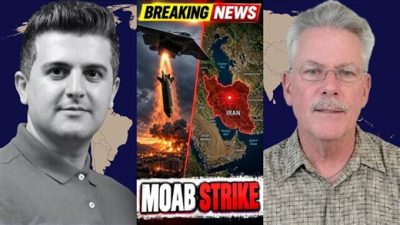
Matt Bracken: US Plans Massive MOAB Strike on Iran?
or go to
Aletho News Archives – Video-Images
From the Archives
Confronting the Threat of Ethnic Bioweapons
By Tony Cartalucci – New Eastern Outlook – 29.11.2017
The United States Air Force’s 59th Medical Wing’s molecular biology branch recently was revealed to have been collecting specifically Russian RNA and synovial (connective) tissue samples, prompting fears in Russia of a possible US directed ethnic-specific bioweapons program. … continue
Blog Roll
 Aletho News
- Matt Bracken: US Plans Massive MOAB Strike on Iran?
- Russia accuses France of ‘piracy’ over tanker seizure
- Why Yemen Is Bombing Saudi Arabia’s Airports: The War Behind the Headlines
- Sally Rooney’s books pulled from UK over support for Palestine Action
- Bombs for Tel Aviv, Promises for Riyadh
- Israeli ad agency conducted vast global espionage campaign using online ads: Report
- Oct. 7 Forever Marks The Big Reveal: ‘We See You, Israel, We Revile You, We Reject You!’
- Meet the US generals and admirals advancing Israeli policy
- Israel’s Straw Widow Protocol: The Kill Zones Where Civilians Were Labelled ‘Terrorists’
- Leading Israeli Think Tank Publishes Psychotic Israeli ‘National Security’ Doctrine
- If Americans Knew
- Israeli firm used online ads to run vast spy operation, researchers say
- No, the world zionist movement is not an antisemitic conspiracy theory
- Hundreds of IDF investigations into killings still have no public outcome, BBC Verify finds
- After Ashley Moody Epstein Probe, Donors Linked to Him Poured Money Into her Senate Campaign
- Worried about Russian meddling in UK politics? Wait till you see what Israel is up to
- Israeli settlers attack West Bank center for disabled children, church leader calls for int’l action
- Pulling Out Teeth Just to Live: How Israel Has Devastated Dental Care in Gaza
- Gaza’s “ceasefire” death toll passes 1,500 – Daily Update
- Activists Abused By Israel Return to New Freedom Flotilla Mission
- 60 Minutes won’t tell the full truth about Israeli settler violence
- No Tricks Zone
- New Study Suggests Large Regions Of The Pacific Ocean Have Been Cooling For The Last 80 Years
- Germany’s Green Energy Debacle: High Energy Costs Force Kahla Porzellan to Close After 182 Years!
- New Study: 50 Years Of The Most Aggressive ‘Net Zero’ Policies Can Only Affect The Global Climate By 0.03°C
- US September “Heat” Was No Record…Many Records Set Decades Ago
- Latest European Green Energy Debacle; Portugal’s Largest Flagship Solar Park Insolvent!
- Green Energy Debacle: German Expert Professor Fritz Vahrenholt Warns Of Severe Economic And Social Consequences
- Two More Paleo Reconstructions Affirm Meters-Higher Sea Levels Across Ireland, Brazil 7000-6000 Years Ago
- New Study: Earth And Venus Surface Warmth Largely Explained By Convection And Lapse Rate, Not CO2 Or Radiation
- 2025 Nature Paper Claiming Worsening Global Drought Gets RETRACTED …Heavily Flawed
- New Study: ‘Global Drought Shows No Detectable Recent Acceleration Under Climate Warming’

